arXiv:1109.6572v2 [hep-ex] 21 Mar 2012
Search for squarks and gluinos using final states with jets and missing transverse
momentum with the ATLAS detector in
√
s = 7 TeV proton-proton collisions
The ATLAS Collaboration
Abstract
CERN-PH-EP-2011-145, Submitted to Physics Letters B
A search for squarks and gluinos in events containing jets, missing transverse momentum and no electrons or muons is presented. The data were recorded in 2011 by the ATLAS experiment in √s = 7 TeV proton-proton collisions at the Large Hadron Collider. No excess above the Standard Model background expectation is observed in 1.04 fb−1of data. Gluino and squark masses below
700 GeV and 875 GeV respectively are excluded at the 95% confidence level in simplified models containing only squarks of the first two generations, a gluino octet and a massless neutralino. The exclusion limit increases to 1075 GeV for squarks and gluinos of equal mass. In MSUGRA/CMSSM models with tan β = 10, A0 = 0 and µ > 0, squarks and gluinos of equal mass are excluded for
masses below 950 GeV. These limits extend the region of supersymmetric parameter space excluded by previous measurements.
1. Introduction
Many extensions of the Standard Model (SM) include heavy coloured particles, some of which could be accessible at the Large Hadron Collider (LHC) [1]. The squarks and gluinos of supersymmetric (SUSY) theories [2] are one class of such par-ticles. This Letter presents a new ATLAS search for squarks and gluinos in final states containing only jets and large miss-ing transverse momentum. This final state can be generated by a large number of R-parity conserving models [3] in which squarks, ˜q, and gluinos, ˜g, can be produced in pairs {˜g˜g, ˜q ˜q, ˜q˜g} and can decay via ˜q → q ˜χ01and ˜g → q ¯q ˜χ
0
1to weakly interacting
neutralinos, ˜χ01, which escape the detector unseen. The analysis
presented here is based on a purely hadronic selection; events with reconstructed electrons or muons are vetoed to avoid over-lap with a related ATLAS search [4]. This updated analysis uses 1.04 fb−1of data recorded in 2011 and extends the sensi-tivity of the previous search described in Ref. [5] by including final state topologies with at least four jets, rather than three as before. The statistical analysis benefits from an improved tech-nique which uses a combined likelihood fit across all the control regions used to determine the background contributions, in or-der to take into account correlations among the measurements. The search strategy is optimised for maximum discovery reach in the (m˜g, mq˜)-plane for a set of simplified models in which
all other supersymmetric particles (except for the lightest neu-tralino) are assigned masses beyond the reach of the LHC. Cur-rently, the most stringent limits on squark and gluino masses are obtained at the LHC [4, 5, 6].
2. The ATLAS Detector and Data Samples
The ATLAS detector [7] is a multipurpose particle physics apparatus with a forward-backward symmetric cylindrical
ge-ometry and nearly 4π coverage in solid angle.1 The layout of the detector is dominated by four superconducting mag-net systems, which comprise a thin solenoid surrounding the inner tracking detectors and three large toroids supporting a large muon spectrometer. The calorimeters are of particu-lar importance to this analysis. In the pseudorapidity region
|η| < 3.2, high-granularity liquid-argon (LAr) electromagnetic
(EM) sampling calorimeters are used. A steel-scintillator tile calorimeter provides hadronic coverage over |η| < 1.7. The end-cap and forward regions, spanning 1.5 < |η| < 4.9, are instrumented with LAr calorimetry for both EM and hadronic measurements.
The data used in this analysis were collected in the first half of 2011 with the LHC operating at a centre-of-mass energy of 7 TeV. Application of beam, detector and data-quality re-quirements resulted in a total integrated luminosity of 1.04 ± 0.04 fb−1 [8]. The main trigger required events to contain a leading jet with a transverse momentum ( pT), above 75 GeV
and missing transverse momentum above 45 GeV. The trig-ger used an energy scale calibrated for electromagnetic objects. The details of the trigger specifications varied throughout the data-taking period, partly as a consequence of the rapidly in-creasing LHC luminosity. The efficiency of the trigger is > 98 % for events selected by the offline analysis. The average num-ber of proton-proton interactions per bunch crossing in the data sample was approximately six.
3. Object Reconstruction
The requirements used to select jets and leptons (objects) are chosen to give sensitivity to a range of SUSY models. Jet 1ATLAS uses a right-handed coordinate system with its origin at the nomi-nal interaction point in the centre of the detector and the z-axis along the beam pipe. Cylindrical coordinates (r, φ) are used in the transverse plane, φ being the azimuthal angle around the beam pipe. The pseudorapidity η is defined in terms of the polar angle θ as η = − ln tan(θ/2).
candidates are reconstructed using the anti-ktjet clustering al-gorithm [9, 10] with a distance parameter of 0.4. The inputs to this algorithm are three-dimensional clusters of calorime-ter cells [11] seeded by those with energy significantly above the measured noise. Jet momenta are constructed by perform-ing a four-vector sum over these cell clusters, treatperform-ing each as an (E, ~p) four-vector with zero mass. These jets are corrected for the effects of calorimeter non-compensation and inhomo-geneities by using pTand η-dependent calibration factors based
on Monte Carlo (MC) and validated with extensive test-beam and collision-data studies [12]. Furthermore, the reconstructed jet is modified such that the jet direction points to the primary vertex, defined as the vertex with the highest summed track p2
T,
instead of the geometrical centre of the ATLAS detector. Only jet candidates with corrected transverse momenta pT> 20 GeV
are subsequently retained. For 84% of the data used, a tempo-rary electronics failure in the LAr barrel calorimeter crea ted a dead region in the second and third longitudinal layers, approx-imately 1.4 × 0.2 in ∆η × ∆φ, in which on average 30% of the incident jet energy is lost. The impact on the reconstruction ef-ficiency for pT > 20 GeV jets is found to be negligible. If any
of the four leading jets fall into this region the event is rejected, causing a loss of signal acceptance which is smaller than 15% for the models considered here.
Electron candidates are required to have pT> 20 GeV, have |η| < 2.47, and pass the ‘medium’ shower shape and track
se-lection criteria of Ref. [13]. Muon candidates [13] are required to have pT > 10 GeV and |η| < 2.4. Since no use is made of
tau-lepton candidates in this analysis, in the following the term lepton will refer only to electrons and muons.
The measurement of the missing transverse momentum two-dimensional vector ~Pmiss
T (and its magnitude E miss
T ) is then
based on the transverse momenta of all electron and muon can-didates, all jets which are not also electron cancan-didates, and all calorimeter clusters with |η| < 4.5 not associated to such ob-jects.
Following the steps above, overlaps between candidate jets with |η| < 2.8 and leptons are resolved using the method of Ref. [14] as follows. First, any such jet candidate lying within a distance ∆R = p(∆η)2+ (∆φ)2 = 0.2 of an electron is
dis-carded: then any electron or muon candidate remaining within a distance ∆R = 0.4 of any surviving jet candidate is discarded. Next, all jet candidates with |η| > 2.8 are discarded. Thereafter, the electron, muon and jet candidates surviving this procedure are considered as “reconstructed”, and the term “candidate” is dropped.
4. Event Selection
Following the object reconstruction described above, events are discarded if they contain any electrons or muons with pT>
20 GeV, or any jets failing quality selection criteria designed to suppress detector noise and non-collision backgrounds (see e.g. Ref. [15]).
These selections include a veto on leading jets (with pT >
100 GeV and |η| < 2) which have a low fraction (< 0.05) of their
Signal Region ≥ 2-jet ≥ 3-jet ≥ 4-jet High mass Emiss T > 130 > 130 > 130 > 130 Leading jet pT > 130 > 130 > 130 > 130 Second jet pT > 40 > 40 > 40 > 80 Third jet pT – > 40 > 40 > 80 Fourth jet pT – – > 40 > 80
∆φ(jet, ~PTmiss)min > 0.4 > 0.4 > 0.4 > 0.4
Emiss
T /meff > 0.3 > 0.25 > 0.25 > 0.2
meff > 1000 > 1000 > 500/1000 > 1100 Table 1: Criteria for admission to each of the five overlapping signal regions (meff, EmissT and pTin GeV). All variables are defined in Section 4. The meffis defined with a variable number of jets, appropriate to each signal region. In the high mass selection, all jets with pT > 40 GeV are used to compute the meff value used in the final cut, but the Emiss
T definition is unchanged. The ∆φ cut is only applied up to the third leading jet.
pTcarried by charged tracks, and a requirement that the leading
jets all have consistent timing information from the calorime-ters. Events are also rejected if the reconstructed primary vertex is associated with fewer than five tracks.
In order to achieve maximal reach over the (m˜g, m˜q)-plane,
five signal regions are defined. Squarks typically generate at least one jet in their decays, for instance through ˜q → q ˜χ01, while gluinos typically generate at least two, for instance
through ˜g → q ¯q ˜χ01. Processes contributing to ˜q ˜q, ˜q ˜g and ˜g ˜g
fi-nal states therefore lead to events containing at least two, three or four jets, respectively. Cascade decays of heavy particles tend to increase the final state multiplicity. Four signal re-gions characterized by increasing jet multiplicity requirements are therefore defined as shown in Table 1, with the leading jet having pT > 130 GeV, and other jets pT > 40 GeV. The
ef-fective mass, meff, is calculated as the sum of ETmiss and the
magnitudes of the transverse momenta of the two, three or four highest pT jets used to define the signal region. Two four-jet
signal regions are defined requiring meff > 500 GeV
(opti-mised for small mass differences between SUSY mass states) and meff > 1000 GeV (optimised for higher mass differences).
In addition, a fifth ‘high mass’ signal region is derived from the four-jet sample, with more stringent requirements on the pTof
the non-leading jets (> 80 GeV) and on meff (> 1100 GeV),
in order to give maximal reach in the SUSY mass spectrum. For this latter signal region the transverse momenta of all jets with pT > 40 GeV are used to compute meff. In Table 1, ∆φ(jet, ~Pmiss
T )minis the smallest of the azimuthal separations
be-tween ~PTmissand jets with pT > 40 GeV (all reconstructed jets
up to a maximum of three, in descending order of pT).
Re-quirements on ∆φ(jet, ~PTmiss)min and EmissT /meff are designed to
reduce the background from multi-jet processes.
5. Backgrounds, Simulation and Normalisation
Standard Model background processes contribute to the event counts in the signal regions. The dominant sources are:
W+jets, Z+jets, top pair, single top, and multi-jet produc-tion. Non-collision backgrounds have been found to be neg-ligible. The majority of the W+jets background is composed of W → τν events, or W → eν, µν events in which no electron or muon candidate is reconstructed. The largest part of the Z+jets background comes from the irreducible component in which Z → ν¯ν decays generate large Emiss
T . Hadronic τ decays in
t¯t → b¯bτνqq and single top events can also generate large Emiss T
and pass the jet and lepton requirements at a non-negligible rate. The multi-jet background in the signal regions is caused by misreconstruction of jet energies in the calorimeters leading to apparent missing transverse momentum, as well as by neu-trino production in semileptonic decays of heavy quarks. Ex-tensive validation of the MC simulation against data has been performed for each of these background sources and for a wide variety of control regions.
In order to estimate the backgrounds in a consistent fashion, five control regions (CRs) are defined for each of the five sig-nal regions (SRs), giving 25 CRs in total. The orthogosig-nal CR event selections are designed to provide uncorrelated data sam-ples enriched in particular background sources. Each ensemble of one SR and five CRs constitutes a different ‘channel’ of the analysis. The CR selections are optimised to maintain adequate statistical weight, while minimising as far as possible the sys-tematic uncertainties arising from extrapolation to the SR. The purities of the CRs for the main background processes in which they are enriched exceed 50% in all cases.
For each channel, measurements in the CRs are used to de-rive background expectations in the SR through the use of ‘transfer factors’ equivalent to the ratios of expected event counts in the CRs and SR, derived independently of the data ob-servations in the CR and SR. Some uncertainties, such as those arising in MC simulation from the jet energy scale and physics modelling, are reduced in the transfer factors. The combined likelihood fit across all control regions ensures that the back-ground estimates are consistent for all processes, taking into account contamination of the CRs by multiple SM processes.
The likelihood function is built by the Poisson probability density function (pdf) describing the SR and the CRs and a pdf describing the systematic uncertainties:
L(n|µ, b, θ) = PSR× PWR× PTR× PZRa× PZRb× PQR× CSyst.
The mean of the Poisson pdfs in the CRs are defined as
λi(µ, b, θ) = µ · CSR→iR(θ) +X j
CjR→iR(θ) · bjR
where the index j runs over the background control regions. µ is the signal strength, bjRis the background j in Region R and CjR−>S Rthe transfer factor of process j from region R to the SR. The terms CQR→QR, CWR→WR,CZRa,b→ZRa,b, CTR→TRare by con-struction all equal to 1. Since the fit is not over-constrained in CR2, CR3 and CR4, where there is a single estimate of the background, the fit output matches the observed number of events in these regions by construction. This is not the case in CR1a and CR1b which both estimate the same background process, and a best fit number is produced in these regions.
The transfer factors are obtained from a combination of data and MC inputs. Those for multi-jet processes are estimated us-ing a data-driven technique based upon the smearus-ing of jets in a low ETmissdata sample (‘seed’ events with ETmiss/pΣpT(jet) < 0.6 GeV1/2) with jet response functions tuned by comparison
with multi-jet dominated data control regions [5]. For the Z+jets, W+jets and top quark processes they are derived from MC. For each channel a likelihood fit is performed to the ob-served event counts in the five CRs, taking into account corre-lations in the systematic uncertainties in the transfer factors.
The irreducible background from Z(ν¯ν)+jets events is es-timated using control regions enriched in related processes with similar kinematics: events with isolated photons and jets [16] and events due to Z(ee/µµ)+jets (control regions denoted ‘CR1a’ and ‘CR1b’ respectively). The reconstructed momen-tum of the photon or the lepton-pair system is added to ~Pmiss
T to
obtain an estimate of the Emiss
T observed in Z(ν¯ν)+jets events.
The results from both control regions are found to be in good agreement, and both are used in the final fit. The small ad-ditional background contributions arising from Z decays to misidentified charged leptons, and misidentified photon events, are estimated using the same control regions with appropriate transfer factors.
The background from multi-jet processes is determined using control regions (CR2) in which the cut on ∆φ(jet, ~PTmiss)min is
reversed and tightened: ∆φ(jet, ~Pmiss
T )min < 0.2. This selects
events in which ~PTmiss is aligned with one of the three leading jets in the transverse plane. Such a topology is characteristic of events containing mismeasured jets, or neutrino emission from heavy flavour decays within jets. A separate control region is used to estimate the additional multi-jet background generated by events affected by the temporarily dead region in the barrel EM calorimeter; this result is added to the multi-jet background estimate obtained from CR2.
The background from W(ℓν)+jets production is estimated from samples of events with a lepton (ℓ), ETmiss > 130 GeV
and a transverse mass of the (ℓ, EmissT ) system between 30 GeV and 100 GeV, i.e. consistent with the W mass (control regions CR3). A veto against jets arising from b-quark decays, based on a tagging procedure exploiting both impact parameter and secondary vertex information, is applied to remove events con-taining top quarks. In this CR, leptons are treated as jets for the computation of the kinematic variables.
The background from top quark production is estimated us-ing the same selection as for W(ℓν)+jets events, but replacus-ing the b-jet veto with a b-tag requirement (control regions CR4). This enhances the population of events containing top quark de-cays relative to that of direct W production events. The result-ing transfer factors include the contribution from events where both top quarks decay semi-leptonically, as well as events due to single top production.
MC simulation samples are used to develop the analysis, determine the transfer factors used to estimate the W+jets, Z+jets and top quark backgrounds, and assess the sensitivity to specific SUSY signal models. Samples of multi-jet events from quantum-chromodynamic (QCD) processes are generated
with PYTHIA [17], using the MRST2007LO* modified leading-order parton distribution functions (PDFs) [18]. Production of top quark pairs is simulated with MC@NLO [19, 20] (with a top quark mass of 172.5 GeV) and the Next-to-Leading Or-der (NLO) PDF set CTEQ6.6 [21]. Single top production is also simulated with MC@NLO [22, 23]. Samples of W and Z/γ∗
events with accompanying jets are generated with ALPGEN [24] and PDF set CTEQ6L1 [25]. Fragmentation and hadroniza-tion for the ALPGEN and MC@NLO samples is performed with
HERWIG [26, 27], using JIMMY [28] for the underlying event. SUSY signal samples are generated with HERWIG++ [29], nor-malised using NLO cross sections determined with PROSPINO [30]. The MC samples are produced using ATLAS parame-ter tunes [31] and are processed through a GEANT4 [32] based detector simulation [33]. Corrections are applied for small dif-ferences in reconstruction efficiencies, energy scales and res-olutions between data and MC. Varying pile-up conditions as a function of the instantaneous luminosity are taken into ac-count by reweighting the simulated events according to the mean number of interactions per bunch crossing observed in the data. Multi-jet MC samples, presented here in some figures for illustrative purposes only, are normalised to a sample of di-jet events with ∆φ(di-jet, ~Pmiss
T )min < 0.4. In all other cases the
best available NLO or Next-to-NLO theoretical cross-section calculations were used.
6. Systematic Uncertainties
Systematic uncertainties arise from the use of the transfer factors relating observations in the control regions to back-ground expectations in the signal regions, and from the mod-elling of the SUSY signal. For the transfer factors derived from MC, the primary common sources of systematic uncertainty are the jet energy scale and resolution, physics modelling and re-construction performance in the presence of pile-up.
The jet energy scale uncertainty has been measured from the complete 2010 data set using the procedure described in Ref. [12]. It depends upon pT, η and proximity to adjacent jets,
and on average amounts to around 4%. The jet energy resolu-tion measured with 2010 data [34] is applied to the MC jets, with the difference between the re-calibrated and nominal MC resolution taken as the systematic uncertainty. Additional con-tributions are added to both of these uncertainties to take into account of the impact of pile-up at the relatively high luminosity delivered by the LHC in the 2011 run. Both in-time pile-up, i.e. multiple collisions within the same bunch crossing, and out-of-time pile-up, which arises from the detector response to neigh-bouring bunch crossings, have effects on jet energy measure-ments. These were studied in detail as a function of the average number of collisions per bunch crossing and by comparing data recorded with 75 and 50 ns bunch spacing. A worsening in the jet energy resolution in the forward region is observed when moving from 75 to 50 ns operation; a systematic uncertainty of 0.07 × pT is therefore applied to jets with |η| > 2.8, used
for the Emiss
T calculation. The combined effects of in-time and
out-of-time pile-up on the jet energy scale are accounted for by an additional conservative systematic uncertainty of up to 7%
depending on |η| and pT. All these uncertainties are propagated
to the ETmiss measurement. The impact of in-time pile-up on other aspects of the selection was also investigated and found to be negligible as expected given the high energies of the jets entering the signal samples.
The dominant modelling uncertainty in MC predictions for the signal region and control regions arises from the treatment of jet radiation,which affects the calculation of meff. In order
to assess this uncertainty, the main backgrounds are estimated using alternative generators (ALPGEN rather than MC@NLO for t¯t production) or reduced jet multiplicity (ALPGEN processes with 0–4 partons instead of 0–5 partons for W/Z+jets production). The impact of renormalisation and factorisation scale variations and PDF uncertainties was also studied. Differences in the ab-solute expectations for the numbers of events in the SR and CR as high as 100% are observed for specific processes; the im-pact on the ratios used in the transfer factors is, however, much smaller (differences ∼<40%, channel dependent).
Additional uncertainties considered, for specific processes, include those arising from photon and lepton trigger efficiency, reconstruction efficiency, energy scale and resolution (CR1a, CR1b, CR3 and CR4), b-tag/veto efficiency (CR3 and CR4), photon acceptance and backgrounds (CR1a) and the limited size of MC samples (all CRs). Uncertainties on the multi-jet transfer factors are dominated by the modelling of the non-Gaussian tails of the response function. Other sources, includ-ing the limited number of data events, and uncertainties on the Gaussian part of the response functions, are also considered.
Systematic uncertainties on the expected SUSY signal are es-timated by varying the factorisation and renormalisation scales in PROSPINO between half and twice their default values and by considering the PDF uncertainties provided by CTEQ6. Uncer-tainties are calculated for individual production processes ( ˜q ˜q, ˜g ˜g, and ˜q ˜g) and are typically ∼35% in the vicinity of the limits expected to be set by this analysis. Jet energy scale and resolu-tion, and pile-up uncertainties on SUSY signal expectations are typically smaller than 30–40%.
7. Results, Interpretation and Limits
The observed signal region meff distributions for each of the
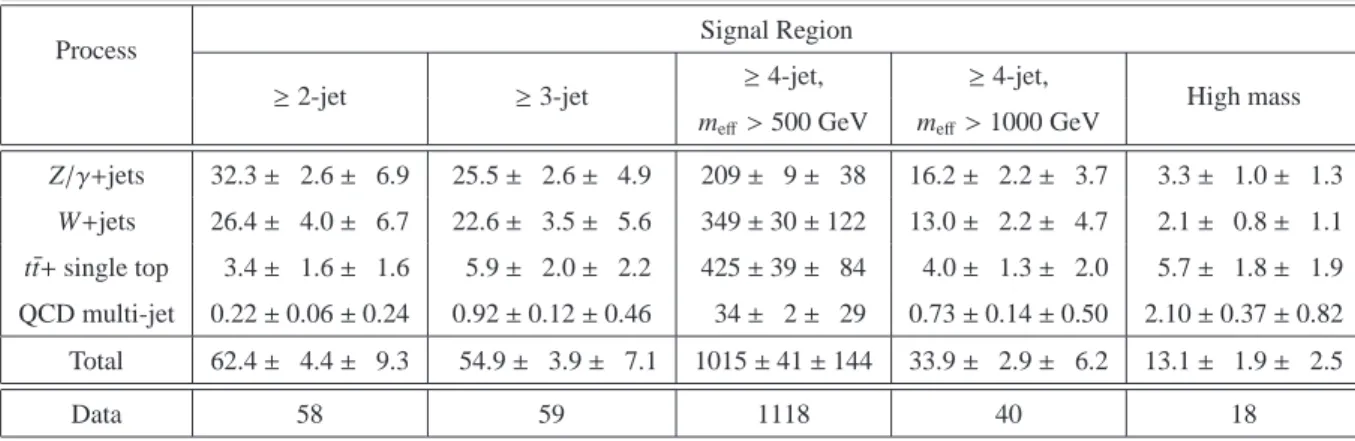
channels used in this analysis are shown in Figure 1, together with MC background expectations prior to using the likelihood fitting procedure. The number of observed data events and the number of SM events expected to enter each of the signal re-gions, determined using the likelihood fit, are shown in Table 2. The data are found to be in good agreement with the back-ground expectation and no excess is observed. To illustrate the procedure, the inputs and outputs of the combined likelihood fit for the high mass channel are shown in Table 3.
Data from the five channels are used to set the limits, taking the channel with the best expected limit at each point in param-eter space. The limit for each channel is obtained by comparing the observed numbers of signal events with those expected from SM background plus SUSY signal processes, taking into ac-count uncertainties in the expectation including those which are
Process Signal Region
≥ 2-jet ≥ 3-jet ≥ 4-jet, ≥ 4-jet, High mass
meff> 500 GeV meff> 1000 GeV
Z/γ+jets 32.3 ± 2.6 ± 6.9 25.5 ± 2.6 ± 4.9 209 ± 9 ± 38 16.2 ± 2.2 ± 3.7 3.3 ± 1.0 ± 1.3 W+jets 26.4 ± 4.0 ± 6.7 22.6 ± 3.5 ± 5.6 349 ± 30 ± 122 13.0 ± 2.2 ± 4.7 2.1 ± 0.8 ± 1.1 t¯t+ single top 3.4 ± 1.6 ± 1.6 5.9 ± 2.0 ± 2.2 425 ± 39 ± 84 4.0 ± 1.3 ± 2.0 5.7 ± 1.8 ± 1.9 QCD multi-jet 0.22 ± 0.06 ± 0.24 0.92 ± 0.12 ± 0.46 34 ± 2 ± 29 0.73 ± 0.14 ± 0.50 2.10 ± 0.37 ± 0.82 Total 62.4 ± 4.4 ± 9.3 54.9 ± 3.9 ± 7.1 1015 ± 41 ± 144 33.9 ± 2.9 ± 6.2 13.1 ± 1.9 ± 2.5 Data 58 59 1118 40 18
Table 2: Fitted background components in each SR, compared with the number of events observed in data. The Z/γ+jets background is constrained with control regions CR1a and CR1b, the QCD multi-jet, W and top quark backgrounds by control regions CR2, CR3 and CR4, respectively. In each case the first (second) quoted uncertainty is statistical (systematic). Background components are partially correlated and hence the uncertainties (statistical and systematic) on the total background estimates do not equal the quadrature sums of the uncertainties on the components.
Signal / Control Region
CR1a CR1b CR2 CR3 CR4 SR
Data 8 7 34 15 12 18
Targeted background Z/γ+jets Z/γ+jets QCD multi-jet W+jets t¯t + single top –
Transfer factor 0.374 0.812 0.063 0.196 0.372 –
Fitted Z/γ+jets 8.3 5.8 0.7 0.5 0.0 3.3
Fitted QCD multi-jet – – 29.8 0.8 0.6 2.1
Fitted W+jets – – 0.5 10.0 0.4 2.1
Fitted t¯t + single top – 0.0 3.0 3.7 11.0 5.7
Fitted total background 8.3 5.9 34.0 15.0 12.0 13.1
Statistical uncertainty ±2.7 ±1.2 ±5.8 ±3.9 ±3.5 ±1.9
Systematic uncertainty ±0.6 ±1.7 ±0.1 ±0.1 ±0.2 ±2.5
Table 3: Numerical inputs (i.e. the observed numbers of events in data) to and outputs from the likelihood fit to the control regions for the high mass channel. Each background process listed in the second row is measured using a control region, and the corresponding transfer factor is listed in the third row. An entry ‘–’ in rows 5–7 indicates that the process in that row is assumed not to contribute to the control region (based on Monte Carlo studies) and hence is excluded from the fit. All numerical entries give event counts, with the exception of the transfer factors.
Entries / 100 GeV 1 10 2 10 3 10 4 10 5 10 6 10 Data 2011 (s = 7 TeV) SM Total QCD multijet W+jets Z+jets
and single top t t SM + SU(660,240,0,10) -1 L dt = 1.04 fb
∫
Dijet Channel ATLAS [GeV] eff m 0 500 1000 1500 2000 2500 3000 D A T A / M C 0 0.5 1 1.5 2 2.5 Entries / 100 GeV 1 10 2 10 3 10 4 10 5 10 = 7 TeV) s Data 2011 ( SM Total QCD multijet W+jets Z+jetsand single top t t SM + SU(660,240,0,10) -1 L dt = 1.04 fb
∫
Three Jet Channel
ATLAS [GeV] eff m 0 500 1000 1500 2000 2500 3000 D A T A / M C 0 0.5 1 1.5 2 2.5 Entries / 100 GeV 1 10 2 10 3 10 4 10 5 10 Data 2011 (s = 7 TeV) SM Total QCD multijet W+jets Z+jets
and single top t t SM + SU(660,240,0,10) -1 L dt = 1.04 fb
∫
Four Jet Channel
ATLAS [GeV] eff m 0 500 1000 1500 2000 2500 3000 D A T A / M C 0 0.5 1 1.5 2 2.5 Entries / 150 GeV -1 10 1 10 2 10 3 10 4 10 5 10 Data 2011 (s = 7 TeV) SM Total QCD multijet W+jets Z+jets
and single top t t SM + SU(660,240,0,10) -1 L dt = 1.04 fb
∫
Four Jet High Mass Channel ATLAS [GeV] eff m 0 500 1000 1500 2000 2500 3000 D A T A / M C 0 0.5 1 1.5 2 2.5
Figure 1: The observed meffdistributions in the signal regions for the ≥ 2 jet channel (top left), the ≥ 3 jet channel (top right) and the two ≥ 4 jet channels (bottom left), and for the high mass channel using the inclusive definition of meff(bottom right), after all the selection criteria but the meffcut. These plots also show the expected SM contributions obtained from MC simulated samples prior to normalisation using the data-driven likelihood method described in the text. The red arrows indicate the lower bounds on meffused in the final signal region selections. The expectation for a MSUGRA/CMSSM reference point with m0= 660 GeV,
m1/2 = 240 GeV, A0 = 0, tan β = 10 and µ > 0 is also shown. This reference point is also indicated by the star on Figure 2. Below each plot the ratio of the data to the SM expectation is provided. Black vertical bars show the statistical uncertainty from the data, while the yellow band shows the size of the systematic uncertainties from the MC simulation.
correlated between signal and background (for instance jet en-ergy scale uncertainties). The impact of SUSY signal contam-ination of the control regions is taken into account by applying MC-derived model dependent correction factors ∼ 0.97–1.02 to the resulting exclusion significance values. The excluded re-gions are obtained using the CLsprescription [41].
An interpretation of the results is presented in Figure 2 (left) as a 95% confidence exclusion region in the (m˜g, mq)-plane for˜
a simplified set of SUSY models with m( ˜χ01) = 0. In these
models the gluino mass and the masses of the squarks of the first two generations are set to the values shown in the fig-ure. All other supersymmetric particles, including the squarks of the third generation, are decoupled by being given masses of 5 TeV. The limits are reduced by decay chain kinematics if m( ˜χ01) is comparable to the squark or gluino mass. ISASUSY
from ISAJET [42] v7.80 is used to calculate the decay tables, and to guarantee consistent electroweak symmetry breaking.
The results are also interpreted in the tan β = 10, A0 = 0, µ > 0 slice of MSUGRA/CMSSM2 [43] in Figure 2 (right).
These limits include the effects of the mass spectrum of the SUSY particles on their decay chains. In regions of parameter space with small mass splittings between states, the modelling of initial state radiation can affect the signal significance. This modelling is taken from HERWIG without modification.
In the limit of light neutralinos, with the assumption that the coloured sparticles are directly produced and decay directly to jets and ˜χ01, the limits on the gluino and squark masses are
ap-proximately 700 GeV and 875 GeV respectively for squark or gluino masses below 2 TeV, rising to 1075 GeV if the squarks and gluinos are assumed to be mass-degenerate. These limits remain essentially unchanged if the ˜χ01 mass is raised as high
as 200 GeV. In the case of a specific SUSY-breaking scenario, i.e. CMSSM/MSUGRA with tan β = 10, A0 = 0, µ > 0, the
limit on m1/2reaches 460 GeV for low values of m0, and equal
mass squarks and gluinos are excluded below 950 GeV. The use of signal selections sensitive to larger jet multiplicities than in [5] has improved the ATLAS reach at large m0. The five
sig-nal regions are used to set limits on σnew =σAǫ, for non-SM
cross-sections (σ) for which ATLAS has an acceptance A and a detection efficiency of ǫ [44]. The excluded values of σneware 22 fb, 25 fb, 429 fb, 27 fb and 17 fb, respectively, at the 95% confidence level.
8. Summary
This Letter reports a search for new physics in final states containing high-pTjets, missing transverse momentum and no
electrons or muons with pT > 20 GeV. Data recorded by the
ATLAS experiment a the LHC, corresponding to an integrated luminosity of 1.04 fb−1 have been used. Good agreement is
2Five parameters are needed to specify a particular MSUGRA/CMSSM model. They are the universal scalar mass, m0, the universal gaugino mass
m1/2, the universal trilinear scalar coupling, A0, the ratio of the vacuum expec-tation values of the two Higgs fields, tan β, and the sign of the higgsino mass parameter, µ > 0 or < 0.
seen between the numbers of events observed in the five signal regions and the numbers of events expected from SM sources. The exclusion limits placed on non-SM cross sections impose new constraints on scenarios with novel physics.
The results are interpreted in both a simplified model con-taining only squarks of the first two generations, a gluino octet and a massless neutralino, as well as in MSUGRA/CMSSM models with tan β = 10, A0 = 0 and µ > 0. In the
sim-plified model, gluino and squark masses below 700 GeV and 875 GeV respectively are excluded at the 95% confidence level for squark or gluino masses below 2 TeV, with the limit increas-ing to 1075 GeV for equal mass squarks and gluinos. In the MSUGRA/CMSSM models, equal mass squarks and gluinos are excluded below 950 GeV.
9. Acknowledgements
We wish to thank CERN for the efficient commissioning and operation of the LHC during this data-taking period as well as the support staff from our institutions without whom ATLAS could not be operated efficiently.
We acknowledge the support of ANPCyT, Argentina; Yer-PhI, Armenia; ARC, Australia; BMWF, Austria; ANAS, Azer-baijan; SSTC, Belarus; CNPq and FAPESP, Brazil; NSERC, NRC and CFI, Canada; CERN; CONICYT, Chile; CAS, MOST and NSFC, China; COLCIENCIAS, Colombia; MSMT CR, MPO CR and VSC CR, Czech Republic; DNRF, DNSRC and Lundbeck Foundation, Denmark; ARTEMIS, European Union; IN2P3-CNRS, CEA-DSM/IRFU, France; GNAS, Geor-gia; BMBF, DFG, HGF, MPG and AvH Foundation, Germany; GSRT, Greece; ISF, MINERVA, GIF, DIP and Benoziyo Cen-ter, Israel; INFN, Italy; MEXT and JSPS, Japan; CNRST, Mo-rocco; FOM and NWO, Netherlands; RCN, Norway; MNiSW, Poland; GRICES and FCT, Portugal; MERYS (MECTS), Ro-mania; MES of Russia and ROSATOM, Russian Federation; JINR; MSTD, Serbia; MSSR, Slovakia; ARRS and MVZT, Slovenia; DST/NRF, South Africa; MICINN, Spain; SRC and Wallenberg Foundation, Sweden; SER, SNSF and Cantons of Bern and Geneva, Switzerland; NSC, Taiwan; TAEK, Turkey; STFC, the Royal Society and Leverhulme Trust, United King-dom; DOE and NSF, United States of America.
The crucial computing support from all WLCG partners is acknowledged gratefully, in particular from CERN and the ATLAS Tier-1 facilities at TRIUMF (Canada), NDGF (Den-mark, Norway, Sweden), CC-IN2P3 (France), KIT/GridKA (Germany), INFN-CNAF (Italy), NL-T1 (Netherlands), PIC (Spain), ASGC (Taiwan), RAL (UK) and BNL (USA) and in the Tier-2 facilities worldwide.
References
[1] L.R. Evans (ed.) and P. Bryant (ed.), LHC Machine, JINST 3 (2008) S08001.
[2] Yu.A. Golfand and E.P. Likhtman, Extension of the algebra of Poincar´e
group generators and violation of P invariance,
gluino mass [GeV]
0 250 500 750 1000 1250 1500 1750 2000
squark mass [GeV]
0 250 500 750 1000 1250 1500 1750 2000 q ~ LEP2 T e v a tr o n , R u n I C D F , R u n I I D0, Run II = 10 pb SUSY σ = 1 pb SUSY σ = 0.1 pb SUSY σ = 0.01 pb SUSY σ ) = 0 GeV 1 0 χ∼ Squark-gluino-neutralino model, m( =7 TeV s , -1 L dt = 1.04 fb ∫ 0 lepton 2011 combined ATLAS observed 95% C.L. limit s CL
median expected limit s CL σ 1 ± Expected limit 2010 data PCL 95% C.L. limit [GeV] 0 m 500 1000 1500 2000 2500 3000 3500 [GeV] 1/2 m 200 300 400 500 600 (600) g ~ (800) g ~ (1000) g ~ (1200) g ~ (600) q~ (1000) q~ (1400) q ~ >0 µ = 0, 0 = 10, A β MSUGRA/CMSSM: tan =7 TeV s , -1 L dt = 1.04 fb ∫ 0 lepton 2011 combined
ATLAS 0 lepton 2011 combined
1 ± χ∼ LEP2 -1 <0, 2.1 fb µ =3, β , tan q ~ , g ~ D0 -1 <0, 2 fb µ =5, β , tan q ~ , g ~ CDF Theoretically excluded observed 95% C.L. limit s CL
median expected limit s CL σ 1 ± Expected limit Reference point 2010 data PCL 95% C.L. limit
Figure 2: Combined exclusion limits for simplified SUSY models with m( ˜χ01) = 0 (left) and MSUGRA/CMSSM models with tan β = 10, A0= 0 and µ > 0 (right). The combined limits are obtained by using the signal region which generates the best expected limit at each point in the parameter plane. The dashed-blue line corresponds to the median expected 95% C.L. limit and the red line corresponds to the observed limit at 95% C.L. The dotted blue lines correspond to the ±1σ variation in the expected limits. Also shown for comparison purposes in the figures are limits from the Tevatron [35, 36, 37, 38] and LEP [39, 40] , although it should be noted that some of these limits were generated with different models or parameter choices (see legends). The previous published ATLAS limits from this analysis [5] are also shown. The MSUGRA/CMSSM reference point used in Figure 1 is indicated by the star in the right-hand figure.
A. Neveu and J.H. Schwartz, Factorizable dual model of pions, Nucl. Phys. B31 (1971) 86-112.
A. Neveu and J.H. Schwartz, Quark model of dual pions, Phys. Rev. D4 (1971) 1109-1111.
P. Ramond, Dual theory for free fermions, Phys. Rev. D3 (1971) 2415-2418.
D.V. Volkov and V.P. Akulov, Diffractive dissociation of composite
particles, Phys. Lett. B46 (1973) 109-130.
J. Wess and B. Zumino, Light cone approach to positivity bounds on
structure functions for deep inelastic lepton scattering in Weinberg’s theory, Phys. Lett. B49 (1974) 52-60.
J. Wess and B. Zumino, Supergauge transformations in four dimensions, Nucl. Phys. B70 (1974) 39-50.
[3] P. Fayet, Spontaneously broken supersymmetric theories of weak,
electromagnetic and strong interactions, Phys. Lett. B69 (1977) 489.
G. R. Farrar and P. Fayet, Phenomenology of the production, decay, and
detection of new hadronic states associated with supersymmetry,
Phys. Lett. B76 (1978) 575.
[4] ATLAS Collaboration, Search for supersymmetry using final states with
one lepton, jets, and missing transverse momentum with the ATLAS detector in√s = 7 TeV pp collisions,
Phys. Rev. Lett. 102 (2011) 131802,arXiv:1102.2357 [hep-ex]. [5] ATLAS Collaboration, Search for squarks and gluinos using final states
with jets and missing transverse momentum with the ATLAS detector in
√
s = 7 TeV proton-proton collisions, Phys. Lett. B 701 (2011) 186,
arXiv:1102.5290 [hep-ex].
[6] CMS Collaboration, Search for Supersymmetry in pp Collisions at 7 TeV
in Events with Jets and Missing Transverse Energy,
Phys. Lett. B698 (2011) 196–218,arXiv:1101.1628 [hep-ex]. CMS Collaboration, Search for New Physics with Jets and Missing
Transverse Momentum in pp collisions at√s = 7 TeV ,
arXiv:1106.4503 [hep-ex].
CMS Collaboration, Inclusive search for squarks and gluinos in pp
collisions at√s = 7 TeV ,arXiv:1107.1279 [hep-ex]. CMS Collaboration, Search for Supersymmetry at the LHC in Events
with Jets and Missing Transverse Energy, ,
arXiv:1109.2352 [hep-ex].
[7] ATLAS Collaboration, The ATLAS Experiment at the CERN Large
Hadron Collider, JINST 3 (2008) S08003.
[8] ATLAS Collaboration, Luminosity Determination in pp Collisions at√s
=7 TeV using the ATLAS Detector in 2011, ATL-CONF-2011-116.
[9] M. Cacciari, G. P. Salam, and G. Soyez, The anti-ktjet clustering
algorithm, JHEP 04 (2008) 063,arXiv:0802.1189 [hep-ph]. [10] M. Cacciari and G. P. Salam, Dispelling the N3myth for the k
tjet-finder, Phys. Lett. B641 (2006) 57–61,arXiv:hep-ph/0512210.
[11] W. Lampl, et. al., Calorimeter Clustering Algorithms : Description and
Performance, ATL-LARG-PUB-2008-002.
[12] ATLAS Collaboration, Jet energy scale and its systematic uncertainty in
proton-proton collisions at√s = 7 TeV in ATLAS 2010 data,
ATLAS-CONF-2011-032.
[13] ATLAS Collaboration, Measurement of the W → ℓν and Z/γ∗→ ℓℓ
production cross sections in proton-proton collisions at √s = 7 TeV with the ATLAS detector, JHEP 12 (2010) 060,
arXiv:1010.2130 [hep-ex].
[14] ATLAS Collaboration, Expected Performance of the ATLAS Experiment
- Detector, Trigger and Physics, CERN-OPEN-2008-020.
arXiv:0901.0512 [hep-ex].
[15] ATLAS Collaboration, Jet energy measurement with the ATLAS detector
in proton-proton collisions at sqrt(s) = 7 TeV,
arXiv:1112.6426 [hep-ex], submitted to European Physical Journal C.
[16] S. Ask et al., Using gamma+jets Production to Calibrate the Standard
Model Z(nunu)+jets Background to New Physics Processes at the LHC,
arXiv:1107.2803v1 [hep-ph], submitted to the JHEP. [17] T. Sjostrand, S. Mrenna, and P. Z. Skands, PYTHIA 6.4 Physics and
Manual, JHEP 0605 (2006) 026,arXiv:hep-ph/0603175.
[18] A. Sherstnev and R. S. Thorne, Parton Distributions for LO Generators, Eur. Phys. J. C55 (2008) 553–575,arXiv:0711.2473 [hep-ph]. [19] S. Frixione and B. R. Webber, Matching NLO QCD computations and
parton shower simulations, JHEP 06 (2002) 029,
arXiv:hep-ph/0204244.
[20] S. Frixione, P. Nason, and B. R. Webber, Matching NLO QCD and
parton showers in heavy flavour production, JHEP 08 (2003) 007,
[21] P. M. Nadolsky et al., Implications of CTEQ global analysis for collider
observables, Phys. Rev. D78 (2008) 013004.
[22] S. Frixione, E. Laenen, P. Motylinski, and B. R. Webber, Single-top
production in MC@NLO, JHEP 03 (2006) 092,
arXiv:hep-ph/0512250.
[23] S. Frixione, E. Laenen, P. Motylinski, B. R. Webber, and C. D. White,
Single-top hadroproduction in association with a W boson,
JHEP 07 (2008) 029,arXiv:0805.3067 [hep-ph].
[24] M. L. Mangano, M. Moretti, F. Piccinini, R. Pittau, and A. D. Polosa,
ALPGEN, a generator for hard multiparton processes in hadronic collisions, JHEP 07 (2003) 001,arXiv:hep-ph/0206293.
[25] J. Pumplin, D. R. Stump, J. Huston, H. L. Lai, P. M. Nadolsky, and W. K. Tung, New generation of parton distributions with uncertainties from
global QCD analysis, JHEP 07 (2002) 012,arXiv:hep-ph/0201195. [26] G. Corcella et al., HERWIG 6.5: an event generator for Hadron
Emission Reactions With Interfering Gluons (including supersymmetric processes), JHEP 01 (2001) 010,arXiv:hep-ph/0011363.
[27] G. Corcella et al., HERWIG 6.5 release note.arXiv:hep-ph/0210213. [28] J. M. Butterworth, J. R. Forshaw, and M. H. Seymour, Multiparton
interactions in photoproduction at HERA, Z. Phys. C72 (1996) 637–646,
arXiv:hep-ph/9601371.
[29] M. Bahr et al., Herwig++ Physics and Manual,
Eur. Phys. J. C58 (2008) 639–707,arXiv:0803.0883 [hep-ph]. [30] W. Beenakker, R. Hopker, M. Spira, and P. M. Zerwas, Squark and
gluino production at hadron colliders, Nucl. Phys. B492 (1997) 51–103,
arXiv:hep-ph/9610490.
[31] ATLAS Collaboration, First tuning of HERWIG/JIMMY to ATLAS data, ATL-PHYS-PUB-2010-014.
ATLAS Collaboration, Charged particle multiplicities in pp interactions
at√s = 0.9 and 7 TeV in a diffractive limited phase-space measured with the ATLAS detector at the LHC and new PYTHIA6 tune,
ATLAS-CONF-2010-031.
[32] GEANT4 Collaboration, S. Agostinelli et al., GEANT4: A simulation
toolkit, Nucl. Instrum. Meth. A506 (2003) 250–303.
[33] ATLAS Collaboration, The ATLAS Simulation Infrastructure, Eur. Phys. J. C70 (2010) 823–874,
arXiv:1005.4568 [physics.ins-det].
[34] ATLAS Collaboration, Jet energy resolution and selection efficiency
relative to track jets from in-situ techniques with the ATLAS Detector Using Proton-Proton Collisions at a Center of Mass Energy√s = 7 TeV,
ATLAS-CONF-2010-054.
[35] D0 Collaboration, Search for squarks and gluinos in p ¯p collisions at √s = 1.8 TeV, Phys. Rev. Lett. 75 (1995) 618–623.
[36] CDF Collaboration, Search for gluinos and scalar quarks in p ¯p collisions at√s = 1.8 TeV using the missing energy plus multijets signature, Phys. Rev. Lett. 88 (2002) 041801,
arXiv:hep-ex/0106001.
[37] CDF Collaboration, Inclusive Search for Squark and Gluino Production
in p ¯p Collisions at√s = 1.96 TeV, Phys. Rev. Lett. 102 (2009) 121801,
arXiv:0811.2512 [hep-ex].
[38] D0 Collaboration, Search for squarks and gluinos in events with jets and
missing transverse energy using 2.1 f b−1of p ¯p collision data at√s = 1.96 TeV, Phys. Lett. B660 (2008) 449–457,
arXiv:0712.3805 [hep-ex].
[39] DELPHI Collaboration, Searches for supersymmetric particles in e+
e-collisions up to 208-GeV and interpretation of the results within the MSSM, Eur. Phys. J. C31 (2003) 421,arXiv:hep-ex/0311019. [40] L3 Collaboration, Search for scalar leptons and scalar quarks at LEP,
Phys. Lett. B580 (2004) 37-49.arXiv:hep-ex/0310007. [41] A. Read, Presentation of search results: the CLs technique,
Journal of Physics G: Nucl. Part. Phys. 28 (2002) 2693–2704. [42] F. E. Paige, S. D. Protopopescu, H. Baer, and X. Tata, ISAJET 7.69: A
Monte Carlo event generator for p p, anti-p p, and e+ e- reactions,
arXiv:hep-ph/0312045.
[43] A. H. Chamseddine, R. L. Arnowitt, and P. Nath, Locally
Supersymmetric Grand Unification, Phys.Rev.Lett. 49 (1982) 970.
R. Barbieri, S. Ferrara, and C. A. Savoy, Gauge Models with
Spontaneously Broken Local Supersymmetry,
Phys. Lett. B119 (1982) 343.
L. E. Ibanez, Locally Supersymmetric SU(5) Grand Unification, Phys.Lett. B118 (1982) 73.
L. J. Hall, J. D. Lykken, and S. Weinberg, Supergravity as the Messenger
of Supersymmetry Breaking, Phys.Rev. D27 (1983) 2359–2378.
N. Ohta, Grand unified theories based on local supersymmetry, Prog.Theor.Phys. 70 (1983) 542.
G. L. Kane, C. F. Kolda, L. Roszkowski, and J. D. Wells, Study of
constrained minimal supersymmetry, Phys.Rev. D49 (1994) 6173–6210,
arXiv:hep-ph/9312272 [hep-ph].
[44] Values of the acceptance A times efficiency ǫ can be obtained from the hepdata archive at
The ATLAS Collaboration
G. Aad48, B. Abbott111, J. Abdallah11, A.A. Abdelalim49, A. Abdesselam118, O. Abdinov10, B. Abi112, M. Abolins88, H. Abramowicz153, H. Abreu115, E. Acerbi89a,89b, B.S. Acharya164a,164b, D.L. Adams24, T.N. Addy56, J. Adelman175,
M. Aderholz99, S. Adomeit98, P. Adragna75, T. Adye129, S. Aefsky22, J.A. Aguilar-Saavedra124b,a, M. Aharrouche81, S.P. Ahlen21,
F. Ahles48, A. Ahmad148, M. Ahsan40, G. Aielli133a,133b, T. Akdogan18a, T.P.A. Åkesson79, G. Akimoto155, A.V. Akimov94,
A. Akiyama67, M.S. Alam1, M.A. Alam76, J. Albert169, S. Albrand55, M. Aleksa29, I.N. Aleksandrov65, F. Alessandria89a,
C. Alexa25a, G. Alexander153, G. Alexandre49, T. Alexopoulos9, M. Alhroob20, M. Aliev15, G. Alimonti89a, J. Alison120,
M. Aliyev10, P.P. Allport73, S.E. Allwood-Spiers53, J. Almond82, A. Aloisio102a,102b, R. Alon171, A. Alonso79,
M.G. Alviggi102a,102b, K. Amako66, P. Amaral29, C. Amelung22, V.V. Ammosov128, A. Amorim124a,b, G. Amor´os167, N. Amram153,
C. Anastopoulos29, L.S. Ancu16, N. Andari115, T. Andeen34, C.F. Anders20, G. Anders58a, K.J. Anderson30, A. Andreazza89a,89b,
V. Andrei58a, M-L. Andrieux55, X.S. Anduaga70, A. Angerami34, F. Anghinolfi29, N. Anjos124a, A. Annovi47, A. Antonaki8,
M. Antonelli47, A. Antonov96, J. Antos144b, F. Anulli132a, S. Aoun83, L. Aperio Bella4, R. Apolle118,c, G. Arabidze88,
I. Aracena143, Y. Arai66, A.T.H. Arce44, J.P. Archambault28, S. Arfaoui29,d, J-F. Arguin14, E. Arik18a,∗, M. Arik18a,
A.J. Armbruster87, O. Arnaez81, C. Arnault115, A. Artamonov95, G. Artoni132a,132b, D. Arutinov20, S. Asai155, R. Asfandiyarov172, S. Ask27, B. Åsman146a,146b, L. Asquith5, K. Assamagan24, A. Astbury169, A. Astvatsatourov52, G. Atoian175, B. Aubert4,
E. Auge115, K. Augsten127, M. Aurousseau145a, N. Austin73, G. Avolio163, R. Avramidou9, D. Axen168, C. Ay54, G. Azuelos93,e, Y. Azuma155, M.A. Baak29, G. Baccaglioni89a, C. Bacci134a,134b, A.M. Bach14, H. Bachacou136, K. Bachas29, G. Bachy29,
M. Backes49, M. Backhaus20, E. Badescu25a, P. Bagnaia132a,132b, S. Bahinipati2, Y. Bai32a, D.C. Bailey158, T. Bain158,
J.T. Baines129, O.K. Baker175, M.D. Baker24, S. Baker77, E. Banas38, P. Banerjee93, Sw. Banerjee172, D. Banfi29, A. Bangert137,
V. Bansal169, H.S. Bansil17, L. Barak171, S.P. Baranov94, A. Barashkou65, A. Barbaro Galtieri14, T. Barber27, E.L. Barberio86,
D. Barberis50a,50b, M. Barbero20, D.Y. Bardin65, T. Barillari99, M. Barisonzi174, T. Barklow143, N. Barlow27, B.M. Barnett129,
R.M. Barnett14, A. Baroncelli134a, G. Barone49, A.J. Barr118, F. Barreiro80, J. Barreiro Guimar˜aes da Costa57, P. Barrillon115,
R. Bartoldus143, A.E. Barton71, D. Bartsch20, V. Bartsch149, R.L. Bates53, L. Batkova144a, J.R. Batley27, A. Battaglia16,
M. Battistin29, G. Battistoni89a, F. Bauer136, H.S. Bawa143, f, B. Beare158, T. Beau78, P.H. Beauchemin118, R. Beccherle50a,
P. Bechtle41, H.P. Beck16, M. Beckingham48, K.H. Becks174, A.J. Beddall18c, A. Beddall18c, S. Bedikian175, V.A. Bednyakov65,
C.P. Bee83, M. Begel24, S. Behar Harpaz152, P.K. Behera63, M. Beimforde99, C. Belanger-Champagne85, P.J. Bell49, W.H. Bell49,
G. Bella153, L. Bellagamba19a, F. Bellina29, M. Bellomo29, A. Belloni57, O. Beloborodova107, K. Belotskiy96, O. Beltramello29,
S. Ben Ami152, O. Benary153, D. Benchekroun135a, C. Benchouk83, M. Bendel81, N. Benekos165, Y. Benhammou153, D.P. Benjamin44, M. Benoit115, J.R. Bensinger22, K. Benslama130, S. Bentvelsen105, D. Berge29, E. Bergeaas Kuutmann41, N. Berger4, F. Berghaus169, E. Berglund49, J. Beringer14, K. Bernardet83, P. Bernat77, R. Bernhard48, C. Bernius24, T. Berry76, A. Bertin19a,19b, F. Bertinelli29, F. Bertolucci122a,122b, M.I. Besana89a,89b, N. Besson136, S. Bethke99, W. Bhimji45, R.M. Bianchi29, M. Bianco72a,72b, O. Biebel98, S.P. Bieniek77, K. Bierwagen54, J. Biesiada14, M. Biglietti134a,134b, H. Bilokon47, M. Bindi19a,19b, S. Binet115, A. Bingul18c, C. Bini132a,132b, C. Biscarat177, U. Bitenc48, K.M. Black21, R.E. Blair5, J.-B. Blanchard115,
G. Blanchot29, T. Blazek144a, C. Blocker22, J. Blocki38, A. Blondel49, W. Blum81, U. Blumenschein54, G.J. Bobbink105,
V.B. Bobrovnikov107, S.S. Bocchetta79, A. Bocci44, C.R. Boddy118, M. Boehler41, J. Boek174, N. Boelaert35, S. B¨oser77,
J.A. Bogaerts29, A. Bogdanchikov107, A. Bogouch90,∗, C. Bohm146a, V. Boisvert76, T. Bold163,g, V. Boldea25a, N.M. Bolnet136,
M. Bona75, V.G. Bondarenko96, M. Bondioli163, M. Boonekamp136, G. Boorman76, C.N. Booth139, S. Bordoni78, C. Borer16,
A. Borisov128, G. Borissov71, I. Borjanovic12a, S. Borroni87, K. Bos105, D. Boscherini19a, M. Bosman11, H. Boterenbrood105,
D. Botterill129, J. Bouchami93, J. Boudreau123, E.V. Bouhova-Thacker71, C. Bourdarios115, N. Bousson83, A. Boveia30, J. Boyd29,
I.R. Boyko65, N.I. Bozhko128, I. Bozovic-Jelisavcic12b, J. Bracinik17, A. Braem29, P. Branchini134a, G.W. Brandenburg57,
A. Brandt7, G. Brandt15, O. Brandt54, U. Bratzler156, B. Brau84, J.E. Brau114, H.M. Braun174, B. Brelier158, J. Bremer29,
R. Brenner166, S. Bressler152, D. Breton115, D. Britton53, F.M. Brochu27, I. Brock20, R. Brock88, T.J. Brodbeck71, E. Brodet153,
F. Broggi89a, C. Bromberg88, G. Brooijmans34, W.K. Brooks31b, G. Brown82, H. Brown7, P.A. Bruckman de Renstrom38,
D. Bruncko144b, R. Bruneliere48, S. Brunet61, A. Bruni19a, G. Bruni19a, M. Bruschi19a, T. Buanes13, F. Bucci49, J. Buchanan118, N.J. Buchanan2, P. Buchholz141, R.M. Buckingham118, A.G. Buckley45, S.I. Buda25a, I.A. Budagov65, B. Budick108, V. B¨uscher81, L. Bugge117, D. Buira-Clark118, O. Bulekov96, M. Bunse42, T. Buran117, H. Burckhart29, S. Burdin73, T. Burgess13, S. Burke129, E. Busato33, P. Bussey53, C.P. Buszello166, F. Butin29, B. Butler143, J.M. Butler21, C.M. Buttar53, J.M. Butterworth77,
W. Buttinger27, T. Byatt77, S. Cabrera Urb´an167, D. Caforio19a,19b, O. Cakir3a, P. Calafiura14, G. Calderini78, P. Calfayan98, R. Calkins106, L.P. Caloba23a, R. Caloi132a,132b, D. Calvet33, S. Calvet33, R. Camacho Toro33, P. Camarri133a,133b,
M. Cambiaghi119a,119b, D. Cameron117, S. Campana29, M. Campanelli77, V. Canale102a,102b, F. Canelli30,h, A. Canepa159a,
J. Cantero80, L. Capasso102a,102b, M.D.M. Capeans Garrido29, I. Caprini25a, M. Caprini25a, D. Capriotti99, M. Capua36a,36b,
R. Caputo148, R. Cardarelli133a, T. Carli29, G. Carlino102a, L. Carminati89a,89b, B. Caron159a, S. Caron48, G.D. Carrillo Montoya172,
A.A. Carter75, J.R. Carter27, J. Carvalho124a,i, D. Casadei108, M.P. Casado11, M. Cascella122a,122b, C. Caso50a,50b,∗,
A.M. Castaneda Hernandez172, E. Castaneda-Miranda172, V. Castillo Gimenez167, N.F. Castro124a, G. Cataldi72a, F. Cataneo29,
A. Catinaccio29, J.R. Catmore71, A. Cattai29, G. Cattani133a,133b, S. Caughron88, D. Cauz164a,164c, P. Cavalleri78, D. Cavalli89a,
S.A. Cetin18b, F. Cevenini102a,102b, A. Chafaq135a, D. Chakraborty106, K. Chan2, B. Chapleau85, J.D. Chapman27, J.W. Chapman87, E. Chareyre78, D.G. Charlton17, V. Chavda82, C.A. Chavez Barajas29, S. Cheatham85, S. Chekanov5, S.V. Chekulaev159a,
G.A. Chelkov65, M.A. Chelstowska104, C. Chen64, H. Chen24, S. Chen32c, T. Chen32c, X. Chen172, S. Cheng32a, A. Cheplakov65, V.F. Chepurnov65, R. Cherkaoui El Moursli135e, V. Chernyatin24, E. Cheu6, S.L. Cheung158, L. Chevalier136, G. Chiefari102a,102b, L. Chikovani51a, J.T. Childers58a, A. Chilingarov71, G. Chiodini72a, M.V. Chizhov65, G. Choudalakis30, S. Chouridou137,
I.A. Christidi77, A. Christov48, D. Chromek-Burckhart29, M.L. Chu151, J. Chudoba125, G. Ciapetti132a,132b, K. Ciba37, A.K. Ciftci3a,
R. Ciftci3a, D. Cinca33, V. Cindro74, M.D. Ciobotaru163, C. Ciocca19a,19b, A. Ciocio14, M. Cirilli87, M. Ciubancan25a, A. Clark49,
P.J. Clark45, W. Cleland123, J.C. Clemens83, B. Clement55, C. Clement146a,146b, R.W. Clifft129, Y. Coadou83, M. Cobal164a,164c,
A. Coccaro50a,50b, J. Cochran64, P. Coe118, J.G. Cogan143, J. Coggeshall165, E. Cogneras177, C.D. Cojocaru28, J. Colas4,
A.P. Colijn105, C. Collard115, N.J. Collins17, C. Collins-Tooth53, J. Collot55, G. Colon84, P. Conde Mui˜no124a, E. Coniavitis118,
M.C. Conidi11, M. Consonni104, V. Consorti48, S. Constantinescu25a, C. Conta119a,119b, F. Conventi102a, j, J. Cook29, M. Cooke14,
B.D. Cooper77, A.M. Cooper-Sarkar118, N.J. Cooper-Smith76, K. Copic34, T. Cornelissen50a,50b, M. Corradi19a, F. Corriveau85,k,
A. Cortes-Gonzalez165, G. Cortiana99, G. Costa89a, M.J. Costa167, D. Costanzo139, T. Costin30, D. Cˆot´e29, L. Courneyea169,
G. Cowan76, C. Cowden27, B.E. Cox82, K. Cranmer108, F. Crescioli122a,122b, M. Cristinziani20, G. Crosetti36a,36b, R. Crupi72a,72b,
S. Cr´ep´e-Renaudin55, C.-M. Cuciuc25a, C. Cuenca Almenar175, T. Cuhadar Donszelmann139, M. Curatolo47, C.J. Curtis17, P. Cwetanski61, H. Czirr141, Z. Czyczula117, S. D’Auria53, M. D’Onofrio73, A. D’Orazio132a,132b, P.V.M. Da Silva23a, C. Da Via82, W. Dabrowski37, T. Dai87, C. Dallapiccola84, M. Dam35, M. Dameri50a,50b, D.S. Damiani137, H.O. Danielsson29, D. Dannheim99, V. Dao49, G. Darbo50a, G.L. Darlea25b, C. Daum105, J.P. Dauvergne29, W. Davey86, T. Davidek126, N. Davidson86, R. Davidson71,
E. Davies118,c, M. Davies93, A.R. Davison77, Y. Davygora58a, E. Dawe142, I. Dawson139, J.W. Dawson5,∗, R.K. Daya39, K. De7,
R. de Asmundis102a, S. De Castro19a,19b, P.E. De Castro Faria Salgado24, S. De Cecco78, J. de Graat98, N. De Groot104,
P. de Jong105, C. De La Taille115, H. De la Torre80, B. De Lotto164a,164c, L. De Mora71, L. De Nooij105, D. De Pedis132a,
A. De Salvo132a, U. De Sanctis164a,164c, A. De Santo149, J.B. De Vivie De Regie115, S. Dean77, R. Debbe24, D.V. Dedovich65,
J. Degenhardt120, M. Dehchar118, C. Del Papa164a,164c, J. Del Peso80, T. Del Prete122a,122b, M. Deliyergiyev74, A. Dell’Acqua29,
L. Dell’Asta89a,89b, M. Della Pietra102a, j, D. della Volpe102a,102b, M. Delmastro29, P. Delpierre83, N. Delruelle29, P.A. Delsart55,
C. Deluca148, S. Demers175, M. Demichev65, B. Demirkoz11,l, J. Deng163, S.P. Denisov128, D. Derendarz38, J.E. Derkaoui135d,
F. Derue78, P. Dervan73, K. Desch20, E. Devetak148, P.O. Deviveiros158, A. Dewhurst129, B. DeWilde148, S. Dhaliwal158,
R. Dhullipudi24,m, A. Di Ciaccio133a,133b, L. Di Ciaccio4, A. Di Girolamo29, B. Di Girolamo29, S. Di Luise134a,134b, A. Di Mattia88,
B. Di Micco29, R. Di Nardo133a,133b, A. Di Simone133a,133b, R. Di Sipio19a,19b, M.A. Diaz31a, F. Diblen18c, E.B. Diehl87,
J. Dietrich41, T.A. Dietzsch58a, S. Diglio115, K. Dindar Yagci39, J. Dingfelder20, C. Dionisi132a,132b, P. Dita25a, S. Dita25a,
F. Dittus29, F. Djama83, T. Djobava51b, M.A.B. do Vale23a, A. Do Valle Wemans124a, T.K.O. Doan4, M. Dobbs85, R. Dobinson29,∗, D. Dobos29, E. Dobson29, M. Dobson163, J. Dodd34, C. Doglioni118, T. Doherty53, Y. Doi66,∗, J. Dolejsi126, I. Dolenc74,
Z. Dolezal126, B.A. Dolgoshein96,∗, T. Dohmae155, M. Donadelli23d, M. Donega120, J. Donini55, J. Dopke29, A. Doria102a, A. Dos Anjos172, M. Dosil11, A. Dotti122a,122b, M.T. Dova70, J.D. Dowell17, A.D. Doxiadis105, A.T. Doyle53, Z. Drasal126, J. Drees174, N. Dressnandt120, H. Drevermann29, C. Driouichi35, M. Dris9, J. Dubbert99, T. Dubbs137, S. Dube14, E. Duchovni171, G. Duckeck98, A. Dudarev29, F. Dudziak64, M. D¨uhrssen29, I.P. Duerdoth82, L. Duflot115, M-A. Dufour85, M. Dunford29,
H. Duran Yildiz3b, R. Duxfield139, M. Dwuznik37, F. Dydak29, M. D¨uren52, W.L. Ebenstein44, J. Ebke98, S. Eckert48,
S. Eckweiler81, K. Edmonds81, C.A. Edwards76, N.C. Edwards53, W. Ehrenfeld41, T. Ehrich99, T. Eifert29, G. Eigen13,
K. Einsweiler14, E. Eisenhandler75, T. Ekelof166, M. El Kacimi135c, M. Ellert166, S. Elles4, F. Ellinghaus81, K. Ellis75, N. Ellis29,
J. Elmsheuser98, M. Elsing29, D. Emeliyanov129, R. Engelmann148, A. Engl98, B. Epp62, A. Eppig87, J. Erdmann54, A. Ereditato16,
D. Eriksson146a, J. Ernst1, M. Ernst24, J. Ernwein136, D. Errede165, S. Errede165, E. Ertel81, M. Escalier115, C. Escobar123,
X. Espinal Curull11, B. Esposito47, F. Etienne83, A.I. Etienvre136, E. Etzion153, D. Evangelakou54, H. Evans61, L. Fabbri19a,19b,
C. Fabre29, R.M. Fakhrutdinov128, S. Falciano132a, Y. Fang172, M. Fanti89a,89b, A. Farbin7, A. Farilla134a, J. Farley148,
T. Farooque158, S.M. Farrington118, P. Farthouat29, P. Fassnacht29, D. Fassouliotis8, B. Fatholahzadeh158, A. Favareto89a,89b,
L. Fayard115, S. Fazio36a,36b, R. Febbraro33, P. Federic144a, O.L. Fedin121, W. Fedorko88, M. Fehling-Kaschek48, L. Feligioni83,
D. Fellmann5, C.U. Felzmann86, C. Feng32d, E.J. Feng30, A.B. Fenyuk128, J. Ferencei144b, J. Ferland93, W. Fernando109, S. Ferrag53, J. Ferrando53, V. Ferrara41, A. Ferrari166, P. Ferrari105, R. Ferrari119a, A. Ferrer167, M.L. Ferrer47, D. Ferrere49, C. Ferretti87, A. Ferretto Parodi50a,50b, M. Fiascaris30, F. Fiedler81, A. Filipˇciˇc74, A. Filippas9, F. Filthaut104, M. Fincke-Keeler169, M.C.N. Fiolhais124a,i, L. Fiorini167, A. Firan39, G. Fischer41, P. Fischer20, M.J. Fisher109, S.M. Fisher129, M. Flechl48, I. Fleck141, J. Fleckner81, P. Fleischmann173, S. Fleischmann174, T. Flick174, L.R. Flores Castillo172, M.J. Flowerdew99, M. Fokitis9,
T. Fonseca Martin16, D.A. Forbush138, A. Formica136, A. Forti82, D. Fortin159a, J.M. Foster82, D. Fournier115, A. Foussat29, A.J. Fowler44, K. Fowler137, H. Fox71, P. Francavilla122a,122b, S. Franchino119a,119b, D. Francis29, T. Frank171, M. Franklin57,
S. Franz29, M. Fraternali119a,119b, S. Fratina120, S.T. French27, F. Friedrich43, R. Froeschl29, D. Froidevaux29, J.A. Frost27,
C. Fukunaga156, E. Fullana Torregrosa29, J. Fuster167, C. Gabaldon29, O. Gabizon171, T. Gadfort24, S. Gadomski49,
G. Gagliardi50a,50b, P. Gagnon61, C. Galea98, E.J. Gallas118, M.V. Gallas29, V. Gallo16, B.J. Gallop129, P. Gallus125, E. Galyaev40,
K.K. Gan109, Y.S. Gao143, f, V.A. Gapienko128, A. Gaponenko14, F. Garberson175, M. Garcia-Sciveres14, C. Garc´ıa167, J.E. Garc´ıa
Navarro49, R.W. Gardner30, N. Garelli29, H. Garitaonandia105, V. Garonne29, J. Garvey17, C. Gatti47, G. Gaudio119a, O. Gaumer49,