Escola de Engenharia
Nuno Ernesto Salgado Oliveira
Improving Program Comprehension Tools
for Domain Specific Languages
U M in ho | 20 09 N un o Er ne st o Sa lg ad o O liv ei ra Im p ro vi n g P ro g ra m C o m p re h e n si o n T o o ls f o r D o m a in S p e ci fi c La n g u a g e s
Master in Informatics
Supervised by:
Professor Doutor Pedro Rangel Henriques
Professora Maria João Varanda Pereira
Universidade do Minho
Escola de Engenharia
Nuno Ernesto Salgado Oliveira
Improving Program Comprehension Tools
for Domain Specific Languages
COMPROMETE;
Universidade do Minho, ___/___/______
Resumo
Desde o início dos tempos a curiosidade e a necessidade de melhorar a qualidade de vida impeliram o humano a arranjar meios para compreender o que o rodeia com o objectivo de melhorar. À medida que a habilidade de uns foi aumentando, a capacidade de compreensão de outros seguiu-lhe os passos. Desmontar algo físico de modo a compreender as ligações entre as peças e assim perceber como funcionam num todo, é um acto bastante normal dos humanos. Com o advento dos computadores e os programas para ele codificados, o homem sentiu a necessidade de aplicar as mesmas técnicas (desmontar para compreender) ao código desses programas.
Tradicionalmente, a codificação de tais programas é feita usando linguagens genéricas de programação. Desde logo técnicas e artefactos que ajudam na com-preensão desses programas (nessas linguagens) foram produzidas para auxiliar o trabalho de engenheiros de software que necessitam de manter ou alterar progra-mas previamente construídos por outros. De um modo geral estas linguagens mais genéricas lidam com conceitos a um nível bastante abaixo daquele que o cérebro hu-mano, facilmente, consegue captar. Previsivelmente, compreender programas neste tipo de linguagens é uma tarefa complexa pois a distância entre os conceitos ao nível do programa e os conceitos ao nível do problema (que o programa aborda) é bastante grande.
Deste modo, tal como no dia-a-dia foram surgindo nichos como a política, a justiça, a informática, etc. onde grupos de palavras são usadas com maior regulari-dade para facilitar a compreensão entre as pessoas, também na programação foram surgindo linguagens que focam em domínios específicos, aumentando a abstracção em relação ao nível do programa, aproximando este do nível dos conceitos subjacentes ao problema.
Ferramentas e técnicas de compreensão de programas abordam, geralmente, o domínio do programa, tirando pouco partido do domínio do problema. Na presente tese assume-se a hipótese de que será mais fácil compreender um programa quando os domínios do problema e do programa são conhecidos, e entre eles é estabele-cida uma ponte de ligação; e parte-se em busca de uma técnica de compreensão de programas para linguagens de domínio específico, baseada em técnicas já conhecidas para linguagens de carácter geral. O objectivo prende-se com aproveitar o conheci-mento sobre o domínio do problema e melhorar as ferramentas de compreensão de programas existentes para as linguagens genéricas, de forma a estabelecer ligações entre domínio do programa e domínio do problema. O resultado será mostrar, vi-sualmente, o que acontece internamente ao nível do programa, sincronizadamente com o que acontece externamente ao nível do problema.
Abstract
Since the dawn of times, curiosity and necessity to improve the quality of their life, led humans to find means to understand everything surrounding them, aiming at improving it. Whereas the creating abilities of some was growing, the capacity to comprehend of others follow their steps. Disassembling physical objects to com-prehend the connections between the pieces in order to understand how they work together is a common human behavior. With the computers arrival, humans felt the necessity of applying the same techniques (disassemble to comprehend) to their programs.
Traditionally, these programs are written resorting to general-purpose program-ming languages. Hence, techniques and artifacts, used to aid on program compre-hension, were built to facilitate the work of software programmers on maintaining and improving programs that were developed by others. Generally, these generic languages deal with concepts at a level that the human brain can hardly understand. So understanding programs written in this languages is an hard task, because the distance between the concepts at the program level and the concepts at the problem level is too big.
Thus, as in politics, justice, medicine, etc. groups of words are regularly used facilitating the comprehension between people, also in programming, languages that address a specific domain were created. These programming languages raise the abstraction of the program domain, shortening the gap to the concepts of the problem domain.
Tools and techniques for program comprehension commonly address the program domain and they took little advantage of the problem domain. In this master’s thesis, the hypothesis that it is easier to comprehend a program when the underlying prob-lem and program domains are known and a bridge between them is established, is assumed. Then, a program comprehension technique for domain specific languages, is conceived, proposed and discussed. The main objective is to take advantage from the large knowledge about the problem domain inherent to the domain specific lan-guage, and to improve traditional program comprehension tools that only dealt, until then, with the program domain. This will create connections between both program and problem domains. The final result will show, visually, what happens internally at the program domain level, synchronized with what happens externally, at problem level.
Acknowledgements
“Love and work are the cornerstones of our humanness”
Sigmund Freud
Love and work are the cornerstones of our humanness, said Freud! I could not agree more. Is it possible to do a good work if you are not surrounded by friends who really love and care for you? I am afraid not! So, I relied on my friends and took advantage of their love to accomplish this master’s work. Now it is time to write some words acknowledging them, one by one, expressing my deepest feeling of friendship and thankfulness. Long time I’ve waited for this moment. The possibility to thank someone would be the greatest thing in a person’s life!
First of all I would like to thank Professor Pedro Henriques for the magnificent and patient time he devoted supervising me, advising me personally when we were together, and writing or whispering comforting words on the chat or on the phone, when we were apart. Perhaps calling him supervisor or professor is meaningless. . . friend for life would suit best and would made a better combination with his friendly beards.
He played a very intensive and important role both in my professional and per-sonal life. I am glad I could become a friend of him, being introduced to his family and other friends, and also for being invited to feel the warmness of his home. Muito obrigado, Rocas!
Second, I would like to thank Professora Maria João Varanda Pereira, for all the time she spent traveling all the way from Bragança to Braga to lend me her hand and guide me through the stormy days of this thesis. I would never forget the amazing times she, her husband, Rolando, and daughter, Patrícia, offered me when I spent some days in Bragança, introducing me to nice and unforgettable persons. Muito obrigado, Zinha!
Third, I would like to thank Daniela da Cruz, for being by my side whenever I needed. She was my pillar! I can’t classify her help on this thesis because such help provoked an enormous stack-overflow in my memory and, principally, in my heart. I am really glad to have a friend like she is! Muito Obrigado, Ni!
Specially, I want to thank these three individuals for our friendship during the previous three years, where we worked together in an unrealistic but terrific envi-ronment.
I would like to thank also the Slovenian team members Marjan Mernik, Matej Črepinšek and Tomaž Kosar, for the constant help and the fruitful discussions in the bilateral project’s meetings. Za vse, moj hvala!
Me gustaria, también, dar mis reconocimientos a mi grand amigo Mario Berón por su constant amistad aunque la distancia, y también por los debates sobre com-prensión de programas y la prestación de material en este campo de la investigacíon. Gracias amigazo!
For pointing some bibliographic references to complete and improve the state of the art of this thesis, I would like to thank Professor Vasco Amaral and Professor Ivan Lukovic.
I must thank also all the participants in the experiment I needed to perform to complete this thesis: Alice Marques, Ana Sofia, Bruno Costa, Carlos Pereira, Dave Moderno, Fábio Lima, Francisco Cruz, Francisco Maia, João Granja, João Tiago, Jorge Abreu, Miguel Lopes, Miguel Nunes, Miguel Pires, Nélio Guimarães, Ricardo Vilas Boas, Rui Pedro, Susana Silva, Nuno Vasco and Zé Luis. To all of you, my sincere acknowledgments.
I can not forget the group of special friends with whom I share interesting time on the most sacred part of the day (the lunch), and with whom I spent some free time playing football and discussing whatever we desired: Carlos, Granja, Fábio, Chico, Maia, Miguel Lopes, Miguel Pires, João Tiago and Giovan.
During the two years of this master degree I met other incredible persons who really helped me a lot in several moments. Besides those acknowledge before, I really want to thank Pedro Lemos for the incredible friendship that we built together; Bas-tian Cramer, for helping me getting to grips with his amazing tool, DEViL; Cristina Pereira, for the hours she spent translating technical german text into portuguese, specially for me; and Alberto Simões, for the conversations in the corridor and the help he gave me on solving several issues concerning my thesis and work around it. . . I would say that if there is a solution for your problem, he knows the answer! To finish this group of acknowledgments, I really want to thank two other amazing persons: Professor José João and Professor Jorge Sousa Pinto; not only for the conversations we had, but also for the friendly support they gave me, which is the most valuable value in the world!
A special acknowledgement I would like to express to all my friends living in other countries or distant cities with whom I could only exchange some comforting words, during this degree, by chat, email, mobile phone messages, phone calls, and so on. I will not name all of you, folks, but you know who you are. Friendship and love can always break the distance!
Finalmente quero agradecer aos meus pais, Arlindo e Teresa, irmã, Patrícia, e seu namorado, Ibraim, por todo o apoio que me deram nas horas mais compli-cadas deste mestrado, e o suporte nos momentos das decisões importantes da vida. Peço desculpa pelas muitas horas de ausência e de silêncio passados em devoção ao trabalho ou pelos momentos de mau humor provocados pelo cansaço ou stress. Obviamente, este agradecimento não é só por estes dois anos; inclui também todos os outros anos de estudos que os antecederam, os quais me guiaram a sucessos a todos os níveis. Sem este constante apoio, nada seria possível. Muito Obrigado Pai, Mãe e Irmã!
Contents
Figures xii Tables xiii Listings xv Acronyms xvii 1 Introduction 1 1.1 Overview . . . 11.2 Problems and Doubts . . . 3
1.3 Goals to Achieve . . . 4
1.4 Outline . . . 6
2 Domain-Specific Languages 9 2.1 Characteristics . . . 11
2.1.1 Cognitive Dimensions . . . 11
2.1.2 Cognitive Dimensions Applied to DSLs . . . 13
2.2 Dichotomies . . . 14
2.2.1 Abstractness and High-level versus Concreteness and Low-level 14 2.2.2 Expressiveness versus Computational Power . . . 15
2.3 Pros and Cons . . . 16
2.3.1 On DSLs Usage Perspective . . . 16
2.3.2 On DSLs Development Perspective . . . 17
2.4 Developing DSLs . . . 18
2.4.1 Complete Language Design Approaches . . . 19
2.4.2 Languages Extension Approaches . . . 21
2.4.3 COTS Products-based Approach . . . 21
2.5 Application Domains . . . 22 2.6 Summary . . . 23 3 Program Comprehension 25 3.1 Fundamental Definitions . . . 28 3.1.1 Program Reader . . . 28 3.1.2 Problem Domain . . . 28 3.1.3 Program Domain . . . 28 3.1.4 Domain Concepts . . . 29
3.1.5 Mental Model . . . 29
3.1.6 Information Extraction . . . 29
3.2 Software Visualization . . . 30
3.2.1 Software Visualization Systems — Categorizations . . . 30
3.2.2 Visual Representations and Their Requirements . . . 31
3.3 Cognitive Models . . . 33
3.3.1 Top-Down Model . . . 33
3.3.2 Bottom-Up Model . . . 34
3.3.3 Hybrid Cognitive Models . . . 35
3.4 Program Comprehension Tools . . . 36
3.4.1 The Tools . . . 36
3.4.2 Tool’s Output Characterization . . . 38
3.5 Domain-Oriented Program Comprehension . . . 40
3.5.1 Approaches for Connecting Domains in DSL Comprehension . 40 3.5.2 Tools for DSLPs . . . 42
3.5.3 Discussion . . . 45
3.6 Summary . . . 46
4 An Idea to Comprehend DSLs 47 4.1 Choosing One Suitable Approach . . . 48
4.2 DAST — The Initial Approach . . . 49
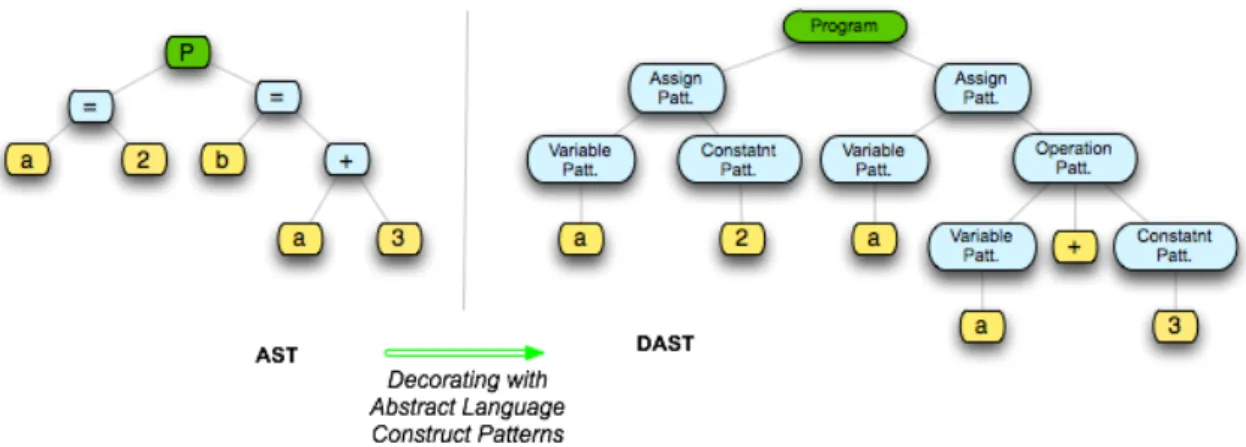
4.3 DapAST — The Improved Approach . . . 51
4.3.1 DAST versus DapAST . . . 52
4.3.2 Inside Animation Nodes . . . 52
4.3.3 Traversing the DapAST — Theoretical Approach . . . 54
4.4 Summary — Answering Question One . . . 55
5 Alma2 57 5.1 Developing the System . . . 58
5.1.1 Architecture . . . 59
5.1.2 Internal Structure . . . 61
5.1.3 Traversing the DapAST — Practical Approach . . . 64
5.2 Using the System . . . 68
5.2.1 The Expert does. . . 69
5.2.2 The Program Reader does. . . 74
5.3 Summary — Answering Question Two . . . 75
6 Case Studies 77 6.1 Karel’s Language . . . 77
6.1.1 Problem Domain Definition . . . 78
6.1.2 Language Formal Definition . . . 78
6.1.3 Conception: Mappings, Visualization and Animation . . . 80
6.1.4 Animation Using Alma . . . 84
6.2 The Lavanda Language . . . 87
6.2.1 Problem Domain Definition . . . 88
6.2.2 Language Formal Definition . . . 88
CONTENTS
6.2.4 Animation Using Alma . . . 92
6.3 Summary . . . 95
7 Approach Assessment 97 7.1 Experiment Preparation . . . 98
7.1.1 Team Know-how . . . 98
7.1.2 Related Work . . . 99
7.1.3 Objective of the Experiment . . . 100
7.1.4 Questionnaire Design . . . 101
7.1.5 Participants Identification . . . 103
7.2 Experiment Execution . . . 104
7.3 Final Results . . . 105
7.3.1 Results and Discussion . . . 105
7.3.2 Threats to Validity . . . 111
7.4 Summary — Theorem Validation . . . 112
8 Conclusion 115 8.1 Discussion and Conclusions . . . 118
8.2 Future Work . . . 119
Bibliography 121
A AnimXXXNode Family of Classes 139
Figures
1.1 Method to Proof the Theory . . . 5
2.1 Overview of Compiler Tasks . . . 20
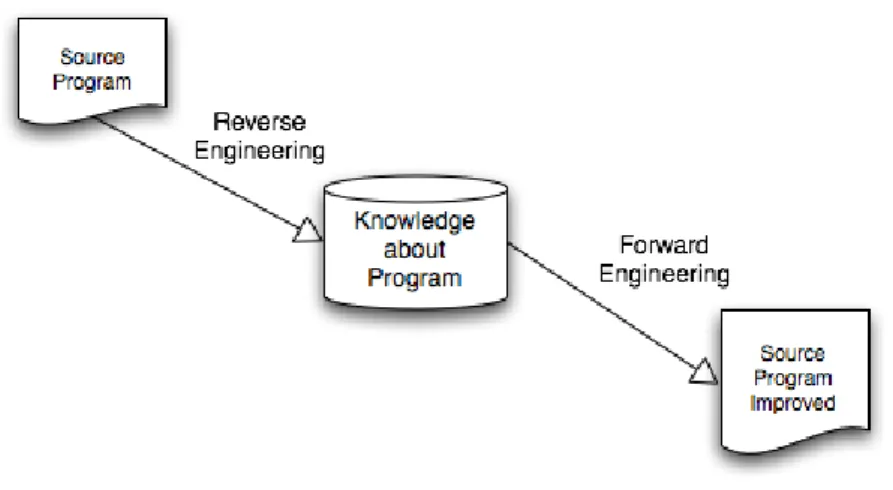
3.1 Reengineering - A Maintenance Methodology . . . 26
3.2 Gap Between Program and Problem Domain . . . 27
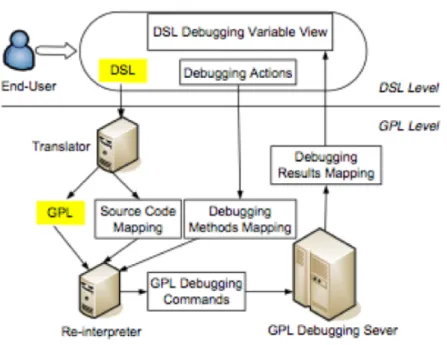
3.3 Framework for Debugging DSLs . . . 44
4.1 Answering Question 1 . . . 47
4.2 DAST . . . 50
4.3 Processing a DAST . . . 51
4.4 DapAST . . . 53
4.5 Processing the DapAST . . . 54
5.1 Answering Question 2 . . . 57
5.2 Alma2 Architecture . . . 59
5.3 Alma2 Internal Structure . . . 61
5.4 Animation Pattern Workflow . . . 64
5.5 Process of Drawing Actors . . . 67
5.6 The Alma2 Users . . . 68
5.7 State Initialization . . . 72
5.8 Initial state of Alma2. . . 74
6.1 Problem Domain associated with the Karel’s Language . . . 79
6.2 Sequence to move the robot . . . 82
6.3 Sequence to rotate the robot . . . 83
6.4 Sequence to pick an object . . . 83
6.5 Sequence to drop an object . . . 84
6.6 Label as a Resource for Visualization . . . 84
6.7 Visualization after executed the first turnright instruction . . . 86
6.8 Visualization after executed the first move instruction . . . 86
6.9 Visualization of a frame of the picking object sequence . . . 87
6.10 Problem Domain associated with the Lavanda Language . . . 89
6.11 Initial Visualization of a Lavanda Language specificaiton . . . 93
6.12 Visualization of the contents in the first bag . . . 94
6.13 Problem Domain Visualization of the second Bag . . . 94
7.1 Theorem Proof Schema . . . 98
7.2 Main Structure for the Experiment Tasks . . . 102
7.3 Distribution of Questions . . . 102
7.4 Comprehension Tasks — History and Expertise of the Participants . . 104
7.5 Time Results . . . 106
7.6 Correctness Results . . . 108
7.7 Importance Results . . . 110
8.1 Final Theorem . . . 117
B.1 Participant Identification Form . . . 142
B.2 Questionnaire — Page 1 . . . 143
B.3 Questionnaire — Page 2 . . . 144
B.4 Questionnaire — Page 3 . . . 145
B.5 Questionnaire — Page 4 . . . 146
Tables
2.1 Sample of DSLs Application Domains . . . 22
3.1 Information Provided by the PCTools Examined . . . 39
6.1 Connection of concepts to images in Karel’s Language . . . 82
6.2 Connection of concepts to images in Lavanda Language . . . 91
7.1 Average of Time Spent in Solving the Questions . . . 106
7.2 Average of Time Spent per Type of Question . . . 107
7.3 Average Correctness of the Questions . . . 108
7.4 Average of Correctness per Type of Question . . . 109
7.5 Average Importance of Problem Domain Visualizations and Views Synchronizations per Question . . . 110
Listings
5.1 Fundamental Packages to Import . . . 70
5.2 Toy Language Syntax . . . 70
5.3 Example of a Tree Injection Method . . . 71
5.4 Creation of an Animation Node . . . 71
5.5 Semantic Rules for the Robot Movement . . . 73
5.6 Definition of Animation Nodes for one Instruction . . . 73
6.1 Formal Definition of Karel’s Language . . . 80
6.2 The code for the Harvest Problem . . . 85
6.3 Formal Definition of the Lavanda Language . . . 88
Acronyms
A
ADT Abstract Data Type, p. 42. AG Attribute Grammar, p. 20.
API Application Programming Interface, p. 21. AST Abstract Syntax Tree, p. 49.
B
BE Back-End, p. 50.
BNF Backus-Naur Form, p. 19.
BORS Behavioral-Operational Relation Strategy, p. 42.
C
CD Cognitive Dimension, p. 11.
CDF Cognitive Dimensions of Notations Framework, p. 11. CFG Context Free Grammar, p. 70.
COTS Commercial Off-The-Shelf, p. 21.
D
DapAST Decorated with animation patterns Abstract Syntax Tree, p. 52.
DARE Domain Analysis and Reuse Environment, p. 18.
DAREp Domain Analysis and Reverse Engineering Project, p. 40. DAST Decorated Abstract Syntax Tree, p. 49.
DDF DSL Debugging Framework, p. 43. DSL Domain-Specific Language, p. 1.
DSLP Domain-Specific Language based Program, p. 2.
DSLpc Slovenian-Portuguese Bilateral Project on Program Comprehension for Domain Specific Languages, p. 1.
DSML Domain-Specific Modeling Language, p. 10.
DsPCTools Domain-Specific Program Comprehension Tools, p. 3. DSSA Domain Specific Software Architectures, p. 18.
E
EBNF Extended Backus-Naur Form, p. 19.
F
FAST Family-Oriented Abstractions, Specifications and Translations, p. 18. FE Front-End, p. 50.
FODA Feature Oriented Domain Analysis, p. 18.
G
GPL General-Purpose Language, p. 2.
GPLP General-Purpose Language based Program, p. 2.
I
IDE Integrated Development Environment, p. 43. IT Identifier Table, p. 31.
J
JVM Java Virtual Machine, p. 63.
M
MDSE Model-Driven Software Engineering, p. 10.
O
ODE Ontology-based Domain Engineering, p. 18. ODM Organization Domain Modeling, p. 18.
ACRONYMS
P
PC Program Comprehension, p. 1. PCTools Program Comprehension Tools, p. 2. PR Program Reader, p. 28.
R
RE Regular Expression, p. 80.
S
SV Software Visualization, p. 2.
SVS Simultaneous Visualization Strategy, p. 42.
V
VL Visual Language, p. 69.
VMTS Visual Modeling Transformation System, p. 43.
X
To Ni, Zinha and Rocas, for being such incomparable friends.
Chapter 1
Introduction
We don’t see things as they are, we see them as we are.
Anaïs Nin
This document is a dissertation presenting a master’s thesis in the area of Pro-gram Comprehension (PC) applied to Domain-Specific Languages (DSL). This mas-ter’s thesis is a component of the second year of the new Masters Degree (second cycle of Bologna’s), that is to held at University of Minho in Braga, Portugal. The subjects discussed in this document sprang out from the Slovenian-Portuguese Bi-lateral Project on Program Comprehension for Domain-Specific Languages (DSLpc)1.
In this chapter is given an overview of this work’s topics in the real world. After a glance on the main pitfalls, which steer the studies in this thesis, are presented the main objectives and the contributes. Also a brief discussion about the methodologies applied in the work behind this dissertation is made.
1.1
Overview
Since the advent of the computer era, every day, some genius brains come up with new ideas and new techniques to solve problems that exist in the world, and can only be solved by a computer program or system. Several problems have been worked out and many others are still there to be figured out. Informatics is not a limited discipline applied to a limited set of domains. Instead, it is everywhere. Businesses, medicine, justice, politics, sports, biology are some of the domains where it is applied to solve emergent problems.
As the techniques and technologies for software development are being constantly improved, rapidly the systems developed (those used to solve the problems) turn into legacy systems.
Legacy systems have been the main propeller for the advances made in the PC area [136]. They need maintenance or even improvements to follow the new requirements imposed by the evolving needs. Maintenance is known to be the most time-consume part of the software life-cycle. In [172] the author, based on [29]
1
and [65] informs that 50% to 75% is the average time spent for the tasks involved in the maintenance; and that 47% to 62% of the maintenance time is spent in comprehending the whole system. Many reasons can cause this time expenditure: the complexity of the systems, the non-preparation of the programmers to perform such a task, the non-familiarization of the programmers with the domain for what the system was developed, and so on. But the main reason lies on the fact that in the major part of the cases, the process of comprehending a program is done manually [172].
In order to gain time in the comprehension tasks, tools have been developed. These tools try to systematize and automatize the process of comprehending pro-grams from the simplest program to the most complex system. However, until now, any of them reduces up to 100% the manual labour involved in these tasks.
Many techniques, which can be seen as sub-systems, are explored in Program Comprehension Tools (PCTools). Software Visualization (SV) systems are an exam-ple. They aid in the comprehension task, by showing internal aspects of the program or system, that otherwise, humans would not assimilate so rapidly [98]. These as-pects are, traditionally, sets of concepts retrieved from the program domain.
Program domain concepts are more complex to understand, the more generic is the language used to write a program. General-Purpose Languages (GPL), like C, C++, C#, Java among others, have this handicap. As they are used to program and solve any problem in any kind of domain, their syntax and semantics are generic and closer to the machine level of understanding than to the human’s. Although the abstraction level of these languages have been increased with the born of new programming paradigms, like the Object-Oriented, they still have programming con-cepts that are hard to comprehend. And these difficulties grow bigger, when the programs coded with such languages — General-Purpose Language based Programs (GPLP) — are huge.
However, as in politics, justice, medicine, and so on, groups of specific words are regularly used to ease the comprehension between people, also in informatics, programming languages that address a specific domain were created. These lan-guages, so called DSLs, rise the abstraction of the program domain and shorten the distance to the concepts of the problem to which they were designed. So that, pro-grams written with these languages — Domain-Specific Language based Propro-grams (DSLP) — can be easily comprehended by persons aware of the problem domain. But, the same may not be true for persons with lack of knowledge in the domain.
Thus, the study of program comprehension for DSLs is a necessity and a reality. In the last few years some studies were done in order to understand on which type of programming language (GPLs or DSLs) program comprehension strategies are more effective. The intuition suggests that is easier to use a language (in the extent of learning it, developing with it and evolving programs made with it) when domain of its application is known and well defined [153].
The contribute provided, so far, by previous projects like VODA2 and PCVIA3, are
important for this area of research. In the sequel of them, a part of the DSLpc project, that origins this thesis, aims at studying Domain-Specific Program Comprehension
2
Project’s home page: http://wiki.di.uminho.pt/twiki/bin/view/Research/Voda
3
1.2. Problems and Doubts
Tools (DsPCTools), in order to find new techniques that can be applied to DSLs.
1.2
Problems and Doubts
In 1978, Brooks [31] drew a theory about the behavior of programmers before the task of comprehending a program. He affirms that, in order to comprehend a pro-gram, any person (commonly a programmer) should gather knowledge, from sev-eral resources related with the program and from the program itself; and with this knowledge, be capable of creating bridges, addressing several domains of knowledge, between the program and the problem domains. To put this in simpler words, the theory says that a program is better understood if the person who is through the process of comprehension knows the program and problem domains, and is capable of establishing bridges between them.
Until today, this theory is proven to be correct. The development of some tools and techniques for program comprehension, have adopted Brook ’s theory in order to ease the process of program comprehension [131, 157]. But, commonly, they give more attention to program domain aspects, and took little advantage from the problem domain. Many times, the latter is not even addressed. So, despite adhering to the proposed theory, they do not follow it completely. Thus, in general, PCTools do not address the problem domain. This causes a hole in this set of tools, and it should be filled out.
In part, it happens because these tools and techniques work upon GPLs, and the difficulties on retrieving problem domain aspects from GPLPs and dealing with them, are known for this kind of languages.
However, when dealing with DSLs, as the problem and program domains are close to each other, it is easier to infer a conceptual connection between them. But as said before, this is true if the person who is being through the process of comprehending a program is acquainted with the problem domain. Otherwise it would be necessary dedicated techniques and tools to help on the comprehension of DSLP [185]. A DSL user has different necessities, compared to a GPL user. He would rather have a visualization of the program at the problem level than at the program level.
As long as PCTools mostly cope with GPLs, throughout the years of research on this area, many techniques tools and approaches (henceforth the set of tools, techniques and approaches will be referred to as PCTools) took shape and were applied to those languages. Concerning this, one question seems to have necessity of being answered:
Question 1. Can the PC techniques, tailored for GPLs, be applied on DSLs?
In case of a positive answer, this question arises an important group of other questions. From that group, the following question gains relevance, since it summa-rizes all the doubts and misbeliefs that hang upon this work:
Question 2. Is it possible to improve existent PCTools, in order to give the end-user useful and better perspectives to comprehend the program and the problem?
Both questions can be answered affirmatively. At least, at a first glance. De-pending on the PCTools that are trying to be adapted, the conviction is that yes,
they can be configured to cope with a new kind of languages, DSLs, in this case. However it is a conviction that should be proved.
Regarding the second question, it is also a conviction that adapted versions of PCTools can help users on the process of comprehending a DSLP, yes, but only if a clear investment in order to address the problem domain, besides the program domain, is made. Without it, the users will only absorb the program internals, and those (users) not familiarized with the domain, will remain with almost all the difficulties as if there were not such PCTools.
Since it is not usual to find, in PCTools, visualizations of the effects that the execution of a program provoke in the problem domain, an investment on this di-rection should be made when adapting the PCTools to cope with DSLs, taking great advantage from the problem domain and its intrinsic connections with the program domain.
1.3
Goals to Achieve
Summing up the previous section, it is known that some PCTools follow Brook’s theory, but not completely. The major part of them only address the program domain and work upon generic programming languages. A problem was raised from the fact that there is not effective PCTools to help in DSLP comprehension, addressing both program and problem domains. From here emerged doubts and convictions about the possibility of adapting PCTools to cope with DSLs, that should be proved. Brook’s theory is the basis of the hypothesis that steers the present thesis. This theory is not focused on the development of PCTools, but on the behavior of the programmer when studying a program to comprehend it. Since PCTools aim at helping the programmers to understand programs, the knowledge behind the theory can be taken to guide the behavior of the programmer via a tool. But, in an attempt to bring closer such theory to the development or improvement of PCTools, it seems that it needs an increment. The following theorem represents the new visage of the theory applied to PCTools:
Theorem 1. (Extended Brook’s Theory) A program comprehension tool, will ease the task of comprehending a program when synchronized visualizations of its program and problem domains are provided, since from these visualizations, the user is able to build a conceptual knowledge base that easily bridges both program and problem domains.
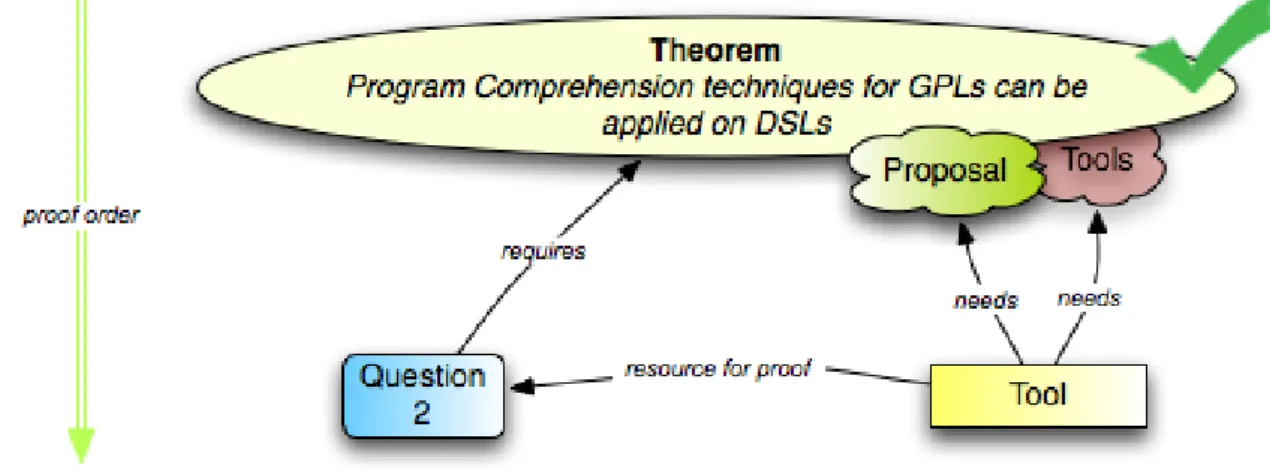
One of the aims of this master’s thesis is to prove that the theory just composed is correct. But, to do so, first, it is needed to support the affirmative answers given to the questions raised in the previous section. In Figure 1.1 is shown a scheme of how to proceed with this proof and what are the main resources needed to succeed. According to this, the studies underlying this thesis are twofold: on the one hand it is made a more theoretical study, and on the other hand a more practical one for proof of concepts. The goals proposed to attain in this work are the following:
1.3. Goals to Achieve
Figure 1.1: Method to Proof the Theory
reason about whether they can or can not be applied to the comprehension of DSLP;
• Study a way of applying them to the development of PCTools and/or their improvement into DsPCTools.
• Propose the new technique which, theoretically, may ease the process of com-prehending DSLP;
• Develop the prototype of a program comprehension tool based on an existent one, which follows a technique studied before. The prototype should focus on the creation of the visualization at the problem domain level, and, fun-damentally, provide a synchronized visualization of the program and problem domains. This would hold the requirements of the theory stated before. • Evaluation of the developed prototype, resorting to a non uniform group of
possible users. This last objective would be used to corroborate, or not, the hypothesis of this thesis.
This work is expected to improve the way the problem subjacent to a program is shown to the user, in order to accomplish its comprehension. Also, it is intended to be a pioneer work aiming at increasing the number of DsPCTools, so the hole on the set of PCTools will be filled out.
1.4
Outline
After this opening chapter, the document is structured as follows:
In Chapter 2 a deep study on domain-specific languages is provided. The char-acteristics of these languages, the advantages and disadvantages concerning their use and development, and approaches to improve and make more agile the DSL’s implementation process are some of the topics addressed in this study. This chapter would provide a basilar knowledge about these languages as they are the focus of this master thesis.
In Chapter 3 are addressed the main keywords of the research field on program comprehension. Some specific and fundamental definitions that will be used through all the document are presented here. Main focus is given to the topics of software visualization and cognitive models, as they are also central issues on this thesis. A study on the state of the art, concerning the tools for program comprehension is also provided in this chapter. Tools are classified according to important program comprehension aspects, to make evident what is missing in those tools. This, along with a presentation of tools to analyze domain-specific language based programs, enables the reader to understand where the contributions of this thesis stand.
In Chapter 4, a program comprehension tool is chosen from those studied be-fore, in Chapter 3; then the program comprehension technique followed by that tool is carefully studied. Finally a new approach is designed based on the ana-lyzed one. This new approach has the objective of providing visualizations and animations of the problem domain concepts, and also to synchronize them with the program domain visualizations. For that, a powerful intermediate representation of the program, extended with special patterns, is used; and the method to animate this representation, resorting to the patterns, is depicted.
In Chapter 5 the tool chosen before is extended to cope with the new program comprehension approach. The architecture of the resultant tool and internal relation between the several components are presented and explained. Moreover, the main algorithm for the animation of the problem domain and its synchronization with the program visualizations, is explained with some detail. At the end, it is briefly explained how the users should use the tool; two groups of users with different expertise level are taken into account in such a usage explanation.
In Chapter 6 the tool is tested with two different case studies. The case studies follow a set of specific steps determined in the previous section as those necessary to build the visualizations of the domains. Each case study addresses a different domain specific language; the first one is an imperative language, and the second is a declarative. Difficulties and problems on creating these visualizations are addressed for each type of language, however explanations to solve them are given.
In Chapter 7 an experiment to assess the effectiveness and usefulness of the ap-proach is described. The details of the preparation, concerning the previous know-how, the tasks and the questionnaire design, and the details of the conduction, concerning the steps followed to achieve successful results are presented. Tables and charts present the results obtained, and are accompanied by analysis and explana-tions for those results.
1.4. Outline
Chapter 2
Domain-Specific Languages
A programming language is low level when its programs require attention to the irrelevant.
Alan Perlis
No matter what is done, computers will always understand things in terms of 0’s (zeros) and 1’s (ones). These things they understand are human-made programs. And humans, although capable of doing it, are not proficient in speaking that binary language. However, the computer can be taught to translate any language into its preferred idiom. For this reason, humans do not need to go down to binary level. Instead, they can keep the way they talk to computers at a very perceptible level by raising the abstraction level of the language they use.
Programming is no more a computer-oriented task. Several factors play an im-portant role in it. One of the most imim-portant is the concern about the future of a software piece, namely, its maintenance. It is not a computer that will maintain the software, but a human. So the target of the code written must not be only the computers, but also the humans.
Thus, to clarify the dialogue between persons and program code, the terms and concepts used in the programming language syntax and semantics should be close to those the person knows about the real world.
Two types of languages are mainly used to write programs for computers: GPLs and DSLs.
There is not a precise definition for GPL [46, 45, 201]. They are created to solve any kind of problem no matter the area or domain this problem fits into. Nor-mally they are the programer’s choice for the communication with the computer. As they are general purpose and widely used, they are adopted by the majority of programmers. The existence of a large community of experts in one GPL also plays an important role in such adoption. But issues like the maturity of the language, the availability of well tested and optimized compilers, and the existence of good devel-opment tools or environments [84], are the more crucial for the referred preference. But, these languages have drawbacks when regarding other aspects like writing and reading or understanding their programs, commonly addressed as semantic gap.
Concerning the former aspect, they always imply vast programming expertise. Hence, not every human is able to use them. Concerning the latter aspect, GPLs are
commonly low level languages. Low level language means that the syntactic con-structors and underlying semantics of that language address implementation partic-ularities that are closer to the machine’s way of working than to the human’s way of thinking. Their varied formats and the programming paradigms they follow, which try to raise the abstraction level, are not enough to erase the difficulties observed on comprehending the programs written with these languages.
DSLs can be defined by the following sentence:
A domain-specific language is a programming language or executable specification language that offers, through appropriate notations and ab-stractions, expressive power focused on, and usually restricted to, a par-ticular problem domain. [196]
This sentence gives a concrete definition of what a DSL is. Although a small aspect can be discussed. It is said that a DSL is a programming language. But Wile [204] affirms that this is not necessarily true. He supports his affirmation with the example of musical notation, which is a DSL, but it is not a programming language. On the other hand, it is said that a DSL is an executable specification language. But, again, Mernik et al. [123] say that DSLs are not necessarily executable, referring that they can be used just for being processed as happens, for instance with Extensible Markup Language (XML) dialects. Therefore, perhaps the better solution is to change the beginning of the definition, and say that a DSL is a computer language; the definition with this change neither generalizes nor specifies the purposes of such a language, but enhances its major characteristic, which is the fact of being tailored for a specific problem domain [197].
As these languages are built for a specific domain, it is easy to absorb the main concepts and features inherent to this domain, and bring them to the language notation [105]. This would result in a notation capable of raising the abstraction level of the programming [41], that is, the notation addresses a higher level of abstractness, enlarging the distance to the machine’s way of working but shortening it to the human’s way of thinking. Moreover, these languages tend to be small [16, 126] and less complex.
DSLs, as well as GPLs, can be regarded as programming languages, or modeling languages. The latter are called Domain-Specific Modeling Languages (DSML) [92], sharing the same global definition given before for DSLs. Although programming languages and modeling languages have not precise boundaries, there are efforts trying to clarify their borders, by defining sets of criteria for their classification [187]. One important point is that DSMLs are used in earlier phases of the development of a software system, namely, the system’s designing or modeling phase, in the Model-Driven Software Engineering (MDSE) approach. Another aspect is that DSMLs can be used to derive computations, by translating the modeled behavior of the software in an executable source.
Since DSLs are the central issue of this thesis, a further and deeper look into their discussion is given in the remainder of this chapter. First, in Section 2.1, the characteristics of these languages are addressed, in order to enhance the main differences to GPLs, which are discussed in Section 2.2. The characteristics of these
2.1. Characteristics
languages are intrinsically related with the advantages and disadvantages that their usage and development present. These pros and cons are discussed in Section 2.3. Finally, it is presented a small overview of DSLs application areas and some examples of these languages, in Section 2.5.
2.1
Characteristics
GPLs are perfectly established in the software development life-cycle. Their char-acteristics are so widely spread among the software engineers community that are regarded as a natural thing. However, with DSLs is not the same. There is the neces-sity of enhancing their characteristics in order to defend their usage instead of GPLs. In part, this oughts to the research and studies made on DSLs during the last ten years [204, 123, 105], revealing the importance that these languages are achieving in software engineering. Because of that, the characteristics of DSLs are worthwhile to know and understand.
The following sections present those characteristics and justifies them resorting to the Cognitive Dimensions (CD), which are also overviewed in the remainder of this section.
2.1.1
Cognitive Dimensions
CDs [71, 73, 74] are attributes of computer languages and other similar notations. These attributes are comprehended in a framework, known as the Cognitive Di-mensions of Notations Framework (CDF) [27], which was created to help on the design of new notational systems, by providing available design choices, and means to evaluate the usability of these systems. So, an usual application of the CDF is on the improvement of notations and associated systems, with respect to the users’ perspectives [93, 38].
In this section, the CDs are listed and each one is briefly explained, in order to expose an overview about its purpose in the framework.
• Abstraction — is related with the possibility of incrementing the original no-tation by creating an higher level perception of the terms. Examples are the possibility of defining new macros and new data-structures.
• Closeness of Mapping — is related with the distance between the notation and the terms of the domain that are to be described. That is, the notation entities describe precisely what the user wants to describe.
• Consistency — is related with the capacity of expressing similar semantics resorting to a similar syntax. That implies the existence of patterns in the no-tation, so they help users on identifying desired information, without breaking expectations.
• Diffuseness — is related with the verbosity of the notation. That is, the number of words and characters necessary to express a term or concept of the domain.
• Error-Proneness — is related with the non-protection of the notation against user-made errors. In other words, are the characteristics of the notation that allow users to express erroneous things.
• Hard Mental Operations — refer to the great necessity that users have on thinking hard and resorting to tools or other resources in order to understand what the notation means in a precise context.
• Hidden Dependencies — refer to connections on the notation entities that are important, but are not fully exposed to the users’ eyes. Examples are intricate class hierarchies, HTML links, operations with side-effect, among others.
• Premature Commitment — is related with the imposition of an order of doing things. The users are constrained on making decisions even before they have the notion of what would be needed in the future. This dimension can also appear under the name of Imposed Guess-Ahead.
• Progressive Evaluation — is related with the possibility of checking the state of a description in a notation, before finishing it. The interpretation rather than the execution of programs, as happens with Haskell, for instance, allows a partial evaluation of the programs.
• Provisionality — is related with the possibility of making provisional actions. It is similar to the Premature Commitment dimension, but in the present case, the commitment is not imposed.
• Role-Expressiveness — refers to the easiness on inferring the purpose of a notation entity, just by reading the specification in the given notation.
• Secondary Notation — is related with the availability of mechanisms for ex-pressing extra information, but not in the syntax of specification. Examples are comments, annotations, colors, and others which give information that sometimes is not possible (or is hard) to infer from the formal syntax only. • Viscosity — refers to the difficulties observed at the time of changing something
in a specification. Normally it can be measured using the number of actions a user need to accomplish a task. Intricate dependencies on the notation entities can be the cause to make a notation or system viscous. More on this dimension can be seen in [72].
• Visibility — is related with the ability of viewing notation components eas-ily. The existence of this dimension (the same happens with all the others dimensions described above) on a notation, depends on the user perspective and usage of the notation. Many times, visibility on notations can only raise problems when performing a comprehension task on a specification.
The CDF is an interesting and usable approach to assess the usability, and to enhance and explain the characteristics of notations. In the following section (Sec-tion 2.1.2), characteristics of DSLs are presented, and their explana(Sec-tion is based on some of the CDs presented above.
2.1. Characteristics
2.1.2
Cognitive Dimensions Applied to DSLs
As DSLs are notations, the application of the CDF, in order to study the usability of these languages, is a powerful approach. DSLs are different, but somehow share some characteristics. In this context, it is possible to create a shelf for these languages, and evaluate and explain their common characteristics. In [153], the authors used the CDF to accomplish a speculation-based evaluation of DSLs.
In this section, the intention is to do a similar analysis, since a complete empirical experiment is not in the scope of the present work. However in this case, the aim is to enhance, describe and point reasons for the characteristics of DSLs based on the CDs presented in Section 2.1.1.
Normally, DSLs are small. The fact of these languages being tailored to deal with the problems of a specific domain, allows their designers to grab only the essential features and concepts of that domain, and manage them to create a small and restricted notation. When languages are small, the proneness to errors is, a priori, also small, so this characteristic diminishes the presence of the error-proneness CD. Small notations allow the specification of solutions to solve the problems, instead of programming them, unlike what happens when dealing with the major part of GPLs. So, DSLs are usually more declarative than imperative languages [196]. This characteristic enables the presence of the progressive evaluation dimension, in the sense that specifications can be interpreted at any time, but this is a topic that depends on the system that cope with the DSL (compiler, processor, and so forth) and not on the notation itself.
Moreover, they are abstract [82] and expressive in their domain [123]. Actually, the latter is not always true, regarding the following law proposed by Heering [78]:
Expressiveness × Domain size = Constant
When analyzing and designing a DSL, engineers should be aware of the domain where the language will be applied. The semantics of the domain should be implicit in the language notation [83]. The latter means that abstraction should be brought to the notation of the language; that is, the low level notions of how something is done should be encapsulated by a high level notation, expressing, for each sentence or statement, the precise purposes of their existence and usage. Indubitably, this allows their users to easily create mappings between the syntax of the language and the objects of the problem domain. So, these two characteristics, enable the presence of the role-expressiveness, closeness of mapping and diffuseness CDs. On the other hand, the encapsulation of semantic information in the notation, reduces the visibility dimension on the language; and, opposed to the role-expressiveness dimension, DSLs would present low indices of hard mental operations. Also, the viscosity of these languages is supposed to be small, because of DSLs being little and abstract languages. In a naif supposition, it is also valid that the abstraction dimension is also present, since DSLs are, per se, abstract languages and, some of them, present mechanisms to create even more abstraction. On the other hand, the abstraction would increase the number of hidden dependencies.
The concentration on the definition of a notation that would only express con-cepts of a single application domain, brings the possibility of sharpening edges on the
language, and make it more and more efficient on various directions. One of these directions is the efficiency on being read and learned by the domain experts [2, 41]. Domain experts are persons with great knowledge on a given domain, but, normally with any or little expertise on programming. Thus, given the abstractness and the expressiveness of DSLs, they can easily read programs, and learn the languages in order to specify the programs with efficiency, or in another words, with little time spent. The same may not happen if the person interpreting the language is outside of the domain.
Another facet of that efficiency can be observed on the tools that give support to the language. Their processors, for instance, can be improved to offer better results, as the domain is restricted and the knowledge is centralized.
2.2
Dichotomies
In this section are used comparisons with both general-purpose and domain-specific languages, to discuss about some dichotomous characteristics on DSLs. For this discussion, the following pairs of characteristics are taken into account: i) Con-creteness and Low-level vs Abstractness and High-level ; ii) Computational Power vs Expressiveness. The following paragraph gives an overview on the concerns of the characteristic written above.
Abstractness and Concreteness address the semantics of the language and how it is exteriorized to the user. Low-Level and High-Level focus on the level where a programmer must think to be capable of working with the language. Expressiveness is related with the easiness of mapping the language notation into the real world objects and other inherent characteristics. Computational Power concerns with the different possible ways of defining a computation and the capability of defining several things using the same constructors.
2.2.1
Abstractness and High-level versus Concreteness and
Low-level
What should be answered when it is asked whether DSLs are abstract or concrete? A language is more abstract the more it hides the operational semantics [137] from the final user. One of the main efforts during the construction of a DSL, is to encapsulate the semantical knowledge in the language notation, in order to have it implicitly, instead of explicitly, as happens with GPLs. For this reason DSLs are more abstract than GPLs, which, by exclusion of parts, are more concrete.
In fact, as Deursen and Klint observed [195], the knowledge about the domain is concentrated in the language notation, and the knowledge about the implementation (the operational semantics of the language) is delegated to the compilers, processors or other related tools that give support to the language usage.
A low level language is a language that takes its user into a thinking level that is known to be unusual for human beings. That is, the handling of constructors and abstractions of a low level language imply the presence of specialized knowledge beyond the empirical knowledge on an application domain.
2.2. Dichotomies
On the other hand, high level languages, remove from their notations explicit implementation aspects (abstractness). Users are able, then, to handle the language constructors at a more rational level.
DSLs are usually high level languages, when comparing with GPLs. The abstract-ness of DSLs raise this level, once the semantics of the language are implicit in the constructors and abstractions that the notation of the language presents. This way, the user’s concerns are focused on issues associated with the problem and not with the solution (code, program and other intricacies). The gains on following this phi-losophy are great; using high level languages (DSLs, namely DSMLs) that allow the focus on the problem and not in the solution, can be profitable at earlier stages of the software life-cycle [76, 87], like the requirements analysis and management [8, 86].
2.2.2
Expressiveness versus Computational Power
A language is said to be expressive when its notation helps the user on creating mappings between the program and problem domain concepts, without resorting to documentation of the software pieces, whether it is internal (comments, annotations and so forth) or external (user manuals, implementation reports and so forth). Such characteristic is observable when the language is easy to learn, and their programs are easy to read and understand.
On the other hand, the computational power of a language is related with the possibility of specifying multiple and different computations relying on the same vocabulary and structures, offered by the language. Also it is manifested when the notation allows the definition of similar computations, using different approaches.
DSLs are usually, more expressive than GPLs; on the other hand, GPLs offer a greater computational power (concerning the CDs, DSLs present more consistency than GPLs). The major difference between these types of languages is precisely this dichotomy. However, it was not always true. Languages like Fortran or Cobol, can be regarded, nowadays, as GPLs, because of their computational power, but they were first constructed to fulfill requirements on the mathematics and the business areas, respectively [196]. That is, they were tailored for a single domain of application.
The expressive power of DSLs make of them very objective languages, in the extent that the user would know, easier, what happens when a statement of a pro-gram is interpreted or executed. The vocabulary of these languages store knowledge of the application domain, and mask behavioral aspects of this same domain. As they are used to cope with the aspects of a single domain, they do not need extra computational power to extrapolate for other domains. The language constructors must encapsulate precisely the behavior required for the concepts of the domain, with which they are associated.
As final words about this dichotomy, Ladd and Ramming [108] state that DSLs should not be designed to describe computations, but to express useful facts from which one or more computations can be derived. This express precisely what was said about DSLs throughout the present section.
2.3
Pros and Cons
All the characteristics of DSLs, listed and explained before, lead to a group of ad-vantages and disadad-vantages.
In this section, an impartial and literature-based overview on this matter is given. In order to proceed, it is important to left clear two perspectives on this discussion. On the one hand, there is the usage perspective, which concerns with the usage of DSLs to produce programs or specifications, and other tasks associated, like comprehension, maintenance or evolution of the specifications. On the other hand, there is the creation perspective, which concerns with the development of new DSLs and tools like processors, compilers or interpreters, and also with the maintenance of the languages and the associated tools.
2.3.1
On DSLs Usage Perspective
The most claimed advantage on using DSLs is the possibility of integrating domain experts in later stages of the software development life-cycle [195, 2, 70]. Normally, domain-experts are very required in the analysis phase of the whole software devel-opment process, and their functions end right there. But are not few the times that, a new overview on the conceptual aspects concerning the software in production, is needed. Since the usage of GPLs require good programming skills, the domain-experts, who are not proficient on that area, little work can do on this matter. However, using DSLs they can steer the flow on the programming tasks and they can even give a hand on specifying the programs.
In this context, DSLs are also appropriated to diminish the distances that exist between the conception and implementation phases of the software development process. Also, this leads to the creation of new software development methodologies, meeting the requirements that the domain imposes [2].
It is possible to sub-divide the present perspective into two parts: (i) the imple-mentation phase and (ii) the maintenance phase.
Concerning the former sub-perspective, (i), DSLs ease and increase the speed on the construction of software pieces [195]. Kieburtz et al. [94] also defined a set of advantages, that, in some extent, empower the existence of the last addressed advan-tage: they claim that DSLs enhance the flexibility, productivity and usability. The justification for these advantages is trivial by regarding the characteristics of DSLs presented before. All they are due, mainly, to the expressiveness and abstraction of these languages, which are, indeed, the main characteristics. Also, the usability of these languages can be justified by the fact of being small and easy to read and write.
Further in the implementation steps, DSLs would enhance the testability of the programs or specifications being described. In this context, non-traditional methods like [179] can be followed in order to test these programs.
Regarding the latter sub-perspective, (ii), there are many advantages. The main one is that using DSLs the software maintenance is simplified [195]. Completely related with this one, is the claim that these languages enhance the comprehensibil-ity of programs and specifications [204, 105]; which is not any novelty, because the
2.3. Pros and Cons
easiness of maintaining a piece of software implies the easiness of comprehending the program specifications. To this advantage contributes the easiness on infer-ring the domain of the language, and on creating mappings between the program and problem domains. Another great aspect of these languages is that, in many cases, they provide self-documentation, what avoids the search for documentation resources that may be unavailable. Together, these three aspects diminish the costs of engineering and reengineering, and increase reliability and repairability on the software constructed with DSLs [81].
DSLs are claimed to be a good approach for software reuse [107]. In this context, not only the pieces of software are reused, but also the knowledge embodied in the language. So, the reutilization is another advantage that is connected to the usage of DSLs.
Until now, only advantages were pointed. However DSLs have also some draw-backs associated, concerning their usage. Some programmers create some resistance to use DSLs, because it may be necessary many DSLs to do the job of a single GPL. This dues to the fact that DSLs are tailored for a specific domain. So the program-mers claim that they do not need to learn many DSLs when already know one GPL. The point is, if there is not adherence on a DSL, it would not have any success, and its evolution or work done upon them, like tool support construction, would be tasks without future; on the other hand, the adherence implies teaching costs, which can be significative [195]. Although the latter has been pointed as a disadvantage, it is believed that it is easy to learn a DSL with little effort.
Moreover, this variety reduces the easiness of interoperability with other well established languages [70]. This is obviously a disadvantage, because in real projects, several domains can be addressed and, thus, several DSLs can be used; and even the combination of DSLs with GPLs is a reality. So, without interoperability between them, DSLs can fall into disuse.
Missing tool supporting for monitoring, debugging and other necessary tasks for DSL users is, indubitably, a great disadvantage. Without tool support, the availabil-ity of DSL is limited [196], what leads to low number of adherents on such language.
2.3.2
On DSLs Development Perspective
The development of DSLs allow optimization and validation at domain level [33, 13, 122]. The optimization of a language concerns with details of implementation at machine level, e.g. managing the memory allocation. As was stated before, these kind of implementations are done at language development time, and not at programming time, providing abstractions that encapsulate these details. So, at programming time, the user is able to build specifications and optimize them at domain level, because the optimization at machine level, is already done. For instance, in C, memory allocation is an indispensable task, but it takes the user to cope with details that are, most of the times, beyond their capabilities.
But this raises the majority of the disadvantages on developing DSLs. Firstly, in order to develop a language, the engineer must be expert on both the domain of application and compilers engineering [195]. Most of the times, the language engineers are not proficient on the problem domain, so creating a language is not a
single-man task; domain experts are needed to steer the DSL requirements [103], and language engineers are needed to concretize the requirements into an abstraction capable of coping with the domain concepts.
This fact empowers the consumption of time and money on the several phases of the language development (design, implementation and maintenance) [196]. In fact, developing a language requires knowledge about programming in GPLs, on most part of the cases. The issues related with the maintenance of GPLPs are widely known. So, maintaing DSLs and their associated tools, like compilers, processors or interpreters, can be a very complicated and difficult task. Not for so little times, this leads to low number of tool supporting; and when there are tools, they may not follow up the evolutionary trends of the language [70].
The disadvantages on the present perspective, can be attenuated regarding the methodologies used for the development of DSLs. Section 2.4 gives a little survey on some development methodologies that were successfully used to implement DSLs, over the times.
2.4
Developing DSLs
Language engineering is an old discipline perfectly established as a branch of the software engineering. The development of DSLs is just a small part on that branch. Unlike the development of GPLs, which is, normally, based on compiler techniques [1], the development of DSLs follows several methods and techniques, including also the techniques used for creating GPLs [123].
Each development methodology is well supported by tools. Not all the tools were tailored to cope with the development of DSLs, but they are successfully and easily adapted to cope with it.
The following sections address the DSLs development techniques, their associated classifications and the tools used for their crafting. The knowledge present in these sections is not relevant for the work of this master’s thesis, thus this small survey does not go deep into details.
In general, five main steps are pointed to be essential on DSL development: de-cision, analysis, design, implementation and deployment [123, 196]. The decision phase concerns with the analysis of pros and cons about developing or not a new language. The analysis is the phase where domain experts gather knowledge related with the domain, relying on domain analysis methodologies like Feature Oriented Domain Analysis (FODA) [90], Domain Specific Software Architectures (DSSA) [188], Organization Domain Modeling (ODM) [178]. Domain Analysis and Reuse Envi-ronment (DARE) [67], Family-Oriented Abstractions, Specifications and Translations (FAST) [202] and Ontology-based Domain Engineering (ODE) [64]. The design step is concerned with the choice and adoption of patterns and conceptual implementation decisions. The implementation phase, is related with the concrete construction of the DSL, using the patterns and implementation approaches adopted in the design phase. The deployment (or distribution) step is when the language is ready to be used, and is made available for general usage.
2.4. Developing DSLs
During these phases, patterns can be used to ease the process of language devel-opment. Spinellis [181], reinforced later by Mernik et al. [123], defined a set of several design patterns. Some of them are listed below with a snippet of their description. For further reading about these patterns, the given references are recommended. Piggyback The capabilities of existing languages are used as host to the
develop-ment of new DSLs;
Pipeline DSLs are constructed in a way that the input of one is the output of another;
Lexical processing The languages are designed with the intuit of not using syntax analysis, but only lexical scanning.
Language extension DSLs are constructed in order to add features to existing languages. It can be seen as an extension of the base language;
Language specialization The languages created remove features from existing languages which serve as base;
Source-to-source transformation The source code of a DSL is transformed into the code of an existing language;
Data structure representation DSLs are designed to represent data structures; System front-end DSLs are constructed to be the front-end of a system, in order
to configure and adapt the underlying system.
These patterns are basis for implementation approaches. In [204], three main shelves were identified to contain such approaches. In the list below are presented the containers and the approaches contained in each one. For each implementation approach a small description is given.
2.4.1
Complete Language Design Approaches
The approaches contained in this shelf involve the creation of a language from the zero. This requires the definition of the language syntax (commonly achieved by using Backus-Naur Form (BNF) or Extended Backus-Naur Form (EBNF) notations), the specification of the semantics, and the translation into target code. Compilation and Interpretation are the main approaches within this container.
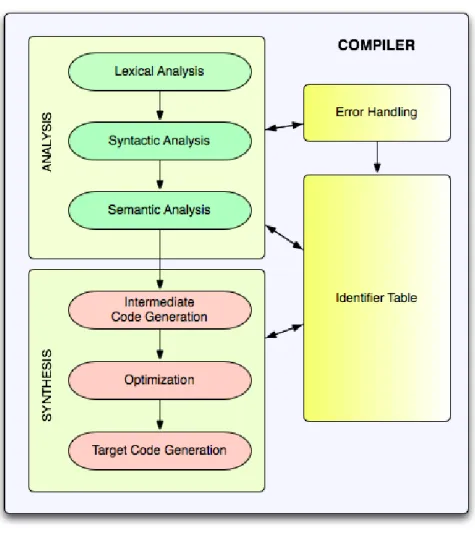
Compilation. It is the most traditional approach to implement a language, no matter the language is a DSL or a GPL. The language constructs are analyzed and synthesized into a target code, that can be machine code or a common GPL lan-guage code, that is to be executed by a machine. The common tasks performed by compilers can be seen in Figure 2.1. Besides the tasks, it is also presented auxiliary data-structures and mechanisms, used to communicate between tasks, and assess the correctness of the programs.
Figure 2.1: Overview of Compiler Tasks
Interpretation. The difference to the compilation approach is that the language constructs are recognized but not executed at machine level; instead they are inter-preted.
These implementation approaches are supported by compiler-compilers (tools for compiler generation) that are widely available for many years. The Lex [112] and YACC [88] system, used for the development of any kind of language, is one of the most popular; but more recent and similar tools (in the extent that are not only focused on the development of DSLs) are available: JavaCC1, SableCC [69], based on translation
grammars, and LISA [125], AntLR [146], JastAdd [61], based on Attribute Grammars (AG) [101], are some examples. On the other hand, there are tools specified on the construction of compilers and interpreters for DSLs. ASF+SDF [194], Khepera [63], Kodiyak [81], InfoWiz [134], are some examples of these specialized tools.
The languages created with these approaches are said to be external languages [164], because they are independent languages; that is, the DSL constructed on this strat-egy is completely designed and implemented from the scratch, not relying on any pre-existent language.
1