1 Comparative performance and digestibility of nutrients in Afshari and Ghezel ram
lambs
Desempenho comparativo e digestibilidade de nutrientes em cordeiros de carneiro Afshari e Ghezel
Morteza Karami1* Fardis Fathizadeh2, Arash Yadollahi3, Mehran Aboozari4 and Yaser Rahimian5
______________________________________________________________________________ Abstract: This study was investigated to comparative performance and digestibility of nutrients in Afshari and Ghezel ram lambs. In the first trial 30 animals at the age of 5 month (15 Afshari (AF) and 15 Ghezel (GH) ram lambs were randomly allocated to individual pen, in order to determined fattening performance for a period of 90 days. In the second trial 10 animals at the age of 10 month from each ecotype were randomly allocated in individual metabolic cages to determine the in vivo digestibility for 8 days after adaptation period. Data were analyzed in a complete randomized design using the GLM of SAS and the means were compared with Duncan’s multiple range test. The results showed that there were no significant effect in initial body weight, daily gain, feed conversion ratio and feed efficiency between treatments. Ghezel ram lambs had lower feed intake compared to Afshari ram lambs. The study showed that there were no significant differences for digestibility of DM, protein, EE, ADF, NDF and P, Ca, Mg, Fe and Cu between treatments. In conclusion the results showed that GH had no significance effect on feed digestibility and fattening characteristics of cross breed lambs.
Key words: Ram lambs, Afshari, Ghezel, Fattening Performance, Digestibility.
Resumo: Este estudo foi investigado quanto ao desempenho e digestibilidade comparativos de nutrientes em cordeiros de carneiro Afshari e Ghezel. No primeiro experimento, 30 animais com 5 meses de idade (15 cordeiros de carneiro Afshari (AF) e 15 de Ghezel (GH)) foram aleatoriamente alocados em currais individuais, a fim de determinar o desempenho de engorda por um período de 90 dias. 10 animais com 10 meses de cada ecótipo foram alocados aleatoriamente em gaiolas metabólicas individuais para determinar a digestibilidade in vivo por 8 dias após o período de adaptação.Os dados foram analisados em um delineamento inteiramente casualizado usando o GLM do SAS e as médias comparadas com Os resultados mostraram que não houve efeito significativo no peso corporal inicial, ganho diário, taxa de conversão alimentar e eficiência alimentar entre os tratamentos.Os cordeiros Ghezel tiveram menor consumo de ração do que os cordeiros Afshari. não houve diferenças significativas na digestibilidade de MS, proteínas, EE, FDA, FDN e P, Ca, Mg, Fe e Cu entre os tratamentos. Concluindo, os resultados mostraram que o GH não teve efeito significante sobre a digestibilidade e características de engorda de cordeiros de raças cruzadas.
Palavras-chave: Carneiro, Afshari, Ghezel, Desempenho de Engorda, Digestibilidade.
Revista Brasileira de Higiene e Sanidade Animal
Brazilian Journal of Hygiene and Animal Sanity
ISSN: 1981-2965
Artig
Karami et al., Revista Brasileira de Higiene e Sanidade Animal (v.14, n.3) p. 1 – 12 jul - set (2020)
2 __________________________
http://dx.doi.org/: 10.5935/1981-2965.20200026
*Author for correspondence: E-mail: [email protected] Received for publication 10.01.2020; approved on 30.09.2020
1-Department of Animal Sciences, Agriculture and Natural resources Research and Education Center, Shahrekord, AREEO, Iran.
2- Department of Veterinary Laboratory Sciences, Tabriz University, Tabriz Iran. 3- Agricultural Engineering Organization, IAO. Shahrekord, Iran.
4- Department of Animal Sciences, Faculty of Agriculture, Abhar Branch, Islamic Azad University, Abhar, Iran
5- Department of Animal Sciences, Shahrekord Branch, Islamic Azad University, Shahrekord, Iran. Introduction
There are high variations among different Iranian sheep breeds in terms of carcass yield and prolificacy. Twin births are frequent in some breeds though infertility is rarely observed in these flocks. The Ghezel sheep originated in northwestern Iran and northeastern Turkey. This region in Iran is known as Azarbayjan and is typlified by dry, cold mountain weather .The fleece of this sheep is red and have sections of black red or light red. The Ghezel are used for both meat and wool in this region (TAVAKKOLIAN, 2000). The productivity of livestock affected by genetic and environmental factor such as diet. The higher productivity breed usually followed by higher nutrient requirement such as protein which is needed for tissue deposition (YULISTIANI et al.,2015, NETO et al., 2014). Therefore the objective of this study was to evaluate comparative
performance and digestibility of nutrients in Afshari and Ghezel ram lambs.
Materials and methods
In order to determination of fattening performance the data of 30 Afshari and Ghezel lambs which born between 2016 and 2017 were used. In vivo feed digestibility was assigned with 6 Afshari and Ghezel ram lambs respectively. The research carried out in research flock at Shooli sheep breeding station in Shahrekord. The flock was generally kept from March to June at the station.
Chemical Composition:
In Table 1, Ingredients of diets were analyzed according to AOAC (2000) methods. Dry matter (DM) with putting feed in 100°C for 24 h., method 967.03, ash by incineration in 550°C for 8 h; method 942 and crud protein (CP) by Kjeldahl procedure. Neutral detergent fiber (NDF) and acid detergent fiber (ADF) were
3 analyzed according to two stage procedures
described by (STERN et al., 1997; VAN
SOEST et al., 1994). The experimental diet is shown on Table 1.
Table 1: Ingredients (DM basis %) and chemical composition of the experimental rations
Ingredients Dry mater basis %
Alfalfa hay1 61 Corn 4.85 Barely 13.60 Wheat bran 9.30 Fish meal 0.78 Soybean meal 2.88 Canola Meal 2.33 Beet pulp 1.94 Edible Salt 1.94 Calcium bicarbonate 0.27 Baking soda 0.39 Magnesium Oxide 016 Sodium-Bentonite 0.39
Mineral and vitamin per mix2 0.17
Chemical Composition
Crude protein 16
Metabolizable Energy (Mcal/kg DM)3 2.5
Ash 8.6
Neutral detergent fiber (NDF) 43.4
Acid detergent fiber (ADF) 21.7
Ca 1.9
P 0.4
1
Chopped to 2-3 cm length,2Supplies per kg of feed: 4.9 mg of Zn, 4.05 mg of Mn,0.45 mg of Cu, 0.075 mg of I, 0.1 mg of Se, 2.500 IU Vitamin A,400 mg of Vitamin D, 2.5 IU2Vitamin E,3Calculated metabolized energy.
Karami et al., Revista Brasileira de Higiene e Sanidade Animal (v.14, n.3) p. 1 – 12 jul - set (2020)
4 First study:
At the first study 30 ram lambs at the age of 10 month (15 Afshari and 15 Ghezel ram lambs) were randomly allocated to the experimental design for 90 days period to study fattening performance in a same condition. The aim of the study was to evaluate the performance of Afshari and
Ghezel ram lambs. In current study the lambs were fed by 3 times per day in the 24 individual pens. In this study the initial weight (IW), final weight (FW), feed intake dry matter (FI), average daily gain (ADG), feed conversion ratio (FCR) and feed efficiency (FE) were investigated
Second study:
At the second study for investigation the In vivo digestibility of feed ingredients, 10 adult animals (5 Afshari and 5 Ghezel ram lambs) with initial weight 52± 5 kg and average age of 300 days were randomly allocated to the individual metabolic cages
for 2 weeks. They also fed by maintenance requirement with total mixed ration ( TMR) contained 60 % alfalfa hay and 40% feedlot concentrate at level, 0.87 ± 0.05 kg day-1 (ENSMINGER, 1986). The ingredients and chemical composition of the experimental rations are shown in Table 2.
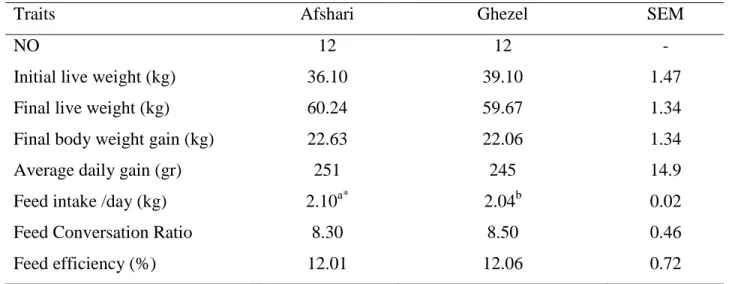
Table 2- The comparative performance in Afshari and Ghezel ram lambs
Traits Afshari Ghezel SEM
NO 12 12 -
Initial live weight (kg) 36.10 39.10 1.47
Final live weight (kg) 60.24 59.67 1.34
Final body weight gain (kg) 22.63 22.06 1.34
Average daily gain (gr) 251 245 14.9
Feed intake /day (kg) 2.10a* 2.04b 0.02
Feed Conversation Ratio 8.30 8.50 0.46
Feed efficiency (%) 12.01 12.06 0.72
*ab: Means within columns with differing letters differ (P≤ 0.05).
The diets were fed seven days for adaptation and seven days for experimental period. Also due the trial plan their feed intake, residual feed and feces were
collected and digestibility of diets and nutrients were investigated (GIVENS et al., 2000).
5 Statistical Analysis
The model used in this study was as a : Yij = µ + Ti + eij*
*Where Yij is the individual observation, µ
is the overall mean, Ti is the effect of
treatment and eij is the remainder effect.
Data were analyzed in a completely randomized design using the GLM of (SAS,
2001), the means were compared with Duncan’s multiple range test.
Result
Data showed that although initial live weight for AF was higher than GH. Data showed that final body weight gain and average daily gain for AF lambs were higher than GH lambs too.
There was a significant difference for feed intake among treatments and feed conversation ratio was better for AF lambs. There is no significant difference between experimental lambs about feed efficiency Table 3. As data observed from Table 3, average nutrients consumption such as total
feed intake, dry matter intake and protein intake were higher for Afshari ram lambs and the intake of ether extract, Neutral detergent fiber (NDF) and acid detergent fiber (ADF) were higher for Ghezel ram lambs. But there were no significant differences between treatments.
Table 3- Average nutrients consumption on Afshari and Ghezel ram lambs
Traits Afshari Ghezel SEM
NO 15 15 -
Total feed intake (gr) 1441 1440 22
Dry matter intake (gr) 1083 1097 16.8
Protein intake (gr) 243 239 3.7
Ether extract intake (gr) 46.9 46.3 0.7
NDF (gr) 214 211 3.3
ADF (gr) 424 419 6.5
*ab: Means within columns with differing letters differ (P≤ 0.05).
According to lambs feed consumptions, phosphorus, calcium and magnesium (4.2, 21.8 gr and 10.4 ppm) were more consumed and zinc, cooper and
iron (34.1, 1.03and 218 ppm) were more consumed for Afshari and Ghezel ram lambs respectively (Table 4).
Karami et al., Revista Brasileira de Higiene e Sanidade Animal (v.14, n.3) p. 1 – 12 jul - set (2020)
6 Table 4- Average consumption of some macro and micro elements on Afshari and Ghezel ram lambs
Traits Afshari Ghezel SEM
No 5 5 - (P) gr 4.2 4.1 0.06 (Ca) gr 21.8 21.6 0.33 (Mg) gr 10.4 10.3 0.15 (Zn) ppm 34.1 34.5 0.52 (Cu) ppm 1.03 1.04 0.01 (Fe) ppm 218 215 30.3
*ab: Means within columns with differing letters differ (P≤ 0.05).
Data from this table showed that among fecal nutrient elements, fecal dry matter, protein, ethyl extract, neutral detergent fiber and acid detergent fiber were
higher for AF ram lambs. These data showed that digestibility of these nutrient elements were lower on AF ram lambs (Table 5).
Table 5. The amount of nutrient excreted in feces on Afshari and Ghezel ram lambs
Traits Afshari Ghezel SEM
No 5 5 -
Fecal dry matter (gr) 594 533 34.7
Fecal Protein (gr) 53.8 46.9 3.7
Fecal ether extract (gr) 5.5 4.7 0.33
Fecal neutral detergent fiber (gr) 152.3 143.5 11.8
Fecal acid detergent fiber (gr) 336.6 279 21.5
*ab: Means within columns with differing letters differ (P≤ 0.05).
Fecal phosphorus, calcium, magnesium, zinc, cooper and iron (1.9 gr, 10.6 gr and 4.9 ppm, 28.7ppm, 14.7ppm,124.5ppm) were higher in LB
compared to R ×LB lambs (1.7 gr, 9.7 gr and 4.3 ppm, 24.9ppm, 11.9ppm,109.1ppm) respectively (Table 6).
7 Table 6. The least square means and standard errors of the mean of some mineral excreted in feces on Afshari and Ghezel ram lambs
Traits Afshari Ghezel SEM
No 5 5 - (P) gr 1.9 1.7 0.10 (Ca) gr 10.6 9.7 0.60 (Mg) gr 4.9 4.3 0.29 (Zn) ppm 28.7 24.9 1.70 (Cu) ppm 14.7 11.9 1.40 (Fe) ppm 124.5 109.1 7.90
*ab: Means within columns with differing letters differ (P≤ 0.05).
The means of in vivo digestibility coefficients of nutrients on AF and GH ram lambs are shown in Table 7. Although there were no significant differences about nutrients digestibility between breeds but
also nutrients digestibility were higher on GH lambs. These data showed that acid detergent fiber digestibility with in vivo method was higher for AF groups.
Table 7. The least square means and standard errors of the nutrients digestibility with (in vivo) on Afshari and Ghezel ram lambs
Traits Afshari Ghezel SE
No 3 3 - Dry matter (gr) 45.8 50.8 34.7 Protein (gr) 77.8 80.4 3.70 Ether extract (gr) 88.3 89.8 0.33 NDF (gr) 64.1 65.8 11.8 ADF (gr) 76.8 74.2 21.5
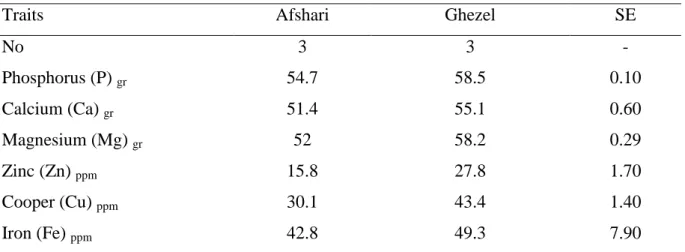
As result relevant by Table 8, the means of in vivo digestibility coefficients of minerals was affected none significantly by animal breeds. Data
showed that digestibility of phosphorus, calcium, magnesium, zinc, cooper and iron were more on R× LB ram lamb.
Table 8. The least square means and standard errors for minerals digestibility with (in vivo) in Afshari and Ghezel ram lambs
Traits Afshari Ghezel SE
No 3 3 - Phosphorus (P) gr 54.7 58.5 0.10 Calcium (Ca) gr 51.4 55.1 0.60 Magnesium (Mg) gr 52 58.2 0.29 Zinc (Zn) ppm 15.8 27.8 1.70 Cooper (Cu) ppm 30.1 43.4 1.40 Iron (Fe) ppm 42.8 49.3 7.90
*ab: Means within columns with differing letters differ (P≤ 0.05).
Discussion
Contrary to our finding, (el fadili et al., 2001) found a significant difference for fattening average daily gain between pure bred and cross bred lambs, in favor of cross breeds. Khaldari et al (2007) reported that there was no significant difference between final and slaughter weight of pure bred and crossbred lambs.Although overweight LB lambs according to their high feed intake, but no increase in feed efficiency lead to increasing the production costs, hence changes in the efficiency of feed utilization in LB lambs cross breeding program is highly regarded (KAZEMI BONCHENARI et al., 2014). Abdullah et al (2010) indicate that crossbreeding Awassi with exotic breeds improves growth rate and meat production. In this study, there are no significantly differences about feed conversion ratio and feed efficiency between R ×LB cross breeds and Lori
Bakhtiari pure breeds. Galivan (1996) showed that the average daily gains after weaning and during the finishing period and dry matter intake in breeding programs are important.
Talebi (2012) demonstrated that with increasing feed efficiency and increased daily weight gain of fattening lambs lead to reduce the fattening period and achieve the ideal faster weight. No significant difference in feed conversion between cross breeds and pure breeds was expressed earlier (GOKDAL et al., 2004). The result of this study are in agreement with (Sayili et al., 2009) demonstrated that lower weight at the start of the fattening period could improve feed efficiency in fattening ram lambs. In the present study there were no significant differences for mineral intake and uptake on AF and GH ram lambs and it was due the lack of significant differences in their feed intake.
9 Esmailizadeh et al (2010) showed that
dry matter intake was significantly influenced by lamb's genotype at different recording periods, except at the fourth one, and total period of the experiment (P≤0.0 5).
Manafiazar et al, (2005) and (Kiyanzad et al., 2005) conducted a feedlot trial involving three Iranian local breeds of sheep (Chaal, Zandi and Zel) and reported that lamb's genotype had no significant effect on average daily gain during a 114-day feedlot period. Although our studies on feed digestibility showed that no significant differences for dry matter, protein, fat, fiber, macro and micro elements but also the better digestibility of attributes mentioned above had shown for R ×LB cross breeds ram lambs (Table 8). It seems that R ×LB cross breed lambs have better ability to adsorption nutrients from the same diet compared to LB pure breeds.
Result of this study in agreement with (Esmailizadeh et al, 2012) that showed there were no significant differences between pure lambs and cross breeds ones about the feed conversion rate. According to the limitation of feed and natural resources and for as much as production efficiency of meat animals can be defined as the return of salable product per unit of feed input, therefore, any reduction in feed cost would have a tremendous effect on production efficiency (Sidwell et al., 1964; Timon, 1986; Lewis et
al., 2010), since the Romanov × Lori Bakhtiari ram lambs had lesser feed intake and better feed efficiency there are more advantageous for farmers.
The positive effects of cross breeding for lambs on better performance of lambs had demonstrated formerly by (Donald et al., 1963).Although (Singh et al., 1967) showed that in some cases cross breeding may decrease the performance of the lambs such as the birth or weaning weight, but the better daily growth rate, better feed efficiency and lesser mortality would be desirable.
Conclusion
We may mentioned that the the existence of breed’s differences for daily dry matter intake and digestibility of dry nutrients. We could be explained some benefit acts by using Afshari breed ram lambs on performance and digestibility of nutrients and minerals. Also Further tests are needed to explore and more detail explanation.
References
ABDULLAH, A.Y., KRIDLI, R.M., MOMANI SHAKER, M., OBEIDAT, M.D., 2010. Investigation of growth and carcass characteristics of pure and crossbred Awasi lambs. Small Ruminant Research, 94, 167– 175.
AOAC.2000. Official methods of analysis, association of official analytical chemists.AOAC press, Gaithersburg, USA. BAHRAMI, Y.A.D. FOROOZANDEH, F.
ZAMANI, M. MODARRESI, S.
Karami et al., Revista Brasileira de Higiene e Sanidade Animal (v.14, n.3) p. 1 – 12 jul - set (2020)
10 2010. Effect of diet with varying levels of
dried grape pomace on dry matter digestibility and growth performance of male lambs. Journal of Animal & Plant Sciences, 6 (1): 605-610.
DONALD, H. P., J. L. READ AND W. S. RUSSELL. 1963. Heterosis in crossbred hill sheep. Anita. Prod. 5:289.
EL FADILI, M., MICHAUX, C.,
DETILLEUX, J., LEROY, P.L., 2001. Evaluation of fattening performances and carcass characteristics of purebred, first and second cross lambs between Moroccan Timahditem, D'man and improved meat rams. Animal Science, 72, 251– 257.Ensminger, Dr. M.E.; R.O. Parker 1986. Sheep and goat ccience, fifth edition. Danville, Illinois: The interstate printers and publishers Inc.
ESMAILIZADEH, A.K.,
MIRAEI-ASHTIANI, S.R., MOKHTARI, M.S., ASADIFOZI, M., 2011. Growth performance of crossbred lambs and productivity of Kurdi ewes as affected by the sire breed underextensive production system. Journal of Agricultural Science and Technology, 13, 701–708.
ESMAILIZADEH, A.K., M. NEMATI, M.S. MOKHTARI, 2012. Fattening performance of purebred and crossbred lambs from fat-tailed Kurdi ewes mated to four Iranian native ram breeds. Trop Anim Health Prod, 44:217–223.
FARID, A.M. MAKARECHIAN AND N. SEFID BAKHT. 1977. Crossbreeding of Iranian fat-tailed sheep. Lamb performance of Karakul, Mehraban and Naeini breeds. J Anim Sci, 44: 542-548.
FITCH, G.Q. 1990.Some ideas about crossbreeding sheep. Oklahoma cooperative extension service, ANSI-3800.
GALIVAN, C, 1996. Breeding objectives and selection index for genetic improvement of Canadian sheep. Ph.D thesis, University of Guelph.174 pp.
GIVENS DI, OWEN E, AXFORD RFE, OMED HM.2000. Forage Evaluation in Ruminant Nutrition, chapter 2, pp.114. GOKDAL, D.; ULKER, H.; KARAKUS, F.; TEMUR, C.; HANDIL, H., 2004. Growth, feedlot performance and carcass characteristics of Karakas and crossbred lambs (F1) (Ile de France×Akkaraman (G1) ×Karakas) under rural farm conditions in Turkey. South African Journal of Animal Science, 34, 223–232.
HUHTANEN, P.; RINNE, M. AND
NOUSIAINEN, J.2007. Evaluation of the factors affecting silage intake of dairy cows: a revision of the relative silage dry-matter intake index. Animal 1: 758-770.
KHALDARI, M.; KASHAN, N.E.J.;
AFZALZADEH, A.; SALEHI, A.
2007.Growth and carcass characteristics of crossbred progeny fromlean-tailed and fat-tailed sheep breed. South African Journal of Animal Science, 37, 51 –56.
KIYANZAD, M.R.J.M.; PANANDAM, N.; EMAMJOMEHKASHAN, Z.A.; JELAN, I.; DAHLAN. 2003. Reproductive Performance of Three Iranian Sheep Breeds. Asian-Australasian Journal of Animal Sciences, 16(1): 11-14.
KJELDAHL protein (crude) determination in animal feed, copper catalyst Kjeldahl method.(984.13) official methods of analysis. 1990. Association of official analytical chemists. 15th Edition.
KOSGEY, I.S.; VAN ARENDONK, J.A.M. AND BAKER, R.L.2001. Breeding objectives for meat sheep in smallholder production systems in the tropics. Proc 52nd annual EAAP meeting, August 26-29, 2001, Budapest, Hungary 1-23.
11 KOSGEY, L.S.; BAKER, R.L.; UDO,
H.M.J.; VAN ARENDONK, J.A.M.
2006.Success and failures of small ruminant breeding programmers in the tropics: a review. Small Ruminant Research, 61, 13 – 28.
LEWIS, R.M.; AND G.C. EMMANTS. 2010. Feed intake of sheep as affected by body weight, breed, sex, and feed composition. J. Anim. Sci. 2010. 88:467– 480.
MANAFIAZAR, G.H.; EMAM JOMEH
KASHAN N.; SALEHI, A.;
AFZALZADEH, A. 2005. Comparison growth and carcass traits of crossbred lambs from Zandi breed with Zel ram. Pajouhesh- Sazandegi, In Animal and Fisheries Science, 18(3):60-56.
MINISTRY OF AGRICULTURAL JAHAD. 2011. Jahad of Agriculture in the mirror of statistics. Ministry of Agricultural Jahad press, Tehran Iran.
MOMANI SHAKER, M.; ABDULLAH, A.Y.; KRIDLI, R.T.; BLAHA, J.; SADA, I.; SOVJAK, R., 2002. Fattening performance and carcass value of Awassi ram lambs, F1 crossbreds of Romanov × Awassi and Charollais ×Awassi in Jordan. Czech Journal of Animal Science, 47, 429–438.
NETO, J.A.S.; OLIVEIRA, V.S.; SANTOS, A.C.P.; ROBERTA DE LIMA VALENÇA, R.L. Distúrbios metabólicos em ruminantes - Uma Revisão. Revista Brasileira de Higiene e Sanidade Animal (v.8, n.4) p. 157–186, out - dez (2014)157.
http://dx.doi.org/10.5935/1981-2965.20140141.
NOORIYAN SOOROR, E. 2000. Estimation of genetic parameters on early growth traits in Ghezel sheep.Agricultur school,Tarbiat Modares University,Tehran, Iran.
RICORDEAU, G.; THIMONIER, J.; POIVEY, J. P.; DRIANCOURT, M. A.;
HOCHEREAU DE REVIERS, M.T.;
TCHAMITCHIAN, L. 1990. Research on the Romanov sheep breed in France: a review. Livestock Production Science. 24 (4¬): 305-332.
ROMANOV. 2008. Sheep breeds. Origin and diversity of North European sheep breeds.
North shed.
http://www.sheep101.info/breedsR.html#Ro manov.
SAS Institute, SAS/STAT User’s Guide for Personal Computer.2001.Release 6.12 SAS Institute, Inc., Cary, N.C., USA.
SATARI, E., FOGARTY, N.M. AND GILMOUR, A. R. 2005. A Review of Genetic Parameter Estimates for Wool, Growth, Meat and Reproduction Traits in Sheep. Livest. Prod. Sci. 92: 271-289.
SATARI, M. 1975. Sheep husbandry in Iran, breeds, feeding and production. Tehran University press, No 1276, Second edition. 328pp.
SAYILI. M,; CIMEN M,; KARAALP, M. 2009. The effects of different initial weight and sex on the fattening performance and economic analysis of fat-tailed lambs in pasture feeding in Turkey. Bulgharian J Agricul Sci. 15: 435-440. SCHNEIDER, B.H AND FLATT, W.P, 1975. The evaluation of feeds through digestibility experiments. Athens, G A. University of Georgia Press.
SHADNOUSH. G.H., GHORBANI, G.R. AND EDRIS, M. A., 2004. Effect of different energy levels in feed and slaughter weights on carcass and chemical composition of Lori-Bakhtiari ram lambs. Small Rumin.
Karami et al., Revista Brasileira de Higiene e Sanidade Animal (v.14, n.3) p. 1 – 12 jul - set (2020)
12 SIDWELL, G.M.; D.O. EVERSON AND C.
E. TERRI, U.1964. Lamb weights in some pure breeds and crosses. J. Anim. Sci. 23:105.
SINGH, B.P.; W.E. REMPD, D. REIMER, H.E. HANKE, K.P. MILLER AND A.B. SALMELA. 1967. Evaluation of breed of sheep on the basis of crossbred lamb.
STERN, M.D.; A. BACH AND S. CALSAMIGLIA. 1997. Alternative techniques for measuring nutrient digestion in ruminants. J. Anim. Sci. 75: 2256-2276. TAVAKKOLIAN, J. 2000. An introduction to genetic resources of native farm animal in Iran.Dep of Ani Scie, Anim Sci Rese Ins, Karaj, Iran.
TALEBI, M.A. 2012. Feed intake, feed efficiency, growth and their relationship with Kleiber ratio in Lori-Bakhtiari lambs. Zootechnica, 15: 4, p33.
TIMON, V. M AND J.P. HANRAHAN. 1986. Small ruminant production in the developing countries
VALIZADEH, R. 2010. Iranian sheep and goat industry at a glance. Indian conference of stress management in small ruminant production and product processing, Jaipur, India.
VAN SOEST, P.J. 1994. Nutritional ecology of the ruminant.2th ed. Cornell University Press. Ithaca, NY, PP. 476.
VATANKHAH, M. 2005. Defining a proper breeding scheme for Lori-Bakhtiari sheep in village system. Ph.D. Thesis, University of Tehran, Iran, 207 PP.
VATANKHAH, M. 2013. Estimation of the genetic parameters for survival rate in Lori-Bakhtiari lambs using linear and Weibull proportional hazard models. J. Agr.Sci. Tech. 15:1133-1143
VATANKHAH. M, TALEBI M.A. 2008. Heritability estimates and correlations between production and reproductive traits in Lori-Bakhtiari sheep in Iran. South African Journal of Animal Science 38(2):110-118. VATANKHAH.M AND F. ZAMANI.2007. Phenotypic and genetic characteristics of longevity in Lori-Bakhtiari sheep. Biotechnology in Animal Husbandry 23 (5-6): 323 – 329.
YULISTIANI D, NAUFALIAH N,
KARDAYA D, SUBANDRIYO. 2015. Nutrient digestibility and growth of five breeds of sheep under different levels of undegradable protein. JITV 20(1): 23-30.