BJRS
RADIATION SCIENCES
07-2A (2019) 01-09ISSN: 2319-0612 Accepted: 2018-08-13
Rare earth elements, U and Th in tunnel dusts of São
Paulo city, Brazil
R. M. Nory
a; A. M. G. Figueiredo
aa
Nuclear and Energy Research Institute, IPEN - CNEN/SP; Research Reactor Center, 5508-000 São Paulo, SP, Brazil e-mail: [email protected]
ABSTRACT
São Paulo is one of the most populated cities in the world, with about 20 million inhabitants in its metropolitan area, more than 12 million motor vehicles and intense industrial activity. Given its importance as a major urban center in South America and the lack of information concerning urban dust composition, the present study aimed to determine rare earth elements (REEs), U and Th mass fractions in tunnel dust, collected in the Jânio Quadros Tunnel, and to assess their possible sources. The study of REEs distribution in urban environments has become of interest over the last decades, due to the increasing industrial use of these elements. The REEs, that are as common as the most familiar metals, are found in metallurgical additives, fluid cracking catalysts and automobile converter catalysts, among other applications. In this study, which employed Instrumental Neutron Activation Analysis (INAA) as analytical technique, the mass fractions of eight REEs were determined and nor-malized to the chondrite concentration values. The results showed that major concentrations were found for light REEs, following the sequence Ce > La > Nd > Sm > Yb > Eu > Tb > Lu. The pattern of the results pointed to a natural origin for these elements. Regarding U and Th concentrations, the results varied between 1.0 – 9.4 µg g-1 and 3.3 – 35.9 µg g-1, respectively. Since there is almost no information about the concentration of these elements in this kind of matrix in São Paulo city, these data are important to support further investigations.
1. INTRODUCTION
Rare Earth Elements (REEs) are a group of metals comprised by the fourteen lanthanide elements, plus yttrium and scandium. They have similar physicochemical properties and are often found to-gether in the same ores and deposits. Despite of the name “rare”, some of them are as common as the most familiar metals in the composition of the Earth’s crust. They are commonly divided into two categories: the light REEs (LREEs), which include lanthanum, cerium, praseodymium, neo-dymium, samarium, europium; and the heavy REEs (HREEs), formed by gadolinium, terbium, dys-prosium, holmium, erbium, thulium, ytterbium, lutetium, scandium and yttrium.
In the last decades, the use of REEs in industrial activities rapidly increased, and, nowadays, these elements are found in several industrial products, such as metallurgical additives, fluid cracking catalysts and automobile converter catalysts, polishing compounds in glasses, rechargeable batter-ies, electronic components in cell phones and flat panel displays, and magnets, among other appli-cations. One of the most important uses of REEs, as above mentioned, is their application to auto-mobile converter catalysts, in which these elements (mainly Ce, La and Nd) help to achieve high levels of conversion of CO, HC and NOx into harmless compounds, such as CO2, H2O and N2. The
main components of these catalysts are precious metals (more commonly Pt, Pd and Rh), and inor-ganic oxides, such as CeO2 and ceria-based composite oxides [1-2].
Regarding this type of application, it is well know that abrasion of automobile catalysts can release metals into the environment, including Pt, Pd, Rh and REEs. This is important because of two fac-tors: the decline of catalytic activity of damaged catalysts, and the consequent release of harmful components into the environment; and the possible consequences of the accumulation of released REEs and other metals, including those concerning human health. Although the associations be-tween the intake of REEs and its consequences to human health are yet a less explored issue and, at the same time, controversial, there is some research pointing to a negative role of some REEs (mainly Ce, La and Gd) in the development or aggravation of some lung, kidney, liver and brain conditions [3-4]. These aspects are of major importance, considering the continuous increase of the automobile fleet, mainly in urban centers and megalopolis, like São Paulo City. São Paulo is one of
the most important regions in South America, with about 20 million inhabitants in its metropolitan area, eight million motor vehicles in its fleet [5] and intense industrial activity.
Despite of this importance, there are still few data on REEs, U and Th concentrations in São Paulo urban dusts, and almost none related to tunnel dust. In previous studies, the concentrations of these elements were only determined in urban park soils [6-7] and in urban street soils of the city [8]. Aiming to give a contribution to fulfill this lack of information, in this study, samples of tunnel dusts were analyzed in order to access its composition, focusing on the determination of the mass fractions of REEs, Th and U.
2. MATERIALS AND METHODS
2.1. Sampling
The dust samples were collected in the Jânio Quadros Tunnel, which is a 1,900 m long tunnel locat-ed in the southeast region of the city of São Paulo, at a distance of 8 km from downtown. Its traffic is characterized by the circulation of light vehicles.
Two sampling campaigns were performed; the first one was held in June 2016 and, the second one, in October 2016. The dust samples were collected using clean polypropylene brushes and pans [9-11], taking extra care on the collection of the finest fractions. The sampling sites were located inside the tunnel, in its mid-section, and comprehended, separately, the traffic lanes (floor) and the pedes-trian catwalk. Amounts of, approximately, 100 g each, were packed in clean polyethylene bags, and properly identified.
2.2. Analytical Procedure
At the laboratory, each sample was oven-dried at 60 °C (FANEM 315 SE), for about 12 h, and was sieved in stainless steel sieves into three different fractions: < 2 mm, < 150 μm and < 63 μm, gener-ating a total of six sub-samples per sampling campaign. Next, the < 2 mm subsamples were grinded in an agate mortar, in order to obtain a fine and uniform dust, suitable for INAA.
Aliquots of 100-150 mg of each one of the sub-samples were weighted (Shimadzu Libror AEL-40SM) and sealed in 1 cm x 1 cm clean polyethylene envelopes. The same procedure was
undertak-en for the certified referundertak-ence materials basalt BE-N and granite GS-N (SARM). All sub-samples and reference materials were, then, irradiated for 8 h at a thermal neutron flux of, approximately, 5 1012 n cm-2 s-1, at the IEA-R1 nuclear research reactor, located at IPEN. The measurements of the induced gamma radiation were done in a gamma spectrometry system, which included a high purity germanium gamma ray detector (Canberra GX20190) and associated electronics. Each sample was measured twice: the first measure occurred 7 to 8 days after the irradiation and, the second one, 7 to 10 days after the first measurement. The quality control of the results was made by the analysis of certified reference material Soil-7 (IAEA), and the results showed relative errors lesser than 10% regarding the certified values.
3. RESULTS AND DISCUSSION
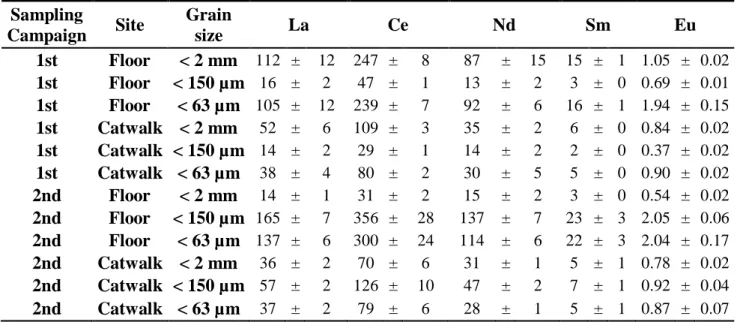
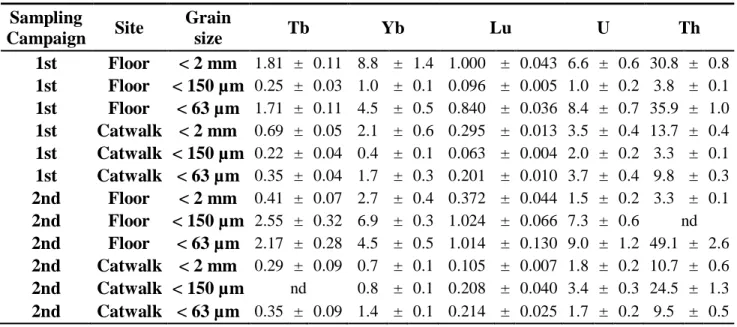
The results obtained for the mass fractions of the analyzed elements are presented in Table 1.
Table 1: Mass fractions (µg g-1) and combined uncertainties (1σ) for REEs, U and Th in
dust samples from the Jânio Quadros Tunnel.
Sampling Campaign Site Grain size La Ce Nd Sm Eu 1st Floor < 2 mm 112 ± 12 247 ± 8 87 ± 15 15 ± 1 1.05 ± 0.02 1st Floor < 150 µm 16 ± 2 47 ± 1 13 ± 2 3 ± 0 0.69 ± 0.01 1st Floor < 63 µm 105 ± 12 239 ± 7 92 ± 6 16 ± 1 1.94 ± 0.15 1st Catwalk < 2 mm 52 ± 6 109 ± 3 35 ± 2 6 ± 0 0.84 ± 0.02 1st Catwalk < 150 µm 14 ± 2 29 ± 1 14 ± 2 2 ± 0 0.37 ± 0.02 1st Catwalk < 63 µm 38 ± 4 80 ± 2 30 ± 5 5 ± 0 0.90 ± 0.02 2nd Floor < 2 mm 14 ± 1 31 ± 2 15 ± 2 3 ± 0 0.54 ± 0.02 2nd Floor < 150 µm 165 ± 7 356 ± 28 137 ± 7 23 ± 3 2.05 ± 0.06 2nd Floor < 63 µm 137 ± 6 300 ± 24 114 ± 6 22 ± 3 2.04 ± 0.17 2nd Catwalk < 2 mm 36 ± 2 70 ± 6 31 ± 1 5 ± 1 0.78 ± 0.02 2nd Catwalk < 150 µm 57 ± 2 126 ± 10 47 ± 2 7 ± 1 0.92 ± 0.04 2nd Catwalk < 63 µm 37 ± 2 79 ± 6 28 ± 1 5 ± 1 0.87 ± 0.07
Table 1 (continued) Sampling Campaign Site Grain size Tb Yb Lu U Th 1st Floor < 2 mm 1.81 ± 0.11 8.8 ± 1.4 1.000 ± 0.043 6.6 ± 0.6 30.8 ± 0.8 1st Floor < 150 µm 0.25 ± 0.03 1.0 ± 0.1 0.096 ± 0.005 1.0 ± 0.2 3.8 ± 0.1 1st Floor < 63 µm 1.71 ± 0.11 4.5 ± 0.5 0.840 ± 0.036 8.4 ± 0.7 35.9 ± 1.0 1st Catwalk < 2 mm 0.69 ± 0.05 2.1 ± 0.6 0.295 ± 0.013 3.5 ± 0.4 13.7 ± 0.4 1st Catwalk < 150 µm 0.22 ± 0.04 0.4 ± 0.1 0.063 ± 0.004 2.0 ± 0.2 3.3 ± 0.1 1st Catwalk < 63 µm 0.35 ± 0.04 1.7 ± 0.3 0.201 ± 0.010 3.7 ± 0.4 9.8 ± 0.3 2nd Floor < 2 mm 0.41 ± 0.07 2.7 ± 0.4 0.372 ± 0.044 1.5 ± 0.2 3.3 ± 0.1 2nd Floor < 150 µm 2.55 ± 0.32 6.9 ± 0.3 1.024 ± 0.066 7.3 ± 0.6 nd 2nd Floor < 63 µm 2.17 ± 0.28 4.5 ± 0.5 1.014 ± 0.130 9.0 ± 1.2 49.1 ± 2.6 2nd Catwalk < 2 mm 0.29 ± 0.09 0.7 ± 0.1 0.105 ± 0.007 1.8 ± 0.2 10.7 ± 0.6 2nd Catwalk < 150 µm nd 0.8 ± 0.1 0.208 ± 0.040 3.4 ± 0.3 24.5 ± 1.3 2nd Catwalk < 63 µm 0.35 ± 0.09 1.4 ± 0.1 0.214 ± 0.025 1.7 ± 0.2 9.5 ± 0.5 nd = not detected
3.1. Seasonality, site of collection and grain size
The obtained data were analyzed in order to assess the influence of seasonality, site of collection and grain size of the dust in mass fractions means. For the elements which presented normal distri-bution, Student’s t-test (seasonality and site of collection) and ANOVA (grain size) were applied. For the others, the non-parametric Mann-Whitney (seasonality and site of collection) and Kruskal-Wallis (grain size) tests were applied. This statistical treatment showed that, for the majority of the analyzed elements, there were no significant difference in the mean values among sampling cam-paigns, sampling sites or grain size, at a significance level α = 0.05. Specifically, differences were found only for Lu, Tb and Yb in relation to site of collection (higher means in floor samples) and for Sc in relation to grain size (higher mean in 63 µm samples).
3.2. Chondrite-normalized rare earth elements patterns
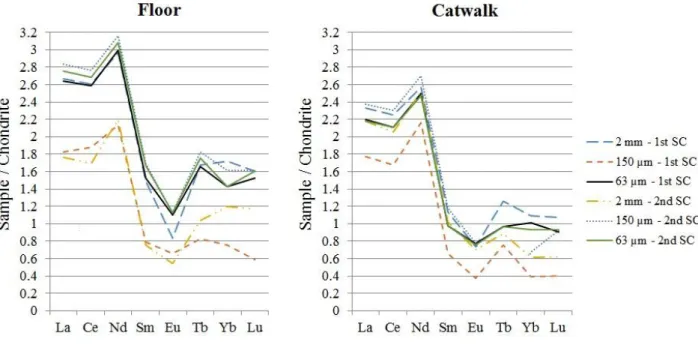
The analysis of the results showed that the mean mass fractions of these elements followed the se-quence Ce > La > Nd > Sm > Yb > Eu > Tb > Lu. In order to display REEs abundances in the stud-ied matrix, chondrite-normalized rare earth elements patterns are presented in Figure 1. Chondrite meteorites were chosen as a normalization factor since they are considered relatively non
fraction-ated samples from the solar system, relfraction-ated to original nucleosynthesis. This normalization elimi-nates natural abundance variation between even and odd atomic number elements and allows the identification of REEs fractionation in the analyzed samples.
Figure 1: Chondrite-normalized REE patterns for the Jânio Quadros Tunnel dust
(SC = Sampling Campaign)
The results presented a pattern that evidenced higher concentrations of the LREEs in relation to HREEs, indicating that concentrations found are compatible to a crustal origin. Supporting this re-sult, La/Ce ratios are approximately the same for all the analyzed samples and similar to that found for chondrites [12].
Europium presents a negative anomaly but, since there is no data for Gd concentrations, it could not be assured. An apparent enrichment of Nd was observed for all the analyzed samples. However, statistical analysis did not signalize any evidence of a possible additional source for this element, as will be discussed in the next section. This will be investigated in further studies.
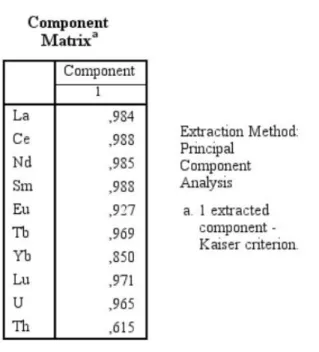
In order to better understand the relationship between elements, the data were also submitted to a multivariate statistics analysis – Principal Component Analysis (PCA). This analysis was made by using the IBM SPSS Statistics software, version 22, adopting the correlation matrix and varimax rotation. The results showed that the elements were grouped in, basically, one major group, as can be seen in the component matrix presented in Figure 2. The extracted component responds for, ap-proximately, 87% of data variance.
Figure 2: Component matrix
These results indicate that the elements have the same origin, probably crustal. There is no evidence of anthropogenic origin. In this environment, vehicle exhausts are expected to be the main contami-nation source, since atmospheric depositions play a minor role in REEs content in soils and similar matrices and tunnels are more protected from this influence because of its partial isolation from atmospheric wind flows and weather changes. In this case, enrichment in the concentrations of La, Ce and Nd, elements commonly found in automobile catalysts, would be expected.
In this study, the mass fractions of REEs, U and Th were determined by INAA in tunnel dust sam-ples from the Jânio Quadros Tunnel, in São Paulo City. The results showed that the mean concen-trations of the studied REEs follow the sequence Ce > La > Nd > Sm > Yb > Eu > Tb > Lu. The chondrite-normalized REEs patterns and multivariate statistics analysis suggested that these ele-ments have the same origin in this environment, probably crustal. The results indicated that there was no evidence of anthropogenic contribution in REEs concentrations in the tunnel dust.
5. ACKNOWLEDGMENT
The authors thank CAPES and CNPq for financial support in the development of this study.
REFERENCES
1. ZHENG, T.; HE, J.; ZHAO, Y.; XIA, W.; HE, J. Precious Metal-Support Interaction in Au-tomotive Exhaust Catalysts. Journal of Rare Earths, v. 32 (2), p. 97–107, 2014.
2. HARRISON, B. B.; DIWELL, A. F.; HALLETT, C. Promoting platinum metals by ceria-metalsupport interactions in autocatalysts. Platinum Metals Review, n. 32, p. 73–83, 1988.
3. RIM, K. Effects of Rare Earth Elements on the environment and human health: a literature review. Toxicology and Environmental Health Sciences, v. 8, p. 189–200, 2016.
4. PAGANO, G.; GUIDA, M.; TOMMASI, F.; ORAL, R. Health effects and toxicity mecha-nisms of rare earth elements—knowledge gaps and research prospects. Ecotoxicology and
Envi-ronmental Safety, v. 115, p. 40–48, 2015.
5. DENATRAN. Frota de Veículos - 2017. Available at:
<http://www.denatran.gov.br/images/Estatistica/RENAVAM/2017/Junho/3_-_Combustível_-_JUNHO_-_2017.xls>. Last accessed: 12 Sept. 2017.
6. CAMARGO, S. P.; FIGUEIREDO, A. M. G.; SÍGOLO, J. B. Uranium and thorium in urban park soils of São Paulo, In: INTERNATIONAL NUCLEAR ATLANTIC CONFERENCE, 2009, Rio de Janeiro. Annals. Rio de Janeiro: Comissão Nacional de Energia Nuclear, 2009.
7. FIGUEIREDO, A. M. G.; CAMARGO, S. P.; SÍGOLO, J. B. Determination of REE in ur-ban park soils from São Paulo city for fingerprint of traffic emission contamination, In:
INTER-NATIONAL NUCLEAR ATLANTIC CONFERENCE, 2009, Rio de Janeiro. Annals. Rio de
Janeiro: Comissão Nacional de Energia Nuclear, 2009.
8. RIBEIRO, A. P.; FIGUEIREDO, A. M. G.; TICIANELLI, R. B.; NAMMOURA-NETO, G. M.; SILVA, N. C.; KAKAZU, M. H.; ZAHN, G. S. Metals and semi-metals in street soils of São Paulo city, Brazil. Journal of Radioanalytical and Nuclear Chemistry, v. 291 (1), p. 137–42, 2012.
9. BARDELLI, F.; CATTARUZZA, E.; GONELLA, F.; RAMPAZZO, G; VALOTTO, G. Characterization of road dust collected in Traforo Del San Bernardo highway tunnel: Fe and Mn speciation. Atmospheric Environment, v. 45 (35), p. 6459–6468, 2011.
10. GUNEY, M.; ONAY, T. T.; COPTY, N. K. Impact of overland traffic on heavy metal levels in highway dust and soils of Istanbul, Turkey. Environmental Monitoring and Assessment, v 164 (1–4), p. 101–10, 2010.
11. VARRICA, D.; DONGARRÀ, G.; SABATINO, G.; MONNA, F. Inorganic geochemistry of roadway dust from the metropolitan area of Palermo, Italy. Environmental Geology, v. 44, p. 222– 30, 2003.
12. PALME, H.; O’NEILL, H. Cosmochemical estimates of mantle composition. In: Holland, H. D.; Turekian, K. K. Treatise on Geochemistry, 2nd ed., v. 3. Elsevier, 2013. p. 1-39.