Carlos Eduardo Dias Coutinho
Licenciado em Engenharia Eletrotécnica, Sistemas e Comunicações
NEGOSEIO: Framework for the
Sustainability of Model
-
oriented Enterprise
Interoperability
Dissertação para obtenção do Grau de Doutor em
Engenharia Eletrotécnica e Computadores
Especialidade Sistemas de Informação Industriais
Orientador: Ricardo Luís Rosa Jardim Gonçalves,
Professor Auxiliar com Agregação, FCT/UNL
Co-orientadora: Adina-Georgeta Bratu
Creţan
,
Assistant Professor, “Nicolae
Titulescu”
University of Bucharest, Romania
Júri:
Presidente: Prof. Doutor José Alberto Cardoso e Cunha
Arguentes:
Vogais:
Prof. Doutor Hervé Panetto
Prof. Doutor Manuel Barata
Prof. Doutor Adolfo Steiger-Garção
Prof. Doutor João Pedro Mendonça
Prof. Doutora Parisa Ghodous
Prof. Doutor António Grilo
Prof. Doutora Claudia-Melania Chituc
Carlos Eduardo Dias Coutinho
Licentiate in Electrical Systems and Communications Engineering
NEGOSEIO: Framework for the
Sustainability of Model
-
oriented Enterprise
Interoperability
Dissertation to obtain the degree of Doctor of Philosophy in
Electrical and Computer Engineering
(Industrial Information Systems)
Supervisor: Ricardo Luís Rosa Jardim Gonçalves,
Auxiliary Professor with Aggregation, FCT/UNL
Co- supervisor: Adina-
Georgeta Bratu Creţan
,
Assistant Professor, “Nicolae
Titulescu”
University of Bucharest, Romania
Evaluation Board:
President: Prof. Doutor José Alberto Cardoso e Cunha
Opponents:
Members:
Prof. Doutor Hervé Panetto
Prof. Doutor Manuel Barata
Prof. Doutor Adolfo Steiger-Garção
Prof. Doutor João Pedro Mendonça
Prof. Doutora Parisa Ghodous
Prof. Doutor António Grilo
Prof. Doutora Claudia-Melania Chituc
NEGOSEIO: Framework for the Sustainability of Model-oriented Enterprise Interoperability
©2012 Copyright Carlos Eduardo Dias Coutinho
©2012 Copyright, Faculdade de Ciências e Tecnologia / Universidade Nova de Lisboa
©2012 Copyright, Universidade Nova de Lisboa
A Faculdade de Ciências e Tecnologia e a Universidade Nova de Lisboa têm o direito, perpétuo e
sem limites geográficos, de arquivar e publicar esta dissertação através de exemplares impressos
reproduzidos em papel ou de forma digital, ou por qualquer outro meio conhecido ou que venha a ser
inventado, e de a divulgar através de repositórios científicos e de admitir a sua cópia e distribuição
com objectivos educacionais ou de investigação, não comerciais, desde que seja dado crédito ao
To Linha, Vido & Nina,
for being the sunshine of my smile
A
CKNOWLEDGEMENTS
After all those years of hard work and research, it is amazing to finally be able to make a brief
pause to recollect what I humbly call “the course to illumination”. I recall with admiration all the places
I’ve been to, the mixed feelings of fear, frustration, luck and gratitude, the growth from nothing into, well, something, and especially the opportunities and the incredible people I’ve had the privilege and honour to share thoughts with. I’m not sure to be able to pay credit to them all, but here’s an attempt.
First of all, my everlasting admiration to my supervisor, Professor Ricardo Jardim-Gonçalves, a
whole section of this thesis wouldn’t be enough to praise your work. Thank you for being so stubborn, for trusting and believing in me against all odds, when my case seemed inevitably lost (so many times)
“sustainably interoperating” through days and nights, pushing me to work harder, to reach farther. Then my big “mulțumesc” to Professor Adina Creţan for your bright ideas, continuous support, counselling, and hard work. In spite of the physical distance, for always being there when I needed.
A word of deep appreciation to Professor Manuel Barata and Professor Steiger-Garção for
inspiring me into starting this amazing journey, so many years ago. Also to journey mates, Carlos
Agostinho, João Sarraipa, David Inácio, Vasco Gomes, José Lima, Pedro Magalhães & Tiago Santos.
I would like to acknowledge the support of the European Commission through the funding of the
FP7 ENSEMBLE, UNITE, MSEE and IMAGINE projects, and the ESA-CDF for their enormous support
and contribution in the development of the business case that was presented in this dissertation. I
particularly wish to highlight the support of Massimo Bandecchi, Sam Gerené and Arne Matthyssen for
so many brainstorming discussions about the ESA-CDF working environment, and to colleagues Ana
Relvas, Arne Tøn, Tore Christiansen, Ray Richardson, and Jochen Haenisch (and many others!) for
their fellowship and support on the OCDS project. Oh, and for teaching me how to ski. Also a thank
you note to Hans-Peter de Koning, Carlos Corral and Tiago Soares for their expert judgement & time.
Moving into my inner circle, I wish to thank Mum Luz, for your restless help and encouragement
through the various ups and downs of this hazard way. Also to my in-laws Domingos, Manuela, and
Sónia for always being there when I needed the most (and for taking such great care of the kids). I’ll never thank you enough for your support, care, and especially, for the precious time you provided me.
To my family, parents, brothers, cousins, uncles… well, as a Goan I have a really large and tight family, and they were all supportive and patient towards my constant unavailability. A special word for
my cousin Florêncio, who taught me how to learn, without whom, I would certainly not be here today.
Also to another cousin, the Most Reverend Archbishop Blasco Collaço, who insisted in meeting me at
the Vatican, near my thesis conclusion, and honoured me with his blessing to this research work.
Finally, and most especially, my wife Carla, and my loving children David and Catarina, please
accept my eternal apologies for being absent and missing some football, karate and ballet exhibitions.
I recall, from my dissertation defence, some words of wisdom from the jury: To my family,
especially my little kids, as they managed to stand there through it all, for so many hours of
discussion, after also standing there for so many years of work. Professor Steiger-Garção told them to
understand it as a good example that life is not easy; perseverance and strength are essential to
achieve our goals. Professor Parisa was surprised that I kept smiling throughout several hours of
intense discussion and exchanging of ideas on the whole defence. When you are performing as a role
model for your children, you should face all challenges with a smile on your face, like the song (“Smile” by Charles Chaplin). That’s what I always taught them, so I couldn’t do less.
A
BSTRACT
This dissertation tackles the problematic of Enterprise Interoperability in the current globally
connected world. The evolution of the Information and Communication Technologies has endorsed the
establishment of fast, secure and robust data exchanges, promoting the development of networked
solutions. This allowed the specialisation of enterprises (particularly SMEs) and favoured the
development of complex and heterogeneous provider systems. Enterprises are abandoning their
self-centrism and working together on the development of more complete solutions. Entire business
solutions are built integrating several enterprises (e.g., in supply chains, enterprise nesting) towards a
common objective. Additionally, technologies, platforms, trends, standards and regulations keep
evolving and demanding enterprises compliance. This evolution needs to be continuous, and is
naturally followed by a constant update of each networked enterprise’s interfaces, assets, methods and processes. This unstable environment of perpetual change is causing major concerns in both
SMEs and customers as the current interoperability grounds are frail, easily leading to periods of
downtime, where business is not possible. The pressure to restore interoperability rapidly often leads
to patching and to the adoption of immature solutions, contributing to deteriorate even more the
interoperable environment. This dissertation proposes the adoption of NEGOSEIO, a framework that
tackles interoperability issues by developing strong model-based knowledge assets and promoting
continuous improvement and adaptation for increasing the sustainability of interoperability on
enterprise systems. It presents the research motivations and the developed framework’s main blocks, which include model-based knowledge management, collaboration service-oriented architectures
implemented over a cloud-based solution, and focusing particularly on its negotiation core mechanism
to handle inconsistencies and solutions for the detected interoperability problems. It concludes by
validating the research and the proposed framework, presenting its application in a real business case
of aerospace mission design on the European Space Agency (ESA).
K
EYWORDS
R
ESUMO
Esta dissertação aborda a problemática da Interoperabilidade em ambientes empresariais no
cenário atual de um mundo interligado. A evolução das Tecnologias de Informação e Comunicação
permitiu o estabelecimento de transmissões de dados rápidas, seguras e robustas, promovendo o
desenvolvimento de soluções em rede. Isto permitiu a especialização das empresas (especialmente
das PMEs) e levou à formação de redes de serviços complexas e heterogéneas. As empresas estão
a deixar de ser auto-centradas, trabalhando em conjunto no desenvolvimento de soluções mais
completas. Soluções de negócio completas são desenvolvidas integrando várias empresas (e.g., em
cadeias de produção, e cooperação empresarial) com vista a um objetivo comum. Além disso, as
tecnologias, plataformas, standards e regulamentos evoluem periodicamente, exigindo conformidade
por parte das empresas. Esta evolução quer-se contínua, e está naturalmente associada a uma
alteração constante das interfaces, conteúdos, métodos e processos de cada empresa. Este
ambiente instável de perpétua mudança está a levar a grandes preocupações, quer por parte das
PMEs como dos seus clientes, dado que o ambiente de interoperabilidade é frágil e pode facilmente
levar a períodos de quebra, em que não é possível realizar-se negócio. A pressão pelo rápido
restabelecimento da interoperabilidade leva frequentemente ao recurso a “remendos” e à adoção de soluções imaturas, contribuindo assim para uma deterioração ainda maior do ambiente de
interoperabilidade. Esta dissertação propõe a adoção da plataforma NEGOSEIO, uma solução que
lida com os problemas de interoperabilidade, desenvolvendo uma sólida base de conhecimento
baseada em modelos, e promovendo a melhoria contínua e a adaptabilidade com o objetivo do
aumento da sustentabilidade da interoperabilidade de sistemas empresariais. Ela apresenta as
motivações para a pesquisa realizada, e os principais elementos da plataforma desenvolvida,
incluindo um sistema de gestão de conhecimento baseado em modelos, arquiteturas orientadas a
serviços colaborativos, realizada sobre uma solução baseada em tecnologias cloud, e principalmente
focando-se na apresentação do seu mecanismo central de negociação para resolução de
inconsistências e decisão das soluções a adotar para os problemas de interoperabilidade detetados.
O documento conclui validando a pesquisa e a solução proposta através da sua aplicação no caso
de negócio real do desenho de missões aeroespaciais na Agência Espacial Europeia (ESA).
P
ALAVRAS-
C
HAVE
T
ABLE OF
C
ONTENTS
1. Introduction ... 1
1.1. Background Observation and Motivations ... 1
1.2. Research Context ... 4
1.3. Research Questions ... 5
1.4. Hypotheses ... 5
1.5. Scientific Research Method ... 6
1.5.1. Definition of Research Question / Problem ... 7
1.5.2. Background / Observation ... 7
1.5.3. Formulation of Hypothesis ... 8
1.5.4. Design of Experiments ... 8
1.5.5. Test and Validation of Hypothesis ... 8
1.5.6. Analysis of Results ... 8
1.5.7. Acceptance by Stakeholders / Industry ... 8
1.5.8. Publication of Findings ... 9
1.6. Dissertation Outline ... 9
2. Research Areas & Literature Review ... 11
2.1. The Multiple Views of an Enterprise ... 11
2.1.1. Literature Review ...11
2.1.2. Research Contribution ...16
2.2. Enterprise Interoperability ... 19
2.2.1. Literature Review ...20
2.2.2. Research Contribution ...21
2.3. Frameworks for Enterprise Interoperability ... 22
2.3.1. Literature Review ...22
2.3.2. Research Contribution ...27
2.4. Sustainable Interoperability ... 27
2.4.1. Literature Review ...29
2.4.2. Research Contribution ...30
2.5. Negotiation ... 34
2.5.1. Agent-Based Negotiation ...37
2.5.2. Agent-Based Software Development ...39
2.5.3. Rules Engine Development ...45
3. Negotiation ... 51
3.1. Negotiation Model ... 52
3.1.2. Interaction Abstract Machines (IAMs) ...54
3.2. Program Formula ... 56
3.3. Negotiation Infrastructure ... 58
3.3.1. Coordination Services in a Closed Environment ...61
3.3.2. Coordination Services in an Open Environment ...61
3.4. Negotiation Component Services ... 62
3.4.1. Outsrc Negotiation Service ...62
3.4.2. Insrc Negotiation Service ...63
3.4.3. Block Negotiation Service ...63
3.4.4. Split Negotiation Service ...67
3.4.5. Broker Negotiation Service ...72
3.5. Negotiation Process Structure ... 73
3.6. Description of the Negotiation Process ... 74
3.7. Agent-based Negotiation Rules Engine ... 77
4. Framework for Sustainability of EI ... 79
4.1. Requirements ... 81
4.2. Methodology ... 83
4.2.1. Knowledge Gathering ...83
4.2.2. Models Building ...84
4.2.3. Creation of Services and Rules ...85
4.2.4. Deployment and Integration ...85
4.3. Architecture ... 87
4.3.1. Multi-Agents System ...90
4.3.2. Semantic Ontologies ...90
4.3.3. Parametric Models ...93
4.4. Application Scenario in a Real Business Case ... 94
4.4.1. Problem Context ...97
4.5. Validation Scenario ... 101
4.5.1. Validation Environment ...106
4.5.2. Storyboard ...106
4.5.3. Test Cases ...107
4.5.4. Challenges ...108
4.5.5. Negotiation Rules ...109
4.5.6. Modules ...110
5. Testing and Validation ... 113
5.1. Functional Testing ... 113
5.1.1. Interoperability problems with growing complexity ...113
5.2. Test Results and Conclusions ... 119
5.3. Hypotheses Validation ... 121
5.4. Validation by Industry/Stakeholders ... 122
6. Final Considerations and Future Work ... 127
6.1. Synthesis of the Work ... 127
6.2. Main Scientific and Technical Contributions ... 129
6.3. Final Considerations ... 131
6.4. Future Work... 132
7. References ... 133
Annex A – Questionnaire on ESA Interoperability ... 143
T
ABLE OF
F
IGURES
Figure 2.1: The influence of People and Technology in MBSE... 13
Figure 2.2: Relation between MDA, MBSE and MSEE/MDSE ... 13
Figure 2.3: The SSME vision ... 15
Figure 2.4: The MSEE/MDSE vision ... 15
Figure 2.5: The servitisation of products (Product as a Service) ... 16
Figure 2.6: Collaborative environment views: Technology and Business + People ... 17
Figure 2.7: Modelling the Enterprise collaborative environment into MDA and B-MDA ... 18
Figure 2.8: The pillars for a Sustainable Enterprise Interoperability (SEI) ... 33
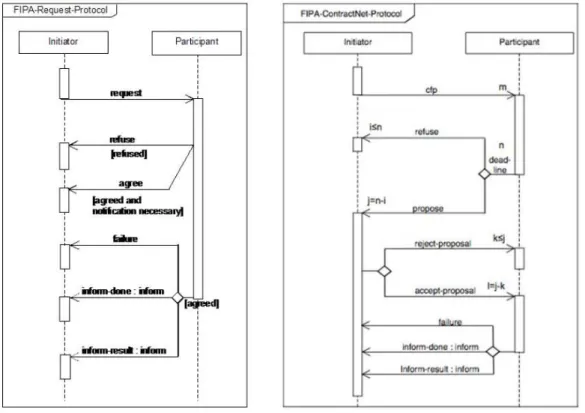
Figure 2.9: The JACK agent development platform ... 40
Figure 2.10: The FIPA protocol for JADE agent communication ... 41
Figure 2.11: The Jason agent development platform ... 42
Figure 2.12: The AnyLogic agent development platform ... 43
Figure 2.13: The JESS rules language ... 46
Figure 2.14: The Drools rules language ... 47
Figure 2.15: The OpenRules suite of tools ... 48
Figure 2.16: OpenRules rules in Excel ... 49
Figure 2.17: OpenRules decision table in Excel ... 49
Figure 3.1: The evolution of agents in the metaphor of IAMs ... 54
Figure 3.2: NEGOSEIO's negotiation levels ... 59
Figure 3.3: The Block negotiation service ... 64
Figure 3.4: The Split negotiation service ... 68
Figure 3.5: The Broker negotiation service ... 72
Figure 3.6: The structure of the Negotiation process ... 73
Figure 4.1: The NEGOSEIO knowledge capture applied to ESA-CDF ... 83
Figure 4.2: The NEGOSEIO methodology ... 86
Figure 4.3: NEGOSEIO proposes multi-levelled Negotiations ... 86
Figure 4.4: The NEGOSEIO conceptual architecture ... 87
Figure 4.5: The NEGOSEIO negotiation rules in Drools ... 88
Figure 4.6: The NEGOSEIO Agent platform implemented in JADE... 89
Figure 4.7: Development of a reference ontology using OWL in Protégé ... 91
Figure 4.8: The MENTOR methodology + Negotiations ... 92
Figure 4.9: Parametric Estimation Model vs Historic data ... 94
Figure 4.10: The ESA-CDF mission design functional diagram ... 95
Figure 4.11: The ESA-CDF room layout (old & new) ... 96
Figure 4.12: CDF domain spreadsheet ... 97
Figure 4.13: The ESA-CDF AS-IS scenario ... 98
Figure 4.14: The ESA-CDF spiral model for iterative assessment... 99
Figure 4.15: The Eclipse GMF development tool ... 102
Figure 4.16: The Eclipse GMF model editor ... 103
Figure 4.17: The ESA-SERDL ontology editor ... 104
Figure 4.18: The proposed TO-BE ESA-CDF environment ... 105
Figure 4.19: The NEGOSEIO proof-of-concept architecture ... 106
Figure 4.20: Questionnaire made by negotiation initiator ... 109
Figure 4.21: Example of Drools rule for negotiation ... 110
Figure 4.22: System Controller connected to Trigger Agents ... 111
Figure 4.23: NEGOSEIO Trigger Agent ... 112
Figure 5.1: Metrics of Restore Time vs. Complexity ... 118
Figure 5.2: Metrics of Restore Time vs. Nr of Participants ... 119
T
ABLE OF
T
ABLES
G
LOSSARY
,
D
EFINITIONS AND
A
CRONYMS
B-CIM: NEGOSEIO’s Business CIM layer;
B-PIM: NEGOSEIO’s Business PIM layer;
B-PSM: NEGOSEIO’s Business PSM layer;
BPEL: Business Process Execution Language;
BPMN: Business Process Model and Notation;
CDF: Concurrent Design Facility;
CIM: Computation-Independent Model;
CS: NEGOSEIO’s Coordination Services;
EI: Enterprise Interoperability;
ESA: European Space Agency;
FP7: European Community’s 7th Framework Programme;
IaaS: Infrastructure as a Service;
IAMs: Metaphor Interaction Abstract Machines;
ICT: Information and Communications Technologies;
INCOSE: International Council on Systems Engineering;
JADE: Java Agents DEveloping Framework;
JESS: Java Expert System Shell programming language;
KLOC: Thousand LOC;
LOC: Lines Of Code;
MAS: Multi-Agent System;
MBSE: Model-Based Systems Engineering;
MDA: Model-Driven Architecture;
MDI: Model-Driven Interoperability;
MDSE: Model-Driven Service Engineering;
MENTOR: Methodology for Enterprise Reference Ontology development;
MSEE: Manufacturing SErvice Ecosystem;
NEGOSEIO: NEGOtiations for Sustainable Enterprise InterOperability framework;
NM; NEGOSEIO’s Negotiation Manager;
OCDS: Open Concurrent Design Server project;
OCL: Object Constraint Language;
OWL: Web Ontology Language;
Pareto Principle: Law of the vital few or 80/20 rule, states that in many situations it can be roughly observed that 20% of the causes are accountable for 80% of the effects;
PIM: Platform-Independent Model;
PSM: Platform-Specific Model;
QoS: Quality of Service;
SaaS: Software as a Service;
SEI: Sustainable Enterprise Interoperability;
SIM: System Independent Model;
SLA: Service Level Agreement;
SME: Small, Medium and Micro Enterprises;
SOA: Service Oriented Architecture;
SSME: Services Sciences, Management and Engineering;
STEP: STandard for the Exchange of Product model data (ISO 10303);
SWOT: Strengths, Weaknesses, Opportunities and Threats;
TIM: Technology Independent Model;
TSM: Technology Specific Model;
UEML: Unified Enterprise Modelling Language;
UML: Unified Modelling Language;
USDL: Unified Service Description Language;
VO: Virtual Organisation;
1. I
NTRODUCTION
“
If you start me up, if you start me up I'll never stop If you start me up, if you start me up I'll never stopI've been running hot, you got me ticking gonna blow my top If you start me up, if you start me up I'll never stop…
”
Start Me Up – Jagger / Richards This section introduces the dissertation and contextualises the developed work. It elaboratesover the field of eliciting problems regarding interoperability, presenting the research environment and
the business case which supported it, detailing the detected problems and setting them as the basis
for a set of research questions and consequent hypotheses to be developed in the subsequent
sections. The chapter concludes with the outlined structure of the remaining document.
1.1. Background Observation and Motivations
Competitiveness. Innovation. Pragmatism. Effectiveness. Proactivity. Improvement. Leadership.
Excellence. Productivity. Environmental-friendliness. Quality. Efficiency. Collaboration. Sustainability.
These are some of the buzzwords that can be found on the motto of every enterprise in the current
days. This is a direct effect of the advent of having a globally available world. To survive, enterprises
have two choices: Either taking a niche market, or going beyond market expectations. Either way, they
must be present, available and they must interoperate.
Technology nowadays seems to surpass all concepts related with information exchange. The
market demand changed a lot from the first information systems, when interoperation was determined
just by being able to consistently exchange data. Since then, Information and Communication
Technologies (ICT) have evolved from little more than wired data exchange to being capable of
providing complex high-performing systems that already handle data reliability over a large bandwidth.
Thus, market needs are moving towards the next step and shifting to Enterprise Interoperability.
Major breakthroughs have been achieved in the near past on this subject: data networking, the
Internet and web-services have contributed to the collapse of the concept of enterprise isolation and
paved the way for businesses to communicate and interoperate.
This quickly led to the growth of service-provider-consumer businesses and directed companies
to specialise and improve their services, moved by the rising competition. The concept of service has
been generalised, as all interactions (e.g., complex computer calculations, graphics design, but also
services that companies can evoke to perform their business. The globalised world has entered the
Service era, where an enterprise produces and consumes services and goods using the internet,
whether these are simple services that provide specific calculations to complex platforms like
Customer Relationship Management (CRM) systems with distributed databases, to producing cars,
houses, tools and other products. Virtualisation and service provisioning are common means of
interoperate; however, this interoperability still relies on sets of agreed message syntax exchanges
and agreements that are fragile and limited in their scope.
The Future Internet concept [1] shall no longer be concerned about data transaction speeds or
data transfer sizes and communication data syntax, but with data reconciliation, service and semantics
understanding. Interoperability needs to evolve to more than messages exchanging; it must rely on
knowledge and share of the involved business models and semantics, in order to achieve a richer
involvement between parties – one that is harder to forget and quicker to be regained, leading to a shorter downtime. Ultimately, this heightens the bonds, trust and confidence between the negotiating
parties, leading to fewer errors in communication and concepts.
Emerging paradigms like the Internet of Things (IoT, which is reshaping the world in the form of
categorized discoverable items) and the Internet of Services (IoS), together with the evolving cloud
computing concepts are gradually transforming the existing reality into a set of available commoditised
virtual objects, services, enterprises and networks.
Competition and high ICT availability have also driven enterprises to evolve by creating
business nests where several enterprises gather their specialisations in the construction of complete
and fully-featured solutions. These business organisations are particularly important when regarding
SMEs, and tend to be very dynamic, with frequent inclusion of new enterprises. Strategic partnerships
and outsourcing are common practices that frequently compete with in-house development.
The globalised market means companies face the availability of multiple possibilities in terms of
suppliers and service providers, partners and customers, but also the growth of competition. Hence, to
be able to be competitive, there is the need to continuously interoperate and seek new partnerships.
The paradigm for each enterprise is shifting from being the most efficient to building the best-suited
business integration. Business success quickly shifts its premises to become a sum of two factors, the
SME’s performance plus its partners/suppliers’ performance. These enterprises thus develop dedicated business areas to handle the seeking for new partnerships for solutions that are aligned
with the enterprise’s strategy, with its inherent need for interoperation, while maintaining the interoperability regarding the current ones.
Competitiveness is also pressuring enterprises to build better solutions with fewer resources,
following new trends and supporting new platforms and methodologies. Business models are
recurrently more complex and detailed. Quality improvements and standards evolve more frequently,
as well as concerns regarding accessibility, expansion, continuous improvement and upgrade,
compliance to new technologies and support of new platforms, frameworks and development
paradigms. Local and global legislation and regulations are updating more frequently and deeply, and
This means a scenario of constant change in the interoperability environment. This move from
enterprise-concentric to service-dispersed strategies, particularly on SMEs, is leading to concerns
about reaching and maintaining the interoperability between customer-provider pairs and its impact on
their associated business networks.
The increasing complexity of processes and interactions between businesses, companies,
providers and customers means interoperability can no further be seen as a tacit and empiric science,
but needs to be well established and founded, with detailed definitions, flows, strategies, procedures
and interactions. Plus, the quality standards for service provisioning have risen, which means the price
of losing interoperability in the current scope may mean the loss of business and credibility in an
irreparable way. Strategies and decisions are increasingly more dependent on interoperability and so
are also the investments and the whole business kernel.
These frequent business changes shake all the interoperability links between the enterprises,
leading to periods of adaptation where business operation is not possible. The urge to rapidly regain
interoperability often leads to unfounded, poorly-chosen solutions, which lead to inefficiency and
rework.
This heterogeneity, constant change and subsequent need for interoperability are also worrying
traditional business areas like finances (banking, insurance), aeronautics and aerospace, which
usually tend to be very conservative towards change on account to accuracy and stability. As an
example, the aerospace industry is served by a small set of large enterprises that implement projects
and missions, and which then subcontract several Small and Medium Enterprises (SMEs) for
supporting their development, thus creating a network of dependencies. The need for interoperability
with the other players in these networks is as crucial for staying in business, as the ability to do so
while maintaining each company’s proprietary business assets protected from the competition.
To large contractors or even final customers like banks and insurance companies, who depend
on the performance of this network of SMEs to conduct their business, the improvement coming from
the specialisation needs to be balanced with the increase on control of the outcomes that result of
multiple sources. The misunderstanding of a concept, a change in a data unit, a mistaken method on a
single enterprise in the network can lead to chained mistakes on its counterparts and consequently to
errors in the final result that are very difficult to detect and even more difficult to trace and resolve.
It is then essential that more than describing data and interface contracts, the interacting
enterprises publish their models, ontologies and methods so that their partners can understand and
cooperate with them easier. Moreover, it is important that a controlling entity (e.g., the prime contractor
or the customer) is able to control if these models and concepts are aligned with the desired outcome.
This is particularly true in the aerospace segment – a competitive and demanding business supported by numerous applications, which vary from general-purposed, specific, proprietary or
open-sourced, all needing to be interoperable and where the interaction between the various business
elements should cause the smallest impact on the business itself. The evolution towards a Future
This research describes common problems that are responsible for breaking interoperability in
businesses among organisations acting in the same industrial market, and proposes solutions to
manage and increase the sustainability of Enterprise Interoperability. It proposes to do so via the
application of negotiations when evaluating interoperability solutions, with the objective of reducing the
impact of changes in the interoperability of the enterprises and their surrounding environment. It
proposes a framework that includes a negotiation mechanism for the management of
enterprise-networked environment changes towards seamless business-to-business interactions.
Negotiation regarding the improvement of tasks and jobs implementation is therefore a task that
despite not being a company’s core business plays a crucial part on its business evolution.
Negotiations often involve several heterogeneous parties, external and internal, using different tools,
languages, platforms and ICT; several internal company areas compete or collaborate with external
parties for the development of a project, or outsource parts of it.
Best practices [4] specify that decision analysis must convey a thorough documentation,
evaluation and analysis of the alternative solutions in order to reach the best solution and learn from it,
to allow the various parties involved in the negotiation need to be interoperable, sharing business,
technical data and information seamlessly.
A strong motivation for dealing with these problems regards the author’s large experience as a project manager in IT projects. Project management best practices [5] state that the most important
assets in projects are predictability and meeting stakeholders’ expectations. This subject is being extrapolated to the field of interoperability, stating that more important than establishing a quick
interoperable link, it is better to focus on providing strong and durable interoperability, which will allow
the pursuit of better solutions and hence avoid rework.
The proper way to handle this is by using simple project management activities like Risk
Management, Scope Management, Time and Cost Management. If all these are applied to
interoperability, then the expected result should be to have a proper and mature way to deal with new
connections with the target of optimising the cost, effort and time to fulfil the demands of a
well-determined scope.
Risk Management adds the capability of mitigation, i.e., the ability to monitor small changes in
the interoperable environment and act accordingly with mitigation strategies with the purpose of
reducing the probability and impact of interoperability changes.
1.2. Research Context
This research benefited from the knowledge and experience developed and acquired following
the participation in the Open Concurrent Design Server (OCDS) project, an European consortium
project which aimed to study and improve the interoperability and systems development of the
This is an environment which involves the critical development of space missions, split in a
multi-disciplinary set and where interoperability is a critical asset, as the entire business is based on
the Concurrent Engineering methodology, which has as its base premises knowledge concentration
and communication as its premises. The ESA-CDF business case is detailed on section 4.4.
The ESA-OCDS project [6] – which regards to the ECSS-E-TM-10-25 Technical memorandum
“System Engineering - Engineering Design Model Data Exchange (CDF)” – outcomes are now being disclosed to other space agencies and the project is heading productisation towards as Open
Concurrent Design Tool (OCDT).
1.3. Research Questions
Based on the state of the art on the actual research (section 2) and the problems described on
section 1.1, the author formulated the following research question:
Can negotiations contribute to improve the sustainability of interoperability in enterprise collaboration?
Based on this question, some sub-questions were elicited:
Will the use of negotiations improve interoperability at the cost of destroying business
secrecy?
How can negotiations improve the establishment of a new interoperable ecosystem?
How can negotiations reduce the time between the loss of interoperability and the
reestablishment of the interoperable state?
1.4. Hypotheses
The stated questions lead to the formulation of a set of hypotheses to be developed:
Sustainability assumes monitoring, control and improvement. The best way to control
and improve a dynamic system and learn from it is by formalising the different
alternatives. After that, clear criteria must fundament the selection of the best
alternative. Applying negotiation processes for this matter formalises another
dimension: the information flows and timings. This promotes interoperability solutions to
maximise their performance, while capturing the knowledge for future improvements;
Negotiations allow enterprises to have a clear definition of what is “public” knowledge that can (and should) be shared, and what is “private” knowledge that needs to be secured for the sake of business secrecy. This promotes a higher transparency of the
offered solutions, methods and interfaces, favouring the collaboration of new and better
The establishment of negotiation processes from the very beginning of the definition of
interoperability solutions favours early analysis of the requirements, best-practices and
experience from the outcomes of previous negotiations help to determine if the
interoperability is possible, and estimate the time, effort and cost it will take to make it
happen. In addition of being able to develop better solutions, this will improve the
predictability of the needs and resources to establish the interoperable ecosystem;
The use of negotiations after the interoperability has been established is important to capture and prioritise the needs and requirements of each participant, which helps on
the decision about determining if a determined change should be adopted by the
participant and the consequences this decision may carry in an eventual loss of
interoperability.
Negotiating the solutions for re-establishing interoperability forces participants to
consider alternative solutions, which favour the achievement of better solutions and
thus to reduce the probability of rework.
1.5. Scientific Research Method
The current research was performed following the classical scientific method. This
methodology, depicted on Table 1.1, defines several steps for the development of research to achieve
the final goal of building a body of knowledge.
Table 1.1: Traditional Research Method steps
Step Description
1 Definition of Research Question / Problem
2 Background / Observation
3 Formulation of Hypothesis
4 Design of Experiments
5 Test and Validation of Hypothesis
6 Analysis of Results
Publication of Findings
7 Acceptance by Stakeholders
Rev
is
io
n
/ R
ed
ef
in
it
1.5.1. Definition of Research Question / Problem
This step concerns a declaration of interest, on stating that there is a science-based topic that
the researcher wishes to address in a different way, or which may provide a different perspective. It
states the researcher focus and determines the information that is required to be understood, hence,
the scope of the research.
In this research, various thematic disciplines are being tackled, including but are not limited to:
Model-Driven Engineering / Architectures / Interoperability;
Model-Based Systems Engineering;
Manufacturing Services;
Enterprise Interoperability;
Ontologies;
Service-Oriented Architectures;
Cloud Computing;
Negotiation / Negotiation Strategies;
Multiple-agent Systems.
1.5.2. Background / Observation
This step concerns the act of analysing the subjected topic on the field or in further research
and documentation, to contextualise and fundament the research. Considering the current period of
information flood, this step is essential to guide the researcher towards a focused path. In this
research, the procedure performed for the concretisation of this step followed the approach proposed
in the FInES project [7], which concerns the identification of the relevant authors using two tools for
scientific publication analysis (Google Scholar [8] and Harzing’s Publish or Perish tool [9]) to collect for each researched discipline:
The five most cited papers;
The five most interesting titles in the opinion of the researcher (different of the above);
The five most recent publications (different from the above);
The five best-ranked papers (different from the above).
The corresponding analysis resulted in a starting base of twenty papers per analysed discipline;
for each, a brief analysis was performed and a classification assigned. Finally, the highest-quoted
papers were analysed thoroughly. This created the first knowledge base, after which further analysis
1.5.3. Formulation of Hypothesis
This step concerns the elaboration of an educated guess prediction to respond to the research
question. It should be stated in a declarative form, focused and straight to the point. This hypothesis is
the subject of the experiments and validation to be carried in the subsequent research. During this
research work, several hypotheses have been formulated until the final one was determined.
1.5.4. Design of Experiments
This step aims to determine the testing artefacts that are required to be developed in order to be
able to test the proposed hypothesis, always with the vision targeted in answering the research
question. In this research this is performed in section 4.5.
1.5.5. Test and Validation of Hypothesis
This step concerns the actual realisation of the designed experiments to test the hypothesis. In
this research, this step is described in section 5.1. The hypothesis should be validated and supported
by a set of evidence artefacts (performed in section 5.3). There is a possibility that the observations of
the artefacts reach a different conclusion than the one submitted as hypothesis, which may lead to the
need to adapt, revise or redefine the hypothesis, or even reject it and define a new hypothesis.
1.5.6. Analysis of Results
The steps for result analysis regards the collection and interpretation of the data resulting from
the testing and development of conclusions from them (in this research this step was performed on
section 5.2), which may provide output findings for new research or to the extension of the current.
1.5.7. Acceptance by Stakeholders / Industry
The final step of the methodology regards the validation and acceptance of the conducted
activities and outputs, and the recognition by the interested parts (stakeholders, scientific community)
that the research is aligned to their expectations and that its outcomes provides valid conclusions that
contribute to the increasing of the body of knowledge in the researched field. This step may include
the productisation / industrialisation of the researched artefacts and outputs.
In this research, this step was realised by the elaboration of a report about the developed
proof-of-concept which was analysed and validated by several experts of the analysed business case: The
main responsible personnel from ESA-CDF, system engineers and other domain experts performed
an analysis of the proof-of-concept and corresponding report, thus providing an essential feedback
1.5.8. Publication of Findings
Finally, this step is executed alongside with the steps of the methodology regarding results
analysis and acceptance by the stakeholders, and concerns the proper disclosure of the developed
findings. While the research methodology should finish in the acceptance of the research by the
industry, academia or other stakeholders, independently of the publication actions, the latter is
essential towards providing feedback and peer validation.
In this research, a great care was taken in properly and periodically releasing the developed
findings, not only in the scope of academic publications but also in presentations in international
conferences. This resulted in the disclosure of its outcomes to a total of 8 scientific publications,
including at least one in a relevant scientific journal (with SCI impact factor).
1.6. Dissertation Outline
Section 1 (this section) presents the introduction to this document, where its objectives are
stated, together with a clear observation of the researched target and its context, the enumeration and
analysis of problems, which then lead to the elaboration of research questions and to the formulation
of hypotheses. Finally, an analysis of the research methodology is stated and correlated to the work
developed in the other sections.
Section 2 presents the analysis of the main researched areas. This investigation comprises
multiple aspects and analysis related to the theme of Enterprise Interoperability, including the multiple
visions of interoperability, the literature review over several techniques used to improve it, and
presents the author’s own research contributions regarding each subject.
Section 3 presents one of the major focuses of this research, negotiation. It then performs a
thorough analysis over the related literature and proceeds to define the contributions of this research
in the field of negotiations, presenting the models, tools, infrastructure, rules, and processes.
Section 4 describes the proposed framework NEGOSEIO, detailing its motivations, premises,
requirements, components and architecture, and describing thoroughly the methodology that supports
its application in enterprises. It also introduces the context environment that will be the basis for the
validation of the research questions and hypotheses, describing the real problems observed and
reported on the business case, and detailing the implementation that was performed on the
NEGOSEIO framework to adapt to the real business case, describing the solutions that were
performed, and detailing the application of this solution in a proof-of-concept, including the validation
scenario plans and test specifications.
Section 5 presents the testing activities and the outcomes that resulted from these tests in
terms of consolidated analysis and in terms of the reporting results that were validated by the
Section 6 presents a synthetic summary of the work performed during the research, highlighting
the major contributions to science that were achieved and paving the way to the next challenges that
are foreseen to be taken in the current research.
Section 7 presents the list of references to the reviewed literature which contributed for the
outcomes of the performed research.
Annex A is an example of an interoperability questionnaire that was submitted to ESA, and
whose answers were used to determine the problems and requirements on sections 4.1 and 4.4.1.
Annex B is a survey that was sent to ESA for peer technical validation of a report that was sent
presenting the NEGOSEIO framework and regarding its applicability to the presented business case,
2. R
ESEARCH
A
REAS
&
L
ITERATURE
R
EVIEW
“
I want to live, I want to give, I've been a miner for a heart of gold. It's these expressions I never giveThat keep me searching for a heart of gold, and I'm getting old. Keeps me searching for a heart of gold, and I'm getting old.
”
Heart of Gold – Neil Young2.1. The Multiple Views of an Enterprise
To understand the intricate matters of an enterprise for interoperation, it is necessary to gather
and capture the knowledge about it. Considering the enterprise business as a complex system, an
interpretation of the General Systems Theory [10] outlines that the business activity of an enterprise
can be considered a reflex of the conjunction of a wide set of areas. Hence, the outcome of a project
cannot be linearly traced to a single cause. It is instead the result of many internal and external
elements and processes.
Consequently, an enterprise (and its business) can be subject to analysis by multiple views, and
the knowledge to be determined about it is the result of the added weighted contributions of all the
science areas that influence it. While respecting this premise, it is not viable to determine or capture all
the contributions of all the different science areas (e.g., hardware, software, tools, interfaces, but also
business strategies, personal skills and interactions, and even others like beliefs, trends, and fortune).
In the same scope, it can be extrapolated by the Pareto principle that 80% of the enterprise business
is defined by 20% of these science areas, i.e., by focusing on its main contributions, it is possible to
maximise the ratio between the obtained knowledge and the effort to obtain it.
2.1.1. Literature Review
This section presents the literature review on some of the analysed methodologies and
architectures for gathering enterprise business knowledge in a holistic manner, i.e., capturing,
inter-relating and consolidating information coming from multiple views and perspectives of a business.
2.1.1.1. Model-Driven Architectures
The term Model-Driven Architectures (MDA) was coined by the Object Management Group
models into lower-level models, which eventually may result in going down to the level of code
generation [11]. This represented a change of the undergoing paradigm that professed that system
architectures are built by designing and maintaining its code. In this case, the changes are performed
in the models, which are then transformed into code.
This means that interoperability may start from the very enterprise foundations, where it is
easier to discuss business-related concepts and ideas, and then the progressive steps of
transformation into lower-level models may also be synchronised to refine this interoperability, so that
the overhead of transforming the concepts into code is performed by automation tools.
The development paradigm of MDA allows the definition of multiple levels of abstraction in the
modelling of businesses, using descriptive languages and schemes e.g., UML, OCL [12], and UEML
[13] to define the solution foundations. Applications should be designed right from a high-level abstract
Computation Independent Model (CIM) where all business related functionalities, objectives, methods,
context, requirements and definitions are specified regardless of any implementation (i.e., pure
design).
Then, this model shall be subject to transformations into a more detailed Platform Independent
Model (PIM), where the business concepts and rules are converted into activities, tasks, ontologies,
structures and algorithms, although still independently of the underlying platform.
Finally, other vertical transformations and conversions shall turn the PIM into a Platform Specific
Model (PSM), which provides the foundations for the development of the application, now targeted to
a specific platform. Using the proposed framework, changes to any model (CIM, PIM) may trigger
alterations in the other parties’ models, which then, by transformation towards new PSMs, swiftly
change the application towards compliance with the new model.
2.1.1.2. Model Based Systems Engineering (MBSE)
Model-Based Systems Engineering is a science initiative that has been evolving in the industry
area, supported by the International Council on Systems Engineering (INCOSE) and the OMG, which
envisions an object-oriented interpretation of a system. Traditional approaches towards the
development of projects and systems determine the building of documentation to describe the
evolution of the system: requirements, analysis, design, assembly, verification and validation. MBSE
envisages the shift from this document-centric approach to a model-centric approach, based on an
extension of the Unified Modelling Language (UML) known as OMG Systems Modelling Language
(SysML [14]).
Over the last years, the Object Management Group (OMG) and other research entities have
been developing standards for performing model-based engineering of systems, which allow the
determination of models for each domain and for the whole system [15], [16]. The purpose is to use
allowing the specialisation of the system and the exchange of systems information throughout the
different systems domains and tools [17].
The use of these techniques in the studied business case aims to promote a clear
understanding of the complexities in the ESA-CDF environment, in order to facilitate reuse and a
proper understanding of the systems, one that is more semantically aware and oriented, able to define
much more than the traditional hardware and software specifications. It needs to include information
about e.g., organisations, personnel, processes and procedures, quality objectives, requirements,
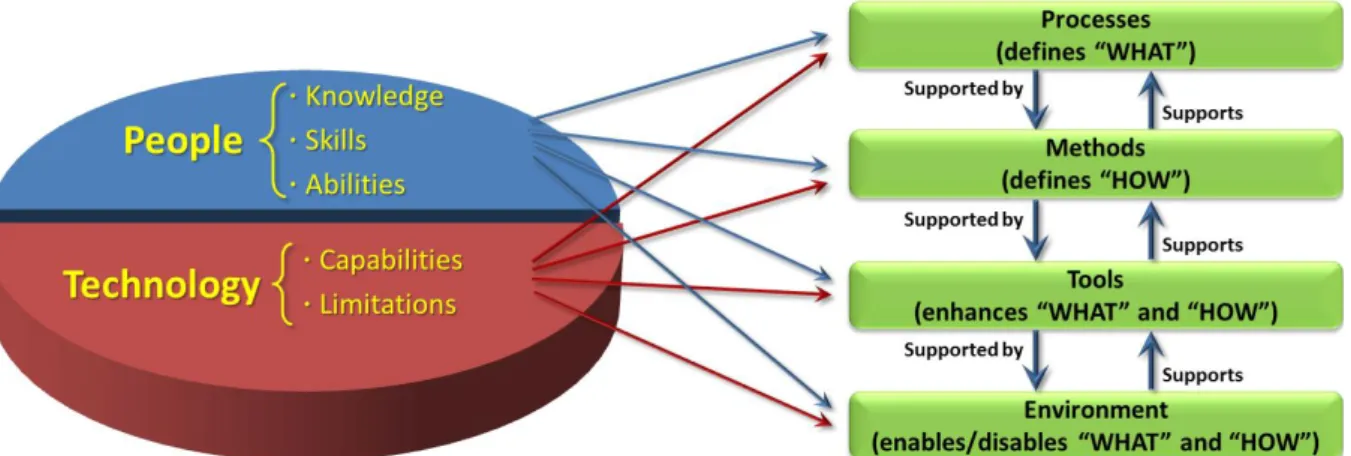
behaviours, hierarchies and structures (see Figure 2.1) [18].
Figure 2.1: The influence of People and Technology in MBSE
Although its purpose is not to define abstraction levels, but to describe systems as a whole, the
current trends in MBSE models are to narrow views with MDA models [19], thus defining multiple
levels of abstraction in the design, description and development of systems, using SysML instead of
UML, as can be seen on Figure 2.2. Within this progressive refinement methodology, a system is
defined in a Systems-Independent Model (SIM), where basilar requirements and capabilities are
specified, as well as enterprise environmental factors, business governance and similar. This SIM
model is thus refined into a Technology-Independent Model (TIM), where a logical model of the
system is developed, together with statistical and mathematical parametric models of the system
behaviour [20]. Finally, the TIM model is transformed into a Technology-Specific Model (TSM),
concerning implementation, automatic system documentation, code and other specific realisations.
While this standardisation is evolving in ESA (e.g., with the definition of standard information
models e.g., ECSS-E-TM-10-25A [21], and the implementation of the Open Concurrent Design
Server/Tool [22]), the transition from document-based engineering to model-based engineering needs
to go beyond the simple architecture and specification. It must involve people, habits, training,
customisation and progressive evolution; otherwise it shall remain a conceptual resolution that will not
be able to be effective in the real-case utilisation. The challenge to build these models is as big as the
difficulty of afterwards maintaining and evolving them.
2.1.1.3. Services Sciences, Management and Engineering
Traditional approaches for analysing and designing a business system focus mainly on its
tangible areas or its direct action items, i.e., functional and non-functional requirements, architecture,
interfaces, databases, specifications and regulations.
The constant evolution of the technology brought an increase of computing capability and
storage, leading to a gradual servitisation of the world. This started with the development and
availability of specific services for performing calculations and other processing tasks, and this
concept has been generalised to the development of architectures based on services (Service
Oriented Architectures, see section 2.3.1.3), and evolved to the servitisation of entire IT structures and
departments, enterprises and environments. Hardware premises have been virtualised and made
available as a commodity in the successful business concept of Cloud Computing (section 2.3.1.4)
and eventually this virtualisation can be (and is being) generalised to a holistic vision where everything
can be seen as a commodity and virtualised to a service. The initiatives towards the Internet of Things
[23], [24], and the Internet of Services [25], [26] are major contributions towards a global availability.
The term Services Sciences, Management and Engineering (SSME) was coined by IBM to deal
with this holistic approach, determining business to be the result of a set of services – the conjunction of people, technology, and organisations to create value [27], towards becoming very adaptive and
flexible, reusable and commoditised. The SSME aims to improve the sustainability of the development
processes, monitoring and controlling assets e.g., the quality, productivity and innovation of services
and the exchange and widespread of services.
SSME vision states that to define a business, more than dealing only with its tangible assets
(hardware, software, and related documentation) – hence Technology, businesses should also be analysed according to their processes, environment, procedures, quality standards, towards achieving
the business optimisation that is needed for being competitive.
SSME also notes that an important asset of businesses is the human factor, i.e. the capabilities
of its human resources and their interactions determine the agility and flexibility of a business. Issues
like motivation, skills, team building and development, leadership, personal involvement and
All these aspects must be developed in the scope of a business vision and strategy, which itself
can be analysed, studied and optimised by statistical methods and Ishikawa (cause-and-effect)
diagrams and analysis towards the creation of servitised strategies that can be reused as business
development frameworks. The overall SSME vision can be depicted on Figure 2.3.
Figure 2.3: The SSME vision
While the SSME group is still active [28], it is currently more focused on academic activities and
initiatives, developing research towards information systems as a service and information
systems-based services.
2.1.1.4. Manufacturing Service Ecosystem
Other initiatives have developed over the SSME concepts, like the Manufacturing SErvice
Ecosystem (MSEE), a consortium project of the ICT Work Programme, of the European Community's
7th Framework Programme (FP7) [29]. MSEE targets to pave the way for service development in
Europe, with the creation of virtual manufacturing factories (Factories of the Future) which shall make
use of extended servitisation for the shift from product-centrism to product-based services, distributed
in virtual organisations and ecosystems.
This project proposed a Model-Driven Service Engineering (MDSE) architecture, largely
inspired in the concepts of MDA and SSME, which accounts enterprise services to be modelled into
three major aspects (views): IT, Machine (and operation) and Human Resources (Figure 2.4). This
modelling relies also on multiple abstraction layers with a progressive refinement. In this case, the
abstractions are developed to define services.
The servitised products (Figure 2.5) are then modelled in a top abstraction layer regarding
Business Oriented Models (BOM). This model describes the information about the service’s product,
the various stakeholders, service levels and indicators, Quality of Service (QoS), human aspects for
organisation, hierarchies, standards and processes. The BOM model is then detailed in a
Technology-Independent Model (TIM), which describes the three aspects (IT, Machine, Human) independently of
the technology which will be used to realise the service. The TIM model is then specialised in a
Technology-Specific Model (TSM) which realise the service in terms of technology, platform,
specifications and documentation (Figure 2.2).
Figure 2.5: The servitisation of products (Product as a Service)
The MDSE models are developed using various specifications, e.g., the EN/ISO 19440
standard [30], the GRAI modelling language [31], the POP* language [32] and the Unified Service
Description Language (USDL [25]).
2.1.2. Research Contribution
The literature review presents a set of initiatives to model an enterprise, which have in common
the vision of defining their modelled subjects in highly abstract specifications which then perform a
progressive specialisation (possibly with the aid of automated tools). While MDA is an established
discipline that is already on the field for some time and is accurate to model technology/IT, the
MBSE/SSME/SMEE views are still evolving and represent an attempt to extend this modelling to other
areas, related to business, strategy and people.
This document thus proposes the vision that an enterprise collaborative environment is also
split in two complementing views, as depicted in Figure 2.6. Reaching and maintaining interoperability
means to capture knowledge about the businesses and detect changes that occur in the collaborative
environment. In this quest, the perception should not only be accounting for changes that are needed
in the technology, but also in business and people interaction. Business changes should actually be
most accountable, as they usually convey deep-impacting changes on the supporting technology.
Human behaviours, flows and interactions acting on the enterprise also play an important role in the
Figure 2.6: Collaborative environment views: Technology and Business + People
In this scenario, the Business + People view provides knowledge about strategies, business
needs, quality requirements, concepts, hierarchies, human relationships, motivation, perception and
understanding, decisions, directions and other intangible definitions. As these are tacit concepts, it is
very difficult to extract specific conclusions directly from them. These then provide the core needs for
the development and shall be captured and consolidated by the technology in the shape of information
systems, ontologies (section 2.3.1.2), Enterprise Resource Planning systems, Customer Relationship
Managers, documents, spreadsheets and other media, defined in the Technology view.
These systems then shall consolidate the tacit information and gather it with other data
regarding functional requirements, architectures, statistics, mathematical statements, technology
specifications and limitations, and hence provide solutions that are able to aid organisations to
improve, whether by being able to respond to technical specifications and solicitations and also by
providing the Business + People with solutions that consolidate the tacit knowledge and support
decisions, which in turn will recursively become new needs to be fulfilled.
The proposed enterprise knowledge gathering activities comprise a holistic approach for
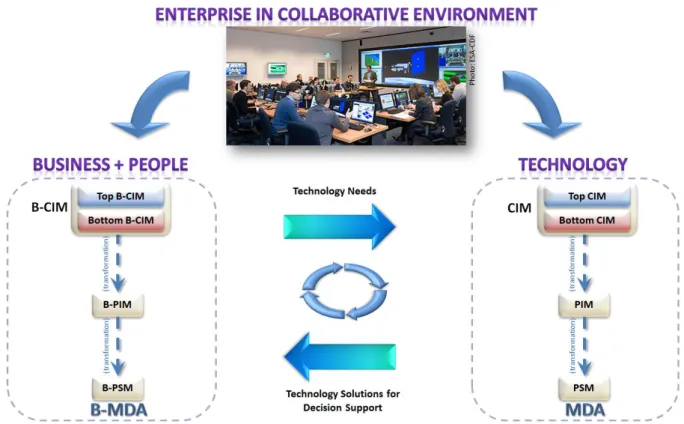
modelling both the Technology knowledge into an MDA architecture and the Business + People
knowledge into a Business-MDA (B-MDA) architecture. In this scope of view, Technology shall be
abstracted into a MDA CIM, which will model system functionalities, user requirements, policies and
constraints, and the Business + People view shall be abstracted into a B-MDA B-CIM, which will
model organisational assets, organisation hierarchies, strategy, processes and quality requirements.
The CIM shall be then transformed into PIM, modelling algorithms and other requirements, and the
B-CIM into a B-PIM, modelling assignments, practices and workflows. Finally, the PIM shall be
regarding documentation, training materials, directives and process activities. The overall picture can
be described by Figure 2.7.
Figure 2.7: Modelling the Enterprise collaborative environment into MDA and B-MDA
Due to the complexity concerning the definition of the CIM and B-CIM models (regarding both
the numerous issues to take into account on the modelling and the transformation of the CIM to PIM),
the CIM and B-CIM layers were each split into two layers [33]: A Top-Level CIM (and B-CIM), which
concerns strategies and abstract functionalities, where a top level specification can be achieved using
enterprise modelling languages such as GRAI; and a Bottom-Level CIM (and B-CIM) which concerns
system requirements, while still independent of any technology, which can be modelled using UML
and thus becomes easier to be transformed to PIM (and B-PIM).
With the analysis of both views of an enterprise, it becomes clear that though they are different,
both can benefit from servitisation, i.e., from the definition of services that when combined and
properly orchestrated perform the desired functionalities. While the benefits of servitisation on the
Technology view are often described on literature, little is said on the Business and People view.
Servitisation in this context encompasses the adoption of standard behaviours, best-practices [4],
better management and technical decisions, alternatives analysis and especially, predictability over
the human factor, which is essential for decisions.
The gathering of knowledge and a proper modelling of this knowledge is an essential step
towards understanding the needs and specificities of each business. This action has many
applications for the future:
It allows proper understanding of each own business, thus promoting control,