Influence of the built environment on physical activity and its relationship
with childhood obesity: A systematic review and meta-analysis
Influência do ambiente construído na atividade física e sua relação com a
obesidade infantil: Revisão sistemática com meta-análise
DOI:10.34117/bjdv6n10-001
Recebimento dos originais: 01/09/2020 Aceitação para publicação: 02/10/2020
Meirielly Furmann
Mestrado em Desenvolvimento Comunitário Universidade Estadual do Centro Oeste
Rua Professora Maria Rosa Zanon de Almeida (Bairro Engenheiro Gutierrez) 84505-677 Irati –PR [email protected]
Luis Paulo Gomes Mascarenhas
Pós- Doutor
Universidade Estadual do Centro Oeste
Rua Professora Maria Rosa Zanon de Almeida (Bairro Engenheiro Gutierrez) 84505-677 Irati –PR [email protected]
Samily dos Santos Silva
Graduada em Fisioterapia
Universidade Estadual do Centro Oeste – Mestranda em Desenvolvimento Comunitário Rua Professora Maria Rosa Zanon de Almeida (Bairro Engenheiro Gutierrez) 84505-677 Irati –PR
Denise Barth Rebesco
Mestrado em Desenvolvimento Comunitário Universidade Estadual do Centro Oeste
Rua Professora Maria Rosa Zanon de Almeida (Bairro Engenheiro Gutierrez) 84505-677 Irati –PR [email protected]
Fernanda Maria Antunes da Silva
Mestrado em Atividade Física
Faculdade de Ciências do Desporto e Educação Física, Universidade de Coimbra Avenida de Conimbriga, Santa Clara, Pav 3, 3040-248 Coimbra
Aristides Machado Rodrigues
Doutorado em Ciências do Desporto e Educação física
Faculdade de Ciências do Desporto e Educação Física, Universidade de Coimbra Avenida de Conimbriga, Santa Clara, Pav 3, 3040-248 Coimbra
Marcio Cascante Rusenhack
Mestrado acadêmico em Ciências do Movimento Humano, Universidade de Costa Rica Universidade de Coimbra
Avenida de Conimbriga, Santa Clara, Pav 3, 3040-248 Coimbra [email protected]
José Pedro Leitão Ferreira
Doutor
Faculdade de Ciências do Desporto e Educação Física Avenida de Conimbriga, Santa Clara, Pav 3, 3040-248 Coimbra
ABSTRACT
Background: Childhood obesity is understood as a health problem of concern due to the changes it
can cause in the development process. Being the physical activity and the built environment important influencers in this process. The authors aimed to analyze studies of the last ten years, checking the relationship between the level of physical activity, the built environment and obesity. Methods: This is a systematic review and meta-analysis, conducted through PubMed, B-on and Web of Science, using the terms (obesity child* AND physi* activit*) AND (obesity child* OR overweight you*) AND (built environment). To evaluate the quality of the studies, the PRISMA tool and the STROBE index were used. Five studies were selected and their data were analyzed by the Comprehensive Meta-Analysis V.3. Results: It can be stated that there is an inverse relationship between the evaluated aspects (obesity, built environment and physical activity), presenting a negative correlation of 0.026 with p = 0.0001. The results of the Z test = -4.050, where the ease and availability of physical activity places are related to childhood obesity levels. Conclusions: Childhood obesity may be inversely related to the built environment, due to the ease and availability of places for physical activity.
Keywords: childhood obesity, overweight, physical activity, built environment. RESUMO
Introdução: A obesidade infantil é entendida como problema de saúde preocupante em função das
alterações que pode causar no processo de desenvolvimento. Sendo a atividade física e o ambiente construído importantes influenciadores neste processo. Objetivo: Analisar estudos dos últimos dez anos, verificando a relação entre o nível de atividade física, o ambiente construído e a obesidade.
Metodologia: Trata-se de uma revisão sistemática com meta-análise, feita através das bases de dados
PubMed, B-on e Web of Science, utilizando os termos (obesity child* AND physi* activit*) AND (obesity child* OR overweight you*) AND (built environment). Para a avaliação de qualidade dos estudos utilizou-se a ferramenta PRISMA e o índice STROBE. Foram selecionados 5 estudos, os quais tiveram seus dados analisados pelo programa Comprehensive Meta Analysis V.3. Resultados: Pode-se afirmar que há relação inversa entre os aspectos avaliados (obesidade, ambiente construído e atividade física), apresentando uma correlação negativa de 0,026 com p=0,0001. Os resultados dos do teste Z=-4,050, onde a facilidade e disponibilidade de locais para a prática de atividade física tem relação com os níveis de obesidade infantil. Conclusão: A obesidade infantil pode estar inversamente relacionada ao ambiente construído, pela facilidade e disponibilidade de locais para a prática de atividade física.
1 INTRODUCTION
Obesity is considered a multifactorial disease that affects a large part of the world population, including the child population in increasing proportions. Therefore, it becomes a worrying health problem due to the consequences and limitations it can cause in the lives of children, especially in their development process.
The practice of physical activity is seen as one of the determining factors in the prevention and treatment of obesity, associated with a healthy diet1. However, it is known that for the practice of physical activity to become regular, factors that encourage and facilitate the same2. Among the many that exist, one of the factors is the environment in which the child is inserted, either due to the accessibility to places that allow the practice of physical and leisure activities, or the habits of the people with whom they live and that encourage them to develop this type of behavior3,4.
Thus, this study aims to analyze the researches carried out in this perspective in the last ten years, in order to identify the relationship between the level of physical activity predisposed by the environment in which the child is inserted and the condition of obesity, and even which others are possible influencing factors of this association.
2 METHODS
This study consists of a systematic review of the literature and meta-analysis, whose purpose was to analyze recent scientific articles found in different databases on childhood obesity and the practice of physical activity according to the built environment in which the child is inserted.
For the selection of articles, the Pub Med, B-On and Web of Science databases were used, after the selection of terms using the PubMed MesHplatform. The research was carried out using the terms in Portuguese and English in the same way in all databases, according to the availability of the system. The select terms were used as follows: obesity child* AND physi* activit*) AND (obesity child* OR overweight you*) AND (built environment), being also described in Portuguese.
Only original studies, in English or Portuguese, from the last ten years (2009 to 2019) were included, which addressed the topic of childhood obesity related to the level of physical activity due to the built environment in which the population in question were included.
Review studies were excluded, those that did not use a sample of the child population, or that failed to address one of the aspects of the theme, or that addressed these associated with other factors such as the main characteristics of the analysis made by the study, such as socioeconomic indexes, ethnic factors, among others, which may be described in the study in an additional way, being a possible influencing factor as moderating variables.
For the selection of the studies, all titles and abstracts of the identified articles were screened and the articles that presented full text were evaluated as to the potential for inclusion in the investigation. All studies that linked the level of physical activity in children according to the built environment and obesity rates were included in the final selection.
The evaluation of the quality of the studies was carried out using the items of preferential report for systematic reviews and meta-analyzes PRISMA, which is described in four stages, these being identification, screening, eligibility and final selection, which are important for the accomplishment of this type of study, also presenting a flowchart of this process5. Besides, we opted to use the report on strengthening observational studies in epidemiology (STROBE), with each item assessed described in detail in others studies6. This method consists of a checklist with22 items, which features a manuscript based on the quality assessment it presents. After applying the above criteria, the total score of the 22 items was assigned a value of 100%, then using the percentage value to identify studies in which the low quality assessment could interfere with the results of the study.
3 STATISTICAL ANALYSIS
For the analysis of the data, the program Comprehensive Meta-Analysis V.3 was used, where an analysis of the association between the practice of physical activity and childhood obesity was performed according to the built environment in which the population of each of the studies was inserted, through the correlation values and the sample size in each study, and thus verifying the results of the data. The magnitude of the effect size and levels of statistical significance was set at p≤0.057. Heterogeneity was measured usingchi-square, Cochran's Q, Higgin I square (I2) and Tau square tests (T2), assuming that a T2> 1 suggests the presence of substantial heterogeneous statistics. The publication was evaluated by visual inspection of the scatterplot generated by the EGGER test.
4 RESULTS
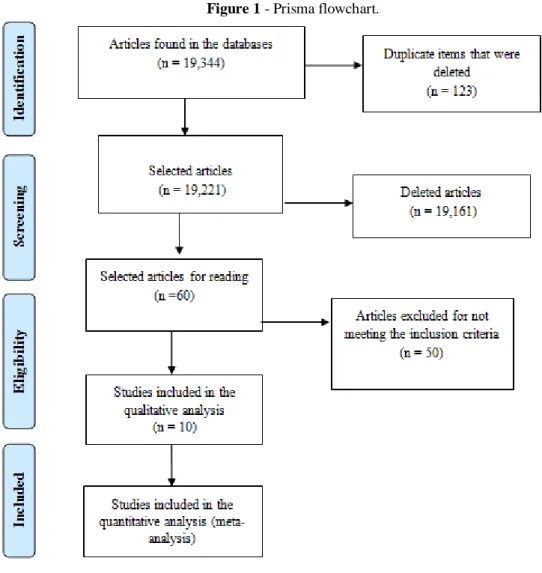
Figure 1 describes the selection process of the studies carried out according to the PRISMA method, using a flowchart, where 19344 studies were initially found, and of these only 123 were duplicated in the 3 databases used, being analyzed first. Initially 19221 studies, of which 60 studies were identified by reading the title of each study, analyzing whether it had inclusion criteria for further analysis of abstracts, the remaining 19161 studies were excluded because they did not have the characteristics defined for inclusion in the study, such as population, type of analysis, or one of the main criteria of physical activity, built environment and obesity. Subsequently, the summary, objectives, methodology and results of each of the 60 studies selected in this stage were read, and of these 50 were excluded, for reasons such as there was no correspondence between objectives and
results, or methodology that did not correspond to what was proposed in the study, and only 10 were selected for complete and detailed reading. Finally, 5 articles were selected, which met the inclusion criteria on time and, mainly, made the association between childhood obesity, physical activity and the built environment.
Figure 1 - Prisma flowchart.
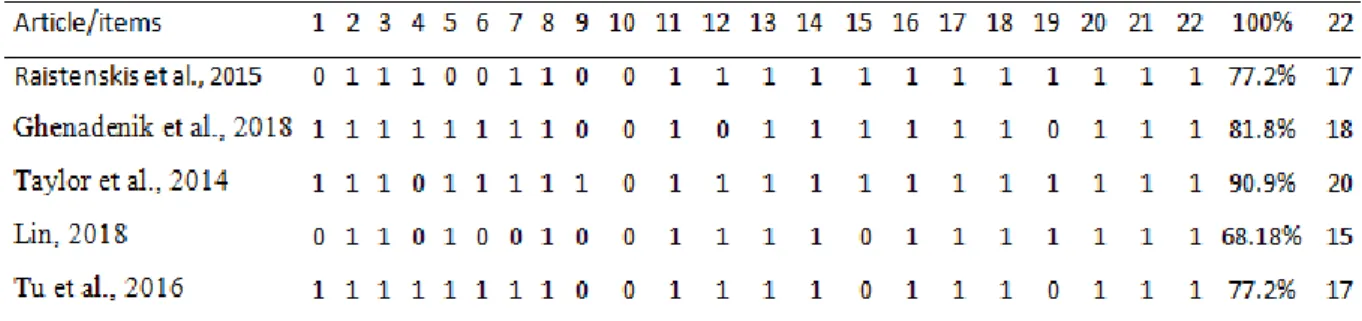
Table 1 shows the STROBE analysis carried out containing the 22 criteria and their final score through the percentage ratio established. It is possible to observe that all studies are in a classification above 60%. In the five studies we obtained a total sample with 24,934 participants, in four different countries (Lithuania, China, Canada and USA), with an average age of 9.56 years, of both sexes.
Table 1 - Evaluation of the quality of the studies using the STROBE analysis.
Table 2 describes the five studies selected for the meta-analysis with their main characteristics, used for their evaluation.
In the analysis of the magnitude of the effect size, which can be seen in Figure 2, we found the results about the central hypothesis of this systematic review, where we sought to assess the influence of the built environment in the practice of physical activity and its relationship with the obesity in children, based on the assumption that children with a higher rate of obesity are those who have a lower level of physical activity due to the low availability and ease of this practice offered in the built environment in which they are inserted.
According to the data obtained, it can be said that there is an inverse relationship between the evaluated aspects, where there was a correlation of –0.026, with a lower and upper limit of -0.038 and -0.013 respectively, with p = 0.0001, observed in the values described in figure 3. The results of the Z test values show that we must reject the null hypothesis, whose value was -4.050, as this way we understand that the facility and availability of places for physical activity are related to the levels of Child obesity.
Figure 3 - Descriptive statistics for each study and overall results of the meta-analysis.
To determine whether the observed variation is within the range attributed to the error and to test the null hypothesis according to which all studies involved in this systematic review study share magnitude of common effects, the Cochran's Q test (Q) was used. If all studies share the same magnitude of effects, the expected value of Q would be equal to degrees of freedom, that is, the number of studies minus 1. The value obtained from the Q test was 17.432, with 4 degrees of freedom. In this analysis, the value found was statistically significant (p <0.002), accepting the alternative hypothesis, that is, the true magnitude of the effect varies from study to study.
The I2 statistics correspond to the ratio between the real heterogeneity of the total variation of the observed effects, that is, it tells us what the proportion (percentage) of the observed variance reflects the differences in the real magnitude of the effect. The value obtained from I2 = 77.053, means that 77% of the variance reflects the true effect. Tau squared values (T2) correspond to the effect size variance between studies, T2 = 0.003.
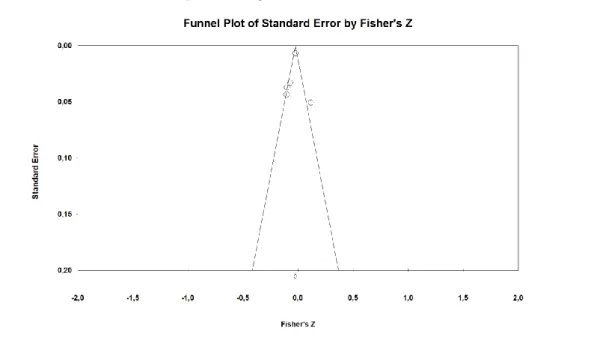
To assess the hypothesis of publication bias in addition to visual analysis of the funnel plot, the EGGER test was performed, adopting a confidence interval (CI): 95% and degree of freedom for the null hypothesis according to which the intercept is equal to zero. The results found were -0.736, with a standard deviation of 1.461 and the lower and upper limit values of -5.387 and 3.913 respectively. The t-value was 0.504, with p = 0.648, and degree of freedom (gl) = 3, which indicates that the studies used in this analysis do not present significant publication bias.
5 DISCUSSION
According to the results obtained in this meta-analysis, we can say that childhood obesity can be related to several factors, including the environment and its geographical conditions, infrastructure and especially accessibility. That offers places that allow the practice of physical activity. However,
it is known that there are also other factors that may be related to the association of the existence of obesity and the environment in which the child is inserted.
In the study it was observed that there is a relationship between the home environment and the levels of PA and obesity, having as a complementary factor the question of sedentary time in TV time, besides that when the comparison with safety and low neighborhood deprivation, children living in urban areas were more likely to be obese than children in rural areas, due to sedentary lifestyle8. Therefore, not only the type of environment and the presence of places that allow PA, but also safety, limited time in media and the development of other habits, influences on the obesity index, corroborating the study carried out with Portuguese children aged 7 to 9 years, who found a positive association between time on TV and the risk of central adiposity9.
Another important factor that must be considered is related to social and economic aspects, such as described in studies developed in China and the USA10,11. Where the fact that children live closer to school makes them more active than those who live at a greater distance, due to the ease of active mobility that this factor offers, also associated with the issue that the comfort characteristics of the environment, directly related to socioeconomic issues, such as family income and parents' educational level, encourage physical activity and are negatively associated with obesity, similarly observed in other study developed in the USA12, who found relationship between the low socioeconomic index and the prevalence of obesity, and the study who observed that children from larger socioeconomic backgrounds are more likely to be exposed to healthier lifestyles and that this leads to inequalities in the prevalence of obesity13.
Living in large centers or small cities is also considered a relevant aspect for the development of physical activity practices according to a study carried out in Lithuania, where children living in small cities have a higher rate of obesity and less activity moderate to vigorous physical activity than children living in large cities14. This finding corroborates the studies that compare the rural and urban environment, where rural children are less active and have a higher prevalence of overweight and obesity8, and thus it is suggested that investigations in this area assess disparities in the accessibility and availability of healthy food and beverage options and safe physical activity locations in rural areas15.
Although studies show that children in the urban area have lower risk levels for obesity, interventions in this area are still necessary, as the rates also depend on other factors that take into account the infrastructure of cities, such as the presence of sidewalks. for pedestrians, cyclists, for example, who can be considered important influencers in facilitating physical activity, as in the study developed in Canada it was observed that the presence of sidewalks has an inverse relationship to childhood obesity due to the higher level of activity, because it allows them to perform commuting
activities over short or long distances, which can already be considered a physical practice of light to moderate intensity16.
The strategies to reduce obesity must start from a global analysis of the environment and its several factors that increase the predisposition of this condition, in addition to physical activity and sedentary time, as well as sleep habits, food, socioeconomic aspects, for example. Furthermore, there is a need to understand that regardless of the location and access to the practice of physical activity, what also influences the practice with great impact is the habit, possibly influenced by the habits of those with whom the child lives as well as through their encouragement. physical activity practices.
In this way, it is understood that the practice of physical activity does not depend exclusively on a suitable place designated for such, but on the interest and perception of its benefits for health and development, in this case with even greater impact because it is the child population, demonstrating the need to understand not only the meaning of the relationships between the built environment and the children's weight status, but taking into account other possible risk factors.
The need for further studies that address this topic is quite evident, suggesting that an even broader approach should be taken, encompassing all possible aspects related to the topic in question, and also with different means of evaluation, such as inclusion accelerometry for a more reliable measurement of the level of physical activity.
6 CONCLUSION
The ease and availability of places to practice physical activity has an inverse relationship with the levels of childhood obesity, regardless of the cultural context in which the child is inserted. However, this is not the main factor that predisposes to the low index of physical practice as a causal factor of obesity. In this way, this study contributed to reinforce the idea that much still needs to be clarified concerning childhood obesity, physical activity and its correlated factors, for each environment and its characteristics.
REFERENCES
1. Carvalho EAA, Simão MTJ, Fonseca MC, et al. Obesidade: aspectos epidemiológicos e prevenção.
Rev Med Minas Gerais. 2013;23(1):74-82. doi:10.5935/2238-3182.20130012
2. Hayes JF, Balantekin KN, Conlon RPK, et al. Home and neighbourhood built environment features
in family-based treatment for childhood obesity. Pediatr
3. Machado-Rodrigues A, Santana A, Gama A, et al. Parental Perceptions of Neighborhood Environments, BMI, and Active Behaviors in Girls Aged 7-9 years. Am J Hum Biol. 2014;26(5):670-675.doi: 10.1002/ajhb.22577
4. Sharifi M, Sequist TD, Rifas-Shiman SL, et al. The role of neighborhood characteristics and the built environment in understanding racial/ethnic disparities in childhood obesitiy. Prev Med. 2016;91:103-109.doi: 10.1016/j.ypmed.2016.07.009
5. Panic N, Leoncini E, de Belvis G, Ricciardi W, Boccia S.Evaluation of the endorsement of the preferred reporting items for systematic reviews and meta-analysis (PRISMA) statement on the quality of published systematic review and meta-analyses. PLoS One. 2013;8(12):e83138. doi: 10.1371/journal.pone.0083138
6. Malta M, CardosoLO, BastosFI, MagnaniniMMF, SilvaCMFP. Iniciativa STROBE: subsídios para a comunicação de estudosobservacionais. Rev SaúdePública. 2010;44(3):559–565.
7. Batterham AM, Hopkins WG. Making meaningful inferences about magnitudes. Int J Sports
Physiol Perform. 2006;1(1):50–57.
8. Tu AW, Mâsse LC, Lear AS, Gotay CC, Richardson CG.Exploring the mediating roles of physical activity and television time on the relationship between the neighbourhood environment and childhood obesity. Can J Public Health.2016;107(2):e168–e175. doi:10.17269/cjph.107.5268 9. Machado-Rodrigues AM, Valente-dos-Santos J, Fernandes R, et al.Waist-to-height ratio and its association with TV viewing in a sample of Portuguese children aged 7–9 years. AmJ HumBiol. 2017;29(5):e23024.doi: 10.1002/ajhb.23024
10. Lin L. Leisure-time physical activity, objective urban neighborhood built environment, and overweight and obesity of Chinese school-age children. J TranspHealth. 2018;10:322– 333.doi:10.1016/j.jth.2018.05.001
11. Taylor WC, Upchurch SL, Brosnan CA, et al.Features of the Built Environment Related to Physical Activity Friendliness and Children’s Obesity and Other Risk Factors. Public Health
Nurs.2014;31(6): 545–555. doi: 10.1111/phn.12144
12. Rogers R, Eagle TF, Sheetz A, et al.The Relationship between Childhood Obesity, Low Socioeconomic Status, and Race/Ethnicity: Lessons from Massachusetts.Child Obes. 2015;11(6):691–695.doi: 10.1089/chi.2015.0029
13. Gray LA, Alava MH, Kelly MP, Campbell MJ. Family lifestyle dynamics and childhood obesity: evidence from the millennium cohort study. BMC Public Health. 2018;18(1):1-15.doi: 10.1186/s12889-018-5398-5
14. Raistenkis J, Sidlauskiene A, Cerkauskiene R, Burokiene S, Strukcinskiene B, Buckus R. Physical activity and sedentary screen time in obese and overweight children living in different environments.
Cent Eur J Public Health. 2015;23suppl:S37–S43.doi: 10.21101/cejph.a4184
15. Liu JH, Jones SJ, Sun H, Probst JC, Merchant AT, Cavicchia P. Diet, physical activity, and sedentary behaviors as risk factors for childhood obesity: na urban and rural comparasion. Child
Obes. 2012;8(5):440-448. doi: 10.1089/chi.2012.0090
16. Ghenadenik AE, Kakinamid L, Van Hulstf A, Hendersonf M, Barnetth TA. Neighbourhoods and obesity: A prospective study of characteristics of the built environment and their association with adiposity outcomes in children in Montreal, Canada. Prev Med. 2018;111:35–40.doi: 10.1016/j.ypmed.2018.02.018