Swe Zin Linn Phyu
UMinho|20 12 Julho de 2012 Sw e Zin Linn Ph yu Human T rafficking and Human (In)Security
: The R
ole of The St
ate of My
anmar as A Security Pro
vider
Human Trafficking and Human
(In)Security: The Role of The State of
Myanmar as A Security Provider
Dissertação de Mestrado
Mestrado em Relações Internacionais
Trabalho realizado sob a orientação da
Professora Doutora Ana Paula Brandão
Swe Zin Linn Phyu
Julho de 2012
Human Trafficking and Human
(In)Security: The Role of The State of
Myanmar as A Security Provider
É AUTORIZADA A REPRODUÇÃO INTEGRAL DESTA TESE/TRABALHO APENAS PARA EFEITOS DE INVESTIGAÇÃO, MEDIANTE DECLARAÇÃO ESCRITA DO INTERESSADO, QUE A TAL SE
COMPROMETE;
Universidade do Minho, ___/___/______ Assinatura: ________________________________________________
Acknowledgement
I would like to express my sincere gratitude and heartiest thinks to my advisor Professor Ana Paula Brandão for her guidance, valuable suggestions and continues encouragement throughout the study period.
I would also like to express gratitude to the member of the committees for their valuable remarks. I would like to express my deepest gratitude to the donors.
I would like to thank to all related departments and data collecting in the study area.
Special thanks are due to my family, especially my beloved mother, my brother, Mr. Thoeung Puthearum for their kind helps in everything. And also very big thanks are to be extended to my teachers who have taught and been teaching me since I started attending the school until the present time.
My thankfulness is also extended to Aunty Ann for her valuable advice to my study. I am grateful to all of my classmates, friends (from the University of Minho and outside) and neighbors for sharing happiness, experiences and encouragements during my study at University of Minho.
Tráfico de Seres Humanos e (In)Segurança Humana: O Papel do Estado Birmanês enquanto agente segurador
Resumo
O ser humano é confrontado com problemas de insegurança, tais como tráfico de seres humanos, migração ilegal, pobreza, degradação ambiental, pirataria e crimes transnacionais resultantes da globalização. A grande maioria das mulheres e jovens birmanesas são atraídas pelas redes de traficantes, que trabalham em grupos organizados ou individualmente. As vitimas são levadas para a Tailândia e vendidas como prostitutas. As causas e as ameaças à segurança individual são escalpelizadas em dois tipos de insegurança: insegurança de saúde e insegurança pessoal. O presente estudo sugere ser de crucial importância que o estado birmanês proteja ativamente os seus cidadãos de forma a colmatar as suas falhas enquanto agente segurador. Assim, procede-se à análise das ações do estado em três níveis. A nível nacional, socorrendo-nos de uma bordagem interligada, cujas componentes são: “liberdade do medo”, “liberdade para viver com dignidade” e “liberdade da necessidade/desejo”. Consideramos tratar-se de um modelo a seguir. Identificámos uma série de lacunas no enquadramento legal birmanês e a respetiva aplicação. Importa, assim, determinar se o governo se compromete a fazer cumprir o código de conduta dos direitos humanos. Em todo o caso, importa sublinhar que o estado parece mais envolvido com as questões de segurança do estado do que com a segurança humana. Finalmente, de referir que a atitude nacional para estas questões não tem grande impacto ao nível da cooperação regional e internacional da Birmânia. Todavia, são questões passíveis de provocarem sérios constrangimentos ao nível da cooperação bilateral, requerendo para tanto esforços mútuos.
Human Trafficking and Human (In)Security: The Role of The State of Myanmar as A Security Provider
Abstract
Nowadays, people of the world face with non-traditional security issues such as human trafficking, illegal migration, poverty, environmental degradation, piracy, terrorism and transnational crime because of the effect of globalization. The vast majority of Myanmar women and girls fall victims to the deception of traffickers who work in organized groups or individually. They are taken across the border to Thailand and are sold into prostitution. Causes and threats to individual security are pointed out with regards to two types of insecurity: health insecurity and personal insecurity. The study suggests that it is crucial and urgent that Myanmar government actively protect its citizen at its best with the least flaws as possible. We analyze the state’s actions at three levels. At the national level, using interconnected approach, whose components are ‘freedom from fear’, ‘freedom to live in dignity’ and ‘freedom from want’. It is a good method to follow. A number of gaps within the Myanmar’s legal instruments and implementing entities are found. The question is to determine whether the government is committed itself to enforcing and abiding itself by the human rights code of conduct. Most of the government’s actions focus upon state security other than human security. The national distraction does not impact much upon Myanmar government’s regional and international cooperation. The only issue arises in bilateral cooperation and the solution requires mutual efforts.
Acronyms AFXB Association Francois-Xavler Bagnoud
ARCPPT Asia Regional Cooperation to Prevent People Trafficking ARTIP Asia Region Trafficking in Persons
ASEAN Association of Southeast Asian Nations ATTF Anti-Trafficking Task Forces
ATU Anti-Trafficking Unit
CAC Convention against Corruption
CBSTP Central Body for Suppression of Trafficking in Persons CC Cervical Cancer
CEDAW Convention on the Elimination of Discrimination against Women COMMIT Coordinated Mekong Ministerial Initiative against Trafficking CRC Convention on the Rights of the Child
CRC Canadian Religious Conference
CTOC Convention on Transnational Organized Crime DSW Department of Social Welfare
ESCAP Economic and Social Commission for Asia and the Pacific FPIA Family Planning International Association
GAO Government Accountability Office
GAATW Global Alliance against Traffic in Women GDP Gross Domestic Product
GMS Greater Mekong Sub-region HDI Human Development Index
HIV/AIDS Human Immunodeficiency Virus infection/ Acquired Immunodeficiency Syndrome HPV Human Papilloma Virus
HRD Human Resource Development
IEC Information, Education and Communication IOs International Organizations
IOM International Organization of Migration ILO International Labor Organization
INGO International Non-Governmental Organization MCAT Treaty on Mutual Assistance in Criminal Matters MFA Ministry of Foreign Affairs
MMCWA Myanmar Maternal and Child Welfare Association
MNCWA Myanmar National Working Committee on Women Affairs MoHA Ministry of Home Affairs
MoU Memorandum of Understanding MPF Myanmar Police Force
MRCS Myanmar Red Cross
MRLC Mekong Regional Law Center
MWAF Myanmar Women's Affairs Federation MYF Mekong Youth Forum on Human Trafficking NGO Non-Governmental Organization
NPA National Plan of Action PPCs Project Concepts
PTSD Post-Traumatic Stress Disorder SC (UK) Save the Children (United Kingdom)
SIREN Strategic Information Response Network SOM Senior Official Meeting
SOMTC Senior Officials Meeting on Transnational Crimes SPA Sub-regional Plan of Action
SPDC State Peace and Development Council STD Sexually Transmitted Disease
STI Sexually Transmitted Infection TIP Trafficking in Persons
UN United Nations
UNAFEI United Nations Asia and Far East Institute UNAIDS Joint United Nations Programme on HIV/AIDS
UNCTOC United Nations Convenstion Against Transnational Organized Crime UNDCP United Nations International Drug Control Program
UNDP United Nations Development Program UNODC United Nations Office on Drugs and Crime
UNIAP United Nations Inter-Agency Project on Human Trafficking UNICEF United Nations Children’s Fund
UK United Kingdom US United States
Index
Introduction 1
Chapter 1 Human security and human trafficking: theory and concepts 9
1.1 Theoretical framework 9
1.2 Human trafficking and human security 12
Chapter 2 Human trafficking: an overview 21
2.1 The overview of human trafficking 21
2.1.1 Human trafficking in the world 21
2.1.2 Human trafficking in Myanmar and Thailand 28
2.2 Who are the victims? 37
Chapter 3 Human trafficking in Myanmar: threats to human security 39 3.1 Causes of human trafficking among Myanmar citizens 39 3.2 The threats of human trafficking to individual security 41
3.2.1 Health insecurity 41
3.2.2 Personal insecurity 44
Chapter 4 The role of Myanmar state as a security provider: 47 a critical appraisal
4.1 The national level 47
4.2 The regional level 59
4.3 The international level 71
Summary and conclusion 77
List of Figures
Figure Title Page
Figure 1 Conceptual framework 9
Figure 2 An interconnected human security approach 11 Figure 3 Countries of human trafficking origin 21 Figure 4 Countries of human trafficking destination 22 Figure 5 Estimation of numbers of victims trafficked into forced labor by region 22
Figure 6 Trafficking routes across Myanmar 29
List of Tables
Table Tittle Page
Table 1 Victim profiles in US Government, International Labor Organization (ILO), 15 UNODC and International Organization of Migration (IOM) databases
Table 2 Trafficking affects the mental and physical health 25 Table 3 Gross Domestic Product (GDP) and Human Development Index (HDI) 31
of Myanmar and Thailand 1990
Table 4 Human Development group of GMS countries 32 Table 5 Number of victims of trafficking or potential victims of trafficking 33
identified by border liaison offices or anti-trafficking task forces
Table 6 Repatriated trafficking victims 2004-2010 34
Table 7 Human trafficking cases 51
Introduction
The term "trafficking" is defined in different ways by different organizations and entities. Trafficking in human beings is a dynamic, tangled issue in which economic, political, social and cultural factors are interrelated. Human security is
“not only concerned with gross violations of human rights, armed conflicts, and natural disasters but encompassed wide-ranging aspects of underdevelopment; inequality, public health, international crime, population growth and environmental degradation”.
(Tadjbakhsh and Chenoy 2007)
Each victim has his or her own story, and it is not possible to generalize about emerging and growing issues in different communities and different countries of origin (Alkire 2003). However, human trafficking occurs in similar circumstances and follows similar paths to various forms of exploitation at its end point.
Human trafficking leads to loss of human rights of victims. Bertrand Ramcharan (2002), a UN human rights expert, says human rights actually define human security “to be secure is to be safe, protected. Security is a secure condition or feeling”. International human rights norms provide the center point for the meaning of human security. Human rights, which are connected with the rule of law, are the only one of the apparatuses of human security. Human rights or rule of law is defined as the “fundamental liberal assumption that individuals have a basic right to life, liberty and the pursuit of happiness” (Hampson et al. 2002, 5) and that the international community has an obligation to protect and promote these rights (Matthew 2005). Once human rights are respected, the core spirit of human security is achievable. In other words, individual, national and international security is attainable through upholding human rights, without which illegal activities pervasively pose threats to world peace. In terms of a series of trans-border challenges, the United Nations Development Program (UNDP 1994) reports that uncontrolled population growth, environmental degradation, economic opportunities disparities, excessive international migration, trafficking and narcotics production, and international terrorism are roots of human rights abuse.
“Whether it is for citizens or non-citizens, migrants or displaced persons, members of a minority or an indigenous community, the essence of human security is to respect the rights and fundamental freedoms that have been distilled and articulated by the international community”
Trafficking in persons impacts on almost all of the countries in the world, including, Myanmar and Thailand. It cannot be tackled by one country alone. The ever changing challenges have pushed world leaders to suggest new cooperative approaches for coping with this momentous issue. It requires that the two governments have to take a number of actions to combat it (United States 2007). Since 1999, increased law enforcement in relations to the commercial sex industry in Thailand has led to a decline in the number of brothels. While brothels still exist, more commercial sex services are now taking place in hidden forms, which makes investigation difficult (Hemming and Piper n.d.). Karaoke bars, go-go bars, massage parlors, hotels, restaurants and cafés became venues where "indirect" sex services are offered. Whether the initial migration steps were voluntary or involuntary, the end-situation in a migratory journey to a sex establishment is often exploitative.
With the aim of suppressing the terrible crime of trafficking in persons, the Myanmar Government has acceded to many international, regional and bilateral anti-trafficking instruments and has drawn up and promulgated a number of new laws, which are in conformity with these instruments (United States 2007). The country is also actively participating in cooperative measures with its Association of Southeast Asian Nations (ASEAN) neighbors and other countries, with international agencies and organizations (IOs) as well as with Non-governmental Organizations (NGOs) in its drive to eliminate human trafficking within the country and in the region as a whole (UNODC 2006).
Human trafficking is a criminal and illegal trading of human beings for the purpose of exploiting their labor (UNODC 2006). Trafficking is often linked with women and girls sold into prostitution. Opening of Myanmar's border and increased economic trade have also had direct and indirect influence on the trafficking through migration since 1989. Indeed, labor migration between Myanmar and Thailand has a long tradition. Because of the traditions of free flow across the borders, people movement in the region is characterized by the use of primarily irregular channels for migration (UNODC 2003). Therefore, the movement of people crossing the border has become widespread and it can easily conceal human trafficking.
Trafficking in persons is by all accounts a global issue. It is the third largest organized crime in the world. This seriousness of this crime and the growing number of its victims have challenged the international community, government, non-governmental organizations as well as the civil society to wage for a zero tolerance to this crime. This issue has to be handled by every nation of the world at all levels. The clandestine nature of the crime makes it extremely difficult to
give estimates about the number of victims worldwide. Human trafficking issue cannot be tackled by one country alone. Therefore, international cooperation is necessary in addressing the problem. In Asia, in particular in the Greater Mekong Sub-region (GMS), organizations have together to undertake a number of initiatives to combat this issue. Myanmar has been conscious of Trafficking in Persons since 1990. After the Fourth World Conference on Women at Beijing in 1995, Myanmar Government initiated measures to combat the issue at the national level with four strategies. Moreover, national task force was also formed and visited the hotspot areas including villages. In order to suppress human trafficking person, the anti-trafficking in persons law was promulgated in 2005. In the context of trafficking law, it is not only giving punitive action against perpetrators but also protection, reintegration to the victims.
Relevance and delimitation
The purpose of this research project is to analyze the role of the Myanmar Government in the fight human trafficking, specifically the traffic of women between Myanmar and Thailand. It will consider the different levels of action – domestic, regional and international. The period of the analysis is from 1988 on because since the late 1988 up to the present, Myanmar situation had undergone profound changes due to the unrest over economy management and prodemocracy demonstration that change the country 180 degree (Yawnghwe 1995). As far as the non-state actor concerns, we add up a certain arguments found in documents of IOs as well as NGOs during the recent years.
The objectives of the research are: to analyze the evolution of the human trafficking between Myanmar and Thailand; to identify the main threats to individual security of the victims; to assess measures implemented by the Myanmar as a state actor providing security in the fight against human trafficking; to assess human trafficking related roles of non-state actors such as IOs and NGOs; to assess cross actor cooperation between the state actor and non-state actor.
Research questions and hypothesis
The main research question for this thesis is how Myanmar government has fought against human trafficking in order to provide security to the victims. To find the solution of this question it will be necessary to research human trafficking and the operation of trafficking networks.
Therefore, several sub-questions are to be dug out which include why human trafficking occurs between Myanmar and Thailand, what the consequences of human trafficking to the victims are, what measures are being implemented by the Myanmar government, and the measures do focus on the protection of individual security of the victims. There will be a quest for answer to a question of the role of NGOs specific to the crime of trafficking in persons.
In this matter, we will have to debate on different decision angles whether they can be approved that leads to our ultimate objective of analysis. To begin the analysis, we will put up a debate on whether Myanmar government, in dealing with human trafficking, has enacted several laws, fully addressing every aspect of its own people’s security provision. In the title of a human security provider, Myanmar government exposes itself to facing challenges regarding the rules of law, enforcement against criminal act perpetrators, revising legal instruments in response to up-to-date developments regionally and globally. For effectively achieve the best possible results, the government cannot act all alone; thus cooperative approaches, both between/among securitizing bodies, which are states, and between state and non-state actors, are keys to catalyze the trafficking combating process.
Case study
Since the independence in 1948, disputes between the democratic government and ethnic groups led this weakened independent political administration to an eventual a military coup in 1962. In fact, the domestic enmities have poured down in the country since the early independence era as the ethnic minorities require the chance of equal independence from the Union1. Hoping to regain stability, the Military government took over the country, launched a new economic program that have isolated Myanmar from the rest of the world and later turned the country, which was initially known as the second wealthiest country in Asia, into one of the world's most impoverished countries. As a result, in 1987, the United Nations (UN) listed Myanmar among the least developed countries due to the catastrophic economic programs one after another. Under military rule, the undemocratic Myanmar, until 2008, was deeply rooted in a unipolar regime dominating other ethnic groups and seizing strong grips over the rules of laws. As part of Tatmadaw’s (the Myanmar Armed Forces) “four cuts strategy” - an attempt to cut off four key supplies (food, funds, intelligence, and recruits) to the insurgents, pervasive abuses towards
those minorities have been reported with social, cultural, and economic rights deprivations (Pimoljinda 2010) that include coercions such as forced eviction, destruction of homes, and livelihood isolation. As a result, a large number of refugee camps have been set up along the border. Some refugees, without many choices, take risk in jobs that are vulnerable to forced labor (International Displacement Monitoring Center 2010). In combination with coercive pressures, the economic bankruptcy, with a serial of devastating reforms, influences incentives of people to make massive economic migrations.
As discussed above, although one principle reason for the migration of vulnerable people is notably due to poverty, the main factor underlying such movements is political commitment to reform. As part of the study, Thailand case is raised as a supporting fact. Thai economy relies heavily on cheaper labor forces from illegal migrants, including children. Those undocumented workers are often trafficked with by brokers on both sides of the border. Besides, there are many cases that corruption culture prevails among immigration police at border checkpoints on both sides.
Many actions have been raised for discussion in state’s endeavor to fight cross-boundary trafficking in persons. Myanmar government has enacted several laws in a bid to prevent crimes, protect victims and prosecute criminals. It has joined other countries in the region and the world for cooperative battles. It is a signatory in many conventions on trafficking in persons. It has made many achievements in the three piers of the prevention, protection and prosecution.
However, there exist many arguments regarding the source motives for the continuation of problems. First of all, there is a widespread doubt whether the military Junta government has put proper efforts to curb its backward economic movement and looks into augmentation for genuine economic growth. Secondly, even though law enforcement has been promoted, it is reported that severe forms of human trafficking, both in and outside its international boundary, persist since the root causes have not been contemplated. The government uses domestic violence to take control of insurgencies that some of the times the suppression is made over the limit of rule of law. This provides a hypothesis to be confirmed that while Myanmar law enforcement agencies attempt to save human trafficking victims, much less attempts are laid down to prevent human trafficking cases and uphold victims’ conditions within its boundaries. The existence of laws aiming at preventing offenses does not provide adequate move towards suppressing the crimes. It requires the government to look into a genuine enforcement. It should also be noted that inputs from
non-state actors are substantially important in dealing with the problems. The pressure imposed can be considered a powerful force in bringing, if not significant, gradual behavioral changes.
Furthermore, to understand thoroughly the questions of how and why the human trafficking persists for decades even if many attempts have been put, it is equally important to examine factors from external boundary. Even though sex industry, exploitative labors are unlawful in Thailand, perpetrators are relatively punishment-free. This immunity takes a large part in an indirect source of trafficking that undermines the efforts of trafficking prevention provided by neighboring countries. Therefore, there is a dire need that the state of Myanmar demonstrates binding pledges in improving the situation, economically and politically, and, of course inevitably, in collaboration with non-state actors. Besides, there is also a quest for a mutual effort between neighboring countries to effectively eradicate trafficking in persons.
Methodology
This research will use qualitative methods, and will focus on the theoretical and empirical assessments of collected data to verify with law, policy and implementation of the focus states. We will produce analysis methods to describe Myanmar's attempt to solve human trafficking issues with Thailand. However, quantitative data also will be used to clarify the phenomenon. The study approach of King et al. (1994) proves to be a good fit for analyzing in our case as they have produced precepts that promise to sharpen and strengthen a wide range of research performed in analysis field. These leading scholars, each representing diverse academic traditions, have developed a unified approach to valid descriptive and causal inference in qualitative research, where numerical measurement is either impossible or undesirable.
By doing this research, the source materials used will include primary data such as Agreements and Memorandum of Understanding (MoU), official laws, speeches and secondary data such as, books, journals articles, reports, research works, conference papers and newspapers.
The first chapter will explain about human security theoretical framework in order to encompass human security and trafficking theory and concept, framework, and human security and original crime. It then proceeds to include research questions and objectives. The second chapter will discuss about human trafficking between Myanmar and Thailand. We go for preliminary insights of the theme by characterizing problems and collecting debates of human
trafficking between Myanmar and Thailand, general connections of human security and human trafficking presented in numbers, percentages, and charts showing its importance within global trafficking network. Chapter 3 will identify the threats of trafficking to individual security. We dig out consequences, especially negative impacts of human trafficking together with the so-called “type of people” (gender) who suffer from, for instance, abuse, abduction, detention, etc. Main reasons and how victims are stuck in the evil situation are also explored. The last chapter “The Myanmar Government as a provider of security: domestic, regional and international action against human trafficking” will provide what the governments and other relevant entities have done to prevent human trafficking at national, regional and global levels by looking at both countries’ cooperation both international and internal? We also bring down measurement of both states’ implementations of their respective roles stated by laws made and ratified by the focus states in tackling human trafficking. And consequently, we will answer a question whether any quest for human security of Myanmar government contributes to state security.
Chapter 1
Human security and human trafficking: theory and concepts
1.1 Theoretical framework
Responsibilities of each actor fall under unitary and joint actions. Actors may work in their own territories or join hand in hand with entities/states/non-states of different and similar functions within the framework in order to achieve successful goals.
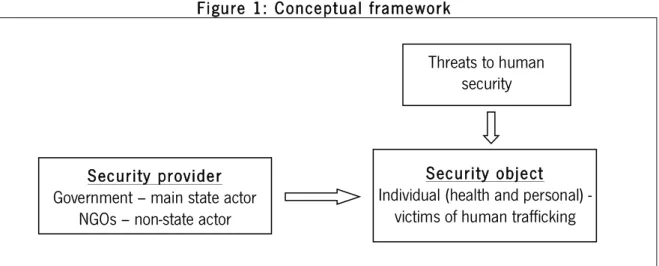
In the conceptual framework illustrated in Figure 1, it demonstrates state actor as a security provider while non-state actor as a problem identifier and solver as well as a loophole identifier and sealer. A state actor makes policies while a non-state actor adopts the policies for implementation in their programs and identifies any problems and loopholes within the policies. The latter usually makes possible of certain solutions by themselves, transmitting those findings to policy makers. The non-state actor, if necessary, makes proposals to the government for policy amendments and subsequently seals the loopholes.
Figure 1: Conceptual framework
Securitizing object is individual who bears the consequences of threats to human security. The human insecurity in this case study is an allusion to two types: personal and health insecurities. Main threats to personal security include physical violence, crime, terrorism, domestic violence, forced labor, and child labor. Meanwhile, threats to health security of Myanmar citizens include unsafe food, malnutrition, deadly infectious diseases, and lack of access to basic health care.
Security provider Government – main state actor
NGOs – non-state actor
Threats to human security
Security object Individual (health and personal) -
The state actor works in policymaking and law enforcement. The state requires responses from actions made by different actors to make amendments to the policies and laws. One state joins hands in hands with the region and even with other countries in the world to make every effort to fight human trafficking. This institution must demonstrate commitments for a non-zero sum game. Venal acts of a state, secretive to another, cause a painful failure and a painful loss, in the case of bilateral agreement, for the innocuous counterpart.
Furthermore, bureaucracy and red tape have become one of the top barriers divorcing policy from actions; especially, they have become an obstruction for the other actor, i.e. IOs/NGOs, to take every step of program implementation to reach their goals. The role of these civil society organizations in human security promotion “deserves attention” and support, especially, because all the three domains of human security approach are fully addressed by these non-state actors. In general, however, governments in Asia have not shown willingness to cooperate with IOs/NGOs (United Nations n.d).
Another problem is that once the red tape and corruption are not tackled through soft policy by a government, it leads to a greater poverty faced by its own nation (which may lead to become a failed state) providing a greater opportunity for criminals to move on without interruption. It also clogs hard policy channels to investigate, identify, arrest and prosecute criminals.
Equal payment is becoming a major issue discussed in the ASEAN outlook to attain a collective identity in the region. The question is how governments of low income would take part in this initiative since the migration would exacerbate given that free border crossing in the amalgamated community would become an incentive for prospective innocent victims to fall into criminals’ traps.
As for the IOs/NGOs, in both democratic and non-democratic world (of course, it would be an easier said than done in the non-democratic world), they play a non-state role to assist the state actor. Criminals are a set of evil ideas that are intelligent enough to spot loopholes in a country’s policies. The first entities that can identify where loopholes are those who stay in touch with victims, listen, analyze the situation, conduct workshops, protect, rehabilitate, and reintegrate the victims. These IOs/NGOs receive victims from trafficking, collect the experience they had faced and then disseminate the lessons they learn through media and seminars to local communities in order which the locals would not be locked in the same situations as the returned victims. In working to prevent locals from opting risky migration, the IOs/NGOs can provide vocational trainings and/or support the community with appropriate micro-finance programs. All the above works can be done
through either single operation or forming network with other IOs/NGOs from within and without their country, especially if without, with other concerned countries.
Between the government and the non-governmental sectors, there should be joint actions to build an interaction for effective operations. The pair can arrange periodical meetings to share experience, lay down directions and destination. The state actor can list down possible matters and concerns and cooperate with or propose the non-state actors to consider and/or conduct studies. Protection can be a resort to efforts of reintegration of victims and awareness campaigns. Protection of victims is a presage of unveiling crimes and revealing criminals. Without government’s, IOs’ commitment to protect victims would be in vain.
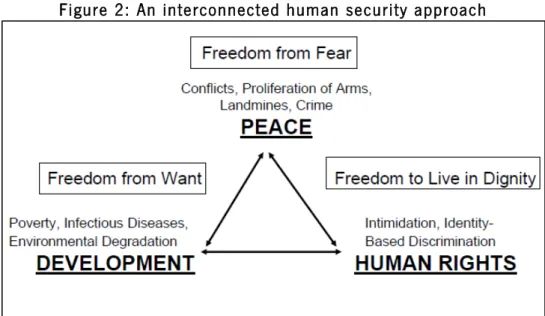
An interconnected approach (Figure 2) in human security theory is raised for discussion in the case of government’s implementation at national level. The human (in)security concept is to achieve outcomes based on three intertwining domains: freedom from want, freedom from fear, and freedom to live in dignity.
Figure 2: An interconnected human security approach
Source: Adapted material of online presentation slides by Mehrnaz Mostafavi, 2009 http://ochaonline.un.org/humansecurity
To be want-free, it is necessary that people live rid of poverty, infectious diseases, and environmental degradation. It can be regarded in terms of state’s economic development. Second to the freedom from want is freedom from fear which includes fear of loss of / danger to life in
conflicts as a result of arm proliferation, landmines and crime. State is required to foster peace in order to attain the essence of this concept. Last but not least, human security concerns relentlessly the retention of human rights protection. Human rights, of course, are basic needs required by mankind to live in dignity, free from intimidation and identity-based discrimination. To be secure, a person cannot lose any of the three entwinements; the loss of which means the loss of security (United Nations n.d).
As in a report of the United Nations Secretary General in:
“We will not enjoy development without security, we will not enjoy security without development, and we will not enjoy either without respect for human rights”.
(United Nations 2005)
In addressing human insecurities and in a bid of a state to provide personal/individual and health security, strategies such as rule of law and explicit and enforced protection of human rights and civil liberties are needed. To enhance protection and empowerment of individuals, it requires, at minimum, comprehensive coping mechanisms.
1.2 Human trafficking and human security
This part of the chapter brings up the facts of human trafficking and human security in both literatures and documents of various organizations.
Human Trafficking
The word trafficking is not a newly coming one. It has started since the 16th century. It has the same meaning like trading and marketing. In the 17th century, trafficking means illicit trading and/or marketing against law and marketing on unreliable commodities. At first, only profit is to be considered in this trading. It is chiefly meant for narcotic drugs trafficking and arms smuggling across borders. In the 19th century, enslaving and trading persons as sales goods are called trafficking in persons. In late 19th century, traditional enslavery is recognized as illegal business. In previous times, only Negroes in Africa are enslaved and trafficked, then at the beginning of the 20th century, white men are also trafficked and the term "trafficking" is intended the word for "white slave trade". In the white slave trade includes carrying women and children across borders to serve as prostitutes. In the late 1990, human trafficking is related to prostitution and sexual exploitation (United Nations 2006).
Human trafficking has its roots in the slave trade, which existed for many centuries in countries all over the world. Although slavery was abolished by law about two hundred years ago, unfortunately, the slavery system itself did not completely disappear. Subsequently, in an effort to curb this degrading crime, many anti-slavery instruments started to emerge, among them, an international agreement for the suppression of the “White Slave Trade” in 1904 (Gould 2010). But the first of these earlier instruments to define the term “Slavery” was the League of Nations Slavery Convention of 1926. The Convention and its 1953 Protocol are legally binding upon their parties. However, it should be noted that the prohibition of slavery applies to all states irrespective of whether they are parties to the Convention or not, under customary international law and norm known as just cogent (David Weissbrodt and Anti-Slavery International 2002).
In 1956, the United Nations drew up and issued the Supplemental Convention on the Abolition of Slavery, the Slave Trade and Institutions and Practices Similar to Slavery. The Convention did not replace the Slavery Convention, but added to it and is still in force today. In addition, The Universal Declaration of Human Rights Applicable to Slavery and Practices Similar to other important international Covenant on Civil and Political Rights are two other important international instruments, which were drawn up with the specific purpose of curbing slavery (United Nations 1991).
For the purpose of the present Convention, the following definitions agreed upon;
(1) Slavery is the status or condition of a person over whom any or all of the powers attaching to the right of ownership are exercised.
(2) The slave trade includes all acts involved in the capture, acquisition or disposal of a person with intent to reduce him to slavery; all acts involved in the acquisition of a slave with a view to selling or exchanging him; all acts of disposal by sale or exchange of a slave acquired with a view to being sold or exchanged, and, in general, every act of trade or Transport in slaves.
(Slavery Convention 1926, 253)
In spite of these international efforts to eliminate slavery, it continues throughout the world and is today related to the trafficking of persons. When the term “trafficking in persons” was first used in the early 1900s, it was understood as mainly implying to traffic in women and as closely linked to slavery and to prostitution (UNODC 2006). Only recently has it been recognizes as a human rights problem, affecting all people, and involving forced labor, forced marriage, slavery, debt bondage, etc., and not a problem limited to prostitution.
In November 2000, the United Nations Protocol to Prevent, Suppress and Punish Trafficking in Persons, especially women and children was adopted, supplementing the UN Convention against Transnational Organized Crime (CTOC). The international community has, in
the Trafficking in Persons Protocol, agreed upon a definition of trafficking in persons (UNODC 2009).
Article 3, subparagraph (a), of the Trafficking in Persons Protocol defines the crime as follows:
“Trafficking in persons means the recruitment, transportation, transfer, harboring or receipt of persons, by means of the threat or use of force or other forms of coercion, of abduction, of fraud, of deception, of the abuse of power or of a position of vulnerability or of giving or receiving of payments or benefits to achieve the consent of a person having control over another person, for the purpose of exploitation”.
(UNODC 2000, 2)
Exploitation shall include, at a maximum, the exploitation of the prostitution of others or other forms of sexual exploitation, forced labor or services, slavery or practices similar to slavery, servitude or the removal organs.
Definition of Trafficking by Global Alliance against Traffic in Women (GAATW) as
“all acts and attempted acts involved in the recruitment, transportation within or across borders, purchase, sale, transfer, harboring or receipt of a person involving the use of deception and coercion including the use or threat of force or the abuse of authority or debt bondage for the purpose of placing or holding such person, whether for pay or not, involuntary servitude (domestic, sexual or reproductive), in forced or bonded labor or in slave-like conditions, in a community other than the one in which such person lived at the time of the original deception, coercion or debt bondage”.
(GAATW 1997)
Furthermore, human trafficking in persons report of the United States of America defines “severe forms of trafficking” as:
(a) Sex trafficking in which a commercial sex act is induced by force, fraud or coercion or in which the person induced to perform such act has not attained 18 years of age; or
(b) The recruitment, harboring, transportation, provision or obtaining of a person for labor or services, through the use of force, fraud or coercion for the purpose of subjection to involuntary servitude, peonage, debt bondage or slavery.
(US Department of State 2007, 5)
The causes of human trafficking are complex and often reinforce each other. There are wide ranges of interrelated factors, which contribute to the dramatic increase in persons being trafficked. The root causes of trafficking are poverty, lack of education and gender inequality. Economic disparity or inequality is also an important factor (UNIAP/MWAF 2003). Political instability, militarism, civil unrest, internal and armed conflict and natural disasters may result in an increase in trafficking. The destabilizing and displacement of populations increase their vulnerability to exploitation and abuse through trafficking and forced labor. War and civil strife led to massive displacement of populations, leaving orphans and street children extremely vulnerable
to trafficking (US Department of State 2001). More description about the causes of human trafficking is discussed in section 3.1.
The problem of trafficking in persons is becoming a major issue all over the entire world and it has moved to the forefront of national and international agendas. International communities have intertwined as an inter-connected world, forming up a strong entity to ensure progress to an end of this crime. The United Nations adopted the Trafficking Protocol in Palermo, Italy in the year 2000, which is the “first global, legally binding instrument on trafficking” in a bid to “facilitate convergence in national cooperation, protect and assist the victims of trafficking in persons” (UNODC 2011). Trafficking in persons is multidimensional threat for the society because it deprives people of their human rights and freedoms, it fuels the growth of organized crime and it is also a health risk. It is learnt that one to two million people are trafficked globally each year (Table 1). Most of the trafficked victims are children, youth and young women who can serve their best for the country: human trafficking means the loss of the country (United States 2008). As human trafficking as a modern crime, it has been supposed to development assistance focuses for international community (Tadjbakhsh and Chenoy 2007).
Table 1: Victim profiles in US Government, International Labor Organization (ILO),
UNODC and International Organization of Migration (IOM) databases
US Government ILO UNODC IOM
Main Focus Global estimate of Victims Global estimate of victims Country and regional patterns of international trafficking Actual victims assisted by IOM in 26 countries Number of Victims Some 600, 000-800,000 people trafficked across borders in 2003 (est.) At least 2.45 million people trafficked internationally and internally during 1995 to 2004 (est.)
Not Available 7,711 victims assisted from 1999 to 2005 Type of Exploitation (%) 1. Commercial sex 2. Economic or forced labor 3. Mixed and other
66% 34% N/A 43% 32% 25% 87% 28% N/A 81% 14% 5% Gender and Age of
Victims (%) 80% female 50% minors 80% female 40% minors
77% female 9% male 33% children 83% female 15% male 2% not identified 13% minors Definition of
Trafficking Used Trafficking Victims Protection Act 2000 UN Protocol (Palermo Protocol) UN Protocol UN Protocol (Palermo Protocol) Criteria for Data
Collection Transnational trafficking
Internal and transnational trafficking Transnational trafficking Internal and transnational trafficking Source: GAO 2006
Human Security
Security or insecurity is defined in relation to vulnerabilities, both internal and external, those threaten to, and regimes (Mohammed 1997) geographically or have the potential to bring down or significantly weaken state structures, both territorial and institutional.
“Human security” emerged in the early 1990s. The ending of the cold war saw a global reduction in armed conflict and political tension. The phrase “human security” attempt to switch attention from the security of states to the security of individuals. It was also an attempt to focus development efforts on mitigating risks and preventing disasters. The UNDP Human Development Report 1994, the first major document to use the concept, summed it up this way: “Human security is a child who did not die, a disease that did not spread, a job that was not cut, an ethnic tension that did not explode in violence, a dissident who was not silenced”.Human security is an integrative framework. People at risk from war are also at risk from famine. Epidemics have no respect for national borders. Most development issues have to be addressed at both national and global levels.
Human security is one of the latest neologisms that encourage the academic and policy fields to deepen the understanding of international security beyond the military defense of state interests and territory. Human security represents a new paradigm for researchers and practitioners. It appears that the concept is still being refined in order to be a more useful guide for scholars and policy-makers of international politics. A discourse analysis of the human security literature reveals overtones of social and material “development” as a means to protect the welfare of “vulnerable people”, predominantly from those in the Third World.
Throughout the 1990s, the economic development and military security were heading on paths towards convergence. The commonly view in economic and development circles that development was a precondition for security and almost automatically reduce the incidence of conflict within the community. In a scarcity situation, development assistance and relief are precious commodities. If they distributed wrongly, the option would be rather reinforce than alleviate social cleavages and sow the seeds of conflict and insecurity. The development-security link has thus been reversed via the acknowledgement that basic security is a pre-condition for political, social and economic development. This reframing of the parallel discourses of security and development reflects a change in conceptualization in the international post-conflict
development community, and signals a growing awareness to narrow the ‘planning gap’ between the two fields.
According to the Report released by the UNDP for the year 1994, human security is argued as a narrow link between of people’s daily lives and nuclear devastation.
“For too long the concept of security has been interpreted narrowly as security if territory from internal aggression, or as protection of national interests in foreign policy or as global security from the threat of nuclear holocaust. Forgotten were the legitimate concerns of ordinary people who sought security in their daily lives”.
(UNDP 1994, 22)
Broad definition gives the meaning of human security as “freedom from fear and freedom from want” and characterized as “safety from chronic threats such as hunger, disease, and repression as well as protection from sudden and harmful disruptions in the patterns of daily life— whether in homes in jobs or in communities” (UNDP 1994; Mahmood et al. 2010). More specifically, in global policy debates one can define human security as a concept which is found in an early definition provided in 1992 in connection with the establishment of the Common Security Forum set it forth as “inclusive of but extending beyond the human dimensions of military conflict— incorporating health and population dimensions of political, ethnic, economic and environmental security as well” (Chen 1992; Edson 2001).
UNDP contributes the people-centered approach to security by considering seven components, namely, economy, food, health, the environment, security of persons, security of community, and political engagement. The threat caused by the absence of these components was common to everyone as it goes beyond traditional weakness which is associated with the underdevelopment status quo (hunger, poverty, pollutions, disease, and etc.).
As mentioned earlier, “human trafficking is a modern-day slave trade. It violates fundamental human rights and exploits innocent people”, said Sheikha Haya Rashed Al Khalifa, President of the General Assembly (US Department of State 2007). The report by Kaul and Stern (1999) argues that in our world today we need a new framework for international cooperation in order to deal with threats of this kind. A theory of global public goods would be an essential part of such a new framework, providing a new motivation for a different type of development assistance.
As former UN Secretary-General Kofi Annan pointed out, human security is all the way on the main agenda items of the three pillars: peace, security and development. Human security is comprehensive in the sense that it integrates these agendas:
“Human security in its broadest sense embraces far more than the absence of violent conflict. It encompasses human rights, good governance, access to education and health care and ensuring that each individual has opportunities and choices to fulfill his or her own potential. Every step in this direction is also a step towards reducing poverty, achieving economic growth and preventing conflict. Freedom from want, freedom from fear and the freedom of future generations to inherit a healthy natural environment are among the interrelated building blocks of human, and therefore national, security”.
(Dulic 2008)
There are seven components of human security: economic security, food security, health security, environmental security, personal security, community security and political security.
- Natural Disasters – In 2008, over 230,000 people lost their lives and over 211 million were affected due to natural disasters (Mostafavi 2009, 6-74). Today, an increasing amount of attention is focused on environmental migrants and what this means in terms of security across communities.
- Conflicts – Attacks on civilians rose by 55% between 1989 and 2005. Today an estimated 34 million people are displaced as a result of conflicts. Moreover, loss of economic growth; militarization of political, economic and social life; as well as the spread of diseases can often spill-over into neighboring communities and manifest themselves in increased insecurities within and across countries (Mostafavi 2009, 6-74)..
- Health – Over 3 billion people live under the threat of malaria, tuberculosis, and HIV/AIDS (Mostafavi 2009, 6-74). Health pandemics move across regions and place added stress on already weak economic and social systems.
- Transnational Organized Crime – Profits gained by criminal organizations can rival many countries’ GDPs and threaten state authority, public safety, and the rule of law (Mostafavi 2009, 6-74).
- Human Trafficking – At least 2.4 million people are trapped in forced labor as a result of human trafficking and the criminal networks connected to it (Mostafavi 2009, 6-74).
- Food Insecurity – Soaring food prices have forced between 130 to150 million people into poverty in 2008, with internal strife and demonstrations witnessed in several countries (Mostafavi 2009, 6-74).
Acharya (2004) argues that human security is a holistic paradigm, which creates potential eclecticism with synthesis and theoretical point of view. The security does not reflect any longer developments in terms of real world.
“Governments can no longer survive-much less achieve legitimacy-solely by addressing economic growth; nor can they maintain social and political stability solely by providing for defense against external military threats. Democratization empowers new actors, such as civil society, that must be accounted for in the security framework”.
(Acharya 2004)
Sabina (2003), as one of the human security commission theorists, crafted her conceptual definition: “to protect the vital core of all human lives in ways that advance human freedoms and human fulfillment.” The human security content was disciplined by the definition by focusing only pervasive and critical threats. However, while she puts the concept to aim at creating a viable security framework that allows for responses to policy to non-state threats, policy priorities need to be clearly defined.
The security challenges confronting Asia today go beyond the traditional dimensions of security and tend to be more diverse than what the region has ever known before. Non-military issues like infectious diseases, trafficking in illegal drugs, irregular migration, environmental degradation, financial crises and natural disasters are increasingly being treated as pressing concerns to the national sovereignty of nation-states as well as to the welfare and security of their respective individuals.
Human security emphasizes issues of responsibilities of state, sovereignty as well as intervention. Reconciling national security and development is necessary in developing countries. Individual must be at least one of the referent points for determining security for the whole nation, from his/her own point of view and by taking appropriate steps in pursuing the state’s responsibility to maintain stable advancement (Evans 2004).
Human security is improved when the “quality of life” of people in a society can be upgraded, that is, the enhancing of what he calls ‘human welfare’. It is threatened when this “quality of life”, which is left open to definition, is degraded by threats such as unchecked demographic growth, diminished resources and scarcity, or access issues, and other global reaching threats. The reformulation of national security into human security has “profound consequences” for international relations, foreign policy and people’s conception of other peoples and culture. Traditional security conception privileges military in terms of resource allocation but non-traditional concerns merit the gravity of the security label (Thakur et al. 2004).
Human security is an integrative concept allowing for bridging and interconnection of sector specific threats to people in the international system, rather than states. Human security means the provision of basic material needs and realization of human dignity, including emancipation from oppressive power structures, global, national or local in origin or scope (Thomas 2001). A distinction is made between quantitative aspects of human security, which are the basic needs (food, shelter, healthcare and education), and the qualitative aspects, encompassing dignity; personal autonomy, control over one’s life, participation in the community, chance and opportunities. The concept provides a language and rationale for raising the concerns of the majority of humanity. The ultimate utility of the concept is in the practical application of knowledge to interconnections between threats. For policy purposes bottoms-up participatory approaches to politics are necessary (Thomas 2001). Thomas (2000) finds that human security is a condition of existence in which basic material needs are met, and in which human dignity, including meaningful participation in the life of the community, can be met. Ogata (2004) posits
that the respect for human rights is at the core of protecting and empowering people, and that human security provides better means to realize human rights. Its framework gives equal importance to civil and political as well as to economic, social, cultural and social rights, thereby addressing violations in comprehensive and integrated ways.
Human security has also rapidly moved to occupy center stage in discussions of foreign policy. Following the end of the Cold War, some world leaders saw that as an opportunity to redirect funds from spending on defense to addressing social and economic needs (Timothy 2004). High on the agenda of these global framers was the pursuit of security through sustainable human development manifested through: peace building, population, the environment, women’s status, and person-centered social and economic development. With its emphasis on protecting individual well-being, dignity, and the exercise of free choice, human security seemed to be an apt framework for this new direction.
The following are four essential characteristics of human security:
(1) Human security is a universal concern. It is relevant to people everywhere, in rich nations and poor. (2) The components of human security are interdependent.
(3) Human security is easier to ensure through early prevention than later intervention. It is less costly to meet these threats upstream than downstream.
(4) Human security is people-centered. It is concerned with how people live and breathe in a society, how freely they exercise their many choices, how much access they have to market and social opportunities – and whether they live in conflict or in peace.
(UNDP 1994, 23)
Nations have always been preoccupied with security. In many parts of the world, states threatened by conflicts often devote their vast resources to protecting their sovereignty and independence. In the name of national security, all things can be threatened. After the end of the Cold War, the world forces common global problems because external and internal threats to security become interrelated (Steven 1994).
Comparing with global effort, regional cooperation may be effective to deal with non-traditional security threat. A global response is generally, less efficient, because of difference in interest in different issue area and difficulties in conducting wide coordination. A regional effort could more effectively address the security issues affecting common interest and easier to coordinate with each other’s.
As another aspect of thinking, human security concept encompasses the definitions human trafficking and debate over human security that applies to human trafficking and other general terms about global situational development.
Chapter 2
Human trafficking: an overview
This chapter is an overview of human trafficking both at international level and at Myanmar-Thailand cross-border level, focusing on three main issues: the causes, the routes and the victims of trafficking in human beings.
2.1 The overview of human trafficking 2.1.1 Human trafficking in the world
Since human trafficking issue is one the top priorities on the international agenda, it has to be handled by every nation of the world at all levels. The trafficking is not a new phenomenon. Although it has caught the attention since the 1990s it has been an issue for over many hundreds of years.
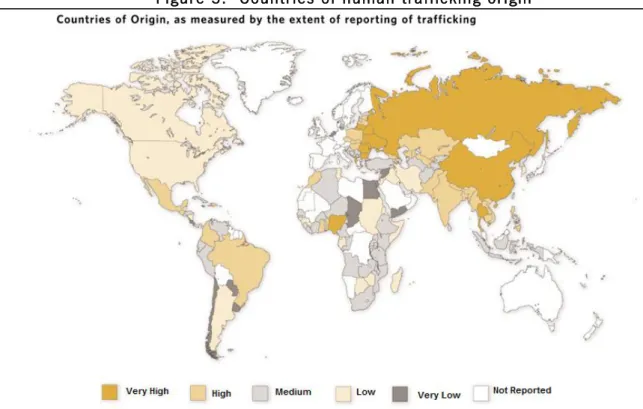
Figure 3: Countries of human trafficking origin
Figure 4: Countries of human trafficking destination
Source: UNODC 2006
At this new millennium, 2.5 million people are estimated to be entrapped in forced labor (including sexual exploitation) as a result of trafficking, half of whom are children under 18 years of age. Up to 46% cases found in the recruiters are not strangers to victims. The chart below shows the portions shared by regions in the world from which human trafficking cases into forced labors take place.
Figure 5: Estimation of numbers of victims trafficked into forced labor by region
Source: ILO (2007). Forced Labor Statistics Factsheet
57%
11% 10%
9% 5%
8% Asia and the Pacific
Industrialized countries
Latin America and the Caribbean The Middle East and Northern Africa Sub-Saharan countries
Historical trafficking in persons and blatant practices of slavery abound in the West, in Middle East as well as in Asia. It can be recalled: trafficking of Africans for slavery into United States was abolished less than 200 years ago. However, new evidence shows that traditional slavery is imposed on 8,800 to 43,000 Nigeriens nowadays where trafficking in Niger children for the purpose of forced labor in gold mines, forced begging, sexual exploitation, domestic servitude, and possibly in agricultural sector and stone quarries can still be found in the country. It is now a little over ten years that trafficking in persons, or what is often referred to as a modern form of slavery, has reemerged. There is no over-riding singular cause but a series of interconnected causes. These causes can be analyzed from the point of view of changes in the global political and economic structures and their effects on societies.
The late 1980s and early 1990s brought about dramatic changes in the structure of the world. The East and the West blocs or the communist and the capitalist blocs that came into existence following the end of World War II collapsed with the fall of the Soviet Union in the late 1980s. With the fall of the Iron Curtain, barriers that had existed between the two blocs were dramatically reduced.
At the same time, technological advancement gave impetus to greater interactions between countries. Unlike the Cold War Era, capitalism now ruled the world. Countries which were less well-off or under-developed have, as the result of lower barriers and greater exposure to the ways of life towards becoming well-off countries, begun to long for the things made possible by a strong economy and way of life.
The effects of lack of equal development and inequitable distribution of wealth on the one hand and better access to information about the materially well-off countries, on the other hand, or areas in the same country have given people hopes of a possibility of new or better life in these areas. Many people are ready to take advantage of such opportunities but often do not have the legal rights to do so or the information and means to do it, a manner that can provide them with protection against abuse and exploitation. This situation has created windows of opportunities for those who want to exploit the poor, the uninformed and those desirous of overcoming poverty or raise their living standards. The outcome is the reemergence of what was thought to have been a dead and gone issue to trafficking in persons or slavery-like practices.
Trafficking in persons involving trafficking for the purpose of slavery or slavery-like practices is, too, not a new concept. It is derived from the slave trade and slavery system, which predominated for thousands of years in the history of the world. Although the slave trade does not
now exist legally, modern forms of slavery re-emerged after the 19th century. With this fact, trafficking in persons has long been perceived as a long-lasting event. However, it was drawn attention by the international organizations, since 1990s. There were many documentary evidences. According to the US government (USCRS 2010), every year, six to eight hundred thousand people are trafficked across various international borders and up to two to four million people are trafficked in within and across borders.
The clandestine nature of the crime makes it extremely difficult to give estimates about the number of victims worldwide. It is learned that one and two million people are trafficked globally each year. It estimated that 300,000 women and children are being trafficked within the GMS (Khin 2007).
The trafficking in human is an international problem with various forms and complexity. One-third of victims worldwide are trafficked for economic purposes other than sexual exploitation.
The United Nations CTOC was adopted by the General Assembly in November 2000. It is the main convention to fight transnational organized crimes including human trafficking, the Protocol to Prevent, Suppress and Punish Trafficking in Persons, especially women and children is a supplementary instrument of CTOC and contains exact definitions of trafficking in persons and detail provisions to prevent, suppress and punish trafficking in persons. This protocol is not only intended to prevent and combat trafficking and facilitates international cooperation against such vulnerable crimes, but also to protect and assist the victims.
The various forms of abuse and coercion intersect numerous times in different ways to create an inextricable labyrinth of physical and Psychological risk. Trafficking can involve extreme forms of exploitation of women, men and children-physically, psychologically and emotionally. Types of abuse may include beatings, forced drug use, inadequate meals, rape, physical confinement and even fatal wounding. In these particular exploitative environments, physical health problems such as injuries, diarrhea, and diseases of sexual organs, skin rashes and malaria may occur. Depression, irritability, aggressiveness, self-rejection, suicidal ideation, insecurity and restlessness are some of the psychological and emotional health problems experienced due to constant threat, extreme pressure and in isolation as shown the following table (UNIAP 2006).
Trafficking affects the mental and physical health of the victims as well as their social situation and future life. It also has legal implications and a damaging effect on society and development.
Table 2: Trafficking affects the mental and physical health
Physical Health Psychological, Emotional Health • Injuries
• Diarrhea
• Sexual organ disease • Malaria
• Poor nutrition • Exhaustion • Starvation • HIV/AIDS
• Amenorrhea and dysmenorrheal
• Acute or chronic pain during sex; tearing and other damage to vaginal tract • Negative outcomes of unsafe abortion • Irritable bowel syndrome
• Stress-related syndromes
• Inability to negotiate sexual encounters • Death • Depression • Irritability • Aggressiveness / Anger • Self-rejection • Suicidal tendencies • Insecurity • Restlessness
• Trauma / Post trauma syndrome • Daydreaming
• Sleeping problems / Nightmares • Short memory span
• Impaired learning ability • Forgetfulness
• Hysteria
• Mental disorders • Afraid of the community • Inability for making decision • Concerned
• Altered sense of time • Loss of trust in others or self • Guilt
• Shame
• Difficulty developing and maintaining intimate relationships
• Problems with or changes in identity and self-esteem
Source: UNIAP 2006
The mental effects caused by trafficking have not been properly documented and assessed. Trafficking in persons involves situations of extreme psychological stress, which may