UNIVERSIDADE DE LISBOA FACULDADE DE CI ˆENCIAS DEPARTAMENTO DE INFORM ´ATICA
CONSISTENT AND FAULT-TOLERANT SDN
CONTROLLER
Andr´e Alexandre Lourenc¸o Mantas
MESTRADO EM SEGURANC
¸ A INFORM ´
ATICA
Dissertac¸˜ao orientada por:
Prof. Doutor Fernando Manuel Valente Ramos
Agradecimentos
Gostaria de agradecer a v´arias pessoas que me acompanharam ao longo deste percurso e sem as quais nada disto seria poss´ıvel.
Primeiramente, aos meus pais por me criarem e educarem naquilo que sou hoje, por me proporcionarem a possibilidade de frequentar a faculdade e de realizar este mestrado (mal eu sabia onde me estava a meter).
`
A minha namorada Sara por todo o apoio e incentivo que me deu ao longo dos bons e maus momentos desta jornada. Por estar sempre l´a para mim e ajudar em tudo aquilo que conseguia, inclusive a decifrar a letra de m´edico do meu orientador.
Aos professores Paulo Ver´ıssimo e Nuno Neves pelas aulas de Seguranc¸a na licen-ciatura que me despertaram o interesse pelo MSI. J´a no mestrado, tenho que agradecer `a professora Dulce por toda a ajuda que me deu e por ter disponibilizado uma das suas aulas durante o primeiro semestre do primeiro ano para que o professor Fernando pudesse apresentar a cadeira de Protocolos em Redes de Dados. N˜ao sei se teria escolhido esta cadeira no segundo semestre sem esta apresentac¸˜ao e, sem isso, n˜ao teria escolhido este tema de tese.
Ao meu orientador, Fernando Ramos, comec¸ando pelas aulas de PRD, passando pelas SDN, e acabando na proposta do tema para a tese. Obrigado pelo apoio, pelas reuni˜oes, ideias e discuss˜oes que levaram ao Rama e a este relat´orio final.
Ao projeto SUPERCLOUD e `a FCT pelo financiamento da bolsa para a tese.
Ao Desmarques por tudo desde o primeiro ano de licenciatura at´e hoje. Pelo estudo para os exames, pelos projetos e discuss˜oes das cadeiras que correram melhor ou pior, pelas gargalhadas descontroladas em locais inoportunos e por tudo o resto.
A todos da nossa sala de mestrado no C8 pelos dias que passamos a partir a cabec¸a com as nossas teses, reuni˜oes, almoc¸os e lanches e muito mais.
Ao bar do C1 pelas torradas e p˜aes com chouric¸o e queijo, ao refeit´orio Universo da Faculdade de Direito pelas ervilhas com ovos escalfados, pela feijoada e, claro, pela massa universo.
A todos os outros que n˜ao mencionei aqui mas que me acompanharam na faculdade e que de uma forma ou de outra fizeram este percurso mais divertido.
E finalmente `a selec¸˜ao de Portugal por ter ganho o Euro 2016, mostrando-me que tudo ´e poss´ıvel.
` A vida.
Resumo
O conceito de Software-Defined Networkings (SDNs) acaba com o acoplamento que existe nas redes tradicionais entre o plano de controlo e o plano de dados. Este desa-coplamento facilita o desenvolvimento de aplicac¸˜oes inovadoras e flex´ıveis para gerir, monitorizar e programar as redes. Em SDN, as aplicac¸˜oes usam uma vis˜ao da rede logi-camente centralizada, fornecida por controladores que programam remotamente os swit-ches na rede. Se esta vis˜ao da rede n˜ao for coerente com o verdadeiro estado da rede, as aplicac¸˜oes v˜ao executar sobre um estado desatualizado e produzir resultados incorre-tos. Isto pode degradar significativamente o desempenho da rede e gerar problemas como criac¸˜ao de loops ou falhas de seguranc¸a. Como em qualquer sistema em produc¸˜ao, falhas em componentes devem ser expect´aveis. Desta forma, ´e importante que o plano de con-trolo seja capaz de manter uma vis˜ao coerente da rede mesmo na presenc¸a de falhas nos controladores ou nas ligac¸˜oes. Para isto, a vis˜ao da rede tem que estar replicada de forma coerente entre v´arios controladores para que a falha de um n˜ao comprometa a disponibi-lidade do sistema. Adicionalmente, o estado mantido pelos switches tem que ser tratado de forma coerente, o que ´e particularmente dif´ıcil na presenc¸a de falhas.
Este trabalho prop˜oe um plano de controlo SDN resiliente que permita a aplicac¸˜oes de rede inalteradas correr num ambiente tolerante a falhas e coerente (tanto a n´ıvel do estado do controlador como dos switches). Para conseguir o ambiente tolerante a falhas, os controladores devem replicar (de forma transparente) entre si os eventos recebidos antes que estes sejam entregues `as aplicac¸˜oes de rede. Para conseguir um sistema coerente, a ideia principal ´e fazer com que os controladores processem as mensagens de controlo (incluindo enviar comandos aos switches) transaccionalmente, exatamente uma vez, e pela mesma ordem total. Esta ordem total ´e decidida por um dos controladores, o l´ıder, que tamb´em ´e o controlador respons´avel por replicar os eventos pelos outros controladores e por enviar os comandos para os switches. Desta forma todos os controladores chegar˜ao ao mesmo estado interno, o que faz com que tenham a mesma vis˜ao da rede e possam gerir os switches no caso de o controlador l´ıder falhar.
Atualmente existe apenas um controlador para SDN que utiliza estes mecanismos e que oferece as garantias de tolerˆancia a falhas e coerˆencia referidas, o Ravana. No en-tanto, o Ravana requer que sejam feitas modificac¸˜oes aos switches de rede e ao protocolo
usado entre os controladores e os switches (i.e., o protocolo OpenFlow) como parte da sua implementac¸˜ao. Especificamente, o Ravana requer que:
• Os switches mantenham dois buffers locais, um para eventos que enviam aos con-troladores e outro para comandos que recebem destes;
• O protocolo OpenFlow seja alterado para adicionar duas mensagens novas de con-firmac¸˜ao (controlador confirma a recec¸˜ao de eventos e switch confirma a recec¸˜ao de comandos) e duas mensagens novas para a limpeza dos buffers mantidos pelos switches (enviadas pelos controladores).
Estes requisitos tornam a adoc¸˜ao do Ravana em sistemas reais problem´atica, pois n˜ao existem switches com estas caracter´ısticas nem ´e expect´avel que o protocolo OpenFlow seja alterado no futuro pr´oximo de acordo com as modificac¸˜oes requeridas pelo Ravana. Com estas limitac¸˜oes em mente, desenvolvemos o Rama, um controlador para SDN que oferece as mesmas garantias de tolerˆancia a falhas e coerˆencia que o Ravana mas que n˜ao requer modificac¸˜oes aos switches nem ao protocolo OpenFlow.
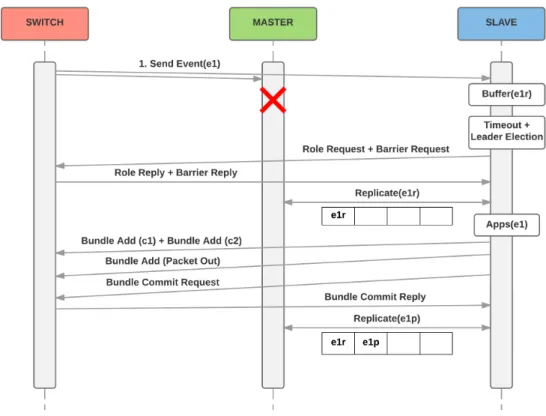
O protocolo do Rama utiliza t´ecnicas inovadoras para cumprir estes objetivos. En-quanto no Ravana cada switch apenas envia os eventos para o l´ıder atual (e guarda o evento num buffer para o caso de ser preciso reenviar para o novo master), no Rama os switches enviam os seus eventos para todos os controladores. Para isto, fazemos uso do protocolo OpenFlow para definir os tipos de mensagens que os switches devem enviar para cada controlador (por exemplo, definindo os controladores como estando no papel equals). Isto permite que os controladores se possam coordenar entre si para n˜ao pro-cessar o mesmo evento mais que uma vez e, mais importante ainda, para que nenhum evento seja perdido sem depender do reenvio do evento pelo switch (como todos os con-troladores recebem o evento, basta que um n˜ao falhe para o evento n˜ao se perder). De seguida, o controlador l´ıder replica o evento para os outros controladores (obedecendo a uma ordem total) e entrega-o `as suas aplicac¸˜oes de rede. Estas aplicac¸˜oes v˜ao gerar comandos para serem enviados para os switches. Aqui entra outro aspeto diferenciador entre o Rama e o Ravana. Enquanto no Ravana o l´ıder simplesmente envia o comando a contar que, em caso de falha, o switch seja capaz de filtrar comandos repetidos, o Rama usa um novo mecanismo introduzido no OpenFlows (OFs) 1.4 – os Bundles (ou grupos) – para garantir que os switches apenas processam cada comando uma ´unica vez. Os bundles permitem aos controladores enviar v´arios comandos para um grupo mantido pelo switch e de seguida dizer-lhe para processar todos os comandos nesse grupo de forma at´omica. Ao fazer isto, o switch, de acordo com o protocolo OFs, tem que enviar uma mensagem de volta ao controlador a confirmar que aquele grupo de comandos foi completamente pro-cessado. Esta confirmac¸˜ao diz ao controlador l´ıder que mais nenhum controlador pode voltar a enviar os comandos para aquele evento. Por´em, como o l´ıder pode falhar sem avisar os outros controladores que recebeu esta confirmac¸˜ao, n˜ao ´e trivial atingir este
prop´osito. Para resolver este problema, propomos um mecanismo adicional (j´a que n˜ao ´e poss´ıvel programar o switch para enviar esta confirmac¸˜ao para todos os controladores): adicionamos uma mensagem do tipo PacketOut ao grupo mantido pelo switch que tenha como destino todos os controladores. Desta forma, quando o switch processa o grupo, o l´ıder recebe a confirmac¸˜ao normal, indicativa de o grupo estar processado, e os outros controladores recebem uma mensagem com o conte´udo definido pelo l´ıder (por exemplo, o identificador do evento).
Estes dois mecanismos, quando usados em conjunto – enviar eventos para todos os controladores e enviar comandos usando bundles – permitem ao Rama oferecer as mesmas garantias de coerˆencia que o Ravana mas sem alterar os switches nem o protocolo OFs.
O Rama foi desenvolvido tendo como base o Floodlight, um controlador SDN modu-lar, open source, escrito em Java e com uma comunidade ativa. No Floodlight, aplicac¸˜oes de rede (e.g., balanceador de carga, firewall) podem ser integradas como m´odulos num n´ucleo bem definido que implementa abstrac¸˜oes de rede comuns (e.g., topologia da rede, descoberta e gest˜ao de caminhos na rede) e oferece uma interface que torna f´acil enviar e receber mensagens aos switches na rede. Para tratar as mensagens vindas dos switches de rede, o Floodlight usa um processamento em forma de encadeamento (pipeline), onde cada m´odulo processa a mensagem (i.e., atualizar o seu estado e possivelmente enviar comandos para programar o switch em conformidade com a situac¸˜ao) um ap´os o outro. Cada m´odulo pode ainda definir relac¸˜oes de ordem com outros m´odulos (i.e., se este m´odulo deve receber mensagens antes ou depois de outros m´odulos) e, quando recebe a mensagem, decidir se o processamento da mesma pelos outros m´odulos deve continuar ou parar.
No desenvolvimento do Rama decidimos usar o ZooKeepers (ZKs) para fazer a coor-denac¸˜ao entre os controladores pela sua confiabilidade, simplicidade e ampla utilizac¸˜ao. O ZK da Apache pode ser visto como um servic¸o de coordenac¸˜ao centralizado que exp˜oe um conjunto de primitivas (e.g., gest˜ao de nomes, gest˜ao de configurac¸˜oes, sincronizac¸˜ao, servic¸os de grupo) a ser utilizado por aplicac¸˜oes distribu´ıdas de forma a que estas n˜ao te-nham que reimplementar as primitivas de cada vez que s˜ao necess´arias. As caracter´ısticas principais do ZK s˜ao: alto desempenho, alta disponibilidade, acesso estritamente orde-nado e o uso de um modelo de dados hier´arquico semelhante a um sistema de ficheiros. O Rama usa o ZooKeeper para:
• Gest˜ao de membros: saber que controladores est˜ao ativos, detetar falhas de contro-ladores e realizar eleic¸˜ao de l´ıder no caso de falha do l´ıder atual. Para isto usamos o mecanismo de n´os tempor´arios que s˜ao criados por cada controlador e apaga-dos pelo ZK quando a ligac¸˜ao deste com algum controlador ´e terminada (e.g., por timeout).
• Replicac¸˜ao de eventos: o l´ıder armazena um ou mais eventos em n´os numa pasta observada pelas outras r´eplicas de forma a que estas sigam a ordem definida pelo
l´ıder e saibam em que estado ele se encontra. Adicionalmente, tamb´em ´e mantida a informac¸˜ao de que eventos j´a est˜ao processados pelos switches (i.e., o l´ıder j´a enviou os comandos para o evento).
Para a fase de avaliac¸˜ao, usamos uma vers˜ao modificada do Cbench – a ferramenta usada para medir o desempenho de controladores OpenFlow – de forma a suportar bun-dles. Com as nossas experiˆencias demonstramos que, embora o Rama atinja n´ıveis de desempenho aceit´aveis (cerca de 28 mil respostas por segundo) ainda fica um pouco atr´as do Ravana (40 mil respostas por segundo). Esta diferenc¸a ´e devida ao custo adicional que o Rama incorre de modo a n˜ao modificar os switches nem o protocolo OpenFlow. Nomeadamente, o uso de bundles leva ao envio de mensagens adicionais para os switches (envio de quatro mensagens contra uma do Ravana para responder a um evento), o que em conjunto com a replicac¸˜ao e ordenac¸˜ao dos eventos reduz um pouco o desempenho do sistema em geral.
Desta nossa proposta resultam v´arias contribuic¸˜oes, incluindo um poster aceite na conferˆencia NSDI’16, contribuic¸˜oes para o deliverable 4.2 do projecto H2020 SUPER-CLOUD, e ainda contribuic¸˜oes para projetos externos:
• Floodlight: contribuic¸˜oes para o controlador Floodlight relacionadas com o trata-mento de bundles e outros melhoratrata-mentos.
• OpenvSwitch: contribuic¸˜ao para aceitar e tratar mensagens do tipo PacketOut den-tro de bundles. Previamente estas mensagens eram rejeitadas.
• Cbench: modificac¸˜ao da ferramenta Cbench que avalia o desempenho dos contro-ladores OpenFlow para aceitar e tratar mensagens relacionadas com bundles.
Palavras-chave: Redes definidas por software, Tolerˆancia a falhas, Coerˆencia forte, OpenFlow
Abstract
The concept of Software-Defined Networking (SDN) breaks the coupling in tradi-tional networks between the control and data planes. This decoupling allows the de-velopment of innovative and flexible applications to manage, monitor, and program the network. In SDN, applications use a logically centralized network view, provided by the controllers, to remotely program switches in the network. If this network view is not consistent with the actual state of the network, applications will operate on a stale state and produce incorrect outputs. This can significantly degrade the network performance (e.g., packets can be forwarded through a failed link) and create problems such as network loops or security failures. As in any system in production, component failures must be the rule and not the exception. Thus, it is important that the control plane is able to maintain a consistent network view in the presence of failures in both controllers and links. There-fore, the network view must be consistently replicated across several controller replicas so that the failure of one controller does not compromise the entire control plane. Addi-tionally, to ensure a correct system, the state maintained by switches must be handled in a consistent way, which is particularly difficult in the presence of failures.
This work proposes a resilient SDN control plane that allows modification-free ap-plications to run in a fault-tolerant and consistent environment (in both controllers and switches state). To achieve the fault-tolerant environment, controllers must replicate (transparently) the received events among themselves before these are delivered to the network applications. For the consistent environment, the main idea is that controllers process control messages transactionally, exactly once, achieving a correct and consistent operation of both controllers and switches, even if some of them fail. The two main tech-niques used are instructing switches to send events to all controllers, which coordinate to ensure exactly once event processing, and using OpenFlow Bundles as the acknowledge-ment mechanism used by controllers to process commands on switches exactly once.
The differentiating factor and novelty over existing works is the fact that the consis-tency guarantees our proposal assures, in a fault-tolerant SDN environment, do not require modifications to neither switches nor to the OpenFlow protocol.
Keywords: Software-Defined Networking, Fault-Tolerance, Strong consistency, Control plane, OpenFlow.
Contents
List of figures xi
List of tables xiii
1 Introduction 1
1.1 Control plane in SDN . . . 2
1.2 Motivation . . . 3
1.3 Goals and Contributions . . . 5
1.4 Additional Outcomes . . . 6
1.5 Document structure . . . 6
2 Context & Related Work 7 2.1 Context . . . 7
2.2 Scaling SDN in the control plane . . . 11
2.2.1 Improving control plane performance . . . 11
2.2.2 Distributing the control plane . . . 11
2.3 Scaling SDN in the data plane . . . 13
2.4 Resilience in SDN . . . 14
2.4.1 Consistent network updates . . . 15
2.4.2 Fault-tolerance . . . 15
3 Rama Design 19 3.1 Architecture . . . 19
3.2 Why Consistency Matters . . . 20
3.2.1 Inconsistent event ordering . . . 21
3.2.2 Unreliable event delivery . . . 21
3.2.3 Repetition of commands . . . 22
3.3 Consistent and Fault-tolerant protocol . . . 22
3.3.1 Fault cases . . . 25
4 Implementation 31
4.1 ZooKeeper . . . 31
4.2 Floodlight architecture . . . 33
4.3 Rama architecture . . . 34
4.4 Event Replication and ZK Manager . . . 35
4.4.1 Fault Detection and Leader Election . . . 37
4.4.2 Event batching . . . 37 4.5 Bundle Manager . . . 38 5 Evaluation 39 5.1 Rama Performance . . . 40 5.2 Latency . . . 43 5.3 Failover Time . . . 43
6 Conclusion & Future Work 45
Glossary 47
References 53
List of Figures
1.1 Control and data plane coupling in traditional network vs. SDN . . . 2
1.2 SDN flow execution . . . 2
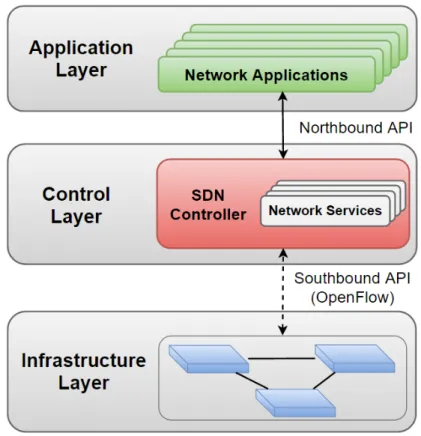
2.1 SDN architecture in layers . . . 8
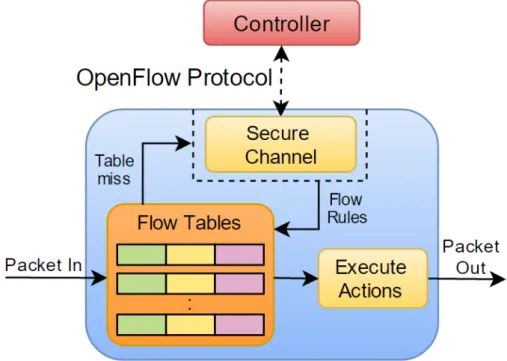
2.2 Main components of an OpenFlow enabled switch . . . 9
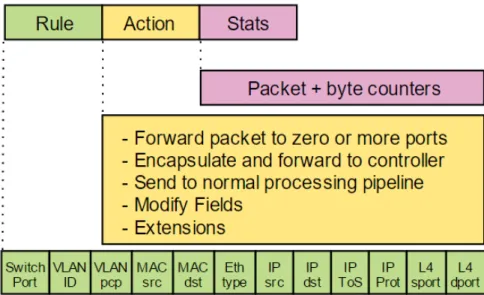
2.3 OpenFlow table entry structure . . . 10
2.4 Ravana Protocol . . . 17
3.1 High level architecture of the system . . . 20
3.2 Control loop . . . 23
3.3 Fault-free case of the protocol . . . 24
3.4 OpenFlow Bundles . . . 25
3.5 Failure case 1 of the protocol . . . 26
3.6 Failure case 2 of the protocol . . . 27
4.1 ZooKeeper components . . . 32
4.2 Floodlight modules architecture . . . 33
4.3 Floodlight thread architecture . . . 34
4.4 Rama thread architecture . . . 34
4.5 ZooKeeper node structure . . . 36
5.1 Experiment setup . . . 39
5.2 Throughput comparison . . . 40
5.3 Rama throughput with different number of switches . . . 42
5.4 Variation of Rama throughput with batch size . . . 42
List of Tables
3.1 How Rama and Ravana achieve the same consistency properties using different mechanisms . . . 29 4.1 Simplified ZooKeeper API . . . 32
Chapter 1 – Introduction
Traditional networks have had an undeniable success over the years, even with all the complexities that their devices must face. These devices are responsible not only for forwarding packets across the network but also for path computation and running network protocols that implement core network functionalities like tunneling, discovery and access control. As a result, network devices must be equipped with powerful hardware, which will makes expensive and inflexible. On top of that, since these devices are implemented in proprietary software and hardware, modifying or improving them is difficult, which makes it very hard to experiment with new control protocols in existing networks.
The slow evolution in the traditional network control plane is caused by this funda-mental problem which leads to a lack of both network management abstractions and of common control platform. This makes the design and deployment of control protocols to take many years, and prevents the development of innovative, flexible and reliable appli-cations for controlling networks [1].
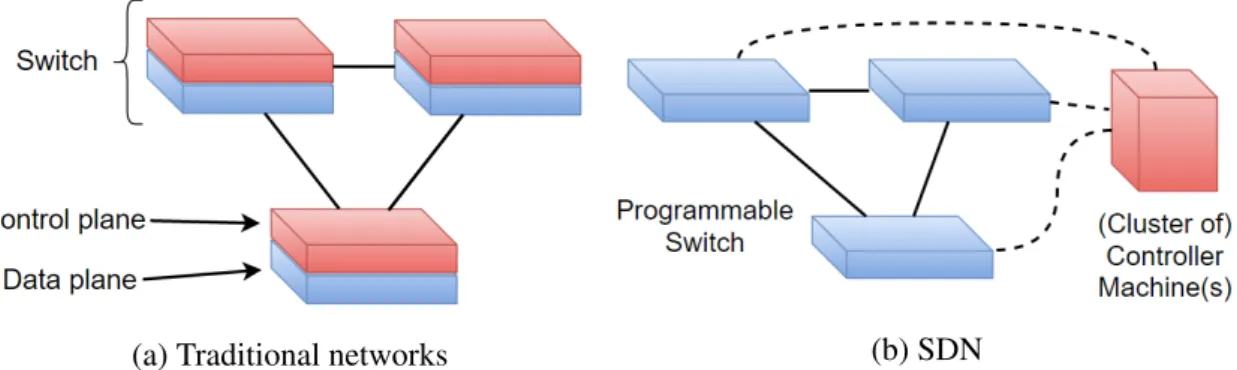
To solve this and other issues with traditional networks, the concept of Software-Defined Networking (SDN) was introduced with the goal of decoupling the control plane (which decides how to handle traffic) from the data plane (which forwards traffic accord-ing to the control plane decisions) via standardized interfaces. A well-defined program-ming interface between the switches and the SDN controller enables this decoupling and allows the control logic to evolve independently from the data plane. Additionally, this separation of concerns is very attractive as it opens the doors to new ways of managing, monitoring and programing the network. Figure 1.1 ilustrates the differences between tra-ditional networks and SDN. In tratra-ditional networks (1.1a), each network element has its own (coupled) control plane with possibily different protocols and interfaces. In contrast, SDN (1.1b) moves the control plane to a new, logically centralized, network node - the controller (see section 1.1).
The most common and adopted interface in SDN is OpenFlow [2]. SDN and Open-Flow both started as an academic project but quickly gained commercial interest. Ex-amples include B4 [3], a software-defined network developed by Google to interconnect its datacenters world-wide, and VMware’s network virtualization platform, NSX [4, 5]. More information about SDN and OpenFlow is given in section 2.1. However, the new possibilities offered by SDN are not simple to put in practice and bring new problems not
Chapter 1. Introduction 2
present in traditional networks. Indeed, the task of providing a logically centralized net-work view brings many new challenges that must be addressed. Sezer et al. [6] explore challenges and possible solutions regarding network performance (network nodes must continue to be fast), scalability (controllers may need to manage a wide area network), security (new SDN-related security threats) and interoperability (SDN coexistence with traditional networks).
(a) Traditional networks (b) SDN
Fig. 1.1: Control and data plane coupling in traditional network vs. SDN
1.1
Control plane in SDN
The controllers are the crucial enabler of the SDN paradigm: they maintain the logi-cally centralized network state to be used by applications and act as a common interme-diary with the data plane. Controllers are responsible for installing flow rules on switches that dictate how traffic should be handled. This can be done in a proactive, reactive or hybrid fashion (see section 2.1). Figure 1.2 shows the normal execution in an SDN en-vironment when a switch receives a packet that does not know how to forward. Note that, usually, only the first packet of a specific flow needs controller intervention. Upon receiving this packet, the controller will install flow rules on the switches with a specific timeout depending on the controller needs. These flow rules allow the switches to forward subsequent packets directly without contacting the controller.
Fig. 1.2: SDN flow execution. Switches send events to the controller as needed and the controller replies with one or more commands that modify the switch’s tables.
Chapter 1. Introduction 3
Martin Casado and Teemu Koponen, two of the first researches advocating SDN, have asked the question of what makes a good controller Application Programming Interfaces (APIs), arguing that controllers should not be yet standardized so that they can evolve without constraints [7]. Additionally, they describe three classes of controller platforms for SDNs: (i) application specific controllers, built with a single goal in mind, (ii) proto-col specific controllers, that provide an interface based on the protoproto-col (e.g., OpenFlow) and (iii) general SDN controllers that fully decouple the control applications from the un-derlying protocols. As noted in [1], classes (ii) and (iii) need to address many challenges such as:
• Generality: the API provided by the controller must be generic enough to allow applications to deliver a wide range of functionality in a variety of contexts;
• Scalability: the controller itself should not be a point of scalability problems; • Reliability: the control platform must handle failures (of controllers, switches and
links) gracefully;
• Simplicity: the control platform should provide common abstractions to ease the development of management applications;
• Performance: the additional latency introduced by the control plane should be rea-sonable for the provided mechanisms.
For simplicity reasons, the original SDN architecture was designed to use a centralized control plane (i.e., only one controller serving switches at each time) [8]. This design has inherent scalability problems as the number and size of the network increases (i.e., the number of events grows with the number of switches, latencies grow with the size of the network, and flow setup times will grow significantly). It is important to note that this general idea that SDN has scalability problems is not strictly related to SDN itself – traditional control protocols face the same challenges – and the centralized design is part of its historical evolution [9]. The main benefit of SDN over traditional networks is that SDN eases the task of overcoming these common challenges by separating concerns and, as such, facilitating the development of new network applications. Additionally, this centralized control plane with only one controller managing the networks, is a single point of failure that we want to avoid. To overcome these design limitations in terms of reliability, there has been a significant number of proposals, explored in chapter 2.
1.2
Motivation
As stated before, SDN provides a logically centralized control plane, which does not necessarily mean that the control plane is composed by only one controller machine. In
Chapter 1. Introduction 4
fact, multiple controllers should coordinate themselves to provide this logically central-ized control plane. Trivially, a single controller would be a single point of failure for the whole system because the switches would lose their intelligence (the control plane) and consequently become unable to make new decisions (although backup rules can be pre-installed). By distributing the switches across multiple controllers, we can offload each controller, achieving better performance, and tolerate faults, which is very important if we consider an SDN in operation.
In SDN, the controllers enable the development of simple and modular applications because they provide fundamental abstractions like control plane distribution, fault toler-ance, consistent updates and others [10]. For example, if a controller has the ability to tolerate faults in the system, applications will not be aware of faults and will still operate correctly in their presence. The same idea is valid for application state. In a logically cen-tralized, but distributed and fault-tolerant control plane, the controllers need to maintain a consistent and updated global network view. Ideally, applications would not be aware of the distribution and replication of their own state (i.e., centralized applications) and would operate always on an updated and consistent network view. This is particularly important in a fault-tolerant control plane. In case of contoller failure, if the network view of the new controller (that will manage the switches) is not consistent with the one of the crashed controller, applications will operate in a stale network view, which can significantly degrade the performance of the system [11, 12].
To build a consistent global network view across replicated and fault-tolerant con-trollers, events (packets) need to be processed in a consistent way that guarantees three properties: (i) events are processed in the same (total) order in all controllers, (ii) no events are lost (processed at least once) and (iii) no events are processed repeatedly (at most once). These properties ensure that all controllers will reach the same internal state and thus build a consistent network view.
However, building a consistent network view in the controllers is not enough to offer a consistent logically centralized controller. In SDN, it is necessary to include switch state into the system model and handle it consistently [12]. Since switches are programmed by controllers (and controllers can fail), there must be mechanisms to ensure that con-trollers actually send commands to the switches (at least once), but never send repeated commands (at most once). In a fault-tolerant scenario, if a controller fails while it is pro-cessing an event, it may have sent or not some commands. A naive approach to avoid that no commands are missed would be for the new controller to simply repeat all commands for that event. However, this could lead to the switch receiving duplicate commands which would result in his state becoming inconsistent (with what is expected by the controller and applications), since some commands are not idempotent and can cause unexpected forwarding to in-flight packets. A simple example of a non idempotent command would be a Packet Out message. If the crashed master sent the Packet Out message and the
Chapter 1. Introduction 5
new master re-sends this command, the switch will simply forward the same packet twice through the same port, which would result in one additional packet in the network (which may be undesirable in certain networks).
Summing up, to achieve a consistent SDN environment, we need to ensure that the following properties are met:
• Total Event Ordering: Controller replicas should process events in the same order and subsequently all controller application instances should reach the same internal state
• Exactly-Once Event Processing: All the events are processed, and are neither lost nor processed repeatedly.
• Exactly-Once Execution of Commands: Any given series of commands are exe-cuted once and only once on the switches.
This type of consistency (in both controllers and switches), provided by controllers, offers full transparency to network applications, and makes controllers more reliable and developer friendly.
To the best of our knowledge, the offer of fault-tolerance and consistency for SDN control planes has only been addressed by Naga Katta et al. in [12]. To achieve these properties, however, Ravana (the system proposed in [12]) requires modifications to the OpenFlow protocol and to existing switches. Specifically, switches need to maintain two buffers, one for events and one for commands, and four new messages need to be added to the protocol – this is further explained in 2.4.2. These modifications preclude the adoption of Ravana on existing systems and hinder the possibility of it being used in the near future (as there are no guarantees these additions would be added to OpenFlow, for instance). They are, thus, the main motivation of our work of achieving the same consistency guar-antees without requiring changes to OpenFlow or modifications to switches.
1.3
Goals and Contributions
The main goal of this work is to develop a transparent control plane that allows un-modified network applications to run in a consistent and fault-tolerant environment. At the same time, no changes should be required to the protocol between the control and data planes (e.g., OpenFlow) nor to the underlying hardware (e.g., switches). This is an important requirement since it allows the system to be used with existing applications, protocols and hardware.
With this in mind, we propose: 1) the design of a protocol that achieves the above requirements and 2) an implementation and evaluation of a controller – Rama – that im-plements the protocol. Rama is an OpenFlow controller built on top of Floodlight [13]
Chapter 1. Introduction 6
that achieves the same consistency and fault tolerance guarantees as Ravana [12], but without modifications to the OpenFlow protocol or to switches.
Additionally, as requisites that were result of our implementation and evaluation phases, two additional contributions are to be mentioned here:
1. A new feature that allows the inclusion of Packet-Out messages inside Bundles was added to OpenvSwitch [14] and integrated into the code line of this widely used software switch.
2. An extended version of Cbench [15], a benchmarking tool for OpenFlow con-trollers, that allows it to emulate OF 1.4 switches (instead of OF 1.0 switches) was implemented.
Furthermore, some contributions were made to the Floodlight project [13], the base controller where Rama was built on, to handle bundle-related messages and small fixes and improvements.
1.4
Additional Outcomes
In February we submitted an abstract1 for a poster to the 13th USENIX Symposium on Networked Systems Design and Implementation (NSDI’16) conference. The abstract was accepted and the poster 2 was presented in NSDI’16 poster session 3, generating interesting discussion, including with the authors of Ravana [12].
We will submit a long paper with our proposal to SOSR’17 in the end of October. We have also contributed to deliverable 4.2 of the H2020 Project SUPERCLOUD with this work.
1.5
Document structure
Chapter 2 gives context about Software-Defined Networks and summarizes the related work in the literature with a focus on scalability, consistency and reliability of SDN.
In chapter 3, we present the design of Rama, the control plane architecture we propose, consisting of controller replicas and a coordination service, as well as a novel consistent and fault-tolerant protocol.
The implementation of the proposed protocol is explained in section 4 with the corre-sponding evaluation in section 5.
Finally, chapter 6 gives some concluding remarks and describes future work.
1https://arxiv.org/abs/1602.04211
2https://www.dropbox.com/s/da9m4pdfxwfyl7c/rama-poster-nsdi16.pdf 3https://www.usenix.org/conference/nsdi16/poster-session
Chapter 2 – Context & Related Work
This chapter presents the general idea of how SDN works so that we get a clearer understanding of the possibilities it brings, its problems and challenges (section 2.1). Then, in the following sections (2.2, 2.3 and 2.4), we dive into different classes of SDN problems and how some of the works in the literature address them.
2.1
Context
To understand the building blocks of SDN, we first need to look at the three planes of traditional networks:
• Data plane: the network nodes that are responsible for forwarding packets.
• Control plane: the network logic that consists of distributed protocols to build and manage the forwarding tables.
• Management plane: software tools used to remotely monitor and configure how the control plane works and to define network policies.
The main problem with the architecture of traditional networks is that the control and data planes are tightly coupled in the same network devices. Despite the proven Internet success, this problem results in networks that are inflexible, and complex to manage and control. Additionally, this architecture hinders the design and deployment of innovative network protocols because a change requires complicated modifications in every network node.
SDN learns from the traditional networks mistakes and, as defined by the Open Net-working Foundation1[16], defines an architecture that is:
• Directly programmable: Network control is directly programmable because it is decoupled from forwarding functions.
• Agile: Abstracting control from forwarding lets administrators dynamically adjust network-wide traffic flow to meet changing needs.
1Open Networking Foundation is a user-driven organization dedicated to the promotion and adoption of Software-Defined Networking through open standards development.
Chapter 2. Context & Related Work 8
• Centrally managed: Network intelligence is (logically) centralized in software-based SDN controllers that maintain a global view of the network, which appears to applications and policy engines as a single, logical switch.
• Programmatically configured: SDN lets network managers configure, manage, se-cure, and optimize network resources very quickly via dynamic, automated SDN programs, which they can write themselves because the programs do not depend on proprietary software.
• Open standards-based and vendor-neutral: When implemented through open stan-dards, SDN simplifies network design and operation because instructions are pro-vided by SDN controllers instead of multiple, vendor-specific devices and proto-cols.
To have a clearer picture of the SDN architecture, lets decompose it in three layers (see figure 2.1). Each layer is equivalent to one plane in traditional networks. The application, control and infrastructure layers correspond to the management, control and data planes, respectively. As explained, in SDN, the control and data planes are physically decoupled, but the management plane can coexist with the control plane in the same device (the controller).
Chapter 2. Context & Related Work 9
The SDN concept was born with the OpenFlow protocol [2] that was built with the goal of providing a way for researchers to run experimental protocols in campus networks. OpenFlow is an open standard that defines an interface to allow switches and controllers to communicate (e.g., defines message types and fields). The protocol is implemented as a feature in commercial Ethernet switches.
The main components of an OpenFlow switch are shown in figure 2.2. The switch has a software component that implements the OpenFlow protocol and communicates with the controller using a TCP connection (it can be secure or not). This component can dynamically change the flow tables (hardware) that are used to match and forward packets (as in regular switches).
Fig. 2.2: Main components of an OpenFlow enabled switch
A switch can have several flow tables through which incoming packets are processed in pipeline. Each flow table contains multiple entries used to match and forward packets. When the switch receives a packet, it is matched against the table entries from top to bottom. A (simplified) structure of a flow table entry is shown in figure 2.3.
If a packet does not match any table entry, the switch will generate an event with the packet in question and send it to the controller. The controller will decide how to handle the event, which usually includes installing flow rules that match the packet and forward it.
This event, denoted as PACKET IN, is the most common event generated by Open-Flow switches. Other events are generated when, for example, a flow entry is removed, or port status modifications (e.g., link down). In addition to these events generated by switches, the controllers can also send specific messages to query or configure the
Chapter 2. Context & Related Work 10
Fig. 2.3: OpenFlow table entry structure
switches.
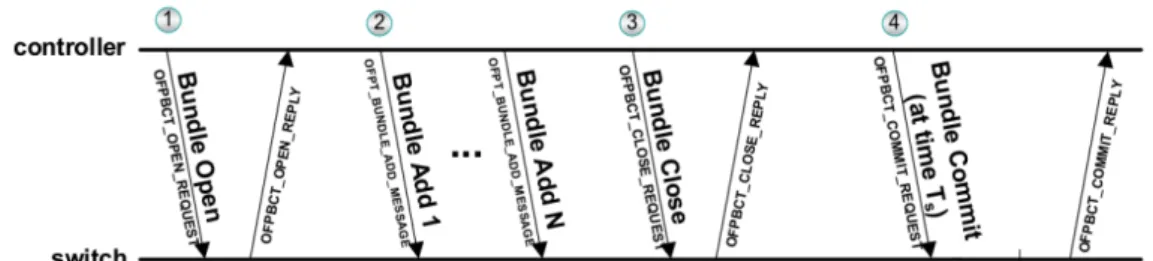
OpenFlow has evolved over the years and enables new features with each release. Two particular features are of interest to our work. First, OpenFlow 1.3 introduced the master-slave model where switches can be connected to at least two controllers with dif-ferent roles. For each switch, only one controller has the master role, while one or more controllers may have the slave role. By default, switches send every event to the master controller but only some events (e.g., port down events) are sent to the slave controllers. Secondly, the addition of Bundles in OpenFlow 1.4 allows controllers to have more con-trol on how switches process commands. Concon-trollers can open bundles and add one or more commands to that bundle before closing and committing each bundle. According to the protocol, the commit can be ordered (commands must be processed in the order they were sent by the controller), atomic (all commands must be processed successfully or else no command can be processed), or both, but it is not mandatory that switches implement all combinations. Upon committing a bundle, the switch must send an acknowledgement message to the controller, the Commit Reply message, indicating if the bundle commit was successful or not. Section 3.3 explains how we use these two mechanisms introduced by OpenFlow to achieve a consistent and fault-tolerant controller.
The SDN design has some specific concerns with scalability and resilience which we will discuss in the next sections. To overcome the scalability limitations of SDN, different techniques have been proposed. These techniques can be classified into two main cate-gories: (i) improving the control plane with well-known distributed systems techniques, and (ii) moving the intelligence into the switches to offload the controller. In addition, recent works complement these proposals by making Software-Defined Networks more secure, resilient and robust to both applications and component faults.
Chapter 2. Context & Related Work 11
2.2
Scaling SDN in the control plane
The majority of research work to address the scalability issues in SDN focuses on the control plane, since it does not require modifications to existing network elements.
2.2.1
Improving control plane performance
NOX [8] was the first controller to provide a higher level of abstraction for applica-tions to program the network. However, NOX can only handle 30K new flow installs per second while maintaining a sub-10ms flow install time [17], which is way far from desired: a 1500 server cluster might generate 100K requests per second [18] and a 100 switch data center might generate 10000K requests per second [19].
With this in mind, some works focused on improving the control plane performance by using multithreaded designs to explore the parallelism of multi-core processors [20, 21, 22, 13]. These implementations use common distributed system techniques such as parallelism, I/O batching [20, 21, 22], shared queues [21] and pipelining [20], while also maintaining a simple programming model for developers (i.e., they can write single threaded applications) [20, 21].
Maestro [21] was the first controller exploiting parallelism to achieve near linear per-formance scalability on multi-core processors. It uses a multithreading design that dis-tributes the work evenly across worker threads and aims to reduce the cross-core over-heads.
Beacon [20] not only optimizes the controller performance but it was also designed to help application developers and network administrators. It provides a platform with tools to ease the development of new applications and enables runtime modularity (new and existing applications can start and stop during runtime).
NOX-MT [22], a multi-threaded successor of NOX, was able to outperform NOX by a factor of 33 with just the use of I/O batching, Boost Asynchronous IO (ASIO) and a multi-threaded malloc implementation.
2.2.2
Distributing the control plane
One key technique to scale the control plane is to distribute it. In this approach, physi-cally distributed controllers work together to create a logiphysi-cally centralized global network view. The distribution can be flat (horizontal) or hierarchical and each controller is re-sponsible for a subset of the network switches, forming a controller domain. While dis-tributed architectures have many advantages (e.g., scalability, switch-controller latency, fault-tolerance and load balancing), the coordination between the controllers to achieve a consistent network view brings new challenges.
Levin et al. [11] explore the trade-offs of state distribution in a distributed control plane and motivate the importance of strong consistency in applications’ performance.
Chapter 2. Context & Related Work 12
On the one hand, view staleness affects the correct operation of applications, which may lead to poor network performance. On the other, applications need to be more complex in order to be aware of possible network inconsistencies.
One possible way to optimize the inter-controller coordination (and thus increase per-formance) is to make use of local algorithms to perform global tasks, as proposed in [23]. The main idea is that each controller instance only needs to reply to events that take place in its local neighbourhood (domain) in order to complete the algorithm, which greatly reduces inter-controller coordination in large scale networks.
The first work to explore and provide a distributed control platform for applications was Onix [1]. It introduced key concepts like the Network Information Base (NIB), par-titioning and aggregation. Applications use a set of general APIs that facilitate the access to network state (NIB), which is distributed and replicated over Onix instances to achieve scalability and resilience. Each controller imports/exports its NIB to/from a data store and registers for notifications to keep it updated with other controller instances. Onix also pro-vides two data stores so that applications can choose their trade-offs between consistency and performance.
Proposals like HyperFlow [24] and ONOS [25] take a different approach to maintain a global network view: they use a publish/subscribe system for inter-controller communi-cation (i.e., exchange network state updates and indirectly program switches from other controllers). HyperFlow’s publish/subscribe system is tolerant to network partitioning and also serves for controller discovery and failure detection. However, because HyperFlow is implemented as a NOX application, it incurs into unnecessary complexities and requires applications to be modified. On the other hand, ONOS, a distributed and open source SDN controller for wide-area networks, uses ZooKeeper [26] to manage and establish the switch-to-controller mastership. ONOS also provides a simple API for network ap-plications that abstracts the network view without exposing unnecessary implementation details (unlike Onix [1]).
To extend the distribution techniques presented in previous works, ASIC [27] pro-poses an intra-domain architecture with three layers, where each one has its own scalable solutions and can be adapted independently according to the network demands. First, a load balancing layer distributes the network events to the controllers cluster (second layer) that uses a distributed and persistent storage system (third layer) to achieve a consistent global network view.
DISCO [28], an open and extensible controller built on top of Floodlight [13], uses similar techniques but addresses the challenges of deploying a multi-domain SDN sys-tem (e.g., its heterogeneous nature). It leverages on Advanced Message Queuing Pro-tocol (that supports multiple proPro-tocols like OSPF, RSVP, BGP) to implement its pub-lish/subscribe system. Network agents use this channel to share aggregated network-wide state to provide end-to-end network services and mobility management. A DISCO
Chapter 2. Context & Related Work 13
controller manages the switches in one domain and maintains separated intra and inter network state in an extended table. DISCO use cases include inter-domain topology dis-ruption, end-to-end priority service request and virtual machine migration.
While proposals like DIFANE [29] and DevoFlow [30] (expanded in the next section) aim to reduce the number of events reaching the control plane by extending the mecha-nisms at the switches, Kandoo [31] achieves the same goal but without requiring switches to be modified. Kandoo is based on the idea that some applications are local, and do not depend on the global network state (e.g., learning switch and elephant flow detection), to separate the control plane in two hierarchies. In this scenario, frequent events can be processed by local controllers (which run local applications close to the switches) while the logically centralized root controllers (i.e., Onix [1], HyperFlow [24]) deal with rare events. In addition, a publish/subscribe system is used to exchange information between the controllers (i.e., subscribe to events or ask for network state). Kandoo is able to au-tomatically distribute application state based on a flag that each application must set to indicate if they need local or global state, which makes it not being completely transparent but easy to use nevertheless.
Beehive [32] extends the idea adopted by Kandoo to implement a platform that gen-erates and optimally deploys a distributed version of centralized applications across mul-tiple controllers. The platform uses techniques such as transactions, replication and fault-tolerance to provide applications with concurrent and consistent state access in a dis-tributed fashion. Because finding the optimum placement of applications is NP-hard, Beehive employs a greedy heuristic aiming at processing messages close to their source.
2.3
Scaling SDN in the data plane
Because the data plane is programmed by the control plane that maintains a global view, the OpenFlow design incurs in additional costs when compared to traditional net-works – flow setup costs (on both the controller and network) and flow statistics costs. These overheads limit the scalability of the control plane due to the high amount of events that controllers may receive.
With this in mind, and as mentioned before, DIFANE [29] and DevoFlow [30] reduce the number of events received by the control plane by adding new functionalities at the switches. Their main idea is to delegate some work to these extended switches to offload the controllers.
DIFANE [29] proposes that controllers should delegate work to authority switches so that they do not need to be involved in the flow setup. Rules generated by the con-trollers are partitioned and distributed across the authority switches whose job is to act as controllers for regular switches. DevoFlow [30] attempts to perform a reasonable trade-off between controller load and network visibility with two main mechanisms: 1)
Chapter 2. Context & Related Work 14
pre-installed wildcard rules are installed to delegate decisions to the switches as much as possible while maintaining a central control and visibility over important flows (e.g., security, QoS); 2) efficient statistics collection techniques implemented in the switches reduce switch-controller network bandwidth.
While partially solved by DevoFlow, this class of proposals choose to trade fine-grained detailed flow-level visibility in the control plane for scalability, which can be reasonable depending on the setting and constraints of the underlying network. In this work, we also try to stay away from anything that involves changing the OpenFlow pro-tocol or the switches.
2.4
Resilience in SDN
Having a strongly consistent network view across the controllers may be critical to the operation of some applications (e.g., load balancing) in terms of correctness and per-formance [11]. However, as noted in the CAP theorem [33], a system can not provide availability while also achieving strong consistency in the presence of network partitions. Because of this, fault-tolerant and distributed SDN architectures must use techniques to explicitly handle partitions in order to optimize consistency and availability (and thus achieving a tradeoff between them) [34]. Section 2.4.2 focuses on detailing proposals that tolerate faults in SDN.
Part of the strong consistency in the controllers comes from a consistent packet pro-cessing (i.e., packets received from switches). OF.CPP [35] explores the consistency and performance problems associated with packet processing at the controller and proposes the use of transactional semantics to solve them. These semantics are achieved by us-ing multi-commit transactions, where each event is a sub transaction, which can commit or abort, of the related packet (the main transaction). However, this transactional se-mantics in the packet processing are not enough as discussed in the previous sections: controllers should also coordinate to guarantee the same semantics in the switches state. Specifically, the commands sent by the controllers should be processed exactly once by the corresponding switches (to achieve consistent command processing – a problem our work addresses).
Furthermore, as each controller manages a set of network switches, a single event can cause applications to install commands on multiple switches. Therefore, it is important to consider how in-flight packets will be processed by switches during an update to the network policy (i.e., the global set of rules installed in the data plane). Ideally, a packet should be forwarded by only one policy and never be forwarded by a combination of an old policy in one switch, and later processed by a new policy in another switch – a property called consistent network updates. Because applications should be as simple as possible, the control plane should abstract the need to perform these consistent network
Chapter 2. Context & Related Work 15
updates [36]. This way, applications do not need to deal with the interactions of old a new network policies when installing forwarding rules in multiple switches. Some proposals for this class of reliability are discussed in section 2.4.1.
2.4.1
Consistent network updates
The concepts of per-packet and per-flow consistency model in SDN were introduced in [36] to provide a useful abstraction for applications: consistent updates. With consis-tent updates, packets or flows in flight are processed exclusively by the old or by the new network policy (never a mix of both). A network policy can be seen as the set of rules installed on all switches in the network at a given moment. For example, with per-packet consistency, every packet traversing the network is processed by exactly one consistent global network configuration. The authors extend this work in [37] and implement Ki-netic, which runs on top of NOX [8], to offer these abstractions in a control plane to be used by applications. The main mechanism used to guarantee consistent network up-dates is the use of a two-phase protocol to update the rules on the switches. First, the new configuration is installed in an unobservable way (no packets go through these rules yet). After, the switch’s ingress ports are updated one-by-one to stamp packets with a new version number (using VLAN tags). Only packets with the new version number are processed by the new rules.
In [38], Canini et al. extend Kinetic to a distributed control plane and formalize the notion of fault-tolerant policy composition. Their algorithm also requires a bounded num-ber of tags, regardless of the numnum-ber of installed updates, as opposed to the unbounded number of tags in [37].
This class of proposals addresses consistent network updates, which is orthogonal to the work presented here, since this work focuses on consistency issues inside the con-troller (consistent packet processing) and on the switches (consistent command process-ing).
2.4.2
Fault-tolerance
As for fault-tolerance, Kim et al. [39] identified three fault domains in SDN: (i) switches and links between them (data plane), (ii) inter-controller links and switch-controller links (control plane) and (iii) the controllers’ machines. In this section we start by explor-ing domains (i) and (ii) and then move to domain (iii).
To address faults in the data plane, [39] and [40], specific proposals for this subject, take different approaches. CORONET [39], a fault-tolerant SDN architecture, provides fast recovery and is able to recover from multiple link failures. It incurs into minimal con-trol traffic, by changing VLAN configuration after detecting faults in switches or links, using the OpenFlow API. Alternatively, FatTire [40] proposes a new programming
lan-Chapter 2. Context & Related Work 16
guage that eases the development of fault tolerant applications by compiling regular ex-pressions into OpenFlow rules. This provides an easy way for developers to specify the set of paths that packets can take in the network and the degree of fault-tolerance required. As a more general approach to handle faults in fault domain (i), most OpenFlow con-trollers take a reactive approach: port-down events sent by switches are fed to applications that program switches accordingly (i.e., reroute traffic around failures). Nonetheless, this approach incurs into high restoration time and additional load on the controllers. A pos-sible solution is to have pre-installed backup paths in the switches to avoid the overhead of communicating with the control plane.
Covering fault domain (ii), Ros et al. [41] address the problem of dynamically adapt-ing the number and locations of controllers, introduced in Bari et al. [42], but for fault-tolerance. The goal is to determine the optimal number, placement and switch-connections of controllers in order to achieve at least five nines of reliability in the southbound inter-face (connectivity between controllers and switches).
Distributed control plane architectures can achieve fault tolerance in domains (ii) and (iii) in the sense that if one controller fails, the switches managed by this controller start to be managed by a new one. However, this does not guarantee that the new controller will always have a consistent network view. The most common approach is to use the master-slave model introduced in OpenFlow 1.3 (see section 2.1), which is used in [13, 25, 43, 44, 45, 12]. ASIC [27] tolerates controller faults because the load balancer (assuming it does not fail) will only distribute requests across available controllers. In contrast with these approaches HyperFlow [24] directly reconfigures switches to connect to a new controller. Some proposals only plan to address fault-tolerance in future work [28, 32].
Deserving special attention, the works by Botelho [43] and Katta [12] address fault tolerance in the control plane while achieving strong consistency. SMaRtLight [43] pro-poses a fault-tolerant controller architecture for small to medium networks and analyses the costs of fault-tolerance in SDN. The architecture uses a hybrid replication approach: passive replication in the controllers (one primary and multiple backups) and active repli-cation in a distributed data store to achieve durability and strong consistency. The con-trollers are coordinated through the data store and achieve good performance by using caching mechanisms. However, SMaRtLight requires that applications are modified to use the data store directly, contrary to our approach, and it does not consider the consis-tency of the interactions between the controllers and the switch state.
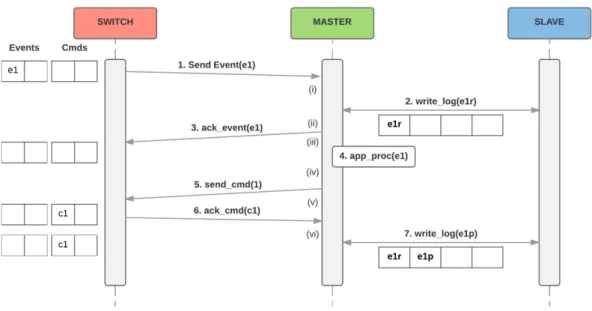
The closest work to ours is Ravana [12] that provides a transparent fault-free con-trol platform for applications in the face of both concon-troller and switch crashes. To achieve this, Ravana processes control messages transactionally and exactly once (at both the con-trollers and the switches) using a replicated state machine approach, but without involving the switches in a consensus protocol. The protocol used by Ravana in show in figure 2.4. Switches buffer events (in case they need to re-transmitted) and send them to the master
Chapter 2. Context & Related Work 17
controller that will replicate them in a shared log with the slaves and reply back to the switch acknowledging the reception of the events. Then, events are delivered to applica-tions that will generate and send one or more commands to the switches. Switches reply back to acknowledge the reception of these commands and buffer them to filter possible duplicates.
Fig. 2.4: Ravana protocol. In Ravana switches maintain two buffers (displayed on the left) to re-transmit events and filter repeated commands in case of master failure. New acknowledge messages (ack event and ack cmd) are exchanged between the switch and the master to guarantee the consistency requirements.
While Ravana allows unmodified applications to run in a fault-tolerant environment, it requires modifications to the OpenFlow protocol and switches: Ravana leverages on buffers implemented on switches to retransmit events and filter possible repeated com-mands received from the controllers; explicit acknowledge messages must be added to the OpenFlow protocol so that the switch and the controller acknowledge received mes-sages.
Despite the very clear value of resorting to more advanced features in switches, the fact is that it takes time for the protocol (and subsequently switches) to be changed to include the necessary features. This motivates our work of, starting from Ravana, achieve the same guarantees without the need to modify the protocol or the switches.
This chapter addressed the main concepts of SDN, its problems and challenges and listed some of the works in the literature that were somehow relevant to the problem we want to tackle. In the next chapter we describe the Rama protocol in detail and the
Chapter 2. Context & Related Work 18
challenges it must surpass to achieve the desired consistency properties without modifying the OpenFlow protocol or the switches.
Chapter 3 – Rama Design
In the previous chapter we summarized how SDN operates, explored some of its chal-lenges and problems, and the relevant proposed solutions. In particular we discussed the challenge that we focus on: maintaining a consistent control and data plane in the pres-ence of faults. The goal of our work is to build a strongly consistent and fault-tolerant control plane for SDN, without modifying switches, to be used transparently by applica-tions. This chapter describes the architecture and protocol for such control plane which is driven by the following requirements:
• Reliability: the system should maintain a correct and consistent state even in the presence of failures (in both the controllers and switches).
• Transparency: the consistency and fault-tolerance properties should be completely transparent to applications and switches.
• Performance: the performance of the system should not degrade as the number of network elements (events and switches) grows.
3.1
Architecture
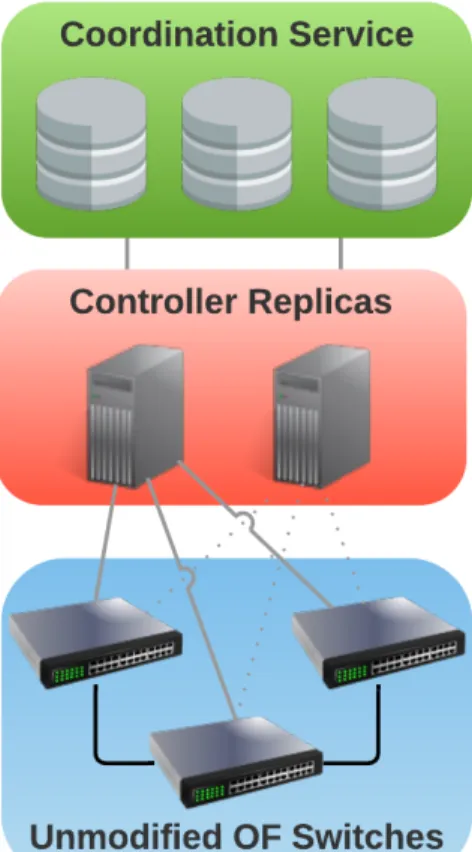
The proposed architecture for our system, Rama1 is depicted in figure 3.1. We have decided to name our system Rama since the original idea behind the protocol was inspired by Ravana [12] (see the description of Ravana in section 2.4.2). The main components are: (i) OpenFlow enabled switches (switches that are implemented according the OpenFlow specification), (ii) controllers that manage the switches and (iii) a coordination service that abstracts controllers from complex primitives like fault detection and total order. In our model, we consider only one network domain with one primary controller and one or more backup controllers, depending on the number of faults to tolerate. Each switch connects to one primary controller and multiple (f to be precise) backup controllers. This primary/backup model is supported by OpenFlow in the form of master/slave and allows the system to tolerate controller faults. When the master controller fails, the remaining controllers will elect a new leader to act as the new master for the switches managed by the crashed master. This election is supported by the coordination service.
Chapter 3. Rama Design 20
Fig. 3.1: High level architecture of the system. One controller manages the OpenFlow (OF) switches (master) and one or more backup controllers are ready in case of failure (slaves, connected in dashed line). All controllers keep an updated and consistent network view using the coordination service. Network applications run inside controller replicas.
The coordination service offers strong consistency and abstracts the controllers from coordination and synchronization primitives, making them simpler and more robust. Note that here we usually want to have a number of replicas equal to 2f+1 with f being the number of faults to tolerate. The strong consistency model assures that updates to the coordination service made by the master will only return when they are persistently stored. This means that slaves will always have the fresh modifications available as soon as the master receives confirmation of the update. This results in a consistent network view among all controllers even if some fail. In addition to the controllers’ state, the switches also maintain state that must be handled consistently in the presence of faults. This will be discussed in section 3.3.
3.2
Why Consistency Matters
In this section we summarize the importance of maintaining a consistent state in both controllers and switches in a tolerant SDN setting. The first step to have fault-tolerance in the control plane is to have more than one controller available to manage the network switches, which can lead us to some problems.
Chapter 3. Rama Design 21
3.2.1
Inconsistent event ordering
In OpenFlow, each switch maintains a TCP connection with each controller it knows and sends them messages using these channels. If we configure switches to send all their events to all known controller replicas, and let replicas process events as they are received, each one will end up building a different internal state. This is because, although each TCP channel orders events sent by each switch, there is no ordering guarantee between the events sent to controllers by all switches.
Consider a simple scenario with two controllers (c1 and c2) and two switches (s1 and s2) that send two events respectively (e1, e2 and e3, e4). One possible outcome where both controllers receive events in different order (while respecting the TCP FIFO property) is c1 receiving events in the order e1, e3, e2, e4 and c2 receiving in the order e3, e4, e1, e2.
As a result of this consistency problem we derive our first design goal for a fault tolerant and consistent control plane:
Total event ordering: all controllers should process the same (total) order of events and consequently reach the same internal state.
3.2.2
Unreliable event delivery
In order to achieve a total ordering of events between controller replicas two ap-proaches can be used:
1. The master (primary) replica can store controller state (including state from network applications) in an external consistent data-store (as in Onix [1], ONOS [25] and SMaRtLight [43]);
2. The controller replicas can maintain a consistent state using replicated state ma-chine protocols (as in Ravana [12]).
Although both approaches ensure a consistent ordering of events between controller replicas, they are not fault-tolerant in a standard case where only the master controller receives all events.
If we consider – for the first approach – that the master replica can fail between re-ceiving an event and finishing persisting the controller state in the external data-store (which happens after processing the event through controller applications), that event will be lost and the new master (i.e., one of the other controller replicas) will never receive it. The same can happen in the second approach: the master replica can fail right after receiving the event and before replicating it in the shared log (which in this case happens before processing the event through the controller applications). In these cases, since only
Chapter 3. Rama Design 22
the crashed master received the event, the other controller replicas will not have an up-dated view of the network and, depending on the type of the lost event or on the type of controller applications running on the controller, this can cause serious performance or security problems.
However, a solution used to solve the problem above cannot be careless. Additionally to not losing events, it is also important to not process them repeatedly in each controller replica, since that would also lead to controllers having an inconsistent view of the net-work. From both these problems comes our second design goal:
Exactly-once event processing: all events sent by switches are processed and are never lost nor processed repeatedly.
3.2.3
Repetition of commands
In SDN, mechanisms to ensure exactly-once event processing are not enough to achieve a consistent system in the presence of faults. This is due to the state maintained by switches taking an important role on how the whole system works.
Consider the case where the master replica is processing an event that generated three commands to be sent to one switch and the slave replica has knowledge of this event. If the master fails while sending these commands, the new elected master will process the event (to reach an updated state) and may send repeated commands. This happens because the old master failed before informing the slave replica of its progress (i.e., which commands have been sent for that specific event) and therefore it cannot decide which commands to send and which commands to filter.
Additionally, to make things worse, one of the differences between traditional client-server models and SDN is that controllers (client-servers) may reply (i.e., send commands) to multiple switches (clients) as a result of one event sent by a switch. Therefore it is essential to integrate switch state into a consistent and fault-tolerant protocol and handle it carefully, which leads to our third and final design goal:
Exactly-once command execution: any set of commands for a given event sent by controllers is executed only once on the switches.
3.3
Consistent and Fault-tolerant protocol
In an SDN setting, switches generate events (e.g., when they receive packets or when the status of a port changes) that are forwarded to controllers. The controllers run multiple applications that process the received events and may send commands to one or more switches in reply to each event. This cycle repeats itself in multiple switches across the network as needed.
Chapter 3. Rama Design 23
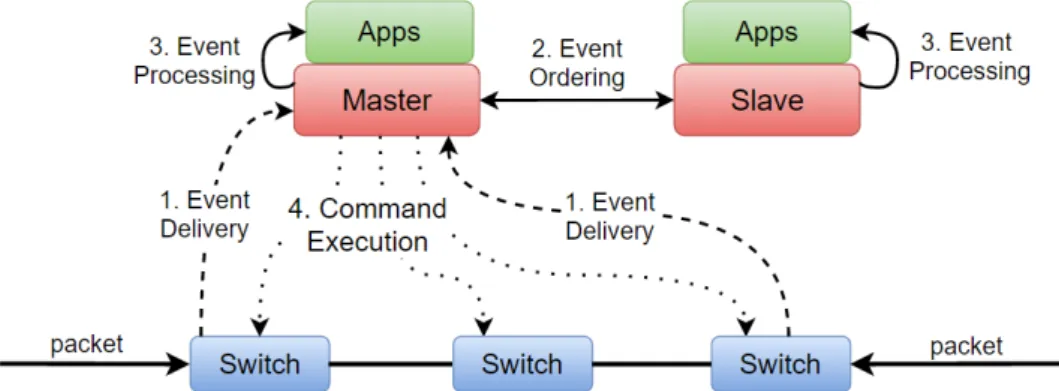
In order to maintain a correct system in the presence of faults, one must handle the state in the controllers (the received events) and the state in the switches (the received commands) consistently. In this work, to ensure this, the entire cycle (figure 3.2) is pro-cessed as a transaction and exactly once. This means that (i) the events are propro-cessed exactly once at the controllers and in a total order (i.e., all controllers process events in the same order to reach the same state) and (ii) the commands are processed exactly once in the switches. Because the standard operation in OpenFlow switches is to simply pro-cess commands as they are received, the controllers must coordinate to send a command exactly once (since we do not want to modify the protocol or the switches). Ravana [12] does not need this coordination because the (modified) switches can simply buffer re-ceived commands and discard repeated commands (with the same identifier) sent by the new controller, as explained in section 2.4.2.
Fig. 3.2: Control loop of (1) event delivery, (2) event ordering, (3) event processing, and (4) command execution. Events are delivered to the master controller, which decides a total order on the received events. The events are processed by applications in the same order in all controllers. Applications issue commands to be executed in the switches.
By default, in OpenFlow, a master controller receives all asynchronous messages (i.e., OFPT PACKET IN) and the slaves controllers only receive some messages (i.e., port modifications). This means that only the master controller would receive the generated events from the switches. To change this behavior, the slaves send an OFPT SET ASYNC message to each switch that modifies the asynchronous configuration in a way that switches will send events also to the slaves. Alternatively, controllers can set their role to EQUAL, and the coordination (to decide who processes and sends commands) is done among con-trollers. In this case, by the OpenFlow protocol specification, switches send all events to every controller in role EQUAL.
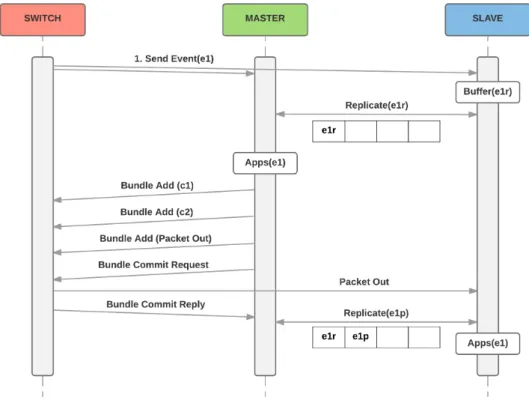
The fault-free execution of the protocol is represented in figure 3.3. In this case, a switch is connected with one master controller and one slave controller. The main idea is that switches must send messages to all controllers, so that they can coordinate themselves even if some fail at any given point. Ravana, because switches simply buffer events (so