The Portuguese Adoption System and the Role of the Multidisciplinary
Team: Potential and Challenges
Emanuelly da Conceição Vieira
Erasmus Mundus Master’s Programme in Social Work with Families and Children
Supervisor: Prof. Dr. Jorge Manuel Leitão Ferreira Co-Supervisor: Prof. Dr. Maria das Dores Horta Guerreiro
ISCTE-Instituto Universitário de Lisboa, November 2016
ACKNOWLEDGEMENTS
I would like to thank my supervisor at ISCTE-IUL, Prof. Dr. Jorge Ferreira, for the guidance during this process. The professors who have contributed to my professional qualification in these two years, especially to our coordinator and also my co-supervisor Prof. Dr. Maria das Dores Guerreiro, for her valuable support and patience during all these months. Thank you for believing in me. Thanks to my colleague and friend Elisabeth Emdal for also helping me with the thesis. A big thanks to all involved at Santa Casa de Misericórdia de Lisboa and at Associação para o Bem-Estar Infantil. Thank you for sharing with me all the experience and knowledge. Last, but not least, I would like to thank my family, friends and MFamily colleagues for being so supportive throughout this master programme. You guys are very important!
ACRONYMS
ABEI – Associação para o Bem-Estar Infantil
IPSS – Instituições Particulares de Solidariedade Social
MSESS – Ministry of Solidarity, Employment and Social Security SCML – Santa Casa de Misericórdia de Lisboa
TABLE AND FIGURE LIST
Figure1. Social ecological model levels ……… 14
Table 1. Interview schedule ……….…….. 22
Table 2. Professionals interviewed ……… 23
Abstract
Title: The Portuguese Adoption System and the Role of the Multidisciplinary Team: Potential and Challenges
Author: Emanuelly da Conceição Vieira
This dissertation project has as its main objective the analysis of the contribution of the multidisciplinary team (Social Workers, Psychologists, Jurist and Social Educator) in the measures that promote the well-being of children in situation of adoption, within the Santa Casa de Misericórdia de Lisboa (SCML) and Associação para o Bem Estar Infantil (ABEI). The specific objectives are, then, to characterize the Santa Casa de Misericórdia de Lisboa, Associação para o Bem Estar Infantil and their multidisciplinary team; to analyse and describe the adoption program at Santa Casa de Misericórdia de Lisboa, Associação para o Bem Estar Infantil and their contribution to the matter of adoption; to gather specific legislation about adoption; to gather information about the difficulties and achievements of families who are in the adoption process, in the Metropolitan Region of Lisbon; to identify the social policies within the adoption theme and to analyse the methodological intervention of the multidisciplinary team in the adoption program.
6
CONTENTS
1. Adoption in Portugal ... 8
1.1. Adoption and legislation ... 8
1.2. Legislation ... 10
1.3. Empowerment theory, ecological model, strength perspective and resilience theory .. 12
1.4. Social policies ... 15
2. Methodology ... 17
2.2. Method ... 18
2.3. Universe and sample ... 18
2.4. Data collection ... 21
3. Results ... 22
3.1 Professionals interviewed at SCML and ABEI ... 22
3.2. Cases of children (life stories) ... 30
Conclusion ... 38
Bibliography ... 40
Appendix ... 42
App. 1 Declaration of informed consent for fieldwork ... 42
7
Introduction
This dissertation project has as its main objective the contribution of the multidisciplinary team (Social Workers, Psychologists, Jurist and Social Educator) in the measures that promote the well-being of children in situation of adoption, within the Santa Casa de Misericórdia de Lisboa (SCML) and Associação para o Bem Estar Infantil (ABEI).
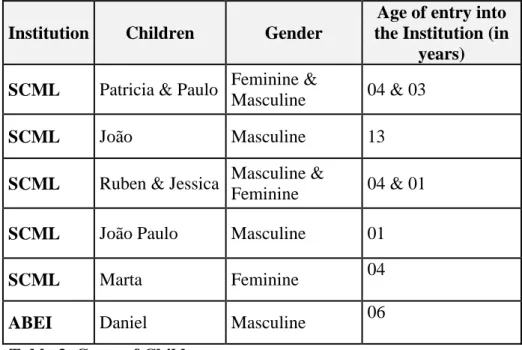
This study was carried out in Lisbon, Portugal. The methodology used for the elaboration of this work was carried out through documentary and bibliographic research, apart from internet researches. The main data collection method was a semi-structured interview and this data was gathered over the course of six days between March and April 2016, where visits were made to the Santa Casa de Misericórdia de Lisboa and Associação para o Bem-Estar Infantil. At SCML the semi-structured interview was conducted with 06 professionals: a Jurist, Social Workers and Psychologists. At ABEI it was conducted with 01 professional of Social Education. The entire study was conducted over four months, between February and June 2016.
It has two main research questions: How the practices of the Multidisciplinary Team (Social Workers, Psychologist, Jurist and Social Educator) assist the children in the adoption situation? Moreover, which experiences do the children face in the adoption situation? Last January I started to search and comprehend the experience of children in adoption situations throughout history, being observed that there are many bad situations experienced by them. In addition to providing greater visibility about children in adoption situations, it will point out the importance of critical and interventionist character of the multidisciplinary team in this theme, for their performance to pursuit of equity and preservation of the rights of individuals.
8
1. Adoption in Portugal
With the fall of Nicolae Ceauşescu regime in Romania, in 1989, became public the conditions and severe deprivation of experiences that children institutionalized in that country were exposed to, many from early childhood. This extremely worrying and atypical of extreme adversity standpoint found, led to a humanitarian response involving the international adoption of many of those children, by families in Western Europe and North America (Rutter et al., 2009 ). Taking into consideration Portugal, the levels of inequality and the extent and intensity of poverty have a structural nature in the country. Deeply inscribed in the main institutions and resulting long-term historical processes which cross atavism resulting from a past off underdevelopment with modernization dynamics which, on the one hand, generate marked improvements in the living conditions of the people and, on the other hand, simultaneously produce new social contrasts (Capucha, 2007). According to the census made by the National Statistical Institute of Portugal (NSI) in 2011, the population in Portugal was compound by 10.562.178 people, against 10.356.117 in 2001. The NSI also informed that after staying below the 100.000 babies in 2011, the number dropped to less than 90,000 in 2012 and fell in 2013 to 82,367.
Aragón (2010), specialist in Clinical Psychology and mediator and family therapist, once said that adoption is one of the ways to acquire filiation, and become part of a particular family. It is a new family relationship equated absolutely biological, since it involves the breaking of all personal, family and legal relationship between the adopted child and its natural or biological parents, and the birth of rights and obligation that establish a bond between parents and adoptive children identical to those arising from biological filiation. The adoption has constitutional consecration (Article 36, paragraph 7 of the Portuguese Constitution), where the State is obliged to provide children deprived of a normal family environment - abandoned, abused or neglected an alternative family space.
The United Nations Convention on the Rights of the Child of 20th of November 1989 expressly recognizes that:
Exhausted the possibilities of the child to enjoy a happy and healthy growth within their biological family, with the support of the State and society, or with the use of extended biological family, adoption comes up with a possible and satisfactory answer.
1.1. Adoption and legislation
Adoption in Civil Law is the legal act in which an individual is permanently assumed as a child by a person or a couple who are not the biological parents of the adoptee. When this happens, the responsibilities and rights (such as parental authority) of parents in relation to the adopted are transferred wholly or partly to adopters. Psychologically, it is the process of assigning the son/daughter of place to a child/adolescent who is not descended of the same story that the couple is, it is the possibility of integrating the family dynamics to a person who comes from another life story. It also takes much affective investment and large caring capacity.
When it comes to terms of who can adopt, the Social Security states that two people can adopt if they are married (and not legally separated from persons and property or de facto) or living in de facto union for more than four years, if both are more than 25 years old. One
9
person can adopt if the person is over thirty years old (or over 25 years old if the person wants to adopt the child of the spouse). From the age of 60 adoption is permitted only if the child is daughter/son of the spouse or if the child has been entrusted to the adopter before he/she has turned 60 years old. The age difference between the adopter and the adoptee must not exceed 50 years (except in special situations). The adoption law has recently changed in Portugal (29 February 2016) and according to Article 3 of the Law nº 9/2010 (that allows the civil marriage between people of the same sex) “the regime introduced by this law implies the legal admissibility of adoption, in any of its forms, for married people with spouses of the same sex.”
It is known that children or young people can be adopted according to the following situations:
In some situations, through an administrative trust (applied by Social Security);
In most cases, through measures applied within the process of promoting the rights and child protection. (Applied by the Court)
Children of the spouse of the adopter.
This can happen since the process of entry in the Court:
They will not be over 15 years old;
They will be under 18 years old (if they are children of the spouse of the adopter or if they are not emancipated and have been entrusted to the adopters or one of them with age not exceeding 15 years old)
The number of adoptions in Portugal is increasing and according to the Social Security reality, there are two adoption procedures, the Full Adoption and Restricted Adoption.
In Full Adoption, the child or young adopted:
Becomes child of the adopter and becomes part of their family, for all legal purposes, including the succession;
No longer has family ties with the family of origin;
Lose their original surnames and acquires the surnames of the adopters;
Can, in some situations, change their own name (if the adopter requests and the Court agrees).
This adoption is definitive and cannot be revoked, not even by agreement between the adopter and the adoptee.
In Restricted Adoption, the child or young adopted:
Becomes son/daughter of the adopter, but retains all rights and duties in relation to the family of origin (except for some restrictions established by the law);
Can receive the surname of the adopter, but maintains one or more surnames from the family of origin;
The adopted, or their descendants, and the adopter's relatives are not heirs of each other or are mutually obliged to pay maintenance.
The Restricted Adoption still has the following features: it can, in certain circumstances, be repealed and; may at any time, by court order, be converted into Full Adoption, at the request of the adopters and provided they meet the respective requirements.
10
To apply to adopt a child it is necessary to contact the Adoption Team in the body of the Social Security of the respective area of living, if the residence area is the city of Lisbon then the person/couple need to contact the Santa Casa de Misericórdia de Lisboa. In Açores, they need to contact the Institute of Social Security of Açores, in Madeira they need to contact the Institute of Social Security of Madeira and in the rest of the country it is necessary to contact the District Centre of Social Security. After this it is required to attended to the Informational Session (called Session A) of the Training Plan for Adoption, where candidates are informed about the objectives of adoption, what is needed to be able to adopt (general requirements and conditions to be met) and the adoption process (including the application process, forms and required documents). Thereafter they will fill out the forms, attach all required documentation and give the application to the adoption services of the Social Security agency in the area where they live, when the candidates are delivering the application they receive a certificate of application. The entity that received the application will do a mandatory social and psychological evaluation of the candidate, where there will be interviews (one of those at the candidate's house) and the application of social and psychological instruments of assessment.
During this evaluation period the candidate will also be invited to take part in a second action of the Training Plan for Adoption, called Session B (in groups of 6 to 8 candidates), and several training sessions. Within 6 months the candidates will be informed if their application has been selected or rejected and if the professionals consider that the application should not be accepted, and before taking the final decision, they communicate the intention to reject the application, giving the opportunity to consult the process and submit new documents or arguments. According to Santa Casa de Misericórdia de Lisboa (SCML), once selected, the applicants will go to the waiting list at national and SCML level, waiting to propose them a child with the desired profile. Desirably, before being made an adoption proposal, it will exist the Sessions C, which prepare the integration of the child to change of the family context. When the child is introduced to the candidate, there is a period of contacts to meet and see if they will accept each other and if this phase goes well, the child is entrusted to the candidate, starting the pre-adoption situation where the child goes through a follow-up for 6 months (this time may be longer depending on the case). During this period, the Adoption Service may also carry the Session D of Parental Training, to support the new family in their roles, helping to strengthen the emotional ties and family relations. Then the adoption service makes a report that the applicant sends, along with the adoption application, to the competent Court (Court of Family and Children of the area of residence) and when the Court utters judgement, the adoption process is completed.
1.2. Legislation
The Best Interest of the Child
As explained by Barroso (2015) adoption it is not more than the realization of the child's right to an alternative family than the one he or she was born. Already in 1994, Year of the Family, the United Nations understood by family: two or more people who share resources and responsibilities for decisions, shared values and objectives and have a commitment to other long-lasting type, regardless of blood ties, adoption or marriage (definition currently considered unsatisfactory). Evolved towards the family is increasingly the result of the will of its members and not social charges or legal. There is an obligation to continue to promote the
11
children’s rights for them to grow responsibly and to become capable adults and, thus, also promote the rights of families. Marriage, kinship, affinity and adoption are stated as sources of legal family relations (Article 1576.º from the Civil Code).
The adoption implies a total and definitive break with the biological family. Children may only be separated from their parents against their will when parents do not fulfil their duties and always by judicial decision, as the Portuguese Constitution requires. Therefore, in no case, even in emergency situations the child can be removed from their parents against their will, without a court immediately confirm the withdrawal. The Court, the judge, can only undertake that court in the case of full adoption proffering an irreversible decision, if the circumstances that the law determines are checked, that is, they must not exist or are seriously committed themselves affiliation links.
As stated by Leandro (2014), the best interests of the child as a legal principle must be expressed as its imposition in Article 3, paragraph 1, of the United Nations Convention on the Rights of the Child (UNCRC), which states: "in all actions concerning children taken by public or proven institutions of social protection, courts of law, administrative authorities or legislative bodies, shall be a primary consideration the best interests of the child”. Taking into account what is set out in Article 4, paragraph a) of the Law for the Promotion and Protection of Children and Young People in Danger (which was approved by Law No. 147/99, 1/9) about the best interest of the child as a guiding principle of intervention: "the intervention should serve primarily the interests and rights of children and youth, without prejudice to the consideration that is due to other legitimate interests within the plurality of interests present in this case".
It is important and necessary the recognition of the child, not only in terms of ethics, culture and politics, but also of international and national law, as an autonomous subject of rights (common and specific) founded its eminent dignity; impose consideration of interest already autonomously, although in correlation with other interests. Adoption is a source of family legal relationship, namely membership (and corresponding parenting), and Article 1576.º and 1586.º of the Portuguese Civil Code. And according to Article 1974º: The adoption will only be imposed when present real advantages for the adoptee, merges into legitimate reasons, does not involve sacrifice unfair to other children of the adopter and may reasonably be expected between the adopter and the adoptee will establish a similar link to the membership. Thus aiming to perform the best interest of the child.
Are well known the need and the advantages of respect for that “timely child”, to be determined by the specific circumstances of the situation of each one, known as the extremely importance of early intervention, either in an attempt of taking or recovery of parental role or, if not obtained, the referral to the adoption, when diagnosed or indicted as feasible, as stated by Leandro (2014:85). For the adoption to be likely to achieve the best the interests of the child the quality it is very important, with all the titles, that they should be substantial answers the promotion and protection of children in danger, before being effectively entrusted to adopters and be ordered to adoption. A long-standing and positive route has been taken in this direction by temporary reception centers, in cooperation with the courts, the commissions of protection of children and young people, social security, health, education, municipalities and other entities with competence in field of childhood and youth that stand out the IPSS (Private Institutions of Social Solidarity), charitable institutions (as Misericórdias) and other NGOs.
For the success in the prosecution of achieving the goal, through adoption, the best interests of the child, the quality of procedures to the study of personal, social and legal situation of the child, and the consequent proposal for development and implementation of project of life is crucial.
12
1.3. Empowerment theory, ecological model, strength
perspective and resilience theory
In this section the concepts of strength perspective, ecological model, empowerment theory and resilience will be introduced as the theoretical concepts used to interpret and explore my empirical data. The theoretical framework aims to highlight the research questions and the objectives from different perspectives and contribute to a richer comprehension and analysis of the collected data.
Empowerment theory
When we talk about the Empowerment theory, it remind us what was said by Rapapport (1981,1984) about being a construct that links competencies and individual strengths, natural helping systems, and proactive behaviours to social change and social policy. On its most general sense, the empowerment relates to the capacity of people to acquire control and comprehension over personal, economic, social and political forces to be able to fight for life improvements. Considering that inside the children and youth field, it is notable that after the UN Child Convention 1989 and the Children Act 1989 in the UK a new impetus to children’s participation was given. The Brazilian educator Paulo Freire (author of the book Pedagogy of the Oppressed) made a rich definition of the word "empowerment”, even though the word already existed in English meaning “to give power” to someone to perform a task without needing permission from others. The empowerment concept by Paulo Freire follows a different logic, for him, the person, group or institution empowered is that one that accomplishes, by themselves, the changes and actions that lead to evolution and strengthen. Paulo Freire points out that even though the individual empowerment or the empowerment of some students, or the feeling of having changed, not enough regarding to the transformation of society as a whole, it is an absolutely necessary process for social transformation. Therefore, "the critical development of these students is critical to the radical transformation of society. His curiosity, his critical perception of reality are fundamental to social transformation, but are not by themselves sufficient "(Freire & Shor, 1986, p. 71).
In social work, Abrams and Moi (2009), “have traced the development of such discourses, noting that while cultural competence – and its predecessor ‘cultural sensitivity’ – was originally coined in response to the need to work in a culturally appropriate way with minority ethnic groups, over time, ideas about cultural competence have evolved to incorporate all groups at risk of social exclusion with reference to disability, sexuality and a range of other identity markers”. According to Laird (2008), to fight against ‘unintended racism’ it is important that social workers learn about other cultures, being also a way of knowing better their clients and to be able to empower them. This approach to social work practice, for example, emphasises holistic empowerment of oppressed groups.
Ecological model
The Ecological model was developed by the Russian-born American psychologist Urie Bronfenbrenner. He would state as his initial theory that in order to understand human
13
development, the entire ecological system in which growth occurs needs to be taken into account. This perspective conceives the ecological environment as a set of structured structures at different levels, where each of these levels contains the other. Bronfenbrenner calls these levels the Microsystem, the Mesosystem, the Exosystem, the Macrosystem and Chronosystem. Based on Bronfenbrenner, the authors Papalia, Olds & Feldman (1998) explain them:
The Microsystem is an immediate level in which the individual (usually the family) develops. It is the child's first system, where she/he receives the basic care essential to her/his development.
The Mesosystem comprises the interrelations of two or more environments in which the developing child participates actively, for example home-school or family-neighbors.
The Exosystem is composed of broader contexts that do not include the child as an active subject but the child undergoes indirectly the influences (which affect her/his development).
the Macrosystem is shaped by the culture and subculture in which the child and all individuals in her/his society develop, for example the cultural patterns, values, beliefs, ideologies, etc.
The Chronosystem adds a new dimension, the temporal one, which considers the influence of change or stability (changes in family, place of residence, work, changes in society, etc.).
Some institutions in Portugal are based on the Ecological Model, believing that in order to understand a child’s situation, they must take a holistic approach and analyze many factors including the child’s needs, the parental capacity and the environment. Bronfenbrenner (1979) also took into account the different systems (family, school, neighborhood, culture, law, etc.) when evaluating the child’s needs and making a diagnosis leading to an intervention-life plan. They believe in the strength of the individual and building capacity in their clients by using their existing knowledge and skills.
14
Figure1. Social ecological model levels
The way people position themselves in the contexts will depend on the way they interpret the contextual information. The position that each one occupies is specific to each individual as well as the way they interact with their social networks and meanings they build. Even when the elements of the context are repeated, the setting is not the same for each one, each person lives in their environment that share with others but that is configured only in the influence it has for each one. The participation and interaction in the contexts alter not only by the ways of being of individuals but also allows the change of contexts and relationships in it and with them are established. People interact with the environment and with other human beings, set themselves to them and vice versa. The relationship between individual and context is dynamic, the result of the personal development depends on how its features interact.
Strength perspective and resilience theory
The strength perspective is client-led, with a focus on future results and strengths that people bring to a problem or crisis. It does not attempt to ignore the problems and difficulties. Instead, it tries to identify the positive basis of the person’s resources (or what may need to be added) and strengths that will lay the basis to address the challenges resulting from the problems. The strengths approach also reduces the power and authority barrier between person and professional by placing the social worker, for example, in the role of partner or guide. Also because when people act as experts on solving the problems of others, they deny to them the possibility of facing the problem, not giving the opportunity to participate, take control and learn. As stated by the psychologist Lisa (2012):
Strengths-based practice is a collaborative process between the person supported by services and those supporting them, allowing them to work together to determine an outcome that draws on the person’s strengths and assets. As such, it concerns itself principally with the quality of the
15
relationship that develops between those providing and being supported, as well as the elements that the person seeking support brings to the process. Working in a collaborative way promotes the opportunity for individuals to be co-producers of services and support rather than solely consumers of those services.
Bringing the meaning of Resilience from the Oxford Dictionary, it is known that it is the capacity to recover quickly from difficulties. Aragón (2010:68) says then:
Researches, in the field of human knowledge, have evolved and advancing ideas and concepts to shape a concept, which opens the way to thinking and, above all, prevention; this term is Resilience, which comes from the Latin word “resilio or resilium” which means to go back, back to the initial state. It is a term used in physics to describe origin in a substance with elastic qualities, and plasticity; is the ability of a material to recover its original shape after undergoing a deforming pressure. This term has migrated, in an initial emphasis since its first application to children, to other stages of the life and family cycle, including other fields that concentrate currently interest such as school, psychosocial field, prevention and research.
There are other definitions of resilience, as Cyrulnik (2002) defined as the ability to develop some human beings to overcome the psychological trauma and severe emotional wounds, such as bereavement, rape, torture, deportation, or war, as well as the psychological and moral violence to which they are exposed millions of people in the world today. Alternatively, even the definition made by Gordon (1996) where Resilience is the ability to grow, mature and increase competition, facing adverse circumstances and obstacles, using all resources, both personal and environmental. It is important to identify characteristics or behaviours associated with a risk, to intervene on those who may be modified, either by deleting a risk factor or strengthening a protective factor.
1.4. Social policies
The policies for children and family are part of a whole three compelling principles contained in the Constitution but also under international law that Portugal agrees: the best interests of the child in that has to deal with the primacy of this principle in decision-making, the family as a fundamental unit of society, in general, and in the generative function, in particular and, finally, the principle of equality, in recognition of common rights and obligations to parents and, consequently, the right to protection in parenthood. The policy measures for children and family, who then identify, correspond to the intervention area of social security, alone or in partnership with other Ministries, not running out the same, then, any intervention of the Portuguese State. The presentation of the same corresponds to the adopted systematic by the Social Security from the respective legislation, having been chosen only for their brief characterization, without specifying its content and evolution, which necessarily refer to more specific legislation and update.
16
The main measures to support families correspond to the measures to support responses to parental duties or address specific needs of the child or regarding the reconciliation of professional and family life, developed through the public, private profit and solidarity sectors. The Sistema Nacional de Intervenção Precoce na Infância (National System of Early Childhood Intervention) it is a response that aims to ensure children's developmental conditions with changes in body function or the structures that limit the personal and social development and their participation in typical activities for their age, as well as children with serious risk of developmental delay. It follows the relationship between three Ministries: Solidarity, Employment and Social Security, Education and Health. Its objectives are to ensure children to protection of their rights and develop their skills. Detect and signal all children with risk of changes or changes in the functions and structures of the body or serious risk of developmental delay. To intervene after the detection and signalling of those situations, depending on the needs of the family context of each eligible child, in order to prevent or reduce the risk of delays in development. Moreover, to support families in the access to the services and resources of the Social Security systems, Health and Education, involving the community by creating articulated mechanisms of social support. According to Ministério da Solidariedade, Emprego e Segurança Social (Ministry of Solidarity, Employment and Social Security) - MSESS
The Ama it is an activity carried out by qualified persons which, on their own and by retribution, take care of one or more children up to 03 years old that are not their relatives for a period of time corresponding to work or incapacity of the parents (or the person who has the custody). Its objectives are to support families through childcare, keep children safe and provide, in a family environment, the right conditions to the integral development of the child. The Creche (Day care center) it is a social response of a socio-educational nature, to accommodate children up to 03 years old during the period of impediment of the parents or the person who has their custody. Its objectives are to provide, through individualized care, well-being and integral development of children in a climate of security on emotional and physical levels. To collaborate with family in sharing care and responsibilities in the development of children and to collaborate in the early diagnosis of any inadequacy or deficiency ensuring their proper referral. The Estabelecimento de educação pré-escolar (Preschool education establishment) it is a targeted social response to the development of children between the age of 03 years old and the age of entry into primary school, providing to them educational activities and family support activities. Its objectives are to promote personal and social development of the child and provide to them well-being and safety conditions. To contribute to equal opportunities in access to education, the success of learning and development of expression and communication, as also to stimulate curiosity and critical thinking. To outwit inadequacies, deficiencies and precocious behaviours for a better orientation and guidance of the child. To encourage the participation of families in the educational process and to establish collaborative relationships with the community, also to support the family by providing meals to children and to extended hours with youth work activities, as stated by the MSESS.
The Ministry of Solidarity, Employment and Social Security explains that the Centro de atividades de tempos livres (Center of leisure activities) it is a social response that provides leisure activities for children and young people from 6 years, on the periods available from school responsibilities, developing through different intervention models, including monitoring/insertion and practice of specific activities. Its objectives are to create a favourable environment for the development of each child or young person and collaborate in the socialization of each child or young person through participation in group life. Encouraging
17
the relationship between family, school, community and property, with a view to appreciation, utilization and monetization of all environmental resources and provide integrated activities in socio-cultural animation project. To improve the social and educational situation and the quality of life of children, as to strengthen interaction and social integration of children with disabilities, at risk and social and family exclusion. The Centro de Apoio Familiar e Aconselhamento Parental (Family Support Center and Parental Guidance) it is a social response, developed through a service dedicated to the study and prevention of social risk situations and support to children and young people in distress and their families, brought into their community, through multidisciplinary teams. In this sense, according also to MSESS, this answer aims to family qualification skills by acquiring and strengthening parenting skills in the various dimensions of family life and to understand different levels of educational and psychosocial nature of intervention, that according to the characteristics of the families, integrate the following modalities:
• Family Preservation (aims to prevent the removal of the child or young person from their natural life);
• Family Reunification (aims the return of the child or young person to their family environment) and;
• Family meeting point (it is constituted as a neutral and suitable space that aims to maintain or restore family ties in cases of interruption or serious disruption of family life, particularly in parental conflict and marital breakdown situation).
2. Methodology
Social work methodologies are based on empirical knowledge derived from research and practice evaluation, including specific knowledge inherent to specific local contexts. Social work takes into account the complexity of the interactions between humans and the environment around them and their ability although affected by this, be prepared to modify the factors including the biopsychosocial framework. As a Social Worker, it is clear that the profession is dedicated to the pursuit of social justice and the well-being of oppressed and marginalized individuals and communities. According to Gil (1999), a good researcher needs, in addition to subject knowledge, curiosity, creativity, intellectual integrity and social awareness.
In this research, the contact was established with the institutions to check the availability for the elaboration of the thesis along with them. In both contacts with the institutions, I had the support of the master programme coordinator Dr. Maria Guerreiro for it to be achieved. The first contact was with the SCML, where we spent around an hour in direct contact, by telephone, with the then director of the adoption sector until we succeeded to start the interview process. Before going in person to conduct the interviews, the interview guide was sent to the director of adoption. The first interview took place on March 1st of 2016, I had an introduction to the adoption sector at SCML with the director and then I conducted the first interview of the thesis with the Jurist. The rest of the interviews with the other professionals were scheduled soon after that first meeting.
18
The same contact was necessary with the director of ABEI in Vila Franca de Xira so I could conduct an interview there. Via email, we scheduled a date for me to go there to carry out the interview with the Social Educator (the interview took place on April 26th, 2016). In the end of the interview, the director also was present and spoke about a child's case with the Social Educator too.
2.2. Method
Scientific research depends on a "set of intellectual and technical procedures" so that its objectives are achieved, that are the scientific methods, according to Gil (1999). From the point of view of the form of addressing the problem it may be a Qualitative research or a Quantitative research. For this project a qualitative methodology was deemed appropriate, meaning that there is a dynamic relationship between the real world and the subject. It is an inseparable link between the objective world and the subjectivity of the subject that cannot be translated into numbers. The interpretation of the phenomena and the attribution of meaning are basic in the qualitative research process. The natural environment is the direct source for data collection and the researcher is the key instrument. It is descriptive and the process and its meaning are the main focuses of approach, as said by Silva and Menezes (2001). Scientific research would therefore be the concrete realization of an investigation planned and developed in accordance with the standards established by scientific methodology. Scientific methodology it is understood as a set of neatly arranged steps that it is important in the investigation of a phenomenon.
From the point of view of technical procedures (Gil, 1991), and used in this project, it contains a literature review, elaborated from already published material, consisting mainly of books, journal articles and currently with material available on the Internet on the aforementioned theme. Also case collections to help on deep and thorough study of the theme, in a way that allows its broad and detailed knowledge.
The case study is a research strategy used in the social sciences quite regularly. We can say that is the most used strategy when you want to know the "how" and "why" (Yin, 1994). Also when we try to understand, explain or describe events and complex contexts in which are simultaneously involved several factors.
2.3. Universe and sample
For this project a non-probabilistic sampling was used, which is used when we do not have access to the complete list of the individuals who makes up the population (sample mark) and they serve to polls without inferential purposes. Used, then, a convenience sample. After that a partnership with two organisms were made as part of the Study group, to conduct the research as well as an initial characterization of the group to be studied: Santa Casa de Misericórdia de Lisboa and Associação Para o Bem Estar Infantil (ABEI). Six professionals from SCML were interviewed, between a Jurist, Psychologists and Social workers and one professional from ABEI was interviewed.
Empirical Field
On behalf of the privileged partnership that Santa Casa da Misericórdia de Lisboa (SCML) has with the MFamily program since the beginning the partnership allows students to do their
19
internships at the institution since the first semester, also ensuring support in gathering information for the dissertation development process. The agency Santa Casa da Misericórdia de Lisboa was founded on August 15th 1498 with the goal of finding solutions to the serious health and social problems that existed in the city at that time. According to its mission statement that it can be found on their website, Santa Casa works in the areas of social action, health, education and teaching, culture and the promotion of quality of life. It is committed to promoting the improvement of people’s well-being, particularly those who are most disadvantaged in Lisbon, Portugal. The public agency is located throughout Portugal, but plays a very special role particularly in Lisbon where it acts as the city’s most influential support. In other cities in Portugal, Santa Casa does not receive similar funding and does not have the same level of influence or scope as it does in the capital city.
Santa Casa da Misericórdia de Lisboa receives most of its funding through the lottery or gaming system in the city. About 90% of the agency’s total funding comes from this method of support while the other 10% comes from community donations as well as the money earned from the buildings they own, for example the profit from the São Roque Museum. The city of Lisbon is divided into four social welfare areas, based on location, and Santa Casa follows this by ensuring they have a main office in each of the areas. Through my key informant interview, I was told that employees at Santa Casa make every effort to follow an empowerment and strength perspective. Their guidelines, mission statement and vision are all very clearly focused on the strengths and capacity of the individual client. Noticing that in order to achieve change in the lives of disadvantaged individuals, employees of Santa Casa appear to make every effort to build strong, genuine relationships with their clients and to involve them in the process that take place within the agency.
The Adoption team of Santa Casa is part of the Adoption Unit, Civil Mentoring and Family Reception (UAACAF), and it is compound by five Social Workers, five Psychologists, one Jurist and one director (that is also a Jurist). The Adoption Service of SCML has the following competences:
- Register, to study and evaluate candidates for adoption resident in the city of Lisbon, with a view to their selection to adopt;
- Forward, integrate and monitor pre-adoption children with an adoption life project and adoptability decision, accepted in the institutions of Lisbon;
- Make in all phases of the adoption process the Parental Training for adoption;
- Ensure a permanent Service and Information to the general public and support families formed after the adoption if they express desire and / or need for such monitoring. In 2016, to date, twenty-two children were signalled to the SCML (including one case of two siblings) and in 2015, forty-two children were signalled to SCML (including five cases of two siblings). Also in the year of 2015, about 26 adoptions of children were enacted in pre-adoption by SCML or signalled to the SCML, which came out of the city of Lisbon. In relation to the Parents candidacy list, currently SCML has one hundred eighty-nine candidacies, of which one hundred twenty-four are couples and sixty-five are single candidates. While asked if there it was any case of children returning to the system, the adoption director stated: “We are not aware or have registration of adopted children situations that have returned to the promotion and protection system”. When asked about adoption by homosexual people, it was said: “We have no record of how many gay people have adopted in
20
the last three years”, mainly because it was not on the law that they could adopt like nowadays.
Similarly, and although it is not a formal partner entity with MFamily program, the Associação para o Bem Estar Infantil (ABEI) was always willing to collaborate to host masters students for internships and providing information related to the activities of the institution. The institution has always been extremely available for the entire data collection process.
The agency Associação para o Bem Estar Infantil (ABEI) was set up in 1975 (shortly after the end of the dictatorship and Salazar regime) with the support of a group of parents and citizens oriented to the prevention and resolution of problems associated with childhood. The institution is a Private Non-profit Institution of Social Solidarity (IPSS, in Portuguese). ABEI is today a reference in the municipality of Vila Franca de Xira, in social responses of Daycare, Preschool Education, First Cycle of Basic Education and Leisure Time Activities, as in supporting children and youth in danger. In the city of Vila Franca de Xira ABEI is the only agency working with adoption but in the municipality of Vila Franca de Xira there are two Temporary Residences (CAT) working with children between 0-12 years old. One of those two institutions of the municipality has a higher number of adoptions in comparison to the other.
At ABEI there are two Temporary Residences (CAT) which are centers that receive children after being removed from their families by Court or the Youth and children protection Commission (CPCJ) in order to find a suitable long term care. Together the Temporary Residences have thirty vacancies divided in two buildings: where fifteen vacancies are for children between 0-12 years old and other fifteen vacancies for youth between 12-18 years old. Their stay in the residence is up to six months, but there are some exceptional cases where they stay up to a year. ABEI’s professional team that evaluates and makes the diagnosis consists of a Social Worker, Psychologist, Social Educator and a Director. They work together with nine Educators per age group and a support team (i.e. driver, cleaner, cook, etc.)
Their mission is to manage the child’s future living situation thorough adoption, institutionalization or family reunification/ reintegration and ensure their protection and coverage of basic needs. All the processes and decisions made are based on the perspective that the stay of the child should be as short as possible, because is a temporary place. According to the technical team, the core value present in all interventions is to serve the best interest of the child. All the processes and decisions made are based on the perspective that the stay of the child should be as short as possible. The social competences are stimulated by the bonds created between the staff and the children but reminding them constantly that their stay is transitory. In this way they establish a base of stability and protection that will be developed further when their life plan is carried out.
ABEI’s interventions follow the values of solidarity, fraternity, social justice and integrity, which match the International Federation of Social Work (IFSW). The approach used in every case is the Ecological model where the professionals take into account the different systems (family, school, neighborhood, culture, law, etc.) when evaluating the child’s needs and making a diagnosis leading to an intervention- life plan. Regarding the
21
participatory perspective, the team works with the family by evaluating the circumstances over the first two months of the child’s stay and then each member’s competences.
As ABEI is short term residential care, the focus is put on finding the appropriate long term care that will meet the child’s needs, meaning its approach is problem focused. They observe the child and take into account the family visits and contacts, as well as the extended families capacities and then, make a diagnosis on the child’s problem-needs that should be addressed as soon as possible. The fulfilment of these needs involves that the child would stay in a protective and stable environment where the empowerment can start. In Portugal the law considers that the best way to promote the child’s well-being is by maintaining it in the family. However, sometimes while evaluating the care capacities of parents or extended family members it is maybe seen that his/her well-being is not ensured in the family context and alternatives options should be found, such as long term institutionalization or adoption. This arises an issue of the need of the law to change and become less familiaristic putting the individual-child’s well-being first. While the children are in the care of ABEI, the team that has the expert power, writes a report which with the court team’s report help the judge reach a decision. It is inevitable that the families feel the power that the social workers report has over the outcome of the case and are on their best behavior trying constantly to prove that they are fit for providing the care needed. Also the staff has power over the children during their stay in the residence that is translated in rules and authority that is a good reference for them making the environment healthy and stable.
The Social Worker observes the child and take into account the family visits and contacts, as well as the extended families capacities and then, make a diagnosis on the child’s problem-needs that should be addressed as soon as possible. The fulfillment of these needs involves that the child would stay in a protective and stable environment where the empowerment can start. The approach used in all cases is the Ecological model.
2.4. Data collection
As said by Harrell and Bradley (2009), Researchers use interviews for a variety of purposes and can further be used to gather background information or to tap into the expert knowledge of an individual. For this project the data collection it was used was a semi-structured interview, which Bryman (2007) states that semi-structured interview typically refers to a context in which the interviewer has a series of questions that are in the general form of an interview schedule but is able to vary the sequence of questions. The questions are frequently somewhat more general in their frame of reference from that typically found in a structured interview schedule. Also, the interviewer usually has some latitude to ask further questions in response to what are seen as significant replies. The guide was compound by seventeen questions to the multidisciplinary team (Social Workers, Psychologists, Jurist and Social Educator) from the core of adoption of Santa Casa de Misericórdia de Lisboa and Associação para o Bem Estar Infantil, to understand the practice of these different professionals. Other seven questions were made to ask the professionals about specific cases of children on the adoption system. The guides can be found on the appendix part of this project. Being a Lusophone speaker and sharing the language of my informants helped me to conduct the interview. Sometimes when something was not quite clear on the question, for example, I repeated the question on a different way to make it easier for them (with also the advance of speaking the same language).
22
The interviews were conducted in person and they were conducted on seven days on the abovementioned agencies. The table below shows the date, institution and profession interviewed.
Table 1. Interview Schedule
Date Institution Profession
01/03/2016 Santa Casa de Misericórdia de Lisboa Jurist 11/03/2016 Santa Casa de Misericórdia de Lisboa Psychologist 11/03/2016 Santa Casa de Misericórdia de Lisboa Social Worker 16/03/2016 Santa Casa de Misericórdia de Lisboa Social Worker 21/03/2016 Santa Casa de Misericórdia de Lisboa Social Worker 21/03/2016 Santa Casa de Misericórdia de Lisboa Psychologist 26/04/2016 Associação para o Bem Estar Infantil Social Educator
3. Results
To contextualize the data collected in this dissertation I started to present my observables: adoption services professionals and cases of children that I will dwell in, reminding that my specific objectives on this are:
- To characterize the Santa Casa de Misericórdia de Lisboa, Associação para o Bem Estar Infantil and their multidisciplinary team;
- To analyse and describe the adoption program at Santa Casa de Misericórdia de Lisboa, Associação para o Bem Estar Infantil and their contribution to the matter of adoption;
- To gather specific legislation about adoption; to gather information about the difficulties and achievements of families who are in the adoption process, in the Metropolitan Region of Lisbon and;
- To identify the social policies within the framework of the adoption and to analyse the methodological intervention of the multidisciplinary teams in the adoption program.
3.1 Professionals interviewed at SCML and ABEI
Here we have the professionals interviewed, taking also into consideration how long they are working on the Portuguese adoption system. These professionals are quite experienced on the adoption thematic. Two Social Workers are the ones working longer on this sector, both of them with 13 years of experience. The names of the professional have been changed to keep anonymity.
23
Nomenclature JT01 PT01 SW01 SW02 SW03 PT02 SE01
Institution SCML SCML SCML SCML SCML SCML ABEI
Academic Education
Jurist Psychologist Social
Worker Social Worker Social Worker Psychologist Social Educator Years working on the Adoption System 02 04 13 13 07 08 07 Factors/causes/pr oblems that lead to adoption
I do not study the child, my role here is more focused on laws and the work more 'secreted', but of course, I deal with the process of children. The situations are probably larger neglects. Abuse (physical and psychological), severe negligence, very dysfunctional families and mental health problems of parents. The neglect, abandonme nt, parents' inability to organize themselves, social misery. Strong negligence by the biological family’s part and disability of the that biological family to ensure the child's welfare. There is never a single factor. In terms of family history it has a lot to do with drug addiction, psychiatric background of diseases, social weaknesses and neglect. Most of the cases have to do with neglect and maltreatment. Always neglect, whether physical abuse, psychological , lack of care or parental incapacity.
Problems that the children arrive at the institution Violence and abuse. They enter with difficulties at various levels, as developme ntal delays, for example. Severe deficiency on emotional, physical and psychologica l terms. Also health issues, arriving often in a It depends on the age the child arrives at the institution but, if we look globally, these children Many children arrive with attachment disorders. Most of it is the lack of personal and social skills.
24
pitiable state. have a development al delay (because they were not sufficiently stimulated). Aspects identified that correspond to situations where children are deprived of well-being These situations of neglect, such as leaving the children alone, let the children take care of themselves, lack of food or have
rules for
whatever... All these things are, as I said, generational and, therefore, people have been taught so because they grew like that.
Can be multiple indicators, for example a child who bring visible marks on the body.
Lack of care on levels since hygiene, health and food. They are not going to school, they are seen on the streets late at night. Sometimes they do not realize that families are already in the system (local Social Action) and, for example, there is no more direct action for the child to be removed earlier from these families. When we realize that happened mistreatment and sexual abuse to those children, for example. When you notice the neglect towards them and the absence of familiars elements that can take care of this child. There is an impairment of rights at many levels, such as the issue of lack of identity for example, children that arrive without any documentatio n at the institutions. The historical trajectory in Portugal to ensure the welfare and rights of children
I think that mainly the vision of who
adopts has changed. [..] And there is already a sign of some progress in relation There is a lot, as the inclusion of psychology in interdisciplinary teams, teamwork in various valences for a more We have a fantastic law which is a highly evolved law, that greatly There is a growing concern in preparing the child for new parents. It has also Adoption it is seen differently from how it was 20 years ago. Since 2011 an I think it has been done a great job, as changes to the legal level for psychosocial term, to be We had increasingly significant progress. I think that with the changes the
25 to adoption, not as
a simple
replacement of biological filiation but lives just for the sake of having a child, to have a foster child and do good to a child who has a family and therefore gives you a family. thorough evaluation, closest to the child's reality. protects children and serves in the adoption area, the problem then is the interpretati on of the law itself. evolved in terms of awareness with technical team in relation to articulation between the different adoption services. education training is made with the candidates for them to be more prepared to receive a child. able to make the intervention.
law has been undergoing, the rights of children are safeguarded above all. Contributions of Social Work/Law/Psych ology/Social Education
The recent fact that now homosexual couples can adopt, for example. The improvement of teamwork, which is essential. It was not only a contributio n from Social Work, it was a multidiscipl inary one. All of them working together made the rights of the children better. This union with the other areas, I believe to be a natural evolution. There is respect between the areas and we seek to see the whole picture. I think the Social Work has evolved, as well as the look of society has also evolved and I think the work in a multidiscipli nary approach is the key. I think that psychology deals with human relations and people seek psychology when they have relationship problems. In the case of adoption it is fundamental a look of psychology because the adoption deals with relationship, so To do this bridge: work the family with the child until he/she can leave the center and start a pre-adoption process.
26 I think that is the basic discipline to think about adoption, with all social intervention as well. Perspectives about adoption by homosexual couples Same as we always had with heterosexual couples. By
changing the law, maybe there are candidates who will convert from single adoption to joint adoption for this reason.
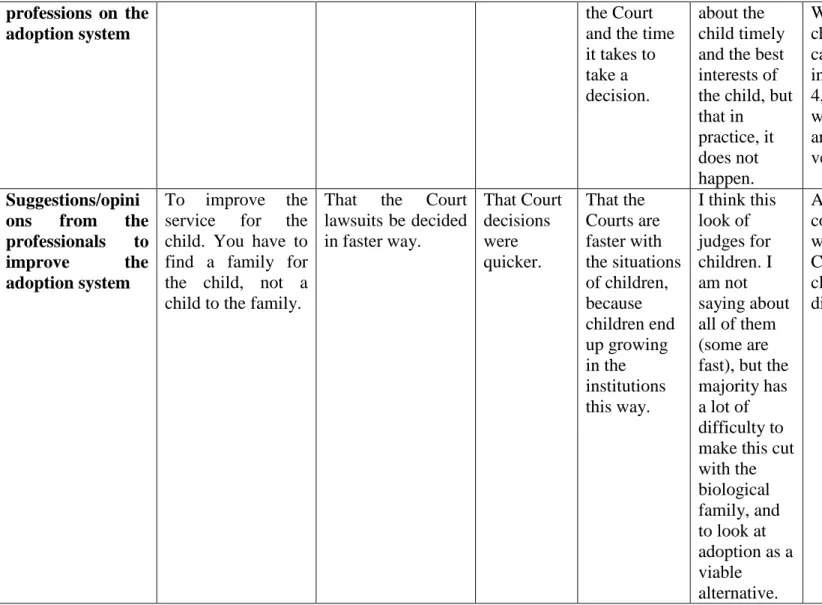
It is a right. We have all the same rights and I think being in the law also greatly facilitates our study (and especially the child's preparation). Provided that they have good characterist ics and meet the needs of children. The law has now given guidance in this sense, that everyone has the same right, then surely the study will be made. We do not have much experience yet. I think people have to be evaluated and have the skills to raise the children to the similarities of the other families. Previously legally we could not accept. I believe that adoption has to do with people, with situations, with the relationship. We here do not study the sexuality of the people, we study the stability of them. I see no benefit in the child's perspective, even though it understands that on the perspective of equal rights for the adult, it can be discussed. I have not gone through this experience in my profession yet but I consider again an advantage and progress of the law. Main difficulties related to the respective Cooperation with the Court. The delay in implementing the measures. I see no difficulty. The greatest difficulty it is regarding The time. On the law they talk a lot I believe it is a matter of the legal system. Getting adoption to be decreed
27
professions on the adoption system
the Court and the time it takes to take a decision.
about the child timely and the best interests of the child, but that in practice, it does not happen. We have children who can stay in institutions for 4,5 years waiting for an answer. This is very serious. by the Court is a more difficult process. Suggestions/opini ons from the professionals to improve the adoption system
To improve the service for the child. You have to find a family for the child, not a child to the family.
That the Court lawsuits be decided in faster way. That Court decisions were quicker. That the Courts are faster with the situations of children, because children end up growing in the institutions this way. I think this look of judges for children. I am not saying about all of them (some are fast), but the majority has a lot of difficulty to make this cut with the biological family, and to look at adoption as a viable alternative. A more direct connection with the Courts, a closer dialogue. The relation with time, making it shorter. Making evaluations in shorter time and more concrete.
28
When talking about the adoption process in Portugal, SE01 stated: “In accordance the law, the law has also made many changes and it is possible to increasingly feel the technical support, not only in the institutions and the teams responsible for the selection of couples. I think it has made many improvements and in my point of view I think we are on the way to go yet but it is getting better”. All of the interviewed professionals mentioned that the main cause that lead to adoption is the negligence factor. SW01 stated, for example:
The neglect, abandonment, parents' inability to organize themselves and social misery (from the point of view that they are not able to organize themselves even with help) are the main problems. […] The child was removed from the family because him/her was abused, because she/he is not being cared properly, because was victim of sexual abuse, for example... well, mistreat. Maltreatment can be qualified, which is the most serious one, in which the parents are mistreating and they know that they are mistreating and continue to do so. Or neglect, which are people that they too were abused and repeat the behaviour (which in most cases is what happens) and so that is what creates these problems. In my experience, it has a lot to do with it, so over the years they are always identical.
The historical trajectory in Portugal to ensure the welfare and rights of children shows some point on their views.
- JT01: “I think that mainly the vision of who adopts has changed. [..] And there is already a sign of some progress in relation to adoption, not as a simple replacement of biological filiation but lives just for the sake of having a child, to have a foster child and do good to a child who has a family and therefore gives you a family.”;
- PT01: “There is a lot, as the inclusion of psychology in interdisciplinary teams, teamwork in various valences for a more thorough evaluation, closest to the child's reality”;
- SW01: “We have a fantastic law which is a highly evolved law, that greatly protects children and serves in the adoption area, the problem then is the interpretation of the law itself”;
- SW02: “There is a growing concern in preparing the child for new parents. It has also evolved in terms of awareness with technical team in relation to articulation between the different adoption services”;
- SW03: “Adoption it is seen differently from how it was 20 years ago. Since 2011 an education training is made with the candidates for them to be more prepared to receive a child”;
- PT02: “I think it has been done a great job, as changes to the legal level for psychosocial term, to be able to make the intervention” and;
-SE01: “We had increasingly significant progress. I think that with the changes the law has been undergoing, the rights of children are safeguarded above all”.
Each one of them could share a point of view on how they saw the trajectory, also expressing that it changed for better.
Many are the problems that the children arrive at the institutions, PT02 stated that “many children arrive with attachment disorders”, while SW02 says that the children arrive with “severe deficiency on emotional, physical and psychological terms. Also health issues,
29
arriving often in a pitiable state”. This lead to the next point, which are the aspects identified that correspond to situations where children are deprived of well-being. SW01 says that “lack of care on levels since hygiene, health and food. They are not going to school, they are seen on the streets late at night”, are a few examples of this fact.
When asked about the advances noticed on the adoption matter PT01 said the she thinks that “the teamwork is essential, there is no doubt. For example: individual interviews had evolved to interviews together (two professionals), now there is more teamwork. There is also research at the national level”. When asked about the difficulties faced by them SE01 also said:
Our main difficulty here as technical staff is not doing the diagnostic evaluation of the situation, in the life project definition. I consider that here, as a reception center, is a very positive matter to do the life project the adoption. Now, to get the adoption to be decreed by the Court… This
is a more difficult process.
More professionals have some comment about the Legal part of the adoption too, as we can see by PT02. The professional says “One difficulty that we have has to deal with the juridical system. We have children that can be waiting for an answer from the juridical system for about 04 or 05 years and this is very serious”. JT01 stated as a difficulty the cooperation with
the Court:
I know they are complying with the law but those situations where - unfortunately this is not good to say but - I think that those who does not fulfil their obligations, there are rights that should not be given. […] I think that this right of appeal should be signed for those who tried to do something and failed. Now we have the situation of a child who is 6 years old, his father and mother are in prison, they never called and the lawyers just asked the appeal, for example.
The main difficulties related to the respective professions on the adoption system has a direct relation to what can be done for the children. The position of the answers correspond to the order they appear on Table 2:
- “Cooperation with the Court”;
- “The delay in implementing the measures”; - “I see no difficulty”;
- “The greatest difficulty it is regarding the Court and the time it takes to take a decision”; - “The time. On the law they talk a lot about the child timely and the best interests of the child, but that in practice, it does not happen”;
- “I believe it is a matter of the legal system. We have children who can stay in institutions for 4,5 years waiting for an answer. This is very serious” and;