2009
Alberto de Jesus
Nascimento
Multilayer Optimization in Radio Resource Allocation
for the Packet Transmission in Wireless Networks
Optimização Multicamada de Atribuição de Recursos
Rádio para Transmissão de Pacotes em Redes em
Fios
Aveiro
2010 Telecomunicações e Informática
Alberto de Jesus
Nascimento
Optimização Multicamada de Atribuição de Recursos
Rádio para Transmissão de Pacotes em Redes em
Fios
Multilayer Optimization in Radio Resource Allocation
for the Packet Transmission in Wireless Networks
Tese apresentada à Universidade de Aveiro para cumprimento dos requisitos necessários à obtenção do grau de Doutor em Engenharia Electrónica e Telecomunicações, realizada sob a orientação científica do Dr. Atílio Manuel da Silva Gameiro, Professor Associado do Departamento de Electrónica,
Telecomunicações e Informática da Universidade de Aveiro
Apoio financeiro do CITMA
Centro de Ciência e Tecnologia da Madeira
Programa Operacional Plurifundos da Região Autónoma da Madeira do Fundo Social Europeu.
Apoio financeiro da FCT e do FSE no âmbito do III Quadro Comunitário de Apoio.
À minha esposa Olívia
Pelo seu apoio constante nos bons e maus momentos, pela sua infinita
paciência e pelo espírito de sacrifício demonstrado perante a nossa separação, decorrente da minha estadia em Aveiro durante cerca de dois anos e meio, para que este trabalho pudesse ter sido realizado.
Aos meus filhos:
Tiago José Câmara do Nascimento Ana Catarina Câmara do Nascimento
Para que possam um dia entender que, apesar do que parece, a vida, e o alcançar de objectivos, implicam sempre trabalho, dedicação, lealdade e espírito de sacrifício.
o júri
presidente Prof. Dr. Carlos de Pascoal Neto
Prof. Catedrático da Universidade de Aveiro
Prof. Dr. Paulo da Fonseca Pinto
Professor Associado com Agregação da Universidade de Lisboa
Prof. Dr. Fernando José da Silva Velez
Professor Auxiliar da Faculdade de Engenharia da Beira Interior
Prof. Dr. Manuel Alberto Pereira Ricardo
Professor Associado da Faculdade de Engenharia da Universidade do Porto
Prof. Dr. Amaro Fernandes de Sousa
Professor Auxiliar da Universidade de Aveiro
Prof. Dr. Atílio Manuel da Silva Gameiro
Ao finalizar este trabalho gostaria de endereçar algumas palavras de agradecimento a todas às pessoas que me ajudaram a que ele pudesse ter sido realizado.
Ao meu orientador, Prof. Dr. Atílio Gameiro, por ter aceite a tarefa de me orientar neste trabalho, pela sugestão do tema e pelo empenho e colaboração manifestados, sem os quais este trabalho não teria sido possível.
Ao Shahid do pólo de Aveiro pela realização das simulações que levaram à obtenção das Look Up Tables utilizadas nas simulações. E pela camaradagem demonstrada.
Um agradecimento especial aos colegas do IT Aveiro: Jonathan, Valdemar e Joaquim, pelos comentários e sugestões surgidos ao longo das diversas conversas decorridas no bar do IT e mesmo nos seus corredores. Muitas vezes ajudaram a esclarecer e contribuíram para o enriquecimento do trabalho desenvolvido.
Aos demais colegas do Instituto de Telecomunicações, pólo de Aveiro, pelo apoio prestado durante a minha estadia em Aveiro.
Ao Instituto de Telecomunicações, pólo de Aveiro, pela cedência de
instalações e equipamento para a realização do trabalho. Ao Pedro Silva pelo apoio prestado ao nível da logística.
Aos meus colegas do Departamento de Matemática e Engenharias (DME) da Universidade da Madeira, Tiago, Eduardo, Karolina, Dionísio, Lina, Maurício e Luís Lopes pela amizade e salutar convívio existente no departamento, os quais me ajudaram, e muito, nas boas e más horas, especialmente nos longos momentos de ausência.
Ao Amândio pelos conselhos antes, durante e depois da minha despensa lectiva e ao Sr. Nélson pelo apoio e camaradagem prestados.
A todos os membros do DME em geral.
Ao CITMA e a FCT pela atribuição das respectivas bolsas.
Finalmente, à minha esposa pela sua dedicação, carinho e, acima de tudo, infinita paciência para suportar todas as dificuldades, variações de humor e a minha ausência prolongada, ao longo dos últimos 4 anos, dispendidos na realização deste trabalho.
O autor gostaria ainda de agradecer aos membros do júri a elegância de ter facultado, por intermédio do orientador, a identificação de algumas gralhas bem como sugestões para a melhoria de alguns aspectos de redacção, o que permitiu a incorporação e consequente melhoria na versão final da tese.
palavras-chave Redes móveis sem fios de 3ª e 4ª gerações; projecto de redes móveis sem fios em modo cross-layer; qualidade de serviço em redes móveis sem fios;
algoritmos de escalonamento de pacotes em redes móveis sem fios; algoritmos de gestão de recursos rádio; atribuição dinâmica de recursos; muliplexagem de recursos por divisão espacial; algoritmos de escalonamento de pacotes através da função utilidade; simulações a nível de sistema do protocolo de comunicação das redes móveis sem fios.
serviço prestado e na implementação de novas infra-estruturas em todo o globo. É ponto assente neste momento que esta tendência irá não só continuar como se fortalecer devido à convergência que é esperada entre as redes móveis sem fio e a disponibilização de serviços de banda larga para a rede Internet fixa, numa
evolução para um paradigma de uma arquitectura integrada e baseada em serviços e aplicações IP. Por este motivo, as comunicações móveis sem fios irão ter um papel fundamental no desenvolvimento da sociedade de informação a médio e longo prazos.
A estratégia seguida no projecto e implementação das redes móveis celulares da actual geração (2G e 3G) foi a da estratificação da sua arquitectura protocolar numa estrutura modular em camadas estanques, onde cada camada do modelo é responsável pela implementação de um conjunto de funcionalidades. Neste modelo a comunicação dá-se apenas entre camadas adjacentes através de primitivas de comunicação pré-estabelecidas. Este modelo de arquitectura resulta numa mais fácil implementação e introdução de novas funcionalidades na rede. Entretanto, o facto das camadas inferiores do modelo protocolar não utilizarem informação disponibilizada pelas camadas superiores, e vice-versa acarreta uma degradação no desempenho do sistema. Este paradigma é particularmente importante quando sistemas de antenas múltiplas são implementados (sistemas MIMO). Sistemas de antenas múltiplas introduzem um grau adicional de liberdade no que respeita a atribuição de recursos rádio: o domínio espacial. Contrariamente a atribuição de recursos no domínio do tempo e da frequência, no domínio espacial os recursos rádio mapeados no domínio espacial não podem ser assumidos como sendo completamente ortogonais, devido a interferência resultante do facto de vários terminais transmitirem no mesmo canal e/ou slots temporais mas em feixes espaciais diferentes. Sendo assim, a disponibilidade de informação relativa ao estado dos recursos rádio às camadas superiores do modelo protocolar é de fundamental importância na satisfação dos critérios de qualidade de serviço exigidos.
Uma forma eficiente de gestão dos recursos rádio exige a implementação de algoritmos de agendamento de pacotes de baixo grau de complexidade, que definem os níveis de prioridade no acesso a esses recursos por base dos
utilizadores com base na informação disponibilizada quer pelas camadas inferiores quer pelas camadas superiores do modelo. Este novo paradigma de comunicação, designado por cross-layer resulta na maximização da capacidade de transporte de dados por parte do canal rádio móvel, bem como a satisfação dos requisitos de qualidade de serviço derivados a partir da camada de aplicação do modelo. Na sua elaboração, procurou-se que o standard IEEE 802.16e, conhecido por
Mobile WiMAX respeitasse as especificações associadas aos sistemas móveis
celulares de quarta geração. A arquitectura escalonável, o baixo custo de implementação e as elevadas taxas de transmissão de dados resultam num processo de multiplexagem de dados e valores baixos no atraso decorrente da transmissão de pacotes, os quais são atributos fundamentais para a
disponibilização de serviços de banda larga. Da mesma forma a comunicação orientada à comutação de pacotes, inenente na camada de acesso ao meio, é totalmente compatível com as exigências em termos da qualidade de serviço dessas aplicações. Sendo assim, o Mobile WiMAX parece satisfazer os requisitos exigentes das redes móveis de quarta geração.
Nesta tese procede-se à investigação, projecto e implementação de algoritmos de encaminhamento de pacotes tendo em vista a eficiente gestão do conjunto de recursos rádio nos domínios do tempo, frequência e espacial das redes móveis celulares, tendo como caso prático as redes móveis celulares suportadas no standard IEEE802.16e. Os algoritmos propostos combinam métricas provenientes da camada física bem como os requisitos de qualidade de serviço das camadas superiores, de acordo com a arquitectura de redes baseadas no paradigma do cross-layer. O desempenho desses algoritmos é analisado a partir de simulações efectuadas por um simulador de sistema, numa plataforma que implementa as camadas física e de acesso ao meio do standard IEEE802.16e
Keywords Beyond 3G and 4G mobile wireless networks; cross-layer design framework; quality of service in mobile wireless networks; packet scheduling; radio resource management; dynamic resource allocation architecture; space division muitple access; utility-based packet scheduling; system level simulations; dynamic rersource allocation architecture.
deployment around the globe. It is expected that this tendency will continue to increase with the convergence of fixed Internet wired networks with mobile ones and with the evolution to the full IP architecture paradigm. Therefore mobile wireless communications will be of paramount importance on the development of the information society of the near future.
In particular a research topic of particular relevance in telecommunications nowadays is related to the design and implementation of mobile communication systems of 4th generation. 4G networks will be characterized by the support of multiple radio access technologies in a core network fully compliant with the Internet Protocol (all IP paradigm). Such networks will sustain the stringent quality of service (QoS) requirements and the expected high data rates from the type of multimedia applications to be available in the near future.
The approach followed in the design and implementation of the mobile wireless networks of current generation (2G and 3G) has been the stratification of the architecture into a communication protocol model composed by a set of layers, in which each one encompasses some set of functionalities. In such protocol layered model, communications is only allowed between adjacent layers and through specific interface service points. This modular concept eases the implementation of new functionalities as the behaviour of each layer in the protocol stack is not affected by the others. However, the fact that lower layers in the protocol stack model do not utilize information available from upper layers, and vice versa, downgrades the performance achieved. This is particularly relevant if multiple antenna systems, in a MIMO (Multiple Input Multiple Output) configuration, are implemented. MIMO schemes introduce another degree of freedom for radio resource allocation: the space domain. Contrary to the time and frequency domains, radio resources mapped into the spatial domain cannot be assumed as completely orthogonal, due to the amount of interference resulting from users transmitting in the same frequency sub-channel and/or time slots but in different spatial beams. Therefore, the availability of information regarding the state of radio resources, from lower to upper layers, is of fundamental importance in the prosecution of the levels of QoS expected from those multimedia applications.
In order to match applications requirements and the constraints of the mobile radio channel, in the last few years researches have proposed a new paradigm for the layered architecture for communications: the cross-layer design
framework. In a general way, the cross-layer design paradigm refers to a
protocol design in which the dependence between protocol layers is actively exploited, by breaking out the stringent rules which restrict the communication only between adjacent layers in the original reference model, and allowing direct interaction among different layers of the stack.
An efficient management of the set of available radio resources demand for the implementation of efficient and low complexity packet schedulers which
prioritize user’s transmissions according to inputs provided from lower as well as upper layers in the protocol stack, fully compliant with the cross-layer design paradigm. Specifically, efficiently designed packet schedulers for 4G networks should result in the maximization of the capacity available, through the
consideration of the limitations imposed by the mobile radio channel and comply with the set of QoS requirements from the application layer.
IEEE 802.16e standard, also named as Mobile WiMAX, seems to comply with the specifications of 4G mobile networks. The scalable architecture, low cost implementation and high data throughput, enable efficient data multiplexing and low data latency, which are attributes essential to enable broadband data services. Also, the connection oriented approach of Its medium access layer is fully compliant with the quality of service demands from such applications. Therefore, Mobile WiMAX seems to be a promising 4G mobile wireless networks candidate.
In this thesis it is proposed the investigation, design and implementation of packet scheduling algorithms for the efficient management of the set of
available radio resources, in time, frequency and spatial domains of the Mobile WiMAX networks. The proposed algorithms combine input metrics from physical layer and QoS requirements from upper layers, according to the
Contents
TABLE OF CONTENTS I
ABBREVIATIONS Vi
CHAPTER 1 Introduction 1
1.1 Preliminaries 1
1.2 Broadband Wireless Technologies 2
1.2.1 3G Cellular Systems 2
1.2.2 Long Term Evolution (LTE) 3
1.2.3 Wireless Fidelity Systems (Wi-Fi) 3 1.2.4 Wireless Interoperability for Microwave Access (WiMAX) 4 1.3 Technical Challenges for Broadband Wireless 4
1.4 Cross-Layer Design 5
1.5 Packet Scheduler 6
1.6 Objectives 7
1.7 Outline of the Dissertation 7
1.8 Publications 9
CHAPTER 2 Cross-Layer Design 11
2.1 Introduction 11
2.2 ISO/OSI Reference Model 13
2.3 Motivation for Cross-Layer Design in Mobile Communications 14 2.3.1 Link Adaptation in Single User Point-to-Point Communication 15 2.3.2 Multiuser Diversity Gain in Multi-User Point-to-Multi-Point
Communications
15
2.3.3 TCP over Wireless Links 16
2.3.4 Multi-User Gain with Quality-of-Service 16 2.3.5 Application’s Adaptability to Changes in Physical and Network
Layers
17 2.4 A Model for the Coordination of the Cross-Layer Entities 17
2.5 Cross-Layer Design Concepts 19
2.5.1 Types of Information Flow across Layers 19 2.5.2 Types of Cross-Layer Management Entities 20 2.6 Disadvantages of the Cross-Layer Design Reference Model 20
2.7 Related Work 21
2.8 Conclusion 25
CHAPTER 3 Mobile WiMAX 26
3.1 Introduction 26
3.2 WiMAX Evolution 28
3.3 WiMAX Physical Layer (PHY) 31
3.3.1 Orthogonal Frequency Division Multiplexing (OFDMA) Basics 31 3.3.2 OFDMA Sub-Channelization in WiMAX 32 3.3.2.1 Diversity Permutation Sub-Carrier Sub-Channelization 32 3.3.2.2 Band Adjacent Multi-Carrier (AMC) Sub-Channelization 33 3.3.3 Frame Structure of Mobile WiMAX 33 3.4 WiMAX Medium Access Control Layer (MAC) 37
3.4.1 MAC Layer Functional Blocks 37
3.4.2 Mechanisms for Quality of Service Support 38 3.4.3 Service Classes in Mobile WiMAX 39 3.4.4 Bandwidth Request and Assignment in Mobile WiMAX 41 3.4.5 Advanced Features for Performance Enhancement 42 3.4.6 Adaptive Modulation and Coding (AMC) 43 3.4.7 Advanced Antenna Systems (AAS) 43 3.4.8 Hybrid Automated Repeat Request (HARQ) 44
3.5 Cross-Layer Implementation in Mobile WiMAX 45
3.5.1 Introduction 45
3.5.2 Cross-Layer Design for Capacity Improvement 46 3.5.2.1 Cross-Layer Design for Effective Resource Allocation 46 3.5.2.2 Cross-Layer Design for Advanced Antenna Techniques 46 3.5.2.3 Cross-Layer Design for Detection and Error Recovery 47 3.5.3 Cross-Layer Design for Quality of Service Support 47
3.6 Related Work 47
3.7 Conclusion 49
CHAPTER 4 System Level Simulator for Mobile WiMAX System 51
4.1. Introduction 51
4.2. System Level Simulation Methodology 54
4.2.1 Simulation Execution Flow 55
4.2.2 Simulation of Packet Decoding Process 57
4.3 Network Scenario and Layout 58
4.4 Propagation Channels 59
4.4.1 Path-Loss Model 60
4.4.2 Shadowing (Slow Fading) Model 60
4.4.3 Fast Fading Model 61
4.5 Signal to Interference plus Noise Ratio (SINR) Modelling 62 4.6 Link Level Interface Modelling – General Concepts 65 4.6.1 Link Level Interface Modelling for Mobile WiMAX System 67 4.6.1.1 Effective SIR Mapping Functions 69 4.6.1.2 Exponential Effective SINR Mapping (EESM) 70 4.7 MIMO Channel Modelling in System Level Simulations 70
4.7.1 3GPP Spatial Channel Model 71
4.7.2 Modelling the SINR at the Mobile Station 75 4.7.2.1 Modelling the Desired User Signal at the Mobile Station 75 4.7.2.2 Modelling Inter-Cell Signal Interference at the Mobile Station 76 4.7.3 Link to System Interface for MIMO channel 77
4.8 Traffic Models 78
4.9 Performance Metrics 79
4.10 Related Work 79
4.11 Conclusion 81
CHAPTER 5 Dynamic Resource Allocation Architecture for Mobile WiMAX 82
5.1 Introduction 82
5.2 System Profile for Mobile WiMAX DRA 84 5.3 Implementation of the Map of Resources 87
5.4 DRA Architecture 90
5.4.1 Introduction 90
5.4.2 Link Adaptation 91
5.4.3 Asynchronous Hybrid Automatic Repeat Request (HARQ) 93
5.4.4 Scheduler 93
5.4.5 Resource Manager 94
5.4.6 Resource Allocation Procedure 97
5.5 Related Work 100
5.6 Conclusion 103
CHAPTER 6 System Validation 104
6.1 Introduction 104
6.2 Validation of the Basic System Level Simulation Platform 105 6.2.1 Fast Fading Channel Model Implementation 105
6.2.1.1 Multipath Power Profile 106
6.2.1.2 Rayleigh Distribution of the Path Amplitude 106
6.2.1.4 Fast Fading Channel Correlation over Each Frame Period 108
6.2.2 Shadowing 109
6.2.2.1 Log-Normal Law 109
6.2.2.2 Space Correlation 109
6.2.2.3 Inter-Site Correlation 110
6.2.3 User Distribution over the Network 111 6.2.4 Validation of the MIMO Channel Model Used in the System Level
Simulations
112 6.2.4.1 Root Mean Square (rms) Delay Spread 112 6.2.4.2 Root Mean Square (rms) of the Angle Spread at the Base Station 113 6.2.4.3 Root Mean Square (rms) of the Angle Spread at the Mobile Station 114 6.2.4.4 CDF Distribution of the Powers from all Paths of the Multi-Path
Channel
114 6.2.4.5 Dynamic Range of Variation of the Powers of all Paths in the
Multi-Path Channel Model
115 6.3 Validation of the Dynamic Resource Allocation Module 115
6.3.1 User Geometry 117
6.3.2 User Residual Frame Erasure Rate (FER) 118 6.3.3 Average Number of Transmissions Attempts per Packet 119 6.3.4 Number of Times a User has been Scheduled 120 6.3.5 Average Received SINR per Packet 121
6.3.6 User Service Throughput 122
6.3.7 Average Packet Delay 122
6.4 Scheduling Algorithms 124
6.4.1 Round Robin (RR) 124
6.4.2 Maximum C/I (CI) 125
6.4.3 Max C/I over Average C/I (AvgCI) 125
6.4.4 Proportional Fairness (PF) 126
6.4.5 Modified Largest Weighted Delay First (M-LWDF) 127
6.4.6 Exponential (EXP) 128
6.5 Performance Evaluation of the Dynamic Resource Allocation Module
128 6.5.1 Performance Evaluation for the Full Queue Traffic Model 131 6.5.2 Performance Evaluation for the Near Real Time Video (NRTV)
Traffic Model
135 6.5.3 Performance Evaluation for the World Wide Web (WWW) Traffic
Model
138 6.5.4 Performance Evaluation for Full Queue Traffic Model with MIMO
Channel
140
6.6 Conclusion 143
CHAPTER 7 Utility-Based Packet Scheduling under Mobile WiMAX Network Scenario
145
7.1 Introduction 145
7.2 Packet Scheduling in Broadband Wireless Access (BWA) Networks 147 7.3 Utility-Based Packet Scheduling 149
7.3.1 Introduction 149
7.3.2 Utility-Based Scheduling Principle and Cross-Layer Design 150 7.3.3 Packet Utility and Utility Function 152
7.3.4 Scheduling Algorithm 154
7.3.5 Guidelines for Utility Function Definition 158 7.4 Multi-Class Utility-Based Packet Scheduling 159
7.4.1 Proposed Algorithm 159
7.4.2 Proposed Utility Functions 161
7.4.2.2 Utility Function for the World Wide Web (WWW) Traffic Users 162 7.4.3 Packer Bundling for VoIP Scheduling Efficiency 163
7.4.4 Algorithm Implementation 165
7.4.4.1 Scheduler 165
7.4.4.2 Resource Allocation 165
7.4.5 Simulation Scenario 167
7.4.6 Results 168
7.5 Joint Utility-Token Bucket Based Packet Scheduler 172
7.5.1 Scheduling Principle 173
7.5.1.1 Non Real Time (NRT) Users 173
7.5.1.2 Best Effort (BE) Users 176
7.5.2 Utility Functions Definition 177
7.5.2.1 Real Time Service Flow – VoIP 178 7.5.2.2 Real Time Service Flow – NRTV 179 7.5.2.3 Non Real Time Service Flow – WWW 179 7.5.2.4 Best Effort Service Flow – File Transfer Protocol (FTP) 179
7.5.3 Simulation Scenario 180
7.5.4 Results 180
7.5.4.1 Users Satisfaction Ratio 180
7.5.4.2 Average Packet Delay per User 182 7.5.4.3 Average Packet Drop Rate per User 184 7.5.4.4 Average Throughput per User 185 7.5.5 Performance Distributions for Maximum System Load 186
7.5.5.1 Performance for VoIP Users 186
7.5.5.2 Performance for NRTV Users 187
7.5.5.3 Performance for WWW Users 188
7.5.5.4 Performance for FTP Users 189
7.6 Related Work 190
7.7 Conclusion 194
CHAPTER 8 Space Division Multiple Access with Utility Based Packet Schedulers for Mobile WiMAX
196
8.1 Introduction 196
8.2 Spatial Beamforming 198
8.3 SDMA Scheme for IEEE802.16e Mobile WiMAX 199
8.3.1 User Spatial Separability 200
8.3.2 SINR Estimation after Performing Beamforming 202 8.4 Proposed SDMA-Enabled DRA Architecture 203 8.4.1 Computation of Users Correlation 204 8.4.2 Computation of SINR for Resources in SDMA and in non-SDMA
Zones
205 8.5 Joint Scheduling and Resource Allocation Algorithm Using SDMA
Multiple Access
207
8.6 Results 210
8.6.1 Performance for Full Queue Traffic Users 210 8.6.2 Performance for VoIP and WWW Traffic Users 211 8.6.2.1 Voice over IP (VoIP) Traffic Model 211 8.6.2.2 World Wide Web (WWW) Traffic Model 216
8.7 Related Work 219
8.8 Conclusion 220
CHAPTER 9 Joint Time and Frequency Domains Packet Scheduler for Mobile WiMAX
223
9.1 Introduction 223
9.2 Resource Space for Time-Frequency Domain Scheduler 225
9.3 Proposed Scheduler 226
9.3.2 Frequency Domain Packet Scheduler 228 9.3.3 Computation of Final Priority 229
9.4 Results 229 9.5 Related Work 236 9.6 Conclusion 238 CHAPTER 10 Conclusions 240 10.1 Preliminaries 240 10.2 Cross-Layer Design 242
10.3 Mobile WiMAX Networks 242
10.4 System Level Simulations for Mobile WiMAX 242 10.5 Dynamic Resource Allocation Module Architecture 243 10.6 Validation of the System Level Simulator and Dynamic Resource
Allocation Module
244 10.7 Utility-Based Packet Scheduling for Mobile WiMAX 244 10.8 Space Division Multiple Access with Utility-Based Packet
Schedulers for Mobile WiMAX
250 10.9 Joint Time and Frequency Domains Packet Scheduler for Mobile
WiMAX
253
10.10 Future Research 256
REFERENCES 255
ANNEX A Methods for Effective SINR Mapping 274
A.1 Introduction 274
A.1.1 One Dimensional Data Compression and Mapping 274 A.1.1.1 Mean Instantaneous Capacity Mapping Method (MIC) 274 A.1.1.2 Exponential Effective SINR Mapping (EESM) 275 A.1.1.3 Effective SINR Mapping Based on Mutual Information (MI-ESM) 275 A.1.2 Two Dimensional Data Compression and Mapping 276 A.2 Calibration of the Link to System Level Interface Model 277
ANNEX B Traffic Models 278
B.1 Introduction 278
B.2 Voice Over IP (VoIP) Traffic Model 278 B.3 3GPP Near Real Time Video (NRTV) Traffic Model 280 B.4 3GPP World Wide Web (WWW) Browsing Traffic Model 281 B.5 3GPP File Transfer Protocol (FTP) Traffic Model 282
ANNEX C Performance Metrics 284
C.1 Introduction 284
C.2 Throughput Performance Metrics 284
C.3 Performance Metrics for Delay Sensitive Applications 288
Abbreviations
Abbreviations
16QAM 16 Quadrature Amplitude Modulation 1xEV-DO 1 x Evolution Data Only
2G Second Generation 3G Third Generation
3GPP Third Generation Partnership Project 3GPP2 Third Generation Partnership Project 2 4G Fourth Generation
64QAM 64 Quadrature Amplitude Modulation AAS Advanced Antenna Systems
ACK Acknowledge
ADSL Asynchronous Digital Subscriber Line AES Advanced Encryption Standard AMC Adaptive Modulation and Coding AoA Angle of Arrival
AoD Angle of Departure
ARQ Automatic Repeat Request ATM Asynchronous Transfer Mode AvgCI Average C/I
AWGN Additive White Gaussian Noise B3G Beyond Third Generation BE Best Effort
BER Bit Error Rate BLER Block Error Rate
BPSK Binary Phase Shift Keying BWA Broadband Wireless Access CAC Connection Admission Control CBR Constant Bit Rate
CC Chase Combiner CC Convolutional Encoder
CDMA Code Division Multiple Access CDMA 2000 Code Division Multiple Access 2000 CI Maximum CI scheduler
CID Connection Identifier
COA Compatibility Optimization Algorithm CP Cyclic Prefix
CPS Common Part Sub-layer CQI Channel Quality Information
CQICH Channel Quality Information Channel CS Convergence Sub-layer
CSMA Carrier Sense Multiple Access CSTD Shift Transmit Diversity
CTC Convolutional Turbo Encoder DCA Dynamic Channel Allocation DL Downlink
DLFP Downlink Frame Prefix DoA Direction of Arrival
DOCSIS Data Over Cable Service Interface Specification DPS Doppler Power Spectrum
DRA Dynamic Resource Allocation DSL Digital Subscriber Line
EAP Extensible Authentication Protocol ECN Explicit Congestion Notification EESM Exponential Effective SINR Mapping ELN Explicit Loss Notification
ertPS Enhanced Real Time Pooling Service
ETSI European Telecommunications Standard Institute EXP Exponential scheduler
FCH Frame Control Header
FDD Frequency Division Duplexing FDMA Frequency Division Multiple Access
FDPS Frequency Domain based Packet Scheduler FEC Forward Error Control
FER Frame Erasure Rate FFT Fast Fourier Transform FIFO First In First Out FTP File Transfer Protocol
FUSC Full Usage Sub-Carrier sub-channelization GSM Global System for Mobile communications HARQ Hybrid Automatic Repeat Request
HOL Head of Line
HSDPA High Speed Downlink Packet Access HSPA High Speed Packet Access
HSUPA High Speed Uplink Packet Access ICI Inter-carrier interference
IE Information Element
IETF Internet Engineering Task Force IFFT Inverse Fast Fourier Transform IP Internet Protocol
ISI Inter Symbol Interference
ISO International Standards Organization ITU International Telecommunications Union LA Link Adaptation
LLC Logical Link Control LTE Long Term Evolution LUT Look-Up Table
MAC Medium Access Control MAP Mobile Application Part MCM Multi-carrier modulation
MCS Modulation and Coding Scheme MIMO Multiple-Input Multiple-Output MISO Multiple-Input Single Output MLD Maximum Likelihood Decoder
M-LWDF Modified Largest Weighted Delay First scheduler MMSE Minimum Mean Square Error
MPDU Medium Access Control layer Protocol Data Unit MRC Maximum Ratio Combiner
NACK Negative Acknowledge NGN Next Generation Network NLOS Non Line of Sight
NRT Non Real Time
nrtPS Non Real Time Pooling Service NRTV Near Real Time Video
OFDM Orthogonal Frequency Division Multiplexing OFDMA OFDM Multiple Access
OS Opportunistic Scheduling OSI Open Systems Interconnection PDU Packet Data Unit
PF Proportional Fairness scheduler PHY Physical Layer
PMT Point to Multi-Point
PUSC Partial Usage of Sub-Carrier channelization QoS Quality of Service
QPSK Quaternary Phase Shift Keying RAM Resource Allocation Map RAU Resource Allocation Unit RB Resource Block
RF Radio Frequency RR Round Robin scheduler RRM Radio Resource Management RT Real Time
RTG Receive to Transmit Gap rtPS Real Time Polling Service
RU Resource Unit
SAP Service Access Point SCM Spatial Channel Model SCS Scheduling Candidate Set SDMA Space Division Multiple Access SDU Service Data Unit
SER Symbol Error Rate SFID Service Flow Identifier SIMO Single-Input Multiple-Output
SINR Signal to Interference plus Noise Ratio SISO Single-Input Single-Output
SM Spatial Multiplexing
SMTP Simple Mail Transfer Protocol SNR Signal to Noise Ratio
SOFDMA Scalable OFDMA SOS Sum of Sinusoids
SPDU Service Packet Data Unit SS Subscriber Station STBC Space Time Block Code TCP Transmission Control Protocol TDD Time Division Duplexing TDM Time Division Multiplexing TDMA Time Division Multiple Access
TD-SCDMA Time Division Synchronous Code Division Multiple Access TTG Transition to Transmit Gap
TTI Transmission Time Interval UDP User Datagram Protocol UGS Unsolicited Grant Service UL Uplink connection
UMTS Universal Mobile Telecommunications System UTRAN UMTS Terrestrial Radio Access Network VoIP Voice over IP
WCDMA Wideband Code Division Multiple Access WiFi Wireless Fidelity
WiMAX Worldwide Interoperability for Microwave Access WLAN Wireless Local Area Network
WMAN Wireless Metropolitan Area Network WWW World Wide Web
1
Chapter 1
Introduction
1.1 Preliminaries
In the last decade mobile communications have witnessed an explosive increase in the amount of users and in the amount of data transferred over the air interface. High bandwidth demanding multimedia applications, originally intended for the fixed Internet, are currently being envisioned for the mobile wireless environment due to technology advances, such as the implementation of Multiple-Input Multiple-output (MIMO) antennas [1-3] and Adaptive Modulation and Coding (AMC) transmission schemes [4], which result in a more efficient utilization of the scarce bandwidth and the increase in the available capacity for data.
First (analog) (1G) and second (digital) generation mobile networks were originally designed for the provision of voice services in a circuit switched transmission mode. Although some data applications are also provided by 2G networks, such as Global System for Mobile Communications (GSM) or Code Division Multiple Access (CDMA) based standards, high bandwidth demanding multimedia applications and services are not envisioned. Third generation (3G) mobile communication systems, based on wideband code division multiple access (WCDMA) and CDMA 2000 radio access technologies, have seen widespread
deployment. As more packet-based applications are implemented the need for more bandwidth, quality of service provision and higher spectrum efficiency increases. Therefore, the research community has been actively involved in the design of a new generation of mobile communication networks: the fourth generation (4G). With this new concept of mobile communications a completely new air interface is justified by the need to serve current and future multimedia and high bandwidth consuming type of applications. Typically, a reasonable approach would be to aim at 100 Mbps full-mobility wide area coverage and 1 Gbps low-mobility local area coverage in about 2010 [5].
Next-generation wireless involves the concept of a major move toward ubiquitous wireless communications systems and high-quality wireless services. 4G mobile communications involve a mix of concepts and technologies in the making of this vision. Some of these can be recognized as derived from 3G, such as High Speed Packet Access (HSPA), which is an evolution from Universal Mobile Telecommunications Standard (UMTS) WCDMA; whereas others involve new approaches to wireless mobile, like Orthogonal Frequency Division Multiple Access (OFDMA) scheme. 4G mobile networks evolution [6] are relevant in the movement toward a new wireless world that is a total convergence of wireless mobile and wireless access communications.
1.2 Broadband Wireless Technologies
Broadband wireless networks attempt to provide broadband type of applications, initially envisioned for fixed networks, into the mobile environment. There are two different types of broadband wireless services: the first type attempts to provide a set of services similar to that of the traditional fixed-line broadband, using wireless as the transmission medium. This is called fixed wireless broadband. The second type of broadband wireless is called mobile wireless broadband and it differs from the fixed one by offering the additional functionality of portability, nomadicity, and mobility. In this section different proposed wireless systems intended for broadband wireless access (BWA) are enumerated.
1.2.1 3G Cellular Systems
3G networks are currently being implemented by cellular network operators to deliver broadband applications over wireless. GSM operators evolved their second generation (2G) networks by deploying UMTS High Speed Downlink Packet Access (HSDPA) and High Speed Uplink Packet Access (HSUPA), as part of the UMTS evolution. Traditional CDMA operators are deploying 1xEV-DO (1x Evolution Data Only) as part of their 3G solution. In China and some Asian countries TD-SCDMA (Time Division-Synchronous CDMA) standard is also being implemented as the 3G solution for broadband wireless access networks.
HSDPA [7] is a downlink evolution of the UMTS standard, defined in the Third Generation Partnership Project (3GPP) UMTS Release 5. It is capable of providing a peak user data rate of 14.4 Mbps, using a 5 MHz channel, provided that all 15 sub-channelization codes available in the radio frame are assigned to one user only. HSDPA is based on a Time Division Duplex (TDD) frame with 15 slots and duration of 5 ms. Some enhancements such as: spatial processing, diversity reception and multiuser detection are used to provide higher performance over basic systems. An uplink version, HSUPA, supports peak data rates up to 5.8 Mbps and is standardized as part of the 3GPP release 6 specifications.
1xEvolution Data Only (1xEV-DO)
1xEV-DO [8] is a high-speed standard defined as an evolution to second-generation IS-95 CDMA systems, by the 3GPP2. It supports a peak downlink data rate of 2.4 Mbps in a 1.25 MHz channel. The Revision A of this standard supports 3.1 Mbps and Revision B will support 4.9 Mbps. 3G systems are also evolving to support multimedia services.
1xEvolution Data Only Revision C (1xEV-DO Rev. C)
This is the major revision of the 1xEV-DO standard from 3GPP2 for longer-term evolution (LTE) to offer data rates of 70 Mbps to 200 Mbps in the downlink and 30 Mbps to 45 Mbs in the uplink, using 20 MHz channel bandwidth.
1.2.2 Long Term Evolution (LTE)
3GPP is developing the next revision of the 3G standards, named Long Term Evolution [9] (LTE). The objective of this new standard is to provide peak data rates up to 100 Mbps in the downlink and 50 Mbps in the uplink, with an average spectral efficiency of three to four times that of Release 6 HSPA. This will be achieved with the introduction of a completely new air interface based on OFDM/OFDMA (Orthogonal Frequency Division Multiplexing; OFDM Multiple Access), and MIMO.
1.2.3 Wireless Fidelity Systems (Wi-Fi)
Wi-Fi systems are based on the IEEE 802.11 family of standards from IEEE. It is primarily a local area networking (LAN) technology. Current Wi-Fi systems, based on IEEE 802.11a/g support a peak data rate of 54 Mbps with indoor coverage less than 100 m. Wi-Fi provides higher peak data rates than do 3G systems thanks to the larger bandwidth used (over 20 MHz). But capacity for outdoor scenarios is mainly reduced due to the inefficient multiple access scheme used, CSMA (Carrier Sense Multiple Access), along with the interference constraints of operating in the license-exempt band. Another limitation of Wi-Fi standard is that it was not designed to support user’s mobility. New technologies are emerging with the revised IEEE 802.11n standard: multiple-antenna, spatial multiplexing and transmit diversity, which are envisioned to support a peak data rate of at least 100 Mbps.
1.2.4 Wireless Interoperability for Microwave Access (WiMAX)
According to the WiMAX Forum, Mobile WiMAX is a broadband wireless solution that enables convergence of mobile and fixed broadband networks through a common wide area radio access technology and flexible network architecture [10-11]. In order to achieve high peak data rate transmissions in Non-Line of Sight (NLOS) scenarios, its air interface is based on the OFDMA multiple access for both the downlink as well as for the uplink connection. In order to address different channel bandwidths, ranging from 1.25 MHz to 20 MHz, according to regulator specifications from different markets, Mobile WiMAX implements scalable OFDMA (SOFDMA) [12]. This technique results in the modification of the size of the Fast Fourier Transform (FFT) used in the OFDM modulation, according to channel bandwidth, while keeping inter-carrier frequency separation constant, to provide orthogonality. WiMAX Medium Access Control (MAC) layer is connection oriented for Quality of Service (QoS) support [13]. Some of the key features provided by Mobile WiMAX are enumerated as follows:
⋅ OFDMA as multiple access technology for both downlink and uplink connections. ⋅ Scalable OFDMA.
⋅ Adaptive Modulation and Coding (AMC). ⋅ Very high peak bit rates.
⋅ Use of retransmission schemes at the link layer for fast and robust retransmissions.
⋅ Use of flexible and dynamic per user resource allocation by means of OFDMA multiple access and sub-channelization schemes.
⋅ Support for advanced antenna techniques such as MIMO and beamforming. ⋅ Implementation of a connection oriented MAC layer for the provision of QoS. ⋅ Robust security schemes and protocols.
⋅ Support of mobility and nomadicity.
⋅ All IP-based architecture for cost efficiency and convergence with fixed IP networks.
1.3 Technical Challenges for Broadband Wireless
Broadband wireless systems must deliver high peak data rates per each cell to end users, while providing QoS requirements from a set of services such as voice over IP, real time video, web browsing, games, etc. These networks must be able to support IP-based applications in order to provide the convergence which is expected to happen between broadband wireless and Internet [14-15].
In order to be successfully implemented as a viable competitor to the solutions provided by Asynchronous Digital Subscriber Line (ADSL) or Cable Modems, WiMAX, a particular implementation of BWA networks, must deliver significantly better performance than current
alternatives such as 3G and Wi-Fi systems. In order to meet these stringent requirements some key technical challenges must be addressed.
⋅ To develop reliable transmission chains which are able to overcome the limitations resulting from such an aggressive transmission medium such as the mobile radio channel, namely for the kind of broadband data envisioned for transportation.
⋅ To achieve high spectral efficiency and coverage in order to deliver broadband services to a large number of users, with limited spectrum available.
⋅ To multiplex multimedia services with a variety of QoS requirements. ⋅ To support mobility through seamless handover and roaming.
⋅ To achieve low power consumption on hand-held devices. ⋅ To provide robust security.
⋅ To adapt IP-based protocols and architectures for the wireless environment to achieve low cost and convergence with wired networks.
⋅ To provide a low cost implementation solution.
1.4 Cross-Layer Design
Traditional communication networks are implemented based on a hierarchical protocol layering architecture composed of seven layers, according to the Open Systems Interconnection (OSI) model from International Standards Organization (ISO). This communication parading resulted in the rapid proliferation of services and applications and the widespread deployment of the Internet. With the strict layering approach followed in this architecture, protocols can be deployed inside each layer, without taking into account other layers functionality and implementation details in the protocol stack. Adjacent layers communicate by means of standardized signalling messages sent through standardized interfaces named Service Access Points (SAPs).
Although appropriate for fixed communication networks, in the last years a new communication paradigm has evolved into a new architecture model, in which the strict layering and modular approach barriers are erased, allowing different layers in the protocol, be they adjacent or not, to interact by means of the exchange of signalling information. In particular, it was realized, that this cross-layer design approach is appropriate for the scenario of wireless networks, as it can potentially result in performance enhancement [16-17], provided the breaking of the layers barriers is performed with care [18].
One of the main objectives of this work is the design and implementation of scheduling algorithms based on the cross-layer design paradigm. Proposed schedulers are based on the interaction and exchange of messages conveying the state of different layers in the protocol stack, in order to improve system capacity, maximize resource efficiency and provide
application’s QoS requirements. It is worth mentioning that the IEEE 802.16e standard for Mobile WiMAX networks was specifically designed with control and signalling channels which can be used in the exchange of information, according to the cross-layer design approach. The architecture of the Dynamic Resource Allocation (DRA) module implemented in this work for Mobile WiMAX system level simulations is based on the control channels available in the Mobile WiMAX radio frame.
1.5 Packet Scheduler
Making efficient use of radio resources is a challenging task for 3G/4G wireless communication systems as the scarcity of radio resources, diverse QoS requirements and wireless channel conditions pose difficulties to the design of the scheduling and radio resource management [19-21].
The design of scheduling algorithms for wireless networks is constrained by the intrinsic characteristics of the mobile radio channel, which is a hazard means for conveying information. Fast fading and slow fading shadowing, as well as path-loss, result in a time-varying wireless link, both in time and space. This random behaviour of the signal impinging on the receiver is also location dependent and is influenced by the user’s mobility across the cell.
Another issue that needs to be considered in the design of a packet scheduler is the limitation in the maximum level of the power available for data from batteries, as well as the desire to prolong batteries life as long as possible in order to maximize mobile’s autonomy.
The scheduler, together with the DRA, the Connection Admission Controller (CAC), the Congestion Controller (CC) and the Link Adaptation (LA) modules, compose the Radio Resource Manager (RRM) and the functional behaviour of these modules depends on the scheduling policies implemented. The main function of the scheduler is to intelligently allocate radio resources to achieve high system performance in terms of efficiency and fairness in radio resource allocation. Depending on the type of multiple access scheme implemented in the air interface, resources are defined in time, frequency and space domains. Schedulers operate across different sessions (connections or service flows) in order to ensure that requested QoS parameters, such as packet delay and delay jitter, packet loss rate, minimum guaranteed throughput and maximum sustained throughput, are provided to each session.
Scheduling decisions require some information to be inputted into the implemented scheduling algorithm, such as: the number of active sessions, QoS constrains, link state and the state of the queues with new packets and with packets in retransmission. This information must be provided by signalling channels implemented in the radio frame for both downlink as well as the uplink connection. A well designed scheduler should be able to provide the following features:
quality and, therefore, with a high probability of errors to occur in packet transmission. Also, under some scenarios of application, bandwidth should be assigned to users who can maximize data transmission over it.
Fairness: resources should be distributed fairly across sessions, in order to avoid starvation of some users in data transmission. However, fairness can result in a decrease in the level of efficiency achieved, which means that there is a trade-off in the scheduler design for the provision of fairness and optimization of the link utilization.
Complexity: the scheduler should be of low complexity in terms of system implementation. The objective is twofold: save battery power (a high complexity scheduler would require too much computations and therefore would be too much power consuming); and minimize the time required to perform scheduling decisions according to the scheduling algorithm.
Isolation: the scheduling algorithm should provide isolation among the different sessions. This means that a given session performance should not be affected by a misbehaving session (typically requiring more bandwidth than the one that should be initially attributed).
Energy consumption: the algorithm should take into account the need to save battery power. Scalability: the scheduling algorithm should operate efficiently no matter the number of sessions attempting to access radio resources.
1.6 Objectives
The objective of this thesis is the investigation, design and implementation of packet scheduling algorithms for the management of radio resources in broadband wireless networks of future generation. These algorithms combine the metrics coming from the physical layer as well as the quality of service requirements from service applications in the application layers, according to a cross-layer design paradigm framework.
1.7 Outline of the Dissertation
This dissertation is organized in 10 chapters and 3 appendixes.
Chapter 1: gives a short introduction to the main issues covered in this research and outlines the objectives to be achieved with this thesis
Chapter 2: gives a detailed description about the Cross-Layer Paradigm and the details to be followed in the implementation of a cross-layer based architecture into a mobile broadband wireless network. The different types of cross-layer architectures are explained, some examples of algorithms implementing this concept are given and some cautions to be followed with such implementation are reinforced.
Chapter 3: describes the IEEE 802.16 standards for both Fixed WiMAX networks and Mobile WiMAX networks. The issues which are of particular importance for the implementation of the DRA and packet schedulers elaborated in this research are presented and the peculiarities of the
physical (PHY) and medium access (MAC) layers, which are considered in the implementation of the simulator used for system level simulations, are provided.
Chapter 4: this chapter provides all details followed into the design, modelling and implementation of the System Level Platform used in the realization of system level simulations for the Mobile WiMAX standard. Used traffic models for data generation as well as the channel models, for Single-Input Single-Output (SISO) and MIMO channels, are provided. The cellular layout architecture used into the simulator is described. Of particular interest in the realization of system level simulations are: the definition of link to system level interfaces, and the generation of a set of look up tables, to be used in the physical layer performance abstraction. The procedures followed in the derivation of the Signal to Interference plus Noise Ratio (SINR) and the function used to map the vector of SINRs into a single scalar, which can be inputted into the look-up tables, is detailed.
Chapter 5: together with chapters 7, 8 and 9, this chapter is the core of this thesis. It is about the design and implementation of the Dynamic Resource Allocation (DRA) module in the system-level platform. The proposed schedulers are plugged into this DRA architecture. All details regarding the DRA functionalities for the exchange of data and signalling messages are provided and the functionalities of the cross-layer design are enforced. The resources available for data allocation and the protocol followed into the signalling of used resources attributed to active and scheduled mobiles are given.
Chapter 6: After implementation of the DRA it must be validated by means of commonly benchmark packet schedulers under simplistic scenarios and/or traffic models. This is the purpose of this chapter. In particular some basic packet schedulers are used in this validation, ranging from full queue to World Wide Web and voice over IP traffic models. Simulations are conducted for different channel models, for SISO and MIMO.
Chapter 7: elaborates on the implementation of packets schedulers for QoS provision, fairness satisfaction and resource utilization efficiency, based on the notion of Utility Functions, a concept derived from economics. The principle behind the implementation of a utility-based packet scheduler is presented and the aspects which must be followed in the definition of the shape and set of parameters, which characterize the type of utility function to be assigned to each type of service class, are given. A modification of the original utility-based packet scheduler is explained, which is based on the jointly implementation of a token bucket packet scheduler with the original utility algorithm. This scheduler is shown to provide QoS to three different types of traffic: real time with maximum packet delay, non real time with minimum throughput guarantees and best effort with no QoS requirements. Commonly used schedulers such as the maximum C/I, the proportional fairness and the modified-largest weighed delay first, available in the literature, are used as benchmark to compare the performance against.
Chapter 8: One of the advanced features for the Mobile WiMAX standard is the implementation of advanced antenna systems (AAS), which can be used for beamforming generation in the implementation of Spatial Division Multiple Access (SDMA). In this chapter the utility-based scheduler is extended to be implemented in conjunction with a resource allocation algorithm implementing an SDMA access scheme. Therefore, besides the original time domain, another degree of freedom is achieved with SDMA: the space domain. The performance enhancements resulting from such DRA architecture are provided.
Chapter 9: In this chapter a variation of the original utility-based packet scheduler is also described. This new packet scheduler is based on the Adjacent Multi-Carrier (AMC) sub-channelization mode of Mobile WiMAX. This mode results in a multi-user frequency diversity gain if sub-channels are assigned to users according to the highest level of the channel quality which is achieved. Results are provided for the capacity with two basic types of sub-channelization modes: Partial Usage Sub-Carrier, PUSC (which is the sub-sub-channelization implemented in all previous work) and AMC.
Chapter 10: draws the main conclusions of this thesis and discusses future research topics.
1.8 Publications
The following articles have been published during the PhD study:
⋅ A. Nascimento, J. Rodriguez and A. Gameiro, “Utility Based Scheduling for Wireless Systems”, Proc. of IST Summit2006, Mykonos, June 2006.
⋅ A. Nascimento, J. Rodriguez and A. Gameiro, “Utility-Based Scheduling for MC-CDMA”, Proc. of WPMC2006, San Diego, USA, Sep. 2006.
⋅ A. Nascimento, J. Rodriguez and A. Gameiro, “Dynamic resource allocation for IEEE802.16e, Proc. of the 3rd international conference on Mobile multimedia communications, Nafpaktos, Greece, 2007.
⋅ A. Nascimento, J. Rodriguez and A. Gameiro, “Dynamic Resource Allocation Architecture for IEEE802.16e: Design and Performance Analysis , Journal on Mobile Networks and Applications, Springer, vol. 13, no. 3-4, Aug 2008, pp. 385-397.
⋅ V. Monteiro, A. Nascimento, J. Rodriguez, A. Gameiro, “Packet based system level simulator for cellular wireless B3G networks”, Proc. Simtools, 2008.
⋅ A. Nascimento, J. Rodriguez and A. Gameiro, “Dynamic Resource Allocation Architecture for IEEE802.16e: Design and Performance Analysis”, Proc. ICT Mobile Summit, 2008.
⋅ A. Nascimento and A. Gameiro, “Jointly Cross-Layer Scheduling and Dynamic Resource Allocation for RT and NRT Traffic Types for IEEE802.16e” accepted for IEEE VTC conference, Spring 2009, Barcelona.
⋅ A. Nascimento, J. Rodriguez, “Dynamic Resource Allocation for IEEE 802.16e” The 1st International Conference on Mobile Lighweight Wireless Systems, Athens, Greece, May 18-20, 2009.
⋅ A. Nascimento, J. Rodriguez, A. Gameiro, “A Joint Utility-Token Bucket Packet Scheduling Algorithm for IEEE 802.16e WiMAX”, The Sixth International Symposium on Wireless Communication Systems (ISWCS 09), Sienna, Italy, September, 7-10, 2009. ⋅ A. Nascimento, J. Rodriguez, A. Gameiro, “A New Cross-Layer based Dynamic Resource
Allocator for IEEE 802.16e Networks” , The Second International Workshop on Cross-Layer Design (IWCLD 2009), Palma Mallorca, Spain, June, 11-12, 2009.
⋅ A. Nascimento, J. Rodriguez, “Dynamic Resource Allocation for IEEE 802.16e”, Mobile Lightweight Wireless Systems, Lecture Notes of the Institute for Computer Sciences, Social Informatics and Telecommunications Engineering, Volume 13, Springer Berlin Heidelberg.
2
Chapter 2
Cross-Layer Design
2.1 Introduction
A layered and hierarchical protocol reference model was the original proposal for the development of communication protocols intended for fixed wired networks. The enormous success of this model for the deployment of communication networks and the widespread use of the Internet resulted in the proliferation of many new applications. In the last decade, the exponential increase in the penetration rate of mobile users, resulting from the maturation of wireless networks of second generation (2G) and also from the development of new wireless standards, brought out the natural idea of coupling both worlds: multimedia applications, originally designed for fixed Internet and the availability of these applications for the mobile and wireless scenario.
On future wireless networks, traffic is expected to be a mixture of real-time applications, such as voice, multimedia teleconferencing or games, together with more delay insensitive applications, in which users do not necessarily have any minimum requirements in terms of time for the delivery of the information, such as web browsing, messaging and file transfers. These applications pose big challenges to the wireless medium as they require diverse levels of quality of service (QoS) and higher amounts of bandwidth for data transfer in restricted periods of time.
With the development of new high-consuming bandwidth multimedia applications it is normal to expect an increasing demand for wireless data services [22]. However, differently from the wired fixed channel, the mobile radio channel is characterized as being an aggressive medium to convey information. Multipath propagation and signal attenuation due to path-loss and shadowing pose significant challenges in the provision of QoS requirements and on the big amounts of bandwidth associated to those applications. Also, radio spectrum is scarce and must be efficiently utilized. Very early these aspects evidenced that although layered architecture has served well for wired networks they do not suit the requirements and constraints posed by wireless ones.
In order to match applications requirements and the constraints of the mobile radio channel, in the last few years researches have proposed a new paradigm for the layered architecture for communications: the cross-layer design framework. In a general way, cross-layer design refers to protocol design in which the dependence between protocol layers is actively exploited, by breaking out the stringent rules which restrict the communication only between adjacent layers in the original reference model, and allowing direct interaction among different layers of the stack, in order to obtain performance gains [16].
This chapter details the principles and motivations behind the cross layer design paradigm and is organized as follows. Section 2 is an introduction to the ISO/OSI protocol layering stack used in the implementation of general communication networks. The motivations for the design of such a modular protocol stack are presented. Section 3 stresses out the limitations resulting from the use of such strict protocol layered architecture in wireless networks. The fundamental properties which differentiate wireless networks, both in concept and behavior, from fixed communication ones are presented and the benefits resulting from the implementation of such cross layer design framework are pointed out. Section 4 elaborates on a model proposed for the cross layer design protocol architecture. This model specifies the set of functionalities provided by each entity in the model. Four planes, extending vertically across the main layers of the OSI reference model are proposed, namely: Physical/Link, Network, Transport and Application. Section 5 describes the different approaches proposed in the literature for the enabling of information exchange among the different layers of the protocol stack, in a cross layer design framework. The concept of cross-layer design can result in network malfunctioning and instability may arise if the interfaces among layers and the type of information to be exchanged are not properly designed. As such, some caution must be followed in implementing cross layer-based wireless network protocol stacks. This is the issue of section 6. Section 7 presents the related work in cross layer design and section 8 concludes the chapter.
2.2 ISO/OSI Reference Model
The Open Systems Interconnection Basic Reference Model (OSI Reference Model or OSI Model) [23] is an abstract description for the design of communication systems whose reference architecture is stratified into modular sub-layers, and in which each sub-layer performs individual and self-contained tasks for the whole system. This reference model was proposed and developed as part of OSI initiative. The goal of this model is the sub-division of complex tasks, encompassing the transmission of data over the network, into smaller and simpler ones, performed by each layer of the protocol stack. In this modular approach each layer is seen as a black box from the remaining ones and they communicate only through well defined primitives sent over interfaces among adjacent layers, named Service Access Points (SAP). By means of these primitives each layer provides services to the layer above and receives services from the layer below. This modular approach also makes it easier the upgrade and portability of protocols designed for specific layers of the model across different systems.
The OSI reference model is sub-divided into seven layers. From top to bottom: Application, Presentation, Session, Transport, Network, Data-Link and Physical. However, the most important ones, from the point of view of the transportation media architecture, are: the Application, Transport, Network, Data-Link and Physical. It is important to mention that this architecture is more theoretical than practical, regarding implementation in communication networks, as most of the protocols in use on the Internet were designed as part of the TCP/IP model, and may not fit cleanly into the OSI model.
Application layer: this is the layer closest to the end user as it interacts directly with the user’s software application. Typical functions of the application layer are the identification of the partners involved in the communication process, the determination of resource availability and the synchronization of the communication. Some examples of applications layer protocols are: Telnet, File Transfer Protocol (FTP) and Simple Mail Transfer Protocol (SMTP).
Presentation layer: this layer has to do with the fact that there exist different ways to present the information to application layer protocols. Protocols on this layer convert data to the standard ASCII pattern and perform data compression and data encryption. Presentation service data units are then encapsulated into session Protocol Data Units PDUs and moved down the stack.
Session layer: this layer establishes, manages and terminates the connections (sessions) between computers which are used in the transportation of data and control information over the network.
Transport layer: this layer provides the transport of data between end users in a transparent way, i.e., hiding the details of the whole communication process across the physical entities of the network to users’ applications. It implements data segmentation, flow and error controls for the reliable transport of data, no matter what type of physical system is used. In the Internet the
Transport Control Protocol (TCP) and User Datagram Protocol (UDP) are the best examples of transport layer protocols in the OSI model.
Network layer: this layer has built-in functionalities for the transfer of data from the source to the destination nodes of the communication process. The data coming from the transport layer is segmented into smaller pieces of information, with variable lengths, and is routed through different paths into the destination. These paths are established among physical entities (routers) which can be inside or in different networks. The routing of these pieces of data must comply with the quality of service (QoS) required from the transport layer. The best known example of network protocol is the Internet Protocol (IP).
Data Link layer: this layer provides services to the physical layer for the reliable transfer of data. It performs functions for error detection and correction. It is divided into two sub-layers: the Medium Access Control (MAC) sub-layer and the Logical Link Control (LLC) sub-layer. The MAC sub-layer determines and controls the access to the resources in the physical layer and the LLC sub-layer is responsible for the control of the connection.
Physical layer: this layer generates the physical signals for the modulation of the bits of information. Among its tasks are: the specification of the physical parameters used in the representation of the logical bits (voltages, currents and frequencies) and the coding and modulation of these bits into the format appropriate to the characteristics of the physical medium.
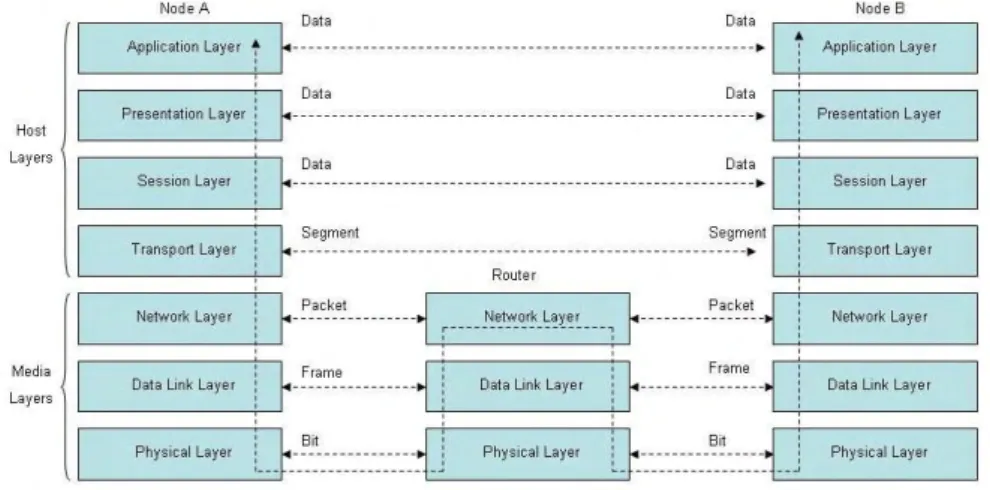
In the OSI reference model the lower three layers are related and specific to the type of media being used in the transportation of the information. The upper three layers closely depend on the type of the host running the end-user application. Figure 1 shows the OSI reference model.
Figure 1 - The seven layers of the ISO/OSI Reference Model
2.3 Motivation
for
Cross-Layer
Design
in
Mobile
Communications
By nature, the wireless channel is a very aggressive medium to convey information: large-scale propagation phenomena accrued from path-loss signal attenuation and shadowing, coupled with
fast-scale multipath propagation and co-channel interference in both time, frequency and space domains, pose challenges in the transmission of information over the mobile channel [24, 25]. ⋅ From a pessimistic point of view, these small and large scale signal variations affect the
system performance, either in terms of the QoS provided to the different users, or in the efficient use of the scarce radio resources available, and create several new problems for protocol design that cannot be well handled in the framework of the layered architectures. ⋅ From an optimistic point of view, however, wireless networks offer new opportunities for
communications which cannot be addressed in a strictly layered protocol design. For instance, the variations in link quality in time, frequency and space domains enables the opportunistic use of the channel if the transmission parameters can be dynamically adapted, according to these variations.
It seems logical to admit that the strict modular and hierarchical layering principles of the OSI reference model, in which the functionality of each layer is not influenced by the performance of others, do not address such constraints and requirements associated to the mobile wireless channel, and do not provide the multiuser gains which can be achieved whenever link adaptation is performed, according to variations in radio channel quality along time and space. It is straightforward to see that these issues can be more efficiently addressed if the design of the original protocol stack is modified according to the new cross-layer design paradigm.
The following sections illustrate some examples of scenarios, where the direct communication among different layers in the protocol stack results in significant improvements in the performance of the network.
2.3.1 Link Adaptation in Single User Point-to-Point Communication
The modulation and coding schemes (MCS) used in the transmission of each symbol can be modified dynamically over time, according to the state of the channel reported by the end user [26]. For example: mobile users report the state of the downlink (from base to mobile station) connection to the base station in pre-defined periods of time. This information is used in the base station to estimate the downlink channel and to select the most appropriate MCS scheme, for the maximization of the data rate over the channel, provided the estimated ratio of packets received with error to the total amount of packets transmitted is under a given upper bound.
2.3.2 Multiuser Diversity Gain in Multi-User Point-to-Multi-Point
Communications
Consider a conventional cellular system with a fixed base station and a number of mobile users. Packets arrive from the wired Internet and are queued temporality at the base station. Consider also a simple Time Division Multiple Access (TDMA) system. A packet scheduler selects, in the beginning of each time-slot, the user which should transmit. As the mobile radio channels vary independently for each user (assuming they are not collocated), and assuming the base