ANA MARIA CARMONA-RIBEIRO
Departamento de Bioquímica, Instituto de Química, Universidade de São Paulo, Cx. Postal 26077 – 05513-970 São Paulo, SP, Brazil
Manuscript received on September 8, 1999; accepted for publication on September 15, 1999; presented byJosé M. Riveros
ABSTRACT
Multiple uses for synthetic cationic liposomes composed of dioctadecyldimethylammonium bromide (DODAB) bilayer vesicles are presented. Drugs or biomolecules can be solubilized or incorporated in the cationic bilayers. The cationic liposomes themselves can act as antimicrobial agents causing death of bacte-ria and fungi at concentrations that barely affect mammalian cells in culture. Silica particles or polystyrene microspheres can be functionalized by coverage with DODAB bilayers or phospholipid monolayers. Neg-atively charged antigenic proteins can be carried by the cationic liposomes which generate a remarkable immunoadjuvant action. Nucleotides or DNA can be physically adsorbed to the cationic liposomes to be transferred to mammalian cells for gene therapy. An overview of the interactions between DODAB vesicles and some biomolecules or drugs clearly points out their versatility for useful applications in a near future.
Key words: interactions, dioctadecyldimethylammonium bromide, phospholipids, liposomes, drugs, sur-faces.
INTRODUCTION
Since their introduction as bilayer-forming synthetic compounds (Fendler 1980), dihexadecylphosphate (DHP) or dioctadecyldimethylammonium (DODA) salts have found many different uses in strategic ap-plied areas (Carmona-Ribeiro 1992). In particular, synthetic cationic liposomes have been sucessfully employed to interact with negatively charged sur-faces or biomolecules such as prokaryotic (Martins
et al. 1997) or eukaryotic cells (Carmona-Ribeiroet al. 1997), antigenic proteins (Tsurutaet al. 1997), nucleic acids (Behr 1993), synthetic polymers and latex (Carmona-Ribeiro & Midmore 1992, Lessa & Carmona-Ribeiro 1996) and mineral surfaces (Ra-puano & Carmona-Ribeiro 1997). In this work,
E-mail: [email protected]
some of their most recent uses in several applied areas are shown.
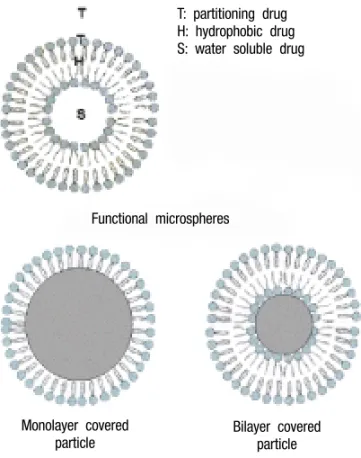
sup-Fig. 1 – Bilayer vesicles and liposomes as drug carriers or as
sources of organized supramolecular assemblies to cover solid
particles.
porting particle have a major role in determining the lipidic supramolecular assembly obtained at the solid surface. The negatively charged nature of sul-fate polystyrene microspheres leads to deposition of cationic bilayers onto the surface and vice-versa (Carmona-Ribeiro & Midmore 1992) whereas the neutral character of phosphatidylcholine (PC) or dipalmytoylphosphatidylcholine (DPPC) leads to monolayer coverage of amidine latex with the phos-pholipid polar heads uppermost and the lipid hydro-carbon tails hydrophobically interacting with the la-tex surface (Carmona-Ribeiro & Herrington 1993). The molar absorptivity for Amphotericin B, an hydrophobic drug currently used as a potent fungi-cide, was determined in small DODA bromide (DODAB) vesicles (1.5 mM DODAB) as solubiliz-ers. It is 160,406 M−1cm−1. This shows that these cationic vesicles are excelent solubilizers for the drug since the molar absorptivity for the drug in its best solvent mixture (methanol/dimethylsulfoxide
1:1) is 164,300 M−1 cm−1. Formulation of hy-drophobic drugs will possibly be substantially im-proved by using DODAB vesicles as solubilizers. However, prospective DODAB uses cannot avoid a systematic evaluation of diferential toxicity for these cationic liposomes.
Table I illustrates the compared toxicity of DODAB liposomes for cultured mammalian cells and some bacteria or fungi. Mammalian cells are more resistant to DODAB than are bacteria or fungi remaining 50% viable at 1.0mMDODAB whereas, for the latter, 50% of viability occurs over the mi-cromolarrange of DODAB concentrations. Mam-malian cells remain ca. 100% alive at DODAB con-centrations where bacteria and fungi do not survive. DODAB liposomes are prone to further uses as bac-tericides themselves in which multiple drugs against multiple infections can be included.
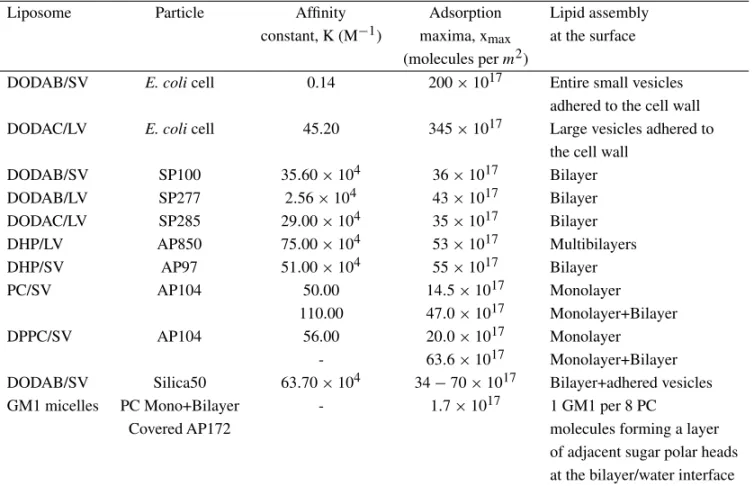
Determination of adsorption isotherms for lipids from liposomes onto latex, silica or bacteria followed by linearization of the langmuirian curves allows calculations of parameters as affinity con-stants and adsorption maxima (Jacksonet al. 1986), which are valuable parameters to ascertain the prod-uct of the liposome/surface interaction (Table II). The occurrence of opposite charge for the liposome and surface pair generally drives deposition of one bilayer onto the latex or the silica particle. Exam-ples for this are the interactions between large or small DODAB vesicles and latex where the cationic DODAB deposits as bilayers onto the negatively charged sulfate polystyrene particles. Similarly, in-teractions between small or large DHP vesicles and oppositely charged amidine polystyrene parti-cles leads to deposition of DHP bilayers onto the latex (Table II). However, the negatively charged
TABLE I
Diferential cytotoxicity of cationic DODAB liposomes. Interaction time between small DODAB vesicles and cells was fixed at 1 h. Adapted from Carmona-Ribeiroet al. 1997, Campanhãet al. 1999.
Cell type Viable cells concentration DODAB concentration for
(cells/mL) 50% survival (mM)
Normal Balb-c 3T3 (clone A31) mouse fibroblasts 104 1.000
SV40-transformed SVT2 mouse fibroblasts 104 1.000
C. albicans 2×10⁶ 0.010
E. coli 2×10⁷ 0.028
S. typhimurium 2×10⁷ 0.010
P. aeruginosa 3×10⁷ 0.005
S. aureus 3×10⁷ 0.006
adhesion, transport, etc, it is not straightforward to achieve a simple explanation for the absence of cationic vesicle disruption at the cell surface. Neu-tral phospholipids such as PC or DPPC from vesicles deposits as an odd number of monolayers onto the amidine latex surface. This agrees with the interpre-tation of a first monolayer coverage on the solid sur-face with the phospholipid polar heads uppermost. In this case, adsorption would be basically driven by the hydrophobic attraction between the lipid hydro-carbon tails and the hydrophobic surface.
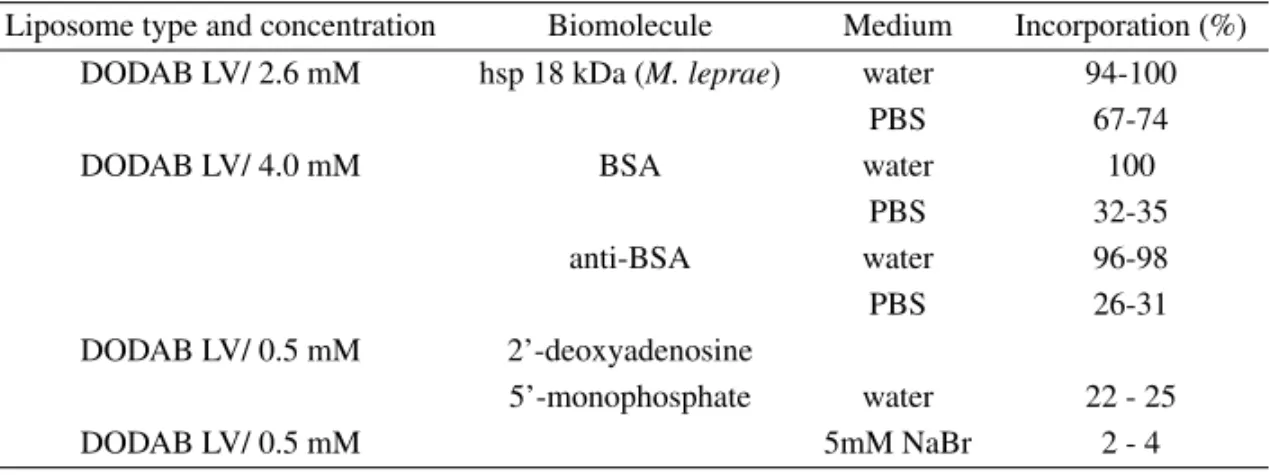
Table III shows how the cationic DODAB liposomes are useful to carry oppositelly charged biomolecules such as proteins or a nucleotide, 2’-deoxyadenosine 5’-monophosphate. The cationic liposomes are useful as immunoadjuvants for in-duction of delayed type hypersensitivity towards the antigenic 18 kDa heat-shock protein ofM. leprae. Incorporation of the protein in the adjuvant lipo-somes increases the cellular immunoresponse ca. 10 times (Tsurutaet al. 1997). Besides the elec-trostatic attraction driving incorporation of the pro-tein onto the liposome, there is also the hydropho-bic attraction between the liposome and the protein that accounts for the large incorporation measured at higher salt concentrations (Table III). Bovine serum albumin (BSA) and anti-BSA incorporation onto the cationic liposomes is more sensitive to ionic strength than is incorporation of hsp−18 kDa fromM.
Lep-rae(Table III). Incorporation substantially decreases when performed in PBS instead of water (Table III) showing the relative importance of electrostatics vs. hydrophobic forces determining protein incorpora-tion in the liposome. The nucleotide in Table III is a typical case of partitioning molecule whose in-corporation in the cationic bilayer requires the large electrostatic attraction that occurs in pure water at zero ionic strength.
ACKNOWLEDGMENTS
I thank FAPESP and CNPq grants and Ms. Renata Rapuano help in drawing Figure 1.
REFERENCES
Behr JP1993. Synthetic gene-transfer vectors. Acc Chem Res26:274-278.
Campanhã MTN, Mamizuka EM & Carmona-Ribeiro AM1999. Interactions between cationic liposomes and bacteria: the physical-chemistry of the bacteri-cidal action.J Lipid Res 40:1495-1500.
Carmona-Ribeiro AM 1992. Synthetic amphiphile vesicles. Chem Soc Rev21:209-214.
Carmona-Ribeiro AM & Herrington TM1993. Phos-pholipid adsorption onto polystyrene microspheres. J Colloid Interface Sci 156:19-23.
TABLE II
Affinities (K) and maximal adsorption (xmax) for different liposome-forming amphiphiles onto a variety of organic, inorganic or biological surfaces. Models for organic synthetic surfaces are different types of latex (polystyrene) particles; for inorganic surfaces, conventional hydrophilic silica (Aerosil OX-50) and, for biolog-ical surfaces,E. colicell surfaces. Liposomes were obtained from the following lipids: phosphatidylcholine (PC), dipalmytoilphosphatidylcholine (DPPC), dioctadecyldimethylammonium bromide (DODAB) or chloride (DODAC), sodium dihexadecylphosphate (DHP) or monosialoganglioside (GM1). Latex particles are quoted as sulfate polystyrene (SP) or amidine polystyrene (AP) followed by the mean latex diameter in nm. Silica particles are Aerosil OX-50 (50 nm mean diameter) from Degussa. Adapted from Tápiaset al. 1994, Campanhãet al. 1999, Carmona-Ribeiro & Midmore 1992, Carmona-Ribeiro & Herrington 1993, Sicchierolli & Carmona-Ribeiro 1995, Sicchierolliet al. 1995, Rapuano & Carmona-Ribeiro 1997.
Liposome Particle Affinity Adsorption Lipid assembly
constant, K (M−1) maxima, xmax at the surface (molecules perm2)
DODAB/SV E. colicell 0.14 200×1017 Entire small vesicles
adhered to the cell wall
DODAC/LV E. colicell 45.20 345×1017 Large vesicles adhered to
the cell wall
DODAB/SV SP100 35.60×10⁴ 36×1017 Bilayer
DODAB/LV SP277 2.56×10⁴ 43×1017 Bilayer
DODAC/LV SP285 29.00×10⁴ 35×1017 Bilayer
DHP/LV AP850 75.00×10⁴ 53×1017 Multibilayers
DHP/SV AP97 51.00×10⁴ 55×1017 Bilayer
PC/SV AP104 50.00 14.5×10¹⁷ Monolayer
110.00 47.0×10¹⁷ Monolayer+Bilayer
DPPC/SV AP104 56.00 20.0×10¹⁷ Monolayer
- 63.6×10¹⁷ Monolayer+Bilayer DODAB/SV Silica50 63.70×10⁴ 34−70×1017 Bilayer+adhered vesicles
GM1 micelles PC Mono+Bilayer - 1.7×10¹⁷ 1 GM1 per 8 PC
Covered AP172 molecules forming a layer
of adjacent sugar polar heads at the bilayer/water interface
Langmuir 8:801-806.
Carmona-Ribeiro AM, Ortis F, Schumacher RI & Armelin MCS1997. Interactions between cationic vesicles and cultured mammalian cells. Langmuir
13:2215-2218.
Carvalho LA & Carmona-Ribeiro AM1998. Interac-tions between cationic vesicles and serum proteins. Langmuir 14:6077-6081.
Fendler JH1980. Surfactant vesicles as membrane mimetic agents: characterization and utilization.Acc Chem Res 13:7-13.
Jackson S, Reboiras MD, Lyle IG & Jones MN1986. Adsorption of phospholipid vesicles on solid sur-faces. Faraday Discuss Chem Soc 85:291-301.
Kikuchi IS, Viviani W & Carmona-Ribeiro AM1999. Nucleotide insertion in cationic bilayers. J Phys Chem A 103:8050-8055.
Lessa MM & Carmona-Ribeiro AM 1996. Bilayer wetting on polymer surfaces.J. Colloid Interface Sci
182:166-172.
Lang-TABLE III
Incorporation (%) of a variety of biomolecules onto cationic DODAB liposomes.
Adapted from Tsurutaet al. 1997, Carvalho & Carmona-Ribeiro 1998, Kikuchiet al. 1999.
Liposome type and concentration Biomolecule Medium Incorporation (%) DODAB LV/ 2.6 mM hsp 18 kDa (M. leprae) water 94-100
PBS 67-74
DODAB LV/ 4.0 mM BSA water 100
PBS 32-35
anti-BSA water 96-98
PBS 26-31
DODAB LV/ 0.5 mM 2’-deoxyadenosine
5’-monophosphate water 22 - 25
DODAB LV/ 0.5 mM 5mM NaBr 2 - 4
muir 13:5583-5587.
Rapuano R & Carmona-Ribeiro AM1997. Physical adsorption of bilayer membranes on silica.J Colloid Interface Sci 193:104-109.
Sicchierolli SM & Carmona-Ribeiro AM1995. In-corporation of cholera toxin receptor in phospho-lipid-covered polystyrene microspheres. Colloid & Surf B 5:57-62.
Sicchierolli SM, Mamizuka EM & Carmona-Ribeiro AM1995. Bacteria flocculation and death by cationic vesicles.Langmuir 11:2991-2995.
Tapias GN, Sicchierolli SM, Mamizuka EM & Carmona-Ribeiro AM1994. Interactions between cationic vesicles and Escherichia-coli.Langmuir10: 3461-3465.