Repositório ISCTE-IUL
Deposited in Repositório ISCTE-IUL:
2018-07-16Deposited version:
Post-printPeer-review status of attached file:
Peer-reviewedCitation for published item:
Abreu, R. & Almeida, F. (2018). E-learning in mixed reality landscape: emerging issues and key trends in scientific research. In Luis Gómez Chova; Agustín López Martínez; Ignacio Candel Torres; (Ed.), 12th International Technology, Education and Development Conference. (pp. 6181-6187). Valencia: IATED.
Further information on publisher's website:
10.21125/inted.2018.1455Publisher's copyright statement:
This is the peer reviewed version of the following article: Abreu, R. & Almeida, F. (2018). E-learning in mixed reality landscape: emerging issues and key trends in scientific research. In Luis Gómez Chova; Agustín López Martínez; Ignacio Candel Torres; (Ed.), 12th International Technology, Education and Development Conference. (pp. 6181-6187). Valencia: IATED., which has been
published in final form at https://dx.doi.org/10.21125/inted.2018.1455. This article may be used for non-commercial purposes in accordance with the Publisher's Terms and Conditions for self-archiving.
Use policy
Creative Commons CC BY 4.0
The full-text may be used and/or reproduced, and given to third parties in any format or medium, without prior permission or charge, for personal research or study, educational, or not-for-profit purposes provided that:
• a full bibliographic reference is made to the original source • a link is made to the metadata record in the Repository • the full-text is not changed in any way
The full-text must not be sold in any format or medium without the formal permission of the copyright holders.
Serviços de Informação e Documentação, Instituto Universitário de Lisboa (ISCTE-IUL) Av. das Forças Armadas, Edifício II, 1649-026 Lisboa Portugal
Phone: +(351) 217 903 024 | e-mail: [email protected] https://repositorio.iscte-iul.pt
E-LEARNING IN MIXED REALITY LANDSCAPE: EMERGING ISSUES
AND KEY TRENDS IN SCIENTIFIC RESEARCH
Ricardo Abreu
1, Filomena Almeida
21
ISCTE-IUL (PORTUGAL)
2ISCTE-IUL (PORTUGAL)
Abstract
E-Learning aims to apply information and communications technology to enhance and support the learning process and is a popular mode of delivering educational materials in universities throughout the world. Recently, due to the advancements of Augmented Reality (AR) and Virtual reality (VR), the E-learning process has great challenges and opportunities ahead. This study intends to explore the current trends in the field of AR/VR applied to distance education research. Using bibliographic data extracted from the Scopus® database and social network analysis techniques were able to analyse author keyword toward the identification of major trends. For the analysis, we collected keywords from research papers published in international journals related to E-learning, AR and VR, between 2006 and 2017, and constructed a co-word network, and then conducted the keyword network analysis. Retrieving the "E-learning" ego-network we could find some clusters that define major trends like virtual environments or evaluations process. The study reveals that E-learning process fits better in AR than VR research. The findings obtained in this study may be useful in the exploration of potential research areas in the field of distance education.
Keywords: E-learning, Augmented Reality, Virtual Reality, Social Network Analysis, Trends
1 INTRODUCTION
E-learning as we know better has been here for a decade and nowadays became a fundamental tool for universities and teaching professionals. The internet and mobile technology development push online learning to the edge and every day we see new trends flourish e-learning systems. The way we work or learn is changing as fast as the world we live in. The dynamic change in learning and business models leaves us stunned and to keep up the pace in this uncooked technological development, demand an insightful look at trends and foresight developments.
In recent years several developments appear in the learning space, as gamification, cloud-based learning or social learning, yet one of the most interesting is Virtual and Augmented Reality (VR&AR) or Mixed Reality (MR) as a fusion of these two reality shapes. MR goes beyond the traditional e-learning video-based e-learning, it put learners inside class in a simulated environment where anyone can interact with virtual content, objects and avatars. It’s seems that MR could be a change maker in the e-learning process.
Given the diversity of technologies and platforms for e-learning developments, this paper aims to analyse the cross-knowledge between VR&AR and e-learning research landscape, using bibliometric indicators and Social Network Analysis (SNA). From different fields of science to a business applied success models, e-learning covers a wide range of research topics, that can be used to provide a smooth view of the links between e-learning and MR research fields, and consequently some trends in this disruptive research landscape.
This study provides an ego-network map view of research topic taxonomy in recent e-learning and MR research literature, allowing scholars, teaching professionals and academies, with a better understanding of learning innovation developments.
Mapping knowledge fields with a bibliometric approach has been a recognised methodology among scholars. Since the first “statistical bibliography” of Hulme [1], passing through the Merton and Garfield’s “scientometrics” [2], to the recent studies of Loet Leydesdorff [3], [4], bibliometric data have been used to understanding the structure of scientific fields. In the field of e-learning research, bibliometric analysis has address several issues such as trends [5]. Although, co-citation is the most used method for data analysis, the co-word analysis has emerged as efficient methodology in bibliometric approach.
Hung [6] used text mining and bibliometric analysis to find underline trends in e-learning research. Data from 280 journals, articles and proceeding papers, from 2000 to 2008, reveals 15 clusters or themes of which stand out “architectures and standards, “semantic web technology”, “multimedia” and “support systems”. His longitudinal study also found that scholars from leading countries on e-learning development focuses their research in educational field more than others from early adopter countries who tended to research technical aspects of e-learning systems.
In a study about e-learning in workspace, the bibliometric analysis was selected by the authors [7] to analyse 324 articles published in academic journals and conference proceedings from 2000 to 2012. The analysis estimates six cluster categorized into four main themes in workplace e-learning research: “e-learning for continuing and professional development”; “e-learning in healthcare sector”; “social media for e-learning”; and “integration of knowledge management with e-learning systems”.
Another review of 26 selected scientific studies published between 2008 and 2012, identify emerging e-learning trends in special education research field [8]. Learning Technology (LT), as mentioned by authors, is scope of effectiveness in several empirical studies. The analysis shows that the most common use of LT is “computer-assisted technology”, followed by “specific software” and a few “mobile learning”. One study is referred as overlapping technology, placing cloud computing systems and augmented reality within special education context.
Augmented Reality and Mobile Learning (ML) appears as selected terms in a bibliometric analysis on 741 journals and 913 conference proceedings publish from 2015 to 2016 [9]. A qualitative analysis at scientific literature in ML/AR results in five research trends: (1) terminological conceptualization; (2) methodological changes; (3) analysis of use factors (4) motivational and ludic dimension; (5) delocalization and selected subject-matter with higher implementation of AR.
In a comprehensive study of Information Communications Technology (ICT) based learning communities [10],. the bibliometric approach was applied to perform an analysis of publications in the field of “Virtual Learning Communities”, between 2006 and 2014, where observed an increase of citations among scholars. This study fit bibliometric and network analysis in to research field. The results are apprehensive, a gap in collaborative work in the ICT-based learning communities and emerging fields like “web 2.0 application” and “design databases” are keywords that shape the trends in communities.
Bibliometric and SNA methodologies emerge as a mixed field of analysis since the emergence of the internet in 90´s [11]. These two research methods are focus on content and in dynamic of co-citation among scholars. Moreover, citation maps and dynamic network visualization of bibliometric data empower us to trace and discover new interdisciplinary fields of science. The same approach can be extending to co-word citation and keyword analysis.
Accordingly to the authors [12], in a knowledge management research study, a bibliographic analysis of keywords and SNA co-words method, was choose, from 758 articles, to analyse the knowledge structure and trends. After collected the keywords assigned to papers, a SNA procedure was applied to identify and quantify the number of co-occurrences between that keywords and afterwards a graphically visualization was used to interpreted the co-word network characteristics. The authors
argue that this type of methodology is a useful method to find patterns and trends in the scientific research journals.
2 METHODOLOGY
The co-word analysis methods were first introduced to map the dynamics of science and technology. These methodologies was developed by Michel Callon and his Centre for Sociology of Innovation in mid-1970 [13], [14]. The prime motivation was to develop a methodology that explain the scientific research framework behind the traditional panels of experts [13].
Compile the dynamics of science is to know how science understand the societal phenomena. For mapping this dynamics, social scientist proposed the “Actor-network” theoretical foundation or ANT for co-word analysis [15]. Along research laboratories, the scientific literature are the fundamental tools toward to master the world challenges. For scientists, put in words what they do every day is an effort to make sense of complex and dynamics systems of their work spaces [16].
Co-word analysis assumes the basic idea that keyword was chosen based in author’s perception of the different fields in their scientific articles. Thus, each time a keyword occurred in a list of scientific literature, that word is count as a co-occurrence of a pair of articles. The sum of all co-occurrences can be retrieve from a database of scientific literature and used to construct a co-occurrence matrix, were the two dimension axes are built from keywords, and elements are the number of co-occurrences. Different bidimensional maps sprout from matrices as a consequence of keyword position in pair relationship, creating a singular structures and different network patterns.
This study follows the methodology used in mapping research trends [12], [17] with co-word and keyword analysis. From Scopus® database we applied a Boolean search for three central keywords: “e-learning”; “Augmented Reality”; “Virtual reality”. That result in 600 papers, published in academic journals and conference, from 2001 to 2017. All papers are characterized mainly by two kind of keywords, one from authors and other by database indexed keywords. For the propose of these research we selected only 78 publications with an “e-learning” in author keyword. This option provides an acceptable scholar´s point of view [12], [18] regarding the Mixed Reality in e-learning research field.
The keywords were subjected to a standardization process such as “Augmented reality (AR)” to “Augmented Reality” or hyphenated words like “elearning” to “E-learning”. A couple of acronyms such as MR was textualized in “Mixed Reality”. After this process, 234 keyword remain to posterior co-word analysis.
Each paper has a set of author keywords that frame a space co-words. These co-occurrences between pairs of similar keywords was analyzed by a SNA methodology. SNA is interdisciplinary resource with some years of development. It is used in scientific areas such as psychology, sociology, marketing or economics in order to identify the relations between the different units of analysis [19]. For this study, we employ the ego-network analysis to isolate the “E-learning” keyword, that enable us draw network graph that illustrate the strongest associations between these word and AR and VR keywords.
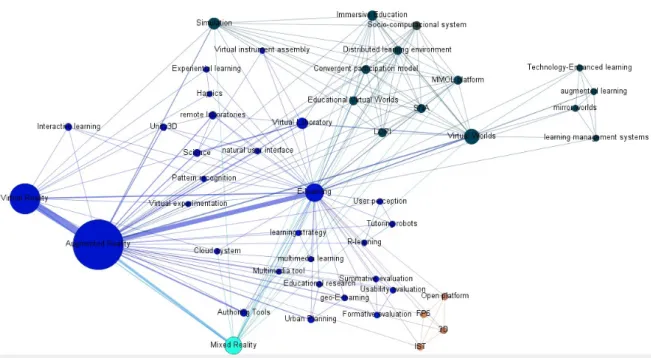
The Gephi software [20] was used to create and visualize the keyword co-occurrence network. The original network is dense with the 232 nodes and 911 edges. For visualization of ego-network it was applied an ego-network filter with one neighbored depth, this means evaluating the direct links, between “E-learning” and other research themes. The ego-network was reduced to 47 nodes and 189 edges (Fig. 2). The size of the nodes is proportional to the number of neighbors or degree and the thickness of the edges represents the number of occurred pairwise keyword.
The software can also output different network statistics, relevant to characterize the network formation by the co-occurrence keywords. One of the most important statistics is de centralization of the node, it could be evaluated by three essential dimensions [21]: degree (number of incident edges in the node); closeness (geodesic length between two pair of nodes); and Betweenness (nodes who lie on paths between two nodes)
3 RESULTS
3.1 Descriptive Analysis
Fig.1 describes the evolution of three main keywords (“E-learning”, “Augmented Reality, “Virtual Reality”) aside the distribution of 77 papers per year. The scientific production has been rising for the last 3 years, followed by Mixed Reality research in E-learning landscape. In this study the “Augmented Reality” keyword manifest greater focus by the scholars. “Virtual Reality” was a topic of choice in the last 5 years, however AR surpass the others in 2017.
Figure. 1 - Distribution of scientific production and main keyword
Source: Data from Scopus®, compiled by author
3.2 Network Analysis
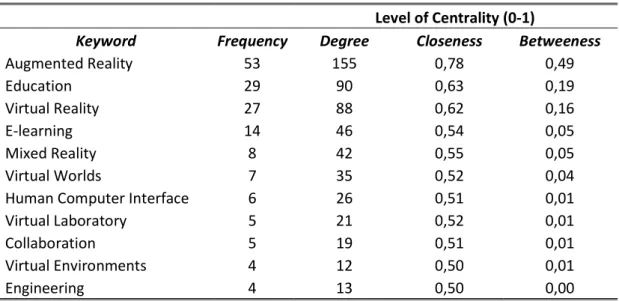
For the co-word analysis, we used SNA to describe some basic network statistics. Table1 display the network measures of keywords sort by the frequency. Again we can verify that AR keyword is the most used keyword in the assigned papers, although it is not the only keyword with the highest level of degree or links. Types of “Education” have to higher level of degree and closeness. The quantitative analysis shows also that “Mixed Reality” has an average level of closeness with a lower frequency, which means this keyword is not used in most of the papers, however, involves several links to others prominent keywords.
Table 1 - - Keyword network measures sorted by frequency
Level of Centrality (0-1)
Keyword
Frequency
Degree
Closeness
Betweeness
Augmented Reality
53
155
0,78
0,49
Education
29
90
0,63
0,19
Virtual Reality
27
88
0,62
0,16
E-learning
14
46
0,54
0,05
Mixed Reality
8
42
0,55
0,05
Virtual Worlds
7
35
0,52
0,04
Human Computer Interface
6
26
0,51
0,01
Virtual Laboratory
5
21
0,52
0,01
Collaboration
5
19
0,51
0,01
Virtual Environments
4
12
0,50
0,01
Engineering
4
13
0,50
0,00
Source: Data from Scopus®, computed by Gephi®, and compiled by author
On a close observation of the data, it appears coupled with other types of education, such as “Immersive Education” or “Education Virtual Worlds”. From this selection of keywords, we can verify that e-learning research is still at the level of technological development, supporting by “Human Computer Interaction” or “Engineering”. From table1 we can say that first 3 keywords have higher level of betweenness, that reveal the presence of this keywords in almost papers.
3.3 Visual Analysis
The Fig.2 show the Ego-network of a co-occurrence of keywords linked to “E-learning” from assigned papers. For this propose we threshold one depth from central keyword, it’s mean that only the direct neighbour is display. From this lighter network, two observations can be made. One is the stronger relations between the e-learning and AR research topic. Other is the intense cloud of topics in the field of virtual environments, such as “MMOL platform”, “Distributed learning environment” or “Immersive Education”
Figure 1 - Ego-network from keyword "E-learning"
Source: Data from Scopus®, computed by Gephi®, and compiled by author
The Ego-network point out the weak linkage between “E-learning” and “Virtual Reality” the same with “Mixed Reality”. One other hand, VR and AR have a strong tie between them. These ties configurations become further explicit when we analyse the clusters.
In sense of linkage level, the Ego-network allow us to observe four groups or clusters of keywords. One about virtual practice environments with more links with “Simulation”, “Virtual Worlds” (the dark green nodes) than to the main keywords. Other on 3D space, in limited proportion, are linked mostly to “E-learning” and AR (the brown nodes). A singular position comes from “Mixed Reality” (light blue node). And, the last but not list, the group to which “E-learning”, AR and VR belongs (dark blue nodes).
The last group of nodes are the core of e-learning landscape. From these keywords we can consider some trends. First, Augmented Reality is a straightforward technology to use, more in e-learning research, than VR. Second, these set of multidisciplinary research fields emerge two innovative perspectives: one from educational and training (e.g. “multimedia learning” or “geo-E-learning”); and other from professional and technical perspective (e.g. “Pattern recognition”, “natural user interface” or “Virtual Laboratory”).
4 CONCLUSIONS
The e-learning research landscape is a multidisciplinary research and the disruptive field of Mixed Reality (i.e. Virtual Reality and Augmented Reality) are part of this landscape. This study chooses a bibliometric and social network analysis methodology to provide a few insights from e-learning research. A co-word analysis was applied to create a network of keywords and an “E-learning” ego-network visualization.
From the research results a few conclusions are implied. Augmented Reality (AR) fits better in learning research than Virtual Reality. Scholars focus their research in applied AR solutions to e-learning practice. Innovation in this multidisciplinary field towards to educational and professional solutions. Late, have his trend in research of multimedia learning and other learning methods. Early, in virtual and remote laboratories as technical interfaces.
The scientometric print by Merton and Garfield’s [2] and explore by Loet Leydesdorff [3], [4] in his maps of scientific fields, has its potential in the discovery and evaluation of trends in e-learning research field. This study clears up the co-word analysis usefulness as viable tool for extracting patterns and trend from research topics inside scientific production.
The present paper contributes for understanding the advancements in Mixed Reality technologies applied to e-learning solutions. From trends we expect to see further interdisciplinary research and a deepening sight in virtual worlds towards immersive education.
REFERENCES
[1] E. W. Hulme, “Statistical bibliography in relation to the growth of modern civilization,” 1923. [2] E. Garfield and R. K. Merton, Citation indexing: Its theory and application in science,
technology, and humanities, vol. 8. Wiley New York, 1979.
[3] L. Leydesdorff, The challenge of scientometrics: The development, measurement, and self-organization of scientific communications. Universal-Publishers, 2001.
[4] L. Leydesdorff and I. Rafols, “A global map of science based on the ISI subject categories,” J. Assoc. Inf. Sci. Technol., vol. 60, no. 2, pp. 348–362, 2009.
[5] J. Hung, “Trends of e-learning research from 2000 to 2008: Use of text mining and bibliometrics,” Br. J. Educ. Technol., vol. 43, no. 1, pp. 5–16, Jan. 2012.
[6] L.-C. Hsu and C.-H. Wang, “Forecasting integrated circuit output using multivariate grey model and grey relational analysis,” Expert Syst. Appl., vol. 36, no. 2, pp. 1403–1409, Mar. 2009. [7] B. Cheng, M. Wang, A. I. Mørch, N.-S. Chen, Kinshuk, and J. M. Spector, “Research on
e-learning in the workplace 2000–2012: A bibliometric analysis of the literature,” Educ. Res. Rev., vol. 11, pp. 56–72, 2014.
[8] G.-Z. Liu, N.-W. Wu, and Y.-W. Chen, “Identifying emerging trends for implementing learning technology in special education: A state-of-the-art review of selected articles published in 2008–2012,” Res. Dev. Disabil., vol. 34, no. 10, pp. 3618–3628, 2013.
[9] J. Fombona, Á. Pascual-Sevillano, and M. González-Videgaray, M-learning and Augmented Reality: A Review of the Scientific Literature on the WoS Repository, vol. 25. 2017.
[10] J. B. Hernández, S. Chalela, J. V. Arias, and A. V. Arias, “Research Trends in the Study of ICT Based Learning Communities: A Bibliometric Analysis.,” EURASIA J. Math. Sci. Technol. Educ., vol. 13, no. 5, pp. 1539–1562, 2017.
[11] L. Leydesdorff, “Bibliometrics/Citation networks,” in Encyclopedia of social networks, vol. 1, G. A. Barnett, Ed. Sage, 2011, pp. 72–74.
[12] R. Valderrama-Zurian, Juan-Carlos; Navarro-Molina, Carolina; Aguilar-Moya, Remedios; Melero-Fuentes, David; Aleixandre-Benavent, “Trends in scientific research in Online Information Review. Part 2. Mapping the scientific knowledge through bibliometric and social network analyses,” 2017.
[13] M. Callon, “L’État face à l’innovation technique: le cas du véhicule électrique,” Rev. française Sci. Polit., pp. 426–447, 1979.
[14] M. Callon, J.-P. Courtial, W. A. Turner, and S. Bauin, “From translations to problematic networks: An introduction to co-word analysis,” Inf. (International Soc. Sci. Counc., vol. 22, no. 2, pp. 191–235, 1983.
[15] M. Callon, “The sociology of an actor-network: The case of the electric vehicle,” in Mapping the dynamics of science and technology, Springer, 1986, pp. 19–34.
[16] B. Latour, Science in action: How to follow scientists and engineers through society. Harvard university press, 1987.
Analysis Based on Keywords from Funded Project,” Procedia Comput. Sci., vol. 91, pp. 547– 555, 2016.
[18] J. Law and J. Whittaker, “Mapping acidification research: A test of the co-word method,” Scientometrics, vol. 23, no. 3, pp. 417–461, 1992.
[19] J. P. Scott, “Social Network Analysis: A Handbook,” 2000.
[20] M. Bastian, S. Heymann, and M. Jacomy, “Gephi: an open source software for exploring and manipulating networks.,” Icwsm, vol. 8, pp. 361–362, 2009.
[21] S. Wasserman and K. Faust, Social network analysis: Methods and applications, vol. 8. Cambridge university press, 1994.