IUL School of Social Sciences
Department of Social and Organizational Psychology
Does it matter who is ostracizing you? Manipulating warmth and competence social dimensions as the source
Daniel Alves da Silva Freire
Dissertation submitted as partial requirement for the conferral of Master in Social and Organizational Psychology
Supervisor:
Doctor Elizabeth C. Collins, Research Fellow
ISCTE - Instituto Universitário de Lisboa
3
IUL School of Social Sciences
Department of Social and Organizational Psychology
Does it matter who is ostracizing you? Manipulating warmth and competence social dimensions as the source
Daniel Alves da Silva Freire
Dissertation submitted as partial requirement for the conferral of Master in Social and Organizational Psychology
Supervisor:
Doctor Elizabeth C. Collins, Research Fellow ISCTE - Instituto Universitário de Lisboa
4
Acknowledgements
I’d like to thank first to my dissertation supervisor, Elizabeth Collins, for all the support and dedication. I couldn’t expect a better supervisor.
Second, I’d like to thank my parents – L. S. and M. F. – for everything. D. F., my brother, it seems I’ll be waiting for you on this “side” now!
And last but not least, I want to thank all my friend who have been supporting me, with a special mention to C. S. and A. S.
5 Abstract
Ostracism – the act of being excluded and ignored – has been shown to have negative psychological consequences such as decreases in feelings of belonging, self-esteem, meaningful existence and control, as well as decreases in cognitive performance. Many attempts have been done in the research to find moderators, but the negative consequences seem to happen regardless of individual characteristics such as personality traits or the source of ostracism. Cyberball, a simple virtual ball-tossing game has been widely used and shown to be enough to affect individual psychological well-being. Moreover, just seeing or imagining being the ostracized individual has caused similar responses. Despite the large number of studies of the phenomenon, few studies have measured what ostracized individuals think about the ostracizers and how that affects the ostracism experience. As such, the present research adopted the warmth and competence dimensions from the Stereotype Content Model (SCM) to manipulate the source of the ostracism and measure possible more subtle effects of being ostracized. In Study 1, an online experiment, participants were asked to imagine being a character in a scenario describing someone being ostracized or included by Men (a group perceived as having high competence and low warmth) or Women (a group perceived as having low competence and high warmth). Results showed participants who read the ostracized scenario felt worse. No simple differences based on character sex were found, however, character sex and participant sex interacted in their effect on the dependent measures. Study 2 was a similar study performed in the lab using the Cyberball game as a manipulation of ostracism and including a dependent measure of a memory task related to female and male characters. Once again, there were strong effects of ostracism, and interactions between character sex and participant sex on participants’ emotions and mood. Implications are discussed.
6 Resumo
Ostracismo – o acto de excluir e ignorer – tem mostrado ter consequências psicológicas negativas no(s) ostracizado(s) como uma diminuição de sentimentos de pertença, auto-estima, existência significativa e de controlo, assim como diminuição do desempenho cognitivo. Diversas tentativas têm sido realizadas a fim de encontrar variáveis moderadoras, mas os tais efeitos negativos parecem surgir independentemente de caraterísticas individuais como traços de personalidade ou a origem ostracizante. Cyberball, um jogo virtual simples de arremeçar uma bola tem sido vastamente usado e provado ser suficiente para afectar o bem-estar psicológico. Mais ainda, ver ou imaginar outrem ser ostracizado tem provocado efeitos similares. Apesar do largo número de estudos sobre o fenómeno, poucos têm medido o que os indivíduos ostracizados pensam sobre os ostracizadores e como isso affecta a experiência do ostracismo. Como tal, a presente investigação adoptou os dimensões de warmth and competence do Stereotype Content Model (SCM) para manipular quem ostraciza e medir possíveis efeitos mais subtis de se ser ostracizado. No Estudo 1, uma experiência realizada online, os participantes foram instruídos a imaginarem ser uma personagem num cenário em que a mesma personagem era ostracizada ou incluída por Homens (um grupo percepcionado como tendo alta competence e baixo warmth) ou Mulheres (um grupo percepcionado como tendo baixa competence e alta warmth). Resultados mostraram que quem leu o cenário ostracizado se sentiu pior. A condição do sexo do grupo não mostrou diferenças, porém, o sexo da personagem e dos participantes interagiram no seu efeito sobre as variáveis dependentes. O Estudo 2 foi parecido ao anterior e consistiu em usar o Cyberball em laboratório como manipulador da origem do ostracismo, tendo ainda uma tarefa adicional de memória relacionado com figuras femininas ou masculinas. Uma vez mais, existiram efeitos robustos do ostracismo, e também interacções entre a condição do sexo do grupo ostracizador e sexo dos participantes nas suas emoções e estado de humor. Resultados e implicações são discutidos.
7
Index
Acknowledgements ... 4 Abstract ... 5 Resumo ... 6 CHAPTER I – Introduction ... 9 CHAPTER II – Study 1 ... 17 Design... 17 Participants ... 17Instruments and Materials... 18
Procedure ... 20
Results ... 21
Discussion ... 29
CHAPTER III - Study 2 ... 31
Design ... 32
Participants ... 32
Instruments and Materials... 33
Procedure ... 34
Results ... 35
Discussion ... 41
CHAPTER V – General Discussion ... 43
Limitations and Future Directions ... 47
Conclusion ... 48
REFERENCES ... 49
ANNEX ... 53
ANNEX A – Presentantion and Informed Consent for Study 1 ... 54
ANNEX B – Study 1 Ostracized Male Scenario Case 1 ... 55
ANNEX C – Study 1 Included Male Scenario Case 1 ... 56
ANNEX D – Instructions and Items Used in Study 1 ... 57
ANNEX E – Informed Consent for Study 2 ... 63
ANNEX F – Instructions and Items Used in Study 2 (Task 1) ... 64
8 Table Index
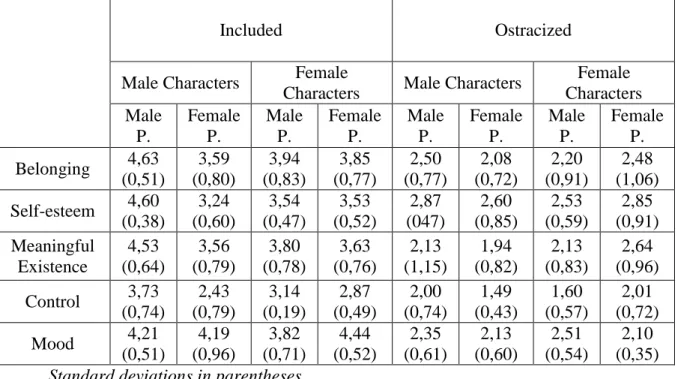
Table 1.1 - Means and Standard Deviations for the Needs and Mood dependent measures in Study 1 ... 21 Table 1.2 - Means and Standard Deviations for the Competence and Warmth dependent measures about the scenario team in Study 1 ... 23 Table 1.3 - Means and Standard Deviations for the Competence and Warmth dependent measures about the scenario team in Study 1 ... 26 Table 2.1 - Means and Standard Deviations for the Needs and Mood dependent measures in Study 2 ... 36 Table 2.2 - Means and Standard Deviations for the Competence and Warmth Perceptions of Men and Women in Portuguese dependent measures, Study 2 ... 37
9
CHAPTER I – Introduction
Social psychology researchers have been focusing more on ostracism, rejection and social exclusion in the last two decades (Williams, 2007; 2011). One of the main reasons for that is the several psychological consequences widely reported (Williams, 2007). Most, if not all, of such consequences reported are strong negative for ostracized individuals, compared with included ones (e.g. lowered levels of positive mood amongst the ostracized in Lustenberger & Jagacinski, 2010). Therefore, it is no surprise that research started focusing on the subject, its impact and how individuals cope with it (e.g., Williams, Forgas & Hippel, 2005).
In spite of the high number of works being published in the recent years, there is not a norm differentiating the terms ostracism, social exclusion and social rejection in the literature (Williams, 2007). Hence, we will use the words interchangeable and adopt Williams’ (2007) definition of ostracism, which is «typically defined as being ignored and excluded, and it often occurs without excessive explanation or explicit negative attention» (p. 429). The author also adds that ostracism «is often operationalized as a process that is characterized as an unfolding sequence of responses endured while being ignored and excluded» (p. 429).
A great contribution for the research on ostracism, rejection and social exclusion is the Cyberball paradigm (Williams et al., 2000) and Williams’ model (2001; Williams & Zardo, 2005). Cyberball is a virtual version of the real-life ball-tossing game (Williams, 1997; Williams & Sommer, 1997) developed to be more standardized, efficient and less traumatic than previous paradigms (Williams, 2007). In practice, participants are told by the researchers that the study aims to measure mental visualization on a task and that Cyberball has been found to work well for that purpose. Participants ostensibly play with two or three other players who connect via online and are told that it does not matter who throws or receives the ball, but how they mentally visualize it as a personal experience. However, the other players are actually computer originated and that is how the manipulation is done: ostracized participants receive the ball only two times at the beginning and included participants receive one third of the total throws. The number of throws are the same for both conditions and usually each game ends after 30-50 throws. The cover story intends to assure participants that their performance in the experiment is not affected by catching the ball thrown by other players or not (Williams, 2007).
Williams’ (2001; Williams & Zardo, 2005) model has been widely used in past research. This model assumes that ostracism threatens four fundamental needs: self-esteem; belonging; the need for control and the need for a meaningful existence. Additionally, the model proposes
10
the existence of three different stages of reaction after ostracism. First, there is an instant reflexive and painful response – by having negative effects on mood and threatening the 4 fundamental needs - to any source of ostracism. This happens regardless of different individual or situational factors. Second, as individuals have their needs threatened, they attempt to regain or satisfy the most threatened needs. Therefore they cope and react according to their individual differences and diverse contextual factors. The third stage describes the long-term effects of ostracism. Individuals who face several episodes of ostracism or a single long-term one might not be able to cope with the threatened needs. Looking at each need, the model also states that prosocial behaviors are expected when self-esteem and feelings of belonging, which represent relational needs, are lowered. Whereas, when control and meaningful existence are threatened, individuals tend to react in a more provocative and antisocial manner because those needs are related to feelings of efficacy and recognition. A new model was presented by Williams in 2009 adding a new stage: resignation. This stage is achieved if one suffers long term ostracism and is incapable of fortifying ones needs, leading to alienation, depression, helplessness and unworthiness.
The great majority of the tests of immediate or short term consequences of ostracism, rejection and social exclusion are usually done in laboratory experiments, whereas the long term effects of ostracism are typically studied in the field and with interviews (Williams, 2007). Studies that used Cyberball and Ball-tossing paradigms have two relevant similarities (Pharo, 2012). First, they are consistent with Williams’ definition of ostracism because they all include a lasting (althought most of the times for few minutes only) period of rejection and exclusion. Second, the dependent variables used to test and measure the effects of ostracism are all based on Williams’ (1997, 2001; Williams & Zardo, 2005) model.
Belonging has been found to be a fundamental human motivation (Baumeister & Leary, 1995). The authors also identified two requirements to define when someone feels that they belong. It is necessary that the (1) individual experiences regular and satisfying interactions with other people, and (2) the interactions have to be steady and constant and, in the case of group members, there must be a solid concern for each other’s wellbeing. Individuals easily form and develop bonds with other individuals. In fact, there is innate desire to form such bonds (Baumeister & Leary, 1995). Furthermore, there are negative consequences when individuals do not experience feelings of belongingness, such as depression, anxiety and other mental disorders (Baumeister & Leary, 1995; Williams, Cheung & Choi, 2000). Most past research has concluded that social exclusion, rejection or ostracism threaten this fundamental need
11
(Williams & Zardo, 2005) and that ostracism itself may be the most direct way to influence feelings of belongingness (Williams & Zadro, 2001).
Terror management principles inspired the idea that humans aim to enhance their sense of worth and/or meaningful existence when they are confronted by their mortality or insignificance (Greenberg et al., 1992). The nature of ostracism can threaten feelings of meaningful existence in individuals because ostracism does not allow people to gain meaning by being remembered by others (Williams & Zadro, 2005). Williams (2001) states that ostracism can be metaphorically associated with death because ostracized individuals might feel like they do not have importance. A meaningful existence represents the individual’s perceived sense of purpose in life.
Feelings of control can positively influence individual health and social comfort (Fiske & Yamamoto, 2005) and are associated with increased likehood of success (Williams & Zadro, 2001). Our definition of ostracism includes that ostracism happens when the ostracized target has little or no control over the situation. Therefore, the individual cannot influence the situation and is denied social feedback from the source (Williams & Zadro, 2001). Hence, the ostracized individual perceives a lack of control which is thought to contribute to the negative experiences after being ostracized (Williams & Zadro, 2001).
It is believed that self-esteem has both cognitive and affective components (Leary et al., 1995). These components represent, respectively, personal beliefs about oneself and feeling good or bad about it. Self-esteem has been pointed to as having high importance to individuals’ subjective well-being (Williams & Zadro, 2001). In fact, many psychological treatments are made to boost the individual’s self-esteem (Leary et al., 1995). Higher self-esteem is also linked to increased goal-seeking behavior, productivity boosts (Leary, et al., 1995) and better academic achievement (Brouillard & Hartlaub, 2005) and lower self-esteem is associated with negative outcomes such as suicide (Wilburn & Smith, 2005). Moreover, individuals with lower self-esteem are more likely to have negative expectations of themselves, with adverse behavioral and cognitive consequences (Williams & Zadro, 2001). It is debated whether ostracism provokes a negative experience in terms of self-esteem because it leads to a perception of inferiority relative to others or because it is related to punishment, which leads to the idea that the ostracized individual did something wrong or undesirable, or both (Williams & Zadro, 2001).
As mentioned earlier, sadness and anger are also affected when experiencing an episode of ostracism. It is believed that emotions can influence behavior and are linked to motivation
12
(Baumeister et al, (2007) and it is plausible to assume that ostracism would have an impact on the emotions someone feels after being excluded, rejected or ostracized, especially because the fundamental needs are shattered. Decreases in an individual’s mood when ostracized, excluded or rejected have been widely reported in the literature (Williams, 2007).
Besides mood and the fundamental needs, ostracism has been found to have other effects on its victims. Social pain has been shown to have similar effects and cures as physical pain (Eisenberg et al., 2003; Dewall et al., 2010); it negatively effects cognitive performance (Lustenberger & Jagacinski, 2010), cognitive performance (Jamieson, Harkings & Williams; 2010), and self-regulation (Oaten et al., 2008). Ostracism experience also lingers and negatively affects cognitive task performance even in the resignation state (Buelow et al.; 2015). In addition, the effects of ostracism have been difficult to reduce, even with monitary rewards when ostracized (Van Beesten & Williams, 2006) and ostracized individuals have been reported to be more suscetiple to persuasion attempts (Sowel, Chen & Williams; 2008). It has also been suggested that ostracism leads to differents type of reactions and behaviors depending on the context (e.g individual or cultural differences) (Williams, 2007). Ostracized individuals can, for example, try to re-affiliate and socially compensate, withdrawal and isolate from the source or act in aggressive way (see Richman & Leary, 2009 for a model). It has been suggested that ostracism has been linked to decreases in cognitive tasks because ostracized individuals may be using such resources to recover from it (Buelow et al.; 2015). It is also discussed that excluded individuals may use their cognitive resources in a social way - probably to re-affiliate again – because they tend to use stereotypic information less and rely more on individuating information, compared to included ones (Claypool & Bernstein; 2014).
Watching someone else playing Cyberball and being ostracized can decrease fundamental needs and mood in the viewer, compared to watching someone being included in the same game (Wesselmann et al., 2009). The effect is even stronger if participants are asked to imagine being the ostracized individual themselves (compared to those who observed the included conditions). Related findings appear in Lau et. al’s (2009) experimental work where how one remembers the ostracism experience affects the emotional impact of the experience. Lower ratings on the fundamental needs were found amongst participants who recounted the experience from their own perspective compared to those who used an observer perspective. In addition, ostracism also increases dehumanization of the self and the ostracizer (Bastian & Haslam, 2010). Lakin, Chartrand and Arkin (2008) conducted two experiments to measure the amount of behavioral mimicry participants performed when placed in a room with a confederate
13
(who moved his/her own feet on purpose) after playing a Cyberball game. Participants who were excluded used more mimicry than included ones. The authors concluded that non-councious mimicry may be a way that individuals try to re-affiliatte with others after ostracized. They also concluded that this effect happens more if the confederate was a member of the ingroup member rather than an outgroup (same sex as the participants versus opposite sex as the participants; the experiment was only done with female participants). Furthermore, if they were ostracized by an ingroup (females) member they mimicked more compared to those ostracized by an outgroup member (males). Wittenbaum et al. (2010) used a discussion group paradigm with one participant and two confederates. Participants were included or excluded in the discussion because of their knowledge or lack of knowledge about the topic of discussion. They found that the negative effects of ostracism were stronger when participants were placed in a mixed-group gender group (one male and one female) than when they were ostracized by members of the outgroup (both confederates were the opposite sex as the participant). Zadro and Williams (2004) designed two experiments showing there were no differences amongst participants who were ostracized by human individuals or a computer. Participants reported the same negative effects on the four fundamental needs regardless of the source, even when told what or who the source was. Similar findings were found by Gonsalkorale and Williams (2007). The authors found that ostracism affected participants’ four fundamental needs despite being ostracized by a favored or a despised group. This was replicated in 2014 by Fayant et. al. As such, the strong, negative and varied effects of being ostracized (compared to being included) seem to happen regardless of who or what is the ostracism source.
Research focusing on individual variables has been scarce (Williams, 2007). However, MacDonald and Donnellan (2012) found no personality variables moderating the effects of being ostracized, at least on the four fundamental needs. Moreover, few studies have found differences between male and female participants. Williams and Sommer (1997) reported that females behaved in a more socially compensated way (worked harder in the task) way compared with males, while Hawes (2012) found that gender moderated the effect of cognitive performance in children (girls were more affected, performing better when included and worse when ostracized). Yet, the findings were always related to how participants behaved or performed after being ostracized and not to effects on the fundamental needs. Usually, individual differences have been related to how the individuals cope with the ostracism rather than the negative feelings felt because of the ostracism experience itself (Williams; 2007).
14
Taken together, ostracism is related to several negative consequences and it affects the ostracized individual in spite of contextual and/or individual differences, compared to included individuals. However, we found no research analyzing how the social perception the ostracized person has about the ostracizers might influence the response to ostracism. In the recent past, a lot of research have acknowledged warmth and competence as central dimensions of social perception (Fiske et al. 2002) - also known as warm versus cold (Ash; 1946, Kelley; 1950), Communality and Agency (Conway; Pizzamiglio & Mount, 1996), and closely related to Trustworthiness and Dominance (Todorov et al.; 2008). The Stereotype Content Model (SCM; Fiske; 2007; 2008) describes the importance of the warmth and competence dimensions in social perception. According to the SCM, these two dimensions are universal and essential to survive in the social world. Warmth is important to predict how friendly or trustworthy, for example, others may be. Competence, on the other hand, answers the question of how capable others may be at fulfilling their intentions (whether good or bad). Ostracism may be consider an act of coldness (lack of warmth) and affect more if the ostracizer is perceived as having high on warmth. Furthermore, the SCM states that warmth judgments are primary – in the sense that individuals judge warmth before competence – because it matters more whether one perceives the other as having good or bad intentions towards the self first, and only afterward whether the other is capable of achieving such goals. As such, warmth related information is also cognitively more accessible. While SCM presents most social groups (e.g. elderly; middle-class, etc.) as having one dimension rated as high and the other as low, there are a few that are usually perceived as being low on both (e.g. homeless or poor) or high on both (usually ingroups societal prototypes like Whites; most of such stereotypes are from Western cultures). Traditional women, for example, are attributed high scores on warmth but low on competence (Fiske; 2008). This doesn’t happen in every subtype (generally non-traditional) of women but usually warmth lowers when competence stereotypes increase (for example, when women become parents, Cuddy et al; 2004). Men, on the other hand, are often perceived as having high competence and less warmth (usually lower than traditional women) (Fiske et al.; 2008). Aim of the present research
The overall aim of the present research was to examine the relation between ostracism’s impact on the individual’s well-being and how that individual ‘sees’ the ostracizer(s) – their cognitions about the ostracizer. Specifically, and in line with the SCM, the relation between the nature of the stereotype (more competent or warm) about the ostracizer and their group and the experience of the ostracizer. Each dimension may carry different weight on the ostracism
15
psychological effects, considering in particular warmth’s primacy. If there is an effect, warmth could affect more because the ostracizer is supposed to be warm and ostracism is, by nature, an act of coldness (opposite from warmth). Competence may eventually play a role too because it might mean that the ostracized individual may not be able to access “important” things if the ostracizer (viewed as competent) is ostracizing him/her. Moreover, because of the nature of each dimension, being ostracized by a certain group may also lead to chances in the judgment about that groups warmth and competence.
For this purpose, two experiments were run. Both studies measured participants’ psychological outcomes after being ostracized (or included) by a high warmth and low competence social group (women) or a low warmth and high competence social group (men). Female and male were used as the groups based on Cuddy’s et al. (2009) data for Portugal that showed females being rated high on warmth and low on competence, compared to males. In addition, Study 2 measured memory for male and female speakers after the ostracism (or inclusion) experience.
17
CHAPTER II – Study 1
The objective of Study 1 was to have a first examination of the question using a scenario to manipulate if imagining being ostracized or included – by either male or female characters - individual affects the ostracism experience. Furthermore, we aim to replicate the previous and usual findings from ostracism studies regarding each need and mood.
Hypothesis
We expect to replicate the usual results from ostracism studies cited above, which are the following:
H1: Participants who read one of the ostracized conditions story will have more negative scores on fundamental needs compared with the included conditions.
H2: Participants in the ostracized conditions will also have more negative mood compared with nincluded conditions.
Our novel hypothesis regarding characters sex conditions are the following:
H3: Participants in male characters sex condition will have more negative scores on fundamental needs compared with participants from female characters.
H4: Participants in female characters’ sex will have more negative scores on mood compared with men conditions.
Design
This study consisted of a 2 (Ostracism condition: ostracized or included) x 2 (Character sex condition: male versus female) between subjects experimental design. The conditions were manipulated through whether the participants read an ostracized or included scenario and the sex of the characters described in the scenario(men versus women) both as members of the team and the individual being ostracized.
Participants
There were 241 participants who started the study, from which 138 completed all measures. Of the participants who finished the study, 9 participants were excluded from further analyzes because they failed to recall important information about the scenarios in two manipulation check items (e.g. if the main character was invited for lunch – included - or not - ostracized). Three additional participants were excluded because they reported that Portuguese was not their native language. The final sample used in the analyses consisted of 126 participants (73 women,
18
53 men) who completed the survey online using Qualtrics (2015). The age of participants ranged from 18 to 60 (M=29.25, SD=10.83). Fifty participants had university degrees, while 42 were undergraduates, 32 had a high school degree and two middle school ones. Participants were randomly distributed between the follow conditions: ostracized by male team (n=33), ostracized by female team (n=32), included by male team (n=27), and included by female team (n=34).
Instruments and Materials
Case Scenario. In order to accommodate an online study, a scenario was developed involving an experience of exclusion and rejection over which the main character had little or no control at all, as suggested by Williams (2007). Second, it was episodic, that is, the main character experienced the ostracism in a single group activity (Williams, 2007).
The scenario described the main character participating in an orienteering event. The event was open to the general public. Since the main character registered alone, he/she was assigned to an existing team. Afterwards, it is described that the main character perceived that he/she was either accepted in the team (included) or that the team was putting him/her aside (ostracized). To make it more believeble a specific example was given when the main character had a suggestion the route to take at a specific point (while the team was unsure about which way to go) and the team either listened and considered the suggestion (included) or ignore what the main character suggested (ostracized).
The target character was the same sex as the team to avoid participant assumptions of gender bias on the part of the team. The scenario described neutral and inclusion/ostracism information in order to make it something participants could fully imagine occurring. Across conditions, scenarios differed only on whether the target was included or excluded, and the sex of the actors, not on the events. Moreover, the scenario did not include any description of what sort of feelings the main character might have experienced in order to avoid influencing the participants. In addition, the scenario was of similar length in both conditions.
Self-reported level of fundamental needs. Several frequently used items about fundamental psychological needs were adapted and translated from Zadro et al. (2004). These included five items for measuring belonging (“I felt I belonged to the team”; “I felt disconnected”; “I felt rejected”; “I felt like an outsider”; “I felt the the other elements from the team interacted with me”); five items measuring self-esteem (“I felt good about myself”; “My self-esteem was high”; “I felt liked”; “I felt insecure”; “I felt satisfied”); five items measuring
19
control (“I felt powerful”; “I felt I had control over the course of the event”; “I felt I had the ability to significantly alter the events”; “I felt I was unable to influence the actions of others”; “I felt the other players decided everything” and five items measuring meaningful existence (“I felt invisible”; “I felt meaningless”; “ I felt non-existent”; “I felt important”; “I felt useful”). Responses for all items ranged from one (Disagree completely) to five (agree completely). For the statistical analysis, every item with negative valence was reversed (e.g. “I felt rejected”; I felt invisible”). Thus when we discuss the results in the thesis, higher scores mean more feelings of belonging, higher self esteem, feelings of more control, and feelings of a more meaningful existence. When answering these items, participants were instructed to imagine themselves being the main character in the situation. The items measuring each fundamental need showed high internal consistency: belonging (α= .93); self-esteem (α= .90); meaningful existence (α= .93) and control (α= .90) and, as such, each of them was averaged to create a composite score for each need. In the survey, presentation order for all fundamental needs items was randomized.
Mood Items Eight items about mood were adapted from Wirth and Williams (2009). The mood adjectives included were: good; bad; friendly; unfriendly; angry; pleased; happy and sad. Responses for all items ranged from one (disagree completely) to five (agree completely). Participants were instructed to imagine themselves being the main character in the situation. For the statistical analysis, every item with negative valence was reversed (e.g “angry”). Participants had to answer which number of the scale represented their mood level – on each previous items – while imagining being the character in the scenario. All items were randomly presented and showed a high internal consistency (α= .95). As such, a composite variable for mood was generated.
Warmth and Competence Items. Given our interest in how a person’s views of a social group change after being ostracized by members of that group, we included measures of two core dimensions of social judgment taken from the Stereotype Content Model: warmth and competence (Fiske et al.; 2008). The measures were previously used and validated with a Portuguese population by Cuddy et al. (2009) and asked participants to state how they perceived the specified group on six items (competent, capable, and determined for competence and warm, well-intentioned and friendly for warmth). Participants answered these measures three times. First, participants were asked to report how they would rate the team on each of the items. Following this, they were asked to respond in terms of how they thought Portuguese people in general view men and women separately (the questions were presented side by side). The
20
response scale was one (not at all) to five (very much) on both occasions. Internal consistency was good in all cases (α>0,81) validating the composite scales for each group.
Manipulation Checks. The survey had two manipulation check items to assess the level of self-reported ostracism experienced by the participants adapted from Zadro et al. (2004): “I felt ignored” and “I felt rejected”. Specifically, participants were asked to rate on a one-to-five scale, where one corresponded to the “not at all” and five to “very much”, which number represented best what they felt. Two additional items were added to check participant’s attention to the scenario and, in particularly, about the manipulation aspects. One question asked what the main character’s name was. The other asked participants if the main character was invited for lunch by the team or not.
Demographics. Demographic information about the participants was collected concerning their age, gender, education level, country of residence and native language.
Procedure
Upon opening the survey link, participants were presented an introduction saying that the purpose of the survey was to analyze how people process information regarding certain social contexts. Moreover, it explicitly stated that participation was anonymous, participants should be at least 18 years old and they could stop their participation at any time. After this, participants could only continue to the study if they clicked yes on the question of informed consent.
Once informed consent was given, participants were randomly assigned to one of the four conditions and were told they could not go back and change or read previous pages after they clicked the ‘next’ button. Participants read one of the four scenarios, depending on the condition the software randomly assigned them to. Participants were instructed to imagine themselves as the main character. After reading the scenario, participants were asked to complete the scales measuring their fundamental needs, mood and checking the success of the ostracism manipulation. Participants were instructed to complete these items as if they were the main character of the story. Subsequently, participants completed the competence and warmth scales focusing first on team in the scenario, and then on how they thought Portuguese people in general rate men and women (separately) on the same items.
Finally, participants were asked demographics questions, including their age, gender, education level, country of residence and mother language the two attention check questions. Following this participants were debriefed, thanked, and presented with e-mail contact for the researcher if they wished to contact him later.
21
Results
Because some research has reported differences in the ostracism effect across participants’ gender (Hawes, 2012; Williams & Sommer, 1997), we included that variable in the statistical analyses. The variable is presented as “participants’ sex”. Additionally, another variable was created to compare participants who read the scenarios where the characters had the same gender as theirs (e.g. female participant reading a female version of the scenario; ingroup) and participants who read about people of a different sex (e.g. male participant reading a female version; outgroup). This new variable is presented as “matching sex.” Throughout the result section, even though participants read a scenario about someone being ostracized or included, we may refer to them as “ostracized participants” or “included participants” to make the interpretation simpler. Moreover, we also may refer to the ratings that participants made about Men and Women (social groups) as just “participants rated Women”, for example, for the same purpose.
Manipulation Checks. The two ostracism manipulation check items were submitted to a MANOVA by ostracism and character sex. The overall model was significant with ostracism condition having a main effect on the two manipulation check items, F (1, 121) = 225,55, p < 0,001. Examining the items individually, ostracism condition affected how much participants felt ignored, F (1, 121) = 368,71, p < 0,001; partial η2 = 0,75 and excluded, F (1, 121) = 429,40, p < 0,001; partial η2= .78. Participants from included scenarios felt less ignored (M=1,41, SE=0,11) and excluded (M=1,40, SE=0,10) compared to the ostracized scenarios responses (M=4,30, SE=0,10, for ignored; M=4,40, SE=0,10, for excluded). Character sex condition showed no significant results (Fs<1,26).
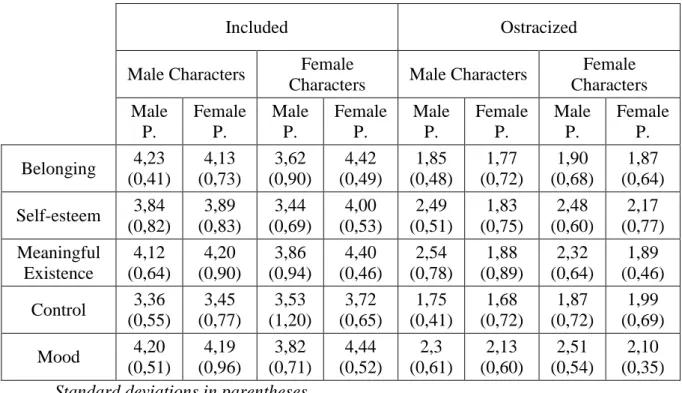
Self-reported levels of needs. All four needs composite scores (self-esteem, meaningful existence, need to belong, and control; see Table 1 for means and standard deviations) were submitted to a MANOVA by ostracism condition, characters’ sex. A statistically significant main effect of ostracism was found on all 4 needs composite scores: need to belong, F (1, 118) = 365,37, p < 0,001; partial η2 = .76; self-esteem: F (1, 118) = 150,38, p < 0,001; partial η2 = .56; meaningful existence: F (1, 118) = 223,51, p < 0,001; partial η2 = .65 and control: F (1, 115) = 160,23, p < 0,001; partial η2 = .58. Participants who read the ostracized scenarios felt lower levels of belonging (M=1,85, SE=0,08), self-esteem (M=2,24, SE=0,09), meaningful existence (M=2,16, SE=0,09) and control (M=1,82, SE=0,09) compared with participants who read the included versions: belonging (M=4,11, SE=0,09); self-esteem (M=3,79, SE=0,09), meaningful existence (M=4,15, SE=0,10) and control (M=3,52, SE=0,10).
22
Ostracism condition also interacted significantly with participant’ sex, F (1, 115) = 4,40, p < 0,01; partial η2 = .13, on two fundamental needs: self-esteem, F (1, 115) = 9,84, p < 0,05; partial η2 = 0,08 and meaningful existence F (1, 118) = 10,37, p < 0,01; partial η2 = 0,08. Regarding self-esteem, female participants’ responses were more extreme than males. Female participants who read the included scenarios (M=3,94, SE=0,11) scored higher than males (M=3,64, SE=0,15) and on ostracized scenarios males scored higher (M=2,49, SE =0,13) than females (M=2,00, SE=0,12). A similar effect happened in meaningful existence because female participants reported higher scores (M=4,30, SE =0,12) than males (M=3,99, SE =0,15) on included scenarios whereas males reported higher scores (M=2,43, SE =0,13) than females (M=1,88, SE =0,13) after reading the ostracized scenarios.
Table 1.1. Means and Standard Deviations for the Needs and Mood dependent measures in Study 1
Included Ostracized
Male Characters Female
Characters Male Characters
Female Characters Male P. Female P. Male P. Female P. Male P. Female P. Male P. Female P. Belonging 4,23 (0,41) 4,13 (0,73) 3,62 (0,90) 4,42 (0,49) 1,85 (0,48) 1,77 (0,72) 1,90 (0,68) 1,87 (0,64) Self-esteem 3,84 (0,82) 3,89 (0,83) 3,44 (0,69) 4,00 (0,53) 2,49 (0,51) 1,83 (0,75) 2,48 (0,60) 2,17 (0,77) Meaningful Existence 4,12 (0,64) 4,20 (0,90) 3,86 (0,94) 4,40 (0,46) 2,54 (0,78) 1,88 (0,89) 2,32 (0,64) 1,89 (0,46) Control 3,36 (0,55) 3,45 (0,77) 3,53 (1,20) 3,72 (0,65) 1,75 (0,41) 1,68 (0,72) 1,87 (0,72) 1,99 (0,69) Mood 4,20 (0,51) 4,19 (0,96) 3,82 (0,71) 4,44 (0,52) 2,3 (0,61) 2,13 (0,60) 2,51 (0,54) 2,10 (0,35) Standard deviations in parentheses.
Mood. The composite mood score was submitted to a three-way ANOVA by ostracism, character sex and participant sex. As expected, ostracism had a significant main effect on mood, F (1,126) = 272,90, p < 0,001; partial η2 = 0,70. Participants’ mood was more negative when they read the ostracized scenario (M=2,27, SD=0,08) than when they read the included one (M=4,16, SD=0,08).
Ostracism also interacted significantly with participants’ sex, F (1,126) = 7,23, p < 0,01; partial η2 = 0,06, again showing the same pattern found with self-esteem and meaningful
23
existence. After reading the ostracism scenario female participants scored lower (M=2,12, SD=0,11) than males (M=2,43, SD=0,11). Whereas, females who read the included scenarios reported having a more positive mood (M=4,31, SD=0,10) than males did (M=4,01, SD=0,13). This was qualified by a marginally significant 3-way interaction effect by ostracism, character sex and participant sex, F (1,126) = 3,37, p = 0,07; partial η2 = 0,03. Looking at the table, amongst participants who read the included scenarios, males felt a slightly more positive mood than females after reading the male scenarios, and females felt a more positive mood than males when they read about the female scenarios. Within ostracized scenarios, males reported a more positive mood than females regardless of the charater sex of the scenario .
To examine this 3-way interaction in a different way, we ran two 2-way ANOVAS by ostracism condition and participants’ sex: one analyzing responses from participants who read the male version scenario and the other responses from participants who read the female version. Regarding responses from those who read about the male version, only ostracism had a significant effect, F (1,118) = 141,36, p < 0,001. Ostracized participants reported a more negative mood (M=2,24, SD=0,13) than included ones (M=4,20, SD=0,14). Looking at the responses from participants who read the scenario with a female team, the same main effect by ostracism was found, F (1,118) = 131,54, p < 0,001. Again, ostracized participants reported a more negative mood (M=2,31, SD=0,10) than included participants did (M=4,13, SD=0,10). However, there was also a significant interaction between ostracism condition and participant sex, F (1,118) = 10,65, p < 0,005. It is here that we see the effect paralleling self-esteem and belonging: after reading the ostracized scenarios, female participants reported a worse mood (M=2,10, SD=0,14) than males (M=2,51, SD=0,13); whereas among participants who read the included versions, females reported a better mood (M=4,44, SD=0,11) than males did (M=3,82, SD=0,16).
A different way to examine the three way interaction is to consider the interaction of character sex and participant sex as an issue of whether they match or not (the ingroup/outgroup variable described earlier). Because of the 3-way interaction described above, we performed a different ANOVA examining the effect of ostracism condition and matching sex (ingroup vs outgroup) as independent variables on mood. There was again a main effect of ostracism, F (1,125) = 288,82, p < 0,001; partial η2 = 0,70, such that ostracized participants reported a worse mood (M=2,27, SD=0,08) than included participants (M=4,20, SD=0,08). There was also a marginally significant interaction between ostracism and matching sex, F (1,125) = 3,43, p =
24
0,07; partial η2 = 0,03. Whereas in the included scenarios ingroup participants reported a more positive mood (M=4,36, SD=0,11) than outgroup sex participants (M=4,04, SD=0,12), outgroup participants responses were very small regarding mood (M=2,31, SD=0,10) compared to ingroup participants (M=2,22, SD=0,12) in the ostracized condition.
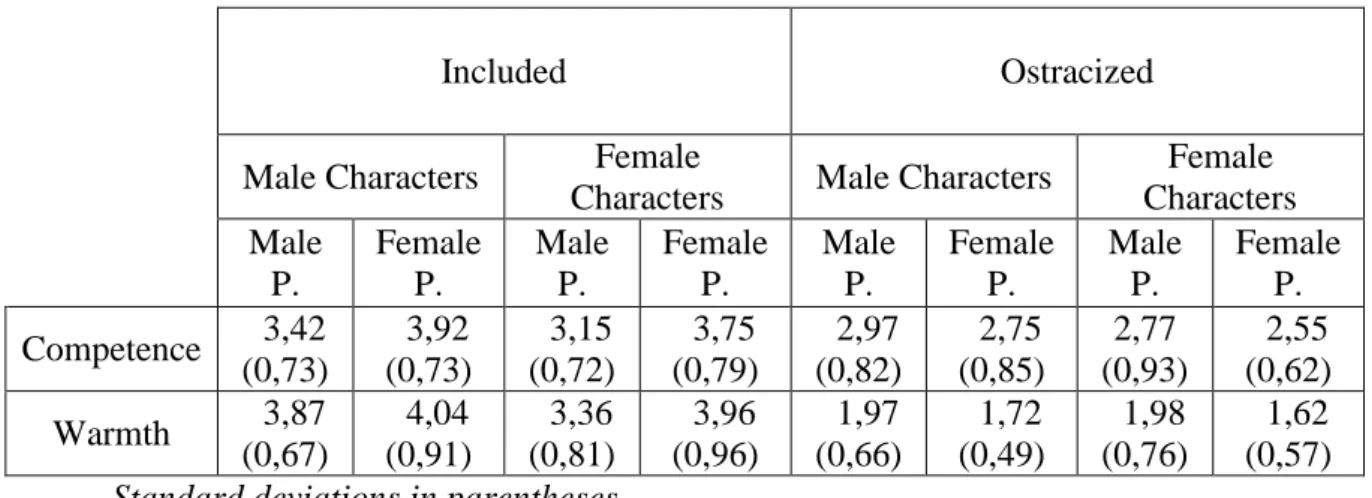
Warmth and Competence of the Team in the Scenario. A mixed ANOVA was conducted in order to test participants’ team ratings by ostracism condition, character sex condition, participant sex and dimension (warmth vs competence). There was a significant ostracism main effect, F (1,118) = 150,18, p < 0,001 partial η2 = 0,56. Ostracized participants rated the team lower across the scale (M=2,29, SE=0,08) compared to included participants (M=3,69, SE=0,08). Character sex condition had a marginal main effect on team ratings, F (1,118) = 2,99, p < 0.1 partial η2 = 0,03. Participants who read the male scenaros gave higher scores generally (M=3,09, SE=0,08) compared to participants who read the female versions (M=2,89, SE=0,08). The dimension showed a main effect, F (1,118) = 15,91, p < 0,001 partial η2 = 0,12, because scores about competence (M=3,16, SE=0,07) were higher than warmth (M=2,82, SE=0,07). Moreover, there was a significant interaction between dimension and ostracism condition, F (1,118) = 47,87, p < 0,001 partial η2 = 0,29. When included, participants rated the team as having more warmth (M=3,81, SE=0,10) than competence (M=3,56, SE=0,11). However, when ostracized participants gave lower warmth scores (M=1,82, SE=0,10) than competence scores (M=2,75, SE=0,10).
Table 1.2. Means and Standard Deviations for the Competence and Warmth dependent measures about the scenario team in Study 1.
Included Ostracized
Male Characters Female
Characters Male Characters
Female Characters Male P. Female P. Male P. Female P. Male P. Female P. Male P. Female P. Competence 3,42 (0,73) 3,92 (0,73) 3,15 (0,72) 3,75 (0,79) 2,97 (0,82) 2,75 (0,85) 2,77 (0,93) 2,55 (0,62) Warmth 3,87 (0,67) 4,04 (0,91) 3,36 (0,81) 3,96 (0,96) 1,97 (0,66) 1,72 (0,49) 1,98 (0,76) 1,62 (0,57) Standard deviations in parentheses.
Competence of Men and Women in Portugal. A mixed ANOVA was run in order to test whether participants’ ratings of competence were influenced by ostracism, character sex,
25
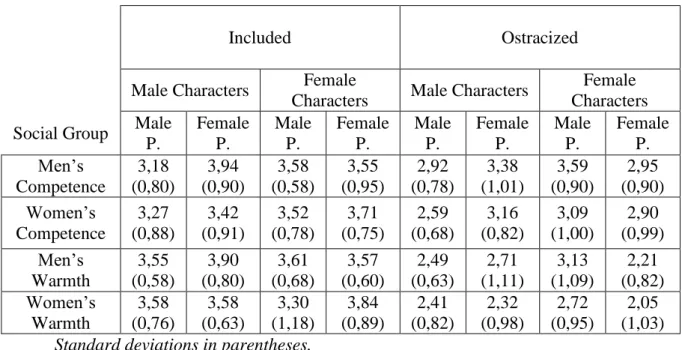
participant’ sex and social group (Men vs Women in Portugal); within subject on the last variable. The main effect on ostracism was significant, F (1,118) = 9,45, p = 0,03; partial η2 = 0,07. Ostracized participants gave lower competence scores (M=3,07, SE=0,10) than included participants did (M=3,52, SE=0,11). Another main effect was also found for social group, F (1,118) = 6,10, p = 0,15 partial η2 = 0,05. As found in previous research, competence scores were higher for Men (M=3,39, SE=0,08) than Women (M=3,10, SE=0,08). An interaction was found between the character sex condition and participant sex, F (1,118) = 5,03, p = 0,03; partial η2 = 0,04. Within participants who read the male scenarios, male participants gave lower scores (M=2,99, SE=0,16) compared to female participants (M=3,48, SE=0,13) while the opposite happened when the female scenario was read because female participants gave lower scores (M=3,28, SE=0,13) compared to males (M=3,44, SE=0,15). A significant 3-way interaction was found between social group (Men in Portugal vs Women in Portugal), character sex condition and participants’ sex, F (1,118) = 4,07, p = 0,046; partial η2 = 0,03. Female participants who read about male characters, rated Men (M=3,66, SE =0,15) and Women (M=3,29 SE =0,14) as more competent than male participants did (Men: M=3,05, SE =0,18; Women: M=2,93, SE =0,18). Additionally, when participants read about the female scenario, male participants rated Men higher (M=3,58, SE 0,17) than female participants did (M=3,25, SE =0,15); whereas ratings of Women did not differ by participant sex (female participants: M=3,31, SE =0,15; male participants: M=3,30, SE =0,16).
To better understand the significant way interaction described above, we ran two 3-way mixed ANOVAs examining the effect of ostracism, social group and participant sex on competence ratings (within subjects on social group), looking at character sex separately.
Male characters. Ostracism condition showed a significant main effect amongst participants
who read about male characters, F (1,118) = 3,51, p < 0,05. Ostracized participants rated gave lower competence ratings (across social group) (M=3,02, SE=0,14) than included participants did (M=3,45, SE=0,16). Moreover, there was a significant main effect of participants’ sex when they read a male scenario, F (1,118) = 5,42, p < 0,05. Here, female participants gave higher competence scores (M=3,48, SE=0,13) than males did (M=2,99, SD=0,62). The social group had a significant main effect on competence ratings, F (1,118) = 5,54, p = 0,01. Again replicating past research, competence was higher when participants rated Men (M=3,36, SE=0,12) compared to when they rated Women (M=3,11, SE=0,11). The main effects were qualified by a marginal interaction between the social group, ostracism condition and participants’ sex, F (1,118) = 3,06 p < .10. Rating Men, female participants gave higher
26
competence ratings when included (M=3,94, SE=0,23) and ostracized (M=3,38, SE=0,20) compared to males (included: M=3,18, SE=0,27; ostracized: (M=2,92, SE=0,25). Same effect happened when rating Women because females also scored higher when included (M=3,42, SE=0,21) and ostracized (M=3,12, SE=0,19) compared to males (included: M=3,27, SE=0,25; ostracized: (M=2,59, SE=0,23).
Female characters. Regarding participants who read about female scenarios, stracism
had a significant effect on competence, F (1,118) = 4,16, p < 0,05. Ostracized participants rated lower (M=3,14, SD=0,14) compared to included participants (M=3,59, SE=0,14). There was also a marginal social group X participants’ sex interaction, F (1,118) = 2,80, p < 0,10. Here, male participants rated Men higher (M=3,58, SE=0,17) than female participants did (M=3,25, SE=0,15) but, when rating Women, ratings did not differ (female participants: M=3,31, SE=0,15; male participants: M=3,30, SE=0,17).
Competence was also submitted to a mixed model ANOVA by ostracism, matching sex and social group because there was previously an interaction between characters sex condition and participant sex. There was a main effect of ostracism, F (1,122) = 11,90, p < 0,001; partial η2 = 0,09. Ostracized participants scored lower (M=3,08, SE=0,10) compared to included participants (M=3,57, SE=0,10). Regarding matching sex, participants who read about ingroup members gave lower competence scores overall (M=3,17, SE=0,10) compared to participants who read about outgroup members (M=3,46, SE=0,10), F (1,122) = 4,32, p = 0,40, partial η2 = 0,03. Finally the main effect of social group showed that Men were rated higher about competence (M=3,41, SE=0,08) than Women (M=3,23, SE=0,07, F (1,122) = 6,66, p = 0,011; partial η2 = 0,05. The main effects of matching sex and social group were qualified by a significant interaction between them, F (1,122) = 5,03, p = 0,023, partial η2 = 0,04. Ingroup participants rated Men (M=3,19, SE=0,12) and Women (M=3,16, SE=0,11) as more or less equally competent, whereas outgroup participants rated Men as more competent (M=3,64, SE=0,11) than Women (M=3,29, SE=0,11).
27
Table 1.3. Means and Standard Deviations for the Competence and Warmth Perceptions of Men and Women in Portuguese dependent measures, Study 1
Included Ostracized
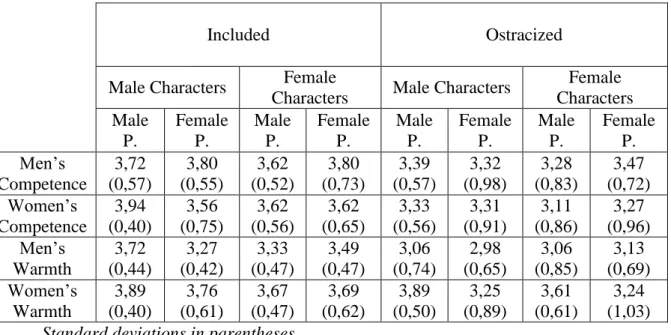
Male Characters Female
Characters Male Characters
Female Characters Social Group Male
P. Female P. Male P. Female P. Male P. Female P. Male P. Female P. Men’s Competence 3,18 (0,80) 3,94 (0,90) 3,58 (0,58) 3,55 (0,95) 2,92 (0,78) 3,38 (1,01) 3,59 (0,90) 2,95 (0,90) Women’s Competence 3,27 (0,88) 3,42 (0,91) 3,52 (0,78) 3,71 (0,75) 2,59 (0,68) 3,16 (0,82) 3,09 (1,00) 2,90 (0,99) Men’s Warmth 3,55 (0,58) 3,90 (0,80) 3,61 (0,68) 3,57 (0,60) 2,49 (0,63) 2,71 (1,11) 3,13 (1,09) 2,21 (0,82) Women’s Warmth 3,58 (0,76) 3,58 (0,63) 3,30 (1,18) 3,84 (0,89) 2,41 (0,82) 2,32 (0,98) 2,72 (0,95) 2,05 (1,03) Standard deviations in parentheses.
Warmth of Men and Women in Portugal. A mixed model ANOVA was run in order to test whether participants’ ratings of competence were influenced by ostracism, character sex, participant’ sex and social group (Men vs Women in Portugal); within subject on the last variable. The overall model was significant and main effect on ostracism was found, F (1,118) = 9,45, p = 0,03; partial η2 = 0,07. Ostracized participants scores lower (M=3,07, SE=0,10) compared to included ones (M=3,52, SE=0,11). Another main effect was also found and it was the scale, F (1,118) = 6,10, p = 0,15 partial η2 = 0,05. Competence scores were higher about Men (M=3,39, SE=0,08) than to competence (M=3,10, SE=0,08). An interaction was found between the character sex condition and participant sex, F (1,118) = 5,03, p = 0,03; partial η2 = 0,04. Within participants who read the male scenarios, male participants scored lower (M=2,99, SE=0,16) compared to female participants (M=3,48, SE=0,13) while the opposite happened when the female scenario was read because females scored lower this time (M=3,28, SE=0,13) compared to males (M=3,44, SE=0,15). A significant 3-way interaction was found between social group (Men in Portugal vs Women in Portugal), character sex condition and participants’ sex, F (1,118) = 4,07, p = 0,046; partial η2 = 0,03. Female participants who read about male characters, rated Men (M=3,66, SE =0,15) and Women (M=3,29 SE =0,14) as more competent than male participants did (Men: M=3,05, SE =0,18; Women: M=2,93, SE =0,18). Additionally, when participants read about the female scenario, male participants rated Men higher (M=3,58, SE 0,17) than female participants did (M=3,25, SE =0,15); whereas ratings of
28
Women did not differ by participant sex (female participants: M=3,31, SE =0,15; male participants: M=3,30, SE =0,16).
In order to better understand the significant 3-way interaction, two 3-way mixed ANOVAs examining the effect of ostracism, social group and participant sex on warmth ratings (within subjects on social group), splitting the dataset by character sex condition.
Male characters. There was a marginal main effect by social group variable on the
ratings, F (1,118) = 3,23, p < 0,01, on participants who read about male scenarios. Here, warmth scores about Men were higher (M=3,16, SE=0,11) than Women ones (M=2,97, SE=0,11). A main affect was found on ostracism as well, F (1,118) = 29,74, p < 0,001, and ostracized participants rated lower (M=2,48, SE=0,13) compared to included ones (M=3,65, SE=0,14).
Female characters. There was a significant main interaction on ostracism condition
was found, F (1,118) = 27,69, p < 0,001. Ostracized participants reported lower (M=2,53, SE=0,15) compared to included ones (M=3,58, SE=0,15). An interaction by social group and participants’ sex was found, F (1,118) = 4,03, p < 0,05. When rating about Men, male participants rated higher scores (M=3,37, SE=0,16) compared to female participants (M=2,89, SE=0,14). There was almost no difference – although if anything the tendency is the same – when rating about Women since males scored (M=3,01, SE=0,19) and females (M=2,94, SE=0,17). Additionally, there was also a significant interaction between ostracism condition and participants’ sex, F (1,118) = 6,83, p < 0,05. When included, female participants reported higher values across social group (M=3,70, SE=0,17) compared to males (M=3,46, SE=0,25). However, when ostracized, female participants scored lower (M=2,13 SE=0,22) compared to males (M=2,93, SE=0,19).
Because of the significant 3-way interaction including character sex and participant sex, we submitted warmth to a mixed ANOVA by ostracism, matching sex, and social group. The main effect of ostracism condition was significant, F (1,122) = 65,58, p < 0,001; partial η2 = 0,35. Ostracized participants reported less levels of warm (M=2,50, SD=0,10) compared to the included participants (M=3,64, SD=0,10). Social group main effect was also significant, F (1,122) = 5,08, p = 0,026; partial η2 = 0,04. Warmth scores about Men were higher (M=3,15, SE=0,08) than the ones about Women (M=3,00, SD=0,18). The interaction between social group and matching sex was significant, F (1,122) = 7,65, p < 0,007; partial η2 = 0,06. Ingroup
29
participants rated Men (M=2,95, SE=0,11) and Women (M=2,99, SE=0,12) as more or less equally warm, whereas outgroup participants rated Men as warmer (M=3,35, SE=0,11) than Women (M=2,99, SE=0,12).
Discussion
Findings in study one show, as hypothesized, that imagining someone being ostracized is enough to provoke negative psychological consequences (worse levels of belonging; self-esteem; meaningful existence; control and mood) compared to imagining that same someone being included in the same scenario. However, that effect was not influenced by manipulating the ostracism’ source to be a social group rated high on competence and low on warmth – Men – versus one rated low on competence and high on warmth – Women, as we thought it might have been. Characters’ sex condition did not affect the fundamental needs, rather we found that ostracism has an extremely strong effect regardless of its source (Williams, 2007).
Participants who read and imagined themselves in a scenario about someone being ostracized, rated the team that ostracized the target lower in terms of both competence and warmth compared to those who read a scenario about someone who was included by the team, although the effect was stronger on the warmth dimension. The reason for this may be explained by (1) the strong impact ostracism has on how people perceive their ostracizers, for instance, considering them less human (Bastian and Haslam, 2010). The importance of warmth could stem from the primacy of warmth over competence (Fiske et al., 2008). However, it could also be that ostracism is an act of coldness toward a person, not so closely related to competence.
Interestingly, participants’ sex interacted with several other variables, as did whether the participant’s sex matched the sex of the characters described in the scenario (matching sex). First, ostracized female participants were more extreme on self-esteem; meaningful existence and mood responses compared to males. In spite of the vast research about ostracism, we find no similar findings in the literature. However, it may explain why Williams and Sommer (1997) reports that female participants were more prosocial after being ostracized. Moreover, Lustenberger and Jagacinski (2010) also found an ostracism X participants’ sex interaction in one of their studies such that females performed poorly in a word search task compared to males. However, they did not measured fundamental needs. Second, participants’ sex interacted with characters’ sex on each of the social dimensions (competence and warmth). There was a tendency for participants to rate Men higher on both dimensions when they were the opposite sex (outgroup) from the characters (main character and team) than when they were the same sex as the characters; whereas there were no differences in ratings of Women depending on
30
participant sex and character sex (matching sex variable did not influence ratings of Women on either warmth or competence). Third, ingroup participants’ reports of their mood were more extreme (higher when included and lower when ostracized) compared to outgroup participants (althought this time the difference was lower). This suggests that mood was more affected when one was being ostracized by an ingroup member. Fourth, while ingroup participants perceived Men and Women social groups as equally warm and competent, outgroup members always rated Men as warmer and more competent than Women.
Because we had several effects with participant sex and matching sex variables that surprised us, we suggest a second study with a stronger manipulation of ostracism to see if such findings are replicated. The same principle applies to the manipulation of the source of ostracism as we did here (Men – high on competence and low on warmth - vs Women – low on competence and high on warmth).
31
CHAPTER III - Study 2
The purpose of Study 2 was to test the same questions addressed in Study 1 – regarding whether character sex can influence responses to ostracism, and furthermore to examine whether participant sex, and the interaction of character sex and participant sex influence these responses when the study is performed in the laboratory with a widely used paradigm in which the participant is actually ostracized: Cyberball. In addition, Study 2 measured memory (Who Said What task) for male and female character (speakers) after the ostracism (or inclusion) experience in order to examine a more subtle possible effect of specific characteristics of the ostracizer.
Cyberball, as said before, differs from the scenarios used in Study 1 not only in terms of the participant being ostracized himself/herself but also that the experience of being ostracized does not have any specific contextual information, as opposed to the scenario. Moreover, in Cyberball, participants are not imagining something that happened in the past to someone (as in Study 1) but will actually experience for a few minutes being left out from an activity without any explanation.
Even though ostracism have been provoking decreases in cognitive functions and performancethere is also research reporting that sometimes in enhances sensitivity for social information (Jamieson, Harkings & Williams; 2010) including memorizing better social information when belonging need is threatened (Gardner, Picket & Brewer; 2000). As such, we developted this task to see if there is any relation between the sex of the ostracizers and the sensitity towards that sex group (male vs female) compared to the opposite sex group in the number of the errors made, and that because WSW allows allows categorization for both.
We expect to replicate the usual results from ostracism studies cited below and Study 1, which are the following:
H1: Participants who are assigned to one of the ostracized conditions will have more negative scores on fundamental needs compared with the included conditions.
H2: Participants who are assigned to one of the ostracized conditions will also have lower levels of mood compared with included conditions.
Our hypothesis regarding women and men conditions are the same as Study 1:
H3: Participants in women conditions will have more negative scores on fundamental needs compared with men conditions.
32
H4: Participants in women conditions will have more negative scores on mood compared with men conditions.
We hope to replicate the follow usual finding in the WSW memory task:
H6: Participants will make more within sex errors (mistaking the sentence said by a male for other male, for example) than between sex errors (mistaken a sentence said by male for a female, for example).
We also add our novel hypothesis:
H7: Participants in the ostracized conditions will make fewer errors in the memory task compared to those in the included conditions.
H6a: If the previous hypothesis is corroborated, ostracized participants will make fewer errors about the characters (speakers) in WSW who share the same sex as the ostracizer (an participant ostracized by female characters in Cyberball will make fewer errors about female characters in WSW than male characters).
Design
This study involved a 2 (Ostracism condition: ostracized or included) x 2 (character sex: male or female) between subjects experimental design. The conditions were whether the participants were included or ostracized in a virtual game by either male or female characters.
Participants
Ninety-four participants either volunteered to receive course credit (N=43) or be entered into a lottery to receive 5 vouchers worth 5€ each, totally 25€ (N=43). From the 94 initial participants responses 6 of them were excluded: five because of technical problems and two for guessing the purpose of the study during the debriefing. An additional participant was removed because Portuguese was not his/her native language. Statistical analyses were performed using a final sample of 86 participants (61 females; 25 males) whose ages ranged from 18 to 52 (M=23,63; SD=6,74). Forty-nine participants were undergraduates, 25 already had a university degree, 11 had a high school degree only and one had a middle school education only. The number of participants per condition was the following: 21 were included by male characters; 22 included by female characters; 22 ostracized by male characters and 21 ostracized by female characters.
33
Instruments and Materials
Cyberball. We used the Cyberball virtual ball toss game (version 40,0, Williams et al., 2012), adapted to Qualtrics. The game allows participants to ostensibly play a ball toss game virtually with other players on a computer. The other players are, however, generated by the game itself. The game shows three simple line drawings of ball-tossers on a white background. One that is in the middle and lower on the screen represents the participant. The other two appear on each side of the screen half way up with their names below the drawings. One player starts with the ball and an animation of the line drawing shows the figure moving when throwing the ball. Participants can only participate when the ball is thrown to them. In order to toss the ball after receiving it, participants click on the drawing of the player they wish to throw the ball to. Each participant played one game that consisted of thirty throws in total. Ostracism was manipulated by the number of times the ball was thrown to the actual participant by either of the other two players. The ball was thrown to all participants two times at the beginning of the game. Participants in the ostracism condition did not have the ball thrown to them again for the rest of the game. Participants in the inclusion condition received one third of the total throws (10 out of 30). This ostracism manipulation has been used successfully a large number of times (Hartgerink et al., 2015). The gender of the ostensible other players was manipulated (fully crossed with the ostracism manipulation) by the names given to them, either male – Nuno and Rui - or female – Ana and Sara – (very typical Portuguese names).
Self-reported levels of needs. The items, instructions and procedures concerning the four fundamental needs - belonging; self-esteem; meaningful existence and control - where the same as those used in Study one, except that the instructions asked participants how they felt during the game. As in Study one, each fundamental need item showed high internal consistency (belonging, α= .87; self-esteem, α=.86; meaningful existence, α=.92 and control, α=.82) and composite scores were created for each of them.
Mood. Mood items used were the same as those in Study one and the instructions and procedures were the same as in self-reported level of needs in this Study (Study 2). A composite score was created because all the items had high internal consistency (α=.93).
Who Said What. Who Said What task used here was adapted from Taylor et al. (1978). This task consisted on two different stages. First, participants were asked to pay attention and memorize sentences associated with a character (picture of a face and a name). Each trial consisted of one of six different face/name pairs displayed on the screen with a sentence they ostensibly said, for four seconds. There were 24 sentences created by the research team about