ADAPTIVE CASE MANAGEMENT IN PRACTICE (CASOS DE USO ADAPTATIVOS NA PRÁTICA)
II
UNIVERSIDADE DE BRASÍLIA
FACULDADE DE TECNOLOGIA
DEPARTAMENTO DE ENGENHARIA ELÉTRICA
ADAPTIVE CASE MANAGEMENT IN PRACTICE
(CASOS DE USO ADAPTATIVOS NA PRÁTICA)
JÜRGEN KRESS
ORIENTADOR: RICARDO STACIARINI PUTTINI
DISSERTAÇÃO DE MESTRADO EM ENGENHARIA ELÉTRICA
PUBLICAÇÃO: PPGENE.DM632/2016
BRASÍLIA, DF, 07 de julho de 2016
IV FICHA CATALOGRÁFICA
KRESS, JÜRGEN MARCUS
Adaptive Case Management in Practice [Distrito Federal] 2016.
632, 77p., 210 x 297 mm (ENE/FT/UnB, Mestre, Engenharia Elétrica, 2016). Dissertação de Mestrado – Universidade de Brasília. Faculdade de Tecnologia. Departamento de Engenharia Elétrica.
1. Adaptive Case Management Methodology 2. Software Engineering Methodology 3. Case Management Modeling Notation (CMMN) 4. Knowledge Work I. ENE/FT/UnB II. Título (série)
REFERÊNCIA BIBLIOGRÁFICA
KRESS, J. M. (2016). Adaptive Case Management in Practice. Dissertação de Mestrado em Engenharia Elétrica, Publicação PPPGEE.DM-632/2016, Departamento de Engenharia Elétrica, Universidade de Brasília, Brasília, DF, 77p.
CESSÃO DE DIREITOS AUTOR: Jürgen Marcus Kress.
TÍTULO: Adaptive Case Management in Practice. GRAU: Mestre ANO: 2016
É concedida à Universidade de Brasília permissão para reproduzir cópias desta dissertação de mestrado e para emprestar ou vender tais cópias somente para propósitos acadêmicos e científicos. O autor reserva outros direitos de publicação e nenhuma parte dessa dissertação de mestrado pode ser reproduzida sem autorização por escrito do autor.
____________________________ Jürgen Marcus Kress
SQN 109 Bloco M apto 604 - Asa Norte Brasília - DF – Brazil - 70752-130
V
Thanks to
The professor and friend Ricardo Puttini for guidance, support of this dissertation and for attending my conferences and workshops.
Gabi the love of my live & Bandit the cloud expert.
Danilo Schmiedel for flying jointly around the world – I remember the discussion in the LH A 340-600 hallway and finding the time to run multiple joint ACM workshops. Excellent contribution to the ACM Methodology by validating customer projects and solving bugs.
Ralf Müller for taking the time to run the ACM workshop with us, lighten my view on the Business Motivation Model and being always available for discussions.
Leon Smiers & Robert Wunderlich & Clemens Utschig-Utschig for continues feedback & discussions.
VI
Abstract
This dissertation aims at developing and validating a new software engineering methodology for Adaptive Case Management (ACM). ACM is a relatively new design pattern used to support work that is well suited for work scenarios where a precise workflow cannot be strictly defined. In such scenarios, work is highly dependent on knowledge-based decisions about activities and outcomes, leading to multiple work paths and business rules that can become quite complex or even unfeasible to model and completely automate.
Concepts and research on Adaptive Case Management, also reviewed in this work, are still evolving and maturing. Current ACM state-of-art lacks of formally described and proven methodology for development of ACM solutions. The goal of this work is to contribute with fulfilling this gap.
The proposed ACM Methodology is based on the five phases, which covers typical software engineering disciplines: Business Modeling, Visualization, Analysis, Design and Implementation. New software artifact models for ACM user interfaces (ACM Workspace) and ACM solution analysis and design (ACM Canvas) are also among the contributions of this work. ACM design leverages the recently established Case Management Modeling Notation (CMMN v1.1). Templates of software artifacts, developed for each methodology phase, are also presented. These support a guided outcome and ensure projects progress and success.
The methodology was developed over the past two years from work and analysis of actual ACM projects in different industries. In this dissertation, a Case Study is completely described and implemented, as a proof-of-concept for the proposed methodology.
VII
Resumo
Esta dissertação tem como objetivo desenvolver e validar uma nova metodologia de engenharia de software para Gerenciamento de Casos Adaptativos (ACM). ACM é um padrão de projeto (design pattern), relativamente novo, utilizado para apoiar, de forma mais adequada, cenários de trabalho em que um fluxo de trabalho preciso não pode ser definido de maneira rigorosa. Em tais cenários, o trabalho é altamente dependente de decisões baseadas no conhecimento sobre as atividades e resultados, levando a várias regras de negócio e possibilidades de fluxo de atividades que podem tornar a modelagem e a automatização bastante complexas ou, até mesmo, inviável.
Conceitos e pesquisas sobre Gerenciamento de Casos Adaptativos, também apresentados neste trabalho, ainda estão evoluindo e amadurecendo. O estado-da-arte atual em ACM carece de metodologia descrita formalmente e comprovada para o desenvolvimento de soluções ACM. O objetivo deste trabalho é contribuir para o preenchimento dessa lacuna.
A proposta de metodologia ACM é baseada em cinco fases, que abrange as seguintes disciplinas típicas de engenharia de software: Modelagem de Negócio, Visualização, Análise, Projeto e Implementação. Novos modelos de artefatos de software para interfaces de usuário ACM (ACM Workspace) e análise e projeto de solução ACM (ACM Canvas) também estão entre as contribuições deste trabalho. O projeto em ACM utiliza a recentemente criada Notação para Modelagem de Gerenciamento de Casos Adaptativos (Case Management Modeling Notation - CMMN). Modelos para artefatos de software, desenvolvidos para cada fase metodologia, também são apresentados. Tudo isso suporta um resultado orientado e garante o progresso e sucesso de projetos.
Essa metodologia foi desenvolvida ao longo dos últimos dois anos de trabalho e análise de projetos ACM reais em diferentes indústrias. Nesta dissertação, um estudo de caso completo é descrito e implementado, como uma prova de conceito para a metodologia proposta.
VIII
SUMMARY
Index of Tables ... x Index of Figures ... xi Acronyms ... xiii 1. Introduction ... 1 1.1 Motivation ... 2 1.2 Objectives ... 3 1.3 Methodology ... 41.4 Limitations and Restrictions ... 4
1.5 Organization of Work ... 5
2. Adaptive Case Management Concepts & Research Status ... 6
2.1 Adaptive Case Management Concepts ... 7
2.1.1 Knowledge Worker ... 7
2.1.2 Case ... 10
2.1.3 Adaptive Case Management... 10
2.2 Business Process Management and Adaptive Case Management ... 13
2.3 Industry Examples Adaptive Case Management ... 15
2.4 ACM Adaptivity Levels ... 18
2.5 Research Status of Adaptive Case Management Methodology ... 20
3. Case Management Model and Notation ... 25
3.1 CMMN Concepts ... 25
3.2 CMMN Elements ... 25
4. Adaptive Case Management Methodology ... 30
4.1 Overview Adaptive Case Management Methodology ... 30
4.2 Business Modeling ... 32
IX
4.2.2 Organization Operative Model ... 33
4.2.3 Information Model ... 34 4.3 Visualization ... 35 4.4 Analysis ... 37 4.5 Design ... 39 4.5.1 CMMN Model ... 39 4.5.2 CMMN Stakeholder Model ... 39 4.5.3 CMMN Rules Model ... 40 4.6 Implementation ... 41 4.6.1 Work Review... 41 4.6.2 Implementation Spreadsheet ... 41 5. Validation ... 45 5.1 Case Study ... 45
5.2 Using the ACM Methodology ... 46
5.2.1 Business Modeling ... 46 5.2.2 Visualization... 49 5.2.3 Analysis ... 50 5.2.4 Design... 51 5.2.5 Implementation... 61 5.3 Proof-of-Concept Implementation ... 67 6. Analysis ... 70 7. Conclusions ... 73 References ... 74
X
INDEX OF TABLES
Table 1-1 Phases in Research Realization ... 4
Table 2-1 Types of Workers and Work Characteristics ... 7
Table 2-2 Business Process Management versus Adaptive Case Management ... 14
Table 2-3 Industry Examples ACM ... 15
Table 2-4 Overview of adaptivity levels, building blocks and examples ... 19
Table 2-5 Summary of case management design components ... 24
Table 3-1 CMMN Elements and Notations ... 26
Table 4-1 ACM Methodology Phases ... 31
Table 4-2 Data Categories within ACM ... 34
Table 4-3 ACM Workspace Templates ... 37
Table 4-4 Activity Conditions Types ... 43
Table 5-1 Stakeholders and responsibilities at Organization Operative Model ... 48
Table 5-2 Case Stages and Milestones ... 50
Table 5-3 Stakeholder at the claim regulation case ... 60
Table 5-4 HumanTasks and UserEventsListeners at the claim regulation case ... 60
Table 5-5 Control Rules in claim regulation case ... 61
Table 5-6 Stages, Roles and Events... 62
Table 5-7 General Activity Information ... 63
Table 5-8 Activity Data ... 64
Table 5-9 Activity Conditions ... 64
Table 5-10 Behavior ... 65
Table 5-11 Implementation ... 66
Table 5-12 Stakeholders ... 66
XI
INDEX OF FIGURES
Figure 2-1 The Forrester Wave™: Dynamic Case Management Q1 2014 ... 6
Figure 2-2 Spectrum of Work ... 9
Figure 2-3 Percentage of the day spent in different modes ... 9
Figure 2-4 ACM Building Blocks ... 12
Figure 2-5 Organization of a BPM System and an ACM System ... 14
Figure 2-6 Three case management categories will emerge... 16
Figure 2-7 Sample Case-Based Processes ... 17
Figure 2-8 Seven key components of a case management methodology ... 21
Figure 2-9 Case Management design categories and components ... 23
Figure 3-1 Decorators Applicability Summary Table ... 29
Figure 4-1 Overview of ACM Methodology Artifacts ... 31
Figure 4-2 BMM Overview ... 33
Figure 4-3 Empowering knowledge Workers ... 35
Figure 4-4 ACM Canvas template ... 38
Figure 5-1 BMM for insurance claim management ... 47
Figure 5-2 Information Model claim regulation ... 49
Figure 5-3 ACM Workspace claim regulation ... 49
Figure 5-4 ACM Canvas for claim regulation ... 51
Figure 5-5 Claim File ... 51
Figure 5-6 Process task Identify responsible knowledge worker ... 52
Figure 5-7 Milestone Responsibilities identified ... 53
Figure 5-8 Stage Identify Responsibilities ... 53
Figure 5-9 Human task Change Responsibilities ... 54
Figure 5-10 Stage Attache Base Information ... 55
Figure 5-11 Process task Request Missing Documents ... 56
Figure 5-12 Event New Document received ... 57
Figure 5-13 CMMN Model for claim regulation... 58
Figure 5-14 Decision logic rule in claim regulation case ... 60
Figure 5-15 Validation CMMN Model against ACM Workspace ... 62
Figure 5-16 ACM Workspace Case Study Implementation ... 68
XII
Figure 5-18 SCA Elements linked to ACM Workspace... 69 Figure 5-19 Case Management in JDeveloper with Milestones and Outcomes ... 69 Figure 5-20 Case Management in JDeveloper with activities ... 69
XIII
ACRONYMS
ACM Adaptive Case Management
BMM Business Motivation Model
BPM Business Process Management
BPMN Business Process Modeling Notation
CDM Collaborative Decision Making
CMMN Case Management Model and Notation
CORA Common Reference Architecture
DMN Decision Model and Notation
IDE Integrated Development Environment
IT Information Technology
KPI Key Performance Indicator
OACM Ontology based Adaptive Case Management
OMG Object Management Group
SOA Service Oriented Architecture
SWOT Strength Weakness Opportunities Threats
UI User Interface
UML Unified Modeling Language
1
1. INTRODUCTION
Business Process Management (BPM) based solutions have brought major advances to work organizations and automation. However, given BPM’s strong basis on formal workflow definition, oftentimes BPM solutions are not well suited for work scenarios where a precise workflow cannot be strictly defined. In such scenarios, work is highly dependent on knowledge-based decisions about activities and outcomes, leading to multiple work paths and business rules that can become quite complex or even unfeasible to model and completely automate. In these cases, a different technology support approach is required. The focus is not to isolate and automate decisions and rules, but rather to deliver opportunistic information support to the knowledge worker to accomplish them. Adaptive Case Management (ACM) rises as a successful design pattern for this.
The BPM design-pattern is well-understood and supporting technologies are maturing. Such approaches have been under consideration and development for decades. While established and proven methodologies for developing BPM-based automations exist, ACM design pattern and technologies are still evolving. Industry practices for ACM are not yet consistently established and mature. The main goal of this dissertation is to fill in these gaps and to provide a practice-proven and systematic approach for developing ACM-based solutions.
A software development methodology refers to the framework and disciplines that are used to structure, plan, and control the process of developing an information system (CMS, 2005). The ACM methodology described here covers typical software engineering disciplines: business modeling, analysis, design and implementation. This approach provides well-understood separation of interest criteria, which aims at making it easier for business analysts and software architects to understand and incorporate ACM design practices into their current professional skills. Additionally, specialized business models and software artifacts required for the successful realization of ACM design pattern are presented and developed in details.
Examples of initial approaches for ACM methodologies include the “The 7 Key Components for an Effective Case Management Methodology” (Wanless, 2010), Dana Khoyi’s chapter, “Building the Solution with ACM” within the book Mastering the Unpredictable (Swenson, et al., 2010), and the “Case Management Solution Framework” part of Oracle Case Management Solutions by Leon Smiers (Smiers, Koster, Deb, & Palvankar, 2015). Available
2
methodologies for ACM systems represent a good start considering the maturity of the adaptive case management concept. These would evolve and mature over time, based on research and project experience.
Object Management Group (OMG) recently introduces the Case Management Model and Notation 1.1 (CMMN) (Babich, et al., Case Management Model and Notation (CMMN), 2013). CMMN has a similar impact to ACM like the Business Process Modeling Notation (BPMN) for BPM. This dissertation takes current ACM Methodologies a step further, by showing how to use CMMN as part of a practice-based ACM methodology and throughout the whole lifecycle of an ACM solution.
The ACM methodology presented at this work was developed and refined over the past two years during execution of actual ACM projects in different customers and industry scenarios. Therefore, it brings together practical experience and real use of existing ACM software platforms.
1.1 MOTIVATION
In the last 10 years Information Technology progress quickly from Service Oriented Architectures and Business Process Management towards new architectures like Adaptive Case Management. With the publications by Thomas Erl including SOA Design Patterns (Erl T. , SOA Design Patterns, 2009), SOA Governance (Erl , et al., 2011), Next Generation SOA (Erl, et al., 2014), a SOA Methodology and international standards like BPEL and WLSDL, Service Oriented Architectures became mature. The same is valid for Business Process Management. BPMN2.0 was defined as a standard and books and methodologies like Enterprise BPM Method and Style (Silver, Bpmn Method and Style with Bpmn Implementer's Guide, 2011) or Enterprise BPM (Slama & Nelius, Enterprise BPM, 2011) have been published. For both architectures countless customer projects have been realized. Compared to Service Oriented Architecture and Business Process Management, Adaptive Case Management is a young architecture paradigm. With the publication of CMMN 1.1 the standard is evolving, first projects are realized, knowledge is published in various books like Mastering the Unpredictable (Swenson, et al., 2010), How Knowledge Workers Get Things Done (Swenson K. D., Palmer , Pucher, Webster, & Manuel, 2012). For further maturity an ACM Methodology, making use of the CMMN notation, is the next milestone. With this dissertation this milestone is achieved. With the Adaptive Case Management Methodology
3
chapter in the book, Best Practice to Support Knowledge Workers, this knowledge is contributed to the community.
1.2 OBJECTIVES
The main objective of this dissertation is the development and validation of an Adaptive Case Management Methodology. This objective is further detailed in four specific goals: Development of an ACM Methodology encompassing characteristic software engineering disciplines of Business Modeling, Analysis, Design and Implementation.
Development of software development artifacts specially designed to cover the specificities of ACM, including the usage of the recently established Case Management Modeling Notation (CMMN).
Visualization development of appropriate user interface (workspace).
Validation of the ACM Methodology with a proof-of-concept implementation based on a customer project.
The work presented in this dissertation resulted in five publications over the past two years: Created a CMMN Poster published at www.acmcommunity.com (Kress, et al., 2014) Contributed a CMMN Model to the CMMN Notation published in CMMN 1.1 by OMG (Babich, et al., Case Management Model and Notation (CMMN), 2014).
Developed an ACM-Proof of-Concept which validates the ACM Methodology.
Author of the ACM book “Thriving on Adaptability: Best Practices for Knowledge Workers” (Swenson, et al., 2015)published by Keith Swenson leading industry ACM expert. Published an ACM Methodology in the book “Best Practices for Knowledge Workers” (Swenson K. D., et al., 2016) by the adoption and extension of the characteristic phases.
Expected benefits
Guided approach to successfully capture and meet requirements from knowledge workers and bridge them to technical requirements of the ACM development team. Build work packages to scale and distribute the tasks within the ACM development
team.
Ensure successful ACM implementation with a clear five phase based model for Business Modeling, Visualization, Analysis, Design and Implementation.
Support the knowledge worker with a specially designed user interface, called ACM Workspace.
4 1.3 METHODOLOGY
This dissertation describes an applied research, with a qualitative and descriptive approach to the problem (Shields & Rangarajan, 2013). This is an exploratory research, whose main purpose is to develop, clarify and modify concepts and ideas, with a view to formulating an Adaptive Case Methodology. This exploratory research involves bibliographical review, application of software engineering practices and techniques, and a Case Study.
This type of research is carried out especially when the chosen subject is underexplored and a new approach is identified. The result of this research is a systematic approach for Adaptive Case Management projects.
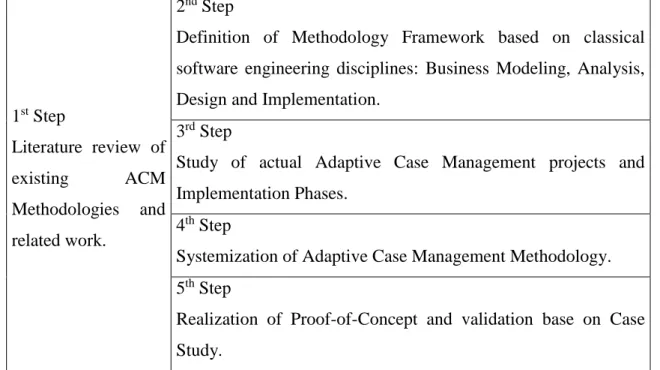
The body of knowledge that gives basis for the design of the proposed solution model in this study was developed in five steps, summarized in Table 1-1.
Table 1-1 Phases in Research Realization
1st Step Literature review of existing ACM Methodologies and related work. 2nd Step
Definition of Methodology Framework based on classical software engineering disciplines: Business Modeling, Analysis, Design and Implementation.
3rd Step
Study of actual Adaptive Case Management projects and Implementation Phases.
4th Step
Systemization of Adaptive Case Management Methodology. 5th Step
Realization of Proof-of-Concept and validation base on Case Study.
1.4 LIMITATIONS AND RESTRICTIONS
For the development of the methodology, a qualitative research approach was used. This option was necessary because the study aimed at developing a new approach for Adaptive Case Management projects. This method has its limitation though adequate:
5
Excellence of the individual ACM Methodology phases might be increased, as the focus is on the adoption and combination of existing techniques.
The methodology was developed in a waterfall approach, due to the relatively young age of the Adaptive Case Management concept. The characteristics of an ACM project might favor a more agile approach, which is appropriate for future research. In a first step the Business Modeling, Visualization and Analysis phases can be leveraged in an agile fashion. Followed by an agile approach for the Design and Implementation phases, executed by each identified activities.
The methodology was proven in two successful customer ACM projects, by industry experts and a proof-of-concept. Validation and experimental data is limited to a reduced number of work. This is due to the complexity of developing end-to-end execution of the proposed methodology. As an academic research this study validation was limited to two customer examples developed over the last two years. The publication of the methodology and further customer projects from various industries will continue to improve and reinforce the methodology.
1.5 ORGANIZATION OF WORK
This dissertation is organized in five chapters. After this introduction as followed:
Chapter 2 explains the concepts and their theoretical foundation of Adaptive Case Management. Followed by the research status of the existing ACM Methodologies.
Chapter 3 explains the concepts and elements of the Case Management Modeling Notation. Chapter 4 explains the Adaptive Case Management Methodology detailed by five phases: Business Modeling, Visualization, Analysis, Design and Implementation.
Chapter 5 explains the validation of the Adaptive Case Management Methodology by a detailed Case Study to describe the methodology in a practical example. This Case Study was fully implemented, based on the described Adaptive Case Methodology, by a Proof-of-Concept.
Chapter 6 highlight the strengths of weakness of the Adaptive Case Management Methodology.
6
2. ADAPTIVE CASE MANAGEMENT CONCEPTS & RESEARCH
STATUS
Industrial revolution has changed the economies in the last 100 years massively. From hand made products via mass production to a service oriented industry. Industry production is outsourced to cheap wage countries like China or automated. Value creation of today’s successful societies more and more relies on knowledge. “The most valuable assets of the 20th-century company were its production equipment. The most valuable asset of a 21st -century institution, whether business or non-business, will be its knowledge worker and their productivity” (Drucker, 2001). The amount of data and information is exploding. At the same time, globalization and Internet made knowledge available everywhere and anytime (Telecommunication Development Bureau, 2015).
Adaptive Case Management (ACM) is the solution that supports knowledge workers in their decision for unstructured processes. With ACM-based solutions, knowledge workers can make better decisions on core company values, which result in more successful business and work organization, in a competitive global environment.
Papyrus (ISIS Papyrus , 2016) OpenText (OpenText Case360, 2016), IBM (IBM, 2016), Pega (Pega, 2016), be informed (be informed, 2016), EMC (EMC, 2016) and Oracle (Oracle, 2016) offer the first commercial ACM solutions. Figure 2-1 shows the Forrester Wave for Dynamic case Management solutions from multiple vendors (Clair & Miers, 2014).
Source: Clair & Miers, 2014 p.7
7
2.1 ADAPTIVE CASE MANAGEMENT CONCEPTS
Adaptive Case Management bases on the key concepts of a knowledge worker who handles a case.
2.1.1 Knowledge Worker
Knowledge work can differentiated from other forms of work by its emphasis on "non-routine" problem solving that requires a combination of convergent, divergent, and creative thinking (Pyöriä, 1997). Winslow Taylor fostered scientific management in a structured way to automate predictable and repeatable processes, which can be approached with workflow automation. Knowledge work is not predictable in that way and requires a different approach. The raise of knowledge work has actually been foreseen for years. (Davenport, 2006). A knowledge worker works towards a goal by continuous planning, re-evaluating and executing, as his work is non-predictable and the information is unfolding over the time, i.e. not completely available from the start of the activity. Table 2-1 compares and illustrates these types of workers and related work characteristics.
Table 2-1 Types of Workers and Work Characteristics
Types of Workers & IT Technology
Technology Example
Routine work BPM Airline check-in
Knowledge work ACM Claim management
Knowledge Work versus Routine Work
Routine Work Knowledge Work
Information Available at start of activity Unfolding over time Path to outcome Predicable / prescribed Unpredictable
IT support Automation Decision support
Focus / aim for Productivity / efficiency Milestone & goal / effectiveness
Two examples clarify the different characteristics of work. An example for routine work is the check-in procedure at an airport. An example for knowledge work is the claim regulation
8
by an insurance company. In the airline example, some persons might remember when it was required to board a plane with a printed ticket and a boarding pass. A travel agency issued the ticket for the flight. The airline check-in validated the documents, handled the luggage and printed the boarding pass. At the gate, a clerk verifies the boarding pass. The required information for the flight is available at the start of the activity. The process from issuing the ticket in the travel agency, check-in and boarding the plane is predictable. Today the whole process is automated, from electronic tickets and boarding passes, self-service check-in, to self-service boarding gates. The automated process allows airlines to achieve higher productivity.
An example for knowledge work is claim regulation within an insurance company. With the creation of a new claim, first information e.g. damage of a car is available. The responsible knowledge worker of the insurance company has the goal to regulate and process the claim. He can receive and request additional information and documents. Two days after the claim was created, he receives a notification that also a person was injured. Personal damage might raise the claim value significantly, therefore the systems suggests him to request a police report. Based on the additional information and an exchange with an experience colleague, who handled similar cases in the past, he decided to request a report from an expert who investigates the accident, and a report from the doctor who examined the patient. The accident report, which also includes pictures, unveils that both drivers were speeding. In the meantime, the police launched an official investigation that resulted in legal proceedings. Based on the judgment, the knowledge worker will evaluate the claim regulation. The example shows that additional information becomes available during the case. Based on this information the knowledge worker decides on the activities. IT can support the knowledge worker with a central repository of all case data e.g. report, pictures and communications and a claim history. Search functionality helps the knowledge worker to access the information. The IT system can also present similar previous cases to support the knowledge worker in the decisions. The claim history & audit trail makes the case comprehensible. Based on the unfolding information, the path of the outcome is unpredictable as each case is unique. The knowledge worker can make the decision of which activity to execute to achieve his milestones and goals.
Motahari Nezhard & Keith D. Swenson (Motahari-Nezhad & Swenson, 2013) summarize the different spectrums of work in Figure 2-2. In the check-in example, the process was
9
routine work, and later an automated process. On the other end of the chart, the claim regulation example is highly unpredictable managed by a knowledge worker.
Source: Motahari-Nezhad & Swenson, 2013 p.3 Figure 2-2 Spectrum of Work
Nathaniel Palmer 2011, 2013 published a conducted study on work modes of knowledge workers shown in Figure 2-3. For two third of the work time, knowledge workers are focused on unstructured and unpredictable work patterns. Only one third of their work time is dedicated on structured, predictable, automated or automatable work (Swenson, Palmer, & Carlsen, Empowering Knowledge Workers, 2014).
Source: Swenson, Palmer, & Carlsen, 2014 p. 297 Figure 2-3 Percentage of the day spent in different modes
10 2.1.2 Case
A case is the coordination of multiple tasks, planned or unplanned, for a specific purpose (Swenson K. D., Palmer, Silver, Fischer, & Koulopoulos, 2011). From a practical perspective, the case can usually be presented as a clip or folder for data & behavior from a domain. This folder can be access by the knowledge worker via a user interface. Examples can be student admission, claim management, patient record, criminal investigation, research, and service procurement or incident.
Within a case, three layers can be defined: user interface, data and behavior. Through the user interface, data can be accessed and behavior can be executed. Data is divided in case and information data. Case data contains for example the case identifier, status or history. Case information data represents unstructured data like communications and pictures. Behavior describes the actions the knowledge worker can execute and stages to where the case can progress. Behavior entities include activities, events, milestones, and goals.
2.1.3 Adaptive Case Management
Forrester (Le Clai & Moore, 2009) defines case management as “a highly structured but also collaborate dynamic and information intensive process that is driven by outside event and requires incremental and progressive responses from the business domain handling the case”. Examples of case folders include a patient record, data, collaboration artifacts, policies, rules, analytics, and other information needed to press and manage the case.
In 2014, a group of architects, Jürgen Kress, Berthold Maier, Hajo Normann, Danilo Schmiedel, Guido Schmutz, Bernd Trops, Clemens Utschig-Utschig and Torsten Winterberg outlined “What is ACM” and “Why ACM?” is required. The team has a broad background of software architectures and implementations. The experience from first SOA implementations towards a mature architecture and methodology was published in multiple books and article series including SOA Design Patterns (Erl T. , SOA Design Patterns, 2009) Industrial SOA (Kress, et al., 2013), Next Generation SOA (Erl, et al., 2014). With the raise of BPM both architectures where combined and research focused on the new ACM architecture. As a result the poster Adaptive Case Management (ACM) in Practice (Kress, et al., 2014) was published.
11 What is ACM?
“ACM aids in the decision making process through suggestions, yet putting the human back into the driver seat.
ACM is centered around living information and relationships, while traditional business processes are centered around a-priori defined activity sequences.
ACM can lead to optimized, normative processes.
ACM is based on dynamic runtime assembly of known and new activities.
ACM and rigid (normative) process modeling are disciplines within the realm of BPM and are complementary.
ACM can be the island within the BPMN process or the other way round.
ACM platforms must integrate seamlessly into an Enterprise's Platform Architecture.” (Kress, et al., 2014)
To clarify ACM, and why a knowledge worker requires ACM support, the claim regulation example is used. The claimant, an insurance company customer, files a claim related to a car accident. Within the insurance company, a claim is created and an employee, the claim manager, is assigned. The claim manager is responsible to make the decision about the next step how to handle the claim. He receives new information like a police report, or collaborates with experienced colleagues. His work is data centric. Based on new data, the knowledge worker decides on the next and new activities, like to request a medical report. This report might be send via collaboration tools, e.g. e-mail, or received via and integration platform from enterprise applications. Once he achieves his goal to regulate this claim, the next step, e.g. payment of the claim, might be a normative BPMN process.
Why ACM?
“Empower Knowledge Worker
Living Knowledge base to embrace the learning organization Suggesting instead of Mandating
No more rigid process boundaries
Adaptive approach to the unpredictable process variances Discovery of process paths
Complements BPMN
12
In the claim management example ACM empowers the knowledge worker to make better decision, which might result in reduced regulation spending, e.g. by detecting fraud, and an increase in customer satisfaction by faster claim regulation. As the audit trail and data of each decision becomes available, the knowledge base of the ACM system constantly increases, the knowledge worker easily can access via search functionality previous cases. He is not forced in process steps that are not required. Instead, he can take unpredictable process variances. In the claim management example, personal damage might result in incapacity to work, and high regulation payments. Therefore, the knowledge worker can get support from an experienced colleague to collaborative make the decision. The additional assigned experienced knowledge worker gets, via the ACM system, an instant overview of achieved milestones and data, e.g. the police investigation, or the accident pictures. Equipped with this information, he can make faster and better decisions. This might also apply in case one knowledge worker is on sick leave and a colleague needs to take over the case.
Based on the requirements of a knowledge worker, and how case management can support them, ACM Building Blocks can be defined. Figure 2-4 shows typical ACM Building Blocks (Kress, et al., 2014), which are described with the aid of the claim regulation example.
Source: Kress, et al., 2014 p. 1 Figure 2-4 ACM Building Blocks
13 Stakeholder: The claim manager is a stakeholder.
Milestones: With the identification of the stakeholder a milestone is achieved.
Integration: The ACM system is integrated with corporate applications, which provide case data, e.g. insurance contract data, claimant address.
Events: Receiving a new document, e.g. the police report, is an event. Activities: The stakeholder can request a missing document.
Aiding Engine: The ACM system can suggest, as a next step, the activity to request a doctor report, following similar progress on previous cases.
Information Model / Data / Documents: All case data and documents are organized and searchable at a central repository, e.g. claim file, accident report, car pictures, doctor report, and communications with the police.
Knowledge Base / Ontologies / Rules: Based on a rule, a next activity might be suggested or enforced. For example, if the claim value exceeds 1 Million Euro, a second claim manager needs to be consulted. Case history from previous similar cases can be easily identified and accessed.
2.2 BUSINESS PROCESS MANAGEMENT AND ADAPTIVE CASE
MANAGEMENT
The check-in and claim regulation examples clarify BPM and ACM. Within BPM, the process is the central theme with the goal to rationalize it. Today an airline check-in process can be automated. The BPM system keeps the process persistent. A token represents the status within the rigid process, the process is the driver. Within ACM, process data is the central theme. Today, a claim handling process can be supported with ACM. The ACM system supports the knowledge worker to achieve his milestones and goals. The ACM systems keeps the data persistent, data is the driver.
From the technical perspective, a BPM engine steps need to be performed in a persistent order. Once a process instance has started, new steps cannot be added. (Silver, Case Management: Adressing unique BPM requirements, 2012). An ACM engine step can be added or changed at runtime by the knowledge worker. Figure 2-5 (Swenson, et al., 2010) shows the organization of a BPM Systems and an ACM System.
14
Source: Swenson, et al., 2010 p. 813
Figure 2-5 Organization of a BPM System and an ACM System
Strengths of Business Process Management is the rationalize structures process rigid to achieve the goal efficient. Compared to it, the strengths of Adaptive Case Management is the combination of the knowledge worker experience with additional IT based information, to enable the knowledge worker to make better decisions (Pucher, 2012). Table 2-2 highlights the key characteristics of Business Process Management versus Adaptive Case Management.
Table 2-2 Business Process Management versus Adaptive Case Management
Business Process Management Adaptive Case Management
Process centric Data centric
Routine worker Knowledge worker
Structured rigid process Unstructured process Predictable process flow Unpredictable process flow
Structured data Unstructured data
Objective to automate process Objective to achieve milestones and goal Process initiates tasks Knowledge worker selects activities: to-do
list, checklist, reach goal, suggest next step Designed by domain expert Knowledge worker control
Audit trail shows the process flow Audit trail shows decision data
15
2.3 INDUSTRY EXAMPLES ADAPTIVE CASE MANAGEMENT
Table 2-3 shows various ACM samples across industries.
Table 2-3 Industry Examples ACM
Public Sector Financial Services Insurance Healthcar e Energy & Utility Service Business Telecom municatio ns Retail Benefits eligibility Loan origin Claim regulation Payer claim processing Process safety manageme nt Customer service manageme nt Network manageme nt Warranty manageme nt Grants manageme nt Investor services Underwriti ng Patient record Catastroph e manageme nt Claim manageme nt Customer service manageme nt New product developme nt Tax processing New account opening New account opening Legal contact manageme nt Transmitta ls Processes Portfolio manageme nt Claim manageme nt Price definition Unemploy ment Dispute resolution Dispute resolution Dispute resolution Resource explorator y Student applicatio n Welfare services Wealth manageme nt Policy manageme nt Member enrollment Campaign manageme nt Police investigati on Complianc e Contract manageme nt Legal case work
Based on the ACM industry examples different ACM categories can be defined. In 2009, Forrester defined three types of case management categories:
Investigative
Incident management Service requests
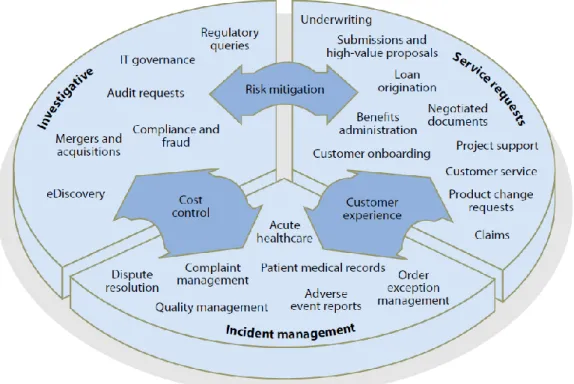
The Forrester segmentation is similar to the Gartner definition. Additionally, Forrester defines three key drivers between the segments: Risk mitigation, cost control and customer experience. The claim management case is categorized as service request and involves risk mitigation and customer experience. The insurance company has the goal to manage their risks by moderating the claim payments and the goal to achieve customer experience by good and fast claim regulation. Figure 2-6 shows the Forrester case management categories (Clair & Miers, 2014).
16
Source: Clair & Mieres, 2014 p. 8
Figure 2-6 Three case management categories will emerge
In 2014, Gartner segmented ACM in four key areas: Service request, Investigative, Incident and Process to decision. For each area, characteristics and samples are defined (Hill, Chin, & Dunie, 2014)
Service request
Characteristic: workflow-heavy
Example: insurance and healthcare claims
Claim management for insurances and healthcare provides Gartner as typical examples for the service request category.
Investigative
Characteristic: data-heavy Example: criminal investigation
Criminal investigation is the example for the investigative category. Within a criminal investigation, a large amount of different data is collected. The goal is to analyze relationships and patterns between this data. Based on this data, the knowledge worker, e.g. police offer, decides on ah-hoc activities.
17 Incident
Characteristic: collaboration-heavy Example: Natural disasters
Incidents like natural disasters, e.g. forest fires, require from the fire department collaboration between the team and between governmental institutions, e.g. police to evacuate houses. Often, this incidents require urgency.
Process to decision
Characteristic: rules- or policies-heavy. Example: compliance audits
Compliance audits driven by government regulations, e.g. banks audited by the central bank to assess their credit risks. This audits are driven by many rules and policies, e.g. credit risk exceeds a level bank needs to ensure additional securities.
Gartner clusters the category examples in a chart ordered by structured/unstructured data, and structured and unstructured workflow, shown in Figure 2-7 (Hill, Chin, & Dunie, 2014).
Source: Hill, Chin, & Dunie, 2014 p. 10 Figure 2-7 Sample Case-Based Processes
18 2.4 ACM ADAPTIVITY LEVELS
ACM solution sophistication can usually relates to its level of adaptivity. Swenson et al. (2015) (Swenson, et al., 2015) defines such levels in the book “Thriving on adaptability”:
Predefined Dynamic Guiding
Adaptive (Swenson, et al., 2015)
The lowest level are represented by pre-defined workflow engines. IT departments can change pre-defined activities, which can be executed by the knowledge worker.
Dynamic adaptivity is represented by BPMN engines with ACM functionality. Events and business rules for gateway result in different process paths the knowledge worker can choose. Knowledge worker might be able to change events and rules, activities and process path is typically predefined at design time.
An ACM system which includes guiding functionality like decision dashboards or collaborative decision making are able to support the knowledge worker by suggestion next steps or similar cases. The set of activities is still defined at design time.
A truly adaptive system is based on ontologies and semantic models that results in a learning knowledge base. The knowledge worker can change the activities and data structures any time by himself without the need to interact with the IT department. Such a truly adaptive case management system is part of future studies and work. Each adaptivity level is described in the Table 2-4 (Swenson, et al., 2015) Overview of adaptivity levels, building blocks and examples.
19
Source: Swenson, et al, 2015 p. 43
Table 2-4 Overview of adaptivity levels, building blocks and examples
Type (level of adaptivity)
Systems / languages / means
Example
Adaptive Ontologies, Semantic models, OACM (ontology based ACM)
Learning knowledge, inference of results rather than static queries, changes on the fly to activities, addition of new activities, changes to data structures, one (NON IT centric) vocabulary
Guiding Analytics in ACM decision dashboard, integration of statistical means (e.g. R), Collaborative Decision Making (CDM), Social BPM
Others have done ABC in your current context, rules bases reasoning, sharing of knowledge across contexts. ACM engine suggest best next steps; user picks one, rules/statistic framework integration. Still finite set of a priori defined activities (known already at design time).
Dynamic BPMN / workflow engine / ACM
More dynamic workflows. Typically using features like events in BPMN or like business rules for gateway logic. Often list of possible steps is dynamically read from external places, like Excel sheet. First ACM engines address this. Finite set of a priori defined activities (known already at design time),
Predefined BPMN / workflow engine Static workflows – a priori defined activities (all known during process design), static, changeable through IT only.
20
2.5 RESEARCH STATUS OF ADAPTIVE CASE MANAGEMENT
METHODOLOGY
A research for the state of the scientific knowledge of Adaptive Case Management Methodologies was conducted. The three following Adaptive Case Management Methodologies were chosen as examples. The 7 Key Components for an Effective Case Management Methodology (Wanless, 2010) was chosen for being one of the first methodologies evolved in healthcare based on a document management solution. Second, the methodology Building the Solution with ACM (Swenson, et al., 2010) was chosen for being a published methodology in the ACM book, called Mastering the Unpredictable, even before the CMMN notation became available. Third, the methodology Case Management Solution Framework (Smiers, Koster, Deb, & Palvankar, 2015) was chosen for its focus on vendor tool selection for ACM solutions.
None of this three methodologies support a truly agile approach. The characteristics of an ACM project might favor a more agile approach (Agile Alliance, 2015). Expected that due to the relatively young age of the Adaptive Case Management concept a waterfall approach was preferred, which might change in the future. (Beck, et al., 2001).
The research also considered if Service Oriented Architecture or Business Process Management Methodologies could be used as an ACM Methodology. The conclusion was the advantage of SOA Methodologies, like SOA Design Patterns from Thomas Erl (Erl T., 2009), Guiding the selection of service-oriented software engineering (Gu & Lago, 2011), A methodology for service architectures (Jones & Morris, 2005), or A Service-Oriented Software Development Methodology from Ricardo Puttini (Puttini, et al., 2012), is that they are similar to ACM due to the data centric (re-usability of services) approach. On the other hand, their use for ACM is limited due to the lacking concept of knowledge workers and support for business people.
Concerning BPM Methodologies, the advantage of such kind of methodology like Business Process Management Practical Guidelines to Successful Implementations (Jeston & Nelis, 2008), Bpmn Method and Style with Bpmn Implementer's Guide (Silver, Bpmn Method and Style with Bpmn Implementer's Guide, 2011), Knowledge Automation: How to Implement Decision Management in Business Processes (Fish, 2012), Enterprise BPM: Erfolgsrezepte
21
für unternehmensweites Prozessmanagement (Slama & Nelius , Enterprise BPM: Erfolgsrezepte für unternehmensweites Prozessmanagement, 2011) or How Work Gets Done: Business Process Management, Basics and Beyond (Mahal , 2010), is that they are suitable for business people. BPMN 2.0 is a widely accepted and understood notation for modeling business process. The disadvantage is that their use for ACM is limited due to the lacking support of the CMMN notation and therefore the lacking data centric approach.
The 7 Key Components for an Effective Case Management Methodology (Wanless, 2010)
The paper “The 7 Key Components for an Effective Case Management Methodology” from Scott Wanless focused on healthcare, a sweat spot for ACM. This methodology consist of seven key components
Capability strategy Repeatable Design Standardized Setup
Internally integrated workflow and toolset Externally integrated with operational systems Managed evolution
Externally integrated with analytical systems (Wanless, 2010)
Based on the software tooling the methodology is focused for document driven cases in hospitals especially patient medical records. Templates and model capabilities are not components of the methodology. Figure 2-8 (Wanless, 2010) shows the seven key components of the case management methodology.
Source: Wanless, 2015 p. 8
22
Building the Solution with ACM (Swenson, et al., 2010)
In the book Mastering the Unpredictable: How Adaptive Case Management Will Revolutionize the Way That Knowledge Workers Get Things Done, Dana Khoyi published a guideline how to build a ACM solution This guideline is based on the following key elements:
Describe the Business Entities
Describe the Relationships Between the Business Entities Add Detail to Each Business Entity
Specify Associated Documents Specify the Tasks
Create a Template Library Add Processes
Specify User Presentation (Swenson, et al., 2010)
The example used in the guideline is a HR on-boarding solutions for new employees. In the first step the business entities are created, follow by modeling an entity-relationship model based on the ideas of Peter Chen. In the next step the capabilities and stages are defined for each business entity. Each business entity is defined as a case. In the fourth steps the case documents are outlined. Task for the knowledge worker are predefined and associated to the cases. This tasks also include the stakeholders. Predefined set of information, documents and tasks can be groups as a template. Cases might trigger structured processes. In the final step the user presentation is defined. This example indicates what steps are required to build an ACM solutions. Key concepts of modern ACM solutions like goals, milestones or CMMN modeling are not part of this process.
Case Management Solution Framework (Smiers, Koster, Deb, & Palvankar, 2015) In the book Oracle Case management Solutions Leon Smiers, Manas Deb, Joop Koster and Prasen Palvankar describe an ACM solution framework. This ACM solution framework includes:
Case management functional design Case management classifications
Determine Solution mapping (Smiers, Koster, Deb, & Palvankar, 2015)
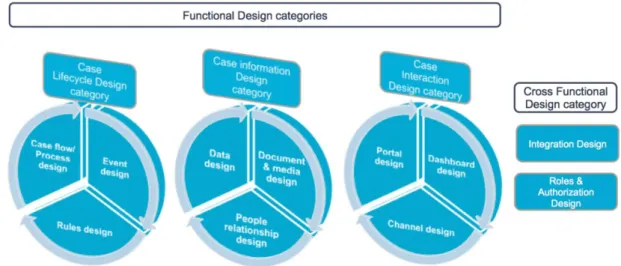
Case management functional design is divided in functional design categories and cross-functional design categories. The cross-functional design category includes case lifecycle, case
23
information design and case interaction design. The cross-functional design category consists of integration design and roles & authorization design.
Based on the Forrester ACM categories (service requests, incident management and investigative handling), the functional design categories and cross functional design categories are described. In the last step, the functionality is mapped towards solution layers and technical capabilities. A Common Reference Architecture (CORA) model is provided. Figure 2-9 (Smiers, Koster, Deb, & Palvankar, 2015) shows the Case Management design categories and components.
Source: Smiers, Koster, Deb, & Palvankar, 2015 p. 103 Figure 2-9 Case Management design categories and components
A detailed template for both the functional design and the cross functional design categories is described. This template, show in Table 2-5 (Smiers, Koster, Deb, & Palvankar, 2015), details the case design components including their high level functionality. This case management solution framework gives good advice for the type of ACM solution based on the Forrester categories. Therefore it is a good approach for vendor and tool selection.
Available methodologies for ACM Systems represent a good start based on the young age of the adaptive case management concept. With recent introduction of CMMN 1.0 in May 2014 ACM methodologies will evolve. This introduction of CMMN is reflected in this dissertation. Similar to service oriented architecture, ACM methodologies will mature over time based on research and project experience.
24
Source: Smiers, Koster, Deb, & Palvankar, 2015 p. 117 Table 2-5 Summary of case management design components
Case Design category Case Design component High level functionalities
Case Lifecycle design
Case Flow/Process design The Case flow specific for a case
Rules Design
Case lifecycle decision-making Entitlement determination Progress measurement Data entry validation Information discovery
Event Design
Interrupting events Non-interrupting events
Case Information design
Data Design
Case execution data Case supporting data Tactical -related information Strategic data
Document & Media design
Case input management Case output management People Relationship
design
Internal stakeholders External stakeholders
Case User Interface design
Portal design
One central view on the case One overview of the customer
Channel design Internal communication External communication Dashboard design KPI management Performance management
Customer satisfaction determination
Cross-functional design
Integration design
Application integration Case integration
Portal/Channel integration
Roles & Authorization
Internal profiles External profiles Compliance
25
3. CASE MANAGEMENT MODEL AND NOTATION
Case Management Model and Notation (CMMN) is a standard defined by Object Management Group. CMMN 1.0 was published in May 2014, followed by the current version 1.1. Beta, in March 2016. Case management requires modeling and notation that can express the essential flexibility that human case workers want. (Babich, et al., Case Management Model and Notation (CMMN), 2014). CMMN can cover both design time and run time. During the design-time a business analyst is visualizing the process based on the CMMN Model. During the run time a case worker executes the model plan. During execution, this plan can evolve. (Babich, et al., Case Management Model and Notation (CMMN), 2014)
3.1 CMMN CONCEPTS
The Case Management Model Notation is based on the concepts: Case Plan Model & Case File Item
Stage Milestone Activities Decorators Events Stakeholders
For this CMMN concepts, standardized graphical notation is defined, as shown in table 3-1. Expect the Stakeholder which are not represented in the graphical notation.
3.2 CMMN ELEMENTS
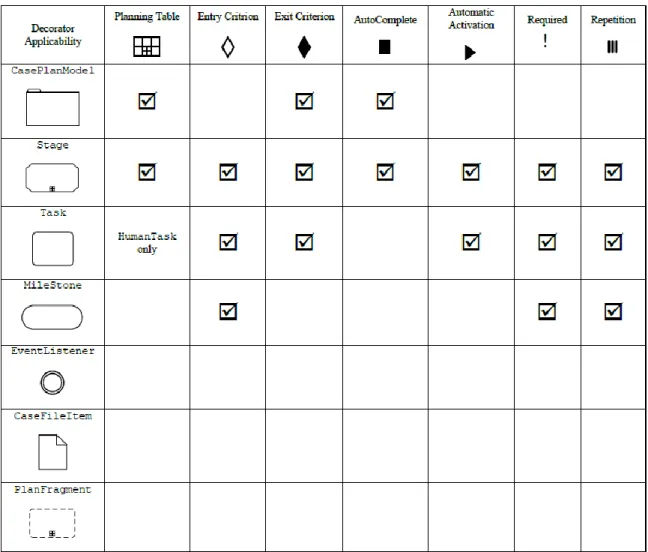
CMMN includes a visualization of the model. Similar to BPMN CMMN allows the process analyst to draw a model. The following CMMN notations are used to model a case. Table 3-1 (Kress, et al., 203-14) shows the CMMN Elements and the related Notations. Figure 3-3-1 (Babich, et al., Case Management Model and Notation (CMMN), 2013) shows the Decorators Applicability Summary Table.
26
Source: Kress, et al., 2014 p. 1 Table 3-1 CMMN Elements and Notations
Element Notation
Case Plan Model
The complete behavior model of a Case is captured in a CasePlanModel. It comprises both: all elements that represent the initial plan of the Case, and all elements that support the further evolution of the plan through run-time planning by case workers. There are four types of PlanItems: Tasks, Plan Fragments / Stages, EventListeners and Milestones.
Case File
All information, or references to information, that is required as context for managing a Case, is defined by a CaseFile. Every Case is associated with exactly one CaseFile. It contains CaseFileItems that can be anything from a folder or document stored in CMIS (Content Management Interoperability Services), an entire folder hierarchy referring or containing other CaseFileItems or simply an XML document with a given structure.
Stages
Stages do have run-time representations in a Case (instance) plan. Instances of Stages are tracked through the CMMN-defined Stage lifecycle. They may be considered “episodes“ of a Case, though Case models allow for defining Stages that can be planned in parallel also. A Stage is depicted with a marker in the form of a “+“ (collapsed) or “-“ (expanded) sign in a small box at its bottom center.
27 Tasks
Case management planning is typically concerned with determination of which Tasks are applicable, or which follow-up Tasks are required. A Task is an atomic unit of work. During the design-time phase of a Case, business analysts engage in modeling, which includes defining Tasks that are always part of pre-defined segments in the Case model, and “discretionary” Tasks that are available to the Case worker, to be applied in addition, to his/her discretion. In the run-time phase, Case workers execute the plan, particularly by performing Tasks as planned and adding discretionary Tasks to the plan of the Case instance in run-time.
Blocking Human Task
A blocking HumanTask is waiting until the work associated with the Task is completed.
Non-Blocking Human Task
A non-blocking HumanTask is not waiting for the work to complete and completes immediately, upon instantiation.
Process Task
A ProcessTask can be used in the Case to call a Business Process.
Case Task
28 Milestone
A Milestone represents an achievable target, defined to enable evaluation of progress of the Case. No work is directly associated with a Milestone, but completion of set of Tasks or the availability of key deliverables (information in the CaseFile) typically leads to achieving a Milestone. A Milestone may have zero or more entry criteria, which define, when a Milestone is reached.
Event Listeners
In CMMN an event is something that “happens“ during the course of a Case. Events may trigger, for example, the enabling, activation and termination of Stages and Tasks, or the achievement of Milestones. Instances of TimerEventListener are used to catch predefined elapses of time. A UserEventListener enables direct interaction of a user with the Case.
Planning Tables
Planning is a run-time effort. A Stage or a HumanTask can have a PlanningTable. The PlanningTable can be used to plan instances of Tasks and Stages into a Stage instance or into a Stage that contains a HumanTask with a PlanningTable. Sentries
Sentries define the criteria according to which the PlanItems are enabled (or entered) and terminated (or exited).
Stakeholders: CMMN defines roles for case workers. A CaseRole authorize a case worker to perform a HumanTasks.
29
Source: Babich, et al., 2014 p. 70
30
4. ADAPTIVE CASE MANAGEMENT METHODOLOGY PROPOSAL
A methodology offers the theoretical underpinning for understanding which method, set of methods, or so-called “best practices” can be applied to specific case, for example, to calculating a specific result. The New Oxford American Dictionary defined methodology as a system of methods used in a particular are of study or activity: a methodology for investigating the concept of focal points courses in research methodology and practice (Angus Stevenson, Christine A. Lindberg , 2010). A software methodology contains the phases Modeling, Visualization, Analysis, Design, Development and Implementation.
4.1 OVERVIEW ADAPTIVE CASE MANAGEMENT METHODOLOGY
In this work, existing analyses, technologies and models are adapted and combined towards a structured and formally defined Adaptive Case Management Methodology. The ACM Methodology presented at this chapter consists of five major phases:
Business Modeling Visualization Analysis Design
Implementation
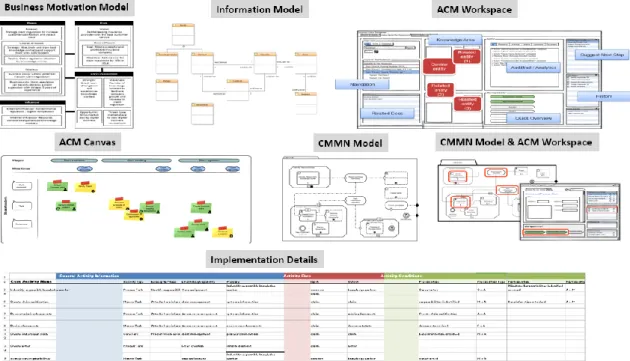
Each phase is described in details together with a set of software artifacts (outcomes), which are developed by different professional roles during the process. As part of the methodology description, specialized software artifact models and templates are created to cover the interests of ACM solution development. Table 4-1 shows the ACM Methodology Phases with their artifacts and stakeholders, and Figure 4-1 shows samples of these artifacts. Each phase is also illustrated using a Case Study derived from an actual customer implementation. A sample implementation for this Case Study is available at www.acmcommunity.com.
31
Table 4-1 ACM Methodology Phases
Phase Artifact Professional Role
Business Modeling
Business Motivation Model Organization Operative Model Information Model
Business Owner Business Analyst
Visualization ACM Workspace (user interface)
Knowledge Worker Business Analyst User Experience Expert
Analysis ACM Canvas Knowledge Worker
Business Analyst
Design CMMN Model Business Analyst
Architect Implementation Implementation Spreadsheet
Code (e.g. IDE project)
Developer Business Analyst
32 4.2 BUSINESS MODELING
The Business Modeling phase consists of three steps, the Business Motivation Model (BMM), Organization Operative Model and Information Model. The goal is to understand why an ACM solution is needed, who are the stakeholders, and what information should it contain.
4.2.1 Business Motivation Model
To understand what and why an organization wants to achieve, a business plan is an essential tool. To support the development of a business plan, OMG developed the Business Motivation Model (BMM). The BMM does not include a methodology, but provides a structure to develop a business plan. This structured approach defines the high level motivations and elements of an enterprise business plan (Hall, Healy, & Ross, 2015). Within the ACM methodology, the BMM is used to develop a business case plan. Within the ACM methodology, the business case plan helps to understand the organization's end (its vision and desired results), and means (its mission and the course of action), to plan the business case. The ACM solutions should address a specific business goal, which is reflect the company goals driven by their strategy and tactics. The BMM is used to align the ACM Solution with existing company mission, vision and goals.
The Business Motivation Model has four key elements: End: What the business wants to achieve in the future.
Means: The action plan how the business wants to achieve the end.
Influencer: The capacity to have an effect categorized in internal and external influencers.
Assessments: The evaluation of the influencers. Internal influences can be the strength and weakness, external influences can be threats and opportunities (SWOT).
End is expressed by the enterprise vision. Desired Results are described in the long-term
business Goals and the short-term Objectives. An Objective should be attainable, time target and measurable. Means are expressed by the enterprise mission. Course of Action is described in the long-term Strategy and the short-term Tactics. Directives govern what can be done within the enterprise. Less formal directives are defined in Business Policies. Formal directives are defined in consistent Business Rules. Means reference external BMM elements including the organization unit which executes the business processes that are governed by the business rules (Hall, Healy, & Ross, 2015). Figure 4-2 shows the BMM Overview (Hall, Healy, & Ross, 2015).
33
Source: Hall, Healy, & Ross, 2015 p. 12 Figure 4-2 BMM Overview
4.2.2 Organization Operative Model
The Business Motivation Model is linked to the organization stakeholders and roles. The Organization Operative Model represents the stakeholders and roles at the organization involved with the case. Stakeholders can be categorized as internal and external. Internal stakeholders work within the organization, e.g. employees, while external stakeholder are outside the organization, e.g. customers. The development of the Organization Operative Model ensures that the stakeholders are identified.
34
Within the internal organization, several roles can be defined:
Management: Based on the business motivation model the management defines, approves, governs, and sponsors the case means and the case end.
Case Owner: Domain expert who is responsible for case transparency, case optimization and case performance.
Case Controller: Business operation expert responsible for case.
Case Manager: Knowledge worker who is the process holder that makes the process decisions.
Case Employee: Knowledge worker who process and enriches the case with information.
Case Administrator: Maintains case and case infrastructures. Often one person might unify multiple roles in the organization.
4.2.3 Information Model
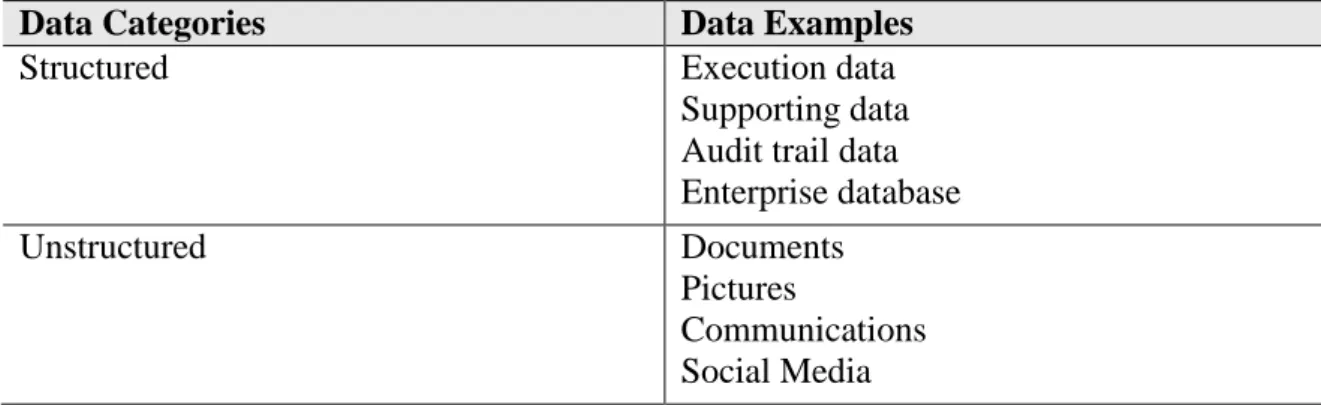
As ACM is about information, the starting point for an ACM solution design is an information model. Data within ACM solutions can be categorized in structured and unstructured data. Examples for structured data in the ACM context are execution data, supporting data, audit trail data and enterprise databases. Unstructured data includes documents, pictures, and communications like e-mail and social data. Table 4-2 shows the Data Categories within ACM. A detailed information model development is the outcome of this phase. Note that often corporate information models are available and existing models should be leveraged. The development of the Information Model ensures the identification of the case data.
Table 4-2 Data Categories within ACM
Data Categories Data Examples
Structured Execution data
Supporting data Audit trail data Enterprise database
Unstructured Documents
Pictures
Communications Social Media
35
The business analyst conducts interviews with the operative stakeholders with the goal to develop a high-level Information Model. Whiteboard technique embracing post-it notes is an interactive approach with the stakeholders. Based on the results, tools like mind maps or class diagrams can be used to represent the information entities and relationships.
4.3 VISUALIZATION
The case information needs to be available for the knowledge worker. Figure 4-3 (Swenson, Palmer, & Carlsen, Empowering Knowledge Workers, 2014) shows the importance of Visualization for the knowledge worker.
Source: Swenson, Palmer, & Carlsen, 2014 p. 336 Figure 4-3 Empowering knowledge Workers
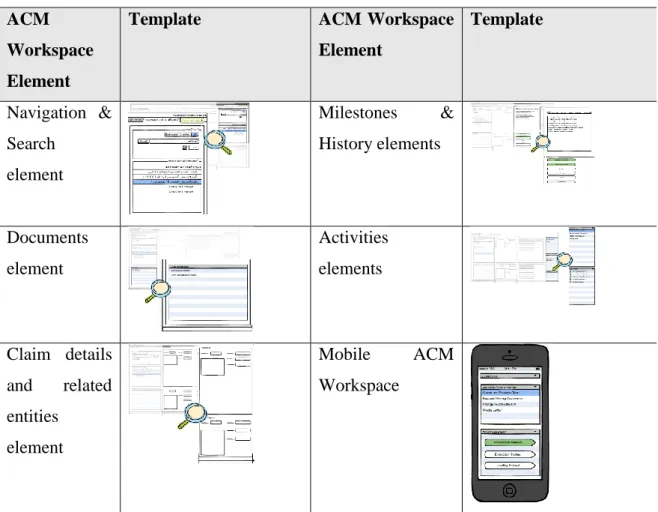
Within the ACM solution, the knowledge workers receive all information through a specialized user interface, called ACM Workspace. In order to build this, the work patterns of knowledge workers are analyzed and UI elements are design to provide visibility in work status, tracking task lists/milestones, team collaboration, manage documents for a given case and to understand the next steps (Oracle Applications User Experience, 2014). To increase acceptance, testing with the knowledge workers is necessary. Modern user interfaces increase the user experience and user acceptance of the solution. Direct feedback from the users improves the acceptance of the UI, gives early insight in required information and