THE IMPACT OF NEW TRENDS IN SUPERMARKET
ENVIRONMENT: THE CASE OF THE OLIVE OIL SECTOR
Filipa Loja Gomes Ferreira Evangelista
Dissertation submitted as partial requirement for the conferral of Msc in
Marketing
Supervisor:
Prof. Doutor Pedro Dionísio, Department of Marketing, Strategy and Operations ISCTE Business School
Co-supervisor:
Prof. Doutora Hélia Pereira, Department of Marketing, Operation, and Management ISCTE Business School
TH E I MP ACT OF NEW TREND S IN S UPER MAR KE T EN VI R ON ME NT : THE CASE OF TH E O LI VE O IL S ECTOR
F
il
ip
a
L
o
ja
Go
m
es
F
erre
ir
a
Ev
a
ng
el
is
ta
I Acknowledgement
I would like to thank my supervisors Prof. Pedro Dionísio and Prof. Hélia Pereira for giving me the opportunity to be part of this project and for all the dedication and encouragement. An extended thanks to Prof. Pedro Dionísio for all the wise advices, for teaching me how to think and behave in the more arduous situations.
I would also like to thank my six colleagues, Dharmite Tushar, Filipe Mendonça, Inês Pinto, Mafalda Simões, Mariana Rodrigues and Rodrigo Santos, that embarked on this project with me. Doing it alone would be much more challenging and it would not certainly be the same. I would like to make a special thanks to Filipe Mendonça, Mariana Rodrigues and Rodrigo Santos, for not only having accompanied me during the participant observation period in the supermarket but also for all the support, being with me side by side during all the hours spent at ISCTE writing this dissertation, and for all the kind and encouraging words in most difficult moments.
My family and friends, Catarina, Inês and Joana played a crucial role in the development of this dissertation, for always encouraging me, never letting me demoralize, and for being so understanding when I had to spend entire days in university.
A special thank should also be given to Mr. Hugo Almeida, owner of the supermarket where the studies took place, for being so flexible and for providing all the technical support needed.
II Abstract
Consumers’ expectation towards shopping experience is changing, shoppers are becoming more independent, confident, empowered and increasingly connected. As a way of responding to these changes, retailers started to introduce new stimuli in their stores. The purpose of this thesis is to understand how future trends influence consumer behavior in the supermarket environment, more specifically in the olive oil sector. This dissertation met the research aim through an extensive study of relevant literature and empirical research. Research in the experimental plan domain was developed in Intermarché, with the support of Sovena, a Portuguese company specialized in the production and commercialization of oils. The study was based on stimulus changes at point of sale and examination of consumer behavior through observation, interviews and sales analysis. Findings suggest that shoppers consider useful the implementation of an informative tablet on point of sale, even though they did not have the impulse of using it. Most buyers did not pay much attention to the implemented elements that aimed to create a differentiated zone for the olive oil section, while others found it pleasant and appellative. It is important to note that the results were influenced by several adjacent limitations. Managers should target consumers with a high optimum stimulation level (OSL). Subsequently, retailers should acknowledge the importance that new trends have on consumer behavior and adapt their stores accordingly. Suggestions for future research on the influence of new trends in store atmosphere are posteriorly discussed.
Keywords: Store Atmosphere, New trends in Marketing, Consumer Experience, Supermarket
JEL classification system: M31 – Marketing
III Resumo
Os consumidores têm vindo a alterar as suas expectativas e perceções face à experiência de compra, tornando-se mais independentes, confiantes e conectados entre si. De forma a responder a estas mudanças, os retalhistas começaram a introduzir novos estímulos nas suas lojas. O objetivo desta tese é a de compreender como as novas tendências em ambiente de loja influenciam o comportamento do consumidor em ambiente de supermercado, mais especificamente na secção dos azeites. Esta dissertação foi realizada a partir de um extenso estudo da literatura relevante e estudo empírico. Estudos no plano experimental foram desenvolvidos no Intermarché, com o apoio da Sovena, uma empresa portuguesa especializada na produção e comercialização de azeite. O estudo teve como base a alteração de estímulos no ponto de venda e análise do comportamento do consumidor através de observação, entrevistas e análise de vendas. Resultados demonstram que os consumidores consideram útil a implementação de um ecrã informativo no ponto de venda, apesar de não demonstrarem intenção de o utilizarem autonomamente. A maioria dos clientes não revelou ter captado a essência dos elementos implementados no ponto de venda, ao contrário de outros que os consideraram agradáveis e apelativos. É importante ter em consideração os diversos fatores externos que influenciaram os resultados. Os retalhistas devem ter como principal target consumidores com um elevado “nível de estimulação ideal” (OSL). Subsequentemente, os retalhistas devem considerar a importância que as novas tendências no comportamento do consumidor e adaptá-las adequadamente.
Sugestões para pesquisas futuras sobre a influencia das novas tendências em ambiente de loja são discutidas posteriormente.
Keywords: Store Atmosphere, New trends in Marketing, Consumer Experience, Supermarket
JEL classification system: M31 – Marketing
IV
Table of Content
1. Introduction ... 1 1.1 Theme ... 1 1.2 Research Problem ... 2 1.3 Objectives ... 2 1.4 Structure ... 3 2. Literature Review ... 4 2.1 Store Atmosphere ... 4 2.1.1 Experiential Marketing ... 4 2.1.2 S-O-R Model ... 6 2.1.3 Traditional Stimuli ... 7 2.1.3.1 External variables ... 82.1.3.2 General interior variables ... 9
2.1.3.3 Layout and design variables ... 12
2.1.3.4 Point of purchase and decoration ... 13
2.1.3.5 Human Variables ... 13
2.2 New trends in Store Atmosphere ... 15
2.2.1 Store atmosphere and the supermarket environment ... 16
2.2.2 New trends in Supermarket ... 18
3. Methodology ... 23
3.1 Sample ... 23
3.2 Research Approach ... 24
3.3 Data Collection ... 24
3.3.1 First stage: Before the stimulus implementation ... 26
3.3.2 Implementation of the new stimuli in the Olive Oil sector ... 26
3.3.3 Second stage: After the stimulus implementation ... 28
3.4 Methods for Data Analysis ... 29
4 Analysis ... 31
4.1 Consumption of Olive Oil ... 31
V
4.3 Analysis of the Olive Oil sales ... 33
5. Conclusions ... 34
5.1 Conclusions ... 34
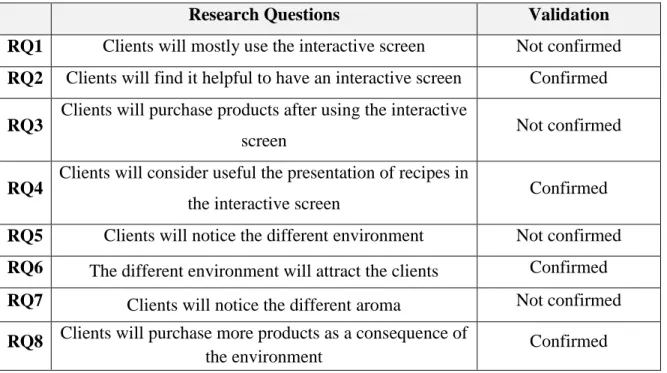
5.1.1 Research Questions– Interactive Screens ... 34
5.1.2 Research Questions- Store Mood Zones ... 35
5.2 Managerial implications ... 37
5.3 Limitations of Research ... 39
5.4 Suggestions for Further Research ... 40
VI
List of figures
Figure 1: Stimulus-Organism-Response (S-O-R) model……….…………8
Figure 2: Method of data collection………...……….……...26
Figure 3: Olive oil section before stimuli implementation……….………....28
Figure 4: Olive oil section after stimuli implementation…………...……….…28
Figure 5: Interactive screen implemented in the olive oil area………...………....29
List of tables
Table 1: Methods to Assess the Research Questions……….………311
1. Introduction
The aim of this research is to identify the influence of new trends in store atmosphere on consumer behavior, in the supermarket environment, more specifically in the olive oil sector.
1.1 Theme
Many authors deepened their studies on store atmosphere components and subsequently in its influence on consumer behavior, namely in the time spent inside the store, the level of satisfaction, the amount of money spent and willingness to return (Babin and Attaway, 2000; Kusumowidago et al. 2011; Mishra et al. 2014; Sabrina, 2014). Most studies have proven through empirical research that store atmosphere elements have impact on consumer behavior. Hence it became crucial for retailers to adapt their marketing strategies, creating influential atmospheres through the use of colors, scents, lights and sounds – considered the most traditional stimuli of store atmosphere -, in order to impact consumers’ perceptions at the point of sale (Turley and Milliman, 2000).
In spite of the influence that traditional stimuli have on consumer behavior inside a store, they are no longer the only means used by retailers to attract and preserve consumers. Nowadays, due to the volatile world we live in and due to the fact that consumers are becoming increasingly more demanding and informed, retailers are starting to adapt their strategies and incorporate new stimuli into their stores, such as interactive screens, store mood zones, co-creation, retailtainment, among others. Most new trends result from the combination of new technologies, human factors and a greater contact between the brand and the consumer. According to Pantano (2016) the combination of the traditional components with new ones may induce consumers to be more willing to enter a store and stay longer inside it, leading to higher levels of purchase intention.
Deeper studies should be made in this concern, exploring which are these new future trends and how can they influence consumer behavior. This study is revolved around this subject, aiming to provide a framework for future researches and giving relevant insights to retailers.
2
1.2 Research Problem
There are many authors defending the influence of store atmosphere stimuli on consumer behavior, once it impacts consumers’ emotional states (pleasure or arousal) which in turn have influence on consumers’ perceptions towards the store environment (Mishra et
al., 2014). In the literature, there is also discriminated the influence of diverse environmental
elements, such as music, color, scents and lighting (Crowley, 1993; Custers et al. 2010; Andersson et al. 2012). However, there is little research on the impact that future trends – co-creation, hybrid store, interactive screens, new payment methods, retailtainment, reverse channels, revolving décor, store mood zones and storytelling – have on consumer behavior, especially in the supermarket environment.
Thus, a gap has been found in the literature, concerning the study of these new trends in depth, including what is their impact on consumer behavior when acting alone and when combined with other trends.
1.3 Objectives
This study aims to explore which are the most appropriate trends to apply in the supermarket context, more specifically in the olive oil sector, and afterwards ascertain which are the consequences of having them implemented. Thus, the aim of this study is to identify the influence of new trends on consumer behavior, in the olive oil sector of a Portuguese supermarket, Intermarché, located in Moita (Setúbal).
The investigation will be conducted in order to provide a framework for future researches and give some insights to retailers.
3 1.4 Structure
The first chapter introduces the main topics and highlights the limitations found in the literature, afterwards the research problem and the study objectives are presented.
The second chapter focuses mainly in the literature review, where is given comprehensive insights about the intended topic. The main focus is on store atmosphere and its components, such as on traditional stimuli and their influence on consumer behavior and on future trends and how can they be applied. A brief explanation of what is happening in the supermarket industry is made, from both the consumer and the retailer perspectives. Then, based on real life examples of supermarkets chains, it is presented which are the more appropriate trends to apply in the supermarket sector. In the end of this chapter the trends chosen to apply to the olive oil sector are presented and explained in more detail.
In the third chapter the methodology is approached and the research methods are clarified and developed in the best way possible to study the olive oil consumers’ behavior towards the implemented trends. An exploratory qualitative approach will be applied. In this chapter, there are also presented the methods used to analyze the collected data.
The analysis of the results is conducted on the fourth chapter and ultimately, the fifth chapter includes conclusions discussion, implications will be outlined, limitations defined, and suggestions for future research proposed.
4
2. Literature Review
2.1 Store Atmosphere
The term “store atmosphere” was first introduced by Philip Kotler, in 1973. The author defined the concept as the conscious design of space to create specific emotional effects on buyers, with the ultimate goal of increasing the likelihood of purchase. According to Olahut, El-Murad and Plaias (2012) atmospheric is the principal element of store image, it is the personality of a store, and it is the way a retailer chooses to attract and preserve customers, that is, encouraging them to stay longer, spend more and return more frequently (Puccinelli
et al., 2014).
Store Atmosphere, store formats and environments vary and compete globally, leading consumers to evaluate the store and behave in a certain way, having the ability to increase or decrease consumer’s perceived quality (Turley and Milliman, 2000; Farias, Aguiar and Melo, 2014; Mishra, Sinha and Koul, 2014).
Store atmosphere cannot be perceived as static, Kotler (1973) defended that in order for a company to be considered successful it must undergo a periodic review and try to reformulate its atmospherics to differentiate itself from the competition and gain advantage. Although it is not a simple task, it can alter significantly the consumer’s perception towards the store (Babin and Attaway, 2000; Turley and Chebat, 2002; Kusumowidago et al. 2011).
2.1.1 Experiential Marketing
It is crucial for companies to have in mind that we are now living in an experiential economic era (Verhoef et al., 2009), where purchasing a product is much more than going into a store and acquiring a product or service. Now products are just a piece of what is called “consumption experience” (Pine and Gilmore, 1998; Schmitt, 1999; Gilmore and Pine, 2002; Kim et al., 2011; Farias, Aguiar and Melo, 2014) “…which is memorable, personal,
prolonged and involves many sensations…” (Farias, Aguiar and Melo, 2014: 88).
In order to achieve an extraordinary retail experience, managers should have in consideration some aspects from the retail atmosphere (essentially those related to
5 customer’s senses), situation moderators (type of store, location, convenience among others) (Kaltcheva and Weitz, 2006) and consumer moderators (buying process and consumer’s goal) (Verhoef et al., 2009). Consumers have two fundamental motivational orientations that lead them to purchase: hedonic and utilitarian (Kaltcheva and Weitz, 2006). Consumers value products for both affective (hedonic) and task-related (utilitarian) reasons (Holbrook and Hirschman, 1982; Rayburn and Voss, 2013; Farias et al., 2014; Andajani, 2015).
Authors like Farias et al. (2014) defend that experiential marketing is a fundamental approach to be followed to achieve success in the competitive world we live in, since that can lead to financial benefits for the company (Pine and Gilmore, 1999) and promote differentiation and customer loyalty (Zomerdijk and Voss, 2010).
Experiential marketing can be seen as the way customers develop perceptions and purchase products or services after experiencing certain activities (Schmitt, 1999; Andajani, 2015), it is a subjective response that customers have to any direct or indirect contact with the company (Meyer and Schwager, 2007; Grewal et al., 2009; Andajani, 2015), motivating them to make faster and more positive decisions (Schmitt, 1999).
After coming to the conclusion that store atmosphere have an actual impact on consumer behavior (Turley and Milliman, 2000; Mishra et al., 2014; Andajani, 2015), managers have become more aware of the need to create value for their customers in the form of experiences (Berry et al. 2002; Verhoef et al., 2009; Kim et al., 2011; Farias et al., 2014; Grewal et al., 2009) once they are recognizing that environmental cues can actually increase sales (Milliman, 1982; Smith and Curnow, 1966; Stanley and Sewall, 1976; Grewal et al., 2009) and customer satisfaction (Bitner, 1990; Harrell et al., 1980; Andajani, 2015; Grewal
et al., 2009). Kim et al. (2011) added that to create a competitive advantage, companies must
provide memorable experiences for their customers, however, according to Farias, Aguiar and Melo (2014: 89) it is crucial for a company to have in consideration that “…each
individual perceives only certain qualities of that space, due to selective attention, distortion and retention.”, meaning that each customer is an isolated case having their own perceptions,
opinions and needs.
Customer experience is also seen as holistic, involving the customers’ affective, emotional, social and physical response to the retailer (Mattila and Wirtz, 2001; Michon et
6
2.1.2 S-O-R Model
Researchers felt the need to use a framework that could help them study and better understand the effects of store atmosphere elements on shopping behavior. According to Voordt et al. (2014) a framework that is often used to describe environmental experiences is the environmental psychology method of Mehrabian and Russel (1974).
The purpose of this model is to try to explain the atmospheric effects on emotions and behaviors (Havlena and Holbrook, 1986; Bakker et al., 2014). Mehrabian and Russell (1974) proposed the Stimulus-Organism-Response (S-O-R) paradigm, which suggests that an environment filled with stimuli (S) can affect the organism (O), resulting in a response (R) from the consumer towards the environment, that can have two outcomes: approach or avoidance (Figure 1). As concerns to retail, such approach and avoiding responses have four distinct stages. The first stage is related with the desire of a customer to approach or avoid the store. The second phase is linked with the willingness of the customer to search and explore the store. The third process of approaching and avoiding is to interact with the employees. Finally, the fourth stage concerns the repurchase frequency and the amount of money spent during the visit to the store (Donovan and Rossiter, 1982).
To describe customer’s feelings Mehrabian and Russel (1974) introduced three basic emotional states that function as mediators towards the approach-avoidance behaviors: pleasure, arousal and dominance (PAD model) (Donovan and Rossiter, 1982).
The Mehrabian and Russel (1974) model was tested by several authors (Farias et al., 2014), and as a conclusion it was found that stimuli that lead to positive emotional responses also lead to approach behaviors (ex: entrance in the store), and on the other hand, stimuli that lead to negative emotional responses lead to avoidance behavior (ex: not entrance in store) (Farias et al., 2014).
7 Figure 1 - Stimulus-Organism-Response (S-O-R) model
Source: Adapted from Donovan and Rossiter (1982)
2.1.3 Traditional Stimuli
As mentioned previously, store atmosphere has a considerable impact not only on the store image but it can also affect consumers’ emotions (Turley and Milliman, 2000) since most of the times customers decide whether to enter the store, or whether to buy or not a product based on the space environment (Kusumowidago et al. 2011). Thus, managers should make an effort to understand which are the most appropriate and valuable variables to incorporate in their stores. According to Farias et al. (2014) those variables can be used as tools to provide experiences to consumers that consequently can convert into a competitive advantage.
When studying the effects of atmospheric variables on consumer behavior it is essential to have in mind that they are not perceived individually, but holistically (Bitner, 1992; Warren and Burns, 2002; Babin et al., 2004; Rayburn and Voss, 2013). As the authors Olahut, El-Murad and Plaias (2012: 335) affirmed “When customers enter a store they do not
experience the music in isolation; they do not smell the scent without seeing the colors as
Environmental Stimuli (S) Emotional Status (O) Response (R) Pleasure Arousal Dominance Approach Avoidance
8
well; they do not walk on the floor covering without feeling the ambient temperature.” Hence
it is not enough just to choose the right stimuli, it is also crucial to understand how the variables interconnect with each other and how they can be managed in a way of minimizing consumer’ confusion when overwhelmed with different stimuli (Marion et al., 2015), such as, when consumers are exposed to multiple scents they tend to spend less time and money inside a store then when exposed to just a single scent (Haberland, 2010).
According to Kotler (1973) there are four main atmospheric dimensions: Visual (sight), Aural (sound), Olfactory (smell) and Tactile (touch). These are the environmental stimuli that can be perceived by consumers and therefore influence them, in terms of assessment and behavior towards the environment (Turley and Milliman, 2000; Olahut et al., 2012; Farias et
al., 2014; Spence et al., 2014) and therefore the purchase intention (Kotler, 1973). This
vision has been developed over the years, Berman and Evans (1995) in Turley and Milliman (2000), established four main atmospheric dimensions: external variables, general interior variables, layout, design variables, point of purchase and decoration variables. However Turley and Milliman (2000) also deepened their studies in this subject adding a fifth category, Human variables, to the set. In the following topics, these five dimensions are analyzed in more detail.
2.1.3.1 External variables
The store exterior includes the storefront, marquee, entrances, display windows, building architecture, the surrounding area and parking. “Store exteriors are what customers
first encounter as they engage in shopping behavior” (Mower et al, 2012: 443), proving
therefore to be a good opportunity for retailers to start building positive impressions. Thus, the storefront becomes an important variable to be considered, since it can become a barrier to potential future customers (Olahut, El-Murad and Plaias, 2012).
Storefront windows can influence potential customer’s moods (Pantano, 2016) as it provides useful information, advertising and sales promotion (Olahut, El-Murad and Plaias, 2012) that influence the decision whether to enter or not in the store (Mower et al. 2012). Studies have concluded that stores using window displays reach higher levels of sales compared with the ones with no window display, moreover researchers found that larger
9 window displays are more successful in attracting consumer’s attention than smaller ones (Edwards and Shackley, 1992). Businesses can gain competitive advantage through this external variable, Cornelius et al. (2010) as referenced by Olahut, El-Murad and Plaias (2012: 326) supported the strong connection between the store image and the store front display. According to the authors the most innovative displays achieve better image perceptions than the ones that only contain promotional information (Sen et al., 2002).
Researchers Mower et al. (2012) concluded in their studies that when customers appreciated the store exterior environment, they experienced higher pleasure and arousal and ultimately increased patronage intentions. To attract more customers Olahut, El-Murad and Plaias (2012) suggested that the storefront window displays should be tailored to shopper’s intentions and store environment.
2.1.3.2 General interior variables
Concerning general interior variables, Turley and Milliman (2000) defined the following variables: flooring/carpeting, lightning, scents and sounds, temperature, cleanness, wall textures and colors. The authors specified that interior stimuli have significant impact on approach/avoidance, time spent in the environment, and sales.
Colors
According to Farias et al. (2014) retailers have been trying, over the years, to manipulate consumer’s willingness to purchase using colors. A good color application can increase competitive advantage (Chebat and Morrin, 2007) since it is considered an important technique when trying to attract customers and increase marketing opportunities, having also the ability to influence environmental perceptions and product quality (Tantanatewin and Inkarojrit, 2016).
Several studies were conducted regarding the influence of colors on shopping behaviors suggesting that consumers are more drawn to warm colors such as yellow, orange and red (Bellizzi et al. 1983) being perceived as being promoters of good space impression and identity (Tantanatewin and Inkarojrit, 2016). On the other hand blue and violet interiors are expected to produce higher levels of purchase intentions, greater excitement, and higher store patronage intentions (Bellizzi et al., 1983; Bellizzi et al., 1992; Crowley, 1993; Babin
10
et al., 2003). Moreover, blue is perceived as a calm, cool and positive color with a strong
evaluative appeal (Crowley, 1993).
For retailers, the study of colors can be a great benefit since they can be used as tools to attract consumers and simultaneously offers them an interesting shopping experience. Shopper’s reactions to a store can be changed when colors are combined with other environmental stimuli, such as lighting and music. Namely the combination of orange with bright lights can reduce the purchase intentions, on the contrary the combination of orange with soft lights reveals the opposite effect (Babin et al., 2003).
Lightning
When lights are used inside a store they can impact store satisfaction, as they influence not only store image and brand classification (Schielke and Leudesdorff, 2014) but also the examination and handling of products (Olahut, El-Murad and Plaias, 2012). Hence retailers resort to the use of light to achieve higher levels of stimulation and therefore a favorable consumer behavior (Spence et al., 2014).
Lights and brightness attract consumer’s attention towards store front windows (Pantano, 2016) and higher-perceived brightness originates higher price perception and a more modern image (Schielke and Leudesdorff, 2014). However, other authors such as Babin
et al. (2003) suggest that lightning brightness does not have significant impact on arousal,
purchasing intentions or time spent in store.
Studies conducted by Custers et al. (2010) reinforced the idea that lightning can influence emotions, moods and atmosphere overall impression. In the same study, brightness, contrast, glare and sparkle were considered the most important attributes. The brighter the shop lights, the less confined/intimate/romantic/relaxing is considered the atmosphere, it becomes more tense, uneasy and unfriendly. The more the glare and sparkle, more energizing/lively/stimulating is the store atmosphere.
Moreover, when soft lights are combined with classical music a sense of higher prices is perceived by consumers (Baker et al. 1994), reinforcing once again the idea that the elements of a store’s environment are perceived holistically (Bitner, 1992; Warren, Burns, 2002; Babin et al., 2004; Rayburn and Voss, 2013).
11
Music
From all the interior atmospheric variables music is the most studied variable, retailers believe that playing appropriate background music can help them developing a desirable environment, contributing to store image and consumer choice (Andersson et al., 2012; Knoferle et al., 2012; Olahut et al., 2012; Farias et al., 2014).
Many studies have come to conclusions regarding the effect of music in store environment, as it can increase time spent (Milliman, 1982) and pleasantness (Yalch and Spangenberg, 1990) inside the store; decrease the perception of buying and waiting time (Chebat et al., 1993); affect the perceived time spent inside the store, as the predicted time is considered longer when music is louder than softer (Kellaris et al., 1996); influence consumer’s perception of a store (Hui et al.,1997); increase sales (Smith and Curnow, 1966); and facilitate consumer interaction (Dude et al., 1995).
Concluding, Turley and Milliman (2000) state that music atmospherics can impact significantly a diversity of behaviors including sales, arousal and perceptions of actual time spent in the store and traffic flow. A recent study (OnBrand, 2016) shows that 70% of customers prefer shopping in stores that has background music and 63% affirm that they probably would purchase more consequently.
Based on the researches of Andersson et al. (2012) music affects positively the purchase action and time spent in store. However, the type of retail store and gender also have a certain influence on the way music influences consumer behavior. Findings indicate that females are positively affected by no music or slow-tempo music and on the other hand males are affected positively by music and fast-tempo music. The authors stated that retailers should be aware of music effects, both in men and women, adapting the atmospheric music to their customers and having in mind that it can differ across different days or time of the day.
Scent
Scents have been studied by numerous researchers over the years. Most of them have showed that odors influence human behavior, including the time spent inside the store and the amount of money spent (Guéguen and Petr, 2006), contributing also to build a favorable perception of the environment and product quality (Chebat and Michon, 2003).
12
Retailers are increasingly using perfumes in their stores (Bone and Ellen, 1999; Morrison and Ratneshwar, 2000), once adding a likable fragrance to a product increases the purchase intentions and willingness to pay higher prices towards the product (Fiore et al. 2000 as referenced in Michon et al. 2005). In fact, placing fresh flowers near the cash register can facilitate sales (Parsons, 2009); customer’s intentions to purchase a backpack increase in the presence of ambient scent (Sangenberg et al., 1996); and the purchase intention for sport shoes increase when the shopper is exposed to a mixed floral-scented room (Miller, 1991). Environmental scents can derive from the sold products or can be placed artificially (Bosmans, 2006). However, when the smell is from the product itself it is considered a sign to consumer evaluation of the quality and attributes of that same product, this has greater relevance when smell is considered a major factor, such as in beverages, food, cleaning products and cosmetics (Milotic, 2003).
A store that provides some sort of pleasant odor is better perceived by consumers, therefore the use of olfactory stimulus has been considered by many researchers a competitive advantage. Although ambient scents are one of the least expensive techniques to intensify shopper’s perceptions (Chebat and Michon, 2003), it can also constitute a greater challenge in terms of introduction in the store (Spence et al., 2014)
2.1.3.3 Layout and design variables
According to Olahut, El-Murad and Plaias (2012) design factors have less impact on the overall store perception compared with ambient and social factors, however Puccinelli et
al. (2009) defended that store layout can also influence consumer’s perception of the
atmosphere and thus their likelihood of avoiding or approaching the product or store. Fixtures, allocation of floor space, product groupings, traffic flow, department locations and allocation within departments are all components of layout and design variables (Turley and Milliman, 2000).
Store layout can impact consumer’s expectations about efficiency. A large store with long, tall aisles can lead consumers to think they will take longer time to find want they need. Smith and Burns (1996) in Olahut, El-murad and Plaias (2012) revealed that small numbers of products configured at larger quantities transmitted a sense of lower prices, as opposed of having a greater variety of products with lower quantities.
13 2.1.3.4 Point of purchase and decoration
Consumers are increasingly making online purchases (Nielsen, 2014). Although the Internet is becoming more present is consumer’s lives (Accenture, 2015) it is at the point of purchase “where the final purchase decision is actually made” (Bill Napier, 2015: 1).
Product displays, point-of-purchase displays, posters, cards, teletext messages, and wall decorations are all components of the point of purchase and decoration category (Turley and Milliman, 2000).
The way products are displayed can influence sales as well as boost impulsive buying (Sence et al., 2014; Prakash and Sharma, 2016), thus shopper’s behaviors can be strongly impacted by point of purchase elements in brick and mortar stores (Prakash and Sharma, 2016) and retailers can use them to attract and communicate with their clients (Puccinelli et
al., 2009). Merchandising, ambience, atmospherics, support, display, convenience, and
visual communication are all components that act as positive reinforcers at point of purchase (Prakash and Sharma, 2016).
Signs also have impact on consumer’s choices, particularly when combined with price information (Chevalier, 1975; Woodside and Waddle, 1975 in Turley and Milliman, 2000). However, according to McKinnon et al. (1981) benefit signs prove to have more desirable effects on consumers than price signs. The amount of information in a sign must be considered (Patton, 1981) since clients choose products that provide a greater amount of information when comparing products of equivalent quality.
2.1.3.5 Human Variables
According to Turley and Milliman (2000), human variables include customer crowding or density, privacy, customer characteristics, personnel/employee characteristics and employee uniforms. Human variables can be subdivided into two major groups: the influence of other shoppers and the influence of retail employees on shopping behavior. Human variables have a significant role in the retail shopping process, being able to slow the shopper, encourage a longer store visit, and increase product interaction and purchase (Zhang et al., 2014).
14
Crowding is directly connected with interactive social influences (Turley and Milliman, 2000). This concept consists in two components, actual shopper density and perceived crowding (Harrell and Hutt, 1976). Large amounts of consumers inside a store may increase the perceived popularity of the store and encourage customers to touch and buy goods, however retailers should pay attention not to create too much traffic, once that it can have negative impact on the shopping process by reducing customer’s personal space, their capability to touch the products and increase the waiting time at the checkout (Eroglu and Mchleit, 1990; Machleit et al., 2000; Zhang et al., 2014).
Employee characteristics, such as friendliness and social cues, are another factor that can have great impact on the shopping process by encouraging shoppers to interact with the merchandise and purchase it (Zhang et al., 2014). Turley and Milliman (2000: 206) refers that “…the more social cues present in the store environment, the higher subjects´ arousal.”. Stores that have more employees, wearing aprons and greeting customers, are perceived as being of high quality. On the other hand, stores with the discount-image social factors (less employees, wearing no apron and not greeting clients) are not so well perceived in terms of quality (Baker et al., 1994).
As reported by Dwayne et al., (1993) there are numerous researchers defending that for consumers’ satisfaction be met, the needs of service providers (employees) should be fulfilled before. Several authors defended that if employees, or internal customers, are satisfied there will be higher possibilities for clients to also be satisfied.
Store atmosphere variables have been having a much more important place in retailer’s sights, Kotler (1973: 61) mentioned that “Buyers may choose vendors as much for their
atmospheres as their goods.” He also added that is possible that atmosphere becomes a strong
form of competition, especially when products of different retailers have become increasingly similar. Store atmosphere, depending on consumer’s environmental perception, can be a very useful tool in creating value and gaining customer share (Babin and Attaway, 2000; Sánchez-Fernández and Inisesta-Bonillo, 2007), having impact on time spent inside the store, emotions, willingness to return and money spent (Donovan and Rossiter, 1982; Farias et al., 2014; Sabrina, 2014; Pantano, 2016).
15 2.2 New trends in Store Atmosphere
“Despite predictions that online shopping will spell the death of brick-and-mortar
retailing, the corner store is still going strong.” (Slawsky, 2016:2). Even with all the infinite
opportunities of online shopping that consumers are exposed to, they continue to shop in physical retail stores, as they want to interact with products before buying them and have some sort of personal experience (Slawsky, 2016).
For retailers to achieve success they need to adapt themselves to this new environment, need to step up their game to meet customers’ new needs and demands. To achieve that, retailers started to change and adapt their stores’ environment and atmosphere, adding new features, concepts and mechanisms. There was a shift from traditional stores to more technological ones, based on the premise that the combination of interactive and entertaining technologies can attract more consumers and increase purchase intentions (Pantano, et al., 2016).
These new means of changing and adapting stores are all about creating new experiences to shoppers, engaging them and essentially making them want to return. Consumers are unquestionably looking for experiences and businesses are responding to that desire (Pine and Gilmore, 1998; Grewal et al., 2009; Verhoef et al., 2009; Steven et al., 2013), as creating a unique shopping experience is becoming a key factor of success for retailers (Norbert Rickert, 2016).
Some of the trends that are being used by retailers in their stores have a more technological component unlike others that may be slightly more related to traditional stimuli presented in section 2.1.3, such as odors, colors or simply to decoration. Some of the trends that can be considered as “new trends” in the store atmosphere world are: Co-creation (Crandell, 2016); Hybrid Stores (Malin, 2016); Interactive Screens (Pantano, 2016); New payment methods (Ohlhausen, 2016); Retailtainment (Mathur and Chhibber, 2016); Reverse channels (Rao, P., 2005); Storytelling (Pulizzi, 2012) and Store mood zones (Kizer and Bender, 2015).
However, regardless of the trend applied, the ultimate objective is always to attract, please and achieve customers’ loyalty.
16
2.2.1 Store atmosphere and the supermarket environment
As mentioned previously consumers want new experiences in their consumption routines (Turley and Milliman, 2000; Farias et al., 2014; Pantano, 2016). The grocery retail sector is no exception, it has been facing intense improvements (Wood and McCarthy, 2014) once shoppers are not only more selective and demanding but also less loyal, showing a more cross-shopping behavior (Jayasankaraprasad 2014; Jayasankaraprasad and Kathyayani 2014).
When faced with this new reality, grocery retailers felt the need to differentiate themselves (Wang et al. 2012) using atmospheric cues as a tool, especially when competition has become fiercer, price differences became minimal, and products and services more similar (Marques et al., 2016). It is important to note that food retailing has almost always been at the forefront of new retail trends and has been innovative and pioneering (Nunes, 2016). Studies undertaken by Marques et al. (2016) about the impact of atmospherics on customer’s store choice proven that shoppers value nice decoration, design/beauty of the store, layouts and displays easy to read, and empathy, staff friendliness and facility to find products in supermarkets. The authors added that different atmospheric variables have distinct meanings depending on the store format.
As reported by Marques et al. (2016), supermarket managers should be more proactive rather than reactive, focusing on decoration, layouts and empathy of staff. Grocery store retailers need to embrace this new experiential world and modify their stores, since while customers choose a store they think about benefits, features and experiences that are associated with the selected store.
In order to transform the customer experience in a more vivid and memorable one, some trends could be adapted by grocery retailers in their supermarkets. As reported by John Karolefski (2016), veteran supermarket watcher and executive director of Shopper Technology Institute (STI), a diverse product department and better product information are some of the top trends in grocery shopping for 2017. Furthermore, the author added that retailers should be prepared for more informed consumers that expect a more enjoyable shopping experience (Karolefski, 2016).
17
2.2.1.1 Supermarkets in the Portuguese context
In Portugal there are many important players in the retail industry, such as Continente, Pingo Doce, Intermarché, Jumbo, Lidl and Mini Preço. The food distribution sector in Portugal has a quite high level of concentration, being the market leaders Continente and Pingo Doce. These two retail groups presented an increase in sales by around 5% at the end of last year, 2016 (Público, 2017).
Despite the fragile economic situation felt in Portugal in the last years, the retail sector achieved the established goals and succeed in satisfying their customer’s needs, this tendency accompanied the fact that Portuguese families are more optimistic and confident (Morais in Pinto, 2017) since studies show that in 2016 was spent more money in supermarkets (Público, 2017). According to Dionísio in Pinto (2017), one of the consequences concerning the Portuguese crisis is reflected in the willingness of consumers to try other ways that bring innovation at the time of purchase, Portuguese consumers are looking for new concepts and experiences.
Although the results are satisfactory, retail companies are still fighting to overcome the economic conjuncture by reinventing the business in benefit of its customers (Pinto, 2017), according to Barbosa in Pinto (2017), retail companies should “get out of the price
logic war and, differentiate themselves and innovate.”.
In contrary to what is expected consumers are returning to the traditional retailing stores, such as grocery stores, as Mateus in Pinto (2017) stated “The economic crisis has also
brought us good things, such as a taste for what is ours and for the proximity”. Despite this
tendency the share of traditional stores is still low comparing with super and hypermarkets (Pinto, 2017). Hereupon, it is not surprising that the struggle for leadership in the consumer goods market has become more pronounced.
The Portuguese consumer has become in general more demanding, but is also true that brands are becoming more aware and presenting innovative solutions, such as related to the product itself and the point of sale, through the improvement of the supermarket sectors or packaging of the product (Silva in Pinto, 2017).
18
2.2.1.2 Olive Oil Industry in Portugal
The olive oil sector in Portugal has been suffering an enormous growth in the past 10 years, driven by a massive investment that has led to the revitalization of the sector, not only in terms of production but also in terms of product quality, presentation and commercialization (Sobral, 2016). As reported by Casa do Azeite (2016), association of olive oil in Portugal, this trend was not only felt in Portugal, but also in the rest of the world, where growth in the last 15 years was about 0.6%. However, overall, Europe accounts for a large share of the world's olive oil consumption, being that 56% of the world consumption belongs to the EU.
Although much olive oil is consumed all over the world, some of the Portuguese olive oils are among the best. In 2014 Oliveira da Serra (from Sovena) and Gallo (from Unilever) were awarded in the Mário Solinas contest, considered the most important olive oil contest in the world (Brito, 2014).
In 2011, Sovena (owner of Oliveira da Serra), was considered the second biggest olive oil company in the world. In that same year, Oliveira da Serra was chosen as the preferred olive oil brand by Portuguese. The company maintained its leadership due to its investment on innovation, as the Pop-Up caps, that brought more functionality to the bottle, and the creation of the plastic bottles that had great impact on the final price for the consumer (Godinho, 2011).
2.2.2 New trends in Supermarket
Over the years competition in the food retail market has become fiercer, consumers distanced themselves from the traditional supermarket models, and food retailers have been facing pressure from alternative channels. To fight this tendency retailers are trying to create more innovative shopping experiences (Duff & Phelps, 2016), by complementing the in-store shopping with technology (Drodge, 2017) and investing on the store design. As reported by Herring (Mckinsey&Company, 2017: 1) “Retailers can take inspiration from the digital
19 Considering the presented studies in chapter 2.2, there is an opportunity to study the applicability of two trends in the supermarket sector: Interactive screens and Store mood zones. These trends can strongly contribute to one of the main objectives of the retailers nowadays, in other words, bring more innovation into the store, more excitement and more day-to-day enjoyment of food (Moulton, 2017).
2.2.2.1 Interactive screens
This trend emerged as a consequence of the rapid technology development, more specifically E-Commerce and mobile technology. Consumers have become very accustomed and dependent of the interactivity of their devices, thus retailers have implemented technological solutions in their stores aiming to boost costumer experience and expectations (Lee, 2013; Pantano, 2016). Having realized that technology should complement and assist the in-store experience (Drodge, 2017). These interactive devices can have multiple formats, such as screen monitors; multi touch video walls; kiosks; interactive mirrors; projections, among others.
There are many benefits linked to this trends, such as the fact that technological devices don’t need “…’coffee breaks’ neither have ‘business hours’.” (Whisbi official website), meaning they can operate continuously, informing and serving customers even when employees are not available. Besides, they provide higher customer service quality as waiting time reduced, better data collection, improvement of the point-of-sale, better advantage of store space, is also a versatile method that can display different types of information, is accessible and serve to brand promotion. In agreement with Sandy Nix in Ingram (2016), “iPads and other tablets, with the right peripherals secured in one of our enclosures, can
enable shoppers to get information, place orders and swipe a card to complete transactions very quickly”.
Ksubaka is a startup based in Singapore that uses interactive gaming kiosks to influence purchasing decisions. The founder felt there should be a better and more effective way to reach consumers at the moment of purchase and wants to make advertisements more memorable by strategically inserting them in retail spaces. Thus, Ksubaka designed the “PlaySports”, a series of interactive gaming kiosks featuring simple games that have a brand
20
message embedded within them. These kiosks are located in areas where consumers are often contemplating purchasing decisions and the ultimate purpose is to make fun and interactive ads, rather than intrusive (Trend Hunter, 2015).
This trend is beginning to be incorporate into the supermarket industry, a supermarket based in Milan displays screens in the produce aisles, where information to the consumer is provided on all products, in the form of augmented reality, using sensors (Garfield, 2017). According to Karolefski (2015), veteran supermarket watcher and executive director of Shopper Technology Institute (STI), turning stores more digital is one of the top trends in grocery shopping.
This trend is in line with what consumers are looking for in their store experiences. As Moulton (2017), partner in McKinsey’s London office, defends “It is really important to
bring more innovation back. We suspect that consumers are looking for it, craving it, even.”,
bringing innovation into the market is a way of finding new manners of engaging customers while making them rediscover the pleasure of shopping (Herring, 2017), since that a study undertaken by McKinsey proved that only 15 percent of customers actually enjoy food shopping (Herring, 2017).
2.2.2.2 Store mood zones
“Merchandise will sell itself when a store’s design is good, but when it’s not, even the
best product can sit on your shelves gathering dust” (Kizer and Bender, 2015: 1). Retailers
can achieve successful stores by planning their store design (Kizer and Bender, 2015) and re-designing some key zones using consumer insight (Novikova, 2015), moreover according to Han-Shen Chen and Tsuifang Hsieh (2010) store atmospheric factors have significant impact on consumer’s approach behaviors. The purpose of a store design is not only to look presentable but essentially to create an environment that attracts customers, seduce them to spend time in the store, and encourage them to purchase on impulsive (Kizer and Bender, 2015). Sight, smell and sound are three of the senses that can be manipulated by retailers to create a more pleasant shopping environment, generating a relaxed and enjoyable experience (Han-Shen Chen and Tsuifang Hsieh, 2010) which might trigger purchase behavior in consumers (Khan, 2016).
21 As reported previously, music can be used to create different mood zones, playing an appropriate music for a specific department can enhance the environment, contributing to increase customer’s purchase intentions. As Slawsky (2016) concluded, sound systems are being increasingly incorporated into the display experience supplementing the visual component inside retail stores, this phenomenon also occurs in supermarket environments, a study undertaken by Millman (1982) concluded that 34% of shoppers increase their time spent inside a supermarket when background music is played with a corresponding sales increment (OnBrand, 2016).
It has been studied and proved that ambient scents affect people´s purchasing routines and determine whether they will return to the store or not (Khan, 2016). A study undertaken by Nike proved that the addition of smell in their stores increased the intent to purchase by 80 per cent, another study proved that using the smell of coffee in a petrol station increased the purchases of the drink by 300 per cent (Semoff, 2011). Moreover, some stores can use artificial scents to reinforce the company’s brand and to create a more pleasant environment for the customer. A brand that adopted this method owns one of the world’s biggest sweet shops: M&M World’s store in London, that has the smell of their main product: chocolate. However, before the implementation of the artificial scent, the store that looked like a place that should smell like chocolate, had no particular smell once all the products are pre-packed (Pratt in Independent, 2011). For most businesses getting the right fragrance can dictate success or failure of a store, "If you get it right, it's a good thing. If you get it wrong, it's
worse than no scent at all." (Herz, 2011).
Previous research proves that colors can influence shopping behavior and there are even authors who claim that color is the most influential ambient variable (Cho and Lee, 2017). According to Porter (2012), one of the reasons that make colors so relevant is that they are not only present in merchandise but also around the customer in the retail space, influencing whether they make a purchase or not. There are different ways how store colors can influence shopping experiences and turn visitors into buyers such as the capacity of telling stories, if the retailer chooses the right color pallet to represent a certain theme, it will transport customers to the intended environment. For example, the retailer can capture the essence of the beach by using colors associated to sand, water and sunshine (Porter, 2012).
22
Intermarché, a supermarket from the Mosqueteiros group, opened a new concept of hypermarket in Lagos, a city located in the south of Portugal (Marcela, 2017). According to Vasco Simões, manager of this Intermarché (2017), the concept is based in the creation of a vegetables and fruit area with the image of a traditional market, using a mixture of specific materials that bring consumers to the ambience of a traditional market with a touch of modernity and freshness. The main objective of this approach is to communicate the company's values, such as its connection to origins, tradition and customer.
According to Han-Shen Chen and Tsuifang Hsieh (2010), store atmospheric elements – including design factors, ambient factors and social factors – have an important positive correlation with customer approach behaviors, being design factors considered the element that causes more impact by bringing to consumers the amusement of aesthetics and joyful moods (Drodge, 2017).
23
3. Methodology
The present study was prepared as part of an investigation conducted by Marketing Future Cast Lab in new trends in store atmosphere. The research was developed with Sovena, a Portuguese company specialized in the production and commercialization of oils, together with the researcher the company outlined the most effective methods of data collection with the aim of searching for solutions that may be useful in the decision process of adapting a new approach at the point of sale, through sensorial stimuli.
The investigation of future trends was thus directed to the olive oil sector in supermarkets, although Oliveira da Serra presents itself as one of the strongest brands in this market, there is still many competition. In this context, the brand developed the need to differentiate itself in the point of sale. All the empirical research has been conducted in that sense aiming to study the influence of new trends on consumer behavior in the olive oil area at Intermarché supermarket of Moita.
The study was developed on the exploratory domain with an experimental approach based in the analysis of consumer behavior in the point of sale when faced with new stimuli, which includes a different store mood zone with the application of new decoration and aroma, and the implementation of an interactive screen in the point of sale. The investigation was supported by the examination of olive oil sales before and after the implementation of the stimuli.
3.1 Sample
Respondents were recruited at the olive oil corridor when shoppers purchased or showed interest on the products, on the interactive screen or in the elements from the new environment.
A total of 55 interviews were completed, of which 25 corresponding to the first stage of the study and the remaining 30 to the second stage. Each respondent provided their age and occupation. 63% of the respondents were over 50 years of age and 76% were female.
24
3.2 Research Approach
According to the authors Richey and Klein (2007) research can be classified as exploratory, descriptive and explanatory. In order to reach conclusions on the study, an exploratory qualitative approach was applied, since it is mostly related to topics that are not very developed and for which there are not very in-depth studies, in this cases the research tend to be qualitative. This approach proves to be the most adequate since is largely used for exploring new experiences and develop new theories (Bailey, 2014). A quantitative approach was not applied since the base of the study are future trends, and if respondents were confronted with questions about themes that they are not familiar with, it would be expected that the answers would not be the most accurate.
The study was on the experimental domain since it was based mainly in the observation of consumer behavior in the point of sale. The research had the duration of six days and took place in a store, Intermarché located in Moita, and it was not developed at a national level due to constraints of time, logistics and budget.
3.3 Data Collection
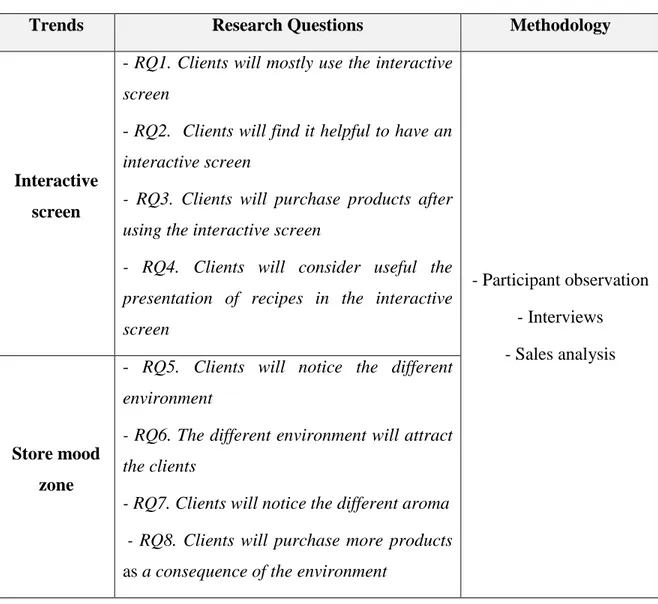
In order to evaluate the effect of the stimuli implemented – interactive screen and store mood zones - at the point of sale, the following research questions were developed:
Interactive Screen
RQ1. Clients will mostly use the interactive screen
RQ2. Clients will find it helpful to have an interactive screen
RQ3. Clients will purchase products after using the interactive screen
RQ4. Clients will consider useful the presentation of recipes in the interactive screen
Store mood zones
RQ5. Clients will notice the different environment RQ6. The different environment will attract the clients RQ7. Clients will notice the different aroma
25 The study was divided into two stages, one before the implementation of the stimuli in the point of sale and the other after the implementation. These two phases were complemented by the analysis of olive oil sales before and after the stimuli implementation (Figure 2).
Figure 2 – Method of Data Collection
Source: Developed by the author
Participant Observation Interviews
Implementation of the new stimuli Participant Observation Interviews - Decoration - Fragrance - Interactive Screen First Stage
Before the stimulus implementation
Second Stage
After the stimulus implementation
- Consumer Behavior - Olive oil consumption
habits
- Consumer Behavior - Olive oil consumption
habits
- Perception towards the new stimuli
- Improvement suggestions
26
3.3.1 First stage: Before the stimulus implementation
The beginning of the empirical part of the research consisted in the observation of consumer’s behaviors, that passed through the olive oil corridor, as well as the performance of interviews in the point of sale. This phase took place over 4 days. The participant observation was designed with the purpose of analyzing the frequency with which clients stopped in front of the olive oil linear, touched or/and purchased olive oil products, as well as count how many clients passed through the corridor and register their gender, age group and which brand of olive oil was purchased. It was used a table (Appendix 1) to support the data collection during the observation.
The interviews were conceived to better understand the role of olive oil in the daily life of the respondents. The questions of the interview were developed with the aim of being able to lead to conclusions on consumption habits of olive oil and on the reason behind the selection of a brand over another. During the interviews the researcher used a table (Appendix 2) where the questions were identified and the answers of the respondents written.
The first phase of the study was necessary since it served as a basis for comparing the moments before and after the implementation of the new stimuli in the point of sale, thus the evaluation of the results of the implementation of the stimuli is much more accurate.
3.3.2 Implementation of the new stimuli in the Olive Oil sector
One of the essential parts of this study was the adjustment of the design from the olive oil sector of the Intermarché, through the implementation of new visual stimuli, introduction of an interactive screen and the application of a olfactory stimuli.
The intended environment was one resembling the origins of olive oil, including some of the characteristic elements of an olive grove, such as olive trees, grass and soil ground- since it would require great investment to include real elements, the chosen option fell on the creation of the environment through specific decoration materials, such as cardboards and vinyl materials. The regular black price rulers were replaced for others with a wooden pattern printed on it, to transmit a greater sense of nature. The addition of the fragrance was made through a dispenser that sprays a fresh suggestive cucumber aroma evoking elements of freshness and the idea of a Mediterranean diet. Retailers are adding odors to their stores to
27 lure consumers to buy more, moreover stores are embracing scent marketing to create ambiance, alongside with lighting and design (Nassauer, 2014).
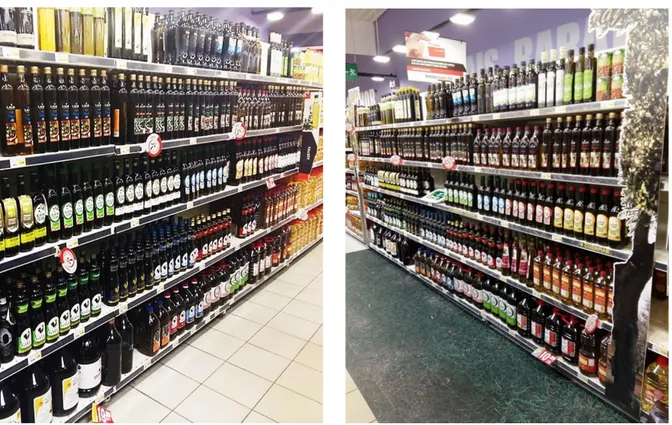
The figures below exhibit the olive oil zone of the supermarket before (Figure 3) and after (Figure 4) the implementation of the mentioned stimuli.
Figure 3 - Before stimuli implementation Figure 4 - After stimuli implementation
.
Source: Developed by the author
The interactive screen applied in the supermarket (Figure 5) displays the different types of olive oils as well as their main characteristics such as the acidity level and main ingredients. The screen also presents the different utilities for each type of olive oil - cooking, seasoning or the both simultaneously. Other feature of the screen is that it displays recipes made with different categories of olive oil, including appetizers, soups, salads, meat and fish main courses, pasta, dessert and also baby food.
28
Figure 5 – Interactive screen implemented in the olive oil area
Source: Developed by the author
3.3.3 Second stage: After the stimulus implementation
The second stage of the study, with a duration of two days, consisted, as in the first one, in participant observation of consumer’s behaviors and performance of interviews. The table used to support the researcher in the observation is the same as the adopted in the first phase (Appendix 1), since the purpose of the observation remains the same.
However, in addition to the questions asked in the interviews of the first stage, were added some more questions related to the new decorative elements, interactive screen and fragrance (Appendix 3). The purpose of this interview is both understand olive oil consumption habits and perceive the impact that the new stimuli had on the interviewee. To answer the research questions, the questions applied in the interview were diverse, included all the stimuli introduced in the point of sale. With this interview the author intends to realize if the consumer was attracted to the olive oil area due to the new decoration or was already going with the purpose of buying olive oil. The interview also tries to understand if the consumer felt the aroma and what was his opinion towards it. Regarding the interactive screen, the author aim to realize if the implementation of a screen near to the olive oils had any impact on the consumer, if is perceived has adding some sort of advantage and if the
29 display of recipes is useful. In the second stage the author also expected to understand if the consumer had any suggestion to improve the interactive screen or the olive oil area in general.
3.4 Methods for Data Analysis
As referred in the chapter 3.2, an exploratory research was applied and therefor the methodology adopted for data collection belongs to the qualitative domain. The two main sources selected for data collection were in form of interviews and participant observation. The olive oil sales were analyzed by comparing the sales before and after the stimuli implementation, assessing subsequently if there was an impact in the category of the olive oils, and on the brand that promoted the implementation of the changes, in the case Oliveira da Serra.
According to Pope and Mays (1995), both interviews and observation techniques are used to provide insights of situations and behaviors.
Interview is, according to Cassell and Symon (2004) the most common method for data collection in a qualitative research. In general, most interviews, are composed by open questions with focus on specific situations and with a low level of structure imposed by the interviewer. According to the authors, this method, is one of the most flexible ones, as it is possible to cluster different types of research questions, something that is very difficult for quantitative methods. The adopted interview has a funnel design, the questions range from more general to more specific, and the questions were developed in the form of yes or no, thus respondents do not waste much time answering the questions and the risk of dubious responses is reduced.
Participant observation requires the researcher to be part of the setting and observe behaviors. This method allows the researcher to witness nonverbal expressions in a natural -setting (DeWalt and DeWalt, 2011) and verify how much time is spent in the activity (Schmuck in Kawulich, 2005). One of the major advantages of this method is the possibility of understand the phenomena in a holistic way, where it is provided better data collection and interpretation of facts. (DeWalt and DeWalt, 2011).
30
Table 1 – Methods to Assess the Research Questions
Trends Research Questions Methodology
Interactive screen
- RQ1. Clients will mostly use the interactive
screen
- RQ2. Clients will find it helpful to have an
interactive screen
- RQ3. Clients will purchase products after using the interactive screen
- RQ4. Clients will consider useful the presentation of recipes in the interactive screen - Participant observation - Interviews - Sales analysis Store mood zone
- RQ5. Clients will notice the different
environment
- RQ6. The different environment will attract the clients
- RQ7. Clients will notice the different aroma - RQ8. Clients will purchase more products
as a consequence of the environment