RESEARCH ON CONFLICT MANAGEMENT: A CASE
STUDY ABOUT SMALL WORK GROUPS IN CHINA
Qingyang Peng
彭清扬
Dissertationsubmitted as partial requirement for the conferral of Master in Human Resources Management and Organizational Consultancy
Supervisor:
Prof. Maria Gabriela Silva, Department of Quantitative Methods for Management and Economics, ISCTE Business School
Spine
RES EARCH ON CON FLICT MANA GEMEN T : A C ASE STUDY ABOUT SMALL WO RK GROU PS IN CHINA Qingyang PengⅠ
Acknowledgements
I am proud of having such a nice and patient supervisor, Professor Maria. In fact, this was my first time to write English thesis. I could not finish my thesis without her help, support and guidance. Every time when I was confused about writing the thesis, she would encourage me and give me the best solutions for the next step. I learned a lot about time management skills and professional knowledge from her. I appreciated that she has rigorous attitude, passion and profound knowledge which are important for academic research. Besides, she is an easy-going professor and we can talk with each other like friends. Thank you, Professor Maria! You are the best professor in my heart. I’m very lucky to meet you when I study in ISCTE-IUL.
I would like to say thank you for all my professors and classmates in ISCTE-IUL, and also my roommates and friends in Lisbon. I had a great time in Portugal with you all. Thank you, my mother. You are a beautiful and knowledgeable lady who always support and encourage me in my life. Mother’s love is like the sunshine which always warms my heart. I’m very grateful that you often care my feelings and communicate with me like friends. With your concern and guidance, my growth became happy and healthy. I learned how to become a confident person and make every effort to realize my dreams from your guidance.
谢谢您,我的妈妈。您是一位美丽,知识渊博的女士,在生活中,您一直支持和 鼓励着我。母爱就像阳光,永远温暖着我的心灵。我很感激您经常关心我的感受, 可以和我像朋友一样交流。在您的关心和指导下,我的成长之路变得快乐和健康。 在您的指引下,我学会了如何成为一个自信的人,并尽一切努力去实现我的梦想。 Thank you, my father. You are a knowledgeable, energetic and nice man who makes a lot of contributions to my family. Father’s love is like a big umbrella which can protect me from getting wet in the rain. You usually tell me that if I treat learning as a pleasure, I will have more motivations to success. I learned how to become a self-disciplined and positive person from your guidance.
谢谢您,我的爸爸。您是一个知识渊博,充满活力和善良的人,为我的家庭做出 了很多贡献。父爱就像一把大伞,可以为我遮风挡雨。您经常告诉我,如果我把 学习当作一种乐趣,我就会有更多的动力去走向成功。在您的指引下,我学会了 如何成为一个自律的和积极向上的人。
Ⅱ
Abstract
This research is focused on a qualitative case study about conflict management in small work groups in China. Data were gathered in companies that have their offices in four Chinese cities, including Guangzhou, Shenzhen, Bozhou and Fuyang. 74 informants from 26 work teams participated in this study. Participants were asked to recall events happened in their teams through face-to-face interviews. This case study aims to understand what types of conflict people experienced in their teams, the strategies people adopted to deal with conflicts and the orientations that emerge in the conflict management process.
Overall, results show that the most common type of conflict is relationship conflict. With regard to conflict management styles, integrating and compromising styles are more frequent among managers, whereas avoiding, obliging and dominating styles are more frequent among subordinates. Overall, most of orientations are constructive. Furthermore, the findings were interpreted based on the Chinese culture.
Keywords: Organizational conflict, intra-group conflict, conflict management styles,
Chinese culture
Ⅲ
Resumo
Esta investigação está centrada num estudo de caso qualitativo sobre gestão de conflitos em pequenos grupos de trabalho na China. Os dados foram recolhidos em empresas com escritórios em quatro cidades chinesas, incluindo Guangzhou, Shenzhen, Bozhou e Fuyang. 74 informantes pertencentes a 26 equipas de trabalho participaram neste estudo Foi solicitado aos participantes para recordarem acontecimentos que surgiram nos seus grupos através de entrevistas presenciais. Este estudo de caso tem por objetivo compreender que tipos de conflito os colaboradores presenciam nas suas equipas, as estratégias que adotam para lidar com os conflitos e as orientações que emergem no processo de gestão de conflitos.
Globalmente os resultados mostram que o tipo de conflito mais comum é o conflito de relações. No que respeita aos estilos de gestão de conflitos, os estilos integração e compromisso são mais frequentes entre gestores, enquanto os estilos afastamento, resignação e dominação são mais frequentes entre os subordinados. Globalmente a maioria das orientações são construtivas. Adicionalmente, os resultados foram interpretados com base na cultura chinesa.
Palavras-chave: Conflito organizacional, conflito dentro do grupo, estilos de gestão
de conflitos, cultura chinesa
Ⅳ
Table of Contents
Acknowledgements ... Ⅰ Abstract ... Ⅱ Resumo ... Ⅲ Table of Contents ... Ⅳ List of Tables ... Ⅵ List of Figures ... Ⅶ Chapter I Introduction ... 1Chapter Ⅱ Conflict in small work groups ... 3
2.1 Definition of small work group ... 3
2.2 Definition of conflict ... 4
2.3 Nature of conflict ... 5
2.4 Different views of conflict ... 5
2.5 Types of conflict ... 7
2.6 Orientations to conflict: constructive/destructive ... 10
2.7 Stages of conflict process ... 11
2.8 Conflict management techniques ... 16
Chapter Ⅲ Chinese business culture ... 20
3.1 Hofstede cultural dimensions in China context ... 20
3.2 Chinese Guanxi culture ... 23
3.3 The great impact of Chinese traditional culture on Chinese business culture ... 24
Chapter Ⅳ Methodology ... 28
4.1 Research strategy ... 28
4.2 Research setting ... 29
4.3 Data generation ... 30
4.4 Interview participants ... 31
4.5 The nature of individual interviews ... 33
4.6 Interpretation of the data ... 35
4.7 Goodness and trustworthiness... 38
Chapter Ⅴ Findings ... 39
5.1 Incident A ... 39
5.1.1 Description ... 39
5.1.2 Type of conflict ... 40
Ⅴ
5.1.4 Orientation of conflict ... 42
5.2 Incident B ... 43
5.2.1 Description ... 43
5.2.2 Type of conflict ... 43
5.2.3 Styles to manage conflict ... 44
5.2.4 Orientation of conflict ... 45
5.3 Incident C ... 45
5.3.1 Description ... 45
5.3.2 Type of conflict ... 46
5.3.3 Styles to manage conflict ... 47
5.3.4 Orientation of conflict ... 47
5.4 Incident D ... 47
5.4.1 Description ... 47
5.4.2 Type of conflict ... 48
5.4.3 Styles to manage conflict ... 49
5.4.4 Orientation of conflict ... 50
5.5 Incident E ... 50
5.5.1 Description ... 50
5.5.2 Type of conflict ... 51
5.5.3 Styles to manage conflict ... 52
5.5.4 Orientation of conflict ... 53
5.6 Incident F ... 53
5.6.1 Description ... 53
5.6.2 Type of conflict ... 54
5.6.3 Styles to manage conflict ... 55
5.6.4 Orientation of conflict ... 55
5.7 Incident G ... 56
5.7.1 Description ... 56
5.7.2 Type of conflict ... 57
5.7.3 Styles to manage conflict ... 58
5.7.4 Orientation of conflict ... 58
5.8 Incident H ... 59
5.8.1 Description ... 59
5.8.2 Type of conflict ... 59
5.8.3 Styles to manage conflict ... 60
5.8.4 Orientation of conflict ... 61
5.9 Summary of other incidents in other teams ... 62
Chapter VI Discussion ... 65
Chapter Ⅶ Conclusion ... 74
7.1 Practical implications ... 74
7.2 Limitations ... 75
Ⅵ
List of Tables
Table 1. A Summary of Three Types of Conflict ... 10
Table 2. A Summary of the Chinese Culture Using Hofstede’s (1980) Cultural Dimension ... 21
Table 3. General Information of All Teams that Participated in the Interviews ... 32
Table 4. Interview Guideline ... 34
Table 5. Categories and Subcategories Used in the Study... 37
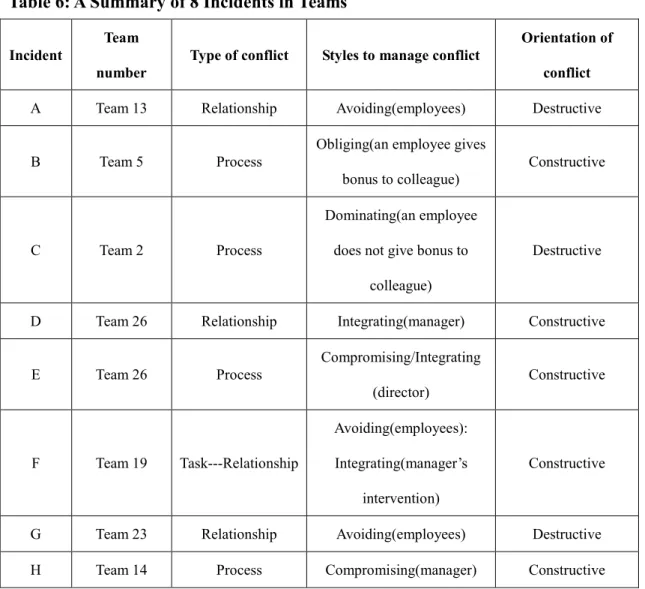
Table 6. A Summary of 8 Incidents in Teams ... 62
Ⅶ
List of Figures
Figure 1. Conflict Process ... 14 Figure 2. Styles of Managing Interpersonal Conflict... 17
Chapter I Introduction
Conflicts naturally occur in teams and organizations (Neck, Houghton & Murray, 2017). Conflict is unavoidable in all cultures, but every culture has its own way to manage it (Hanif, Khan, Adeel & Shah, 2016). Back to precious studies of organizational conflict, Jehn (1997) defined three types of organizational conflict, which are task conflict, relationship conflict and process conflict. Rahim (2002) stated five styles of managing conflict, including integrating, obliging, dominating, avoiding and compromising styles. Deutsch (1973) initially argued two orientations of conflict, containing constructive and destructive orientations. In this study, the research was focused on intra-group conflict in small work teams. Intra-group conflict is the conflict between people who work together in the same department or teams (Rahim, 2001).
In this study, the author went to four cities in China, including Guangzhou, Shenzhen, Bozhou and Fuyang. The main objective is to do a qualitative case study about team dynamics in China. The purpose of research is to understand conflict management in Chinese small work groups. In order to do it, critical incident interview technique was used to conduct the interviews (Flanagan, 1954). In total, 26 Chinese teams with 74 team members participated in the interviews. The present case study aims at answering three research questions:
1. Which type of conflict did emerge in the interviews?
2. What type of strategy did people adopt to deal with the conflict?
3. What kind of orientations did people adopt to handle conflicts? If the conflict is constructive, to what extent does the incident help team members to improve work performance or connect with each other? If the conflict is destructive, how do team members keep focus on performing the work at hands?
believed that it is possible to understand conflict management in Chinese small work teams through interview transcriptions and Chinese cultural dimensions.
This thesis is composed of five parts:
1. The Literature Review includes chapter Ⅱ and chapter Ⅲ and presents the review of previous studies on organizational conflict and Chinese culture characteristics. 2. The Methodology includes a brief explanation of the methods and techniques used to conduct the study.
3. The Findings describe several incidents gathered from interview transcriptions. 4. The Discussion focuses on answering three research questions based on Chinese cultural dimensions.
Chapter Ⅱ Conflict in small work groups
This chapter presents the state of the art about conflict, including six sections: definition of conflict, nature of conflict, types of conflict, orientations of conflict, conflict process and conflict management techniques.
2.1 Definition of small work group
In this study, the research was focus on conflicts in small work groups (teams). Work teams are defined as “interdependent collections of individuals who share
responsibility for specific outcomes for their organizations” (Sundstrom, DeMeuse &
Futrell, 1990: 120). With regard to the size of work teams, one typology of work group is the small work group. Studies indicate that the optimal size of work team is less than 10 people which are called small teams (Katzenbach & Smith, 1993). According to the duration of existence, small work group can be divided into permanent formal group and temporary formal group. In this thesis, the research was focused on permanent formal groups which have long life spans (Sundstrom, DeMeuse & Futrell, 1990). Permanent formal groups have various forms, for example, Sundstorm et al. (2000) distinguished six team categories: production, service, management, project, action and performing, and advisory.
Although some scholars believed that work teams and work groups should be distinguished (e.g. Katzenbach & Smith, 1993), in this thesis, the labels “group”, “team” and “department” will be used interchangeablely because they refer to the same thing (e.g. Sundstrom, DeMeuse & Futrell, 1990). This viewpoint seems supported by the argument that “the distinction is a rather artificial one that reflects
more about subdisciplinary territoriality than about fundamental differences in focus or objectives” (Kerr & Tindale, 2004: 624).
2.2 Definition of conflict
Conflict is inevitable in the workplace. It exists anytime and anywhere at work. CPP Global Human Capital Report (2008) shows that the average number of hours per week for employees to spend on dealing with workplace conflict is approximately 2.1 hours. To begin with, we should understand the definition of conflict.
According to Deutsch (1973: 10), “a conflict exists whenever incompatible activities
occur. The incompatible actions may originate in one person or group; such conflicts are called interpersonal or intergroup conflict”. Thomas (1992: 265) proposes a
conceptual definition for “conflict”, which was generally accepted by most of scholars. He defined conflict as “the process which begins when one party perceives that
another has frustrated, or is about to frustrate, some concern of his”. Katz and
McNulty (1994: 1) argues that “a conflict situation exists when there are at least two
parties involved who are interdependent, who are experiencing strong emotions, who seemingly hold incompatible outcomes or beliefs, and at least one of the parties recognize the incompatibility and perceives this to be problematic”. Rahim (2001: 18)
analyzes different views of conflict and defines conflict as “an interactive process
manifested in incompatibility, disagreement, or dissonance within or between social entities (i.e., individual, group, organization, etc.)”.
Organizational conflict can be classified into different types, such as intrapersonal, interpersonal, intra-group, intergroup, intra-organization and inter-organizational conflicts. In this thesis, the researcher was focus on intra-group conflict. Intra-group conflict refers to the conflict between people who work in the same department or team at workplace. Such a conflict may occur as a result of incompatibilities or disagreements between some or all members of a group or between group members and its leader(s) (Rahim, 2001). In conclusion, intra-group conflict is known as “disagreement or confrontation between members of the same group” (Forsyth, 2010: 381).
2.3 Nature of conflict
Rahim (2002) reviewed previous studies of conflict and came up with the nature of conflict. He wrote:
“Conflict may occur when:
A party is required to engage in an activity that is incongruent with his or he
needs or interests.
A party holds behavioral preferences, the satisfaction of which is
incompatible with other person’s implementation of his or her preferences.
A party wants some mutually desirable resource that is in short supply, such
that the wants of everyone may not be satisfied fully.
A party possesses attitudes, values, skills, and goals that are silent in
directing his or her behavior but are perceived to be exclusive of the attitudes, values, skills, and goals held by the other(s).
Two parties have partially exclusive behavioral preferences regarding their
joint actions.
Two parties are interdependent in the performance of functions or activities.” (Rahim, 2002: 207)
Forsyth (2010) suggests few roots of conflict: a group brings individuals into contact with other people, who have their own interests, motivations, outlooks, and preferences; when members interact with each other, they compete against one another; they selfishly claim more than their fair share; they treat better those people who they like more than those they dislike. Thus, conflict seems to be an unavoidable consequence in groups.
2.4 Different views of conflict
Khaiyat (2016) stated that researchers have been working on three different views of conflicts in organizations for years. The three views of conflict are: (1) Traditional
view, (2) Human relations view, (3) Inter-actionist view.
Traditional view of conflict
The traditional view of conflict is consistent with attitudes about group behavior that prevailed in the 1930s and 1940s. Robbins and Judge (2005) suggests that the early approach to conflict assumed all conflicts were bad and to be avoided. Conflict was viewed negatively and discussed with such words as violence, destruction, and irrationality to emphasize its negative connotation. Conflict was a dysfunctional outcome resulting from poor communication, a lack of openness and trust between people, and the failure of managers to be responsive to the needs and aspirations of their employees. The view that all conflict is bad certainly offers a simple approach to looking at the behavior of people who create conflict. For example, by directing our attention to the causes of conflict, we can correct those malfunctions to improve group function and performance, because as it was referred earlier, conflict is inevitable.
Human Relation school view of conflict
The human relations view is also called the management view. Conflict can be avoided by creating a goodwill and trusty environment. Management has been concerned about avoiding conflicts and, if possible, resolving conflicts as soon as possible (Thackore, 2013). The manager should not suppress or completely eliminate the conflict, but he or she should accept effectively manage the conflict (Ebhote and Osemekev, 2015). They should not allow the conflict to rise above a certain level or should not make conflict unresolved (Khaiyat, 2016).
Inter-actionist view of conflict
The third view, also known as the latest view of conflict, is called the inter-actionist view. In this view, conflict is necessary for an organization, because it promotes the organization’s performance. If there is no conflict in an organization, the organization cannot make any progress and innovation (Bacal, 2004). Andersen (2009) argues that
conflict can enhance an organization’s ability to deal with changes. Thus, this argument encourages conflict occurring in organizations.
2.5 Types of conflict
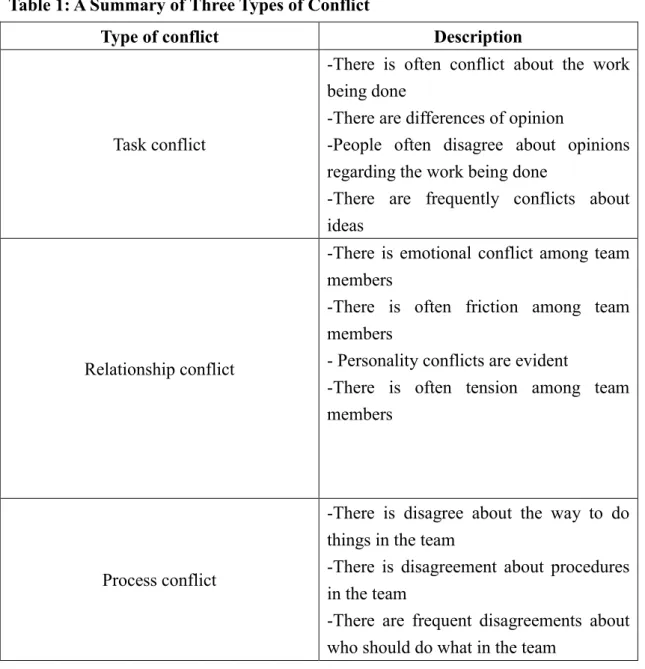
Generally speaking, there are three main types of conflict in organizations, task conflict, relationship conflict, and process conflict(Jehn, 1997).
Task conflict
According to the historical overview, conflicts about the task have been given various labels: cognitive conflict, substantive conflict, content conflict and realistic conflict. From recent studies about the definition of task conflict, Jehn (2014) states that task conflict are focused on disagreements among group members about the tasks being performed. Organizational employees describe these conflicts as “task problems,” “work conflict,” and “work disagreements”.
Task conflict refers to a clash between individuals about the direction, content, or goals of a work assignment. Task conflict is related with group performance. According to Jehn’ s (1995) study of intra-group conflict, the result showed that task conflict are not strictly linear with group performance, because there is an optimal level of task conflict in no routine-task groups. Jehn (1995) stated that high levels of conflict interfered with group performance, because of confusion over responsibilities and time management problems, while low levels of conflict were effectively for allocating resources and tasks. Later, Jehn (1997) argues that moderate task conflict generally improves group performance, but it can be dysfunctional when it includes strong negative emotion, such as anger, defensiveness, and perceptions that it is not resolvable. More recently, studies show that high task conflict and low task conflict have different outcomes for individuals in groups. For instance, high task conflict can lead to disagreements that may raise negative emotions such as resentment, anger, and aggression. On the contrary, low levels of task conflict have the most positive effect
on organizations by stimulating creativity, healthy competition, and critical thinking among the individuals discussing the various ways to approach a task (Neck, Houghton & Murray, 2017).
Relationship conflict
The concept of relationship conflict was initially introduced and defined as existing when there are interpersonal incompatibilities among group members (Jehn, 2014). Relationship conflicts involve disagreements among group members about interpersonal issues, such as personality differences or differences in norms and values (Wit, Greer & Jehn, 2012). According to Jehn’ s (1997) qualitative study of intra-group conflict, the results demonstrated that issues of relationship conflict were related with interpersonal relationships among coworkers, including problems that members had with others’ personalities or dispositions.
On one hand, relationship conflict has negative outcomes on organizations. The negative reactions associated with relationship conflict arouse uncomfortable feelings and dejection among members, which inhibits their ability to enjoy each other and their work in the group (Jehn, 1995). Similarly, Pelled (1996) states that relationship conflicts made organizations’ productivities decreased as perceived by team members. In addition, De Dreu and Weingart (2003) also mention that the effect of relationship conflict was detrimental to group performance and member satisfaction. In a recent paper, Meier et al. (2013) examine the effect of conflict among 131 employees from several organizations. The authors focused on the effects of relationship conflict on mood and the result provided evidence that relationship conflict was positively related to negative mood. Thus, their result confirmed that relationship conflict has negative effects on human beings.
Process conflict
Jehn (1997) did a qualitative analysis on conflict types and defined process conflict as the third type of conflict. Process conflict refers to conflict about how task
accomplishment should proceed in the work unit, who is responsible for what, and how things should be delegated. Process conflict includes disagreements about assignments of duties or resources. Jehn’ s (1997) data show that high levels of process conflict interfered with performance by allowing group members to work at cross-purposes, by creating inconsistencies in task roles in the group, and by generating time-management problems that sometimes resulted in failure to meet deadlines.
Thatcher et al. (2003) did a quantitative research on the three types of conflict among 144 teams from 55 different countries and they noted that the process conflict was negatively related to group spirit and performance.
Table 1: A Summary of Three Types of Conflict
Type of conflict Description
Task conflict
-There is often conflict about the work being done
-There are differences of opinion
-People often disagree about opinions regarding the work being done
-There are frequently conflicts about ideas
Relationship conflict
-There is emotional conflict among team members
-There is often friction among team members
- Personality conflicts are evident
-There is often tension among team members
Process conflict
-There is disagree about the way to do things in the team
-There is disagreement about procedures in the team
-There are frequent disagreements about who should do what in the team
Source: Adapted from Ayoko, Ashkanasy & Jehn (2014: 89)
2.6 Orientations to conflict: constructive/destructive
Deutsch (1973) is the first scholar to distinguish constructive and destructive conflict. Constructive conflict is a conflict with productive consequences. In other words, the participants are all satisfied with their outcomes and feel that they have gained as a result of the conflict. In contrast, destructive conflict is defined as a conflict with destructive consequences. In other words, the participants are dissatisfied with the outcomes and feel they have lost as a result of the conflict.
Weitz and Jap (1995) mention some of the benefits of constructive conflict:
Conflict can often act as a source of novelty for the relationship, forcing it into new terrain that, if handled successfully, can strengthen the interpersonal relationship and cultivate greater trust, communication and relationship satisfaction.
On the contrary, dysfunctional conflict usually hinders organizational performance and decreased productivity. This conflict orientation is characterized by competing individual interests over-riding the overall interest of the business. Frequently, managers withhold information from one another (Kinicki and Kreitner, 2008; Omisore and Abiodun, 2014). Furthermore, Deutsch (1973) states that in a destructive conflict process, individuals compete, trying to defeat others and ultimately there would be only a winner, that is, other parties will always lose something.
Nowadays, constructive and destructive conflicts are also known as functional and dysfunctional conflict.
When conflict is functional, it is mainly task oriented and focused on judgmental difference about how best to achieve common objectives (Brehmer, 1976; Cosier & Rose, 1977; Jehn, 1992; Amason, 1996). This type of conflict is also called cognitive conflict (Amason & Schweiger, 1994; Amason, 1996).
When conflict becomes dysfunctional, it tends to be emotional and focused on personal incompatibilities or disputes (Brehmer, 1976; Coiser & Rose, 1977; Jehn, 1992; Priem & Price, 1991; Riecken, 1952; Torrance, 1957; Amason, 1996).
2.7 Stages of conflict process
Pondy (1967) identified five stages of conflict process as follows: (1) Latent conflict (conditions):
This stage of conflict is marked by a potential tension between one or both sides, which have not evolved into a clear dispute. In latent conflict stage, there are tensions caused from a problem that is not fully defined and is known by some, but not all people who will be affected by the problem and participate in the dispute. Latent conflict is the stage where there is a potential for conflict because of three latent factors:
a. Competition for limited sources b. Drive autonomously
c. Target differences
(2) Perceived conflict (cognition):
Conflict is perceived when no latent conflict arises. This stage results from the parties misunderstanding each other’s true position. Such conflict can be resolved by improving communication between the parties.
(3) Felt conflict (affect):
Felt conflict is the stage where conflict parties are emotionally aware of the conflict, they feel anxious or stressful, and begin to think about strategies for handling conflict. There is an important difference between perceiving conflict and feeling conflict. For example, perceived conflict refers to a situation where A may feel that B and A are in disagreement on some things, but A may not feel anxious, and A’s feeling may not have any effect on B; while felt conflict means that both A and B perceive that there is a conflict and begin to formulate strategies about how to deal with the conflict
(4) Manifest conflict (behavior):
Manifest conflict refers to a stage where both parties have some behaviors to stimulate each other. The most typical behavior is open confrontation. Violence rarely exists in manifest conflict stage. The motivation of violence may remain but the parties prefer non-violent behaviors.
(5) Conflict aftermath (conditions):
The aftermath of a conflict may have positive or negative effect on the organization depending on how conflict is resolved. Conflict aftermath may be split into two kinds of conflict episodes: one is that the conflict is resolved and all participants are satisfied with it, the other is that the conflict is merely suppressed but not resolved correctly. This conflict stage is called conflict aftermath.
Rummel (1976) suggests that conflicts pass through five stages:
1. The initial conflict stage: parties hold different attitudes, which could lead to conflict. For example, differences in values, goals, and prospects set the stage for future conflicts.
2. During the initiation stage, some triggering event causes the parties to act. At this stage, the potential differences become the basis for conflict.
3. After the conflict has been initiated, the conflict moves into a stage of open conflict. In this third stage, parties assess each other’s capabilities and willingness to use force, threats, and rewards, and sometimes they attack and act in their own defense.
4. The settlement leads to a balance of power stage in which the participants come to understand the consequences of the resolution and learn to accept the outcomes.
5. Such evolving changes lead to a disruption stage. In this stage, the parties recognize that if a new trigger event happens, conflict and the final confrontation may happen again.
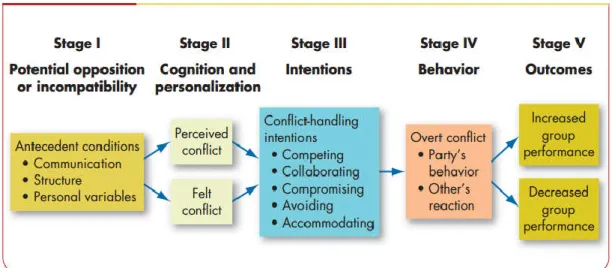
Robbins and Judge (2005) suggest five stages of conflict process: potential opposition or incompatibility, cognition and personalization, intentions, behavior, and outcomes. The diagram below shows the explanation of five stages of conflict process (Figure 1).
Figure 1: Conflict Process
Source: Robbins & Jugde (2005: 450)
According to this diagram, five stages of conflict process can be described as follows: Stage I: Potential Opposition or Incompatibility
The first step in the conflict process is potential opposition or incompatibility. This step is divided into three general categories: communication, structure, and personal variables.
Communication:
Obviously, an increase in communication is up to a point, after which it is possible to over-communicate, with an increase in the potential for conflict. Structure:
Structure includes some variables such as size of the group, degree of specialization in the tasks assigned to group members, jurisdictional clarity, member–goal compatibility, leadership styles, reward systems, and the degree of dependence between groups.
Personal Variables:
It refers to personality, emotions, and values.
Stage II: Cognition and Personalization
If the conditions in Stage I negatively affect something one party cares about, then the potential for opposition or incompatibility will come true in the second stage.
Individuals perceived and felt conflict in this stage.
Stage III: Intentions
We can identify five conflict-handling intentions: Competing:
When A seeks to satisfy his or her own interests regardless of the impact on B, it means that A is competing.
Collaborating:
When A and B all desire to fully satisfy the concerns of each other, there is cooperation and they search for a mutually beneficial outcome.
Avoiding:
A may recognize that there is a conflict and wants to suppress it. Accommodating:
A seeks to appease an opponent and may be willing to place the opponent’s interests above his or her own, sacrificing to maintain the relationship.
Compromising:
Both A and B intend to give up something.
Stage IV: Behavior
In Stage IV, conflicts become visible. The behavior stage includes the statements, actions, and reactions made by the conflicting parties, where they usually attempts to implement their own intentions.
Stage V: Outcomes
The outcomes of conflict may be functional or dysfunctional. If the conflict improves the group’s performance, the outcome will be functional; if it hinders performance, it will be dysfunctional.
Functional outcome:
Conflict is functional when it improves the quality of decisions, stimulates creativity and innovation, encourages interest and curiosity among group
members, released members’ tensions and resolves problems correctly. Dysfunctional outcome:
Members who are unsatisfied with the resolution of conflict may feel unhappy which may lead to the destruction of the group.
2.8 Conflict management techniques
In the field of conflict management strategy, the earliest and most influential experts were Blake and Mouton. They studied conflict from one-dimensional space to two-dimensional space. Blake and Mouton (1964) proposed a classification model of dealing with interpersonal conflict. They defined the abscissa as "caring people", and the ordinate is defined as "concerned with production", thus distinguishing between five conflicts management strategies: problem - solving, smoothing, forcing, withdrawal, and sharing.
Later, the five-factor model proposed by Thomas (1976) has also been widely influenced. He defined two dimensions to determine conflict strategies: to meet one own interests and to meet the interests of others. The desire to meet one own interests depends on the pursuit of individual goals with arbitrary or not arbitrary degree. The wish to meet the interests of other people’s desire depends on the degree of cooperation. On this basis, Thomas proposed five strategies to resolve conflicts: (1) Avoiding, neither satisfied with one own interests nor meet each other’s interests. Here, people try not to deal with the conflict;
(2) Forcing, that is to only consider their own interests, in order to achieve the goal and ignore the interests of others;
(3) Accommodation, that is, only consider other interests at the expense of one own interests;
(4) Cooperation, that is, as much as possible to meet the interests of both sides, to seek a win-win situation;
Rahim et al. (2002) developed the conflict management styles and stated that there are five specific styles of handling conflict (Figure 2). Descriptions of these styles are: (1) Integrating (high concern for self and others),
(2) Obliging (low concern for self but high concern for others), (3) Dominating (high concern for self and low concern for others), (4) Avoiding (low concern for self and others),
(5) Compromising (intermediate in concern for self and others. The diagram below can clarify these five styles of managing conflict.
Figure 2: Styles of Managing Interpersonal Conflict
Source: Rahim et al. (2002: 310)
This diagram presents five different styles of managing interpersonal conflicts:
(1) The integrating style indicates high concern for self and others. It involves collaboration between the parties that are willing to reach a mutual and acceptable solution through openness, exchange of information, examination and exploration of differences for arriving to a constructive solution that goes far beyond personal and limited visions of the problem.
(2) The obliging style, which suggests low concern for self and high concern for others, is also known as a style in bargaining dimension. An obliging person neglects
and sacrifices personal concern so to satisfy the concern of the other party. This style is associated with a non-confrontational element, which is characterized by minimizing differences and emphasizing common things to satisfy the other person’s concerns.
(3) The dominating style shows high concern for self and low concern for others. A dominant person maintains his rights and ignores the needs and expectations of others; he tries to defend what he thinks is the right personal position. This is a win-lose expression of compulsive behavior in order to win one’s position.
(4) The avoiding style indicates low concern for self and others. An avoiding person can neither satisfy their individual concerns nor satisfy others’ concerns. It is related with shirking responsibility and avoiding problems. This style often reflects the concerns of the parties involved in the conflict, and reject to admit or deny a conflict in public.
(5) The compromising style indicates intermediate concern for self and others. It shows that both sides are willing to accept or share solutions, and both sides are willing to give up something to make acceptable decisions. The compromise style may include differences, exchange concessions, or seek a quick middle ground. A compromise person or party is not a dominant or coercive. Similarly, a compromise party is more openly to solve a problem, not avoid people or parties, but try to be as an integrated person or find an alternative solution.
In addition, the diagram shows two dimensions of conflict management styles, which are problem solving dimension and bargaining dimension. A High-High use of the problem solving dimension indicates that it attempts to increase the satisfaction of the two parties by including a unique solution to the problem they can accept. A Low-Low use of the problem solving dimension show that the involved parties failed to face and solve their problems because focus on both sides are reduced. A High-Low use of the bargaining dimension indicates that you are trying to achieve a high level of self-attention and provide low satisfaction to other people’s concerns. A Low-High use of the bargaining dimension indicates an attempt to achieve the
opposite result. A positive score on a problem solving scale indicates a common gain, but negative scores indicate losses for both parties. In the bargaining dimension, a positive or negative score represents a gain (or lost) to one party but a lost (or gain) to the other party. Compromise is the intersection of the two dimensions, that is, a party has an intermediate level of concerns for own and others.
To sum up, this chapter reviews previous studies of conflict in organizations, the research is focus on conflict in small groups, including definitions of conflict, nature of conflict, different views of conflict, three types of conflict, two orientations of conflict, stages of conflict process and conflict management techniques.
Chapter Ⅲ Chinese business culture
Hofstede (2001: 9) defined national culture as the collective programming of the mind
that distinguishes the members of one group or category of people from others. Thus,
in order to understand the reason why conflict occurs, how people behave in Chinese organizations and what conflict management styles are adopted by Chinese employees, we should understand Chinese business culture first. This part introduces the Chinese business culture, including Hofstede cultural dimensions on China, Chinese “Guanxi” culture and the impact of Confucius theory on Chinese practices.
3.1 Hofstede cultural dimensions in China context
Hofstede (2011: 8) proposed six culture dimensions called “Hofstede cultural dimensions:
(1) Power distance, related to the different solutions to the basic problem of human inequality;
(2) Uncertainty Avoidance, related to the level of stress in a society in the face of an unknown future;
(3) Individualism versus Collectivism, related to the integration of individuals into primary groups;
(4) Masculinity versus Femininity, related to the division of emotional roles between women and men;
(5) Long Term versus Short Term Orientation,related to the choice of focus for people’s efforts: the future or the present and past;
(6) Indulgence versus Restraint, related to the gratification versus control of basic human desires related to enjoying life.
Each country has been positioned relative to other countries through a score on each dimension (Hofstede, 2011). However, researchers prefer Hofstede five-dimension
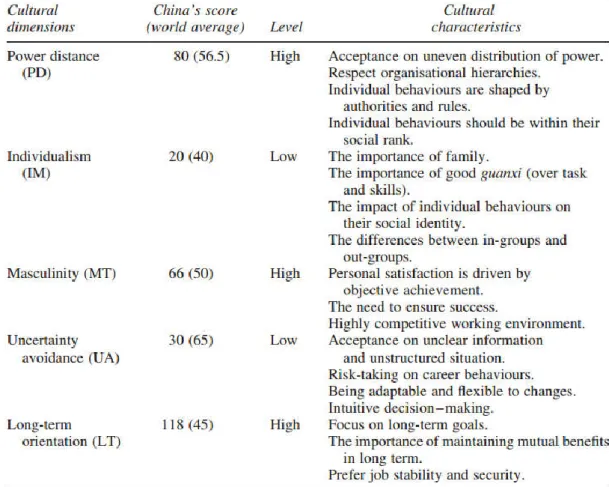
framework than six-dimension, because of its clarity, parsimony, and resonance with managers (Kirkman, Lowe & Gibson, 2006). In order to understand culture differences in China, Yao (2014) summarizes the Chinese culture characteristics using Hofstede’ s (1980) five cultural dimensions (Table 2).
Table 2: A Summary of the Chinese Culture Using Hofstede’s (1980) Cultural Dimension
Source: Yao (2014: 612)
According to table 2, the Chinese culture dimensions have these characteristics: High score in power distance. The power distance remains high in business and in society in general. This means that people are less willing to challenge authority which is likely due to old communism beliefs which still have a strong influence on people’s behavior.
Research shows that, in countries with large power distance culture, employees are unlikely to express their concern to colleagues and managers, because they try to avoid direct conflict with others. They believe that they should learn to be obedient in the workplace (Hofstede, 1991).
Scholars find that in countries with high power distance, the way in which people interact in organizations is affected by the interaction between employees and supervisors. People are less open to show their emotions or feelings, they usually hide their emotions when they face their supervisors and do not want to be treated directly in conflict situations (Huang et al., 2005). In a contextual simulation study of employee’s inhibition, Wei and Zhang (2010) found that the higher the tendency of employees to be distant from their supervisor, the more they are reluctant to express different objections to the decision-making of the superior.
Collectivist culture. Chinese businessmen tend to stay with the same partners or suppliers to keep loyalty and not deteriorate relationships. Lu et al. (2006) mentioned that countries with high collectivist culture emphasize obedience, harmony and coordination.
Studies show that in most collectivist cultures, direct confrontation of another person is considered rude and undesirable. For example, the word “no” is seldom used, because saying “no” is a confrontation; “you may be right” and “we will think about it” are examples of polite ways of turning down a request. At the same time, the word “yes” should not necessarily be inferred as an approval, since it is used to maintain the line of communication. Thus, culture is more often a source of conflict than of synergy (Hofstede, 2005).
High sore in masculinity. China is a masculine society. It means that promotion, money welfare and objective career success are more important than the success of subjective things, such as personal satisfaction (Briscoe, Hall & Mayrhofer, 2012). In
a highly competitive work environment, employees are willing to accept challenging work even if there is a personal/familial sacrifice.
Low score in uncertainty avoidance. Many scholars have different views on uncertainty avoidance dimension in China. Recent studies suggest that China is in the low score of uncertainty avoidance, which means that Chinese people are more disgusted with risk and tolerance of ambiguity (Hofstede, 2007; Fang, Zhao & Worm, 2008). However, other scholars highlight that Chinese people are flexible and easily adapt to changes in the new environment. For example, Shen (2006) stresses that Chinese companies do not have clear structure selection procedures and rarely provide training. However, this does not affect the effectiveness of staff in carrying out international missions.
High score in long-term orientation. Chinese people are focus on long-term orientation, such as stability and job security (Hofstede, 1980). Chinese employees also focus on long-term career goals rather than immediate benefits. For example, the Chinese people will not reject management’s decision because they are afraid that this may affect their future career opportunities. They also focus on maintaining long-term relationships, which provides mutual beneficial in the future (Shen, 2006).
3.2 Chinese Guanxi culture
Guanxi culture can be regarded as a typical and unique culture characteristic in China. The Chinese word "Guanxi" refers to networks of informal relationships and exchanges of favors that dominate business activity throughout China and East Asia. It is an ancient system based on personal relationships.
Guanxi is one of the major dynamics in the Chinese society where business behavior revolves around Guanxi. It is widely recognized that Guanxi is a key business determinant of firm performance because the life blood of the macro economy and the
micro business conduct in the society is Guanxi network (Luo, 1997).
Gong and Suzuki (2013) did a quantitative study about Guanxi actions in China and Japan, the results shows that collectivism has an important relationship with relationships, especially with close relationships. In the collectivism society, Guanxi determines who are in the group and who are out the group, and people’s attitude about the relationship between in-group and out-group is totally different. They share more long-term orientation, mutual trust, loyalty and reciprocity with members of the in-group than with members of the out-group. .Zhang and Pimpa (2010) also mention
that in collectivist societies, people only establish relations with reliable partner, and relationship orientation is only applicable to network of insiders, rather than network of outsiders. Thus, understanding Guanxi and establishing it as a foundation for business activities is a key in Chinese business culture.
To sum up, China is a country where business relations are highly socially embedded and Guanxi plays a pivotal role in the shaping and advancement of daily business operations. Specifically, in a business context, Guanxi occurs through individual interactions first; then it is applied on a corporate level (Gu, Hung & Tse, 2008).
3.3 The great impact of Chinese traditional culture on
Chinese business culture
Born 500 years before Christ, the great philosopher and teacher, Confucius, established the cultural foundation of China. Western culture respected individualism, the pursuit of personal goals and personal values, advocate fair, reasonable, competitive, whereas Chinese traditional culture respected collectivism, the pursuit of collective goals and collective values, advocate harmony, tolerance and moderation (Dai, 2007).
business culture. Chen (2000) concludes that the wheel of Equilibrium and Harmony proposed by Confucius has been running in the Chinese society for over two thousand years and continues to influence Chinese behaviors in the contemporary age. Rarick (2007) proposes that current managerial values, beliefs, and practices are strongly influenced by its Confucian tradition. Leadership under the Confucian tradition emphasizes a holistic concern for the welfare of employees, and harmony plays an important role in groups, teamwork, and self-sacrifice. At the same time, Confucian leaders are frugal and demand loyalty and dedication to the organization. They expect employees to work tirelessly for the good of the group, the organization, and the nation. Zakić (2010) noted that Confucianism is more about an act or a way of life. Confucianism also influenced the way China did business.
Some incidents happened in Chinese companies show that employees’ behavior and ideas for handling conflict are deeply affected by the impact of traditional Chinese culture. For example, Liu (2010) did a case study about conflict management in a Chinese oil company. He found that the Chinese traditional culture emphasizes “tolerance”, “moderation” and “harmony”, so employees usually choose to avoid conflict, rather than to use an open and direct way to show the conflict they experienced. Employees tried to control and constrain their emotions and behavior to transfer conflicts. Scholars' research shows that Chinese traditional culture emphasizes stability and harmony. In that case, employees usually held a negative attitude towards the positive effect of conflict.
Furthermore, Leung (1997) points out that the motivation behind the conflict avoidance is the nature of harmony. There are two motivations for maintaining harmony in Chinese society, one is to prevent the loss of relations, and the second is to promote the relationship between them. Driven by the first motivation, people maintain harmony as a means to protect themselves from the interests of self and thus avoid the conflict with others. On the contrary, if they are motivated by the promotion of relations, people want to build a long-term, mutually beneficial relationship, they
welcome rather than avoid the debate, so as to achieve the results of both sides satisfactory. Tjosvold and Sun (2002) state that conflict avoidance can be constructive when the relationship is already effective in China.
Researchers generally regard conflict avoidance as the influence of cultural values. For example, Friedman, Chi and Liu (2006) compared the conflict management styles between the Chinese and Americans in a specific conflict situation. The Chinese preferred to avoid the conflict because the Chinese were concerned with the relationship with others. In order to maintain interpersonal harmony, people decided to avoid conflict. Wei and Zhang (2009) analyzed people’s judgment and approaches of specific conflict situations, they use the social life situation simulation study, confirmed that in conflict situations, people concerned about interpersonal relationships rather than each other’s own opinions, because they believed that confrontation will destroy the relationship between each other, hence, they avoid conflict rather than direct conflict resolution.
However, with the development of Chinese society, some scholars argued that Chinese traditional culture have negative effects on Chinese business culture and conflict management styles. In fact, when employees avoid conflicts, they can not effectively solve the problem. Studies of Tjosvold, Hui and Ding (2003) found that conflict avoidance has a negative impact on team effectiveness and organizational citizenship behavior. For example, Lu et al. (2006) proposed that Chinese traditional culture emphasize moderation and obedience, thus, people pay attention to maintenance rather than development. It is true that harmony is beneficial for society. However, it encourages people to avoid conflict rather than deal with conflict. With the progress of the Chinese society, Chinese culture and people’s ideas had great changes, but if conflict handling styles has always been the avoidance and tolerance, in the long term, it will not only cause the break of emotional conflict, but also inhibit the cognitive conflict excitation.
In summary, this chapter reviewed previous studies of Chinese business culture and explained three sections in detail.
Chapter Ⅳ Methodology
This chapter presents the description of methodology of this thesis. The methodology chapter is composed of 7 sections: research strategy, research setting, data generation, interview participants, the nature of individual interviews, interpretation of the data and goodness and trust worthiness.
4.1 Research strategy
Case study
According to Yin (2009), case study refers to an empirical inquiry that studies a contemporary situation in depth and within its real-life context, particularly when the boundaries between phenomenon and context are not clearly. The case study method allows researchers to record the characteristics of real-life events, for example, small group behavior or organizational and managerial processes (Yin, 2009). Thus, in this thesis, in order to study conflict management in small work groups, case study is the most appropriate research method.
Advantages of case study
According to previous studies, there are many advantages of case study method. Researchers indicate that using case studies to analyze the detailed qualitative data not only help to explore the data in real-life environment, but also help to explain the complex real-life situations, which are better than other research methods (Zainal, 2007). Yin (2009) states that a unique advantage of case study is that it can deal with a variety of evidence, like artifacts, interviews, and observations.
Thomas (2016) argues that case study provides a rich picture with information from different angles of many insights and is a frame that offers a boundary. Case study is not only a research method, but also provides the direction of study and explains what
changes will happen to the research. Thus, readers can learn a lot from a case through the researcher’s narrative description (Stake, 2005). Shields (2007) also argues that case study is an ideological, methodological, epistemological and humanly research method, which can be regarded as the gold standard.
Disadvantages of case study
In spite of advantages, there are also some disadvantages of case study. In fact, case study received some criticisms. A common criticism of case study method is that it is difficult to reach a generalizing conclusion depending on a single case exploration making (Tellis, 1997). Yin (2009: 15) suggests that the “case studies provide little
basis for scientific generalization. ‘How can you generalize from a single case? ’ is a frequently heard question”. In addition, case study is often regarded as a
time-consuming research method, because it is difficult to conduct and producing a massive amount of documentation (Yin, 2009). In this study, the researcher adopted Thomas’ s (2011) definition of case study. Therefore, case study is defined as “analyses of persons, events, decisions, periods, projects, policies, institutions, or
other systems that are studied holistically by one or more methods. The case that is the subject of the inquiry will be an instance of a class of phenomena that provides an analytical frame—an object—within which the study is conducted and which the case illuminates and explicates” (Thomas, 2011: 513).
4.2 Research setting
In this research, a case study about team dynamics was studied in some Chinese organizations. From October 15th 2016 to December 1st 2016, the researcher went to four cities in China, including Guangzhou, Shenzhen, Bozhou and Fuyang. Guangzhou and Shenzhen come from Guangdong province, which are located in the southern part of China; Bozhou and Fuyang belong to Anhui province, which are located in the middle part of China. The researcher interviewed 2 teams in Guangzhou, they came from finance management and property agency sectors; 1 team in
Shenzhen, they came from manufacturing and production industry; 12 teams in Fuyang, they came from customer service, telecom, real estate and media & advertisement industry; 11 teams in Bozhou, they come from hotel, telecom products, cosmetics and retail industry. In total, 26 teams participated in the interviews.
In this study, the researcher investigated work teams in different types of companies in China, including private company, international company, government company and family company. These companies belonged to different sectors, such as finance, insurance, tourism, education, media, telecom, customer service, real estate management, property agency, advertisement and hotel. Permission to conduct this study was obtained in each company.
4.3 Data generation
The qualitative research was used in this study. There are many data gathering techniques of qualitative study, such as observations, interviews, audio materials and collections of different kinds of documents (Creswell, 2003). In this research, interviews were used to collect data. The emphasis was placed on the interview format, that is, semi-structured interviews with team members (Robson, 2002). In semi-structured interviews, themes to speak about are predetermined, but questions can be changed according to what the interviewees talk about (Sarma, 2012). Thus, during the interviews, the researcher used both predetermined and open interview questions. Opened questions were used to better understand what interviewees were saying, because the aim was to understand deeply what was going on when informants were working in their teams.
The purpose of qualitative research interview is to describe the meanings of events happened in the real-life world. Interviews aim to understand the meaning of what the interviewees say (Kvale, 1996). Interviews are useful for getting the story behind an interviewee’s experiences. In an interview, the interviewer can seek deep information
of the topic (McNamara, 1999).
4.4 Interview participants
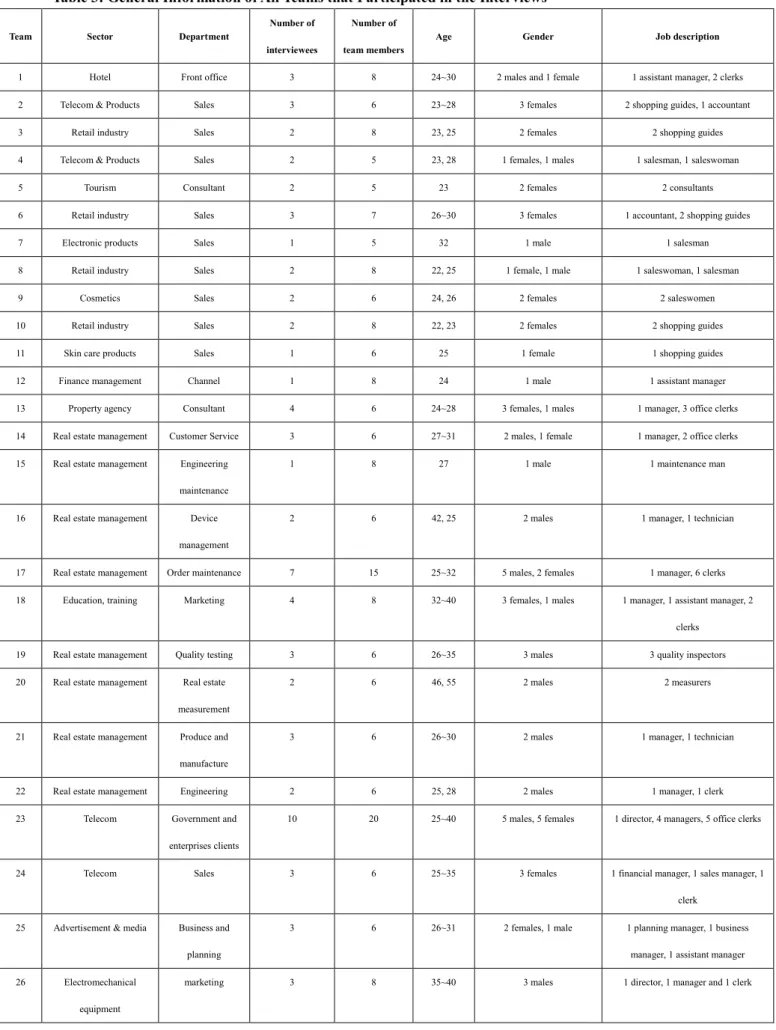
This study investigated 26 teams. 74 team members participated in the interviews and were interviewed separately.
Table 3 illustrates the socio-professional information of interviewees and teams that participated in this research.
Table 3: General Information of All Teams that Participated in the Interviews
Team Sector Department
Number of
interviewees
Number of
team members
Age Gender Job description
1 Hotel Front office 3 8 24~30 2 males and 1 female 1 assistant manager, 2 clerks
2 Telecom & Products Sales 3 6 23~28 3 females 2 shopping guides, 1 accountant
3 Retail industry Sales 2 8 23, 25 2 females 2 shopping guides
4 Telecom & Products Sales 2 5 23, 28 1 females, 1 males 1 salesman, 1 saleswoman
5 Tourism Consultant 2 5 23 2 females 2 consultants
6 Retail industry Sales 3 7 26~30 3 females 1 accountant, 2 shopping guides
7 Electronic products Sales 1 5 32 1 male 1 salesman
8 Retail industry Sales 2 8 22, 25 1 female, 1 male 1 saleswoman, 1 salesman
9 Cosmetics Sales 2 6 24, 26 2 females 2 saleswomen
10 Retail industry Sales 2 8 22, 23 2 females 2 shopping guides
11 Skin care products Sales 1 6 25 1 female 1 shopping guides
12 Finance management Channel 1 8 24 1 male 1 assistant manager
13 Property agency Consultant 4 6 24~28 3 females, 1 males 1 manager, 3 office clerks
14 Real estate management Customer Service 3 6 27~31 2 males, 1 female 1 manager, 2 office clerks
15 Real estate management Engineering maintenance
1 8 27 1 male 1 maintenance man
16 Real estate management Device management
2 6 42, 25 2 males 1 manager, 1 technician
17 Real estate management Order maintenance 7 15 25~32 5 males, 2 females 1 manager, 6 clerks
18 Education, training Marketing 4 8 32~40 3 females, 1 males 1 manager, 1 assistant manager, 2
clerks
19 Real estate management Quality testing 3 6 26~35 3 males 3 quality inspectors
20 Real estate management Real estate measurement
2 6 46, 55 2 males 2 measurers
21 Real estate management Produce and manufacture
3 6 26~30 2 males 1 manager, 1 technician
22 Real estate management Engineering 2 6 25, 28 2 males 1 manager, 1 clerk
23 Telecom Government and
enterprises clients
10 20 25~40 5 males, 5 females 1 director, 4 managers, 5 office clerks
24 Telecom Sales 3 6 25~35 3 females 1 financial manager, 1 sales manager, 1
clerk 25 Advertisement & media Business and
planning
3 6 26~31 2 females, 1 male 1 planning manager, 1 business
manager, 1 assistant manager 26 Electromechanical
equipment
4.5 The nature of individual interviews
In this study, the researcher adopted the critical incident technique to conduct the interviews.
Critical incident technique is often used to collect observations reported from memories. The purpose of interview is to ask people to recall real stories or events happened in their teams at work, the incidents can be positive or negative. Critical incident technique aims to obtain the necessary observations and assessments of specific behaviors from the records of those who are in the best position, rather than collecting opinions or researcher’s observations and estimations(Hughes, 2007; Chell, 2004; Flanagan, 1954).
In this study, informal conversations were used in the interviews. For example, if interviewees were in the company, the author went to the company with permission, have a coffee with the informant and ask some open questions; when it was not possible to meet the respondent, the interviews were made by phone, providing the same informal conversations.
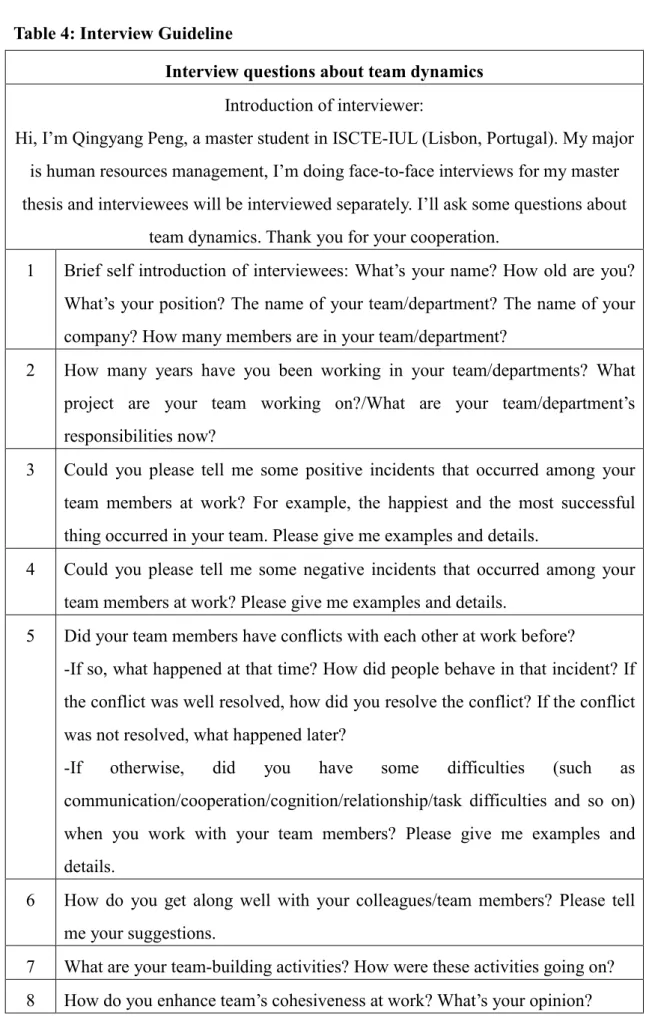
In summary, in order to get rich description of employees’ behaviors and interactions at workplace, to understand what happened when people had conflicts with each other and how they managed it, critical incident technique was used in the interviews. In this study, the researcher conducted 63 face-to-face interviews and 11 phone interviews. The durations of the interviews were between 10 minutes to 40 minutes.
Table 4: Interview Guideline
Interview questions about team dynamics Introduction of interviewer:
Hi, I’m Qingyang Peng, a master student in ISCTE-IUL (Lisbon, Portugal). My major is human resources management, I’m doing face-to-face interviews for my master thesis and interviewees will be interviewed separately. I’ll ask some questions about
team dynamics. Thank you for your cooperation.
1 Brief self introduction of interviewees: What’s your name? How old are you? What’s your position? The name of your team/department? The name of your company? How many members are in your team/department?
2 How many years have you been working in your team/departments? What project are your team working on?/What are your team/department’s responsibilities now?
3 Could you please tell me some positive incidents that occurred among your team members at work? For example, the happiest and the most successful thing occurred in your team. Please give me examples and details.
4 Could you please tell me some negative incidents that occurred among your team members at work? Please give me examples and details.
5 Did your team members have conflicts with each other at work before?
-If so, what happened at that time? How did people behave in that incident? If the conflict was well resolved, how did you resolve the conflict? If the conflict was not resolved, what happened later?
-If otherwise, did you have some difficulties (such as communication/cooperation/cognition/relationship/task difficulties and so on) when you work with your team members? Please give me examples and details.
6 How do you get along well with your colleagues/team members? Please tell me your suggestions.
7 What are your team-building activities? How were these activities going on? 8 How do you enhance team’s cohesiveness at work? What’s your opinion?
4.6 Interpretation of the data
In this research, content analysis technique was used to interpret interview data. All interviews were recorded. In total, 52 interviews were transcribed in Chinese, 20 interviews were transcribed from Chinese to English and 32 interviews were not fully transcribed because some interviews were not well recorded.
Krippendorff (2004) states that content analysis is a research technique that can be replicated and effectively inferred from text or other meaningful things to its usage Content analysis is a scientific and reliable tool which helps researchers to understand particular phenomenon or practical actions. Weber (1990) reviewed previous studies of content analysis and suggested that content analysis is a research method to make valid inferences from text. Content analysis method can be used for qualitative operations on texts and reveal the focus of individual, group or societal attention. Qiu and Zou (2004) argue that content analysis is a scientific research method. The reason is that from the philosophical point of view, through the analysis of objective information, researchers can have a correct understanding of the objective world. Hence, in this process, content analysis is a correct and effective analytical method that can be used in a variety of studies and researchers can see the nature of the phenomenon after using this method. Furthermore, the strength of qualitative content analysis is that the analysis is resolved into individual steps of interpretation which are determined in advance. Therefore, this method can be applied to other studies and regarded as a scientific method (Mayring, 2014).
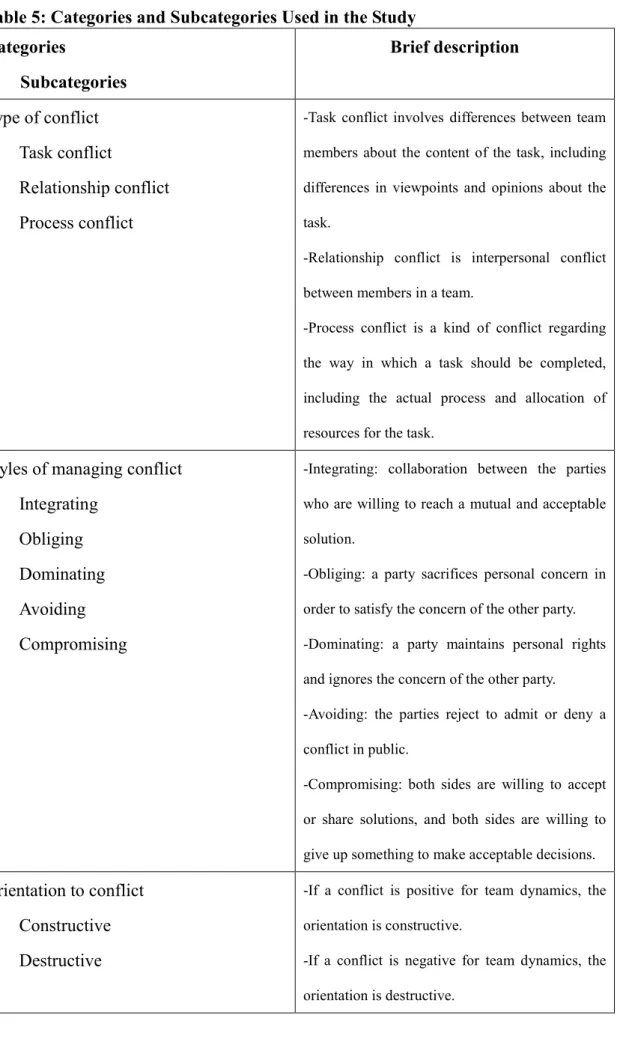
In content analysis, investigators should define the categories. Stemler (2001) states that content analysis method is a systematic, reproducible technique which can be used to compress many words into smaller categories that based on coding rules. Particularly, content analysis is very useful to handle large amounts of data. In this study, the categories were identified in the literature review presented in the previous chapter. Accordingly, three categories and respective subcategories were defined: (1)
type of conflict (task conflict, relationship conflict and process conflict), (2) orientation to conflict (constructive or destructive), and (3) styles of managing conflict (integrating, obliging, dominating, avoiding and compromising).
Table 5: Categories and Subcategories Used in the Study Categories Subcategories Brief description Type of conflict Task conflict Relationship conflict Process conflict
-Task conflict involves differences between team members about the content of the task, including differences in viewpoints and opinions about the task.
-Relationship conflict is interpersonal conflict between members in a team.
-Process conflict is a kind of conflict regarding the way in which a task should be completed, including the actual process and allocation of resources for the task.
Styles of managing conflict Integrating
Obliging Dominating Avoiding Compromising
-Integrating: collaboration between the parties who are willing to reach a mutual and acceptable solution.
-Obliging: a party sacrifices personal concern in order to satisfy the concern of the other party. -Dominating: a party maintains personal rights and ignores the concern of the other party. -Avoiding: the parties reject to admit or deny a conflict in public.
-Compromising: both sides are willing to accept or share solutions, and both sides are willing to give up something to make acceptable decisions.
Orientation to conflict Constructive Destructive
-If a conflict is positive for team dynamics, the orientation is constructive.
-If a conflict is negative for team dynamics, the orientation is destructive.