DOI 10.20504/opus2018c2406
. . .
CASTRO LIMA, Marcel; PITOMBEIRA, Liduino. Systemic Modeling of Camargo Guarnieri’s Ponteio n. 8. Opus,
Systemic Modeling of Camargo Guarnieri’s Ponteio n. 8
Marcel Castro Lima
(Universidade Federal do Estado do Rio de Janeiro – Rio de Janeiro, RJ)
Liduino Pitombeira
(Universidade Federal do Rio de Janeiro – Rio de Janeiro, RJ)
Abstract: Divided in three parts, this article demonstrates the process of Systemic Modeling of Ponteio n. 8 by Camargo Guarnieri as the basis for the composition of a work for solo violin by
Marcel Castro-Lima entitled Prelude. In the first part, Systemic Modeling will be presented with its theoretical assumptions and methodological phases. Then we propose the possibility of a Schenkerian Analysis in which Costère’s Acoustic Polarization offers a solution to the hierarchy problem, arising from the post-tonal environment of the analyzed piece. The analytical process is described in detail. Finally, we demonstrate the Compositional Planning process of Preludio, based on the Compositional System resulting from the modeling of Ponteio n. 8.
Keywords: Composition; musical analysis; Systemic Modeling; Schenkerian analysis; acoustic
polarization.
Modelagem Sistêmica do Ponteio n. 8, de Camargo Guarnieri
Resumo: Dividido em três partes, este artigo demonstra o processo de Modelagem Sistêmica
do Ponteio n.8, de Camargo Guarnieri, como base para a composição da obra para violino solo de Marcel Castro-Lima, intitulada Preludio. Na primeira parte, a Modelagem Sistêmica é apresentada com seus pressupostos teóricos e fases metodológicas. Em seguida propomos a possibilidade de uma Análise Schenkeriana na qual a Polarização Acústica de Costère oferece uma solução para o problema da hierarquia, decorrente do ambiente pós-tonal da peça analisada. O processo analítco é descrito em detalhes. Por último, demonstramos o processo de Planejamento Composicional de Preludio, a partir do Sistema Composicional resultante da modelagem do Ponteio n.8.
Palavras-chave: Composição. Análise musical. Modelagem Sistêmica. Análise schenkeriana.
his article deals with the methodological procedures related to the compositional planning of a piece for solo violin based on the Systemic Modeling of Camargo Guarnieri’s Ponteio n. 8. Divided into four parts the paper’s first part will define the concept of Systemic Modeling and explain its methodological procedures and phases. The second part will discuss the concepts related to two theories used in the analytical phase: Acoustic Polarization and Schenkerian Analysis. The third part deals with the Systemic Modeling of Ponteio n. 8 that consist of the concomitant application of the two theories discussed in part two. The fourth part will describe the Compositional Planning of Preludio, a new piece based on the Compositional System that resulted from the modeling of Guarnieri’s Ponteio. In addition to the description of the methodology used in the production of the new piece, it is our purpose to collaborate with the understanding of Camargo Guarnieri's compositional language within the scope of his Ponteios, as well as to provide practical experience with Systemic Modeling as a compositional tool. Moreover, from a theoretical point of view, an innovative analytical approach is proposed that resulted from the convergence of the Schenkerian Analysis and Acoustic Polarization.
Systemic Modeling
Systemic Modeling applied to music composition was inspired by an homonymous technique
used in the field of engineering1 with a purpose to understand the structure of a musical work. It
originated from the convergence of the Theory of Compositional Systems with the Theory of Intertextuality and is carried out basically through three methodological phases: (1) Parametric selection: selecting the parameters to be observed; (2) Analysis: revealing the structure of the work in terms of its objects and relations; and (3) Parametric Generalization: considering only the relations between objects. The result of this process is a model that consists of a set of relations between generic objects. Therefore, Systemic Modeling is fashioned from a series of procedures through which a particular musical work is analyzed and, through the observation of its structural principles and the behavior and interrelationships between its various musical parameters, a systemic model is proposed. This model is a hypothetical Compositional System from which a new work is planned and composed. The original work being modeled and the resulting new work share common intrinsic characteristics, albeit without, necessarily appearing alike on the surface. The role of the composer is determinant both during modeling, in choosing the parameters that will describe
the system, and later through Compositional Planning2 in choosing how the defined parameters in
the system will behave. In the field of music, the Compositional System was defined by Flávio Lima (2011: 62) as "a set of guidelines, forming a coherent whole, which coordinates the use and interconnection of musical parameters, for the purpose of producing musical works". Besides Lima (2011), the works of Fred Lerdahl (1988), and Robert Morris (1987) are also relevant for
establishing the concept of Compositional System3.
1 Bruno Mororó (2008: 87) states that "a model is defined as the simplified representation of a real system with the purpose of studying this system". Generally, a model consists of a physical model, called a prototype, and a mathematical model, which provides essential input and output information. The mathematical model also assists in the prediction of situations that are not contained in the model, being useful to establish the limits of the system. Systemic Modeling is applied in the examination of a musical work as an analogy to mathematical modeling and its purpose is to understand the structural principles observed in several musical parameters of a work, as well as the relations between the values associated to these parameters (MORAES, PITOMBEIRA, 2013: 4).
2 In our methodology, we consider that a Compositional System works at deep, archetypal musical levels, while the more superficial aspects are treated in a phase that we call compositional planning. In this planning phase, specific aspects not contemplated by the Compositional System are decided.
3 The concept of System itself is also in debt to Klir (1991) and Bertalanffy (1968), both examined in Lima’s dissertation written under the supervision of Pitombeira.
Lerdahl, in his paper Cognitive Constraints in Compositional Systems (1988) that attempts to demonstrate that the serial organization in Boulez’s Le Marteau Sans Maître is innocuous to the aural result of the work, demonstrates several cognitive limitations that would prevent us from perceiving this type of organization. To this end, Lerdahl offers a definition of Compositional System as being a set of rules (compositional grammar) that generates, through certain specifications, a musical text that will later be deciphered by the listener (hearing grammar). Lerdahl's proposal that a composition starts from a set of previously defined regulatory rules is particularly interesting to us. However, the concept of the Compositional System used by Lerdahl bears little relation to the concept we use in this work as his definition of Compositional System implies a more inclusive structure that consists of an entire musical production cycle of a piece, starting from the pre-compositional stage to the performance of the work by the interpreter and its perception by the listener.
Morris, in Composition with Pitch-classes (1987), proposes a compositional design that consists of a group of strategies for planning a work from operations performed in sets of pitch classes (transposition, inversion, retrogradation, etc.). This concept better approaches what we consider to be a Compositional System than Lerdahl’s idea. However, including specific objects, in addition to relations, makes Morris’s concept of Compositional Design closer to our concept of Compositional Planning, which constitutes a process of "reverse engineering" with reference to Systemic Modeling. Compositional Planning, like Systemic Modeling, is carried out in three phases. In the first phase, called Particularization, new objects are applied to the generic relations declared in the systemic model (or hypothetical Compositional System). In the second phase, called Application, objects are
applied in terms of surface parameters4; in the last phase, called Complementation, the parameters
not included in the Compositional System are considered by the composer5.
Systemic Modeling is an abstract type of intertextuality6 in that an original musical text is
understood in terms of its objects (lexical) and relations (syntax). These objects manifest themselves through musical parameters (pitches, durations, textures, etc.). Identifying a possible profile of a work is a fundamental procedure in Systemic Modeling, that is, the relationships between its basic objects. Such relationships are formally declared with the support of a set of definitions or through a computational algorithm. It is important to point out that Systemic Modeling operates exclusively at
the neutral7 level, that is, it does not attempt to identify poietic aspects and intentionality or the
historical context where these aspects have been developed, even less the esthesic aspect, in terms of listener consequences and reactions. What happens in practical terms is an aesthetic emptying of the original musical text which, through modeling, translates itself into a complex set of relationships. Subsequently, the level of proximity between the original text and the new text produced from Compositional Planning is verified, and the quality of this proximity is also consciously determined by the composer.
The theoretical bases of Systemic Modeling are the Theory of Intertextuality, particularly in its abstract aspect, and the Theory of Compositional Systems, as described by Lima (2011). However, Systemic Modeling has a distinct nature with respect to the way the latter author uses Intertextuality. The Compositional Systems developed by Lima determine how many and in what way various intertexts will be handled with the objective of composing a new work. The resulting
4 This phase is particularly important in the case of abstract objects such as melodic contours, inverted axes, or textural partitions, for example, that provides no information related to pitch.
5 During this phase, Compositional Planning based on a system that has only information related to the pitch parameter, will complement the information related to other parameters (duration, dynamics, timbre, etc.). 6 A comprehensive study of intertextuality applied to music can be found in Korsyn (1991) and Straus (1990). 7 The neutral, esthesic, and poietic levels are the three dimensions of music according to Jean Molino (NATTIEZ, 1990: 11-12).
material of this manipulation is elaborated during the Compositional Planning phase giving rise to a new work.
In Systemic Modeling, the Compositional System does not deal with the coordination of intertexts. The relationship between the original text (intertext) and the new text is deeper than it is in Lima’s work. What is mutual between the original text and the new text is the Compositional System itself, which generated the new work and could have hypothetically generated the original work. In this way, we try to elaborate a Compositional System that potentially contains in itself both the original work and the new work, in addition to an infinitely large number of musical possibilities: a kind of hypothetical compositional link, which, if taken to the last consequences, could unite in one Compositional System any two works of music. This idea is in line with Kristeva's statement that “all text is constructed from a mosaic of quotations; all text is the absorption and transformation of another text. Thus, any text is, in a sense, itself and another−or others−that preceded it” (KRISTEVA, 2005: 68).
Through the musical analysis and observation of the functioning and interrelationships between several musical parameters, it is possible, by generalizing these parameters, to propose a Compositional System that would be able to both regenerate the analyzed work and generate new works through new Compositional Planning. The first step in elaborating this system consists in generalizing the characteristics of the work, that is, we will consider the original text as a particular case of Compositional Planning derived from a hierarchically deeper structure: the Compositional System (MORAES; PITOMBEIRA, 2013: 6).
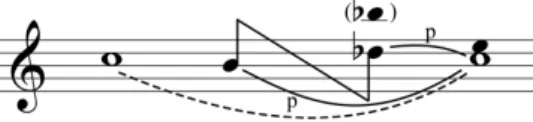
An important step in defining the system is what we call Parametric Generalization that basically consists of disregarding specific values for a given observed parameter, focusing exclusively on the relationship among its elements. Thus, in the example of Fig. 1, the analysis of an original text (a) reveals that the trichordal sonorities (b) are related by a geometric pattern, in which the extremities move in opposite directions parsimoniously around a fixed axis (D).
Fig.1: Example of Parametric Generalization.
Declaring the principle of symmetry without specific pitch values is a generalization. Applying other values that are guided by the same geometric pattern in which the extremities move in opposite directions parsimoniously (c) allows us to arrive at a new musical text (d) that is connected to the original text only regarding this aspect.
When Guarnieri, for example, incorporates elements of popular music into his Ponteios, he practices something that resembles Parametric Generalization. His music uses features of popular
rhythmic pattern of Afro-Brazilian dances, for example, in which the measure is divided by tempos of three and two eighths forming what is called a tresillo (3 + 3 + 2). In Ponteio 21, Guarnieri uses this aspect of Brazilian popular music in a generalized manner, dividing the bars asymmetrically with various combinations of tempos composed of three, or two eighth-notes (FIALKOW, 1995: 76). Another example is the use of parallelism in the melodies that originate from the parallel thirds of the Brazilian Toada. Fialkow (1995: 57) emphasizes this "use of thirds and other intervals that function as the vocal outline of the Toada. The use of the third is expanded to several other intervals [...] with the result of emphasis on the horizontal and parallel contour of the lines". The process of using intertexts in an abstract manner is common in Systemic Modeling.
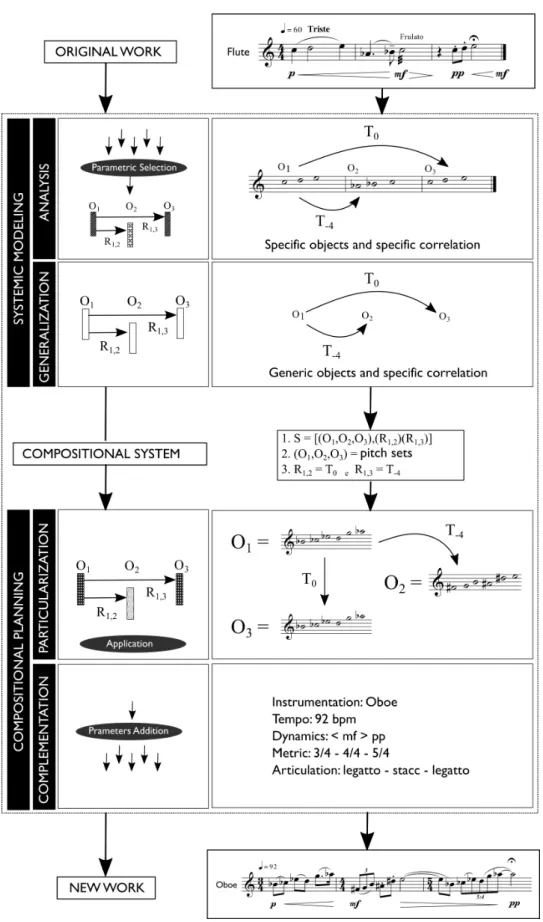
In Fig. 2, we observe the methodological phases of Systemic Modeling and Compositional Planning. In the first phase, we select the parameters (in this case, only pitch) and then we conduct the Analysis (second phase). In the last phase, Parametric Generalization, we deprive the musical objects of their specific values. A Compositional System model is then built, consisting of a series of definitions or a formal model (mathematical or computational) that has the potential to regenerate the analyzed work. Compositional Planning is divided into three phases: Particularization, Application, and Complementation. In the Particularization phase, we will assign new values to the previously generalized parameters to generate new musical material. Depending on the type of
parameter, the second phase (Application) must be performed8. Complementation consists of
adding parameters not contemplated in the modeling. In this phase the material generated by the system is manipulated by the composer and the musical surface takes its final form, giving rise to a new work.
In the case of the example in Fig. 2, during the analysis we only focus on the relationships between pitch segments, neglecting the other parameters (timbre, tempo, dynamics, metric,
articulation, ...) and conclude that the segments are related by transposition: O2 = T-4 (O1) and O3
= T0 (O1). One can observe in this conclusion that we perform a parametric generalization by
removing the melodic segments from their original values (pitches) conserving only the relation between them.
The systemic model or Compositional System to which we arrive in the example consists of a formal description of the relations between the three objects. This description consists of the following set of statements:
• S = [(O1, O2, O3), (R1,2, R1,3)]. Through this statement, we understand that the system consists of
three objects and two relations.
• (O1, O2, O3) = sets of pitches. This statement specifies the nature of the objects mentioned in
statement 1. Note that these sets of pitches are not specified in relation to cardinality or any other qualitative or quantitative characteristics.
• R1,2 = T-4 e R1,3 = T0. This definition specifies the type and magnitude of the relations, that is,
transposition relations of 0 and -4 semitones.
Composition Planning, therefore, begins from this model. In Particularization, we assign a
new pitch value to object O1. Through the relations described in the system, we obtain the pitches
of O2 and O3. In addition, we complement information of parameters that were neglected during
modeling. We decided, for example, that the passage will be written for oboe in a tempo of 92 bpm. We defined the rhythm, metric and articulation. This information, added to the pitches generated by the system, contributes to the creation of a new segment of music.
8 For example, if the parameter is contour, the segment would be chosen in the first phase (Particularization) and the pitch values would be chosen in the second phase (Application). If the parameter is pitch, as it is in the example of Fig. 7, the second phase is transparent.
Acoustic polarization and Schenkerian analysis
From here on, we will demonstrate the methodological phases of Systemic Modeling applied to Ponteio n. 8 by Camargo Guarnieri with the intent of planning and composing a new work for solo violin. We will explore Schenkerian analytical techniques applied to
post-tonal music9. In this case, we propose an analysis of the melodic line of Ponteio n. 8 based on
the Prolongation Principles of Heinrich Schenker (1868-1935) allied to the principles of Acoustic Polarization of Edmond Costère (1905- ). The resulting piece, Preludio by Marcel Castro-Lima, integrated a composer-performer project that was part of a doctoral thesis in
Music by violinist Elaine Bastos (2017) at Florida State University (USA)10.
Schenker's theory is formed by a series of principles that seek to explain the processes by which a basic structure extends through time. In the case of tonal music, Schenker proposes that the main triad of a work (the tonic) expands in time from a
fundamental structure11. The Schenkerian theory was originally designed to explain tonal
music of the eighteenth and nineteenth centuries, through principles of harmony and counterpoint.
That which is called "Schenkerian theory" is a complex set of regulatory principles that were initially intended to explain the tonal music of the eighteenth and nineteenth centuries; it is at the same time a synthesis of many traditions, embracing Fuxian counterpoint, the thorough-bass teaching of Carl Philipp Emanuel Bach and late nineteenth-century harmonic theory. It is at once a sophisticated explanation of tonality, but also an analytical system of immense empirical power (DRABKIN, 2002: 812).
Developments of Schenkerian theory advanced throughout the twentieth century
while adaptations to the contexts of popular12, pre-tonal13 and post-tonal music emerged. In
the case of post-tonal music, complications arise in relation to one of the basic principles of Schenkerian analysis: hierarchy. While in the tonal system hierarchy comes from the harmonic system itself, in post-tonal music each case must be evaluated, and the organizational principles of each work must be studied in order to identify structural elements and components of prolongation. In the case of Ponteio n. 8, we will attempt to elect the structural notes through principles of Acoustic Polarization.
Edmond Costère developed the theory of Acoustic Polarization as a potential universal theory of music to overcome differences of style and epoch through a physical-acoustic approach of harmonic relations.
9 Several papers deal with the use of principles of Schenkerian analysis in atonal repertoire (DIBBEN, 1999. LERDAHL, 1989, 1997. STRAUS, 1987. TRAVIS, 1966).
10 For this collaborative project, entitled “Collaboration between Composer and Performer: Four New Commissions from the Studio of Liduino Pitombeira”, four original works were composed from the Systemic Modeling of four of Guarnieri’s Ponteios.
11 Schenker proposes three forms for the fundamental structure, which consists of the inseparable combination of a fundamental line (Urlinie) and a bass arpeggio (Baβbrechung): [1] 3-2-1/I, [2] 5-4-3-2-1/ I-V-I, e [3] 8-7-6-5-4-3-2-1/ I-V-I (SCHENKER, 1977: 3-21).
12 Cf., for example, Drew Nobile's Ph.D. dissertation (2014), entitled A Structural Approach to the Analysis of
Rock Music.
13 Several works deal with the use of Schenkerian principles in pre-tonal repertoire (BERGER, 1980. JUDD, 1985. STERN, 1990).
Debating the profound transformations suffered by harmony in this century, in this work, Costère finds traces of kinship between the so-called "atonal" harmony and the harmonies of the previous epochs (modal and tonal) through acoustic and physical data that demonstrate clear similarity elements between seemingly distant or even antagonistic harmonic contexts, proving that, in reality, there was no death in harmony history and its different states of life, but rather transfigurations of these same states. Costère weaves his analyzes based on a phenomenon around which the history of harmony has lived and will live: the phenomenon of acoustic polarization. From this obviously physical terminology, Costère clearly exposes to us the almost inevitable greater attention that certain frequency require in a particular musical context, due to physical-musical factors that privilege such a note (MENEZES FILHO, 1987:65).
What we propose in the current analysis is the use of Costère’s principles of Acoustic Polarization as a determining factor in defining the prolongation relations in Ponteio n. 8’s melody. From Schenkerian Analysis, in addition to its theoretical assumptions, we will borrow its notation system and its concept of linear prolongation with a few modifications. In Schenker, linear prolongation consists of a sequence of melodic movements by step or half-step, in the same direction, within the same harmony (PANKHURST, 2008). We will employ this concept in a broader way, regardless of whether movement is in the same direction or not. Nor will the rule concerning the maintenance of harmony apply, since in this case, harmony is a determining factor.
The intent in this analysis, as well as in any Schenkerian analysis, is to identify the structural notes throughout the melody and how they are developed and extended to form the musical surface as it is. Hence, the opposite movement is made, i.e., it starts from the surface moving towards a deeper level; starting from the musical surface, one can identify the most important hierarchical notes and, through the rules of prolongation, the embellishment notes that only prolong the structural notes. The less important notes are then discarded so that one can more clearly observe deeper structural levels of the music in question.
Linear analysis, inherently tied to the concept of structural hierarchy, seeks to identify embellishments and elaborations on the surface of a musical work that serve to prolong more structurally significant objects—such as the tonic triad—to the extent that a stratified representation of the musical work emerges. This stratification offers a more complete picture of the melodic, harmonic, and contrapuntal forces at work and how they interact with other musical elements such as motive, texture, and form (HUFF, 2010: 2-3).
From Edmond Costère and his theory, we borrow the classification of musical intervals as either polar, neutral or nonpolar, according to their potential in a given context to accentuate the listening of one of the two constituent notes of the interval. Polar intervals, i.e., intervals that acoustically reinforce one of the pitches, would be the intervals
of P8, P5, P4, M7 and m214, respectively, the perfect octave as the exact double of the
frequency; the perfect fifth as the first natural harmonic after the octave; the perfect fourth as the inversion of the perfect fifth; the major seventh; and finally the minor second. These
intervals polarize the listening of a certain pitch because they are formed by the smaller distance within the temperament between a note and the reference note. The polarization in the major seventh and minor second intervals are perhaps most noticeable in a melodic context. What ultimately defines which of the two notes of the interval polarizes is the context.
In fact, all polar intervals are intervals that can polarize either of its two components, and this fact can only be clarified - that is, one of the two notes polarizes - among the musical context, depending on how the interval and other sound factors (such as intensity, melodic sequence, duration, etc.) come into play (MENEZES FILHO, 1987: 67).
The intervals of M3, m3, M6 and m6 are considered by Costère as neutral intervals, that is, they do not polarize a pitch (present or not in the interval). The nonpolar intervals, finally, are the A4, m7 and M2. These intervals have a repulsion power that directs the listening to another note that is not apparent in the interval. This would explain the presence of these intervals in chords of dominants: a perfect major triad becomes unstable with the addition of an m7, having, in addition to the minor seventh interval, the A4 interval between the third and seventh of the chord and M2 interval between the seventh and the eighth of the chord.
Acoustic Polarization will serve as a paradigm for electing the structural notes in the melody of Ponteio n. 8. Considering the classification of these intervals we propose that, in a melody, a structural note can be prolonged by a polar or neutral interval, producing a relation of hierarchy between two consecutive notes. In the case of a nonpolar interval, where none of the notes are polarized, there is a disruption, because a hierarchical relationship cannot be established.
Allen Forte suggests in his work on post-tonal music analysis (FORTE, 1955) that criteria such as duration, repetition, accent and unfolding are a means to support the identification of structural notes. In this way, when there are notes in our melody followed by polar intervals, we will use these guidelines as a criterion for defining which note is a prolongation and which note is structural.
Similarly, when there are notes followed by neutral intervals we propose that they are verticalized in a similar manner to that proposed by Schenker for arpeggio prolongations in the same direction within the same harmony. The argument here, however, is based on the acoustic properties of the interval and not on a harmonic assumption. In the case of notes followed by nonpolar intervals we assume this as a rupture and such notes cannot be related by prolongation.
Systemic Modeling of Camargo Guarnieri’s Ponteio n. 8
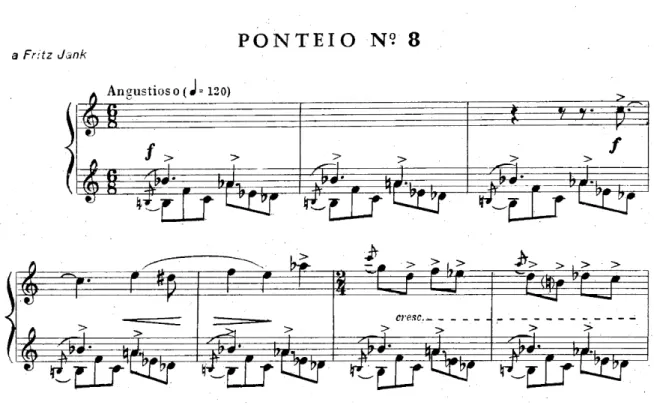
Ponteio n. 8 presents a melody over an ostinato with contrasting metrical characteristics from the beginning to the end. Its beginning measures are shown in Fig. 3. Considering the high degree of independence both metrically and harmonically between the melody and the ostinato, we chose to perform a prolongation analysis of only what we will call the melodic layer of Ponteio n. 8. This analysis is therefore partial and only intends to explore the possibility of applying Schenkerian Theory allied to the theory of Acoustic Polarization, and not offer an analytical solution for the work as a whole. The complete score of Ponteio n. 8 can be seen in Appendix 1.
Fig. 3: Beginning measures of Ponteio n. 8 by Camargo Guarnieri.
We propose, initially, to segment the Ponteio into three small parts. An initial section (c.1-7); a second section, the beginning of which is marked by a change of register in the melody, shifting to the left hand; and a third section (c. 43-55) that presents a re-exposition of the melody, appearing this time two octaves below in the left hand.
We will conduct a system-to-system analysis, identifying the structural notes according to the proposed methodology. In Fig. 4, the upper staff corresponds to the melodic layer as it was extracted from Ponteio n. 8 and the lower staff shows the analysis process. During the analysis, we will begin with the more hierarchically important white notes, then black notes with a stem, and finally only black notes without a stem. Prolongations will be indicated by a slur. LP designates, in the scope of this work, a linear prolongation. A single "p" designates a prolongation by a polar interval.
The melody begins with the note C (Fig. 4) represented as a structural note by a white note head. Next, there is the E, one level below, because it is a prolongation by a neutral interval (M3). Subsequently, there is a movement of a minor second lower to a D♯ (polar interval). In this way, the D♯ is a prolongation of E by a polar interval, which in turn, is a prolongation of C by a neutral interval. Next, there is an F at the beginning of bar 5 (strong beat) considered a structural note extended by a lower minor second. The A♭ in the
third beat is a minor second anticipation of the G in bar 615.
15 The criterion for deciding which of the two notes (A♭ or G) is structural was the metric, the G being in a more relevant position in the measure and the A♭ functioning as an anacrusis.
Fig. 4: Bars 1 to 6.
The G is prolonged by a polar interval (P4) to D. At this point, there is an unfolding of the melody in two voices. The upper voice performs a linear prolongation (melodic motion by step degree) to the note D at the beginning of bar 7 (Fig. 5). A similar type of unfolding occurs in bar 7. The lower voice's B is prolonged to the next bar and the upper voice performs a linear prolongation to the same B. The three chromatic steps starting from B (B♭, A, and G♯) are a prolongation of B by a polar interval. The next note is indicated as a level below, since it will be later verticalized with the B (m3) and performs a linear progression until returning to the B in bar 10. The following three notes are a polar prolongation of F♯ which in turn is a polar prolongation of C (P5).
Fig. 5: Bars 7 to 11.
From here there is a linear prolongation of C6 to the B in bar 13 (Fig. 6) followed by an unfolding of the note F♯ in measure 12 in a lower voice that anticipates the B in the next measure by a polar interval (P4).
Fig. 6: Bars 12 to 15.
In measure 15, there is a sequence of linear prolongations that take the note A to its equivalent in the lower octave three times, finally leading through a chromatic scale to the D♭ in bar 17, initiating the second section (Fig. 7).
Fig. 7: Bars 16 to 17.
The melody begins to present doublings that will be considered auxiliary notes in a way similar to what Schenker calls a shadow. It follows the same logic presented, until bar 19 (Fig. 8) where there is an arpeggio in C minor that will be verticalized. The result is a prolongation by intervals of P4 from the C through F leading to the B♭ in the next measure.
Fig. 8: Bars 18 to 21.
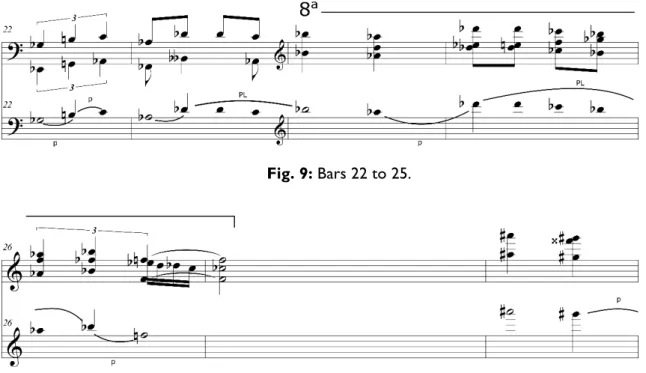
In bar 25 (Fig. 9) a new internal voice appears that does not move in parallel, like the shadow, but independently and chromatically. As they are always formed by minor second intervals, these internal melodies will be considered prolongations by a polar interval of one of the common doublings (shadows). Fig. 10 shows bars 26 to 28.
Fig. 9: Bars 22 to 25.
From bar 29 on, there is a complex section that requires closer appreciation (Fig. 11). Having an unfolding of the superior voice in notes E (c. 29) and C (c. 30), these notes are reached by P4, therefore neutral, and are a polar interval prolongation of B♯ and F# in the lower voice, which in turn performs a linear prolongation from the C♯ at the beginning of bar 29 to the D♯ in bar 31. Between this D♯ and the following note (A), the interval is d5, making it impossible to relate these two notes. Then, another unfolding follows with A anticipating G♯ and a chromatic movement from F♯ to G♯ in the lower voice.
Fig. 11: Bars 29 to 32.
From F♯ in measure 32, there is a prolongation by minor seconds to the F♮ in the next bar (Fig. 12), which in turn, in addition to being prolonged by the C, performs a linear prolongation to the C♯ in bar 34.
Fig. 12: Bars 33 to 35.
From bars 35 to 36 there is a large linear prolongation that leads to C♯, and another large linear prolongation that leads to C♯ (Fig. 13), then C♮ and B (Fig. 14). In measure 42, the initial melody in C returns two octaves below.
Fig. 14: Bars 40 to 43.
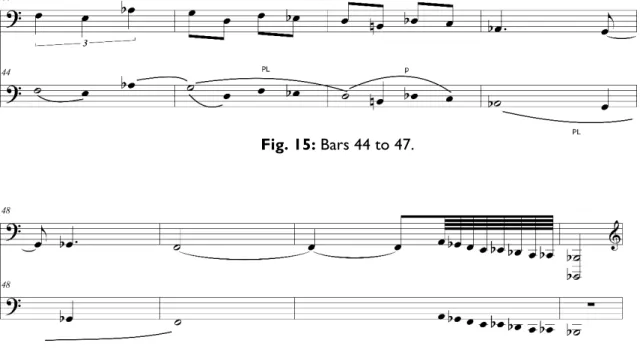
The analysis is similar up to bar 47 (Fig. 15). Instead of the linear prolongation that led to the B in the first section, there is a discontinuity with the A♭. From the A♭ there is a chromatic prolongation to the F (Fig. 16), and then a large linear prolongation to the B♭ in bar 51.
Fig. 15: Bars 44 to 47.
Fig. 16: Bars 48 to 51.
From bar 52 to the end, there is a small coda in which the E is linearly prolonged through an incomplete symmetric whole tone scale (E, G♭ B♭, and C). Next, there is a descending chromatic prolongation from E to D♭ (Fig. 17).
The resulting reduction that follows the analysis is shown in Fig. 18. Each staff consists of a section. After the reduction, we applied the criteria once more to identify the structural notes for an even deeper observation. At this level, we observe prolongation features based mainly on P4 intervals, as well as symmetrical features. A structural logic emanates from this reduction in a manner we would not perceive on the musical surface as a whole.
Fig. 18: First reduction results.
Following the same procedure, we eliminated the prolongation notes arriving at the structure shown in Fig. 19. The numbers above the notes identify the measure where the structural note is located. We conclude by these reductions that the first section is divided in two: a prolongation of C and an extension of B. The third section, which re-exposes the beginning of the melody, is also divided in two: a prolongation of C (recapitulation of the melody) and a prolongation of E (coda). The central section consists of a large prolongation
of D♭. In b1, however, there is a slope to the major sixth of D♭, that is, B♭. And in b2 the
structure of the melody returns to D♭ (C♯).
If we had explored deeper into one more level, we would have the elemental structure of the entire melodic layer of Ponteio n. 8 as shown in Fig. 20. The first section consists of a prolongation of C and a prolongation of B. The second section would be a prolongation of D with an inclination to B♭. The third section would be a prolongation of C with an inclination to E in the coda. If we consider the main notes, there would be a double chromatic surround of C, notably the structurally more important pitch of the melody.
Fig. 20: Elemental structure of Ponteio n. 8’s melodic layer.
Compositional planning of Preludio
From the analysis of Ponteio n. 8, we generalize certain parameters to elaborate our Compositional System that serves as the starting point for the planning of a new work: Preludio, for solo violin. The Compositional System resulting from the modeling of the Ponteio n. 8 comprises both a melodic layer and an overlapping ostinato layer, as it occurs in Ponteio n. 8. The Compositional System consists, then, of the following definitions:
(1) A melodic layer should be composed through prolongation by polar or neutral intervals of the structural notes present on one of the reductions shown in Figs. 18, 19 and 20 (such
a decision is made during Compositional Planning)16;
(2) Throughout the entire length of the piece, an ostinato must coexist with the melodic layer. This ostinato can consist of a rhythmic or melodic figure.
To conduct the Compositional Planning of Preludio’s melodic layer based on the modeling of the melodic layer of Ponteio n. 8, we will use the first reduction (Fig. 18). The ostinato layer will be generalized more freely, determining only that there must be some type of ostinato overlapping the melodic layer.
The melodic layer was composed from the structural notes apparent in the reduction, adding new notes from prolongations by polar and neutral intervals, as seen in the analysis. Here, however, we observe the opposite path to that of the analysis, in which the structural notes were identified by means of the principles of prolongation. At this point, we will start from the structural notes and, from the prolongation principles, we will compose the new melodic layer. This new melodic layer and the melodic layer of Ponteio n. 8 share a deep structural similarity, since a Schenkerian analysis (in the presented models) of the two melodies can produce the same result.
With respect to the formal structure, we have maintained the formal relationship between the result of the Schenkerian reduction and the structure of Ponteio n. 8, i.e., a
ternary form of type A, B with subsections b1 and b2, and A'. As the new work will be
composed for solo violin, it is necessary to review the register of the structural notes in the
16 It is important to note that both the first (Fig. 18) and second reductions (Fig. 19), as well as the last reduction (Fig. 20) could be used for Compositional Planning. These figures show a decreasing level of superficiality. While the use of the former implies a general structure closer to that of Ponteio n. 8, as far as the melodic layer is concerned, the use of the latter would bring broader possibilities of development because of the greater degree of generalization.
reduction. So that no notes exceed the range of the violin, it is necessary to reallocate some
notes an octave above, as it is the case of the notes in the sections b1 and A '. Fig. 21 shows
both the basic structure with the notes to be prolonged and the relationship between them and the formal structure.
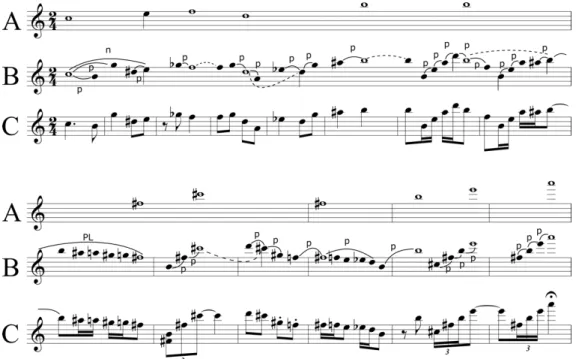
Fig. 22 illustrates the way in which the structural notes were prolonged, giving rise to the new melodic layer in A. In the figure, there are groups of three guidelines: A, B and C, where A is the staff containing purely structural notes, B illustrates the prolongations and notes to be used in the melody, and C, contains the final melody that was used in the new
melodic layer. Prolongation procedures for the entire piece can be found in Appendix 2. The
notation used to indicate the prolongations is the same as that used in the analysis of Ponteio n. 8, that is, p for Polar Interval, n for Neutral Interval and LP for Linear Progression.
Fig. 21: Basic structure for the melodic layer of Preludio, with its structural
notes and formal structure.
Fig. 22: Prolongation procedure of structural notes by polar and neutral intervals that gave rise to
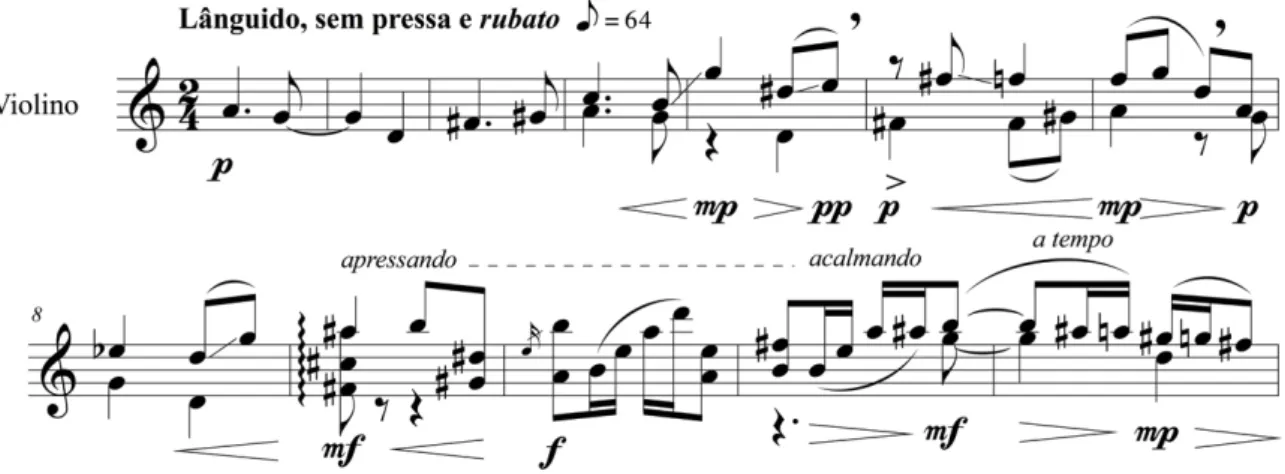
The result of overlapping the layers gives rise to the final musical material of Preludio. Fig. 25 illustrates the first measures of the piece and the way the ostinato overlaps the melodic layer. The full score is given in Appendix 3.
Fig. 23: Ostinato, used in sections A and A’.
Fig. 24: Example of the Ostinato used on sections b1 and b2.
Fig. 25: First measures of Preludio.
Final thoughts
Having implications in several areas because of the multidisciplinary nature of Systemic Modeling, we must consider the results according to four aspects: (1) the results of the Schenkerian Analysis combined with an Acoustic Polarization approach; (2) the practical aspects of Systemic Modeling with the peculiarities of the case studied in this article; (3) the results observed in the Preludio’s Compositional Planning regarding the prolongation of the structural notes by polar intervals; and (4) the theoretical and aesthetic implications of the use of Systemic Modeling for the composition of Preludio.
We consider the results of the analytical methodology applied quite revealing, recalling that it was only applied to a supposed melodic layer of Ponteio n. 8 and, therefore, considered only in that scope. After strictly following the rules determined a priori for identifying the structural notes and prolongations by polar and neutral intervals, we have reached a result that confers unity and structural logic to the entire melodic layer of the piece, as can be observed in Fig. 25. We think that future analytical studies applied to a wider scope of works should be conducted to
observe whether the association between acoustic polarization and Schenkerian analysis could offer a solution to hierarchical issues in post-tonal prolongation.
Regarding the modeling of the work, a relevant factor was the choice of the final object of the analysis, which was elected for our Compositional Planning. It is characteristic of the Schenkerian Analysis process to gradually deepen the analysis of the structure of a work, generating several levels of reduction from the surface to its basic structure (denominated Ursatz). These various levels all have potential to be used in Compositional Planning, i.e., several analytical scenarios were available in the Compositional System. We can observe, for example, the structures shown in Figs. 18, 19 and 20 at different levels of depth. Any one of them could have served as the starting point for Compositional Planning. It is important to emphasize that the more superficial the analysis stage, the greater the proximity of the original work. If we had used the most elementary structure, shown in Fig. 20, we would have a wider range of development possibilities than the one shown in Fig. 18, which was used in the Compositional Planning of Preludio. The option of Fig. 18 is justified precisely because we desired to preserve some of its structural elements, without making it unfeasible, however, to use the other two situations or even others not presented.
Although it was not our intention to reveal the composer's creative intention, i.e., even without claiming that Ponteio n. 8 was composed by Guarnieri from the prolongation of structural notes by polar and neutral intervals, this compositional tool proved to be quite effective. We believe that it can offer coherence to a melodic structure in its development from a more basic structure. Being the intention of Systemic Modeling, the tools developed or resulting from the analytical process can be incorporated in the repertoire of the composer’s creative tools.
Systemic Modeling, as it was introduced in this article, considering its theoretical framework and its methodological procedures, has proven to be a helpful methodology, especially with respect to its main objectives: (1) to generate compositional materials from a Compositional System; and (2) to produce relevant analytical information on the modeled work. In addition, Systemic Modeling presents itself as a new possibility of Intertextuality, which we call Abstract Intertextuality, and deepens the concept of Compositional System.
References
BERGER, Karol. Tonality and Atonality in the Prologue to Orlando di Lasso's Prophetiae Sibyllarum: Some Methodological Problems in Analysis of Sixteenth-Century Music. The Musical Quarterly, v. 66, n. 4, p. 484-504, Oct. 1980.
BERTALANFFY, Ludwig von. General System Theory: Foundation, Development, Application. New York: George Braziller, 1968.
DIBBEN, Nicola. The Perception of Structural Stability in Atonal Music: The Influence of Salience, Stability, Horizontal Motion, Pitch Commonality, and Dissonance. Music Perception, v. 16, n. 3, p. 265-294, 1999.
DRABKIN, William. Heinrich Schenker. In: CHRISTENSEN, Thomas (Ed.). The Cambridge History of Western Music Theory. Cambridge: Cambridge University Press, 2002. p. 812-843.
FIALKOW, Ney. The Ponteios of Camargo Guarneri. The Peabody Institute Johns Hopkins University, 1995.
FORTE, Allen. Contemporary Tone-Structures. New York: Bureau of Publications, Columbia Univ. Teachers College, 1955.
HUFF, David. Prolongation in Post-Tonal Music: A Survey of Analytical Techniques and Theoretical Concepts with an Analysis of Alban Berg’s op. 2, nº 4, Warm die Lüfte. Dissertation (Master’s). University of North Texas, 2010.
JUDD, Cristle Collins. Some Problems of Pre-Baroque Analysis: An Examination of Josquin's 'Ave Maria... Virgo Serena'. Music Analysis, v. 4, n. 3, p. 201-227, 229-239, Oct. 1985.
KLIR, George. Facets of Systems Science. New York: Plenum, 1991.
KORSYN, Kevin. Toward a New Poetics of Musical Influence. Music and Analysis, v. 10, n. 1/2, p. 3-72, 1991.
KRISTEVA, Julia. Semiótica: introdução à semanálise. 2nd ed. São Paulo: Perspectiva, 2005.
LERDAHL, Fred. Generative Processes in Music: The Psychology of Performance, Improvisation and Composition. Clarendon Press. Oxford, 1988.
______. Atonal Prolongational Structure. Contemporary Music Review, v. 4, p. 65-87, 1989.
______. Spatial and Psychoacoustic Factors in Atonal Prolongation. Current Musicology, n. 63, p. 7-26, Fall 1997.
LIMA, Flávio. Desenvolvimento de sistemas composicionais a partir da intertextualidade. Dissertation (Master’s in Music). UFPB, João Pessoa, 2011.
MENEZES FILHO, Flô. Apoteose de Schoenberg: ensaios sobre os arquétipos da harmonia contemporânea. São Paulo: Editora da Universidade de São Paulo, 1987.
MORAES, Pedro Miguel; PITOMBEIRA, Liduino. Composição do Ponteio Nº 5 de Pedro Miguel a partir da Modelagem Sistêmica do Ponteio nº 15 de Camargo Guarnieri. Música Hodie, v. 13, p. 8-33, 2013.
MORORÓ, Bruno. O. Modelagem sistêmica do processo de melhoria contínua de processos industriais utilizando o Método Seis Sigma e Redes de Petri. Dissertation (Master’s of Engineering). PUC, São Paulo, 2008.
MORRIS, Richard. Composition with Pitch-classes: A Theory of Compositional Design. New Haven: Yale University Press, 1987.
NATTIEZ, Jean-Jacques. Music and Discourse: Toward a Semiology of Music. Princeton: Princeton University Press, 1990.
NOBILE, Drew. A Structural Approach to the Analysis of Rock Music. New York: Cuny Academic Works, 2014.
PANKHURST, Tom. SchenkerGUIDE: A Brief Handbook and Web Site for Schenkerian Analysis. New York: Routledge, 2008.
SCHENKER, Heinrich. Free Composition. Transl. Ernst Oster. New York: Pendragon Press, 1977. STERN, David. Schenkerian Theory and the Analysis of Renaissance Music. In: SIEGEL, Heidi (Ed.). Schenker Studies. Cambridge: Cambridge University Press, 1990. p. 45-59.
STRAUS, Joseph. The Problem of Prolongation in Post-Tonal Music. Journal of Music Theory, n. 31, v. 1, p. 1-21, Spring 1987.
______. Remaking the Past: Musical Modernism and the Influence of the Tonal Tradition. Cambridge: Harvard University Press, 1990.
TRAVIS, Roy. Directed Motion in Schoenberg and Webern. Perspectives of New Music, v. 4, n. 2, p. 85-89, Spring-Summer 1966.
. . .
Marcel Castro Lima holds a bachelor's degree in orchestral conducting from UFRJ, a master's
in music from UFRJ under the guidance of Liduino Pitombeira, and presently is pursuing a doctorate in music from UNIRIO under the guidance of Daniel Quaranta. He is first place winner of the IV National Composition Competition of UFRJ in 2016, the OPUS 1 competition promoted by the Philharmonic Orchestra of Goiás in 2017, and third place winner in the V National Composition Contest promoted by UFRJ in 2018. Lima has works presented and published at
ANPPOM, the Colloquium of Research at UFRJ, and at UNIRIO. [email protected]
Liduino Pitombeira (Brazil, 1962) is a professor of composition at the School of Music of the
Federal University of Rio de Janeiro (UFRJ). His works have been performed by various groups in Brazil and abroad. He has received several awards in composition contests in Brazil and the United States. Pitombeira received his PhD in composition from the Louisiana State University (USA) where he studied with Dinos Constantinides. He has published several scientific articles on composition and theory and developed research as a member of the MusMat group of UFRJ. These articles are available at: https://ufrj.academia.edu/LiduinoPitombeira. His pieces are published and recorded in Brazil and abroad. For more information visit: