1 FUNDAÇÃO GETÚLIO VARGAS ESCOLA BRASILEIRA DE ADMINISTRAÇÃO
PÚBLICA E DE EMPRESAS
Key Success Factor Ranking for Intrafirm Knowledge Sharing: A Delphi Method Approach in the Oil and Gas Industry
THASSIA CONCEIÃO ALMEIDA DA SILVA Rio de Janeiro, 2017
2 FUNDAÇÃO GETÚLIO VARGAS ESCOLA BRASILEIRA DE ADMINISTRAÇÃO
PÚBLICA E DE EMPRESAS
THASSIA CONCEIÇÃO ALMEIDA DA SILVA
Key Success Factor Ranking for Intrafirm Knowledge Sharing: A Delphi Method Approach in the Oil and Gas Industry
RIO DE JANEIRO - RJ 2017
Master Thesis submitted to the Brazilian School of Public and Business
Administration in partial fulfilment of the requirements for the degree of Master of Science in Administration.
3
Ficha catalográfica elaborada pela Biblioteca Mario Henrique Simonsen/FGV
Silva, Thassia Conceição Almeida da
Key success factor ranking for intrafirm knowledge sharing: a Delphi method approach in the oil and gas industry / Thassia Conceição Almeida da Silva. – 2017.
85 f.
Dissertação (mestrado) - Escola Brasileira de Administração Pública e de Empresas, Centro de Formação Acadêmica e Pesquisa.
Orientador: Luiz Antonio Jóia. Inclui bibliografia.
1.Gestão do conhecimento. 2. Aprendizagem organizacional. 3. Indústria petrolífera. 4. Delphi, Método. I. Jóia, Luiz Antonio. II. Escola Brasileira de
Administração Pública e de Empresas. Centro de Formação Acadêmica e Pesquisa. III. Título.
5 ACKNOWLEDGEMENTS
I would like to first and foremost thank God for such an amazing opportunity that has had ramifications in both my personal and professional life. I dedicate this master thesis to my parents and sisters for always seeing something in me that I did not see in myself, for always saying the right words of comfort or even discomfort whenever necessary. To my hero dad, let this be the beginning of amazing things that are yet to come.
To my wonderful adviser, Professor Joia, a good teacher explains, a great teacher inspires. You have inspired me! This would not have been possible without your guidance, patience and incredible advice. I will forever carry you in my heart as I head towards fulfilling my dreams.
To the participants who fought through with me to answer my questionnaire, this research would not have been possible without your dedication.
To Mariela and Jinlong, your experience and time have been beyond valuable in getting this project operationalized. Without you, certainly I would not have gotten as far as I did as fast as I did. I really appreciate all you both did!
To Celene, a truly special person with a heart of gold and a spirit to serve, none of us at EBAPE would survive a day without you. You dedicate yourself to each one of us in such a special way, even if we all do not say it: THANK YOU!
To Professor Fabio, an amazing coordinator that really believes in what he does and does it whole heartily, thank you for your encouraging words!
To my truly amazing brilliant professors, you have changed me, pushed me and encouraged me to go beyond my own limitations.
Once again, thank you, thank you, thank you!
6 ABSTRACT
Knowledge and its propagation are unquestionably at the center of most, if not all,
discussions on innovation, performance, as well as other elements related to firm success. Although the literature has proposed several key success factors for knowledge sharing, it has yet to explore how these factors rank in terms of importance from a firm nationality
perspective. Through a Delphi Method approach, upstream professionals from four major multinational Oil & Gas firms (Brazilian, North American, Norwegian and French), with at least seven years of experience, ranked specific literature-based proposed factors for
successful intrafirm knowledge sharing. There was a total of three rounds, where the first round had 41 participants, and the remaining two rounds (second and third) had 39 participants. On average, open door policy was the most relevant factors that lead to knowledge sharing among the four firms. In terms of the least relevant ones,
acknowledgement and status were seen, on average, as factors less likely to lead to intrafirm knowledge sharing.
7 FIGURES
Figure 1 – A Three Round Delphi Method Process……….………..27
Figure 2 – Delphi Research Process-Expert Group Analysis………28
TABLES Table 1 – Success Factors and Supporting Literature……….24
Table 2 – Interpretation of Kendall’s W………..32
Table 3 – Interpretation of Kendall’s W p-value……….33
Table 4 – Delphi Panel Participants: Educational Background and Firm Nationality Breakdown………...34
Table 5 – First Round Antecedent Evaluation………35
Table 6 – First Round Rank Based on Average Scores……….36
Table 7 – Second Round Delphi Statistics………..37
Table 8 – Second Round Overall Key Factor Rank………38
Table 9 – First & Second Round Convergence Check………38
Table 10 – Third Round Delphi Statistics………...39
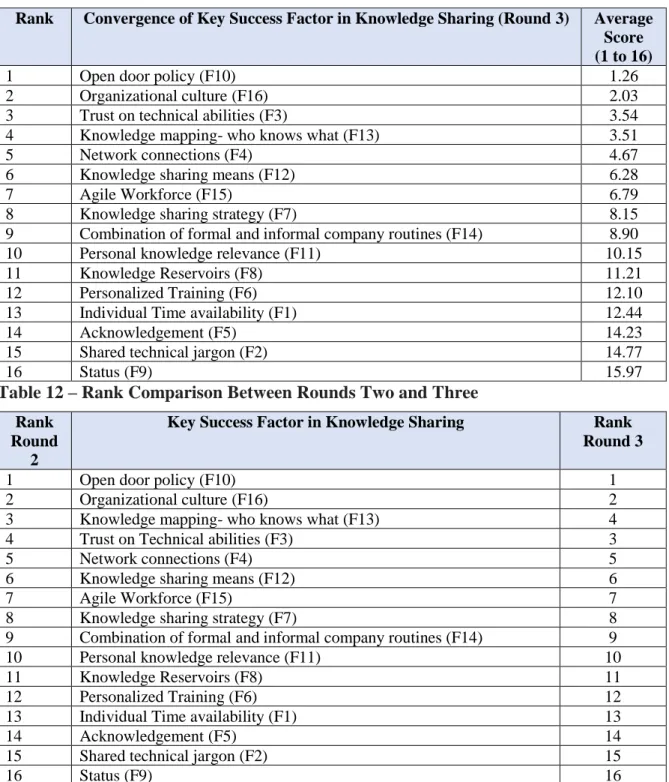
Table 11 – Third Round Overall Key Factor Rank……….40
Table 12 – Rank Comparison Between Rounds Two and Three………40
Table 13 – Second & Third Round Convergence Check………41
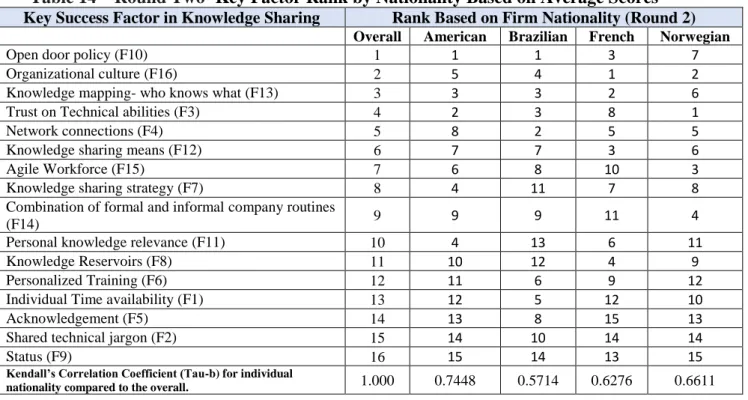
Table 14 – Round Two- Key Factor Rank by Nationality Based on Average Scores………42
Table 15 – Round Three - Key Factor Rank by Nationality Based on Average Scores…….43
Table 16 – Third Round—W Value Based on Firm Nationality………44
Table 17 – Kendall´s Correlation Coefficient (Tau-b)—Third Round Comparisons Between Firm……….44
Table 18 – Second & Third Round Convergence Check Based on Firm Nationality………44
Table 19 – Comparing Rounds Two and Three Rankings (American Firm)………..50
Table 20 – Comparing Rounds Two and Three Rankings (Brazilian Firm)………...52
Table 21 – Comparing Rounds Two and Three Rankings (French Firm)………...53
Table 22 – Comparing Rounds Two and Three Rankings (Norwegian Firm)………....54
8 TABLE OF CONTENT
1. INTRODUCTION……… 9
2. LITERATURE REVIEW………... 10
2.1 KNOWLEDGE SHARING (KS)……….12
2.2 FACTORS INFLUENCING KNOWLEDGE SHARING………...14
2.3. SUCCESS FACTORS IN TACIT KNOWLEDGE SHARING……… .17
3. METHODOLOGICAL PROCEDURES………25
3.1. THE DELPHI METHOD………...25
3.2 RESEARCH DESIGN………..29 3.2.1. RESEARCH SETTING………29 3.2.2. DATA COLLECTION………. 30 3.3. DATA ANALYSIS………..31 4. RESULTS……….. 33 4.1 DESCRIPTIVE STATISTICS………. 33
4.2 FIRST ROUND DELPHI METHOD RESULTS……… 34
4.3 SECOND ROUND DELPHI METHOD RESULTS………....36
4.4 CONVERGENCE CHECK—COMPARING ROUNDS ONE AND TWO………38
4.5 THIRD ROUND DELPHI METHOD RESULTS………39
4.6 CONVERGENCE CHECK—COMPARING ROUNDS TWO AND THREE…………41
4.7 RANK BASED ON FIRM NATIONALITY………...41
5. DISCUSSION……….45 6. CONCLUSION………..55 6.1 ACADEMIC IMPLICATIONS……….57 6.2 MANAGERIAL IMPLICATIONS………... 57 6.3 RESEARCH LIMITATIONS………... 58 6.4 FURTHER RESEARCH………... 58 REFERENCES………...59
ANNEX 1 First Round Email to Participants………..69
ANNEX 2 First Round Questionnaire—Delphi Method………....70
ANNEX 3 Second Round Email to Participants………..…75
ANNEX 4 Second Round Questionnaire—Delphi Method……….…...76
ANNEX 5 First Round Ranking Based on Participant………..…….79
9 1. INTRODUCTION
One may strongly argue that knowledge without the possibility of being transferred is both useless and valueless to the firm (Nooshinfard and Nemati-Anaraki, 2014; Glazer, 1998). As such, the creation of knowledge alone is not enough; irrespective of how unique this knowledge is.
Unquestionably, human participation is always present in knowledge sharing. Perhaps this fact serves as the reason to why firms often face difficulties in diffusing knowledge from person A to person B. Regardless of how explicit knowledge can become, there will always be a tacit factor present. For this reason, as pointed out by Nooshinfard and Nemati-Anaraki (2014), knowledge is perceived as one of the main drivers in the world today.
Considering this, the factors that enable knowledge sharing (KS) are of high importance both to practitioners as well as the academic world. Although several studies, which will be further explored under the literature review section, have generated an incremental understanding regarding knowledge sharing, there has been no rank regarding relevance of the key success factors that lead to knowledge sharing based on firm nationality.
The purpose of this research is to understand knowledge sharing in the context of Oil and Gas (O&G) within firms of different nationalities—a setting with a highly-specialized workforce where knowledge is essential. More specifically, this study will investigate this phenomenon from a Exploration and Production (E&P) professionals´ perspective—an area also referred as upstream—of four major O&G firms from four different nationalities (American, Brazilian, French and Norwegian).
The E&P area is highly intricate in terms of its produced and utilized knowledge. In this context, no single O&G unit operates alone nor within a sole location. Often,
headquarters are in major capitals, while oil platforms and drilling systems are located in the middle of nowhere. Although this is the case, knowledge must be shared in its totality amongst the different units, departments and partners in a timely, effective and efficient manner.
Therefore, in its essence, this study seeks to answer the following research question: How are the key success factors for intrafirm knowledge sharing in the O&G industry ranked vis-à-vis firm nationality?
10 To answer this question, the main objective for this research is to rank the existing key success factors for intrafirm knowledge sharing by means of the Delphi method.
More specifically, the desired deliverables for this study go as follows:
i) Identify factor relevance in intrafirm knowledge sharing by means of expert opinions within the E&P area of O&G firms;
ii) Develop a ranking of the key success factors for intrafirm knowledge sharing divided by firm nationality;
This master thesis is divided into three major sections. The first part entails the literature review and the fifteen key success factors for knowledge sharing accrued from the extant literature review. Following, the research methodology will be explained. Lastly, the results and the discussions will be set forth.
2. LITERATURE REVIEW
In this section, the extant relevant literature on knowledge sharing is analyzed. Before anything else, the concept of knowledge as well as the different types of knowledge will be explained. Then, the levels of knowledge sharing and factors that lead to knowledge sharing will be examined. Lastly, fifteen chosen key success factors that lead to intrafirm knowledge sharing will be explored, setting the stage for the research at hand.
Concept of Knowledge
A concept as abstract as knowledge has had several definitions and interpretations. Regardless of the context, knowledge is viewed as a resource with an immense capacity for change. As proposed by the Knowledge Based View (KBV), resources linked to knowledge bases are more likely to contribute to the firm’s gaining and sustaining of superior knowledge than tangible resources (Wang et al., 2014; Bogner and Bansal, 2007). Moreover, for firms to fully exploit the possibilities derived from knowledge, understanding how to create it is not sufficient; the firm’s ability to share and use knowledge is also essential (Nooshinfard and Nemati-Anaraki, 2014). As such, knowledge is not the end nor a simple consequence of a process, instead, it is an element within a much more complex evolution.
An interesting and very dominating definition of knowledge is provided by Nonaka and Takeuchi (1995). According to them, knowledge is the justified belief that increases an entity’s capacity for effective action. In line with this definition, Xiong and Deng (2008) perceive knowledge as the combination of experts’ experiences, beliefs, and perceptions that
11 are pivotal to assessing and enclosing new information. Complementing this thought, as pointed out by Nooshinfard and Nemati-Anaraki (2014, p. 242), “knowledge can be understood as a skill, intuition, and experience that can influence decision making.”
Adding to the previously well-established definitions within the field, the
classification of the knowledge process presented by Davenport and Prusak (1998) is also well propagated, illustrating the complex nature of knowledge itself. Davenport and Prusak (1998) point to four knowledge process classifications: knowledge generation, knowledge codification, knowledge sharing, and knowledge application. These processes comprise two major types of knowledge as well as different levels wherein knowledge sharing takes place.
Types of Knowledge
In this section, the two main types of knowledge will be further explained as defined by the extant literature.
According to Grant (2013), the literature of knowledge management (Nonaka, 1994; Kogut and Zander, 1992; Grant, 1996) distinguishes the different types of knowledge based on the extent of which knowledge can be transferred. More precisely, there are essentially two main types of knowledge (Polanyi, 1966; Saint-Onge, 1996; Nooshinfard and Nemati-Anaraki, 2014): tacit and explicit.
Tacit Knowledge: Described as “soft” knowledge, tacit knowledge is composed of
insights, intuitions, and hunches. Highly related to the cognitive dimension of human
perception and understanding, tacit knowledge is extremely difficult to be expressed or even formalized; thus, it is not easily shared amongst the different members of the firm. The above cited authors also argue that this type of knowledge is developed over time and includes one’s know-how and personalized skills rooted in the present organizational practices. Tacit knowledge exists within employees’ minds—something not easily expressed or identified (Grant, 2013). This is consistent with what is demonstrated by Nonaka et al. (1995), Adhikari (2010) and Nooshinfard and Nemati-Anaraki (2014), who expressed that tacit knowledge includes mental models, beliefs and perceptions intensely rooted in one’s own psyche.
Explicit Knowledge: May also be referred to as “hard” knowledge. Explicit
knowledge is expressed as numbers and words, shared by formal means as well as through a systemic way; including data, manuals, etc (Nooshinfard and Nemati-Anaraki, 2014). Complementing this idea, Grant (2013) explains that the more visible the knowledge is, the
12 higher the number of accessible sources will be, mainly through information technology systems.
In this study, tacit knowledge will be the primary focus. 2.1 KNOWLEDGE SHARING (KS)
Complementing the definitions of the two different types of knowledge previously presented, the concept of knowledge sharing will be further explored.
A major issue, as depicted by Nooshinfard and Nemati-Anaraki (2014), is that firms primarily focus on systems and tools, and not necessarily on the core concerns of knowledge sharing within and across firms. Knowledge sharing, as stated by Antonova et al. (2011), serves to create new knowledge through the combination of already existing knowledge in an improved manner.
McAdam et al. (2012) and Wang et al. (2014) define knowledge sharing as the
activity that permits knowledge, in its various forms, to be transferred or exchanged from one person, group or organization to another. Haas and Hansen (2007) defined it as a process of interaction, communication and coordination of knowledge or expertise. Wang et al. (2014) view it as the shared understanding related to providing individuals with the appropriate access to relevant information, whilst using the pre-existing available knowledge within the firm. Enhancing the perception of knowledge sharing, Ardichvilli et al. (2003) defend that KS encompasses both the supply and demand of new knowledge. The presence, as well as the need, for knowledge are essential sources for knowledge sharing; all of which are
fundamental elements to create firm advantages.
Taking it a step further, KS can also grant the right people access to the most
appropriate knowledge as well. This can easily be attributed to the fact that tacit knowledge, that of which cannot be codified, is highly entrenched within the individual. Even when firms are capable of codifying some of the knowledge it so arduously generates, firms often depend on the individual interpretation, perception, applicability and sharing of such knowledge.
Levels of Knowledge Sharing
Building on the previous section, the different levels of knowledge sharing will be explained under this section.
13 Knowledge sharing is extremely dynamic, occurring at different levels. As pointed out by Wang et al. (2014), knowledge sharing occurs amongst individuals, teams, units, and firms. Jansen Van Vuuren (2011) defines knowledge sharing at the individual level as a voluntary act that has the potential of creating a new experience or even a novice
understanding for the knowledge sharing recipient (Wang et al., 2014). Wang et al. (2014) and Willem (2003) complement this idea by stating that at least two parties must be present for knowledge sharing to take place; in this case, being a reciprocal process yielding the reshaping and sense-making of knowledge in the new context. In the team level, as Nooshinfard and Nemati-Anaraki (2014) point out, project teams can be very effective in knowledge sharing when there is a timely integration of knowledge across organizations.
Intrafirm knowledge sharing, one that occurs within the boundaries of the firm, is the focus of this study. Thus, Argote and Ingram (2000) state that the intrafirm level literature on knowledge sharing has been primarily well developed under the individual psychology literature; however, it has also started gaining momentum within the strategic management and organizational theory literature.
There are several ways to share knowledge as it will be presented below.
Knowledge Sharing (KS) Means
As depicted by Nonaka and Takeuchi (1997, p.64) and Joia and Lemos (2010, p.411) “knowledge is essentially related to human action.” As firms are fundamentally the
combination of both its tangible and intangible assets, KS can be vital to the firm’s existence, expansion and survival. The importance and impact of the implemented knowledge sharing strategies depend not only on the firm’s chosen path, but also upon the collective
predisposition to share, receive and apply the acquired knowledge.
As the literature on knowledge sharing has taken several directions, Nooshinfard and Nemati-Anaraki (2014) summarized five major emerging themes regarding how knowledge sharing is accomplished:
1. Information Technology—allows for the presence of both explicit and tacit knowledge (with different levels of intensity);
2. Human interactions—seen as the most basic line to knowledge sharing; 3. Knowledge management strategies—adaptable to firm’s needs;
14 4. Motivation—including rewards, recognition, and praise as means to entice individuals to share knowledge (Wang et al., 2014; Husted et al., 2012);
5. Trust—powerful element alluring knowledge sharing behavior.
Complementing these five major emerging themes, Wang et al. (2014) also highlight that previous studies have attempted to understand KS practices from several additional angles. These include, but are not limed to: tacit and explicit KS (Quickley et al., 2007; Reychav and Weisberg, 2010; Wang and Wang, 2012), management practices, technology, and business models (McEvily et al., 2000), formalized and informal KS (Taminiau et al., 2009; Zahra et al., 2007), exploratory and exploitative KS (Im and Rai, 2008), solicited and voluntary KS (Teng and Song, 2011), and full and partial KS (Ford and Staples, 2010).
2.2 FACTORS INFLUENCING KNOWLEDGE SHARING
Several major factors that influence KS have been identified within the literature, of which may be divided into two major streams: tangible issues, such as technologies and tools (Chennamaneni, 2006; Kim and Lee, 2005; Van den Hooff and De Ridder, 2004) and
intangible issues, such as motivation (Cheng et al., 2009; Taylor and Murthy, 2009),
communication environment (Moffett et al., 2003; Van den Hooff and De Ridder, 2004), and trust (Aulawi, 2009; Choi et al., 2008).
Different angles have been tackled in terms of the literature regarding the knowledge sharing factors. In fact, these factors vary greatly; however, all have a noticeable impact on one´s willingness to share his/her knowledge. These factors go as follow:
Trust: Trust has been shown to have an impact on how individuals share knowledge.
Several authors have shown that the combination of trust and the presence of good relations amongst individuals within the firm are key to knowledge sharing (Al-Alawi et al., 2007; Zakaria et al., 2004; Cheng et al., 2008; Das and Teng, 1998; Kramer, 1999; Lucas, 2005; Wu et al., 2009). Complementing this idea, Dulaimi (2007) also states that mutual trust can work as an enabler for knowledge sharing, while also increasing collaboration amongst the different parties.
In addition, Fathi, Eze, and Goh (2011) explain that individuals will not share knowledge unless it is certain that such knowledge sharing will not threaten them; namely,
15 trust has an impact on the communication process. In climates of low trust, employees will not share knowledge to its full potential (Goh, 2002).
Individual characteristics: Constant et al. (1996) empirically demonstrated that
individuals with a higher expertise level had a greater propensity to share knowledge when asked. Additionally, individuals with a higher level of confidence in their abilities to share knowledge were more likely to share the knowledge they possessed (Lin, 2007).
Intention: One’s intention to share knowledge has a direct impact on knowledge
management (Chatzoglou and Vraimaki, 2009). Essentially, an individual’s intention is pivotal for knowledge sharing to take place (Gupta and Govindarajan, 2000).
Individual attitudes: Studies have shown that both individual and organizational
attitudes impact one’s willingness to share knowledge. According to Bock and Kim (2002), an individual´s expectation of their knowledge usefulness, as well as the act of sharing such knowledge, can improve the relationship among individuals. As such, this has a direct link with one’s intention and behavior towards knowledge sharing.
Power and job security: Some individuals believe that by sharing knowledge, they
can essentially lose power. Those who believe that knowledge is power (Chong and
Besharati, 2014) do not usually share their knowledge, often keeping it to themselves (King, 2006).
Lack of communication: Lindsey (2006) and Chong and Besharati (2014) listed
several communication source barriers, these being: know-it-all attitude (Golen &
Boissoneau, 1987); appropriateness and effectiveness of a channel (Westmyer, Dicioccio, & Rubin, 1998); unsuitable feedback (Golen & Boissoneau, 1987); dislike to listen (Golen, Burns, & Gentry, 1984); receiver evaluation tendency (Rogers & Roethlisberger, 1991); distance among employees of an organization (Blagdon & Spataro, 1973).
Culture and organizational climate: Organizational culture can be an instrument in
shifting organizational behavior (Chaudhry, 2005). As such, one’s reaction to a given event may be a response to a dominant organizational culture.
Motivation: Knowledge within the firm is essentially a consequence of individual
cognition, as such, firms depend on the employees´ willingness to share what they know. Consequentially, as proposed by Nooshinfard and Nemati-Anaraki (2014, p. 248),
“knowledge sharing can be managed through the enthusiasm that excites the deepest parts of the employee´s opinions”. In other words, if individuals are not motivated to share what they know, nothing else can make them share it.
16
Reward and Recognition: There is a link between rewards and recognition in
knowledge sharing (Al-Alawi et al., 2007; Xiong and Deng, 2008). In the presence of both, individuals tend to share more of what they know.
Management leadership and support: As pointed out by Kyriakidou (2004),
leadership is central in the successful use and application of knowledge sharing. More specifically, management support impacts an employee´s willingness to share his/her knowledge within the firm (Connelly and Kelloway, 2003; Lin, 2007). Complementing this idea, Lee et al. (2006) found that top management support has a direct impact on the quantity and quality of the shared knowledge.
Organizational Structure: The more flexible and informal organizational structures
are, the more knowledge is shared (Riege, 2005; Nooshinfard and Nemati-Anaraki, 2014). This is also illustrated in the study completed by Syed-Ikhsan and Rowland (2004), where the authors argue that knowledge sharing will most likely increase in quantity in the presence of structures that support the ease of information flow and lesser boundaries across the different areas. Several studies have pointed out that an open and flexible structure yields the best knowledge sharing results (Nonaka and Takeuchi, 1995; De Long and Fahey, 2000; Probst et al., 2000; Riege, 2005). Interestingly, in environments where the structure is more
decentralized, interaction amongst employees is encouraged, thus leading to higher levels of communication amid the different areas (Kim and Lee, 2006; Nooshinfard and Nemati-Anaraki, 2014). Supporting this idea, as pointed out by Riege (2005) p. 23, “the use of a strong hierarchy, position-based status and formal power can be a source of knowledge sharing barrier”. In the absence of a formal distance, employees can better interact with one another, and thus share their knowledge (Rivera-Vazquez, Ortiz-Fournier, & Flores, 2009).
Kwan and Cheung (2006) argue that equipment has a major influence in the transfer of knowledge within the organization. In fact, the means as well as the workforce’s ability to properly use equipment, as depicted by Nooshinfard and Nemati-Anaraki (2014), are
essential to knowledge sharing. Information and communication technology (ICT) is an intricate, and often embedded element, within the knowledge sharing process.
Additionally, Han, Zhou, and Yang (2011) highlight the necessity of proper
technological means to find, disseminate and utilize knowledge to its highest potential. As such, some of the possible technological barriers mainly highlighted by Riege (2005, p.29) and Chong and Besharati (2014) are: lack of integration of technology, systems and actions; refusal and unwillingness to fully use the IT system due to lack of experience with it; lack of
17 IT training; missing knowledge of IT features and advantages; and unpractical technology expectations. The presence of a adequate infrastructure is essential to knowledge sharing (Coleman, 1999; Schlegelmilch and Chini, 2003; Riege, 2005). In fact, in the absence of an appropriate infrastructure, knowledge sharing, as pointed out by Gold et al. (2001), is destined to fail.
2.3 SUCCESS FACTORS IN TACIT KNOWLEDGE SHARING
As can be seen, there are several success factors that lead to intrafirm knowledge sharing. However, the focus of this study is on tacit knowledge sharing, fifteen factors accrued from the extant literature on it are presented below.
(F1) Individual time availability
Time has always been a limited resource; even more so now. As a scarce resource, time should not be wasted, and investing time in any activity needs to bring compensation to the firm (Davenport and Prusak, 2003). Individuals are often caught up in their own tasks, as such, taking the time to help, converse or even teach someone a new skill is time-consuming. The diffusion of tacit knowledge involves the presence of time, something that is not so easily found in today´s reality (Haldin-Herrgard, 2000). As presented by Joia and Lemos (2010) p. 413, “tacit knowledge is a direct result of experience, reflection and dialogue— three activities that require time.”
Thus, the first factor presented in this study is the availability of time (or lack thereof) to share tacit knowledge within the firm.
(F2) Shared technical jargon
Having a common language is key to tacit knowledge sharing. When tacit knowledge sharing occurs, there is well established communication between the receiver and the
knowledge source. An element that minimizes a communication collapse is the familiarity with both terminology and jargons used (Joia and Lemos (2010); Davenport and Prusak, 2003; Disterer, 2003; Haldin-Herrgard, 2000).
As pointed out by Joia and Lemos (2010), tacit knowledge is often stored in non-verbal forms, as such, individuals are unaware of what they know, and consequentially incapable of properly expressing something that, to them, may seem to be second nature (Davenport and Prusak, 2003; Haldin-Herrgard, 2000; Leonard and Sensiper, 1998; Stenmark, 2001, Bou-Llusar and Segarra-Cipre, 2006).
18 Therefore, an additional factor of success in tacit knowledge sharing is the common technical language amongst individuals.
(F3) Trust on Technical abilities
There must be a relationship of trust between the individuals for tacit knowledge to flow within the firm; a type of trust that is developed through a social and cultural context (Joia and Lemos, 2010; Joia, 2006; Foos et al., 2006). In the presence of higher levels of trust, risks and uncertainties in tacit knowledge transfer are reduced (Davenport and Prusak, 2003; Roberts, 2000). As presented by Roberts (2000) p. 434, “the trust and mutual
understanding that developed in a social and cultural context are prerequisites for tacit knowledge transfer.”
Accordingly, trust among individuals is another success factor in tacit knowledge sharing.
(F4) Network connections
As presented by Joia and Lemos (2010) p. 414, “the communication process within the company depends on an internal relationship network.” In fact, there is an immense difficulty in knowing where the needed knowledge is (Szulanski, 1996). This tends to occur as people are often unaware of those who may be interested in the knowledge they have and vice-versa (Joia and Lemos, 2010). This can potentially be a consequence of one’s inability to fully gage the worth of the types of knowledge they possess (Disterer, 2003).
Consequently, an additional success factor in tacit knowledge sharing is the link between those who own type A knowledge and those who need type A knowledge.
(F5) Acknowledgement
Properly rewarding individuals is a great way to encourage them to share what they know (Disterer, 2003; Szulanski, 1996). Additionally, as pointed out by Joia (2006) and Joia and Lemos (2010), it is of high relevance to establish performance appraisal systems that embrace knowledge sharing. As stated by Davenport and Prusak (2003) p. 53: “To establish a consistent culture of knowledge sharing, the use of financial incentives, such as substantial gratuities, wage increases, promotion and so forth are necessary.”
Rewards systems with a focus on expertise recognition without the acknowledgement of time dedication to share knowledge do not encourage knowledge dissemination (Hansen et al., 1999; Leonard and Sensiper, 1998; O’Dell and Grayson, 1998).
19 Thus, another success factor in tacit knowledge sharing is that the acknowledgement included in reward systems values the action of sharing knowledge.
(F6) Personalized training
The often-transitory nature of employees’ relocation as well as the entrance of newcomers to the firm require suitable training for the familiarization of the new activities (Joia and Lemos, 2010; Joia 2000). As such, training can be an indication of the firm´s propensity to disseminate knowledge (Joia and Lemos, 2010).
The traditional formal training provided by firms through means of classes and presentations simplifies the exchange of explicit knowledge (Nonaka and Takeuchi, 1997; Murray and Peyrefitte, 2007). Individuals are encouraged to read pamphlets as well as manuals where tests are given to measure the necessary knowledge (Joia and Lemos, 2010; Joia, 2007). In this case, a more standardized and less personalized training becomes the norm.
However, a more intricate way of transferring tacit knowledge is more appropriate; this being done through coaching or even mentoring (Disterer, 2003; Leonard and Sensiper, 1998). Under this type of training, more experienced individuals transmit their tacit
knowledge to the less experienced. As pointed out by Joia and Lemos (2010) and Joia (2007), such type of training focuses primarily on work activities. This personalized type of training varies tremendously, and essentially is an element that enables tacit knowledge sharing, as individuals are placed together for purposeful sharing.
Therefore, another success factor in tacit knowledge sharing is the presence of personalized training.
(F7) Knowledge sharing strategy
According to Hansen et al. (1999), a firm’s knowledge transferring strategy can be one that focuses on people or on the reuse of codified knowledge. Regarding the people focus strategy, the emphasis is on the dialogue as well as relationship developed between the different individuals; which is essentially achieved through social contact (Joia and Lemos, 2010; Joia, 2007; Hansen et al., 1999; Leonard and Sensiper, 1998; Nonaka and Takeuchi, 1997). In the case of a reuse strategy, it “presupposes that knowledge be stored in a database to which all those within the organization have access and may use it” p. 415 (Joia and Lemos, 2010; Hansen et al., 1999). As such, the presence of a proper technical support is
20 necessary, although a human interaction must be also present for its success (Joia and Lemos, 2010; Joia, 2007, O’Dell and Grayson, 1998).
For that reason, another success factor in tacit knowledge sharing is a knowledge sharing strategy that involkes primarily people’s interactions.
(F8) Knowledge reservoirs
Knowledge can be stored in several ways. In the case of explicit knowledge, the focus tends to be on the databases available across the firm (Hansen et al., 1999). Under this
strategy, as pointed out by Joia (2007) and Joia and Lemos (2010), using an information technology approach warrants high investments in database systems.
In the case of a more personalized strategy, firms depend on the accumulated
experience of their employees, especially since the knowledge gathered is directly related to those who develop it (Joia and Lemos, 2010; Joia, 2007; Hansen et al., 1999; Leonard and Sensiper, 1998; Nonaka and Takeuchi, 1997).
Thus, another success factor in tacit knowledge sharing is the effective storage of organizational knowledge in people.
(F9) Status
Knowledge can be a source of empowerment for both the individual as well as the group within the firm (Joia and Lemos, 2010). For individuals that are sharing what they know, this could mean a loss of influence, dominance and job security (Davenport and Prusak, 2003; Disterer, 2003; Szulanski, 1996). As the value of knowledge lies in its accessibility and use instead of its ownership and control (Joia and Lemos, 2010; Glazer, 1998), knowledge may be perceived as a source of power that leads to better status within the firm.
Therefore, an additional success factor in tacit knowledge sharing is when knowledge is understood as a source of power that leads to status—the presence of self-benefit being a consequence of sharing knowledge.
(F10) Open door policy
An environment less than favorable to questions is one that may kill an atmosphere of knowledge sharing. The presence of a safe psychological environment to self-express as well to give new opinions and ideas fosters knowledge sharing (Joia and Lemos, 2010). In an ambiance where individuals can get to know each other, and trust is then achieved, conflicts and conflicting ideas are better handled, consequentially enriching the level of available
21 knowledge (Sun and Scott, 2005). From an open, sincere and receptive mind to reach new perspectives (Fahey and Prusak, 1998) to having the possibility of agreeing to disagree is key to one’s willingness to share what (s)he knows.
Thus, another success factor in tacit knowledge sharing is the openness within the firm regarding the tolerance level of questioning and criticism.
(F11) Personal knowledge relevance
Some of the different types of tacit knowledge, such as intuition and personal skills, may not be considered relevant in specific organizations (Joia and Lemos, 2010). In fact, pending on the firm, certain types of knowledge are more appreciated than others. For instance, several firms value technical knowledge and knowledge acquisition more than knowledge sharing and knowledge disseminating within the firm (O’Dell and Grayson, 1998).
Hence, an additional success factor in tacit knowledge sharing is the acceptance level of suggestions and ideas that are not supported by data within the organization (i.e intuition, personal abilities, etc.).
(F12) Knowledge sharing means
As identified by Joia and Lemos (2010), the firm’s chosen media can contribute to tacit knowledge sharing. The nature of knowledge as well as the type of information to be shared are great influencers on what media firms choose to use (Daft and Lengel, 1986; Murray and Peyrefitte, 2007).
Ambiguity as well as uncertainty are at the base of knowledge sharing; both should be minimized within the organization (Daft et al., 1987). More precisely, the type of chosen means to share knowledge must enable the diffusion of an individual’s vision, insights and understanding. The means must also integrate the possibility for the knowledge to be used in different languages (Daft and Lengel, 1986; Daft et al., 1987).
According to Roberts (2000) and Joia and Lemos (2010), the presence of a rich means of communication is very important in knowledge sharing. Personal conversations yield the highest level of communication as it encompasses several elements relevant to enabling proper knowledge sharing (Haldin-Herrgard, 2000; Leonard and Sensiper, 1998). On the other hand, that of which is low in communication richness is deemed more appropriate for explicit knowledge sharing (Murray and Peyrefitte, 2007).
22 Hence, another success factor in tacit knowledge sharing is the use of means of
communication between individuals within an organization.
(F13) Knowledge mapping- who knows what
As stated by Wegner (1987), Lewis and Herndon (2011), and Argote and Guo (2016), Transactive Memory System (TMS) is a collective system of encoding, storing and retrieving information within a social system. In other words, it gives an individual the ability to go beyond the boundaries of the knowledge (s)he possesses by having access to a third party’s knowledge base. It is also known as “who-knows-what”, having two key components:
specialized knowledge present within the individual’s mind and the transactive processes that link individuals while allowing for the coordination of their specialized knowledge and skills (Wegner, Giuliano, Hertel and Ickes, 1985; Argote and Guo (2016). Argote and Guo 2016 simplify this by stating that “TMS enables groups and organizations to match tasks to the most qualified members”. Although compatible with shared mental models (Klimonski and Mohammed, 1994; Argote, 2016), it is fundamentally different with a much more narrower scope, while also having a “cognitive division of labor where group members specialize in remembering knowledge in different areas” (Argote and Guo, 2016).
The benefit of TMS is one that leads to the performance of tasks to be completed more efficiently (Argote and Guo, 2016), consequently becoming a knowledge sharing amplifier.
As a result, another success factor in tacit knowledge sharing is knowing who the experts of specific knowledge sources are.
(F14) Combination of formal and informal company routines
Routines are essential for the execution of daily tasks. More specifically, Levitt and March (1988) as well as Argote and Guo (2016) state that “routines are independent of the individual actors who execute them, and are capable of surviving considerable turnover in the organization (p. 320).” Also, by means of routines, firms can give continuity, at least to some extent, to their work in a sustainable fashion. For this study, routines are defined as a
“repetitive pattern of independent tasks performed by multiple members of the organization” p. 2 (Argote and Guo, 2016). In other words, it is “the recurring sequence of tasks performed by different organization members” p. 2 (Argote and Guo, 2016). Consequentially, there are several benefits when well-established routines are present within the firm. As the above-mentioned authors discuss, it is a way to reduce uncertainty, provide a foundation for
23 coordination, intensify efficiency and furnish stability. All of which enable knowledge
sharing.
Thus, another success factor in tacit knowledge sharing is when the procedures within the firm in terms of standardized steps of action are known by the individuals.
(F15) Agile workforce
An agile workforce is one that possesses a positive attitude towards learning and self-development, an ability of problem-solving while also generating innovative ideas, accepting new responsibilities, and being comfortable with change, new ideas and technology
(Plonka,1997; Al-Faouri et al., 2014). Additionally, an agile workforce is also defined as an employee’s ability to attempt to solve problems on a daily basis (Vanstone, 2009) and to respond strategically to uncertainty” (Batten Institute, 2012; Al-Faouri et al., 2013). Based on the models proposed by Griffin & Hesketh (2003), Dyer & Shafer (2003) and Sherehiy et al. (2007), the attributes of the agile workforce have been grouped into three dimensions: proactivity, adaptability and resiliency.
Therefore, an additional success factor in tacit knowledge sharing is the ability to deal with emerging problems in a proactive, adaptable and resilient manner.
A summary of these fifteen factors along with the supporting literature is presented in Table 1.
24 Table 1 – Success Factors and Supporting Literature
SUCCESS FACTORS IN INTRAFIRM TACIT KNOWLEDGE SHARING
Factors Bibliographical References
Individual Time availability (F1)
Leonard and Sensiper (1998), Roberts (2000), Fahey and Prusak (1998), Haldin-Herrgard (2000), Grover and Davenport (2001), Davenport and Prusak (2003); Joia and Lemos (2010)
Shared technical jargon (F2)
Reber (1989), Segarra-Cipre´s (2006), Stenmark (2001), Leonard and Sensiper (1998,
Haldin-Herrgard (2000), Disterer (2003), Davenport and Prusak (2003); Joia and Lemos (2010)
Trust on Technical abilities (F3) Davenport and Prusak (2003), Joia (2006), Foos et al. (2006); Joia and Lemos (2010)
Network connections (F4)
Disterer (2003), O’Dell and Grayson (1998), Szulanski (1996), Davenport and Prusak (2003) Joia (2006), O’Dell and Grayson (1998), Disterer (2003), Fahey and Prusak (1998), Szulanski (1996), Sun and Scott (2005); Joia and Lemos (2010)
Recognition (F5)
Haldin-Herrgard (2000), O’Dell and Grayson (1998), Leonard and Sensiper (1998), Hansen et al. (1999), Szulanski (1996), Davenport and Prusak (2003), Joia (2006), Disterer (2003); Joia and Lemos (2010)
Personalized Training (F6)
Leonard and Sensiper (1998), Disterer (2003), Joia (2007), Stewart (1998), Murray and Peyrefitte (2007), Nonaka and Takeuchi (1997); Joia and Lemos (2010)
Knowledge sharing strategy (F7)
O’Dell and Grayson (1998), Nonaka and Takeuchi (1997), Joia (2007), Leonard and Sensiper
(1998), Hansen et al. (1999); Joia and Lemos (2010)
Knowledge Reservoirs (F8)
Leonard and Sensiper (1998), Joia (2007), Hansen et al. (1999), Nonaka and Takeuchi (1997), Disterer (2003), Cross et al. (2001), Sun and Scott (2005), Fahey and Prusak (1998)
Status gain (F9)
Davenport and Prusak (2003), Disterer (2003), Szulanski (1996), Drucker (1993),
Haldin-Herrgard (2000), Sun and Scott (2005), Haldin-Herrgard (2000), Leonard and Sensiper (1998), Glazer (1998); Joia and Lemos (2010)
Open door policy (F10)
Sun and Scott (2005), Disterer (2003), Fahey and Prusak (1998), Cross et al. (2001); Joia and Lemos (2010)
Personal knowledge relevance (F11) Haldin-Herrgard (2000), Leonard and Sensiper (1998), O’Dell and Grayson (1998)
Knowledge sharing means (F12)
Daft and Lengel (1986), Roberts (2000), Leonard and Sensiper (1998), Murray and Peyrefitte (2007), Haldin-Herrgard (2000), Daft et al. (1987); Joia and Lemos (2010)
Knowledge mapping- who knows what (F13)
Wegner, Argote and Guo (2016); Lewis and Herndon (2011); ); Klimonski and Mohammed (1994); Giuliano, Hertel and Ickes (1985); Wegner (1987)
Combination of formal and informal company routines (F14) Argote and Guo (2016); Feldman and Pentland (2003); Levitt and March (1988)
Agile Workforce (F15)
Al-Faouri et al. (2014); Al-Faouri et al. (2013); Batten Institute (2012); Vanstone (2009); Sherehiy et al (2007); Griffin & Hesketh (2003), Dyer & Shafer (2003); Plonka (1997)
25 3. METHODOLOGICAL PROCEDURES
In this section, the used methodology as well as the reasons for its selection will be explained first. Following, the data collection and analysis process will be set forth. 3.1 THE DELPHI METHOD
For this study, the Delphi method was the chosen methodology. It is a method that in the presence of incomplete information becomes highly appropriate (Skulmoski et al., 2007). The Delphi method is a way to collect as well as refine the accrued expert anonymous opinions of a given area. This is done in an intercalated fashion where feedback is given to those
participating in each round; requiring at least two rounds of participation.
The Delphi method was originally presented in the 1950´s by Norman Dalkey and Olaf Helmer, both researchers at Rand Corporation, for an American military project (Estes, Kuespert, 1976). With time, the Delphi method was down-streamed to other areas.
According to Rowe and Wright (1999) and Assis (2016), the classic Delphi Method has four major characteristics:
• Anonymous participation—encouragement of one´s free and open expression of opinion without interferences;
• Interactions that improve and clarify participants´ own opinions throughout the different survey rounds;
• Controlled feedback with all participants´ anonymous opinions regarding the topic. This can potentially give further clarification on the research topic as well as the possibility to change opinions based on a controlled feedback mechanism; • Statistical clustering of the responses, allowing for a quantitative analysis and
interpretation of the data.
As pointed out by Assis (2016), some authors argue that only studies that meet the four characteristics above can be considered Delphi studies (Rowe and Wright, 1999), while others have argued that modifications can be made to meet a given study’s specific necessities (Adler e Ziglio, 1996; Delbeq et al., 1975; Linstone e Turloff, 2002).
For this research, the classic definition of the Delphi Method shall be used. As such, according to Skulmoski et al. (2007) and Assis (2016), the successful application of the Delphi method must encompass the following in a research project:
26 • Methodological choices: Although the Delphi method uses a quantitative approach, it
can also utilize a qualitative approach that respects research rigor. As such, it is the type of method that can successfully be structured under a qualitative, a quantitative or even a mixed method;
• Broad or narrow initial question: Often the initial questions are broad when the goal is to seek a wider range of answers. However, more structured and punctual questions guide participants towards a specific objective. As such, the types of questions to be asked (broad or narrow) must be well-established in the initial phase of the research project;
• Specialist choice criteria: experts must have know-how and experience with the analyzed subject; must have the ability and willingness to participate; must have enough time to participate in the different rounds of the study; and must be good communicators;
• Number of participants: there is no clear set number of participants in any given study. However, the following must be considered: in the case of group homogeneity (smaller sample size is enough, 10-15 individuals) and heterogeneity (requires a larger sample size);
• Number of rounds: pending on the research goal, the number of rounds varies. In general terms, two to three rounds are usually enough for most studies;
• Means of interaction: there are several ways for participants to interact; these being via paper and pen, email, and online surveys.
In general, a survey is passed around across experts in several rounds, this being done until a convergence of answers occurs across the group (Linstone and Turoff, 2002; Assis, 2016). As previously stated, participants remain anonymous in all rounds. According to Giovinazzo and Fischmann (2001) and Assis (2016), the rationale for that is based on the very fact that a group´s judgment is far better than an individual one. In this case, the collective opinion of the given group is central to answering the research question.
27 The Delphi process flow is one with a specific, planned and organized sequence of
actions. Figure 1 shows the overall flow of the Delphi process used in academic research. In the specific example proposed by Skulmoski et al. (2007), the authors illustrate how a three-round survey is executed.
As presented in Figure 1, a research question can emerge from several potential sources: the experience an individual possesses, a literature gap or pilot studies that may point out to a given phenomenon. In the study here presented, the 15 key factors to successful tacit
knowledge sharing were derived from an extensive body of literature – the starting point of the Delphi process for this research.
Illustrated in Figure 2, Prado (2016) also proposes the use of the Delphi method with a few modifications; specifically showing the expert groups’ different behaviors. These
modifications are also seen in Skulmoski et al. (2007), as the authors understand that there is no single Delphi method format – the circumstances and the research question determine the applicability of the method. This is shown in Figure 2 where another format with the presence of different expert groups is presented (Prado, 2016).
Regarding this study, the units of analysis for data analysis will be the firm nationality instead of the individual expert alone.
28
Furthermore, Brady (2015) sees the Delphi method as being pragmatic, often used in mixed study designs. However, as pointed out by Assis (2016), under qualitative studies, this pragmatic method is:
• Flexible and appropriate for quantitative as well as qualitative data;
• Accessible due to its low cost in survey application (with a range of open-ended and more structured questions);
• With a relatively low level of complexity in comparison to other methods that require specific types of configuration, technology, and knowledge.
As such, the Delphi method is appropriate for the current study as it leads to the gathering of expert opinion on knowledge sharing success factors.
29 3.2 RESEARCH DESIGN
3.2.1. Research Setting
Knowledge has a major role in the oil and gas industry context. As stated by Grant (2013, p.92), “the oil and gas industry has been at the forefront of the deployment of knowledge management techniques”. Several factors have caused this:
• The presence of both technological as well as market change in the petroleum segment have become highly intensified as of the 1990’s. As pointed out by Grant (2013, p.92), “the pressures resulting from the depletion of established fields, the need to explore in frontier locations (especially in deep waters) and demand for greater environmental responsibility provided massive impetus for technological advance. Upstream technologies have moved especially rapid in the areas of seismology, drilling technologies, and offshore E&P.”
• “The fast improvements in information and communication technologies (ICT) have enabled firms to gather and process unprecedented quantities of data while providing the means for globally dispersed employees to communicate and collaborate closely” (Grant 2013, p. 93).
• Extremely costly projects, typically long-term in nature, require extraordinary “careful analysis of the risks involved necessitating a marshalling of the full range of available information and knowhow relevant to the project” (Grant, 2013, p.93). • A change of mindset from tangible assets to “knowledge-based business where
superior performance is achieved through the early identification and appraisal of opportunities and their speedy exploitation” (Grant, 2013, p.94).
Essentially, tacit knowledge became a game-changer in this highly complex and fast shifting environment. Timing is key, as such, a timely response to problems leads to competitive advantages amongst the different firms. Local laws tend to favor firms up to a certain extent due to local protectionism. However, without the right technologies and know-how, firms may suffer from slower processes, higher costs, and an overall inability to push beyond its own limitations to seek new oil fields.
Furthermore, specific conditions found within the oil and gas industry suggest that the presence of solid knowledge management practices can generate the appropriate solutions for this industry. As pointed out by the Society for Petroleum Engineers (SPE), between the
30 years 2000 and 2010, an estimated “231,000 years of cumulative experience and knowledge would be lost in this industry in the following 10 years due to retirement of petroleum engineers and other technical staff” (Grant, 2013, p. 94). As such, adequate knowledge management practices serve to mitigate the negative impact of knowledge loss due to retirement and downsizing (Drain, 2001). In addition, finding methods to properly and fully share tacit knowledge has become standard practice in the O&G business realm to date. 3.2.2 Data Collection
The participants of this study are experts within the upstream area of operating firms, namely those that are responsible for oil field management and day-to-day operations.
For this specific study, in the first round, there were a total of 41 participants. They were divided into four main clusters based on their firm nationalities: 11 American
participants, 10 French participants, 10 Brazilian participants, and 10 Norwegian participants. In rounds two and three, there were 39 returning participants (2 participants dropped out).
The respondents are professionals with at least seven years of experience in the upstream segment. The career areas include, but are not limited to: geology, geophysics, petrophysics, reservoir engineering, well engineering, chemistry, electrical engineering, and administrative areas.
a. Round One of the Delphi Method
In the first round, participants were given a survey to be answered individually and anonymously via email. The answered provided were of a quantitative nature and supported by specific justifications in the form of qualitative information (Assis, 2016). As proposed by Estes and Kuespert (1976) and Assis (2016), the answers for the quantitative questions must be tabulated using basic statistics, being the results given back to the participants as
supporting feedback for the following rounds. In the case of qualitative data (justifications and opinions) related to quantitative questions, the former was listed accordingly and sent back to the participants as well.
More specifically, in this given survey, participants were asked to mark their level of agreement with each of the key success factors (refer to Annex 1 and 2 for Participant Letter and First Round Survey). This was accomplished by using a Likert-type scale (ranging from 1-strongly disagree to 5-strongly agree; and an “I do not understand the statement” option). Additionally, participants were asked to provide any supplementary comments as an
31 explanation of their scoring of each factor. Once participants concluded the Likert-type scale questions, they were also asked to supply any supplementary factors they thought would be important for knowledge sharing not listed within the 15 proposed in this study. There was a total of five additional new factors emerging from the participants, however, only one was included in the following round (“organizational culture” - F16). The other four factors were actually subgroups of the already presented factors.
In accordance with the given answers, a ranking of the key factors for tacit knowledge sharing emerged; from the highest to the lowest agreeance level. For the next round, a total of 16 factors were considered.
b. Round Two and Subsequent Rounds of the Delphi Method
Upon the conclusion and analysis of the first round results, a decision must be made on whether new complementary questions are necessary for the following round. Per the Delphi method, with every new round, the same questions are repeated, and participants reevaluate their answers using the information given from the previous rounds (Assis, 2016).
Going in line with the abovementioned, the gathered information from the first round was presented along with the new survey to the same participants. More specifically, a
ranking of the key factors from round one was given to the participants, with the comments in order from the most agreed to the least agreed factors. A percentage breakdown of the
agreement level was also provided for each of the 15 factors (Annex 5 and 6).
With the provided information from round one, participants were asked to carefully review the results from the previous round and rank the factors in order of the most important (1) to the least important (16) (Refer to Annex 3 and 4 for the Letter to Participants and Second Round Survey).
The same procedure was repeated in round three. Participants were given the results of round 2 and asked to rank the 16 factors in terms of their relevance.
3.3 DATA ANALYSIS
The rounds within the Delphi Method build on each other. The goal is to transform the given answers into a sensible set of information participants can easily read, understand, and use in the subsequent rounds.
32 In round one, an answer average (where 1=strongly disagree; 2=disagree; 3=neither disagree nor agree; 4=agree; and 5=strongly agree) for each of the 15 factors was calculated. From this average, the key success factors were ranked in terms of the most agreed to the least agreed. The “I did not understand” option was not accounted for in the average calculation. An additional factor emerged in this round based on participant comments, leading to 16 total key success factors. The compilation of the results was then provided to the participants in the second-round survey.
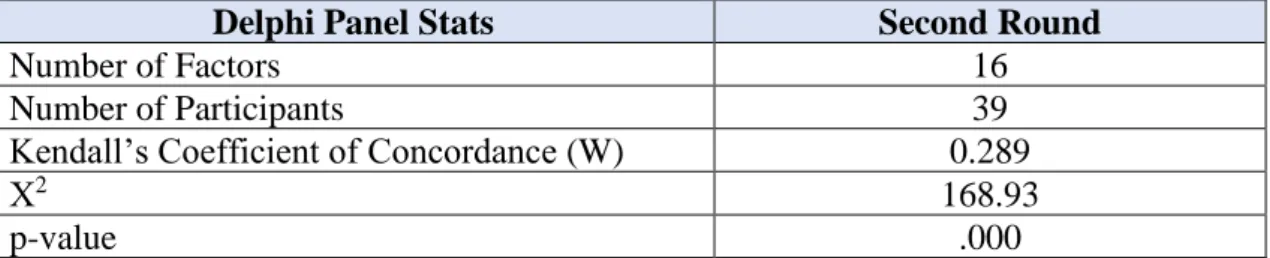
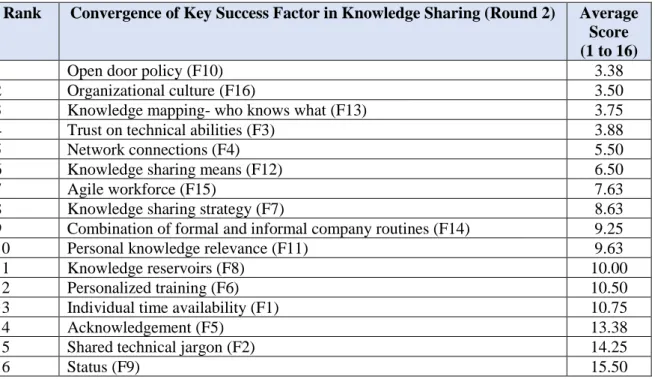
In the second round, after reading the results, participants were asked to rank, in terms of relevance, the factors in a 1 to 16 scale; where 1 was the most relevant and 16 the least relevant factor. Based on the participants’ answers, a new ranking was then calculated.
According to Mitchel (1992), the provided feedback in the different rounds through this method leads to the exchange of information amongst the different participants. This in essence allows for the convergence of answers.
To ensure a satisfactory group convergence level, Kendall’s coefficient of
concordance (Kendall’s W) was used in the second round, when participants were explicitly asked to rank the 16 factors. According to Okoli and Pawlowski (2004), several metrics can measure ranking, however, Kendall’s W is acknowledged as being the best alternative.
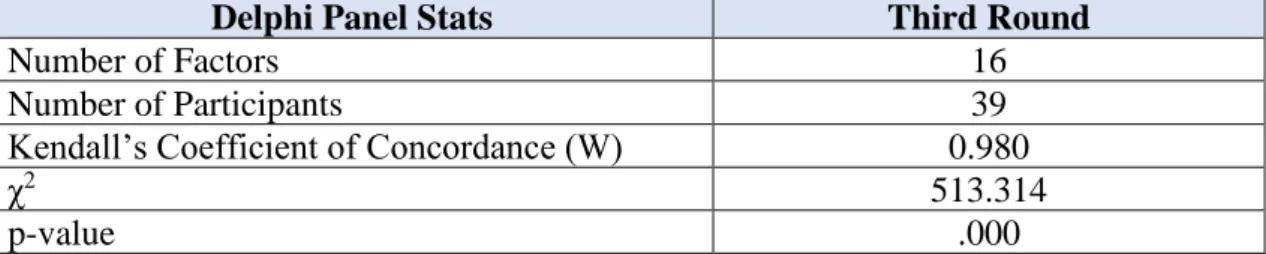
As stated by Schmidt (1997), the value of W varies from 0 to 1, where 0 means there is no consensus and 1 means full consensus. As shown in Table 2, an interpretation and the confidence levels of the ranks are presented.
Table 2-Interpretation of Kendall’s W W
(Ranges)
Interpretation Confidence in Ranks
Below 0.1 Very weak agreement None
Above 0.1 to 0.3 Weak agreement Low
Above 0.3 to 0.5 Moderate agreement Fair
Above 0.5 to 0.7 Strong agreement High
Above 0.7 to 1 Unusually strong agreement Very High
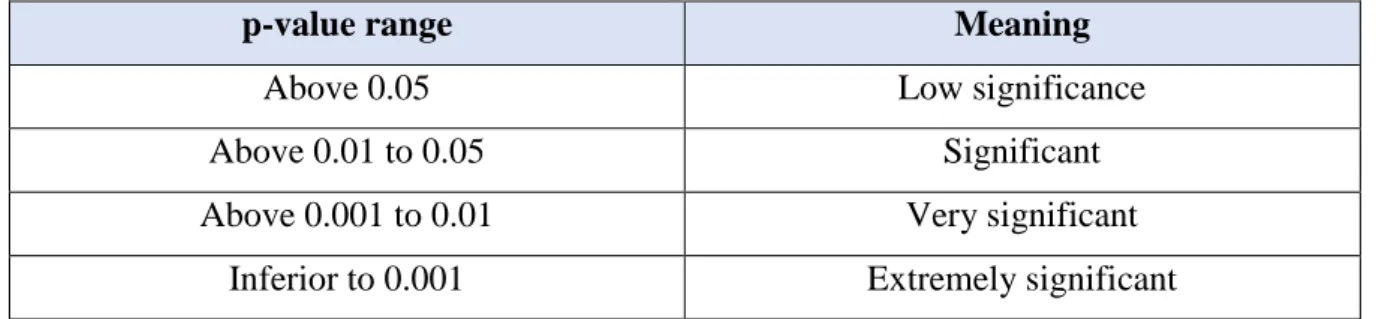
33 Once Kendall’s W was calculated and interpreted,
a χ
2 statistics was then calculatedto attain a p-value to determine W´s significance level. The critical value was then interpreted based on the table provided by Prado (2016) (Table 3).
Table 3 – Interpretation of Kendall’s W p-value
p-value range Meaning
Above 0.05 Low significance
Above 0.01 to 0.05 Significant
Above 0.001 to 0.01 Very significant
Inferior to 0.001 Extremely significant
Source: Adapted from Assis (2016) and Prado (2016)
In this specific study, when calculating Kendall’s W, as there were 16 key factors analyzed, with 15 degrees of freedom, any
χ
2 above 25.00 would classify W’s value as being significant since its p-value would be below 0.05 (95% confidence level). Anyχ
2 above 39.72 would be considered extremely significant (p-value below 0.001).Once this was accomplished, the ranking of both rounds one and two were statistically compared. For this purpose, Kendall´s correlation coefficient (Kendall´s Tau) was calculated. This specific coefficient is used to measure the order of two measured quantities. More
specifically, Kendall’s tau focuses on the relative order of the different items, and not the difference in their classifications (Schmidt, 1997; Assis, 2016). The closer it is to 1, the higher the consensus in the rankings, thus ensuring the conclusion of the classification.
Upon this comparison, as the convergence level between rounds one and two was not satisfactory, a third round was necessary. The abovementioned procedures were repeated and a new statistical comparison using Kendall´s Tau-b and Kendall´s W were calculated
considering the obtained answers from rounds two and three. 4. RESULTS
4.1 DESCRIPTIVE STATISTICS
The sample for the presented study is composed of 41 professionals in the first round and 39 in the second and third rounds (with a minimum of six years of experience in Oil & Gas). The firm nationalities are as follow: American, Brazilian, French and Norwegian (Table 4).
34 In the first round, from the 41 participants involved in this research, 22 were female (53.66%) and 19 were male (46.34%). For the second and third rounds, out of the 39 respondents (2 dropouts: one participant left the firm for another job and the other was on a medical leave of absence), 21 were female (53.85%) and 18 were male (46.15%). The average age of the participants is 38.51, being that the youngest participant was 29 and the oldest 58 years old. Regarding the years of experience in the upstream segment, the group presented an average of 12.41 years of experience, 6 years being the lowest and 32 the highest.
Additionally, the group was mostly made up of individuals with graduate degrees (22 individuals with Master’s degrees and 2 with PhDs) making up 58.54%. The remaining participants had undergraduate degrees (17 participants with a 4-year bachelor degree), making up 41.46%. As there were two less participants on the second and third rounds, there were a few minor differences. In these rounds, individuals with a graduate degree accounted for 51.28% (20 individuals with Master degrees and 2 with PhDs) and those with an
undergraduate degree accounted for 43.59% (17 participants with a 4-year bachelor degree). This is illustrated in Table 4.
Table 4– Delphi Panel Participants: Educational Background and Firm Nationality Breakdown Round 1 Round 2 Round 3
Educational Level % of Total Participants Number of % of Total Participants Number of % of Total
Number of Participants 4-Year Bachelor´s Degree 41.5 17 43.6 17 43.6 17
Master's Degree 53.7 22 51.9 20 51.9 20
PhD 4.9 2 5.1 2 5.1 2
Firm Nationality % of Total Number of
Participants % of Total Number of Participants % of Total Number of Participants American 26.8 11 23.1 10 23.1 10 Brazilian 24.4 10 25.6 9 25.6 9 French 24.4 10 25.6 10 25.6 10 Norwegian 24.4 10 25.6 10 25.6 10
4.2 FIRST ROUND DELPHI METHOD RESULTS
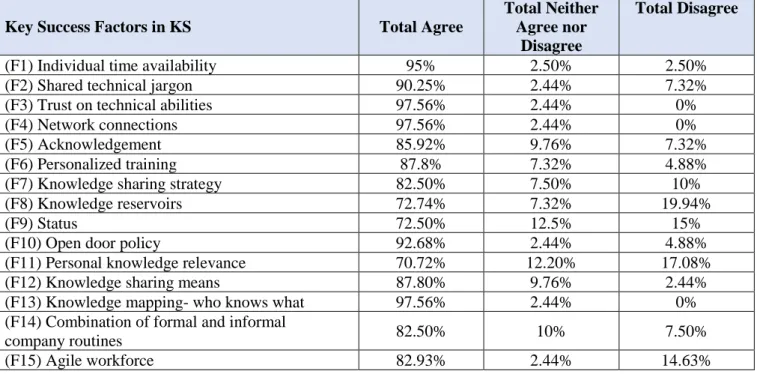
The results of the first round were treated using basic statistics. Table 5 illustrates the results (not in order of relevance) for each key factor divided into three categories: Total Agree (composed of “strongly agree” and “agree” answers); Total Neither Agree nor
35 Disagree; and Total Disagree (composed of “strongly disagree” and “disagree answers). Not included were those who chose the alternative “I did not understand the item”.
Table 5- First Round Antecedent Evaluation
The average for each of the 15 proposed key success factors was also calculated using the method explained under section 3.2.2; generating an average result rank. Additionally, the comments provided by the participants were compiled and can be found under Annex 6. Round one’s rank can be found in Table 6 from the highest average score (most agrees) to the lowest average score.
Key Success Factors in KS Total Agree
Total Neither Agree nor
Disagree
Total Disagree
(F1) Individual time availability 95% 2.50% 2.50%
(F2) Shared technical jargon 90.25% 2.44% 7.32%
(F3) Trust on technical abilities 97.56% 2.44% 0%
(F4) Network connections 97.56% 2.44% 0%
(F5) Acknowledgement 85.92% 9.76% 7.32%
(F6) Personalized training 87.8% 7.32% 4.88%
(F7) Knowledge sharing strategy 82.50% 7.50% 10%
(F8) Knowledge reservoirs 72.74% 7.32% 19.94%
(F9) Status 72.50% 12.5% 15%
(F10) Open door policy 92.68% 2.44% 4.88%
(F11) Personal knowledge relevance 70.72% 12.20% 17.08%
(F12) Knowledge sharing means 87.80% 9.76% 2.44%
(F13) Knowledge mapping- who knows what 97.56% 2.44% 0%
(F14) Combination of formal and informal
company routines 82.50% 10% 7.50%
36 Table 6 – First Round Rank Based on Average Scores
In round one, the 41 participants’ top choices were: “open door policy” (F10) with a 92.68% agreement rate and “network connections” (F4) with a 97.56% agreeance rate. Both factors obtained an average score of 4.39 (see Table 6). This means that on average,
participants felt that a firm’s open door policy (firm openness regarding the tolerance level for questioning and critique) as well as the presence of a network connection (the link between those who own type A knowledge and those who need type A knowledge) led individuals to more likely share what they knew with their fellow colleagues.
The runner up factor was “knowledge mapping-who knows what” (F13), with a 97.56% total agreement rate (summation of strongly agree and agree answers), with an average score of 4.37 (Tables 5 and 6). In third place, with an average score of 4.34 (Table 6) and a 97.56% agreeance rate was “trust on technical abilities” (F3), which meant that
individuals trusted their co-workers’ abilities.
Moreover, the three key factors with the lowest average scores were: “knowledge reservoirs” (F8) with an average score of 3.73 (12th place rank); “status” (F9) with an average score of 3.70 (13th place rank); and “personal knowledge reference” (F11) with an average score of 3.59 (14th place rank).
4.3 SECOND ROUND DELPHI METHOD RESULTS
In this round, as previously stated, participants were asked to review the first-round average score ranking and create a re-rank the key factors ranging from 1 to 16, in terms of
Rank Key Success Factor in Knowledge Sharing (Round 1) Average Score (From 1 to 5)
1 Open door policy (F10) 4.39
1 Network connections (F4) 4.39
2 Knowledge mapping- who knows what (F13) 4.37
3 Trust on technical abilities (F3) 4.34
4 Individual time availability (F1) 4.30
5 Knowledge sharing means (F12) 4.22
6 Personalized training (F6) 4.12
7 Shared technical jargon (F2) 4.10
8 Acknowledgement (F5) 4.05
9 Agile workforce (F15) 4.00
10 Combination of formal and informal company routines (F14) 3.98
11 Knowledge sharing strategy (F7) 3.95
12 Knowledge reservoirs (F8) 3.73
13 Status (F9) 3.70