Conference on Health and Social Care Information Systems and Technologies
Business Processes Improvement in ANA, SA, Aeroportos de
Portugal: Maintenance Management Procedure
João Abreu
a, Paula Ventura Martins
b, Silvia Fernandes
b, Marielba Zacarias
b aFaculty of Economics, University of AlgarvebResearch Centre for Spatial and Organizational Dynamics-University of Algarve,Campus de Gambelas 8005-139 Faro, Portugal
Abstract
With the implementation of a computerized maintenance management system for a corporate perspective in the Organization ANA, SA. Aeroportos de Portugal, combined with several parameterizations related to core business processes in place, naturally there was a set of opportunities to improve business processes through research and metrics development allowing more analyses. These were previously dealt without the same depth and without access to the same database and data model. On this basis, the idealization of the maintenance management procedure, based on the framework for maintenance management in force in the organization, moved quickly to the reality. The development of the procedure starts by identifying problems, setting goals and objectives to be achieved, research literature in maintenance area and best practice in service management with a focus on ITIL, study existing maintenance standards with respect to concepts and KPI calculation methods, presentation of business processes in production at the Organization, development of the procedure for maintenance management with appropriated methods and outcome analysis, and finally the main conclusions of the work. A major contribution of this work has been considered a series of actions to improve and/or correct existing business processes that may prove technical, organizational and economic benefits for the maintenance management in that Organization.
Keywords: Maintenance management; computerized maintenance management system (CMMS); key performance indicator (KPI); ITIL
1. Introduction
“Business processes improvement in the organization ANA, SA. Aeroportos de Portugal: Maintenance Management Procedure” is based on the corporate implementation of a maintenance management system, which in the near future will allow a cross-sectional analysis integrated with the core business processes of maintenance. The Procedure for Maintenance Management is an important tool for the whole process of maintenance, because it assists coordinators and managers in decision-making based on indicators previously studied, analysed, discussed and approved by all agents. In the recent past, all local and corporate organizational analysis were developed empirically and based on good maintenance practices and solid knowledge of technicians, where many decisions were based on life cycles and technological analysis of equipment. With the implementation of a truly corporate maintenance management system, the whole approach to maintenance has been developed through a repository with the same data structure in all airports, allowing both upstream and downstream visions of all processes involved as a multidisciplinary area [1]. In an organization such as ANA, SA. Aeroportos de Portugal, responsible for the management of airport infrastructures, the maintenance area has a great relevance mainly from a perspective of necessary resources to perform all actions. Having in mind that an asset “is any element, component, device, subsystem, functional unit or system that can be considered individually” [2], and that maintenance is responsible for most of the assets of that Organization, one comes quickly to the conclusion about the importance of this area
of knowledge. Knowing the business model related to maintenance, we identified the following problems:
Difference among airports in the method of calculating key indicators
Need to investigate and develop new metrics
Lack of maintenance reports with a local and corporate perspective
Lack of improvement actions (and/or correction) in the existing business processes
Inability to obtain a truly corporate vision oriented to common goals across all business units
The procedure for maintenance management describes:
The evaluation metrics of maintenance services
The goals for the evaluation metrics of maintenance services
The KPI (Key Performance Indicator) of maintenance
The goals for the KPI for each of the airports
And answers questions such as:
What is the level of quality of the response to customers?
What is the rate of effort expended on maintenance processes?
What are the main consumptions in maintenance actions?
Is there a need for changes to be made by sector in order to improve the operational performance?
Which is the right time for the replacement of equipment based on its value and maintenance cost?
The analysis and combination of the topics and issues referred reflect the strengths and weaknesses of the maintenance structure, and consequently ways to correct and/or improve them. The entire analysis is obtained based on parameters properly validated and structured both in the organization and in the implemented maintenance management system. Thus, the technical manager of the airports’ infrastructure will have a broad view of all actions being performed and, if necessary, ways to improve them.
This paper is organized as follows. Section 2 describes the concepts, standards and indicators for maintenance management effectiveness. Section 3 introduces the case study based on a computerized maintenance management system for a corporate perspective in the Organization ANA, SA. Aeroportos de Portugal. It has subsections related to the development of the maintenance management procedure with appropriated methods and performance analysis, with a focus on the ITIL’s approach. Section 4 presents our conclusions.
2. Literature Review
In this section we present the concepts, standards and indicators related to maintenance management that are essential for defining the system presented in the case study. We conclude the section with a brief description of ITIL, since this is the selected approach for studying the system.
2.1. General concepts in maintenance
The definition of maintenance is based on the “combination of all technical, administrative and management activities of the life cycle of an asset, in order to keep it or return it to a state where it can perform its required function”[2], where the required function is “the function or combination of functions of an asset considered as necessary to provide a certain service”[2]. In a general overview, there are three major types of maintenance: preventive, corrective and improvement [3]. In theoretical terms they are defined as:
Preventive Maintenance [2] – “maintenance carried out at predetermined intervals or according to prescribed criteria and intended to reduce the probability of failure or the degradation of the functioning of an item”
Corrective Maintenance [2] – “maintenance carried out after fault recognition and intended to put an item into a state in which it can perform a required function”
Improvement Maintenance [2] – intended to improve the performance of an asset in its context, considered as an improvement over the conditioned maintenance, where identification of the change that can improve the asset’s functioning is the key
The relationship between the several maintenance types is based on the fact that corrective maintenance should represent a ratio of 20% in the overall maintenance processes for well-structured organizations [4], [5]. The context where maintenance was regarded as the “poor relative” of an organization is already gone, where it was only seen as a source of expense without any growth factor associated. Nowadays, maintenance is one of the most important areas of the organizational structure, especially in industrial sector, as it contributes to performance enhancement, process security, interpersonal relationships, control of return on investment, and solid image of the organization towards members and shareholders. Increasingly the focus on maintenance management is a reality, especially when it comes to organizations where the asset portfolio susceptible to maintenance involves high figures. In these cases, such as the ANA, SA. [1], it is really crucial for their sustainability in the short, medium and long term.
2.2. Maintenance management system
A maintenance management system is composed of an indispensable tool, defined as CMMS (Computerized Maintenance Management System). The implementation of such a tool in an organization requires dedication and constructive spirit, mainly if there is no record of maintenance management, even without going through any computing platform [6]. Despite being a powerful support, it is fundamental the involvement of all agents in keeping a common goal about practices to improve, which under normal conditions will leverage the organization to a new technical and operational paradigm. Without this essential contribution there is no sustainable maintenance management system, because most effectiveness lies in people than in the computing platform [7].
2.3. Maintenance management standards
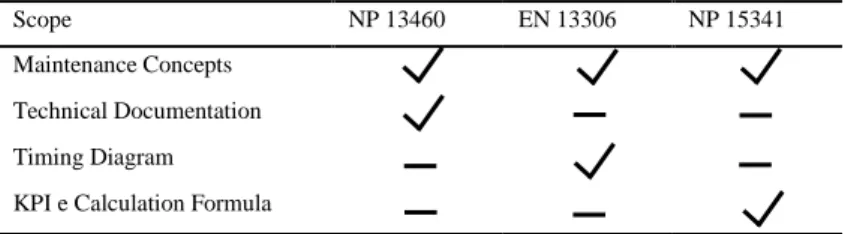
Associated with maintenance management there are some rules that allow a detailed study depending on its specificity. Table 1 identifies the different approaches of the main standards.
Table 1. Maintenance Management Standards
Scope NP 13460 EN 13306 NP 15341
Maintenance Concepts Technical Documentation Timing Diagram KPI e Calculation Formula
2.4. Key performance indicators and metrics
The literature refers that an indicator is “the measured feature (or set of features) of a phenomenon, according to a specific formula that evaluates its development” [8]. The use of indicators is of high importance as these will inform the current status of maintenance in the organization and answer questions related to the:
Number of breakdowns, availability and unavailability of equipment
Distribution of human resources and related costs
Requests from the various departments
Materials’ consumption and inventory management
Requests for services from external entities
Needed changes in the infrastructure
Time to replace equipment
Some main objectives of implementing metrics through key performance indicators are the following:
Evaluation and comparison of performances
Identification of strengths and weaknesses
Planning strategies, procedures and actions
Monitoring the evolution of changes over time
2.5. ITIL
A framework [9] is a basic conceptual structure that allows a homogeneous handling of different business objects, which increases management discipline. Examples of frameworks are ISO 9000 [10], ISO 14000 [11], ITIL [12], and CMMI [13]. The ITIL, Information Technology Infrastructure Library, addresses a set of good practices related to information technologies to apply in infrastructure, operation and maintenance of services. Major goals of ITIL are customer orientation and service quality standards of excellence achievement. It was developed in the late 80’s by the Central Computer and Telecommunications Agency (CCTA), but is currently under the jurisdiction of the English government institution Office for Government Commerce (OGC). The appearance and strong growth of ITIL followed the “big bang” of information technology (IT), mostly from the 80’s having its source on the management of IT services, or Information Technology Service Management (ITSM) [14]. This service management had resulted in the creation of a set of methodologies and good organizational practices to overcome previous inefficiencies. The well-known standard ISO 20000 [15] from 2005, was based on the English standard BS 1500 [16], which in turn was based on ITIL best practices. The third review of ITIL, based on lifecycle of service good practices, aggregates the best of previous versions with tested and validated best practices of IT service management [17].
3. Case Study
The case target of this study was Maintenance Management Procedures, which is part of the ANA Framework. The research was conducted between March 2011 and March 2012 using the ITIL based five-stages improvement process. Researchers used case study research [18] and action research [19] methods with a single case organization to find answers to the research problem. Researchers observed, analysed the environment and makes notes by combining different data collection methods. Researchers used ITIL [16] best practices help to identify challenges and opportunities to align IT with business requirements and improve service quality in the Maintenance Department of ANA, SA Aeroportos de Portugal.
The following five subsections describe in detail the activities performed at each one of the five ITIL stages: service strategy, service design, service transition, service operations and continual service improvement.
3.1.1. Service Strategy
ANA, SA Aeroportos de Portugal has long been invested the IT in order to support its business processes. The maintenance management framework implemented in this organization, controlled by a Computerized Maintenance Management System(CMMS), is divided into five main structures:
Maintenance management - responsible for maintenance management services, which includes the maintenance management procedure presented in the case study section.
Operational management - specifies the registration process of related activities such as corrective maintenance, preventive maintenance and technical services.
Project management - repository for new and current projects about maintenance and investments, where all activities are recorded, such as the contract specifications.
CMMS management - responsible for the evolution and development of the information system.
Knowledge management - ensures the sustainability of all business processes associated to the framework, the repository of all technical documentation, skills and training acquired throughout CMMS implementation.
Although the system includes several information systems, in this paper we only report the subprocess Maintenance Management Procedures (MMP) that is part of the Maintenance Management Process. These MMP are essential for data organization and analysis. The information obtained from multiple processes, such as corrective maintenance and preventive maintenance, allows defining metrics that will be essential in he decision process performed by airport infrastructure managers.
At this stage, strategic decisions for the maintenance management procedure are based on the identification of strengths and weaknesses, analysis of organizational reality and definition of goals to achieve.
In the past, maintenance management was mostly made independently at each airport and based on knowledge of technical managers. This corporate project, strongly related to maintenance management and direct contact with the operational reality of an airport infrastructure, allowed the emergence of key knowledge and improvements in the area of maintenance management. The implementation of the maintenance management framework, identifying and linking business processes, as well as the procedure described in this work led to a rapid transition to reality.
First, we need to identify the objectives or targets for its services. This drives the identification of services offerings as well as the strategic assets that will constitute those services. We also added a set of indicators in order to present an objective procedure for decision support to technical managers. The study of maintenance management standards, especially EN13306 and NP15341, allowed a theoretical definition of metrics that fed key performance indicators.
The team has identified the following service strategies for its business operations: change management, configuration management, configuration item, knowledge management and resource management.
Change Management ensures that changes are implemented in a controlled manner, evaluated, planned,
tested and documented. There are several reasons for a change occurs, such as reduction of cost, or improved a particular service.
Configuration Management includes a set of tools and supporting databases that are used to manage
configuration data of a service provider. It includes information about events, problems, known errors, changes and deliberations. Configuration management may contain data about human resources, suppliers,
locations, business units and customers. It also includes tools for collecting, storing, managing and presenting data for all configuration items.
Configuration Item is any component that needs to be managed and which may result in a service. The
information is recorded in a configuration management system through a configuration register, being under control of change management. Usually, these configuration items include hardware, software, facilities, people, and formal documents, such as, documents about service level agreements.
Knowledge Management is responsible for collecting, analysing, storing and sharing knowledge and
information with the entire organization. The main goal is to improve efficiency and productivity reducing the need to rediscover knowledge.
Resource Management used to store the configuration registers. A configuration management system must
ensure one or more databases; each database stores Configuration Items attributes.
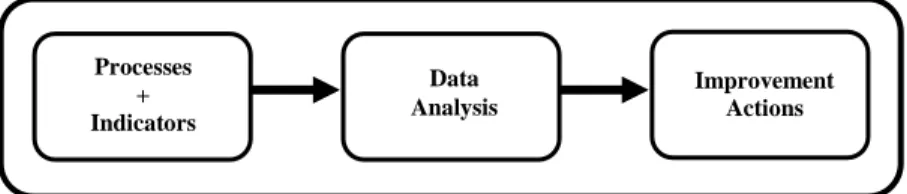
As shown in figure 1, the maintenance management procedure will receive, as input, the main maintenance processes with clear definition of related metrics, then it will analyse the data produced and finally will have, as output, the improvement actions in key maintenance strategic points. This will give to the technical manager a better perception of status of all actions related to maintenance. The whole analysis will be based on an existing data repository for all airports, which has the same structure and configuration.
Finally, in order to sustain correct strategic planning, we defined a catalogue of maps, based on systems and equipment. In the end of this stage, we found that the number of actions is substantially high and the degree of technical and/or operational criticalness is considerably. After the main definitions and strategic considerations, transition to maintenance management design naturally came to new and existing services.
3.1.2. Service Design
This stage begins with the identified service strategies and ends with a service solution in order to meet organizational requirements. The activities performed during this period involve process definition to satisfy business goals, development of measurement methods and metrics to assess organizational effectiveness and efficiency, architectures, frameworks and additional documents. The main goal would be to identify improvement/correction actions that could create value for existing or new business processes. Data collection and analysis provided by key organizational members in maintenance management allowed the identification of five distinct actions:
Contract management improvement/correction
Improvement / correction in material asset management
Improvement / correction in consumption management
Improvement/correction of human asset management
Processes + Indicators Data Analysis Improvement Actions
Improvement / correction in ratios management between corrective maintenance and preventive maintenance
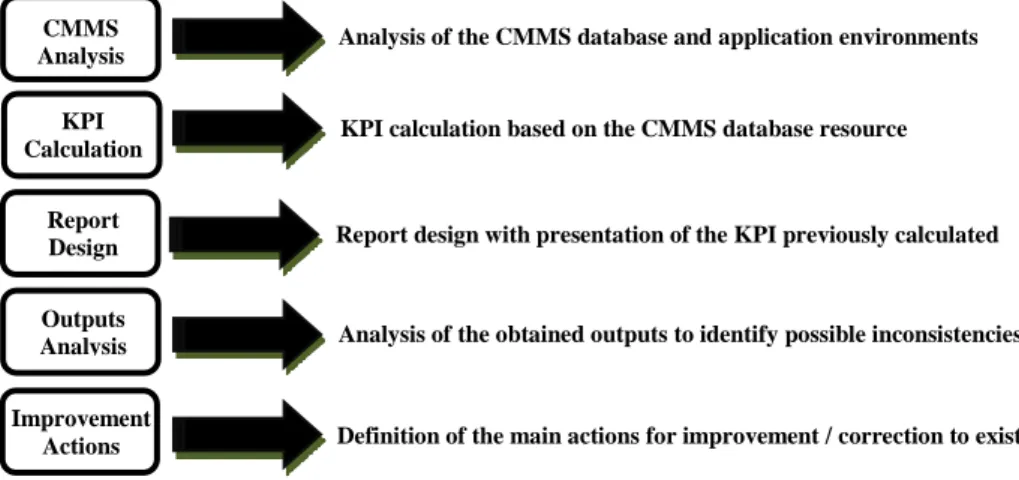
Defined the main structural vectors, the team initiated the design in five sequential distinct stages, as the figure 2 shows, sustained in documents with the assumptions, actions and settings of these phases.
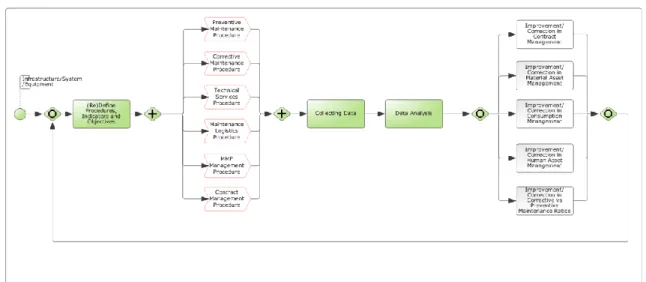
Since the maintenance management procedure (figure 3) is a decision support procedure, it was important to present a business model with easy to interpret objects, as well as, to clearly point out the several improvement possibilities in terms of obtained inputs. At development time, the processes implemented in the Maintenance Management System (MMS) treated corrective and preventive maintenance, however, in order to reveal this procedure, we included additional processes that were in the implementation phase and that could influence defined improvement actions.
Despite the unified approach, the maintenance management procedure can be divided into four sub-processes with different goals, but important for the final result:
Processes, indicators and goals definition
Review of business processes in production
Collect and analyse data through reports, created for this purpose
Improvement actions
This division is not essential to ensure they are grounded in operational reality, however, demonstrates the dynamics in their development.
Figure 2 - Design phases of the maintenance management procedre Outputs
Analysis Analysis of the obtained outputs to identify possible inconsistencies Report
Design Report design with presentation of the KPI previously calculated CMMS
Analysis Analysis of the CMMS database and application environments KPI calculation based on the CMMS database resource KPI
Calculation
Definition of the main actions for improvement / correction to existing business processes Improvement
Figure 3 - Maintenance management procedure 3.1.3. Service Transition
At this transition stage, where settings of the design stage have been applied, there was some care, not only with the existing processes but also with the operational impact of the maintenance management procedure. As with most information systems, the CMMS has a development environment, which it was a key factor, especially, in test-runs of developed reports. However, only with the transition to the real environment will be possible to test the effectiveness degree of the CMMS, especially in reports-runs. Never forgetting that in reports-runs is implicit the access to the database that feeds all other processes in production, i.e., the impact assessment has been prepared in a judicious way. Results presentation to key maintenance management stakeholders was important with the aim of providing the new procedure production. This was achieved thorough a shared folder on the organization’s internal network with samples of different reports. Reports presentation to key maintenance management stakeholders allowed to analyse and increase main key performance indicators that influence existing business processes and consequent improvement or correction actions, i.e., in practice finding possible cause-effect relationships to address. Note that, although there is a strong theoretical basis in the present work, the exchange of ideas among people of high operational experience resulted in a remarkable enrichment on the main goals to achieve with the maintenance management procedure.
3.1.4. Operation
As mentioned above, there is a corporative repository based on business processes in production, which can be accessed by key stakeholders in maintenance management. At each airport, the MMS administrator performs the “feed” of this repository with a defined periodicity, usually monthly. Running and analysis of can be automated to some extent, however, the decision is left to the technical management.Figure 4 shows the diagram related to the operational procedure.
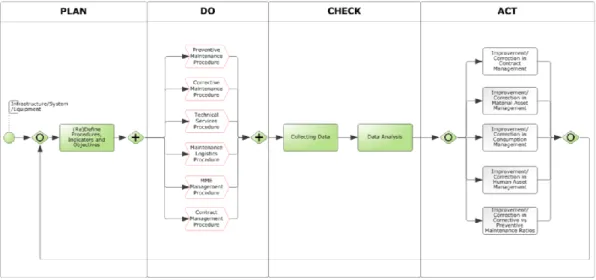
The conception of maintenance management procedure was based on a set of best practices and concepts covered in ITIL and presented in this paper, theoretical aspects, as well as the methodology used throughout the development. Beginning in strategy, from the procedure design, moving to reality, analysing operational implications and finally ensuring sustainability of the procedure through continuous improvement. That is, despite the procedure development is based on ITIL stages, after implementation, the procedure itself should be interpreted as a routine of continuous improvementwith the four subprocesses presented, directly linked to the Deming’s PDCA cycle (Plan, Do, Check, Act), as illustrated in figure 5.
Figure 5 – Deming’s cycle of the maintenance management procedure
It is easy to understand that ensure the repository data update related to management reports is of major importance, since they will be the main inputs of the maintenance management procedure. With regard to this study (procedure development and implementation), main concepts and methodologies were described. However, this approach focuses on a knowledge area that is constantly evolving and also because this information system is dynamic, considering the proposed improvements and new business process development, it is impossible to consider that the maintenance management procedure, discussed in this paper, will be impermeable to possible upgrades. Thus, it is important to define improvement actions that will serve to strengthen and improve implemented processes, as well as to open new horizons for future research in this area.
Figure 4 - Operational diagram of the maintenance management procedure
Improvement Actions
Technical Manager Decision
KPI CMMS Report Execution Data Collection Data Analysis
3.1.5. Continual Service Improvement
Implement routines that forward to success with regard to continuous improvement, is not an easy task, however, the maintenance management procedure ensures that certain assumptions are guaranteed:
Monitor the correct reports implementation by the MMS administration at each airport;
Constantly monitor the quality of MMS records;
Define, using the Deming’s cycle, a set of activities that promote the quality of implemented procedures;
At application level, prepare as many frames/boards which at certain degree reflect the major reports produced to support the procedure;
Inform those involved in maintenance management about all changes at the level of production processes, as well as providing new reports;
Investigate, idealise and produce new metrics that allow added value to KPI calculations and in turn contribute to the ongoing procedure evolution.
To ensure sustainability and quality of the maintenance management procedure, it is essential to strengthen continuous improvement, since the introduction of a new business process should not be regarded as a sealed action and paused in time. A knowledge area, such as maintenance, is constantly changing and only with follow-up activities will be possible to meet current and future needs. After applying the methodologies used in this work, it is important to analyse results in order to sustain the improvement that the maintenance management procedure brought to business processes in production.
4. Conclusion
Monitoring the implementation of the maintenance management system in ANA Airports of Portugal, allowed the know of the business model related to maintenance, starting with infrastructure, systems and equipment, through the organizational structure with respect to the different departments, and ending with a key factor, direct contact with implemented business processes and settings for future implementations. Since the definition of KPIs for business processes monitoring and evaluation, was developed from scratch, allowed idealizing in a sustainable way the procedure presented in this paper. This definition of KPI is based on standards, especially EN13306, EN13460 and EN15341, allowing the sustainability of quality processes related to maintenance. Due to the nature of the concepts covered, in addition to the purposes described in previous sections, creating value for the organization has always been an implicit goal to achieve. Not only because of the potential added value of the procedure itself, but also due to possible business process improvements, becoming a tangible reality. We should highlight the importance of ITIL, which identifies a set of best practices, enabling continuous improvement process in a structured and systematic way. All the stages of this framework were important,nevertheless,service strategy turns out to be crucial,especially in problem identifying and setting development goals. Furthermore, several methods of business management were applied in this framework.
References
[1] Duarte, N, 2011. Framework de Gestão da Manutenção ANA,SA. [2] CEN, 2010. Patente N.º EN13306.
[3] Swanson, L., 2003. An information-processing model of maintenance management. International Journal of Production Economics 83(1), pp. 45-64.
[4] Cabral, J., 2009. Gestão da manutenção de equipamentos, instalações e edifícios. Lidel. [5] Wireman, T., 2004. Benchmarking best practices in maintenance management. Industrial Press.
[6] Durán, O., 2011. Computer-aided maintenance management systems selection based on a fuzzy AHP approach. Advances in Engineering Software 42(10), pp. 821-829.
[7] Valesko, S., 2010. CMMS increases efficiency, cuts downtime. The National Provisioner 224(3), pp. 20-23. [8] CEN., 2009. Patente N.º NP15341.
[9] Márquez, C., Gómez, F., Campos, L., 2009. The maintenance management framework. Journal of Quality in Maintenance Engineering 15(2), pp. 167-176.
[10] Casadesús, M., Karapetrovic, S., 2005. The erosion of ISO 9000 benefits:a temporal study. International Journal of Quality & Reliability Management 22(2), pp. 120-136.
[11] Viadiu, F., Saizarbitoria, I., Casadesús, M., 2006. ISO 9000 and ISO 14000 standards: an international diffusion model. International Journal of Operations & Production Management 26(2), pp. 141-165.
[12] Neničková, H., 2011. Critical success factors for ITIL best practices usage. Economics and Management 16(1), pp. 839-844. [13] Chrissis, M., Konrad, M., Shrum, S., 2007. CMMI Guidelines for Process Integration and Product Improvement. Boston USA: Addison Wesley Professional.
[14] Tan, W., Steel, A., Toleman, M., 2009. Implementing IT service management: a case study focussing on critical success factors. Journal of Computer Information Systems 50(2), pp. 1-12.
[15] Dugmore, J., Taylor, S., 2008. ITIL® V3 and ISO/IEC 20000. The Stationery Office , pp. 2-5. [16] Bon, J., 2010. Foundations of ITIL v3. Van Haren.
[17] Wegmann, A., 2008. Specifying Services for ITIL Service Management. Conference paper , pp. 8-12. [18] Yin, R. K., 2002. Case Study Research: Design and Methods. Newbury Park, Sage Publications.
[19] Susman, G. I. and Evered, R. D., 1978. An Assessment of the Scientific Merits of Action Research. Administrative Science Quarterly 23, pp. 582-603.