Universidade do Algarve
Faculdade de Ciências do Mar e do Ambiente
Bioaccumulation and Effects of TBT on Molluscs from Southern Portugal
Ma do Rosário T. Cortez Noronha Coelho
BlOACUMULAÇÂO E EFEITOS DO TBT EM MOLUSCOS DO SUL DE Portugal
Dissertação apresentada na Universidade do Algarve para obtenção de grau de Doutor no ramo de Ciências e Tecnologias do Ambiente, especialidade de Ambiente Aquático
Ma do Rosário T. Cortez Noronha Coelho
■ ir • n- ALOAR^E
1 ,j_ -C T>C l AÇÃO Iç -Oi et-,
; ' toV-cc 1 . ..tot* 3<<?
I am grateful to Professora Doutora Maria João Bebianno for suggesting and supervising this work and for helping me throughout these years; I am also very thankful to Dr. W. J. Langston for the supervision of this work, for ali the collaboration and encouragement; thanks are also due to Dr. Peter Gibbs for the instructive collaboration in fieldwork.
Many people throughout the years gave me great help and continuous encouragement. I could not have made this work without them:
In the University of Algarve, my colleagues, Angela, Bli, Cristina, Filomena, Miguel, Mário, Sr. Magro, Jacinta, Patucha, João Quintela, Luís, Pedro, Jorge and the K-team; the staff from FCMA;
In Plymouth, in the Marine Laboratory, ali the staff and particularly in the Tracer Lab, to Mr. Gary Burt, Dr. Nick Pope and also Paz, Pedro, Mel and Joe;
In the Águas do Algarve, ali the staff in the laboratory and colleagues from the production (DOA).
I am also grateful to my friends who directly or indirectly helped and support this study. A special thanks to Maria Alex, for the encouragement during ali these years.
I should make a special mention to my family, in particular my mother, my father, Nuno and Ana Rita: their encouragement was essential and allowed me to complete this work. Finally, to Zé João for the illustrations and for ali the patience and support throughout the years.
I would like to convey my gratitude to ali of you.
This work was financially supported by;
Fundação para a Ciência e Tecnologia - Programas CIÊNCIA (BD/1424/91-IG), e PRAXIS XXI (BD/3741/94).
EU MAST 2 Programme: Risk Assessment of Organotin Antifoulings on Key Benthic Organisms of European Coastal Habitats" (BOATS) (MAS2-CT94-099). 1994/1997.
ABSTRACT
The present work intended to study the impact of the highly toxic compound tributyltin (TBT) in one of the most important mollusc species in southern Portugal, the ciam Ruditapes decussatus.
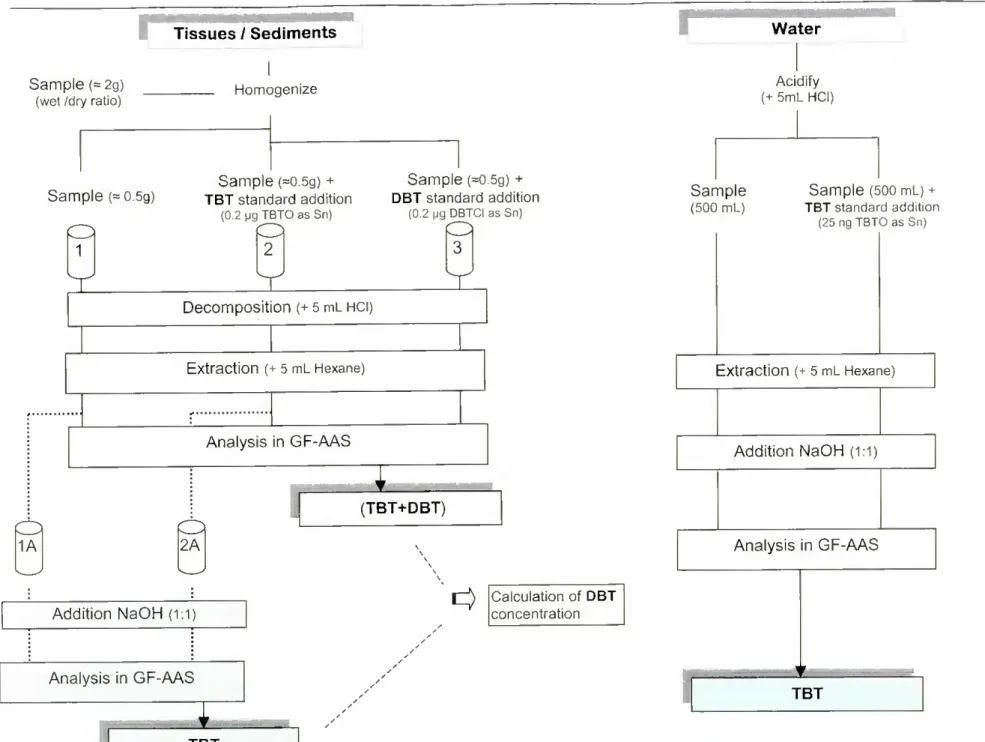
The first Chapter provides a general overview of the TBT problem in the marine environment. A summary of the analytical methods employed to analyse organotins in water, sediments and biological tissues is presented in Chapter 2.
The effects of sublethal tributyltin concentrations on the growth and development of R. decussatus larvae were studied (Chapter 3). Veliger larvae of Ruditapes decussatus were exposed to TBT nominal concentrations of 25, 50, 75 and 100 ngL"1 Sn in the water for a
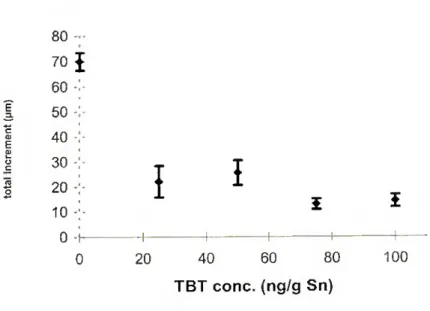
period up to 13 d. Larval growth and development were chosen as endpoints for evaluation of TBT toxicity. Growth of R. decussatus larvae was severely affected by TBT concentrations (25-100 ngL'1 Sn). A 3- to 5-fold reduction in growth was observed in these early larval
stages. Furthermore, R. decussatus larvae exposed to TBT did not develop further than D- larvae while larvae from control cultures reached the umbonated stage.
The effects of sublethal concentrations of tributyltin (TBT) on growth of ciam juveniles, R. decussatus, were determined in clams exposed to nominal TBT concentrations of 50, 100 and 250 ng L^Sn in sea water, for a period up to 2 years (Chapter4). R. decussatus iuvenWes increased regularly in length and weight over the whole experimental period. Final length and weight were affected by TBT exposure. Flowever, growth rates (in length and weight) were not significantly different amongst treatments, after 2 years of TBT exposure. Thus, under the deschbed experimental conditions, although a decrease in growth (length and weight) of R. decussatus juveniles was observed with increasing TBT concentrations, it was not significantly affected by TBT exposure.
The relative importance of water, sediments and food as vectors of TBT uptake was assessed for the infaunal, suspension-feeding bivalve, Ruditapes decussatus (Chapter 5). Accumulation of TBT was determined in R. decussatus exposed for 60 days to, moderately high, but environmentally realistic, leveis of TBT dissolved in water (100 ngL"1 Sn) and
sediments (0.8 pgg"1 Sn dw), separately or in combination, using constant-flow systems.
The results indicate that this species accumulates TBT predominantly from water. Although some accumulation from sediments does occur, the processing of large amounts of water needed to sustain the filter-feeding habits of this species is a prime determinant of TBT uptake. The route of exposure is reflected in tissue distributions of TBT in R. decussatus. However, gills are the most important sites for accumulation of TBT from water, irrespective of whether contaminated sediments are present or not. In addition, the relative importance of phytoplankton as a vector of TBT uptake was assessed in the same species. Accumulation of TBT via the algal diet was determined by experimental exposure of R. decussatus to 14C-
TBT labelled phytoplankton Isochrisis galbana, for a period up to 60 days. Ruditapes decussatus exhibited increasing TBT burdens during a period up to 40 days, after which an apparent steady state was achieved. Within the body, the digestive tract of these clams initially accumulated TBT. After a few weeks of exposure, internai remobilization resulted in a more widespread partitioning of TBT amongst tissues.
From the results of these experiments (Chapter 5), in which R. decussatus were exposed to TBT in water, sediments and food partitioned realistically, it seems clear that this species accumulates TBT predominantly from water. Although some accumulation from sediments and food does occur, the contribution from these phases was negligible when compared to water, at least under the conditions and concentrations used in this experiment.
In a filed survey (Chapter 6), organotin concentrations were measured in water, sediments and clams {Ruditapes decussatus) from eleven sites in the Ria Formosa lagoon, Portugal, in 1992-1993. Results showed a marked spatial pattern of tributyltin (TBT) and dibutyltin (DBT) concentrations. Highest organotin concentrations were observed at Olhão (site 5), where the most important fishing harbour of the Southern coast of Portugal is located. Results indicated that fishing vessels, moored in the harbour at Olhão (site 5), were the major source of organotin contamination to the lagoon. No significant seasonal trend was observed, suggesting a continuous input of organotin compounds throughout the year.
species: Ocenebra erinacea, Hexaplex trunculus, Murex brandaris, Conus venthcosus, Nassarius reticulatus and Nucella lapillus, using the two índices RPLI and VDSI. Imposex was observed in females from ali the sampled sites in Algarve, except in Zavial (13), where ali females Nucella lapillus were unaffected by imposex.
The final discussion is presented in the last Chapter (8). It emphasizes that results from this work constitute a further step to confirm that TBT is among the most toxic chemicals introduced in the marine environment. Its potential for negative impact on the benthic community is evident. In the particular case of R. decussatus cultured in Ria Formosa and other important mariculture sites, a continued input of organotins will probably cause serious damage to shellfish species, particularly to its early life-stages. According to the World Health Organisation (WHO, 1990), recommendations for protecting human and environmental health against the damaging effects of TBT include (1) the establishment of restrictions on the use of TBT compounds; (2) evaluation of organotins inputs to the environment from sources other than antifouling paints; (3) improvement of methods for the safe application removal and disposal of organotins. Furthermore, future research needs comprise improvement of detection and analysis of organotins and better knowledge of toxicity, namely immunological effects, mechanisms of toxicity, endocrine effects and mammalian toxicity including studies on potential carcinogenic effects. Human intake of TBT should also be carefully studied; specific consumption recommendations should eventually be published and maximum residue leveis (MRL) for TBT, and other organotin compounds, in seafood products should be set to minimize human risks. Attention should also be given to the search for other sensitive bioindicator species, including freshwater organisms and finally more information is required on butyltin residues in fish and shellfish for human consumption.
CONTENTS
CHARTER 1 - GENERAL INTRODUCTION 1 1.1. Fouling and antifouling paints 1 1.2. The TBT problem' 3 1.3. Tributyltin compounds 4 L3.1. Physical and chemicalproperties 4 1.3.2. Partitioning coefficients 6 1.3.4. TBTdegradation g 1.4. TBT IN THE ENVIRONMENT 10 1.4.1. Environmental sources 10 1.4.2. Environmental concentrations 11 1.4.2.1. Water 11 1.4.2.2. Sediments 14 1.4.2.3. Marine bivalves 16 1.5. Routes of TBT uptake in marine bivalves 19 1.5.1. Uptake of TB Tfrom water / 9 1.5.2. Uptake of TB Tfrom sediments 21 1.5.3. Uptake of TB Tfrom food 22 1.6. Toxic EFFECTS OF TBT 23 1.6.1. Imposex 24 1.6.2. Lethal toxicity ofTBT to bivalves 25 1.6.3. Chronic toxicity ofTBT to bivalves 27 1.7. TBT Legislation 32 l. 7.1. History j 2 1.7.2. Current Legislation 36 1.8. Studied species - Ruditapes decussatus 37 1.9. Objectives ofthisstudy 38 CHARTER 2 - ANALYTICAL METHODS 41
2.1. Organotin extraction 41 2.1.1. TBT extraction in Seawater 41 2.1.2. TBT extraction in Tissues 43 2.1.3. TBT extraction in Sediments 44 2.2 Organotin analysis using atomic absorption spectrometry 47 CHARTER 3 - EFFECTS OF TBT ON CLAM LARVAE 49 Abstract 49 3.1. INTRODUCTION 49 3.2. Materials and methods 51
3.2.1. Details of broodstock maintenance and fertilisation procedure 51 3.2.2. Expôs ure of ciam kwvae to TBT 52 3.2.3. Sta tis tical analysis 55 3.3. Results 57 3.4. Discussion 62
4.1. INTRODUCTION 66 4.2. Materials and Methods 68 4.3. Results 71 4.4. DISCUSSION 78 CHARTER 5 - ROUTES OF TBT UPTAKE IN CLAMS 81
Abstract 81 5.1 INTRODUCTION 82 5.1.1. Uptake ofTBT 82 5.1.2. Phytoplankton aspossible vector for TBT uptake 83 5.2. Materials and methods 85 5.2.1. Water andsediment as vectors of TBT uptake in R. decussatus 86 5.2.2. Food as a source ofTBT to Rudi tapes decussatus 89 i) 14C-TBT uptake by phytoplankton Isochrysis galbana 89 ii) TBT uptake by clams fed with TBT contaminated I. galbana 91 5.3. Results 94
5.3.1. Water and sediment as vectors ofTBT uptake in R. decussatus 94 5.3.2. Food (phytoplankton) as a source ofTBT to Rudi tapes decussatus 99 i) 14C-TBT uptake by phytoplankton Isochrysis galbana 99 ii) TBT uptake in the clams R. decussatus fed with 14C-TBT labelled
I. galbana 101 5.4. Discussion 107 /. Water as vector ofTBT uptake to Ruditapes decussatus 107 2. Sediments as a vector for TBT uptake 109 3 - Food (phytoplankton) as a source ofTBT to R. decussatus 110 i) 14C-TBT uptake by phytoplankton Isochrysis galbana 110 ii) TBT uptake in the clams R. decussatus fed with I4C-TBT labelled
/.galbana 112 iii) Accumulation ofTBT within the tissues o/R. decussatus 114 Final remarks 117 CHARTER 6 - ASSESSMENT OF TBT LEVELS IN SOUTHERN PORTUGAL.... 119 Abstract 119 INTRODUCTION 119 Study area : Ria Formosa 779 TBTsurvey in Ria Formosa 727 Materials and Methods 123 Sampling program 725 Collection and treatment of samples 725 i) Water 125 ii) Sediment 125 iii) Molluscs 125 Results 126 TBT in water 726 TBT in sediments 729
TBT in Ruditapes decussatus 132 Discussion 138 CHARTER 7 - ASSESSMENT OF IMPOSEX IN SOUTHERN PORTUGAL 144 7.1. INTRODUCTION 144 7.2. Materials and methods 151
7.2.1. Imposexfield survey y jy 7.2.2. Assessment of imposex yjj 7.2.3. Relative Penis Size Index (RPSI) 154 7.2.4. Vas Deferens Sequence Index (VDSI) 155 7.2.5. Intercomparison exercises 155 7.3. Results and Discussion 157 CHARTER 8 - GENERAL DISCUSSION 165 8.1. Toxicity of TBT TO early LIFE stages of clams 165 8.2. Routes of TBT Uptake in R. decussatus 157 8.3. Adverse effects and intake of TBT by humans 169 8.3. Field Survey 170 8.4. Imposex 172 8.5. Alternatives to the use of TBT 173 8.6. Final remarks 176 BIBLIOGRAPHIC REFERENCES 179
Table 1.1- TBT partition coefficient between benthic sediments and overlying water (Kd) in different environmental samples 7 Table 1.2- Tributyltin concentrations (expressed as ng L'1 TBT) in estuarine and
marine subsurface waters 13 Table 1.3 - Tributyltin concentrations (expressed as ng g'1 TBT *) in surface sediments
from different locations worldwide 14 Table 1.4 - Tributyltin concentrations ( expressed as ngg'1 TBT *) in the whole soft
tissues of several species of clams, oysters and mussels, collected in different locations world-wide 17 Table 1.5- Bioconcentration factors (BCF) determined for several species of marine
bivalves exposed to TBT in the water 20 Table 1.6- Lethal concentrations of TBT to embryos, larvae, post-larvae, juveniles
and adults of different bivalve species, exposed to TBT in the water 25 Table 1.7- Sublethal effects of TBT to embryos, larvae, post-larvae, juvenile and adults
of bivalves, exposed to TBT in water 30 Table 2.1- Standard additions of TBT and DBT in water, tissue and sediment
samples 45 Table 2.2- Experimental GF-AAS conditions employed to analyse Sn in water,
biological and sediment sample extracts 47 Table 3.1 - R decussatus. Growth rates (pm/day) and maximum length (pm) exhibited
by larvae after 13 days of exposure, in sea water (control 1). ethanol control (2) and different TBT treatments 60 Table 4.1- Initial and final average length (mm) and growth rates (mm/month) of
juveniles in two control treatments and exposed to different TBT
concentrations, after an exposure period of 2 years 73 Table 4.2- Initial and final average weight (mg) and growth rates (mg month'1) of
juveniles in two control treatments and different TBT concentrations, after exposure for 2 years 74 Table 5.1 - TBT and DBT concentrations (pg g"1 Sn dw) in spiked sediments, during the
whole experimental period (60 days) 88 Table 5.2- Bioconcentration factors (BCF) reported for marine suspension feeder
bivalves, exposed to TBT in the water 108 Table 6.1- Sampled sites in Ria Formosa lagoon 123 Table 6.2- TBT concentrations (ng L"1 Sn) in water samples from the field survey in
Ria Formosa 126 Table 6.3- TBT and DBT concentrations (pg g'1 Sn-dw) in surface sediments from
Ria Formosa, collected in 1993 130 Table 6.4- TBT and DBT concentrations (pg g'1 as Sn dw) in the whole soft tissues of
Table 6.5- Tributyltin concentrations (expressed as ng L"1 TBT) in estuaries and
mariculture s subsurface waters, determined in this and other studies 139 Table 6.6- Tributyltin concentrations (expressed as ng g"1 TBT *) in estuaries and
mariculture's surface sediments, determined in this and other studies 140 Table 6.7- Tributyltin concentrations (expressed as ng g'1 TBT *) in the whole soft
tissues of several species of clams, oysters and mussels, collected in different locations world-wide
Table 7.1- Effects of TBT exposure, on the reproductive system of the female /V lapillus during the first 2 years of life, based on field and laboratory data
(after Gibbs et al., 1988; 1991) -147
Table 7.2- Neogastropod species collected at each site, in the coast of Algarve, for the assessment of imposex '
Table 7.3 - Results from the imposex field survey in southem Portugal: % females ;% penis-bearing females, sex ratio; imposex index (RPSI and VDSI) and
eventual signs of sterility 158
Table 7.4 - Organotin (TBT and DBT) concentrations (pg g-1 Sn dw) in the whole soft tissues of male and female neogastropods collected in Algarve 160
tissues, sediments and water samples Figure 3.1 - Glass flasks used for culturing larvae of R. decussatus, exposed to
different concentrations of TBT (ng L-1 Sn) in the water, wiíh an initial
density of 6 larvae per ml ^ Figure 3.2- Different larval phases of the ciam Ruditapes decussatus 55 Figure 3.3 - Ruditapes decussatus. Measurement of larvae shell lengíh in the antero-
posterior axis, in a microscope fitted with a micrometer eyepiece 56 Figure 3.4 (A-F) - R. decussatus. Relative frequency (%) of larvae in each size class
(20pm), when exposed to different concentrations of TBT in the water for a period of 13 days
Figure 3.5 - Ruditapes decussatus. Total length of larvae exposed to different
concentrations of TBT (25; 50; 75 and 100 ng L-1 Sn) in the water for 13
dayS 59
Figure 3.6 - R. decussatus. Maximum shell length of larvae after 13 days of exposure to different concentrations of TBT ™
Figure 3.7 - R. decussatus. Relationship between total increment of larvae and TBT
concentration in the water, after 13 days 61
Figure 3.8 - R. decussatus. Abnormal larva, with tissues extruded from the shell observed in ali TBT contaminated cultures (25, 50, 75 and 100 ng L"1'TBT
62 Figure 4.1- Static renewal system devised for culturing ciam R. decussatus juveniles
in the laboratory 6g
Figure 4.2- Measurement of R. decussatus juveniles using a digital calliper
connected to a PC and a printer 71
Figure 4.3 - R. decussatus- Increase in length (mm) of juveniles exposed to different concentrations of TBT: 0, 50; 100; 250 ng/L Sn. during the experimental
period of approximately 2 years 72
Figure 4.4 - R. decussatus- Increase in weight (mg) of juveniles exposed to different concentrations of TBT: 0; 50; 100; 250 ng/L Sn, during the experimental
period of approximately 2 years 74
Figure 4.5 - R. decussatus - Weight/length relationship (and linear regressions) of juveniles exposed to different concentrations of TBT (0; 50; 100; 250 ng/l Sn) in the water, for a period of approximately 2 years ' jq Figure 4.6- R. decussatus - Survival (%) of juveniles exposed to different
concentrations of TBT: 0; 50; 100; 250 ng/L Sn. during the experimental
period of approximately 2 years 77
Figure 5.1- Flow-through system used for exposure of R. decussatus adults to TBT m the water (100 ng L-1 Sn) and sediments (0.8 pg g-1), either combined or separately __
Figure 5.2- System utilised to feed adult clams R.decussatus with 14C-labelled phytoplankton (Isochrysis galbana), using a peristaltic pump to provide continuous transfer of phytoplankton from the culture flask to the ciam
tank 92
Figure 5.3 - TBT (pgg-1 Sn) in whole soft tissues of R. decussatus, exposed to this compound through the water (100 ngL-1 Sn) and sediments (0.8 uqq-1
Sn), either combined or separately gg Figure 5.4- DBT (pg g-i Sn) in whole soft tissues of R. decussatus, exposed to TBT
via water (100 ng L-1) and sediments (0.8 pg g-i), either combined or separately
Figure 5.5 - Fraction of DBT (%) from the total organotin burden (I TBT+DBT), in the whole soft tissues of R. decussatus during exposure to TBT in b)
sediments; o) water and sediments and d) water only 98 Figure 5.6 - TBT concentrations (pg g-iSn dw) in different tissues of R. decussatus
exposed to TBT through distinct routes of exposure, for a period of 90
dayS 99
Figure 5.7- TBT and DBT in the algae I. galbana (ng g-1 Sn) and culture water (nql- 1 Sn) after exposure to 14C- labelled TBT (100 ng L-1 Sn), for a period up to 48 hours (log scale)
Figure 5.8 - TBT and DBT concentrations (ng g-1 Sn) in the whole soft tissues of R. decussatus exposed to TBT contaminated phytoplankton, for a period up
to 60 days K 102
Figure 5.9 - TBT and DBT concentrations (ng g-1 Sn) in: (A) gills, (B) digestive gland and (C) remaining tissues of R. decussatus, exposed to contaminated
phytoplankton, for 60 days 104
Figure - TBT and DBT concentrations (ngg-1 Sn) in remaining tissues of R. decussatus, exposed to contaminated phytoplankton for a period up to 60
dayS 105
Figure 5.11 - TBT (pg g-1 Sn) in whole soft tissues of R. decussatus, exposed to this compound in water (100 ng L-1), sediment (0.8 pg g-i), and food, for 60
dayS 106
Figure 6.1- Map showing sampling sites in Ria Formosa lagoon 124 Figure 6.2- TBT concentrations (ng L-1 Sn) determined in water samples, collected
dunng a 1 year period (winter 92-winter 93), in Ria Formosa 127 Figure 6.3- Mean, maximum and minimum (n=4) TBT concentrations (ngL-1 Sn)
determined in water samples, collected during a one year period in Ria
Formosa ' 128
Figure 6.4 - Frequency distribution (class intervals = 5 ng L-1) of TBT concentrations (ng L-1 Sn) in water samples, collected during a one year period in Ria Formosa ' Figure 6.5 TBT and DBT concentrations (pg g-1 Sn-d.w.) in surface sediments
sampled in the summer of 1993, in Ria Formosa 129 Figure 6.6- TBT and DBT concentrations (pg/g Sn-d.w.) in surface sediments
Figure 6.8- R. decussatus. TBT and DBT concentrations (pg g-1 Sn-d.w.) in the
whole soft tissues of clams collected in winter (1992) 132 Figure 6.9- R. decussatus. TBT and DBT concentrations (pg g-1 Sn d.w.) in the
whole soft tissues of clams collected in the spring (1993) 133 Figure 6.10- R. decussatus. TBT and DBT concentrations (pg g-1 Sn dw) in the
e soft íissues of clams collected in the summer of 1993 133 Figure 6.11- R decussatus. TBT and DBT concentrations (pg g-1 Sndw) in the
whole soft tissues of clams collected in the winter of 1993 134 Figure 6.12 - R. decussatus. Mean TBT concentrations (pgg-1 Sn dw) determined in
^0^^=" " d—' t®^ during a one^rear
,. ,, „ 135 Figure 6.13- Mean, maximum and minimum TBT concentrations (nq q-1 Sn)
Formrosaed R'CleCUSSatUS' collected durin3 ^ one year period, in Ria
135 Figure 614 "JBT concentrahons in water(ng L-1 Sn) and R. decussatus (ng L-1 Sn
- dw) collected in Ria Formosa, between 1992-1993 137
FÍ9Ure 7 ^eque^VDS)0'imP0SeX ^ baSed 0n the Vas deferens
_ 146 Figure 7.2- Effect of imposex in Ocenebra erinacea 14Q
Figure 7.3 - Location of sampling sites along the coast of Algarve 151 Figure 7.4 - Species of neogastropods collected in the south coast of Portugal for
imposex assessment y '
_. 152 igure 7.5- Proportion (%) of females affected by imposex, from different
tnhTfielfs0u^evSPeC,eS ^ CaCela (2)' Culatra (6) and ^ í9)- in
Chapter 1
The present work intends to study the impact of the highly toxic compound tributyltin (TBT) in one of the most important mollusc species in southern Portugal, the ciam Ruditapes decussatus, together with an assessment of the situation of TBT contamination in this region.
1.1. Fouling and antifouling paints
From the multitude of species that inhabit the oceans some marine organisms live in the water column or in the sea-bed, others such as sea weeds and barnacles, have to find a hard surface on which to settle and metamorphose in order to fulfil their life-cycle. Settlement can take place on natural substrates such as rocks or shells of other organisms and also on artificial structures, such as pipes, boat hulls and buoys. This settlement of plant spores and animal larvae in man-made structures in the sea is called "fouling" (Champ & Pugh, 1987). It has been estimated that the number of species involved in fouling is in the order of 4000 - 5000. Thus, in contrast with many other forms of pest control which deal with specific species, antifouling protections must function effectively against a whole diversity of species.
The problem of unwanted growth of marine organisms on vessers hulls has existed ever since boats were immersed in the sea. For more than 2000 years, wax and tar have been used on ships to protect wooden hulls. The ancient Phoenicians and Chartaginians were said to have used pitch and probably copper strips in the hulls of their ships to inhibit the growth of fouling organisms (Champ & Pugh, 1987). Arsenic and sulphur mixed with oil are also said to have been used in 412 BC (Callow, 1990). The Greeks and the Romans are believed to have used lead sheets to prevent the action of boring and fouling in wooden ships. In the 1500s lead sheeting was widely used by Spanish, English and French against fouling and has been the most frequently material used prior to the 1700s (Callow, 1990).
In the 18th century, the use of lead decreased due to its corrosivo effect on iron ships and by the turn of the 20th century, with the arrival of steel ships lead and copper sheeting were abandoned due to the severe galvanic corrosion. As an alternative, other coatings using copper sulphate appeared.
Introduction
From these early formulations cuprous oxide antifouling paints were developed and widely used.
Antifouling paints efficacy is based on the use of biocidal components which are incorporated in the paint matrix. These components will slowly leach into the surrounding water, inhibiting settlement or even killing most fouling organisms (Champ & Pugh, 1987). The main biocide used in antifouling paints has been cuprous oxide. Although this compound is effective against a wide range of animal fouling, many plants are resistant to it. Furthermore, in contact with sea water cuprous oxide forms insoluble salts in the paint surface, interfering with biocide release and thus leading to a loss of the paint efficiency (Anderson & Dalley, 1986).
In order to increase the biocidal charactehstics of copper, several other chemical compounds were added to antifouling paints, including organomercury, arsenic and organolead compounds. These chemical compounds are no longer in use, due to the recognition of its toxicity and environmental impact. It was in the search for other biocides to "boost" the performance of cuprous oxide in antifouling paints that, in the early ^GCTs, another chemical compound, tributyltin (TBT), was first used in antifouling paints. Initially, TBT paints seemed favourable due to their toxicity to fouling animais and plants at low concentrations, low mammalian toxicity and also to its rapid degradation into less toxic products. These charactehstics made TBT an obvious replacement for the far more toxic compounds previously used. In addition to TBT, triphenyltin (TPT) was also used as a biocide in antifouling preparations (UNEP, 1996).
An important advantage of organotin compounds was the fact that they were colourless, enabling them to be used in brightly coloured antifoulings for pleasure boats. Furthermore, in conditions of "heavy" fouling such as in tropical oceans, while antifouling copper paints were found to be effective for less than one year, organotin-based paints would prevent fouling for 5-7 years (Champ & Pugh, 1987). Because of their longer useful lifespan, the popularity of organotin paints rose in the decades of 1960s and 1970s, as their cost- effectiveness became widely recognised by paint users (Goldberg, 1986). As a result, TBT has increasingly been used in antifouling preparations over the
80s and 90s decades, both as "booster" in copper-based paints, and also as the sole biocidal agent (at concentrations as high as 3% Sn (dw)) (Batley, 1996). The reduction in fuel costs, together with less frequent dry-docking maintenance and re-painting of ship's hulls were estimated to be worth about 5.7 billion USD (or euros) to the shipping industry in the mid 1990s. As a result, TBT-based antifouling paints dominated the market and, in 1996, were still applied to approximately 70% of the world's commercial shipping fleet (Abbott, 2000; Evans et ai, 2000).
1.2. The 'TBT problem'
Taking into account its extremely effective biocide action against a wide variety of fouling organisms, it is hardly surphsing that TBT should also affect non-target organisms, especially in areas with high boating activity such as ports, marinas and shipyards (Bryan & Gibbs, 1991).
The deletehous effects of TBT leached from antifouling paints on non- target organisms became apparent in the late 1970s when it was pointed out as the responsible for the decline in oyster (Crassostrea gigas) production along the Atlantic Coats of France and in the UK. Abnormal shell formation and poor recruitment of larval oysters were shown to occur in the presence of only a few ng litre "1 of TBT in the water (Alzieu et ai, 1989; Chagot et ai,
1990), illustrating the high toxicity of TBT. In Arcachon Bay, one of the most TBT affected sites in France, economic losses in oyster production were estimated at 150 million dollars, between 1977 and 1983.
More evidence of the deletehous effects of TBT was provided by the responses induced in gastropods. In the group of neogastropods TBT leached from antifouling paints was linked to a reproductive anomaly whereby male sex charactehstics are supehmposed on female sex organs ("imposex"), at a concentration of 1 ng litre '1 (Smith, 1981a-c: Gibbs et ai, 1987). Above 5
ng l'1 TBT Nucella lapillus females became progressively stehlised leading to
Introduction
As a result of its ecological damage to non-target organisms, TBT was considered the most toxic substance ever deliberately introduced into the marine environment (Goldberg, 1986; Maguire, 1987; Mee & Fowler, 1991).
Because of the extreme toxicity of TBT many countries have conducted extensive surveys to assess the impacts of TBT in the marine environment, particularly in coastal areas. Consequently, severe resthctions were imposed on the use of TBT based antifouling paints and the European Union adopted, on the 5th May 2003, a Regulation on the prohibition of
organotin compounds on ships (Regulation (EC) 782/2003 of the 14th April
2003). At the moment in Portugal, legislation follows the EU Directives and thus, the use of TBT based paints is banned; however no Environmental Quality Standard was implemented for coastal waters. Although some countries have extensively monitored TBT leveis in coastal environments, in southern Portugal data on TBT contamination is still limited.
1.3. Tributyltin compounds
1.3.1. Physical and chemical properties
Tin (Sn) is a metal of the IV group of the periodic table, with an atomic number 50 that can be found in the environment in two oxidation states (Sn2+
or Sn4+). It can be present in a wide variety of both inorganic and organic
compounds. Essentially, in ali organotin compounds, tin is in the oxidation state (+4). Organotin compounds differ from inorganic tin compounds both in environmental behaviour and effects.
Organotins are characterised by the presence of at least one covalent carbon-tin bond. Depending on the number of organic ligands, organotin compounds are classified as mono-, di-, th-, and tetraorganotins with the general structure RSnXa, R2SnX2, RsSnX, R4Sn. In compounds of industrial importance, R is usually a butyl, octyl, or phenyl group, while X is usually a chloride, fluoride, oxide, hydroxide, carboxylate orthiolate (Snoeij et ai, 1987; UNEP, 1996). The discovery of thorganotin compounds biocidal properties, in the 1950s, led to its use in antifouling paints. It was recognised that different
triorganotin compounds presented different toxicities to distinct living organisms. Tributyltin (TBT) compounds were found to be the most toxic of the triorganotins to bactéria, fungi and a wide range of aquatic organisms (see reviews by Hall & Pinkney, 1984; WHO, 1990; Bryan & Gibbs, 1991). Toxicity of triorganotin compounds led to the use of TBT and to a lesser extent TPT (thphenyltin), as biocides in antifouling paints preparations (Fent & Hunn, 1991; UNEP, 1996). Antifouling paints represent the greatest source of TBT in the marine environment and thus, the present review will focus on these compounds.
Tributyltin compounds are charactehsed by the existence of three covalent bonds between three carbon atoms and the tin atom. They conform to the general chemical formula (n-C^g^Sn-X, where X is an anion or a group linked covalently to the tin atom. The nature of X influences its physico- chemical properties, especially the relative solubility in water and non-polar solvents as well as the vapour pressure (WHO,1990).
There is little consensus in the literature regarding tributyltin speciation in sea water. Nuclear Magnetic Ressonance (NMR) analysis performed with typical sea water extracts showed the presence of tributyltin chlohde (TBTCI), tributyltin oxide (TBTO) and tributyltin carbonate (TBTCOg) (Laughlin et ai, 1986a). TBT speciation in sea water is influenced by the pH, according to the scheme:
BU3- Sn-OH2+ and BU3- Sn-CI for pH < 7
BU3- Sn-CI, Bu3-Sn-OH and Bu3-Sn-C03" for pH ~ 8 Bu3-Sn-OH and Bu3-Sn-C03~ for pH > 10
Thus, under typical sea water conditions (at pH ~ 8), it is considered that the three butyltin species (chloride, hydroxide and carbonate), remain in equilibrium (Laughlin eia/., 1986a).
TBT by itself is unstable and will break down in the environment unless it is combined with an element such as oxygen. One of the most common
Introduction
mild oxidising agent; it is flammable, but does not form explosive mixtures with air. TBTO vapour pressure is low, with values in the order of IO-3 Pa
(20oC), indicating a low affinity of the compound to the air (WHO,1990). A
study carried out with a TBTO solution of 1 mg L'1 showed a negligible
volatility of this compound from solution to the air, after a period of two months (Maguire et ai, 1983), and also negligible release from fresh water- sediment mixture to the air over a period of eleven months (Maguire & Tkacz, 1985). TBTO solubility in sea water is also relatively low (1 to 2 mg L"1 Sn)
(Meinema et ai, 1978; Inaba et ai, 1995). In contrast, this compound dissolves readily in organic solvents such as ethanol, ether and hexane (DNER, 1996).
1.3.2. Partitioning coefficients
The chemical properties of TBT, particularly its poor water solubility, negligible volatility and lipophilic nature are such that when TBT is introduced into water, a partition process occurs and TBT will preferentially adsorb onto particles (Dooley & Homer,1983: Langston & Pope, 1995). Adsorption of TBT to suspended particles is an important process which will facilitate its transport to benthic sediments.
The partitioning of contaminants between water and sediments is traditionally described by the sediment-water partition coefficient (Kd), the ratio between the concentration of a compound measured in the sediments and that in the overlying water, at equilibrium. Kd is highly dependent on a number of variables including the leveis of TBT contamination in overlying water, particle size, salinity, pH and the characteristics of the sediment (Langston and Pope, 1995). Due to the many variables that influence this coefficient, measurements of Kd values in field samples, shown in Table 1.1, presented considerable discrepancy, with values ranging from 227 to 55 500.
In field samples, TBT concentrations in benthic sediments are always several orders of magnitude higher than in the overlying water, confirming the tendency of TBT to adsorb to particles. Once bound to sediments this compound will remain strongly adsorbed, even after long periods of time. An in-situ study at the sediment-water interface in Pearl Harbour (Hawaii)
suggested that TBT does not significantly desorbs from sediments after a period of 2.5 months (Stang & Seligman 1987). Moreover, a time series (1985-1992) of TBT leveis from Roole harbour (UK) sediments and water, indicated 'half times' in sediments in the order of 50 months (Langston & Pope, 1995). Experiments carried out in the present work assessed the importance of sediments as vectors of TBT uptake to a sediment- dwelling ciam, Ruditapes decussatus (Chapter 5).
Table 1.1- TBT partition coefficlent between benthic sediments and overlying water (Kd) in different environmental samples.
Site TBT in water (ng L'1 Sn)
Kd Reference
Poole harbour, UK 44.4 5 170 Langston & Pope, 1995 16.5 10 992 Langston & Pope, 1995 6.9 32 969 Langston & Pope, 1995 Tamar River, UK 1.7 20 798 Langston & Pope, 1995 Algarve coast, Portugal 4 31 400 Langston et a/., 1997 Sado estuary, Portugal 48.5 7 270 Langston et al., 1997 Tejo estuary, Portugal 316 1 930 Langston et al., 1997 San Diego bay, USA 57 227 Valkirs et ai, 1986a,b
44 1 590 Valkirs et ai, 1986a,b 193 4610 Valkirs et ai, 1987 213 38 900 Valkirs et ai, 1987 Sarah creek, USA 7 2 500 Unger et ai, 1988 4 2 600 Ungereta/., 1988 9 5 500 Unger et ai, 1988 Pearl Harbour, Hawaii 7 6 250 Stang & Seligman, 1987
6 55 500 Stang & Seligman, 1987
It is also important to stress that slow desorption of TBT from sediments, over extended periods of time, can result in significant TBT leveis in the overlying water and may be of long-term ecotoxicological significance (Dowson et al., 1993b: Langston & Pope, 1995).
In addition to a tendency to adsorb to the particulate phase, chemicals with poor water solubility and negligible volatility, present a high affinity for the
Introduction
lipid phase in biota and thus can be stored and concentrated in tissues with high lipid content (Mackay, 1982; Rand et ai, 1995). This affinity is described by the octanohwater partition coefficient, Kow (the ratio between
concentration in n-octanol and in water, for the two phases at equilibrium). Typically, logarithmic values of Kow higher than 3 classify a compound as
lipophilic (Connell, 1988).
For sea water, TBTO exhibits a moderately high Kqw. presenting values between 5x10³ and 6x10³ (Laughlin et ai, 1986a).
1.3.4. TBT degradation
Degradation of organotins in the environment proceeds by successive debutylation steps. This degradation is considered completed with the liberation into water of an inorganic tin compound, as follows (Blunden & Chapman, 1986):
R^Sn => R3SnX => R2SnX2 ^ RSnX3 =í> SnX4 R - butyl, octyl, or phenyl group;
X - chloride, fluoride, oxide, hydroxide, carboxylate or thiolate
For TBT, degradation pathways involve sequential debutylation steps, via dibutyltin (DBT) and monobutyltin (MBT) to inorganic tin (SnX4). This stepwise loss of butyl groups is followed by a progressive decrease in toxicity. Thus, in the environment TBT compounds were supposed to exert their biocidal function on target organisms and degrade to less toxic compounds in a short period of time. In fact, early studies of TBT emphasised the "disappearance" of the compound in the water.
Degradation of TBT in marine waters can proceed by both biotic and abiotic routes, occurring simultaneously in the environment. Biological processes are probably the most important mechanisms of TBT degradation in the marine environment and several studies suggest a rapid degradation of TBT by microorganisms (fungi, bactéria and phytoplankton) in natural waters
(Lee et ai, 1987; Maguire et aí., 1984; Maguire & Tkacz, 1985; Olson & Brinckman, 1986; Seligman et ai, 1986a; 1986b; Stang & Seligman,1986;).
Like other processes, biodegradation is dependent on a number of factors such as light, temperature, pH, dissolved oxygen, levei of mineral elements, presence of biodegradable organic substances, and the nature and density of the microorganisms, including phytoplankton (Lee et a/., 1987, 1989; WHO, 1990). A number of laboratory microcosm experiments have been carried out on the degradation kinetics of TBT in spiked sea water samples from harbours and estuaries. Results indicate half-life values of 3-13 days for TBT in sea water (Lee et ai, 1987; 1989; Seligman et ai, 1986b:)
In the case that phytoplankton does not degrade TBT, algal cells may accumulate this compound and act as a vector of TBT uptake for organisms higher in the food chain, such as molluscs. Laboratory studies are required to evaluate the role of phytoplankton as vector of TBT uptake for marine organism, particularly filter feeding bivalves. This was one of the objectives of the present work (see Chapter 5).
TBT degradation by microorganisms also depends on the concentration of this compound in the water. When a high levei of TBT (744 pg L'1). higher than the lethal or inhibitory threshold for microorganisms, was
added to natural sea water, under light and ambient temperature, no degradation was observed over a period of 144 days. At such high concentrations, biodegradation was probably inhibited by direct toxicity of TBT (Seligman et ai, 1986a).
Besides biological degradation two other processes can be defined as promoting TBT degradation in marine waters; these are photodegradation by ultraviolet radiation (Maguire et ai, 1983; Maguire et ai, 1986) and hydrolysis (Maguire et ai, 1983; Maguire & Tkacz, 1985). Two further processes, with no environmental significance, are capable of inducing TBT degradation; these are thermal cleavage (since temperatures above 200 0C are needed to break
the Sn-C bond) and gamma radiation (owing to its negligible intensity at the earthTs surface) (Blunden & Evans, 1990).
Although degradation can occur in a short period in marine waters, several studies indicated that degradation in other environmental
Introduction
compartments, such as sediments, are slower processes that may pose long- term ecological threats (Dowson et al., 1993b: Kilby & Batley, 1993; Langston & Pope, 1995; de Mora et al., 1989). TBT degradation in sediments is also dominated by microorganisms, leading to the same final chemical products as in water but presenting a slower rate, with half-lives ranging from months to 4 years (Dowson et al., 1993b: Langston & Pope, 1995; Stang & Seligman,1986).
Long half-life of TBT in sediments coupled with a slow desorption of this compound from contaminated sediments into the water column is of major ecological importance and confirms the importance of sediments as a TBT reservoir in the marine environment. Even if restrictions are set on the use of TBT, leveis of this compound in some environmental compartments, particularly sediments, may not decrease for several years, as confirmed by field studies in the UK (Langston et al., 1997; Waite et al., 1991). Thus, repeated field sampling of sediments, as performed in the present study (Chapter 6), is crucial to determine the extent of TBT contamination in areas of ecological importance.
1.4. TBT in the environment
1.4.1. Environmental sources
It is important to emphasise that butyltin compounds are not produced naturally and therefore their environmental presence is due entirely to anthropogenic inputs (Maguire, 1996).
In the marine environment, antifouling paints represent by far the greatest source of TBT and can be used in several structures such as boats, ships, quays, buoys, fish nets and cages. In addition to antifouling paints, the stripping of old paints from ships hulls, by surface blasting with water, sand or other abrasive agents can also represent a source of TBT to the marine environment (Langston et al., 1995b). Other less important sources of TBT into marine waters include their use as wood preservativas, as slimicides on masonry, as biocides for cooling systems - particularly in power station
cooling towers - and effluents of domestic waste plants, pulp and paper mills, leather processing and textile mills (see reviews by Blunden & Chapman, 1986; WHO, 1990).
1.4.2. Environmental concentrations
1.4.2.1. Water
Since its first use in marine antifouling paints, TBT concentrations have been extensively monitored in marine and estuarine waters world-wide. Ranges of TBT concentrations in sub-surface waters from different areas of the world, are shown in Table 1.2.
In estuarine waters, measured TBT concentrations ranged typically from non detected leveis up to 50 ng L'1 TBT (Table 1.2).
Mariculture areas generally exhibited TBT leveis in water from less than 1 ng L'1 up to 300 ng L'1, although prior to the TBT ban exceptionally high
concentrations were registered in the UK (500-700 ng L'1 TBT) (Table 1.2).
Maricultures can be considered highly sensitive areas to TBT contamination since this compound is likely to pose a threat to molluscs, traditionally cultured at these sites. Most TBT data obtained in European maricultures concerns France and the UK. Data on TBT leveis in Portuguese waters is scarce. Thus, further surveillance is required to assess the impacts of TBT, in coastal waters, particularly in areas where molluscs are cultured, such as Ria Formosa. This is the aim of the field survey carried out in the present study (Chapter 6).
At locations with intensive boating activity, such as marinas and shipyards, high TBT concentrations in water (up to 4000 ng L 1 TBT) were
detected (Table 1.2). In Portugal, measurements of TBT in waters in the vicinity of shipyards such as Solisnor (Sado estuary) and Lisnave (Tejo estuary), revealed high leveis of this compound in the water (up to 1000 ng L"1
TBT) at these sites (Table 1.2). Taking into account that estuaries, where major shipyards are located, are preferential reproduction and nursery areas for many marine organisms and include mariculture areas (e.g. Sado
Introduction
estuary), continuous monitoring should be performed to assess impacts of TBT in these areas.
Table 1.2- Tributyltin concentrations (expressed as ng L 1 TBT) in estuarine and
marine subsurface waters.
Sampling area Location TBT min
;ng L*1l) Reference 1
max 1 Estuaries / bays Portugal ❖ 2.5 20 Langston et a/., lyu/
UK ❖ <3 44 Langston & Burt, 1991 Chesap.Bay, USA nd 24 Hall et aL, 1987
5 48 Hall et a/., 1988 San Diego, USA 1 13 Valkirs et a/., 1991 Thailand <1 3 Larsen, 1997 Maricultures Portugal ''W^íp 28 Langston et ai, 1997
France <2 "17" Gabrielides et ai, 1990 UK 530 730 Waldock & Miller, 1983 Austrália <1 40 Batley & Scammell, 1991 Hong-Kong <90 285 Lau, 1991
Harbours UK 19 157 Langston & Burt, 1991 Turkey <8 935 Kubilay et ai, 1996 San Diego, USA <5 350 Seligman et ai, 1989 Thailand 7 11 Larsen, 1997 Marinas Portugal 10 1000 Langston et ai, 1997
UK < 80 2250 Waldock & Miller, 1983 * <8 289 Cleary & Stebbing, 1987
< í 3260 Waite et ai, 1989 _Tg- 575 Langston & Burt, 1991
<3 100 Dowson et ai, 1993a Italy 10 3930 Gabrielides et ai, 1990 Turkey <8 353 Kubilay et a/., 1996 Holland 120 4000 Ritsema et ai, 1991 Denmark ❖ 60 950 Kure & Depledge,1994 Chesap.Bay, USA nd 998 Hall et ai, 1987
77 1801 Hall et a/.,1988 San Diego, USA. 17 120 Valkirs et ai, 1991 Hong-Kong < 90 1000 Lau, 1991
Austrália 100 249 Batley & Scammell, 1991 Naval base Portugal > 8 120 Langston et ai, 1997
San Diego, USA 3 14 Valkirs et ai, 1991 Shipyard Portugal - Sado ❖ 125 1030 Langston et ai, 1997
Portugal - Tejo ? 100 790 Langston et ai, 1997 <> Converted from concentrations originally expressed as ngL Sn (Sn x 2.5 - TBT)
* Expressed as concentration of total organotins nd - not detected
In addition to field surveys, studies should be carried out on the impact of dissolved TBT on bivalves. Although bivalves are benthic organisms, their life-cycle includes planktonic larval stages which live in the water column.
Introduction
the aqueous phase (Beaumont & Budd, 1984; Laughlin et ai, 1988; Lapota et ai, 1993; Ruiz et ai, 1995a). Studies on the deleterious effects of TBT on the early life-stages of R. decussatus are addressed in Chapters 3 and 4 of this work.
Considerable evidence has shown that TBT concentrations in water are notably enriched in the so-called surface microlayer (1000 pm in thickness) (Gucinski, 1986; Cleary & Stebbing, 1987; Hall et ai, 1987; Battley & Scammell, 1990; Hardy & Cleary. 1992; GESAMP, 1995). Probably, enhanced leveis of TBT present in the surface microlayer are ecologically significant, since they may cause adverse biological effects. Organisms that inhabit the microlayer permanently such as bactéria, ciliates and aigae, termed neuston, together with temporary inhabitants including eggs and larvae of a great number of fish and invertebrate species, may be severely affected by exposure to high TBT leveis (Hardy et ai, 1987; Cleary et ai, 1993; GESAMP, 1995). Still, in situ studies are required to assess the magnitude of damaging effects caused by TBT enhanced contamination in the surface microlayer
1.4.2.2. Sediments
As for waters, there have been a significant number of studies which report TBT concentrations in estuahne and marine sediments. Examples, from different locations world-wide, are shown in Table 1.3.
Table 1.3 - Tributyltin concentrations (expressed as ng g'1 TBT *) in surface
sediments from different locations world-wide Sampling area Location TBT min (ng g"1) * max Reference
"Clean" sites Portugal nd 23 Langston et a/., 199/ Puget Sound, USA <2 Krone et al., 1989
Egypt 35 Gabrielides et al., 1990
Coastal zone Chesap. Bay, USA < 1 6 Espourteille et al., 1993 USA <5 187 Wade et al., 1990 Estuaries /
bays
Portugal ^ <8 53 Quevauviller et ai, 1988 ^ nd 70 Langston et ai, 1997
UK 25 Langston & Burt, 1991
Sampling Location TBT (ng g"1) * Reference
area ' ' í. * 'V f . ' " •' min max Estuaries /
bays
San Diego, USA 2 78 Valkirs eí a/., 1991 Chesap. Bay, USA 1 93 Espourteille et ai, 1993 Korea ^ 55 000 307000 Hwang et ai, 1999 Fjord Denmark < 10 84 Kure & Depledge, 1994 Mariculture Portugal nd 90 Langston et ai, 1997
Italy ★ 13 19 Cardellicchio et ai, 1992 ★ 14 29 Cardellicchio et ai, 1992 Thailand 4 81 Kan-Atireklap. 1997
Hong-Kong 52 1100 Lau,1991
Harbour UK 4^ 40 2875 Langston & Burt, 1991 Thailand 36 4500 Kan-Atireklap, 1997 Marina Portugal 4^ nd 60 000 Langston et ai, 1997
UK ^ 250 550 Langston & Burt, 1991 < 3 4207 Dowson et ai, 1993a Denmark 45 74 Kure & Depledge, 1994 Egypt 260 975 Gabrielides et ai, 1990 Puget Sound, USA -O- <7 8283 Krone et ai, 1989 San Diego, USA 37 280 Valkirs et ai, 1991 Thailand 9 880 Kan-Atireklap, 1997 Hong-Kong 60 1160 Lau, 1991
Fiji Islands 4- 40 95380 Stewart & de Mora, 1992 Naval base Portugal A 120 160 Langston et ai, 1997
Italy ★ 45 51 Cardellicchio et ai, 1992 San Diego, USA 15 1100 Valkirs et ai. 1991 Shipyard Portugal CO V 1305 Quevauviller et ai, 1988
^ 580 1910 Langston et a/., 1997 4^ 1520 1820 Langston et ai, 1997 Chesap. Bay, USA 24 4000 Espourteille et ai, 1993 ^ Converted from concentrations originally expressed as Sn (Sn x 2.5 - TBT)
* TBT concentrations in dry weight (dw), except where indicated ★ Concentrations expressed in wet weight
nd - not detected
In sediment samples from "clean" sites, leveis of TBT were generally <50 ngg"1 TBT (dw) (Table 1.3). In estuaries, fjords and mariculture sites
TBT concentrations ranged typically from non detected leveis up to 100 ng g-1 (dw). However, unusually high TBT contaminations were detected in sediments from a mariculture in Hong-Kong (up to 1 pgg 1 dw) and from
Chinhae Bay in Korea (up to 307 pg g 1 dw) (Table 1.3).
In the vicinity of marinas and shipyards TBT leveis were generally high and concentrations up to 8 pgg'1 (dw) were observed (Table 1.3).
Introduction
Table 1.4 - Tributyltin concentrations ( expressed as ng g 1 TBT *) in the whole
soft tissues of several species of clams, oysters and mussels, collected in different locations world-wide.
Species Location/ type TBT min. (ng g'1) max. Reference Clams Ruditapes decussatus
Spain / harbour ❖ 420 710 Morcillo et a/., 1997 Spain / mariculture nd Morcillo et ai, 1997 Scrobicularia
plana
Portugal / estuary <> nd 730 Langston et ai, 1997 Portugal / shipyard ^4 450 14 600 Langston et ai. 1997 UK/ estuary ❖ CO CO 131 Langston & Burt, 1991 UK / commercial
harbour
❖ 1 255 5 120 Langston & Burt, 1991 UK / marina ❖ 3 790 12 775 Langston & Burt, 1991 Mya arenaria Denmark/coastal
zone
❖ 628 1 330 Kure & Deplege, 1994 Denmark / fjord 4-9 638 36 900 Kure & Deplege, 1994 Anadara scapha Fiji / marina 226 Stewart & de Mora,
1992 Oysters
Crassostrea gigas
Japan / coastal zone 50 300 Mizuishi e/a/., 1989 Korea / bay ❖ 250
-
4 500 Hwang e/a/.. 1999 Austrália / estuary 439 Batley & Scammell,
1991 Crassostrea
virginica
USA / coastal zone 7 180 Espourteille et ai, 1992 USA / coastal zone 10 4 030 Uhler et ai. 1993 USA / bay ^ < 13 4 209 Wade et ai, 1991
43 2 000 Espourteille et ai,. 1992 USA / shipyard 1000
5 600 Espourteille et ai, 1992 Ostrea angasi Austrália /estuary <3 Batley & Scammell,
1991 Ostrea
sandvencis
USA / marina 970 5 280 Uhler et ai, 1993 Saccostrea
commercialis
Austrália / estuary <5 879 Batley & Scammell, 1991
Mussels
Mytilus edulis Holland / estuary < 1 530 Ritsema et ai, 1991 Holland / marina 350 2 300 Ritsema et ai, 1991 Norway / fjord 870 1 580 Page & Widdows, 1991 UK / naval base 540 1 880 Page & Widdows, 1991 UK/ oil terminal 330 1 560 Page & Widdows, 1991 USA / bay 10 1 380 Uhler et ai, 1993 USA /bay -estuary ★ 27 390 Valkirs et ai, 1991 Mytilus edulis USA/ naval base ★ 11 1 700 Page & Widdows, 1991
USA/ marina ★ 110 2 100 Page & Widdows, 1991 Austrália / bay ★ 18 166 Batley & Scammell,
1991
Species Location/ type TBT (ng g"1) Reference min. max. Mytilus galloprovincialis Portugal / coastal zone ❖ 40 100 Quevauviller et ai, 1988 C 1
Portugal / shipyard ❖ 60 286 Quevauviller et ai, 1988
o4 500 8 100 Langston et ai, 1997 Spain / harbour 308 2 900 Morcillo et ai, 1997 Italy / mariculture ★ 10 24 Cardellicchio et a!.,
1992
★ 10 13 Cardellicchio et ai, 1992
Italy / naval base ★ 23 34 Cardellicchio et ai, 1992
Korea / bay ❖ 300 3000 Hwang et ai, 1999 Mytilus
californianus
USA / bay 10 470 Uhler et ai, 1993
* TBT concentrations in dry weight, except where indicated ★ concentrations expressed in wet weight
Converted from concentrations originally expressed as Sn (Sn x 2.5 = TBT) nd - not detected
A wide range of TBT leveis were detected in marine bivalves. TBT concentrations in ciam tissues ranged from non detected leveis in S. plana up to 37 pgg'1 in Mya arenaria (Table 1.4). Oysters exhibited TBT burdens from
less than 3 ngg'1 in Ostrea angasi up to 5.6 pg g'1 in C. virginica (Table 1.4).
Mussels exhibited TBT concentrations from less than 1 ng g"1 in M. edulis up
to 8.1 pg g'1 in M. galloprovincialis (Table 1.4). The wide rage of TBT leveis
detected in bivalves collected in the field is probably a reflection of their proximity to organotin sources, as well as distinct accumulation, feeding habits and ability to degrade TBT compounds in different species.
Extensive assessments of TBT contamination in bivalves were performed in several countries such as the USA, UK and France among others. As for TBT contamination in waters and sediments, data on TBT burdens in bivalves is scarce in Portugal. A survey on TBT burdens in bivalves from the Portuguese coast seems crucial in order to evaluate the accumulation of organotins in these species, hence their inclusion in the field survey described in Chapter 6. Furthermore, it is important to stress that several bivalve species, as R. decussatus, are important edible resources in Portugal. Thus, continued surveillance to monitor TBT burdens in bivalve's
Introduction
tissues should be performed also in order to assess potential human consumption of this compound.
1.5. Routes ofTBT uptake in marine bivalves
It is olear from numerous studies that marine organisms can obtain and accumulate pollutants directly from sea water and also from sediments and from contaminated food (see, for example, Bryan, 1979; Fowler, 1982). In bivalves, routes of uptake include the water, benthic sediments and food (including phytoplankton and particles in suspension). Extensive reviews on TBT bioaccumulation from water and sediments were published during the last decade (Alzieu, 1996; Bryan & Gibbs, 1991), but very limited information exists for R. decussatus and related species (Gomez-Ariza et al., 1999). Thus in order to understand, more fully, the implications and hsks of TBT impact in this species, a study of uptake rates and routes is required (see Chapter 5).
1.5.1. Uptake ofTBT from water
In respect to the major organic pollutants, uptake by marine organisms is dominated by a passive diffusion from solution, although there is evidence that carrier-mediated uptake may also occur (Van den Berg et al., 1995). In marine organisms, the bioconcentration mechanism involves transfer from water to gills, or body surface, then to the circulatory fluid followed by either metabolism and excretion of the products or storage in body lipids. Molecules having a high degree of liposolubility are usually absorbed more rapidly and certainly the lipophilic properties of TBT as well as its moderately high octanol-water partitioning coefficient (Kqw) contribute to its bioaccumulation by marine organisms (Fowler, 1982; Connell, 1988).
The ratio between the steady-state concentration of a compound in the organism and its leveis in water (expressed in the same unit) is usually referred to as the Bioconcentration Factor (BCF). Bioconcentration increases with increasing lipophilicity as measured by the Kow and theoretically, the Kqw
coefficient provides the possibility of predicting the BCF (Connell, 1988). For organic compounds the relationship between BCF and Kqw. in aquatic
organisms, was examined by several authors and direct relationships were obtained between BCF and Kqw (see review by Connell, 1988). In the case of
TBT (Kqw 5x10³- 6x10³) predicted BCFs for molluscs, including clams, varied
between 78 and 91 (Hawker & Connell, 1986). These predicted BCF values, appear to be very low in comparison with "true" values determined in field and laboratory experiments (Table 1.5), suggesting that lipid partitioning is not the only factor involved in the bioconcentration of pollutants in molluscs.
Bioconcentration from water is influenced by a number of abiotic and biotic factors including exposure time, the physico-chemical form of the pollutant, salinity, temperature, competitive effects with other substances as well as stage of the life-cycle, physiology and feeding strategy of the organism. Considering the multitude of factors that impinge on the bioaccumulation process it is not surprising that, for TBT, BCFs appear to vary across a wide range. Examples of BCFs determined for a variety of bivalve organisms, exposed to TBT in the water, are given in Table 1.5.
Table 1.5 - Bioconcentration factors (BCF) determined for several species of marine bivalves exposed to TBT in the water.
Species Lab./field
study water (pg L"TBT conc. in 1)
BCF Reference Scrobicularia plana laboratory *0.25 13 000 Langston & Burt, 1991
field *0.17 49 487 Bryan & Gibbs, 1991 Macoma balthica field * 0.17 67 258 Bryan & Gibbs, 1991 Mercenária mercenária field *0.17 126 818 Bryan & Gibbs, 1991 Mya arenaria field *0.17 539 690 Bryan & Gibbs, 1991 Crassostrea gigas (juveniles) laboratory 0.15 1.6 11 400 2 300
Waldock & Thain, 1983 Crassostrea gigas (adults) laboratory 0.15 1.25 6 000 2 000 Waldock eia/., 1983
field * < 20 - 88 25 000 Shim et ai.. 1998 Ostrea edulis laboratory 0.15
1.25
1 500 1 000
Waldock et ai., 1983 Mytilus edulis field *<0.10
0.50
50 000 5 000
Zuolian & Jensen, 1989
Introduction
Species Lab. / field study
TBT conc. in water (pg L'1)
BCF Reference
Perna viridis laboratory 2.8 10
32 174 7 503
Karande et a/., nyyj
Cerastodeme edule field *0.17 60 528 Bryan & Gibbs, 1991
* Converted from concentrations originally expressed as Sn (Sn x 2.5 - TBT)
Results demonstrate considerable interspecific variability with respect to bioconcentration of TBT, suggesting that mussels and oysters accumulate TBT to a lower extent (BCF from 1000 to 50000) than cockles and clams (BCF from 13000 to 540 000) (Table 1.5). Large interspecific differences in BCF values are probably related with variation in feeding habits, uptake rates and distinct abilities to degrade TBT in vivo (Kaag et a/., 1997; Meador, 1997).
Information on TBT bioconcentration in bivalves found in the Portuguese coast is scarce. Long-term experiments, using environmentally realistic concentrations, along with field surveys are required to assess accumulation of TBT from water, in commercially important bivalve species such as R. decussatus. This is one of the main objectives of the current research (see Chapters 5 and 6).
1.5.2. Uptake of TBT from sediments
lt is generally accepted that sediments act mainly as a médium for sequestration and degradation of organic pollutants and comparatively little attention has been given to its role as a potential pathway for pollutant uptake. Taking into account the adsorption of TBT to particles and consequent accumulation in surface sediments, this should be regarded as a potential route of uptake for benthic organisms. In fact, it has been suggested that TBT bound to sediments may be a threat to benthic species namely deposit feeding bivalves (Langston & Burt, 1991). For the deposit feeder S. plana, laboratory studies demonstrated that sediments constitute a preferential route of TBT uptake when compared to water (Langston & Burt, 1991). Similarly, it was shown that sediment was the major uptake route of other organic pollutants (PCBs and PAHs) for the ciam Macoma balthica
kl*
(Kaag et ai, 1997). Sediment-dwelling clams, Mya arenaria, from a contaminated harbour were also shown to concentrate TBT from sediments (Langston et ai, 1987). Moreover, freshwater mussels Elliptio complanata exposed to TBT contaminated sediments exhibited concentration factors, between mussels and sediments, from 0.1 to 18.1 (Chau et ai, 1989).
Studies on TBT bioaccumulation from sediments is very limited, especially for suspension feeding bivalves and further studies are necessary to evaluate the importance of sediments as vectors of TBT uptake. As with waters, environmentally realistic concentrations should be used in order to ensure ecological relevance. The study of sediment as potential vector of TBT uptake in clams R. decussatus is one of the aims of this work (Chapter 5).
1.5.3. Uptake of TBT from food
In marine benthic organisms uptake of pollutants from food and water exhibits different mechanisms. According to Fowler (1982) when uptake from food occurs, a contaminant is probably taken up by cells in the digestive tract and then distributed to other tissues. Once assimilated from the digestive tract, many of the same physiological factors affecting pollutants absorbed from water will determine the fate of ingested contaminants. Thus, tissue accumulation of pollutants taken up from food depends on the assimilation efficiency, subsequent metabolism and excretion or storage of the contaminant (Fisher & Reinfelder, 1995).
SeveraI laboratory experiments have been carried out using different prey and predator species in order to determine transfer of organic compounds from particles of food. In a study carried out for 60 days, mussels M. edulis, showed an ability to accumulate TBT directly from the algae Dunaliela sp. previously exposed to low leveis of this compound (20-500 ng L'1) (Guolan & Yong, 1995). In addition, differential tissue accumulation was
observed in M. edulis exposed to TBT contaminated phytoplankton (Isochrysis galbana). Higher leveis of this compound were detected in the víscera, while the gills, mantle and the adductor muscle exhibited lower TBT concentrations (Laughlin et ai, 1986 b).
Introduction
contaminated mussels. This study, using whole-body autoradiography, indicated that TBT was absorbed in the stomach, transferred to pyrolic caeca (where absorption of food takes place) and then from this tissue to the rest of the body.
Relative tissue disthbutions of contaminants are insufficient to identify accumulation pathways. Understanding the bioaccumulation of TBT in bivalves requires a quantitativa appreciation of the relative importance of each source (water, sediments and food), as well as the kinetics of TBT uptake in these organisms. As mentioned earlier, environmentally realistic concentrations have to be used in expehments to ensure ecotoxicological relevance. Assessment of TBT uptake from contaminated food, using these sorts of concentrations, is the objective of the work deschbed in Chapter 5.
Studies on bioaccumulation of TBT are of particular importance when attempting to set environmental quality criteria for the protection of aquatic life. In countries, like Portugal, where Environmental Quality Standards should be defined despite existing legislation, in order to protect marine organisms, standards should focus on the media which constitutes the main route of TBT uptake.
1.6. Toxic effects ofTBT
Since TBT eventually degrades to harmless inorganic tin {SnX4) in the
environment it initially seemed to have acceptable advantages over the previously used organometallic biocides. Thus, TBT rose in popularity until it was recognised as one of the most damaging compounds ever introduced in the marine environment.
Toxic effects induced by low concentrations of TBT have been catalogued in a large spectrum of marine organisms, including bactéria (Dooley & Kenis, 1987), phyto and zooplankton (Laughlin & French, 1980), macroalgae (Burridge eia/, 1995), worms (Moore, 1991; Walsh et ai, 1986a), echinoderms (Mercier et ai, 1994; Walsh et ai, 1986b), crustaceans (Burridge et ai, 1995; Laughlin et ai, 1983; Lignot et ai, 1998; Weis & Perlmutter, 1987) and fish (Pinkney et ai, 1990; Ward et ai, 1981).
Nevertheless, substantial evidence indicates that molluscs are the most sensitive taxa to TBT contamination (Bryan & Gibbs, 1991). A remarkable example of sensitivity to TBT comes from neogastropods, such as Nucella lapillus, which display 'imposex' - a peculiar reproductive anomaly caused by TBT, which has been used as biological indicator of TBT contamination.
1.6.1. Imposex
In females of different species of neogastropods, TBT induces 'imposex' - the imposition of male characters on females (Smith 1971), with the formation of a penis and vas deferens - following an exposure to TBT concentrations of only a few parts pertrillion (ng L"1) (Bryan et ai 1986, 1987;
Gibbs et ai, 1987; Smith, 1981a-c). Effects on populations vary considerably and for some gastropod species, such as Nucella lapillus and Ocenebra erinacea, TBT can cause an impairment in the breeding activity, stehlity of females and, consequently, a reduction in the population's abundance which can eventually lead to extinction (Bryan et ai, 1986). In others, such as llyanassa obsoleta and Nassarlus reticulatus, imposex appears to cause little interference with the reproductive activity of the affected female, hence reproduction and population ecology do not appear to be affected (Smith, 1981a-c). Demonstrating the global nature of the problem, imposex has been observed in over 150 gastropod species in coastal waters world-wide (Bettin et ai, 1996; Gibbs & Bryan, 1994; Schulte-Oehlmann et ai, 2000). Studies with N. lapillus have shown that the extent of imposex depends on the ambient TBT concentrations; concentrations as low as 1-2 parts per thllion TBT (as Sn) (1-2 ng L'1 Sn) can induce the development of a penis and a vas
deferens in females and lead to oviduct blockage. Leveis of 3-5 ng L"1 Sn
can stehlise females, thus leading to an inhibition on reproduction (Gibbs et ai, 1987; 1988).
High sensitivity of neogastropods to TBT can be used as a valuable tool to assess TBT contamination, since lowest effect leveis are similar to detection limits reported for this compound. Thus, studies on the degree of imposex in neogastropod species should be performed in order to further
Introduction
the degree of imposex in different species of neogastropods from the Algarve coast, was the objective of Chapter 7.
In addition to imposex, TBT causes other damaging effects on many molluscan species, in particular bivalves. Several reviews on TBT lethal and sublethal toxicity on marine organisms were published in the last decades (Bryan & Gibbs, 1991; Hall & Pinkney, 1984; Maguire, 1987; Rexrode, 1986; Waldock, 1994; Waldock et a/., 1987; WHO, 1990).
1.6.2. Lethal toxicity of TBT to bivalves
Assessment of pollutants toxicity is commonly carried out by measurement of short-term lethaiity and thus, standard ecotoxicological procedures are known to include this type of toxicity testing. For a given substance, this involves determining the median lethal concentration (LC50) of the chemical compound to which test organisms are exposed. The LC50 is the concentration estimated to produce mortality in 50% of a test population of organisms over a specific time period (Duffus, 1980; Rand et ai, 1995) and constitutes a major part of the ecological risk assessment of potential pollutants (Forbes & Forbes, 1994). Besides LC50, data found in the literature on lethal toxicity refers to the "concentration that causes high mortality to organisms (generally >50%)". A summary of lethal effects of TBT to different life stages of bivalves, is presented in Table 1.6.
Table 1.6- Lethal concentrations of TBT to embryos, larvae, post-larvae, juveniles and adults of different bivalve species, exposed to TBT in the water,
Stage of life- cycle Species Exposure time LC50 (MQ L" ) Concentration causing high mortality (pg L'1l) Reference
Embryo M. mercenária 48 h 1.13 Koberts, iya/
C. virginica 48 h 1.30 Roberts, 1987
Larvae M. mercenária 48 h 1.65 Roberts, 1987 8 d >0.6 Laughlin et a/.,
1989
S. plana 10 d >0.312° Ruiz, 1993
C. gigas 24 h >5 His & Robert, 198C
48 h 1.6 Thain, 1983