Emerging
Technologies
Applied to the
Renewable
Authors
Leonardo Paz Neves
Felipe Conti
Publisher
Nicole Stopfer
Konrad-Adenauer-Stiftung e.V
Regional Programme Energy Security and Climate Change in Latin America (EKLA)
Design
Presto Design
Director of FGV IIU
Renato Galvão Flôres Junior
International Intelligence Analyst of FGV IIU
Leonardo Paz Neves
Research Assistant of FGV IIU
Jade Constantino de Vasconcellos
Head of EKLA - KAS
Nicole Stopfer
Project Manager of EKLA - KAS
Karina Marzano Franco
FUNDAÇÃO GETULIO VARGAS International Intelligence Unit
210 Praia de Botafogo – 12th floor Rio de Janeiro
Brazil
This publication is licensed under the terms of Creative Commons Attribution-Share Alike Conditions 4.0 international “, CC BY-SA 4.0 (available at: https://creativecommons.org/ wlicenses/by-sa/4.0/legalcode.de)
COVER IMAGES:
Wind power: Photo by Chick Mcclure on Unsplash Photovoltaic: Photo by Mariana Proenca on Unsplash Hydro power: Photo by Dan Meyers on Unsplash Nuclear power: Photo by Jiří Sedláček on Wikimedia Biogas plant: Photo by Petter Duvander on Flickr
KONRAD-ADENAUER-STIFTUNG Regional Programme Energy Security and Climate Change in Latin America (EKLA)
Calle Cantuarias 160 Of. 202 Miraflores, Lima 18 - Perú Phone +51 13 20 28 70 [email protected]
Realized by: Supported by:
Emerging
Technologies
Applied to the
Renewable
Energy Sector
December, 2019
Neves e Felipe Conti - Rio de Janeiro: FGV NPII, 2019. 54 p.
Em parceria com Konrad-Adenauer-Stiftung. Inclui bibliografia.
1. Energia – Inovações tecnológicas. 2. Energia – Fontes alternativas. 3. Empresas novas. 4. Recursos naturais renováveis. 5. Mudanças climáticas. I. Fundação Getulio Vargas. Núcleo de Prospecção e Inteligência Internacional. II. Título
CDD – 333.79 Disclaimer: The views presented are those of the authors alone and do not necessarily reflect those of the FGV IIU or KAS EKLA.
Contents
Foreword
1. Introduction
2. Startups Overview
3. A New Startup
Assessment Proposal
4. Startup Profiles
4.1. Cubi
4.2. Fohat
4.3. Infra Solar
4.4. SolarLatam
4.5. Suncast
5. Recommendations
Bibliography
6
8
15
20
27
28
32
36
40
44
48
51
Foreword FGV IIU
Dear Readers,
Once again, FGV IIU and KAS EKLA join forces to identify the scope and uses of new technologies in the climate debate.
International intelligence, for us, includes the probing and investigation of the shape of approaches and solutions that may become relevant for tackling global problems. Early awareness of those may prepare more adequately communities and specific groups, which can either benefit from or become actors of the prospective changes and developments.
This joint project, apparently simple, innovates in methodology and in its hands on way to tackle an indeed complex theme.
It is hoped that the present report, besides its own conclusions and impact, will stimulate similar pursuits, extremely needed to add a modern, or rather future dimension to the way we deal with the climate issue.
We thank the collaboration and efforts of all who gladly contributed to this final output, especially those who participated in the workshop and provided us with valuable inputs.
Renato G. Flôres Jr
The Konrad-Adenauer-Stiftung (KAS) is a political foundation. In Germany, 16 regional offices and 2 convention centers offer a wide variety of civic education conferences and events. Our offices abroad are in charge of more than 200 projects in more than 120 countries. At home and abroad, our civic education programs aim to promote freedom, peace and justice. We focus on the consolidation of democracy, the unification of Europe and the strengthening of transatlantic relations, as well as development cooperation.
For KAS, energy security and climate change have become important pieces for the structure and maintenance of a democratic social order. In view of this, our Regional Program “Energy Security and Climate Change in Latin America” (EKLA) has been designed as a platform for dialogue, in order to give impetus to the political decision-making processes on these issues. According to our values, the present study is the result of our Project “Emerging Technologies Applied to the Renewable Energy Sector”, based on a workshop held in July 2019, in Rio de Janeiro, plus online research and interviews, developed in cooperation with the International Intelligence Unit of the Fundação Getulio Vargas (FGV IIU). The workshop gathered experts from the energy sector, development banks and start-ups as well as technology experts. During the workshop, we discussed developing solutions, challenges and benefits of emerging technologies, with a special focus on Blockchain technology applied to the renewable energy. Among these major techs, it is important to highlight some of the most popular emerging technologies as Blockchain; Artificial Intelligence & Internet of Things. The collection of those initiatives is central for the development of the project methodology and with this publication, we aim to present a summary of our research and debate and offer policy proposals. Not at least, with the solutions that have been developed by the startups in this publication, we identify indicators that are able to measure the level of replicability and adaptability for other actors.
We hope this report meets its objective of strengthening the collaboration between local governments and entrepreneurs for better climate action. We would also like to thank everyone involved in this study and wish you all a pleasant reading.
Nicole Stopfer
Director of EKLA-KASForeword EKLA-KAS
Research members and collaborators gathered at the workshop Foreword 7Introduction
Applied to the
Renewable
Energy Sector
Climate Change is considered one of the most important global
threats of our time. In order to mitigate it from advancing and adapt
to its impacts, both the international community and states have
been engaging in a number of initiatives to limit the climate effects.
A common criticism observed in this process is that, despite the
wide reach of the Climate Change, the action is very much state
centered. Other actors, so far, have only marginally committed.
That happens for a myriad of reasons, and here we shall focus on
small and medium municipalities.
1. Introduction
9
Small and medium municipalities also are, generally, less committed to engage in climate action for several reasons, but we believe that two of them should be highlighted: Resources Constraints and Knowledge Gap.
Most small and medium municipalities have to live with budgetary restrictions. Even though many times they are heavily impacted by extreme climate events, such as droughts, desertification, floods, etc., they usually focus on adapting their infrastructure to resist such events. Due to their financial restrains, many times they have difficulty also to invest in mitigation initiatives.
The Knowledge Gap reason refers to the lack of information that decision makers, from those small and medium municipalities, have on the new solutions to address a given issue. For being distant from major centers, smaller municipalities are usually unaware of the disruptive advances - in our case here – provoked by dynamic startups working with emerging technologies. In that sense, this project aimed to identify a number of initiatives on the renewable energy sector that use emerging technologies to enhance their efficiency and scalability. The mapped initiatives should have relative small or medium size, in order to allow themselves to be replicated or adapted in other contexts, especially small localities/cities.
Once the mapping was done, we realized that not every solution was very flexible or could be used in many different contexts. Therefore, the project tried to develop a methodology that would allow us to measure the level of “replicability” that a given initiative would have. By that, we mean how adaptable
to other contexts such initiative is.
In the process of developing a methodology, our efforts have involved distinct activities, such as bibliographic reviews, interviews, a workshop, among others. The workshop was convened by Fundação Getulio Vargas’ International Inteligence Unit in partnership with Konrad Adenauer Foundation through it’s Regional Programme Energy Security and Climate Change in Latin America (KAS-EKLA) and it aimed to design the project’s methodology through debates centered in challenges faced by energy startups and governments. It helped the research team to develope indicators, elements, criterias and other features explored by this work.
For having a disruptive nature, startups that try to operate in the energy sector often faces additional challenges, since the energy sector is considered to be very traditional and requires one a high level of knowledge to operate in it. In addition, amidst the industry particularities, there is a need of high upfront investments, which escalates even more with the introduction of clean cutting-edge technologies. As startups have very dynamic models and must react quickly to the market, the lack of considerable amounts of funding can be especially problematic to an innovative idea with great potential in the energy sector. Until now, it seems that the model adopted by most startup-oriented energy investment funds rarely follows the logic that would be most appropriate in this case.
There are only few specific calls for startups that develop services and/or products in the energy segment. Most research and development programs are implemented through governmental agencies.
Emerging Technologies Applied to the Renewable Energy Sector
Acceleration
Programs Examples
The Programa Centelha funds innovative
projects offering more than forty thousand reais per project. The Brazilian iniciative has national character, having representatives of the Ministry of Science, Technology, Innovations and Communications, Finep, CERTI Foundation, Confap, as well as representatives of various state funding institutions.
Start-Up Chile (SUP) is the leading accelerator in Latin America, developed by the Chilean government to upgrade high potential entrepreneurs to launch their startups. The From Chile to the World is the seed capital acceleration program aimed at companies with a functional product and an early validation of six months experience. Funds up to $50,000,000 CLP.
The Argentinian “Secretaria de Emprendedores y Pymes” manages the “Fondo Aceleración” to foster the development of high-impact technological, social and scientific enterprises. The program provides ‘matching’ funds for those startups that are accepted in the program of a group of ten accelerators selected by the Fondo Aceleración program. For the technological and/ or social ventures, if the accelerator’s investment surpasses US$ 25,000, the Fondo Aceleración will match the contributions, with a limit of up to US$ 50,000.
The Brazilian Petrobras Conexões para Inovação Program is mainly about enabling the insertion of small businesses and startups in the development of solutions to overcome technological challenges in the oil and gas area. In this first annoucement, which will be in January 2020, the forecast is that ten projects will be awarded with resources that vary, on average, between R$ 500 thousand and R$ 1.5 million.
This Report is divided in five sections. The first section introduces a number of elements that oriented the rationale used to develop this project, such as the centrality of the energy sector, the importance of the replicability character from mitigation initiatives and the role of the emerging technologies. The second section concentrates the startups world; here, we tried to introduce a number of elements necessary to understand what it is and how to evaluate it. The third section refers to the methodology designed by this project in order to help us to evaluate the level of robustness and replicability a given startup has. The fourth section presents the profile of several promising startups analyzed through the lens of our methodology. Those startups were selected from a comprehensive survey, conducted by the research team, with startups from Argentina, Brazil, Chile and Mexico. All information used to assess the startups profile was provided directly by them through an online form developed for those selected startups, conducted as a follow up step in the aforementioned survey. In the fifth and final section, we had presented some recommendations drawn from the research conclusions.
1. Introduction
11
The international flows of capital aimed to fund climate
initiatives have recently gained a lot of attention and have
been at the center of the climate change debate.
Energy as a Protagonist
Related to this, is the massive volume of resources and its multiple financing channels, which have posed an enormous challenge in managing and guaranteeing the efficiency of the funding.
The levels of spending in climate finance have been steadily increasing in the last few years, although it was possible to identify a significant decrease from the 2015 to the 2016 levels. In 2015, a record high was achieved in terms of climate finance flows, reaching US$ 437 billion dollars. This surge was largely driven by private investments, according to the Global Landscape of Climate Finance 2017.
Mitigation efforts have been receiving the lion’s share of the climate investment. In the 2015-2016 period, it accounted for nearly 93% of the total investment. From the volume directed to mitigation activities, the largest beneficiary was the renewable energy sector, having received 74% in the same period. This was a considerable increase, if compared to the last few years. This increase was propelled by heavy investments from United States, Japan and especially China, who was responsible for a surge in investment on its generational renewable capacity (Buchner, Oliver, Wang, Carswell, Meattle, Mazza, 2017).
Photo by Pawel Nolbert on Unsplash
Emerging technologies have been gaining ground as drivers of
growth and progress. In this sense, development solutions have
the potential to improve the competitiveness of the regions,
reduce asymmetries between and within countries and help in
tackling some protracted developmental challenges.
Replicability and Adaptability
Within the development objectives to be achieved, the promotion of integration, understood in its broad sense (economic, institutional, functional and commercial integration), is instrumental and may happen by the consolidation of mutual assistance through cooperation and collaboration between countries and subnational actors.
The collective generation and transmission of knowledge through different instruments in the context of the South-South cooperation promotes innovation and the development of new collective solutions and dissemination of good practices and lessons. A large number of projects have the potential to replicate ideas from another country or municipality. In this way, the exchange of experiences
within the framework of a given program is carried out through formal and informal channels that link the actors, developing good practices to potential recipients - hence the objective of our workshop, the exchange between participants with different backgrounds, fostering their cooperation.
Identifying and fostering replicable good practices constitute a powerful and flexible initiative that, through cooperation, different actors can obtain greater development benefits than if they operate on their own or produce these benefits at lower cost. This efficiency gain has been the emphasis of several programs from developmental banks such as the “Bienes Publicos Regionales” from the Inter-American Development Bank.
Photo by Nasa on Unsplash
1. Introduction
13
While the bulk of the “startup economy” is drawing more
attention, some areas have been growing more than the
average. This is the case of the emerging technologies sector,
which has outpacing the others.
Emerging Technologies
To illustrate this point, currently nearly half (45%) of the new startups are from emerging technology-related sub-sectors. Their growth is remarkable not only in terms of volume but also speed, since this number corresponds to a 100% increase if compared to the year 2010 (Global Startup Ecosystem Report, 2019).
When we look at the emerging technologies sub-sector investment growth level, it is possible to identify the four best performing technologies, according to the 2019 Global Startup Ecosystem Report:
1. Advanced and Robotic Manufacturing (107.9%) 2. Blockchain (101.5%)
3. Agtech and New Foods (88.8%)
4. Artificial intelligence, Big Data and Analytics (64.5%)
In search for comparative gains in scale and efficiency, some of the emerging technologies have been changing the landscape of the energy sector, especially when it comes to renewable sources. Those technologies have enabled new approaches and solutions to old issues and constraints, which positioned them as real pivots in this scenario. In this sense, it is understood the importance of clean technologies, which consist of innovations capable of reducing the negative impacts on the environment through an increase in energy efficiency, productivity gains and costs and waste reduction in a sustainable performance. As CB Insights’ The State of Tech Investment by the Fortune 500 (2017) report puts it, non-tech companies are losing market value to giant tech companies, while compared to startups with a strong technology base, the discussion gets even more complex.1
Photo by Luca Bravo on Unsplash
1. Lost of market value by non-tech companies to technology giants: example chart available at page 15 of the refered CB Insights’ State of Tech Investment by The Fortune 500 (2017).
Startups that develop and/or apply solutions that use cognitive computing on data and information in order to identify and process patterns, images, speech recognition, movements, languages, conversations, among others. In a broader concept, they are codifications that allow specific tasks to be completed in a “smart” way, or as a human brain would do it. A hot branch of A.I. is Machine Learning, that consists in the application of this technology to accomplish any kind of job (not only predetermined ones) as systems and devices can learn for themselves from nearly everything.
As its name implies, big data is a large set of data from different sources (and, therefore, non-standardized and with a wide variety of types) that are generated, collected and processed very rapidly. Usually, a term used to refer to this technology is “3Vs”: Volume, Variety, and Velocity. Companies and startups in general commonly combine big data with Machine Learning projects, predictive modeling and other advanced analytics applications, in order to own and manage massive databases in a highly efficient and targeted manner. In this sense, such technology allows customizations and quick decisions that improve the service provided to each client.
It consists of complex machines that can be used to perform a number of jobs. Many startups use this technology in activities that would be too dangerous, unhealthy, highly standardized or even boring for human workers. A common application in the renewable energy sector is the use of robotic equipment for solar plate cleaning at predetermined time intervals, so the dust and waste removed from the plate surface allows greater sunlight absorption and increases significantly its energy production capacity.
For the present report purposes, we highlighted
some of the most popular technologies that
have been powering solutions developed by
tech startups:
Platforms and solutions that develop and apply Blockchain as protocol technology for trust, security, certification and validation of transactions or process completion, as well as cryptocurrencies.This technology enables easy access and storage of data on demand from computer system resources without the need of an active user management. Put simply, these are “spaces” with capacity to hold data, allowing applications and services to be accessed from anywhere (as long as there is internet), without the user having to know about this mechanism.
Internet of Things can be understood as the technology capable of connecting electronic devices to each other and/or to the internet. Virtually everything that goes on and off can be included in the logic of IoT, such as refrigerators, cell phones, computers, cars, turbines, lighting and cooling systems, and more. The great innovation of this technology is that it allows devices with different settings and encodings - that is, that doesn’t have a common language - to communicate effectively, at distance and wireless to each other. For example, some startups in the energy sector use sensors in an IoT system to prevent power waste.
Comprises the manipulation of matter at the nanoscale, that is, atomic and nuclear. It allows the construction of new liquid, solid and gas materials and components in a wide range of research areas, generally aimed at improving natural or existing structures.
It is important to note that technologies rarely
act in isolation - their functionalities intersect
and complement each other in many ways,
allowing a wide range of combinations and
possibilities of action.
Artificial Intelligence
Cloud Computing
Big Data and Analytics
Robotics
Internet of Things
Nanotechnology
Blockchain
Startups
Overview
Emerging
Technologies
Applied to the
Renewable
Energy Sector
15When it comes to the modern business world, some recurring
questions that emerge are about the concept and nature of startups.
After all, what is a startup? What makes it different from a regular
company? When does it no longer have this specific status?
Thinking about this matter, Steve Blank (2012), a Silicon Valley entrepreneur, concluded that a startup is an organization that aims to find a scalable business model, adopting a structured work process and being able to quickly test hypotheses in order to rapidly correct its routes when necessary. In this dynamic process, the startup turns its initial assumptions into facts, whether confirming or discarding these assumptions through the feedback received from customers during the earliest stages of development. A startup should always be based on solid data and its business model must have a high ability in adapting itself so that, when developed, it can be easily replicated and scalable (BLANK; DORF, 2012).
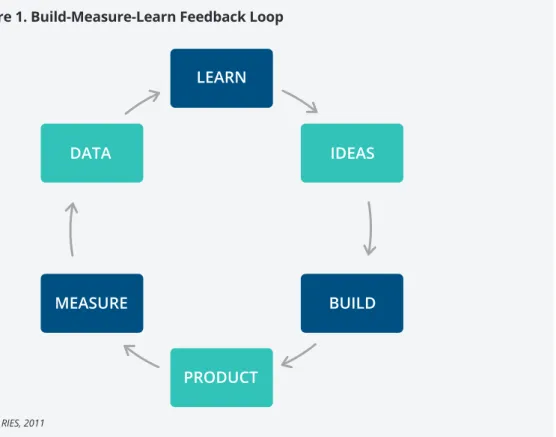
The whole process is fluid and should not be understood as linear, but in a circular logic instead, which could be better understood through the concept of Plan-Do-Check-Act (PDCA) that works under a continuous feedback loop. In this configuration, all planning generates an execution process, which in turn generates a measurement activity, and then it generates new initiatives that will once more be built and implemented, feeding the operation of this system. It is important to have in mind that every interaction with customers and suppliers provides qualitative and quantitative data that must be measured and incorporated into the learning process of the startup. These new ideas will define the construction of a new experiment to be carried out, which generates more data and learning, in a continuous cycle, as in the diagram below:
Figure 1. Build-Measure-Learn Feedback Loop
Source: RIES, 2011
LEARN
PRODUCT
MEASURE BUILD
2. Startups Overview
17
Peter Thiel (2014), on the other hand, disregards the constant learning logic of a startup as proposed by Blank and Dorf, and focuses on another approach. For Thiel, the essential matter in a startup development is that innovation can be enough to create a monopoly. Thus, other factors are given more importance in a startup’s development operation, like the idea that they should proceed, from the beginning, by a group of people with skills that allow them to create something new. However, it is worth noticing that this group should not be too large or have bureaucracies in its own hierarchical structure, since it is critical to be able to make quick decisions in this environment.
A startup development
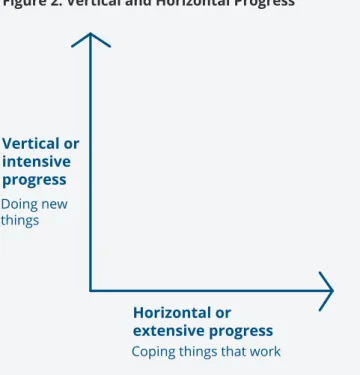
In Thiel’s book, “From Zero to One”, he focuses on two different courses of action a given project should take aiming to pave the way for its business progress: the first is the Horizontal or Extensive Progress, which relies on the replication of existing ideas that already work. This process could be represented by the scale 1 to “n”. On the other hand, there is the Vertical or Intensive Process, which relies on innovating and developing new ideas that could be represented by the scale 0 to 1. This latter strategy is particularly more challenging than the first one, since it works with the creation of original concepts, that is, that were never tested before.
Figure 2. Vertical and Horizontal Progress
Source: Thiel & Masters (2014)
As mentioned earlier, Thiel relates the success of startups to the creation of a monopoly, stating that a business has its success measured by its differentiation - by its ability to do something that others have not or cannot. Thus, we conclude that the possibility of creating a “monopoly” relies on unique solutions to unique problems, and this relationship is fundamental to the outcome of a successful business.
To a better understanding of what Thiel says about this process, we can look at companies like Tesla, Google, and Uber, as all these startups, in addition to creating value for the customer, have become synonymous with the services they provide. The fact here is that all of them have managed, at one point, to create semi-monopolies in the areas they operate. Vertical or intensive progress Doing new things
Coping things that work
Horizontal or extensive progress
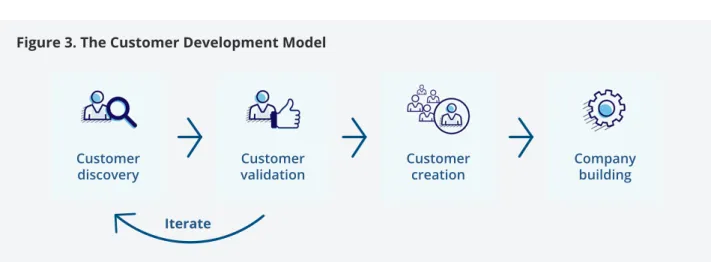
Figure 3. The Customer Development Model
Source: https://producttribe.com/product-management/customer-development-guide; based on The Four Steps to the Epiphany, by Steven G. Blank Customer
validation Customercreation Companybuilding Iterate
Customer discovery
The Customer Development Model
An important element observed by Blank is the application of the Customer Development Model by startups. This process has four steps that indicate all activities related to the customer and is divided in two sections: Search and Execution (BLANK; DORF, 2012):
i. The Costumer Discovery
Starts from the emergence of the initial business idea, going to the business model hypoteses formulation and the thinking of how these hypotheses can be tested by customers. The Customer Discovery can be divided into two phases: The first will test customer perception of the problem to be solved and the customer’s need to solve it. The second phase happens when the product or service is a prototype or on a Minimum Viable Product (MVP) form and is first presented to the customer. This process of confirming the importance of the problem and the proposed customer solution marks the end of this step. (BLANK; DORF, 2012).
ii. Customer Validation
Testing and measurement of consumer reactions – consists on the actual confirming or discarding the formulated hypotheses. This step is characterized by business model testing: product, price and margins will be tested to check if it is validated by the customer, meaning that the model is replicable and scalable from the Customer Discovery step. In the case of validation, the business model should go on. If not, it must be reformulated (iterated).
It is noteworthy that Blank’s stage model is very important when distinguishing a startup at a more advanced stage of development. Therefore, we can say that a startup begins to create value by reducing its uncertainties with its customers and suppliers. On the first two steps observed above, we went through the Search elements of the Customer Development Model: design the business, identify the customer, analyze the partner network and refine the product or service. Having the business idea validated, we move to the next two steps related to the Execution part of the Model:
iii. Customer Definition
It is here that the startup will invest to create user demand and direct them to sales channels, which means greater investments in marketing and communication. The approach strategies will vary according to the nature of the market, whether it is well defined, whether it is a new demand created by the startup, or whether it is a specific niche between the two.
iv. Company-Building
At this stage, the business is already operating, with its model already tested and validated. During this period, the startup should begin to structure itself, creating its culture, training methods, product and process management, implementing KPIs and formalizing its operating standards. The IPO or purchase by a larger company usually occurs at this stage (BLANK; DORF, 2012).
2. Startups Overview
19
An Initial Public Offering (IPO) is the first capital opening of a company, in which it will be distributing shares on a stock exchange, allowing shareholders to acquire significant shares of the company. This “opening” means giving up part of the property, privacy of information and even control over the company, in return for the possibility of absorbing large amounts of investment capable of financing a large expansion.
Classic Valuation Methods
Valuation methods are normally used and taken as references by investors who aim to acquire equity interests in mature companies, and they form the basis for startup valuation methods.
Measuring the value of an asset is always the ‘search’, in an objective manner, for the “real” value of something. However, it is essential to be clear that the views under which this measurement occurs is always endowed with subjectivity and biased at some level, which may alter the valuation in different directions, depending on the assumptions that underlie such analysis. To better illustrate this process, Damodaran (2015) developed a valuation approach as the following:
INTRINSIC: Assesses the cash flow generation capacity of an asset (discounted cash flow methods). This method is able to bring the present value of the company’s ability to generate wealth in the future at a discount rate called Weighted Average Cost of Capital (WACC).
RELATIVE: This technique will always estimate the value of an asset by comparing it with similar ones, through a common variable such as net income, cash flow, EBITDA, revenue, among others. It is very useful due to it is capacity of presenting values close to the market value of similar companies. However, it may not be the closest value to what the business is really worth.
Startup investments
To better evaluate a startup and its conditions of prosperity, it is also necessary to understand how investments are or should be made. Within this framework, it is common for a successful startup to go through the following steps: angel investor, seed capital, venture capital funds, private equity funds and initial public offering (IPO).
Angel Investors are individuals who are interested in investing in young, high-risk companies, that is, generally without a product or service ready and geared toward initial product development and marketing efforts. They act individually or in small groups and most are experienced professionals. A striking feature is that they have a less complex investment strategy, often without very deep analysis of the business.
Seed Capital Investors set the first tier of investment above angel investors and typically their strategy is to set up funds with multiple sources of investment and apply them to a larger number of early-stage companies (already with product and customers defined) to increase their chances of return.
The Venture Capital Fund is usually a modality of private equity fund that usually focus on high risk investments and high return potential, such as startups. It is also common for these funds to be very active in the daily lives of these companies, putting experienced executives in various areas to advise entrepreneurs and sharing resources and contacts with them.
The Private Equity Fund is a kind of financial intermediary that raises cash to invest in a portfolio of companies seeking financing. These companies are usually privately held, or are publicly traded companies that have some restrictions on the sale of their shares, and provide a minority (or sometimes majority) equity interest in return for such investment. Note that these funds often have an influence on the business and operations of the company that received the investment.
A New Startup
Assessment Proposal
Applied to the
Renewable
Energy Sector
After understanding how a startup works, how it generates value and
can be evaluated, we intend to propose a new startup classification
methodology in order to assist both startups and decision makers in
identifying fragilities and strengths of their solutions.
3. A New Startup Assessment Proposal
21
It was designed aiming to aid us to identify the level of replicability and resilience of startups and to help decision makers to develop their plans, strategies and decide whether or not rely on a given startup solution.
There are currently hundreds startups linked to the energy sector in the world and, by the nature of this market, they have a distinctly different profile when comparing to ‘traditional’ digital startups. Amidst the major energy startups particularities we highlight: i. they often have greater need of capital expenditure for investments in their early stages; ii. they usually require “patient and smart” money; iii. they need the possibility of rapid and constant expansion of their products and services to became viable; and iv. they operate in a highly regulated environment. Due to the complexity of the sector, we seek to develop a methodology that can minimally analyze the replicability potential of a startup. Yet, beyond the capacity of measuring the replicability of a given startup in the energy segment, this methodology also intend to aid policy and decision makers to identify what they can do to help those startups to better operate and deliver their solutions in a reliable and efficient manner.
For instance, a municipality could use this methodology to classify a startup that presents an interesting solution for an important problem. If the startup ranks scores badly, the municipality decision makers will be able to identify where this startup failed to achieve a good rank and decide if they are able and/or willing to create better conditions to this startup to operate.
That means that, sometimes, it is possible that a startup might have a great solution and present a very good institutional, financial and business plan maturity, but it scores badly because there is a particular law that prohibit its operation and/or regulations that
prevents it to apply to the procurement process. In that sense, the policy makers will be able to decide whether they should, or not, propose a change in the law and/or regulations to lift possible restrictions, allowing not only that potential startup to operate, but also enable other innovative business to thrive. The methodology analysis presents multivariable data, and is represented in a Radar Diagram.
The goal is to provide a comparative portrait of a given startup and allow the comparison and analysis of multiple cases. The Methodology works with nine indicators: i. MVP Value; ii. Startup Stage; iii. Financial Maturity; iv. Business Plan; v. Regulatory Barrier; vi. Capital Requirement; vii. Technologies Adoption; viii. Financial Barrier; and ix. Entry Barriers.
Those indicators cover a wide array of features and possible contexts in which startups are involved. To try to have a comprehensive perspective, we combine endogenous elements, those that depend uniquely on the startups (such as the number of methodologies used to build the Business Plan) and exogenous elements, those that the startup does not control (such as legislation and regulations). Conscious that several variables will differ their impact on different contexts, we also adopted a mixed approach in including qualitative and quantitative variables to try to capture this rich and diverse scenario.
Each indicator have 5 levels. To determine the score of each indicator, one must refer to the levels described. That means, each level refers to a point, for example: an answer that refers to the level 1 equals to 1 point and the level 3 equals to 3 points. Once those points are inserted in the formula, the final score would help us to identify, not only the level of replicability of a given startup, but also assist us to better identify where startups could improve and municipalities may aid.
Formula
[(Financial Maturity + Capital Requirement) x Financial Barrier] + [(Technologies Adoption +
MVP Value) x Entry Barrier] + [(Startup Stage + Business Plan) x Regulatory Barrier]
Risk Assessment Formula
[(Regulatory Barrier + Capital Requirement + Financial Barrier + Entry Barrier) / 20] -1
Simplified Formula
[(FM + CR) x FB] + [(TA+MVP) x EB] + [(SS+BP) x RB]
Simplified Risk Assessment Formula
[(RB + CR + FB + EB) / 20] - 1
Once a final score is reached, we will be able to refer it to a “Reference Chart” that will help us to locate the general level of strength and replicability a given startup has. The final score of a given startup can range from 6 to 150. The “Reference Chart” is divided in five intervals and uses both a traditional metric to rank startups states of development and the level of replicability of the startup product. The Reference Chart does not have a linear progession. Rather, it focuses more on the startup ability on dealing with its barriers.
6 to 30
Discovery Difficult Replicability31 to 54
Validation Eventual ReplicabilityTo complement the analysis, this methodology also gives us the opportunity to do a Risk Assessment of the startups. From the indicators developed, some of them have a “negative character”, in the sense that they try to measure barriers and obstacles to the startup solution. Those are: Regulatory Barrier; Capital Requirement; Financial Barrier; and Entry Barrier. The Risk Assessment would then single out four “negative” indicators and create a second score only based in those indicators. The final score of the Risk Assessment will range from -1 to 0, where -0,8 refers to the higher risk possible and 0 to the lowest risk possible.
88 to 120
Efficiency Very Good Replicability121 to 150
Scale High Replicability To reach a final score, we developed a formula that considers the score from all indicators. Theformula was designed dividing the equation into three members. The first member refers to the financial related indicators, the second to the solution/product related indicators and the third member is related to the institutional indicators. Since the main focus of the project is to try to measure the degree of replicability of a given startup, each member has a “barrier indicator” that has a multiplier effect.
55 to 87
ConsolidationGood Replicability
3. A New Startup Assessment Proposal
23
LEVEL 1 LEVEL 2 LEVEL 3 LEVEL 4 LEVEL 5
More than 1000 * Values in thousand dollars 500 - 1000 200 - 500 100 - 200 Less than 100
Indicators
1. Minimum Viable Product Value (MVP)
MVP is an important indicator commonly used to assess startups on their early stages. It aims to identify what is the minimum amount of resources needed to make viable a given product. This indicator could be used to evaluate the risks from new enterprises. It is also commonly used by startups to test and gather information from a less complete version of the product, since adding features also increase costs and risks in the event of the product fails. Startups with low MVP are more flexible and may conduct more tests to improve its final product.
2. Startup Stage (SS)
The level of maturity of the startup helps to mitigate the risks associated to the viability of its project. The earlier the stage a given startup is located, the bigger and more numerous are the obstacles that its solution face. In that sense, the later the stage a given startup is, the more tested and robust its solution should be, therefore it would probably have a more reliable solution.
LEVEL 1 LEVEL 1 LEVEL 2 LEVEL 2 LEVEL 3 LEVEL 3 LEVEL 4 LEVEL 4 LEVEL 5 LEVEL 5 Ideation and
Conceptualization Gestation Operation Traction Consolidation
3. Financial Maturity (FM)
The financial maturity of startups is directly linked to their “advancement” in terms of funding stages, which directly determine their ability to expand their business. With an adequate volume of resources, the startup will be able to expand not only in the sense of its market share but also toward further investments to enhance its products/solutions, acquiring technology and strengthen its team.
Angel
4. Business Plan (BP)
It is fairly common to have new startups beginning their business with nothing but a good idea. As we try to indicate in this report, there are a number of obstacles that requires a more professional approach to transform a good idea into a good business. Building a robust business plan is considered a pivotal condition not only to give the startup a “chart” to navigate more securely, but also to better communicate its project to investors and clients. There are several business model design methodologies, and we listed some of the most consolidated ones. Startups often evaluate their model based on more than one methodology, therefore here we correlate the number of methodologies used with the strength of the business model. The methodologies are: i. Customer Development; ii. Customer Discovery; iii. Business Model Canvas; iv. Target Market; v. MVP; or others.
LEVEL 1 LEVEL 1 LEVEL 2 LEVEL 3 LEVEL 4 LEVEL 5
LEVEL 2 LEVEL 3 LEVEL 4 LEVEL 5
The solution requires change in the legislation in one or more levels (municipal, state, federal) 1 Methodology 2 Methodologies The solution requires change in legislation in a municipal level The solution requires change in non-legislative regulation The solution is built upon the existing law, but requires governmental licenses to operate Do not require any conformity with the law or non-legislative regulation 3 Methodologies 4 Methodologies 5 or more Methodologies
5. Regulatory Barriers (RB)
Regulatory barriers are a paramount obstacle to any enterprise, and this is particularly more acute in the case of startups for several reasons. First, because startups frequently are offering innovative solutions, solutions that were not foreseen by laws and regulations. Second, in the case of the startups segment that this research has mapped, those solutions rely on the use of emerging technologies, which also were not regulated and often are opposed by traditional business that are concerned with the impact those technologies might provoke in their business. Third, given their particularities (their dynamics of operations and need of rapid expansion), startups frequently are not able to compete in public procurement processes because of the traditional requirements of participation and the considerable length of the whole process. In that fashion, we measure here the conformity that a given solution has with laws and regulations to determine their ability to operate and the possible risks this solution might incur.
3. A New Startup Assessment Proposal 25 More than 4000 * Values in thousand dollars 3000 - 4000 1000 - 2000 500 - 1000 than Less 500
6. Capital Requirement (CR)
Capital Requirement is directly related with the amount of resources that a given startup needs to operate. This indicator aims to include the traditional Capital Expenditure (CAPEX), which tries to measure the amount of resources a startup would need to cover acquisition and investments, in its diverse forms. This particular indicator also includes a second traditional concept, the Operating Expenses (OPEX), which covers the everyday operational costs. Since many startups, especially in their early stages find it difficult to separate those two concepts, we believe it is useful to create a category that includes both, so we could have a better overview of the annual capital requirement a given startup demands.
LEVEL 1 LEVEL 2 LEVEL 3 LEVEL 4 LEVEL 5
7. Technological Adoption (TA)
Based on the previous discussion on emerging technologies, this report works under the assumption that the adoption of disruptive technologies is an important aspect when we asses a startup. In one hand, startups working with emerging technologies are growing more and faster than the average, in the other hand they are gaining more attention and that performance have being “opening doors” to Venture Capitalists and other private funds and are leading to specific public programs designed to them. In that fashion, the report is considering that the number of emerging technologies adopted will not only (possibly) lead to more complex products, but also will attract more attention from supporters and clients. Since there are many different technologies and even more combinations, the report will adopt a quantitative approach to this indicator. Technologies: i. Artificial Intelligence; ii. Big Data; iii. Blockchain; iv. Cloud Computing; v. Internet of Things; vi. Nano Technology; vii. Robotics or others.
LEVEL 1 LEVEL 2 LEVEL 3 LEVEL 4 LEVEL 5 1 Technology 2 Technologies 3 Technologies 4 Technologies 5 or more Technologies
LEVEL 1 LEVEL 2 LEVEL 3 LEVEL 4 LEVEL 5 There is no available acceleration or incubator program (private or public) suitable for the proposed solution The startup solution requires special financing programs The solution requires financing for equipment and/ or prototypes (high CAPEX) The startup manages to access both government programs and private financing The startup is created with a secured major client
8. Financial Barriers (FB)
Financial barriers are a common obstacle for startups in general, since many of them are still seen with skepticism. This barrier is particularly challenging when it comes to startups that focus on the energy sector. Differently from most startups, the ones from the energy segment generally require a higher capital expenditure (CAPEX) to invest and acquire prototypes and equipments. The need of more resources to implement a given project generates more obstacles to capture external funds, especially because most public funds allocate only a moderate amount of resources in its programs, due to the risk generally associated with the startups business. Therefore, this indicator tries to measure the ability a given startup has to identify and capture the necessary resources to its projects (regardless of the amount).
9. Entry Barriers (EB)
Entry barriers are one of the key elements that hinder or obstruct a startup’s business development. It is possible to identify barriers from various natures. This indicator lists some of the most common barriers cited in the survey conducted by this research. Those are: i. public bureaucracy; ii. technical; iii. low public awareness of the technology(ies) involved in the solution; iv. high competition; v. access to skilled labor or others. It is important to highlight that those barriers could vary its intensity greatly from one context to another, thus against the difficulty to describe all the contexts and scenarios, we will measure the size of the obstacle a given startup has by summing up the number of barriers it may face.
LEVEL 1 LEVEL 2 LEVEL 3 LEVEL 4 LEVEL 5 1 Barrier 2 Barriers 3 Barriers 4 Barriers 5 or more Barriers
Startup
Profiles
Emerging
Technologies
Applied to the
Renewable
Energy Sector
27STARTUP 1:
Cubi
It allows working with various types of clean energy, such as wind, solar, geothermal, hydraulic, biofuel, nuclear and electrical energy in a broader sense.
Energies involved
PROCESS
First, the customer’s energy infrastructure and connectivity points are evaluated. After that, the energy meters are installed in the equipment of interest, which can indicate when, where and how the energy costs in the production process occur. Subsequently, the vast amount of data stored in the cloud is finally processed by Cubi’s algorithms, indicating opportunities for improvement and optimization, in a dynamic that feeds back this intelligent model so that it is increasingly efficient.
COMPLEXITY
The technical complexity involved in the project is low for the users. Despite the complexity in energy management, the possibility to adapt to the needs of each customer in the face of the same type of service (if the tools and methods vary), is key to simplify the customer experience. Thus, the maintenance fits in the knowledge of the teams themselves, so that any electrician can supply the functions. In other words, the solution is designed especially so that lay people could keep it after it is installed and enjoy their processed data and recommendations.
Solution
PRODUCT
MAINTENANCE SKILLED LABOR
Startup solution involves
SERVICE INSTALLATION
Due to inherent characteristics of the energy, it is hard to have it well managed. Many people use tools such as energy bills and spreadsheet controls to monitor power consumption levels, but these tatics are not efficient in terms of time consuming and accuracy.
Presenting a response for this scenario, Cubi was born in São Paulo, Brazil, and has developed a complex solution focused in the service provision that aims to simplify energy management for the customer, making it more intuitive and pragmatic in applications, savings, planning and decision making in general. More information at: www.cubienergia.com
Cubi
INTERNET OF THINGS
BLOCKCHAIN
ARTIFICIAL
INTELLIGENCE BIG DATA CLOUD COMPUTING NANO- TECHNOLOGY ROBOTICS
Managers and decision makers in the small, large and medium-sized industry. Some sectors that show greater natural interest in Cubi’s solution because of its energy intensity are: plastics, food and metalworking sectors. In general terms, industries and buildings that can and may be interested in installing energy meters on specific machinery.
In addition to using hardware designed to maximize data security, connectivity (only wireless networks are used) and technical security, Cubi’s main innovation can be understood in the intelligent processing phase. With a focus on delivering a service, the company can extract value from the data that is generated and present it clearly, already indicating the outputs that can be generated and also creating benchmarks of each segment, allowing internal comparison and in terms of the market. That is, transforming raw data into real and useful information for immediate decision making.
Innovation of
the solution
Main techs involved
Target public
Acceleration/Awards
EDP Starter (1st edition in Brazil) Participation in Sebrae SP PRE-Acceleration ProgramParticipation in EDP Open Innovation
Braskem Labs Challenge Batch (Top 10 Best Pilot Projects)
Third place winners at the SECOP Challenge 2017 of Innovation (allowed the adoption of the Innovation Seal of ABEP (Brazilian Association of State Information and Communication Technology Entities)
Startup finalist at Inovativa Brasil - in 2017.2
4. Startup Profiles
DATA ACQUISITION PROCESSING DECISION MAKING How does it work | CUBi
Online Control Panel Reports & Analytics Ecosystem of Solutions and implementation IMPLEMENTATION Cloud Database and processing Energy Meters Data enrichment Readily available Utility billing OCR technology Buildings Industry Machinery Retail IoT
Graphic scheme
Greater accessibility and better values for IoT connectivity: The low amount of connection options make them very expensive, and this is directly linked to poor infrastructure, with many poor sites with low levels of coverage. In addition, there are also few companies / tools that manage mobile chips on the type of equipment needed. Two other challenges are the development of a hardware product in Brazil, where access to prototyping is costly and difficult and the lack of market knowledge about the benefits that this type of solution can generate.
Focused on an Operational Expenditure (OPEX) solution, customers are usually not charged for an initial investment, but monthly fees are required for full power management. Because each model is tailored to the particular needs of each customer, there is no specific model on return on investment. What can be said in this sense is that the increase in the contracted time brings more impacts to the negotiation than the increase in the volume of solutions regarding price reduction.
Major obstacles
Operation
investment/ROI
Diagram
Cubi
Minimum Viable Product Value (MVP) Startup Stage (SS) Financial Maturity (FM) Business Plan (BP) Technological Adoption (TA) Capital Requirement (CR) Regulatory Barriers (RB) Financial Barriers (FB)Entry Barriers (EB)
Less than 100 Traction Seed Capital 5 Methodologies 4 Technologies Less than 500 Do not require any conformity with the law or non-legislative regulation
The startup manages to access both government programs and private financing 3 Barriers
FINAL SCORE 100 INDICATOR LEVEL SCORE
RISK ASSESSMENT 5 4 2 5 4 5 5 4 3 -0,15 0 1 2 3 4 5 MVP SS FM BP TA CR RB FB EB
Cubi stands out by combining relative low costs for its operations (MVP and Capital Requirement), strong business (tested business model and a solution supported by several technologies) and manages to not get very impacted by the barriers indicators. From the methodology perspective, once the startup manages to access more resources and cope with several of its entry barriers, it will have a high potential to gain scale.
4. Startup Profiles
STARTUP 2:
Fohat
It allows working with various types of clean energy, such as wind, solar, geothermal, hydraulic, biofuel, nuclear and others.
Energies involved
PROCESS
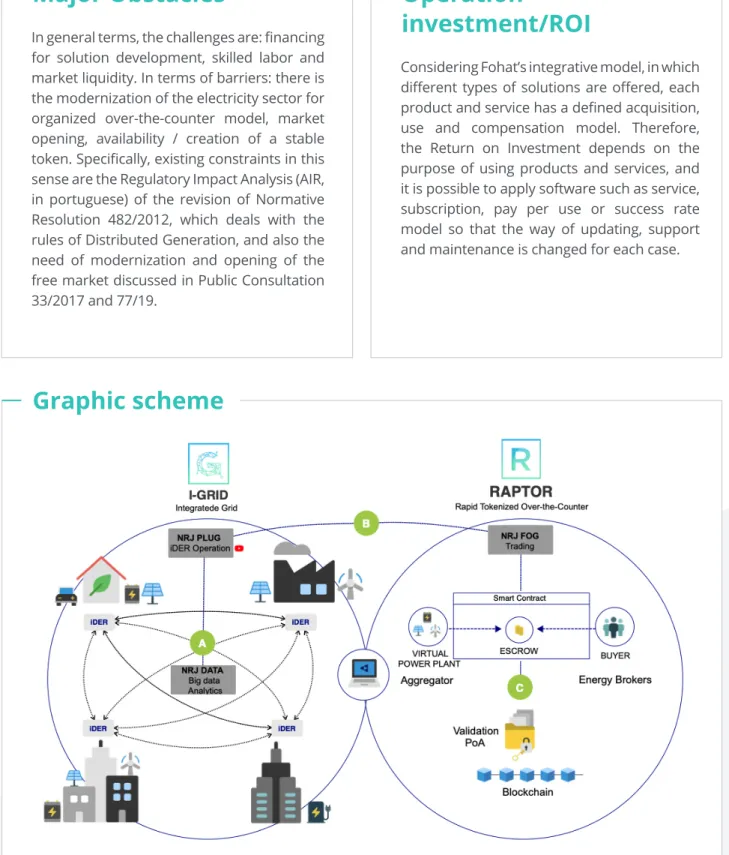
Fohat operates in three major segments: 1. Integration, control, management and dispatch of distributed generation assets in arrangements such as Microgrids and Virtual Power Plants (VPP). In this sense, the products offered are i. I-Grid2You (Microgrid Solutions) and ii. I-Grid2Corp (Microgrid Solutions, Virtual Power Plants and Demand Response Program fulfillment); 2. Digitalization of trading to over-the-counter (OTC) and stock markets, promoting the free trading market. The products of this segment are i. Raptor Home Broker (Energy Trading Home Broker Solution), ii. Raptor Unorganized Balcony (Energy Trading Balancing Solution for Unorganized Markets), iii. Raptor Organized Balcony (Energy Trading Solution for Organized Markets), iv. Turing Clearing House (central counterparty solution for custody and settlement in organized OTC markets and v. Raptor + Turing Trading Exchange (Distributed Market Energy Trading Solution); 3. Automation and market places for trading certificates of Origin and Distributed Generation Lots. Products: i. I-Grid Certificates of Origin (Issuance, Trading, Consumption and Retirement of Certificates of Origin [I-RECs]) and ii. Autonomous Assets (Distributed Generation Allotment and Commercialization Solution).
COMPLEXITY
As different product and service models apply (in Generation Line, Commercialization and Automation), complexity varies by customer’s purpose. In terms of skilled labor, the level of complexity can be understood as high: are required software developers in Blockchain, Java, Javascript, React, Angular, Django, Python, Graphql, Apollo, Jenkins, Spring boot, multi agents systems, deep learning, Machinne Learning, Docker, MongoDB and PostgreSQL and people with specific knowledge in the energy market and financial sector.
Solution
PRODUCT MAINTENANCE SKILLED LABORStartup solution
involves
SERVICE INSTALLATIONStarting from the concept of “Energy Intelligence ”, Fohat comes from Curitiba, Brazil, and works with disruptive technologies such as Blockchain, Artificial Intelligence, Big Data and Tokenomics. This sofisticated combination allows them to solve problems in the energy industry with regards to the integration, control, management and dispatch of distributed generation assets, as well as digitalization of energy trading with the financial sector.
More information at: fohat.co
4. Startup Profiles 33
Fohat
INTERNET OF THINGS BLOCKCHAIN ARTIFICIALINTELLIGENCE BIG DATA CLOUD COMPUTING NANO- TECHNOLOGY ROBOTICS
All players in the Generation, Distribution, Transmission, Trading and Consumption segments are potential target audiences. That is, generators, distributors, transmitters, traders, self-producers, special consumers, free consumers, exporters, importers or independent producers may enter here. In addition to being the first company to reconcile Blockchain technology and the energy sector in Latin America, Fohat has the distinction of integrating solutions and platforms, creating end-to-end solutions from generation through accumulation, distribution, transmission and commercialization, until finally energy consumption. Thus, innovation lies in the articulation of sophisticated technologies capable of promoting high levels of effectiveness, flexibility, decentralization, reliability and scale around sustainable solutions.
Innovation of
the solution
Main techs involved
Target public
Acceleration/Awards
Founder Institute (2018) Recognized as Top 6 Energy by 100 Open Startups Startupbootcamp Energy Australia (2019)Graphic scheme
In general terms, the challenges are: financing for solution development, skilled labor and market liquidity. In terms of barriers: there is the modernization of the electricity sector for organized over-the-counter model, market opening, availability / creation of a stable token. Specifically, existing constraints in this sense are the Regulatory Impact Analysis (AIR, in portuguese) of the revision of Normative Resolution 482/2012, which deals with the rules of Distributed Generation, and also the need of modernization and opening of the free market discussed in Public Consultation 33/2017 and 77/19.
Considering Fohat’s integrative model, in which different types of solutions are offered, each product and service has a defined acquisition, use and compensation model. Therefore, the Return on Investment depends on the purpose of using products and services, and it is possible to apply software such as service, subscription, pay per use or success rate model so that the way of updating, support and maintenance is changed for each case.
Major Obstacles
Operation
investment/ROI
Fohat
Diagram
Minimum Viable Product Value (MVP) Startup Stage (SS) Financial Maturity (FM) Business Plan (BP) Technological Adoption (TA) Capital Requirement (CR) Regulatory Barriers (RB) Financial Barriers (FB)Entry Barriers (EB)
200 -500 Operation Seed Capital 5 Methodologies 5 Technologies 500-1000
The solution requires change in the legisla-tion in one or more levels
The startup manages to access both government programs and private financing 2 Barriers
FINAL SCORE 64 INDICATOR LEVEL SCORE
RISK ASSESSMENT 3 4 2 5 5 4 1 4 4 -0,3 0 1 2 3 4 5 MVP SS FM BP TA CR RB FB EB
Fohat is a case point of a startup operating in the energy sector which, for having a solution that involves equipment, has considerably higher costs of operation. Nonetheless, its solution and business model seems very robust, for having the business model tested by many methodologies and applying numerous technologies to its solution. Fohat case is important for this analysis because it presents a situation in which the main barrier posed to the startup is of an exogenous nature, which means, in the event of positive changes promoted by the public power, its business will probably make a big leap in scale and reduce considerably its risks.
4. Startup Profiles
STARTUP 3:
Infra Solar
Solar energy
Energies involved
PROCESS
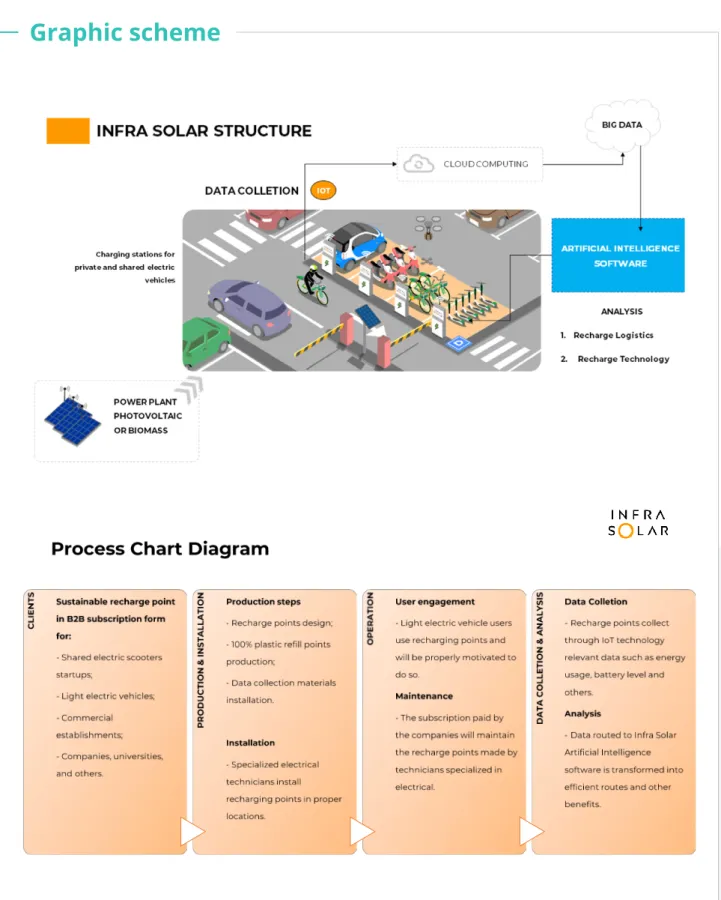
Infra Solar operates in the battery market for electric vehicles, offering sustainable solutions through the use of new technologies such as Big Data, Cloud Computing, Internet of Things and Artificial Intelligence. Its solutions cover energy recharging - through solar panels - and parking for light electric vehicles increasingly common in large cities (such as scooters and bicycles) and intelligent data management operation and maintenance services. Its performance is in the midst of a nascent but exponentially escalating activity (the size of the world market for electric vehicle batteries is $ 84 billion), which has been finding solutions and problems on a daily basis, which means that Infra Solar can also monitor regulatory issues and contribute to the best use of this type of transport.
COMPLEXITY
Medium complexity for data collection and analysis during operation - requiring specialized operators, and low complexity for maintaining the physical recharge points - with no need for great technical knowledge.
Solution
PRODUCT
MAINTENANCE SKILLED LABOR
Startup solution involves
SERVICE INSTALLATION
(NOT FOR EACH CUSTUMER)
Considering the chaotic distribution of electric modes spread over large cities and the consequent difficulty of charging the batteries and their full utilization by users. Originated in São Paulo, Brazil, Infra Solar’s sustainable energy recharging and parking space in strategic locations of cities represent a solution aligned with the legislation and capable of solving problems that tend to increasingly escalate.
More information at: infrasolar.com.br
The design of monitoring and control systems is highly scalable: there are only costs of storage and installing a computational microsystem. The physical recharge point project has only labor costs after the final investment in Capital Expenditure, with an average return on investment of eighteen months since installation and the beginning of the service.
Another type of return on investment that lies in Infra Solar is its alignment with the legislation in a new (and sometimes chaotic) market, making the brand a reference in this kind of solution for scooters, bicycles and any electric modes.
Operation
investment/ROI
4. Startup Profiles 37Infra Solar
INTERNET OF THINGS BLOCKCHAIN ARTIFICIALINTELLIGENCE BIG DATA CLOUD COMPUTING NANO- TECHNOLOGY ROBOTICS
The use of renewable energy and emerging technologies for the development of a SaaS (Software as a Service) so that it works as a mediator software in a Cloud Computing environment. This allows to implement a mathematical model of mediation and suggestions, based on Artificial Intelligence, of charging and parking points using a NoSQL (nonrelational) database capable of receiving real-time data from remote devices with Internet of Things (IoT) technology over a mobile network data communication.
Innovation of
the solution
Main techs involved
Acceleration/Awards
Acceleration - Braskem Labs Scale 2019
Mentoria - Eduardo Mayer Fagundes
Infra Solar offers gains in energy efficiency and clean energy solutions for electric transport modes and O&M maintenance services) with intelligent data management. Thus, its target public can be described as the suppliers of micro mobility and shared electric vehicles.
Target public
In terms of scaling the project from the pilot, the major obstacles are the recruitment and retention of professionals specialized in artificial intelligence and communications tools and sufficient service provision contracts to make the operation profitable. In addition: the untimely changes in legislation, finding financial support, adhesion of electric vehicle companies and the technology development in the country.
Graphic scheme
Infra Solar
Diagram
Minimum Viable Product Value (MVP) Startup Stage (SS) Financial Maturity (FM) Business Plan (BP) Technological Adoption (TA) Capital Requirement (CR) Regulatory Barriers (RB) Financial Barriers (FB)Entry Barriers (EB)
Less than 100 Operation Angel Investment 5 Methodologies 4 Technologies 500 - 1000 Do not require any conformity with the law or non-legislative regulation
The startup manages to access both government programs and private financing 2 Barriers
FINAL SCORE 96 INDICATOR LEVEL SCORE
RISK ASSESSMENT 5 3 1 5 4 4 5 4 4 -0,15 0 1 2 3 4 5 MVP SS FM BP TA CR RB FB EB
Infra Solar is another case of a startup in its early stages that has developed a strong business model with an interesting solution that lies in a considerable number of technologies and that manages to keep its operation at relative low costs. It is also notable that their solutions do not face a high resistance from the barrier indicators. Once it manages to access more funds and move in the Financial Maturity indicator, its operation could gain traction and scale considerably.
4. Startup Profiles