PASSIVE TIME REVERSAL PROBE-SIGNAL CAPTURE
OPTIMIZATION FOR UNDERWATER COMMUNICATIONS
António Silvaa, Sérgio M. Jesusa, João Gomesb
a
Institute for Systems and Robotics, Universidade do Algarve, Campus de Gambelas, 8005-139 Faro, Portugal
b
Institute for Systems and Robotics, Instituto Superior Técnico, Av. Rovisco Pais, 1049-001 Lisboa, Portugal
António João Silva, Universidade do Algarve, Escola Superior de Técnologia, Campus da Penha, PT-8005-139 Faro, Portugal; Fax.: +351 289888405, email: [email protected]
Abstract: Passive Time Reversal (pTR) is an emerging technique for underwater communications where a channel probe is sent ahead of the data packet. The channel probe must be captured in a time window for post crosscorrelation with the data. The Signal to Noise Ratio (SNR) of pTR, and hence the detector error rate, will be dependent on the starting point and duration of this time window. Typically the beginning and length of the time window should depend on the time dispersion of the acoustic channel which, in turn, depends on the environment properties and on the experimental geometry. Heuristic reasoning would suggest that if a short time window fails to include all significant multipath it will result in imperfect focusing, while an overly long window will reduce the efficiency of the communication system by introducing additional noise in the pTR system. That problem calls for an optimization that has previously been addressed only heuristically. In order to bring the pTR capabilities to a practical modem the engineering problem of time window automatic optimisation must be solved, and that is the main purpose of our paper. An expression for the optimal pTR SNR time window length is presented and its validity confirmed with simulations and real data from the INTIFANTE’00 sea trial.
Keywords: Acoustic time reversal, underwater coherent communications, shallow water propagation.
1. INTRODUCTION
Multichannel adaptive equalization methods provide, up to now, the most popular framework to mitigate the intersymbol interference (ISI) in underwater digital coherent communications, but they are computationally quite demanding. Passive Time Reversal (pTR)[1] is a less demanding technique where the physics of ocean acoustic propagation simplifies the deconvolution. In pTR a probe-signal is transmitted ahead of the data-signal in order to estimate the channel impulse responses (IRs) for later use as replica signals in a Time Reversal Mirror (TRM) fashion.
When applied to underwater digital communications pTR makes use of the orthogonality property of propagating modes and an estimate of underwater channel IRs to recombine energy in a matched-filter-like manner, whose function is to maximize the output SNR at a given time instant [2]. Fully exploiting mode orthogonality requires an impractically long and dense receiving-array, without which residual ISI cannot be eliminated by pTR. In practice channel IR estimates must be captured in a time window in order to be used as FIR filters in the receiving computer. The Signal to Noise Ratio (SNR) and error rate of pTR will dependent on the starting point and duration of this time window. Heuristic reasoning would suggest that if a short time window fails to include all significant multipath it will result in imperfect focusing, while an overly long window will reduce the efficiency of the communications system by introducing additional noise in the pTR system.
That problem calls for an optimization that has been addressed heuristically in the past [3]. In order to bring time reversal capabilities to a practical modem the problem of time window a priori automatic optimization must be solved. Preliminary results of [4] show that the maxima of pTR SNR output can be predicted by means of a differential equation that operates over the channel IR estimates, and these do not depend on the noise level of the underwater channel. Simulations and real data from INTIFANTE’00 sea trial will be used to show the correctness of such approach.
2. THEORECTICAL BACKGROUND AND RESULTS
Fig.1: Passive time reversal implementation for coherent communications
The baseband equivalent of pTR for communications can be implemented by using a system shown in fig. 1, where the dirac (t is the probe-signal and ) , , ( )
0 t
gkt is the time windowed estimation of the k th hydrophone narrowband channel impulse response,
) (
' t
hk , contaminated with noise uk(t); a(n)is the transmitted data-stream and vk(t)is the received data-stream multipath-contaminated by the channel IR hk(t) and noise-contaminated by wk(t). In the following the index (t0, )indicates that the signal has been
multiplied by a unit-gate function of length and starting pointt , referred to as the time 0 window. The pTR output z(t)is then sampled at the symbol rate T and applied to the b detector to obtain a data-stream estimate aˆ n( ).
In fig. 1 the resulting pTR output is given by ) ( 3 ) ( 2 ) ( 1 ) ( ) (t y t x t x t x t z (1) where y(t) contains the desired data-stream and x1..3(t)are noise terms given by
K k t k k K k t k k K k t k k K k t k k t u t w t p t x t h t w t p t x t u t h t p t a t x t h t h t p t a t y 1 , , 3 1 , , 3 1 , , 4 1 , , 4 ) ( ) ( ) ( ) ( 3 ) ( ) ( ) ( ) ( 2 ) ( ) ( ) ( ) ( ) ( 1 ) ( ) ( ) ( ) ( ) ( 0 0 0 0 (2)
where a(t) an (t nTb) is a continuous version of the data-stream, p(t)is a fourth-root raised cosine pulse [4], and pn(t) is the n times self convolution of p(t) (yielding a raised cosine pulse p4(t)for n 4).
In [4], after deriving the pTR output SNR (SNRout(t0, )) as a function of the time-window parameters(t0, ), it was found that the local maxima of SNRout(t0, ), as a function of , are given by the zero crossings of
0 ) , ( ) , ( ) , ( 0 0 C t0 d t dC t y y (3)
where 2 when noiseless channels IR estimates are available and
K k t t k y t h t dt C 1 2 0 0 0 ) ( ) , ( (4)
is the sum of the accumulated energy for all channels. When only a noisy estimate of the channel IRs hˆk(t) hk(t) uk(t) is available, should be smaller that 2 in order to compensate for the noisy increment in Cˆy(t0, )estimation. Equation (3) states the remarkable result that the window that ensures maximum pTR output SNR does not
depend on the noise power and, moreover, that it only depends on the channel IRs (see (4)).
2.1 Simulations results
Equation (3) and (4) are applied to a simulated acoustic channel, where the impulse responses hk(t)have been computed by using the C-Snap normal mode model. The sound transmitter and the receiving array were placed 1.3 km apart in a range-independent environment with 118 m depth, over silt-like sub-bottom of 1.5 m thickness and gravel-like bottom. The sound speed profile is downward reflecting with a thermocline down to 30 meters and a sound speed ranging from 1500 m/s to 1510 m/s. The source depth is 74 m and the receiver is a 16-hydrophone 4-meter-spaced array with the first hydrophone placed at 30 m depth. The transmitted data signal is a 2-PSK signal with 50% rolloff and fourth-root raised-cosine pulse shape, the carrier frequency is 1600Hz, and the data rate is 300 bits/s.
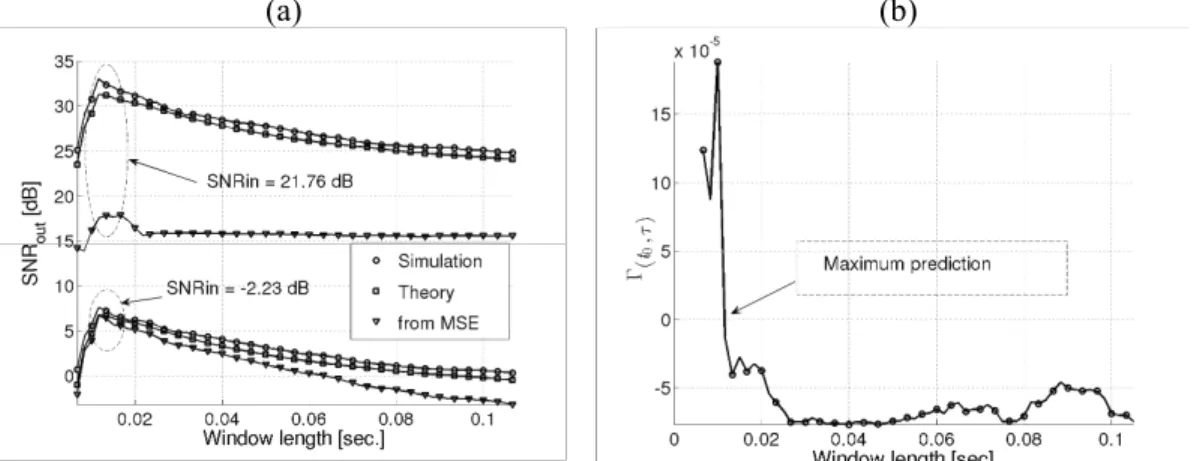
(a) (b)
Fig.2: Simulation performance of the proposed optimal time window prediction method. (a) pTR SNR output; (b) local maxima prediction with 2
Fig. 2(a) shows the pTR SNR output (in dB) as a function of window length for two input SNR of -2.28 dB and 21.76 dB: with ‘o’ a Monte-Carlo simulation computed from the signal and noise terms (2) where the ISI is considered to be part of the signal term
) (t
y ; with ‘V’ a generally more accurate pTR SNR output for communications, that is based on the detector input Mean Square Error (MSE) where the ISI is considered as a disturbing signal, given by ( , ) 1( 0, ) 1
0
' t MSE t
SNRpTR [3]; and with ‘’ the
theoretical curve derived in [4]. This figure shows that for low input SNR good agreement is obtained between all curves. For high input SNR it can be seen that the SNR output computed from the MSE saturates due to the residual ISI of the TR operator. Despite these differences it is important to note that the maxima are always obtained for the same time window length, which means that the optimum time window length predicted by the theoretical expression (3) is true in any case. Fig. 2(b) shows the behaviour of (t0, ) given by (3). It can be seen that the up-down zero crossings clearly coincide with the maxima of the output SNR curves of fig. 2(a).
(a) (b)
(c) (d)
Fig.3: Real data performance of the proposed optimal time window prediction method. (a) pTR SNR output computed by using MSE for shot 9; (b) local maxima prediction with
5 .
1 for shot 9; (c) pTR SNR output computed by using MSE mean over the 9 shots; (d) local maxima prediction weighed mean over the 9 shots with 1.5.
2.2 Experimental results
The experimental data were acquired during the INTIFANTE'00 sea trial that took place in October 2000 off the town of Setúbal, approximately 50 km south of Lisbon, Portugal. This paper concentrates on the Binary Phase Shift Keying data collection. The scenario was similar to that used in the simulations, the main differences being that with real data there will be noise corruption and geometric/environment mismatch between the probe-signal and the data transmissions. Nine sequential transmissions will be considered (in the following assigned as shot 1 to 9), each composed of a probe-signal transmitted 0.5 seconds before a 5-second PSK data packet, repeated every 7 seconds with a total duration of 63 seconds.
During INTIFANTE'00 the setup for pTR-based data communications was similar to that of Fig. 1, with the p2(t) narrowband filter used for IR estimation (path above in Fig. 1) distributed between the transmitter and the receiver, which is equivalent to say that the transmitted probe-signal was a fourth-root raised-cosine pulse and that IR estimation was obtained by correlating the received probe-signal with the transmitted one (see [4] for details).
Fig. 3(a) shows the pTR SNR output computed by using the MSE at the detector input for the first 3 seconds of data in shot 9. One can see that there is a progressive loss of
performance due to the geometric/environmental mismatch between the probe-signal and data-signal transmissions. This affects primarily larger time windows since those include the later arrivals that are usually considered more prone to fading. In spite of the time variability, Fig. 3(b) shows that the predicted pTR SNR output local maxima, given by the up-down zero crossings of ˆ(t0, ), are in good agreement with the true local maxima in the first-second curve of fig. 3(a). The arrows indicate the well-predicted local maxima and the ellipsoid highlights the global maximum.
In order to verify the robustness of the proposed optimization technique a mean analysis over the first second of data by using the nine shots is presented in Figs. 3(c-d). Fig. 3(c) shows that averaging will partially eliminate the fake noise paths and the later path arrivals more sensitive to fading. In Fig. 3(d) one can see the weighted mean of
) , ( ˆ
0
t over all shots, where the weight for each shot is given by the mean of )
, (t0
SNRout over . This way, shots with better performance contribute more to the result. One can see that the predicted local maxima of Fig. 3(d) are in good agreement with the true local maxima of Fig. 3(b), except for the last local maximum that is predicted two symbols apart.
3. FUTURE WORK
The problem of time window optimization when operating a pTR with a vertical line array for underwater communications was considered. It was found that the optimum time window ensures higher pTR SNR output and simultaneously lower MSE at the detector input. The optimum time window does not depend on the noise level, but only on the channel IRs by means of a first-order differential equation (3). Simulations and real data show that the pTR SNR output local maxima can be predicted accurately. Future work will address the solution for automatic global maximum prediction.
4. ACKNOWLEDGEMENTS
This work was supported by Fundação para a Ciência e a Tecnologia, Portugal, under NUACE POSI/CPS/47824/2002 project, ATOMS POCTI/P/MAR/15296/1999 and the Portuguese Ministery of Defence under LOCAPASS project. The authors would like to thank the NATO Undersea Research Centre for the loan of the acoustic sound source, the support of Enrico Muzzi and the NRP D. Carlos I crew during INTIFANTE’00 sea trial.
REFERENCES
[1] R.D.Dowling, Acoustic pulse compression using passive phase-conjugation processing, JASA, 95(3), pp.1450-1458, 1994.
[2] M. Stojanovic, Retrofocusing techniques for high rate acoustic communications, JASA, 117 (3), pp. 1173-1185, 2005.
[3] J. Gomes, V. Barroso, Asymmetric underwater acoustic communications using a time-reversal mirror, In Proc. of MTS/IEEE OCEANS’00, Providence, USA, 2000. [4] A. Silva, S.M. Jesus, J. Gomes, Time reversal optimization for underwater