Ana Paula Pereira Peixoto
Search for tZ production via Flavour Changing
Neutral Currents with the ATLAS experiment
at the LHC
Agosto de 2016 U m inho | 20 1 6 Ana P aula P er eir a P eix o toSearch for tZ production via Fla
vour Changing Neutral Currents
wit h t he A TL AS e xperiment at t he LHC
Escola de Ciências
Ana Paula Pereira Peixoto
Search for tZ production via Flavour Changing
Neutral Currents with the ATLAS experiment
at the LHC
Agosto de 2016
Dissertação de Mestrado
Mestrado em Física - Física Aplicada
Trabalho efetuado sob a orientação do
Professor Doutor Nuno Filipe da Silva Fernandes de Castro
Escola de Ciências
Nome: Ana Paula Pereira Peixoto
E-mail: [email protected] Telefone:+351969233066
N´umero de Cart˜ao de Cidad˜ao:13630865
T´ıtulo da Tese: Search for tZ production via Flavour Changing Neutral Currents with the ATLAS experiment at the LHC
Orientador: Doutor Nuno Filipe da Silva Fernandes de Castro Ano de Conclus˜ao:2016
Designa¸c˜ao do Mestrado: Mestrado em F´ısica Aplicada
´
E AUTORIZADA A REPRODUC¸ ˜AO INTEGRAL DESTA TESE APENAS PARA
EFEITOS DE INVESTIGAC¸ ˜AO, MEDIANTE DECLARAC¸ ˜AO ESCRITA DO
INTERESSADO, QUE A TAL SE COMPROMETE; Universidade do Minho, 29/08/2016
Search for tZ production via Flavour Changing
Neutral Currents with the ATLAS experiment
at the LHC
Tese de Mestrado
Mestrado em F´ısica - F´ısica Aplicada
Trabalho efectuado sob orienta¸c˜ao do
Professor Doutor Nuno Filipe da Silva Fernandes de Castro
This thesis would not be possible without the support of many people. I would like to gratefully acknowledge all of them, in particular the people that supervised my work, those with whom I have worked and those who shared their knowledge with me.
First of all, I would like to express my gratitude to Dr. Nuno Castro for many reasons but more importantly for being a very supportive and, at same time, exigent advisor. Thanks for all you taught me and for the opportunities you gave me.
I also have to thank the Humboldt University (Berlin, Germany) for letting me use their analysis code as well as the cluster to run the analysis presented in this thesis. A special thanks to the Humboldt University group involved in this work composed by Oliver Kind, Thomas Lohse, Sebastian Mergelmeyer and Soren Stamm. They made possible a big part of the work presented here through their expert advices and their support from the first minute of our collaboration. I would like to also thank for their hospitality during my stay in Berlin. I have to acknowledge, in particular, Oliver Kind and Sebastian Mergelmeyer for always being available to help me and for everything I learned with them.
I thank the LIP-Minho team, specially my close colleagues Juan Pedro Araque, Tiago Vale and Jos´e Correia for all the help they gave me and for the moments we spent during the last year.
I would like to thank the whole LIP team for their support with a special thanks to the Portuguese ATLAS group. I also have to thank all the people in the Single Top subgroup in ATLAS for all the important advices to the development of this
analysis.
A special word of gratitude goes to my Physics and Chemistry teacher S´onia Torres for introducing me to the physics world and for made me believe in my dream of being a physicist.
The most important thanks go to all my family specially to my mother Manuela and my father Carlos for all their patience and emotional support. Thanks for the motivation and love you give me every day. Finally, I want to thank Tiago who always understands and helps me no matter what. Thank you for being always by my side.
I thank LIP (Laborat´orio de Instrumenta¸c˜ao e F´ısica Experimental de Part´ıculas), FCT/MEC (Funda¸c˜ao Ciˆencia e Tecnologia / Minist´erio da Educa¸c˜ao e da Ciˆencia), FEDER (Fundo Europeu de Desenvolvimento Regional) for funding my activi-ties this past year, as established by the partnership PT2020 partnership with COMPETE2020 (Autoridade de Gest˜ao do Programa Operacional Competitivi-dade e Internacionaliza¸c˜ao), by providing me with a research scholarship (Refer-ence LIP/BI-26/2015).
A presente disserta¸c˜ao tem como objectivo a pesquisa da produ¸c˜ao de eventos tZ atrav´es de processos de mudan¸ca de sabor por correntes neutras recorrendo a uma an´alise de dados colectados pelo detector ATLAS do Large Hadron Collider localizado no CERN. Os processos de mudan¸ca de sabor por correntes neutras s˜ao muito raros no Modelo Padr˜ao da F´ısica de Part´ıculas, sendo ausentes a tree-level e extremamente suprimidos a loop-level. No entanto, estes processos tˆem uma maior probabilidade de ocorrer em v´arios modelos para al´em do Modelo Padr˜ao.
Neste trabalho ´e estudada a produ¸c˜ao de um quark top e de um bos˜ao Z atrav´es de processos de mudan¸ca de sabor por correntes neutras numa topologia trilept´onica. O estado final desta pesquisa consiste num par de lept˜oes de carga oposta e sabor idˆentico com uma massa compat´ıvel com o decaimento de um bos˜ao Z, um lept˜ao carregado em conjunto com um lept˜ao neutro provenientes do decaimento de um quark top e finalmente um jacto proveniente de um quark bottom (b-tagged jet). Os dados analisados, relativos a colis˜oes prot˜ao-prot˜ao a uma energia de centro de
massa de √s = 13 TeV, foram obtidos no per´ıodo de Julho a Novembro de 2015
correspondendo a uma luminosidade integrada de 3.21 fb−1.
Um estudo complementar de poss´ıveis vari´aveis discriminantes ´e apresentado. Atrav´es deste estudo, s˜ao obtidos limites superiores esperados com um n´ıvel de confian¸ca de 95% na sec¸c˜ao eficaz de produ¸c˜ao deste processo. Estes limites s˜ao interpretados em termos do acoplamento tZq e da frac¸c˜ao de decaimento t → qZ.
The subject of the present dissertation is the search for tZ event production by Flavour Changing Neutral Currents (FCNC) through the analysis of data collected by the ATLAS detector of the Large Hadron Collider located in CERN. The FCNC processes are very rare in the Standard Model of Particle Physics since they are not allowed at tree-level and extremely suppressed at loop-level. However, this processes have a higher probability to occur in several models beyond the Standard Model.
In this thesis, a search for the production of a top quark and a boson Z via FCNC in a trileptonic topology is discussed. The final state of the tZ production consists in a pair of leptons with opposite sign and same flavour having a mass compatible with the decay of a Z boson, a charged lepton and a neutral lepton classified as coming from the decay of a top quark and finally a jet coming from a bottom quark (b-tagged jet). The analyzed data coming from proton-proton collisions at
the centre-of-mass energy of √s = 13 TeV was collected in the data-taking period
between July and November of 2015 corresponding to an integrated luminosity of
3.21 fb−1.
A complementary study of possible discriminant variables is presented. Through this study, expected upper limits at 95% confidence level on the cross-section of tZ production via FCNC were obtained. An interpretation of these limits in terms of branching ratios for t → qZ and the tZq coupling is also presented.
1 Introduction 1
2 The Standard Model of particle physics and beyond 3
2.1 The Standard Model of particle physics . . . 3
2.1.1 Quantum electrodynamics . . . 6
2.1.2 Quantum chromodynamics . . . 7
2.1.3 Electroweak theory . . . 9
2.1.4 The Brout-Englert-Higgs mechanism . . . 10
2.2 Top quark physics . . . 13
2.3 Top quark FCNC interactions . . . 15
3 Experimental Setup 19 3.1 CERN . . . 19
3.2 The Large Hadron Collider . . . 20
3.3 The ATLAS detector . . . 22
3.3.1 Inner detector . . . 23
3.3.2 Calorimeters . . . 25
3.3.3 Muon spectrometer . . . 26
3.3.4 Magnet system . . . 28
3.3.5 Trigger and data acquisition system . . . 28
3.3.6 Worldwide LHC Computer GRID . . . 29
4 Event analysis 33 4.1 Data sample and triggers . . . 33
4.2 Objects definition . . . 34
4.3 Analysis strategy . . . 37
4.4 Signal modeling . . . 40
4.5 Background modeling . . . 40
4.6 Signal region definition . . . 42
4.7 Comparison between data and prediction . . . 46
4.7.1 Validation regions . . . 46
4.8 Systematic uncertainties . . . 61
4.9 Discriminant variables . . . 62
5 Limits 71 5.1 The CLs method . . . 71
5.2 Limits on the tZ production . . . 73
2.2.1 Leading order Feynman diagrams corresponding to the top quark pair production through quark anti-quark annihilation and gluon fusion [22]. . . 14 2.2.2 Feynman diagrams for the single top quark production at leading
order. . . 14 2.2.3 Summary of ATLAS and CMS measurements of the single top
pro-duction cross-sections in various channels as a function of the center of mass energy [24, 25, 26, 27, 28, 29, 30, 31, 32, 33, 34, 35, 36, 37, 38, 39, 40, 41, 42, 43, 44]. . . 15 2.3.1 Summary of the current 95% CL observed limits on the branching
ratios of the top quark decays via FCNC to a charm quark (left) and to an up quark (right) along with a neutral boson [59]. . . 18 3.1.1 Schematic view of the CERN accelerator complex.[62] . . . 20 3.3.1 Representation of the ATLAS detector showing the different subsystems.[61] 22 3.3.2 Representation of the ATLAS inner detector. The pixel detectors
refers to the Insertable B-Layer and the Pixel Detector. [73] . . . . 24 3.3.3 Open view of the ATLAS calorimeter system.[74] . . . 26 3.3.4 Representation of the ATLAS muon spectrometer.[75] . . . 27 3.3.5 The total integrated luminosity delivered in the year of 2015 as a
function of time [76]. . . 29 xi
3.3.6 Representation of the structure of the tiers 0, 1 and 2. The various locations of the thirteen computer centres of tier 1 can also be found [78]. . . 31 4.2.1 The efficiency to tag b, c and light-flavour jets for the MV2c20 tagger
with the 77% working point. Efficiencies are shown as a function of
the jet pT and |η| [92, 93]. . . 36
4.3.1 Distributions concerning the leptons after require events containing exactly one jet. . . 38 4.3.2 Distributions of relevant variables after require exactly one jet and
three leptons. . . 39 4.6.1 Signal region distributions before and after the b-tagged jet
require-ment. . . 43 4.6.2 Signal region distributions before and after the b-tagged jet
require-ment. . . 44 4.7.1 Z+jets dilepton control region distributions before and after the
b-tagged jet requirement. . . 48 4.7.2 Z+jets dilepton control region distributions of b-tagged jet
multi-plicity before and after the final requirement. . . 49 4.7.3 Z+jets trilepton control region relevant distributions before and
after the b-tagged jet requirement. . . 51 4.7.4 Z+jets trilepton control region distributions of b-tagged jet
multi-plicity before and after the b-tagged jet requirement. . . 52
4.7.5 t¯t control region distributions before and after the b-tagged jet
re-quirement. . . 53 4.7.6 W Z Diboson control region distributions after the selection criteria. 57 4.7.7 tZj control region distributions before and after the b-tagged jet
requirement. . . 59 4.9.1 Two dimensional distributions for different backgrounds shown as
a function of the Z boson candidate pT and the reconstructed top
4.9.2 Two dimensional distributions for the Z+jets background and
sig-nal, shown as function of the Z boson candidate pT and the
recon-structed top quark mass and the transverse mass of the W boson. . 64 4.9.3 Relevant distributions for the signal region with the added cut on
the transverse mass of the W boson. . . 66 4.9.4 Relevant distributions of the signal region with the added cut on
the reconstructed top quark mass. . . 69 5.2.1 The pull plot for the systematics studied in this analysis and their
correlation with the signal. . . 75
5.2.2 Expected upper limits at 95% CL for the anomalous coupling KLut/Λ
considering the expected upper limits of the cross-sections for a
lu-minosity of 3.21 fb−1 and 30 fb−1 and the theoretical prediction. . . 76
6.0.1 Luminosity per year for the different centre-of-mass energy at the LHC [100]. . . 78
2.1.1 The fundamental fermions of the Standard Model and their mass
and charge according to the Particle data Group [5]. . . 5
2.1.2 The interactions in the Standard Model and their mediating gauge bosons with the mass and charge according to the Particle data
Group [5]. . . 6
2.3.1 The theoretical values for the branching ratios of FCNC top decays predicted by the Standard Model, the quark-singlet model (QS), the two Higgs doublet model (2HDM), the flavour-conserving two Higgs doublet model (FC 2HDM), the minimal supersymmetric model (MSSM) and SUSY with R parity violation (6R SUSY) [50]. . . 16 2.3.2 Summary of the 95% CL observed limits on the branching ratios
along with the production mode, the luminosity and the centre-of-mass energy for the different searches performed by the ATLAS and the CMS collaboration. . . 17 4.2.1 Operating points for the MV2c20 b-tagging algorithm including the
c-jet and light-jets rejection rates [91]. . . 36
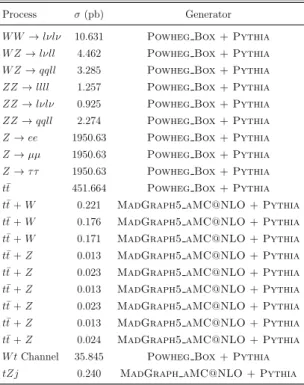
4.5.1 Background MC samples with the corresponding cross-sections and generators used in the analysis presented in this thesis. . . 41 4.6.1 Signal region event yields after the selection criteria. The
uncer-tainties presented corresponds only to the statistical errors. . . 45 4.7.1 Selection criteria used to define the considered control regions. . . . 46
4.7.2 Z+jets dilepton control region event yields after the selection crite-ria. The uncertainties presented corresponds only to the statistical errors. . . 49 4.7.3 Z+jets trilepton control region event yields after the selection
crite-ria. The uncertainties presented corresponds only to the statistical errors. . . 52
4.7.4 t¯t control region event yields after the selection criteria. The
uncer-tainties presented corresponds only to the statistical errors. . . 55 4.7.5 W Z Diboson control region event yields after the selection criteria.
The uncertainties presented corresponds only to the statistical errors. 58 4.7.6 tZj control region event yields after the selection criteria. The
uncertainties presented corresponds only to the statistical errors. . . 60 4.9.1 Definition of distinct signal region selections in order to separate
background for signal. A cut on the transverse mass of W boson or in the reconstructed top quark mass are added to the signal region selection. . . 65 4.9.2 Event yields for the signal region selection with a cut on the
trans-verse mass of the reconstructed W boson. The uncertainties pre-sented corresponds only to the statistical errors. . . 68 4.9.3 Event yields for the signal region selection with a cut on the
recon-structed top quark mass. The uncertainties presented corresponds only to the statistical errors. . . 70
ALICE A Large Ion Collider Experiment ATLAS A Toroidal LHC ApparatuS BSM Beyond the Standard Model CKM Cabibbo-Kobayashi-Maskawa CL Confidence Level
CMS Compact Muon Solenoid
CERN Conseil Europ´een pour la Recherche Nucl´eaire FCNC Flavour Changing Neutral Currents
LHC Large Hadron Collider LO Leading Order
MC Monte Carlo
OSSF Opposite-Sign Same-Flavour
SM Standard Model of Particle Physics SPS Super Proton Synchroton
PS Proton Synchroton
QCD Quantum Chromodynamics QED Quantum Electrodynamics
Introduction
The Standard Model of particle physics (SM), developed in the 1960’s [1], is the theoretical framework that so far best describes the nature of the subatomic world. This model has been severely tested and has been very successful in the description of the experimental observations. However, this theory cannot explain phenomena like the neutrinos masses or the dark matter and dark energy. Several models were presented to extend the SM since is thought that it is not the most complete theory of particle physics.
Discovered in 1995 [2, 3], the top quark is the heaviest particle in the SM and decays almost all the times to a W boson and a b-quark. The top quark can decay also through a neutral current. Within the SM, the Flavour Changing Neutral Currents (FCNC) processes are forbidden at tree level due to the GIM mechanism [4] and is suppressed at higher orders because of unitary of the CKM matrix. In extensions of the SM it is possible having FCNC processes at tree level and loop level where enhancements of the FCNC branching ratios were predicted. The study of the top FCNCs interactions can be performed in two modes: one in the t production along with a Z boson, Higgs boson or a photon (γ) and another in
the t¯t decays.
In this thesis, a search for the production of a single top quark in association with a Z boson is considered. The goal of this thesis is to perform an analysis
comparing data events with an integrated luminosity of 3.21 fb−1 recorded with
a centre-of-mass energy of √s= 13 TeV at the ATLAS detector with simulated events for the signal region and for the different control regions. The study of possible discriminant variables for the signal region is also performed, presenting expected limits for the branching ratio of the tZ production via FCNC processes. In Chapter 2 a review of the SM and an introduction to the FCNC processes are presented. Chapter 3 is composed by a presentation of the CERN and a review of the LHC and of the ATLAS detector. A description of the analysis used to study the signal region and the different control regions is made in Chapter 4. Expected upper limits at 95% confidence level (CL) on the cross-section for the process pp
→ tZ were obtained in the Run-2 of the LHC at √s= 13 TeV with an integrated
luminosity of 3.21 fb−1 and 30 fb−1 are presented in Chapter 5. These limits were
also interpreted as limits on the coupling tZq and the branching ratio of the decay t → qZ.
The Standard Model of particle
physics and beyond
The SM is the theoretical framework that so far better describes the subatomic world. Developed in the 1960’s [1], it has been tested and successful in describing the experimental observations. This chapter briefly introduces the structure of the SM and the FCNC interactions.
2.1
The Standard Model of particle physics
The matter is made from atoms which are made from electrons and nuclei. The atomic nucleus is made of neutrons and protons and both of them are made of elementary particles named quarks. The elementary particles interact via four fundamental forces in nature: strong force, weak force, electromagnetic force and gravitational force.
The strong interaction is responsible for the stability of the atomic nuclei by pre-venting them from fragmenting as a result of the electric repulsion of the protons
and is a very short range force (typically around 10−15 m). The weak force is
responsible for the beta decay of unstable atoms and acts at very short distances
(typically around 10−18 m). The electromagnetic interaction acts over an infinite
range and is responsible for the interaction between electric charged particles. The 3
electromagnetic force is well defined through the Maxwell equations. The gravita-tional force is an interaction between massive objects with an infinite range. The strong, weak and electromagnetic forces are the interactions included in the SM of particle physics.
Based on relativistic quantum field theory, the SM describes the interactions be-tween the elementary particles. This model assumes that matter is made from elementary point-like particles with spin 1/2 called fermions. The interactions be-tween the fermions are mediated by spin 1 particles called bosons. There are two types of fermions: quarks and leptons. The leptons are divided in the electrically
charged with the fundamental charge of e = −1.6 × 10⁻¹⁹ C and the electrically
neutral particles called neutrinos (ν). In the other hand, the quarks carry frac-tional charge which can be +2/3 |e| or - 1/3 |e|. The quarks carry also another quantum number which is the colour charge. This charge is of three different types: red, green or blue. Another characteristic of the fermions is that every particle has an associated antiparticle with the same mass but carrying the opposite charge to its corresponding particle.
The fermions are grouped into three generations. The difference between the generations is the flavour, i.e. the fermion type, and the mass of the particles, remaining the other corresponding quantum numbers. Each generation is defined by two doublets, one in the lepton family and one in the quark family. The doublet from the lepton family contains a charged lepton and his partner neutrino. The doublet from the quark family contains a quark with a charge of + 2/3 |e| and a quark with a charge of - 1/3 |e|. There are three lepton doublets: the electron
(e) with his partner electron neutrino (νe), the muon (µ) with his partner muon
neutrino (νµ) and the tau (τ ) with his partner tau neutrino (ντ). The electron
doublet, the muon doublet and the tau doublet correspond to the first, second and third generation of leptons, respectively.
There are three quark doublets: the up quark (u) with the down quark (d), the charm quark (c) with the strange quark (s) and the top quark (t) with the bottom quark (b). The up doublet, the charm doublet and the top doublet correspond to the first, second and third generation of quarks, respectively. The elementary
particles in the SM are listed in Table 2.1.1.
Generation Symbol Name Mass Electric charge (|e|)
Quarks 1st u Up 2.3 MeV +2/3 d Down 4.8 MeV -1/3 2nd c Charm 1.3 GeV +2/3 s Strange 95 MeV -1/3 3rd t Top 173.5 GeV +2/3 b Bottom 4.6 GeV -1/3 Leptons 1st e Electron 0.5 MeV -1 νe Electron Neutrino < 2 eV 0 2nd µ Muon 105.7 MeV -1 νµ Muon Neutrino < 2 eV 0 3rd τ Tau 1.8 GeV -1 ντ Tau Neutrino < 2 eV 0
Table 2.1.1: The fundamental fermions of the Standard Model and their mass and charge according to the Particle data Group [5].
The bosonic sector is responsible for the interactions described in the SM. The electromagnetic force carrier is the photon (γ). The photon is a massless
parti-cle and electrically neutral. The weak force carriers are the W± and Z bosons.
Before their discovery, the theory predicted that they should be massive. The Z
charge, respectively. The strong force carriers are the gluons (g) which are massless particles with no electric charge. Since gluons carry colour charge with eight com-binations, they interact among themselves and only couple to the strong charged particles. Consequently, only quarks can participate in the strong interaction. The gauge bosons of the three forces and their characteristics are summarized in Table 2.1.2.
Beside this twelve gauge bosons, the SM contains one scalar boson, the Higgs boson.
Interaction Mediator Mass (GeV) Electric Charge (|e|)
Strong Gluon × 8 (g) 0 0
Electromagnetic Photon (γ) 0 0
Weak Z 91.19 0
W± 80.39
±1
Table 2.1.2: The interactions in the Standard Model and their mediating gauge bosons with the mass and charge according to the Particle data Group [5].
2.1.1
Quantum electrodynamics
The classical theory of electromagnetic interactions is well known through the Maxwell equations of the nineteenth century. The theory of Quantum Electrody-namics (QED) unified electrodyElectrody-namics and quantum mechanics providing a quan-tum field theory based on the gauge invariance of electrodynamics. The QED theory describes the interactions between electrically charged particles mediated by a quantized electromagnetic field.
The free spin 1/2 particles are described in the Dirac Lagrangian
LDirac = ψ(iγµ∂µ− m)ψ (2.1.1)
where ψ corresponds to γ0ψ†, γµ (µ=1,2,3,4) corresponds to the Dirac matrices,
following relations γµ, γν = γµγν+ γνγµ= 2gµν where gµν ≡ Metric tensor, (2.1.2) γ5 = γ5 = iγ1γ2γ3γ4, σµν = i 2[γ µ, γν] = i 2(γ µγν − γνγµ).
However, this Lagrangian is not invariant under a local U (1) gauge transformation of the form
ψ −→ e−ieα(x)ψ and ψ −→ eieα(x)ψ (2.1.3)
where e is in units of the electric charge of the proton and α is a real number. With
this transformation the Dirac Lagrangian acquires an additional term of ψeγµ∂
µψ.
To obtain a U (1) invariant Lagrangian, another term with the expression ψeγµA
µψ
is added, where Aµ is the four-potential of the electromagnetic field.
Adding this term and the free field dynamics, described by the Maxwell equation, the QED Lagrangian can be obtained:
LQED = − 1 4F µνF µν+ ψ[iγµ(∂µ− eAµ) + m]ψ (2.1.4) where Fµν = ∂
µAν − ∂νAµ is the electromagnetic field tensor. Requiring local
phase invariance under U (1) applied to free Dirac Lagrangian, it is generated all of electrodynamics and introduced a massless field which can be interpreted as the photon.
2.1.2
Quantum chromodynamics
The interactions between quarks and gluons are described by a quantum field theory called Quantum Chromodynamics (QCD) [6]. Analogous to the electric charge in QED, each quark has an internal degree of freedom known as colour. This new quantum number was introduced to explain how bound stated of three identical quarks can exist and not violate the Pauli exclusion principle. The quark colour state could be red (R), green (G) or blue (B). In this theory, the quarks interact with each other through a gluon exchange. The gluon exchange changes the colour state of the interacting quarks. The gluons also interact with each other implying that the gluons are also colour carriers.
The QCD theory is based on the gauge group SU (3) where exists three dimensions and each dimension is a colour (R, G and B). The number of gluons is eight since SU (3) has eight generators where each generator represents a colour exchange and a gauge boson (gluon) in colour space. The generators of SU (3) are written as
ta= 1
2λa (2.1.5)
where λa with a =1,2,...,8 corresponds to the Gell-Mann matrices. Each quark
flavour consists in a triplet of fields represented as
q = qR qG qB (2.1.6)
where each of this fields is a Dirac spinor associated to a colour state. The QCD Lagrangian is LQCD = q(iγµDµ− m)q − 1 4G a µνG µν a (2.1.7)
with the covariant derivative Dµ = ∂µ + igstaGaµ and the strength field tensor
defined by
Gaµν = ∂µGaν − ∂νGaµ− gsfabcGbµG
c
ν (2.1.8)
where Ga
µ are the gluon fields, gs is the QCD gauge coupling constant and fabc
are the structure constant of SU (3)c defined by the commutation relation [ta, tb] =
ifabctc.
The QCD theory has been very successful in the description of the interactions binding quarks to hadrons. However, there are two important characteristics of this theory: asymptotic freedom and confinement [7, 8]. Asymptotic freedom means that at very high energies and short distances quarks and gluons interact weakly with each other allowing the computation of observables using the perturbation theory. Confinement means that at very low energy scales which corresponds to large distances, when we try to separate quarks, the energy of the gluon field in-creases, creating quark and anti-quark pairs and, consequently, free quarks cannot exist.
2.1.3
Electroweak theory
Proposed by Glashow, Salam and Weinberg [9, 10, 11], the electroweak theory is a unified theory of electroweak interactions which describe the weak and
electromag-netic forces from a single gauge group SU (2)L ⊗ U(1)Y where Y corresponds to
the weak hypercharge. The weak hypercharge is given by the Gell-Mann-Nishijima
relation Y = 2 (Q - T3) where T3 is the third component of the weak isospin
op-erator ˆT = σi/2 (i=1,2,3) with σi corresponding to the three Pauli matrices and
Q is the fermion electric charge (in units of |e|). The subscript in SU(2)L refers
to the fact that only left-handed fermions interact through the weak force. The electroweak interaction is the interaction responsible for the change of flavour of leptons and quarks.
The left-handed and right-handed components of the fermions fields can be ob-tained via the operators of the weak symmetry group
ψL= 1 2(1 − γ 5)ψ, (2.1.9) ψR= 1 2(1 + γ 5)ψ.
Right-handed fermions transform as singlets and left-handed fermions transform as doublets fi R= l i R, u i R, d i R, (2.1.10) fi L= li L νi L ! , u i L di L ! ,
with i = 1,2,3 corresponding to the generation index. It is necessary define the Lagrangian of the gauge field
Lgauge = − 1 4W i µνW µν i − 1 4BµνB µν. (2.1.11) The Wi
µν and Bµν are the field strength tensors for the weak isospin and weak
hypercharge fields and they can be explicitly written as
Wi µν ≡ ∂µWνi − ∂νWµi + gǫ ijkWj µW k ν, (2.1.12) Bµν ≡ ∂µBν − ∂νBµ,
where ǫijk corresponds to the totally antisymmetric Levi-Civita tensor, g
corre-sponds to the SU (2)L gauge coupling, Wνi and Bν are the gauge bosons of SU (2)L
and U (1)Y respectively and i take values of 1, 2 or 3. Finally, this theory could be
described through the Lagrangian
LEW =
X
f=l,q
f (iγµD
µ)f + Lgauge (2.1.13)
where covariant derivative Dµ is defined by
Dµ≡ ∂µ− ig−→T .−→Wµ− ig′
Y
2Bµ (2.1.14)
where g and g′ are the coupling constants of the SU (2)
L and U (1)Y gauge groups,
respectively.
At this point, these gauge boson fields are massless in order to maintain the gauge invariance while we know that the weak interaction is mediated by heavy bosons
(W± and Z).
2.1.4
The Brout-Englert-Higgs mechanism
Proposed by three independent groups [12, 13, 14], the Brout-Englert-Higgs mech-anism solved the contradiction between massive particles and the requirement of gauge invariance. This mechanism is based in a spontaneous symmetry breaking,
where the symmetry group SU (2)L ⊗ U(1)Y breaks down to U (1)EM. The Higgs
field is an isospin doublet of complex scalar fields and is defined as
Φ ≡ φ
+
φ0
!
(2.1.15)
where φ+ corresponds to a electrically charged field and φ0 to a electrically neutral
field.
The Lagrangian which describes the free Higgs field is defined as
LΦ = (DµΦ)†(DµΦ) − V (Φ) (2.1.16)
with the covariant derivative Dµ given by Equation 2.1.14 and the V (Φ)
corre-sponding to the Higgs potential defined as
The Higgs potential depends on the parameters µ2 and λ. Consider the case where
µ2 < 0 e λ > 0, the minimum of the potential V (Φ) is given by
Φ† Φ = −µ 2 2λ ≡ v2 2 (2.1.18)
and the Higgs field has a non-zero vacuum expectation value of v/√2 and does
not have a unique minimum. The Higgs potential minimum could be chosen in a way that the Higgs field acquiring a vacuum expectation value is the electrically neutral field and the Equation 2.1.15 can be rewritten as
Φ(x) = √1 2 0 v + H(x) ! (2.1.19) where H(x) represents the ground state fluctuations around the vacuum state. The interaction between the Higgs field and the fermions fields could be written as
LY ukawa =
X
f=l,q
yf(fLΦfR+ fR ΦfL) (2.1.20)
where the matrices yf describe the Yukawa couplings between the Higgs doublet
and the fermions. This Lagrangian, called the Yukawa Lagrangian, is gauge
in-variant since the terms fLΦfR and fR ΦfL are singlets. Through the Yukawa
Lagrangian, the Higgs field and the Higgs Lagrangian, the prediction for the mass of the fermions and the mass of the Higgs boson can be obtained
mf = yf v √ 2, (2.1.21) mH = √ 2λv.
The mass of the Higgs boson could not be predicted since the value of the λ is unknown by the theory. The electroweak boson masses could also be obtained through the Higgs Lagrangian and can be written as
mW = vg 2 , (2.1.22) mZ = v pg2+ g′2 2 , mγ = 0.
The W± boson can couple the up type quarks with the down type quarks from another generation changing the quark flavour. The Cabibbo-Kobayashi-Maskawa (CKM) matrix describe the strength of flavour changing weak decays. The CKM matrix consists in a n × n unitary matrix which describe n quark families. Im-posing the three known particle generations and the unitarity of the matrix, the CKM matrix can be obtained through a global fit to all available measurements [5]: VCKM = |Vud| |Vus| |Vub| |Vcd| |Vcs| |Vcb| |Vtd| |Vts| |Vtb| = (2.1.23) = 0.97427 ± 0.00014 0.22536 ± 0.00061 0.00355 ± 0.00015 0.22522 ± 0.00061 0.97343 ± 0.00015 0.0414 ± 0.0012 0.00886 ± 0.00033 0.0405 ± 0.0011 0.99914 ± 0.00005
The theory of SM is based in the combination of the electroweak and strong
in-teractions through a gauge theory with the underlying symmetry group SU (3)c ⊗
SU (2)L⊗ U(1)Y. Except for gravity, the SM explain the fundamental interactions
of fermionic fields having free parameters corresponding to [15]:
• three coupling parameters (g,g′ and gs);
• two parameters to define the Higgs potential (µ2 and λ);
• six Yukawa couplings of the quarks to the Higgs field;
• four parameters for the CKM matrix corresponding to three mixing angles and one CP-violating phase;
• three charged lepton masses;
• one parameter related with non-perturbative CP violation in QCD.
Since its formulation, the SM has been strongly tested and proved to be a well based theory. However, there are also some open questions that the SM cannot answer as, for example, the matter anti-matter asymmetry, the number of fermion
generations and the mass of neutrinos confirmed by neutrino oscillations [16, 17, 18, 19, 20]. Knowing that neutrinos have mass, the SM was extended with seven more parameters (three parameters for neutrino masses, three for their mixing angles and one for CP violating phase for the neutrino mixing matrix). The SM as described here has a total of 26 parameters.
2.2
Top quark physics
Discovered in 1995 by the CDF and DØ collaborations at Fermilab [2, 3], the top quark is the heaviest elementary particle know so far. Its existence has been postulated since the discovery of the bottom quark allowing the completion of the third generation of the SM. With the discovery of the top quark, a new field of particle physics opened due to its exciting properties:
• It is the only quark that decays before hadronising due to the very short
lifetime around 10−25 s [21];
• It is the heaviest quark with a mass close to the electroweak symmetry break-ing scale of v = 246 GeV [5];
• Determined by the CKM matrix (|Vtb|), the decay is dominated by the t −→
W b channel with a branching ratio of approximately 1 [5].
The top quark can be produced in top quark pairs called t¯t production or as a
single top-quark associated with other particles called single top quark
produc-tion. In hadron colliders, the t¯t production occurs dominantly through the strong
interaction (QCD). In the pp collider LHC, unlike the p¯p collider Tevatron, the top
quark pair is produced dominantly through the gluon fusion (around 85%). The quark anti-quark annihilation and the gluon fusion processes at Leading Order (LO) are shown in Figure 2.2.1.
Figure 2.2.1: Leading order Feynman diagrams corresponding to the top quark pair production through quark anti-quark annihilation and gluon fusion [22].
Considering the single top quark production, the top quark is produced via the weak interaction in three different channels:
• t-channel: W boson and gluon fusion (shown in Figure 2.2.2(a));
• W t-channel: associated production of a top quark and a W boson (shown in Figure 2.2.2(b));
• s-channel: W boson and quark anti-quark annihilation (shown in Figure 2.2.2(c)).
(a) (b) (c)
Figure 2.2.2: Feynman diagrams for the single top quark production at leading order: (a) t-channel, (b) W t-channel and (c) s-channel [23].
The cross-section values for the three channels are presented in Figure 2.2.3 with the ATLAS and CMS measurements and the theoretical calculations which are
based on NLO QCD, NLO QCD complemented with NNLL and NNLO QCD (for
t-channel only) assuming a mtop=172.5 GeV.
] V e [T s Inclusive cross-section [pb] 1 10 2 10 7 8 13 WG top LHC ATLAS+CMS Preliminary Single top-quark production
June 2016 t-channel Wt s-channel ATLAS t-channel ATLAS-CONF-2015-079 112006, ATLAS-CONF-2014-007, (2014) PRD90 CMS t-channel CMS-PAS-TOP-16-003 090, (2014) 035, JHEP06 (2012) JHEP12 ATLAS Wt 064 (2016) 142, JHEP01 (2012) PLB716 CMS Wt 231802 (2014) 022003, PRL112 (2013) PRL110 LHC combination, Wt ATLAS-CONF-2016-023, CMS-PAS-TOP-15-019 ATLAS s-channel 228 (2016) PLB756 L., ATLAS-CONF-2011-118 95% C. CMS s-channel L. 7+8 TeV combined fit 95% C.
× arXiv:1603.02555 95% C.L. 58 (2014) PLB736 NNLO scale uncertainty 091503, (2011) PRD83 NNLL + NLO 054028 (2010) 054018, PRD81 (2010) PRD82 contribution removed t Wt: t uncertainty s α ⊕ PDF ⊕ scale 74 (2015) 10, CPC191 (2010) NPPS205 NLO , top = m F µ = R µ
CT10nlo, MSTW2008nlo, NNPDF2.3nlo V e G 60 = removal t veto for t b T Wt: p V e G 65 = F µ and scale uncertainty uncertainty s α ⊕ PDF ⊕ scale V e G = 172.5 top m stat total
Figure 2.2.3: Summary of ATLAS and CMS measurements of the single top pro-duction cross-sections in various channels as a function of the center of mass energy [24, 25, 26, 27, 28, 29, 30, 31, 32, 33, 34, 35, 36, 37, 38, 39, 40, 41, 42, 43, 44].
2.3
Top quark FCNC interactions
Flavour Changing Neutral Current (FCNC) corresponds to a interaction with a change in the fermion (quark or lepton) flavour through the emission of a neutral boson. This process is not allowed at tree-level in the SM since there is no vertex that directly couples neutral currents with two fermions from different generations. However, this process can occur at higher order correction or loop-level or in Beyond the Standard Model (BSM) models. The branching ratio of top quark decay via FCNC is highly suppressed since it suffers from the small decay width through FCNC [4] and the large tree-level rate for top quark decay to a b quark and
a W boson. In the other hand, there are several new physics models that predict FCNCs with higher branching ratios by several orders of magnitude and where it is possible to have this processes at tree-level. A comparison between SM and new physics models predictions for branching ratios of the decays of the top quark to a up or a charm quark and a neutral boson is shown in Table 5.2.2. Several theoretical studies has been done through the years related to FCNC processes. Two examples of these studies are related with the FCNC processes on the strong sector [45, 46] or the implementation of a Lagrangian describing these processes in a Universal Feynrules Output (UFO) model using dimension-six gauge invariant operators [47, 48, 49]. Process SM QS 2HDM FC 2HDM MSSM 6R SUSY t → gu 3.7 × 10⁻¹⁴ 1.5 × 10⁻⁷ – – 8 × 10⁻⁵ 2 × 10⁻⁴ t → Zu 8 × 10⁻¹⁷ 1.1 × 10⁻⁴ – – 2 × 10⁻⁶ 3 × 10⁻⁵ t → γu 3.7 × 10⁻¹⁶ 7.5 × 10⁻⁹ – – 2 × 10⁻⁶ 1 × 10⁻⁶ t → Hu 2 × 10⁻¹⁷ 4.1 × 10⁻⁵ 5.5 × 10⁻⁶ – 10−5 ∼ 10−6 t → gc 4.6 × 10⁻¹² 1.5 × 10⁻⁷ ∼ 10−4 ∼ 10−8 8 × 10⁻⁵ 2 × 10⁻⁴ t → Zc 1 × 10⁻¹⁴ 1.1 × 10⁻⁴ ∼ 10−7 ∼ 10−10 2 × 10⁻⁶ 3 × 10⁻⁵ t → γc 4.6 × 10⁻¹⁴ 7.5 × 10⁻⁹ ∼ 10−6 ∼ 10−9 2 × 10⁻⁶ 1 × 10⁻⁶ t → Hc 3 × 10⁻¹⁵ 4.1 × 10⁻⁵ 1.5 × 10⁻³ ∼ 10−5 10−5 ∼ 10−6
Table 2.3.1: The theoretical values for the branching ratios of FCNC top decays predicted by the Standard Model, the quark-singlet model (QS), the two Higgs dou-blet model (2HDM), the flavour-conserving two Higgs doudou-blet model (FC 2HDM), the minimal supersymmetric model (MSSM) and SUSY with R parity violation (6R SUSY) [50].
Searches for FCNC interactions in the top sector have already been performed at the Tevatron [51, 52] and the LHC. The ATLAS collaboration performed searches for tgq anomalous couplings [53] and the CMS collaboration searches for tγq anomalous couplings [54]. Concerning the tZq anomalous couplings, both the
AT-LAS and the CMS collaboration obtained expected and observed upper limits at
95% CL for tZ production, t¯t decay [55, 56, 57] and for the two production modes
combined [58]. The most stringent and recent exclusion limit on BR(t → qZ) excluded at 95% CL branching ratios for tZ production via FCNC greater than 0.02% [58]. Searching for the production of a single top quark in association with a Z boson is a good strategy due to the sensitivity of these processes to both tZq and tgq anomalous couplings.
t production BR(t → ug) < 4 × 10⁻⁵
20 fb−1 √s =8 TeV [53] BR(t → cg) < 2 × 10⁻⁴
t production BR(t → uγ) < 1 × 10⁻⁴
20 fb−1 √s =8 TeV [54] BR(t → cγ) < 2 × 10⁻³
tZ production BR(t → ug) < 6 × 10⁻³ BR(t → uZ) < 5 × 10⁻³
5 fb−1 √s =7 TeV [56] BR(t → cg) < 7 × 10⁻² BR(t → cZ) < 1 × 10⁻¹
t¯t decay BR(t → qZ) < 7 × 10⁻⁴
20 fb−1 √s = 8 TeV [55] q = u,c
t¯t decay BR(t → qZ) < 6 × 10⁻⁴
20 fb−1 √s = 8 TeV [57] q = u,c
tZ production and t¯t decay BR(t → uZ) < 1.7 × 10⁻⁴
20 fb−1 √s =8 TeV [58] BR(t → cZ) < 2.0 × 10⁻⁴
Table 2.3.2: Summary of the 95% CL observed limits on the branching ratios along with the production mode, the luminosity and the centre-of-mass energy for the different searches performed by the ATLAS and the CMS collaboration.
Figure 2.3.1 shows a summary of the current 95% CL observed limits on the branching rations specifically of the top decays via FCNC to a charm quark with a neutral boson and to an up quark with a neutral boson.
Figure 2.3.1: Summary of the current 95% CL observed limits on the branching ratios of the top quark decays via FCNC to a charm quark (left) and to an up quark (right) along with a neutral boson [59].
Experimental Setup
Located at the European Organization for Nuclear Research (CERN), the Large Hadron Collider (LHC) [60] is the world’s highest energy particle accelerator. The ATLAS experiment [61] is one of the four large experiments that benefit from the collisions of the particles in the LHC. In this chapter an introduction to the CERN’s accelerator complex, the LHC and the ATLAS detector is presented.
3.1
CERN
Based on the Franco-Swiss border near Geneva, the CERN was founded in
Septem-ber 29th of 1954 with 12 member states and the acronym CERN Conseil Europ´een
pour la Recherche Nucl´eaire was born. The initial goal of this council was the study of atomic nuclei and the congregation of scientists. It was soon improved to the research in the high energy physics focusing in the interactions of subatomic particles.
CERN has built several accelerators and detectors with distinct targets in the particle physics field to probe the fundamental structure of the Universe. Figure 3.1.1 shows the accelerators and the detectors currently working at CERN. Since its beginning, CERN played a major role in the great achievements in particle physics. Among them are the discovery of neutral currents with the Gargamelle
bubble chamber (1973) [63], the discovery of W± and Z boson with the UA1
Figure 3.1.1: Schematic view of the CERN accelerator complex.[62]
and UA2 experiments (1983) [64, 65], the determination of the number of light neutrino families at the Large Electron-Positron Collider (LEP) (1989) [66], the discovery of direct CP violation [67](1999) and the latest discovery of the Higgs boson [68, 69](2012) with a mass of 125 GeV observed by the ATLAS and the CMS collaboration to fulfill the SM.
Through the years, the CERN laboratory has become more than an european organization having already 22 member states and receiving more than 12,000 scientists from over 70 countries for their research.
3.2
The Large Hadron Collider
The latest addition to the CERN’s accelerator complex was the Large Hadron Collider [60]. Today it is the world’s largest and most powerful particle accelerator.
Located in a tunnel 100 meters underground, the LHC consists of a ring with a perimeter of 27 kilometers of superconducting magnets and several accelerating structures. Inside the tunnel, two proton beams, traveling in opposite directions in separate beam pipes, are accelerated until reaching a speed close to the speed of light.
Older accelerators like the Proton Synchroton (PS) and Super Proton Synchro-ton (SPS) are used to boost the energy of the particles before the injection in the LHC. First they are accelerated at the LINear ACcelerator 2 (LINAC 2) reaching an energy of 50 MeV. After that they are accelerated in the Proton Synchroton Booster (BOOSTER), PS and SPS until they have an energy of 1, 25 and 450 GeV, respectively. Finally, the bunches of protons are injected in the LHC (each
bunch contains about 1011 protons). The first protons beams circulated in the
LHC for the first time in September 10th of 2008. From 2010 to 2012, the protons
beams had an energy of 3.5 TeV. From 2012 to 2013, the energy reached was 4 TeV per beam. The first shutdown ended when the LHC started to accelerate
beams up to an energy of 6.5 TeV in April 5th of 2015. Since then, the LHC have
been performing very well running at √s=13 TeV for the rest of 2015 and 2016.
Since the protons are charged particles, a strong magnetic field maintained by electromagnets is needed to curve the proton beams around the circular accelera-tor. The total of 1232 superconducting electromagnets requires a temperature of 1.9 K (-271.3 °C) which is colder than outer space and, consequently, a ultrahigh vacuum. This temperature allows this dipole magnets to generate a magnetic field of 8 T. Besides this magnets, a total of 392 quadrupole magnets maintain the beams focused and 16 radiofrequency cavities accelerate particles and keep them in controlled bunches with an constant energy.
The beams inside the LHC intersect in four interaction points where distinct par-ticle detectors are placed: A Large Ion Collider Experiment (ALICE) [70], A Toroidal LHC ApparatuS (ATLAS) [61], Compact Muon Solenoid (CMS) [71] and Large Hadron Collider beauty (LHCb) [72]. The ATLAS and CMS detectors are two multi-purpose experiments, and ALICE and LHCb are focused on the study of heavy-ions collisions, and CP violation and b-physics, respectively.
3.3
The ATLAS detector
The ATLAS detector, shown in Figure 3.3.1, is one of the two general purpose detectors at the LHC that explores a vast range of physics scenarios studying the particles produced in proton-proton collisions at high energies [61]. It is the biggest detector of this kind built having 44 meters long, 25 meters wide and weighting 7000 tonnes.
Figure 3.3.1: Representation of the ATLAS detector showing the different
subsystems.[61]
The full coverage of the space around the pp interaction point allows the de-tection and the reconstruction of almost all final state objects. This full coverage is possible due to the multilayer structure which consists in many sub-detectors, each of them with a specific purpose. From inside to outside, the sub-detectors are: the inner detector, the electromagnetic calorimeter, the hadronic calorimeter and the muon spectrometer.
towards the center of the LHC ring, the y-axis pointing upwards and the z-axis pointing along the beam pipe. The nominal interaction point is defined as the origin of the coordinate system. To better describe rotational invariant properties, the spherical coordinates (R, φ, θ) are used and defined by
R =px2+ y2, φ = arctan(y/x), θ = arctan(R/z). (3.3.1)
The azimuthal angle φ is the angle between the x-axis and the y-axis and the polar angle θ is defined as the angle between the z-axis and the x – y plane. The azimuthal angle is defined within φ ∈ [−π, π] and the polar angle within θ ∈
[0, π]. The particle momentum px, py and pz are defined along the x, y and z-axis,
respectively. However, it is widely used the transverse momentum pT defined by
pT =ppx2 + py2. (3.3.2)
The pseudorapidity is another important variable used in the ATLAS experiment and it is defined by η ≡ 12ln(| − → P | + pZ |−→P | − pZ ). (3.3.3)
Since the difference in the pseudorapidity of two particles ∆y is independent of Lorentz boosts along the beam axis and, for massless particles, the pseudorapid-ity coincides with the rapidpseudorapid-ity y, the pseudorapidpseudorapid-ity provides a physically better variable. It can be also written in terms of the polar angle as
η ≡ − ln(tanθ2). (3.3.4)
Another variable used is the distance between two particles ∆R defined in terms of the difference in the pseudorapidity and the difference in the azimuthal angle between the two particles:
∆R ≡ q
∆η2+ ∆φ2. (3.3.5)
3.3.1
Inner detector
The inner detector, shown in Figure 3.3.2, is a very compact and highly sensitive part of ATLAS and the closest system to the beam pipe allowing the study of
the resultant particles from the pp collisions. This detector constitutes a tracking system used to the identification and the measurement of the momenta of the charged particles. It also allows the reconstruction of the interaction vertex. It begins a few centimeters close to the proton beam axis and extends to a radius of 2.1 meters and is 6.3 meters in length along the beam pipe. The inner detector has an acceptance in pseudorapidity of |η| < 2.5 and full coverage in the azimuthal angle φ.
Figure 3.3.2: Representation of the ATLAS inner detector. The pixel detectors refers to the Insertable B-Layer and the Pixel Detector. [73]
Immersed in a 2 T solenoidal magnetic field parallel to the beam axis, it is divided in four different concentric subdetectors named the Insertable B-Layer (IBL), the Pixel Detector (PD), the Semicondutor Tracker (SCT) and the Transi-tion RadiaTransi-tion Tracker (TRT). The Pixel detectors which consist in the IBL and the PD are the innermost part of the inner detector contributing to the accurate measurement of vertices. The PD uses silicon sensors (pixels) composed by three cylindrical layers in the barrel region and three concentric disks in the end-cap re-gion. The SCT is the middle part of the inner detector and is a silicon microstrip detector composed of a barrel, with four layers of silicon microstrip detectors,
and two end-caps, each with nine disks. The TRT is the outermost part the in-ner detector and consists of 4 mm diameter gaseous straw tubes interleaved with transition radiation material.
Combining the information from the four subdetectors, the transverse momentum resolution measured in the plane perpendicular to the beam axis is [61]
σpT
pT
= 0.05%
GeV pT⊕ 1%. (3.3.6)
3.3.2
Calorimeters
The ATLAS calorimeter system, shown in Figure 3.3.3, is used to provide an accurate measurement of particles energies by absorbing them and measuring the shower properties, which eases the particle identification. The calorimeters are designed to stop the majority of the particles, except for muons and neutrinos. Each of the calorimeters are divided into a central barrel part and two symmetric end-caps.
The calorimeter system stops most of the particles from arriving to the muon spectrometer preventing them from being identified as muons. Given the neutrinos do not leave any signatures to be observed and do not interact with the detector
material, the called missing transverse energy Emiss
T could be obtained since the
four-momentum carried by neutrino implies as unbalance in the total momentum
available in the event. The good measurement of Emiss
T is an important mission
in the ATLAS calorimeters since this variable is a crucial discriminant for many physics searches.
The electromagnetic calorimeter force the decay and then measure the energy of the electromagnetic particles which are leptons or photons. The hadronic calorimeter measures the energy deposition from the hadronic showers of high energy hadrons which are protons or neutrons. The components of the calorimetry system are: the Liquid Argon (LAr) electromagnetic calorimeter, the LAr hadronic end-cap calorimeter (HEC), the LAr forward calorimeter (FCal) and the Tile calorimeter (TileCal). The electromagnetic and the hadronic calorimeters cover a region of |η| < 3.2 and |η| < 4.9, respectively.
The LAr electromagnetic calorimeter uses liquid argon as active material and lead
Figure 3.3.3: Open view of the ATLAS calorimeter system.[74]
plates as absorber composing a sampling detector of one barrel and two end-caps. The target energy resolution for the electromagnetic calorimeter is [61]
σE E = 10% √ E ⊕ 17% E ⊕ 0.7%, (3.3.7)
with E measured in GeV.
The TileCal hadronic calorimeter is also a sampling calorimeter using steel (as absorber material) and scintillating plastic tiles (as active material) placed in one central barrel and two extended barrels. The target energy resolution for the TileCal hadronic calorimeter is [61]
σE
E =
50% √
E ⊕ 3% (3.3.8)
with E measured in GeV.
3.3.3
Muon spectrometer
The muon spectrometer, shown in Figure 3.3.4, is a combination of toroidal super-conducting magnets and precision chambers designed to detect and measure the
momentum of the muons. As muons minimally interact with the other parts of the detector and have long lifetimes, they are identified and measured in the outermost detector layer. This system is by far the largest tracking system in ATLAS since it extends from a radius of 4.25 m around the calorimeters out to the full radius of the detector (which is 11 m). This detector system covers a region of |η| < 2.7. It is also designed to trigger the muons in the region |η| < 2.4.
Figure 3.3.4: Representation of the ATLAS muon spectrometer.[75]
It is composed by four distinct chambers: Thin Gap Chambers (TGC), Resis-tive Plate Chambers (RPC), Monitored Drift Tubes (MDT) and Cathode Strip Chambers (CSC). Due to the magnetic field provided by the toroidal magnets, this subdetectors measure the muons momentum through the measurement of the curvature of the deflected muon trajectory. The muon spectrometer was designed to provide a transverse momentum resolution of [61]
σpT
pT
3.3.4
Magnet system
The ATLAS magnet system allows the measurement of the charged particles mo-mentum and it is designed to provide a field mostly orthogonal to the particle trajectory. It is composed of four large superconducting magnets: one central solenoid magnet, one barrel toroid, and two end-cap toroids.
The central solenoid magnet encloses the inner detector and provides a high mag-netic field to bend the trajectory of charged particles allowing the momentum measurement by the tracking system.
The toroidal magnet system is divided in three parts with a barrel part placed around the central calorimeter and two end-caps placed at each end of the detector. Each of these toroidal magnets has eight identical coils built radially in a symmetric way around the beam pipe. The toroidal magnet system provides the magnetic field for additional bending of the muon trajectories in order to measure with precision their momentum in the muon barrel and end-cap spectrometers.
In contrast with the central solenoid magnet which produces a uniform magnetic field of approximately 0.5 T, the magnetic field produced by the toroidal magnets it varies from 0.15 T to 2.5 T [61].
3.3.5
Trigger and data acquisition system
The production cross-section of inelastic proton-proton scattering events at the LHC is several orders of magnitude higher than the cross-section of elastic scat-tering. Consequently, millions of uninteresting collisions happen every second. Besides that, the high collision rate of 40 million events per second at the LHC running conditions does not allow the storage and analysis of all amount of data generated.
To reduce the flow of data to acceptable levels, the ATLAS trigger and data acquisition system selects in real time events with different characteristics that make them interesting for physics analyses. The trigger system works in three stages: the level 1 hardware trigger (L1), the high level software trigger containing the level 2 (L2) and event filter triggers (EF) [61]. In nominal conditions, the
L1, L2 and EF system reduces the event rate to 75 kHz, 3.5 kHz and 200 Hz, respectively.
The collision data samples used in this analysis were collected by the ATLAS detector during 2015. The total integrated luminosity delivered by the LHC in
2015 was 4.2 fb−1. However, not all collisions events recorded by ATLAS are used
for data analysis. Each subdetector has a record of its performance across the run and only the data collected with all subdetectors working with certain quality requirements are considered. With this information, Good Run Lists (GRL) are created recording which subdetectors satisfied the requirements for each luminosity block. The fraction of data considered as ”good” is ∼ 82%, giving a total integrated
luminosity of 3.21 fb−1 satisfying data quality that is used for this analysis.
Day in 2015
-1
fb
Total Integrated Luminosity
0 1 2 3 4 5 1/6 1/7 1/8 1/9 1/10 1/11 = 13 TeV s Preliminary ATLAS LHC Delivered ATLAS Recorded All Good for Physics
Total Delivered: 4.2 fb-1
Total Recorded: 3.9 fb-1
All Good for Physics: 3.2 fb-1
Figure 3.3.5: The total integrated luminosity delivered in the year of 2015 as a function of time [76].
3.3.6
Worldwide LHC Computer GRID
The Worldwide LHC Computer GRID (WLCG) is a global network of more than 170 computing centers in 42 countries. With the goal of the distribution around the
globe the data from the LHC experiments, the WLCG is linking up national and international grid infrastructures. This worldwide network is designed to store, organize and analyze the ∼ 30 Petabytes of data annually generated at the LHC [77]. The WLCG is divided in different layers, called tiers, each one with distinct purposes.
The Tier 0 is the CERN data Centre located in Geneva and also at the Wigner Research Centre for Physics in Budapest. The two sites are connected by two dedicated 100 Gigabit/s data links. The Tier 0 is responsible for the safe-keeping of raw data, first pass reconstruction, distribution of raw data and reconstruction output to the Tier 1.
The Tier 1 is composed by thirteen large computer centres. They are responsible for the safe-keeping of a proportional share of raw and reconstructed data, large-scale reprocessing and safe-keeping of corresponding output, distribution of data to Tier 2 and safe-keeping of a share of simulated data produced at these Tier 2. The Tier 2 is composed by around 160 sites typically located at universities and other scientific institutes. This sites can store data and provide computing power for specific analysis tasks. The individual scientists can access and process the data through the Tier 3 computing resources consisting of local clusters.
Figure 3.3.6: Representation of the structure of the tiers 0, 1 and 2. The various locations of the thirteen computer centres of tier 1 can also be found [78].
Event analysis
This chapter presents the search analysis focused on the top FCNC process where a top quark and a neutral Z boson is produced. A trileptonic topology with three leptons, two charged leptons coming from the decay of the Z boson and one charged lepton along with one neutrino coming and one b-tagged jet from the decay of the top quark is considered. This topology was chosen since the final state consists in a clear signature of three leptons and just one jet [79]. The consequent loss in acceptance are compensated with the gain in efficiency. An overview of the analysis is presented taking in account the objects definition, data and Monte Carlo (MC) simulation samples, analysis strategy and systematic uncertainties. The analysis presented in this thesis uses the A++ code as analysis code which was developed by the Humboldt University group in Berlin [80].
4.1
Data sample and triggers
The data sample analyzed in this search was collected with the ATLAS detector in proton-proton collisions at a centre-of-mass energy of 13 TeV between July and
November of 2015. A total integrated luminosity of 3.21 fb−1 was recorded after
requiring all subdetectors to be fully operational during the data taking.
The analyzed events are selected using single electron and muon triggers with
different pT thresholds and then are combined in a logical OR in order to increase
the overall efficiency [81]. The single electron triggers used are HLT_e60_lhmedium and HLT_e120_lhloose. Beside these, HLT_e24_lhmedium_L1EM20VH for data and
HLT_e24_lhmedium_L1EM18VHfor MC triggers are used where the only difference is
due to the transverse energy threshold of the electromagnetic cluster. The single
muon triggers used are HLT_mu20_iloose_L1MU15 and HLT_mu50 [82]. The pT
thresholds are 24 or 60 GeV for the electron triggers and 20 or 50 GeV for the muon triggers. In order to share information, a process named triggers match is performed where a geometrical acceptance is applied to the triggers information with a chosen ∆R. Due to the precise momentum measurement and the low misidentification rate, muons are the objects best able to be measured and provide an excellent trigger matching.
4.2
Objects definition
The physics objects studied in this analysis are electrons, muons and hadronic jets including b-tagged jets.
Electron candidates [83] are reconstructed from energy deposits in the electromag-netic calorimeter that are matched with tracks in the inner detector. Only electron
candidates with pT > 25 GeV in the central region defined by the range |ηcluster| <
2.47 (|ηcluster| corresponds to the pseudorapidity of the cluster associated with the
electron candidate) are selected. There are three electron identification selections: Medium, Loose and Tight to the specific needs of different physics analyses. In this analysis, electrons candidates must satisfy tight quality criteria.
Muon candidates [84] are reconstructed from tracks in the layers of the muon spec-trometer which matched with the corresponding tracks in the inner detector. Only
muon candidates with pT > 25 GeV and |η| < 2.5 are selected. A longitudinal
impact parameter with respect to the interaction point smaller than 2 mm is re-quired to ensure that the muon candidate is a muon produced in the collisions and not cosmic muons. Concerning the muon reconstruction, there are four
identifi-cation selections: Medium, Loose, Tight and High-pT. Loose, Medium and Tight
included in the looser categories. In this analysis, muon candidates must satisfy tight quality criteria.
Jets are reconstructed using the anti-ktalgorithm [85, 86, 87] with a radius
param-eter of ∆R=0.4 using calibrated topological clusters built from energy deposits in the hadronic calorimeter. The calibration of topological clusters [88, 89] is made to correct the cluster energy for the effects of non-compensation, dead material and out-of-cluster leakage. The corrections are obtained through simulation of neutral and charged particles. During the jets reconstruction electrons and hadronic en-ergy deposition can not be distinguish. To remove this overlap between electrons and jets, any jet identified within a cone of radius ∆R < 0.2 is excluded. After that, any remaining electrons or muons within a radius of ∆R < 0.4 of a select
jet are excluded. After energy calibration [90], only jets that satisfy pT > 30 GeV
and |η| < 2.5 are selected.
The identification of jets coming from the bottom quark, known as b-tagged jets, is made using the MV2c20 algorithm. The MV2c20 algorithm uses a boosted de-cision tree algorithm to discriminate b-jets from light (u,d,s-quark or gluon jets)
where the training is performed on a set of around 5 million t¯t events. With a
total of 24 input variables, this b-tagging algorithm takes into account parameters like transverse momentum, pseudorapidity, invariant mass of tracks and distances between others. Through a cut on the MV2 output distribution, the b-tagging algorithm is characterized by different operating points. The operating points are
calibrated in a sample of simulated t¯t events and provide a specific b-tagging
effi-ciency of 60%, 70%, 77% or 85% [91].The performance of the b-tagging algorithm is affected by the capability to correctly identify jets coming from a real b-quark compared to the probability of mistakenly b-tagging a jet originating from a c-quark or a light-flavour parton (u,d,s-c-quark or gluon). The b-tagging efficiencies with the c-jet and light-jets rejection rates are presented in Table 4.2.1.
b-jet efficiency c-jet rejection Light-jet rejection
60% 21 1900
70% 8.1 440
77% 4.5 140
85% 2.6 28
Table 4.2.1: Operating points for the MV2c20 b-tagging algorithm including the c-jet and light-jets rejection rates [91].
For the analysis presented in this thesis, the operating point used is the one with a jet efficiency of 77% due to the reasonable balance between the efficiency of the identification of b-jets and the rejection of light quarks. The tagging efficiency to b, c and light-flavour jets for the MV2c20 algorithm with the 77% operating point
as a function of jet pT and |η| are presented in Figure 4.2.1.
(a) (b)
Figure 4.2.1: The efficiency to tag b (green), c (blue) and light-flavour (red) jets for the MV2c20 tagger with the 77% working point. Efficiencies are shown as a
4.3
Analysis strategy
The strategy of this analysis consists in a set of requirements taking into account the final state of tZ production via FCNC. The tZ production via FCNC consists in the production of a Z boson which decays to two leptons, the production of a top quark which decays to a W boson and a bottom quark. The final state is characterized by two leptons coming from the Z boson, one charged lepton and one neutral lepton (neutrino) coming from the W boson decay and one b-tagged jet coming from the hadronisation of a bottom quark.
At the first selection level is required that events contain, exactly, one jet and three leptons. In the next selection level, the events without a Z boson candidate
are excluded. The two leptons with higher pT are used to reconstruct the Z boson
candidate. The Z boson candidates are reconstructed with a pair of Opposite-Sign Same-Flavour (OSSF) leptons (electrons or muons) with a invariant mass higher than 70 Gev and lower than 110 GeV (which are around 20 GeV of difference from the measured Z boson mass 91.19 GeV [5]). In the case of two Z bosons reconstructed, the candidate with the mass closest to 91.19 GeV is selected. The lepton not chosen as coming from the decay of the Z boson is used to reconstruct the decay of the W boson. It is assumed that the W boson decays leptonically, having a charged and a neutral lepton as final state. Figure 4.3.1 shows the lepton
multiplicity and the three leptons pT distributions after requiring events with
ex-actly one jet. The filled region corresponds to the multiple background processes predictions and the solid line is the signal hypothesis for the tZ production through FCNC processes.
Figure 4.3.1 (a) shows the lepton multiplicity. The signal sample has more events in the regions with two and three leptons, which corresponds to the W boson decaying hadronically and leptonically, respectively. In the dileptonic region the background is defined by the Z+jets and dibosons processes. However, in the trileptonic region the background corresponds mainly to the diboson processes. In this analysis, it is studied the process where the W boson decays leptonically.
![Figure 2.2.1: Leading order Feynman diagrams corresponding to the top quark pair production through quark anti-quark annihilation and gluon fusion [22].](https://thumb-eu.123doks.com/thumbv2/123dok_br/17290354.790279/36.892.143.746.152.375/figure-leading-feynman-diagrams-corresponding-production-annihilation-fusion.webp)
![Figure 2.3.1: Summary of the current 95% CL observed limits on the branching ratios of the top quark decays via FCNC to a charm quark (left) and to an up quark (right) along with a neutral boson [59].](https://thumb-eu.123doks.com/thumbv2/123dok_br/17290354.790279/40.892.145.748.395.696/figure-summary-current-observed-limits-branching-ratios-neutral.webp)
![Figure 3.3.1: Representation of the ATLAS detector showing the different subsystems.[61]](https://thumb-eu.123doks.com/thumbv2/123dok_br/17290354.790279/44.892.137.753.369.731/figure-representation-atlas-detector-showing-different-subsystems.webp)

![Figure 3.3.3: Open view of the ATLAS calorimeter system.[74]](https://thumb-eu.123doks.com/thumbv2/123dok_br/17290354.790279/48.892.230.659.207.467/figure-open-view-atlas-calorimeter.webp)
![Figure 3.3.4: Representation of the ATLAS muon spectrometer.[75]](https://thumb-eu.123doks.com/thumbv2/123dok_br/17290354.790279/49.892.229.665.372.687/figure-representation-of-the-atlas-muon-spectrometer.webp)
![Figure 3.3.5: The total integrated luminosity delivered in the year of 2015 as a function of time [76].](https://thumb-eu.123doks.com/thumbv2/123dok_br/17290354.790279/51.892.212.631.490.829/figure-total-integrated-luminosity-delivered-year-function-time.webp)