IOS Press
Effects of low-fat milk enriched with
phytosterols on plasma cholesterol
concentrations and hemorheological
parameters of Wistar rats
A.S. Silva∗, C. Saldanha and J. Martins-Silva
Instituto de Biopatologia Química, Unidade de Biopatologia Vascular, Instituto de Medicina
Molecular, Faculdade de Medicina de Lisboa, Av. Professor Egas Moniz, 1649-028 Lisboa, Portugal
Abstract. Clinical and experimental studies have shown that the use of phytosterol esters as a food ingredient reduces the
plasma concentrations of cholesterol and LDL cholesterol, not affecting the HDL cholesterol levels. Based on the use of phy-tosterols as a food ingredient, we have conducted a 30-day feeding study with Wistar rats, drinking low-fat milk containing phytosterols, in order to evaluate the plasma cholesterol concentrations and the hemorheological parameters. Throughout the study, clinical observations, body weights and food and milk consumption were measured and at the end of the feeding period, blood samples were collected for biochemical and hemorheological determinations. There were no clinical changes, alterations in growth, food or milk consumption. In the plasma cholesterol and HDL concentrations there were no significant differences, but LDL levels decreased about 70%. In the hemorheological parameters, significant changes were observed in plasma viscosity and in membrane fluidity in all experimental groups. The blood viscosity and the erythrocyte deformability show significant improvements with the ingestion of the phytosterols enriched milk. With these results we conclude that phytosterols maintain their cholesterol lowering properties when incorporated in milk and can be considered a hypolipemic food component. Keywords: Phytosterols, cholesterol, LDL-cholesterol, HDL-cholesterol, milk, hemorheology
1. Introduction
Phytosterols (PE), or plant sterols are not produced by animals or human body, they are natural sub-stances usually found in nuts, vegetable oils, corn, rice and some other plants present in the human diet and they are structurally similar to cholesterol. When absorbed, phytosterols displace cholesterol from intestinal micelles, reducing the pool of absorbable cholesterol.
Studies on the efficacy of plant sterols in reducing the plasma cholesterol date back to the 1950s. It is now known that phytosterols effectively reduce LDL-cholesterol when given as supplements, and as smaller amounts in foods. Isolated VLDL and LDL added to plasma in vitro cause a dose-dependent and exponential rise in blood viscosity [1].
In more recent studies, the esterification of sterols has allowed the use of the phytosterols as a food ingredient, resulting in a food component to reduce the blood cholesterol and a number of studies have demonstrated the efficacy of these components in a variety of low fat foods such as bread, cereal and yo-gurt [3]. With phytosterols as functional food, we have conducted a 30-day feeding study in Wistar rats,
*Corresponding author. E-mail: [email protected].
using low-fat milk containing phytosterols, in order to evaluate the plasma cholesterol concentrations and the hemorheological parameters.
2. Materials and methods
The animals used in this study received human care in accordance with the Directive of the European Community no86/609/CEE. Groups of 10 Wistar male rats (HsdBrlHan:Wist, Harlan Iberica) with a
average weight of 223.67± 38.18 g were used. After an adaptation period of one-week, the rats were housed singly and divided in 5 groups: Group 1 – low-fat milk with 0.2 g phytosterols/dl; Group 2 – low-fat milk with 0.3 g phytosterols/dl; Group 3 – low-fat milk with 0.4 g/dl of phytosterols; Placebo – low-fat milk without phytosterols and Control – water. Clinical observations, body weights and milk consumption were daily measured during the 30 days period of study.
After the drinking period, the animals were anesthetized for blood collection. Anesthesia was achieved with intraperitoneally urethane (Sigma) 1.5 g/kg body and intramuscular ketamine (Pfizer, Parke Davis) 50 mg/kg. Body temperature was maintained between 35–37◦C with an auto-regulated heating platform. The left carotid artery was cannulated with polyethylene tubing and blood samples were collected.
2.1. Biochemical parameters
The plasma pH, sodium, potassium and chloride concentrations were determined with an ABL505 electrode system from Radiometer (Copenhagen, Denmark). Hemoglobin was measured with the Osm3 hemoximeter from Radiometer and red blood cell count, total white blood cell counts, and hematocrit were determined with a Cell Dyn 1600 hemocytometer (Abbott, Abbot Park, IL). Total cholesterol, LDL-Cholesterol and HDL-LDL-Cholesterol plasma concentration were determined using enzymatic-colorimetric tests (Spinreact, SA, Spain).
2.2. Hemorheological parameters
Blood samples anticoagulated with K3EDTA were centrifuged at 3000 rpm for 10 minute, and the
resulting plasma was collected for the determination of plasma viscosity with the Harkness method [7]. Whole blood viscosity (WBV) was determined in a Brookfield digital viscometer model LVTDV II cp., using native blood aliquots submitted at low (22.5 s−1) and high (225 s−1) shear stress forces.
Membrane lipid fluidity was determined by measuring fluorescence anisotropy with 1,6-diphenyl-1,3,5-hexatriene (DPH) probe for hydrophobic zone of membrane, 1,4-(trimethyl)-phenyl-6-phenylhexa-1,3,5-triene (TMA-DPH) and 4-heptadecyl-7-hydroxicoumarin (HC) for the external region of the mem-brane. The fluorescence anisotropy was measured using a spectrofluorometer Hitachi F3000 (Hitachi, Japan), according to the method described by Shirilo et al. (1981) [8]. Erythrocyte deformability was determined using the Rheodyn SSD laser difractometer from Myrenne (Roetgen, Germany).
3. Results
3.1. Body weights and milk consumption
There were no statistically significant differences in mean body weights observed for any of the ex-perimental groups versus the control group. There was no effect on the food consumption.
Table 1
Hematological and biochemical parameters (mean± standard deviation) determined after a 30-day feeding period with low-fat milk
Experimental groups
Control Placebo Group 1 Group 2 Group 3
Initial weight (g) 306± 58 364± 43 310± 17 295± 36 291± 24
Mean consumption (ml/rat/day) 30± 2 35± 6 39± 19 34± 19 34± 1 Hemoglobin (g/dl) 16.0± 1.1 17.2± 1.2 16.5± 1.0 15.9± 1.0 15.9± 1.0
Hematocrit (%) 52± 12 53± 15 49.3± 2.7 46± 2.0 47.2± 1.3
Red blood cell count (×1012/l) 8.00± 0.91 7.03± 2.23 7.79± 1.39 8.31± 0.50 7.76± 0.90 White blood cells (×109/l) 4.15± 2.09 5.15± 1.48 4.53± 1.59 4.99± 0.67 4.79± 1.78
pH 7.35± 0.07 7.38± 0.04 7.41± 0.04 7.41± 0.03 7.42± 0.04
Sodium (mmol/l) 139.0± 1.0 134.88± 1.89a 135.5± 2.6a 135.5± 3.2a 136.9± 2.6a Potassium (mmol/l) 3.50± 0.48 3.54± 0.23 3.74± 0.4b 3.46± 0.32 3.89± 0.48c Calcium (mmol/l) 1.15± 0.05 1.13± 0.04 1.15± 0.06 1.16± 0.06 1.13± 0.07
aStatistically significant difference from the control group p < 0.001;bstatistically significant difference from the control group p < 0.007;cstatistically significant difference from the control group p < 0.003.
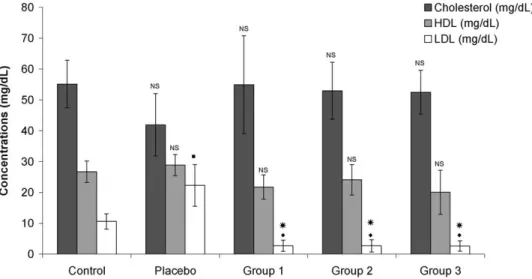
Fig. 1. Cholesterol, HDL and LDL plasma concentrations in Wistar rats after the ingestion of milk supplied with different phytosterols concentrations during a 30-day period. No significant (NS) differences were found between the control and the other experimental groups. The LDL levels decrease significantly comparing both with the control or the placebo group. There was an increase in the LDL plasma levels after the ingestion of milk with no phytosterols addition (2
p < 0.0007). Comparing
to the control group there were significant decreases in the groups I, II and III (F
p < 0.0001). The differences between the
placebo and the other experimental groups were also statistically significant,∗p < 0.00001.
3.2. Biochemical parameters
The haematology parameters don’t show statistically significant differences in any of the experimental groups. The variations obtained in sodium and potassium levels, although with statistical significance, were considered to have no biological significance (Table 1).
Analysing the cholesterol levels obtained in the experimental groups in study, we can see that there is no statistically significant difference between the control and the remaining groups. In the HDL-cholesterol plasmatic levels there are no statistically significant changes from the control group. The
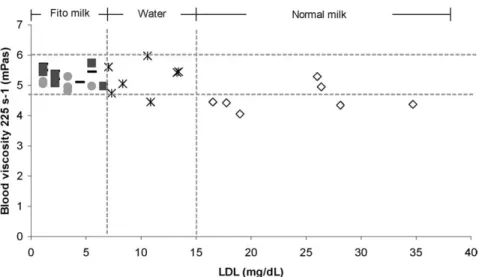
Fig. 2. Correlation between the blood viscosity and the LDL-cholesterol plasma concentrations. The results show that milk decreases blood viscosity values but with the phytosterols ingestion the values are similar to those in the control group. ingestion of milk supplied with phytosterols, comparatively to the placebo group, leads to a decrease in the HDL plasma levels. The plasmatic LDL-cholesterol levels have statistically significant changes: a 54.5% increase in the placebo group; a 73.7% decrease with a phytosterols concentration of 0.2 g phytosterols/dl (p < 0.0001), 79.2% with 0.3 g phytosterols/dl (p < 0.0001) and 74.8% with 0.4 g phytosterols/dl (p < 0.0001) (Fig. 1).
3.3. Hemorheological parameters
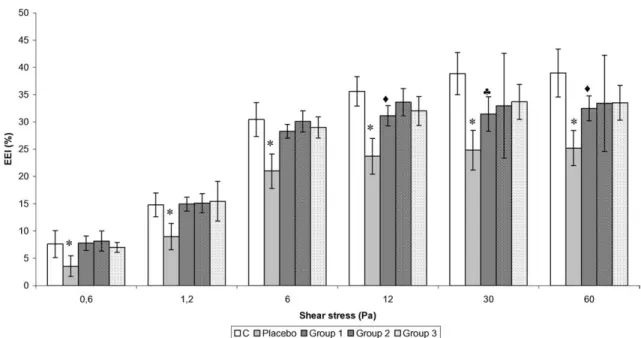
Relatively to the hemorheological parameters the following results were obtained: an increase of the erythrocyte membrane fluidity, p < 0.0001 for HC probe and a decrease of the erythrocyte deformability comparatively to the control group, p < 0.00001 for the placebo group, and p < 0.04 for group 1 at 12 and 60 Pa shear stresses.
The plasma viscosity results show significant increases with milk ingestion. Blood viscosity values when compared with the LDL-cholesterol plasma concentrations (Fig. 2), decrease for high levels of LDL-cholesterol.
4. Discussion and conclusions
The ingestion of low-fat milk supplied with phytosterols by Wistar rats and the further analysis of the hemorheologic and biochemical parameters results show interesting findings. One is that the phytosterols when incorporated in milk maintain their cholesterol-lowering properties, as we can see by the decreases observed in LDL levels after the milk 30-day feeding period, without alterations on food and milk consumption, body weight gain and biochemical parameters (Table 1).
Concerning the hemorheological parameters some significant differences were obtained compared with the control group: an increase in erythrocyte membrane fluidity, probably due to the decrease of cholesterol in the erythrocyte membranes; and in agreement with results obtained by Abugo et al. [9] a decrease in erythrocyte deformability (Fig. 3). Regarding the blood and plasma viscosity, the results
Fig. 3. Erythrocyte deformability measured by the erythrocyte elongation index (EEI). There are statistically significant changes in the placebo group (∗p < 0.00001) and in the group 1, (F
p < 0.04) for a shear stress of 12 and 60 Pa, and (♣p < 0.009) for
a shear stress of 30 Pa. All the other values show a decrease, but not statistically significant. Table 2
Values of erythrocyte membrane fluidity and plasma and blood viscosity (mean±standard deviation) after a 30-day feeding period with low-fat milk
Experimental groups
Control Placebo Group 1 Group 2 Group 3
DPH (sd) 0.309± 0.021 0.294± 0.019 0.314± 0.034 0.339± 0.034 0.296± 0.032 TMA-DPH (sd) 0.312± 0.018 0.326± 0.026 0.321± 0.017 0.315± 0.007 0.314± 0.009 HC (sd) 0.324± 0.061 0.259± 0.024 0.260± 0.041 0.186± 0.020 0.260± 0.045 p < 0.0008• p < 0.0001• p < 0.0002• p < 0.0003• NS◦ p < 0.006◦ NS◦ Plasma viscosity 1.09± 0.05 1.19± 0.12 1.16± 0.07 1.19± 0.07 1.15± 0.06 (mPa.s)* NS• p < 0.004• p < 0.0004• p < 0.003• Blood viscosity 5.20± 0.42 4.55± 0.42 5.36± 0.27 5.54± 1.10 4.97± 0.20 225 s−1(mPa) p < 0.005• NS• NS• NS• p < 0.001◦ p < 0.02◦ p < 0.04◦ ◦Statistically significant difference from the Control group;◦statistically significant difference from the Placebo group; •no statistically significant difference from the placebo group.
show a significant increase of plasma viscosity with milk ingestion and a decrease of blood viscos-ity for high levels of LDL (absence of phytosterols). With these results we may infer that milk should not be introduced in rats’ diet due to its bad influence on lipid metabolism, namely the increase of the LDL-cholesterol plasma levels (Fig. 1). While the experimental animal model traditionally used for atherosclerosis studies has been the rabbit, with our study with rats we could obtain two different mod-els, such as hypo- and hypercholesterolemia states. As can be seen in Fig. 2, for almost the same values of blood viscosity we have low LDL levels. With normal milk the LDL levels increase significantly and
blood viscosity decrease. The incorporation of phytosterols changes some of the alterations produced by milk ingestion, such as blood viscosity (Table 2) and erythrocyte deformability (Fig. 3). In conclu-sion the results show that low-fat milk containing phytosterols could be considered a hypolipemic food component, for further use in humans.
Acknowledgements
The authors wish to thank everyone at Serviço de Cirurgia Experimental of the Hospital de Santa Maria, for the support given in the animals’ feeding. We also want to thank to Mrs. Teresa Freitas for all the hemorheological parameters determination. Finally to Lactogal, SA for their financial support.
References
[1] A.H. Seplowitz, S. Chien and F.R. Smith, Effects of lipoproteins on plasma viscosity, Atherosclerosis 38 (1981), 89–95. [2] C. Saldanha, J. Loureiro, C. Moreira and E.J. Martins, Silva, Behaviour of red blood cell aggregation in presence of
lipoproteins, Clin. Hemorheol. 11 (1991), 543.
[3] R.P. Mensink, S. Ebbing, M. Lindhout, J. Plat and M.M.A. van Heusten, Effects of plant stanol esters supplied in low-fat yoghurt on serum lipids and lipoproteins, non-cholesterol sterols and fat soluble antioxidant concentrations, Atherosclerosis
160 (2002), 205–213.
[4] R. Volpe, L. Nittynen, R. Korpeia, et al., Effects of yoghurt enriched with plant sterols on serum lipids in patients with moderate hypercholesterolaemia, Br. J. Nutr. 86 (2001), 233–239.
[5] P. Nestel, M. Cehun, S. Pomeroy et al., Cholesterol lowering effects of plant sterol esters and non-esterified stanols in margarine, butter and low fat foods, Eur. J. Clin. Nutr. 55 (2001), 1084–1090.
[6] O.A. Matvienko, D.S. Lewis, M. Swanson, B. Arndt, D.L. Rainwater, J. Stewart and D.L. Alekel, A single daily dose of soybean phytosterols in ground beef decreases serum total cholesterol and LDL cholesterol in young, midly hypercholes-terolemic men, Am. J. Clin. Nutr. 76 (1) (2002), 57–64.
[7] J. Harkness, A new instrument for measurement of plasma viscosity, Lancet 16 (1963), 280–281.
[8] G. Schiliro, S. Livalti, E. Geremia, L. Masoti, A. Vanella and L. Mollica, Fluorescence studies on erythrocyte membranes from normal and thalassemic subjects, IRCS Med. Sci. 9 (1981), 599.
[9] O.O. Abugo, R.R. Peddada, J.F. Kelly, G.S. Roth and J.M. Rifkind, Effect of cholesterol content in diet on capillary flow of rat erythrocytes, Part I: Geometric and Flow Characteristics 17 (1997), 437–443.