Vitalii Shcheglov
The structural characteristics
of women-endorsers in advertising messages
and their influence on consumers
’ responses
Vitalii Shcheglov
The structural characteristics
of women-endorsers in advertising messages
and their influence on consumers
’ responses
Doctoromento em Psicologia
Trabalho efetuarado sob orientação
da Prof.a Doutora Gabriela Gonçalves e de Prof. Doutor Luís Faísca
The structural characteristics
of women-endorsers in advertising messages
and their influence on consumers
’ responses
Declaração de autoria de trabalho
Declare ser autora deste trabalho, cue é original e inedito. Autores e trabalhos consultados estão devidamente citados no texto e constam da listagem de referéncias incluida.
Assintura
--- (Vitalii Shcheglov)
Copiright 2017 Vitalii Shcheglov: A Universidade do Algarve tem o direito, perpétuo e sem limites geograficos, de arquivar e publicitar este trabalho através de exemplares impressos reproduzidos em papel ou de forma digital, ou por qualquer outro meio conhecio ou que venha a ser inventado, de o divulgar através de repositórios cientificos e de admitir a sua cópia e distribução com objetivos educacionais ou de investigação não comerciais, desde que seja dado crédito ao autor e editor.
Acknowledgements
I am very grateful for the encouragement and guidance from my dissertation committee. I would like to sincerely thank all the participants who took part in this research. But especially I would like to thank my dissertation supervisors, Dr. Gabriela Gonçalves, and Dr. Luís Faísca for their support, patience, inspiration and confidence in me. They helped me to pass through very difficult times, to grow and mature as a researcher and as a person and therefore deserve my appreciation. I have been really fortunate to gain from their experience. These people will always be wonderful examples to me as professionals of the highest class and have definitely influenced my professional and personal life. I would also like to take opportunity to express my appreciation to all the committee for immeasurable support.
i
Table of contents
Resumo ix
Abstract xiv
1. Introduction 1
2. State of the art 8
2.1 Introduction 8
2.2 Attitude towards Women-Endorsers 10
2.3 Attractiveness 12
2.4 Attention Engagement 14
2.5 Competition of Stimuli 14
2.6 Arousal of Interest 16
2.7 Attitude towards the Product 19
2.8 Purchase Intention 22
2.9 Attitude Towards Advertising 24
3. Construct of structural modalities 28
3.1 Introduction 28
3.2 Modality-I: Verbal Exposure (VM) 30
3.2.1 Literature Review 30
3.2.2 Verbal Efficacy 32
3.2.3 Verbal Semantic: Associative Links 33
3.2.4 Argumentation and Effect 34
3.3 Modality-II: Nonverbal Exposure (NVM) 36
ii
3.3.2 Semantic Discourse: Emotion, Attitude and Evaluation 40
3.3.3 Limitations of Study 42
3.4 Modality-III: Physical Appearance (PA) 43
3.4.1 Literature Review 43
3.4.2 Physical Appearance and Effect of Attractiveness 45
3.4.3 Limitations of Study 46
3.4.4 Males and Females: Differences of Effects 47
3.5 Modality-IV: Exposure of Female Stereotypes (FS) 49
3.5.1 Literature Review 49
3.5.2 Principles of Psychological Stereotyping in Advertising 51
3.5.3 Limitations 53
3.6 Modality-V: Exposure of Brand Image (BI) 55
3.6.1 Literature Review 55
3.6.2 Brand Image Content 57
3.6.3 Limitations of Constructs 59
3.6.4 Attitude towards Brand 64
4. Hierarchy of Effects and Consumers’ Behavior 66
4.1 Literature Review 66
4.2 Lavidge and Steiner Model (LAS) 68
4.3 DAGMAR Model 69 4.4 AIDA Model 70 4.5 Limitations of Constructs 72 5. Research problem 74 5.1 Introduction 74 5.2 Research questions 75 5.3 Hypothesis 77
iii
5.4 Variables 77
6. Method 78
6.1 Introduction 78
6.2 Primary Research 79
6.3 Semantic Differential Approach 83
6.4 Instruments and Stimuli 84
6.5 Participants 84 6.7 Procedure 85 7. Results 87 7.1 Attention 88 7.2 Interest 95 7.3 Purchase Intention 102
7.4 Positive Attitude towards Brand 109
7.5 Positive Attitude towards Advertising 116
8. Discussion 124
9. Conclusion 143
10. Study Limitations 148
11. References 150
iv
Indice of Figures
Figure 1. Attention Engagement 15
Figure 2. The Maslow’s Hierarchy of Needs (Five Stage Model) 17
Figure 3. Optional Determiners of Purchase Intention: Influence of Attitudes towards Advertising and Attitude towards Brand 22
Figure 4. Structural Elements of Attitude towards Advertising 25
Figure 5. Scheme of Main Correlates Determining Attitude within Advertising Exposure 26
Figure 6. Dependence of Presentation on Verbal and Non-verbal Exposure in percentage correlation 37
Figure 7. Construct of Associations in the Structure of Content of Brand Image 59
Figure 8. Construct of Hierarchy of Effects 67
Figure 9. The Lavidge and Steiner Model 69
Figure 10. The DAGMAR Model 70
Figure 11. The AIDA Model 72
v
Indice of Tables
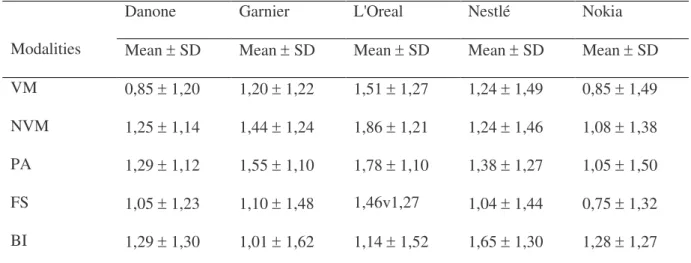
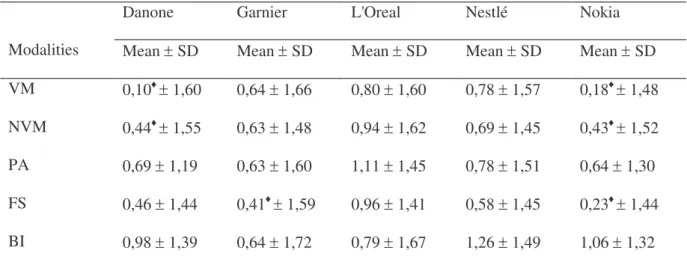
Table 1. Effect of each modality on participants’ attention towards the five spots 88 Table 2. Effect of each modality on participants’ interest towards the five spots 95 Table 3. Effect of each modality on participants’ purchase intention
towards the five spots 102 Table 4. Effect of each modality on participants’ positive attitude intention
towards the brand in the five spots 109 Table 5. Mean scores given for each modality considering positive attitude
intention towards the five advertising spots 116 Table 6. Female stereotypes: number (and percentage) of participants
vi
Indice of Charts
Chart 1. Modality and gender effects on participants’ attention
towards the five spots 94 Chart 2. Modality and gender effects on participants’ interest
towards the five spots 101 Chart 3. Modality and gender effects on participants’ purchase intention
towards the five spots 108 Chart 4. Modality and gender effects on participants’ attitude
towards the brand advertised in the five spots 115 Chart 5. Modality and gender effects on participants’ attitude
vii Abbreviations VM - Verbal modality NVM - Non-verbal modality PA - Physical appearance FS - Female stereotype BI - Brand image A - Attention I - Interest PI - Purchase intention
AA - Attitude towards advertising
AB - Attitude towards brand
E - Expert Br - Buyer W - Wife Fr - Friend Mo - Mother Gf - Girlfriend Bl - Business-Lady H - Housewife
viii
DAGMAR - Construct of Hierarchy of Effects for measurable objectives studying stages of communication between brand and consumers
AIDA - Construct of Hierarchy of Effects studying stages of consumers’ responses in the form of attention, interest, desire and action
S - Source Se - Sender R – Receiver F - Female M – Male TA - Target audience
QMC - Quantity of main characters
QF - Quantity of women-endorsers in the spot
N - Number of advertising spot
D - Duration of spot (seconds)
ix
Resumo
As imagens humanas são os elementos publicitários que mais influenciam a avaliação que os consumidores fazem sobre produtos e marcas, bem como as suas atitudes e intenções de compra (Adomaitis e Johnson, 2008; Baker, Gilbert e Churchill 1977; Bahram, Zahra e Zahra, 2010; Bagozzi, Gopinath e Nyer, 1999; Hume e Mort, 2010). As imagens humanas não só refletem características psicossociais (papéis psicossociais e interações) e padrões (de autorreflexão, autoestima, atitudes de género), como também estruturam estereótipos e atitudes positivas ou negativas (Carrabis e Peverill-Conti, 2011; Chaudhuri e Micu, 2012; Debono, Kenneth, Harnish e Richard 1988; Huang, 2009). Em especial, as imagens femininas são percebidas pelos consumidores como as mais fortes fontes de exposição à publicidade. E ainda assim, são o elemento publicitário menos estudado (Cramphorn, 2011; De Barnier e Valette-Florence, 2001; Park, e Thomson, 2008; Reingen e Kernan, 1993; Fedorikhin).
Embora diversas pesquisas tenham analisado personagens femininas que desempenhando papéis estereotipados em anúncios (Darden e Frances, 1971; Ford, LaTour e Clarke, 2004; Stafford, Leigh e Martin 1995), permanece por explorar a questão de como estas imagens estereotipadas e respetivas características estruturais afetam provocam impacto nas atitudes e avaliações dos consumidores (Gane, 2007; Gordon, 2005; Lazar, 2006; Mager e Helgeson, 2011; Pradeep, 2010; Reingen e Kerman, 1993). A investigação tem mostrado que as atitudes dos consumidores em relação às imagens humanas usadas na publicidade têm um forte impacto nas atitudes em relação à marca e nas intenções de compra (Adomaitis e
Johnson, 2008; Bagozzi, Gopinath e Nyer, 1999; Chi, Yeh e Huang, 2009; Hume e Mort, 2010; Gobé, 2009; Maheswaran e Sternhall, 1990), o que vem sublinhar a representa relevância deste tipo de estudo.
x
O presente estudo procura investigar como as avaliações que fazemos sobre as características das figuras femininas usadas em publicitários afetam as nossas atitudes face aos produtos e marcas anunciadas, bem como à mensagem publicitária. Assim, procura-se averiguar como a avaliação destas características influencia a resposta ao anúncio, nomeadamente ao nível de variáveis como a atenção, o interesse, a atitude positiva face à mensagem publicitária, ao produto e à marca, bem como ao nível da intenção de compra. O objetivo específico deste estudo consiste em determinar as características mais significativas por meio das quais a fonte (imagens femininas) implementa no recetor (participantes) uma exposição mais significativa à publicidade.
A problemática da exposição publicitária e do papel relativo aos diferentes aspetos das figuras femininas publicitárias é revista a partir de um quadro conceptual psicológico. Assim, a discussão teórica centra-se nas dimensões psicologicamente relevantes representadas pelas imagens femininas publicitárias: comunicação verbal e não-verbal, estereótipos veiculados e aparência física. Assim, definimos as seguintes questões de investigação:
1. Em que medida as características verbais das figuras femininas usadas em spots publicitários influenciam as respostas dos participantes, nomeadamente ao nível da Atenção, Interesse, Intenção de compra e Atitudes face em relação à publicidade e à Marca?
2. Em que medida as características não-verbais das figuras femininas usadas em spots publicitários influenciam as respostas dos participantes, nomeadamente ao nível da Atenção, Interesse, Intenção de compra e Atitudes face em relação à publicidade e à Marca?
3. Em que medida a aparência física das figuras femininas usadas em spots publicitários influencia as respostas dos participantes, nomeadamente ao nível da Atenção, Interesse, Intenção de compra e Atitudes face em relação à publicidade e à Marca?
xi
4. Em que medida os estereótipos publicitários de veiculados pelas figuras femininas de spots publicitários influenciam as respostas dos participantes, nomeadamente ao nível da Atenção, Interesse, Intenção de compra e Atitudes face em relação à publicidade e à Marca?
5. Em que medida o género do participante modula as suas respostas?
A abordagem metodológica foi escolhida com base nos objetivos definidos e na perspetiva teórica escolhida. Assim, neste estudo optou-se pela técnica de diferencial semântico, um tipo de escala de avaliação que permite chegar ao valor conotativo (expressão de significado) dos estímulos. Spots publicitários de cinco marcas internacionais (Nestlé, L'Oreal, Danon, Garnier e NOKIA) foram selecionados por recorrerem a figuras femininas como principais estímulos publicitários. As marcas foram escolhidas por serem bem conhecidas em todo o mundo, não havendo necessidade de descrever as marcas ou os seus produtos aos participantes. Após o visionamento de cada um destes spots publicitários, pedia-se aos participantes para se concentrarem em determinadas características da figura feminina principal do anúncio e de posicionarem num conjunto de escalas bipolares (limitadas por dois adjetivos semanticamente opostos, por exemplo: "Adequado-Inadequado", "Bom-Mau" ou "Valioso-Sem Valor"); procurou-se assim medir diferentes as opiniões, atitudes e valores dos participantes sobre aspetos específicos do anúncio e usando uma escala psicometricamente fiável.
Os resultados do estudo remetem para as variáveis psicológicas do processo percetivo responsáveis pela formação de atitudes sobre um produto e intenção de compra do mesmo. Neste sentido, o estudo centrou-se no grau em que a atenção, o interesse e a intenção de compra dos participantes masculinos e femininos depende da exposição a figuras publicitárias femininas associadas aos estereótipos sociais de género; do género dos participantes e da atitude face à marca.
xii
Assim, os resultados obtidos indicam quais os determinantes (variáveis independentes) que influenciam as avaliações do recetor (consumidores) e respetivas respostas (variáveis dependentes). Por outro lado, mostram também como as fontes de publicidade (imagens do sexo feminino), catalisadoras da representação funcional de realidade social, formam condições para a estimulação de feedback apropriado nos recetores (consumidores), sendo capazes de representar ideias diretas sobre marcas e respetivos produtos no contexto de outras ideias que não estão diretamente relacionadas com eles, e, portanto, representam uma necessidade relevante para a investigação no âmbito da psicologia, semiologia e ciências associadas. Algumas imagens femininas publicitárias são capazes de contribuir para estes objetivos; outras, pelo contrário, contribuem para os resultados opostos que se refletem nas avaliações dos participantes e, assim, indicam problemas relevantes). No âmbito dos objetivos definidos, argumenta-se e enfatiza-se a necessidade de uma abordagem complexa para a criação de imagens femininas publicitárias como fontes multimodais de exposição à publicidade. A presente investigação, tanto ao nível da revisão teórica como dos resultados empíricos obtidos, mostrou que atitudes impróprias em relação a imagens femininas publicitária podem não só influenciar a autoestima, podendo afetar a saúde mental e física dos consumidores. Assim, este problema remete para dois aspetos: o problema de criar fontes de publicidade adequadas (imagens femininas) e o problema de perceção das suas características estruturais dentro das modalidades representadas como sinais psicológicos que na sua totalidade influenciam a atitude em relação à marca e respetivas mensagens, o que representa um problema psicológico relevante na cultura moderna.
Acreditamos que este estudo vai ajudar novos investigadores na obtenção de resultados empíricos importantes em estudos futuros no campo da Psicologia de Publicidade, Marketing, Comunicação, Mídia, Sociologia, Gestão, EWconomia, Psicologia Transcultural,
xiii
Ética e Estética, Psicologia do Género, Psicanálise, Psicologia Comportamental e Gestalt, Filosofia, bem como diferentes programas governamentais direcionados e focados na saúde física e mental da Sociedade e educação.
xiv
Abstract
Participation of women-endorsers in advertising is key element in solving some of the psychological problems of the advertising industry: to involve consumers into the message of the brand, to evoke desire to possess advertised product and to form positive attitude towards brand. Researchers claim that consumers build their attitude towards brand messages based on their first impression. Human images are the first sources which consumers pay attention to in advertising. Negative reaction to these images has strong impact on consumers’ attention towards the advertising message, their interest towards the product and brand which may lead to disregarding of advertising. Study shows that image of endorsers may influence not only on attention or interest of consumers to brand but also may form their attitude towards the product and intention to purchase (Bjerke and Polegato, 2006; Chi, Yeh, Huang, 2009; Goldsmith, Laffery and Newell, 2000; Maheswaran, Durajraj and Sternhall, 1990; Solomon and Michael, 2004).
On the other hand, for the consumers, the endorsers used in adverting are the most powerful vehicles for the brands’ messages because they are capable of forming the opinion of consumers through a large number of psychological effects (Bahram and Zahra, 2010; DeBono, Kenneth, Harnish and Richard, 1988; Goldsmith, Laffery and Newell, 2000). Basic modalities represented by endorsers, such as speech, emotional expression, behavior, etc., are dependent on several external and internal factors (social, cultural, political, religious, economic, and others), and therefore, they tend to vary in space and time. This complexity makes then elusive to scientific study.
The purpose of this study is to define how participants’ attitudes towards different characteristics of women-endorsers influence on their assessments of brands and their messages. How participants’ assessments of these characteristics influence on responses of participants in the form of subjective feedback (such as attention, interest, positive
xv
attitude towards advertising message, brand and intention to purchase). This study shows to what extent participants’ assessments of women-endorsers are subject to influence of brand attitude in consumers and how these assessments correlate.
1
1. Introduction
Researchers found that advertising sells a great deal more than products because they sell values, images, and concepts of success and worth, love and sexuality, popularity and normalcy. Advertisings tell people who they are and who they should be (Kilbourne, 2011). The practice of advertising industry proves that human images in advertising not only reflect psychosocial characteristics (regularities of psychosocial roles and relations) and patterns (self-reflection, self-esteem, gender attitudes) but also structure them, forming positive or negative stereotypes and attitudes (DeBono, Kenneth, Harnish, Richard, 1988; Lazar, 2006).
Due to the fact that b e i n g m e d i a t o r s o f a d v e r t i s i n g m e s s a g e s o f b r a n d s , women-endorsers are the most significant psychological, cultural, psychosocial sources which influence consumers’ assessments, opinions, values and attitudes (Aagerup, 2011; Adomaitis and Johnson, 2008; Baker, Gilbert and Churchill, 1977), they can strongly impact subjective attitude towards brand and intentions to purchase (D'Alessandro and Chitty, 2011; Maheswaran, Sternhall, 1990). Although there has been some works conducted in research analyzing women-endorsers which played stereotypical roles in advertising (Darden and French, 1971; Stafford, Leigh and Martin, 1995; Dillavou, 2009; Haboush, Warren and Benuto, 2012), the question of how these stereotypical images and their structural characteristics impact consumers’ assessments and attitudes has remained an area in need of more academic research (Reingen and Kerman, 1993; Robertson and Davidson, 2013; Tellis, 2004) which represents relevance of this study.
This study investigates how participants’ assessments of different characteristics of women-endorsers influence on their assessments of brands and their messages. How participants’ assessments of these characteristics (independent variables) influence on responses of participants in the form of subjective feedback such as attention, interest,
2
positive attitude to advertising messages and intention to purchase (dependent variables). The study shows to what extent participants’ assessments of e x p r e s s i o n o f women-endorsers a r e subject to influence of brand attitude in consumers and how these assessments correlate. Hence, the specific goal of this study is to determine the most significant (valuable) characteristics by means of which the Source (S) (women-endorsers) implements advertising exposure on the Receiver (R) (participants). More specifically we are intended to identify which stimuli are more significant determiners of positive responses: assessments of endorsers or assessments of brands represented by women-endorsers; to determine significance of modalities for the Receiver (R) (participants) implemented by the Source (S) (women-endorsers) and to determine how correlation of assessments influences on the Receiver’s (R) (participants) responses expressed in specific reactions of – attention (A), interest (I), attitude towards advertising (AA), brands (BA) and intention to purchase (PI).
We defined the following research questions for this study
1. Do participants consider verbal exposure (VM) more significant modality for their Attention (A), Interest (I), Intention to purchase (PI), positive attitude towards brand (BA) and positive attitude towards advertising (AA) comparing to other modalities?
2. Do participants consider non-verbal modality (NVM) more significant variable for their Attention (A), Interest (I), Intention to purchase (PI), positive attitude towards brand (BA) and positive attitude towards advertising (AA) comparing to other modalities?
3. Do participants consider exposure of physical appearance (PA) more significant modality for their Attention (A), Interest (I), Intention to purchase (PI), positive attitude towards brand (BA) and positive attitude towards advertising (AA) comparing to other modalities?
3
modality for their Attention (A), Interest (I), Intention to purchase (PI), positive attitude towards brand (BA) and positive attitude towards advertising (AA) comparing to other modalities?
5. Do participants consider exposure of brand image modality (BI) more significant variable for their Attention (A), Interest (I), Intention to purchase (PI), positive attitude towards brand (BA) and positive attitude towards advertising (AA) comparing to other modalities?
Research problems of advertising exposure and perception of different aspects of women-endorsers by respondents are reviewed in theoretical framework of psychological approach. Therefore the theoretical framework focuses on psychological classifications of researched phenomena representing women-endorsers as psychological sources of different modalities of advertising exposure: verbal (VM) and nonverbal (NVM) communication, stereotypes (FS) which contain variety of social roles, physical appearance (PA), and exposure of brand image (BI), which effect is intended to create positive feedback of consumers towards advertising messages.
On the basis of theoretical approach the methodological approach was chosen. This study is performed by means of Semantic differential scale (Osgood's method) which is a type of a rating scale, designed to measure the connotative influence (expression of signifying) of suggested stimuli (attitude towards women-endorsers and brands). The connotations are used to derive the attitude towards given variable. The respondent is asked to choose where his or her position lies, on a scale between two bipolar adjectives (for example: “Pleasant-Unpleasant”, "Adequate-Inadequate", "Valuable-Worthless"). Semantic differentials is given to measure different opinions, attitudes and values of participants on a psychometrically controlled scale developed in framework of scientific approach based on main objectives of this work.
4
We used a Chain Referral Sampling Technique which is a non-probability sampling method that is used to identify participants. This type of sampling technique works like chain referral. The process of Chain Referral Sampling is much like asking your subjects to nominate another person with the same trait as your next subject. The researcher then observes the nominated subjects and continues in the same way until sufficient number of subjects is obtained. Current sampling is a useful tool for building networks and increasing number of participants.
Five advertising spots of five brands (DANON, GARNIER, L’OREAL, NESTLE, NOKIA) were selected that contained women-endorsers as main advertising characters represented different products. These brands were chosen as they are well known across the world and participants did not have a need in description of brands, their products and advertisements. All advertising spots were taken from different media sources (Brands advertising agencies websites, You Tube, On-line Television channels) and were represented in European marketplaces as part of advertising campaigns.
As main technique by means of which collecting of empirical data was carried out we have chosen the best for psychological study methods applied in advertising industry, in particular, by means of demonstration of content of advertising spots, and appropriate questionnaires for each respondent which contained filling forms and instructions to each of them which will be discussed in separate chapter. In addition the study researches psychological effects of advertising communication mediated by brands messages which frames this work with psychological approach: participants’ responses to advertising stimuli represented as psychological and psychosocial characteristics of advertising sources (women-endorsers) which intended to influence on the Receiver’s (participants) assessments of suggested stimuli (advertising messages): intrinsic properties of advertising signs relatively their interpretation; relationship between advertising signs and their denotata;
5
relationship between advertising signs as sources of psychological and psychosocial characteristics and sign-using agents (addressee), significance of advertising signs for addressee, which are the main objectives of semiotic studies, and thus, largely, frame current study by this approach.
More specifically the study analyses such relevant psychological questions as to what extent participants’ subjective assessments of one modalities influence on their feedback to other modalities and how this correlation is reflected in participants responses to advertising messages. In particular, the extent of attention (A), interest (I), positive or negative attitude towards the Source (S) (women-endorsers), advertising messages and brands. In framework of stated objectives it is argued and emphasized on necessity of complex approach to representation of women-endorsers as multimodal agents of advertising exposure. Literature review showed that human factor serves the most significant and efficient source of advertising exposure. This factor strongly influences on the structure of personality (cognitive, emotional and volitional responses) forming reflection, self-esteem, social and gender stereotypes and behaviors. Research proved that inappropriate perception of women-endorsers may not just influence on self- esteem but also do harm to consumers’ mental and physical health (Amos, Holmes and Strutton, 2008; Bagozzi, 1999; Smolak and Striegel-Moore, 2004; D'Alessandro and Chitty, 2011; Gilbert and Hixon, 1991).
Obviously that this problem includes both, the problem of creating advertising Sources (S) (women-endorsers) and the problem of perception of their structural characteristics (modalities) as psychological signs perceived by the Receiver (consumers) which in its totality influence on attitude towards the Sender (S) (brand), and, thus, reflects social, psychological and semantic problem of modern culture – relationships of the person and environment.
6
Women-endorsers as catalysts of functional representation of social reality form conditions for stimulation of imagination being capable of representing direct ideas about brands and their products (social, cultural, educational, psychological, aesthetic, valuable, beneficial and others) in the context of other ideas that are not related with them directly, and thus represent increasing need for research in framework of not just psychology but also related sciences. Obviously that some advertising sources are able to contribute to these goals, others, on the contrary, contribute to opposite results. Therefore, this problem covers practically all socio-cultural and psychosocial levels which put in dependence the whole process of advertising communication and form conditions for their continuous investigation.
The results of the study have obtained necessary data on important psychological, semantic, and marketing research problems, such as the factor of influence of stereotypes; the factor of influence of needs caused by biological, psychological and social conditions; the factor of influence of gender identification on assessment of advertising messages; the factor of dependence of attention, interest and purchase intention of men and women on exposure of women-endorsers in advertising; the factor of influence of brand image on attitude towards advertising; the factor of influence of advertising signs in framework of different modalities of the Sources (S) (women-endorsers) on attitude towards the Sender (Se) of messages (brands); the factor of influence of different modalities of women-endorsers on formation of positive or negative attitudes towards advertising messages and brands depending on gender. Thus, obtained data indicate what determiners (modalities) p o s i t i v e l y o r n e g a t i v e l y influence on the Receiver’s (participants) assessments o f r e p r e s e n t e d s t i m u l i ( s p o t s ) and how participants estimate different effects (advertising exposure) of researched phenomena (modalities) i m p l e m e n t e d b y w o m e n - e n d o r s e r s intended to actualize positive communication
7 with consumers.
It is proved that advertising men and women images are perceived by consumers as the strongest sources of advertising exposure. And yet they are still the least studied elements of advertising (Reingen and Kernan, 1993). Mainly scientific studies in this direction we may find in the US literature, which, in present, makes it necessary research area for big scale of study (psychology, sociology, philosophy, marketing, communications, and education). Besides, taking into account how changes of modern culture and society are being developed under the influence of global processes, this study provides favorable environmental conditions for further development and study of constantly changing needs of consumers in framework of brand campaigns and brand communication, in particular, how advertising Sources (S) (as external stimuli) impact on the Receiver’s responses (as internal processes) and thus shedding light on constantly changing conditions of communication between the Sender (brand) and the Receiver (consumers).
In whole, we have formed new data base in framework of study of brand new scientific field: advertising communication, which will help new researchers to obtain new important results, for other studies in the field of Advertising Psychology, Marketing, Communications, Media, Sociology, Management, Economics, Cross-cultural Psychology, Ethics and Aesthetic, Gender Psychology, Analytical Psychology and Psychoanalysis, Behavioral and Gestalt Psychology, Philosophy, different governmental programs directed and focused at physical and mental health and education.
8
2. State of the art
2.1 Introduction
Researchers claim that there are a set of skills women should use when interpreting messages in the media (Stieber and Thoman, 2000). These skills include observing women-endorsers in advertising seeking out alternative depictions and supporting women to make their own messages, and sharing knowledge with society. Goffman‘s frame analysis concept focuses on key characteristics that display important messages about gender representations in advertising. The concept examines the study of images that represent relationships between men and women, and thus potentially representing scientific insights into the images of both genders (Klassen, Jasper and Schwartz, 1993). Goffman‘s approach allows the exploration of less obvious elements or what he called the “opaque goings on” of an advertisement. Specifically, the frame analysis concept involves a coding system that analyses different characteristics of advertising human images (for instance, facial expressions, gestures, postures, relative sizes, positions, etc.) inherent for men and women images in advertising. Goffman argued that these content categories indicate gender differences in “social weight” a measurement of social power, influence, and authority.
Goffman‘s research also analyses psychosocial basis of advertising, in particular, what social portrayals in advertising say about the positions of men and women within society operating with different stereotypes and different social roles. Research found that women stereotyping in advertisements mainly includes relative size, function ranking and feminine touch. Author addressed power and rank for classification in advertising images relates to relative size, thus, describing not only women-endorsers but relatively both genders. Results of investigation report that in the interaction of men and women in advertising, the man‘s superior status over the woman was often highlighted by the man appearing much taller or larger than the woman. Study has shown that advertisers portray women-endorsers
9
(more often than men) using their fingers and hands to outline, cradle, or caress objects. Women are portrayed just barely touching the objects like a relationship between two electrically charged bodies which also focuses attention at female nature (Klassen, Jasper and Schwartz, 1993).
Further analysis has found that women in advertising were overwhelmingly portrayed in stereotypical roles and subsequent researches supported these findings and confirmed that advertising women-endorsers were regularly depicted stereotypically (Belknap and Leonard, 1991; Kang 1997; Lindner, 2004; Gane, 2007; Sirakaya and Sonmez, 2000; Sohn and Youn, 2013). In his research Kang (1997) found that the women-endorsers did not change significantly from images found in Goffman‘s study in 20 years. Kang (1997) notes that only superficial changes of women‘s roles in advertising occurred over the years.
Other findings supported that stereotyping of women in advertising also influences on different forms of communication. A content analysis was done in order to examine potential gender stereotyping in advertisements. Milburn, Carney and Ramirez (2001) conducted a study where they examined women-endorsers in two popular clipart packages, Microsoft and Print Shop Ensemble for gender and racial equality. Researchers found significant representational biases in both packages. There was an under representation of women, and when depicted, both software packages portrayed them in a significantly different manner than males. Women were more likely to be depicted as submissive. Men were more likely to be depicted as authoritative and more knowledgeable and predominantly more active. Women were more likely to be shown younger then the middle aged or elderly and were dressed in more revealing wardrobes and more likely to be shown in activities like sitting while men were depicted in activities like running.
10
advertising negatively impacts teenagers’ self-esteem by setting unrealistic expectations for them about their physical appearances through the use of idealized models. Consequent studies also showed that advertisements demonstrate a dominance of decorative images of women who are basically concerned with physical beauty (Zotos and Plakoyiannaki, 2009). Results of the study examined women-endorsers in tourism promotional materials (Sirakaya and Sonmez, 2000) also supported that women in advertising mostly played roles of subordinate, submissive, and dependent on men. Pritchard and Morgan found that women more likely played roles of passive observers who were “sexually available” in the context of advertising (Pritchard and Morgan, 2007). Other researchers, such as Heidi Posavac (2001) acknowledge this, but believe that this only applies to teenagers who already possess low self-esteem or poor self-images. Other researchers, in contrast, have concluded that young consumers to be generally unaffected by these advertisements due to the repeat exposure that can create an immunity to images and messages in advertisements which were supported by relative studies (Campbell and Keller, 2003). Besides, some researchers, such as Paul Humphreys, have concluded that exposure to such advertisements can lead to opposite results and create not low but higher self-esteem. Martin and Gentry also found that advertising exposure can impose a sense of inadequacy on young women's self-concepts.
2.2 Attitude towards Women-Endorsers
Effective advertising must arouse the Receiver’s (consumers) desire to acquire the product advertised. For the consumer, such arousals as women-endorsers are the most powerful vehicles for the brands’ messages (Kenneth, Harnish, 1988). These images are capable of forming the opinion of the subject through a large number of psychological effects (modalities). Therefore women-endorsers (S) may influence not just on attention or interest
11
of consumers towards brands but also may form their attitude towards the product and intention to purchase (Maheswaran 1990; Dorot, 2013; Sternhall, Dholakia, Leavitt, 1978).
Researchers state that such effects as appealing to hedonic needs are capable to execute the role of significant cues (de Witt, Evers and De Ridder, 2011; Holbrook and Hirschman, 1982). Consumers tend to pay attention to stimuli that make them feel good (Isen, 1982). In this regards, such advertising source as women-endorsers may appeal to this need through the set of efficient characteristics. Such cues may be found in multiple studies d e d i c a t e d t o advertising influence oriented on sexual stimuli of human images which is not objectives of this study. However, w e c a n r e f e r t o findings and mention that advertising using sexual vs. nonsexual sources create more attention to the advertising context, and create greater attractiveness and interest towards advertising messages (Bello, Pitts, and Etzel, 1983; Gibbs, Harper and Tiggemann, 2008; Severn, Belch, and Belch, 1990).
The purpose of advertising exposure is to arouse certain feeling. In other words, advertising demonstrates how the consumer is going to feel after acquiring product by appealing to appropriate associations and emotional memory. Arousal is a variable directly related to cognitive and affective processes, which represents the body activation level (Gould, Krane, 1992) as a human capacity to react to external stimuli (Benedek and Kaernbach, 2010). Arousal is thus a physiological and psychological state of alertness (Shapiro and MacInnis, 2002).
Arousal is difficult to analyze and it has been commonly measured by self-report techniques. As a fundamental dimension in the study of emotions, arousal has been related to simple processes such as awareness and attention and also to more complex tasks such as information retention and attitude formation (Holbrook and Hirschman, 1982) which affects advertising effectiveness and brand desirability (Aaker, Stayman and
12
Hagerty, 1986). Thus, objectives of this study largely are consistent with described phenomena of similar problems observed in previous study. More specifically, this study is intended to analyze how characteristics of women-endorsers (S) influence on participants' (R) responses: Attention (A), Interest (I), Intention to purchase (PI) to identify their effectiveness on attitude towards advertising (AA), and brand i m a g e (BI), combining it with traditional methods (semantic differential).
2.3 Attractiveness
Numerous study show that highly attractive person is perceived as possessing more positive characteristics whereas those low in physical appearance are perceived less positively (Gillen, 1981). Implicit personality theory suggests that people stereotype others on the basis of categorical assumptions related to physical characteristics, and as such physical appearance is subsequently linked to other positive characteristics. Meta-analyses support the strong effect of physical attractiveness on positive impressions and the “what is beautiful is good” phenomenon (Dion, Berscheid and Walster, 1972; Eagly, Ashmore, Makhijani and Longo, 1991; Feingold, 1992; Hosoda, Stone-Romero and Coats, 2003; Jackson, Hunter and Hodge, 1995; Langlois, 2000) with the strength of the effect apparently comparable for both men and women (Eagly, 1991; Langlois, 2000).
Due to the fact that studies in psychology confirm that physical attractiveness (Pa) influences on social perception (Eagly, 1991), and given that images of attractive persons appear to evoke responses similar to those obtained with real stimulus persons, it seems likely that physically attractive women-endorsers affect advertising effectiveness. On the other hand, despite the fact that study of exposure of attractiveness in advertising is low, responses in a number of dimensions have been documented (Belch, 1987; Julander and Söderlund, 2005). Existing studies appear to have failed to acknowledge a crucial aspect of
13
the typical advertising with physically attractive women: the model and the advertised product are connected by means of visual juxtaposition, and explicit verbal statements about their connection are absent which testifies about efficiency of indirect persuasion (McQuarrie and Phillips, 2005).
However, despite the fact that nonverbal exposure has a much more implicit syntax compared to verbal messages (Kress and van Leeuwen, 2004; Lister and Wells, 2002; Messaris, 1997; Messaris, 1998), the consumers appear to be fully able to form connections between juxtaposed visual elements. Indeed, consumers have been shown to spontaneously form multiple inferences when they are faced with image-based indirect advertising claims (McQuarrie and Phillips, 2005). Research addressing this issue reveals that influence of attractiveness in advertising is considerably more complicated variable (Abraham and Dijkstra, 2011; Bower, 2001; Bower and Landreth 2001; Pringle and Binet 2005; McQuarrie and Phillips, 2005; Söderlund and Rosengren, 2004). Sometimes attractive women are found to increase positive attitudes toward advertising (Kahle and Homer, 1985). However, sometimes attractiveness of endorsers does not appear to influence consumers at all (Caballero, Lumpkin and Madden, 1989). Other studies showed that attractive women have been found to actually decrease advertising persuasion (Bower, 2001). On the other hand, researchers found that purchase intention may be also decreased when an attractive women-endorsers was paired with the target product rather than when the product was paired with an unattractive women-endorsers (Caballero and Solomon, 1984). Thus we may come to conclusion that attractiveness of women-endorsers may have unpredictable advertising effect on the consumers. Therefore an effect of such strong element of advertising exposure requires extreme attention regarding correlation with other indicators which on all probability might be in certain extent determined by such variable as physical appearance.
14 2.4 Attention Engagement
Attention engagement is the process of sustaining attention to an already selected source, and has duration and intensity components. Attention selection and engagement are determined by the significance of exposure of the Source (S) for the Receiver (R) (consumers). If stimuli are significant the Receiver (R) may get into another level of engagement such as interest (I) which is equivalently such engagement model as AIDA or DAGMAR (hierarchy of effects models) which will be discussed in separate chapter. However, if the stimulus has not interested the subject then he or she may loss interest and switch attention to more significant stimuli.
Physiological explanation of attention describes this mental function as fixation of consciousness at certain stimulus expressed in eyes movement. Any stimulus may express both extrinsic (objective) significance for the subject (such as image, size, form, voice, color, movement, behavior) and intrinsic (subjective) significance (attitudes) for the subject (Itti 2005; Wolfe 2005). This approach is relevant to our study as we were interested to measure extent of participants’ attention expressed in their assessments and find out to what extent different characteristics (modalities) of women-endorsers may influence on men’s and women’ attention which is indicated in Hypothesis 1.
Hypothesis 1 (H1). Participants’ attention towards advertising is more subject to effect of physical appearance modality, while exposure of other modalities participants considered less significant for their attention.
2.5 Competition of Stimuli
Significant stimuli capture attention reflexively and immediately when they are salient. The salience of the stimuli depends on their local contrast with other characteristics of the advertising context on basic perceptual features, such as size, form,
15
color, luminance and others (Itti, 2005; Wolfe, 2005). In order to save effort of consciousness the brain tends not to react to stimulus that is irrelevant (not interesting, not valuable or inaccessible) to consciousness. Resulting, the brain concentrates attention only at those stimuli which are more significant while other stimuli become irrelevant for the subject’s attention. Therefore the more significant or important advertising stimulus is for brain, the greater extent of attention this stimulus gets, and the more sensory isolation from other stimuli. The same rule acts vice versa: the less attractive advertising stimulus is for the subject, the less extent of attention this stimulus gets, resulting in consumer switch attention to more exciting stimulus (Figure 1).
Figure 1. Attention Engagement.
Because of human attention’s resources are limited, attention to one stimulus may be evoked at the expense of other stimulus. On the other hand, attention to a particular stimulus may also spill over to another stimulus. Researchers state that in order to be effective advertising source must contain vivid and memorable stimuli (Miller and Stocia, 2003). Vivid stimuli have been defined as the ones which draw and hold attention, evoke
16
concrete mental imagery, emotionally interesting and stimulate senses (Nisbett and Ross, 1980).
Consumers may freely view and explore advertising that they are exposed to without a particular task in mind (Janiszewski, 1998; Kahneman, 1973). But they may also pursue a specific goal, such as learning new information about the Source (women-endorsers) or the Sender (brand) or attractiveness of the stimuli (Lichtenstein and Srull, 1987). Observed problems directly related to main objectives of this study as we were interested to find out how much certain modality of women-endorsers was contributing to attention of the participants in demonstrated spot.
General research effort has been devoted to understanding reflexive control by stimulus factors (Itti, 2005; Treisman and Gelade, 1980), in advertising, mainly the size of advertising and the objects contained therein (Janiszewski, 1998; Lohse, 1997; Pieters and Wedel, 2004). As a result, the role of goals of attention to advertising stimuli is still largely unknown, which has been identified as an important gap in the knowledge (Henderson and Hollingworth, 1998; Kingstone, Smilek, Ristic, Friesen, and Eastwood, 2003; Pashler, Johnston, and Ruthruff, 2001) which represents novelty and relevance for this study as well.
2.6 Arousal of Interest
After catching their attention, maintaining interest of the Receiver (consumers) is the hardest part. The most appropriate method to evoke Interest (I) of the audience is to appeal to the stimuli that seem to be relevant to the Receiver’s (consumers) needs which may be goal of acquiring of the product. Interests and goals have been identified as two important motivational constructs that influence engagement and achievement in learning process (Chen, 2001; Chen and Shen, 2004; Chen and Ennis, 2004; Hidi and Harackiewicz, 2000).The main indicator of the Receiver’s (consumers) needs for advertiser is target
17
audience which relevance is widely represented within Maslows’ hierarchy (Figure 2). Another way to evoke consumers’ interest is to appeal to their problems (time poor, work issues, global conflicts); to their weaknesses (jealousy, vanity, selfishness); or their emotions: positive (happiness, joy, etc.) or negative (fear, anger, etc).
Figure 2. The Maslow’s Hierarchy of Needs (Five-Stage Model).
Environmental p s yc h o l o g y model provides better concept of emotional response of the Receiver (consumers) to advertising rather than traditional research (Hitchon, 1994). Such stimuli as sense and information assessments make the environmental psychology model relevant for this study, and therefore require discussion. The environmental psychology model proposes an environment (advertising) that produces an emotional feeling
18
in the Receiver’s (consumers) mind, which is divided into pleasure, arousal or dominance in different consumption situations. Sense modalities are images, sounds, sights; emotional expression, behaviors and touch that can affect the Receiver’s (R) (consumers) experience are used in advertising so that they might correlate. Assessments (positive or negative) of these determiners can strongly affect audience for gaining information from advertising and therefore stimulate consumers’ interest towards verbal, nonverbal and other signs expressed by the Source (women-endorsers).
On the other hand, interest has both, a cognitive and affective component as a motivational construct (Hidi and Harackiewicz, 2000). It emerges as a result of interaction between subject and environment and has been conceptualized as individual interest and situational interest (Krapp and Hidi, 1992).
Both individual and situational interests consist of two characteristics. For individual interest, these characteristics involve an emerging individual interest and a defined individual interest (Renninger, 2000). Individual interest refers to an individual's relatively enduring psychological predisposition (preference) to re-engage in particular classes of objects, events, or ideas over time and is content specific. In essence, individual interest develops slowly and tends to be long-lasting and is considered to be relatively stable. Individual interest may serve predictor of attitude towards person or brand and thus stimulate evaluation of advertising. Furthermore, individual interest develops in combination with an individual's knowledge and values. Given the above characteristics, individual interest plays a major role in a learner's preference to engage in processes over time and in predicting future motivation.
Situational interest refers to the affective response triggered in the moment by stimuli exposure which may influence an individual's knowledge and values. Typically, this type of interest is evoked by specific or appealing features (image, lifestyle, expression
19
and behaviors) of the Source (S) and has the potential to generate a true state of interest (Hidi, 1990; Hidi and Anderson, 1992; Hidi and Renninger, 1992).
Both situational and individual interest may serve predictor of attitude towards advertising increasing or decreasing positive attitude towards brand and its product. Although individual interest is triggered by an individual's psychological predisposition and situational interest by environmental stimuli, researchers point out that individual interest and situational interest are not dichotomous phenomena that occur in isolation (Hidi, 1990). On the contrary, both types of interest tend to interact and influence each others' development. This approach is directly related to this study because the role of modalities is to appeal to both types of interest making holistic effect on the Receiver (R) not contradicting psychological regularities. More specifically this task is formulated in hypothesis 2.
Hypotesis 2 (H2). Participants’ interest towards advertising is more subject to effect of non-verbal modality while exposure of other modalities participants considered less significant for their interest.
2.7 Attitude towards the Product
Literature testifies that advertising effectiveness may be enhanced if the product’s characteristics “match up” with characteristics expressed by the Source (women-endorsers). These findings support suggestions that h i gh re l e v a n c e o f advertising exposure is more effective when it is relevant to advertised product compared to when relevance is low. For example, Kamins (1990) exposed participants to an advertisement depicting either an attractiveness-relevant product (a luxury car) or a product less relevant for attractiveness (a home computer). The product was endorsed by either an attractive celebrity or a less attractive celebrity. Results indicated that exposure to the advertisement in which the
20
attractiveness-relevant product was paired with the attractive celebrity resulted in more positive attitudes toward the product than did the advertisement that paired the attractive celebrity with the product less relevant for attractiveness. However, although a number of studies, including the Kamins (1990) study, produced findings consistent with the match-up hypothesis, it remains unclear whether it is always important to match women-endorsers to products (Trampe, Diederik, Stapel, Frans, Siero and Henriëtte, Mulder, 2010).
Attitude toward product is expressed in consumer's positive or negative feelings about the product. More specifically, attitude refers to knowledge (experience) and positive or negative feelings about an object and can also be seen as an “overall evaluation that expresses how much consumer likes or dislikes the product” (Macinnis, 2001; Petty, Unnava and Strathman, 1991; Solomon, 2004). A number of studies testify in both psychology and marketing research that attractive endorsers (S) favorably affect attitudes of consumers toward advertising and products (Caballero and Pride, 1984; Chaiken, 1979; Reingen and Kernan, 1993). Further studies supported these findings (Kamins and Gupta, 1994; Koernig and Page, 2002; Till and Busler, 2000).
However, consumers never have motive to possess a product without subjective evaluations which lead to product attitude. Attitude towards product may be elicited by various emotions, not only by the product’s appearance, but also by other aspects, such as the product’s function, brand attitude, consumers’ behavior, and associated meanings. These various underlying appraisals are the key factors that have been used to classify human emotions in one of the following five classes of product emotions:
1. Instrumental (evoke satisfaction or disappointment related to expectations about
the product);
2. Aesthetic (evoke appropriate emotions based on the subject’s impression of look, feel, smell, taste, sound and other stimuli effecting senses);
21
3. Social (emotions related to beliefs, norms, regularities and other stereotypes); 4. Surprise (emotions evoked by nonstandard, sudden and unexpected stimuli); 5. Interest (emotions which make laugh, stimulate, motivate to some creative action
or thought).
Attitudes are formed by three main components (Hawkins, Best and Coney, 2004): Cognitive: consumer’s beliefs about product, which can be generally evaluated; Affective: feelings and emotional reactions to the product and Behavioral: tendency to respond in a certain manner toward the product expressed in intention to make a purchase. The concept of hierarchy of effects (such as AIDA or DAGMAR) was developed to explain the relative impact of these 3 components on a sequence of steps to form attitude (Solomon, 2004).
Those attributes go beyond the tangible characteristics of the product, involving also the augmented product. Thus, we may conclude that attributes of the advertised product may be endowed with not only attributes of the Source (S) reflecting attitude towards women-endorsers but also attributes of the Sender (Se) reflecting attitude towards brand, and, thus, influencing on general evaluation of the product attitude. Some studies support this dilemma indicating that the link between attitude toward the product and behavior is not always clear: sometimes consumers may have such strong attitudes toward an advertisement that they transfer these feelings from the advertising to the brand and product. Sometimes, attitude towards product has a direct effect on behaviors (PI) (Bagozziand, Warshaw, 1992; Bagozzi and Yi, 1988); and sometimes they do not. Such findings represent interest for this study represented in Hypothesis 3.
Hypothesis 3 (H3). Participants’ purchase intention is more subject to effect of verbal modality, while exposure of other modalities participants considered less significant for their purchase intention.
22 2.8 Purchase Intention
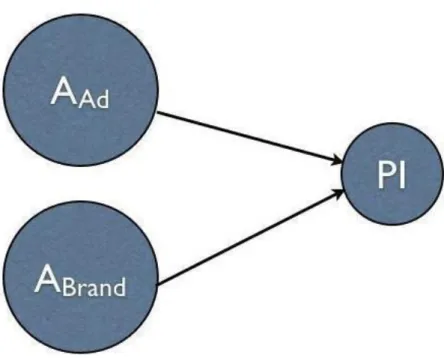
One of the advertisers’ objectives is to determine factors that influence consumers (R) of advertising messages to act in a particular way. Researchers describe terminology for purchase intention (PI) as real sense to purchase advertised product. However it’s found that participants more likely intended to experience purchase intention when they cannot actually make decision about the product (Goldsmith and Lafferty, 2002) which indicates the influence of other variables in the context of advertising that affects decision making. When consumer watches an endorser in advertisement, he or she develops likeness for the brand and then eventually intention to purchase which forms general construct of purchase intention. (Figure 3).
Figure 3. Optional Determiners of Purchase Intention: Influence of Attitudes towards Advertising and Attitude towards Brand.
Such determiners as advertising attitude and attitude towards brand not always lead to purchase intention and may vary by the extent of exposure depending on evaluations of
23
other variables. Such efficient tactics as associations that capture consumer attention takes extremely important place in advertising context. It’s found that, explicit sexual images have great effect in advertising even when the sexual image has little relevance to the advertised product (Reichert and Lambiase, 2003, 2006). Other study found that women participants would not use a product if the brand depicts women-endorsers in sexist manner in advertising context. Women participants stated that they would not use a product if the product adopted a sexist advertising campaign of the brand even when they liked the product (Ford, LaTour and Lundstrom, 1991). Studies by Jaffe and Berger (1988) supported these conclusions and found that attitudes toward advertising were more positive and had a higher purchase intention when women-endorsers were representative and expressed image of herself.
Another important moment is positive emotional response of the consumer which consequently may generate attitude towards advertising, brand, and in result these feeling on purchase intentions. Research found that emotion elicited by products, services, and store atmosphere positively impact subsequent consumer responses such as satisfaction (Hume and Mort, 2010) and purchase intention (Kang, 2010). Study also revealed a positive correlation between verbal and nonverbal exposure of women-endorsers determining emotional responses in consumers and proved that positive emotional response on represented stimuli is the most effective way, because participants ultimately transfer emotions to the product. In addition, Shimp (1981) investigated the effect of attitude toward an advertising on purchase intentions and the results supported that the participant‘s attitudes towards advertising were a significant indicator of their purchase intentions. Mitchell and Olson (1981) conducted study on the role of attitude toward the advertising (AA) and also found that participants’ responses to advertising determined attitude toward brand and purchase intentions. Thus, we may assume that purchase intention as the last stage
24
of consumers’ behavior is quite unsteady and weak variable and may be mediated by evaluations of such predictor as attitude towards advertising resulting to impact product demand. This kind of determination represents interest for the study formulated in Hypothesis 2.
Hypothesis 2 (H2). Participants’ interest towards advertising is more subject to effect of non-verbal modality while exposure of other modalities participants considered less significant for their interest.
2.9 Attitude towards Advertising
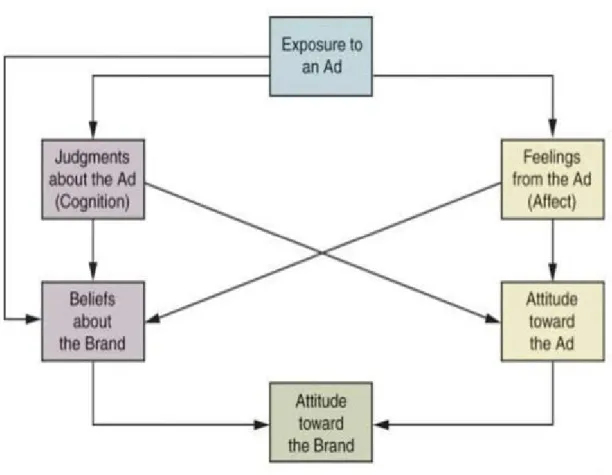
Attitude towards advertising is probably one of the most analyzed construct in the research. Attitude towards advertising is defined as ‘‘a learned predisposition to respond in a consistently favorable or unfavorable manner to advertising in general (Lutz, 1985). In fact attitude towards advertising as well as attitude towards any stimuli from environment consists of three basic elements determining consumers’ responses (Hawkins, Best and Coney, 2004) (Figure 4).
Attitude towards advertising is an important predictor of behavioral intentions, and for this reason, is a critical variable for researchers and advertising designers (Dianoux, Linhart and Ogjanov, 2012; Mitchell and Olson, 1981). One of the biggest challenges that advertisers have to face is to know what messages are relevant for consumers and how to stimulate consumers’ mental process. It is found that positive attitude towards advertising has more ability to recall advertising message then those having negative attitude. This is why the most influencing theory in advertising psychology research is attitude towards advertising and represents one of objectives of this study.
25
Figure 4. Structural Elements of Attitude towards Advertising.
Cognitive component of attitude (judgments about advertising, beliefs about brand) is based on a series of informative stimuli being evaluated, which is progressively stored by individual. Affective component of attitude (feelings from the advertising, attitude towards advertising) is oriented and reflects feelings, positive or negative, or evaluation regarding the stimuli in the context of advertising. Psycho-sociologists claim that attitude is persistent by nature, although it can be modified and structured, in the sense that it has internal (subjective) consistency and is based on evaluative criteria. However, intensity of attitude may vary widely or retain a state of neutrality.
Advertising encourages positive attitude in consumers due to exposure of hedonic benefits which serve a source of pleasure (Alwitt and Prabhaker, 1992; Chaudhuri and Micu, 2012; Pollay and Mittal, 1993). For this reason hedonic appeals of advertising source intended to provide benefits can be effective in given the positive function of product information on general attitudes toward advertising (Taylor, Bonner and Dolezal, 2002).
Previous research supported that consumers’ exposure to advertising triggers affective (feelings and attitudes) and cognitive (judgments, beliefs, thoughts) responses
26
which influence the consumers’ attitude towards advertising and the cognitions that relate to the brand which consequently affect attitude toward the brand (Clarkson, Tormala and Rucker, 2011; Mayer and Tormala, 2010). The reasoning is as follows: consumers with a favorable attitude towards advertising are more receptive to arguments in favor of the brand (Figure 5).
Figure 5. Scheme of Main Correlates Determining Attitude within Advertising Exposure.
Study of LeRoux suggests a construct in which attitude toward advertising is dependent on three predispositions: reactions triggered by the execution of advertising, emotional reactions and cognitive reactions triggered by arguments presented in advertising context. LeRoux developed a construct with specific characteristics identifying a type of reaction: