An argumentation model for
deliberation in heterogeneous
multiagent systems
Daniel José Marques Nora
Mestrado Integrado em Engenharia Informática e Computação Supervisor: Professor Ana Paula Rocha
Second Supervisor: Professor Rosaldo J. F. Rossetti
heterogeneous multiagent systems
Daniel José Marques Nora
Mestrado Integrado em Engenharia Informática e Computação
Approved in oral examination by the committee:
Chair: Professor Daniel Castro Silva External Examiner: Professor Paulo Novais Supervisor: Professor Ana Paula Rocha
The perception of the society about the negative impact of transportation on quality of life and on the environment has greatly increased over the last few decades. To be capable of satisfying the transportation requirements of a region, planners must design efficient transit facilities while respecting environmental, social, economic and legal factors. This task is highly complex and error-prone due to the overwhelming number of issues to take into account, pertaining to widely different areas of expertise. Ideally, planners should be assisted by good decision support systems to efficiently discover the best solutions in each situation. This principle applies to many other complex design problems.
The aim of this thesis project is to develop an argumentation model for deliberation in hetero-geneous multiagent systems. The model shall be generic enough to be easily adaptable to different application contexts, facilitating the construction of decision support systems based on argumen-tative agents. Such agents specialize in different areas of knowledge, and collaborate in search of solutions to solve a given problem as effectively as possible, while trying to respect the different quality parameters valued by each other. This approach should be particularly useful when the problems to solve are too complex to employ traditional optimization algorithms. Additionally, users will benefit from argumentation-based justifications for the system’s suggestions.
Several key concepts pertaining to decision-making processes and deliberation dialogues are used as reference for the development of the model, which is split into three major components: an abstract argumentation framework for deliberation; a set of criteria for choosing decisions for individuals and groups, based on accepted arguments, priorities between goals and concepts from social choice theory; and a communication protocol enabling agents to interact and exploit the the-ory in connection with the previous components, allowing integration of innovating techniques, such as simulation, in order to take full advantage of the agents’ analytical abilities. The ap-plication domain used for demonstrating the model’s capabilities is that of urban transportation networks.
Nas últimas décadas, a perceção da sociedade sobre os impactos negativos dos transportes na qualidade de vida e no meio ambiente tem vindo a aumentar. Para poder satisfazer as necessi-dades de transporte de uma região, os planificadores têm de desenhar infraestruturas de transporte eficientes, tendo em consideração fatores ambientais, sociais, económicos e legais. Esta tarefa é altamente complexa e suscetível a erros devido ao grande número de questões a ter em conta, rela-cionadas com áreas de conhecimento muito distintas. O ideal seria que os planificadores fossem sempre assistidos por bons sistemas de apoio à decisão para que pudessem descobrir eficazmente as melhores soluções em cada situação. Este princípio aplica-se a muitos outros problemas de designcomplexos.
Este projeto de dissertação tem como objetivo desenvolver um modelo de argumentação para deliberação em sistemas multiagente heterogéneos. O modelo deverá ser suficientemente genérico para que possa ser adaptado facilmente a outros domínios de aplicação, facilitando assim a con-strução de sistemas de apoio à decisão baseados em agentes argumentativos. Tais agentes são es-pecialistas em diferentes áreas de conhecimento, e colaboram na procura de soluções para resolver determinado problema da forma mais eficaz possível, tentando respeitar os diferentes parâmetros de qualidade valorizados por cada um. Esta abordagem deverá ser especialmente útil quando os problemas a resolver forem demasiado complexos para aplicar algoritmos de otimização tradi-cionais. Mais ainda, os utilizadores beneficiarão da argumentação como mecanismo de justificação para as decisões propostas pelo sistema.
Diversos conceitos-chave relativos aos processos de tomada de decisão e diálogos de deliber-ação são utilizados como referência para o desenvolvimento do modelo, que está divido em três componentes principais: uma framework de argumentação abstrata para deliberação; um conjunto de critérios de escolha de decisões para indivíduos e grupos, baseados em argumentos aceites, pri-oridades entre objetivos e conceitos da teoria da escolha social; e um protocolo de comunicação que permite aos agentes interagir e tirar partido da teoria relativa às componentes anteriores, pos-sibilitando a integração de técnicas inovadoras, tais como simulação, de modo a aproveitar em completo as capacidades analíticas dos agentes. O domínio de aplicação utilizado para demon-strar as aptidões do modelo será o das redes de transporte urbanas.
First and foremost, I would like to express my feelings of great gratitude and debt towards my parents, José Nora and Luciana Marques, whose love gives meaning to all things I have done in life, and plenty of motivation for all things I will continue to do. All those moments when I felt discouraged or frustrated become insignificant before the sympathy and support they always provided me with. There are no two people for whom I could be more grateful in my whole life.
Secondly, I would like to thank all other members of my family, grandparents, uncles, aunts and cousins, who were sympathetic during my episodes of absence, both physical and psycholog-ical, during those times of greatest hardship. To be in your company cures all.
Thirdly, I would like to stress out the invaluable support that I received from my supervisors, Professor Ana Paula Rocha and Professor Rosaldo Rossetti, towards whom I feel great friendship, respect and admiration. I thank them for always guiding me in the right path, for wisely helping to manage my expectations, and for all the enjoyable discussions we shared together. I wish them all the personal and professional realizations they rightfully deserve. I would also like to extend these wishes to Professor João Pascoal Faria, also from Faculdade de Engenharia da Universidade do Porto, towards whom I feel special appreciation for his sincere commitment and excellent attitude towards his colleagues and students. Furthermore, I acknowledge the precious help that I received in the form of a research grant, awarded by the FCT (Fundação para a Ciência e a Tecnologia).
Lastly, I would like to acknowledge the pertinent remarks by Professor Paulo Novais from Departamento de Informática da Universidade do Minho, by my friends and course colleagues and by all other people who in some manner contributed to my work. I would also like to thank all authors referenced throughout this thesis, which would not have been possible without studying their precious articles. Finally, I humbly thank all those who, in the great and arduous cause of the progress of Science, dedicate themselves to reading my small contribution.
Em primeiro lugar, gostaria de expressar o meu enorme sentimento de gratidão e dívida para com os meus pais, José Nora e Luciana Marques, cujo amor dá significado a todas as coisas que fiz na vida, e motivação bastante para tudo o que continuarei a fazer. Todos os momentos em que senti desânimo ou frustração se tornam insignificantes perante a compreensão e apoio que sempre me ofereceram. Não há duas pessoas pelas quais possa ser mais grato em toda a minha vida.
Em segundo lugar, gostaria de agradecer a todos os outros membros da minha família, avós, tios e primos, que foram compreensivos perante os meus episódios de ausência, quer física quer psicológica, durante os períodos de maior esforço. Nada que a vossa companhia não cure.
Em terceiro lugar, gostaria de salientar o apoio valioso que recebi dos meus supervisores, a Professora Ana Paula Rocha e o Professor Rosaldo Rossetti, para com os quais sinto a maior amizade, respeito e admiração. Agradeço por me terem sempre guiado no caminho certo, por aju-darem sabiamente a gerir as minhas expectativas, e por todas as discussões agradáveis que tivemos. Desejo-lhes toda a realização pessoal e profissional que merecem. Gostaria também de estender estes votos ao Professor João Pascoal Faria, também da Faculdade de Engenharia da Universidade do Porto, por quem sinto especial apreço pelo seu empenho sincero e excelente tratamento de to-dos os colegas de trabalho e alunos. Reconheço ainda a preciosa ajuda que me foi concedida na forma de uma bolsa de investigação da FCT (Fundação para a Ciência e a Tecnologia).
Por último, gostaria de reconhecer as observações pertinentes do Professor Paulo Novais do Departamento de Informática da Universidade do Minho, dos meus amigos e colegas de curso e de todas as outras pessoas que de alguma forma contribuíram para o meu trabalho. Queria ainda deixar o meu agradecimento a todos os autores referenciados ao longo desta tese, a qual não teria sido possível sem a leitura dos seus preciosos artigos. Para terminar, agradeço com humildade a todos aqueles que, pela grande e árdua causa do avanço da Ciência, se dedicarem à leitura do meu pequeno contributo.
1 Introduction 1
1.1 Motivation . . . 1
1.2 Aim of the thesis, goals and applicability . . . 2
1.3 Thesis structure . . . 3
2 Literature review 5 2.1 Multiagent systems . . . 5
2.1.1 Agent Oriented Software Engineering . . . 6
2.1.2 JADE - Java Agent Development Framework . . . 7
2.2 Argumentation-based negotiation . . . 7
2.2.1 Argumentation theory . . . 8
2.2.2 Dialogues of deliberation for collaborative decision-making . . . 10
2.2.3 Abstract argumentation frameworks . . . 12
2.2.4 Argumentation and Decision Support Systems: motivation and applications 15 2.3 Transportation . . . 18
2.3.1 Technology in transportation planning . . . 18
2.3.2 Simulation tools for transportation . . . 19
2.3.3 Assessing network performance . . . 20
2.4 Summary . . . 22
3 Preliminaries 25 3.1 Overview of the proposed solution . . . 25
3.2 Key concepts . . . 27
3.3 Summary . . . 35
4 Arguments: structure, attacks and acceptability 37 4.1 Arguments about beliefs and arguments about decisions . . . 37
4.1.1 Definition of epistemic arguments . . . 37
4.1.2 Definition of practical arguments . . . 40
4.2 The abstract argumentation framework . . . 43
4.3 Summary . . . 48
5 Criteria for choosing decisions 49 5.1 Establishing individual preference order . . . 49
5.2 Computing goal satisfaction . . . 51
5.3 Establishing joint preference order . . . 53
5.4 Analysis of joint preference computation . . . 56
6 Communication protocol 63
6.1 Outline of the architecture . . . 63
6.2 Stages . . . 64
6.3 Locutions . . . 69
6.4 Analysis of the communication protocol . . . 70
6.5 Summary . . . 76
7 An example dialogue 77 7.1 The scenario . . . 77
7.2 Requesting help and conveying the situation . . . 79
7.3 Defining goals and actions . . . 82
7.4 Debating potential decisions . . . 84
7.5 Gathering suggestions . . . 91
7.6 Summary . . . 94
8 Conclusions 95 8.1 Contributions . . . 95
8.2 Possibilities for future work . . . 97
References 99 A Locution rules 107 A.1 Auxiliary locutions . . . 107
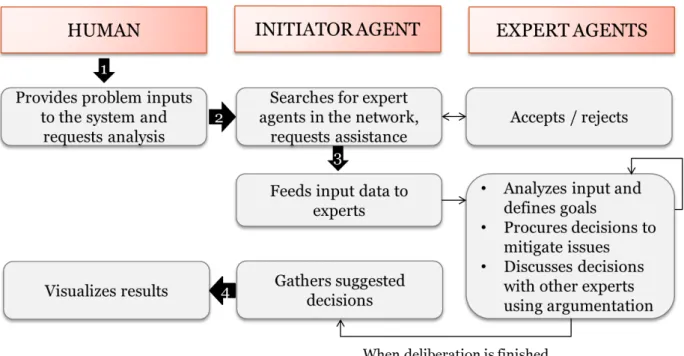
3.1 A simplified diagram of the deliberation process . . . 26
7.1 An illustration of the scenario . . . 78
2.1 LOS for urban facilities and road segments . . . 21
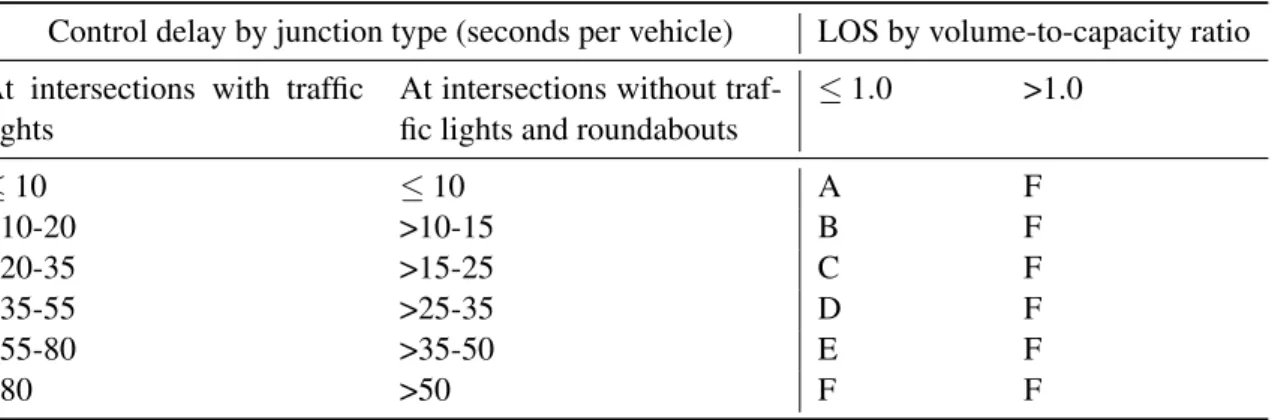
2.2 LOS for intersections with and without traffic lights and roundabouts . . . 22
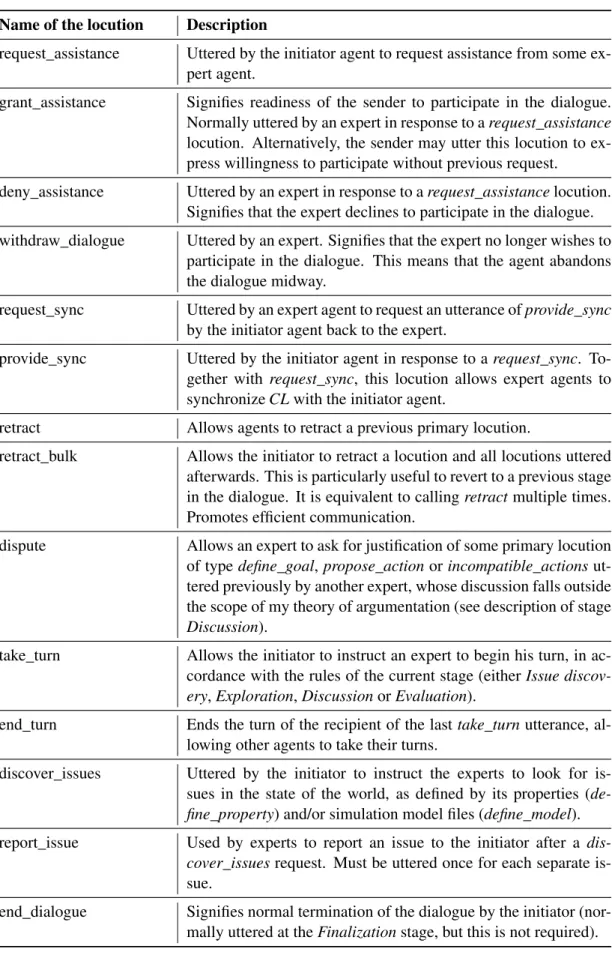
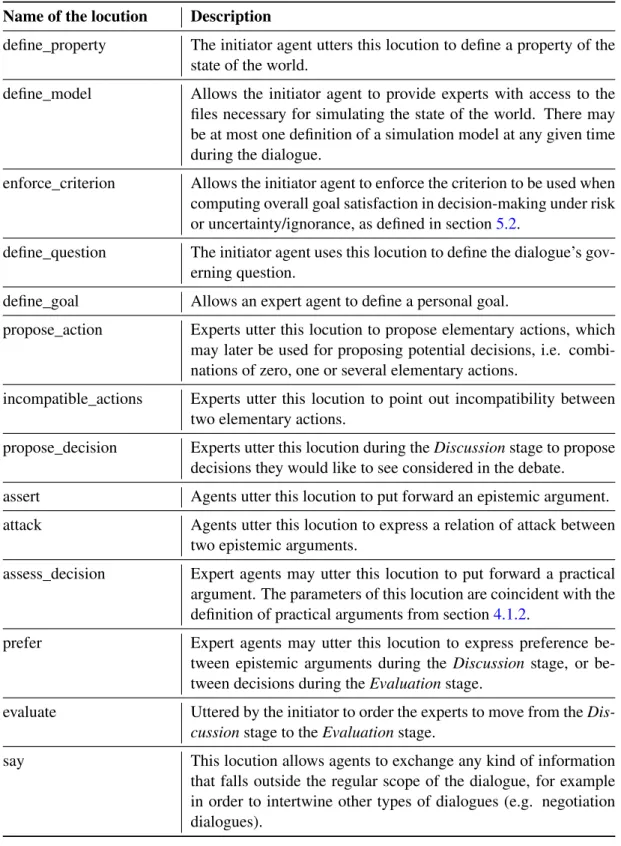
6.1 Quick reference list of auxiliary locutions . . . 71
AF Argumentation Framework
AFD Argumentation Framework for Deliberation AI Artificial Intelligence
AOSE Agent Oriented Software Engineering API Application Programming Interface CBR Case-Based Reasoning
CL Conversation Log
DDF Deliberation Dialogue Framework DN Do Nothing
DSS Decision Support System(s) EA Epistemic Argument
EAFD Expert-specific Argumentation Framework for Deliberation GUI Graphical User Interface
HBEFA HandBook Emission FActors for road transport LOS Level Of Service
MAS MultiAgent System(s) PA Practical Argument
Introduction
In this chapter I begin by explaining the general purpose of this thesis, including its motivations and the goals that I seek to address, followed by an outline of the document’s structure.
1.1
Motivation
Decision-making is everywhere. Sometimes it is informal, sometimes it’s a well-structured pro-cess. Sometimes it’s individual, sometimes it’s in groups. Sometimes it’s grounded on reasonable expectations, sometimes it has to deal with much uncertainty. And while it’s often about simple things, sometimes it’s so complex that it takes vast amounts of time, money and other resources.
We make decisions every day, often without being conscious of doing so: what to do in our free time, what to buy at the market, what to wear, and many other little things. But decision-making is also used for important things: we may not always be aware of it, but it affects our lives. From corporate meetings to political debates, big decisions have an impact on all of us.
Treating complex problems is often done in groups. Such groups discuss potential alternative decisions. Such discussions are usually called deliberations, or deliberation dialogues. In a de-liberation, each member of the group presents reasons in favor and against different alternatives. Such reasons are grounded on arguments. Those arguments need to be correct, otherwise the rea-sons they support can’t be considered valid. When in disagreement, people use argumentation to defend their points of view. Therefore, arguments are an intrinsic part of decision-making in groups.
Complex problems often require dealing with vast amounts of information, something that computers can greatly help with. Using decision support systems (DSS), decision makers can more efficiently discover the best alternatives to put into practice in each situation. Therefore, it is of general interest that planners are increasingly more assisted by good DSS. Most DSS, however, are merely aimed at tackling complex numerical problems like projecting profits, impacts or damages.
Couldn’t DSS combine such features with argumentation-based justifications in favor or against different decisions, similar to how human beings reason?
1.2
Aim of the thesis, goals and applicability
The aim of this master’s thesis project is to develop an argumentation model for deliberation in heterogeneous multiagent systems (MAS). Heterogeneity means that each agent specializes in a different area of knowledge. Agents argue with each other, debating alternative decisions. Their ultimate purpose is to collaborate in search of solutions to solve a given problem as effectively as possible, while trying to respect the different quality parameters valued by each other. The model shall be generic enough to be easily adaptable to different application contexts, facilitat-ing the construction of DSS based on computational agents with argumentative capabilities. This MAS approach should be particularly appropriate to solve complex problems, composed of several sub-problems associated to different domains of knowledge, for which it is difficult to implement regular optimization algorithms. Additionally, users will benefit from argumentation-based justifi-cations for proposed solutions. After all, arguments are the most natural way to elicit suggestions, making those solutions clearer to understand, analyze and discuss by different stakeholders.
To achieve my aim, I propose to address five goals, each of which is tackled on a separate chapter, starting at chapter3. Those goals are:
1. Determine the high-level key concepts that are common to any deliberation dialogue, inde-pendently of the context on which it might take place;
2. Establish an abstract argumentation framework that, based on the previously defined key concepts, allows deliberating agents to represent interactions between arguments and com-pute which ones are acceptable;
3. Establish a set of criteria that allows agents to determine a preference order for decisions, based on personal values and acceptable arguments in favor and against such decisions; 4. Build a communication protocol that allows agents to conduct deliberation dialogues in
accordance with my argumentation model;
5. Demonstrate the capabilities and potential of my theory with an example inspired by a com-plex problem from the real world.
Each chapter will present a variety of concepts that are novel in literature, building on top of well-established theory and integrating knowledge and techniques from different subjects like decision-making, argumentation theory, social choice theory and simulation, among others. Fur-thermore, the unified nature of this thesis is by itself an innovating aspect: few approaches consider the issue from so many angles, all the while maintaining consistency. Indeed, most other docu-mented efforts attempt to address one, at most two of these goals.
The application domain that will be used for demonstrating the model’s capabilities and poten-tial is that of urban transportation networks, in accordance with the ambitions of a larger project in which this work is integrated, the MAS-Ter Lab platform. This platform, currently in development at the LIACC laboratory at Faculdade de Engenharia da Universidade do Porto, consists of an in-tegrated MAS for cooperative design, visualization and engineering of intelligent transportation solutions by computational agents specializing in different subjects related to transportation plan-ning [ROB07, FERO08]. Although, as far as I was able to determine, the argumentation-based deliberation approach has never been used to tackle the problem of designing urban transporta-tion networks, this paradigm has proven to be particularly useful for solving problems of similar complexity in other areas [BBG12].
Nowadays, the role of urban and transportation planners is increasingly more complex and multidisciplinary. Historically, as the economy of a region grows, so does the demand in terms of passenger and freight transportation [BB01]. The perception of the consequences of this phe-nomenon has greatly increased over the last few decades, as both the scientific community and the society in general realize the negative impact of unsustainable transportation on the environment and quality of life [SG05], with direct consequences for the economy. Therefore, to be capable of satisfying the transportation requirements of a region, planners must provide efficient transit mechanisms while respecting environmental, social, economic and legal factors. This is a highly complex problem due to the diversity of quality measures to take into account, such as traffic flow, energetic costs, air pollution levels and the existence of green spaces. The search for appropri-ate measures is an expensive process in terms of time and resources. In the past, this process has often produced rather inappropriate solutions because planners sometimes base their decisions on inadequate models or, when faced with a problem of seemingly intractable complexity, adopt straightforward measures, like expanding highways to accommodate growth in traffic, without taking sustainability factors into account [RCS06].
If transportation planning impacts the general population, it is of general interest that planners are assisted by good software to help them make good decisions. Using a system that presents suggestions substantiated by arguments seems like a good way to achieve this aim, especially if such arguments are previously subject to scrutiny by different computational agents, experienced in different topics. Obviously, not only transportation planning could benefit from this approach: many other problems of similar complexity already rely heavily on DSS, such as engineering design processes [JG09], agriculture [PS04] and environmental impact assessment [CSMC+00]. This is why a generic argumentation model is of particular usefulness.
1.3
Thesis structure
To sum up this chapter, this thesis project concerns the area of argumentation-based deliberation in MAS, in particular, it is sought to determine how an argumentation model could be used as basis for implementing multiagent deliberations, with the ultimate purpose of assisting decision-makers.
The complex problem of designing urban transportation networks is explored as a potential appli-cation of the argumentation model. This thesis is structured as follows:
• Chapter2contains a literature review on the topics of MAS, argumentation-based negotia-tion and transportanegotia-tion planning;
• Chapter 3outlines the general aspects of the proposed solution and the key concepts un-derlying any deliberation dialogue, which are necessary to the development of subsequent chapters;
• Chapter 4 defines an abstract argumentation framework, which deals with the issues of representing conflicts between opposing arguments, deciding which ones are acceptable and enabling the comparison of decisions grounded on accepted arguments;
• Chapter5establishes some criteria for rank-ordering decisions from the perspective of in-dividual agents and joint decision-making, taking into account priorities between goals, accepted arguments and other factors;
• Chapter6defines the rules and admissible locutions of a communication protocol that allows agents to engage in deliberation dialogues, exploiting the theory designed over the previous chapters;
• Chapter7shows an example dialogue conducted in accordance with my theory, in the con-text of planning improvements for an urban transportation network;
• Chapter8contains a critical review of the theory and suggestions for future work.
Additionally, appendixA provides the detailed rules of each the communication protocol’s locutions introduced in chapter6.
Literature review
The objective of this chapter is to present an overview of the literature that is relevant to the un-derstanding of the solution proposed in this thesis, focusing on the topics of MAS, argumentation-based negotiation and transportation planning.
2.1
Multiagent systems
MAS have been studied since the early 1980s. Over the years, they have gained massive popularity thanks to the growing perception of their appropriateness in dealing with many different kinds of problems. Their background and some early uses are well explained by Jennings [JSW98].
The applications of MAS are greatly varied, with many examples in industry, commerce, en-tertainment and other domains. They are employed in contexts as different as controlling man-ufacturing processes [SWH06], managing air traffic [LL92], bidding automatically on electronic auctions [PCS10] and many others.
The kind of problems typically addressed by MAS present a combination of the following characteristics [BBG12,DPH07]:
• large complexity, with many variables and constraints to be considered;
• heterogeneity, in that they are composed of several sub-problems from different domains of knowledge;
• decentralization, because the information and resources required to solve the problem are dispersed;
• time-constrained, because a solution has to be reached in a short amount of time.
MAS are particularly useful in those situations because they are generally more modular, efficient and adaptable than typical software approaches like optimization algorithms. As a consequence,
they can be applied in contexts where it’s more important to produce good solutions in a short amount of time than the best possible solutions with high temporal complexity.
2.1.1 Agent Oriented Software Engineering
With the growing popularity of MAS, researchers began to realize the necessity of identifying clear and systematic methodologies to analyze, design and implement agent-based systems [Jen00]. These are generically called Agent Oriented Software Engineering (AOSE) methodologies. A qualitative comparison of different AOSE methodologies can be found in [Dam03]. They differ in aspects like application scope and in the coverage of different software development phases. Some mature, general-purpose methodologies are:
• GAIA: one of the first AOSE methodologies [WJK00]. It is composed of two phases: analysis and design. During analysis, developers define the key roles (composed of respon-sibilities, permissions, activities, and protocols) that exist in the system and the relationships between those roles. During the design phase, each role is assigned to one or more agents, the services provided by each role (in terms of inputs and outputs, pre- and post-conditions) are clearly identified and all communication links that may exist between the agents are de-fined. GAIA requires a good previous understanding of the system requirements (nothing is said about the elicitation of requirements). It does not address the implementation phase. • Tropos: a methodology that encompasses all phases of the development process, from early
requirements to implementation [BPG+04]. The concepts of agent, goal, task and social dependency are used throughout the entire process. In the early requirements phase, de-velopers discover the intentions of stakeholders by understanding their goals and the re-lationships maintained with each other in the real world. A distinction is made between hardgoals and softgoals (goals whose satisfaction can’t be precisely verified, such as the user-friendliness of a computer program). The late requirements phase focuses on the sys-tem to be implemented and its interactions within the environment. The syssys-tem is modeled as an actor with dependencies on other actors. In the architectural design phase, the system is decomposed into several interconnected sub-actors, each one responsible for fulfilling a portion of the system’s functions. Afterwards, the capabilities that each actor needs to pos-sess in order to fulfill their goals are clearly identified. Those capabilities are assigned to agents in the system to be implemented. The design phase follows, involving the specifica-tion of diagrams for capabilities, plans (which are the building blocks of capabilities) and agent interactions using UML activity and sequence diagrams. Finally, there are a variety of tools to assist developers in designing a system using the Tropos methodology. Some are capable of automatically generating code based on the design, therefore covering part of the implementation phase.
• Others: there are other general-purpose AOSE methodologies with lesser degrees of adop-tion, such as O-MaSE, Prometheus and MESSAGE.
Given the dynamism and complexity of the interactions in urban transportation systems, none of the above-stated general-purpose AOSE methodologies is capable of adequately modeling this scenario and its requirements without significant adjustments. Acknowledging this difficulty, Pas-sos, Rossetti and Gabriel [PRG11] have developed a new AOSE methodology that expands upon Gaia, Tropos and other approaches. The aim of their methodology is to better represent the dy-namism of complex systems by integrating concepts from business process modeling and service oriented architectures (SOA) in MAS. The notion of services becomes one of the core concepts of the system model, with the advantage of allowing implementers to exploit the benefits of mod-ularity, flexibility and user-centricity from SOA. They demonstrate a practical example of their methodology to design a MAS that helps people plan efficient trips in urban scenarios, using real-time information about different transportation offers.
Several software tools and libraries have also been developed with the purpose of facilitating the implementation of MAS, based on the perception of common needs across different scenarios.
2.1.2 JADE - Java Agent Development Framework
JADE [Tel] is a middleware framework written in Java whose main purpose is to ease the im-plementation of distributed MAS in compliance with FIPA (Foundation for Intelligent Physical Agents) specifications. It provides a software library to build and execute agents in a platform-independent run-time environment. JADE’s Application Programming Interface (API) allows efficient asynchronous passing of ACL (Agent Communication Language) compliant messages [FIP02] between agents by abstracting over lower level communication issues and automatically selecting the best available communication protocol in each situation. It also incorporates many of the interaction protocols devised by FIPA, such as Contract Net. A set of GUI tools is provided to facilitate the configuration and monitoring of a distributed agent system at run-time.
According to a survey in 2013 [MF14] regarding the impact of MAS technologies, JADE (and its extensions, such as WADE) is the most widely used agent development framework in mature applications in terms of absolute numbers when compared to other frameworks, such as JACK and KOWLAN.
2.2
Argumentation-based negotiation
One of the branches of MAS is that where agents have the ability to communicate with each other in order to agree on a solution that is acceptable to all parties. Some of those communi-cation mechanisms (protocols) are greatly simplified (when compared to regular communicommuni-cation between humans) in order to streamline the decision process and minimize the implementation effort [Woo02]. An example could be an auction platform where the only possible communicative acts are the opening and closing of the auction (by the auctioneer agent) and making bids (by the bidder agents).
To communicate with each other and negotiate solutions, agents can also be implemented with the ability to argue. Although difficult to implement, argumentation-based negotiation has the
advantage of being applicable to general, complicated settings, allowing agents to justify their positions and influence each other’s thoughts.
Argumentation is everywhere. It is used in conversations in everyday life, courts of law, pol-itics, scientific research and many other contexts. According to Frans Van Eemeren and Rob Grootendorst, argumentation is "a verbal, social, and rational activity aimed at convincing a rea-sonable critic of the acceptability of a standpoint by putting forward a constellation of propositions justifying or refuting the proposition expressed in the standpoint" [VEG04].
2.2.1 Argumentation theory
The necessity to understand the requirements that make arguments good or bad is not new. Original work in this area dates back to ancient Greece, with Aristotle being one of the most influential authors. He writes about the art of persuasion, taking into account the factors of credibility (Ethos), emotion (Pathos) and logic (Logos) as the major parts of rhetoric speech. His works about logic are particularly famous, setting up the foundations to the modern discipline of formal logic.
Formal logic, to put it simply, is the study of how abstract inference rules can be combined together to make valid reasoning, so that one can determine the validity of a conclusion drawn from a set of premises. The rules are said to be abstract because their application does not concern any particular type of object: what is important is the form of the argument (how the premises are put together), not the content (what is being talked about). Over the last century, developments in formal logic were heavily influenced by mathematics, which was perceived by many as a step away from its original purpose of the study of argumentation as a human practice [Joh00]. Students, teachers of critical thinking and philosophers alike began to see formal logic as too detached from real-life argumentation to be of much use in practical contexts [Joh00,Wal09]. Thus informal logic and argumentation theory were born, taking knowledge from fields like philosophy, law, and, more recently, computer science.
Walton [Wal09] provides an accessible introduction to the various concepts of argumentation theory, including important notions like the types of tasks undertaken by argumentation, attacks and refutations, argumentation schemes, implicit premises, types of dialogue and others. He ex-plains that there are four major tasks undertaken by argumentation.
• Identification: extract the premises and conclusion of an argument in textual form; • Analysis: discover implicit premises or conclusions in the argument;
• Evaluation: determine whether the argument is weak or strong and why; • Invention: generate new arguments for supporting or refuting some conclusion.
Walton also proposes that one of the tasks of the identification phase is to determine if the ar-gument under analysis fits a well-known, standard pattern or form of arar-gumentation. In [Wal13], Walton provides an analysis of several such patterns of argumentation that typically arise in ev-eryday conversation, legal argumentation and other contexts, called argumentation schemes. Each
scheme is associated to a set of critical questions representing standard ways to find flaws in the argument. Many different schemes exist, such as argument from expert opinion, argument from negative consequencesand practical inference. The latter is particularly useful in the context of decision-making because it can be employed to justify the necessity to undertake some candidate action. Walton’s scheme of practical inference can be defined as follows:
• Major Premise: G is a goal for agent X.
• Minor Premise: Carrying out action A is necessary/sufficient1to realize G.
• Conclusion: Therefore, agent X ought to carry out action A. And the corresponding critical questions are:
1. Does agent X have any other goals that might conflict with goal G? 2. Are there any alternative actions which could realize goal G?
3. Between action A and the alternatives, which are presumably more efficient? 4. Is it possible for agent X to carry out action A?
5. Are there any (negative) consequences of agent X carrying out action A that should be taken into account?
Long before artificial intelligence (AI) researchers realized the potential benefits of using ar-gumentation in MAS, arar-gumentation theory was already a fertile research area. One of the most influential authors from this area on AI is Toulmin [Tou58]. Although the field of argumentation theory has not yet produced a single unifying, widely accepted theory, Toulmin’s argument model is one of the major sources of inspiration both for argumentation theorists and AI researchers. An analysis of its impact on AI can be found in [Ver09]. Toulmin suggested a simple model for practical argumentation by identifying six major components for structuring arguments (of which the first three are most commonly employed in AI).
• Claim: the conclusion that one seeks to convince others of (e.g. "All birds can fly"); • Ground: the fact that one uses as grounds for making the claim (e.g. "All birds have
wings");
• Warrant: the statement one uses to justify why the ground proves the claim (e.g. "Any animal with wings is able to fly");
• Backing: a statement that attempts to strengthen the perceived validity of the warrant (e.g. "Wings are parts of the body responsible for producing aerodynamic forces that are essential to initiate and maintain flight");
1Walton [Wal13] distinguishes between two forms of practical inference schemes: the necessary condition scheme
• Rebuttal: a statement that seeks to reduce the validity of the claim (e.g. "Chickens are birds but they cannot fly");
• Qualifier: an expression that conveys one’s certainty concerning a claim (e.g. "All birds can probably fly").
Gottsegen [Got98] provides an interesting analysis of a land use debate in Santa Monica based on Stephen Toulmin’s argumentation model. He shows, through the use of diagrams, how the structural components of the arguments put forward by each stakeholder interact with the compo-nents of other arguments. This exposes the ways in which the views of the different stakeholders relate to each other in terms of support and rebuttal.
2.2.2 Dialogues of deliberation for collaborative decision-making
In [Wal95], Walton introduces the concept of types of dialogue in argumentation. Each type of dialogue has different purposes, i.e. is suitable in different conversation settings, and the stan-dards for properly conducting argumentation are different as well depending on the type. Types of dialogue can be differentiated by the initial situation of the participants, the goals of each partici-pant and the overall purpose of the dialogue. Walton identifies six fundamental types of dialogue: persuasion (prove the validity of one’s thesis against an opposing interlocutor), inquiry (obtain evidence to verify an hypothesis), negotiation (achieve a reasonable deal with another party when there is a conflict of interests), information-seeking (exchange information about some topic), deliberation (coordinate goals and actions in a decision group with slightly different views) and eristic (arguing solely for the sake of winning a conflict, instead of finding the truth). For exam-ple, Walton defines a deliberation dialogue as having the initial situation of a "dilemma or practical choice", the goals of the participants as "coordinating goals and actions" and the purpose of the dialogue as "deciding the best available course of action".
The concept of dialogues of deliberation is particularly useful in the context of this work, because such are the dialogues typically conducted by humans in joint decision-making processes. McBurney, Hitchcock and Parsons [MHP07] presented a very abstract protocol for deliberation dialogues between computational entities called Deliberation Dialogue Framework (DDF). As they explain, the need for deliberation dialogues arises when there is a perception of some problem, in the form of a question, that needs to be resolved by taking an action. It can start from a question like "How should we respond to the prospect of global warming?", or, in the context of this work, "What could be done to improve the performance of this traffic network?". Different actions can be evaluated on a large number of attributes like potential consequences (positive and negative), economic costs, practical feasibility, likelihood of success and so forth. They go on to propose a system with different types of sentences (about actions, goals, constraints, perspectives, facts or evaluations), stages of dialogue (open, inform, propose, consider, revise, recommend, confirm, close) and axiomatic semantics for specific locutions (open_dialogue, enter_dialogue, propose, assert, prefer, ask_justify, move, reject, retractand withdraw_dialogue).
As the authors recognize, however, no practical assessment is provided about the quality of the outcomes achieved in dialogues using the DDF protocol, nor is the protocol sufficiently complex to cover all relevant interactions of every potential application context (which would be extremely difficult). They do, however, perform an assessment of the framework in light of (proposed) nor-mative principles for conducting deliberations, i.e. sets of rules for rational, productive conversa-tion between humans. They discuss and measure to what extent the DDF adheres (or rather, allows implementers to adhere) to the various principles suggested by Alexy’s rules for discourse ethics [Ale90] and Hitchcock’s principles for rational mutual inquiry [Hit91]. The authors also make a brief mention to the work of Webler et al. [WTK01], which concerns a set of normative principles identified by participants in public debates about environmental matters like land use. This study shows that people have different perceptions about what constitutes a good deliberation process and that five major ideologies can be identified, contrasting in areas like the necessity for leader-ship, democratic equality among participants, discussion of fundamental values, etc. McBurney et al. rightfully claim that these principles are too abstract to assess the DDF protocol. Nevertheless, it might have been interesting if the authors made some considerations about how implementers could adapt the protocol in order to account for those different ideologies, especially since they are based on data collected from people involved in real deliberations.
McBurney et al. also make a clear distinction of the concepts of deliberation and negotia-tion, which may help understand my argument in favor of deliberative argumentation in DSS in subsequent sections:
"A (...) characteristic of deliberations relates to their mutual focus. Although the par-ticipants may evaluate proposed courses of actions according to different standards or criteria, these differences are not with respect to personal interests that they seek to accommodate in the resulting decision. In this respect, a deliberation dialogue differs from a negotiation dialogue, which concerns the division of some scarce resource be-tween competing allocations and so must deal with reconciling potentially competing interests. In a negotiation, for example, it may be deleterious for a participant to share its information and preferences with others. But a sharing strategy should behoove participants in a deliberation; to the extent that agents are unwilling to share infor-mation or preferences, we would define their discussion to be a negotiation and not a deliberation." [MHP07].
For those wishing to better understand the specific dynamics of negotiation, Raiffa [Rai02] provides an excellent analysis of this area, including two-party win-lose/win-win and multiple party interactions. He works from the perspective of providing guidelines to help humans become better negotiators, drawing from fields like economics (e.g. game theory) and psychology (e.g. behavioral analysis).
Walton’s concept of dialogue shift is also accounted for in the work of McBurney and his colleagues. Participants in a deliberation dialogue may, at any point of the process, disagree about some fundamental concept which needs to be clarified. In such cases, participants may
engage in an embedded dialogue for a few moments until the issue is resolved. This new sub-dialogue could be one of deliberation, or it could represent a temporary shift into a persuasion or negotiation dialogue. While the concept of dialogue types and shifts is not explicitly mentioned by Jin [JG09] (see section2.2.4for an analysis of his work), his example conversations in the context of collaborative vehicle design provide a good view on how a dialogue of deliberation may embed both negotiation (to settle minor conflicts) and persuasion (to justify or reformulate major design decisions).
2.2.3 Abstract argumentation frameworks
The purpose of an abstract argumentation framework is to determine if some claim is true by ana-lyzing the attack relations between the arguments put forward at a given point in an argumentation process. Such frameworks do not concern the invention of arguments or their internal structure, in fact, for them the content of the argument per se is not relevant. The only information that is necessary for building an argumentation framework is a set of arguments and a binary relation of attacks between those arguments. Therefore, nothing is assumed about the form of the argument, other than that it may attack or be attacked by other arguments. Such a framework can be repre-sented by a directed graph where the nodes are arguments and each edge is an attack between a pair of arguments (the direction of the attack being coincident with the direction of the edge).
Dung [Dun95] proposed the first abstract argumentation framework in a seminal paper in 1995, which has become one of the most important foundations for many developments in argumenta-tion. He starts by defining the concept of argumentation framework in a manner similar to the pre-vious paragraph, then defines different semantics for determining the acceptability of arguments, concluding with a demonstration of the correctness of his theory in light of other approaches to that date. What follows is a selection of some of the most important definitions in Dung’s work, which are essential to its comprehension.
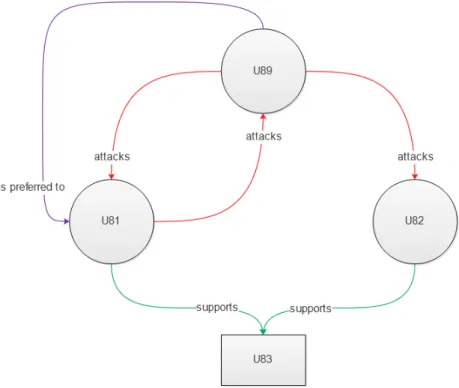
Argumentation framework "An argumentation framework is a pair AF = hAR, attacksi, where ARis a set of arguments, and attacks is a binary relation on AR, i.e. attacks ⊆ AR × AR." attack(A, B) represents an attack of argument A on argument B.
Conflict-free set "A set S of arguments is said to be conflict-free if there are no arguments A and Bin S such that A attacks B", i.e. if S has no internal attacks.
Acceptable argument "An argument A ∈ AR is acceptable w.r.t. a set S of arguments iff for each argument B ∈ AR: if B attacks A then B is attacked by [an argument in] S."
Admissible extension "A conflict-free set of arguments S is an admissible extension iff each ar-gument in S is acceptable w.r.t. S", i.e. iff S defends all of its elements (by attacking all attackers).
Complete extension "A conflict-free set of arguments S is a complete extension iff it is admissible and contains all the arguments it defends".
Grounded extension "A conflict-free set of arguments S is a grounded extension iff it is a minimal (w.r.t. set inclusion) complete extension of AF".
Preferred extension "A conflict-free set of arguments S is a preferred extension iff it is a maximal (w.r.t. set inclusion) admissible extension of AF", i.e. iff S defends all of its elements and is as large as possible. All preferred extensions are complete.
Stable extension "A conflict-free set of arguments S is a stable extension iff S attacks each argu-ment which does not belong to S [even if some of those arguargu-ments do not attack S]", i.e. iff Sis a preferred extension that attacks any argument not included in itself.
It is expected that participants are rational and agree about what arguments have been put forward and what attacks exist between those arguments (naturally this does not implicate agree-ment). In Dung’s framework, however, it is also assumed that arguments have the same strength, i.e. that each argument attacks other arguments with the same force and that participants agree about that fact. This may be sufficient for some uses, but it’s obviously not a good model of what happens in argumentation between humans. In real life, people may recognize that an opposing argument is valid in its essence (structure and logic) but still disagree about its relevance.
This limitation in Dung’s abstract framework has led to the development of many extensions to address the problem of different argument strengths. Bourguet [BAT10] provides a summary of some of those extensions, such as PAFs [AC02] and CPAFs [APP00] (which are briefly introduced in chapter4), and a new framework unifying their benefits. It is particularly interesting to analyze Bench-Capon’s [BC03] extension in the context of this thesis because he incorporates the concept of values (as in social or personal values, not economical or statistical values), which can be used as inspiration for modeling the preferences of different expert agents.
Bench-Capon theorizes that the perception of the strength of an argument is closely related to the concept of social or personal values. He exemplifies this way:
"(...) two arguments can conflict, and yet both be accepted. For an example sup-pose that Trevor and Katie need to travel to Paris for a conference. Trevor offers the argument "we should travel by plane because it is quickest". Katie replies with the argument "we should travel by train because it is much pleasanter". Trevor and Katie may continue to disagree as to how to travel, but they cannot deny each other’s argu-ments. The conclusion will be something like "we should travel by train because it is much pleasanter, even though traveling by plane is quicker."[BC03]
He draws attention to the fact that the persuasive impact of an argument is largely determined by the audience to which it is addressed. So an argument can be sound from a logical perspective but still be perceived as of little importance. Such an audience consists of one or more people with the same notion of values, or to be more specific, the same preferential order of personal values. In a different work [ABC07], Bench-Capon and Atkinson also indicate a shortcoming in Walton’s practical inference scheme (see section2.2.1) because it does not explain why G is a goal for agent A or how important it is for agent A to bring about goal G, therefore recommending a
more elaborate scheme in the lines of "In the circumstances R, the agent should perform action A to achieve new circumstances S, which will realize some goal G which will promote some value V of the agent". Value V is thus clearly stated as the reason why the agent desires to achieve goal G. Each agent can independently choose the order of importance of his values. Nevertheless, during the argumentative process, it may sometimes be impossible to satisfy the values of both agents simultaneously. In such cases, it’s necessary for the agents to conciliate their views on the importance of their values in order to agree on a course of action. Bench-Capon also accounts for the fact that some arguments are taken to be true regardless of the preferences of the agents (in the context of the broader example quoted above, he gives the example of a train strike, which makes it impossible to decide in favor of taking the train). Such arguments become associated to the value Truth, which is respected by all audiences above all other values.
Bench-Capon’s framework, besides providing semantics for acceptability, includes two impor-tant definitions:
Value based framework "A value-based argumentation framework (VAF) is a 5-tuple: VAF = hA, R,V, val, Pi", where A and R are equivalent to AR (set of arguments) and attacks (binary relation) in Dung’s framework respectively, V is a non-empty set of values, val is a mapping of each action to the value it promotes and P is the set of possible audiences (or partial orders on V ).
Audience specific VAF "An audience specific value-based argumentation framework (AVAF) is a 5-tuple: VAFa= hA, R,V, val,Val pre fai", where A, R, V and val are the same as for the
definition of VAF, a is an audience (from set P of the VAF) and Val pre fais an irreflexive,
assimetric and transitive preference relation Val pre fa⊆ V × V , which represents the order
of preference of values from the perspective of audience a.
One of the limitations of Bench Capon’s theory is that arguments can’t simultaneously support multiple values. This problem has been addressed in an extension of his work in [KvdT08]. How-ever, neither framework accounts for the fact that the relationship between preferences or values, in human discourse, is not necessarily linear. Extending Bench-Capon’s example of Trevor and Katie, imagine that the only train ride they can afford to take is very slow, such that they would need a couple of weeks to arrive at their destination. Even if the conference they wish to attend is only to be held within a month (therefore taking the train would not implicate missing the con-ference), would they still prefer taking the train instead of the plane? Probably not, for various reasons. One could argue that this is a matter of inserting more values in the argumentation frame-work related to the inconveniences or risks associated to taking the slow train. Nevertheless, that would require a difficult process of enumeration. Typical human reasoning would take those fac-tors into account implicitly by saying something like "I prefer to travel by train because it is more comfortable, unless the train is too slow, in which case I prefer to take the plane instead". This isn’t possible to represent directly using Bench-Capon’s framework or its extension, in part be-cause they don’t allow the explicit indication of negative impacts on values, or the representation
of the fact that when two arguments promote the same value, one may be preferred to the other if it promotes the value better or with more likelihood of success.
2.2.4 Argumentation and Decision Support Systems: motivation and applications
In real life, people justify their beliefs and decisions based on arguments. Therefore, argu-mentation seems like the most natural and powerful way to suggest and defend a choice. It quickly becomes evident that DSS could greatly benefit from argumentation-based approaches to justify their suggestions. Recently, this position has been defended by several authors [RS09,
MM12] and exemplified with applications in different domains, such as in collaborative engineer-ing design [JG09], public health policy-making [BTMA13] and dynamic supply chain formation [WWV+09].
Girle et al. [GHMV03] provide a set of recommendations to adopt when designing DSS for practical reasoning (i.e. for reasoning about what has to be done in some situation), encouraging the use of argumentation-based MAS and exploring some of the typical, key challenges of DSS design. Their opinion about argumentation and DSS is similar to that described in the previous paragraph and compatible with the concept of using heterogeneous agents specialized in different areas of expertise: "when faced with difficult decisions about what to do, decision makers benefit from good advice. Good advice comes most reliably from advisors with relevant expertise". Girle et al. also offer some recommendations about how advice should be presented to the user.
"First, the advice should be presented in a form which can be readily understood by the decision maker. Second, there should be ready access to both the information and the thinking that underpins the advice. Third, if decision-making involves details which are at all unusual, the decision maker needs to be able to discuss those details with their advisors". [GHMV03]
The first part concerns what information is relevant to the user (e.g. estimations of perfor-mance, comparison between alternatives) and how it should be presented so that it is easily under-stood (e.g. text, tables, charts, graphs). The second part concerns the system’s ability to justify its suggestions, which can be supported by argumentation. The third part concerns the user’s ability to interact with the DSS by configuring the inputs, seeking further explanation for certain sug-gestions (or even rejecting them), supplying more information to enrich the deliberation process, basically, to debate alternatives together with the system.
Regarding these points, Girle and his colleagues offer a list of recommendations for Graphical User Interface (GUI) design in DSS. Without going into detail about all those topics, it seems at least interesting to mention here the necessity to provide users with a clear representation of the arguments that support the decisions suggested by a DSS. Arguments pro and against a decision should be represented both in textual and visual format, since different users have varying degrees of capacity in comprehending text and images. Over the last few years, some software has been developed for representing arguments graphically through diagrams or argument maps (with the
purpose of teaching and researching argumentation theory), for example Araucaria [RR04] and Carneades [GPW07]. There is also an area of research devoted to enhancing the acquisition of knowledge through visual methods, closely related to human-computer interaction and to methods for eliciting and modeling expert knowledge [CHCF02].
Girle et al. also provide a discussion on the matter of comparing the projected performance of different courses of action in a DSS. One could think of several criteria for carrying out this task, such as preferring the decisions with greater number of reasons in favor (pros) subtracted by the number of reasons against (cons), weighing the probability of outcomes, attributing importance values to different performance criteria, etc. Classical decision theory [MVN53] proposes a quan-titative method for measuring the performance of a scenario by taking into account the probability of each different outcome under that scenario, as well as a number representing how positive (or negative) each outcome would be if it came to be true. Then one uses a criteria like the maximum expected utility to rank potential decisions. Some of the disadvantages of this approach are that, to be useful, it requires prior knowledge of all the possible outcomes of a decision (or, at least, the most likely ones), it requires knowledge of the probability of each outcome and it presumes that the user has a good understanding of the expected utility of each outcome. Most of these requirements do not hold in complex deliberations.
In addition, Girle et al. point to a study in the UK by Stirling and Mayer [SM99] regarding a debate about policies for genetically modified crops involving specialists in different areas of expertise. To rank options, they use a method of multi-criteria evaluation where weightings are assigned to different criteria (e.g. environment, health and economy) and a score is given to each option in light of each criterion. The final rank of an option takes into account the weighted combination of the scores of all criteria. Naturally, as indicated by Girle and his colleagues, this method is vulnerable to the inherently subjective nature of numerical weights and scores; nevertheless, it is one of many possible approaches.
Bourguet’s work dealing with argumentation applied to food quality decisions [BTMA13] demonstrates a case of a real-world problem that could be solved by connecting argumentative-based reasoning to DSS. He proposes a model grounded on Dung’s abstract argumentation frame-work [Dun95], taking into account three dimensions of argumentation models: the internal struc-ture of an argument (how arguments are constructed), the relationships between different argu-ments (such as attack or support) and the varying perception of the strength of an argument by different audiences. The model is applied to a public health policy making context, in particular to the bread manufacturing process, which is a complex problem due to the contradictory interests of different stakeholders, such as public health institutions (which seek to decrease the emergence of diseases), millers (who are concerned about production costs) and bakers (who seek to main-tain sensorial pleasure associated to their products). Bourguet concludes by suggesting that DSS involving argumentation models could be helpful to stakeholders for eliciting new arguments and suggestions, thus facilitating communication and making the decision process more productive. It’s important to note, however, that because the different stakeholders have conflicts of interest,
his is a work about negotiation dialogues, not deliberative dialogues. One of the shortcomings of his approach, as Bourguet himself admits, is the difficulty to find a set of actions that concil-iates widely different concerns such as sanitation and economy ("we thus need to enhance the model with aggregation procedures recommending relevant actions in situations where weighted preferences can be elicited and heterogeneous concerns are merged"). Nevertheless, Bourguet’s framework allows for the analysis of alternative courses of action in light of each individual con-cern, similar to Bench-Capon’s concept of audiences [BC03].
In collaborative contexts, agents should be interested in maximizing the performance of the system as a whole while respecting the different quantitative and qualitative parameters valued by each other. This concept is well illustrated by Jin [JG09] in a collaborative engineering environ-ment, where each individual is responsible for designing a specific part of a car. The individuals are not self-interested: their focus is on collaborating to provide the best possible design for the vehicle. Conflicts arise, for example, when individuals have different views of quality measures or when a certain design decision by individual A conflicts with a previous design decision by individual B. Such conflicts are solved by searching for mutually compatible solutions or, when impossible, trying to decide which design principles are more important to the overall quality of the car. During this process, individuals often have to explore new design alternatives they had not conceived before. This expands the argumentation process beyond a mere set of conquests and concessions by each individual, allowing them to find new alternative solutions that benefit the performance of the entire system. This a good example of using deliberative argumentation to successfully solve decision-making problems, though the practical implementation of Jin’s model is not a DSS but rather a collaboration support system (agents don’t argue spontaneously, instead, the system, using agents, suggests possible lines of argumentation to the user).
One could say that, if agents had a good understanding of solutions that worked well in the past, they could more easily select the best positions to defend in new situations. Therefore, in theory, a combination of argumentation-based negotiation with case-based reasoning (CBR) could be used to great effect in DSS. CBR [AP94] is an AI approach for solving problems based on the knowledge gained in previous experiences. To solve new problems, one starts by finding similar cases in the past, and then applying the solutions that worked best for those cases. Every time a solution is applied, its results are preserved so that we can learn from it in future experiences.
Heras [HJBJ13] shows a promising approach by combining in a single framework the concept of argumentation with that of domain-cases (representing previous problems and their solutions) and argument-cases (the success of different argumentation strategies in defeating an opponent’s arguments in different situations). While the usage of domain-cases seems to produce better re-sults (compared to not using them), some issues arise when all agents have the ability to use argument-cases, essentially because they all become equally competent in terms of selecting the most persuasive arguments (besides, the focus of the process shifts from finding good solutions to a given problem to finding the best arguments to convince other people, which is, obviously, greatly dependent on the characteristics of the interlocutors). Choosing arguments based on how well they work at convincing others and extrapolating suggestions from that process does not seem
to be a good criteria for making neutral, responsible, informed decisions using a DSS. My view is that the usage of argument-cases and competitive argumentation mechanisms in general, while perhaps adequate for implementing competing agents, is inappropriate in most contexts of col-laboration, because agents should work together to reach the best solution for the system without pursuing selfish interests (Heras [HJBJ13] implicitly agrees with this view at the conclusions in her article by suggesting the development of a new framework "(...) in a cooperative environment where agents are not interested and collaborate to reach the best agreement for them all"). To conclude, we are interested in the truth value of the arguments, not in the personal benefit of the arguer, the latter being seen by some as counterproductive to argumentation [Joh00].
2.3
Transportation
Applications of MAS in transportation typically concern traffic management and control to pre-vent (or resolve) congestions [Sch02]. This is part of a series of recent efforts towards improving the efficiency of transportation networks by directly influencing drivers’ behavior, instead of car-rying out physical modifications to the networks themselves. These approaches are generically called ITS (Intelligent Transportation Systems), and their overall purpose is to provide technolog-ical services to help people make more efficient use of the available transportation mechanisms. This requires good understanding of human behavior, in particular the reasoning process of drivers according to external circumstances and their reaction to new information conveyed by such tech-nologies. Rossetti et al. [RBB+02] have proposed an approach for representing and assessing driver behavior by means of MAS with BDI (Belief–Desire–Intention) architectures. A follow-up on this work introduces a methodology for assessing the impact of pre-trip information systems on the cognitive process of drivers and its effect on overall network performance [RL05]. Another example of an application of MAS-based technologies in transportation is solving Vehicle Routing Problems, i.e. optimizing the service of several customers with a limited fleet of vehicles [BBG12]. The domain of transportation, and urban transportation planning in particular, is far too broad to be covered within this chapter with anything more than an introductory level of detail. Over the following subsections, I’ll only touch upon topics regarding tools and techniques used in planning, simulating traffic networks and assessing network performance.
2.3.1 Technology in transportation planning
As far as I could ascertain, there are no documented practical applications of MAS with the pur-pose of directly assisting transportation planning processes (i.e. the actual process of designing transportation networks). Nevertheless, there is a long tradition in this area of using software tools to build simulation models and devise alternative traffic scenarios, e.g. using GIS (Geographic Information System) based decision support tools.
The main challenges related to transportation planning in the modern world have already been briefly presented in chapter1. If the reader wishes to know more about this topic, the United States
Federal Transit Administration2 3provides a vast selection of quality literature to the public (see footnotes and TPCB [Tra07]). This section is more concerned with summarizing the technological applications typically used in transportation planning.
According to [Tra07], for many decades, transportation planners have used a so-called "four-step" approach in modeling transportation demand. Before being able to employ this approach, planners have to understand the land use in a region (and its estimates for the future), as well as demographic and socioeconomic factors (e.g. population clusters, average household size, em-ployment types). Once this is understood, planners use the "four-step" approach (trip generation, trip distribution, mode split and network assignment) to estimate the total number of trips through each link of the transportation network. This allows planners to forecast congestion at each link, which can be used to provide an estimate of the system’s performance.
Emission levels can also be forecast by using a separate model that takes the results of the "four-step" model as input. Additionally, planners may use a variety of technologies to help stake-holders visualize transportation plans in an accessible way, as well as scenario planning tools to understand the impact of alternative decisions in the future.
It seems evident that the usefulness of technology is well understood by the professionals of the transportation planning sector. Therefore, it should not be difficult to explain the advantages of using a single system that encompasses the whole decision-making process. Using arguments to explain the merits of potential solutions seems like a good way to help both planners and stake-holders comprehend the pros and cons of different alternatives. Using agents as a development paradigm seems adequate to handle the size and multidisciplinary traits of the problem.
2.3.2 Simulation tools for transportation
A proper DSS in the context of transportation needs a good traffic simulation engine to estimate the implications of different design decisions on the real world with a reasonable degree of confidence. Many traffic simulators exist, with different advantages and disadvantages. Most can be inte-grated or communicate with other applications via dedicated APIs. Some examples are Quadstone Paramics4, MATSim5 and SUMO6. A tool in development by researchers at Faculdade de
En-genharia da Universidade do Porto called TraSMAPI [TARO10] aims to provide a common API to observe and interact with different traffic simulators in an accessible manner, hiding low level communication details from the user. The obvious advantage of using such a tool is to allow researchers to spend more time on actual research and less time on implementation details (like adapting the code to run on different simulators). A documented example of the use of this tool in combination with JADE and SUMO can be found in Azevedo [AARR14].
SUMO [KEBB12] is an open source microscopic traffic simulator, providing information and control over each separate vehicle in the simulation model independently. It supports multimodal
2http://www.fta.dot.gov/15576.html
3http://planning.dot.gov
4http://www.paramics-online.com
5http://www.matsim.org
traffic systems including personal vehicles, public transportation and pedestrians. Traffic lights can be freely positioned and controlled. It also provides an OpenGL based GUI for real-time vi-sualization and an API called TraCI to allow other applications to remotely control the simulation. Additionally, SUMO supports several extra features, such as importing road networks from dif-ferent formats (including Open Street Maps), automatically planning routes, calculating noise and particle emissions and generating traffic flow statistics.
SUMO allows users to define their own traffic networks using a combination of mandatory and optional configuration files containing road definitions (edges), intersections (nodes), traffic lights, vehicle types, vehicle routes, emission detectors and others. The SUMO distribution also contains many programs and scripts to assist users in configuring networks and analyzing simulation results. In addition, researchers have compiled ready-to-use simulation models containing vast amounts of data obtained from real traffic networks, which can be easily used to study the impact of different traffic-related measures on the performance of a network. One of those scenarios is based on the city of Cologne, Germany [Ins] and another is based on the city of Bologna, Italy [BKM+14].
SUMO has been used in several multipurpose studies, from vehicle and vehicle-to-infrastructure projects [iTE10] to forecasting traffic congestions during major social events. One particularly interesting study uses SUMO to analyze the impact of different measures for the re-duction of air pollution in the city of Brunswick, Germany [TKGD13]. In this study, various tools of the SUMO suite are used together to simulate the enforcement of an environmental friendly zone in the city (where only low emission vehicles can pass) and the reduction of the speed limit in certain areas. It is concluded that implementing the environmental friendly zone causes a large reduction on the emissions of particulate matter (PMx) and oxides of nitrogen (NOx) both in the
area of application and the city as a whole, while the reduction of the speed limit causes the same effect locally but deteriorates the global emissions because impatient drivers choose roads with higher speed limits.
2.3.3 Assessing network performance
Many different metrics exist to evaluate the quality of service of transportation networks. Such variety stems not only from the necessity to take into account different quality parameters (e.g. environmental, financial, legal) but also the application context (metrics for freeways are different from those for urban facilities and rural areas) and user perspective (a pedestrian demands different services from the transportation network compared to an automobile driver).
To determine how appropriately a road serves traffic demand, the United States Transportation Research Board publishes a very detailed, regularly updated manual for use by analysts and trans-portation engineers: the Highway Capacity Manual [HCM10]. Should the reader wish to know more about the broad topic of transportation planning, this is a good manual to study. It explains a set of methodologies for evaluating the capacity of freeways, multilane and two-lane highways, urban facilities (i.e. major urban arteries like avenues) and urban segments (i.e. a segment of road between two consecutive intersections), intersections with and without traffic lights, round-abouts and other network facilities. The perspectives of automobile drivers, pedestrians, bicyclists