I
IUL School of Social Sciences
Department of Social and Organizational Psychology
Let’s put a smile…on that brand!
The effect of Emojis on Brand Perception and Brand Personality
Dissertation submitted as partial requirement for the conferral of
Master in Social and Organizational Psychology
by
Bernardo Miguel Pereira Cavalheiro
Supervisor:
Doctor Marília Prada, Invited Assistant Professor, ISCTE-IUL, CIS-IUL
III
todo o conhecimento necessário para a realização deste projeto. Um especial agradecimento também pela célere resposta em momentos de indefinição e incerteza durante o atribulado ano letivo, nomeadamente no que a questões pessoais e profissionais diz respeito.
Um último agradecimento por ter exigido de mim mais do que eu achava possível e razoável, não me deixando acomodar com decisões que só a curto prazo me facilitariam a vida e percurso. Obrigado.
Aos meus pais, por toda a formação. Pelo carácter que ajudaram a moldar. Pelo desenvolvimento intelectual que sempre suscitaram. Por nunca terem esperado de mim o razoável, mas sim a excelência e a constante superação. Por me terem sustentado mais do que deviam. E por nunca o terem cobrado. Obrigado.
Ao meu irmão, por cedo me ter ensinado que o que é, não parece. Por me ter ensinado que muitas vezes, sou eu contra o mundo. E por cedo me ter ensinado que primeiro estou eu, e depois o resto.
À minha avó, pela educação e apoio no desenvolvimento, apesar da forma arcaica com que sempre o fez (e vai fazendo).
À Lúcia, por ter sido mais do que uma consultora informal. Por me ter suportado em momentos de desânimo e desencanto. Por todas as horas que perdeu. Por ter sido mais do que minha amiga. Por ter sido companheira e companhia. Por ter sido mais do que se esperava que fosse. Nunca o vou esquecer. Obrigado.
Ao Ricardo, pela compreensão e flexibilidade em momentos de aperto. E pelas dicas! A todos os meus amigos, por me terem perguntado recorrentemente “quando é que acabas o mestrado!?”, empurrando-me no caminho certo e deixando implícita a sugestão “a ver se desta te redimes da licenciatura”.
E a todos os que participaram neste estudo, tornando assim possível a conclusão desde longo projeto. A todos os que aqui vierem parar, obrigado!
V
comunicação adotada por grande parte das pessoas e pode variar entre contextos (comunicamos com parceiros românticos, amigos, colegas). Isto ocorre não só entre indivíduos, mas também entre indivíduos e marcas. Contudo, ao contrário da comunicação face-a-face (F2F), na CMC temos falta de pistas não verbais, dificultando a compreensão da mensagem e podendo redundar em ambiguidade. Uma forma de contornar esta limitação, é através da utilização de emoticons ou emojis, que permitem expressar emoções, e reforçar o tom de uma mensagem, sendo relevante perceber como é que a inclusão de emojis, em CMC, é percebida por potenciais consumidores de uma marca fictícia, relevante pela crescente presença das marcas em contextos digitais (i.e., redes sociais). Realizamos um estudo experimental para investigar como é que a inclusão de emojis (vs. Controlo) numa
comunicação emitida por uma marca fictícia em crise (i.e., recolha de produto defeituoso) influencia a perceção global da marca e suaa personalidade. Os participantes (N = 201, 62.4% sexo feminino) foram expostos a um cenário fictício que variava em termos da inclusão ou não de um emoji e do nível de gravidade do defeito. Os resultados sugerem que fazer a recolha de produtos defeituosos pode ser visto como socialmente responsável. Os emojis não exerceram influência direta na perceção de marca. A utilização de emojis não se adequa a todos os contextos. Estas evidências são de especial relevância para a área da psicologia do consumidor e da comunicação.
Palavras-chave: comunicação mediada por computador, emoji, personalidade de marca, perceção da marca, crise de produto.
Classificação APA:
2700 Communication Systems 2750 Mass Media Communications 3900 Consumer Psychology
VI
communicating, varying across contexts (e.g., we communicate with romantic partners, friends, or in professional settings). This occurs not only among individuals, but also between individuals and brands. However, in contrast to face-to-face (F2F) communication, CMC lacks non-verbal cues, making it harder to perceive a message. One way to overcome this limitation is the inclusion of emoticons and emojis, used to express emotion and to reinforce and clarify a message. Our goal is to understand how the inclusion of emojis in CMC is understood and apprehended by customers of a fictional brand, relevant due to the increasing presence of most brands in digital contexts (i.e., social media platforms). We conducted an experimental study to investigate how including emoji (vs. control) in a product recall message influences general brand perception and brand personality. Participants were presented with a fictional scenario of a fictional brand dealing with a product-harm crisis. Participants (N = 201, 62.4% females) were assigned to a fictional scenario that varied in terms of the presence or absence of an emoji and the level of perceived severity of the defect. Results suggest that making callbacks of defective products can be seen as socially
responsible. No direct effects of emojis in brand perception were found. The usage of emojis is not appropriate in all contexts. These findings are of relevance especially for the field of consumer psychology and communication studies.
Key-words: computer mediated communication, emoji, brand personality, brand perception, product-harm crisis.
American Psychological Association (PsycINFO Classification Categories and Codes): 2700 Communication Systems
2750 Mass Media Communications 3900 Consumer Psychology
VII
Computer Mediated Communication ... 1
Brand Perception ... 5
Brand Personality ... 8
Aims and Hypotheses ... 11
CHAPTER I Method ... 13
Participants and Design ... 13
Instruments ... 13
Brand personality ... 13
Brand and company perception ... 13
Procedure ... 14 CHAPTER II Results ... 17 Manipulation check ... 17 Severity level ... 17 Emoji’s presence ... 18
Impact of Emoji Presence and Severity of the Defect on Brand and Company Perception . 18 Impact of Emoji Presence and Severity of the Defect on Brand personality ... 21
Additional Analysis ... 22
Attitudes towards emoji use in marketing communication ... 23
CHAPTER III Discussion ... 25
Conclusion ... 31
References ... 32
Appendix A – Study Survey ... 39
Appendix B – Brand Personality Scale ... 47
Appendix C - Effect of conditions on Brand Perception ... 48
Appendix D - Effect of conditions on Brand Personality ... 49
VIII
Table 1. Mean Evaluations across Brand and Company Perception Dimensions (Overall, according to Severity and Emoji Conditions) ... 19 Table 2. Mean Evaluations across Brand Personality Subscales (Overall, according to
IX
Figure 2. Interaction effect of severity level and emoji’s presence on the confidence of the opinion about Electra. ... 20 Figure 3. Interaction effect of severity level and emoji’s presence on the willingness to buy another Electra product. ... 21 Figure 4. Interaction effect of severity level and emoji’s presence on the level of worry
1 Introduction Computer Mediated Communication
As social creatures, humans spend most of their time communicating (e.g., working, playing, parenting, persuading, selling, Burgoon, Guerrero, & Floyd, 2016). And we not only communicate face to face (F2F), we also communicate by watching television, videos,
listening to the radio, talking on the cell phone and/or using webcams (Burgoon, et al., 2016). Indeed, as digital technologies continue to create more universal and user-friendly
communication platforms, human beings are even more connected (Pittman & Reich, 2016). That is the case of social media websites (i.e., online platforms that allow users to create and share content with their networks, like friends and followers) which have revolutionized how people interact with each other (Pittman & Reich, 2016). Thus, we can communicate through social media platforms (e.g., Twitter or Facebook) and through email, with social actors that we never met (Walther, 2011). More, as Pittman and Reich (2016) suggested, these types of platforms allow people to rapidly communicate about feelings and situations by sharing with their networks image and video files. This kind of communication resorts on computer
mediated communication (CMC), a form of electronic message communications, synchronous or asynchronous, usually typewritten (Adrianson, 2001), or image-based, as noted above.
Communication is not a simple change of words and meanings, on the contrary, it is a result of the interaction of many factors (e.g., words, grammar, context, nonverbal cues, Rezabek & Cochenour, 1998). During F2F communication, nonverbal cues (e.g., eye gaze, posture, distance,) are just as important as choosing the right words (Knapp, Hall, & Horgan, 2013). Indeed, the meaning of a message is complemented by nonverbal visual cues such as body language or facial expression (Kiesler, Siegel, & McGuire, 1984; Knapp, et al., 2013; Rezabek & Cochenour, 1998) or by paralinguistic cues such as the tone of voice (Kiesler, et al., 1984; Knapp & Daly, 2011). For example, facial expressions convey emotions during F2F communication and serve the purpose of helping receivers to understand the meaning of a verbal communication, by clarifying and reiterating those messages (Rezabek & Cochenour, 1998). Moreover, Knapp and Daly (2011) suggest that people tend to believe in the veracity and spontaneity of nonverbal cues, and rely on such cues as a source of psychological and emotional information that helps the receiver in understanding another person’s
communication, by providing a deeper context. Hence, nonverbal cues serve the purpose of clarifying the verbal content of communication (Knapp & Daly, 2011).
2
Nowadays, CMC has become as common as F2F communication (Derks, Fischer & Bos, 2008; Kraut, Mukhopadhyay, Szczypula, Kiesler, & Scherlis, 1999; Rodrigues, Lopes, Prada, Thompson, & Garrido, 2017). As mentioned earlier, people resort on CMC to
communicate with different interlocutors. Indeed, CMC can be used in several contexts: to communicate intimately with a romantic partner (e.g., Luo, 2014; Rodrigues, Lopes, et al., 2017), to make professional communications at work (e.g., through email, Manganari & Dimara, 2017; Skovholt, Grønning, & Kankaaranta, 2014), to communicate with friends (or followers) through social media platforms (e.g., Pittman & Reich, 2016; Walther, 2011) or by just texting a message (Burgoon, et al., 2016). However, in CMC, contextual cues (e.g., verbal cues, physical context, observable information regarding social characteristics) are typically absent (Adrianson, 2001; Brown, Broderick, & Lee, 2007; Glikson, Cheshin, & Van Kleef, 2017; Perry & Werner-Wilson, 2011). There is frequently the need to complement the message when talking through CMC, since most users presented with only pure text have difficulties in perceiving the correct emotion, attitude and intentions of the message (Derks, Fischer, & Bos, 2008; Lo, 2008). For example, a sentence such as “You are such a jerk” may be interpreted literally or intending to convey irony or sadness (Weissman & Tanner, 2017). In this sense, the creation of emoticons – that is, smiley faces created with typographic symbols resembling facial expressions, such as ;) or :) - emerged as a way to complement written messages with social meaning (Walther & D’Addario, 2001). Emoticons serve as nonverbal surrogates, suggestive of facial expression, enhancing and promoting the exchange of emotional information by providing social cues that go beyond a written message,
reinforcing it (Derks, Bos, & Grumbkow, 2008; Manganari & Dimara, 2017; Rezabek & Cochenour, 1998). Therefore, an emoticon allows receivers of a message to properly understand the level and direction of an emotion and attitude, performing nonverbal
communication functions (Derks, Bos, & Grumbkow, 2008; Lo, 2008). Indeed, individuals may use emoticons to signal irony, reinforce positive messages or soften a request (Skovholt, et al., 2014). Thus, as long as the valence of an emoticon is congruent with the valence of a message, it guides the way in which the message should be interpreted (Derks, Bos, et al., 2008; Rodrigues, Lopes, 2017). For example, a positive message with a smile emoticon is rated more positively than a positive message alone, whereas a negative message with a frown is more negative than a negative message alone (Derks, Bos, & Grumbkow, 2008).
Emojis emerged as a further development of emoticons. Compared to emoticons, emojis are colored, are not rotated by 90º and those representing facial expressions, the face is often delimited by a circle and may include multiple facial cues (Rodrigues, Prada, Gaspar, &
3
Garrido, 2017). Moreover, these graphic symbols include not only representations of facial expressions (e.g., ), but also abstract concepts and emotions (e.g., ), animals (e.g., ), plants (e.g., ), activities (e.g., ), gestures (e.g., ) and objects (e.g., , Novak, Smailović, Sluban, & Mozetič, 2015; Rodrigues, Prada, et al., 2017). Emojis usage has become
particularly popular in multiple online communication means such as chat or email applications, as well as in social media platforms worldwide (Pavalanathan & Eisenstein, 2016). Not only there are currently thousands of emoji readily available (see, for instance, https://emojipedia.org/), but users can also develop custom emojis. For example, custom emojis can be created by uploading images into Slack (https://slack.com/), an application made for team communication inside organizations.
Emojis were developed with the intent of facilitating communication with more expressive messages (Novak, et al., 2015; Riordan, 2017). They are expected to give nonverbal cues, by conveying emotions, such as excitement (Kelly & Watts, 2015), by enabling a playful interaction (Kelly & Watts, 2015), and/or by softening negativity, as well as giving information about social rules (Sugiyama, 2015). Using the example above, we can convey irony if an emoji/emoticon is included: “You are such a jerk ;)” (Weissman & Tanner, 2017). Without emoticons or emojis, online messages could be ambiguous (Kaye, Wall, & Malone, 2016; Lo, 2008; Rodrigues, Lopes, et al., 2017; Riordan, 2017), and result, for example, in escalation of conflict (Derks, Bos, & Grumbkow, 2008). Indeed, Kaye et al. (2016), collected open-ended responses in which participants referred using emoticon to make sure the message conveyed the right message, thus reducing ambiguity. Moreover, emojis can also increase the level of positive affect in the interpretation of a message. For example, overall, tweets/messages with (vs. without) emojis are perceived more positively (Novak, et al., 2015; Riordan, 2017; Rodrigues, Lopes, et al., 2017). However, emojis and emoticons do not seem to be able to change the intrinsic valence of the message (Riordan, 2017). For instance, Derks, Bos, and Grumbkow (2008) showed that a negative verbal message that included a smile emoticon was interpreted more positively than the same message without emoticon, but less positively than the positive verbal message. Therefore, this suggests that, during online communication, the verbal component of the message seems to be more determinant for message interpretation than the nonverbal part (Derks, Bos, & Grumbkow, 2008). These conclusions are also corroborated by Riordan (2017): an emoji is capable of softening the negativity of a message, just like smiles and frowns do in F2F communication (Derks, Bos, & Grumbkow, 2008), but seems incapable of making a negative message positive (Riordan, 2017). Being so, emojis may be used as a method to mediate social
4
relationships, as they are able of providing emotion information, maintaining or enhancing such relationships.
CMC is growing in popularity not only among individuals, but also between
individuals and brands. Actually, most brands are now present in social media platforms, as a way to interact with consumers (Kwon & Sung, 2011) for sales and promotions, as well as customer service. The main goal is to nurture a long-term relationship with current or
potential customers (Sung, Kim, Kwon, & Moon, 2010). To do so, brands call upon nonverbal cues in messages (e.g., emoticons, informal language), adding verbal nuances or other verbal subtleties that may reinforce the message and reveal emotions (Kwon & Sung, 2011). This is of great importance because emojis and emoticons are able of conveying emotional
information (e.g., Kelly & Watts, 2015; Kwon & Sung, 2011; Rodrigues, Lopes, et al., 2017) and emotionally charged messages (e.g., on Twitter) are more likely to be shared (Stieglitz & Dang-Xuan, 2013). For example, the usage of emojis on Instagram posts results in higher engagement and interaction, with brands and businesses using emojis to tell stories in
marketing campaigns (Gottke, 2017). Therefore, by using emojis, brands can induce cognitive and arousal-related effects that affect sharing behavior in social media communication
(Stieglitz & Dang-Xuan, 2013), which can promote the engagement of customers with the brand.
Several brands have recently used emojis in advertising and marketing campaigns. A common strategy is to develop own set of emojis or apps in which customers can interact using personalized emojis, indirectly promoting its products and/or augmenting customers’ engagement with the brand (Neff, 2015; Wohl, 2016). For example, Pepsi recently aimed to indirectly draw attention to its products by developing several emojis (PepsiMoji campaign) designed to be used on pictures in social media platforms (e.g., Instagram, Twitter, Johnson, 2016; Nudd, 2016), Dove created a branded emoji keyboard depicting curly-haired faces, Burger King created an emoji keyboard of chicken fries to celebrate the return of a fan favorite food and Ford developed a keyboard with cars (Greenberg, 2016). The idea is to bring consumers’ attention towards the brand through the usage of the brand’s emojis, serving the purpose of implicitly advertising the brand, instead of spamming ads and pop-ups,
considering that we spend most of our time communicating through mobile devices (Greenberg, 2016). These potential benefits of emojis to brands have been recognized by social media platforms (e.g., Twitter launched an option that allows brands to pay for the promotion of its own emojis and stickers, giving users branded emojis to use over their photos, Johnson, 2016).
5
Despite this widespread use of emojis in brand communication, research focusing the impact of using emoji in CMC between brands and consumers is still scarce. An exception is the recent study by Manganari and Dimara (2017) that examined how the presence of
emoticons influenced the interpretation of negative and positive hotel reviews. The authors found that: in the case of positive reviews, the presence of emoticons has no impact in consumer’s perceptions of booking intentions; in the case of negative reviews, the emoticon strengthens the review credibility, but attenuates attitudes towards the hotel and booking; in negative reviews, emotions also strengthen the negative effect of review valence on
consumer’s attitude and intention regarding the hotel (Manganari & Dimara, 2017). Likewise, we aim to examine how the inclusion of a positive emoji in a message (voluntary product callback) modulates brand perception. Specifically, besides overall evaluation of the brand, we will assess the impact of the emoji on measures related to brand personality and brand perception (e.g., favorability, corporate social responsibility, intention of future purchases).
Brand Perception
It is important to relate the ways a brand communicates with customers and the consequences that such behaviors have in consumers’ perception. As explained in the last section, brands communicate through advertising and by being active in social media platforms, with regular posts and content, often featuring emojis. However, brands can also communicate with customers for less positive motives, like when recalling a defective product while dealing with a product-harm crisis (Klein & Dawar, 2004). Therefore, it is important to evaluate how less positive communications can affect brand perception, especially when the communication relies on nonverbal cues such as emojis.
Dawar and Pillutla (2000) define a product-harm crisis as well-publicized instances of defective or dangerous products. During such moments, the market receives negative
information about a company and its product and, thus, companies assume consumers’ attitudes will be negatively impacted (Dawar & Pillutla, 2000). Product harm-crisis can cause serious survival problems to the company, due to the potential financial costs, negative effects on sales and potential destruction of corporate image (Cleeren, Dekimpe, & Helsen, 2008; Siomkos, 1999; Vassilikopoulou, Lepetsos, Siomkos, & Chatzipanagiotou, 2009;
Vassilikopoulou, Siomkos, Chatzipanagiotou, & Pantouvakis, 2009). Because of that,
companies need to handle properly these situations (Vassilikopoulou, Lepetsos, et al., 2009). Hence why they choose to communicate information to its customers about its efforts to manage the crisis (Siomkos & Kurzbard, 1994), seeking to improve customers’ opinions
6
(Siomkos & Kurzbard, 1994), by incurring in voluntary product recalls to minimize damage to their brands (Klein & Dawar, 2004). Since the news of a product callback is a type of negative information, consumers are more likely to deepen the information more heavily than communications revealing a product’s strengths (negative bias, Siomkos, 1989). The
organization response to a crisis can vary, namely it can: deny responsibility for the defect; make an involuntary callback, after an intervention (e.g., legal or governmental imposition); make a voluntary callback, before any external intervention; or perform a super effort intervention, in which a company tries hard to communicate a social responsible image, making the recall of the product, while simultaneously compensating the consumers and/or making the recall process very easy for them, thus, showing great concern with their wellbeing (Siomkos, 1989; Siomkos & Kurzbard, 1994; Vassilikopoulou, Siomkos, et al., 2009). Companies that act prior to any external intervention are seen as more social
responsible, especially if they incur in the last type of voluntary intervention (Siomkos, 1989; Siomkos & Kurzbard, 1994; Siomkos & Shrivastava, 1993) and, thus, following the super effort intervention, future purchases are less negatively influenced by the crisis, the same being true for voluntary recalls (Siomkos & Kurzbard, 1994). That was the case of Ikea, when, in 2016, following the death of children caused by unstable dressers and chests with tip-over hazard, the brand recalled all the twenty-nine million defective models, offering refund or reparation (Sakoui, 2016).
Thus, the success of brand behaviors, when seeking to minimize the effects of a product-harm crisis, depends on four major factors: company’s reputation and corporate social responsibility (CSR), external effects (such as media coverage), and company’s response to the crisis and the severity of the crises (Siomkos, 1989; Siomkos & Kurzbard, 1994; Vassilikopoulou, Lepetsos, et al., 2009; Vassilikopoulou, Siomkos, et al., 2009). The company’s reputation is an important factor, with well-known companies with positive image suffering a minor impact, contrary to less known companies that can suffer greater impacts (Jolly & Mowen, 1985; Siomkos, 1989; Siomkos & Kurzbard, 1994; Siomkos & Shrivastava, 1993). This is due to the fact that consumers have prior beliefs/perceptions about a brand, with prior perceptions of CSR influencing customers’ blame perceptions (internal locus, stability and controllability are all related to blame, Klein & Dawar, 2004). McWilliams and Siegel (2001) define CSR as actions that seek to serve social good, beyond the interests of the firm and the law itself (i.e., actions that are taken by the will of the company, not imposed by the law). Communications of CSR activities boost purchase intentions and promote the enhancement of evaluations of the brand (Sen & Bhattacharya, 2001), as well as increase
7
loyalty behaviors (Du, Bhattacharya, & Sen, 2007) and mitigate responses to negative publicity (Klein & Dawar, 2004). The level of CSR perceived by customers can, then, be a protective factor during a crisis, as the reputation that derives from those actions may protect the company’s image (Cheah, et al., 2007; McWilliams & Siegel, 2000; Vassilikopoulou, Lepetsos, et al., 2009). The Volkswagen scandal regarding diesel engines, publicly revealed in 2015, is an example of a company being accused of acting in an irresponsible way due to its practices (Stockton, 2015). However, probably due to its previous reputation, it is still one of the most popular automobile manufacturers across the world, despite having suffered in terms of market value and sales. This is of great importance as CSR, if seen by the lenses of consumers (Klein & Dawar, 2004), can comprehend designing products with quality, adding value and satisfying customers (Waddock & Smith, 2000). In that sense, a callback can exert positive effects if communicated as a socially responsible behavior (Jolly & Mowen, 1985; Mowen, Jolly, & Nickel, 1980). Indeed, if the consumer perceives product callback as a social responsible practice, the adverse reactions regarding the recall can be mitigated (Cheah, Chan, & Chieng, 2007), with the recall being seen as positive efforts towards corporate
responsibility and accountability (Cheah, et al., 2007). Regarding the severity of the crisis, perceived danger of the defect was one of the best predictors of a subject’s favorability towards a brand (Mowen, et al., 1980). Severity is usually measured in terms of the number and severity of injuries (Coombs, 1998; Vassilikopoulou, Siomkos, et al., 2009), or even the occurrence of deaths (Coombs, 1998; Mowen & Ellis, 1981; (Vassilikopoulou, Siomkos, et al., 2009), harm to the environment (Coombs, 1998; Vassilikopoulou, Siomkos, et al., 2009) and/or financial damage (Coombs, 1998). Coombs (1998) showed that crisis damage can be analyzed in terms of the amount of damage and seriousness of injuries, with participants classifying little property damage and non-serious injuries as “minor damage” and high property damage and serious injuries as “major damage”. Lee (2004), also divided severity in two categories (extreme severity and high severity), suggesting future research to investigate with a wider range of variation in the difference of severity levels. Moreover, severity has an impact on the emotional response of stakeholders (Vassilikopoulou, Siomkos, et al., 2009) and companies dealing with high-injury (vs. low-injury) crisis are perceived less favorably (Mowen & Ellis, 1981). The higher the perceived severity of the crisis, the more blame is attributed to the company. This influences future behaviors towards the brand, given that if the situation is of great (vs. lower) severity, costumers are less likely to buy other products from the brand (Laufer, Gillespie, McBride, & Gonzalez, 2005).
8
The perceived level of CSR of the brand and the brand’s responsibility for the defect are also good predictors of the favorability towards a brand (Mowen, et al., 1980). Consumers tend to seek for a reason for the defect, and, depending on the cause inferred for the failure, it will influence how the consumer will respond (Folkes, 1984). Consequently, consumer’s attributions are particularly important in this context, constituting one of the basis for brand judgements and subsequent behaviors towards the brand (Klein & Dawar, 2004). According to Weiner’s (1980) attribution model, judgements of responsibility regarding the
responsibility for the defect are anchored in three dimensions: the locus of the behavior (internal or external); the stability of the behavior (unchanging or temporary) and the controllability of the behavior (within or outside control). Consumer reactions to product failures vary as function of those dimensions (Folkes, 1984), such that if the locus is internal and the behavior stable and controllable, consumers tend to attribute responsibility to the actor (brand) , along with blame and anger feelings; if the locus is external and the behavior
temporary and uncontrollable, attributions will tend to be made to external factors (Folkes, 1984).
As such, we seek to understand how the perceived severity of a given defect (low vs. high), during a callback situation, affects consumers’ brand perception. Also, being corporate reputation a critical dimension to ensure company’s success, as it influences positively variables related to costumers’ perceptions (trusting a brand, being loyal to a given brand and/or organization), it is important to measure the impact of certain behaviors from a given brand, such as the use of emojis when contacting with a customer, as it can be related to the opinion that a customer can build about a given organization (Walsh & Beatty, 2007). Brand Personality
Because the way a brand communicates (e.g., using emojis), along with the type of communication (e.g., making the recall of a defective product during a product-harm crisis), can be seen as a brand behavior (Aaker & Fournier, 1995), it is expected that a given
personality trait may be associated towards that brand. Therefore, it is important to understand the concept of brand personality, how it emerges from consumers’ perceptions, how it can be measured and how it is used by brands and marketers.
According to Aaker (1997), brand personality refers to the set of human characteristics that can be associated or imbued to a brand. Indeed, consumers assign human characteristics to brands (Aaker, 1997; Sung & Kim, 2010). For example, Apple is thought to be “exciting”, due to its cool design, while Microsoft is seen as “intelligent”, because of the production of
9
intelligent software and market success (Maehle, Otnes, & Supphellen, 2011). Such association of human characteristics to brands has several potential benefits to the brands (Freling & Forbes, 2005), namely: it can increase consumer preference (Sirgy, 1982) and positive emotions in consumers (Biel, 1993; Sung & Kim, 2010); it can increase levels of trust and loyalty (Fournier, 1998) and provide a basis for product differentiation (Aaker, 1996). Just as for humans, brand personalities are expected to reflect stable and enduring traits (Freling & Forbes, 2005). Therefore, the development of brand personality by marketers promotes the differentiation of a brand from its competitors (Sung & Kim, 2010). At the individual level, consumers use brands to serve their needs, creating connections between their self-concepts and brand images (Escalas & Bettman, 2003). For example, in a study by Maehle and colleagues (2011) participants reported using Apple products due to its
uniqueness in terms of design, which made them also feel unique. The self-concept/brand connections are highly relevant for the creation of brand equity (i.e., the value, defined in economic terms, of a brand that derives from consumer perception, going beyond the product itself, Aaker & Biel, 1993) and for nurturing long-term consumer-brand relationships (Sung & Kim, 2010). Moreover, brand personality can be used as an extrinsic product attribute,
influencing how consumers process information regarding a product (Freling & Forbes, 2005), particularly when the evaluation of intrinsic product attributes (e.g., physical composition of a product) is difficult (Freling & Forbes, 2005; Sung & Kim, 2010), by providing a base for differentiation (Freling & Forbes, 2005).
A brand can be seen as a contributing member of a relationship with a customer, and consumers may infer traits from the intentional behaviors in which a brand incurs (Aaker & Fournier, 1995). Such brand behaviors can go from advertising campaigns to coupons
delivered (Aaker & Fournier, 1995), or even engaging in conversations in virtual communities with customers (Kwon & Sung, 2011). The inferred traits are typically categorized in five personality dimensions: sincerity, excitement, competence, sophistication and ruggedness (Aaker, 1997). Still, “sincere” personalities and “exciting” personalities (Aaker, Fournier, & Brasel, 2004) are the most prevalent in marketing research (Aaker, et al., 2004), due to its similarity to two of the dimensions identified by Fletcher and colleagues (1999) that are relevant for interpersonal relationships, and capacity of capturing the majority of variance in personality rankings for brands (Aaker, 1997).
On the one hand, sincerity (e.g., nurturance, warmth, family orientation,
traditionalism, Aaker, 1997) can induce inferences of trustworthiness and dependability (Aaker, 1999; Sung & Kin, 2010), thus improving relationships between customers and
10
brands (Aaker, et al., 2004). Therefore, both small and bigger companies aim to promote the association between their brands and the sincere trait (to be seen as caring and warm; or down-to-earth, respectively). For example, Swaminathan, Stilley and Ahluwalia (2009) were able to convey sincere personality to a fictional brand by using a tagline with the word
“meaningful”, along with a presentation of individuals interacting with friends and family in a print ad. On the other hand, the exciting personality is built around the idea of energy and youthfulness (Aaker, 1997), attempting differentiation through irreverent advertising, peculiar brand logos and the use of slang/informal/cool language (Aaker, et al., 2004). For example, Portuguese telecommunications companies, such as NOS, created specific services for younger customers (WTF), and communicated with informal and cool language, using
famous Portuguese youtubers to promote the product (Marques, 2013). Indeed, brands tend to pursue exciting personalities when seeking for the attention of younger customers,
repositioning towards increased cultural vitality and seeking differentiation from market leaders (Aaker, Fournier, & Brasel, 2004). Moreover, perceiving a brand as exciting also fosters positive brand affect towards that same brand. However, an exciting personality can be in disadvantage when compared to a sincere personality, as it may induce an idea of being less legitimate for long-term relationships (Aaker, Fournier, & Brasel, 2004).
Aaker’s pivotal work (1997) has inspired much of the research regarding brand personality, in particular as it presents an instrument to assess this construct. However, Aaker’s brand personality measure has been criticized because: it includes/evaluates dimensions other dimensions beyond personality (Azoulay & Kapferer, 2003); the factor structure does not generalize for analyses at the respondent level (Austin, Siguaw, & Mattila, 2003); and has not been replicated across cultures (Azoulay & Kapferer, 2003). Geuens and colleagues (2009) proposed a new measure, consisting of twelve items, aggregated in five factors (i.e., responsibility, activity, aggressiveness, simplicity and emotionality) that relate to the big five personality traits. We choose to use this new instrument as it was shown to be reliable at several levels (between-brand between-category, between-brand within-category and between-respondent comparisons), as well as valid cross-culturally.
To sum, by engaging consumers in communication through social media platforms, marketers can convey brands’ personality (Kwon & Sung, 2011). Thus, since the presence of brands in social media may increase the tendency for people to associate human
characteristics to brands (anthropomorphize), as a marketing strategy (Aggarwal & McGill, 2007), marketers animate and humanize their brands by attributing human characteristics to them (Kwon & Sung, 2011). This induces trait inferences that summarize consumer
11
perceptions about brands, while also elevating the brand to the status of a relational partner (Fournier, 1995), which can, then, foster the sense of a brand having a meaningful
personality, having a distinctive image, different from competitors (Aaker, 1997). According to Cho (2006), putting brand stories on blogs promotes an association between brands and personality traits, resulting from informal language (e.g., emojis).
Aims and Hypotheses
To our knowledge, few research has been conducted in the field of CMC relating the use of emojis with brand personality and brand perception (including brand personality and CSR). In the current experiment, we created a fictional scenario, in which a fictional brand (Electra) communicates a defective product recall, resorting on CMC (i.e., it includes an emoji on the written message).
As reviewed, product-harm crisis negatively impacts consumers’ opinion (Dawar & Pillutla, 2000) and sales (Cleeren, et al., 2008; Simkos, 1999; Vassilikopoulou, Lepetsos, et al. 2009; Vassilikopoulou, Siomkos, et al., 2009). We were particularly interested in the severity of the crisis and defect because it is a predictor of favorability towards a brand (Mowen, Jolly & Nickell, 1980). Therefore, the severity of the defect was also manipulated (i.e., lower vs. higher severity) in the scenario.
Emoji usually convey positivity to a message (Novak et al., 2015; Riodarn, 2017) and are able to soften the negativity of a message (Riordan, 2017). Emojis also constitute an instance of informal communication, which in the marketing communication context can be seen as an attempt to evoke an exciting personality. On the other hand, showing concern with customers by voluntarily recalling a product (Laufer & Coombs, 2006) can be seen as a brand behavior (Aaker & Fournier, 1995), which can result in the emergence of a sincere
personality, which typically results from behaviors related to care and warmth (Aaker, Fournier, & Brasel, 2004). Therefore, since the content related to exciting and sincere
dimensions of the measure developed by Aaker (1997) is similar, respectively, to the content of activity and responsibility personality traits from the new measure of Geuens and
colleagues (2009), we expect similar results.
Likewise, based on the nature of the message (a callback of a defective product) and the specific features of the CMC (inclusion of an emoji vs. control), we expected participants to: associate specific personality traits to the brand (e.g., active, due to the presence of the emoji; or responsible, due to the nature of the message), while also reporting different levels
12
of favorability and buying intentions, depending on the severity level. Specifically, we expected to observe:
H1: A main effect of the emoji manipulation, such that participants in the emoji condition (vs. control) would: perceive the brand more positively (e.g., higher favorability, higher rebuying intentions, more socially responsible, less responsibility for the defect attributed to the brand, association to an active and/or emotional brand personality trait), and have a more stable opinion about the situation (e.g., higher confidence in the own opinion about the brand, higher perception of the message being objective, higher perception of the information being trustworthy).
H2: A main effect of the severity manipulation, such that participants in the higher severity condition (vs. lower severity) would perceive the brand more negatively (e.g., lower favorability, lower rebuying intentions, higher danger perceived, less socially responsible, more responsibility for the defect attributed to the brand, association to a responsible brand personality)
H3: The interaction between emoji and severity of the defect, with emoji (vs. control) exerting a more positive effect on participants in the lower severity (vs. higher severity) condition (e.g., favorability towards the brand, on rebuying intentions, lower danger perceived, lower responsibility for the defect attributed to the brand).
13 CHAPTER I
Method Participants and Design
The sample included 201 individuals (62.4% women, MAge = 28.31 years, SD = 7.59;
age range: 18-64 years), who volunteered to participate in an anonymous web survey. Most respondents had university level education (77.3%), and were either employees (55.4%) or students (35.6%). Participants were randomly distributed by the four conditions resulting of the following design: 2 (Emoji: present vs. absent) x 2 (Severity: sigh vs. low). Both factors were manipulated between-subjects.
Instruments
Brand personality. To evaluate respondents’ perception of brand personality of the
fictional brand (i.e., Electra) used in this study, we used the measure developed by Geuens and colleagues (2009). This new measure of brand personality results from the combination of items from Aaker’s (1997) scale that reflect personality and items that measure human
personality from several Big Five questionnaires, as well as traits referred by participants during spontaneous recall tasks. Specifically, this new measure consists of five factors (total of 12 items) – Responsibility (“Down to Earth”, “Stable”, “Responsible”), Activity (“Active”, “Dynamic”, “Innovative”), Aggressiveness (“Aggressive”, “Bold”), Simplicity (“Ordinary”, “Simple”) and Emotionality (“Romantic”, “Sentimental”). The items were translated from English to Portuguese by two experts independently and discrepancies in translations were discussed until a consensus was found (see Appendix B).
Participants were asked to indicate how characteristic each trait was of the fictitious brand, using a 7-point rating scale (1 = Not characteristic, 7 = Very characteristic). The internal consistency of the sample, for each subscale, was then measured, with Responsibility reporting α = 0.36 (this lead to the exclusion of the item “Down to Earth”, with the internal consistency rising to α = 0.72), Activity α = 0.80, Aggressiveness α = 0.56, Simplicity α = 0.65 and Emotionality α = 0.82.
Brand and company perception. To assess brand and social responsibility perceptions,
we adapted the measure presented by Jolly and Mowen (1985) which includes three factors (“Perception of the company”, “Objectivity of the presentation of the information and the trustworthiness of the source of information” and “Certainty of the perception of the company, the danger of the defect and the responsibility of the company for the defect”). However, due to low reliability on one of the factors on our sample (the third factor,
14
“certainty of the perception of the company, the danger of the defect and the responsibility of the company for the defect”), we decided to analyse the eight items individually. The items are: “How favourable/unfavourable is your perception of Electra” (1 = Unfavourable, 7 =
Favourable); “To what extent do you consider that Electra was socially responsible” (1 = Slightly responsible, 7 = Very responsible); “Would you buy other products from Electra” (1
= I certainly would not, 7 = I certainly would;) “To what extent was the information presented in the press release objective” (1 = Slightly objective, 7 = Very objective); “To what extent was the information presented in the press release trustworthy” (1 = Slightly reliable, 7 = Very
reliable); “To what extent are you confident about your own opinion of the brand” ( 1 = Slightly confident, 7 = Very confident); “To what extent do you consider it dangerous to use
the dishwashing machine” (1 = Slightly dangerous, 7 = Very dangerous); “To what extent is Electra responsible for the defect of the product” (1 = It certainly is not responsible, 7 = It
certainly is responsible).
The eight items were adapted to the scenario and translated from English to Portuguese by two experts independently and discrepancies in translations were discussed until a
consensus was found. Procedure
The data was collected from February 25th to March 11th. Participants were invited through social media and online discussion forums to collaborate on a web survey about consumer psychology focused on the relation between brands and consumers. After clicking on the provided hyperlink, participants were directed to a secure webpage in Qualtrics containing information about the goals of the study, its expected duration (approximately 7 min), and ethical considerations (i.e., anonymity, confidentiality and the possibility to
withdraw from the study at any point). After agreeing to collaborate in the study (by checking the “I agree option”), participants were asked to answer sociodemographic questions (e.g., sex, age, education and occupation).
Next, we presented a general description of a fictional brand (Electra) that described Electra’s core values (e.g., innovation, quality, performance and reliability), made a reference to its business area and announced the amount of investment made in research and
development of its products each year. After that, a manipulation check question was
presented, in order to access the overall perception of the brand (the scale was a 7-point rating scale, ranging from 1 = Unfavourable to 7 = Favourable). Participants were then asked to read a press release from Electra, in which a recall of a defective product (dishwasher) was
15
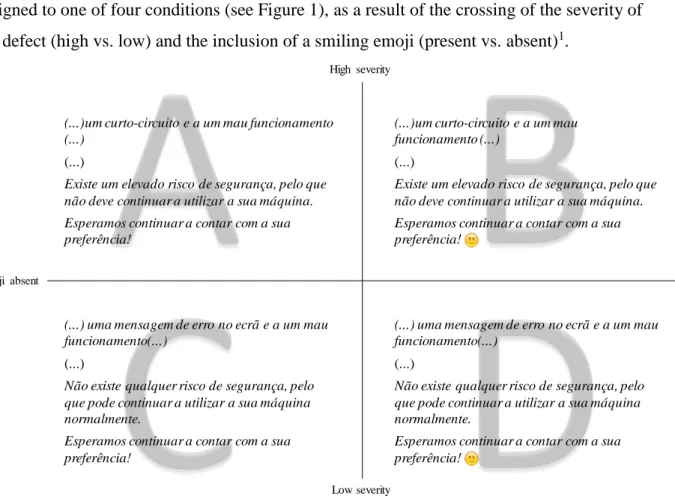
being announced, due to defect on one of its components. Each participant was randomly assigned to one of four conditions (see Figure 1), as a result of the crossing of the severity of the defect (high vs. low) and the inclusion of a smiling emoji (present vs. absent)1.
Figure 1. Scenarios according to experimental condition.
As shown in Figure 1, in the high severity conditions (A and B) the message stated that the defect could lead to a short-circuit and that due to a high safety risk the machine should not be used. In contrast, in the low severity conditions (C and D) the message stated that the defect could lead to an error message on the machine’s screen and that, because it did not constitute a safety risk, the machine could still be used. The same farewell message was included in all scenarios, and in conditions B and D, a smiling emoji was also included.
Before reading the press release, but after reading the general description of Electra, participants were asked to answer one single question regarding:
a) overall perception of the brand (7-point scale, 1 = Unfavorable to 7 = Favorable); After reading the press release, participants were asked to answer a set of questions (see Appendix A), namely:
1This emoji (U+1F642) was selected from the Lisbon Emoji and Emoticon Database (LEED,
Rodrigues, Prada, et al., 2017) and was shown to be highly familiar, clear and meaningful as well as positive to reinforce the pleasantness of the farewell message.
Emoji present Emoji absent
High severity
Low severity (...)um curto-circuito e a um mau funcionamento
(...)
(...)
Existe um elevado risco de segurança, pelo que não deve continuar a utilizar a sua máquina. Esperamos continuar a contar com a sua preferência!
(...)um curto-circuito e a um mau funcionamento (...)
(...)
Existe um elevado risco de segurança, pelo que não deve continuar a utilizar a sua máquina. Esperamos continuar a contar com a sua preferência!
(...) uma mensagem de erro no ecrã e a um mau funcionamento(...)
(...)
Não existe qualquer risco de segurança, pelo que pode continuar a utilizar a sua máquina normalmente.
Esperamos continuar a contar com a sua preferência!
(...) uma mensagem de erro no ecrã e a um mau funcionamento(...)
(...)
Não existe qualquer risco de segurança, pelo que pode continuar a utilizar a sua máquina normalmente.
Esperamos continuar a contar com a sua preferência!
16
b) brand perception measures (eight items adapted from Jolly & Mowen, 1985, 7-point rating scales);
c) manipulation check questions regarding severity level (four items, 7-point rating scales): valence of the message presented in the press release (1 = Negative to 7 = Positive); how worried would the participant be if he own such a defective product (1 = Not worried at
all to 7 = Very worried); how grave was the issue (1 = Small severity to 7 = High severity);
and how likely would they schedule the picking up of the defective machine (1 = I certainly
would not to 7 = I certainly would) (Appendix A)
d) the new measure of brand personality (Geuens, et al., 2009) (Appendix B) e) manipulation check questions regarding emoji presence (one item, 7-point rating scale): “Did the message include any emoji (i.e., a coloured figure representing a face)?” (1 =
It certainly did not, 7 = It certainly did). Participants who were not sure that the message did
not include any emoji (i.e., all that responded 2 to 7 in the previous question) were asked to identify, from a list of five emojis (selected from the LEED, Rodrigues, Prada et al., 2017), which one was present in the message. These emojis were selected from the LEED
(Rodrigues, Prada, et al., 2017) database and were all similar, all smiling, except for one, that presented a neutral face. These emojis were presented in fixed order.
f) attitudes towards the suitability of brands’ usage of smiling emoji in several
scenarios (four items, 7-point rating scales): “To what extent do you consider the use of emoji
adequate in the following scenarios…”: “social media posts”, “social media replies to
consumer”, “advertising of new products” or “press releases communicating defective products and call backs” (7-point scale, 1 = Not adequate at all, 7 = Very adequate).
In the end, an acknowledgement message was presented, thanking participants, followed by the investigator’s e-mail address.
17 CHAPTER II
Results
Statistical analyses were completed using SPSS, version 23.0. and only complete surveys were retained for analysis thus, there were no missing cases.
The analysis initiates with manipulation checks regarding the severity level of the scenario and of presence of emoji. Following, we analysed the direct effects and interactions of our two independent variables (emoji’s presence and severity level) in our outcome variables (brand and company perception and brand personality).
Manipulation check
Severity level. To check the manipulation of severity of the defect described in the
scenario (press release), we compared the evaluation of the brand (Electra) and the perception of the severity of the defect (one item asking directly how severe was the technical failure and two indirect measures, one assessing the worry resulting from the situation and another
assessing if the participant would schedule for the pickup and return of the machine).
Overall, the brand was evaluated positively prior to the presentation of the press release (M = 5.38; SD = 1.32), t(201) = 14.84, p < .001, (t test against scale midpoint: 4). Importantly, this a priori evaluation was equivalent for low severity (M = 5.30, SD = 1.41) and high
severity (M = 5.46, SD = 1.23) conditions, t < 1. As expected, after reading the press release, participants in the low severity condition (M = 5.76, SD = 1.34) showed a more positive opinion about Electra than those in the high severity condition (M = 5.18, SD = 1.62), t(200) = 2.79, p = .006, d = 0.39.
Analysing the perception of severity of the defect reinforces the idea that the
manipulation for severity worked: those in the low severity condition reported the problem to be of lower severity (M = 3.85, SD = 1.66) than those in the high severity condition (M = 5.76, SD = 1.36), t(200)= - 8.91, p < .001, d = - 1.26. Likewise, participants in the high severity condition reported higher levels of worry about the defective product (M = 5.53, SD = 1.41) than those in the low severity condition (M = 4.51, SD = 1.76), t(200)= - 4.54, p < .001, d = - 0.64. Finally, participants in the high severity condition reported a higher
probability of scheduling the pickup of the defective product (M = 6.89, SD = 0.45) than those in the low severity condition (M = 6.39, SD = 1.09), t(200)= - 4.23, p < .001, d = - 0.59.
In sum, based on the differences found between participants in the low versus high severity conditions across several measures, the severity manipulation was successful.
18
Emoji’s presence. As expected, participants in the emoji condition reported that they
were more certain of seeing it (M = 4.96, SD = 2.56) than those in the no-emoji condition (M = 2.04, SD = 1.57), t(200) = -9.86, p < .001, d = - 1.39.
These results corroborate that this manipulation was also successful.
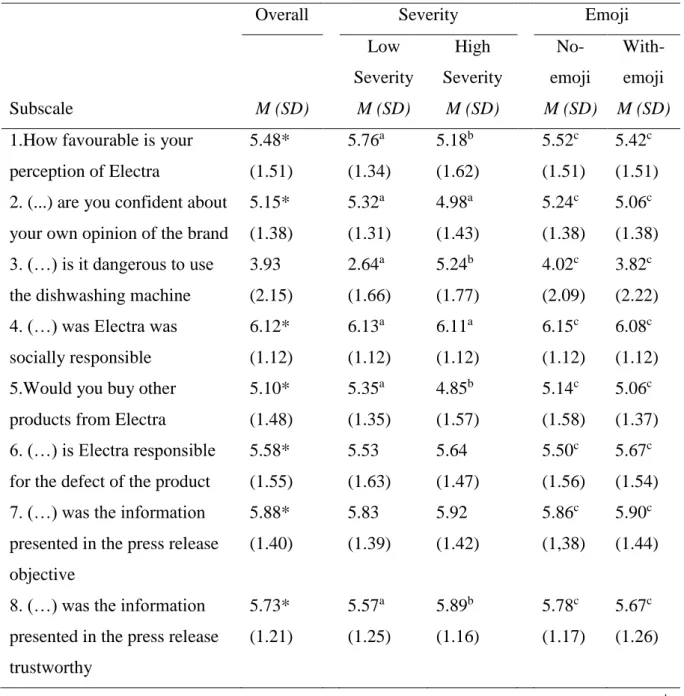
Impact of Emoji Presence and Severity of the Defect on Brand and Company Perception The eight items used to evaluate brand/company perception (Jolly & Mowen, 1985) were analysed individually, by performing a univariate ANOVA considering ratings of each item as the dependent variable and severity level and emoji’s presence as the between-subjects factors (results are summarized in Table 1).
19
Table 1. Mean Evaluations across Brand and Company Perception Dimensions (Overall,
according to Severity and Emoji Conditions)
Overall Severity Emoji
Low Severity High Severity No-emoji With-emoji Subscale M (SD) M (SD) M (SD) M (SD) M (SD)
1.How favourable is your perception of Electra 5.48* (1.51) 5.76a (1.34) 5.18b (1.62) 5.52c (1.51) 5.42c (1.51) 2. (...) are you confident about
your own opinion of the brand
5.15* (1.38) 5.32a (1.31) 4.98a (1.43) 5.24c (1.38) 5.06c (1.38) 3. (…) is it dangerous to use
the dishwashing machine
3.93 (2.15) 2.64a (1.66) 5.24b (1.77) 4.02c (2.09) 3.82c (2.22) 4. (…) was Electra was
socially responsible 6.12* (1.12) 6.13a (1.12) 6.11a (1.12) 6.15c (1.12) 6.08c (1.12) 5.Would you buy other
products from Electra
5.10* (1.48) 5.35a (1.35) 4.85b (1.57) 5.14c (1.58) 5.06c (1.37) 6. (…) is Electra responsible
for the defect of the product
5.58* (1.55) 5.53 (1.63) 5.64 (1.47) 5.50c (1.56) 5.67c (1.54) 7. (…) was the information
presented in the press release objective 5.88* (1.40) 5.83 (1.39) 5.92 (1.42) 5.86c (1,38) 5.90c (1.44)
8. (…) was the information presented in the press release trustworthy 5.73* (1.21) 5.57a (1.25) 5.89b (1.16) 5.78c (1.17) 5.67c (1.26)
Note. * Different from scale midpoint (i.e., 4), all p < .001. Means that share the same superscript - a,b
(means associated with the main effect of the severity of the defect manipulation) and – c,d (means
associated with the main effect of emoji presence) - did not differ significantly.
Overall, participants rated all items (except item 3) significantly above the midpoint of the scale (see Table 1). This means that participants reported high favourability towards the brand, perceived it as highly socially responsible and were highly confidence in their own opinion about Electra. Moreover, despite perceiving the brand as highly responsible for the defect of the product being recalled, participants also reported that they would buy Electra products in future. Regarding the overall ratings of the message, participants perceived the
20
press release as being highly objective and trustworthy. Finally, the usage of the defective product (i.e., dishwashing machine) was only perceived as moderately dangerous.
As shown in Table 1, we found a main effect of the severity manipulation in the following variables:
(a) customers’ favourability towards the brand (item 1): those in the high severity condition (M = 5.18, SD = 1.62) reported a less favourable perception of Electra than those in the low severity condition (M = 5.76, SD = 1.35), F(1,198) = 7.51, p = .007, ηp2 = .037;
(b) perceived danger of the defect (item 3): those in the high severity condition reporting that using the product would be more dangerous (M = 5.24, SD = 1.77) than those in the low severity condition (M = 2.64, SD = 1.66), F(1.198)=116.11, p < .001, ηp2 = .370;
(c) future purchases (item 5): participants in the high severity condition reported that they would be less likely to buy another product from Electra (M = 4.85, SD = 1.57) than those in the low severity group (M = 5.35, SD = 1.35), F(1,198) = 5.59, p = .019, ηp2 = .027;
(d) trustworthiness of the information (item 8): participants in the high severity condition perceived the information in the press release as more trustworthy (M = 5.89, SD = 1.16) than those in the low severity condition (M = 5.57, SD = 1.25), F(1,198) = 3.97, p = .048, ηp2 = .020.
Contrary to our expectations, no main effect of emoji presence across variables emerged, ps >.308.
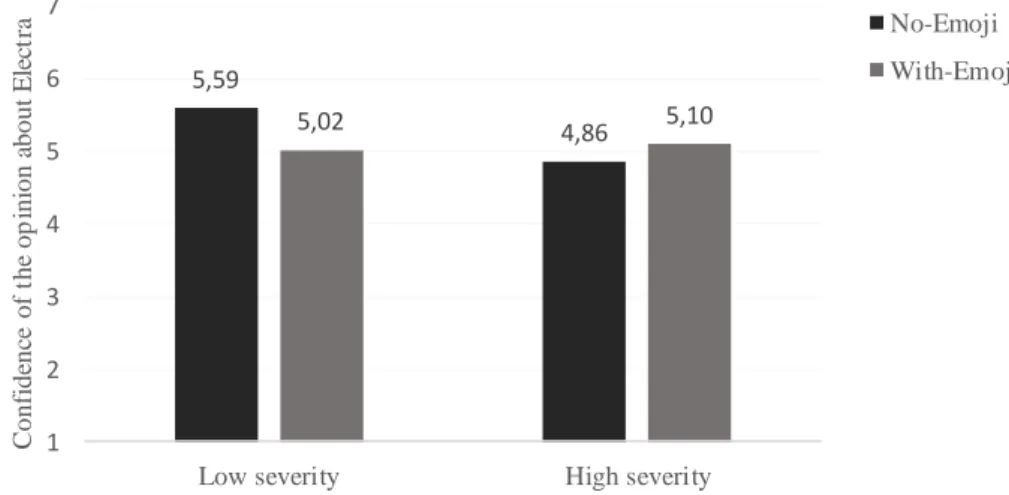
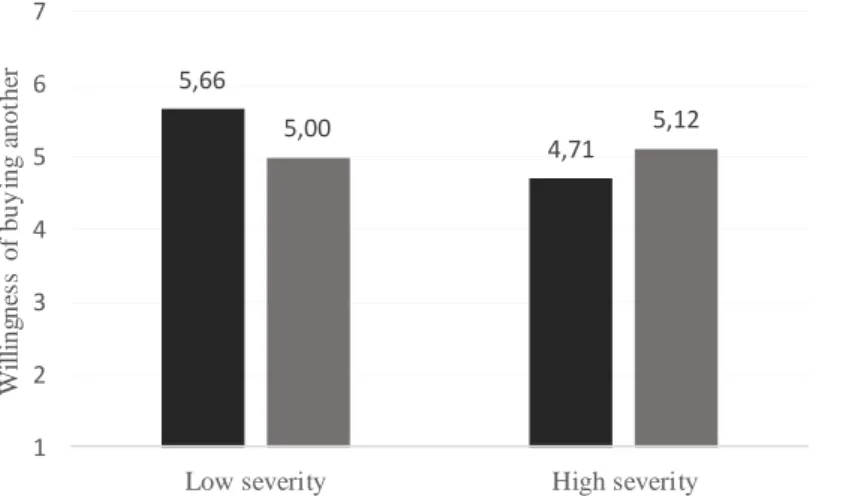
Severity level and emoji presence only showed significant interactions for two variables related to brand perception: confidence in the opinion about the brand (Item 2, see Figure 2), and willingness to buy another product from the brand (Item 5, see Figure 3).
Figure 2. Interaction effect of severity level and emoji’s presence on the confidence of the
opinion about Electra.
5,59 4,86 5,02 5,10 1 2 3 4 5 6 7
Low severity High severity
Co nf ide nc e of t he o p ini on a bo ut E le ct ra No-Emoji With-Emoji
21
As shown in Figure 2, in the low severity condition, participants that were exposed to a message containing an emoji (M = 5.02, SD = 1.41) reported a lower confidence in their own opinion about Electra than the ones exposed to a message without an emoji (M = 5.59, SD = 1.17), t(198) = 2.19, p = .035, d = 0.31. In contrast, participants in the high severity
condition, showed similar confidence in their opinion about the brand, irrespectively of being exposed the emoji (M = 5.10, SD = 1.36) or not (M = 4.86, SD = 1.49), t < 1.
Figure 3. Interaction effect of severity level and emoji’s presence on the willingness to buy
another Electra product.
Regarding the willingness to buy another Electra product, as shown in Figure 3, in the low severity condition, participants that were exposed to a message containing an emoji (M = 5.00, SD = 1.39) reported a lower willingness of acquiring another product from Electra than the ones exposed to a message without an emoji (M = 5.66, SD = 1.27), t(198) = 2.34, p = .020, d = 0.33. In contrast, participants in the high severity condition, reported similar
willingness to buy Electra products in the future, irrespectively of being exposed the emoji (M = 5.12, SD = 1.35) or not (M = 4.71, SD = 1.63), t(198) = -1.86, p = .064, d = - 0.26
(Appendix C).
Impact of Emoji Presence and Severity of the Defect on Brand personality
The five subscales of the brand personality scale (Geuens, et al., 2009) were analysed individually, by performing a univariate ANOVA considering mean ratings on each subscale as the dependent variable and severity level and emoji’s presence as the between-subjects factors (results are summarized in Table 2).
5,66 4,71 5,00 5,12 1 2 3 4 5 6 7
Low severity High severity
W il li ng ne ss of bu y ing a no the r No-Emoji With-Emoji
22
Table 2. Mean Evaluations across Brand Personality Subscales (Overall, according to
Severity and Emoji Conditions).
Overall Severity Emoji
Low Severity High Severity No-emoji With-emoji Subscale M (SD) M (SD) M (SD) M (SD) M (SD) Responsibility 5.16* (1.09) 5.33a (.99) 4.99b (1.16) 5.25c (1.06) 5.07c (1.11) Activity 5.11* (1.04) 5.18a (1.07) 5.05a (1.02) 5.21c (1.09) 5.01c (.98) Aggressiveness 3.28* (1.17) 3.27a (1.18) 3.29a (1.17) 3.37c (1.18) 3.19c (1.17) Simplicity 4.12 (1.12) 4.03a (1.19) 4.21a (1.02) 4.05c (1.15) 4.19c (1.08) Emotionality 2.45* (1.39) 2.59a (1.45) 2.31a (1.32) 2.29c (1.41) 2.62c (1.36)
Note. * Different from scale midpoint (i.e., 4), all p <.001. Means that share the same superscript - a,b
(means associated with the main effect of the severity of the defect manipulation) and – c,d (means
associated with the main effect of emoji presence) - did not differ significantly.
Overall ratings of the brand, suggest that participants reported the brand as highly responsible and highly active. In contrast, they perceived the brand as low in aggressiveness and emotionality, and as moderate in simplicity (see Table 2).
Contrary to our expectations, and as observed for the brand and company perception dimensions, the emoji presence did not influence how participants perceived brand
personality. Indeed, as shown in Table 2, overall no significant effects of emoji presence and severity of the defect were detected on brand personality subscales. The exception was the main effect of severity on the responsibility dimension, such that participants in the in the low severity condition (M = 5.32, SD = 0.99) reported Electra as being more responsible than those in the high severity condition (M = 4.99, SD = 1.16), F(1,198) = 4.64, p = .033, ηp2 =
.002 (Appendix D).
23
One of the items used for the check of severity of the defect manipulation required participants to take the perspective of the Electra costumer receiving information about owning a defective product. They were then asked to report how worried they would be about that defect. As already reported, the severity of the defect influenced such ratings, F(1,198) = 20.01, p < .001, ηp2 = .092 . We also explored if this rating was influenced by emoji presence.
Although no main effect of emoji presence was observed, F(1,198) = 1.42, p = .236, ηp2 =
.007, a significant interaction between emoji presence and severity of the defect emerged, F(1,198) = 5.13, p = .025, ηp2 = .025 (see Figure 4).
Figure 4. Interaction effect of severity level and emoji’s presence on the level of worry
regarding the defect.
As shown in Figure 4, in the low severity condition, participants that were exposed to a message containing an emoji reported a higher level of worry (M = 4.92, SD = 1.75) than the ones exposed to a message without an emoji (M = 4.15, SD = 1.69), t(198) = 2.45, p = .015, d = 0.35. In contrast, participants in the high severity condition, reported similar levels of worry, irrespectively of being exposed the emoji (M = 5.65, SD = 1.31) or not (M = 5.41,
SD = 1.53), t < 1.
Attitudes towards emoji use in marketing communication. We assessed participants’
attitudes towards the suitability of brands’ emoji usage in different forms of communication. We conducted a principal components analysis with Varimax rotation with the four items. Based on this analysis (Appendix E), all items were retained and two factors were extracted using the Kaiser criterion, accounting for 77.71% of the variance: 1. Suitability of emoji usage in social media, comprising two items (α = .61), and 2. Suitability of emoji usage in product communication, also comprising two items (α = .77). For each factor, scores were
4,15 5,65 4,92 5,41 1 2 3 4 5 6 7
Low severity High severity
L eve l of w orry re ga rdi ng the de fe ct No-Emoji With-Emoji
24
computed by averaging the respective items, with higher scores meaning higher agreement with emoji usage.
Results show that participants agreed that brands using emoji on the social media context is adequate (M = 4.87; SD = 1.66), t(201) = 7.48, p < .001. However, when it comes to the use of emoji in communications about products, participants reported it as inappropriate (M = 2.54; SD = 1.62), t(201) = - 12.79, p < .001 (t tests against scale midpoint: 4).
25 CHAPTER III
Discussion
Despite the popularity of emojis, few experimental research has been conducted in this field. Research focusing on the usage of emojis in communication processes of brands and in the consumer psychology and marketing contexts is particularly scarce.
The study aimed to explore the effects of the way in which a brand communicates (e.g., using emojis) and the type of communication (e.g., making the recall of a defective product) on the brand perception of customers and the brand personality that could arise.
A crisis is an event developed through complicated processes that causes damage and affects an entire organization. Product-harm crisis, related to defective or dangerous products, are an example of such events (Vassilikopoulou, Lepetsos, et al., 2009). Therefore, product-harm crisis can result in prejudice towards the corporate image of a brand, varying in terms of severity levels (e.g., Siomkos, 1999; Vassilikopoulou, Lepetsos, et al., 2009; Vassilikopoulou, Siomkos, et al., 2009). More specifically, perceived high severity tends to result in lower favorability towards a brand (Mowen & Ellis, 1981). Therefore, we expected that participants in the high severity condition would have a worse opinion about Electra. Following the suggestion of Lee (2004), we used a wider range of severity level variation (i.e., instead of using two similar levels of severity, such as high and extreme, we used low and high), which produced its effects: as expected, participants in the high severity condition reported lower favorability towards Electra, higher danger perceived and a lower intention of rebuying products from Electra. The perception of the information being trustworthy was also higher for participants in the high severity condition. Due to the high severity, a possibility would be participants incurring in systematic processing of the information contained in the press release. If that was the case, participants would mobilize more cognitive resources (Chen & Chaiken, 1999), which would allow for a better understanding of the message content and higher levels of trust (Griffin, Neuwirth, Giese, & Dunwoody, 2002), making a more stable judgment of the information provided. However, all the participants reported an overall perception of the message being trustworthy and objective.
It is also important to note the level of CSR perceived by consumers following the product-recall communication issued by Electra. As noted, incurring in an effort to resolve a product-harm crisis, by recalling the defective product, can be seen as behaving in socially responsible ways (Cheah, et al., 2007; Waddock & Smith, 2001). Our results corroborate this idea. As Electra was a fictional brand, along with the presented scenario, participants had little information to constitute a stable perception of Electra regarding CSR levels. Therefore,
26
the findings that the brand is perceived as highly social responsible are based on participants’ interpretation of the press-release. Because of this, it can be assumed that the recall of a defective product, offering a solution free of charge (i.e., super-effort type), induced high levels of CSR on participants. Congruently, overall, participants also reported higher
intentions of rebuying products. This is in line with the suggestion of Siomkos and Kurzbard (1994), that the negative impact of a product-harm crisis can be attenuated if a brand incurs in a super effort recall and is perceived as socially responsible.
Moreover, communicating a product recall can be seen as efforts towards
responsibility and accountability (Cheah, et al., 2007). Given that this type of response to a product-harm crisis can be related to showing concern with customers’ welfare (Siomkos & Kurzbard, 1994), we expected the possibility of participants seeing Electra as having a responsible brand personality trait. Indeed, the overall opinion of participants (independently of their experimental condition) was that Electra acted as a responsible brand, being that especially evident for those in the low severity condition. This is in line with the conclusions above: the scenario and behavior of Electra conveyed a perception of the brand as responsible (in terms of personality and social responsibility).
To sum, regarding severity, as expected, overall, the manipulation was verified and severity had significant impacts on the perception of Electra, being it in terms of brand perception or brand personality associations. However, although the manipulation check reported the manipulation of emoji as being of relevance, the impact was not as strong as we expected.
The literature suggests that emojis contribute with positivity to messages in which they are used (Novak, et al., 2015; Riordan, 2017). Therefore, we expected that including a smiling emoji in a press release communicating a voluntary callback of a defective product, would also convey such positivity. We expected this positivity to impact brand evaluations.
However, no significant direct effects of emoji were reported. It could have been relevant to include a direct variable evaluating the valence of the press release, to assess an overall perception. In any case, a possible explanation could be the extension of the press release. In order to convey realistic scenario, the press release was adapted from a real one. Therefore, it included details such as the date in which the defective product was sold; the serial number of the allegedly defective products, along with a graphical representation of the machine and the place where that number would be registered; the procedures to be taken if the consumer owned a defective product; and the defect and its consequences. The overall perception of participants was that the press release was trustworthy and objective, which is in line with its