Classical Music in Cartoons as Education Source
Eka ChabashviliDepartment of composition, V. Sarajishvili Tbilisi State Conservatoire Georgia
Maia Virsaladze
Department of composition, V. Sarajishvili Tbilisi State Conservatoire Georgia
Abstract Fine art and music are very different physical phenomena, music being a product of acoustic processes and the visual of optical ones. As generally known, the spatial aspect is important for visualization, and the temporal one for sound-making. The connection between these two fields of art is possible only metaphorically, by associative thinking. In my opinion, for conciliating these two fields of art, it is important to mix the principles of thinking associated with both of these aspects. Therefore, cinematography uses some principals of musical thinking for montage and construction of movie composition. Visualization of music is an important way for a confluence of image and sound. This is the reason why many famous works of classical music are included in cinematography. So, any classical music work may be used as film music. The aim of my paper is the analysis of sound material connected with the classical music in several well-known cartoons, for example, such as Disney. This music brings out not only an elegant effect; it is also a means of familiarizing children with classical music. I would like to present a method for how classical music in cartoon film could possibly be included in education. The cartoon is a very good opportunity for child composers to improve their musical fantasy and feelings of sound communication.
Keywords Music, Composition, Audio-visual, Cartoon, Children
“You can teach your tiny child absolutely everything, that you can present to him in an honest, factual and joyous way.“ (Glenn Doman)
Audio-visual media is the additional important source for the development of child's cognition in the 20th and 21st centuries. It is a main part of the environment where child grows up, where his/her psychology, intellect and erudition are formed. Later this child will become a member of the society for which above mentioned environment is natural. Factors that mould children’s way of thinking are found mostly in the environment where they grow up. These include daily events, memorable experiences and peak feelings. Cartoons are one of the daily habits for our children.
The researchers Kayla Bois & Brad Bushman of Michigan University summed up the cartoon content in our children’s schedules as follows:
• 2 - 5 years old children watch cartoon 32 hrs. Weekly. • 6 - 11 years old children watch cartoon 28 hrs. Weekly. And they stated that:
• 71% of 8 - 18 years old have a TV in their rooms.
• 53% of 7 - 12 years old have no parental monitoring for what is being watched on TV. • 51% of homes: TV is switched on most of the time.
Studies have proven that an average child with a facility of a TV and a satellite connection at his/her home watches approximately 18,000 hours of television from kindergarten to high school graduation. Naturally questions follow:
How does this experience affect our children’s minds? Does it have positive or negative effects?
What types of content are delivered to our kids in a cartoon show?
Are all shows trustworthy, or shall parents play monitor and pay more attention to the TV shows?
How do our children’s brains absorb and analyse information in the first place? (Etc.)
We often hear shared opinion, that new audio-visual communications have damaging effects on child’s behaviour, but it is impossible that a child will become a full-fledged member of contemporary society, if we restrict his/her access to this phenomenon. Furthermore, if a child grows up in the information field of new technologies and he /she unconsciously feels discomfort due to the lack of knowledge of these opportunities, the child’s mind begins to diverge and forms a number of psycho-emotional complexes that can be the cause of his/her aggression or depression. Therefore, it is better to turn the audio-visual media into a useful resource for their development, and thus save them from such harmful habits such as dependence on cartoon films or on video games, when people lose sense of reality and sink in a virtual world. Audio-visual communications, as everything in our life, also have two sides - negative and positive.
Cartoons have been a part of cinema history from the time the first motion pictures were made in the late 1800s. A cartoon is a movie using animation instead of live actors, especially a humorous film intended for children. Cartoons can also be described as the making of movies by filming a sequence of slightly varying drawings or models so that they appear to move and change when the sequence is shown. These are the elements that keep viewers, (mostly children) glued to their seats. Cartoons were initially so short because people would be watching these shorts in the movie theatres before their feature film. When cartoonists could put their shows on TV, they began to get longer, creating the half hour block shows that are on Nickelodeon, Cartoon Network, and the Disney Channel today. Also, the cartoons had to become more “family friendly” so that more people would watch their show.
Research conducted by Sharmin of BRAC University, concluded:
• Most parents prefer to leave their children in front of TV in order to finish their work or to have a rest.
• Putting a child in front of the TV is the best way for a parent to make their child eat their food.
Which is better and more relevant that the child would learn from, academic books and teacher, or from an animated TV Series? In our opinion, it is possible to connect both sources and get more effective result. And how?
The aim of this paper is the analysis of sound material connected with classical music in several well-known cartoons, such as Disney. This music brings out not only an elegant effect - it is also a resource for familiarizing children with classical music. I would like to present a method on how classical music in a cartoon can be a part of education. For child composers, the cartoon is a very good way of improving musical fantasy and feeling features of sound communication.
If a person, especially a child, while listening to music, has got a strong impression, always when he/she will hear this music or sound, it will give him/her an association with this event and will feel the same when she/he first listened to this music. Often the voice of the sound is exacerbated by visual imagery. Vice versa, often those visual associations help to remember music. By the way, children make links between existing information with previous
impression. Sometimes the music is perfectly reminiscent of a story or event, a context. So while teaching classical music, we can provoke their memory by such visualisation of music. However, we should always take into consideration the interests of their generation, which means that any product that we want to provide can be wrapped in their life-style. They will be very happy to get new information with their own packages.
Sharmin of Michigan University said in her research that children are attracted to the cartoon content much more than to the academic traditional ways of learning, due to the well-written scenarios, audio & visual effects and colours. These factors are enough to cause a child to absorb information a dozen times better than that absorbed from a teacher in a classroom. The child’s brain at early ages always seeks new experiences, that is why what is delivered in cartoon gets toddlers glued to their chairs while watching animated series. A well written scenario, the right audio & visual effects and a decent looking character, are all the main factors for the child to get stuck on the cartoons’ hero, and enough for his/her brain to begin automatically following his path and trying to be a copycat even for the finest details, including way of speaking, thinking, body language... and even the way of dressing up. These are the factors that traditional schools lack in delivering the academic content, even when a teacher tries to explain a part that children failed to understand, s/he uses facial expression, acting & vocal effects for the children to imagine the content. In animated series these are the backbones of the show, that is why children chase their best TV series among channels and can sit still for long hours watching TV... easily absorbing the included content. Not even among the child, you can imagine watching a documentary with an academic content on National Geographic Channel, you can easily recall the scenes and the situations that you have watched, much better than a situation that was told with no visual or vocal effects. Consequently, children who watch educational programming are more likely have higher grades, read more books, place greater value on achievement.
In recent years scientists have studied well how the brain works. Listening to music in the process of growing up develops musical pathways in the brain. Such connections influence how person thinks. Listening to classical music develops the spatial thinking and spatial reasoning for a short period of time. But learning to play any instrument can have a long-term effect on the development of thinking skills in a certain way.
Even in ancient Greece they knew what an important role music had for mental
development. Music does not only affect our emotions but also it influences our thinking. That is why music in antiquity was not considered an independent field of art, but a necessary component of education.
Experiments have proven that after listening to classical music, adults can do something that requites spatial perception more quickly, such as a puzzle. Why is this happening? The musical pathways generated as a result of listening to classical music in the brain are very similar to the contacts in the brain that are needed for spatial thinking. When we listen to classical music, spatial connections are turned on and are ready to work. Creation of such a base facilitates resolving the puzzle. However, the effect is only for a short time and the
ability to improve our spatial thinking lasts about an hour after listening to classical music. Many artists prefer to paint during listening to classical music, maybe this is subconscious demand to increase the visual perception of space. Thus, music is closely linked to the visual world, moreover, it helps to create a visual world in us. So while studying music, there may be a direct link between these two phenomena.
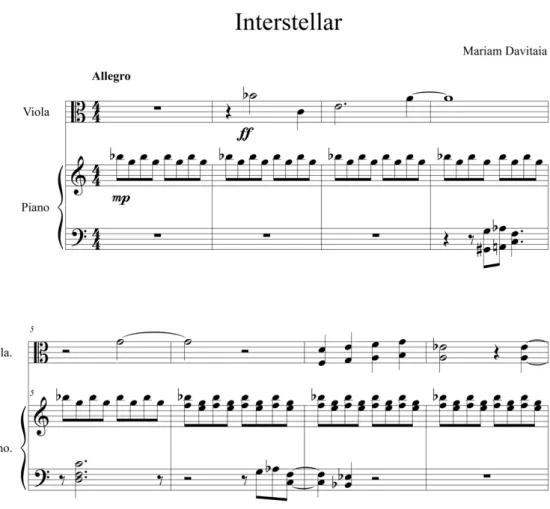
In my pedagogical practice I found that the majority of children who are free from the musical doctrine clichés bring ideas for composing music mostly related with a book, or a movie or a cartoon, which generates great impressions and produces visual imagery. The source of their inspiration is the visual art. It is noteworthy that when they create music for this visualization, this music is never under the influence of the music, which is actually the original; for example,
Figure 3. Elene Gogodze «The Chronicles of Narnia» (VIII class)
Also group composition, where each of students have chosen character and composed music for them.
Figure 3. Elene Gogodze «The Chronicles of Narnia» (VII class)
Also group composition «Cinderella», where each of students have chosen character and composed music for them.
Figure 4. group composition: Mariam Sazandrishvili, Salome Sazandrishvili, Mariam Shashiashvili, Kristina Shashiashvili, Elene Gogodze «Cinderella» (V class)
And the kids, whose fantasies mainly depend on their performing musical experiences, are always influenced by the music of the composer's works they are performing at the moment.
Figure 5. Kristine Shashiashvili
After observing this, I decided to use visual art as one of the components when teaching the composition. This source really gave a result even to those students who are under the influence of music that they are playing. I do not think that it is a big problem if student's music is influenced by a great composers' music. In my opinion the problem is something else, that some kids are aggressive towards the trends of modern classical music, because they trust taste of competent people, who very often are their teachers in instrumental class
and whose negative attitudes to contemporary music hinder freedom of fantasy during the creative process. When they have connection with visual communication, it frees their fantasy. Even the music of romanticists in a Disney cartoon children perceives much more freely and fun, because their subconscious does not feel a stressful background appearing during practical performing work of this music.
For example, Franz Liszt's Hungarian Rhapsody N2 in Cartoon of Disnay «Bugs Bunny»
https://www.youtube.com/watch?v=bYM84n-2Sas or
«Tom And Jerry – The Cat Concert» https://www.youtube.com/watch?v=uKZgi06fVsk
I often use method of visualization in composition during studying some topics, for example, during explanation of instruments and their timbral character, it is very interesting is Disney’s cartoon ‘Peter and Wolf’ with S.Prokofiev’s music:
https://www.youtube.com/watch?v=Ot7m9i70JDg
Carole Cox in her book offers: ”Read aloud Sergei Prokofiev's «Peter and the Wolf” (Schulnam and Prokofiev, 2004), which comes with a fully orchestrated and narrated CD. After playing the music, the teacher can lead a class discussion using reader response questions and prompts: What did you picture in your mind as you listened to the story and the music? The students can write in double-entry journals on what they pictured in their mind for each part of the story in the left-hand column, and they can write the sound and music that corresponded to that part of the story in the right-hand column. The teacher can make a chart with five columns for (1) characterised in the story, (2) description of the characters, (3) the instrument representing each character, (4) the sound of the character in the music, and (5) the mood of the music in that part of the story and how it made them feel. The teacher can read the story and play the music again. Students can take turns as the chart, asking other students to raise their hands when they hear another character in the music. Students can use the other arts to respond to the book and music by illustrating scenes from the story and music for posting on classroom bulletin boards, for making a class book, or for first pantomiming the characters and then writing scripts for each of the scenes to present as a story dramatization to accompany the music with spoken lines.”
Fine art and music are very different physical phenomena, music being a product of acoustic processes and the visual of optical ones. As generally known, the spatial aspect is important for visualization, and the temporal one for sound making. The connection between these two fields of art is possible only metaphorically, by associative thinking.
We use two ways for involve children's attention to improve their musical fantasy by the method of associative thinking:
1. From sound to visual;
2. From visual to sound; both of them are methods of visualisation music.
Children enjoy when they paint or create some short story on their own, what music dictates after listening to any classical work during composition class. This practice involves
association connections between visual and sound. Free improvisation of fantasy is the first step, but then begins the second stage, analysing what musical factors lead to these associations. If in the first case, associations relied on the emotional-minded category, now they are making more mental and logical conclusions, analysing music already listened to, to prove the result of the association. They are looking for musical elements, artistic-expression techniques, etc. and comparing connections with their associations. This is the method from music to visual. The second option is from visual to music. When kids create music for visual
resource, which is source of inspiration and connected with video or literature work. This practice helps them to feel the musical character of the intonation aspect, as well as the feeling of tempo-rhythm and perceiving musical form, sometimes realising the genre's features.
For example, Australian Kim Maloney, creator of MusicTeacherResources, also uses visual resources for familiarize children with romantic music: “I recently commenced a unit on Romantic Music with my senior tertiary music class. I love to use ‘The Sorcerer’s Apprentice’ from Disney’s Fantasias to introduce the idea of Romanticism in music. I have very clear recollections of watching it when I was a student and I remember how after viewing it, I understood the concept more clearly and was in awe of just how powerfully music could tell a story and portray emotions and feelings! This got me thinking about classical music being used in cartoons, so I decided to do a search of what was available. Below is a list of what I discovered on youTube. If you know of any other please share!”
While every child has the potential for creativity, the main thing is to give the opportunity to develop it. Often the child creates his/her world, which is a source of his/her imagination. Even looking at the gameplay of children of primary school age, they use their imagination to create an absolutely complete, detailed world where this game develops. The most vivid example is when a child has an imaginary friend. This is a living imagination that is a mystery for adults, and they often think that their child has some mental illnesses, which is wrong, because the child's fantasy creates alternate reality from our reality and in fact, this phenomenon is related to the creative process. The problem which is really dangerous for our children is when parents think that their child has mental disorder and by their fear, they push child to the virtual world. A tiny person cannot draw a line between reality and virtual world, because they still are influenced by «united thinking». So, instead of panicking, we have to teach them the journey between the virtual world and reality and everything will end well. On the other hand, adults, possibly unconsciously, also create many virtual events; the difference with their children is that adults can cover them by real situations, children cannot. The composition or other creative lessons help children to differentiate real and virtual worlds, find their own originality in society and not to live in the surroundings of many different false "egos". Students can freely discuss their fantasies and ideas at the
composition lessons. We teach them to develop, to travel and to accompany others in own creative world. These lessons help them not to mix their personal features with creative characters, what is a result of their fantasy and artistism.
There is a known saying "this man is infantile" - this opinion is often directed towards the artists; this is true, because they kept the child's ability to create and live simultaneously in their own virtual world and in the real world.
In my school I often hear a question, what does the composition lessons give to you? Especially, this is the last priority for teachers of performing art and sometime well-trained students are told not to waste their time for composition. The difference between us is that they train children to play an instrument without understanding what and why they perform; we help them to form their personalities.
References
Cox, C. (2012). Literature-Based Teaching in the Content Areas: 40 Strategies for K-8 Classrooms. California, USA: California State University.
Habib, K., Soliman, T. (2015). Cartoons’ Effect in Changing Children Mental Response and Behavior, Retrieved from http://dx.doi.org/10.4236/jss.2015.39033
Maloney, K. (2015) Classical Music in Cartoons, Music Teacher Resources. Retrieved from
http://music-teacher-resources.com/classical-music-in-cartoons/
!"#$%#, &. (2012). !"#$%$# &'($ )*+,+$# -*.+$/*&0)*,$. Retrieved from https://ganatlebageo.wordpress.com/2012/09/11/'(%#)#%-*+$#-!,-.-#%-/+0/