J
OURNAL OFC
OMPARATIVER
ESEARCH INA
NTHROPOLOGY ANDS
OCIOLOGYCopyright © The Author(s), 2010 Volume 1(1): 133-149 ISSN 2068 – 0317 http://compaso.ro
Women’s response to the question of development in the Niger
Delta, Nigeria
Michael Folami Olankunle 1
Abstract
Women are the champions for peace in any society because women are always at the receiving end of any out-break of disasters, especially war. Women lose virtually everything from property to life. Women have also been known to challenge repressive governments. Women, throughout history have led various social movements that brought change to the society. This paper examines the
roles played by women to address exploitation in Nigeria’s Niger Delta. It also examines the modus
operandi of women to address the question of under-development in the area. Social Exchange Theory is employed in this paper to explain the reason why women engage in protests in order to redress injustice in the Niger Delta. Qualitative method of In-depth Interviews was employed to
collect data from women’s organizations in the randomly selected oil-producing States in the Niger Delta. The paper main finding is that women have been drastically affected by the activities of oil companies in the area. Also, the restiveness among women was found to be caused by injustice, neglect, deprivation, and unequal distribution of resources. The paper, therefore, recommends the creation of a special account to finance women development projects. And also, women rights must not only be recognized by government and oil companies, but must be upheld and respected.
Keywords
Women, development, crisis, empowerment
Introduction
The discovery of oil in Nigeria s Niger Delta has brought untold hardships to people more than blessing. Since the discovery of crude oil in the region by Shell in 1937, exploitation of oil continues unabated on a daily basis. It is, thus, worrisome that the communities where oil is exploited have recorded no substantive development. Bankole (2008) said that proceeds from oil has been mis-managed and often end up in the pockets of a few individuals in the country. The Nigerian government in the last ten years could not account for trillions of Naira generated from oil. Oil-wealth has created under – development, characterized by a deep-seated crisis. The social arrangements in the Niger Delta is undoubtedly pervaded by injustice, abject poverty, economic deprivation, destitution, lack of social amenities, land degradation2, kidnapping, unemployment, youth restiveness, etc.
All over the world, most especially in Nigeria, women have been known to often sue for peace. Apart from Aba Women s riots in and Abeokuta s women s riot of 1948, women have not mounted a major struggle in the country. The consequences of exploration and exploitation of oil in the Niger Delta, which affected women disproportionately, gave rise to a series of agitations. The exploitation, inequality, social exclusion, de-empowerment and virtual lack of development accounted for the restiveness among women in the Niger Delta. According to Oil-watch (2002), in the last decade, oil-bearing communities in the western flank of the Niger Delta have been witnessing a rising tempo of resistance to the inhuman activities of the oil and gas industries. Women whose local industries such as fishing, farming, and livelihood have been terribly affected by the activities of the transnational oil companies - Chevron, Texaco and Shell- are organizing the protests.
Women who have been victimized by a series of crises in the region lamented that: The river they are polluting is both our life and death. We depend on it for everything. When this situation became unbearable, we decided to come together to protest. We insisted on dialogue with the oil companies, but the soldiers refused and started kicking us with their boots, they flogged us, they wounded us, as I am talking to you, three of our women are still missing. As we are disgraced this way, those of
us remaining will go there and let them kill us. We don t want Shell, Chevron, Texaco, or any of the oil companies (Rose, 2004).
In recent times, the attention of researchers in Nigeria and all over the World have been shifted to the peoples problems, most especially women in the Niger Delta. Most of these studies focused on youth restiveness and armed struggle among men in the Niger Delta. Most of the authors that have written on women and environmental issues
2 Land degradationand soil-fertility loss compounds women s limited access to land for agriculture in the
in the Niger Delta used culturally inappropriate criteria to measure the role played by women and their collective interests towards the emancipation of their people.
Response of women s to environmental damage caused by the exploration of oil in the Niger Delta includes confrontation between women and oil companies. Protests by women in the Niger Delta are mostly brought about by oil spillage3, land degradation, gas flaring43 and water pollution5. About 58 protests have been organized by women in the region to fight neglect, isolation, hunger, poverty, unemployment, and mis-management of oil- resources.
The protests embarked upon by women against mis-management and exploitation oil deposits in the Niger Delta, were played down by many commentators on the problem. It is also important to state that the method of research employed by many researchers to explain the impact of oil exploitation on women has been the quantitative method which tends to be more specific but data collected through questionnaires can be a difficult task data in a violence-ridden environment like the Niger Delta. In view of this therefore, the qualitative method (that is, in-depth interview) was employed to collect data for this study. This study, one of its kinds, seeks to highlight the hardships facing women in the Niger Delta. Also, the study moves away from the traditional method of explaining exploitation of oil in the Niger Delta from macro-analytical perspective - the Conflict and Functionalist- to a micro sociological-perspective - the Exchange Theory.
The problems in the Niger Delta can best be understood by looking at the problems at the level of inter-personal interaction and relationships that exist between social structures in parts and within the oil producing communities. The novel theoretical and methodological approaches of this study stand out from others previously used by scholars. This study is more significant because it is believed that the findings would be useful for policies on Niger Delta development; and, also, on issues concerning women in oil producing areas in general.
The specific aim of this study is to examine the effects of oil exploration and exploitation on women in the Niger Delta. Other aim of this study is to identify the major environmental problems confronting women in the Niger Delta as a result of oil exploration and exploitation. To examine the roles played by women to address problems of oil exploitation and exploration in the area. Also, the study is designed to understand how to manage oil and other oil -resource deposits in the area for the benefit of the communities- women in particular.
3 Oil spillage is a major problem affecting people of Niger Delta. This includes variety of factors such as
blow-out, equipment failure, burst/rupture of flow-lines/pipelines, corrosion of flow-lines/pipelines, over-pressure, over-flow (tanks), value failure, hose failure/single buoy moorings (SMB), operator/maintenance error, engineering error, sand cut (erosion), avoidable accidents, sabotage, etc.
4 Gas-flaring pollutes the air and suppresses plant growth near the flaring-points. In cassava-cultivation, for
example, there is decrease in length, weight, starch, protein and ascorbic acid (Vitamin C) content (Iheonvbare, 2000).
5 Water pollution is a major threat to women s fishing, sea-foods and fuel-wood collection in the Niger
The following research questions are the correlates of the ideas generated in this study from both the literature and theoretical construction to explain the socio-economic consequences of oil exploration and exploitation in the Niger Delta: who gains from oil exploration and exploitation in the Niger-Delta? Is the distribution of oil-wealth justifying the level of development? What is the relationship between oil-companies and the people of the Niger Delta, most especially women? Do women play any significant role in the management of oil and its wealth?
History of oil exploration and exploitation in Nigeria
Oil and its allied mineral deposits are given by nature and it is mostly found in non-western nations. Oil exploration and exploitation are not traditional economic activities. The Industrial Revolution in the West opened up the exploration of oil from where it serves no economic relevance. Oil-exploration in Nigeria dates back to . Shell d Arch has the whole country as a concession bloc. Between 1937 and 1939, it carried out preliminary sub-surface geological investigations. A more competitive base for the penetration of the oil and gas sector by multinational corporations was created in Nigeria through statutory relinquishment of 50 per cent of the concession granted Shell BP in 1958. Subsequently, between 1960 and 1963, Mobil, Texaco, Gulf (now Chevron), Agip, Esso and Strap (now ELF) were allotted concessions including offshore blocs. This probably set the stage for the large-scale expansion in exploration and production activities in the Niger Delta (Onosode, 2000).
Oil has become the main-stay of the Nigeria s economy since the oil-boom of 1972. Oil-resources production alone account for about 80% of the Gross Domestic Product (GDP), and 95% of foreign-exchange earnings in Nigeria. According to Zwingina (1972), daily oil-production was pushed from 540 thousand barrels per day in 1969 to one million barrels per day in 1970, reaching the two million mark in 1973. Simultaneously, oil-revenues also jumped from 509.6 million Naira in 1970, to 5.4billion Naira; and, have been on the increase from 7 billion Naira in 1974, to 13.5 billion Naira 1977 and 1980, respectively, until relatively recently.
When the oil companies moved to the oil producing area, they came with a lot of promises. Roads were tarred, waterways means of transportation were provided, employment was provided for women. The disappointment over unfulfilled aspirations of the Niger-Delta people such as good roads, women empowerment, even development, portable water, housing facilities, electricity and others exacerbated by perceived or actual marginalization of women and youth from the key decision-making segments of the country s politics, cumulate to agitation and restiveness among the people. )n , the Ogoni Bill or Rights was presented to the Babangida administration.
resource-control through yet another declaration. Recently, in 2004, a group that refers to itself as the Niger-Delta Peoples Volunteer Force (NDPVF), led by Mujhahid Dokubo Asari, proclaimed its existence.
On July 8, 2002, when women from Itsekiri communities occupied Chevron s Oil terminal, more women from the Gbaramatu, Egbema, and Urhobo communities blocked Chevron flow-stations in Niger Delta as the wave of women protests spread. The impoverished women, long neglected and income-denied by oil-related disasters are now demanding for a clean environment conducive to survival, jobs for their children, hospitals, potable water, and support for livelihood ventures such as poultry, and farming.
On August 10, 2002, hundreds of women from the Itsekiri, Ijaw, and Ilaje ethnic groups united to march to the western operational headquarters of two major oil and gas producing companies in the country – Shell and Chevron/ Texaco. The protesting women who were armed with placards and green leaves sang solidarity songs to protest years of plunder of their environment s natural resources by the Europe- and US-based oil-companies. Their mission was to barricade the gates of these oil-companies to compel the companies to stop the dangerous flaring of gas.
Ifeanacho and Irikana (2006) said that a women group confronted Federal- Government troops deployed to secure oil installations in some communities of the Niger Delta. The control of the resources in the Niger Delta, oil in particular, was the main concern of all these movements/groups.
Seymour and Girandet (1990) said that carbon dioxide released into the atmosphere by the burning of fuels like oil and gas flaring release into the air by the use of aerosol and material for insulation cause lots of environmental pollution and climate warming. Carbon dioxide is the main influence on the process of global warming which many scientists believe is occurring, while the other gases attack the ozone layer around the earth. The level of development in the Niger Delta is disproportionate to the amount of dollars generated through the exploitation of oil.
Hancock (1989) succinctly describes the kind of assistance rendered by oil companies in the Niger Delta. According to him, the roads that end at rivers and then continue blithely onward on the other side, electrification without power supplies, highly sophisticated equipments that no one can use, installed in remote places, aquaculture projects producing dish at $4,000 per kilo for consumption by peasants who do not earn $400 per year, dams that dispossess thousands and spread fatal water-borne diseases, resettlement schemes that make the migrants poorer than were before they left home, that destroy the environment and obliterated tribal people – such blunders are not quaint exceptions to some benign and general rule of development.
The reaction of the Nigerian state to the peculiar legitimacy-crisis, confronting it in the Niger Delta has been marked by excessive repression. The Umuechem Community agitated for the provision of amenities by Shell Petroleum in 1991. The women from the community stopped work at the various oil fields in the community. The Police was sent in to intervene. In the crisis that ensued, the community was completely devastated. Choba women participated in such an agitation in 1991. The community was under siege for more than one month during which Choba indigenes became refugees. The Odi crisis, which resulted in the complete destruction of the community by the Nigerian military, falls into the same pattern.
Theoretical perspective
The exploitation of oil in the Niger Delta has not benefited the people of the region since exploration stated in the region in 1937. Women are the most vulnerable of all people in the region. They are least benefited from the oil exploration.
Exchange Theory, according to Peter Blau (1964a), is an understanding of social structure on the basis of an analysis of social processes that govern the relations between individuals and groups. People are attracted to each other for a variety of reasons that induce them to establish social association. Once initial ties are forged, the rewards that they provide to each other serve to maintain and enhance the bonds.
Zwingina (1992) posited that we cannot, therefore, disengage the productive forces of capitalism and expect them to develop independent of capitalism to penetrate and automatically develop pre-capitalist social formations without domestic strategies for legitimating the development. The opposite situation is also possible: with insufficient rewards, an association will weaken or break. When one party needs something from another but has nothing comparable to offer in return, according to Blau, four alternatives are possible. First, people can force other people to help them. Second, they can find another source to obtain what they need from others. Third, they can attempt to get along without what they need from others. Fourth, most important, they can subordinate themselves to the others, thereby giving the others generalized credit in their relationships; the others then can draw on this credit when they want them to do something.
Blau (1964b) extended his theory to the level of social facts. He noted, for example, that we cannot analysis processes of social interaction apart from the social structure that surrounds them. To give theoretical understanding to crisis in the Niger Delta, social structure of exploitation must be understood between the oil companies and the people. Social structure emerges from social interaction, but once this occurs, social structures have a separate existence that effects the process of interaction.
relationship with the new group members will be solidified when the new comers have received the rewards they expected. Newcomer s efforts to impress group members generally lead to group cohesion, but competition and, ultimately, social differentiation can occur when too many people actively seek to impress each other with their abilities to reward.
Group members with the ability to impress can be attractive associates; their impressive characteristics also can arouse fears of dependence in other group members and cause them to acknowledge their attraction only reluctantly. In the early stages of group formation, competition for social recognition among group members actually acts as a screening test for potential leaders of the group. Those best able to reward are most likely to end up in leadership positions. Those group members with less ability to reward want to continue to receive the rewards offered by the potential leaders, and this usually more than compensates for their fears of becoming dependent on them. Ultimately, those individuals with the greater ability to reward emerge as leaders, and the group is differentiated.
Method
Nigeria s Niger-Delta is located in Southern riverine areas of the country. It consists the following oil-producing States: Abia, Akwa Ibom, Bayelsa, Cross-River, Delta, Edo, Imo, Ondo, and Rivers. The Niger Delta is the Africa s largest delta covering about 70,000 square kilometers, with about one-third of it made up of wetlands, and the third largest world mangrove forest (Gabriel, 2007). The region is known for crises because of the injustice and under-development that exploitation and exploration of crude oil has brought upon the people. Oil spillage, illegal bunkering, workers kidnapping, oil-pipeline canalization, and violence killings feature on daily basis in the Niger Delta.
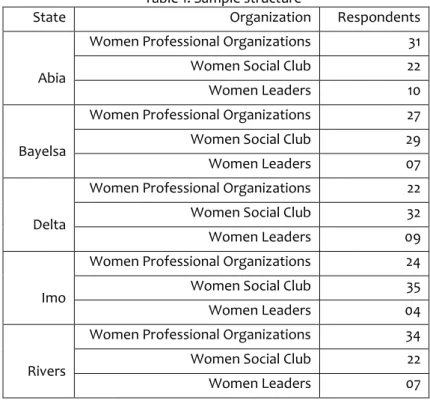
Sample
Table 1. Sample structure
State Organization Respondents
Abia
Women Professional Organizations 31
Women Social Club 22
Women Leaders 10
Bayelsa
Women Professional Organizations 27
Women Social Club 29
Women Leaders 07
Delta
Women Professional Organizations 22
Women Social Club 32
Women Leaders 09
Imo
Women Professional Organizations 24
Women Social Club 35
Women Leaders 04
Rivers
Women Professional Organizations 34
Women Social Club 22
Women Leaders 07
Source: Field survey 2008
Instruments
In-depth interview is the research instrument employed to collect data from the respondents. The In-depth-interview schedule consists of twenty-one unstructured items designed purposely to elicit opinion, experiences, and the means by which they would manage oil revenue once they are generated by the existing oil companies.
Problems encountered
It took the researcher about three years to complete the fieldwork. The risks involved in carrying out a study in a volatile region like Nigeria s Niger Delta where militants kill, maim, and kidnap people, especially foreigners, on a daily basis prolonged the time spent on the field. The researcher would have preferred to use questionnaires to compliment the data collected through the in-depth interviews but the pilot survey suggested jettisoning of the idea.
made available to buy souvenirs and other gift items for the respondents. Motivation is needed for the respondents (women) whose majority was illiterates. Attitude of women to research in this area was also poor. A lot of persuasions were deployed to ensure adequate participation.
Data analysis
Interviews were conducted in local languages of the respondents, that is, Igbo, Efik and Ijaw. The researcher employed trained resource-persons who could speak and write these local languages. The resource persons assisted the researcher to translate the interview-schedule from English Language to local languages. The Research Assistants transcribed the tape records that contained the responses of the interviewees/respondents. The transcribed data were analyzed. Inferences and conclusions were drawn from case by case analysis of the primary data generated. However, interpretative phenomenological analysis (IPA) was employed to analyze the qualitative data collected through in-depth interview. This method of analysis was chosen in order to understand the experiences an individual respondents has in life, how they make sense of them and what meaning these experiences hold.
Findings
The findings of this study were generated from the literature review and analysis of data. This study discussed the level of developments that have been recorded in the Niger Delta since the discovery of oil in the area. The effects of oil exploration and exploitation on women s lives were also discussed. Furthermore, the effective management of oil exploration and exploitation was explained and finally, the roles played by women to assuage the effects of exploration on women in the Niger Delta were extensively discussed.
Development in the oil-producing area
Discovery of mineral resources in a particular area is supposed to bring desired development. Though oil is exploited in the Niger Delta, the level of development in the area is not commensurate to the quantum of wealth derived there from. Income generated from the area is not expended on its transformation. Other regions in the country where oil is not found are far more developed in terms of socio-economic infrastructure.
non-existent. Portable water is highly inadequate. Streams and rivers have been polluted by oil spillage, thereby destroying occupational sources of survival for the people.
According to Eteng (1998) exploration and exploitation of oil over the last four decades have impacted most disastrously on the socio-physical environment of the Niger Delta Oil-bearing communities biodiversity is massively threatened such that hence, their entire social livelihood and very survival. For instance, excerpts from the in-depth interviews provide an insight into the state of development so far as perceived by the residents of the Niger Delta area:
Our resources are not adequately managed. Money generated from the land is not
spent on people and the land. No significant development has been recorded in the Niger Delta. Women suffer most. Modern market, adequate power supply, means of
transportation, hospital and maternity are epileptic and short in supply Women
organization, Bayelsa State)
Exploitation of oil in our community brings curse than blessing. (istorically, our
town– Oloibiri- is more back ward than it was before oil was discovered. Oil-exploitation brings about oil-spillage and penury. Our chicken, goats, sheep and farmland are destroyed by the activities of the oil-companies. No development in the real sense of development. Shanty houses, un-tarred roads, dilapidated schools that have been in this village since 1948 remain unchanged. The village records more uneducated inhabitants. Oil-companies paid little or no attention to our plights. Women are neglected! Children are not catered for!! Niger Delta People are
forgotten!!! Women leader, Delta State
Women s future here is bleak! No food on the family s table, women rights are not respected and protected, socio-economic facilities are in abysmal, there is no means of transportation for farm produce and people, no electric-power supply is provided, oil-companies have become occupying agents, they are not people-oriented and
responsive Women club, )mo State
) don t think we are moving forward at all. This is not how an oil producing
community like Tulsa, Texas in the United States looks like. There is international conspiracy between Nigeria governments and oil companies to move development far away from us. If not, why the exportation of crude oil? Why oil could not be refined where it is exploited? Government mis-management and insensitivity to the
plight of the Niger Delta affect women in a great proportion Women leader, Delta
State)
Satellite television, Internet, etc, have created avenues for us women to know what development looks like in other parts of the world. Oil-producing Communities are dirty and inhabitable. Oil companies have dehumanized people of oil producing communities in Nigeria. Our farms, livestock and even, human beings are polluted. Strange diseases are affecting our children and us. Our land is barren; it can no
longer sustain us. Women are most affected Women organization, Rivers
Women in Abia, Delta and Rivers States equate development with peace and tranquility. Peace and development are like Siamese twins. The activities of oil -companies in the Niger Delta have given room to the resurgence of local freedom fighters like the Mobilization for the Emancipation of Niger Delta (MEND), Niger Delta Volunteer Peoples Force (NDVPF), and others. The prolonged crisis in the area has had untold effect on women. They are more traumatized by the loss of husbands, children, property, means of subsistence and are sometimes sexually abused.
Atmosphere for peace is needed in this region so that we can enjoy the fruits of the land. The protracted conflict in the Niger Delta has worsened the level of women development. Markets, farmlands, oil-pipelines, oil-deposits, etc have been
destroyed. Divideand rule adopted by the oil-companies in the region can not but exacerbate the crisis. Oil-companies settle the traditional rulers and chiefs at the expense of the poor rural populace. The warlords continue to smuggle the crude oil in exchange for arms and ammunition. Women hate war! War is harrowing Women organization, Delta State)
Nigerian governments treat us as pariah. Government kills our children and
husbands. Our offence is that we asked government to spend our money on us. North where oil is not produced is developed more than Niger Delta. 13% monthly derivation given to oil-producing States is misappropriated. It goes to the hands of politicians and government cronies. Unfortunately, Niger Delta Development Corporation (NNDC) could not provide desired development that would touch the life of women. Most of the focuses of NDDC are palliatives that could not sustain
women s demands in the area. NDDC is also found of promoting governments interests that are exploitative in structure and intent (Women leader, River State)
Effects of oil exploitation on women
erosion, oil-spillage, gas-flaring, land degradation, de-forestation, soil-fertility loss, water, land, air and noise pollution. The foregoing human-created environmental problems pose great challenges to women s economic development in the Niger Delta.
Women are affected by the ineffective management of natural resources in the Niger Delta. Most women finance the education of their children. Insurmountable human created problems have eroded the sources of finance of women. Our daily source of income is destroyed and disturbed. Women engage in fish-selling, oil- spillage has poisoned our waters; it has become so difficult to catch enough fish from the rivers for trading. Our land is no longer sustainable. Fire emanating from broken oil-pipes has destroyed most of our farmlands. (Women leader, Bayelsa State)
Oil exploration and exploitation have also created woes for women in this area. Nigeria government produces a mercantile-capitalist economy. The capitalist economy creates self-centered orientation. This has actually led to the formation of different militant groups in the region. Economic stagnation and abject poverty deprive the ruling class of Nigeria of the change of maintaining even a veneer of legitimacy. They reveal capitalism in all its grotesqueness and wickedness and compel attention to the necessity of equitable distribution. They cannot overcome the stagnation and poverty as long as the global production system remains; as long as they maintain the existing property relations in Nigeria (Ake, 1978).
Apart from this, oil exploitation has affected the community s intra-relationships. Communal arrangements have been destroyed. This has paved way for self-orientation drives. People are no longer their brothers keepers. We feeling has been replaced with ) feeling. Things have fallen apart, the centre cannot hold! Personal interests have divided kinship networks hitherto united. Social aspect of oil exploration in the Niger Delta is more damaging going the responses of the selected women in the area:
Do you think oil exploitation affects us economically and environmentally only? No, it affects our social fabrics also. Crisis in the Niger Delta has led to human debasement; women are maimed, killed, raped, kidnapped and also become refugees. I remembered when President Olusegun Obasanjo directed the Nigerian soldiers to invade Odi, women that were not killed, were raped and victimized. It looks like crime against humanity – ethnic- cleansing. Who will bail us from this modern colonialism and imperialism in the Niger Delta? Women Social club, Bayelsa State)
Most young ladies have been trafficked, out of this State to other States like Lagos,
Ogun, Oyo, Kaduna, Plateau, Abuja (the Federal Capital Territory), etc. Some are trafficked to oversea countries like Italy, Britain, United States of America, Saudi Arabia, Germany, France, Spain, Canada, Malaysia, Singapore, etc. for prostitution
because oil exploitation and exploration have destroyed the community s means of
Strange diseases appear on our Land. Gods are angry! (alf of the population is
infected with one form of disease or the other. No medical facilities to fix these diseases. Health of our people is poor. Source of good and potable water is absent. Niger Delta human crisis attracted no international attention and condemnation. Oil community deserves better treatment. Women deserve better attention. We produce the largest crude oil consume by the world (sic). We hope one day this
international conspiracy would end Social organization, Delta State .
Oil exploration has led to increase in crime-waves in the area. Interviews conducted with women provide the trends in crime in the area.
Most women in the Niger Delta are now prostitute! Their means of subsistence have been destroyed by the oil spillage. Our men are now armed robbers. We cannot have a sound sleep has ever before. Arms and ammunition are proliferated in this area. The evil of neglect on the part of government and Oil companies is starring us in face. Raping of old and young women by the solders that were sent on peace keeping has
become a common phenomenon Women leader, Delta State
We have lost most of our men to gun running. Kidnapping has become the order of the day. Huge ransom had to be paid before those kidnapped could be released. Foreigners, most especially the oil workers are the targets of kidnappers. Bunkering is another area that has added woes to the plight of people. Sea pirates have turned our water to a battle ground. The situation of lawlessness is worrisome in the Niger Delta (Women social club, Bayelsa State)
Management of oil-exploitation
Mis-management of oil-wealth over the years has shown how insensitive men are. It is also demonstrated how weak and parochial the interests of governments and transnational oil-companies are. Oil-proceeds and the entire oil producing areas have been grossly mismanaged by the government and the oil companies whose management is organized and directed by men. Women demand for more participation in the affairs of oil companies and in the governance of their communities. Some women have suggested, inter alia, how oil resources generated from the Niger Delta should be managed.
Oil proceed has grossly been mis-managed. Government spends oil money on white elephant projects. Though government created Ministry of Niger Delta but the Ministry serves the interest of politicians, militants, and traditional chiefs. It neglects
women s interests. A special department in the Ministry must be created for women. A special account for women development must also be created. What are we
talking about; we are the mothers of the nation Women Professional Organization,
Women want the exploration of oil in their region to stop! Since the exploration has not benefited them a little bit. Women want to form cooperative association that would transform their economically. We want the present exploitation to stop. We want women organization to explore our oil for the benefit of the whole community .Women want to see to the management of their environment and its resources. Men are known for wasteful spending but women think about the future of their children and husbands. Women are wonderfully created Women Leader, )mo State
Women will mobilize and fight. We are not going to carry arms and ammunition. We
are going to form prayer warriors, go on hunger strike, stage protests, and organize
towns meetings and media war. Problems solved on the roundtables are easily won
than in the jungle. Women will tell them that there is a power in weak sex Women
Leader, Bayelsa State)
Women’s roles in development
The roles played by women to address environmental problems in the Niger Delta cannot be over-emphasized. The roles were quiet different from methods employed by men to address environmental problems causes by the years of oil exploitation and exploration in the region. Women have dropped support for men in the Niger Delta for engaging in armed struggle against the government, kidnapping, abduction and killing of oil workers, foreigners and innocent citizens. They are toll now the part of peace, their protests have been peaceful, and they organized community sensitization, press war, civil disobedience, and lobby to press home their demands.
We have organized cooperative and thrift society to address poverty among
women. We have also given out soft loans to women. Our organization has given alternative business opportunities to women in replacement of their sources of subsistence that have been destroyed by the exploration. Our organization has also provided scholarships and grants to young school girls in secondary and tertiary institutions. Vocational training has been organized for women. Women mind is flexible and soft. We cannot wage war, carry arms like men Women Professional Organization, Rivers State)
We championed the amnesty arrangement made with the militants who raised
arms against the government over the oil exploitation. We have protested openly to government in Abuja, women have protested to the National Assembly, we have also protested to the international organizations, women have initiated peace meeting between the government and oil-producing communities. We are women, we are different from men. We believe in our capacity to achieve peace and development in
the Niger Delta Women Leader, Delta State
Conclusion and recommendations
ethnic settings is unique. Women identified good roads, provision of pipe borne water, good housing scheme, modern market-structure, good transportation system, environmental protection, adequate management of oil-wealth as components of development. The construction of globalization as a veritable mechanism for spreading development around the World increases women knowledge and awareness.
Women have absolutely resolved to participate in public issues as they form a variety of organizations and actively participate in the political process in order to contribute meaningfully to the overall development of their society. It is in this light that it has become imperative for them to develop strategies to challenge inadequacies arising from environmental problems, of which they are most affected.
The socio-economic problems encountered by women in the Niger Delta are attested to in this study. The harrowing experiences of women in the hands of foreign oil-companies are painstakingly highlighted such as oil spillage, land degradation, water pollution, and air pollution. Also, unemployment, unequal treatment, crisis, and other problems encountered in the hands of governments by women were examined.
Oil is explored from the Niger Delta in commercial quantity on daily basis. The level of development is abysmal. Struggle for local participation becomes appalling. Women are not left out in this struggle. Such demand becomes more compelling since the area is so viable; yet the people are blatantly denied development and the common necessities of live. If Nigeria government continues to fail in doing something to drastically improve the lot of the people, inevitably, a point of saturation will be reached. Oil companies in the area would bear the brunt of the new social order- turbulence and permanent crisis. The lingering crisis in the Niger-Delta which also involved women was discussed. The crisis has implication on the traditional status of women. It is believes traditionally, that women are for the private life, while men enjoy the public life. The exploration and exploitation of oil in the Niger Delta has a theoretical implication for women s studies, which hitherto treated women as the weaker sex.
The theoretical implication of this study is explained by various assistances given by various women s organizations such as soft loan, grants, vocational education, training, peace meetings, and scholarship among others to women in the Niger Delta. This is a radical departure from the ways by which men counterpart approached problems associated with oil exploitation and exploration in the Niger Delta, this include assassination, kidnapping, war, extortion, pipeline vandalization, oil smuggling, and bunkering.
This study has also examined the political awareness and participation of women in the Niger Delta. Women groups need to assert their presence in their various communities; relate cordially with governments so that they will be fully and actively represented among delegates to both the oil-companies, and governments. Women must be educated on how to challenge any process of deprivation, deforestation, bio-diversity as well as loss in their communities.
Finally, equal participation of women in decision-making, employment, financing cottage-industries, micro-credit loans with token interest, the upgrading of socio-economic infrastructures could bring about expected development to the Niger Delta. It is only through dialogue, peaceful negotiations, and affirmative actions that positive development could be achieved rather than resorting to brutal force, especially through the barrels of guns.
R E F E R E N C E S Ake C. (1981), A Political Economy of Africa, London, Longmans.
Bankole . O (2008), Niger Delta Militants Asked to Suspend Armed Struggle, Nation on Sunday, January, 2008. Vintage Press Ltd. Lagos.
Blau. P (1964), Exchange and Power in Social Life. New York: Wiley.
Eteng I. A. (1998), The Nigerian State, Oil Exploration and Community Interest, Human Rights Defender Quarterly Journal, (October – December).
Hancock, G. (1989) Lords of Poverty: London Macmillan W.L.
Ifeanacho & Irikana (2006),The State, Legitimacy Crisis, and Social Disorder in the Niger Delta,
Socio-Anthropology Perspective on Africa Development, Owerri, Nigeria: Springfield Publishing Ltd.
Ihonvbare J. (2000) A Recipe for Perpetual Crisis: The Nigerian State and the Niger Delta Question, in W Raji et.al. (eds.) A CDHR Publication on the Crisis in the Oil Producing Communities in Nigeria, Ikeja, Lagos, CDHR.
Onasode G. (2008), Insinuate Niger Delta Problem from Politics Cross-Border Crime under United Nations Microscope. [Online] Available at http://www.africa_co_ee.mht [Accessed February 10, 2010].
Oil-watch (2002), Protest against Use of Violence against Unarmed Women in Peaceful Protest.
Environmental Rights Action, Nigeria. [Online] Available at http://www.oilwatch.net [Accessed February 10, 2010].
O Neil, W.L. (1971) A History of Feminism in America. Chicago: Quadrangle Books.
Perlmutter H.V. (1972), The Development of Nations, Unions and Firms as Worldwide Institutions in H. Gunter (ed.), Transnational Industrial Relations New York: St Martin s Press.
Rose J.O (2004), Chevron Dredged our Creeks at a Gun Point. Environmental Rights Action. [Online] Available at http://www.oilwatch.net [Accessed February 10, 2010].
Seymour. J & Girardet H (1990) Far from Paradise: The story of the Human Impact on the Environment. London: Green Print.