ABSTRACT
BACKGROUND AND OBJECTIVES: Pain is one of the
most persistent cancer symptoms. Non-pharmacological therapies are potential sources for cancer children care and should be considered alternatives for handling cancer signs and symptoms. This study aimed at identifying effective dis-traction interventions for pain relief and control of cancer children submitted to invasive procedures.
CONTENTS: This is a systematic review carried out in elec-tronic databases LILACS, CINAHL, CENTRAL Cochrane Library and Pubmed, using the combination of controlled and uncontrolled keywords: child, pain, cancer and distrac-tion. Ten studies were identified addressing distraction as intervention for venous, muscle and subcutaneous punc-tures, and procedures related to bone marrow aspiration and lumbar puncture.
CONCLUSION: Among identiied interventions, there are virtual reality, practices such as blowing soap bubbles, use of warm pillows, party blower, electronic toys, among other self-selected interventions (music, games, books). Most interven-tions are easy to implement considering their low cost and are useful for health professionals looking at enhancing pediatric patients’ assistance with regard to pain management.
Keywords: Child, Children care, Pain, Pediatrics, Tumors.
Distraction methods for pain relief of cancer children submitted to
painful procedures: systematic review*
Métodos de distração para o alívio da dor em crianças com câncer submetidas a
procedimentos dolorosos: revisão sistemática
Elaine Barros Ferreira1, Flávia Oliveira de Almeida Marques da Cruz1, Renata Cristina de Campos Pereira Silveira2, Paula Elaine
Diniz dos Reis1
*Received from University of Brasília, School of Health Sciences, Nursing Department, Brasília, DF, Brazil.
1. University of Brasília, School of Health Sciences, Nursing Department, Brasília, DF, Brazil.
2. University of São Paulo, School of Nursing of Ribeirão Preto, Ribeirão Preto, SP, Brazil.
Submitted in July 03, 2014.
Accepted for publication in April 24, 2015. Conlict of interests: none – Sponsoring sources: none.
Correspondence to: Elaine Barros Ferreira
Departamento de Enfermagem, Faculdade de Ciências da Saúde da Universidade de Brasília Campus Darcy Ribeiro. Asa Norte
70910-900 Brasília, DF, Brasil. E-mail: [email protected]
© Sociedade Brasileira para o Estudo da Dor
RESUMO
JUSTIFICATIVA E OBJETIVOS: A dor assume papel de destaque dentre os mais persistentes sintomas do câncer. As terapias não farmacológicas são fontes potenciais para a as-sistência das crianças com câncer e devem ser consideradas como alternativas para o manuseio de sinais e sintomas on-cológicos. O objetivo deste estudo foi identificar interven-ções efetivas de distração para o alívio e controle da dor em criança com câncer quando submetida a um procedimento invasivo.
CONTEÚDO: Trata-se de revisão sistemática, cuja busca dos estudos primários foi realizada nas bases de dados ele-trônicas LILACS, CINAHL, Biblioteca Cochrane CEN-TRAL e Pubmed, utilizando-se a combinação dos descri-tores controlados e não controlados: child, pain, cancer, e
distraction. Foram identificados 10 estudos, que abordavam
a distração como intervenção para punções venosas, muscu-lares, subcutâneas e procedimentos relacionados à aspiração de medula óssea e punção lombar.
CONCLUSÃO: Dentre as intervenções identificadas está o uso da realidade virtual, práticas como soprar bolhas de sabão, uso da almofada aquecida, soprador de festa, brinquedo eletrônico, dentre outras intervenções autosse-lecionadas (música, jogos, livros). As intervenções são, em sua maioria, de fácil programação considerando seu baixo custo e úteis aos profissionais de saúde que buscam apri-morar a assistência ao paciente pediátrico no que se refere ao manuseio da dor.
Descritores: Criança,Cuidado da criança, Dor, Neoplasias, Pediatria.
INTRODUCTION
Pain is one primary cancer symptom1, being experienced by all cancer children, with more than 70% of them hav-ing severe pain. So, there is the need to recognize this pain, even if subjectively understood, thus avoiding its inadequate treatment2.
Common during diagnosis and management, pain may re-sult from painful procedures, disease progression or nerve compression, among other factors3. It is important to note
that invasive procedures, common in different moments of the therapy imposed to cancer patients, induce the most dis-tressing and difficult pain experiences for children and their parents, justifying further focus on handling pain related to such procedures4.
Currently, adequate pain management is becoming in-creasingly relevant, since it is considered indicator both of quality of life (QL) and of the assistance itself5, being that such management should take into consideration physi-cal, psychosocial and spiritual aspects of patients and their families6. So, one should understand the need for psycho-logical support and the use of non-pharmacopsycho-logical meth-ods, as well as teaching strategies aiming at handling pain, thus decreasing behavioral impacts generated during inva-sive procedures7.
Non-pharmacological pain control therapies are potential sources for cancer children assistance and should be seen as alternatives to handle cancer signs and symptoms. In addi-tion, it is critical to prioritize the investigation of their most different application manners and of their results to manage other signs and symptoms different from pain, such as nau-sea, vomiting and anxiety8. Knowledge coming from avail-able evidences is an important tool for the identification of different types of non-pharmacological therapies to prevent or decrease invasive procedure-related pain4.
This study aimed at identifying in the scientific literature effective distraction interventions for pain relief and control in cancer children submitted to invasive procedures, sum-marizing identified results, so that health professionals may use such information for the benefit of better assistance to pediatric patients in terms of pain management. We hope that the summary of existing knowledge on this subject may contribute to enhance the skills needed by health profes-sionals when dealing with such patients.
CONTENTS
This is a systematic literature review, aiming at gather-ing all scientific evidences meetgather-ing pre-established eligi-bility criteria, to answer a specific research question. So, essential features of this review are: clear objective with pre-established selection criteria; explicit methodological reproducibility; systematic search to identify all studies which could meet eligibility criteria; evaluation of primary studies results, as well as a summary of their characteristics and results9.
The guiding question of the research – “Which effective distraction interventions are used for pain relief and con-trol in cancer children submitted to invasive procedures?” – was developed using the PICO strategy from the acronym: Patient, Intervention, Comparison and Outcomes. PICO strategy has shown to be efficient for effective evidences re-covery, because it focuses on the objective of the research and prevents unnecessary searches10.
Search went on until June 2014 in the following databases: LILACS, CINAHL, Cochrane Central Register of
Con-trolled Trials (CENTRAL) and Pubmed. The following de-scriptors were used for the search: child, pain, cancer and
distraction. Boolean operator “AND” was used for
checking among descriptors, establishing a single cross-check as search strategy, namely: child AND pain AND can-cer AND distraction.
Inclusion criteria were clinical trials in Portuguese, English and Spanish addressing distraction interventions for pain relief and control in cancer children submitted to invasive procedures. Publication period limits were not adopted. We have identified 79 articles of which titles and abstracts were read, which allowed a priori selection of 15 studies. Since not all studies had in the abstract their methodologi-cal design or did not precisely indicate participants’ age and could be or not studies involving cancer children, type of outcome and intervention being used, it was necessary to initially examine in full all pre-selected studies. So, from identified studies, five have not met inclusion criteria, be-ing left 10 articles as observed in figure 1. It is important to note that repeated studies in one or more databases were considered only once.
Articles data extraction and evaluation were independently made in pairs and divergences were discussed to reach a con-sensus.
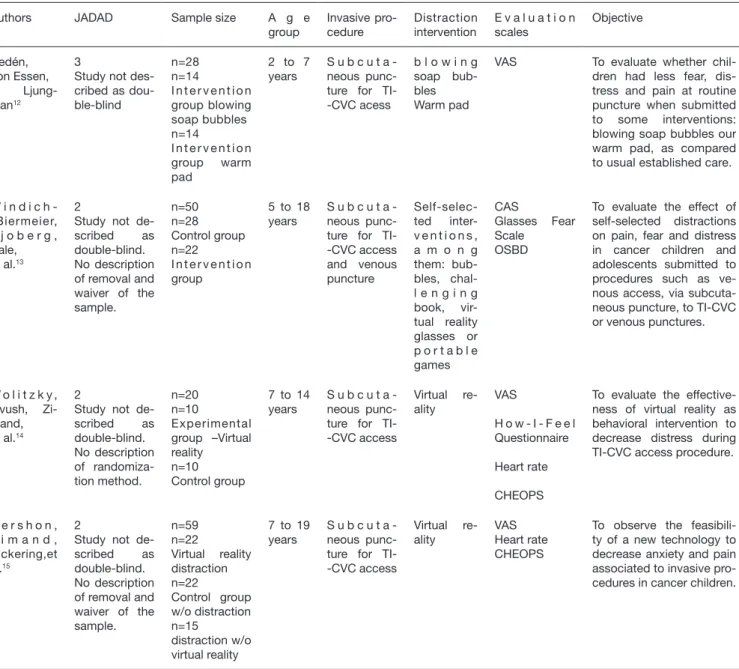
Selected articles were reviewed by means of their full reading and filling of data collection tool developed by the authors. Then, articles were classified according to essay method-ological quality, considering Jadad Scale11 (Table 1).
Tem articles were identified which addressed distraction as intervention to remove children’s focus from the invasive
Figure 1. Selection criteria for studies. Brasília-DF, Brazil, 2014 Selected primary studies
(n=79)
Pubmed = 27 LILACS = 24 Cinahl = 25 Cochrane Library = 3
Eligible studies fully analyzed
(n=15)
Included studies (n=10)
Primary studies repeated among databases
(n=34)
Excluded primary studies (n=30)
Unrelated to the subject = 4 Different sample (adolescents) = 2 Not a clinical trial = 24
Excluded after full análysis
(n=5) Not addressing
inva-sive procedure = 1 Different sample
procedure to which they were being submitted. With regard to language, all articles were published in English. Publica-tion years varied between 1988 and 2009 and age groups of studied sample has varied from 2 years to 19 years of age (Table 1).
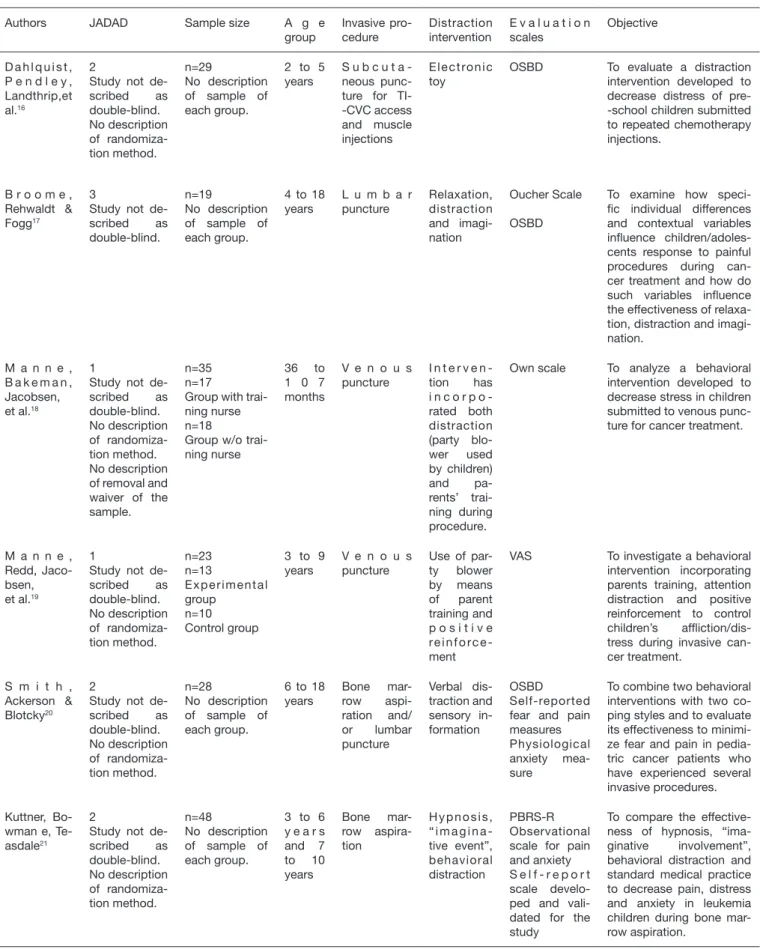
All selected articles used some way of non-pharmacological intervention based on distraction, such as behavioral cog-nitive intervention for venous, muscle and subcutaneous punctures, and procedures related to bone marrow aspira-tion and lumbar puncture (Table 1).
According to the articles, interventions were in general
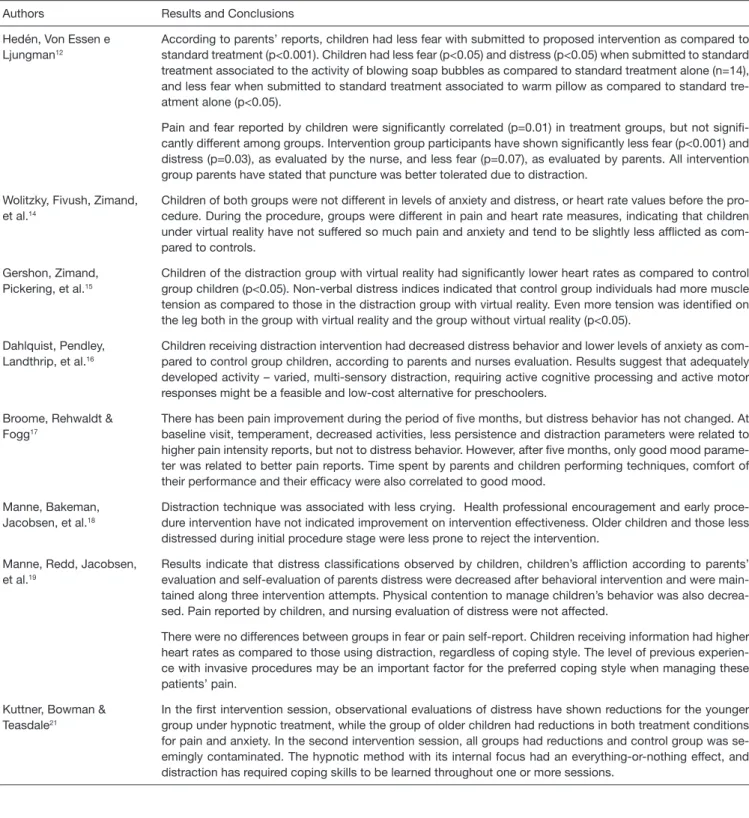
use-ful for pain relief or have shown decreased levels of anxiety, distress, affliction or fear present during invasive procedures (Table 2).
To evaluate the methodological quality of selected studies, Jadad Scale was applied, which evaluates criteria related to randomization, blinding and reasons for losing or exclud-ing subjects from the study. Accordexclud-ing to these criteria, no study was considered of high-quality, as seen in table 1, which contains scores followed by justification. No evalu-ated study was characterized as double-blind, which has im-plied lower scores.
Table 1. Distribution of articles according to year, internal validity according to JADAD scale, sample age group, invasive procedure, applied intervention, evaluation scales and objectives. Brasília-DF, Brazil, 2014
Authors JADAD Sample size A g e
group
Invasive pro-cedure
Distraction intervention
E v a l u a t i o n scales Objective Hedén, Von Essen, & Ljung-man12 3
Study not des-cribed as dou-ble-blind
n=28 n=14
I n t e r v e n t i o n group blowing soap bubbles n=14
I n t e r v e n t i o n group warm pad
2 to 7 years
S u b c u t a -neous punc-ture for TI--CVC acess
b l o w i n g soap bub-bles Warm pad
VAS To evaluate whether
chil-dren had less fear, dis-tress and pain at routine puncture when submitted to some interventions: blowing soap bubbles our warm pad, as compared to usual established care.
W i n d i c h --Biermeier, S j o b e r g , Dale, et al.13
2
Study not de-scribed as double-blind. No description of removal and waiver of the sample.
n=50 n=28 Control group n=22
I n t e r v e n t i o n group
5 to 18 years
S u b c u t a -neous punc-ture for TI--CVC access and venous puncture
Self-selec-ted inter-v e n t i o n s , a m o n g them: bub-bles, chal-l e n g i n g book, vir-tual reality glasses or p o r t a b l e games
CAS
Glasses Fear Scale
OSBD
To evaluate the effect of self-selected distractions on pain, fear and distress in cancer children and adolescents submitted to procedures such as ve-nous access, via subcuta-neous puncture, to TI-CVC or venous punctures.
W o l i t z k y , Fivush, Zi-mand, et al.14
2
Study not de-scribed as double-blind. No description of randomiza-tion method. n=20 n=10 Experimental group –Virtual reality n=10 Control group
7 to 14 years
S u b c u t a -neous punc-ture for TI--CVC access
Virtual re-ality
VAS
H o w - I - F e e l Questionnaire
Heart rate
CHEOPS
To evaluate the effective-ness of virtual reality as behavioral intervention to decrease distress during TI-CVC access procedure.
G e r s h o n , Z i m a n d , Pickering,et al.15
2
Study not de-scribed as double-blind. No description of removal and waiver of the sample. n=59 n=22 Virtual reality distraction n=22 Control group w/o distraction n=15 distraction w/o virtual reality
7 to 19 years
S u b c u t a -neous punc-ture for TI--CVC access Virtual re-ality VAS Heart rate CHEOPS
To observe the feasibili-ty of a new technology to decrease anxiety and pain associated to invasive pro-cedures in cancer children.
Table 1. Distribution of articles according to year, internal validity according to JADAD scale, sample age group, invasive procedure, applied intervention, evaluation scales and objectives. Brasília-DF, Brazil, 2014
Authors JADAD Sample size A g e
group
Invasive pro-cedure
Distraction intervention
E v a l u a t i o n scales
Objective
D a h l q u i s t , P e n d l e y , Landthrip,et al.16
2
Study not de-scribed as double-blind. No description of randomiza-tion method. n=29 No description of sample of each group.
2 to 5 years
S u b c u t a -neous punc-ture for TI--CVC access and muscle injections
E l e c t ro n i c toy
OSBD To evaluate a distraction
intervention developed to decrease distress of pre--school children submitted to repeated chemotherapy injections.
B r o o m e , Rehwaldt & Fogg17
3
Study not de-scribed as double-blind.
n=19
No description of sample of each group.
4 to 18 years
L u m b a r puncture Relaxation, distraction and imagi-nation Oucher Scale OSBD
To examine how speci-ic individual differences and contextual variables inluence children/adoles-cents response to painful procedures during can-cer treatment and how do such variables inluence the effectiveness of relaxa-tion, distraction and imagi-nation.
M a n n e , B a k e m a n , Jacobsen, et al.18
1
Study not de-scribed as double-blind. No description of randomiza-tion method. No description of removal and waiver of the sample.
n=35 n=17
Group with trai-ning nurse n=18
Group w/o trai-ning nurse
36 to 1 0 7 months
V e n o u s puncture
I n t e r v e n -tion has i n c o r p o -rated both distraction (party blo-wer used by children) and pa-rents’ trai-ning during procedure.
Own scale To analyze a behavioral intervention developed to decrease stress in children submitted to venous punc-ture for cancer treatment.
M a n n e , Redd, Jaco-bsen, et al.19
1
Study not de-scribed as double-blind. No description of randomiza-tion method. n=23 n=13
E x p e r i m e n t a l group
n=10 Control group
3 to 9 years
V e n o u s puncture
Use of par-ty blower by means of parent training and p o s i t i v e r e i n f o r c e -ment
VAS To investigate a behavioral
intervention incorporating parents training, attention distraction and positive reinforcement to control children’s afliction/dis-tress during invasive can-cer treatment.
S m i t h , Ackerson & Blotcky20
2
Study not de-scribed as double-blind. No description of randomiza-tion method. n=28 No description of sample of each group.
6 to 18 years Bone mar-row aspi-ration and/ or lumbar puncture Verbal dis-traction and sensory in-formation OSBD Self-reported fear and pain measures Physiological anxiety mea-sure
To combine two behavioral interventions with two co-ping styles and to evaluate its effectiveness to minimi-ze fear and pain in pedia-tric cancer patients who have experienced several invasive procedures.
Kuttner, Bo-wman e, Te-asdale21
2
Study not de-scribed as double-blind. No description of randomiza-tion method. n=48 No description of sample of each group.
3 to 6 y e a r s and 7 to 10 years Bone mar-row aspira-tion
H y p n o s i s , “ i m a g i n a -tive event”, behavioral distraction
PBRS-R Observational scale for pain and anxiety S e l f - r e p o r t scale develo-ped and vali-dated for the study
To compare the effective-ness of hypnosis, “ima-ginative involvement”, behavioral distraction and standard medical practice to decrease pain, distress and anxiety in leukemia children during bone mar-row aspiration.
DISCUSSION
Non-pharmacological interventions used in selected studies difer among them with regard to the type of strategy. It is predominant the use of behavioral interventions using dis-traction as resource to control and manage pain in cancer children submitted to invasive procedures, as well as for the evaluation of behavioral factors, such as distress, aliction, fear and anxiety.
Among distraction techniques found in the literature there is the use of electronic toys, relaxation, imagination, soap bub-bles, warm pillow, self-selected distractions, party blower and virtual reality, being the two latter methods the most com-monly used among selected articles.
With regard to virtual reality, studies have pointed that such intervention may be efective for children submitted to pain-ful and distressing procedures14,15. It is important to consider in which procedures such intervention may be used and
un-Table 2. Distribution of articles according to results and conclusions. Brasília-DF, Brazil, 2014
Authors Results and Conclusions
Hedén, Von Essen e Ljungman12
According to parents’ reports, children had less fear with submitted to proposed intervention as compared to standard treatment (p<0.001). Children had less fear (p<0.05) and distress (p<0.05) when submitted to standard treatment associated to the activity of blowing soap bubbles as compared to standard treatment alone (n=14), and less fear when submitted to standard treatment associated to warm pillow as compared to standard tre-atment alone (p<0.05).
Pain and fear reported by children were signiicantly correlated (p=0.01) in treatment groups, but not signii-cantly different among groups. Intervention group participants have shown signiisignii-cantly less fear (p<0.001) and distress (p=0.03), as evaluated by the nurse, and less fear (p=0.07), as evaluated by parents. All intervention group parents have stated that puncture was better tolerated due to distraction.
Wolitzky, Fivush, Zimand, et al.14
Children of both groups were not different in levels of anxiety and distress, or heart rate values before the pro-cedure. During the procedure, groups were different in pain and heart rate measures, indicating that children under virtual reality have not suffered so much pain and anxiety and tend to be slightly less aflicted as com-pared to controls.
Gershon, Zimand, Pickering, et al.15
Children of the distraction group with virtual reality had signiicantly lower heart rates as compared to control group children (p<0.05). Non-verbal distress indices indicated that control group individuals had more muscle tension as compared to those in the distraction group with virtual reality. Even more tension was identiied on the leg both in the group with virtual reality and the group without virtual reality (p<0.05).
Dahlquist, Pendley, Landthrip, et al.16
Children receiving distraction intervention had decreased distress behavior and lower levels of anxiety as com-pared to control group children, according to parents and nurses evaluation. Results suggest that adequately developed activity – varied, multi-sensory distraction, requiring active cognitive processing and active motor responses might be a feasible and low-cost alternative for preschoolers.
Broome, Rehwaldt & Fogg17
There has been pain improvement during the period of ive months, but distress behavior has not changed. At baseline visit, temperament, decreased activities, less persistence and distraction parameters were related to higher pain intensity reports, but not to distress behavior. However, after ive months, only good mood parame-ter was related to betparame-ter pain reports. Time spent by parents and children performing techniques, comfort of their performance and their eficacy were also correlated to good mood.
Manne, Bakeman, Jacobsen, et al.18
Distraction technique was associated with less crying. Health professional encouragement and early proce-dure intervention have not indicated improvement on intervention effectiveness. Older children and those less distressed during initial procedure stage were less prone to reject the intervention.
Manne, Redd, Jacobsen, et al.19
Results indicate that distress classiications observed by children, children’s afliction according to parents’ evaluation and self-evaluation of parents distress were decreased after behavioral intervention and were main-tained along three intervention attempts. Physical contention to manage children’s behavior was also decrea-sed. Pain reported by children, and nursing evaluation of distress were not affected.
There were no differences between groups in fear or pain self-report. Children receiving information had higher heart rates as compared to those using distraction, regardless of coping style. The level of previous experien-ce with invasive proexperien-cedures may be an important factor for the preferred coping style when managing these patients’ pain.
Kuttner, Bowman & Teasdale21
der which conditions, since problems have been raised about low painful stimulation related to evaluated invasive proce-dure, that is, totally implanted venous catheter puncture, and the use of topic local anesthetics before the procedure15. One should also consider that some studies have reported that topic local anesthetics would be used at puncture site, which could interfere with results12,13,15.
Still about virtual reality, it is inferred from the literature the need for further studies about the application of this tech-nology taking into consideration its cost-efectiveness ra-tio15. Further studies should compare virtual reality eicacy to other distraction methods14, considering the high cost of some equipment used for virtual reality as compared to other distraction or amusement techniques, such as soap bubbles our warm pillow, which are simple, low-cost interventions not requiring professionals workload increase, being this of-ten considered a barrier for the adoption of unconventional treatment means12.
Plural analysis of children’s behavior face to invasive proce-dures, including painful stimulation, is performed by means of diferent evaluation scales. Such scales are applied before, during and after the use of non-pharmacological interven-tions. Importance should be given to visual analog scale (VAS) and physiological evaluation taking into consideration parameters such as heart rate (Table 1). Physiological evalua-tion measures are valued in articles as method of analysis since they have brought signiicant results to studies14,15,20, being even considered tools to be included in the evaluation of fu-ture studies of those who have not used them yet19.
Involving the family during care is critical. Studies have shown that parents are able to play an active role in support-ing and trainsupport-ing their children dursupport-ing the procedure13, fact that is conirmed by other studies which have also counted on parents’ role during intervention and/or during evalua-tion12,14-19,21.
he study working with party blower18,19, has also efectively incorporated parents in the intervention process, even evalu-ating their distress during procedure19. Parents-children re-lationship favors coping with and accepting the distraction intervention, during knowingly painful procedures. Manne et al.18 suggest that the link between parents and children is ex-tremely relevant for the efectiveness of the intervention when it depends on the training ofered by parents to children. It was observed among selected studies that diferent distrac-tion forms may be considered efective strategies for pain re-lief and control, in addition to decreasing distress, aliction, fear and anxiety; however the literature shows the need for expansion and analysis with regard to study samples. A large part of the studies state that sample was small12,18-20 indicating in their analyses the need for experiments with larger sam-ples13-15,18,20.
he wide variety of age groups (younger age=2 years and older age=19 years) causes major divergences, since it simultane-ously encompasses diferent development stages and cogni-tive capacities, being even important to consider the use and evaluation of adequate devices for younger children14,15. On
the other hand, Manne et al.18 state that, according to their study data, older children tend to cooperate and present more positive results to distraction interventions as compared to younger children, for not rejecting distraction that much. It should be noted that studies have indicated as fragility the fact that they have not followed criteria with regard to evaluators blinding14,15,19. Aiming at preventing or decreas-ing possible biases of analyses and interpretation of results, we suggest the development of further studies with blind evaluators14.
CONCLUSION
he study allowed for the identiication of evidences avail-able in the scientiic literature with regard to pain relief and control in cancer children using distraction practices. Among them there are virtual reality, practices such as blowing soap bubbles, use of warm pillow, party blower, electronic toys, among other self-selected interventions (music, games, books). Most interventions are easy to implement, consid-ering their low cost, and are useful for health professionals looking at enhancing pediatric patients’ assistance with regard to pain management.
Major study limitations were: decreased number of partici-pants both in experimental and control groups, which does not allow for more robust conclusions. Distraction techniques were varied and were not deeply described, considering the broad guiding question, which makes diicult to elect the most efective distraction intervention and for which inva-sive procedure. In addition, studies should have worked with more speciic age groups, since development competences of each child are quite diferent and interaction and response to stress are age-dependent.
REFERENCES
1. Monteiro AC, Rodrigues BM, Pacheco ST. O enfermeiro e o cuidar da criança com câncer sem possibilidade de cura total. Esc Anna Nery. 2012;16(4):741-6. 2. Menossi MJ, Lima RA, Correa AK. [Pain and the challenge of interdisciplinarity in
child care]. Rev Lat Am Enfermagem. 2008;16(3):489-94. English, Portuguese, Spa-nish.
3. hrane S. Efectiveness of integrative modalities for pain and anxiety in children and adolescents with cancer: a systematic review. J Pediatr Oncol Nurs. 2013;30(6):320-32.
4. Landier W, Tse AM. Use of complementary and alternative medical interventions for the management of procedure-related pain, anxiety, and distress in pediatric oncology: an integrative review. J Pediatr Nurs. 2010;25(6):566-79.
5. Kurita GP, Pimenta CA, de Oliveira Júnior JO, Caponeiro R. [Alterations in attention and cancer pain treatment]. Rev Esc Enferm USP. 2008;42(1):143-51. Portuguese. 6. Abreu MA, Reis PE, Gomes IP, Rocha PR. Non pharmacologic pain management on
oncologic patients: systematic review. Online Braz J Nurs. 2009;8(1):[8 telas]. 7. Benchaya I, Ferreira EA, Brasiliense IC. Efeitos de instrução e de treino parental em
cuidadores de crianças com câncer. Psicol Teor Pesq. 2014;30(1):13-23.
8. Rheingans JI. A systematic review of nonpharmacologic adjunctive therapies for symptom management in children with cancer. J Pediatr Oncol Nurs. 2007;24(2):81-94.
9. Higgins JP, Green S. (Editors). Cochrane Handbook for Systematic Reviews of Inter-ventions Version 5.1.0 [updated March 2011]. he Cochrane Collaboration, 2011. Available from www.cochrane-handbook.org. Acesso em 30 de junho de 2014. 10. da Costa Santos CM, de Mattos Pimenta CA, Nobre MR. [he PICO strategy for
the research question construction and evidence search]. Rev Lat Am Enfermagem 2007;15(3):508-11. Portuguese.
12. Hedén L, Von Essen L, Ljungman G. Randomized interventions for needle procedu-res in children with cancer. Eur J Cancer Care. 2009;18(4):358-63.
13. Windich-Biermeier A, Sjoberg I, Dale JC, Eshelman D, Guzzetta CE. Efects of dis-traction on pain, fear, and distress during venous port access and venipuncture in children and adolescents with cancer. J Pediatr Oncol Nurs. 2007;24(1):8-19. 14. Wolitzky K, Fivush R, Zimand E, Hodges L, Rothbaum BO. Efectiveness of virtual
reality distraction during a painful medical procedure in pediatric oncology patients. Psychol Health. 2005;20(6):817-24.
15. Gershon J, Zimand E, Pickering M, Rothbaum BO, Hodges L. A pilot and feasibil-ity study of virtual realfeasibil-ity as a distraction for children with cancer. J Am Acad Child Adolesc Psychiatry. 2004;43(10):1243-9.
16. Dahlquist LM, Pendley JS, Landthrip DS, Jones CL, Steuber CP. Distraction inter-vention for preschoolers undergoing intramuscular injections and subcutaneous port access. Health Psychol. 2002;21(1):94-9.
17. Broome ME, Rehwaldt M, Fogg L. Relationships between cognitive behavioral tech-niques, temperament, observed distress, and pain reports in children and adolescents during lumbar puncture. J Pediatr Nurs. 1998;13(1):48-54.
18. Manne SL, Bakeman R, Jacobsen PB, Gorinkle K, Redd WH. An analysis of a behavioral intervention for children undergoing venipuncture. Health Psychol. 1994;13(6):556-66.
19. Manne SL, Redd WH, Jacobsen PB, Gorinkle K, Schorr O. Behavioral interven-tion to reduce child and parent distress during venipuncture. J Consult Clin Psychol. 1990;58(5):565-72.
20. Smith KE, Ackerson JD, Blotcky AD. Reducing distress during invasive medical pro-cedures: relating behavioral interventions to preferred coping style in pediatric cancer patients. J Pediatr Psychol. 1989;14(3):405-19.