220
Psychological stress treated by acupuncture and evaluated by
trapezius muscle electromyography*
Tratamento do estresse psicológico pela acupuntura, avaliado pela eletromiografia do
músculo trapézio
Alessandra Vilas Boas Terra Gomes
1, Mônica Cristina Furtado Silva
1, Paulo Fernando de Souza
Júnior
1, Fausto Bérzin
2, Denismar Alves Nogueira
3, Wagner Costa Rossi Junior
4, Alessandra
Es-teves
4* Received from the Department of Anatomy, Federal University of Alfenas (UNIFAL-MG). Alfenas, MG.
1. Students of Biomedicine, Federal University of Alfenas (UNIFAL-MG). Alfenas, MG. Brazil.
2. Professor of Anatomy, School of Dentistry, FOP-UNI-CAMP and Senior Guest Professor of Capes, Federal Uni-versity of Alfenas (UNIFAL-MG). Alfenas, MG. Brazil. 3. Assistant Professor Doctor of Basic Statistics, Federal University of Alfenas (UNIFAL-MG). Alfenas, MG. Brazil. 4. Assistant Professor Doctor, Department of Anatomy (DA-nat), Federal University of Alfenas (UNIFAL-MG). Alfenas, MG. Brazil.
Correspondence to: Alessandra Esteves, M.D.
Rua Gabriel Monteiro da Silva, 700 – Centro 37130-000 Alfenas, MG.
Phone: (35) 3299-1302
E-mail: [email protected]
SUMMARY
BACKGROUND AND OBJECTIVES: Stress is a
modern life phenomenon and may be present in the li-ves of anyone, regardless of age, gender, social class or profession. This research aimed at proposing an alter-native treatment for stress with acupuncture, evaluating by electromyography right and left trapezius muscles of patients under psychological stress one week before evaluations and after acupuncture.
METHOD: Participated in this study 20
volunte-ers submitted to a questionnaire to evaluate signs of psychological stress. The trapezius muscle was
selec-ted for best relecting stress signs. The study was bila -teral and muscle action was captured at rest and during isometric activities with raising and lowering move-ments. The following points were needled during each one of the 10 acupuncture sessions: C7 point, points
obtained as from a pentagram and conluence points of
the distinct meridian affected on the pentagram.
RESULTS: RMS values, compared before and after
acupuncture treatment, at rest and with elevation of the
scapula were statistically signiicant (p < 0.01).
CONSLUSION: Muscles have shown less
electromyo-graphic activity after treatment, thus showing the eficacy
of acupuncture for patients under psychological stress.
Keywords: Acupuncture, Electromyography,
Psycho-logical stress, Trapezius muscle.
RESUMO
JUSTIFICATIVA E OBJETIVOS: O estresse é
con-siderado um fenômeno da vida moderna, que pode es-tar presente na vida de todas as pessoas, independente
de idade, sexo, classe social ou proissão. Esta pesqui -sa foi realizada vi-sando propor um tratamento alterna-tivo para o estresse, pelo tratamento com acupuntura,
avaliando eletromiograicamente o músculo trapézio,
direito e esquerdo, de indivíduos portadores de estres-se psicológicos, uma estres-semana antes das avaliações e após a acupuntura.
MÉTODO: Para a realização deste estudo foram sele
-cionados 20 voluntários, submetidos a um questionário
que avaliou os sinais de estresse psicológico. O músculo estudado foi o trapézio por reletir melhor os sinais de estresse. Este foi estudado bilateralmente e a ação mus -cular foi captada no repouso e durante atividade
isomé-trica, realizando-se movimentos de elevação e abaixa -mento. Em cada uma das 10 sessões de acupuntura foi realizado o agulhamento do ponto C7; pontos obtidos a
partir de um pentagrama e ponturar pontos de conluên -cia do meridiano distinto afetado no pentagrama.
RESULTADOS: Os valores de RMS, quando
compa-rados antes e após o tratamento com acupuntura, no
repouso e em elevação da escápula foram estatistica
CONCLUSÃO: Os músculos apresentaram menor ati
-vidade eletromiográica após o tratamento, mostrando assim a eicácia da acupuntura em indivíduos portado -res de est-resse psicológico.
Descritores: Acupuntura, Eletromiograia, Estresse
psicológico, Músculo trapézio.
INTRODUCTION
Acupuncture aims at reestablishing the balance between contradictory function states and homeostasis, alterna-ting states of energy and with this maintaining the ideal organization of the organ and the organism to be treated. The theoretical-philosophical basis of acupuncture is the energetic rebalance of meridians, which are channels sending vital energy (Qi) throughout the body.
Electromyography is a technique to monitor electrical ac-tivity of excitable membranes, representing the measure of sarcolemma’s action potential as a voltage effect as a function of time. The electromyographic signal (EMG) is the algebraic sum of all detected signals in a certain area and may be affected by muscular, anatomic and physio-logic properties, as well as by peripheral nervous system control and by the tools used for signal acquisition1.
Stress is a psychophysiological body change, noticeable through physical and psychological symptoms to react to a situation of stress and oppression. Stress is a process rather than a single reaction, because when a person is submitted to a stress source, a long biochemical process is installed and its onset is manifested in a very simi-lar manner by symptoms such as tachycardia, excessive sweating, muscle tension, dry mouth and sensation of alertness. Stress is considered a modern life phenome-non and may be present in the lives of anyone, regardless of age, gender, social class or profession.
Electromyography (EMG) has been widely used to stu-dy muscle system functions and stu-dysfunctions during movement, and has allowed studies in different areas of interest for physical therapists and other professionals dedicated to movement.
EMG captures the myoelectric signal resulting from
muscle ibers action potentials, which occur befo -re their contraction, so it is not a measu-re of muscle strength. The electromyographic signal is originated by
the action potential, which is ired by each motor unit
during muscle contraction, and the sum of all motor units activities is the electromyographic signal which
may be captured by supericial skin electrodes. This
is a safe, sensitive and non-invasive technique2 which
aims at evaluating muscle activity during a certain mo-vement, synchronization of activated muscles, muscle
contraction intensity and duration and the activity of synergists and/or antagonists2. After being collected,
the signal has to be processed to be interpreted.
This study aimed at proposing an alternative treatment for psychological stress using acupuncture.
METHOD
Participated in this study 10 control group individuals (CG) and 10 stressed group individuals (SG) of both genders, aged between 18 and 25 years, who have signed the Free and Informed Consent Term contai-ning all research procedures, according to resolution 196/96 CNS.
Volunteers were selected via a questionnaire to identify
stress signs, made up of patient’s identiication and pre -sence of subjective signs and symptoms of stress, such as memory problems, self-report of bruxism during sle-ep and/or alertness, stiff muscles, insomnia, boredom, tachycardia, emotional hypersensitivity, among others. The trapezius muscle was bilaterally evaluated and muscle action was captured at rest and during isometric activity with raising and lowering movements.
Two surface active differential electrodes were used to cap-ture electrical signals, with signal detection surface made up of two parallel silver bars with amplitude range of 20 to 500 Hz, roll-off of at least 12dB/octave, common mode
re-jection index > 80 dB, noise < 2 RMS μV (20-40 Hz), input
impedance > 100 mega ohms and 20 times gain.
After collection, the electromyographic signal has gone through a LYNX signal conditioning module model MCS 1000-V2, with 16 input channels, which were
conigured to receive load cell signals, with on/off swi -tch, electrogoniometer and electromyographic signals. For electromyographic record, channels were gauged
by a Butterworth-type two-pole analog ilter to allow a inal gain of 2000, with cutoff frequency of 20 Hz in the high pass ilter and of 500 Hz in the low pass ilter. Analog signals were ampliied and prepared to be con -verted into digital signals by a LYNX analog/digital conversion plate (A/D) model CAD 12/36, with 12 bytes of resolution, 16 analog inputs and DMA sup-port (direct memory access), allowing maximum signal collection speed independent from the microcomputer central processing unit.
Signal acquisition system was checked by Aqdados Sof-tware and always according to the following sequence:
a) channels coniguration enabling 4 channels for elec -tromyographic signals (channels 1 to 4), with
ampli-tude of up to 2000 μV; b) signals sampling frequency
in all channels used; c) suitability of essay parameters with duration time of 5; d) data treatment screen
con-iguration established for simultaneous visualization of 4 channels, being all conigured for electromyographic
signals; e – essay to test enabled channels.
Initially, the volunteer was informed about the experi-ment. Patient was placed on a chair with Frankfurt plane parallel to ground. Activities to be executed during the experiment were practiced before each essay, followed by the placement of electrodes to capture electric activi-ty of muscles to be evaluated, preceded by skin cleaning with cotton soaked in alcohol and hair removal.
Electrodes were ixed to the skin with double-face
adhesive collar and/or adhesive tape. Electrodes were placed on the intermediate region between the innerva-tion zone center, which is the motor point, and the cle tendon, longitudinally aligned and parallel to
mus-cle ibers direction, always with a distance of 1.5 cm
between each pair as from the center of the electrodes.
Since the electrode ixation site on the trapezius muscle is easily identiied by palpation, volunteer was asked
to perform maximum forced elevation. Electrode was
ixed at the point of highest volume.
After ixing the electrodes an essay was carried out
with the volunteer to observe the presence of possible interferences and whether the electrodes were adequa-tely capturing muscle electrical activity. It is important to stress that a ground reference electrode was always used to decrease interferences even further.
Initially the signal was collected with the volunteer at rest, sitting with Frankfurt plane parallel to the ground, without performing any movement. Data at forced eleva-tion were collected 2 seconds after the beginning of the activity maintained for 5 seconds and being performed in 5 stages. Captured signals were analyzed by the data treatment screen to assure the quality of acquired data. The following points were needled during all acupunc-ture sessions: strong heart point C7; points obtained as from a pentagram aiming at evaluating general patient’s condition to reach energetic balance, which may vary according to the acupuncture session because they de-pend exclusively on individual’s general status at that
moment and conluence points of the distinct meridian
affected on the pentagram.
Volunteers were submitted to 10 acupuncture sessions.
The irst session was carried out in the same week when the irst electromyographic signals were collec -ted. Then, patients were submitted to weekly sessions until completing 10 sessions.
With the volunteer comfortably laid on a stretch, balance points were established and needles were inserted into
speciic points where they remained for 30 minutes. Be -fore insertion, points were cleaned with 70º alcohol. This study was approved by the Research Ethics Com-mittee, Federal University of Alfenas (UNIFAL-MG), protocol 048/2010.
RESULTS
A basic questionnaire was used to select volunteers to exclude individuals not matching the objectives of the research. This questionnaire was developed by rese-arch participants so that volunteers would match the objective. We selected 10 individuals for the control group (CG) and 10 for the stressed group (SG). SG answered the questionnaire in the beginning of the re-search, before the tests period and after acupuncture. This questionnaire has shown the level of stress
quanti-ied as from the sum of presented symptoms values on
each studied period. We have observed a positive chan-ge before and after acupuncture in the level of stress of patients during the analyzed period (Graph 1).
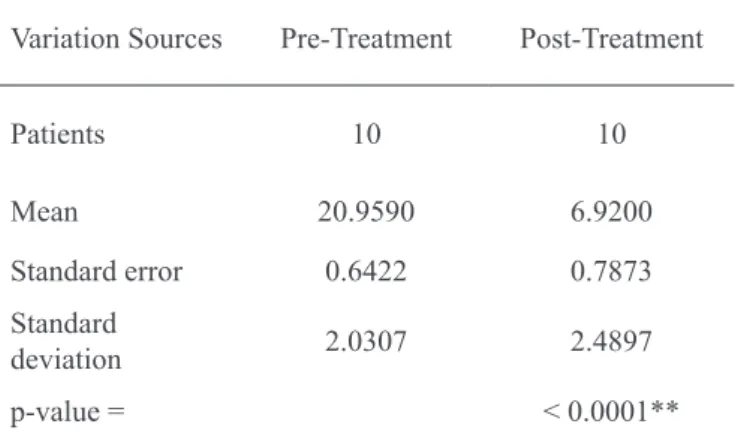
Electromyography has measured muscle activity of vo-lunteers at rest and when raising the trapezius muscle before and after acupuncture. Muscle activity was con-verted into RMS values by the electromyograph and has shown that the trapezius muscle has higher activity when the individual is under psychological stress.
Statistical analysis has shown signiicant differences
between SG and CG after acupuncture both at rest and at scapula raising movement; mean RMS value for SG at rest was 6.92 and after treatment the value was 6.92 (Table 1). SG values at scapula raising movement was
195.45; after treatment the value was 87.14 (p < 0.01)
(Table 2).
Su
m
o
f
symp
to
ms
va
lu
e
s
Beginning of the semester Before acupuncture After acupuncture
Patients
Table 1 – Mean square root values of the trapezius muscle at rest before and after acupuncture, evaluated by electromyography.
Variation Sources Pre-Treatment Post-Treatment
Patients 10 10
Mean 20.9590 6.9200
Standard error 0.6422 0.7873 Standard
deviation 2.0307 2.4897 p-value = < 0.0001**
**= p < 0.01(signiicant at 1% probability).
Table 2 - Mean square root values of raised trapezius muscle sig-nals before and after acupuncture, evaluated by electromyography.
Variations
Sources Pre-Treatment Post-Treatment
Patients 10 10
Mean 195.4580 87.1340
Standard error 5,9014 10.6585
Standard
deviation 18.6619 33.7052
p-value = < 0.0001**
**= p < 0.01(signiicant at 1% probability).
syndrome, where the concept of sensitive or painful points has a close relationship with the concept of acu-puncture points4, what made possible to infer that
vir-tually all volunteers had lower levels of psychological stress after acupuncture.
Our study has shown that RMS values were lower after acupuncture indicating decreased muscle activi-ty and stress, as observed by other studies5-7.
Stress--induced psychological and physical symptoms were also decreased8,9.
CONCLUSION
Muscles had less electromyographic activity after
tre-atment, which evidences the eficacy of acupuncture
for individuals under psychological stress.
REFERENCES
1. Freitas Filho CHB, Silva JRT, Silva ML. Prin-cípios etiológicos e de diagnose em fibromialgia e seu tratamento através da acupuntura. Sobrafisa 2004;1(5):11-8.
2. Ocarino JM, Silva PLP, Vaz DV, et al.
Eletromio-grafia: interpretação e aplicações na ciência da rea
-bilitação. Fisioter Bras 2005;6(4):305-10.
3. Bassani E, Candotti CT, Pasini M, et al. Avaliação da ativação neuromuscular em indivíduos com esco -liose através da eletromiografia de superfície. Rev Bras Fisioter 2008;12(1):13-9.
4. Duarte Kroll C, Bérzin F, Alves MC. Avaliação clínica da atividade dos músculos mastigatórios du
-rante a mastigação habitual – um estudo sobre a nor
-malização de dados eletromiográficos. Revista de
Odontologia da UNESP 2010;39(3):157-62.
5. Huang W, Howie J, Taylor A, et al. An investiga-tion into the effectiveness of tradiinvestiga-tional Chinese acu-puncture (TCA) for chronic stress in adults: a rando-mised controlled pilot study. Complement Ther Clin Pract 2011;17(1):16-21.
6. Politti F, Vitti M, Amorim CF, et al. Correspon-dence of the auricular acupoint with the upper tra-pezius muscle: a electromyographic study. Comple-ment Ther Clin Pract 2010;16(1):26-30.
7. Chou LW, Hsieh YL, Kao MJ, et al. Remote in-fluences of acupuncture on the pain intensity and the amplitude changes of endplate noise in the myofas-cial trigger point of the upper trapezius muscle. Arch Phys Med Rehabil 2009;90(6):905-12.
8. Kim H, Park HJ, Shim HS, et al. The effects of
DISCUSSION
According to some authors3 who have clinically
eva-luated masticatory muscles activity during normal chewing – a study on electromyographic data norma-lization – it was possible to suggest that absolute data
may conirm clinical indings observed from the quali -tative analysis of electromyographic signals. So, data normalization was waived in this study.
acupuncture (PC6) on chronic mild stress-induced memory loss. Neurosci Lett 2011;488(3):225-8. 9. Zhang Y, Feng B , Xie JP, et al. Clinical study on treatment of the earthquake-caused post-trau-matic stress disorder by cognitive-behavior
the-rapy and acupoint stimulation. J Tradit Chin Med 2011;31(1):60-3.
Submitted in November 07, 2011.