ORIGINAL ARTICLE
Yale-Brown Obsessive Compulsive Scale modified for
Body Dysmorphic Disorder (BDD-YBOCS): Brazilian
Portuguese translation, cultural adaptation and validation
Maria J. de Brito,
1,2Miguel Sabino Neto,
1Ma´rio F. de Oliveira,
1Ta´ki A. Corda´s,
3Leandro S. Duarte,
3Maria F. Rosella,
1Gabriel A. Felix,
1Lydia M. Ferreira
11Division of Plastic Surgery, Universidade Federal de Sa˜o Paulo (UNIFESP), Sa˜o Paulo, SP, Brazil.2College of Health Science, Universidade
do Vale do Sapucaı´ (UNIVA´ S), Pouso Alegre, MG, Brazil.3Department of Psychiatry, Universidade de Sa˜o Paulo (USP), Sa˜o Paulo, SP, Brazil.
Objective:To translate, culturally adapt, and validate a Brazilian Portuguese version of the Yale-Brown Obsessive Compulsive Scale modified for Body Dysmorphic Disorder (BDD-YBOCS).
Methods:Ninety-three patients of both sexes seeking rhinoplasty were consecutively selected at the Plastic Surgery Outpatient Clinic of the Universidade Federal de Sa˜o Paulo, Brazil, between May 2012 and March 2013. The BDD-YBOCS was translated into Brazilian Portuguese. Thirty patients participated in the cultural adaptation of the scale. The final version was tested for reliability in 20 patients, and for construct validity in 43 patients (correlation of the BDD-YBOCS with the Body Dysmorphic Disorder Examination [BDDE]).
Results:Total Cronbach’s alpha was 0.918. The BDD-YBOCS had excellent inter-rater (intra-class correlation coefficient [ICC] = 0.934; po0.001) and intra-rater reliability (ICC = 0.999; po0.001).
Significant differences in BDD-YBOCS scores were found between patients with and without BDD symptoms (po0.001), and among patients with different levels of BDD severity (po0.001). A strong
correlation (r = 0.781; po0.001) was observed between the BDDE and the BDD-YBOCS. The area
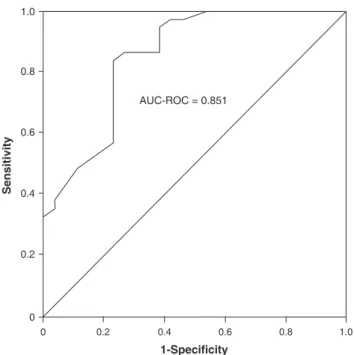
under the receiver operating characteristic curve was 0.851, suggesting a very good accuracy for discriminating between presence and absence of BDD symptoms.
Conclusion:The Brazilian Portuguese version of the BDD-YBOCS is a reliable instrument, showing face, content and construct validity.
Keywords: Body dysmorphic disorders; body image; psychiatry; plastic surgery; therapeutics
Introduction
Body dysmorphic disorder (BDD) is a relatively common and often severe psychiatric disorder that is possibly underdiagnosed and underreported.1,2 It is classified under obsessive-compulsive and related disorders in the DSM-5.3
According to the DSM-5, BDD is characterized by a ‘‘preoccupation with one or more perceived defects or flaws in physical appearance that are not observable or appear slight to others,’’ and by ‘‘repetitive behaviors (e.g., mirror checking, excessive grooming, skin picking, reassurance seeking) or mental acts (e.g., comparing his or her appearance with that of others) in response to the appearance concerns.’’ In addition, it causes ‘‘clinically significant distress or impairment in important areas of functioning’’ and its ‘‘symptoms are not better explained by normal concerns with physical appearance or by concerns with body fat or weight in individuals meeting
diagnostic criteria for eating disorders.’’ BDD symptoms may be associated with muscle dysmorphia. Also, BDD patients may show different degrees of insight regarding BDD beliefs of looking ugly or deformed - that is, they may recognize these beliefs as probably false or perceive them as absolutely true.3
Patients with severe BDD symptoms exhibit high suicidal ideation (80%) and suicide attempt (24%) rates.4-6 These rates have been observed in clinical samples and not in the general population.4-6Phillips & Menard7reported that the suicide rate among individuals with BDD is 45 times higher than that of the general U.S. population, with a higher mortality rate for anorexia nervosa, major depression, and bipolar disorder. Moreover, in BDD patients, impulsive traits may lead to increased levels of health-risk behaviors, including aggressiveness, self-destructiveness associated with substance abuse, indebtedness, eating disorders, repeated hospitalizations, obsessive desire to undergo cosmetic procedures, and extreme behaviors, such as ‘‘do-it-yourself’’ cosmetic surgery, which consists of severe self-inflicted procedures performed in an attempt to correct a perceived defect.1,8
Individuals with BDD frequently seek cosmetic surgery to correct perceived defects and reduce the extreme dissatisfaction with their physical appearance.9,10BDD is
Correspondence: Maria Jose´ Azevedo de Brito, Division of Plastic Surgery, UNIFESP, Rua Napolea˜o de Barros 715, 4o
andar, CEP 04024-002, Sa˜o Paulo, SP, Brazil.
E-mail: [email protected]
Submitted Jan 27 2015, accepted Apr 22 2015.
Associac¸a˜o Brasileira de Psiquiatria
one of the most common psychiatric conditions found in patients seeking cosmetic surgery,11 with rhinoplasty being one of the most sought-after cosmetic procedures by patients with BDD.10,12The prevalence of BDD ranges from 1 to 6% in the general population, reaches up to 16% among psychiatric patients, and varies from 7 to 53% in plastic surgery settings.13-17
An excessive concern with appearance can conceal psychopathological traits that are not always easy to recognize and may result in iatrogenic and medico-legal problems if neglected.1,18,19Thus, patient-reported outcome scales are important tools for the identification of BDD symptoms among cosmetic surgery patients, so as to determine whether these procedures are indicated or contraindicated in this population.1,20,21 The Yale-Brown Obsessive Compulsive Scale modified for Body Dysmorphic Disorder (BDD-YBOCS) has been shown to be sensitive to changes in the severity of BDD symptoms, revealing its importance for studies assessing the efficacy of treat-ments.22Thus, a Brazilian version of the BDD-YBOCS will be useful for clinical trials evaluating the efficacy of interventions to reduce the severity of BDD symptoms.
The aim of this study was to translate, culturally adapt, and validate the BDD-YBOCS for Brazilian Portuguese. Internal consistency, test-retest reliability, and convergent and divergent validity were also determined for the Brazilian version of the instrument.
Methods
The study was approved by the research ethics commit-tee of Universidade Federal de Sa˜o Paulo. Patient selection was conducted between May 2012 and March 2013. Written informed consent was obtained from all participants after the procedures had been fully explained and prior to their inclusion in the study; anonymity was assured.
A total of 95 patients of both sexes showing excessive concern with physical appearance associated with clini-cally significant subjective distress and seeking rhino-plasty were consecutively selected at the Plastic Surgery Outpatient Clinic of the Universidade Federal de Sa˜o Paulo, Brazil. Exclusion criteria were inability to under-stand the interview questions, severe physical deformities resulting from tumors or other conditions, and psychotic disorders.
No patient declined participation, but two patients with very noticeable (not slight) physical defects and indication for orthognathic surgery were excluded from the study, for a final sample of 93 patients. Total sample and subsample sizes for the cross-cultural adaptation, relia-bility, and validity phases were calculated based on the methodology of Guillemin et al.,23-25 and Gandek &
Ware.26
One of the authors (MJB), a psychologist with expertise in BDD, performed the initial clinical assessment of the patients and applied the Brazilian Portuguese version of the Body Dysmorphic Disorder Examination (BDDE).27 The 34-item BDDE is a specific questionnaire that measures symptoms of severely negative body image.27,28 Besides assessing body image dissatisfaction, specific
items of the BDDE (items 9-11, 13, 23-26) are also used for the diagnosis of BDD.28 To meet diagnostic criteria, patients are required to have a score of 4 or greater on these items. Patients with BDD symptoms were classified as having mild to moderate or severe symptoms,1,10based
on their level of subjective distress and avoidance behavior (BDDE scores on the specific items).1
The instrument
The BDD-YBOCS22 was derived from the Yale-Brown Obsessive Compulsive Scale (Y-BOCS).29,30Permission
to translate, culturally adapt, and validate the instrument for Brazilian Portuguese was obtained from Dr. Katharine A. Phillips, senior author and copyright holder of the original version of the BDD-YBOCS. The BDD-YBOCS is a 12-item semi-structured clinician-rated instrument designed to measure severity of BDD symptoms in individuals showing excessive preoccupation and sub-jective distress with physical appearance.22 It is an outcome measure in clinical studies and in the treatment of BDD.22The 12 items are rated on a 0-4 scale, where 0 indicates no symptoms and 4 indicates extreme BDD symptoms. The first 10 items assess excessive preoccu-pation, obsessions, and compulsive behaviors associated with dissatisfaction with physical appearance. The first 3 items are based on the BDD diagnostic criteria and assess preoccupation, impairment of global functioning, and subjective distress, which are related to both excessive preoccupation and compulsive behaviors. Items 11 and 12 assess insight and avoidance respectively. The total score is calculated as the sum of ratings for the 12 items, for a maximum score of 48.22
Translation
The original version of the BDD-YBOCS was translated from English into Brazilian Portuguese by two indepen-dent translators. Only one of the translators was informed about the objectives of the study, so as to produce a conceptual rather literal translation of the scale.23 Both translations were evaluated by a multidisciplinary com-mittee composed of two psychologists, two psychiatrists, and three plastic surgeons. All items were checked for translation errors and evaluated for content validity. A consensus Brazilian Portuguese version of the scale was then obtained by combining elements from both transla-tions. The consensus version was adequately adapted to the linguistic context and care was taken to preserve all essential characteristics of the original instrument. Idiomatic, semantic, conceptual, and cultural equivalences were considered during the translation phase.
by discussion. This analysis resulted in the development of consensus version 1 of the BBD-YBOCS in Brazilian Portuguese, which was appropriately adapted to the linguistic and cultural context of the target population, maintaining all the essential characteristics of the original scale in English.
Application of the instrument
During the cultural adaptation phase, a psychologist with a doctoral degree and expertise in BDD (MJB) applied the BDD-YBOCS to the first 10 patients and supervised a second psychologist during the application of the instru-ment to the next 20 patients. The cultural adaptation phase served to train the second psychologist for the inter-rater reliability phase.
Cultural adaptation or pretest
Version 1 of the scale was administered to 30 patients to test eventual failures of the respondents to comprehend the items. After informed consent, patients were given the opportunity to express their comprehension of the scale and suggest any changes they considered necessary. All patients understood that the scale items were related to concerns and dissatisfaction with physical appearance. Interviews were conducted face to face. The final version was obtained when patients, translators, and health professionals reached a consensus (Appendix 1, avail-able as online-only supplementary material).
Psychometric documentation
After translation and cultural adaptation, the final version of the scale was tested for reliability in 20 patients, and for face, content, and construct validity in 43 patients. These 63 patients did not participate in the cultural adaptation phase.
Reliability
Cronbach’s alpha was used to estimate the internal consistency reliability of the instrument. Test-retest reliability (reproducibility) is the ability of an instrument to produce stable or similar results on repeated admin-istration when no change in patient characteristics has occurred. The instrument was assessed by test-retest procedures in three interviews conducted by two inde-pendent interviewers (two experienced psychologists). Twenty patients were interviewed by psychologist #1. The interview was repeated three hours later on the same day by psychologist #2. Two weeks later, the instrument was again administered to the same patients by psychologist #1 only. Inter- and intra-rater reliability analyses were performed. This phase of testing is used to verify the precision of the instrument in measuring the properties for which it was designed.24,25
Statistical analysis of test-retest reliability was per-formed using Pearson’s correlation coefficient and the intra-class correlation coefficient (ICC).
Validity
Face validity evaluates whether the instrument appears to measure what it was designed to measure. In this study, face validity was determined by consensus of the multi-disciplinary committee responsible for the Brazilian version of the scale.
Content validity is defined as the degree to which each item is relevant to measure the target content, and examines if a scale represents the universe of concepts or domains to which it corresponds. This is usually established by specialists in the field before the items (questions) are worded. Establishing content validity requires a defining standard against which the content of a measure is compared.26
Construct validity is the process through which the correlation of a measure with other variables is tested for theoretical consistency. In testing construct validity, hypotheses are stated regarding the direction and strength of expected relationships.26 Our hypothesis was that preoccupations and excessive levels of body investment associated with clinically significant distress in patients seeking cosmetic surgery would reveal symptoms of BBD, which may be present in different severity levels. Construct validity was tested by comparing the BDD-YBOCS with factors considered correlated with symptoms of severely negative body image and with the degree of dissatisfaction with appearance. Convergent validity was assessed using the Brazilian-Portuguese version of the Body Dysmorphic Disorder Examination (BDDE) in the interview format.27
Construct validity of the BDD-YBOCS was measured in 43 patients by studying the association between domains of the BDD-YBOCS and the BDDE, using Pearson’s linear correlation. Discriminant validity was determined by comparing mean BDD-YBOCS scores of patients with and without BDD symptoms, and scores of patients with different levels of BDD severity, using Student’sttest for independent samples or analysis of variance (ANOVA). The Kolmogorov-Smirnov test was used to test the data for normal distribution. Duncan’s multiple range test was carried out to determine significant differences between ANOVA results at the different levels.
The level of significance was set at 0.05 (po0.05) for
all tests.
A cutoff point for symptom severity and the correspond-ing sensitivity and specificity were estimated by receiver operating characteristic (ROC) analysis. A ROC curve was constructed based on clinical evaluation and BDDE assessment of patients.
Data are expressed as means 6 standard deviation (SD).
Results
The Brazilian-Portuguese version of the BDD-YBOCS (Appendix 1, available online) was administered to 63 patients after a clinical interview. Thirty seven (58.7%) patients met diagnostic criteria for BDD,3with 27 (42.9%) of them having mild/moderate symptoms, and 10 (15.9%) showing severe symptoms (BDDE).1,10
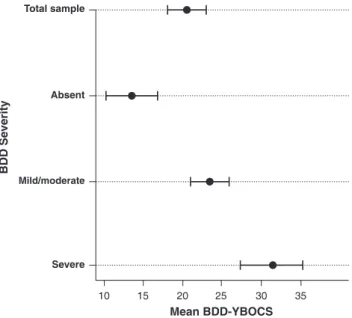
The mean BDD-YBOCS score for patients with BDD was 25.567.1. When considering the severity of symp-toms, mean BDD-YBOCS scores were 23.466.5 for patients with mild/moderate symptoms (according to the BDDE) and 31.265.5 for patients with severe symptoms. Overall, most patients were women (84.1%), Cauca-sian (60.3%), and single (57.1%). Mean age was 34.7610.6 years. Almost half (46%) of the participants had complete primary education. Seventy-three percent of patients reported that they had first experienced body dissatisfaction in adolescence; 41.3% spent more than 3 hours daily worrying about their physical appearance. Thirty (32.3%) patients had high scores (more severe BDD symptoms) on item 8, and 56 (60.2%) had high scores on item 11, which assess distress and insight, respectively.
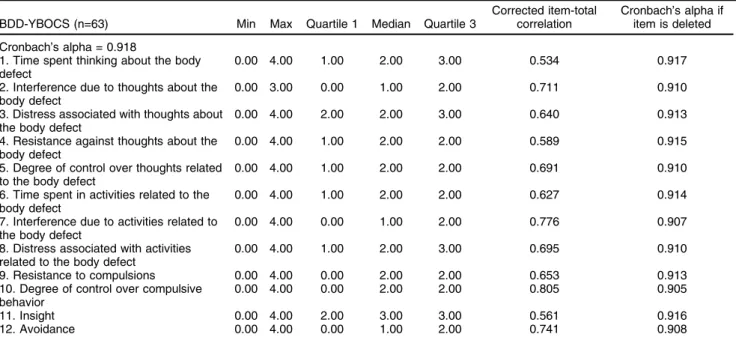
The instrument showed excellent internal consistency (Cronbach’s alpha = 0.918). All items favorably contrib-uted to the internal consistency of the scale (Table 1).
The BDD-YBOCS demonstrated excellent inter-rater (r= 0.944; ICC = 0.934; 95% confidence interval [95%CI] 0.843-0.973; po0.001) and intra-rater reliability (r= 0.999;
ICC = 0.999; 95%CI 0.998-1.000; po0.001).
Inter-rater reliability showed that 10% of the scores were outside the 95% limits of agreement (-4.5 to 7.2). The mean difference was 1.463.0. Mean scores ranged from 6.5 to 36.0. Intra-rater reliability revealed that 10% of the scores were outside the 95% limits of agreement (-0.6 to 0.6). The mean difference was 060.3. Mean scores ranged from 8 to 40.0.
There were significant differences in BDD-YBOCS scores between patients with and without BDD symptoms (po0.001), and among patients with different levels of
BDD severity (po0.001), as depicted in Table 2.
Patients without BDD symptoms had significantly lower BDD-YBOCS scores compared to those with BDD symptoms. Also, the mean BDD-YBOCS score of patients with mild/moderate BDD symptoms was significantly lower than that of patients with severe BDD symptoms (Figure 1).
A strong correlation (r = 0.781; p o0.001) was found
between the BDDE and BDD-YBOCS (Figure 2). The cutoff score of 19 for the BDD-YBOCS was determined using a ROC curve (Figure 3). The cutoff score was associated with a sensitivity of 86.5% and specificity of 73.1%, meaning that 73.1% of patients without BDD symptoms according to the BDD-YBOCS probably did not have BDD. The area under the ROC curve was 0.851, suggesting very good accuracy for discriminating between presence and absence of BDD symptoms.
Discussion
The BDD-YBOCS is a specific instrument that measures the severity of BDD symptoms.22It is a short and easy-to-administer scale that captures specific information about BDD symptoms.
In the present study, general guidelines for cross-cultural adaptation of quality of life instruments were followed to ensure the elaboration of an adequate version of the BDD-YBOCS in Brazilian Portuguese (Appendix 1, available online). Patients and health professionals with experience in the management of BDD patients partici-pated in the evaluation of this version.23
Table 1 Internal consistency analysis: statistical summary for BDD-YBOCS scores
BDD-YBOCS (n=63) Min Max Quartile 1 Median Quartile 3
Corrected item-total correlation
Cronbach’s alpha if item is deleted
Cronbach’s alpha = 0.918
1. Time spent thinking about the body defect
0.00 4.00 1.00 2.00 3.00 0.534 0.917
2. Interference due to thoughts about the body defect
0.00 3.00 0.00 1.00 2.00 0.711 0.910
3. Distress associated with thoughts about the body defect
0.00 4.00 2.00 2.00 3.00 0.640 0.913
4. Resistance against thoughts about the body defect
0.00 4.00 1.00 2.00 2.00 0.589 0.915
5. Degree of control over thoughts related to the body defect
0.00 4.00 1.00 2.00 2.00 0.691 0.910
6. Time spent in activities related to the body defect
0.00 4.00 1.00 2.00 2.00 0.627 0.914
7. Interference due to activities related to the body defect
0.00 4.00 0.00 1.00 2.00 0.776 0.907
8. Distress associated with activities related to the body defect
0.00 4.00 1.00 2.00 3.00 0.695 0.910
9. Resistance to compulsions 0.00 4.00 0.00 2.00 2.00 0.653 0.913
10. Degree of control over compulsive behavior
0.00 4.00 0.00 2.00 2.00 0.805 0.905
11. Insight 0.00 4.00 2.00 3.00 3.00 0.561 0.916
12. Avoidance 0.00 4.00 0.00 1.00 2.00 0.741 0.908
Thirty patients, who were interviewed to assess the cultural equivalence of the translated BDD-YBOCS,25
found the instrument easy to understand. The mean time to respond to the questionnaire was 10 min.
The Brazilian-Portuguese version of the BDD-YBOCS, validated in a sample of cosmetic surgery patients (n=63), shows excellent internal consistency (Cronbach’s alpha coefficient of 0.91 compared to 0.80 for the original measure),22 test-retest reliability of 0.93 (compared to 0.88 for the original instrument),22and intra-rater reliability of 0.99. ROC curve analysis indicated that a cutoff score of 19 for the BDD-YBOCS was able to discriminate patients with body dissatisfaction from those with BDD. This suggests that the BDD-YBCOS can be used to identify individuals who are dissatisfied with their physical appearance, but do not meet all diagnostic criteria for BDD. According to the authors of the original BDD-YBOCS,22the instrument should only be applied after checking if an individual meets all BDD criteria. The BDD-YBOCS assesses the severity of BDD symp-toms; it was compared with a similar tool to be validated. To
assess the construct validity, the literature recommends evaluating the relationships of comparable constructs with similar operational concepts.26 The BDDE27 is the only instrument translated and validated for Brazilian Portuguese that measures the degree of dissatisfaction with a given physical feature and contributes to the diagnosis of BDD.28 The strong correlation observed between the BDD-YBOCS and the BDDE indicates that both instruments identify the pattern of neurocognitive deficits (obsessive thoughts and compulsive behaviors) present in BDD. The assessment of discriminant validity showed a significant difference in mean BDD-YBOCS scores between patients with and without BDD symptoms and among patients with different levels of BDD symptoms.
In the present study, 30 and 56 patients reported high scores (more severe BDD symptoms) on item 8 (distress) and item 11 (insight), respectively, which are the factors that most strongly interfere with the global functioning of BDD patients. The level of subjective distress and psychosocial impairment associated with physical appear-ance may be the most important factor to be evaluated in cosmetic surgery patients.1Conversely, it is hard to assess the degree of insight, because patients are often convinced Table 2 Statistical summary of BDD-YBOCS scores in patients with and without BDD symptoms and patients with different levels of BDD severity
Mean SD Min Max Quartile 1 Median Quartile 3 n
BDD* 20.5 9.5 3.0 40.0 11.0 22.0 26.0 63
With symptoms 13.4 7.9 3.0 28.0 7.0 10.0 21.0 26
Without symptoms 25.5 7.1 10.0 40.0 21.0 24.0 30.5 37
BDD severityw 20.5 9.5 3.0 40.0 11.0 22.0 26.0 63
Absent 13.4a 7.9 3.0 28.0 7.0 10.0 21.0 26
Mild/moderate 23.4b 6.5 10.0 37.0 21.0 23.0 27.0 27
Severe 31.2c 5.5 24.0 40.0 25.8 31.0 35.8 10
ANOVA = analysis of variance; BDD = body dysmorphic disorder; BDD-YBOCS = Yale-Brown Obsessive Compulsive Scale modified for Body Dysmorphic Disorder; SD = standard deviation.
*Kolmogorov-Smirnov test (p = 0.332),t= 6.34 (po0.001).
wKolmogorov-Smirnov test (p = 0.432), ANOVA: F
2.60= 27.33 (po0.001).
Different letters indicate significant differences between means. Duncan’s multiple range test (po0.05).
Figure 1 Mean Yale-Brown Obsessive Compulsive Scale modified for Body Dysmorphic Disorder (BDD-YBOCS) scores and respective 95% confidence intervals for patients with different levels of body dysmorphic disorder (BDD) severity.
about the presence of the perceived defect and have fixed ideas about their perception. However, this belief appears to be more related to an overvaluation of the defect than to a delusional perception. This may explain why item 11 (insight) contributed the least to the internal consistency of the BDD-YBOCS - in other words, the exclusion of item 11 would result in a Cronbach’s alpha of 0.916, which is very similar to 0.918 (Table 1). This result is consistent with the original findings of Phillips et al.,22 and may reflect the difficulty in evaluating this variable. Nevertheless, insight is an important part of clinical investigations, and degree of insight plays a role in predicting treatment response and prognosis in BDD patients.
Items 11 and 12 assess the degree of insight and avoidance behavior associated with appearance, respec-tively, and differentiate the BDD-YBOCS from the YBOCS.22 Individuals with BDD are unable to see the ‘‘bigger picture’’ as they are over-focused on small details. This neural dynamics seems to have an impact on thinking and overall perception, which in individuals with BDD appears fragmen-ted, affecting their level of insight.18 In addition, avoidance and social withdrawal have been appointed as contributors to BDD severity1,10and chronicity.31-33
In the study population, the prevalence of BDD symptoms was 58.7%; 73% of patients began to experi-ence body dissatisfaction in adolescexperi-ence and 41.3% spent more than 3 hours daily with appearance-related concerns and behaviors, showing increased subjective distress.
The mean age (34.7610.6 years) of the participants at the time of the interview was not associated with the onset of BDD symptoms, which is consistent with the original study.22It is interesting to note that a similar amount of time elapsed between the onset of body dissatisfaction
and the patient’s decision to seek either cosmetic treatment (about 15 years) or mental health treatment, showing different profiles of this population. This means that patients with BDD who seek cosmetic surgery will not necessarily seek psychiatric treatment later.34
In conclusion, the translated BDD-YBOCS was suc-cessfully adapted and validated for Brazilian Portuguese; it is a reliable instrument, showing face, content, and construct validity.
Disclosure
The authors report no conflicts of interest.
References
1 de Brito MJ, Nahas FX, Ortega NR, Corda´s TA, Dini GM, Neto MS, et al. Support system for decision making in the identification of risk for body dysmorphic disorder: a fuzzy model. Int J Med Inform. 2013;82:844-53.
2 Phillips KA, Wilhelm S, Koran LM, Didie ER, Fallon BA, Feusner J, et al. Body dysmorphic disorder: some key issues for DSM-V. Depress Anxiety. 2010;27:573-91.
3 American Psychiatric Association. Obsessive-compulsive and related disorders. In: American Psychiatric Association. Diagnostic and Sta-tistical Manual of Mental Disorders, Fifth Edition (DSM-5) Arlington: American Psychiatric Publishing; 2013. p. 235-64.
4 Phillips KA. Suicidality in body dysmorphic disorder. Prim Psychiatry. 2007;14:58-66.
5 Fang A, Hofmann SG. Relationship between social anxiety disorder and body dysmorphic disorder. Clin Psychol Rev. 2010;30:1040-8. 6 Reese HE, McNally RJ, Wilhelm S. Reality monitoring in patients with
body dysmorphic disorder. Behav Ther. 2011;42:387-98.
7 Phillips KA, Menard W. Suicidality in body dysmorphic disorder: a prospective study. Am J Psychiatry. 2006;163:1280-2.
8 Michalczuk R, Bowden-Jones H, Verdejo-Garcia A, Clark L. Impul-sivity and cognitive distortions in pathological gamblers attending the UK National Problem Gambling Clinic: a preliminary report. Psychol Med. 2011;41:2625-35.
9 Crerand CE, Franklin ME, Sarwer DB. Body dysmorphic disorder and cosmetic surgery. Plast Reconstr Surg. 2006;118:167e-80e. 10 Felix GA, de Brito MJ, Nahas FX, Tavares H, Corda´s TA, Dini GM, et al.
Patients with mild to moderate body dysmorphic disorder may benefit from rhinoplasty. J Plast Reconstr Aesthet Surg. 2014;67:646-54. 11 Shridharani SM, Magarakis M, Manson PN, Rodriguez ED.
Psy-chology of plastic and reconstructive surgery: a systematic clinical review. Plast Reconstr Surg. 2010;126:2243-51.
12 Picavet VA, Prokopakis EP, Gabrie¨ls L, Jorissen M, Hellings PW. High prevalence of body dysmorphic disorder symptoms in patients seeking rhinoplasty. Plast Reconstr Surg. 2011;128:509-17. 13 Dyl J, Kittler J, Phillips KA, Hunt JI. Body dysmorphic disorder and
other clinically significant body image concerns in adolescent psy-chiatric inpatients: prevalence and clinical characteristics. Child Psychiatry Hum Dev. 2006;36:369-82.
14 Sarwer DB, Wadden TA, Pertschuk MJ, Whitaker LA. Body image dissatisfaction and body dysmorphic disorder in 100 cosmetic surgery patients. Plast Reconstr Surg. 1988;101:1644-9.
15 Veale D, De Haro L, Lambrou C. Cosmetic rhinoplasty in body dys-morphic disorder. Br J Plast Surg. 2003;56:546-51.
16 Alavi M, Kalafi Y, Dehbozorgi GR, Javadpour A. Body dysmorphic disorder and other psychiatric morbidity in aesthetic rhinoplasty candidates. J Plast Reconstr Aesthet Surg. 2011;64:738-41. 17 Vindigni V, Pavan C, Semenzin M, Grane` S, Gambaro FM, Marini M,
et al. The importance of recognizing body dysmorphic disorder in cosmetic surgery patients: do our patients need a preoperative psy-chiatric evaluation?. Eur J Plast Surg. 2002;25:305-8.
18 de Brito MJ, Nahas FX, Corda´s TA, Felix GA, Neto MS, et al. Understanding the psychopathology of body dysmorphic disorder in cosmetic surgery patients: a literature review. Rev Bras Cir Plast. 2014;29:599-608.
19 da Silva DB, Nahas FX, Bussolaro RA, de Brito MJ, Ferreira LM. The increasing growth of plastic surgery lawsuits in Brazil. Aesthetic Plast Surg. 2010;34:541-2.
20 de Brito MJ, Nahas FX, Ferreira LM. Should plastic surgeons operate on patients diagnosed with body dysmorphic disorder?. Plast Reconstr Surg. 2012;129:406e-7e.
21 Morselli PG, Boriani F. Should plastic surgeons operate on patients diagnosed with body dysmorphic disorder? Plast Reconstr Surg. 2012;130:620e-2e; author reply 622e.
22 Phillips KA, Hollander E, Rasmussen SA, Aronowitz BR, DeCaria C, Goodman WK. A severity rating scale for body dysmorphic disorder: development, reliability, and validity of a modified version of the Yale-Brown Obsessive Compulsive Scale. Psychopharmacol Bull. 1997;33: 17-22.
23 Guillemin F, Bombardier C, Beaton D. Cross-cultural adaptation of health-related quality of life measures: literature review and proposed guidelines. J Clin Epidemiol. 1993;46:1417-32.
24 Guillemin F. Cross-cultural adaptation and validation of health status measures. Scand J Rheumatol. 1995;24:61-3.
25 Beaton DE, Bombardier C, Guillemin F, Ferraz MB. Guidelines for the process of cross-cultural adaptation of self-report measures. Spine (Phila Pa 1976). 2000;25:3186-91.
26 Gandek B, Ware JE Jr. Methods for validating and norming translations of health status questionnaires: the IQOLA project approach. Interna-tional Quality of Life Assessment. J Clin Epidemiol. 1998;51:953-9.
27 Jorge RT, Sabino Neto M, Natour J, Veiga DF, Jones A, Ferreira LM. Brazilian version of the body dysmorphic disorder examination. Sao Paulo Med J. 2008;126:87-95.
28 Phillips KA. Body image and body dysmorphic disorder. In: Fairburn CG, Brownell KDBody image: a handbook of theory, research, and clinical practice. New York: Guilford Press; 2004. p.113-7. 29 Goodman WK, Price LH, Rasmussen SA, Mazure C, Fleischmann RL,
Hill CL, et al. The Yale-Brown Obsessive Compulsive Scale. I. Devel-opment, use, and reliability. Arch Gen Psychiatry. 1989;46:1006-11. 30 Goodman WK, Price LH, Rasmussen SA, Mazure C, Delgado P,
Heninger GR, et al. The Yale-Brown Obsessive Compulsive Scale. II. Validity. Arch Gen Psychiatry. 1989;46:1012-6.
31 Kelly MM, Walters C, Phillips KA. Social anxiety and its relationship to functional impairment in body dysmorphic disorder. Behav Ther. 2010;41:143-53.
32 Bjornsson AS, Didie ER, Phillips KA. Body dysmorphic disorder. Dialogues Clin Neurosci. 2010;12:221-32.
33 Marques L, LeBlanc N, Robinaugh D, Weingarden H, Keshaviah A, Wilhelm S. Correlates of quality of life and functional disability in individuals with body dysmorphic disorder. Psychosomatics. 2011;52: 245-54.