Brazilian standard NBR 7212 sets a time limit of 150 minutes for a concrete load to be discharged in full. In practice, situations arise where mixer trucks have to hold their load for much longer periods. The main aim of this paper is to assess changes in the compressive strength of concrete
that is used when the time limit for mixing and transport speciied by standard NBR7212 is exceeded. To this end, concrete was mixed for a period
of 6 hours, and a superplasticizer was added at intervals to restore slump to its initial value. Results show that compressive strength is not affected
by the prolongued mixing in the conditions of this research.
Keywords: prolonged mixing; ready-mixed concrete; compressive strength; superplasticizer.
A norma NBR 7212, para execução de concreto dosado em central, estipula o tempo máximo para que o concreto seja descarregado (aplicado)
completamente em 150 min; porém, na prática, ocorrem situações onde caminhões icam carregados por tempos bem acima desse limite. O
objetivo principal deste artigo consiste na avaliação do comportamento do concreto em relação à sua resistência à compressão, quando utilizado
posterior ao tempo máximo de mistura e transporte especiicado pela norma. Para tal, adotou-se como procedimento o restabelecimento do aba
-timento à condição inicial com aditivo superplastiicante por um período de 6 horas. Os resultados mostram que não houve perda de resistência
à compressão para esse tempo de mistura prolongada, nas condições dessa pesquisa.
Palavras-chave: mistura prolongada; concreto usinado; resistência à compressão; superplastiicante.
by Brazilian Standard NBR 7212 for mixing and
transporting concrete?
O limite de tempo especiicado pela NBR 7212, para
mistura e transporte do concreto, pode ser ultrapassado?
E. POLESELLO a [email protected]
A. B. ROHDEN b [email protected]
D. C. C. DAL MOLIN c [email protected]
A. B. MASUERO d [email protected]
a Universidade Federal do Rio Grande do Sul, Departamento de Engenharia Civil, Escola de Engenharia, Núcleo Orientado para Inovação da Ediicação, [email protected], Rua Osvaldo Aranha, 99 - Centro, Porto Alegre / RS, Brasil.;
b Universidade Federal do Rio Grande do Sul, Departamento de Engenharia Civil, Escola de Engenharia, Núcleo Orientado para Inovação da Ediicação, [email protected], Rua Osvaldo Aranha, 99 - Centro, Porto Alegre / RS, Brasil.;
c Universidade Federal do Rio Grande do Sul, Departamento de Engenharia Civil, Escola de Engenharia, Núcleo Orientado para Inovação da Ediicação, [email protected], Rua Osvaldo Aranha, 99 - Centro, Porto Alegre / RS, Brasil.;
d Universidade Federal do Rio Grande do Sul, Departamento de Engenharia Civil, Escola de Engenharia, Núcleo Orientado para Inovação da Ediicação, [email protected], Rua Osvaldo Aranha, 99 - Centro, Porto Alegre / RS, Brasil.
Received: 02 Nov 2012 • Accepted: 23 Dec 2012 • Available Online: 05 Apr 2013
Abstract
1. Introduction
Today, considerations of cost and ease of use as well as market requirements for improved proportioning, uniformity and homoge
-neity, much of the concrete used in Brazil is central-mixed. How
-ever, mixing plants pose problems of their own because they gen -erate considerable amounts of waste and are therefore a cause for environmental concern. Most concrete waste is the result of
leftover concrete that is rejected at site for failing to comply with the time limits for placement after load into mixer trucks speciied by technical standards. Brazilian Standard NBR 7212 for ready-mixed
concrete sets a limit of 90 minutes for transport between the mixing plant to the construction site and a limit of 150 minutes for concrete
discharge. Some of the factors that may affect the time for con
-crete use include cement hydration reactions, the onset of setting and a reduction in workability observed in the irst few hours, all of which may make placement and consolidation more dificult.
1.1 Bibliographical review
Ready-mixed concrete should be transported to the construction
site in the shortest possible time to minimize hardening and loss
of workability and allow appropriate consolidation and inishing
operations after casting. Under normal circumstances, losses in
workability in the irst 30 minutes after the hydration of Portland
cement are negligible. When concrete is kept at low mixing speeds
or remixed periodically, some slump loss may be observed after some time, which usually poses no risk to the placement or com
-paction of fresh concrete in the irst 90 minutes. Concrete work
-ability determines the amount of effort required to handle a given amount of fresh concrete with a minimum loss of homogeneity. Handling refers to initial operations such as placement, compac
-tion and inishing (MEHTA; MONTEIRO, 2008).
When subject to high temperatures, fresh concrete hardens faster when compared to concrete exposed to normal conditions. This
faster setting time reduces workability during placement, com
-paction and inishing operations. In most situations, the interval between initial and inal set is reduced as curing temperatures in
-crease, a phenomenon related to the increase in cement hydration rates, particularly in the irst few instants (HEIKAL et al., 2005). The major factors that inluence concrete workability are evapo
-ration, hyd-ration, absorption and agitation. Environmental condi
-tions may cause evaporation and hydration to accelerate over time. (DEWAR; ANDERSON, 1992). Slump loss in fresh concrete is a normal phenomenon and may be deined as a loss of low characteristics over time. This property of concrete in particularly
important for central-mixed concrete, because proportioning and initial mixing take place in the mixing plant, while placement and/or
compaction will only take place minutes or even hours later, when the mixer truck arrives at the construction site (WEIDMANN et al., 2007). Prolonged mixing accelerates both hardening and the rate of slump loss, which is a problem in most situations, particularly
when long transportation periods are involved, as is the case with
ready-mixed concrete (ERDOĞDU, 2005).
Kirca et al. (2002) investigated concrete with strength values of 25.0 and 35.0 MPa and found signiicant slump losses when mixing
periods increased, with greater losses reported for concrete
com-positions with higher cement consumption because of its hydration
mixing times were extended and no retempering was used. How
-ever, to make placement easier and allow suitable inishing opera
-tions, slump losses are often corrected by adding water. Teixeira and Pelisser (2007) carried out a study in a mixing plant using a concrete composition with a predeined strength of 20.0 MPa. They measured strength losses after retempering and found a re -duction of 34% in strength after 2.5 hours and of 44% after 4 hours.
Erdoğdu (2005) also observed this drop in compressive strength
after retempering was used in concrete compositions that had been mixed for up to 150 minutes and in which water was added at 30-minute intervals to restore slump values. The drop is dramatic
in the irst 90 minutes of mixing, and then slows down afterwards.
After 150 minutes of mixing, the loss of strength is greater than 40% when compared to initial values. The practice of retempering should be abandoned as superplasticizers provide a useful alter-native that will not affect the other properties of concrete.
Admixtures generate chemical interactions with the binders in the concrete, thus affecting its performance both in the fresh and the
hardened state. They may be used to improve the workability of the fresh mix or the strength and durability of hardened concrete.
Superplasticizers are a more useful alternative to other chemical substances because of the range of improvements that can be
achieved from their use (COLLERPADI, 2005).
Kirca et al. (2002) attempted to simulate the reality of a construc
-tion site, where ready-mixed concrete is used and transported
in mixer trucks. Concrete mixes with two different compressive
strength levels were prepared in a laboratory and kept under pro
-longed mixing for up to 4 hours, with samples analyzed every hour. The initial slump of 150 mm was restored at speciic intervals by means of four different processes: adding water only, and adding
water with three different superplasticizer concentrations (1.5%,
3.0% and 4.5% by weight of water). The addition of a superplas -ticizer meant that less amount of water was required to restore
slump values. Therefore, the inal w/c ratios of the mixes with the superplasticizer admixture are lower than when only water was used. Consequently, the reduction in compressive strength in
concrete where slump was restored with the aid of a superplasti-cizer is smaller than the one observed when plain water is used. In fact, in some cases minor increases in compressive strength were
observed in concrete adjusted with superplasticizer (particularly in
concentrations of 4.5%).
Erdoğdu (2005) found an increase in compressive strength in con -crete that was mixed for 150 minutes and whose slump was main-tained with the addition of a superplasticizer at 30-minute intervals. An increase of 30% in compressive strength was observed after 90 minutes of mixing and of 10% when compared with the reference sample, which was mixed for 150 minutes.
Superplasticizers offer a good choice to improve concrete
proper-ties, particularly when slump values need to be maintained over time. They could be used alongside retempering, if necessary. In real life, situations arise when it is necessary to restore slump values. However, when water is used concrete properties are af -fected, as several studies attest. Therefore, the use of a super-plasticizer is a sound alternative.
1.2 Research signiicance
2.1 Materials
2.1.1 Cement
This study used blended Portland cement (CP II Z 32). Its proper -ties are shown in Table 1.
2.1.2 Fine aggregate
Quartz sand was used a ine aggregate, quarried from a local river with speciic mass of 2.62 kg/dm³ according to Brazilian Standard NBR NM 45 (2006), maximum nominal size of 4.75 mm and ine -ness modulus of 2.54 according to Brazilian Standard NBR NM 248 (2003).
2.1.3 Coarse aggregate
Two types of coarse aggregates of basaltic origin were used, iden
-tiied as crushed aggregate #1 and crushed aggregate #0, with maximum nominal size of 19mm and 9.5mm and ineness modu
-lus of 6.82 and 5.70, respectively, according to Brazilian Standard NBR NM 248 (2003). Speciic masses were determined accord
-ing to Brazilian Standard NBR NM 45 (2006), with 2.80 kg/dm³ for crushed aggregate #1 and 2.82 kg/dm³ for crushed aggregate #0.
2.1.4 Water and admixture
Mains water from the city of Porto Alegre was used. The admix -tures used in this research were a standard plasticizer, designed
for concrete production, with mean density of 1.05 g/cm³ (manu
-facturer’s data) and a polycarboxylate-based superplasticizer used to correct slump, with mean density of 1.08 g/cm³, both with normal
setting times.
2.2 Test Program
Three w/c ratios and ive mixing periods were used as control vari
-ables in this study. Concrete mixes were prepared in a laboratory or 5 hours because of delays in transportation or unloading, which
means that the time limits speciied by the standard are exceeded.
In such cases, two situations arise:
a) The concrete is accepted by the site engineer for the simple
reason that no changes in concrete temperature are noticed, in
which case it is likely that slump values will be corrected by add -ing water. This, in turn, will affect w/c ratios and the mechanical
properties and durability of concrete, rendering this approach
unacceptable;
b) The concrete is returned to the mixing plant, which must ind a
destination for this rejected concrete. This creates other prob-lems given that this concrete reject poses an environmental
hazard. The problem is compounded by the large volumes in
-volved and the inancial losses incurred.
Faced with these choices, users need to decide whether to use concrete in these conditions. This is a serious issue as there is no
conventional wisdom regarding the inal properties of concrete that is placed after the time limit speciied by the standard. For this rea
-son, and also because of the lack of data and studies that analyze
the time limit for mixing and transporting concrete, it is imperative
to advance and further expand scientiic knowledge on the impact
of mixing times on the properties of concrete mixes that are used
when the time speciied by the standard is exceeded.
This aim of this study was to assess the compressive strength
properties of concrete that is used when the time limit of 150
min-utes for mixing and transporting after the irst contact of cement with water, as speciied in Brazilian Standard NBR 7212, is ex
-ceeded and concrete slump is maintained by adding a polycarbox
-ylate-based superplasticizer.
2. Materials and test program
The selection and choice of the materials used in the research took
into account the reality of concrete mixing plants in the city of Porto Alegre and surrounding areas area. All materials were assayed in the laboratories of the Science and Technology Foundation of Rio Grande do Sul (CIENTEC).
Table 1 – Characteristics of Portland cement compost used
Characteristics and properties
Manufacturer
information
obtained
Values
Specifications by NBR 11578
(ABNT, 1991)
CaO
MgO
SO
3Loss on ignition
2
Specific surface - blaine (cm /g)
3
Specific mass (kg/dm )
Fineness on sieve nº 200
Initial setting time (min)
Final setting time (min)
Compressive strength (MPa) 3 days
Compressive strength (MPa) 7 days
Compressive strength (MPa) 28 days
mixing times might result in more dramatic changes in concrete properties.
Concrete slump was measured according to Brazilian standard
NBR NM 67 (1998) to determine fresh concrete workability. The test program attempted to maintain the workability of concrete by adding a polycarboxylate superplasticizer at speciic intervals
along a period of 6 hours after concrete mixing started, which is
when cement particles irst come into contact with water. In laboratory conditions, the materials were mixed for five min
-utes to ensure materials were thoroughly mixed before mea
-suring concrete workability. Slump was then measured at the
intervals of 120 min (2h), 180 min (3h), 240 min (4h), 300 min (5h) and 360 min (6h) along rest (15 minutes) and agitation
cycles (5 minutes). After each measurement, the superplasti -cizer was added to restore slump to its original value (120±20 mm) and test specimens (TS) were cast for each time interval. It should be noted that the time intervals for the slump test
checks in the mixer trucks are slightly different from the inter
-vals used in the laboratory mixer. This was necessary because
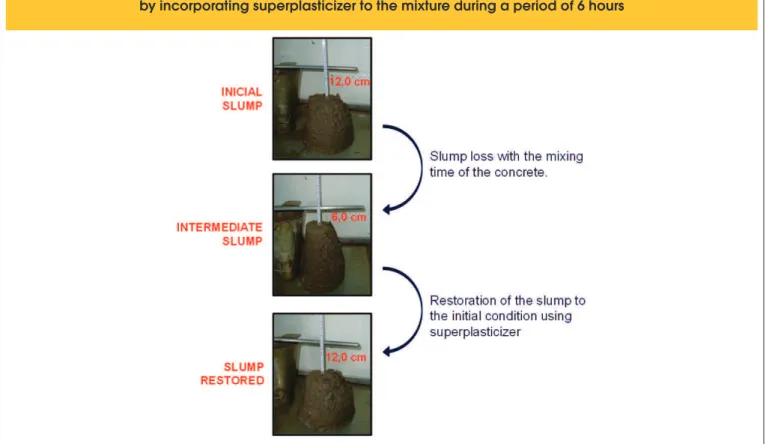
the drums in mixer trucks must be kept revolving. In order to simulate real life construction site conditions, the drum was kept at 2 rpm during the rest intervals. Just before measuring slump, drum speed was increased to 16 rpm. The process of restoring slump can be seen in figure 2.
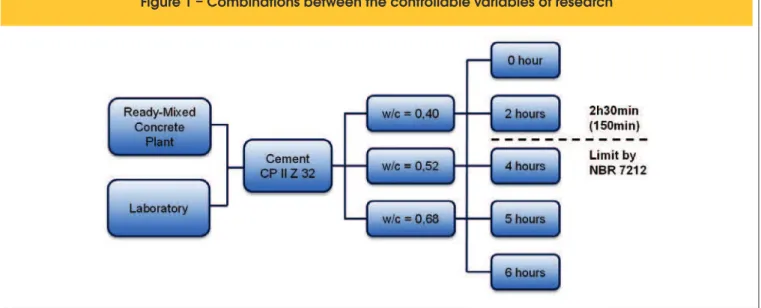
and in real life conditions in a ready-mixed concrete plant for all
control variables selected, resulting in a total of 30 compositions,
as shown in igure 1.
The cement type used is readily available from mixing plants in the city of Porto Alegre and surrounding areas, which includes the plant in which the laboratory tests were reproduced in real
life production. The three w/c ratios used were selected
be-cause they correspond to different cement consumption thresh -olds and therefore provide a better assessment of compressive
strength behavior in three different levels. As it was necessary
reproduce the test results in real life conditions, the concentra-tions used followed the patterns used at the mixing plant
(ta-ble 2), characterized by the amounts of cement, natural sand, crushed aggregate #0, crushed aggregate #1, water and super -plasticizer admixture. The coarse aggregate consists of 85% crushed aggregate 19mm and 15% crushed aggregate 9.5mm.
The concentration of superplasticizer was 0.6% by weight of ce -ment and slump was set at 120±20mm.
Tests were carried out in freshly mixed concrete, after 6 hours of
mixing and at intervals in between these limits to provide a bet-ter picture of concrete strength behavior. Two-hour inbet-tervals were
used. The test program allowed a ifth sample to be tested so an
interval of 5 hours of mixing was used (instead of 3 hours, which was another possible sampling interval) as it was felt that longer
Figure 1 – Combinations between the controllable variables of research
Table 2 – Dosages of the concretes used in this study
Mix proportion
1 : m
Unit mix proportion,
in mass
level (%)
Mortar
ratio
w/c
3
Amount of materials per m (kg)
Cement
aggregate
Fine
aggregate
Coarse
Water
1 : 3,2
1 : 4,5
1 : 6,2
514
395
300
206
205
204
660
776
869
1000
997
996
1 : 1,28 : 1,95
1 : 1,97 : 2,53
1 : 2,90 : 3,32
54
54
54
After casting, TS were stored and sheltered with a plastic liner for
the irst 24 hours to prevent water loss by evaporation. They were then removed from the molds and labeled. After labeling they were
placed in a tank with saturated lime water at 23±2ºC and cured in a
controlled temperature chamber at the NORIE/UFRGS laboratory until the test age, 28 days, was reached, as speciied by Brazilian
Standard NBR 5738 (2003).
Compressive strength, the most important property of concrete,
was measured at 28 days, according to Brazilian Standard NBR
5739 (2007). A total of 15 TS were cast for each composition (three TS for each mixing interval). The surface of the TS is ground one
day before the compressive strength test to ensure the planeness and perpendicularity of test surfaces. Compressive strength tests
were performed in a servo controlled Shimadzu press of 2.000 kN
at a compressive speed of 0.45 MPa/s, which was kept constant
through the test.
Figure 2 – Checking the slump and restoration to the initial condition (120±20mm)
by incorporating superplasticizer to the mixture during a period of 6 hours
3. Results and discussion
3.1 Compressive strength
Polesello (2012) recorded all individual results for compressive
strength as well as standard deviation values and their
corre-sponding coeficients of variance. Figures 3 and 4 illustrate the
mean values of compressive strength for concrete sampled in the
laboratory and in the mixing plant, respectively.
Results show that even when a concrete sample is mixed for a period of up to 6 hours, using a superplasticizer as described
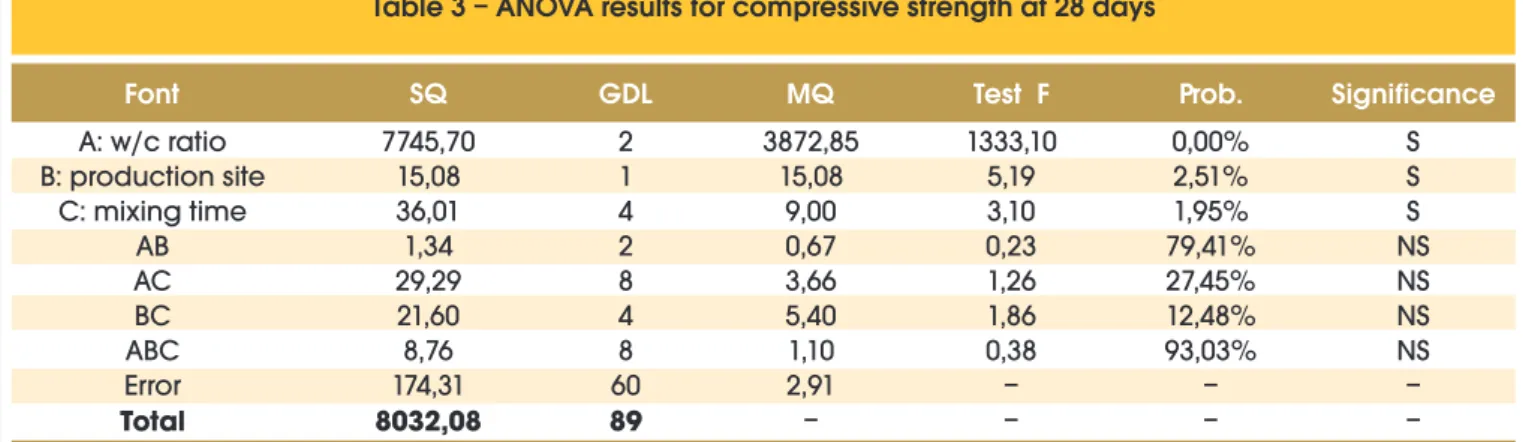
in this study, its mean compressive strength value at 28 days is maintained. To check for the inluence of w/c ratios, produc -tion site and mixing periods, as well as for interac-tions of these variables on the results, individual values were checked using
analysis of variance (ANOVA). The results of this analysis are
shown in table 3.
ANOVA results show a statistically signiicant inluence for the
three control variables (w/c ratio, production site and mixing time)
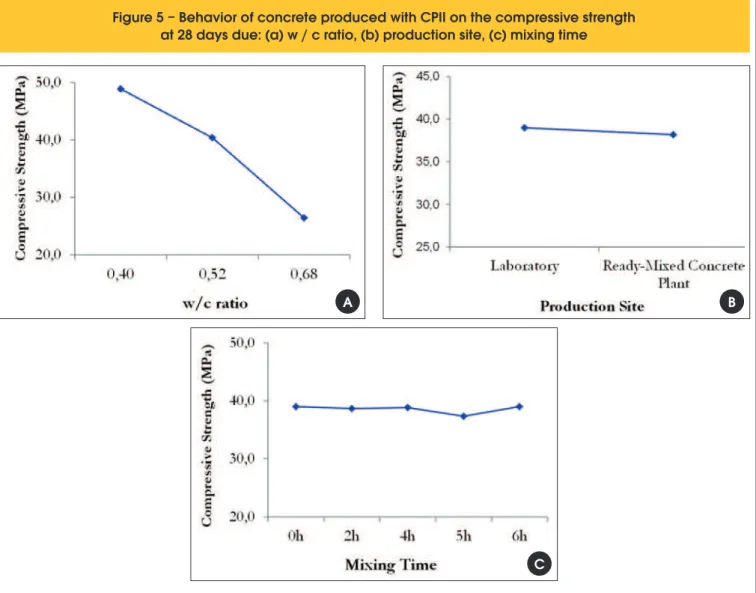
on compressive strength at 28 days. The isolated behavior of each of these variables is shown in igure 5.
Figure 5a presents the effect of the w/c ratio in isolation. It shows that compressive strength values decrease as the w/c ratios
in-crease, a conirmation of conventional wisdom in the technical ield. Mixing times display a signiicant effect as illustrated in ig -ure 5c. The mean results in the 5-hour interval show a slight drop
in compressive strength followed by an increase. After 6 hours, compressive strength was identical to the one in freshly mixed con
-crete. With reference to the statistical signiicance of the produc
-tion site factor, this could be explained by the fact that the volume
of concrete mixed in real-life conditions is much larger than in a
laboratory, which results in differences in evaporation and mixing
processes.
The fact that the mean compressive strength at 28 days was main -tained in concrete mixed for a period of 6 hours could be explained
by the loss of water to the environment, which would cause w/c ratios in the mixture to drop. Kirca et al (2002) recorded this loss of water in their study, and found an increase in compressive strength
in two concrete compositions of different classes, C25 and C35,
Figure
4 – Average results of compressive strength at 28 days of concrete produced in ready-mixed concrete plant
Table 3 – ANOVA results for compressive strength at 28 days
Font
SQ
GDL
MQ
Test F
Prob.
Significance
A: w/c ratio
B: production site
C: mixing time
AB
AC
BC
ABC
Error
Total
7745,70
15,08
36,01
1,34
29,29
21,60
8,76
174,31
8032,08
3872,85
15,08
9,00
0,67
3,66
5,40
1,10
2,91
–
1333,10
5,19
3,10
0,23
1,26
1,86
0,38
–
–
0,00%
2,51%
1,95%
79,41%
27,45%
12,48%
93,03%
–
–
S
S
S
NS
NS
NS
NS
–
–
2
1
4
2
8
4
8
60
89
when kept in prolonged mixing for 4 hours. According to these
re-searchers strength at 28 days increased by 15% and 27%, respec
-tively. Alhozaimy (2007) investigated real- life conditions in the delivery of ready-mixed concrete and also observed that the fall in
slump values observed between the arrival of the mixer truck at the
construction site and midway through the unloading operation was accompanied by a small increase in strength when no retempering
was used. In the studies of Erdoğdu,(2005), there was an increase in compressive strength of 15% at 28 days for concrete mixed for
150 minutes with no retempering. When a superplasticizer was
used to correct slump values, according to the methodology used in the present study but for shorter intervals, of up to 150 minutes, increases in compressive strength slightly greater than 10% at 90 minutes and approximately 8% at the end of 150 minutes were
A
B
C
Figure 5 – Behavior of concrete produced with CPII on the compressive strength
at 28 days due: (a) w / c ratio, (b) production site, (c) mixing time
Table 4 – Slumps, environmental conditions and slump loss during 2h
Production
site
w/c
Initial Final
Slump (mm)
Temp. ( C)
ohumidity (%)
Relative
Loss (mm)
Laboratory
Ready-mixed
concrete plant
89%
95%
73%
83%
81%
98%
w/c = 0,68
w/c = 0,52
w/c = 0,40
w/c = 0,68
w/c = 0,52
w/c = 0,40
50
50
60
40
45
35
120
140
130
120
125
120
70
90
70
80
80
85
recorded. A possible reason for this behavior (i.e. maintenance or
increase in compressive strength) may be the continuous agitation of concrete during the hydration phase, which may cause the initial hydration products (larger and more fragile) to break down.
3.2 Slump loss and superplasticizer consumption
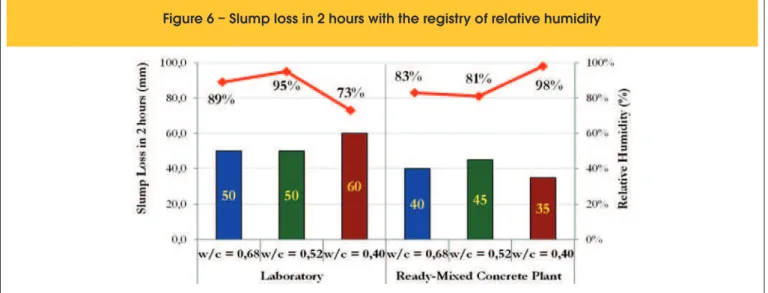
Slump loss in concrete occurs at a speciic rate that is affected mainly by time, temperature, concrete composition and the type of additions used (MEHTA; MONTEIRO, 2008). Table 4 lists ini -tial slump values and their respective decrease over a period of 2 hours, when no superplasticizer was added, alongside concrete
production conditions. The loss recorded in the irst two hours can be better seen in igure 6.
As expected, for lower w/c ratios and therefore greater cement consumption, a greater decrease in slump is observed. In situa-tions when this decrease was the same or smaller, for different w/c
ratios, the inluence of relative humidity on slump loss is notice
-able, as shown in igure 6.
After 2 hours of mixing, the superplasticizer was added to the mix
at the intervals speciied above to restore slump to its initial value.
The slump measured at each time as well as increases resulting
from the addition of the superplasticizer for the laboratory samples and the mixing plant can be seen in igures 7 and 8, respectively.
Slump behavior along the mixing interval was similar at both
production sites. However, in laboratory conditions, inal slump
values show smaller differences, because it is easier to visualize the concrete in the mixer at the moment of adding the superplas-ticizer. It is also noticeable that slump losses tend to increase as longer mixing periods are used. This happens because at the end
of the test, slump is more affected by the addition and less by the
water content.
The concentrations of superplasticizer used (by weight of ce -ment) to correct slump values along the test period of 6 hours are
shown in igures 9 and 10. It should be remembered that the use
of additions such as plasticizers or superplasticizers can affect setting times.
More superplasticizer was needed to restore slump to its initial
val-Figure 6 – Slump loss in 2 hours with the registry of relative humidity
ue in the concrete prepared in the mixing plant, which also tends to require higher concentrations of admixture as mixing times in-creased. The total concentration of superplasticizer used until the time limit of 6 hours in both test settings fell within the limits
speci-ied by the manufacturer for this addition (between 0.2% to 1.0%).
4. Conclusions
The results for the tests with ready-mixed concrete and in laboratory
conditions indicate that, for the methods and materials in this test, it is possible to use concrete that has been mixed for periods that
Figure
8 – Slump and increase in slump by the addition of the superplasticizer
for concrete produced in the ready-mixed concrete plant, during the 6 hours of mixing
Figure 9 – Percentages of admixtures used in concrete produced in the laboratory
exceed the time limits speciied by Brazilian Standard NBR 7212, as long as that the concrete workability is maintained by adding a
superplasticizer under constant agitation and no water is added until
concrete placement. Further studies with other concrete types and
mixing temperatures, among other variables, can be performed to
consolidate the procedures used in this test and contribute signii
-cantly with decisions made in real life conditions regarding the possi
-bility of accepting or rejecting concrete shipments when mixing and transportation periods do not comply with the standard.
5. Acknowledgements
The authors would like to thank NORIE (Research Group for In
-novation in Construction) of the Federal University of Rio Grande
do Sul (UFRGS) for their support with the tests and to the Concreto
Redimix do Brasil S/A company for their support and the opportu
-nity to perform studies in situ.
6. References
[01] ALHOZAIMY, A. M. Effect of retempering on the compressive strength of ready-mixed concrete in hot-dry environments. Cement & Concrete
Composites 29, 124-127, 2007.
[02] ASSOCIAÇÃO BRASILEIRA DE NORMAS TÉCNICAS NBR 5738: Concreto - Procedimento para moldagem
e cura de corpos de prova. Rio de Janeiro: ABNT, 2003. 3p.
[03] ______ NBR 5739: Ensaios de compressão de corpos-de-prova cilíndricos. São Paulo, 2007. 9p. [04] ______ NBR 7212: Execução de concreto dosado
em central. Rio de Janeiro: ABNT, 1984. 7p.
[05] ______ NBR 11578: Cimento Portland composto.
Rio de Janeiro: ABNT, 1991. 5 p.
[06] ______ NBR NM 45: Agregados – Determinação da massa unitária e do volume de vazios. Rio de Janeiro: ABNT, 2006. 8p.
[07] ______ NBR NM 67: Concreto – Determinação da consistência pelo abatimento do tronco de cone. Rio de Janeiro: ABNT, 1998. 8p.
[08] ______ NBR NM 248: Agregados – determinação da composição granulométrica. Rio de Janeiro: ABNT, 2003. 6p.
[09] COLLERPADI, M. Admixtures-enhancing concrete
performance. 6th International Congress, Global Construction, Ultimate Concrete Opportunities,
Dundee, U.K. July 2005.
[10] DEWAR, J.D.; ANDERSON, R. Manual of ready mixed concrete. Blackie Academic and Professional, second ed., Glasgow, UK, 1992.
[11] ERDOĞDU, S. Effect of retempering with superplasticizer
admixtures on slump loss and compressive strength of
concrete subjected to prolonged mixing. Cement &
Concrete Research 35, 907-912, 2005.
[12] HEIKAL, M.; MORSY, M. S.; AIAD, I. Effect of treatment temperature on the early hydration
characteristics of superplasticized silica fume blended
cement pastes. Cement & Concrete Research 35,
680-687, 2005.
[13] KIRCA, Ö.; TURANLI, L.; ERDOĞAN, T. Effects of retempering on consistency and compressive strength of concrete subjected to prolonged mixing. Cement &
Concrete Research 32, 441-445, 2002.
[14] MEHTA, P.K.; MONTEIRO, P.J.M. Concreto: Microestrutura, Propriedades e Materiais. 3.ed. São Paulo: IBRACON, 2008.
[15] POLESELLO, E. Avaliação da resistência à
compressão e da absorção de água de concretos utilizados após o tempo máximo de mistura e
transporte especiicado pela NBR 7212. (Dissertação de Mestrado) Engenharia Civil, Universidade Federal do Rio Grande do Sul, Porto Alegre, 2012.
[16] TEIXEIRA, R. B.; PELISSER, F. Análise da perda de
resistência à compressão do concreto com adição de água para correção da perda de abatimento ao
longo do tempo. Revista de Iniciação Cientíica da UNESC, Vol. 5, No 1, 2007.
[17] WEIDMANN, D. F.; OLIVEIRA, A. L.; SOUZA, J.; PRUDÊNCIO JR, L. R.; BIACHINI, M. Avaliação