ORIGINAL
ARTICLE
Cost-effectiveness of telbivudine
versus
lamivudine
for chronic hepatitis B
Authors Astrid Wiens1 Rafael Venson2 Cassyano Januário Correr3
Roberto Pontarolo4
1MSc in Pharmaceutical Sciences; PhD student in Pharmaceutical Sciences, Universidade Federal do Paraná (UFPR), Brazil 2Pharmacist; MSc student in Pharmaceutical Sciences; UFPR, Brazil
3MSc in Pharmaceutical Sciences; PhD. in Internal Medicine and Health Sciences, UFPR; Professor at UFPR, Brazil
4MSc, PhD in Biochemistry; Professor at UFPR, Brazil
Submitted on: 11/22/2010 Approved on: 12/15/2010
Correspondence to: Roberto Pontarolo Universidade Federal do Paraná - Departamento de Farmácia
Avenida Prefeito Lothário Meissner, 632 - Jardim Botânico
Curitiba - PR - Brazil 80210-170 [email protected]
We declare no conflict of interest.
ABSTRACT
Background and aim: Chronic hepatitis B is a highly prevalent disease worldwide, leading to seri-ous consequences if not properly treated. Six treatment options for chronic hepatitis B are currently provided by the Brazilian public health system. Telbivudine is a nucleoside analogue that is neither included in the Brazilian clinical protocol nor in the therapeutic guidelines for chronic hepatitis B. Objective: The aim of this study was to evaluate the cost-effectiveness of telbivudine for the view-point of the Brazilian public system, comparing it to lamivudine. Methods: A Markov model was used to project lifetime complications and costs of treatment with lamivudine or telbivudine for chronic hepatitis B in both HBeAg-positive and HBeAg-negative patients. To evaluate disease pro-gression, probabilities and utilities of virologic response, virologic resistance, compensated cirrhosis, decompensated cirrhosis, hepatocellular carcinoma, treatment, interruption of treatment, death and seroconversion were collected in systematic reviews. Costs were collected in DATASUS, ABC da Saúde and scientific literature. Results: Higher rate of virologic response and seroconversion was obtained with telbivudine, and also higher values of quality adjusted life years. However lamivudine is associated with lower costs and also lower cost-effectiveness values. The incremental cost-effec-tiveness ratios for telbivudine, when compared with lamivudine, were US$ 30,575 and US$ 40,457, respectively for HBeAg-positive and HBeAg-negative patients. Conclusions: In chronic hepatitis B lamivudine is a more cost-effective or even cost-saving strategy when compared with telbivudine. Keywords: lamivudine; cost-effectiveness evaluation; hepatitis B, chronic.
[Braz J Infect Dis 2011;15(3):225-230]©Elsevier Editora Ltda.
INTRODUCTION
Currently, more than two billion people have been infected by hepatitis B virus (HBV), and about 350 million remain chronically infected, and more than 500,000 people die annually due to diseases related to HBV infection.1 It is
esti-mated that chronic hepatitis B (CHB) is among the ten leading causes of death worldwide.2
Individuals with CHB have also increased risk of developing liver cirrhosis and hepatocellular carcinoma, leading one million individuals an-nually to death.1,3,4
Treatments of CHB aim to prevent or to reduce the development of liver cirrhosis and hepatocel-lular carcinoma. They also aim viral suppression, normalization of alanine aminotransferase (ALT) levels, decrease liver damage and seroconversion. In Brazil, there are currently six approved drugs for use in CHB: lamivudine, interferon alpha (pegylat-ed and conventional), entecavir, adefovir dipivoxil
and tenofovir disoproxil fumarate.5-7 Telbivudine is
a drug used worldwide but not included in Brazil-ian therapeutic guidelines for CHB.8
Lamivudine was the first nucleoside analogue approved for the treatment of CHB, showing to be beneficial by reducing HBV DNA levels, nor-malizing ALT and improving histological liver in short-term treatments.9,10 Lamivudine has potent
action against reverse transcriptase. It inhibits the synthesis of HBV DNA from pre-genomic RNA, blocking the synthesis of new viral particles.2,11
Telbivudine is a nucleoside analogue with po-tent activity, selective and specific for hepa DNA virus and blocking viral replication. The com-monly used dose is 600 mg/day.9,12 In the GLOBE
The worldwide increasing technology incorporation, with introduction of new equipments, health products and medicines, which in the vast majority have high costs, implies to investigate whether the improvement in results is significant on the aggre-gate costs. In particular it is essential that the public manager have data for decisions of new technologies to the population.
The introduction of economic evaluation methods and the increase in pharmaceutical costs began to contribute to the claim for cost-effectiveness evaluations before use new technologies.14 Economic evaluation studies also show
costs among the various treatment options available, con-tributing to harmonization of the growing health demands. The aim of this study was to conduct a cost-effectiveness analysis comparing treatments with lamivudine and telbivu-dine for CHB, thus providing information to the Brazilian pub-lic health system in the incorporation of telbivudine therapy.
MATERIAL AND METHODS
A systematic review was conducted by two independent re-viewers, to compare efficacy of telbivudine and lamivudine. The electronic searches were conducted in the following databases: MEDLINE, Cochrane Library, SciELO, LILACS and International Pharmaceutical Abstracts. Only studies published in English, Portuguese, German or Spanish were included. The following words were used in the searches: chronic hepatitis B, telbivudine, lamivudine and efficacy. Search filters were used to identify RCT. Only studies that directly compared the two drugs were included.
The studies were identified and selected and data were extracted using pre-prepared tables. In case of discrepan-cies in any previous steps, discordant results were resolved by consensus. Studies that compared treatments of telbi-vudine with lamitelbi-vudine during 24 weeks were included. Doses of 600 mg/day of telbivudine or 100 mg/day of lami-vudine were eligible for inclusion. Data about efficacy and safety were extracted from included studies.
For the costs of treatments, direct costs were calculated, including drugs, laboratory tests and medical consultations. Drug costs were calculated using “ABC da Saúde” tables, used in Brazil as a reference, considering that the price of telbivudine is not available in public health systems, for not having been approved for use in CHB. Other costs, such as exams and medical consultations, were calculated from the DATASUS price tables of the public health system.
A Markov model was elaborated in the timeframe of ten years, allowing evaluating the possible phases of CHB and relevant over time, with each cycle of the model cor-responding to six months. This model is useful in deci-sion making, considering the continuing risk over time. Moreover, the duration of events that can occur more than once during the simulation, is of paramount impor-tance in this model. To construct the model software was used TreeAge ® Pro 2009.
In the model, scenarios were created assuming health conditions and situations arising from the use of medicines and clinical pathology. The event sequences used were taken from studies found in systematic review and adapted with support of hepatologists. We adopted the scenario consider-ing that the sequence of events that may occur are the same for both interventions, which varied the probabilities, costs and effectiveness of treatments. It was assumed that the age of patients that began treatment was 40 years.
It was assumed that all patients entering treatment are diagnosed with CHB. The model compares two treatment options with telbivudine or lamivudine. Due to the differ-ent outcomes to treatmdiffer-ent in HBeAg positive and negative patients, we performed a Markov model for the HBeAg-pos-itive and another for HBeAg-negative patients.
We did not evaluate change of therapy.
As the outcome measure, treatment effectiveness was determined by the quality-adjusted life years (QALY). This measure takes into account both the quantity and quality of life resulting from treatment. Quality of life is estimated by using instruments to assess the perception of a given health condition in a value between two extreme points: 0 (death) and 1 (perfect health). This value, known as utility, is multi-plied by time in which the individual spends in each state of health. For each Markov state of the literature, information regarding the utility of patients in the state was searched.
After defining the health states, the costs for each health state were also searched in the literature. These were added to the Markov model and added to the costs of treatment (with lamivudine or telbivudine).
Sensitivity analysis was performed to determine the robust-ness of the model by varying the value of some key variables used.15 So it may lead to a decrease in the level of uncertainty
in estimates of costs and their relationship with the effect of the intervention. A one way analysis of costs and effectiveness (measured by utility of virologic response and seroconversion) was performed for both treatment groups, varying them by 20%. The discount rate was 5% for costs and effectiveness (util-ity of virologic response and seroconversion).
RESULTS
Nine citations in electronic databases were founded, of which four were excluded on the basis of title or abstract. The remaining five citations were evaluated by two inde-pendent reviewers. Among these, three studies were ex-cluded after examination of the full text (different times of treatment or comparison to other drugs). The remaining two articles were included in our economic evaluation.
We created the following health states in Markov model for HBeAg-positive patients: virologic response, virologic resistance, compensated cirrhosis, decompen-sated cirrhosis, hepatocellular carcinoma, CHB-treatment, interruption of treatment, death and seroconversion. For
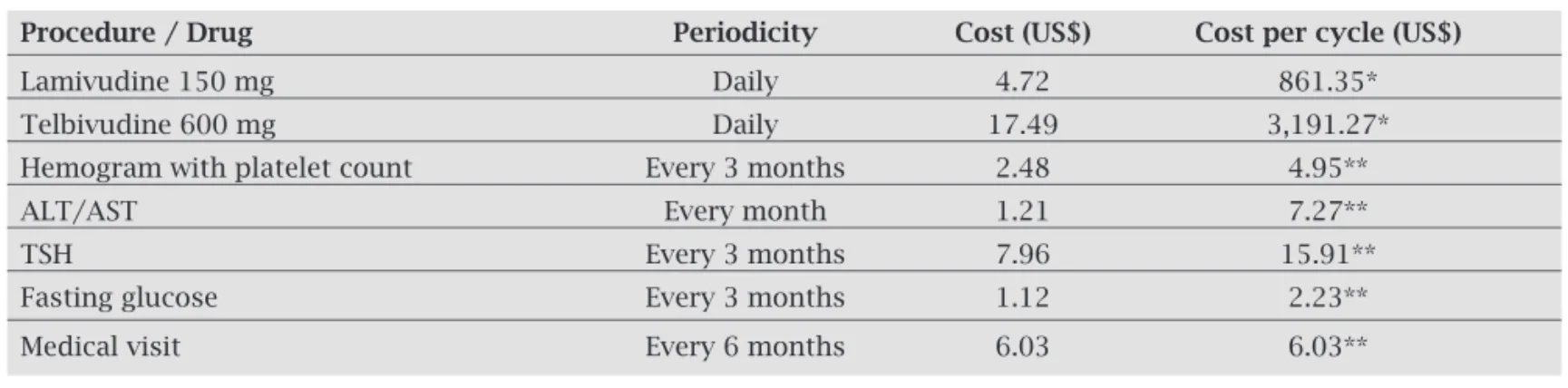
Table 1. Costs of procedure/drugs per unity and per cycle
Procedure / Drug Periodicity Cost (US$) Cost per cycle (US$)
Lamivudine 150 mg Daily 4.72 861.35*
Telbivudine 600 mg Daily 17.49 3,191.27*
Hemogram with platelet count Every 3 months 2.48 4.95**
ALT/AST Every month 1.21 7.27**
TSH Every 3 months 7.96 15.91**
Fasting glucose Every 3 months 1.12 2.23**
Medical visit Every 6 months 6.03 6.03**
ALT, alanine aminotransferase; AST, aspartate aminotransferase; TSH, thyroid-stimulating hormone. * according ABC tables
** according DATASUS tables
HBeAg-negative patients the state seroconversion was withdrawn. It was considered that all patients started treatment in the state CHB-treatment. In the next cycle, patients switched to other states according to the probabilities found in the literature review, described in Table 3.
Table 2. Costs of each health state, annual and per cycle fixed to current values16
Procedure Clinical follow-up Compensated Decompensated Hepatocarcinom Hepatic
cirrhosis cirrhosis transplant
Annual cost (US$) 770.25 976.20 17,293.35 3,741.70 68,609.73
Per cycle cost (US$) 385.12 488.10 8,646.68 1,870.85 34,304.86
Table 3. Probability of reaching each state of CHB
Initial state State reached Range lamivudine Range telbivudine Reference
Virologic resistance 0.1188 0.0562 12, 17
Virologic response 0.4637 0.5186 12, 17
CHB CC 0.0999
18
HC 0.0131 18, 19
Death 0.0014 1
Soroconversion* 0.2063 0.2314 12, 17
Virologic Death 0.029 18
resistance HC 0.4782 19
Soroconversion CC 0.0391
18
HC 0.0131 19
DC 0.05 20
CC Death 0.029 18
HC 0.071 20
HC Transplant 0.0008
20
Death 0.372 20
HC 0.025 20
DC Transplant 0.014 20
Death 0.39 20
Transplant Death 0.15 20
Table 4. Utility of each disease state
Health state Utility Reference
Transplant 0.5 20
Virologic resistance 0.655 Experts opinion
Virologic response (HBV DNA < 5log10) 0.755 21
Decompensated cirrhosis 0.35 22
Treatment 0.755 21
Treatment interruption 0.8 Experts opinion
Seroconversion 0.755 21
Hepatocarcinom 0.37 22
Compensated cirrhosis 0.7 22
Table 5. Cost, effectiveness, cost-effectiveness and ICER of lamivudine and telbivudine for HBeAg positive patients
Cost Incremental Effect Incremental C/E Incremental (US$)
(US$) cost (US$) (QALY) effect C/E (ICER)
Lamivudine 19,065 12.79 1,491
Telbivudine 50,284 31,220 13.81 1.02 3,641 30,575
QALY, quality-adjusted life year; ICER, incremental cost-effectiveness ratio.
Cost-effectiveness analysis
HBeAg positive patients
Lamivudine
Telbivudine
Effectiveness
Figure 1: Cost-effectiveness analysis in HBeAg positive patients.
12,70 QALY 13,30 QALY 13,90 QALY RS54K
RS49K
RS44K
RS39K
RS34K
RS29K
RS24K
RS19K
Cost
Cost-effectiveness analysis
HBeAg negative patients
Lamivudine
Telbivudine
Effectiveness
Figure 2: Cost-effectiveness analysis in HBeAg negative patients.
10,40 QALY 10,90 QALY 11,40 QALY RS62K
RS57K
RS52K RS47K RS42K
RS37K RS32K
RS27K RS22K
Cost
The utility of patients in each of the health states found in the literature is described in Table 4.
Markov models for cost-effectiveness analysis of HBeAg-positive and HBeAg-negative patients are rep-resented in Figures 1 and 2, respectively.
The effect, cost, effectiveness and incremental cost-effectiveness ratios (ICER) are described in Tables 5 and 6, re-spectively for HBeAg-positive and HBeAg-negative patients.
Table 6. Cost, effectiveness, cost-effectiveness and ICER of lamivudine and telbivudine for HBeAg negative patients
Cost Incremental Effect Incremental C/E Incremental
(US$) cost (US$) (QALY) effect C/E (ICER) (US$)
Lamivudine 22,649 10.44 2,170
Telbivudine 58,619 35,970 11.33 0.89 5,175 40,457
QALY, quality-adjusted life year; ICER, incremental cost-effectiveness ratio.
Table 7. One way sensitivity analysis for costs and effects
Variable Basal value Range Value
Cost lamivudine (US$) 897 20% 1,077
-20% 718
Cost telbivudine (US$) 3,227 20% 3,873
-20% 2,582
Virologic response 0.4637 20% 0.5564
Lamivudine -20% 0.3709
Virologic response 0.0562 20% 0.0674
Telbivudine -20% 0.0449
Soroconversion 0.2063 20% 0.2475
Lamivudine -20% 0.1650
Soroconversion 0.2314 20% 0.2777
Telbivudine -20% 0.1851
DISCUSSION
Lamivudine is used for the treatment of CHB for over 20 years, with demonstrated effectiveness and safety.9,10
How-ever, many patients suffer some viral mutation and develop viral resistance to the drug.11 In recent years, new drugs were
developed for the disease, providing other treatment options. The efficacy and safety of telbivudine for the treatment of CHB has been shown previously.12,13 However, when there are
new drugs to treat a disease, it is of great importance to evalu-ate its cost-effectiveness, comparing it to existing treatments. Due to the widespread use of lamivudine for the treatment of CHB, it was used as the standard to be compared to telbivu-dine to evaluate cost-effectiveness of this study.
When evaluating the effectiveness data of both therapies separately, within six months of treatment there are higher seroconversion rates and better virologic response of telbi-vudine, and also lower rate of virologic resistance. However, this is not enough for a decision, especially in a disease of high prevalence worldwide. In such cases, it is of paramount importance that health care managers and physicians have information about the cost-effectiveness of available treat-ments, for a better allocation of available resources.
In the current study, we obtained values of QALY 12.79 and 13.81 for lamivudine and telbivudine, respectively, af-ter 10 years of treatment in HBeAg-positive patients, and 10.44 and 11.33, respectively, for HBeAg-negative patients. These values lead us to indicates similar effectiveness of both treatments. However, when evaluating the cost-ef-fectiveness ratios, we found that this ratio is much higher for telbivudine, reaching an ICER of over than $ 30,000 in both, HBeAg-positive and HBeAg-negative patients. In such cases, health system and physicians have to assess the benefits of each therapy and the available resources to be spent on the treatment.
CONCLUSION
In conclusion, in our analysis of clinical and economic out-comes of lamivudine and telbivudine, for treating HBeAg-positive and HBeAg-negative patients, both strategies are effective, whereas the effectiveness of telbivudine is slightly higher than that of lamivudine. However, comparing the cost-effectiveness, lamivudine is more cost-effective than telbivu-dine. Managers and professionals have to choose the appro-priate therapy to patients according to the available budget.
REFERENCES
1. Elgouhari HM, Abu-Rajab Tamimi TI, Carey WD. Hepatitis B virus infection: understanding its epidemiology, course, and diagnosis. Cleve Clin J Med. 2008; 75(12):881-9.
2. Palumbo E. Lamivudine for chronic hepatitis B: a brief review. Braz J Infect Dis. 2008; 12(5):355-7.
3. Barcena Marugan R, Garcia Garzon S. DNA-guided hepatitis B treatment, viral load is essential, but not sufficient. World J Gastroenterol. 2009; 15(4):423-30.
4. Souto FJ, Piraja AC, da Silva GS, Bottecchia M, Gomes SA. [Long-term use of lamivudine for treating chronic hepatitis B in the State of Mato Grosso]. Rev Soc Bras Med Trop. 2007; 40(1):18-24.
5. Keeffe EB, Dieterich DT, Han SH et al. A treatment algorithm for the management of chronic hepatitis B virus infection in the United States: 2008 update. Clin Gastroenterol Hepatol. 2008; 6(12):1315-41; quiz 286.
7. Nguyen MH, Keeffe EB. Chronic hepatitis B: early viral suppression and long-term outcomes of therapy with oral nucleos(t)ides. J Viral Hepat. 2009; 16(3):149-55.
8. Ministério da Saúde. Protocolo Clínico e Diretrizes Tera-pêuticas para o Tratamento da Hepatite Viral Crônica B e Coinfecções. In: Secretaria de Vigilância em Saúde - De-partamento de DST AeHV, editor.: Programa Nacional para a Prevenção e o Controle das Hepatites Virais; 2009. p. 128.
9. Ferreira MS, Borges AS. Advances in the treatment of hepatitis B. Rev Soc Bras Med Trop. 2007; 40(4):451-62.
10. Kurashige N, Ohkawa K, Hiramatsu N et al. Lamivudine-to-entecavir switching treatment in type B chronic hepatitis pa-tients without evidence of lamivudine resistance. J Gastroen-terol 2009; 44(8):864-70.
11. Ferreira MS. [Diagnosis and treatment of hepatitis B]. Rev Soc Bras Med Trop. 2000; 33(4):389-400.
12. Lai CL, Gane E, Liaw YF et al. Telbivudine versus lamivu-dine in patients with chronic hepatitis B. N Engl J Med. 2007; 357(25):2576-88.
13. Liaw YF, Gane E, Leung N et al. 2-Year GLOBE trial results: telbivudine Is superior to lamivudine in patients with chronic hepatitis B. Gastroenterology 2009; 136(2):486-95.
14. Mota DM. Avaliação Farmacoeconômica: instrumento de me-dida dos benefícios na atenção farmacêutica. Acta Farm Bon-aerense 2003; 22:73-80.
15. Brennan A, Bansback N, Reynolds A, Conway P. Modelling the cost-effectiveness of etanercept in adults with rheumatoid arthritis in the UK. Rheumatology (Oxford) 2004; 43(1):62-72. 16. Castelo A, Pessoa MG, Barreto TC, Alves MR, Araujo DV. Cost
estimates of chronic hepatitis B virus for the Brazilian unified health system in 2005. Rev Assoc Med Bras. 2007; 53(6):486-91. 17. Hou J, Yin YK, Xu D et al. Telbivudine versus lamivudine in
Chinese patients with chronic hepatitis B: Results at 1 year of a randomized, double-blind trial. Hepatology 2008; 47(2):447-54. 18. Iloeje UH, Yang HI, Su J, Jen CL, You SL, Chen CJ. Predicting
cirrhosis risk based on the level of circulating hepatitis B viral load. Gastroenterology 2006; 130(3):678-86.
19. Chen CJ, Yang HI, Iloeje UH. Hepatitis B virus DNA levels and outcomes in chronic hepatitis B. Hepatology 2009; 49 (5 Suppl):S72-84.
20. Veenstra DL, Sullivan SD, Lai MY, Lee CM, Tsai CM, Patel KK. HBeAg-negative chronic hepatitis B: cost-effectiveness of peginterferon alfa-2a compared to lamivudine in Taiwan. Value Health 2008; 11(2):131-8.
21. Lam ET, Lam CL, Lai CL, Yuen MF, Fong DY, So TM. Health-related quality of life of Southern Chinese with chronic hepati-tis B infection. Health Qual Life Outcomes 2009; 7:52. 22. Levy AR, Kowdley KV, Iloeje U et al. The impact of chronic