THE EFFECTS OF CONSTANT AND ALTERNATING
TEMPERATURES ON THE REPRODUCTIVE POTENTIAL,
LIFE SPAN, AND LIFE EXPECTANCY OF Anastrepha
fraterculus (WIEDEMANN) (DIPTERA: TEPHRITIDAE)
CARDOSO, V. V.,1 FERREIRA,M. P.,1 MONTAGNER, J. M.,1 FERNANDEZ, C. G.,2 MOREIRA, J. C.3 and OLIVEIRA, A. K.1
1Departamento de Genética, Instituto de Biociências, UFRGS, Av. Bento Gonçalves, 9500, C. P. 15053,
CEP 91501-970, Porto Alegre, RS, Brazil
2Departamento de Ciências Morfológicas, Instituto de Ciências Básicas da Saúde, UFRGS, R. Sarmento Leite,
500, CEP 90050-170, Porto Alegre, RS, Brazil
3Departamento de Bioquímica, Instituto de Biociências, UFRGS, Av. Ramiro Barcelos, 2600,
CEP 91501-990, Porto Alegre, RS, Brazil
Correspondence to: Alice Kalisz de Oliveira, Departamento de Genética, UFRGS, Av. Bento Gonçalves, 9500, C. P. 15053, CEP 91501-970, Porto Alegre, RS, Brazil, e-mail: [email protected] Received August 28, 2001 – Accepted November 12, 2001 – Distributed November 30, 2002
(With 6 figures)
ABSTRACT
Ovarian development, oviposition, larval eclosion, ornithine decarboxylase (ODC) activity, ovarian, testis and ejaculatory apodeme measurements (length, width, and area), and the number of spermatozoa of Anastrepha fraterculus (Wiedemann) were analyzed at alternating (20º/6ºC and 20º/13oC) and constant (6oC; 25oC) temperatures. Life span and life expectancy were also analyzed for both genders. All the results suggest that temperature, especially alternating temperatures, increase not only male and female reproductive potential but also their life span and life expectancy. These changes can be a powerful strategy triggered by A. fraterculus as a means to survive the stressful temperature conditions found in winter in the apple production region in Brazil, enabling this species to increase its population density and cause apple damage when spring begins.
Key words: reproductive potential, Tephritidae, temperature.
RESUMO
Efeitos de temperaturas constantes e alternadas no potencial reprodutivo,
longevidade e expectativa de vida de fêmeas e machos de Anastrepha fraterculus (Wiedwmann) (Tephritidae)
O desenvolvimento ovariano, ovoposição, eclosão larval, atividade de ornitina descarboxilase (ODC), medidas de largura, comprimento e área do ovário, testículo e apódema ejaculatório e número de espermatozóides de Anastrepha fraterculus (Wiedemann) foram analisados em temperaturas alternadas (20º/6oC e 20º/13oC) e constantes (6oC e 25oC). A longevidade e a expectativa de vida também foram analisadas em ambos os sexos. Todos os resultados sugerem que a temperatura baixa e principalmente as temperaturas alternadas afetam não somente o potencial reprodutivo de machos e fêmeas, mas também sua longevidade e expectativa de vida, prolongando-as. Essas mudanças podem ser uma poderosa estratégia usada por A. fraterculus para sobreviver às condições estressantes de temperatura observadas no inverno na região produtora de maçãs, tornando-as capazes de aumentar sua densidade populacional e causar dano à maçã no início da primavera.
INTRODUCTION
Anastrepha (Schiner) is a native fly genus of the neotropical region with 195 known species, 94 of which are present in Brazil (Zucchi, 1999).
Anastrepha fraterculus (Wied, 1830) is the most prevalent species, infesting more than 20 species of cultivated fruit in the states of Paraná, Santa Catarina and Rio Grande do Sul, amounting to 95%-97% of the Tephritidae caught in traps (Salles & Kovaleski, 1990). The cities of Vacaria (RS) and São Joaquim (SC) are characterized by large-scale apple production. A high rate of A. fraterculus oviposition in the earlier stages of apple development leads to the fall of the host fruit, causing severe apple production damage. Fletcher (1973) observed that only adult Dacus tryoni successfully overwinter. Thus, to maintain tolerable population frequency, control efforts are aimed at this developmental stage.
Insect development is largely determined by environmental temperature (Fletcher, 1989) and data collected by Humeres et al. (1996) showed the very low temperatures in the apple production region in the south of Brazil. Taufer (1998) and Taufer et al. (1998) analyzed fly ovarian development, life span, life expectancy, and some enzymatic patterns, especially those related to energy metabolism, at different ages of individuals reared at seasonal mean temperatures (9º, 13º, 20º) in this region, and at 25oCas control. They found that ovarian development only occurred at 25oC and 20oC. Full ovarian development at 20oC needed twice the time than that required at 25oC. The life span of the flies reared at 20oC was 31 weeks and 16 weeks at 25oC. Flies kept at 9oC and 13oC did not show ovarian development but their life span increased. These data were obtained for flies kept at constant temperatures. However, it is known that the apple production region experiences temperature varia-tions, especially in winter, the worst season for fly survival. Liu et al. (1995) showed that the development level in insects is higher at alternating than at constant temperatures. Thus, in our study, alternating and constant temperatures were used to analyze the reproductive potential, life span, and life expectancy of males and females. Furthermore, considering that ornithyne decarboxilase (ODC) is
differentiation (Tabor & Tabor, 1984), this enzyme was also analyzed in 30d females. The resulting data can be used to develop more efficient methods of biological pest management since control with insecticides leads to an increase in the number of red acarids as a side effect.
MATERIALS AND METHODS
Infested fruit (Campomanesia xanthocarpa
Berg.) were collected in the town of Vacaria, RS (28o30’S/50o54’W), and kept in laboratory conditions at 25oC ± 1oC, L: D of 12:12 cycle, and 60-80RH. After adult eclosion, the F1 was distributed in plastic cages (19 x 13 x 13 cm) and
provided with food (brown sugar: soy bean flour: wheat flour 3:1:1) and water. The cages were placed in two separate environmental climatic control chambers adjusted to 60-80 RH and daily 12/12 h. alternated temperatures (20/6oC; 20/13oC) corresponding to the maximal and minimal mean temperatures of winter and autumn respectively in the apple production area (Humeres et al., 1996). In addition, two other environmental climatic control chambers were adjusted to 60-80RH and constant temperatures of 6oC and 25oC, conditions used as the control in all statistical comparisons. Five cages were used for each temperature.
1. Ovarian development
formation but no corionated oocytes; and mature ovaries (MO) with corionated oocytes.
2. Oviposition and larval eclosion
Five replicates were used for this analysis. Sixteen fly couples were placed in each plastic cage. Oviposition took place in synthetic fruit made with agar-agar (8 g), grape juice (200 ml), and propionic acid (1 ml). After cooling, these artificial fruits were wrapped with parafilm. Oviposition time was 24 h. and the production of eggs and first instar larval eclosion was counted at eight different ages (30, 45, 60, 90, 120, 145, 160, and 180 days). The flies were fed as usual (brown sugar: soy bean flour: wheat flour 3:1:1) between age intervals. Fruit was not used for oviposition. Because females need an appropriate medium to oviposit, oviposition probably did not occur within cage walls.
3. Ornithine decarboxylase activity
Ornithine decarboxylase activity was measured in three samples of thirty ovaries of fifteen 30-day old females, replicated three times for the four temperatures. The CO2 released was determined by the method described by Wyatt et al. (1973) and protein content was measured using the method described by Lowry et al. (1951).
4. Testis and ejaculatory apodeme measurements Five replicates of twenty fly couples from each cage were used for each temperature. Five males from each cage at six different ages (1, 15, 30, 45, 60, and 90 days of age) were analyzed. The testis and ejaculatory apodeme were placed in physiological solution (Ephrussi) and then measured (length, width, and area) and analyzed using the same procedure as that for females.
5. Number of spermatozoa
The reproductive potential was obtained by counting the number of moving spermatozoa present in the testis of five males from each of the five cages containing 20 couples and maintained at the various temperatures. The technical conditions developed by Camargo (1972) for Apis mellifera, later modified by Bressan (1995) for Anastrepha, were used. The testis were transferred to Becker and mashed in 1 cm3 of Bardahl (Rad Cool) 0.005% solution. After shaking, one drop was placed in a NewBauer hemacytometer (1/400 SQ mm-1/1C deep) (Hirschmann EM Techcolor). The mean calculation for the number of
spermatozoa was done by using the average of fifty units of hemacytometer (x) and the following equation:
0.004 mm3 — x 1000 mm3 — y,
x = X/0.004 mm3 and y = mean number of spermatozoa/1,000 mm3.
The data were analyzed by using the Tukey HSD statistical test.
6. Life span and life expectancy
Twenty-five A. fraterculus couples were placed in each of five cages for each temperature. The life span for females and males was observed weekly and life expectancy was calculated using the method proposed by Carey (1993). The “long rank” test (Soares & Colosimo, 1995) was used to test the survival function equality.
RESULTS
Female analysis
The results for ovarian development showed that, at the age of 30 days and at 25°C, 60% of the ovaries were mature and 40% are in development while at other temperatures they were either DO or IO (Table 1). At the age of 90 days this situation is different because, while at 25°C, 100% of the ovaries are DO, at alternating temperatures they were MO or DO. At 6°C, full ovarian development has never been observed.
The comparisons of length, width, and area of ovaries of females reared at 25°C and at the other temperatures were significantly different at 6°C except for length at 15 days, width at 90 days, and area at 45 days. Measurements in all experimental conditions were usually smaller than those of the controls, except at the age of 90 days where females reared at both alternating temperatures had larger ovarian areas than those of the controls.
Ages (in days) Temperature (°C) Development (%) Length (mm) (x ± SE)
Width (mm) (x ± SE)
Area .10–5.(mm2) (x ± SE)
1 25 100 IO 0.0042 ± 0.0003 0.0028 ± 0.0003 0.0076 ± 0.058
25 80 DO : 20 IO 0.0047 ± 0.0003 0.0033 ± 0.0002 1.17 ± 0.140
6 100 IO 0.0033 ± 0.0033 ns
0.0024 ± 0.0001 p = 0.009*
0.55 ± 0.068 p = 0.0009*
20-6 80 DO : 20 IO 0.00048 ± 0.0003 ns
0.0031 ± 0.0003 ns
1.13 ± 0.190 ns 15
20-13 60 DO : 40 IO 0.0054 ± 0.0002 ns
0.0036 ± 0.0001 ns
1.40 ± 0.070 ns
25 60 MO : 40 DO 0.0080 ± 0.0007 0.0058 ± 0.0008 3.74 ± 0.790
6 80 IO : 20 DO 0.0052 ± 0.0001 p = 0.016*
0.0033 ± 0.0002 p = 0.016*
1.22 ± 0.095 p = 0.0090*
20-6 100 DO 0.0053 ± 0.0004 p = 0.047*
0.0035 ± 0.0003 ns
1.48 ± 0.270 p = 0.047* 30
20-13 100 DO 0.0051 ± 0.0004 p = 0.028*
0.0034 ± 0.0035 p = 0.0090*
1.28 ± 0.230 p = 0.016*
25 60 MO : 40 DO 0.01 ± 0.0014 0.0057 ± 0.0005 4.32 ± 1.060
6 80 IO : 20 DO 0.0062 ± 0.0001 p = 0.0090*
0.0041 ± 0.0002 p = 0.0472*
1.90 ± 0.090 ns
20-6 60 DO : 40 MO 0.0076 ± 0.0060 ns
0.0049 ± 0.0004 ns
3.54 ± 0.690 ns 45
20-13 100 DO 0.0057 ± 0.0003 p = 0.009*
0.0037 ± 0.0001 p = 0.0090*
1.68 ± 0.190 p = 0.028*
25 80 MO : 20 DO 0.0097 ± 0.0008 0.0058 ± 0.0010 4.53 ± 0,54
6 60 DO : 40 IO 0.0048 ± 0.0004 p = 0.0090*
0.0031 ± 0.0004 p = 0.0090*
1.15 ± 0.190 p = 0.0009*
20-6 60 DO : 40 MO 0.0088 ± 0.0002 ns
0.0048 mm ns
3.79 ± 1.610 ns 60
20-13 100 DO 0.0045 ± 0.0001 p = 0.0090*
0.0030 ± 0.0002 p = 0.0090*
1.04 ± 0.096 p = 0.0090*
25 100 DO 0.0058 ± 0.0003 0.0033 ± 0.0003 1.42 ± 0.200
6 60 DO : 40 IO 0.0039 ± 0.0002 p = 0.0090*
0.0024 ± 0.0001 ns
0.63 ± 0.052 p = 0.0091*
20-6 60 MO : 40 DO 0.0083 ± 0.0009 ns
0.0043 ± 0.0004 ns
2.89 ± 0.480 p = 0.028* 90
20-13 80 DO : 20 MO 0.0068 ± 0.0006 ns
0.0045 ± 0.0006 ns
2.49 ± 0.490 p = 0.0009* ns = not statistically different.
* p < 0.05.
TABLE 1
Ovarian developmental stage (MO = mature; DO = in development; IO = immature) and measurements (length, width, and area) of Anastrepha fraterculus, at different ages (1, 15, 30, 45, 60, and 90 days) in adult stage at alternating temperatures (20oC/6oC and 20oC/13oC) and constant temperatures (6oC and 25oC). Data
When the same ages were compared at different temperatures we discovered that at 30 days in the experimental conditions, the ovarian area is significantly smaller than that of the control. This result is different at 90 days because at both alternating temperatures the ovarian area is larger than that of the control group.
Oviposition and larval eclosion are faster from day 30 to 45 at 25°C, while at 20o/6°C these biological parameters showed higher numbers from day 90 to 180. The performance at 20o/13oC is somewhat intermediate between those shown for the two previous conditions (Fig. 2).
When oviposition and larval eclosion at different temperatures but at the same age were compared, we found that at 30 days females reared at 25°C showed faster oviposition and eclosion, while females reared at alternating temperatures showed a lower rate of oviposition and eclosion. This behavior was seen until 45 days, but at 90 days the animals kept at alternating temperatures (20o/ 6oC) presented a higher rate of oviposition and larval eclosion. This pattern was constant until 180 days. Females reared at 20o/13oC presented an overall lower rate of oviposition and larval eclosion when compared to those shown for the other temperatures.
ODC activity (Fig. 3) was greater (115%) in animals reared at 6°C than at 25°C (100%) and at alternating temperatures (20/6°C = 91%; 20/13°C = 106.5%). Therefore, increased ODC activity in female ovaries at 6°C can be related to the
developmental stage, classified as immature (80%) and in development (20%) at 30 days when the ODC activity was measured.
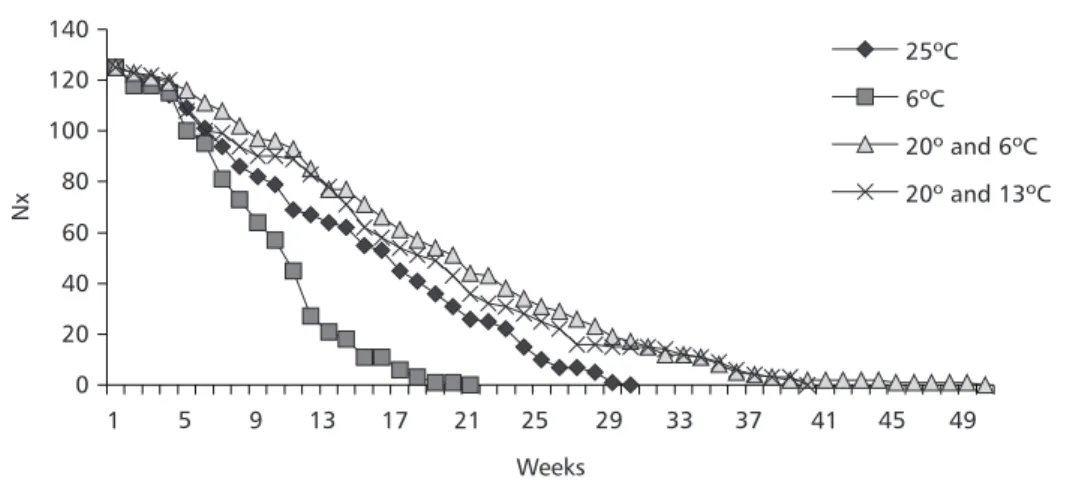
The life span of females reared at alternating temperatures was longest, 336d and 280d at 20º/6º and 20º/13ºC, respectively, when compared to the other two conditions, i.e., 182d and 147d at 25º and 6ºC, respectively. The lowest value was found for females reared at 6°C.
A higher life expectancy was also observed at 20º/6ºC and 20º/13ºC: 123.48d and 13.65d respectively. At 25ºC and 6ºC these values were 95.84d and 68.12d, respectively.
The number of surviving female flies for each age group and temperature condition is shown in Fig. 4.
The long rank test for survival analysis showed significant results when the values for all temperature conditions were compared, except for the comparison between the alternating temperatures (25ºC and 6ºC: 26.46, df = 1, p < 0.001; 25ºC and 20º/ 6ºC: 24.34, p < 0.001; 25ºC and 20º/13ºC: 12.49, p < 0.001; 6ºC and 20º/6ºC: 68.68, p < 0.001; 6ºC and 20º/13ºC: 36.69, p < 0.001; 20º/6ºC and 20º/13ºC: 0.04, p = 0.850).
2. Male analysis
The mean number of spermatozoa and measurements of length, width, and area of the A. fraterculus ejaculatory apodeme for males kept under the experimental and control conditions are shown in Table 2.
0.00 0.50 1.00 1.50 2.00 2.50 3.00 3.50 4.00 4.50 5.00
15 30 45 60 90
Ages (in days)
mm
2
25 Co
6 Co
20/6 Co
20/13 Co
Fig. 1 — Ovarian area.10–5(mm2) in different ages of Anastrepha fraterculus females reared at alternating (20oC/13ºC;
20º and 6 Cº
6 1
13 11 1 60
39 20
8
1
5 10
57 31 21 9
2
0 20 40 60 80 100
30 45 60 90 120 145 160 180 Age (in days)
%
Ovoposition Larval eclosion
20º and 13ºC
6 10
4 17 41 43
11
1 1
4 2 14 25 38
1 9
0 20 40 60 80 100
30 45 60 90 120 145 160 180 Age (in days)
%
Ovoposition Larval eclosion 25ºC
4 6 15 8 13 31 46 61
1 2 7 3 9 23 21 57
0 20 40 60 80 100
30 45 60 90 120 145 160 180 Age (in days)
%
Ovoposition Larval eclosion
Fig. 2 — Oviposition and larval eclosion (%) of Anastrepha fraterculus females reared at a constant temperature (25oC)
and alternating temperatures (20oC/13ºC; 20oC/6oC) at different ages. Numbers above each bar correspond to the number
0 20 40 60 80 100 120
25 6 20\6 20\13
Temperatures ( C)o
ODC
activity
(%)
Fig. 3 — Ornithine decarboxylase activity(ODC) (%) in 30-day-old females of Anastrepha fraterculus reared at alternating (20oC/13ºC; 20oC/6oC) and constant temperatures (6oC; 25oC).
0 20 40 60 80 100 120 140
Weeks
25ºC
6ºC
20º and 6ºC
20º and 13ºC
Nx
1 5 9 13 17 21 25 29 33 37 41 45 49
Fig. 4 — Number of surviving female Anastrepha fraterculus kept under different temperatures in relation to age.
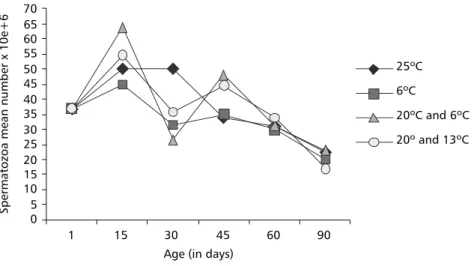
As shown, 15-day-old males reared at 20/6oC showed a greater number of spermatozoa than control males kept at 25oC. However, 30-day-old males in all temperature experimental conditions showed significantly fewer spermatozoa than the males in the control group. At the other ages (45, 60, 90 days) there was no difference in the mean number of spermatozoa in all temperature con-ditions.
The Fig. 5 shows male performance for each temperature condition. A great number of spermatozoa was observed at 15 days under all conditions. However, while males at 25oC kept this number until day 30, under other temperature
conditions it decreased abruptly, especially at 20º/ 6oC. Interesting is the slow decrease in the number of spermatozoa shown by males at 25oC and 6oC, while males at alternating temperatures presented production peaks at 15 and 45 days. Thus, tempe-rature fluctuation does not seem to be important for spermatozoa production after 45 days.
Ages (in days)
Temperature (°C)
Y (x ± SE)
Legth (mm) (x ± SE)
Width (mm) (x ± SE)
Area .10–5.(mm2) (x ± SE)
1 25 37 ± 1.61 0.006 ± 0.0003 0.0021 ± 0.00020 1.06 ± 0.060
15 25 50 ± 3.15 0.0071 ± 0.001 0.0036 ± 0.0001 1.86 ± 0.002
6 45.6 ± 2.45 ns 0.0058 ± 0.001 p = 0.009*
0.0022 ± 0.001 p = 0.009*
1.08 ± 0.001 p = 0.009*
20-6 64 ± 2.03
p = 0.01* 0.0066 ± 0.0023 ns
0.0029 ± 0.0023
p = 0.047* 1.46 ± 0.15 ns
20-13 54 ± 3.59 ns 0.0072 ± 0.0002 ns 0.0031 ± 0.0035 ns 1.78 ± 0.055 ns
30 25 50 ± 2.79 0.0079 ± 0.00031 0.0043 ± 0.0001 2.46 ± 0.15
6 31 ± 2.50 p = 0.0001*
0.0062 ± 0.0003 p = 0.009*
0.0028 ± 0.0001 p = 0.009*
1.25 ± 0.905 p = 0.009*
20-6 27 ± 2.10
p = 0.0001* 0.0079 ± 0.0002 ns
0.0037 ± 0.00019
ns 2.13 ± 0.67 ns
20-13 36 ± 2.52
p = 0.004* 0.0072 ± 0.0001 ns 0.0040 ± 0.0001 ns 2.18 ± 0.15 ns
45 25 34 ± 3.35 0.0072 ± 0.0002 0.0043 ± 0.0001 2.23 ± 0.095
6 35 ± 3.50 ns 0.0062 ± 0.0023 ns 0.003 ± 0.0030 p = 0.0009*
1.46 ± 0.0058 p = 0.009*
20-6 48 ± 4.41 ns 0.0072 ± 0.0003 ns 0.0045 ± 0.0003 ns 2.12 ± 0.169 ns
20-13 45 ± 5.28 ns 0.0073 ± 0.0002 ns 0.0040 ± 0.0002 ns 1.98 ± 0.14 ns
60 25 31 ± 3.20 0.0076 ± 0.0003 0.0043 ± 0.0001 2.39 ± 0.076
6 30 ± 2.31 ns 0.0057 ± 0.0025 p = 0.00001*
0.0023 ± 0.0001 p = 0.009*
1.09 ± 0.094 p = 0.009*
20-6 31 ± 2.65 ns 0.0075 ± 0.0003 ns 0.0039 ± 0.0039 ns 2.22 ± 0.171 ns
20-13 34 ± 4.75 ns 0.0070 ± 0.001 ns 0.0035 ± 0.0003 ns 1.91 ± 0.138 p = 0.0163
90 25 22.5 ± 4.50 0.0074 ± 0.003 0.0039 ± 0.0001 1.93 ± 0.085
6 20 ± 2.53 ns 0.0061 ± 0.0004 p = 0.00009*
0.0025 ± 0.00009 p = 0.009*
1.33 ± 0.0012 p = 0.009*
20-6 23 ± 2.19 ns 0.0074 ± 0.0001 ns 0.00388 ± 0.00016
ns 2.06 ± 0.00016 ns
20-13 17 ± 2.33 ns 0.0074 ± 0.0002
ns 0.0036 ± 0.0075 ns 1.92 ± 0.138 ns y = mean number of spermatozoa x 106/1000 mm3; ns = not statistically different; * p < 0.05.
TABLE 2
Spermatozoa mean number (Y) and ejaculatory apodeme measures (length, width, and area) of Anastrepha
fraterculus males, of different ages (1, 15, 30, 45, 60, and 90 days) reared in adult stage at alternated
temperatures (20oC and 6oC; 20oC and 13oC) and constant temperature (6oC and 25oC). Data obtained at
constant 25oC were used as control in the Tukey HSD statistical test used for spermatozoa mean number and
The results for testis measurements (length, width, and area) did not vary among different age groups and temperature conditions (mean length = 0.0084 ± 0.0001 mm; mean width = 0.0035 ± 0.0004 mm; and mean area = 2.28 x 10⁻⁵ ± 0.083 mm2).
Therefore, the testes of A. fraterculus were non-progressive.
Life span for males reared at 20º/6ºC and 20º/ 13ºC were 343d and 273d respectively, whereas at 25ºC and 6ºC they were 203d and 140d respectively. Furthermore, life expectancy at 20º/6ºC and 20º/13ºC was 119.31d and 109.73d. Flies kept at 25ºC and 6ºC had life expectancies of 89.96d and 57.54d respectively.
The number of surviving flies for each age group is shown in Fig. 6.
The longest life span and highest life expectancy were shown by males reared at alternating temperatures, while males kept at low temperature (6oC) showed the shortest/lowest life span/expectancy. Similar results were observed for females under the same temperature conditions. The long rank test for survival analysis presented the same significant results as in the female group. Performance under all temperature conditions was different, except for the comparison between flies reared at alternating temperatures (25ºC and 6ºC: 41.61, p < 0.001; 25ºC and 20º/6ºC: 15.26, p < 0.001; 25º and 20º/13ºC: 7.68, p < 0.001; 6ºC and 20º/6ºC: 83.82, p < 0.001; 6ºC and 20º/13ºC =
0 5 10 15 20 25 30 35 40 45 50 55 60 65 70
1 15 30 45 60 90
Age (in days)
25ºC 6ºC
20ºC and 6ºC 20º and 13ºC
Spermatozoa
mean
number
x
10e+6
Fig. 5 — Spermatozoa mean number of Anastrepha fraterculus at different ages reared at alternating (20/6oC and 20/
13oC) and constant temperatures (6oC and 25oC).
67.89, p < 0.001; 20º/6ºC and 20º/13ºC: 0.21, p = 0.644).
The long rank test comparing the survival rate between the male and female groups at each temperature did not show significant results except for survival at 6ºC (25ºC: 0.53, p = 0.467; 6ºC: 12.04, p < 0.001; 20º/6ºC: 0.06, p = 0.803; 20º/13ºC: 0.82, p = 0.366).
DISCUSSION
Data collected from 1989 to 1994 by Humeres
et al. (1996) on A . fraterculus incidence in the apple production in southern Brazil showed no adults in winter when conventional traps were used. Since this fly begins its population increase in spring, three hypotheses, not mutually exclusive, can be posed: 1. migration of adults from regions where the temperature is not so cold; 2. ontogenetic genetic regulation which allows flies to survive during winter; 3. inefficient traps.
The first hypothesis is difficult to accept since
The high incidence of mature ovaries until 90 days of age in alternating temperatures, especially at 20o/6oC, is important for maintaining the fly population in the apple production region fields where temperature variations are common.
The flies kept at 6ºC showed a shorter life span, lower life expectancy, lower ovarian and ejaculatory apodeme development, and greater ODC activity than the flies reared under the other temperature conditions. ODC is essential to polyamine synthesis and, as in Drosophila melanogaster (Meigen, 1830), ODC activity increases 24 h after female eclosion and decreases 48 h later, a pattern not seen in males. Birnbaum & Gilbert (1990) suggested that polyamines act on ovarian maturation. Because ODC is an enzymatic step prior to polyamine synthesis, its increased activity can also indicate an absence of polyamines which results in the poor ovarian development found in the flies reared at 6ºC. Furthermore, Drew (1968) proposed that the ejaculatory apodeme needs to reach an optimal size to withstand the musculature used in copulation while Kamali & Schultz (1974) hypothesized that sexual maturity is correlated with ejaculatory apodeme development. These three factors: low ovarian and ejaculatory apodeme development levels and high ODC activity can account for the absence of oviposition and larval eclosion in flies reared at 6ºC.
Another explanation for the results of ODC activity at 6ºC could lie in a hypothesis presented
stressful procedures, a phenomenon they called “injury syndrome”. The low stress temperature (6ºC) would make females produce more ODC. In our experiment, the flies kept at 6ºC also showed a shorter life span and lower life expectancy. These results suggest that the biological mechanisms used by flies to survive in the fruit area are limited at extreme temperatures and that only periods of alternating temperatures allow fly survival.
When males and females were compared, we found that the life span of males is longer at 25ºC and 20º/6ºC but shorter at 6ºC and 20º/13ºC while females showed a longer life span at the latter temperatures as well. However, female life expectancy was always higher than male life expectancy in all temperature conditions. The fact that females can retain spermatozoa is important for oviposition and larval eclosion and, consequently, for maintaining the fly population. Furthermore, since the longest life span and highest life expectancy were presented by both males and females at alternating temperatures, these circumstances can delay fly oviposition and eclosion and, therefore, explain the presence of some flies during springtime even after a severe winter. However, the number of flies in this case is small and this explains the results found by Humeres et al. (1996). More efficient traps would probably capture some flies. Meats (1983) analyzed the effects of alternating and constant temperature regimens in Dacus tryoni and observed that the damage of low temperatures is minimized when the Fig. 6 — Number of surviving male Anastrepha fraterculus kept under different temperatures in relation to age.
0 20 40 60 80 100 120 140
Weeks
25ºC
6ºC
20º and 6ºC
20º and 13ºC
1 4 7 10 13 16 19 22 25 28 31 34 37 40 43 46 49
The high rate of oviposition and larval eclosion observed at 90d and 180d in flies kept at alternating temperatures (20º/6ºC) corroborates the apparent diapause suggested by Baker & Miller (1978) about the effect of cyclic and constant temperatures on the development of the fruit fly
Rhagoletis cerasi.
The difference observed by us for life span and life expectancy in females reared at 20º/6ºC and 25ºC (for over two months) is related to their delayed ovarian development. It can explain the overwintering proposed by Kovaleski (1997) in the adaptation process of A. fraterculus colonization in the apple region of Vacaria (RS). Furthermore, it seems that the combination of two temperatures (alternating temperatures) decreased the effects of extreme temperatures by allowing animal acclimation.
Our findings on A. fraterculus behavior when reared under different temperature conditions and knowing of temperature conditions prior to apple growth (occurring in spring) can be used to predict fly oviposition and emergence, making it possible to foresee when damage will begin and, therefore, make better pest control choices, as suggested by Pritchard (1970).
Acknowledgments — We are grateful to Ricardo Pires for his help in computerized data analysis, to Dr. Adalécio Kovaleski (EMBRAPA-Vacaria, RS) for Anastrepha fraterculus supply, Fundação de Amparo à Pesquisa do Rio Grande do Sul (FAPERGS), and Conselho Nacional de De-senvolvimento Científico e Tecnológico (CNPq) for grants and fellowships.
REFERENCES
BAKER, C. R. B. & MILLER, G. W., 1978, The effect of temperature on the post-diapause development on four geographical populations of the European cherry fruit fly (Rhagoletis cerasi). Entom. Exp. Appl., 23: 1-13. BIRNBAUM, M. J. & GILBERT, L. I., 1990, Juvenile hormone stimulation of ornithine decarboxilase activity during vitellogenesis in Drosophila melanogaster. J. Comp. Physiol. B., 160: 145-151.
BRESSAN, S., 1995, Desenvolvimento e potencial reprodutivo do macho de Anastrepha ssp. (Diptera: Tephritidae) em condições naturais. Rev. Bras. Ent.,
39(4): 849-854.
BRESSAN, S., 1996, Desenvolvimento e potencial reprodutivo de fêmeas de Anastrepha obliqua
(Diptera: Tephritidae) em condições naturais. Rev. Bras. Ent., 40: 11-16.
CAMARGO, C. A., 1972, Aspectos da reprodução dos Apídeos sociais. Dissertação de Mestrado, Faculdade de Medicina, Universidade de São Paulo, Ribeirão Preto, 266p.
CAREY, J. R., 1993, Applied demography for biologist, with special emphasis on insects. Oxford University Press, New York, 206p.
DREW, R. A. I., 1968, Morphology of reproductive system of Strumeta tryoni (Froggat) (Diptera: Thypetidae) with a method of distinguishing sexually mature adult males. J. Aust. Ent. Soc., 8: 21-32. FLETCHER, B. S., 1973, The ecology of a natural
population of the Queensland fruit fly, Dacus tryoni.
Austr. J. Zool., 21: 541-565.
FLETCHER, B. S., 1989, Temperature-development rate relationships of the immature stages and adults of Tephritid fruit flies. In: A. S. Robson & G. Hooper (eds.), Fruit flies: their biology natural enemies and control, 446p. Elsevier Science Publ., New York. HUMERES, E., DA CRUZ, I. B., RIBEIRO, L. G. &
OLIVEIRA, A. K., 1996, Detection of Anastrepha fraterculus (Diptera: Tephritidae) adults in field under winter conditions in São Joaquim county, Brazil. Ann. 2nd Meeting of Working Group on Fruit Flies of Western Hemisphere, 1: 51.
KAMALI, K. & SCHULTZ, T., 1974, Biology and Ecology of Gymnocarena diffusa (Diptera: Tephritidae) on Sunflkower in North Dakota. Ann. Entomol. Soc. Am., 67: 695-699.
KOVALESKI, A., 1997, Processos adaptativos na colonização de maçã (Malus domestica L.) por
Anastrepha fraterculus (Wied) (Diptera: Tephritidae) na região de Vacaria, RS. Tese de Doutorado em Ciências, Universidade de São Paulo, SP, 122p. LIU, S., ZHANG, G. & ZHU, J., 1995, Influence of
temperature variations on rate of development in insects: analysis of case studies from entomological literature. Ann. Ent. Soc. Am., 88: 107-119. LOWRY, O. H., ROSENBROUGH, N. J., FARR, A. L. &
RANDALL, R. J. J., 1951, Protein measurement with the folin phenol reagent. Bio. Chem., 193: 265-275. MEATS, A., 1983, Critical periods for developmental acclimation to cold in the Queesland fruit fly, Dacus tryoni. J. Insect Physiol., 29: 943-946.
PRITCHARD, G., 1970, The ecology of a natural population of the Queensland fruit fly, Dacus tryoni. III. The maturation of females flies in relation to temperature. Austr. J. Zool., 18: 77-89.
SALLES, L. A. B. & KOVALESKI, A., 1990, Moscas-das-frutas em maciera e pessegueiro no Rio Grande do Sul. Hortisul, 1: 5-9.
SOARES, J. F. & COLOSIMO, E. A., 1995, Métodos estatísticos na pesquisa clínica. 40a Reunião Anual da
Região Brasileira da Soc. Int. de Biometria. Minicursos. 105p. USP, Ribeirão Preto.
TABOR, C. W. & TABOR, H., 1984, Polyamines. Ann. Rev. Biochem., 53: 749-790.
TAUFER, M., 1998, O efeito da temperatura na biologia de adultos de Anastrepha fraterculus (Diptera: Tephritidae): longevidade, desenvolvimento ovariano e isoenzimas relacionadas com o metabolismo energético. Dissertação de Mestrado, Curso de Pós-graduação em Genética e Biologia Molecular da UFRGS, 104p.
TAUFER, M., NASCIMENTO, J. C., CANTO, M. E. P., DA CRUZ, I. B. M. & OLIVEIRA, A. K., 1998, Desen-volvimento ovariano, taxa de ovoposição e velocidade do desenvolvimento embrionário em Anastrepha fraterculus (Diptera: Tephritidae) quando submetidas a diferentes temperaturas. Anais do XVII Congresso Brasileiro de Entomologia, 1: 180.
WYATT, G. R., ROTHAUS, D., LAWLER, C. & HERBST, E. J., 1973, Ornithine decarboxylase and polyamines in silkmouth pupal tissues: effects of ecdysones and injury. Biochem. Biophys. Acta, 304: 4 8 2 - 4 9 4 .