Sao Paulo Med J. 2010; 128(3):174-6
174
Case report
Urological complication following aortoiliac graft: case report
and review of the literature
Complicação urológica após enxerto aorto-ilíaco: relato de caso e revisão de literatura
Leonardo Lima Borges
I, Fábio César Miranda Torricelli
I, Gustavo Xavier Ebaid
II, Antônio Marmo Lucon
III, Miguel Srougi
IVHospital das Clínicas, Faculdade de Medicina da Universidade de São Paulo, São Paulo, Brazil
IMD. Resident, Department of Urology, Faculdade de Medicina da Universidade de São Paulo (FMUSP), São Paulo, Brazil. IIMD. Urological surgeon, Department of Urology, Faculdade de Medicina da Universidade de São Paulo (FMUSP), São Paulo, Brazil. IIIMD, PhD. Urological surgeon, Department of Urology, Faculdade de Medicina da Universidade de São Paulo (FMUSP), São Paulo, Brazil. IVMD, PhD. Full professor and chairman, Department of Urology, Faculdade de Medicina da Universidade de São Paulo (FMUSP), São Paulo, Brazil.
ABSTRACT
CONTEXT: Ureteral stenosis and ureterohydronephrosis may be serious complications of aortoiliac or aortofemoral reconstructive surgery. CASE REPORT: A 62-year-old female patient presented with a six-month history of left lumbar pain. She was a smoker, and had mild chronic arterial hypertension and Takayasu arteritis. She had previously undergone three vascular interventions. In two procedures, Dacron prostheses were necessary. Excretory urography showed moderate left ureterohydronephrosis and revealed a illing defect in the ureter close to where the iliac vessels cross. This inding was compatible with ureteral stenosis, and the aortoiliac graft may have been the reason for this inlammatory process. The patient underwent laparotomy, which showed that there was a relationship between the ureteral stenosis and the vascular prosthesis. Segmental ureterectomy and end-to-end ureteroplasty with the ureter crossing over the prosthesis anteriorly were performed. There were no complications. The early and late postoperative periods were uneventful. The patient evolved well and the results from a new excretory urogram were normal. We concluded that symptomatic ureterohydronephrosis following aortoiliac graft is a real complication and needs to be quickly diagnosed and treated by urologists.
RESUMO
INTRODUÇÃO: Estenose ureteral e ureterohidronefrose podem ser sérias complicações da cirurgia reconstrutiva aorto-femoral ou aorto-ilíaca. RELATO DE CASO: Uma paciente de 62 anos apresentou-se referindo história de dor lombar a esquerda há seis meses. Ela era fumante, portadora de hipertensão arterial crônica leve e arterite de Takayasu. Havia sido submetida a três intervenções vasculares. Em dois procedimentos o uso de prótese de Dacron foi necessário. Uma urograia excretora revelou moderada ureterohidronefrose à esquerda e falha de enchimento no ureter próximo ao cruzamento dos vasos ilíacos. Esse achado era compatível com uma estenose ureteral e o enxerto aorto-ilíaco poderia ser a causa do processo inlamatório. A paciente foi submetida a laparotomia, que evidenciou a relação entre estenose ureteral e a prótese vascular. Ureterectomia segmentar e uretroplastia término-terminal com o ureter passando anteriormente à prótese foram realizadas. Não ocorreram complicações. Os períodos de pós-operatório precoce e tardio transcorreram sem intercorrências. A paciente evoluiu bem e uma nova urograia excretora apresenta-se normal. Concluímos que ureterohidronefrose sintomática após enxerto aorto-ilíaco é uma complicação real e precisa ser rapidamente diagnosticada e tratada pelo urologista.
KEY WORDS: Ureter.
Ureteral obstruction. Kidney.
Hydronephrosis. Blood vessel prosthesis.
PALAVRAS-CHAVE: Ureter.
Obstrução ureteral. Rim.
Hidronefrose. Prótese vascular.
INTRODUCTION
Ureteral stenosis and ureterohydronephrosis may be serious com-plications in aortoiliac or aortofemoral reconstructive surgery. Ureteral lesions from vascular surgery are believed to account for 0.8% of le-sions recognized at the time of surgery and 2.2% of complications ob-served later.1 Ureteral lesions are sometimes not iatrogenic. hey are
related to the aneurysmal form of aortic disease, and some develop from inlammatory secondary reactions. Today, intraoperative ureter-al injury, secondary retroperitoneureter-al ibrosis, residuureter-al hematomas, fureter-alse aneurysms after surgery, graft placement anterior to the ureter and graft infection are the main causes of urological complications follow-ing vascular reconstructive surgery.1
We report on a case of a late complication from an aortoiliac graft in a symptomatic patient that needed surgical intervention. We also present a brief review of the literature on this subject.
CASE REPORT
A 62-year-old Caucasian female presented with a six-month histo-ry of left lumbar pain. She had no histohisto-ry of fever, hematuria, dysuria, frequency, urgency, polyuria, nocturia, incontinence or diiculty in voiding. he patient was a smoker, and she had mild chronic arterial hypertension and Takayasu arteritis. Both of these diseases were under control with medications. She had previously undergone three vascu-lar interventions because of complications from the Takayasu arteritis. In 1984, she underwent superior mesenteric artery endarterectomy. In 1986, she underwent aortobicarotid graft surgery with implantation of a Dacron prosthesis and in 1991, she underwent aortobiiliac graft surgery, also with a Dacron prosthesis.
nor-Urological complication following aortoiliac graft: case report and review of the literature
Sao Paulo Med J. 2010; 128(3):174-6
175
mal limits. Abdominal ultrasonography (US) revealed a cyst in the left kidney. Abdominal computerized tomography (CT) just conirmed the diagnosis. he patient was submitted to US-guided aspiration puncture, follow by ethanol sclerosis.
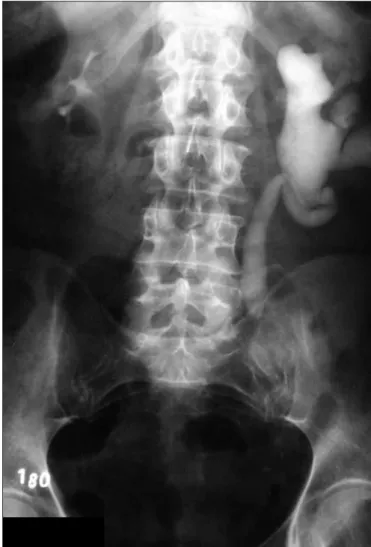
he pain kept bothering the patient and CT was performed again. his showed moderate left ureterohydronephrosis and a stop point in the mid-portion of the left ureter. Intravenous urography conirmed the moderate left ureterohydronephrosis and showed a illing defect in the ureter close to where the iliac vessels crossed (Figure 1). his was compatible with ureter stenosis, and the aortoiliac prosthesis may have been the reason for this inlammatory process. he patient underwent laparotomy, which showed that there was a relationship between the ureteral stenosis and the vascular prosthesis. Segmental ureterectomy and end-to-end ureteroplasty with the ureter crossing over the prosthe-sis were performed. Some fat tissue was interposed between the ureter and prosthesis and a double-J catheter was implanted.
here were no complications. he early and late postoperative peri-ods were uneventful. he results from a new intravenous urogram were normal, i.e. contrast was eliminated through the ureter without illing defects. At a 24-month follow-up, the patient remained asymptomatic.
DISCUSSION
he irst case of hydronephrosis secondary to placement of an aor-tic prosthesis was reported by Jacobson et al. in 1962.2 Since then, a few
other cases have been reported in the literature. We performed a search in the PubMed, Embase (Excerpta Medica), Cochrane library and Lilacs (Literatura Latino-Americana e do Caribe em Ciências da Saúde) data-bases (Table 1) and found 13 case reports and ive case series with no more than three cases each, which reported occurrences of obstructive uropathy following vascular graft placement. Cases with ureteral istula were not included.
Six retrospective1,3-7 studies attempted to estimate the incidence of
this pathological condition, but the results were dissimilar. Wright et al.1
reported on 33 years of experience with 58 ureteral complications in 50 out of 3580 patients who had undergone aortoiliac reconstructive sur-gery. Just 42 patients presented hydronephrosis, thus revealing very low incidence. Gil-Salom et al.4 reported one case of hydronephrosis out of
50 aortobifemoral bypass procedures. However, Frusha et al.5 reported
an incidence of 14% among 50 patients who underwent aortobifemoral bifurcation grafts, and Heard et al.6 noted incidence of 10% of the
pa-tients and 7% of the ureters in a study on 20 papa-tients.
hree prospective studies8-10 attempted to discover the real
inci-dence of this complication. Goldenberg et al.8 performed serial
ultra-sound examinations on 93 patients who had undergone aortofemoral or aortoiliac reconstructive surgery (one week, three months and one year postoperatively) and found that hydronephrosis developed in 11 patients (12%). he obstruction resolved spontaneously in 10 of these patients within three months and only a single case persisted for one year. In a similar study, Daune et al.9 reported no cases of symptomatic
early or late hydronephrosis among 30 patients who underwent aorto-bifemoral graft. In another prospective study, Henriksen et al.10 did not
Figure 1. Intravenous urography showing moderate left
ureterohydronephrosis and a illing defect in the ureter close to where the iliac vessels cross.
ind any patients with signs of ureteral obstruction among 56 patients who underwent aortic reconstruction.
After reviewing both the retrospective and the prospective studies, we could see that real urological complications following vascular grafts, such that surgical interventions were necessary, were described well in the case reports. We also discerned that well-designed studies are needed in order to validate the diagnosis and management.
Sao Paulo Med J. 2010; 128(3):174-6 Borges LL,Torricelli FCM,Ebaid GX, Lucon AM,Srougi M
176
Treatment aims to restore urinary tract continuity and preserve kid-ney function. he type of therapy is chosen taking into account the type of lesion, time of occurrence, functional capacity of the corresponding kidney and patient status. A conservative approach is recommended for incidental asymptomatic cases of early postoperative hydronephrosis, since spontaneous resolution may occur in a high proportion of these patients.8 However, when symptoms are present or severe and late
hy-dronephrosis is found, an operative procedure tends to be performed. he approaches used go from ureterolysis to nephrectomy. Ureterolysis, transection of the ureter and end-to-end anastomosis is an option of in-terest. Some authors prefer to divide and perform reanastomosis on the graft, in order to avoid opening the ureter and prevent extravasation of potentially infected urine and graft sepsis.12 In our opinion, it is a good
alternative in cases of associated graft complications.
CONCLUSION
Symptomatic ureterohydronephrosis following aortoiliac graft is a real complication and it needs to be quickly diagnosed and treated by urologists. he approach should be selected based on the particular fea-tures of each case.
REFERENCES
1. Wright DJ, Ernst CB, Evans JR, et al. Ureteral complications and aortoiliac reconstruction. J Vasc Surg. 1990;11(1):29-35; discussion 35-7.
2. Jacobson ME, Masto GJ, Berkas EM. Aortic grafts. Ureteral obstruction as a late complication of abdominal aneurysm resection. J Kans Med Soc. 1962;63:516-8.
3. Pavlica P, Viglietta G, Barozzi L, Piraccini A, Stasi G. Ostruzione ureterale secondaria ad in-terventi di by-pass aorto-femorale [Ureteral obstruction secondary to aortofemoral bypass]. Radiol Med. 1988;75(6):643-6.
4. Gil-Salom M, Martinez-León J, Maldonado L, et al. Obstructive uropathy following aortofemo-ral graft surgery. Urol Int. 1991;46(1):39-42.
5. Frusha JD, Porter JA, Batson RC. Hydronephrosis following aorto-femoral bypass grafts. J Cardiovasc Surg (Torino). 1982;23(5):371-7.
6. Heard G, Hinde G. Hydronephrosis complicating aortic reconstruction. Br J Surg.. 1975;62(5):344-7.
7. Schubart P, Fortner G, Cummings D, et al. The signiicance of hydronephrosis after aortofe-moral reconstruction. Arch Surg. 1985;120(3):377-81.
8. Goldenberg SL, Gordon PB, Cooperberg PL, McLoughlin MG. Early hydronephrosis following aortic bifurcation graft surgery: a prospective study. J Urol. 1988;140(6):1367-9. 9. Daune B, Batt M, Hassen-Khodja R, et al. Hydronephrosis after aortofemoral bypass graft. A
prospective study. J Cardiovasc Surg (Torino). 1991;32(4):447-50.
10. Henriksen LO, Mejdahl S, Petersen F, Tøonnesen KH, Holstein PE. The incidence of ureteral obstruction secondary to aorto-femoral bypass surgery. A prospective study. Eur J Vasc Surg. 1988;2(6):417-8.
11. Sant GR, Heaney JA, Parkhurst EC, Blaivas JG. Obstructive uropathy--a potentially serious complication of reconstructive vascular surgery. J Urol. 1983;129(1):16-22.
12. Schapira HE, Li R, Gribetz M, Wulfsohn MA, Brendler H. Ureteral injuries during vascular surgery. J Urol. 1981;125(3):293-7.
Conlict of interest: Not declared Sources of funding: Not declared Date of irst submission: June 1, 2009 Last received: October 30, 2009 Accepted: April 9, 2010 Address for correspondence: Fábio César Miranda Torricelli
Av. Vereador José Diniz, 3.300 — conj. 208 São Paulo (SP) — Brasil
CEP 04604-006 Tel. (+55 11) 5533-4900 E-mail: [email protected]
Table 1. Search for case reports, in Medline (Medical Literature Analysis
and Retrieval System Online), Embase (Excerpta Medica), Lilacs (Literatura Latino-Americana e do Caribe em Ciências da Saúde) and Cochrane library databases
Databases Search strategy Results
Medline Hydronephrosis AND
Ureteral obstruction AND Vascular prosthesis OR vascular graft OR blood vessel prosthesis
papers found: 38 papers reported: 23
case reports: 11 case series: 4 retrospective studies: 5 prospective studies: 3
Embase Hydronephrosis AND
Ureteral obstruction AND Vascular prosthesis OR vascular graft OR blood vessel prosthesis
papers found: 52 papers reported: 14
case reports: 7 case series: 2 retrospective studies: 4 prospective studies: 1
Lilacs Hydronephrosis papers found: 161; papers reported: zero
Hidronefrose papers found: 168; papers reported: zero
Ureteral obstruction papers found: zero
Obstrução ureteral papers found: 120; papers reported: zero
Cochrane Hydronephrosis papers found: 124; papers reported: zero
Ureteral obstruction papers found: 185; papers reported: zero
Final results 27 papers case reports: 13
case series: 5
retrospective studies: 6