Ana Claudia C. de Ornelas Maia, Arthur Azevedo Braga, Cristiane Aparecida Nunes, Antonio Egidio Nardi, Adriana Cardoso Silva*
Tratamento transdiagnóstico utilizando um protocolo uniicado: aplicação em
pacientes com diferentes transtornos de humor e ansiedade comórbidos
Transdiagnostic treatment using a uniied protocol:
application for patients with a range of
comorbid mood and anxiety disorders
Abstract
Objective: To evaluate the effectiveness of a uniied cognitive --behavioral therapy protocol for group treatment of patients with a range of comorbid mood and anxiety disorders.
Methods: In this open-trial study, the uniied protocol was followed for the psychotherapeutic treatment of 16 patients with comorbid mood and anxiety disorders, conirmed by the Mini International Neuropsychiatric Interview. Beck Depression and Anxiety Invento-ries, the World Health Organization Quality of Life evaluation ins-trument, and the ARIZONA scale of sexual function were used to evaluate progress in patients throughout the therapeutic process.
Results: All patients showed unipolar depressive disorder. Comor-bidity with anxiety disorders was distributed as follows: generali -zed anxiety disorder, 13 (81.3%); panic disorder, 3 (18.8%); so-cial anxiety disorder, 1 (6.3%); and post-traumatic stress disorder, 1 (6.3%). Improvement was observed in the signs and symptoms of depression (F = 78.62, p < 0.001) and anxiety (F = 19.64, p < 0.001), overall quality of life (F = 39.72, p < 0.001), physical domain (F = 28.15, p < 0.001)), psychological variables (F = 9.90, p = 0.007), social functioning (F = 36.86, p < 0.001), environmental va-riables (F = 27.63, p < 0.001), and sexuality (F = 13.13; p < 0.005). All parameters showed highly signiicant correlations (p < 0.01).
Conclusion: An effort to establish one uniied treatment protocol for a whole family of emotional disorders (primarily mood and an-xiety disorders) showed beneits in the ield of clinical psychology and for the treatment of patients. No other data were found in the literature describing the implementation of the uniied protocol in a transdiagnostic group. Our results revealed statistically signii -cant improvement in all variables, suggesting that the protocol proposed can become an important tool to improve quality of life, sexuality, and anxiety/depression symptoms in patients with di-fferent diagnoses.
Keywords: Protocol, transdiagnostic approach, anxiety, depression.
Resumo
Objetivo: Avaliar a eicácia de um protocolo uniicado de terapia cognitivo-comportamental para tratamento em grupo de pacien-tes com diferenpacien-tes transtornos de humor e ansiedade comórbidos.
Métodos: Neste estudo aberto, o protocolo uniicado foi seguido no tratamento psicoterápico de 16 pacientes com transtornos de humor e ansiedade comórbidos, conirmados pelo Mini Interna -tional Neuropsychiatric Interview. Os Inventários de Depressão e Ansiedade de Beck, o instrumento de avaliação de qualidade de vida da Organização Mundial da Saúde e a escala ARIZONA de função sexual foram utilizados para avaliar o progresso em pacientes ao longo de todo o processo terapêutico.
Resultados: Todos os pacientes tinham transtorno depressivo unipolar. A comorbidade com transtornos de ansiedade apresentou a seguinte distribuição: transtorno de ansiedade generalizada, 13 (81,3%); transtorno do pânico, 3 (18,8%); fobia social, 1 (6,3%); e transtorno do estresse pós-traumático, 1 (6,3%). Foi observada melhora nos sinais e sintomas de depressão (F = 78,62, p < 0,001) e ansiedade (F = 19,64, p < 0,001), na qualidade de vida geral (F = 39,72, p < 0,001), no domínio físico (F = 28,15, p < 0,001)), em variáveis psicológicas (F = 9,90, p = 0,007), funcionamento social (F = 36,86, p < 0,001), variáveis ambientais (F = 27,63, p < 0,001) e sexualidade (F = 13,13; p < 0,005). Todos os parâmetros demonstraram correlações altamente signiicativas (p < 0,01).
Conclusão: O esforço para estabelecer um protocolo uniicado de tratamento para toda uma família de transtornos emocionais (especialmente humor e ansiedade) mostrou benefícios na área da psicologia clínica e no tratamento dos pacientes. Não foram encontrados outros dados na literatura descrevendo a imple-mentação do protocolo uniicado em um grupo transdiagnósti -co. Nossos resultados revelaram uma melhora estatisticamente signiicativa em todas as variáveis, sugerindo que o protocolo proposto pode se tornar uma ferramenta importante para me-lhorar qualidade de vida, sexualidade e sintomas de ansiedade/ depressão em pacientes com diferentes diagnósticos.
Descritores: Protocolo, abordagem transdiagnóstica, ansiedade, depressão.
* Institute of Psychiatry, Universidade Federal do Rio de Janeiro (UFRJ), Rio de Janeiro, RJ, Brazil. National Science and Technology Institute for Translational Medicine (INCT-TM).
Financial support: none.
Submitted Oct 02 2012, accepted for publication Feb 04 2013. No conlicts of interest declared concerning the publication of this article.
Introduction
The prevalence of anxiety and mood disorders is estimated to be 25% in the general population.1 In
parallel, there is a greater awareness of the need to treat these clinical conditions, as they can affect social coping skills and make it dificult for an individual to be successful in society.1-3 However, much of the population
lacks suficient inancial resources to pay for individual medical treatment.
Studies on the use of cognitive-behavioral therapy (CBT) in group treatment settings have demonstrated satisfactory results,4-7 and a meta-analysis8 has indicated
signiicant positive results of CBT in mixed disorders (d = 0.26, 95% conidence interval = 0.44 to 0.08). Treatment effectiveness is also inluenced by the adjustment to a group situation, indicating that dysfunctional thoughts associated with anxiety disorders are usually damaging to the effectiveness of group therapy.5,6
Anxiety disorders as comorbidities in a group appear more exacerbated than mood disorders. Fear, worry, or decision-making are characteristics of thought that seem to be common in these patients.5-8 However, in
group psychotherapy, a primary treatment focus has to be elected, so that therapists can focus on connecting symptoms and follow the patient’s experience during the process, promoting open communication in terms of both social skills and cognitive restructuring.7-11
In recognition to the empirical origin of CBT, the treatment protocol usually provides measures for patients to focus on during their treatment and assist them in determining their progress.12 There is currently much interest, both
clinically and scientiically, in the active ingredients of CBT, and in how therapists might focus their interventions to be effective across diagnoses. Given the signiicant rates of comorbidity encountered in clinical practice, the notion of formulating and intervening with transdiagnostic underlying cognitive and behavioral processes has become the subject of increasing attention.12-14
The protocol can be a guide for the therapist and the patient to analyze treatment progress, and should include four therapy components: 1) psychoeducation/ boosting motivation (increasing self-knowledge and becoming a partner in therapy); 2) cognitive reappraisal (learning to think accurately about one’s own thinking); 3) preventing emotional avoidance (accepting emotional experience and increasing emotional literacy); and 4) changing behavioral habits in the context of exposure treatment (facing fears and learning new habits).13,14 The
conceptual clinical process requires the setting of goals and their inclusion in the treatment.1-6,12
The uniied protocol can be applied individually or in groups and consists of therapeutic procedures
that enable patients with severe multiple disorders to participate in the same group. Emotions are recognized, regulated and restructured through scientiic techniques that reinforce new knowledge and behavior before the patient’s problems surface.13,14 There are few published
studies that evaluate the results of the uniied protocol, especially in a group intervention setting.
Therefore, the objective of the present study was to evaluate the effectiveness of a uniied CBT protocol for group treatment of patients with a range of comorbid mood and anxiety disorders.
Method
This longitudinal study used the transdiagnostic uniied protocol as the therapeutic intervention, with a focus on CBT, to treat patients diagnosed with unipolar mood disorder of mild to moderate severity and comorbidity with anxiety disorders. The following inclusion criteria were adopted: diagnosis of depression by a psychiatrist and conirmed using the Mini International Neuropsychiatric Interview (MINI)14,15; at least one
diagnosis of anxiety disorder conirmed using the MINI; no changes in psychopharmacology drugs or dosages in the 4 months prior to or during the psychotherapeutic protocol (to ensure medication stability throughout the therapeutic process); attending and completing the initial interview; having enough cognitive ability to understand the instructions; and being at least 18 years old.
Initially, 148 patients who had voluntarily sought medical treatment at a public health service and were in a waiting list for group treatment were invited to participate in screening for possible inclusion in this study. According to the inclusion criteria mentioned above, patients should have both unipolar depression and an anxiety disorder. Moreover, they could not have neurological problems, cognitive deicits, or personality disorders. Patients were assessed based on referral by the health center psychiatrist and on MINI interview results, applied by trained psychologists. Of all patients who agreed to be evaluated for possible inclusion in this study, 16 fulilled the criteria and were selected to receive treatment with a uniied transdiagnostic protocol. Selected patients were divided into two groups of eight, all of whom participated in the whole treatment process (total of 12 sessions).
physical emotions), changing behavioral habits in the context of exposure treatment (to learn how to confront in exposure treatment and to solve problems).
The protocol was applied in the two groups over 12 sessions lasting for 2 hours each. The main procedures followed in each section are described below.
Session 1
Orient the patient to treatment and apply scales to assess anxiety, mood, quality of life, and sexual functioning. Orientation to treatment is conducted after providing information on the group CBT model for the treatment of anxiety and mood disorders. The aim is to demonstrate to patients the importance of setting goals and accomplishing tasks at home, such as reading information about the characteristics of signs and symptoms of anxiety and depression prepared by the therapist.
Session 2
Identify emotions. At this stage, patients get in touch with their emotions by reading about the disorders presented as complaints. This session is called bibliotherapy, and it begins with a group discussion on the development of behavioral strategies for troubleshooting and overcoming obstacles in the treatment based on goals.
Session 3
Understand emotions. Based on the reports of situations encountered by patients during the previous week, the consciously recognized feelings of each participant are identiied in the group. Thereafter, group participants understand their feelings and the situations in which they are raised and reinforced. Thus, psychoeducation and a correct understanding of thoughts and feelings are achieved, and emotion regulation and self-monitoring symptoms become the focus.
Session 4
Learn to observe emotions and subsequent reactions. Patients at this stage of treatment already know their automatic thoughts and recognize feelings related to anxiety and mood. Based on this understanding, an intervention using psychoeducation and cognitive correction is conducted, enabling the analysis of thoughts, emotion regulation, and the introduction of self-monitoring relaxation techniques for self-correction when not in the therapy group.
Session 5
Understand the inluence of thoughts: thinking the worst and risk estimates. Thoughts have a direct inluence on emotions and behavior. This psychoeducational intervention introduces the cognitive restructuring of thoughts, the analysis of emotion regulation and self-monitoring, and the management of anxiety and stress with relaxation techniques. The search for evidence of automatic thoughts is introduced, and inally, the evaluation of social skills begins with routine situations in the patient’s lives, which differ in terms of aggression, passivity, and assertiveness.
Session 6
Understand the behavior and the inluence of emotion. Identify the relationship between thoughts, feelings, and behaviors. This psychoeducational intervention enables patients to understand what is real and what is imaginary. Emotion regulation, self-monitoring of thoughts, feelings, and actions, and the management of anxiety and stress with relaxation and cognitive restructuring are discussed. Finally, social skills training is conducted, beginning with real situations experienced by each patient and discussion of the most appropriate response in each case.
Session 7
Understand behavior and emphasize the inluence of emotion on behavior. In this phase of treatment, it is important to monitor mood and anxiety. Here, the psychoeducational intervention promotes emotion regulation, cognitive restructuring, the management of anxiety and stress with relaxation, and social skills training, beginning with real situations experienced by each patient, choosing the most appropriate response and applying it, and therefore promoting problem-solving.
Session 8
Session 9
Put into practice the understanding of the inluence of emotion on thinking and behavior. This psychoeducational intervention aims to regulate the emotional state and restructure the beliefs of the group. Management of anxiety and stress via different relaxation techniques is promoted, and social skills are practiced, leading to the resolution of problems.
Session 10
Put learned responses and behaviors into practice in situations that provoke a dysfunctional emotional state. At this time, patients are able to assess thoughts and feelings that change the signs and symptoms of anxiety and depression. Group treatment reinforces recent learning about emotions and behavior. The functional response of self-monitoring promotes the relief of depressive and anxiogenic symptoms and the implementation of social skills. Treatment is reafirmed with the introduction of relapse prevention using situations that will possibly be faced in the future and the correction of patterns of thoughts and dysfunctional beliefs.
Session 11
Motivate continuous learning through problem situations and future relapse prevention. The group reviews the emotional change obtained with treatment and self-monitoring, which promoted the learning of functional responses for the relief of symptoms experienced at baseline. Relapse prevention, including future situations, and the correction of patterns of thoughts and dysfunctional beliefs are also reviewed.
Session 12
Finish treatment, but promote continuing therapeutic practices. At this stage, measures taken at baseline are reviewed. The group compares the scores obtained at the beginning and end of treatment using the uniied protocol.
Patients’ sociocultural data were collected and included sex, age, occupation, religion, education, comorbidities, and drug use. The following instruments were used: MINI version 5.0,14,15 Beck Depression
Inventory (BDI),16 Beck Anxiety Inventory (BAI),17,18
the World Health Organization Instrument for the assessment of quality of life (WHOQoL-bref),19 and the
ARIZONA scale of sexual function.20
Descriptive statistics were used to analyze sociodemographic data, expressed as the absolute frequencies and percentages or as means and standard
deviation. WHOQoL-bref, BDI, BAI, and ARIZONA results were expressed as means and standard deviation. Treatment results were assessed using repeated measures analysis of variance (ANOVA) followed by Greenhouse-Geisser correction to avoid an increase in type I error. Signiicance was set at p < 0.01.
This research project was approved by the Research Ethics Committee of Universidade Federal do Rio de Janeiro (UFRJ), and all patients signed an informed consent form.
Results
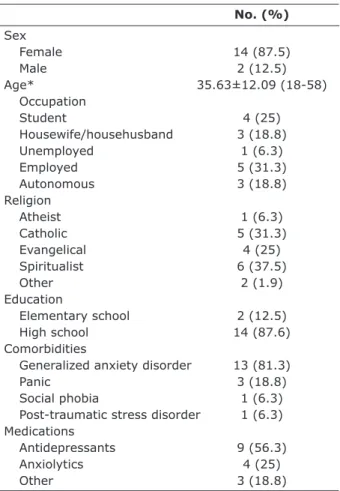
Sample characteristics for sex, age, occupation, religion, education, comorbid anxiety disorders, and drug use are presented in Table 1.
No. (%)
Sex
Female 14 (87.5)
Male 2 (12.5)
Age* 35.63±12.09 (18-58)
Occupation
Student 4 (25)
Housewife/househusband 3 (18.8)
Unemployed 1 (6.3)
Employed 5 (31.3)
Autonomous 3 (18.8)
Religion
Atheist 1 (6.3)
Catholic 5 (31.3)
Evangelical 4 (25)
Spiritualist 6 (37.5)
Other 2 (1.9)
Education
Elementary school 2 (12.5)
High school 14 (87.6)
Comorbidities
Generalized anxiety disorder 13 (81.3)
Panic 3 (18.8)
Social phobia 1 (6.3)
Post-traumatic stress disorder 1 (6.3) Medications
Antidepressants 9 (56.3)
Anxiolytics 4 (25)
Other 3 (18.8)
Table 1 – Sample characteristics
* Mean ± standard deviation.
Discussion
The primary objective of this study was to evaluate the effectiveness of a uniied CBT protocol in the group treatment of patients with a range of comorbid mood and anxiety disorders. Secondary objectives were the reduction of signs and symptoms of anxiety and depression and improvement in quality of life, which will be evaluated in light of the patient’s status.
At the start of treatment, patients evaluated in both groups showed depression and anxiety ranging from moderate to severe according to the scores obtained using the Beck inventories. After 12 treatment sessions with the uniied CBT protocol, all indicators reduced, attesting to the effectiveness of the protocol and to its superiority in group settings compared to other proven clinical approaches to anxiety disorders,7,8,21,22 e.g., mood23,24 and apathy.25 In this
study, we veriied the effectiveness of group CBT treatment for patients with a variety of mood, anxiety, and comorbid disorders, as the intervention model provided beneits for both the patient and the therapist.
Psychoeducational strategies, self-monitoring of thoughts, exposure, prevention and management of responses have all shown good results in previous studies22,26,27 and were part of the techniques applied
in the uniied protocol of group CBT. These techniques facilitate the identiication of thoughts that inluence emotions and behaviors and that are generators of anxiety or depression; such awareness gives patients the security necessary to face situations and make decisions.
Implementing the uniied protocol in group CBT with patients with a range of disorders allowed for relection on treatment practices, with an emphasis on the feasibility of not separating groups according to speciic disorders. Such separation is usually adopted because each therapy is aimed at treating a single disorder, and as a result a group of patients receives one single treatment according to the investigated problem21,22,25-30
(for example, a treatment group for mood disorders or social phobia).
In the present study, signiicant improvement in quality of life was observed for all the participants in the sample (F = 39.72, p < 0.001), including the physical (F = 28.15, p < 0.001), social (F = 36.86; p < 0.001), psychological (F = 9.90, p = 0.007), and environmental domains (F = 27.63, p < 0.001). Studies have shown that the relationships established in treatment groups promote the instillation of hope and enhance quality of life, especially when individuals learn how to recognize and regulate their emotions through anxiety management during interpersonal interactions.4-7 These
phenomena were observed in our group and may have contributed to the good results obtained.
When the uniied CBT protocol is adopted in group treatment settings, including patients with a range of disorders, quality of life and its domains become the focus of intervention, as the experience of the group resembles the daily lives of patients. The skills learned in this group setting, including social skills and assertiveness training, are practical and translate into real life experiences outside the treatment setting.
The results obtained for all variables related to quality of life, in addition to signs and symptoms of anxiety and depression, were satisfactory in patients who underwent to the uniied protocol. Treatment helped them identify thoughts, emotions, and behaviors that promote safety, express feelings in an assertive manner, and learn skills for handling stress and anxiety, thus restructuring their emotional state.31-33 These achievements are
fundamental to the goals of cognitive-behavioral group treatment using the uniied protocol.12-14
Improvement was also observed in sexual functioning: there was a statistically signiicant difference between ARIZONA scores obtained at the beginning vs. at the end of treatment (F = 13:13, p < 0.003). Surveys have shown that sexual functioning is associated with anxiety and depression.34,35 Dissatisfaction with overall sex life
(37.5%) and sexual anxieties (44.2%) were substantial in our subjects, corroborating previous indings.34 Also,
increased depression and anxiety levels were associated
End of Type III sum Mean
Baseline treatment of squares df square F p η2
Quality of life 75.81±15.07 94.00±8.94 2646.28 1 2646.28 39.72 < 0.001 0.73
Physical 21.81±5.39 27.06±4.07 220.50 1 220.50 28.15 < 0.001 0.65
Psychological 17.88±4.39 21.56±2.15 108.78 1 108.78 9.90 0.007 0.39
Social relationships 8.56±2.70 12.44±2.15 120.12 1 120.12 36.86 < 0.001 0.71
Environment 23.69±4.71 29.56±3.07 276.12 1 276.12 27.63 < 0.001 0.65
Anxiety 19.56±14.35 9.19±7.46 861.125 1 861.125 19.64 < 0.001 0.57
Depression 20.94±11.64 8.25±7.24 1287.78 1 1287.78 78.62 < 0.001 0.84
Sexuality 15.50±9.07 11.75±7.28 112.50 1 112.50 13.13 0.003 0.47
Table 2 – Results at the beginning and end of treatment and comparison of measurements obtained in the two periods
with a disturbed body image and with decreased levels of sexual satisfaction (86.98±23.63).35 This result suggests
the need for further study about sexual functioning in individuals with mood and anxiety disorders and on the therapeutic effects of the uniied protocol on sexuality, even when these areas are not targeted in the same approach.
As limitations of the present study we can mention the small sample size (only 16 participants) and the fact that it was an open trial. This is the irst study to evaluate the effectiveness of a new treatment protocol in a Brazilian population. Therefore, despite the small sample, results were important and showed good results both in reducing signs and symptoms of depression and anxiety and in improving the patients’ quality of life in various aspects. Also, the study did not adopt a protocol to measure treatment adherence.
The fact that patients were using psychotropics could also be considered a limitation. In order to ensure that the indings would be a result of the therapeutic process under investigation rather than of medication use, only patients without any change in medication in the 4 months preceding the study and with stable clinical conditions were included. Moreover, none of the patients changed the type or dosage of the medication used over the course of the psychotherapeutic treatment. In view of these measures, we have reason to believe that the improvements observed were a result of the therapeutic process using the uniied protocol. Future studies, with larger samples, should be conducted, especially randomized clinical trials, to conirm our preliminary indings.
Conclusion
The use of a uniied transdiagnostic protocol in treatment groups allows for a greater number of patients to beneit from treatment with trained therapists, at a lower cost, and with greater treatment eficiency. Moreover, it offers the advantages of social learning through the exchange of experiences among patients.
In our opinion, several factors favored success of this uniied protocol treatment, e.g., its focus on treatment, the possibility to express feelings and lexibly interact with the therapists, the patients’ willingness to actively participate in the evaluation of problems, their ability to recognize that symptoms have a psychological origin, the group’s curiosity about one’s self, openness to new ideas, realistic expectations regarding treatment results, and their willingness to make a reasonable sacriice for a short time (3 months), of either money or time, to address issues commonly found to be unpleasant.
Given the positive results here described, reinement of an effective treatment program for groups of patients with different mild to moderate anxiety and mood disorders is warranted, as there are few studies describing CBT approaches in groups of patients with a range of disorders. It is important to note that, in this context, strategies and techniques known to be successful in individual treatments should be adapted to groups. Speciically, a group setting provides more examples for making connections between thoughts and feelings than can be obtained in individual therapy.
The patients who participated in the uniied CBT protocol for group treatment obtained good results in the elimination and management of anxiety and phobic symptoms, coping with anxiogenic situations, troubleshooting, and restoring previous mood states. In addition to these achievements, they improved their quality of life, especially with regard to the physical domain, social relationships, and the environment. In fact, environmental variables promoted an increase in social skills and led to increased self-esteem and motivation for life.
References
1. Andrade LH, Wang YP, Andreoni S, Silveira CM, Alexandrino-Silva C, Siu ER, et al. Mental disorders in megacities: indings from the São Paulo megacity mental health survey, Brazil. PLoS One. 2012;7:e31879.
2. Ayers B, Smith M, Hellier J, Mann E, Hunter MS. Effectiveness of group and self-help cognitive behavior therapy in reducing problematic menopausal hot lushes and night sweats (MENOS 2): a randomized controlled trial. Menopause. 2012;19:749-59.
3. Zitman FG. [ROM in mood, anxiety and somatoform disorders: a promising technique with pleasing results]. Tijdschr Psychiatr. 2012;54:173-7.
4. Mykletun A, Jacka F, Williams L, Pasco J, Henry M, Nicholson GC, et al. Prevalence of mood and anxiety disorder in self reported irritable bowel syndrome (IBS). An epidemiological population based study of women. BMC Gastroenterol. 2010;10:88.
5. McEvoy PM, Nathan P. Effectiveness of cognitive behavior therapy for diagnostically heterogeneous groups: a benchmarking study. J Consult Clin Psychol. 2007;75:344-50. 6. Steward RE, Chambless DL. Cognitive-behavioral therapy for
adult anxiety disorders in clinical practice: a meta-analysis of effectiveness studies. J Consult Clin Psychol. 2009;77:595-606.
7. Tolin DF. Is cognitive-behavioral therapy more effective than other therapies? A meta-analytic review. Clin Psychol Rev. 2010;30:710-20.
8. Meuret AE, Rosenield D, Seidel A, Bhaskara L, Hofmann SG. Respiratory and cognitive mediators of treatment change in panic disorder: evidence for intervention speciicity. J Consult Clin Psychol. 2010;78:691-704.
9. Hood HK, Antony MM, Koerner N, Monson CM. Effects of safety behaviors on fear reduction during exposure. Behav Res Ther. 2010;48:1161-9.
11. Hunot V, Churchill R, Silva de Lima M, Teixeira V. Psychological therapies for generalised anxiety disorder. Cochrane Database Syst Rev. 2007;1:CD001848.
12. Donker T, Grifiths KM, Cuijpers P, Christensen H. Psychoeducation for depression, anxiety and psychological distress: a meta-analysis. BMC Med. 2009;16:7-79.
13. Schramm E, Hautzinger M, Zobel I, Kriston L, Berger M, Härter M. Comparative eficacy of the cognitive behavioral analysis system of psychotherapy versus supportive psychotherapy for early onset chronic depression: design and rationale of a multisite randomized controlled trial. BMC Psychiatry. 2011;11:134.
14. Barlow DH, Farchione TJ, Firholme CP, Ellard KK, Boisseau CL, Allen LB, et al. Uniied protocol for transdiagnostic treatment of emotional disorders. Therapist guide. New York: Oxford University Press; 2011.
15. Sheehan DV, Lecrubier Y, Sheehan KH, Amorim P, Janavs J, Weiller E, et al. The Mini International Neuropsychiatric Interview (MINI): the development and validation of a structured diagnostic psychiatric interview for DSM-IV and ICD-10. J Clin Psychiatry. 1998;59:22-33.
16. Amorim, P. Mini International Neuropsychiatric Interview (MINI): validação de entrevista breve para diagnóstico de transtornos mentais. Rev Bras Psiquiatr. 2000;22:106-15. 17. Beck AT, Steer RA. Beck Depression Inventory. San Antonio:
Psychological Corporation; 1993.
18. Beck AT, Steer RA. Beck Anxiety Inventory Manual. Behav Res Ther. 1995;3:477-85.
19. Cunha JA. Manual da versão em português das escalas Beck. São Paulo: Casa do Psicólogo; 2001.
20. Vaz Serra A, Canavarro MC, Simões MR, Pereira M, Gameiro S, Quartilho MJ, et al. Estudos psicométricos do instrumento de avaliação da qualidade de vida da Organização Mundial de Saúde (WHOQOL-Bref) para português de Portugal. Rev Psiquiatr Clin. 2006;27:41-9.
21. Craske MG, Farchione TJ, Allen LB, Barrios V, Stoyanova M, Rose RD. Cognitive-behavioral therapy for panic disorder and comorbidity: more of the same or less of more? Behav Res Ther. 2007;45:1095-109.
22. Hofmann SG, Smits JAJ. Cognitive-behavioral therapy for adult anxiety disorders: a meta-analysis of randomized placebo-controlled trials. J Clin Psychiatry. 2008;69:621-32. 23. Chorpita BF. Modular cognitive-behavioral therapy for anxiety
disorders. New York: Guilford; 2007.
24. Tolin DF. Is cognitive-behavioral therapy more effective than other therapies? A meta-analytic review. Clin Psychol Rev. 2010;30:710-20.
25. McGahuey CA, Gelenberg AJ, Laukes CA, Moreno FA, Delgado PL, McKnight PK, et al. The Arizona Sexual Experience Scale (ASEX): reliability and validity. J Sex Marital Ther. 2000;26:1, 25-40.
26. Erickson DH. Group cognitive-behavioral therapy for heterogeneous anxiety disorders. Cogn Behav Ther. 2003;32:179-86.
27. Norton PJ, Hope DA. Preliminary evaluation of a broad-spectrum cognitive-behavioral group therapy for anxiety. J Behav Ther Exp Psychiatry. 2005;36:79-97.
28. Johnston L, Titov N, Andrews G, Spence J, Dear BF. An RCT of a transdiagnostic internet-delivered treatment for three anxiety disorders: examination of support roles and disorder-speciic outcomes. PLoS One. 2011;6:e28079. Epub 2011 Nov 23. 29. Roy-Byrne DP, Craske MG, Stein MB, Sullivan G, Bystritsky
A, Katon W. A randomized effectiveness trial of cognitive-behavioral therapy and medication for primary care panic disorder. Arch Gen Psychiatry. 2005;62:290-8.
30. Sullivan G, Craske MG, Sherbourne C, Edlund MJ, Rose RD, Golindle D. Design of the Coordinated Anxiety Learning and Management (CALM) study innovations in collaborative care for anxiety disorders. Gen Hosp Psychol. 2007;29:379-87. 31. Donker T, Grifiths KM, Cuijpers P, Christensen H.
Psychoeducation for depression, anxiety and psychological distress: a meta-analysis. BMC Med. 2009;16:7-79. 32. Barlow DH, Gorman JM, Shear MK, Woods SW.
Cognitive-behavior therapy, imipramine, or their combination for panic disorder: a randomized controlled trial. JAMA. 2000;283:2529-36.
33. Barlow DH, Allen L, Choate M. Toward a uniied treatment for emotional disorders. Behav Ther. 2004;35:205-30.
34. Köhler B, Kleinemeier E, Lux A, Hiort O, Grüters A, Thyen U, et al. Satisfaction with genital surgery and sexual life of adults with XY disorders of sex development: results from the German clinical evaluation study. J Clin Endocrinol Metab. 2012;97:577-88.
35. Oyekçin DG, Gülpek D, Sahin EM, Mete L. Depression, anxiety, body image, sexual functioning, and dyadic adjustment associated with dialysis type in chronic renal failure. Int J Psychiatry Med. 2012;43:227-41.
Correspondence
Ana Claudia C. de Ornelas Maia
Institute of Psychiatry, Universidade Federal do Rio de Janeiro (UFRJ), INCT-TM
Rua Visconde de Pirajá, 407/702 22410-003 - Rio de Janeiro, RJ - Brazil Tel.: +55 (21) 2521.6147