Integrality in cervical cancer
care: evaluation of access
I Centro Acadêmico de Vitória. Universidade Federal de Pernambuco. Vitória de Santo Antão, PE, Brasil
II Departamento de Medicina Social. Centro de Ciências da Saúde. Universidade Federal de Pernambuco. Recife, PE, Brasil III Departamento de Enfermagem Geral e
Especializada. Escola de Enfermagem de Ribeirão Preto. Universidade de São Paulo. Ribeirão Preto, SP, Brasil
IV Departamento de Prática de Saúde Pública. Faculdade de Saúde Pública. Universidade de São Paulo. São Paulo, SP, Brasil
Correspondence:
Keila Silene de Brito e Silva
Rua Major Nereu Guerra, 87/202 Casa Amarela
52070-300 Recife, PE, Brasil E-mail: [email protected] Received: 3/25/2013 Approved: 12/9/2013
Article available from: www.scielo.br/rsp
ABSTRACT
OBJECTIVE: To evaluate integrity of access to uterine cervical cancer prevention, diagnosis and treatment services.
METHODS:The tracer condition was analyzed using a mixed quantitative and qualitative approach. The quantitative approach was based on secondary data from the analysis of cytology and biopsy exams performed between 2008 and 2010 on 25 to 59 year-old women in a municipality with a large population and with the necessary technological resources. Data were obtained from the Health Information System and the Regional Cervical Cancer Information System. Statistical analysis was performed using PASW statistic 17.0 software. The qualitative approach involved semi-structured interviews with service managers, health care professionals and users. NVivo 9.0 software was used for the content analysis of the primary data.
RESULTS: Pap smear coverage was low, possible due to insuficient screening
and the dificulty of making appointments in primary care. The numbers of biopsies conducted are similar to those of abnormal cytologies, relecting
easy access to the specialized services. There was higher coverage among younger women. More serious diagnoses, for both cytologies and biopsies, were more prevalent in older women.
CONCLUSIONS: Insuficient coverage of cytologies, reported by the
interviewees allows us to understand access dificulties in primary care, as
well as the fragility of screening strategies.
DESCRIPTORS: Uterine Cervical Neoplasms, prevention & control. Women’s Health Services. Integrality in Health. Health Care Quality, Access, and Evaluation.
Keila Brito-SilvaI
Adriana Falangola Benjamin BezerraII
Lucieli Dias Pedreschi ChavesIII
In step with worldwide trends, the most common types of cancer in Brazilian women are breast cancer and uterine cervical cancer (UCC). According to Brazilian
Ministry of Health National Cancer Institute igures,19
UCC is responsible for the deaths of around 230 thou-sand women annually. In developing countries, inci-dence is around two times higher than in more deve-loped countries. At the same time, it is a type of can-cer with higher potential for prevention and for cure if diagnosed early.
The high prevention and cure potential is explained by
the of the disease, with well-deined stages, and the ease of early detection of changes, making quick diagnosis and eficacious treatment viable.
Effective early UCC detection, through Pap smear tests, associated with treating squamous intraepithe-lial lesions, can reduce the incidence of such cancers
by 90.0%, with signiicant impact on morbidity and
mortality rates.16 However, such a reduction depends
on quality screening covering at least 80.0% of the tar-get population (25 to 59 years old). As recommended by the World Health Organization (WHO).28 Effective
screening programs can help to reduce incidence rates and, consequently, mortality from UCC.17
Despite improvements in the coverage of cytological
testing in Brazil, it is still deemed insuficient to reduce
UCC mortality.16 Moreover, the quality of testing and
the stages at which cases are diagnosed are other
fac-tors inluencing this situation.24
Delayed diagnosis makes it more dificult to access services and, above all, reveals a lack of quantity and
quality oncological services outside of the larger state capitals.16 Other aspects which may contribute to delayed
diagnosis are: poor professional training in oncologi-cal care, inability of health care units to meet demand
and municipal and state administration dificulties in deining and establishing low at different care levels.20
In one sense, integrality can refer to the population’s access to different levels of care. Although universal
access is a constitutional right and this has broken down formal barriers, dificulties in access to, and continuity
of, care remain,15 both in primary care and in more
spe-cialized services.9,26
Seeking to combat the disease effectively, the National
UCC Control Program in Brazil provides access to diffe-rent services for dealing with each phase of the illness. Early detection (screening) of UCC in asymptomatic women is this program’s paramount initiative, with the
following essential elements: deining the target popula -tion and screening method and interval; coverage goals; infrastructure in the three levels of care and guaranteed quality of the actions.18
INTRODUCTION
Developing evaluative studies regarding UCC care
integrality may encourage identiication of this con
-text, enabling bottle necks in the different levels of care to be identiied.
Using tracers is one of the recommended strategies in developing evaluative research.13,23 Using this techni-que enables foci to be more easily deined and means
multiple care points involved in integrating services can be covered.12
UCC is a tracer4,13,16 as it is a disease which meets the requisites: frequent event with scientiically well-dei -ned etiology, diagnosis, treatment and prevention; the existence of a consolidated national program involving all levels of care; a disease that evolves slowly and for which there is an effective treatment.
Considering that integrality covers different dimen-sions,6 the aim of this study was to evaluate integrality
in the dimension of access to prevention, diagnosis and treatment services for uterine cervical cancer.
METHODOLOGICAL PROCEEDINGS
Evaluative research was conducted based on the sequen-tial mixed methods design. Quantitative data were used, followed by qualitative data. This combination aimed to enable better understanding of the research problem by converging numeric trends from a quantitative appro-ach and qualitative details.8
It was decided to use a case study. The location studied is one of the Brazilian cities with the highest number of registered health care establishments and available health care professionals, being the biggest health care reference center in the northeast of Sao Paulo state. It
is a signiicant case 29 due to its coverage and capacity
to provide UCC care, as well as for historical and poli-tical investment processes and advances in local SUS structuration. Given these details, this study
denomi-nated the location as a key-municipality.
As in other large urban centers, despite the provision of health care services, the location studied has limita-tions concerning the quality and capacity of responses at different care levels.26 Although there are suficient health care facilities to make integrality of UCC care viable, the place studied relects the Brazilian reality
of mortality from this type of cancer, with a rate of 4.5 deaths per 100 thousand women in 2008.
The focus of the study identiied functional bottle necks
25.0
25.0
15.0
10.0
5.0
0.0
2008
Year %
2009 2010
Figure 1. Annual coverage of cytological tests for women
aged 25 to 59. Key municipality, SP, Southeastern Brazil, 2008-2010.
The irst stage of investigation consisted of formulating
the following hypotheses:
1. Pap smear coverage is insuficient in the key municipality;
2. There are dificulties in accessing levels of more technological density (biopsy and treatment).
To investigate these hypotheses, the different care levels were studied, aiming to quantitatively unders-tand women’s capacity to access different services, as well as their ability to meet users’ needs.
The data were taken from Hygiaweb and the regional Siscolo. Hygia is the key municipality’s health care secretariat’s oficial information system in which pro -cedures performed in municipal health care units are recorded. The data were generated in Excel spreadsheets, enabling access to cytopathology tests, diagnoses and possible referrals for women aged 25 to 59 and recor-ded in the system between January 2008 and June 2010.
To complement the data obtained from Hygia, the XIII Regional Health Department of the Sao Paulo State Health Secretariat (SES/SP) database was accessed regarding the UCC prevention diagnosis procedures that
occurred under state administration in the key muni -cipality. The data available in the state and municipal sphere were organized in a single database, enabling the procedures covering the local health care system to be visualized together in one place.
Secondary data were analyzed using PASW statistic 17.0 software to analyze frequency distribution and the study variables.
The variables studied concerning cytology (performed and with changes) and biopsies were: year test was per-formed, age group, type of change (diagnostic), health care service administration (state/municipal).
From these variables, cytology coverage in the key municipality was identiied by year and age group as
were the changes that most affected the women in the study and biopsy coverage where necessary.
Regarding data concerning treatment, a lack of records in the local health care information system was identiied.
The qualitative approach involved selecting the two health districts (HD 3 and HD 4) that conducted the most cytological tests in the period studied, these having the greatest provision and, consequently, the greatest coverage of care activities for the condition traced. The
key informants selected were: primary and/or specia -list health care professionals involved in activities pro-moting, preventing, diagnosing and/or treating women with UCC; users aged between 25 and 59, registered with the health care unit and in need of referral to other levels of care due to changes detected in their cytology
tests. In addition to the health care professionals directly involved, representatives of municipal administration
with attributes identiied as being relevant in the other
interviews were also interviewed.
Individual, semi-structured interviews were conducted with ten health care professionals operating at different levels of the health care system; ten users and two repre-sentatives of the administration. The primary data were transcribed and underwent content analysis.11 the data
were categorized using NVivo 9.0 software.
Although the qualitative indings covered different
dimensions of integrality, the results shown here only refer to the dimension of access, in dialogue with the
quantitative indings of the research.
Thus, the categories presented are: rapid access to
spe-cialist services; dificulty in making appointments; and
primary care spontaneous demand based care.
Names were changed to maintain participants’ coni
-dentiality. Users were given the irst name “Maria” and
administration representatives and health care profes-sionals were given names related to weaving.
ANALYSIS OF RESULTS AND DISCUSSION
Preventing uterine cervical cancer
In the key municipality, the female population aged
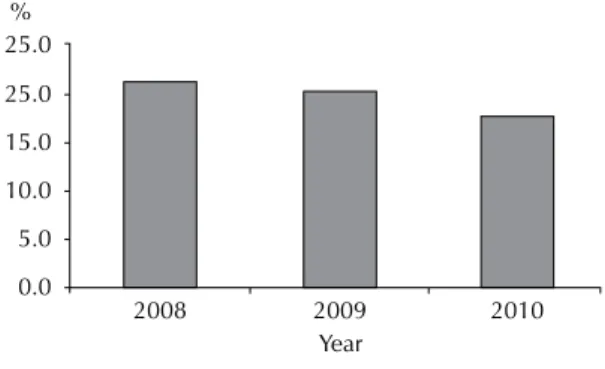
between 25 and 29 corresponded to a total of 146,868 women and the 30 thousand smear tests performed annu-ally by SUS services for this population means coverage of around 20.0% per year, as can be seen in Figure 1.
Smear test coverage in the key municipality is, therefore,
lower than WHO recommendations (80.0%) to have
signiicant impact on morbidity and mortality rates for this kind of cancer.28 However, the coverage observed in the key municipality exceeded that in the majority of
Pap smear screening is deemed to be the most effective approach for controlling UCC. Epidemiological studies
have shown a higher risk of the disease in women who
have never had the test done and a proportional rise in
risk according to the time elapsed since the most recent
smear test.10,14
Hypotheses regarding poor coverage in the key muni -cipality include: underreporting of tests actually perfor-med, the percentage of women having the test done in
private health care services, insuficient supply of servi
-ces/human resources making access to primary care ser
-vices more dificult and/or insuficient active searching.
On the topic of private health care service use, it was noted in the interviews that many users used means of accessing health care other than the SUS, such as health care plans.
In addition to these hypotheses, the indings of Brenna et
al5 on factors associated with poor adherence to having a smear test done should also be taken into account; these include: embarrassment, distance, dificulty lea
-ving children or dependents, getting time off work, as well as inancial or transport-related dificulties. Of the hypotheses listed above, dificulty in accessing primary care and insuficient active search were repor -ted in the interviews.
“In the health care center, there is only one day on which you can make appointments. It’s the irst of
the month. When that day comes round, there are so many things going on that you end up forgetting.
When you remember, it’s too late”. (Maria de Nazaré) “It is dificult to access the primary care unit (...). It takes users a long time to manage it. (...) in some
units they are very strict about it. In the end, they only do what is very urgent. If not, no time is made
for it”. (Cotton)
“From the moment I became strict about punctuality,
the patients I saw dropped by 30.0% (...). Today, I
don’t squeeze them in. I only make room for emer -gencies. Miss your appointment? It’s not my
pro-blem”. (Fabric)
Based on the interviews, it can be stated that dificulty in accessing primary care is, above all, related to lack of lexibility in making appointments. The dynamic
of attendance is restricted and bureaucracy
contribu-tes to making it dificult and to discouraging women from seeking to use the service, delaying them having
a smear test done, as can be seen in Figure 1.
There are different studies that indicate a similar
situation to that observed in the key municipality.
Andrade et al2 (2007) indicate critical access
situa-tions in family health care units in a municipality in
Bahia, Northeastern Brazil, where it was common to arrive at the unit in the early hours of the morning and even then not be guaranteed an appointment. Cunha & Vieira-da-Silva9 highlighted dificulties in acces
-sing primary care in cities in the Northeast of Brazil, in both traditional units and family health care units,
emphasizing the appointment making process as a signiicant obstacle to using the service.
Statements such as those of Fabric and Cotton portray the indifference of professionals who see themselves
as spectators, without taking responsibility for the situ -ation and ignoring users’ rights.
Regarding the entrance policy for users,
representati-ves from the three groups interviewed conirmed it was
based on the logic of spontaneous demand:
“I hadn’t had one [smear test] for 20 years (...). Nobody ever talked to me about it. I did it now because I decided to look after myself”. (Maria de Nazaré)
“Our unit is very passive. It waits for people to come
to it (...) we deal with whoever shows up and we
have no idea who needs to have it done”. (Fiber) “Units that don’t have a community health worker
don’t have that type of focus: someone missed their appointment? Deal with the user who is there and
no one looks into it any further”. (Warp)
The way in which the health care services are organized to screen for cancer can be based on either organized or spontaneous provision.27
In the organized model, there are appropriate structure and resources to perform screening tests regularly, as well as to treat suspicious lesions. There are mechanisms to recruit the target population and systematic moni-toring of individuals whose test results are positive.3
In the spontaneous model, screening is not a systema-tic part of the routine of health care services and is
res-tricted to those who occasionally seek the health care
service for different reasons, with no actions
develo-ped to actively seek cases, resulting in inequalities in access and ineficient use of resources.27
Organization based on spontaneous demand is a basic characteristic of the privatized care model traditionally found in health care services in this country.
Regarding prevention of UCC, various studies21,25 have
shown that having a Pap smear test done is
predomi-nantly associated with the women themselves seeking this, reafirming what was stated above in the inter -views and resulting in situations such as that of Maria
de Nazaré, who reported not having the test done for
25.0 20.0 15.0 10.0 5.0 0.0
25 30 35 40 45 %
50 55 Age (years)
Figure 2. Cytology in women aged 25 to 59 by age group. Key municipality, SP, Southeastern Brazil, 2008-2010.
Figure 3. Diagnoses of cytology by age group. Key municipality, SP, Southeastern Brazil, 2008-2010. 70.0
60.0
50.0
40.0
30.0
20.0
10.0
25 30 35 40
%
45 50 55
Age (years) 0.0
Benign changes
Carcinoma
Pre-malignant N1
Pre-malignant N2
Normal Adenocarcinoma
Unsatisfactory result Vale et al25 emphasize the relationship between primary
care based on spontaneous demand and poor coverage. Higher frequency of events, such as pregnancy, need for contraceptive methods or treating discharge, in youn-ger women, means that they see the gynecologist more often than older women.1 Thus, in addition to being insuficient, coverage is also concentrated on younger
women and does not reach those in their 50s and 60s,
the group with the highest cancer risk. Actively seeking
cases, associated with monitoring and performing tests, are actions which could encourage increased Pap smear coverage, especially in women over 50.
As can be seen in Figure 2, in the key municipality, there
is a trend for coverage to decrease with age group. Over the age of 40, coverage is below 15.0%.
The fact that women between 40 and 59 visit the gyne-cologist less often results in low frequency of having Pap smear tests and, consequently, in diagnoses being more serious than those observed in younger women. The concentration of cytopathology tests in women aged under 35 is a commonly observed situation in Brazil.
Amorim et al1 deem it essential that health care services take advantage of older women using them for other
health problems to perform a Pap smear.
Parada et al21 suggest reorganizing reception in primary
health care units using strategies such as: consultations without appointments, alternative opening hours (during
the night or the weekend), actively seeking women
within the program’s age range, especially those who
have never had a smear test, seeking to increase and
facilitate women’s access to these services.
The urgent need to capture users aged over 50 can be seen in Figure 3, which shows the predominance of malignant changes in women aged over 50. Malignant changes (adenocarcinoma, carcinoma) were mainly diagnosed in women aged between 50 and 59, whereas benign and pre-malignant changes were concentrated in younger women (25-39) (Figure 3).
Ribeiro et al22 identiied that, for women aged between
46 and 74, gynecological examination is seen by many as a painful, embarrassing and disagreeable experience. According to the authors, this perspective is explai-ned as they form part of a generation which suffered intense sexual repression, as well as having under-gone negative experiences during impersonal, careless gynecological examinations without any explanation
of the process given, which contributes signiicantly to these women’s refusal to seek this form of caring
100.0
120.0
80.0
60.0
40.0
20.0 0.0
2008
Year %
2009 2010
Figure 4. Coverage of biopsy by cytology with changes. Key municipality, SP, Southeastern Brazil, 2008-2010.
Incorporating guidance by the health care team on the preventative role of the test in menopausal women’s health is essential in encouraging it, contributing to reducing incidence and mortality in this population.
Diagnosing and treating uterine cervical cancer
The Brazilian Ministry of Health20 recommends the
following procedures for diagnoses obtained from Pap smear tests: normal cytology and benign changes should follow routine (annual) cytological screening: for pre--malignant changes, it is recommended that cytology is repeated every six months; in case of malignant changes, a colposcopy is immediately performed and, if lesions are found, a biopsy is recommended.
Thus, the aim is to identify equivalent coverage between the number of biopsies performed and the number of Pap smear results with changes that led to them being performed, by year and age group.
In Figure 4, it can be seen that the number of biopsies is equivalent to the number of cytological tests showing changes. In 2008, however, this was not the case, with the rate being around 80.0%. The years 2009 and 2010
had rates of 116.7% and 119.3%, respectively. This in -ding can be explained both by inappropriate referral in cases that did not require a biopsy, as reported by health care professionals from the specialist service, and by women having the smear test done in the pri-vate sector and then referred to have the biopsy done in the public sector.
“I see that my colleagues have dificulty following
the ministry guidelines. For example, when an NIC 1 cytology appears, they immediately refer this patient, when they should repeat the test after 6 months (…). In my outpatients’ unit, around 50.0%
of referrals are not appropriate”. (Shuttle)
The qualitative data conirm that cases requiring a
biopsy are referred to specialist services. From the interviews, it was observed that access to medium
complexity care occurs quickly, which may favor the
observed result.
According to the interviewees, it varies between one
and two weeks to enter secondary level care when some change requiring more complex tests is identiied in the cytology: the period between making an appointment
and the result is between 15 and 20 days.
“It didn’t take long. It was really quick. Around 20 days”. (Maria da Conceição)
“It’s around a week, at the most. The PHC (primary health care unit) itself calls and makes an appointment.
In a week, the patient has an appointment sched
-uled”. (Needle)
It was not possible to obtain qualitative data on users’ treatment. According to data from the UCC Information System,a the key municipality did not have follow up
records of 99.98% of cases, as proposed by Siscolo.
However, the qualitative approach identiied issues such as making access to tertiary level care within a
short space of time more viable:
“Ah! It was really quick there. I was referred the same week”. (Maria das Graças)
“When someone needs to be referred to the uni
-versity hospital, they have an appointment made
to start treatment within 15 or 20 days”. (Needle)
“There is no dificulty making appointments with
the university hospital for cervical cancer cases.
None at all”. (Loom)
Facilitated access to secondary and tertiary levels of care is not a commonly observed situation in this coun-try. According to Parada,21 guaranteeing appropriate actions in diagnosing and treating UCC is a key point in the organization of the care low.
Cecílio & Merhy7 state that “the care low, thought of
as a whole, crosses through countless health care
ser-vices”. According to these authors, there is no radical
integrality without transversality within the system.
UCC, speciically, depends on uniting different tech -nologies to advance women’s health care, considering the disease’s different levels of evolution.
The situation observed in the key municipality is explai -ned by the prioritization of immediate referral of service users when necessary. Ease of access to specialized ser-vices is a relevant investment in preventing secondary and tertiary UCC.
Using UCC as a tracer to assess integrality in the dimension of access enabled the principal strengths and
weaknesses of the different care levels for this disease to be identiied.
Ongoing insuficient cytological coverage, especially among older women, relects users’ problems in acces -sing primary care and the fragility of active searching for cases.
There are no access problems in the secondary level, which includes a higher number of women than expec-ted. On the other hand, as well as portraying referrals from the private sector, professional insecurity concer-ning Pap smear results may mean that not all the cases they refer for biopsy are suspicious.
Regarding following up of positive cases, we found pro-blems recording data, impeding a quantitative assessment of access to this level of care. The limitations found in the health care information systems consulted portrays
a problem researchers often face when working with
secondary data obtained using these tools.
It is dificult to ind health care information systems
being consulted in planning and assessing actions, with
this instrument being underused in decision making.
This underuse frequently results in incomplete,
unre-liable and out of date data, making their use for scienti
-ic studies or administration dif-icult. As administrators
come to better understand the use of such data in
deci-sion making, their recording will gradually improve.
CONCLUSION
The indings of this study met the expectation to assess integrality in access to UCC care. Identifying bottle necks
in the SUS encourages decision making by adminis
-trators aiming to improve UCC care quality as well as other health problems. However, in order for advances
1. Amorim VMSL, Barros MBA, César CLG, Carandina L, Goldbaum M. Fatores associados à não realização do exame de Papanicolaou: um estudo de base populacional no Município de Campinas, São Paulo, Brasil. Cad Saude Publica. 2006;22(11):2329-38. DOI:10.1590/S0102-311X2006001100007 2. Andrade CS, Franco TB, Ferreira VSC. Acolhimento:
uma experiência de pesquisa-ação na mudança do processo de trabalho em saúde. Rev APS. 2007;10(2):106-15.
3. Bastos EA. Estimativa da efetividade do programa de rastreamento do câncer do colo do útero no Estado do Rio de Janeiro [dissertação de mestrado]. Rio de Janeiro: Universidade Federal do Rio de Janeiro; 2011 4. Bottari CMS, Vasconcellos MM, Mendonça MHM.
Câncer cérvico-uterino como condição marcadora: uma proposta de avaliação da atenção básica.
Cad Saude Publica. 2008;24(Supl 1):S111-22. DOI:10.1590/S0102-311X2008001300016 5. Brenna SMF, Hardy E, Zeferino LC, Namura I.
Conhecimento, atitude e prática do exame de Papanicolaou em mulheres com câncer de colo uterino. Cad Saude Publica. 2001;17(4):909-14. DOI:10.1590/S0102-311X2001000400024 6. Brito-Silva K, Bezerra AFB, Tanaka OY. Direito
à saúde e integralidade: uma discussão sobre os desafios e caminhos para sua efetivação.
Interface (Botucatu). 2012;16(40):249-60. DOI:10.1590/S1414-32832012005000014 7. Cecilio LCO, Merhy EE. A integralidade do cuidado
como eixo da gestão hospitalar. In: Pinheiro R, Mattos RA, organizadores. Construção da integralidade: cotidiano, saberes e práticas em saúde. Rio de Janeiro: IMS/ABRASCO; 2003. p.197-210.
8. Creswell JW. Projeto de pesquisa: métodos qualitativo, quantitativo e misto. 2.ed. Porto Alegre: Artmed; 2007. 9. Cunha ABO, Vieira da Silva LM. Acessibilidade
aos serviços de saúde em um município do Estado da Bahia, Brasil, em gestão plena do sistema. Cad Saude Publica. 2010;26(4):725-37. DOI:10.1590/S0102-311X2010000400015 10. Ferreccio C, Bratti MC, Sherman ME, Herrero R,
Wacholder S, Hildesheim A, et al. A comparison of single and combined visual, cytologic and virologic tests as screening strategies in a region at high risk of cervical cancer. Cancer Epidemiol Biomarkers Prev. 2003;12(9):815-23.
11. Flick U. Uma introdução à pesquisa qualitativa. 2.ed. Porto Alegre: Bookman; 2004.
12. Hartz ZMA, Contandriopoulos AP. Integralidade da atenção e integração de serviços de saúde: desafios para avaliar a implantação de um “sistema sem muros”. Cad Saude Publica. 2004;20(Supl 2):S331-6. DOI:10.1590/S0102-311X2004000800026
13. Kessner DM, Kalk CE, Singer J. Assessing health quality: the case for tracers. N Engl J Med. 1973;288(4):189-94. DOI:10.1056/NEJM197301252880406
14. Martins LFL, Thuler LCS, Valente JG. Cobertura do exame de Papanicolaou no Brasil e seus fatores
determinantes: uma revisão sistemática da literatura.
Rev Bras Ginecol Obstet. 2005;27(8):485-92. DOI:10.1590/S0100-72032005000800009 15. Mattos RA. A integralidade na prática
(ou sobre a prática da integralidade).
Cad Saude Publica. 2004;20(5):1411-6. DOI:10.1590/S0102-311X2004000500037 16. Mendonça VG, Lorenzato FRB, Mendonça JG,
Menezes TC, Guimarães MJB. Mortalidade por câncer do colo do útero: características sociodemográficas das mulheres residentes na cidade de Recife, Pernambuco.
Rev Bras Ginecol Obstet. 2008;30(5):248-55. DOI:10.1590/S0100-72032008000500007 17. Ministério da Saúde. Instituto Nacional de Câncer.
Plano de ação para redução da incidência e mortalidade por câncer do colo do útero: sumário executivo. Rio de Janeiro: INCA; 2010 [citado 2011 jul 12]. Disponível em: http://www1. inca.gov.br/inca/Arquivos/Livro_DARAO_utero.pdf 18. Ministério da Saúde. Instituto Nacional de Câncer.
Plano de ação para redução da incidência e mortalidade por câncer do colo do útero: sumário executivo. Rio de Janeiro: INCA; 2010 [citado 2011 jul 12]. Disponível em: http://www1.inca.gov.br/inca/ Arquivos/Livro_DARAO_utero.pdf
19. Ministério da Saúde. Instituto Nacional de Câncer. Estimativa 2010: incidência de câncer no Brasil. Rio de Janeiro: INCA; 2009 [citado 2011 jul 12]. Disponível em: http://www.inca.gov.br/estimativa/2010/ 20. Ministério da Saúde. Instituto Nacional
de Câncer. Nomenclatura Brasileira para Laudos Cervicais e Condutas Preconizadas: recomendações para profissionais de saúde.
J Bras Patol Med Lab. 2006;42(5):351-73. DOI:10.1590/S1676-24442006000500008 21. Parada R, Assis M, Silva RCF, Abreu MF, Silva MAF,
Dias MBK, et al. A política nacional de atenção oncológica e o papel da atenção básica na prevenção e controle do câncer. Rev APS. 2008;11(2):199-206.
22. Ribeiro MGM, Santos SMR, Teixeira MTB. Itinerário terapêutico de mulheres com câncer do colo do útero: uma abordagem focada na prevenção. Rev Bras Cancerol. 2011;57(4):483-91.
23. Tanaka OY, Espírito Santo ACG. Avaliação da qualidade da atenção básica utilizando a doença respiratória da infância como traçador, em um distrito sanitário do município de São Paulo.
Rev Bras Saude MaterInfant. 2008;8(3):325-32. DOI:10.1590/S1519-38292008000300012
24. Thuler LCS. Mortalidade por câncer do colo do útero no Brasil. Rev Bras Ginecol Obstet. 2008;30(5):216-8. DOI:10.1590/S0100-72032008000500002
25. Vale DBAP, Morais SS, Pimenta AL, Zeferino LC. Avaliação do rastreamento do câncer do colo do útero na Estratégia Saúde da Família no Município de Amparo, São Paulo, Brasil. Cad Saude Publica. 2010;26(2):383-90. DOI:10.1590/S0102-311X2010000200017
Article based on the doctoral thesis of Brito-Silva KS, entitled: “Avaliação da integralidade no cuidado ao câncer de colo uterino: uso da condição marcadora em um estudo misto”, presented to the Faculdade de Saúde Pública of the Universidade de São Paulo, in 2013.
The author received a grant from the Coordenação de Aperfeiçoamento de Pessoal de Nível Superior (Capes) during the doctorate and from the Conselho Nacional de Desenvolvimento Científico e Tecnológico (CNPq) during the Sandwich PhD abroad (SWE – Process 200741/2011-0).
This study was supported by the Fundação de Amparo à Pesquisa do Estado de São Paulo (FAPESP – Process 2009/08844-8). The authors declare that there is no conflict of interest
nos grandes municípios paulistas: efetividade, eficácia, sustentabilidade e governabilidade.
Cienc Saude Coletiva. 2006;11(3):577-606. DOI:10.1590/S1413-81232006000300009
27. World Health Organization. Cancer control: knowledge into action: WHO guide for effective programmes: early detection. Geneva; 2007 [citado 2012 set 6]. Disponível
em: http://www.who.int/cancer/modules/Early%20 Detection%20Module%203.pdf
28. World Health Organization. National cancer control programmes: policies and managerial guidelines. 2.ed. Geneva; 2002.