INTERNATIONAL PROSTATE SYMPTOM SCORE – IPSS - AUA AS
DISCRIMINAT SCALE IN 400 MALE PATIENTS WITH LOWER URINARY
TRACT SYMPTOMS (LUTS)
PAULO RODRIGUES, ALEX MELLER, JOÃO C. CAMPAGNARI, DANIEL ALCÂNTARA,
MÁRCIO D’IMPÉRIO
Neurourology and Voiding Section, Beneficência Portuguesa Hospital, and Santa Helena Hospital, São Paulo, SP, Brazil
ABSTRACT
Objective: This study analyzed the total symptom score, irritative and obstructive domains of IPSS questions regarding quality of life and the urodynamic diagnosis in 400 men with LUTS.
Materials and Methods: Four hundred consecutive male patients were prospectively enrolled after being submitted to full urodynamic evaluation and IPSS. Obstructed and non-obstructed patients were compared regarding the symptoms score and quality of life. Results were assessed through Wilcox, ANOVA and Student-t tests.
Results:80.2% were diagnosed as urodynamically obstructed of which 42.4% presented detrusor instability in the filling phase. In obstructed patients there were no statistical difference concerning obstructive or irritative questions from IPSS (p = 0.50). It was not possible either to predict which patients presented detrusor instability based on the questionnaire (p = 0.65). Out of seventy-nine cases unobstructed (19.8%), 65.4% revealed detrusor instability. These cases could not be distinguished from all obstructed men based on the clinical questions measured by IPSS (p = 0.87). Obstructive and irritative questions did not present different indexes than obstructed cases (p = 0.63). Subjective quality of life index did not discriminate obstruction nor it could predict detrusor instabil-ity in both groups.
Conclusion: Clinical symptoms and quality of life index measured by the IPSS as well as its obstructive and irritative domains do not have discriminating power to predict the presence of infravesical obstruction in males with LUTS, demanding objective tools to demonstrate obstruction.
Key words: urinary symptoms; urodynamics; bladder outlet obstruction; prostate; prostatism Int Braz J Urol. 2004; 30: 135-141
INTRODUCTION
Benign prostatic hyperplasia is a frequent histological finding in the elderly population. In the meanwhile symptomatic voiding disturbances related to infravesical obstruction are a much less frequent complaint (1). Notably surgical therapy is intended to relief the symptoms and complaints in case there is urodynamically proven urethral obstruction (2).
Clinical questionnaires allow homogeneity and comparable final results after different therapies. They were also historically designed with an initial intent to avoid invasive and costly evaluations justi-fying the division of urinary symptoms into irritative and obstructive ones (3-6).
irrita-tive urinary symptoms becoming extremely difficult to diagnose those with infravesical obstruction from those with detrusor instability.
The morphologic evaluation of the prostate based on volume, presence of median lobe, flow rate, bladder residual volume or urinary symptoms seems to be inadequate due to the wide variability and the same clinical prevalence despite the presence or ab-sence of infravesical obstruction (7,8) requiring spe-cial attention not to the prostate morphology but to the clinical picture and bothersome symptoms related to voiding difficulties (2).
In the present study the International Pros-tate Symptoms Score (IPSS) (3) diagnostic specific-ity was questioned as a valid tool to determine the presence of infravesical obstruction.
PATIENTS AND METHODS
Four hundred consecutive enrolled male patients were prospectively studied with urodynamic evaluation to assess the significance of the IPSS - AUA. All patients filled out the IPSS with no interferences before going to urodynamic evaluation.
The urodynamic study was repeated 3 times, in order to allow reproducibility and smoother curves according to ICS (9) recommendations. It consisted of repeated pressure-flow and cystometry in a stand-ing position with saline infusions at 37°C.
Infravesical obstruction was established on the Abrams-Griffiths’ normogram (10) while instability was assigned if > 15 cmH2O (11).
When patients were assigned to the doubtful zone passive urethral resistance relation was calcu-lated and designated as obstructed if > 2 cmH2O/ml/ s is obtained.
Obstructed patients were compared to non-obstructed ones.
Total symptoms score and quality of life were compared between the groups.
The sum of questions addressing irritative symptoms (questions 2, 4 and 7) was compared to the sum of questions addressing obstructive com-plaints (questions 1, 3, 5 and 6) from the IPSS in each group and between the groups.
Quality of life index was also compared to the irritative and obstructive sum in the obstructed and non-obstructed groups.
Wilcox, ANOVA and Student-t test were used as necessary with a 5% statistical significance.
RESULTS
Whole Group
The median age of the whole group was 58.2 years (range: 44 – 77 years-old).
The average obstructive symptoms was 8.05
± 3.2 (maximum possible = 20) while the irritative symptoms showed an average 9.26 ± 4.1 (maximum possible = 15) for the studied population. This find-ing revealed an important contribution of urgency symptoms as a bother perception of the voiding dys-function in males seeking medical care.
Urodynamic findings
Infravesical obstruction could be documented in 321 cases (80.2%) of which 136 men (42.4%) re-vealed detrusor instability on filling cystometry. On the other hand 52 (19.8%) of the 79 non-obstructed cases showed detrusor instability (Table-1).
Total symptoms score X Quality of life
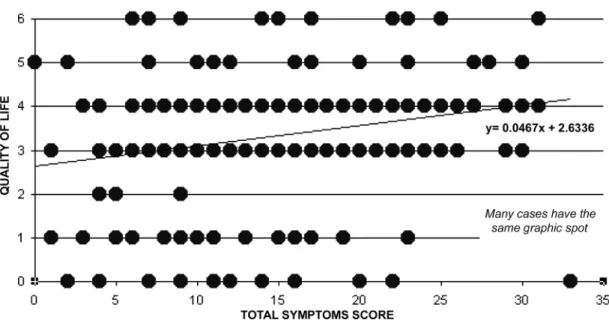
There was no statistical correlation between quality of life and total symptoms score in all 400 cases (p = 0.14), although the total score demonstrated a trend to higher interference in the subjective perception of quality of life (Y = 0.0467 + 2.63). Paradoxically some patients (32 cases) showed higher total symptoms score but low perception of bother (Figure-1).
Table 1 – Prevalence of detrusor instability in 400 urodynamically evaluated men.
Men N
Obstructed
Total: 321 With instability (42.4%) 136 Without instability (57.6%) 185 Non-obstructed
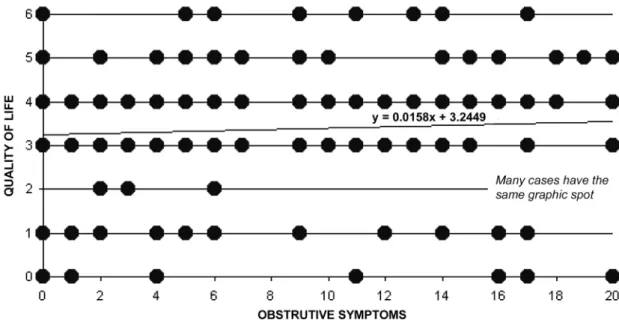
The division of the questions domains into obstructive and irritative questions demonstrated non-significant statistical relationship to the observed quality of life (Figures-2 and 3).
Total symptoms score in obstructed and non-ob-structed groups
The total symptoms score did not differ be-tween obstructed and non-obstructed cases (p = 0.87) and the same observation was set when only patients
with detrusor instability in both groups were com-pared (p = 0.53). (Table-2)
Irritative symptom score in the obstructed and non-obstructed groups
The irritative symptoms score in obstructed and non-obstructed patients did not show any statis-tical significance (p = 0.18).
When only the obstructive symptoms were analyzed in patients presenting detrusor instability no
Table 2 – Characteristic of the studied population according to the urodynamic criteria in 400 men with voiding disturbances evaluated by IPSS - AUA.
Diagnostic
Obstructed Total: 321 With instability Without instability Non-obstructed Total: 79 With instability Without instability
Irritative
8.6 ± 2.4 7.6 ± 1.8
8.0 ± 2.2 8.0 ± 2.4
Obstructive
11.9 ± 1.8 12 ± 0.9
9.2 ± 2.7 8.2 ± 1.2
Total
20.5 ± 2.9 19.6 ±
17.2 ± 3.2 16.2 ± 2.6
Quality of Life
3.34 ± 0.4 3.20 ± 0.3
3.40 ± 0.4 3.80 ± 0.5
statistical difference could be noticed (p = 0.32). (Table-2)
Obstructive symptom score in the obstructed and
non-obstructed groups
The irritative symptoms score in the ob-structed and non-obob-structed patients did not show any statistical significance (p = 0.15).
When only the irritative domain of symp-toms was analyzed in patients presenting detrusor instability no statistical difference could be reached (p = 0.23). (Table-2)
Quality of life in obstructed and non-obstructed
groups
The quality of life in obstructed and non-ob-structed males was not statistically different (p = 0.23). Unstable patients did not differ from the stable ones (p = 0.17) but the unobstructed group showed lower total symptom score (p = 0.07). (Table-2)
Obstructed X Non-obstructed - value of
questions domains
The irritative and obstructive questions do-mains from obstructed and non-obstructed groups were compared to check if the nature of the
ques-tions could diagnose the presence of infravesical ob-struction.
There was no statistical difference between question domains in both groups or between 2 do-mains to each individual urodynamic classified group (Table-3).
Quality of life in obstructed and non-obstructed
groups related to the urinary questions domains
The obstructed group did not show any sta-tistical correlation between the subjective impression of quality of life and the questions from the obstruc-tive domain (p = 0.77). The same was observed for the questions of the irritative domain (p = 0.67).Neither obstructive questions (p = 0.75) nor irritative ones (p = 0.88) reached statistical correla-tion in non-obstructed cases. In none of the groups, when exclusively cases with instability were analyzed, it was possible to reach statistical significance (Table-3).
DISCUSSION
eth decade of life on, it demands high surveillance from health authorities (11).
The gold standard for bladder relief is tran-surethral resection of the prostate, but this can only be accomplished if obstruction is clearly present (2,12).
The subjective clinical success of prostate relief is directly related to pre-operative evaluation of infravesical obstruction frequently observing poor outcome in those not obstructed improperly diagnosed as infravesical obstruction due to bladder failure or
Table 3 – Statistical comparison among multiple studied variables in 400 men with and without urodynamic proven obstruction.
Group
Obstructed Obstructed Obstructed Obstructed Not-obstructed Not-obstructed Not-obstructed Not-obstructed
Symptoms
Obstructive symptoms x Quality of Life Obstructive symptoms x Quality of Life Irritative symptoms x Quality of Life Irritative symptoms x Quality of Life Obstructed symptoms x Quality of Life Obstructive symptoms x Quality of Life Irritative symptoms x Quality of Life Irritative symptoms x Quality of Life
Detrusor Instability
With instability Without instability With instability Without instability With instability Without instability With instability Without instability
P
0.27 0.32 0.33 0.38 0.42 0.44 0.02 0.14
bladder instability comprehending 30 to 42% of males in prospective series (2,12).
The clinical practice of electing patients to surgical treatment based on clinical evaluation was strengthened by the acceptance of standard urologi-cal questionnaires allowing homogeneity and objec-tivity to multiple treatment options (4). This practice was immediately accepted and new questionnaires were conceived and assumed as better than others, some with 24 items (13) demanding understanding
from the patients but increasing the difficulty for wide-spread usage.
The modern approach for the treatment of LUTS highly recommends the subjective perception form the patient as well as the presence of obstruc-tion.
The American Urological Association com-piled all the questionnaires and consensually validated its own (3). They added a question concerning the subjective impression from the patient if he had to live forever with that urological picture.
Our series did not show any correlation to the urodynamic findings besides observing scatter-ing pattern of subjective impression from the urologi-cal complaints into the same urodynamic group.
Other authors pointed out the lack of speci-ficity of the clinical complaint as well as the ques-tionnaires when they found similar picture in women with urological complaint originating the improper name “female prostatism” (14).
Non-invasive objective parameters such as free-flow rate (15), residual (16) and prostate volume (17) were not accurate.
Critical studies using urodynamic criteria failed to identify obstruction through clinical com-plaints or the presence of detrusor instability (18).
The division of the AUA symptoms score into irritative (questions 1, 3, 5 and 6) and obstructive (questions 2, 4 and 7) domains failed to identify ob-struction or worsening of the quality of life.
We had also demonstrated that the symptoms cannot distinguish obstructed from non-obstructed cases.
Symptoms score is an easy and valuable tool to homogenize and compare clinical studies but it should not be used as a diagnostic instrument for sur-gical intervention since it does not show discrimina-tive value.
CONCLUSIONS
International Prostate Symptom Score (IPSS) validated by the AUA should not be used to diagnose infravesical obstruction. The symptoms grouped ac-cording to the questionnaire did not distinguish ob-structed from non-obob-structed patients neither allowed
previewing the presence of bladder instability on both groups. Obstructive and irritative symptoms should no longer be used since they do not state the exist-ence or absexist-ence of infravesical obstruction in males. It was also possible to confirm that the clinical pic-ture has a mild correlation with subjectively measured quality of life.
REFERENCES
1. Lytton B, Emer JM, Harvard BM: Incidence of benign prostatic obstruction, J Urol. 1968; 99: 639-45. 2. Rodrigues P, Lucon AM, Freire GC, Arap S:
Urodynamic pressure-flow studies can predict the clini-cal outcome after transurethral prostatic resection. J Urol. 2001; 165: 499–502.
3. Barry MJ, Fowler FJ Jr, O’Leary MP, Bruskewitz RC, Holtgrewe HL, Mebust WK, et al.: The American Uro-logical Association symptom index for benign pros-tatic hyperplasia. J Urol. 1992; 148: 1549–53. 4. Boyarsky S, Jones G, Paulson DF, Prout GR Jr: A new
look at bladder neck obstruction by the Food and Drug Administration regulatros: Guidelines for investigation of benign prostatic hypertrophy, Trans Amer Genito-Urin Surg. 1977; 68: 29-33.
5. Madsen PO, Iversen P: A point system for selecting operative candidates In Benign Prostatic Hypertrophy, New York, Heidelberg, Berlin:Springer-Verlag. 1983; pp.763-5.
6. Brasso K, Stigsby B, Pilsgard B, Nordling J: Preci-sion of a patient-weighted symptom score in prostat-ism. Scand J Urol Nephrol. 1994; 28: 71-5.
7. Neal DE, Styles RA, Powell PH, Ramsden PD: Rela-tionship between detrusor function and residual urine in men undergoing prostatectomy. J Urol. 1987; 60: 560-4. 8. Meyhoff HH, Ingelmann L, Nordling J, Hald T: Accu-racy in preoperative estimation of prostatic size. Scand J Urol Nehrol. 1981; 15: 45-51.
9. Abrams P, Donovan JL, de la Rossette JJMC, Schafer W, the ICS-Study group: International Continence Society “Benign Prostatic Hyperplasia” Study: Back-ground, Aims and Methodology. Neurourol Urodynam. 1997; 16: 79–91.
10. Abrams PH, Griffiths DJ: The assessment of prostatic obstruction from urodynamic measurements and from residual urine. Br J Urol. 1979; 51: 129-34.
12. Javlé P, Jenkins AS, Machin DG, Parsons KF: Grad-ing of benign prostatic obstruction can predict the out-come of transurethral prostatectomy. J Urol. 1998; 160: 1713-5.
13. Meyhoff HH, Hald T, Nordling J, Andersen JT, Bilde T, Walter S: A new patient weighted symptom score system (DAN-PSS-1). Scand J Urol Nephrol. 1993; 27: 493-6.
14. Lepor H, Machi G: Comparison of AUA symptom in-dex in unselected males and females between fifty-five and seventy-nine years of age. Urology. 1993; 42: 36-9. 15. Gerstenberg TC, Andersen JT, Klarskov P, Ramirez D, Hald T: High flow infravesical obstruction in men:
Symptomatology, urodynamics and the results of sur-gery. Scand J Urol Nephrol. 1982; 127: 943-5. 16. Griffiths CJ, Murray A, Ramsden PD: Accuracy and
repeatability of bladder volume measurement using ultrasonic imaging. J Urol. 1986; 136: 808-12. 17. Meyhoff HH, Ingelmann L, Nordling J, Hald T:
Accu-racy in preoperative estimation of prostatic size. Scand J Urol Nephrol. 1981; 15: 45-51.
18. Chal TC, Belville WD, Mcguire EJ, Nyquist L: Speci-ficity of the American Urological Association void-ing symptom index: comparison of unselected and selected samples of both sexes. J Urol. 1993; 150: 1710-3.
Received: August 10, 2003 Accepted after revision: March 1, 2004
Correspondence address:
Dr. Paulo Rodrigues
Clínica de Especialidades Cirúrgicas
Rua Maestro Cardim 377 / 7o. andar / cj. 75/76 São Paulo, SP, 01323-002, Brazil
Fax: + 55 11 283-1450