online | memorias.ioc.fiocruz.br
Larvicidal activity of extracts from three
Plumbago
spp
against
Anopheles gambiae
Barasa M Maniafu1, Lwande Wilber2, Isaiah O Ndiege3, Cornelius C Wanjala4, Teresa Ayuko Akenga4/+
1Chemistry Department, Jomo Kenyatta University of Agriculture and Technology, Nairobi, Kenya 2Behavioural and Chemical Ecology
Department, International Centre of Insect Physiology and Ecology, Nairobi, Kenya 3Chemistry Department, Kenyatta University, Nairobi,
Kenya 4Department of Applied Chemistry, Kigali Institute of Science and Technology,BP 3900, Kigali, Rwanda
Three Plumbago spp have been tested for mosquito larvicidal activity. The crude extracts exhibiting the highest larvicidal activity against Anopheles gambiae were hexane (LC50 = 6.4 µg/mL) and chloroform(LC50 = 6.7 µg/mL) extracts from Plumbago zeylanica Linn, chloroform (LC50 = 6.7 ug/mL) extract from Plumbago stenophylla Bull and ethyl acetate (LC50 = 4.1 µg/mL) extract from Plumbago dawei Rolfe. These LC50 values were within 95% confidence limits. 5-hydroxy-2-methyl-1,4-naphthoquinone (plumbagin) 1 (LC50 = 1.9 µg/mL) and β-sitosterol 2 were character -ised from ethyl acetate extract of root bark ofP. dawei, a native medicinal plant growing in Kenya, based on spectral analysis and comparisons with data in literature.
Key words: Plumbago zeylanica - Plumbago stenophylla - Plumbago dawei - larvicidal activity - 5-hydroxy-2-methyl-1,4-naphthoquinone - Anopheles gambiae
Financial support: WHO/TDR/MIM (99056) + Corresponding author: [email protected] Received 5 December 2008
Accepted 30 June 2009
The repeated use of synthetic insecticides for mos-quito control has disrupted natural biological control systems and led to resurgences in mosquito populations. It has also resulted in the development of resistance (Brown 1986), undesirable effects on non-target organ-isms and fostered environmental and human health con-cern (Cheng et al. 2003). These side effects have initi-ated a search for alternative control measures. Natural products of plant origin with insecticidal properties have been assayed in the recent past for the control of a variety of insect pests and vectors. These include essential oils (Harve & Kamath 2004) and azadiractins (Obomanu et al. 2006). Phytochemicals derived from plant sources can act as larvicides, insect growth regulators, repellents and ovipositor attractants, as observed by many researchers (Venketachalam & Jebasan 2001, Thomas et al. 2004).
Plumbaginaceae is a plant family consisting mostly of shrubs that is found in scarcely distributed grassland steppes of arid and coastal regions. They are slow grow-ing, highly branched evergreen shrubs (Kokwaro 1993). Extracts of several Plumbaginacea family members have been investigated for anti-malarial, anti-bacterial and anti-protozoal properties (Saraswathy et al. 2003, Parekh & Chanda 2006, Dorni et al. 2007). Here we report the larvicidal activity of organic extracts of three Plumbago
spp commonly found in the Coastal and Eastern Regions of Kenya. The species investigated were Plumbago zeylanica Linn, Plumbago dawei Rolfe and Plumbago
stenophylla Bull. P. zeylanica is traditionally used topi-cally for skin disorders and orally for hookworms. Ad-ditionally, in some communities, this species is used as a traditional medicine against malaria. The decoction of the leaf of P. dawei is consumed as a purgative and
P. stenophylla root extracts are used for the treatment of wounds (Kokwaro 1993). In addition to the characterisa-tion of larvicidal activity, phytochemical investigacharacterisa-tion of the most active extracts was carried out.
MATerIALs ANd MeThOds
Plant material - The roots of P. zeylanica, P. da-wei and P. stenophylla were collected from Kibwezi, Mwatate and Arabuko, respectively, in June 2005, and identified by SG Mathenge of the Nairobi Univer-sity Botany Department. Voucher specimen 2005/10, 2005/11 and 2005/12, respectively, were deposited at the University Herbarium, Botany Department, University of Nairobi.
Extraction - The air dried root bark of the plant (1 kg) was crushed and extracted sequentially with hexane, chloroform, ethyl acetate and methanol at RT for three days. The extract was filtered and the solvent removed at low temperature (35-400C) and reduced pressure on a rotary evaporator.
metha-nol and kept in the oven at 1050C for 10 min. 1H NMR was recorded at 200 MHz and 13C NMR (DEPT) recorded at 50 MHz on Varian Gemini 200 MHz instrument at RT; chemical shifts are reported in ppm upfield of tetramethyl-silane and multiplicities are reported as singlet (s), doublet (d), triplet (t) and quartet (q). MS analyses were carried out in Finigan Mat SSQ700 single quadrupole instrument and Autospec time of flight spectrometer EI-MS and ES-MS.
The root bark of P. dawei (410 g) was extracted (RT) with ethyl acetate (1.5 L) for three days. The extract (3 g) was fractionated by column chromatography on sil-ica gel 230-400 mesh eluting with C6H14: EtOAc (9:1, 8:2, 7:3 and 100% EtOAc) to afford 56 fractions (Fr1-56). The first solvent system yielded fractions Fr1-11(76 mg, 0,0253%). The second system gave fractions Fr12-34 (401 mg, 13,37%) while the third gave fractions Fr 35-56 (106 mg, 0,0353%). Fraction Fr12-34 gave compound 1, which was obtained as bright yellow needle-like crystals with melting point 77.8-77.4ºC. PTLC purification (using 8: 2 C6H14: EtOAc) of fraction Fr35-56 gave 2as a colour-less crystalline solid with melting point 130-132ºC.
Larvicidal bioassays - Larvicidal tests were carried out on late 3rd and newly emerged 4th instar Anopheles gambiae larvae. The larvae were reared under standard conditions in the mosquito insectary of the International Centre of Insect Physiology and Entomology, Nairobi, Kenya. A. gambiae larvae were reared on fish food and maintained at 27 ± 1oC, > 70% relative humidity, with a photoperiod of 16 h. Twenty-five larvae were used (5 insects per 30 mL vial) for each experiment in five rep-licates. The larvae were considered dead if they were immobile, unable to reach the water surface and lacked head to tail flexion in response to tapping the beaker with the end of a pencil. The larvae were scored for per-cent mortality after 24, 48 and 72 h. Deltamethrin was used as a positive control.
Larvicidal activity of extracts/compounds was de-termined on the basis of the percentage mortality of the larvae introduced into the test vials. Mortality was mon-itored after 24, 48 and 72 h until emergence of adults in the test at different concentration ranges. Percentage mortality (PM) was determined using the equation:
% PM = [mean death count/initial larvae population] 100
Relative potency values LC50 were determined by probit analysis.
resuLTs ANd dIsCussION
The yields of the crude extracts from the three spe-cies are presented in Table I. The MeOH extracts gave the highest yields from each species.
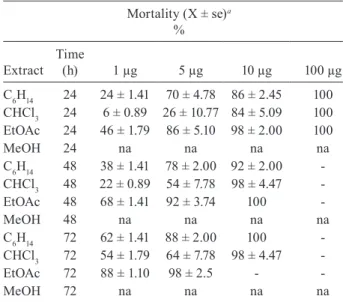
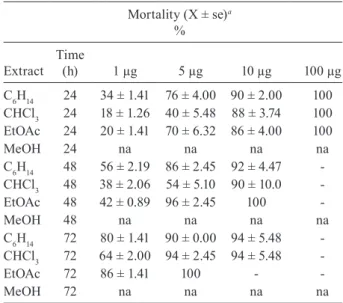
Larvicidal bioassays on crude extracts and isolat-ed compounds - Larvicidal activities of crude organic extracts from Plumbago spp are summarised in Tables II-IV. They are presented as percentage mortalities (% mortality).
From the results, all crude extracts (except that of methanol) (Table II) achieved maximum mortality of 100% at 100 µg/mL; 84-98% at 10 µg/mL; 26-98% at 5 µg/mL and 6-88% at 1 µg/mL (24-72 h). Mortality
in-creased when the larvae were exposed for a longer peri-od. P. dawei extracts had the highest activity, followed by
P. zeylanica (Table IV) and finally P. stenophylla (Table III). The results reveal that the extracts of different plants varied significantly in their larvicidal potential.
The larvicidal activity of the organic extracts was found to be species-dependent. For P. dawei, EtOAc extract showed the highest larvicidal activity (Table V). For P. zeylanica, the extract of C6H14 was the most active, while for P. stenophylla the CHCl3 extract was the most active.
From the data in Table V, the ethyl acetate extract from the root bark of P. dawei displayed LC90 and LC50 values of 10.6 and 4.10 µg/mL, respectively, making it the most active of all extracts tested. This extract was
TABLE I
Yields of extracts of Plumbago spp root bark
Yield %
Solvent C6H14 CHCl3 EtOAc MeOH
Species
Plumbago dawei 0.4 0.15 0.5 8.2
Plumbago zeylanica 0.5 0.2 0.7 4.15 Plumbago stenophylla 0.4 1.0 2.6 9.13
TABLE II
Percentagemortality of Plumbago dawei extracts against Anopheles gambiae larvae
Mortality (X ± se)a
%
Extract Time
(h) 1 µg 5 µg 10 µg 100 µg
C6H14 24 24 ± 1.41 70 ± 4.78 86 ± 2.45 100 CHCl3 24 6 ± 0.89 26 ± 10.77 84 ± 5.09 100 EtOAc 24 46 ± 1.79 86 ± 5.10 98 ± 2.00 100
MeOH 24 na na na na
C6H14 48 38 ± 1.41 78 ± 2.00 92 ± 2.00 -CHCl3 48 22 ± 0.89 54 ± 7.78 98 ± 4.47 -EtOAc 48 68 ± 1.41 92 ± 3.74 100
-MeOH 48 na na na na
C6H14 72 62 ± 1.41 88 ± 2.00 100 -CHCl3 72 54 ± 1.79 64 ± 7.78 98 ± 4.47
-EtOAc 72 88 ± 1.10 98 ± 2.5 -
-MeOH 72 na na na na
selected for further analysis and was subjected to chro-matographic fractionation. The fractions obtained were then tested for their larvicidal activity to establish the chemicals responsible in these species.
Three major fractions were obtained when the EtOAc extract of P. dawei was subjected to column chromatography. Table VI shows the lethal concentra-tion values of these fracconcentra-tions. Fr1-11 (LC50 = 110.0 μg/mL) and F12-34 (LC50 = 1.9 μg/mL) exhibited the strongest lar -vicidal activities, while Fr35-56 with (LC50 = 16.1 μg/mL) was the least active.
The larvicidal activities obtained in this study are in agreement with reported data. For example, Sosan et al. (2001) reported the larvicidal activities of essen-tial oils of Ocimumgratissium, Cymbopogon citrus and
Ageratumconyzoides against Aedes aegypti, achieving 100% mortality at concentrations of 120, 200 and 300 ppm, respectively. Das et al. (2007) reported that the LC90 values of methanol and ethanol extracts from Aris-tolochia saccata roots, Annona squamosa leaves and
Gymnopetelu cochinchinensis fruits/pericarp against
Aedes albopictus and Culex quinquefasciatus larvae ranged from 31.80-155 ppm. These results show that the larvicidal activities ofplant extracts vary according to the plant species, part of the plant used, application method and geographical location wherethe plants were grown. However, ours is the first report of the larvicidal activities of these Plumbago spp.
The naphthoquinone, plumbagin, 1 was obtained from fractions F12-34, while β-sitosterol 2 was obtained
from Fr35-56.These two compounds were subjected to lar-vicidal assays. The concentration of 1used ranged from 1-5 μg/mL over a period of 24 h. The results confirm that the larvicidal activity of P. dawei is due to 1.Plumbagin has been isolated in a range of Plumbago species(Croft et al. 1989, Panichayupakaranant & Tewtrakul 2002, Ri-beiro de Paiva et al. 2003) and also in the leaves, roots and stem bark of different plant species (Borges-Argáez et al. 2007, Dzoyem et al. 2007, Ganapaty et al. 2006). This compound has been reported to exhibit anti-pro-tozoal, anti-fungal, cytotoxic and anti-bacterial effects (Cai et al. 2000, Wang et al. 2001, Inbaraj & Chignell
2003). In contrast, α-sistosterol,2 did not show any
lar-val mortality at the tested concentration ranges.
TABLE III
Percentage mortality of Plumbago stenophylla extracts against Anopheles gambiae larvae
Mortality (X ± se)a
%
Extract Time
(h) 1 µg 5 µg 10 µg 100 µg
C6H14 24 20 ± 1.41 46 ± 1.41 84 ± 1.41 100 CHCl3 24 28 ± 1.41 58 ± 7.35 96 ± 2.45 100 EtOAc 24 22 ± 1.41 50 ± 10.0 90 ± 3.16 100
MeOH 24 na na na na
C6H14 48 32 ± 2.61 60 ± 2.00 96 ± 2.46 -CHCl3 48 50 ± 2.00 70 ± 4.47 100 -EtOAc 48 46 ± 2.00 62 ± 9.49 100
-MeOH 48 na na na na
C6H14 72 58 ± 2.28 78 ± 2.00 100 -CHCl3 72 76 ± 1.79 86 ± 5.10 - -EtOAc 72 62 ± 1.41 72 ± 8.60 -
-MeOH 72 na na na na
a: each percentage mortality is the mean (X) and standard de-viation (se) as the average from five repetitions performed on 25 larvae per group of Anopheles gambiae. Relative potency for deltamethrin was 0.06 %. na: no activity.
TABLE IV
Percentagemortality of Plumbago zeylanica extracts against Anopheles gambiae larvae
Mortality (X ± se)a
%
Extract Time
(h) 1 µg 5 µg 10 µg 100 µg
C6H14 24 34 ± 1.41 76 ± 4.00 90 ± 2.00 100 CHCl3 24 18 ± 1.26 40 ± 5.48 88 ± 3.74 100 EtOAc 24 20 ± 1.41 70 ± 6.32 86 ± 4.00 100
MeOH 24 na na na na
C6H14 48 56 ± 2.19 86 ± 2.45 92 ± 4.47 -CHCl3 48 38 ± 2.06 54 ± 5.10 90 ± 10.0 -EtOAc 48 42 ± 0.89 96 ± 2.45 100
-MeOH 48 na na na na
C6H14 72 80 ± 1.41 90 ± 0.00 94 ± 5.48 -CHCl3 72 64 ± 2.00 94 ± 2.45 94 ± 5.48
-EtOAc 72 86 ± 1.41 100 -
-MeOH 72 na na na na
a: each percentage mortality is the mean (X) and standard de-viation (se) as the average from five repetitions performed on 25 larvae per group of Anopheles gambiae. Relative potency for deltamethrin was 0.06 %. na: no activity.
TABLE V
Lethal concentrations (LC) of most active extracts of Plumbago spp
LC
(95% confidence limits)
Species Extract LC25 LC50 LC75 LC90
Plumbago dawei EtOAc 2.5 4.1 6.7 10.6 Plumbago zeylanica C6H14 3.1 6.4 13.4 26.2 Plumbago stenophylla CHCl3 4.3 6.7 10.5 15.6
In conclusion, it is evident that all three Plumbago
species tested and the isolated naphthoquinone 1 pos-sess remarkable larvicidal activity. Larvicides of great value could be developed from these plants as an al-ternative means to control mosquitoes and thus help combat malaria.
Identification of isolated and purified compounds
5-Hydroxy-2-methyl-1,4-naphthoquinone (Plumbagin) - This was obtained from fraction Fr12-34 and identified from 1D and 2D NMR data, mass spectral data and by comparing these spectroscopic data with those reported in literature. Plumbagin (Figure) was obtained as bright yellow needles (401 mg), mp 77.8-77.4°C [literature value 76.8-77.4°C (Dinda et al. 1998, Hazra et al. 2002)]; 1 H-NMR (CDCl3, 200 MHz,), δ 2.20 (3H, s, CH3), 6.81 (1H, s, H-3), 7.24 (1H, d, J = 7.8 Hz, H-8), 7.61 (2H, t, J = 7.8, 2.4 Hz, H-6 and H-7), 11.98 (1H, s, OH). 13C-NMR (CDCl
3, 50 Hz), δ: 16.8 (C-9, q), 115.3 (C-4a, s), 119.6 (C-8, d), 124.4 (C-6, d), 132.3 (C-8a, s), 135.7 (C-7, d), 136.4 (C-3, d), 149.9 (C-2, s), 161.4 (C-5, s), 185.1 (C-1, s), 190.5 (C-4, s). EIMS:
m/z 188 (M+, 100%, C
11H8O3), 173 (M-CH3, 2.9), 160 (3.5), 131 (71.4), 120 (4.7), 92 (72.9), 77 (3.4) and 63 (85).
17-(5-Ethyl- 6 -methylheptan-2-yl)-10,13- dime- thyl-2,3,4,7,8,9,11,12,14,15,16,17-dodecahydro-1H-cyclopenta[a]phenanthren-3-ol (β-Sitosterol) - This
compound (Figure) was identified by comparing the spectral data obtained with those reported in the litera-ture (Dey & Harbone 1991). The stereochemistry at the C-24 asymmetric centre was investigated by a careful comparison with the 1H NMR spectra of both epimers at C-24 in similar steroids (Gamze et al. 2002). The ste-roid was obtained as colourless crystals (13 mg), mp 130-132ºC; 1H-NMR (CDCl
3, 200 MHz) δ 0.67 (3H, s, H-18),
1.0 (3H, s, H-19), 0.81 (3H, dd, H-27), 0.84 (3H, t, H-29), 0.82 (3H, d, H-26), 0.93 (3H, d, H-21), 3.50 (1H, m, H-3), 5.34 (1H, d, 6-H); the rest of the protons were found in a
complex multiplet signal between α 1.13-2.34. 13C NMR
(CDCl3, 50 Hz) δ 37.2 (C-1), 31.6 (C-2), 71.8 (C-3), 42.3 (C-4), 140.7 (C-5), 121.7 (C-6), 31.9 (C-7), 31.6 (C-8), 50.1 (C-9), 36.5 (C-10), 23.0 (C-11), 39.7 (C-12), 42.3, (C-13), 56.6 (C-14), 24.3 (C-15), 28.2 (C-16), 56.0 (C-17), 11.8 (C-18), 19.4 (C-19), 36.1 (C-20), 19.0 (C-21), 33.9 (C-22), 26.0 23), 45.7 24), 29.7 25), 18.8 26), 19.8
(C-27), 21.1 (C-28), 12.0 (C-29); EIMS: m/z, 414 ([M]+, 4.2, C29H50O), 396 ([M-H2O]+, 1.8), 381 ([M-H
2O-CH3] +, 1.2),
303 ([M-C7H11O]+, 1.6), 301 ([M-C 8H17]
+, 1.0), 273
([M-C10H20]+, 1.4), 231 ([M-C 13H25]
+, 1.0), 213 ([231-H 2O]
+,
1.7), 255 (M-H2O-C10H21]+, 14), 43 (C 3H7]
+, 100).
TABLE VI
Lethal concentrations (LC) values of Plumbago dawei EtOAc fractions
LC (µg/mL) (95% confidence limits)
Fractions LC25 LC50 LC75 LC90
Fr1-11 36.0 110.0 335.5 0 926.3
Fr12-34 (1) 1.7 1.9 2.1 2.3
Fr35-56 (2) 13.5 16.1 19.2 22.3
relative potency for deltamethrin was 0.06%. 7
O
O OH
OH 3
1
1 2
CH
3
Though compounds 1 and 2 have been reported else-where in literature (Dey & Harbone 1991, Hazra et al. 2002), this is the first time they are being reported from the Plumbago species growing in Kenya.
ACkNOWLedgeMeNTs
To Kenya Wildlife Services, for permission to collect plants in the protected areas.
refereNCes
Borges-Argáez R, Canche-Chay LM, Peña-Rodríguez S, Molina-Salinas GM 2007. Antimicrobial activity of Diospyros anisan-dra. Fitoterapia 78: 370-372.
Brown AWA 1986. Insecticide resistance in mosquitoes: a pragmatic review. J Am Mosq Control Assoc 2:123-143.
Cai L, Wei GX, van der Bijl P, Wu CD 2000. Namibian chewing stick, Diospyros lycioides, contains antibacterial compounds against oral pathogens. J Agric Food Chem 48: 909-914.
Cheng SS, Chang HT, Chang ST, Tsai KH, Chen WJ 2003. Bioactivity of selected plant essential oils against the yellow fever mosquito Aedes aegypti larvae.Biores Technol 89: 99-102.
Croft SL, Evans AT, Neal RA 1989. Antileishmanial effects of clofaz-imine and other antimycobacterial agents. Ann Trop Med Parasit 79: 651-654.
Das NG, Goswami D, Rabha B 2007. Preliminary evaluation of mosquito larvicidal efficacy of plant extracts. J Vect Borne Dis 44: 145-148.
Dey PM, Harborne JB 1991. Methods in plant biochemistry. Terpe-noids vol. 7, Academic Press, New York, London, p. 370-425.
Dinda B, Das SK, Hajra AK 1998. Simultaneous determination of 1,4-naphtoquinone, lawsone, juglone and plumbagin by Liquid Chro-matography with UV detection. Indian J Chem Sect B 37: 25-28.
Dorni AIC, Vidyalakshmi KS, Vasanthi RH, Rajamanickam GV, Dubey GP 2007. HPTLC method for the quantification of plumbagin in three Plumbago species. Res J Phytochem 1: 46-51.
Dzoyem JP, Tangmouo JG, Lonts D, Etoa FX, Lohoue PJ 2007. In vitro antifungal activity of extract and plumbagin from the stem bark of Diospyros crassiflora Hiern (Ebenaceae). Phytother Res 21: 671-674.
Compounds isolated from EtOAc extract of Plumbago dawei:
Gamze K, Gülac T, Ahmet CG, Wolfgang V 2002. Steroids and terpe-noids from Ajuga relicta. Z Naturforsch 57b:957-960.
Ganapaty S, Thomas PS, Karagianis G, Waterman PG, Brun R 2006. Antiprotozoal and cytotoxic naphthalene derivatives from Di-ospyros assimilis.Phytochemistry 67: 1950-1956.
Harve G, Kamath V 2004. Larvicidal activity of plant extracts used alone and in combination with known synthetic larvicidal agents against Aedes aegypt. Indian J Exptl Biol 42: 1216-1219.
Hazra B, Sarkar R, Bhattacharyya S, Ghosh PK, Chel G, Dinda B 2002. Synthesis of plumbagin derivatives and their inhibitory ac-tivities against Ehrlich ascites carcinoma in vivo and Leishmania donovani promastigotes in vitro. Phytother Res 16: 133-137.
Inbaraj JJ, Chignell CF 2003. Photochemical and photobiologi-cal studies of Tirapazamine (SR 4233) and related quinoxaline 1,4-di-N-oxide analogs. Chem Res Toxicol 17: 164-170.
Kokwaro JO 1993. Medicinal plants of East Africa. East African Lit-erature Bureau, Nairobi, 177 pp.
Obomanu FG, Ogbalu OK, Gabriel U, Fekarurhobo GK, Adediran BI 2006.Larvicidal properties of Lepidagathis alopecuroides and Azadirachta indica on Anopheles gambiae and Culex quinque-fasciatus. Afri J Biotechnol 5:761-765.
Panichayupakaranant P, Tewtrakul S 2005. Plumbagin production by root cultures of Plumbago rosea. Electron J Biotech 5: 228-232.
Parekh J, Chanda SKN 2006. Screening of some traditionally used medicinal plants for potential antibacterial activity. Indian J Pharm Sci 68: 832-834.
Ribeiro de Paiva S, Figueiredo RM, Aragão TV, Kaplan MVC 2003. Antimicrobial activity in vitro of plumbagin isolated from Plumbago species.Mem Inst Oswaldo Cruz 98: 959-961.
Saraswathy A, Chandran RVP, Manohar BM, Vairamuthu S 2003. Wound healing activity of the chloroform extract of Plumbago rosea Linn and plumbagin. Natl Prod Sci 12: 50-54.
Sosan MB, Adewoyin FB, Adewunmi CO 2001. Larvicidal proper-ties of three indigenous plant oils on the mosquito Aedes aegypti. Niger J Natl Prod Med 5: 30-33.
Thomas TG, Rao S, Lal S 2004. Mosquito larvicidal properties of an indigenous plant, Ipomoea cairica Linn. Jpn J Infect Dis 57: 176-177.
Venketachalam MR, Jebasan A 2001. Larvicidal activity of Hydro-cotyl javanica Thunb (Apiaceae) extract against Cx. quinquefas-ciatus. J Exptl Zool India 4: 99-101.