Elongation Control Supercoil Density in a Bacterial
Chromosome
Nikolay Rovinskiy1., Andrews Akwasi Agbleke1., Olga Chesnokova1
, Zhenhua Pang1,2, N. Patrick Higgins1*
1Department of Biochemistry and Molecular Genetics, University of Alabama at Birmingham, Birmingham, Alabama, United States of America,2Cathay Industrial Biotech, Shanghai, China
Abstract
Gyrase catalyzes negative supercoiling of DNA in an ATP-dependent reaction that helps condense bacterial chromosomes into a compact interwound ‘‘nucleoid.’’ The supercoil density (s) of prokaryotic DNA occurs in two forms. Diffusible supercoil density (sD) moves freely around the chromosome in 10 kb domains, and constrained supercoil density (sC) results from binding abundant proteins that bend, loop, or unwind DNA at many sites. Diffusible and constrained supercoils contribute roughly equally to the total in vivo negative supercoil density of WT cells, so s=sC+sD. Unexpectedly,
Escherichia coli chromosomes have a 15% higher level of s compared to Salmonella enterica. To decipher critical
mechanisms that can change diffusible supercoil density of chromosomes, we analyzed strains ofSalmonellausing a 9 kb ‘‘supercoil sensor’’ inserted at ten positions around the genome. The sensor contains a complete Lac operon flanked by directly repeated resolvase binding sites, and the sensor can monitor both supercoil density and transcription elongation rates in WT and mutant strains. RNA transcription caused (2) supercoiling to increase upstream and decrease downstream of highly expressed genes. Excess upstream supercoiling was relaxed by Topo I, and gyrase replenished downstream supercoil losses to maintain an equilibrium state. Strains with TS gyrase mutations growing at permissive temperature exhibited significant supercoil losses varying from 30% of WT levels to a total loss ofsDat most chromosome locations. Supercoil losses were influenced by transcription because addition of rifampicin (Rif) caused supercoil density to rebound throughout the chromosome. Gyrase mutants that caused dramatic supercoil losses also reduced the transcription elongation rates throughout the genome. The observed link between RNA polymerase elongation speed and gyrase turnover suggests that bacteria with fast growth rates may generate higher supercoil densities than slow growing species.
Citation:Rovinskiy N, Agbleke AA, Chesnokova O, Pang Z, Higgins NP (2012) Rates of Gyrase Supercoiling and Transcription Elongation Control Supercoil Density in a Bacterial Chromosome. PLoS Genet 8(8): e1002845. doi:10.1371/journal.pgen.1002845
Editor:Josep Casadesu´s, Universidad de Sevilla, Spain
ReceivedJanuary 23, 2012;AcceptedJune 7, 2012;PublishedAugust 16, 2012
Copyright:ß2012 Rovinskiy et al. This is an open-access article distributed under the terms of the Creative Commons Attribution License, which permits
unrestricted use, distribution, and reproduction in any medium, provided the original author and source are credited.
Funding:Research reported in this publication was supported by the National Institute of General Medical Sciences of the National Institutes of Health under award number R01GM33143. The content is solely the responsibility of the authors and does not necessarily represent the official views of the National Institutes of Health. The funders had no role in study design, data collection and analysis, decision to publish, or preparation of the manuscript.
Competing Interests:The authors have declared that no competing interests exist. * E-mail: [email protected]
.These authors contributed equally to this work.
Introduction
Negative supercoiling in bacterial DNA is generated by gyrase, which is composed of GyrA and GyrB proteins organized as A2B2 tetramers [1]. The average supercoil density of large bacterial chromosomes and small plasmid DNA is influenced by mutations in gyrase and two other topoisomerases. Topo I is a type Ia topoisomerase that breaks and rejoins DNA with a one-strand mechanism [2]. The enzyme is encoded by the essential genetopA [3] and it removes negative supercoils in a cofactor-independent reaction to protect chromosomes from toxic R-loops that can form at sites of high transcription [4]. Topo IV is a hetero-tetramer of ParC and ParE proteins in the form C2E2 [5]. With extensive homology to gyrase, Topo IV breaks both DNA strands simultaneously during the reaction cycle [2] and relaxes both positive and negative supercoils in steps of two supercoils per cycle in ATP-dependent reactions. Although Topo IV influences the
supercoil density of chromosomal and plasmid DNA [6], its primary function is thought to be decatenation of sister chromosomes during final stages of chromosome segregation [7]. Changing the average supercoil density (s) alters the efficiency and phenotype of many proteins involved in DNA replication [8], chromosome segregation [9–10], RNA transcription [11–13], homologous and site-specific recombination [14], and transposi-tion [15]. Supercoil levels vary with growth conditransposi-tions, and topoisomerase mutations arise as evolutionary adaptations in bacterial populations undergoing long-term growth on a monot-onous carbon source [16–17]. Other than topoisomerases, our understanding of the roles of enzymes that contribute to the average supercoil density is poor, in part, because measuring supercoil density at specific locations of a 4 Mb chromosome is technically challenging.
gradients [18], give only an average supercoil density of the entire chromosome. The most common alternative method infers an average chromosomal supercoil density from the linking number of small plasmids in the same cell [19]. We developed techniques to monitor the supercoil-dependent movement of chromosomal DNA strandsin vivo[8,20–21]. Thecdsite-specific recombination system uses supercoil diffusion to drive the assembly of a precise 3-node synapse of directly repeated Res sites (Figure 1A) [22–23]. Once a synapse forms, phosphodiester bond exchange leads to deletion of the intervening DNA segment without any accessory factors fromE. coli[24]. The interwound DNA strands synapse by slithering and branching (Figure 1B). Slithering displaces two opposing strands along the axis of interwound loops. Branching rearranges the structure with new loops that grow and ebb laterally. If branching and slithering is unobstructed, resolution efficiency increases as the level of diffusible negative supercoiling increases, and deletions form rapidly and efficiently in vitro[25] andin vivo[26].
To analyze supercoiling at multiple locations, a 9 kb module called the ‘‘supercoil sensor’’ was developed [8]. It contains an entire Lac operon (lacIZYA) plus a selectable gentamycin resistance gene (Gn) flanked by directly repeated Res sites (Figure S1). The ends of the module are directly repeated Frt sites, which can be used to insert or extract sensors at unique chromosomal loci using the yeast 2mFlp recombinase (see Figure S1). The deletion efficiency of a LacI-repressed supercoil sensor is 50-fold more sensitive than agyrB -lacZpromoter fusion, which varies by only 2-fold and has been used in many studies of chromosome topology inE. coli[12,27–28].
The graph in Figure 1C illustrates the resolution response to negative supercoiling. Solid squares representin vitro recombina-tion rates (left Y axis) for endpoint assays carried out with plasmid DNAs with different supercoil densities (X axis).In vivo, about half of chromosomalsis constrained (sC) and half is diffusible (sD) so that whens=20.060,sD$0.030. The scale on the right Y axis shows the resolution response to sDin vivo. Calculations of the apparent supercoil densities use the bottom half of the curve because after X-ray-induced relaxation of diffusible supercoiling, theE. colichromosome retained a constrained supercoiling value ofsD= 0.030 [29]. Resolution efficiency atsD=20.030 is about
50% (blue arrow). When resolution efficiency approaches 100%, thesD$20.040 (red arrow). We assume thatin vivoreactions fall to 0 atsD#0.004.
Three regions near theSalmonella ribosomal rrnGoperon have different supercoil properties during exponential growth in rich medium [13]. Recombination betweencd Res sites flanking the 5 kbrrnGoperon was less than 1% because the presence of 60–80 RNA polymerases in the transcribed track blocked supercoil branching and slithering required for synapse. RNA polymerase unwinds a segment of the template strand at the active site, which represents 21.7 constrained supercoils per enzyme [30]; the accumulated supercoil density within therrnGoperon approaches sC=20.290. WhensCincreased,sDdecreased, but temporary interruption of RNA transcription by addition of rifampicin increased resolution efficiency 60 to 100-fold [13]. This result confirmed our earlier finding that highly transcribed genes are barriers to supercoil diffusion in the chromosome [31–32].
In 1987, Liu and Wang proposed that RNA polymerase generates two supercoiling domains during transcription [33]. The rationale was that rather than RNA polymerase rotating around DNA, the DNA duplex rotates (relative to the cytoplasm) due to the large inertial mass of polymerase, its associated transcription factors, and ribosomes that bind and translate the nascent mRNA during transcription elongation [34]. This model predicts a supercoil density difference with increased (2) supercoiling in DNA upstream and a loss of (2) supercoils downstream from expressed operons. We tested this model by placing a sensor upstream of therrnGpromoter and downstream of the transcrip-tion terminator. The upstream sensor had a 75% resolutranscrip-tion efficiency compared to 28% for the downstream sensor [13], confirming the twin domain model and indicating a differential supercoiling value ofD sD=+0.014 [13].
Previously, we measured what happens to twin domain super-coiling in strains with a mutant of Topo I (topA217) and TSgyrA205 and gyrB1820 mutants [13]. Each mutant caused the supercoil differential to increase in regions flanking therrnGoperon. In cells with thetopA217mutation, upstream resolution efficiencies rose to 97% compared to 38% downstream. Conversely, agyrA205mutant caused downstream resolution to fall to 9% compared to 60% resolution upstream. Most strikingly, agyrB1820mutation caused downstream resolution to fall to 1% while recombination efficiency was 11% in the upstream domain. Local supercoiling levels were able to rise and fall dramatically at opposite ends of a highly transcribed operon in cells growing at permissive temperatures.
Here, we measured Salmonella chromosome supercoiling levels and transcription elongation rates using supercoil sensors at multiple positions covering the 6 macrodomains ofE. coli. Our results show that rates of gyrase supercoiling and transcription elongation are linked. Temperature sensitive mutations in gyrase and Topo IV caused significant changes in genome-wide negative supercoil levels, even when cells were grown at a permissive temperature (30u). Transcription played a causal role in the supercoil losses because supercoiling rebounded after addition of rifampicin (Rif), which blocked transcription initiation. Our model is that transcription kinetics determine the optimal catalytic speed for gyrase, and the average chromosome supercoil density is an integral function of topoisomerases and RNA polymerase working in tempo together.
Results
Type II TS Topoisomerase Mutants ofSalmonellaLoose Supercoiling at 30u
During DNA synthesis, gyrase and Topo IV collaborate to remove (+) supercoils generated by fork movement [35]. However, Author Summary
A 9-kb module called the ‘‘supercoil sensor’’ was used to measure supercoil density at 10 positions in the 4.8-Mb
SalmonellaTyphimurium chromosome. The sensor includes a
their contribution to the dynamics of transcription has remained largely untested. We showed previously that some TS gyrase mutants cause a decline in (2) supercoiling at permissive growth temperatures in twin domains of therrnGoperon [13]. To study the general impact of transcription on chromosomal supercoil density, we evaluated 6 TS topoisomerase mutants for their influence on supercoil density near the origin of replication. Strains with TS alleles of gyrase and topo IV were constructed with a supercoil sensor placed betweengidBand atpI(Figure S1). The Atp operon encodes a group of 9 highly expressed membrane proteins that generate ATP using the energy of the proton motive force across the cytoplasmic membrane. Each strain also carries the plasmid pJBRes 309, which expresses a form of resolvase with a 30 min cell half-life.
All 4 subunits of gyrase and Topo IV were tested. GyrA contains the catalytic tyrosine residue that carries out DNA cleavage and re-ligation during the supercoiling reaction (Figure S2 A).NH6016carries thegyrA213TSallele (R358-H), which has a
mutation located in the DNA-binding and cleavage domain [36]. Cultures were grown at 30uand doubling times were measured for each strain during mid log before resolution assays were carried out (Table 1 and Table 2). The complete derivation and genetic structure of each strain used in this manuscript is listed in Table S1.
Strain NH6016 had the same doubling time as WT (3961 min) but the resolution efficiency fell from 8163% for WT to 5861%, representing a 28% loss in recombination efficiency. To compare alleles, we define a term Mutant Impact Factor (MIF) to be the resolution efficiency of the WT strain divided by the resolution efficiency of an isogenic mutant. A large MIF indicates a dramatic change in supercoiling.NH6016had a significant MIF of 1.4. A gyrA209TS
allele (G597-D) inNH6019alters the second ß-propeller of GyrA, which contributes to DNA-looping that forms a chiral (+) node [37]. ThegyrA209doubling time increased from 3961 min to 4563 min, which is a 15% decrease in growth rate. The resolution efficiency in this strain fell to 30612%, resulting in a Figure 1. Mechanism of thecdresolution reactionin vitroandin vivoshowing how reaction efficiency correlates with (2) superhelix density.A. Recombination in the Tn3/cdresolvase system requires a pair of 114 bp sites (Res) that include three binding sites for a dimer of the resolvase. The sites are I (blue), II (red), and III (yellow.) Supercoiling is required for the formation of a synapse in which two directly repeated Res sites entrap 3 negative crossing DNA nodes. Only resolvase dimers bound to Res site I, shown as blue boxes or blue ovals for different Res sites, can catalyze strand exchange. B. Movement of the interwound DNA strands promotes formation of the three-node tangle in A that occurs by reversible branching and slithering. Recombination results in an irreversible strand exchange that leaves two molecules linked as single supercoiled catenanes. C. The dependence of (2) supercoiling for plasmid recombinationin vitrois shown by the scale on the left [22]. The inferred diffusible supercoil density for recombination of a 9 kb interval in theSalmonellachromosomein vivois shown on the right [13].
MIF of 2.7. Thus, two gyrATS
mutants had reduced resolution efficiency, which indicates a loss of (2) supercoiling even at the permissive temperature of 30u.
The GyrB subunit encodes the ATP-binding domain of gyrase, which couples ATP binding to a large conformation shift that drives negative supercoiling reactions (Figure S2 B). Two GyrB mutants were tested.NH6028contains thegyr652mutation (R436-S), which alters a Mg++
binding domain that coordinates structural conformation changes during DNA cleavage [38]. This enzyme has a low kcatrelative to WT gyrase [8], and the doubling time of strains with this mutation increased by 36% to 5363 min. The resolution rate inNH6028was 763% (Table 2), and the resulting MIF of 12 indicates dramatic loss of supercoil density. The scale in Figure 1 predicts a change of+0.027 in the supercoil sensor for an
apparentsD#20.012. A second allele,gyrB1820TS(C56-Y) alters the ATP binding domain that dimerizes and then hydrolyzes two ATPs during the catalytic cycle [39]. This mutant is the most severe allele in ourSalmonellagyrase collection. The doubling time at 30u increased by almost 50% to 5864 min. NH6037had a resolution efficiency of 866%, resulting in a MIF of 10. Thus, the supercoil sensor shows that two TSgyrA and two TSgyrBalleles cause significant losses in (2) chromosome supercoiling at the ATP operon location.
Topo IV TS Mutants Lose Negative Supercoiling
Topo IV has a subunit structure, catalytic mechanism, and sensitivity to drugs novobiocin and fluoroquinolones that is similar to gyrase [28]. Although its primary function is decatenation and
Table 1.Resolution measurements and apparentsDvalues of WT, and TS mutants of gyrase (gyrA, gyrB) and Top IV (parC, parE).
Strain Map Position Relevant Mutation Resolution Efficiency MIF ApparentsD AveragesD(w/o Cs 33)
NH3868 Cs 57.65 None 7566% 1 20.037
NH4028 Cs 57.64 None 2863% 1 20.023
NH6000 Cs 85 None 8164% 1 20.038
NH6001 Cs 71 None 8262% 1 20.038
NH6002 Cs 58 None 8063% 1 20.038
NH6003 Cs 45 None 7366% 1 20.036
NH6005 Cs 33 None 4566% 1 20.022
NH6006 Cs 21 None 9262% 1 20.041
NH6007 Cs 9 None 73612% 1 20.036 WT
NH6008 Cs 96 None 8563% 1 20.040 20.0366.005
NH6016 Cs 85 gyrA213 5861% 1.4 20.032
NH6019 Cs 85 gyrA209 30612% 3 20.024
NH6020 Cs 71 gyrA209 3066% 3 20.024
NH6021 Cs 58 gyrA209 2669% 3 20.022
NH6022 Cs 45 gyrA209 1765% 5 20.018
NH6024 Cs 33 gyrA209 964% 5 20.013
NH6025 Cs 21 gyrA209 20613% 5 20.019
NH6026 Cs 9 gyrA209 3063% 2 20.02 gyrA209
NH6027 Cs 96 gyrA209 4865% 2 20.030 20.0236.004
NH6028 Cs 85 gyrB652 763% 12 20.012
NH6029 Cs 71 gyrB652 ,1% .80 ,20.003
NH6030 Cs 58 gyrB652 261% 40 20.004
NH6031 Cs 45 gyrB652 ,1% .70 ,20.003
NH6033 Cs 33 gyrB652 ,1% .45 ,20.003
NH6034 Cs 21 gyrB652 ,1% .90 ,20.003
NH6035 Cs 9 gyrB652 ,1% .70 ,20.003 gyrB652
NH6036 Cs 96 gyrB652 361% 28 20.007 20.0056.003
NH6040 Cs 85 parC281 7661% 1.1 20.037
NH6043 Cs 85 parE206 5964% 1.4 20.033
NH6044 Cs 71 parE206 6664% 1.2 20.034
NH6045 Cs 58 parE206 6463% 1.1 20.034
NH6046 Cs 45 parE206 6066% 0.8 20.032
NH6048 Cs 33 parE206 2762% 1.7 20.021
NH6049 Cs 21 parE206 5863% 1.6 20.032
NH6056 Cs 9 parE206 5164% 1.4 20.030 parE206
NH6058 Cs 96 parE206 6364% 1.3 20.033 20.0326.001
untangling of sister chromosomes prior to segregation and cell division [7], Topo IV relaxes both (2) and (+) supercoils in vitro and contributes to the dissipation of (+) supercoils during DNA replication in vivo [35]. Therefore, we tested the impact of TS Topo IV alleles on chromosomal supercoiling. The ParC subunit catalyzes DNA breakage/reunion during strand passage reactions, andNH6040has theparC281TS(P556-L) mutation, which resides in a region with no known function. This mutant showed no difference in growth rate from the WT (3961 min) and resolution efficiency was 7661%, which is close to the WT (8164%) with a MIF of 1.1. ParE functions like GyrB, binding and hydrolyzing ATP to fuel cycles of strand transfer. The parE206 (V67-M) mutation in strainNH6043is in the ATP binding domain of Topo IV, and the doubling time at 30uincreased by 33% to 5262 min. The resolution efficiency was 5964% (Table 1), yielding a MIF of 1.4. Therefore, the defect in the ParE206 subunit of Topo IV caused a supercoil loss comparable to GyrA213.
WT Supercoiling Levels Are Similar in 5 Macrodomains The E. coli chromosome appears to have multiple levels of organization. In addition to 10 kb domains that restrict supercoil diffusion [40], a long range order called macrodomains has been proposed [41]. Macrodomains represent segments of 0.6 to 1 Mb that may coalesce in the folded chromosome. The first indication of macrodomain structure came from fluorescent in situ hybrid-ization (FISH) with the Ori and Ter regions occupying distinct positions near the opposing cell poles in newborn cells [42]. The Boccard laboratory extended theE. coliframework to include three additional segments and two less structured regions by measuring the interaction frequencies of pairs of l attachment sites distributed across the chromosome [41,43–44]. Although the efficiency of l site-specific recombination shows variation at specific points inSalmonella[45], the macrodomains proposed for E. colimay or may not be conserved along with gene order that is shared between these species.
Supercoil levels in all potential macrodomains were measured by introducing sensors into 7 more sites inSalmonellato include at least one measurement in eachE. colimacrodomain (Figure 2).E. coli chromosome map coordinates are notated in minutes that reflect the HFR transfer time of each genetic region during a standard mating experiment (1–100 min). TheSalmonella chromo-some has a gene order that is highly congruent withE. coli, but with numerous inserted gene islands, the genome size is 5% larger. To compensate, map coordinates in Salmonella are described in units of 100 centisomes (Cs) with the same starting position as inE. coli. The largestE. colimacrodomain is Ori, which spans 930 kb of
DNA. The corresponding segment inSalmonellaextends from Cs 81 to Cs 1 in Figure 2 (the green arc). Ori includes 4 of the 7 ribosomal RNA operons and many highly transcribed genes involved in transcription and translation. 70% of the RNA polymerase in rapidly dividing cells is confined to this chromosome sector. The module at Cs 85 (Table 1) is near the left edge of the Ori macrodomain in replichore 2; it had a recombination efficiency of 8164%. InNH6008, resolution efficiency was tested in another segment of the Ori domain in replichore 1. The sensor disrupts the Salmonella gene STM4442, which encodes a small putative ‘‘cytoplasmic protein’’ at Cs 96. NH6008 matched NH6000with a resolution efficiency of 8563% (Table 1).
Two domains reside exclusively in replichore 1. The Right Unstructured region is shown in black (Figure 2) clockwise oforiC. The smallest macrodomain inE. coli(560 kb), it extends from Cs 1 to Cs 13 inSalmonella. A sensor was inserted at Cs 9 in NH6007 betweenampH, which encodes a beta-lactam binding protein, and sbmA, a gene encoding an inner membrane ABC transporter. NH6007 had a resolution efficiency of 73612%. The Right macrodomain of E. coli spans 600 kb from Cs 13 to Cs 26. In NH6006, a sensor was inserted at Cs 21. This is the only position in which a reporter lies between two divergently transcribed genes. These genes are STM0951, which encodes a ‘‘cytoplasmic protein’’ transcribed in the counterclockwise direction, and STM0952, which is a transcription regulatory protein transcribed in the clockwise direction. The recombination efficiency in NH6006was the highest measured at 9262%.
TwoE. colimacrodomains reside entirely in replichore 2. The Left Unstructured region is a 550 kb sector. The comparable region of Salmonella is shown in Figure 2 as a black arc counterclockwise oforiCrunning from Cs 81 to Cs 62. A sensor inserted at Cs 71 lies between STM3261, which encodes a galacticol-1-phosphate dehydrogenase, andSTM3262, a putative repressor in strainNH6001. The resolution efficiency was 8262%. (Table 2, Figure 2). The Left macrodomain inE. coliis an 892 kb region extending from Cs 62 to Cs 43, shown as a blue arc. Two modules were placed in this segment ofSalmonella. InNH6002, a module resides at Cs 58 between smpB, which makes a small protein that may bind the SsrA subunit of the SsrA/SsrB two-component regulatory complex [46], and pseudogeneSTM2689. A second module in this sector is integrated betweenSTM2135, which encodes an inner membrane protein, and the protease-encoding geneyegQat Cs 45. The deletion efficiencies ofNH6002 andNH6003were 8063% and 7366%, respectively.
The macrodomain that lies across from Ori inE. coliis the Ter domain (purple arc), which is a 780 kb region ofE. coli. Ter has 24
Table 2.TS alleles of gyrase and Topo IV decrease diffusible chromosome supercoiling at Cs 85.
Strain Number Relevant Genotype Doubling Time (min) Resolution Efficiency ApparentsD MIF
NH6000 WT 3961 8163% 20.038 1
NH6016 gyrA213TS 3961 5861% 20.032 1.4
NH6019 gyrA209TS 4563 30613% 20.026 2.7
NH6028 gyrB652TS 5363 763% 20.010 12
NH6037 gyrB1820TS 5864 866% 20.011 10
NH6040 parC281TS 3961 7661% 20.037 1.1
NH6043 parE206TS 5262 5964% 20.032 1.4
Resolution assays for a Lac-Gn module introduced at Cs 85 were measured in WT and TS mutations of gyrase and Topo IV. Two mutations in gyrA and gyrB genes plus 1 TS allele of theparCandparEgenes of Topo IV were tested in exponential phase at 30u. The apparentsDwas estimated from the graph in Figure 1C. The MIF is
copies of a unique 14 bp site calledmatSthat is found uniquely in this segment. ThematSsites bind MatP, which may organize them into a single focus in cells with a chromosomal MatP-GFP fusion. One model is that 23 Ter domain loops are formed with a central hub of MatP protein [47]. InSalmonella, the Ter domain may be a smaller 560 kb region with only 14 predictedmatSsites [47] (black lines in Figure 2). In NH6005, a sensor was inserted at Cs 33
between the pseudogeneSTM1553and STM1554, which encodes a putative ‘‘coiled coil protein.’’ The resolution efficiency here was lower than any other site tested in the survey, 4566%.
The cumulative average resolution efficiency of sensors located at 7 regions (excluding the Ter domain) was 8167% and the apparentsD=20.0386.002. There was no statistically significant variation in supercoil levels from the Ori to the terminus. At Cs 33, Figure 2. Resolution efficiencies in theSalmonellachromosome decline in strains carrying TS mutations in gyrase and Topo IV, even when cells are grown at permissive temperature (306). Recombination reactions at 8 locations around theSalmonellachromosome was studied in 32 strains described in Table 1. The experiment covers the 6 macrodomains ofE. coli, shown as color coded arcs superimposed on the
Salmonellamap: green, Ori domain; black, Right Unstructured domain; red, Right domain; purple, Ter domain with black hatches showingmatSsites; blue, Left domain; and black, Left Unstructured domain [41]. The direction of replication fork movement in replichore 1 (brown) or 2 (pink) is shown by arrows outside the circle. Each strain had a 9 kb Lac-Gn supercoil sensor inserted between consecutive genes, plus a plasmid that contains a thermo-induciblecdresolvase with a 30 min half life (Materials and Methods). Recombination data and estimated values of apparent diffusible supercoiling for each experiment are reported in Table 1.
the resolution efficiency of 45% is roughly half that measured at the other 7 sites. At this location, a Res site is only 470 bp fromdif. We believe that resolvase binding to the site nearest difmay be occluded by DNA-binding proteins unique to the region. These proteins include matS-MatP complexes [47], the FtsK DNA translocation motor complex [48], a high affinity site for Topo IV [49], and XerC/D proteins that binddifto catalyze complex topological reactions that untangle and separate sister chromo-somes [50].
TS Alleles of Gyrase and Topo IV Cause a General Loss of Supercoiling
With the exception of the Ter macrodomain, the genes and mechanisms that organize the Ori, Right, and Left macrodomains are undefined. Supercoiling is an important factor in bacterial DNA condensation, so we tested the impact of topoisomerase mutations in all domains using the supercoil sensor. In the strain seriesNH6019 -NH6027, each strain has thegyrA209TS
allele, which showed a MIF of 2.7 at the Cs 85 position (Table 2). The resolution efficiency measured at 7 positions (excluding position Cs 33) showed more variability than the WT set (Table 2 and Figure 2, green characters). The average recombination efficiency was 2869%. This drop corresponds to a mean MIF of 3. The estimated change in sD relative to WT at 7 positions was+0.013. Previous work from other laboratories showed that growth of E. coli cells stopped when supercoiling dropped to this level [3,51–52].
Supercoil losses at 7 locations ingyrB652TSmutants were larger than those measured at Cs 85 (Table 2). The resolution efficiency at Cs 71 –NH6029, Cs 45 –NH6031, Cs 33 –NH6033, Cs 21 – NH6034, and Cs 9 – NH6035were all less than 1% (Figure 2, purple characters). The estimated value of sD dropped from
20.038 to an apparentsD=,20.004. Resolution efficiency was near the detection limit at Cs 58 – NH6030 (261%) and at Cs 96 – NH6036 (361%). Averaging across 7 points on the chromo-some, the mean recombination efficiency was 262% and the MIF was 40. Surprisingly, this strain with a greatly relaxed chromosome has a doubling time only 36% longer than WT (5363 vs. 3961). To see if Topo IV has a related genome-wide supercoil phenotype, theparE206TSallele of Topo IV was tested (Figure 2, blue characters). The resolution efficiency at Cs 85 (5964%) was similar to results at positions Cs 71, 6664%; Cs 58, 6463%; Cs 45, 6066%; Cs 21, 5863%; Cs 9, 5164%; and Cs 96, 6364% (Figure 2, blue characters). The mean recombination efficiency at 7 chromosomal positions fell to 6065% for a MIF of 1.4. Again, the Ter macrodomain at Cs 33 showed lower resolution efficiency
than all other locations. NH6048 recombined at 2762% compared to 4566% in WT.
Transcription Causes Supercoiling Losses in Gyrase Mutants
Replication and transcription generate positive supercoils in regions downstream of replisomes and highly expressed operons, respectively. To understand the reason a TS GyrB mutant loses most of the detectable diffusible chromosomal supercoiling, we tested the role of transcription. Like E. coli, WT Salmonella is organized into 400–500 domains that limit supercoil diffusion [21]. Topo I relaxes negative supercoils generated upstream of highly transcribed regions. If gyrase can’t supercoil DNA at rates matching the rotation speeds downstream of the 7 ribosomal RNA operons, the multiple tRNA genes, and 30 highly transcribed protein-encoding genes that are spread out over the chromosome, then transcription could run down reservoirs of stored supercoils in low transcribed regions. Supercoil depletion might also be a consequence of having all highly transcribed genes oriented in the same direction as replication, presumably to mitigate effects of head on replisome-RNAP collisions [53].
To test the role of transcription in supercoil regulation, a strain set carrying the severe gyrB1820TS
mutation was constructed (Table 3,NH6037-NH6114). Similar to cultures with thegyrB652 mutation, the resolution efficiency was at the detection limit ($1%) at all locations other than Cs 85 (Table 3, Figure 3, black numbers). The average recombination value at 7 sites was 1.663% (entering values of 0.5% for measurements,1%) and the MIF mean was 50.
We added Rif to aliquots of each culture immediately after the 10 min resolvase induction period. Rif blocks transcription initiation, but elongation and termination occurs normally; no cell death was associated with drug treatment. After 30 min of incubation, the drug was washed out and the recombination efficiencies were measured after cells doubled more than twice, to allow chromosome segregation. Rif had a dramatic impact on resolution efficiency (Table 3, Figure 3, black numbers). At Cs 85 -NH6037, resolution was 866% with a MIF of 10. Rif treatment increased resolution 7-fold to 5665% and the MIF dropped to 1.4 (Table 3 and Figure 3, purple numbers). Dramatic results were also observed at 6 other locations. In strains with modules at Cs 9, Cs 71, and Cs 96, resolution rose at least 10-fold from#1% to 1162%, 1166%, and 965% respectively (Figure 4, Table 3). At Cs 45, resolution increased from,1% to 2267%. The largest improvement was observed inNH6109at Cs 58 where resolution
Table 3.Rifampicin induced recovery of chromosomalsDingyrB1820mutants.
Strain Map Position Relevant Mutation Resolution Efficiency MIF Efficiency+Rif IncreasedsD+Rif
NH6037 Cs 85 gyrB1820TS 8
66% 9 5665% 20.020
NH6108 Cs 71 gyrB1820TS ,1% .80 1166% 20.012
NH6109 Cs 58 gyrB1820TS ,1% .80 5762% 20.030
NH6110 Cs 45 gyrB1820TS 1
61% .73 2267% 20.018
NH6111 Cs 33 gyrB1820TS ,1% .45 261% 20.004
NH6112 Cs 21 gyrB1820TS 161% 90 1966% 20.016
NH6113 Cs 9 gyrB1820TS ,1% .73 11
62% 20.012
NH6114 Cs 96 gyrB1820TS ,1% .85 965% 20.011
Resolution assays were carried out as described in Materials and Methods. Each result is the product of 3 independent replicas61 SD of the mean. The value ofsDwas
increased .60 fold from ,1% to 5762%. Like the gyrB652TS strain set (Figure 2), resolution efficiency in the Ter domain at Cs 33 was low and remained low after Rif addition, rising only from
,1% to 261%. Overall, excluding the Ter domain, Rif addition reduced the MIF mean from 50 to 3.
Supercoil Density Increases in Strains with a Mutant RNA Polymerase
The increase in resolution after Rif addition supports the hypothesis that general transcription can deplete supercoil levels when gyrase is impaired. But what would happen to supercoiling in strains with a WT complement of topoisomerases and a slow RNA polymerase? If catalytic rates of transcription and supercoiling are under selection to match, would such cells experience a general
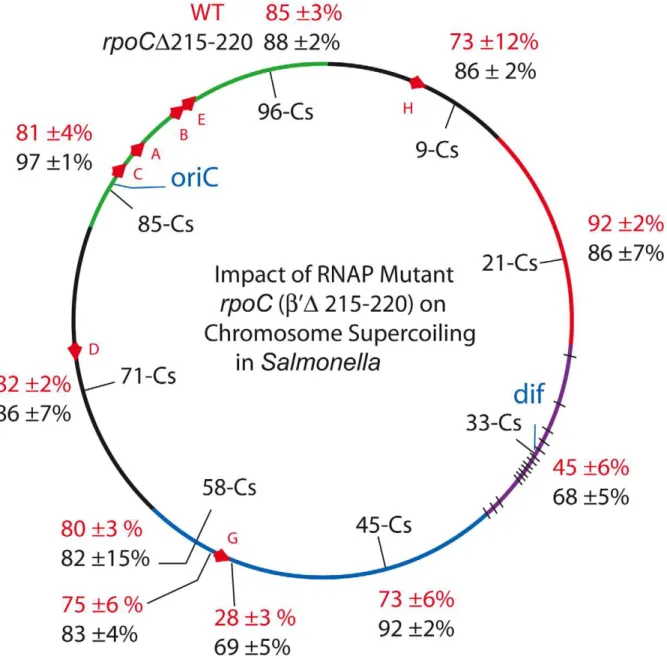
supercoil increase? Deletion of 6 amino acids in the ß9 subunit (RpoC D D215–220) makes a form of RNA polymerase with a constitutive low transcription rate for stable RNA, including the 7 ribosomal RNA operons [54]. This mutation was introduced to Salmonella strain set (NH6206-NH6215), which included sensors upstream and downstream ofrrnG, increasing the number of test locations to 10 (Table 4). The doubling time of the mutant growing at 30u increased by 28% from 3961 min in WT to 5062 min. Remarkably, the resolution efficiency increased throughout the mutant chromosome, except for one position at Cs 21, which was within experimental error of matching the highest efficiency in the WT RNA polymerase strain (9262 - 8667, Table 4, Figure 4). The WT mean resolution efficiency at 10 positions was 74618%, whereas the RpocD215–220 average was 8568% with a MIF of Figure 3. Interrupting transcription causes a dramatic rebound in resolution for strains carrying the GyrB1820 gyrase.
Recombination efficiencies of supercoil sensors at 8 positions are shown for WT (red) andgyrB1820TSmutants tested without Rif (black). The purple numbers show recombination rates after rifampicin was added to cultures immediately following the 10 min induction of resolvase and rifampicin was subsequently washed out of cells 30 min later.
0.87. A 13% increase in resolution represents an apparent mean change of DsD=20.004. Interestingly, the impact of the rpoC mutation was greatest at positions where the WT resolution levels were lowest. For sensors adjacent to therrnGoperon at Cs 57.64 and Cs 57.65, the upstream sensor increased from 7566% resolution to 8364% and the downstream location changed from 2863% to 6965% resolution. The downstream location had a MIF of 0.41, proving that locations where gyrase worked the hardest benefited the most from reduced transcription rates.
A GyrB1820 Mutation Decreases RNAP Elongation Rates In 1973 Pato, Bennett, and von Meyenberg discovered that the rates of transcription elongation and translation were closely matched for most genes in E. coli [34]. Could the transcription rate include a role for gyrase? We measured the coupled lacZ transcription/translation kinetics at 8 locations in WT andgyrB1820 mutants. The method is outlined in Figure 5 A. Cultures grown in
minimal medium plus glucose were sampled at 10 sec intervals and placed on ice in lysis buffer [55]. The first three samples established a baseline, then IPTG was added to each culture at a final concentration of 1.5 mM, and 10 sec sampling was continued. After all samples were collected, the chromogenic substrate ONPG was added to timed reactions that ran at 37u for 1.5 to 3 h. The transcription rate in nucleotides per second (nt/sec) is calculated as the length of the LacZ transcript (3072 nt) divided by the lag time to the start of a linear increase in enzyme activity (Figure 5A). Each strain was tested in triplicate using different colonies, and the transcription rates with one standard deviation are shown for WT (red) and GyrB1820 mutants (black) in Figure 5B.
Unexpectedly, coupled transcription/translation rates varied at different positions in theSalmonellagenome. The fastest transcrip-tion speeds were 6969 nt/sec at Cs 85 and 62610 nt/sec at Cs 58. These sites were 45% faster than the 3861 nt/sec rate measured at Cs 9. The average elongation rate in WT cells across
Figure 4. An RpoC mutant that slows transcription and mimics the stringent response in the absence of ppGpp causes global increases in resolution efficiency in theSalmonellachromosome.Resolution assays for Lac-Gn modules around theSalmonellachromosome are shown for WT (red) and therpoCmutant (black).
all positions was 52610 nt/sec. The impact of a gyrB1820TS mutation was tested in strain set NH6222-NH6229. Elongation at 7 positions fell to a uniform mean of 3266 nt/sec, which is 40% slower than the average of these positions in WT. Again, the Ter domain at Cs 33 was different. Transcription/translation rates at dif fell from 5666 nt/sec to 1662 nt/sec in gyrB1820. These results together with the experiments using Rif suggest to us that unique factors influence resolution efficiency and transcription neardif. Nonetheless, throughout most of the genome, and in at least 5 macrodomains, transcription/translation rates and gyrase supercoiling efficiency were covariant.
Discussion
Transcription Contributes to Supercoil Regulation Three results show that the mean supercoil density ofSalmonella DNA is determined by a mechanism that links the catalytic
efficiency of gyrase to the elongation rate of transcription. First, TS alleles of GyrB caused a broad and dramatic depletion of (2) supercoiling throughout the Salmonella genome (Figure 2). This effect was largely reversed by temporarily blocking transcription with Rif (Figure 3). Second, supercoil densities rose above the WT level in cells carrying a mutant ß9 subunit (RpocD215–220) (Figure 4). Third, the GyrB1820 mutation caused the rates of coupled LacZ transcription/translation to decrease from the WT mean of 52610 to 3266 nt/sec over most of the genome (Figure 5).
The impact of TS mutations in both GyrA and GyrB on resolution efficiencies for cells growing exponentially at a permissive temperature of 30uwas unexpected (Table 1, Table 2, and Figure 2). There are three plausible explanations for this reduction in recombination rates: 1) When the catalytic rate of gyrase was slowed by mutation, the loss of negative supercoiling downstream of highly transcribed genes was spread across the genome. 2) The slow growth rate in gyrase mutants caused a drop in resolvase expression that limited recombination. 3) A slow growth rate induced increased expression or rearrangement of nucleoid-associated-proteins (NAPs) that constrained (2) super-coiling [56–58] and/or occluded resolvase binding to Res sites.
A change in the resolvase expression level does not explain the cd recombination results for two reasons. First, we analyzed resolvase in WT and mutant strains using Western blots. The resolvase band at 21 KDa appeared after thermo-induction in all strains tested (Figure S3.) The expressed resolvase contains an SsrA degradation tag appended as the terminal 11 amino acids, and this tag limited thein vivo protein half-life to under 30 min [21]. Resolvase disappeared during a 30 min incubation at 30u following the 42u incubation, including the cells treated with Rif [21]. Whereas the resolvase band intensity varied somewhat between different strains, the band variation did not correlate with the ratios of WT to mutant catalytic resolution efficiency. These results agree with our earlier finding that a 5–10 fold decrease in resolvase expression seen in stationary phase cells does not limit resolution [20].
Second, a much more compelling argument comes from the Rif experiment shown in Figure 3. When transcription was
unob-Table 4.Impact of a 6 amino acidrpoCdeletion on Salmonellaresolution efficiency.
Strain Map
Position Relevant Mutation
Resolution Efficiency MIF
NH6206 Cs 85 rpoCD215–220 9761% 0.83
NH6207 Cs 71 rpoCD215–220 8667% 0.95
NH6208 Cs 58 rpoCD215–220 82615% 0.98
NH6209 Cs 45 rpoCD215–220 9262% 0.79
NH6210 Cs 33 rpoCD215–220 6865% 0.66
NH6211 Cs 21 rpoCD215–220 8667% 1.07
NH6212 Cs 9 rpoCD215–220 8662% 0.84
NH6213 Cs 96 rpoCD215–220 8862% 0.96
NH6214 Cs 57.65 rpoCD215–220 8364% 0.90*
NH6215 Cs 57.64 rpoCD215–220 6965% 0.41*
Resolution assays were done as described in Materials and Methods. *The MIF in NH6214 and NH6215 was calculated from WT results upstream and downstream of therrnGoperon in Booker et al [13].
doi:10.1371/journal.pgen.1002845.t004
Figure 5. RNAP elongation rates at 8 chromosomal loci in WT (red) andgyrB1820mutant strains (black) are significantly reduced by the GyrB1820 mutation.A. 20 ml cultures growing in minimal (AB) medium with glucose were grown at 37uto an OD A600= 0.20. Three 0.5 ml
aliquots were taken, added to ice-cold ZS buffer and saved for a base line reading. IPTG was added to a concentration 1.5 mM at the time point indicated by the arrow, and samples were removed at 10 sec intervals. The chromogenic substrate ONPG was added to each culture in timed assays that extended for 1.5–3 h, depending on the activity level. B. The mRNA elongation rate was calculated by dividing the 3072 ntlacZmRNA by the lag time to linear increase inb-Gal, giving the rate in units of mRNA nt/sec.
structed, the resolution efficiencies ingyrB1820strains were at the detection limit of 1% at 7of 8 genome locations. But resolution increased at Cs 85 and Cs 58 to 56% when Rif was added to the cultures after downshift to 30u. An interruption in transcription restored 70% of the resolution efficiency at these two sites compared to that seen in WT cells. The length of time that cells were exposed to resolvase was previously shown to be a factor in resolution efficiency [21], and after transcription inhibition, resolvase exposure dropped from about 40 min (induction plus incubation time) to 25 min or less. Yet, at 7 chromosome locations covering 5 macrodomains (excluding Ter), the mean resolution efficiency for GyrB1820 without Rif was 1.663% with a MIF = 50 (81%/1.6%), and after Rif, the mean efficiency rose to 26%621% with the MIF shrinking to 3 (81%/26%). The variation in resolution around the chromosome after the addition of Rif could mean that extra factors contributed (i.e. increased constrained structure by H-NS). But Rif would not be expected to lower the abundance of NAPs around the genome. The parsimonious explanation is that supercoil density was restored once transcrip-tion was reduced by Rif during the incubatranscrip-tion at 30u. In our view, non-supercoil factors might account for 2–3 fold of a 50-fold impact that a gyrB1820 mutation exerts on resolution. An independent measure of chromosomal supercoil structure at specific locations would be a very useful tool to help resolve the issue.
Models for Regulating Supercoil Density
Various theories for regulating chromosomal supercoiling have been proposed since gyrase was discovered and the importance of negative supercoiling was revealed [59]. One model is that cells maintain a uniform level of supercoiling throughout the chromo-some by varying levels of gyrase and Topo I [60]. When chromosomes experience a significant supercoil decline, the change is sensed by the promoter of GyrB, which increases expression by about 2-fold along with about 100 other ORFs [12]. When excessive levels of (2) supercoiling accumulate, transcrip-tion from the Topo I promoter [61] increases along with about 200 other ORFs [11,62]. This system clearly modulates expression of GyrB and Topo I. However, because supercoil levels do not respond to changes in enzyme levels in a dramatic way, we view this as a fine tuning system [63]. For example, increasing or decreasing the abundance of Topo I or gyrase by 10% resulted in only a 1.3% change in DNA supercoil density [64], which would be equivalent to a MIF of 1.05 or 0.95 for each 10% difference in enzyme level. By contrast, when theSalmonella GyrB protein was expressed at 10% of normal levels in WTE. coli, the toxic effect caused the disappearance of most cells containing the plasmid [10]. We speculate that 50 slow or uncoordinated chimeric gyrase variants working in a WT background may cause sporadic supercoil disruptions with toxic consequences, perhaps by promoting RNAP blockades to the fast moving replisomes.
A second model proposes that a long range supercoil gradient exists within the bacterial chromosome [65]. The origin of replication was proposed to have the highest supercoiling level withs=20.068, and the terminus was predicted have the lowest s=20.043 with a smooth transition along the genome [65]. If constrained and diffusible supercoiling densities partition equally along the gradient, this model predicts resolution efficiencies of the supercoil sensor to decline from 75–80% near oriC to 15–20% at the terminus. However, our data disagree with this model. Our resolution assays showed equal recombination in 5 different macrodomains. Moreover, previous investigators used supercoil-responsive promoter fusions tolacZandluxABto test supercoiling levels in both the E. coli and Salmonella chromosomes [66–67].
They both found uniform levels of supercoiling along the genome, although none of their test positions were located close to highly transcribed genes or thedifsite.
Our data suggest that the Liu and Wang model of twin domains of local opposite-handed supercoiling is a dominant force near the 30–50 highly transcribed genes [13]. Although the impact of transcription may be limited to a 10 kb zone from the point of origin, like transpositions immunity in Mu [68], a persistent loss of supercoil density during transcription can spread, causing slight or dramatic relaxation of chromosome DNA structure, depending on how an allele modifies gyrase supercoiling efficiency. We propose that the impact of RNA polymerase on global supercoil density is linked to transcription speed. At 30u in WT Salmonella, the elongation rate ranges from 45–60 nt/sec at different points around the genome (Figure 5). This causes DNA rotations of 4–6 supercoils per second. WT gyrase processively supercoils DNA at 4–5 sc/sec at 30u(Rovinskiy and Higgins, manuscript submitted) and Topo I removes negative supercoils at this rate in single molecule studies. Any condition that reduces gyrase supercoiling without directly reducing transcription kinetics or Topo I activity would cause supercoil density to decline across the genome.
We were surprised that a TS mutant of Topo IV also lost significant negative supercoiling at the permissive growth temper-ature. The common wisdom is that Topo IV functions primarily at the end of replication to decatenate sister chromosomes and allow complete segregation [7]. However, recent work shows that the C-terminal domain of Topo IV interacts with the hinge region of the MukB condensin [68], implicating Topo IV in processes occurring near the fork. Perhaps, in conjunction with DNA compaction, Topo IV removes (+) supercoils of transcription to prevent disruptive interactions between replisomes and RNA polymerase [69–70].
Complex Regulation of the Transcription/Translation System
The third piece of experimental evidence supporting the mechanistic linkage between rates of gyrase and RNAP catalysis is the decreased rate of coupled transcription/translation through-out the chromosome in cells carrying a gyrB1820 mutation (Figure 5.) The mean WT transcription rate was 52611 nt/sec for the 7 sites, which fell to 3266 nt/sec in GyrB1820 strains. We propose that there is a strong selection for matching catalytic rates of gyrase supercoiling with transcription elongation. When cells have a sluggish gyrase, transcription/translation slows down. In cells with reduced transcription efficiencies, like therpoCD215– 220, WT gyrase boosted supercoiling above the level in WT cells (Figure 4). Excess supercoiling wastes ATP, increases the likelihood that cells form toxic R-loops at locations of high transcription, and increases the susceptibility of chromosomal DNA to oxidative damage by free radicals that attack single stranded regions more efficiently than double stranded DNA.
and salvage polymerases that have stalled in mid-stream. Mutants of both subunits raised the average supercoil density ofSalmonella (Chesnokova and Higgins, unpublished results). These observa-tions, along with older experiments showing that mutations in RNA polymerase influence cellular resistance to the gyrase inhibitors novobiocin and nalidixic acid [72], increase our confidence that RNA polymerase and its associated factors play a central role with gyrase in controlling the global supercoiling average.
Does Supercoiling Control Transcription or Is It the Other Way Round?
DNA supercoiling has generally been studied as a mechanism to control gene expression by modulating promoter activity around the chromosome [11,73].In vivo, 300E. coligenes are reported to change expression within 5 min after DNA relaxation by drug treatment [12]. However, three problems with studying supercoil regulation of transcription are often ignored or not considered important. First, transcription increases upstream and decreases downstream supercoil levels respectively, so the act of transcription would put the promoter in a zone of increased supercoil density. The increase in supercoiling is substantial [13], so after 200E. coli genes are induced by increased (2) supercoiling, a different mechanism would be needed to turn them off.
Second, most of the chromosomal changes in transcription detected after DNA relaxation are 2-fold differences. The transcription rate of the Lac operon, which varies several hundred fold from the uninduced state to maximum expression, also changes elongation rate by 2-fold, according to its chromosome position (Figure 5). This is not a result of genetic adaptation, but is dictated by local differences in chromosome dynamics. Dissecting 2-fold changes in gene expression is a daunting task and can be the result of 3 different 1.3-fold causes. It is unclear how many of the 300E. colisupercoil responsive genes actually improve fitness and how many represent regulatory noise that is insignificant from a physiological perspective.
Third, many investigators rely on plasmids to estimate chromosomal supercoiling and to gauge the effects of mutations on chromosomal structure. But plasmids can be misleading. By assuming that pUC19 was a good reporter of chromosome supercoil density, we completely missed the impact of transcription and the large supercoiling change in aSalmonella gyrB652mutant chromosome [26]. pUC19 lacks strong promoters and when plasmids from WT and gyrB652 strains were compared, they differed by only 1 topoisomer. One cause for these chromosome/ plasmid differences is that plasmids are single domain elements, except when they have an anchoring element or two active transcription units moving in opposing polarities [33]. In single domain plasmids, positive and negative supercoils cancel out by diffusing around the circle [74]. For plasmids with strong promoters, the primary topological effects are changes in constrained supercoil density associated with each added RNA polymerases [75–76].
Implications and Further Experiments
E. coli and Salmonella have a 15% supercoil difference that changes the phenotype of multiple proteins contributing to chromosome dynamics [10]. Could species-specific amino acid substitutions in gyrase orthologs fine-tune supercoil densities in these closely related organisms? Recent work suggests this could be the case. One difference between theE. coliandSalmonellaGyrA proteins is the amino acid sequence and length of the acidic amino acid-rich C-terminal tail (Figure S2). This C-terminal segment controls DNA looping of the pinwheel domain and establishes the
supercoil reverse point forE. coligyrase [77]. Moreover, when the E. coliGyrA ortholog was compared toM. tuberculosis(M. tb.) GyrA, the latter protein lacked C-terminal features present inE. coli[78]. In vitro supercoiling tests confirmed that both the speed and endpoint of M. Tb gyrase supercoiling are lower than those measured for theE. colienzyme. Secondly, the GyrB subunit has the ATP binding site that fuels the supercoiling reaction. Whereas SalmonellaGyrB protein is toxic inE. coli, the reverse is not true. Salmonellatolerates theE. coliGyrB chromosomal substitution, and the average supercoiling level of this strain increased at multiple chromosomal locations, including the region immediately down-stream of rrnG (Rovinskii and Higgins, unpublished data.) Therefore, both gyrase subunits contribute to the enzyme vmax and supercoil endpoint.
Three untested issues related to these finding are worth mentioning. They involve current limitations on the fluxuation of supercoil density that we can monitor, the implications of the Salmonella/E. colicomparison for other bacterial species, and the relevance of this work to gene expression in eukaryotes. First, our data represent the mean values of an ensemble of cells in different states of the cell cycle during rapid division in rich medium and during slower growth in medium containing a defined carbon sources. Many investigators assume that supercoil density in a bacterium is maintained at a static modulus so that small changes in supercoil density can be used to modulate gene expression. Our view is more dynamic. The constant thrust from highly transcribed genes causes local gradients of supercoil density to arise throughout the genome. If topoisomerase efficiency is changed by metabolism or mutation, supercoil change spreads across the genome. However, little is currently known about single cell metabolism. For example, yeast cells go through an ultradian cycle that oscillates between periods of reductive reactions of the TCA cycle followed by an oxidative phosphorylation phase that increases ATP concentration [79–80]. Expression of most yeast genes increases then declines in either the oxidative period (a few genes) or the reductive phase (most genes). This cycle is shorter than the cell cycle and it is usually studied in carbon- or phosphate-limited chemostats, where yeast self-synchronize with the acetate flux. But non-synchronized cells show the same periodic variations of gene expression [81]. Bacteria could have similar behavior because they share with yeast a mechanism to increase or decrease acetate metabolism using a sirtuin-dependent acetylation/deacetylation of acyl-CoA synthase [82]. A test of cyclical transcription and negative supercoiling pulses for periods shorter than a bacterial cell cycle is challenging and would require different approaches.
The second interesting issue is the relationship between optimum growth rates and supercoil levels in different bacterial species. A significant supercoiling difference exists betweenE. coli andSalmonella[10]. WTE. colicells grow faster thanSalmonellaand they double every 25 min at 37u in rich medium where transcription elongation rates top out at 90 nt/sec [83]. The fastest doubling time for Caulobacter crescentus is 2 h [84], presumably because rapid growth rates are not important for life in open ocean water.M. tb. has a doubling time of 14 h, contains only 1 ribosomal RNA operon, and encodes a gyrase with significantly slower vmaxand a lower supercoiling endpoint thanE.
coli [78]. To understand chromosome structure in prokaryotes other than E. coli and Salmonella, methods will be needed to measure in vivo transcription/translation rates and to define supercoil density at multiple chromosome locations.
(Topo I) relaxes both positive and negative supercoils and is active during transcription. Single molecule studies [85] showed that yeast Topo I relaxes both (+) and (2) supercoils at $4 sc/sec, matching the yeast Pol II transcription elongation speed of 30– 40 nt/sec [86]. Camptothecin caused little change in the Topo I-dependent relaxation of (2) supercoils, but the rate of (+) supercoil removal fell 40-fold in the presence of drug. When the topology of in vivotranscribed DNA was analyzed, camptothecin treated yeast cells produced highly (+) supercoiled DNA, and further transcrip-tion was impeded [85,87]. This is similar to the behavior we see in gyrase mutants (Figure 2). Therefore, tuning transcription machinery to topoisomerase catalytic rates may be necessary for efficient gene expression in yeast as well as in other eukaryotes.
Materials and Methods
Strain Construction
All strains in this work are derivatives of S. Typhimurium LT2, and their genotypes are listed in Table 1. Insertion mutagenesis was done using the l Red recombineering method and the plasmids pSIM5 or pSIM6 [88–89]. The PCR amplification of drug modules for insertion into the chromosome and the electroporation conditions used to introduce DNA for homologous recombination were carried out as described previously [31].
Chromosomal recombinants were selected as antibiotic-resistant colonies on LB medium or as Lac+colonies on minimal lactose medium. In each case the expected recombinant genotype was verified by PCR analysis using flanking PCR primers. Each recombinant was tested and shown to contain a cassette-modified allele with no WT allele present. Transduction crosses were performed as described previously using P22 HT105/1 int-201, a high-efficiency transducing variant of bacteriophage P22 [20].
The growth rate of individual strains was measured in early-mid log phase and calculated from the log slope of change over time of the OD650between 0.01 and 0.4. Each strain was tested, starting from three independent colonies grown overnight and diluted 100 fold in fresh LB at 30u. Results are reported61 standard deviation from the average.
Plasmids
Plasmid pJB cd 309 was used to induce the expression of a modified form of cd resolvase. In this plasmid, resolvase is controlled from the lPL promoter using the TS cI857 repressor [21]. In pJBcd309, 11 residues were incorporated at the natural C-terminus of resolvase that makes an SsrA degradation tag, which targets the protein to degradation by the ClpXP proteo-some. At position 9 of the 11 amino acid SsrA tag, a L9D substitution gives the protein a 30 min half-life in exponentially growingE. coliandS.Typhimurium cells [21].
Resolution Assays
Log-phase cultures growing in LB at 30u were sampled at a density of 50 Klett units. A 0.1 ml aliquot of each culture was placed in a 42uC shaking water bath for 10 min to induce Resolvase expression. The induced cells were immediately diluted with 2 ml of LB+Cm and incubated overnight at 30uC. On the following day, 100ml aliquots of 1026 dilutions of each culture were plated on LB medium or on NCE glucose minimal medium containing chloramphenicol and 5-bromo-4-chloro-3-indolyl b-D-galactoside (X-gal) plus 200mM IPTG [13]. Plates were incubated for 2–3 days at 30u, and deletion frequencies were scored by counting the number of white colonies that reveal the loss oflacZ [20]. Each data point represents the average 61 standard deviation of at least three independent experiments in which
$200 colonies were counted for drug sensitivity or loss of lacZ expression.
Transcription Elongation Assays
To measure elongation rates in Salmonella, the b-Gal method described by Vogel was used [55]. A flask with 20 ml of minimal AB medium supplemented with glucose [90] was inoculated with 2 ml of a fresh overnight culture, and growth was carried out at 30u or 37u. Samples (0.5 ml) of each culture having an OD600 between 0.2–0.4 were added to 500 ul ZS buffer (chilled at 4uC) containing 200 ug/ml chloramphenicol. Three samples were taken at 10 s intervals for the background measurement, and IPTG at a final concentration 1.5 mM was added to each culture. Aliquots of 500 ul were withdrawn every 10 sec and mixed with 500ml ZS buffer for about 4 min. 100ml chloroform was added to each sample followed by 200 ul ONPG which initiated a timed enzyme reaction. Reactions incubated at 30ufor 1.5–4 hrs to allow development of appropriate levels of color were stopped by the addition of 500 ul Na2CO3. The OD420and OD550values were taken, and standard Miller Units were calculated as described [91]. Lag times and the transcription rates were determined using three independent colonies for each strain with results reported as the average value61 SD of the mean.
Deletion of therpoCRegion 215–220
To make a 6 amino acid deletion (DKKLTKR) in therpoCgene ofSalmonella, we used the method described by Sharan et al. [92]. Four primers were designed with a 20 bp overlap of N- and C-terminal segments of RpoC. The primer pair of Rpoc fwd
(CGCGAAGATGGGGGCGGAAG) and RpoC rev del
(aaggcttccagcagtttgat acgcttggtttcggagttgg) and RpoC frd del2 (ccaactccgaaaccaagcgt atcaaactgctggaagcctt) and Rpoc rev (CCATCCAGCGGAACCAGCGG) both make 130 bp PCR products carrying the upstream and downstream region of RpoC with a deletion in both fragments. These products were combined and amplified with the RpoC fwd and RpoC rev primers to generate a 220 bp PCR with the 6 amino acid deletion at the center. The PCR DNA was introduced by electroporation of WT LT2, which had been pre-induced for recombineering function encoded on the pSIM6 plasmid. After incubation for 2 hrs in LB to allow recovery, 200–400 cells were plated onto 5 LB plates and incubated at 30ufor 2 days. Small colonies were observed in both WT and fis mutant plates at a frequency of 1/500 to 1/1000. Three colonies were picked and subjected to PCR sequencing using the outside primers and DNA template from a negative control. Every small colony we tested carried the deletion called RpoC (ß9D115–220) by Bartlett et al. [54] and gave no WT RpoC sequence.
Supporting Information
Figure S1 Strain construction for supercoil analysis in the Salmonellachromosome. In each strain, a single 34 bp Frt site was introduced into the chromosome using thel red recombination methods [89]. In the diagram shown above, a Frt site was placed between theatpIgene and thegidBgene. The circular form of the Lac-Gn Res module isolated from a donor strain with a chromosomal copy by thermo-induction of the Flp recombinase was re-inserted in new locations by transformation of cells induced for the Flp expression (center). Each module was transferred by P22 transduction to strains with the desired test gene plus the pJB-cd-Res-Ssra-L9D plasmid, which encodes a 30 min half-life resolvase.
Figure S2 Map of GyrA and GyrB subunits of S. typhimurium gyrase. In A the GyrA protein is shown with the catalytic tyrosine-122 (Ytyrosine-122*). ThegyrA213TSmutation is caused by a change of Arg 358 to His in the DNA binding/cleavage domain (aqua), and the gyrA209TSallele changes Gly 597 to Asp in the second ß-propeller domain (Blue). There are 72 codon differences between WTE. coli and Salmonella GyrA (black hatches); most changes are in the carboxyl-terminal segment of the protein that involve DNA looping (blue) and regulation of looping by the acidic tail (Red) [77]. B. The two TS mutations ofgyrBused in this study are the gyrB1820TSmutation of Cys 56 to Tyr in the ATPase domain (red) and thegyrB652TSsubstitution of Arg 436 to Ser in the magnesium binding/DNA cleavage activation domain (green). Only 28 amino acids have diverged between E. coli and Salmonella GyrB (black hatches.)
(TIF)
Figure S3 Western Blot analyses of Resolvase expression in WT and mutant strains ofSalmonella enterica. Bacteria were grown to an optical density of 50 Klett units. Aliquots (4 ml) of each culture were harvested before and after temperature induction. Cells concentrated by centrifugation at 4uC were suspended in sterile 100ml TGED buffer (50 mM Tris HCl pH 8.0, 10% glycerol, 1 mM EDTA pH 8.0 and 1 mM DTT). 8ml aliquots were mixed with 2ml 56 SDS PAGE loading buffer (250 mM Tris HCl pH 6.8, 500 mM DTT, 10% SDS, 0.5% bromophenol blue, 50% glycerol), boiled 5 minutes and spun down. 5ml of each supernatant was loaded onto an SDS 15% polyacrylamide gel. Membranes washed twice in TBST and once in TBS (100 mM Tris HCl pH 7.5, 2.5 M NaCl) were developed using PerkinElmer
Western Lightning Plus-ECL kit according to manufacturer recommendations. Two cell proteins run near the resolvase protein react with the rabbit antiserum; one lies above and one much lighter band runs at the same position as Resolvase (21 kDa) in the control lane. Lane 1) NH2002 (WT LT2) without a plasmid after 10 min at 42u. In all other lanes each strain has the pJBRES 309; 2) NH6000 (LT2 WT) uninduced; 3) NH6000 10 min at 42u; 4) NH6000 10 min at 42ufollowed by 30 min incubation in Rif at 30u; 5) NH6018 (gyrA213) uninduced; 6) NH6018 10 min at 42u; 7) NH6019 (gyrA209) uninduced; 8) NH6019 after 10 min at 42u; 9) NH6037 (gyrB1820) uninduced; 10) NH6037 10 min at 42u; 11) NH6206 (rpoC) uninduced; 12) NH6206 10 min at 42u.
(TIF)
Table S1 List and genetic structure of all strains used in this study. All strains were created for this or previous studies related to this work.
(DOC)
Acknowledgments
We thank Molly Schmid and Nello Bossi for GyrA, GyrB, ParC, and ParE mutants.
Author Contributions
Conceived and designed the experiments: NR AAA OC ZP NPH. Performed the experiments: NR AAA OC ZP NPH. Analyzed the data: NR AAA OC NPH. Contributed reagents/materials/analysis tools: NR AAA OC ZP NPH. Wrote the paper: NR AAA OC NPH.
References
1. Higgins NP, Peebles CL, Sugino A, Cozzarelli NR (1978) Purification of the subunits ofEscherichia coliDNA gyrase and reconstitution of enzymatic activity. Proc Natl Acad Sci USA 75: 1773–1777.
2. Roca J (1995) The mechanisms of DNA topoisomerases. Trends Biochem Sci 20: 156–160.
3. DiNardo S, Voelkel KA, Sternglanz R, Reynolds AE, Wright A (1982)Escherichia coliDNA topoisomerase I mutants have compensatory mutations in DNA gyrase genes. Cell 31: 43–51.
4. Drolet M, Broccoli S, Rallu F, Hraiky C, Fortin C, et al. (2003) The problem of hypernegative supercoiling and R-loop formation in transcription. Front Biosci 8: D210–D221.
5. DiGate RJ, Marians KJ (1988) Identification of a potent decatenating enzyme from Escherichia coli. J Biol Chem 263: 13366–13373.
6. Zechiedrich EL, Khodursky AB, Bachellier S, Schneider R, Chen D, et al. (2000) Roles of topoisomerases in maintaining steady-state DNA supercoiling in Escherichia coli. J Biol Chem 275: 8103–8113.
7. Espeli O, Marians KJ (2004) Untangling intracellular DNA topology. Mol Microbiol 52: 925–931.
8. Pang Z, Chen R, Manna D, Higgins NP (2005) A gyrase mutant with low activity disrupts supercoiling at the replication terminus. J Bacteriol 187: 7773– 7783.
9. Ogura T, Niki H, Mori H, Morita M, Hasegawa M, et al. (1990) Identification and characterization ofgyrBmutants of Escherichic coli that are defective in partitioning of mini-F plasmids. J Bacteriol 172: 1562–1568.
10. Champion K, Higgins NP (2007) Growth rate toxicity phenotypes and homeostatic supercoil control differentiate Escherichia coli from Salmonella enterica serovar Typhimurium. J Bacteriol 189: 5839–5849.
11. Higgins CF, Dorman CJ, Stirling DA, Waddell L, Booth IR, et al. (1988) A physiological role for DNA supercoiling in the osmotic regulation of gene expression in S. typhimurium and E. coli. Cell 52: 569–584.
12. Peter BJ, Arsuaga J, Breier AM, Khodursky AB, Brown PO, et al. (2004) Genomic transcriptional response to loss of chromosomal supercoiling in
Escherichia coli. Genome Biol 5: R87.
13. Booker BM, Deng S, Higgins NP (2010) DNA topology of highly transcribed operons in Salmonella enterica serovar Typhimurium. Mol Microbiol 78: 1348– 1364.
14. Cozzarelli NR, Wang JC (1990) DNA topology and its biological effects. Cold Spring Harbor, N.Y.: Cold Spring Harbor Press. 480 p.
15. Sternglanz R, DiNardo S, Voelkel KA, Nishimura Y, Hirota Y, et al. (1981) Mutations in the gene coding forEscherichia coliDNA topoisomerase I affect transcription and transposition. Proc Natl Acad Sci USA 78: 2747–2751.
16. Crozat E, Philippe N, Lenski RE, Geiselmann J, Schneider D (2005) Long-Term Experimental Evolution in Escherichia coli. XII. DNA Topology as a Key Target of Selection. Genetics 169: 523–532.
17. Crozat E, Winkworth C, Gaffe J, Hallin PF, Riley MA, et al. (2010) Parallel genetic and phenotypic evolution of DNA superhelicity in experimental populations of Escherichia coli. Mol Biol Evol 27: 2113–2128.
18. Steck TR, Pruss GJ, Manes SH, Burg L, Drlica K (1984) DNA supercoiling in gyrase mutants. J Bacteriol 158: 397–403.
19. Higgins NP, Vologodskii A (2004) Topological behavior of plasmid DNA. In: Funnell BE, Phillips GJ, editors. Plasmid Biology. Washington D.C.: ASM Press. pp. 181–201.
20. Higgins NP, Yang X, Fu Q, Roth JR (1996) Surveying a supercoil domain by using thecdresolution system inSalmonella typhimurium. J Bacteriol 178: 2825– 2835.
21. Stein R, Deng S, Higgins NP (2005) Measuring chromosome dynamics on different timescales using resolvases with varying half-lives. Mol Microbiol 56: 1049–1061.
22. Benjamin KR, Abola AP, Kanaar R, Cozzarelli NR (1996) Contributions of supercoiling to Tn3resolvase and phage Mu Gin site-specific recombination. J Mol Biol 256: 50–65.
23. Stark WM, Sherratt DJ, Boocock MR (1989) Site-specific recombination by Tn3 resolvase: topological changes in the forward and reverse reactions. Cell 58: 779–790.
24. Grindley ND, Whiteson KL, Rice PA (2006) Mechanisms of site-specific recombination. Annu Rev Biochem 75: 567–605.
25. Oram M, Marko JF, Halford SE (1997) Communications between distant sites on supercoiled DNA from non-exponential kinetics for DNA synapsis by resolvase. J Mol Biol 270: 396–412.
26. Staczek P, Higgins NP (1998) DNA gyrase and Topoisomerase IV modulate chromosome domain size in vivo. Mol Micro 29: 1435–1448.
27. Moulin L, Rahmouni AR, Boccard F (2005) Topological insulators inhibit diffusion of transcription-induced positive supercoils in the chromosome of Escherichia coli. Mol Microbiol 55: 601–610.
28. Hardy C, Cozzarelli NR (2005) A genetic selection for supercoiling mutants of
Escherichia coli reveals proteins implicated in chromosome structure. Mol Microbio 57: 1636–1652.
29. Pettijohn DE, Pfenninger O (1980) Supercoils in prokaryotic DNA restrained in vivo. Proc Natl Acad Sci USA 77: 1331–1335.