Participation in nighttime activities
in the genesis of depression in public
school teachers from the State
of Pernambuco, Brazil
Francisca Maria da Silva Correia1, Rosângela Nieto de Albuquerque3,
Hugo André de Lima Martins4, Luciano da Fonseca Lins 5, Murilo Duarte Costa Lima6,
José Marcos da Silva Dias7, Cícera Maria da Silva8, Allison José dos Santos9,
Leonardo Tárcito dos Santos10, Valdenilson Ribeiro Ribas2
ABSTRACT. Teachers often undertake nighttime work involving exam corrections, projects and devising lesson plans in their homes. Many present excessive daytime sleepiness (EDS) and depression. Objective: The objective of this study was to evaluate EDS and depression in teachers from public schools. Methods: 201 female teachers were evaluated in the district of Quipapá/PE, Brazil. Among the study sample, 38 working 1 shift (CONTROL 1), 40 working 2 shifts (CONTROL 2) and 123 working 3 shifts (WTeachers-3T). The subjects were submitted to evaluation by the Epworth Sleepiness Scale and Beck Depression Inventory (BDI).The EDS data were analyzed by the Kruskal-Wallis test with Dunn’s multiple comparison, p<0.05 and expressed in MEDIAN (MINIMUM - MAXIMUM) whereas the depression data were analyzed by the Chi-square test, with p<0.05, expressed in percentage. Results: WTeachers-3T presented excessive daytime sleepiness and higher rates of mild (24%) and moderate (37%) depression compared to controls - Control 1: mild (8%) and moderate (11%) - Control 2: mild (5%) and moderate (15%). Conclusion: This study found that teachers in the Quipapá municipality of Penambuco state working three shifts showed excessive daytime sleepiness and a higher percentage of mild and moderate depression compared to teachers working only one (1) or two (2) shifts.
Key words: female teachers, excessive daytime sleepiness, depression.
PARTICIPAÇÃO EVENTUAL DE ATIVIDADES NOTURNAS NA GÊNESE DA DEPRESSÃO EM PROFESSORES DA REDE PÚBLICA DO ESTADO DE PERNAMBUCO, BRASIL
RESUMO. Professores têm trabalhado muito no período noturno com correções de provas, trabalhos e elaborando planejamento de ensino em suas casas. Muitos estão apresentando sonolência excessiva diurna (SED) e depressão. Objetivo: O objetivo deste trabalho foi avaliar sonolência excessiva diurna e depressão em professoras da rede pública. Métodos: Foram avaliadas 201 professoras do município de Quipapá/PE, Brasil, sendo 38 que trabalham em 1 turno (CONTROLE 1), 40 que trabalham em 2 turnos (CONTROLE 2) e 123 que trabalham em 3 turnos (PROFas-3T). Os sujeitos foram avaliados pela Escala de Sonolência de Epworth e pelo Inventário de Depressão de Beck. Os dados referentes à SE foram analisados pelo teste Kruskal-Wallis com comparação múltipla em Dunn, p<0,05 e expressos em MEDIANA (MÍNIMO – MÁXIMO) e os dados referentes à depressão foram analisados pelo teste qui-quadrado, com p<0,05, expressos em percentuais. Resultados: PROFas-3T apresentam sonolência excessiva e apresentam maior percentual de depressão leve (24%) e moderada (37%) comparadas a seus controles – CONTROLE 1: leve (8%) e moderada (11%) – CONTROLE 2: leve (5%) e moderada (15%). Conclusão: Este estudo observou que professoras da rede municipal de Quipapá/PE que trabalham em 3 turnos apresentam sonolência excessiva e maior percentual de depressão leve e moderada comparadas às professoras que trabalham em 1 (um) ou em 2 (dois) turnos.
Palavras-chave: professoras, sonolência excessiva, depressão.
Study conducted in the Higher Institute of Languages and Administration (ISLA) in Portugal, at the postgraduate degree in Neuropsychiatry and Behavioral Sciences, Federal University of Pernambuco (UFPE) and José Lacerda Filho College of Applied Sciences - FAJOLCA, Pernambuco, Brazil. 1Master Student in
Educational Psychology. 2Doctor in Neuropsychiatry. 3Master in Language Sciences. 4Doctor in Neuropsychiatry. 5Post-doctorate in Science Education. 6Doctor in
Medicine. 7Expert in Educational Psychology. 8Graduate Student in Education. 9Expert in Educational Psychology. 10Masters Student in Organizational Ssychology.
Valdenilson Ribeiro Ribas. Avenida Armindo Moura, 581 / Quadra D / Bloco 02 / Apto. 201 – 51130-180 Recife PE – Brazil. E-mail:[email protected]
INTRODUCTION
T
he World Health Organization (WHO) estimates that 450 million people in the world are sufering from some type of mental disorder. hese diseases that can cause severe disability and stigmatization in the lives of these individuals and their families. Such individuals sufer when they become dependent on other people, of-ten rendered incapable of participating in work and lei-sure activities. hey cannot perform their responsibilities within the family and with friends and typically sufer discrimination by society. here are multiple impacts of mental and behavioral disorders in economic terms, but only part of this is measurable. However, the major efect can be highlighted as follows: need for social and health services, loss of a job, reduced productivity, impact on families, level of criminality and premature mortality.1Among the numerous mental disorders, depression has been considered one of the ten main causes of dis-ability in the world, limiting physical, personal and so-cial functioning of afected individuals.2 However, few
people afected seek or receive proper treatment, prin-cipally because of the process of stigma leading to them hiding the condition and seeking palliative treatment.3
he term depression, in its clinical context, does not refer to depressed mood, but to the syndrome charac-terized by mood changes and by a variety of somatic and neurovegetative disorders. When deining a diagnosis of depression, emotional or afective, physiological and behavior symptoms are taken into account.4
All human beings are familiar with emotions of happiness and sadness. Healthy individuals experience these emotions in a predictable way, usually in response to an external stimulus. hese emotions are experienced by healthy individuals to some extent and for a period of time commensurate for the situation. hose individuals who sufer from depression however, experience a pro-found sadness apparently unrelated to external stimuli and for a long period.5 Sadness and depression may be
associated with one another, but depression is a disease and not a feeling. In both cases the same internal an-guish is evident, the same loss of interest in a dry world, empty, with the same isolation from other people, lone-liness and feeling of emptiness.6
he latest report of the World Health Organization (WHO) presented Depression as a disease more com-monly found in women, with an estimated prevalence of Depressive Episodes of 1.9% in males and 3.2% in females. Moreover, this report estimated that 5.8% of men and 9.5% of women experience a Depressive Epi-sode over a period of 12 months. hese prevalence rates vary among diferent populations.
Although depression may afect people in any phase of life, its incidence is higher during adolescence and in early adult life.1
Depression is essentially a disease that is manifested by recurrent Depressive Episodes. Each episode lasts from some months to some years, with a period of nor-mality between them. In approximately 20% of cases, however, Depression follows a chronic course without remission, i.e., persists continuously (WHO), especially when there is no adequate treatment available.7
Some statistical data show that Depression afects from 15% to 20% of women and 5% to 10% of men. Ap-proximately 2/3 of people with Depression do not un-dergo treatment and among patients that seek general practitioners, only 50% are correctly diagnosed.8
here are many professions that involve nighttime working, such as airport workers, health professionals, security guards and police oicers among others. Al-though not shift work, evening activities in the teach-ing profession seem to be routine durteach-ing restteach-ing hours, with many teachers performing exam corrections and devising lesson plans in their homes.9
Various external and internal elements that in-teract in maintaining the circadian cycle (from Latin: circa=around; dies=of the day) guide the capacity of the individual to adjust their cycle of sleep and wakefulness to remain in line with the night-day cycle of the Earth. hus, the light and heat of the day, darkness, variations in light incidence throughout the day, clocks, sounds of the cities and animals (cock, birds, etc...) are all ele-ments that condition us to maintain a pace of activity alternating with rest and interspersed with functions of food ingestion and elimination, all in synchrony with the circadian pattern. Experiments with human volunteers deprived of their natural environments and all these elements indicating the night-day cycle, show that the endogenous cycle in humans is around 25 hours, not necessarily obeying the 24 hours of the geo-logical day. Such experimental environments were ini-tially caves with camps improvised with artiicial light-ing, or more recently closed apartments isolated from any sound or external light, and devoid of clocks, TV or Internet that could give the individual clues as to the time of day.10
period of 25 days, the subject returns to the time that the experiment began. his is called the free cycle.
Some people have diiculties synchronizing their cycle of rest-activity, wake-sleep with the geological and social cycle, even in the face of all the parameters of conditioning found in the environment. hus, they have a period of irregular sleep, always tending to de-lay one hour per day in relation to the beginning of night sleep. his diiculty, when endogenous and not caused by poor sleep hygiene, has been classiied as a disorder of the circadian cycle, called “diferent cycle of 24 hours”.
From the endogenous perspective, the human or-ganism exhibits complex cycles of hormonal secretion of neurotransmitters, as well as patterns of activity of certain brain centers, which are linked to the external synchronizers in order to allow a variation of the bio-rhythm of rest and activity, in agreement with the cir-cadian cycle of the Earth. One of the most important brain centers in this synchronization is the supraoptic nucleus in the anterior hypothalamus, which receives light impulses carried by the optic nerve, with light serving as one of the elements that controls the func-tioning of this center. he light stimuli also act on the pi-neal gland, which secretes melatonin, a neurohormone involved in the chronobiology of the sleep-wake cycle. he secretion of melatonin follows a programmed pat-tern, which is inluenced by environmental light, with its peak in the early hours of the night and participating in the tendency of the individual to fall sleep. his peak is considered one of the “gates” of the entrance into a sleep state. hus, if an individual forces the wakefulness state, struggling against sleep at this propitious time, they lose the entrance through this gate determined by the secretion peak of melatonin, subsequently having diiculties to fall sleep. Obviously, melatonin is not the only element determining this frequency of the wake-sleep cycle in humans, but is certainly recognized as one of the most important neurohormones.10
he secretion of some hormones and neurotrans-mitters is linked to the wake-sleep cycle, facilitating the wakefulness state or sleep state. hus, in the irst few hours of the morning, there is an increase in the secre-tion of the thyroid hormone, cortisol and insulin, which are facilitators of wakefulness, because of the increase in the metabolic rate for commencing activities of the day, or indirectly because of the increase of glycemia and use of glucose by cells.11
Although several causes of depression are known, this work sought to investigate and discuss, highlight-ing the interference caused by the performance of
nighttime activities as one of the contributing factors in the etiology of depression among teachers.
hus, the following questions emerge: Are Brazilian teachers indeed dedicating part of their nighttime rest period to work? If true, is this behavior afecting their sleep architecture? Are these professionals presenting depression? Does the nighttime working habit have its genesis in Brazilian society or is there interference from multiculturalism?
METHODS
Subjects. A total of 201 teachers from public schools of Quipapá/PE were evaluated, comprising 38 profession-als working 1 shift, 40 working 2 shifts and 123 work-ing 3 shifts. he subjects were submitted to evaluations using the Epworth Sleepiness Scale and by a question-naire with 21 groups of answers, each containing 4 (four) airmative statements related to depression symptoms. When tallied at the end of the test, scores enable the identiication of depression or otherwise, un-der the following classiications: absent – mild – mod-erate or severe (Beck Depression Inventory). he tests were performed in a room, under standard conditions, within a building with ceiling fans, at a temperature of 29o±2°C. Only female subjects that reported dedicating
three days of the week to test corrections activities and schoolwork and sleeping only four hours were included whereas all male subjects were excluded given the small number of men.
Groups. he subjects were divided into three groups:
female teachers working 1 shift (CONTROL 1), n=38; teachers working 2 shifts (CONTROL 2), n=40; and teachers working 3 shifts (WTeachers-3T), n=123.
Evaluations. his study was approved by the Research
Ethics Committee of the Restoration Hospital, homolo-gated on September 16, 2009.
Before data collection, all the evaluated subjects signed the Free and Informed Consent Form (FCCT).
Instruments used: Epworth Sleepiness Scale (ESS) –
he Epworth Sleepiness Scale is a self-report question-naire with eight questions, each describing in more de-tail the chance of dozing of in each one of them. hese encompass diferent situations, all commonly found in everyday life.
he answers must be written in numerical form from 0 to 3, with the following meanings: 0 no chance of dozing, 1: slight chance of dozing, 2: moderate chance of dozing and 3: high chance of dozing.12
BDI is a self-report scale with 21 items, each having four alternatives, indicating increasing degrees of de-pression severity, with scores from 0 to 3. According to Beck & Steer (1993b)13 the estimated time for test
com-pletion is from 5 to 10 minutes for the self-report form and around 15 minutes for the version applied orally by an examiner, although for very obsessed patients this may take up to 30 minutes.
he items were selected based on observations and reports of most frequent symptoms and attitudes in psychiatric patients with depressive disorders and were not chosen on the basis of any particular theory of depression. he BDI items refer to: [1] Sadness; [2] Pessimism; [3] Past failures; [4] Loss of pleasure; [5] Guilty feelings; [6] Punishment feelings; [7] Self-dislike; [8] Self-criticalness; [9] Suicidal ideation; [10] Crying; [11] Irritability; [12] Social withdrawal; [13] Indecisiveness; [14] Body image change; [15] Work diiculties; [16] Insomnia; [17] Fatigue; [18] Loss of appetite; [19] Weight loss; [20] Somatic concerns; [21] Lack of interest in sex.
he BDI total score is obtained by summing scores on each item. Each group has four alternatives scored as 0, 1, 2 or 3. he highest possible score is 63, because if the evaluated subject marks more than one option, the airmation with the highest evaluation will be used to calculate the total score.
he irst cut-of score of the original BDI was based on clinical evaluations of depression corresponding to the scores determined. In the 1993 edition, diferent cut-of scores were suggested to evaluate depression in-tensity: 0-9, minimum depression; 10-16, mild depres-sion; 17-29, moderate depresdepres-sion; and 30-63, severe de-pression. However, the authors believe that the cut-of may vary according to the purpose of the examiner and the sample. hus, if the purpose is to detect the maxi-mum number of depressed people the cut-of should be lowered to minimize false negatives. Hence, even if the number of false positives increases, this method is use-ful for screening possible cases of depression.
Statistical treatment. Statistical program: he program used for statistical analysis was SIGMA STAT for Win-dows – Version 2.0 by Jandel Corporation.
Data relating to Excessive Daytime Sleepiness by the
Ep-worth scale – Analyzed by the Kruskal-Wallis test with
Dunn’s multiple comparison, p<0.05. Data was ex-pressed as MEDIAN (MINIMUM – MAXIMUM).
Data relating to the evaluation of depression by the Beck
Inventory – Analyzed by the Chi-square test, with
p<0.05, expressed in percentage.
RESULTS
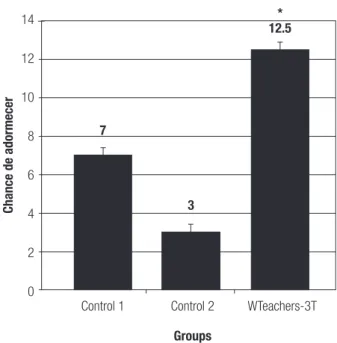
Presence of excessive daytime sleepiness–EDS. Female teach-ers from public schools of Quipapá/PE working 3 shifts had excessive daytime sleepiness, considering that for the Epworth scale, the value of excessive daytime sleepi-ness is above a score of 9 (Figure 1).
Presence of depression in teachers of public schools of Qui-papá/PE, Brazil – BDI. Female teachers working 3 shifts (WTeachers-3T, n=123) had a higher percentile of mild (24%) and moderate (37%) depression compared to the control groups – Control 1: mild (8%) and moder-ate (11%) – Control 2: mild (5%) and modermoder-ate (15%) (Table 1).
DISCUSSION
his study observed that teachers from public schools of Quipapá/PE who worked 3 shifts had excessive
day-14
12
10
8
6
4
2
0
Chance de adormecer
7
3
12.5 *
Control 1 Control 2
Groups
WTeachers-3T
time sleepiness and a greater rate of mild and moderate depression compared to teachers working 1 (one) or 2 (two) shifts.
hese results corroborate the indings of Rocha & Sarriera (2006)14 and Moraes et al. (2011)15 regarding
the speciic aspect of sleep disorders in teachers. How-ever, although these results are linked, it is necessary to highlight their methodological diferences. While the present study involved 201 female teachers of ele-mentary school, comprising 38 professionals working 1 shift, 40 working 2 shifts and 123 working 3 shifts, Ro-cha & Sarriera (2006)14 assessed 161 teachers from 14
graduate-level courses of various disciplines, in a sample comprising 56% female subjects and 44% male subjects. In relation to the study of Moraes et al. (2011)15 there
was great methodological similarity with the present study, the only diference being the quantity of female teachers in the study which numbered only 121. Nev-ertheless, the sleep disorders evaluated and conirmed were not related to excessive daytime sleepiness, but to other disorders, including snoring loudly, pauses in breathing (apnea), waking up choking, restless sleep, hypnagogic hallucinations, unpleasant sensations in the legs, movement of limbs, speaking while asleep, sleep-walking, nightmares, feeling anxious, tachycardia, irri-tability and sweating hands.
Despite the few diferences in the methods men-tioned above, the results raise attention given the high rate of impairment in sleep quality found among Bra-zilian educators. he aspect of dividing groups by shifts also proved relevant in this study since, akin to a study of stress by Albuquerque et al. (2010)16 using the same
methodological coniguration, the results pointed to greater compromise in subjects working 3 shifts.
Despite a number of diferent phenomena studied, these morbidities (stress, depression and sleep disor-ders) are intimately connected on a neurophysiological level. Porsolt et al. (1977),17 studying animal models,
proved that stress leads to depression. Depression is not only sadness but is a disease that causes neurochemical
alterations. Studies in animals and humans have shown for example, the role of serotonin in emotional disor-ders such as depression,18,19 and in regulating aggressive
behavior (Moeller et al., 1998; Evenden, 1999)20,21 and
anxiety.22,23
It seems that the interlacing of these morbidities is connected to the functioning of serotonergic neuro-transmission. A wide variety of functions of the central nervous system involve the participation of serotonin.24
Some of these functions are associated with pain sen-sitivity, learning and memory processes as well as with dietary and emotional behaviors.24,25
he aforementioned factors may justify the cognitive impairment connected to sleep disorders, such as atten-tion problems, concentraatten-tion and memory26 which,
al-though not evaluated in this work, have been the source of constant complaints by teachers. hese impairments are evidenced by poor performance at school, work and in other aspects of the subjects’ lives.27
Regarding the relationship between sleep and mem-ory, it is known that the transition from wakefulness to sleep tends to afect memory, since sleep renders trans-fer from registers of short-term to long-term memory inactive. Decoding of the material after the beginning of sleep is similarly afected, owing to lapses that hamper mnemonic strategies which do not present suicient strength to allow evocation.28 Although apnea was not
investigated in this study, it is possible that some of the teachers assessed had this syndrome, since excessive daytime sleepiness was observed, constituting the main symptom of the syndrome of sleep obstructive apnea, and may lead to problems in memory function.29
It is clear that the cause of depression in the evalu-ated teachers is not attributed solely to sleep disorders but a series of factors, including lack of support at the institutions, diferent structures of personality, non-inancial recognition of the importance of a profession that prepares for all others.
hese results are not common only to the teachers of the Northeast region Brazil. Stoltz & Cezar Junior
Table 1. Presence of depression.
Subjects
Absence Mild Moderate Severe
Total
Freq. % Freq. % Freq. % Freq. %
Control 1 31 82% 3 8% 4 11% 0 0% 38
Control 2 32 80% 2 5% 6 15% 0 0% 40
WTeachers-3T 48 39% 29 24% 46 37% 0 0% 123
Total 111 34 56 0 0 201
(2008)30 carried out a study with 1368 teachers from
the State Public Network of Florianópolis in Southern Brazil. From this number of teachers, 339 teachers were undergoing health treatment in general, corresponding to 24.78% that did not fully exert their functions. Of the 339 teachers, 142 were of work due to mental ill-ness (Mental and Behavior Disorders – F00/F99 of the international code of disease – ICD 10), accounting for 41.88% of absences in the 6-month period. It was per-ceived that the most frequent diseases belonged to the Group of Mental Disorders, representing almost half of the total cases. Among the most frequent diagnoses of these Disorders, Mood Disorders had the highest rate, observed in 52.55%. In this group of Mood Disorders, both Depressive Episode and Moderate Depressive Episode were ranked joint top statistically, having a fre-quency of 15.38%.
Helplessness in a large proportion of professionals of the education sector does not seem to afect only the question of mental health, which is signiicant, but also the social identity of the teachers. According to Paula (2010)31, the image of teachers in recent years has
suf-fered due to the lack of inancial incentive and also be-cause of the supericial training of a large proportion of teachers in the country. his evident lack of preparation of many teachers of elementary and high school level is possibly the result of lack of motivation or inancial diiculties precluding them from pursuing their profes-sional training. However, this reality is not exclusive to Brazilian schools. According to Nóvoa (1992),32 until
the 1960s, the Portuguese government maintained an attitude of vigilance in relation to teachers’ training and intensiied the mechanisms of ideological control: re-laxation of the pre-requisites for admission into normal teaching, reduction in the contents and time for train-ing, implying a lower intellectual and scientiic demand. hus, as with the situation of Luso-Brazilian teach-ers, other studies have shown similar realities such as the case of teachers from Hong Kong cited by Penning-ton (1995).33 According to the author, besides a high
lev-el of daily stress afecting school teachers and students, the teachers are not incentivized by favorable working conditions or opportunities for personal development, on the contrary, the educators of Hong Kong have little autonomy over the work they carry out, few opportuni-ties for collaborative work, and a lack of incentives such as promotions or recognition by society.31
Of broader concern however, is the fact that these conditions are not realities conined to Brazil, Portugal or Hong Kong, but closely relect a world stereotyped image of teachers. Zeichner (2003)34 airms that in
most countries, teachers earn low wages in comparison to pay levels of other professionals with the same or in-ferior schooling level , obliging many education profes-sionals to engage in two or more professional activities in order to survive with the minimum comfort. Possi-bly, this lack of inancial recognition of teachers is one of the factors afecting the image that teachers have of the profession and consequently of themselves.
In this sense, in order to remain a teacher, there seems to be the need to create a sort of psychic de-fense so as not to quit or fall ill, like a love of the pro-fession. he work of the teacher, in this context, has a preponderant factor, for “the teacher, in order to per-form the work in a way to reach their objectives, the establishment of the afection connection is practically mandatory”.35
his said, the impression is that the teaching profes-sion makes the individual fragile, that is, in the educa-tional context it could be said that teachers undergo a continued process of building their identity by means of dialogic relationships with colleagues, coordinators, parents and mainly with their students. hus, it is un-derstood that teachers build or rebuild their profession-al identity when they interact with the people around them, when reiterating personal and social conceptions about themselves and the profession, when negotiating and renegotiating their personal-professional identity, rendering this a process of constant development. Con-sequently, a deining element of the identity is perma-nent instability.36
his instability seems to place teachers in a situation of having to “kill a lion” per day in order to prove their merit. his becomes tiring and places them under con-stant pressure. Although, depression seems to be caused by thought processes when not of genetic origin and also becomes physical in other ways. herefore, depres-sion cannot be conceived as a moment of sadness, but a disease that causes neurochemical disorganization.
Depression is one of the most common mental dis-turbances and constitutes a contemporary public health problem, with a prevalence of 2-3% in men and 5-9% in women. However, the overall risk throughout life for a major depressive episode is double this prevalence. he condition is associated with an increase in morbid-ity and mortalmorbid-ity, through not only committing suicide, but also owing to increased risk or worsened prognosis of other chronic so-called “organic” diseases. Coronary disease and diabetes mellitus type 2 represent two ex-amples of well-established consequences.37
depressive episode (in the absence of episodes of mood elation and psychotic disorders) is deined when a sick individual experiences a depressive mood and/or loss of interest or pleasure for longer than two weeks, or for at least four more weeks in the case of manifesting both these symptoms. Signs and symptoms include the fol-lowing: loss of weight or increased appetite; insomnia or hypersomnia; psychomotor retardation or agitation; fa-tigue or loss of energy; feeling of devaluation or dispro-portionate guilt; indecisiveness or loss of concentration or the capacity of thinking; suicidal ideation or suicide attempts, or constant thoughts about death.37
When it is said that depression is a disease afect-ing the neurochemistry of the nervous system this illus-trates the gravity of the problem because the individual loses control of everything, that is, one cannot simply say: stop being sad and go to the church and everything will be ine. From a morphofunctional perspective, re-garding the neuronal circuits of depression, it is known that diferent brain regions mediate the diversity of the aforementioned symptoms in relation to depression.38
here are three sub regions of the prefrontal cortex (PFC) most frequently implicated in depression physio-pathology, namely, the ventromedial PFC, lateral orbital region and dorsolateral region.39 In the ventromedial
PFC, the blood low is increased in depressed subjects showing a reduction in grey matter, with this cortex mediating in theory, the conscious aspects related to pain (physical), anxiety and depressive ruminations.40
he lateral orbital region, which normally suppresses or modulates emotional responses, has increased activ-ity in major depression, maybe to compensate for the excess limbic activity. he dorsolateral PFC shows a de-crease in metabolic and grey matter, where this region participates in interconnection with the portion of the dorsal anterior cingulate cortex, in cognitive paths, and is also the core of working memory. hus, this region mediates apathy, psychomotor retardation and altera-tions in attention and working memory.41
Several clinical and preclinical studies have reported indings that support these hypotheses, i.e. a decrease in the density of serotonin (5-HT) and NA receptors in the prefrontal cortex and limbic structures, increased levels of MAO in brains of depressed subjects, decreased number of neurons both in the locus coeruleus and dor-sal raphe nucleus and increased turnover of 5-HT in de-pressed individuals.42
he hippocampus, the most studied structure in the context of depression, is especially vulnerable to mecha-nisms of neurotoxicity induced by stress, due to its “cen-tral” location. It is also a mood modulator and crucial
to the formation of new memories. he most common dysmorphology in major depression is a reduction in its mass, while some authors have also found changes in its segments or shape, implying a role in depression neu-robiology.39 his seems to conirm the participation of
stress in the genesis of depression.
he fundamental response of stress consists of the corticotropin-releasing hormone (CRH) and the locus
coeruleus-noradrenaline system (LC-NA), with the
re-spective efector peripheral extensions: the hypotha-lamic-pituitary-adrenal axis (HPA) and the sympathetic division of the autonomic nervous system, although the latter is not contiguous, but interconnected to the
lo-cus coeruleus-noradrenaline system (LC-NA). hese two
systems inluence one another mutually and positively and are also counter-regulated by the hippocampus in prefrontal cortex – both having inhibitory aspects – and by the amygdale, with a stimulatory function. It is the latter that detects and integrates the “stress informa-tion” and may trigger the adaptation response through the efector systems.43
A meta-analysis of the genetic studies based on families showed that the relative risk of an individual presenting MD of having an afected irst degree relative is 2.8, and that the number of early cases or with mul-tiple depressive episodes tends to rise with an increase in family aggregation of the disorder. Studies of twins with a monozygotic concordance rate of 37%, also sug-gest that shared genetic heritage has more signiicance in terms of relative risk than exposure to the same en-vironmental factors in twins that grew up together. In conclusion, although depression is a highly inheritable disorder, with 40-60% of the risk attributed to genetic factors, if the individual has a calm life, he/she may not manifest the disease and in this sense, where stress may be the trigger for the pathology.44
Knowledge at the level of neurobiology of depres-sion has evolved substantially in recent years, although this disorder has a complex pathogenesis. A paradigm has been developing from philosophical considerations to etiological considerations, based on scientiic method and incorporating diferent approaches and hypotheses, all of which are complexly interconnected and undoubt-edly incomplete.37
inces-sant search to top up the family income through over-loaded schedules.
It is noteworthy that according to Silva (2003),45 one
is not born with an identity. his identity is built and in-volves the notion of its ixation with a process resulting from acts of linguistic creation. hus, identity is a social and cultural instable creation, that is, it is in constant transformation. According to this author (2003, p. 96-97) the identity is not an essence, nor a fact of nature or culture, neither ixed nor stable, on the contrary, it is marked by instability and by constant construction:
[...] we can say that identity is a construction, an ef-fect, a process of production, a relation, a performative act. he identity is instable, contradictory, fragmented, unconscious and uninished. he identity is connected to discursive and narrative structures. It is also connect-ed to systems of representations. he identity has close connections with relations of power.
Coupled with this question, that involves the con-struction of a professional identity, there remains an-other that refers to the inluence of an-other cultures. To what extent is multiculturalism beneicial? Often times, this inluence of culture of a foreign country can reach the point of interfering in the cultural identity of teach-ers, developing a sort of loss or devaluation or their own cultural identity. In other words, depending on how the culture of the foreign country is presented or sub-tly imposed, it may inluence the habits of the social or professional life of a given culture. For example, the in-vasion of Hollywood movies seems to lead some Brazil-ians to overvalue cultural aspects of the United States of America.
In accordance with this notion, regarding the atti-tude of teachers and satti-tudents of English in relation to the American culture, an overly positive attitude and almost veneration have been observed.46
Critical studies for example, illustrate how English language teaching has been reported by the media as being the salvation for the poorest communities of the world, in which the English language is seen as an op-portunity to improve the living conditions of its indi-viduals, which in reality does not always occur. his rein-forces a historical feeling of inferiority and a devaluation complex of colonized countries in relation to the Colony. In the face of this reality, the author reinforces the need to look critically at the interests and ideologies passed by the industry of English teaching, so the teacher is not a collaborator in fostering the inequality conditions this knowledge produces in an underprivileged society.
he situation of these teachers, who are people that deal with knowledge, seems to be a little more delicate,
in the face of this bombardment of information that comes from post-modernity. It seems that this profes-sional is left to his fate. Given the above, this poses a question: is the sensation of helplessness a factor fur-ther weakening this professional today?47
Few readers may be aware, but in some ways the irst scholar concerned about human helplessness was Freud. Among the explored approaches in the psycho-analytic literature, two lines standout: the anthropolog-ical or phylogenetic and the mentalist or ontogenetic. In the former, the question was the passage from nature to culture and the corresponding process of “humaniza-tion”. By contrast, in the mentalist or ontogenetic ap-proach, the nature-culture passage is already assumed for the species, needing only to be carried out by each new individual. Demarcated in this plan, the theory of the subject focuses on the study of stimulants or natu-ral mental state precursors of individual subjectivity. herefore, what diferentiates the anthropological and mentalist approaches is the fact that in the former, cul-ture is the product or something that accompanies the formation of the subject, while in the latter, culture is assumed as the generic and peripheral environment of subjectivity. As marked as the overlaps among the ap-proaches are, didactic separation is feasible. Of the two approaches, the mentalist is far more considered in the theory of the subject by Freud.47
Under the mentalist approach of the subject and more precisely the discussion of stimulants and origi-nal mental states, Freud equally proposes two theses: the irst, more well-known and used is that of sexual-ity. In this thesis, Freud views the subject as a product of libidinal history, something moved by the demand of pleasure or by sexual stimulus.
fate and by other humans. It is in this helplessness state that the subject is born and lasts.
Freud maintained the primacy of the sexuality thesis in subject theory, transforming it, little by little in the way of psychoanalytic thinking. he idea of helplessness was left to the wayside throughout Freud’s work, thus composing the block of unsuccessful ideas in psycho-analysis. And now helplessness comes to the fore once more.47
In this general sense, social helplessness of teach-ers seems to lead them to becoming overloaded in an attempt to survive and sustain their family, obliged to give classes in several schools or colleges to aford the basic bills. his situation seems to mean an individual is restricted from furthering their quality by say, going
to the dentist periodically, taking care of their skin and hair and general health, visiting relatives and friends or prioritizing leisure.
Although this study has been carried out with the care and rigor of scientiic methodology, the need to car-ry out a more in-depth study involving the investigation of the correlation among stress, quality of life, adminis-tration time and sleep disorders emerges. Determining the correlation among these instruments of evaluation will enable identiication of the focus on comorbidity. he inventory of quality of life, for example, allows iden-tiication of whether the disarrangement that causes the sequence of comorbidities is connected to social, emotional, professional or organic health aspects of the individual assessed.48
REFERENCES
1. World Health Report (WHO). (2001). Mental health: new understanding, new hope.
2. Murray CJL, Lopez AD. The Global Burden of Disease: A comprehen-sive assessment of mortality and disability from diseases, injuries and risk factors in 1990 and projected to 2020. Cambridge: Harvard Uni-versity Press; 1996.
3. Santos MJ, Kassouf AL. Uma investigação dos determinantes socio-econômicos da depressão mental no Brasil com ênfase nos efeitos da educação. Economia aplicada, São Paulo, 2007;11: 5-26.
4. Macedo VCD, Monteiro RM. Educação e saúde mental na família: ex-periência com grupos vivenciais. Texto Contexto Enferm 2006;15:222-230.
5. Taylor CM. Manual de enfermagem psiquiátrica de Mereness. 13a ed. Porto Alegre (RS): Artes Médicas; 1992.
6. Crivelatti MMB, Durman S, Hofstatter LM. Sofrimento psíquico na ado-lescência. Texto Contexto-enferm; 2006;15:64-70.
7. Hegadoren K, Norris C, Lasiuk G, da Silva DGV, Chivers-Wilson K. The many faces of depression in primary care. Texto Contexto Enferm, Flo-rianópolis, 2009;18:155-164.
8. Ramos M. Os sintomas depressivos e as relações sociais na terceira idade. Rev Depart Psicol - UFF, 2007;19: 397-410.
9. Åkerstedt T. Shift work and disturbed sleep/wakefulness. Occupl Med 2003;53:89–94.
10. Fernandes RMF. O sono normal. Simpósio: Distúrbios Respiratórios do Sono. Medicina, Ribeirão Preto, 2006;39:157-168.
11. Culebras A. The biology of sleep. In: Culebras A, ed. Clinical handbook of sleep disorders. Oxford: Butterworth-Heinemann;1996:13-15. 12. Johns MW. Sensitivity and specificity of the multiple sleep latency test
(MSLT), maintenance of wakefulness test and the Epworth sleepiness scale: failure of the MSLT as a gold standard. J Sleep Res. 2000;9:5–11. 13. Beck AT, Steer RA. Beck Depression Inventory. Manual. San Antonio,
TX: Psychological Corporation;1993b.
14. Rocha KB, Sarriera JC. Saúde percebida em professores universitários: gênero, religião e condições de trabalho. Rev Sem Assoc Bras Psicol Escol Educ (ABRAPEE) 2006;10:187-196.
15. Moraes KCC, Ribas VR, Costa DFS, et al. Brazilian educators that work in three shifts present sleep disturbances. Neurobiologia 2012;75(no Prelo). 16. Albuquerque EE, Costa SL, Ribas Almeida PIL, et al. Professores do
Ensino Fundamental do Município de Quipapá/PE Apresentam Estres-se. Neurobiologia 2010;73:117-125
17. Porsolt RD, Le Pichon M, Jalfre M. Depression: a new animal model sensitive to antidepressant treatments. Nature 1977;266:730-732 18. Manhães de Castro R, Peregrino A, Sourgey E, Barreto Medeiros JM,
Deiró TCBJ. Depression: Repercussion in Serotonergic System. Neuro-biologia 1998;61:45-55
19. Mendes da Silva C, Lopes de Souza S, Barreto-Medeiros JM, et al. Neonatal treatment with fluoxetine reduces depressive behavior induced
by forced swim in adult rats Arq Neuropsiquiatr 2002;60:928- 931 20. Moeller FG Allen T Cherek DR Dougherty DM Lane S Swann AC Ipsapir-one neuroendocrine challenge: relationship to aggression as measured in the human laboratory. Psychiatry Res 1998;81:31-38.
21. Evenden J. Impulsivity: a discussion of clinical and experimental find-ings. J Psychopharmacol 1999;13:180-192.
22. Silva RCB, Brandão ML. Acute and chronic effects of Gepirone and Fluoxetine in rats tested in the Elevated Plus - Maze: an ethological analysis. Pharmacol Bioch Beh 2000;65:209–216.
23. Jaiswal AK, Upadhyay SN, Satyan KS, Bhattacharya SK. Behavioural effects of prenatal and postnatal undernutrition in rats Indian. J Exp Biol 1996;34:1216-1219.
24. Chopin P, Moret C, Briley M. Neuropharmacology of 5-hydroxytrypta-mine1B/1D receptor ligands. Pharmacol Therap 1994;62:385-405. 25. Teodósio NR, Cabral Filho JE, Guedes RCA, Costa JA, Costa FRB,
Silva AT. Learned and emotional behavior in chronically malnourished rats. Acta Physiol Latinoam 1979;29:255-262.
26. Bassiri AG, Guilleminault C. Clinical features and evaluation of obstruc-tive sleep apnea–hypopnea syndrome. In: Kryger MH, Roth T, Dement WC (eds) Principles and practice of sleep medicine. Saunders, Philadel-phia; 2000;869–878.
27. Kryger MH. Management of Obstrutive Sleep Apnea-Hypopnea Syn-drome: Overview. In: Kryger MH, Roth T, Dement WC. Principles and Practice of Sleep Medicine. Philadelphia: WB Sauders Company; 2000:1336.
28. Bonnet MH, Arand DL. Clinical effects of sleep fragmentation versus sleep deprivation. Sleep Med Rev 2003;7:297-310.
29. Krueger JM, Majde JA. Sleep and host defense In: Kryger MH. Roth T. Dement WC. Principles and Practice of Sleep Medicine. 5th Ed St Louis: WB Saunders; 2011: 281-290.
30. Stoltz MR, Cezar Junior NNBA. Depressão e o Afastamento do Trab-alho em Professores Universidade do Sul de Santa Catarina. Rev Prog Unisul Inic Cient (PUIC) do Campus da Grande Florianópolis/ Pedra Branca 2008;2:8-10.
31. Paula LG. O processo de construção da identidade do professor REV-ELLI. Rev Educ Ling Literat, UEG – Inhumas. 2010;2:7-16.
32. Nóvoa A. Os professores e a sua formação. Portugal: Publicações Dom Quixote; 1992.
33. Pennington MC. The teacher change cycle. Tesol Quarterly 1995; 29: 705-731.
34. Zeichner KM. Formando professores reflexivos para a educação cen-trada no aluno: possibilidades e contradições” In: Barbosa RLL (Org) Formação de educadores: desafios e perspectivas. São Paulo: Editora Unesp; 2003:35-56.
36. Rajagopalan KELT. Classroom as na arena for identity clashes In: Gar-magnani AMG, Grigoletto M. Inglês como língua estrangeira: identidade práticas e textualidade. São Paulo: USP Humanitas; 2001:70-90. 37. Lage JT. Neurobiologia da Depressão [Mestrado Integrado em
Me-dicina Área: Psiquiatria] Acta Méd Port, Universidade do Porto; 2010. 38. Nestler EJ, Barrot M Dileone RJ, Eisch AJ, Gold SJ, Monteggia LM.
Neurobiology of depression. Neuron 2002;34:13-25.
39. Lorenzetti V, Allenb NB, Fornito AA, Yücel M. Structural brain abnor-malities in major depressive disorder: a selective review of recent MRI studies. J Affec Disord 2009;117:1-17.
40. Zandio M, Ferrín M, Cuesta MJ. Neurobiología de la depression. Anales Sis San Navarra; 2002;25(Supl 3):43-62.
41. Maletic V, Robinson M, Oakes T, Iyengar S, Ball SG, Russel J. Neurobi-ology of depression: an integrated view of key findings. Int J Clin Pract 2007;61:2030-2040.
42. Maletic V, Raison CL. Neurobiology of depression fibromyalgia and neu-ropathic pain. Front Biosci 2009;14:5291-338.
43. Heim C, Plotsky PM, Nemeroff CB. Importance of studying the contri-butions of early adverse experience to neurobiological findings in de-pression. Neuropsychopharmacology 2004;29:641-648.
44. Lesch KP. Gene-environment interaction and the genetics of depres-sion. J Psychiatry Neurosci 2004;29:174-184.
45. Silva TT. A produção social da identidade e da diferença In: SILVA T T (Org) Identidade e diferença: a perspectiva dos estudos culturais Petrópolis: Editora Vozes; 2003:73-102.
46. Moita Lopes LP. Oficina de Lingüística Aplicada: a natureza social e educacional dos processos de ensino/aprendizagem de línguas. Campinas SP: Mercado de Letras; 1996.
47. Ferraz CH. Sexualidade e desamparo: as origens do sujeito em Freud. [Dissertação de Mestrado]. Universidade do Estado do Rio de Janeiro UERJ Brasil. 1996