The daily life of patients with dementia
A comparative study between the information
provided by the caregiver and direct patient assessment
Lucia Aparecida Bressan
1, Francisco de Assis Carvalho Vale
2, José Geraldo Speciali
3Abstract – The functionality concept is very important, as the diagnosis of dementia presupposes the existence of functional impairment. Instruments assessing functional performance present some limitations. In most cases, the assessment is based on the caregiver’s report. Some studies in international literature have evaluated this issue and concluded that a difference exists between the caregiver’s report and direct patient assessment. American and European caregivers tend to underestimate the patient’s functional limitations. However, this issue has hitherto not been investigated in our context. Objective: To compare the caregiver’s information with direct assessment of the patient’s performance based on the same functional assessment questionnaire. Methods: Seventy-two patients and caregivers were attended by the Occupational Therapy service of the Behavioral Neurology Outpatient Clinic between 1999 and 2001, 25 of whom fulfi lled the inclusion criteria: having a confi rmed diagnosis of dementia according to the DSM-IV; having attended three or more return appointments, and where the caregiver belonged to the patient’s family nucleus. The remaining subjects were excluded because of non-adherence to treatment or refusal to participate in the study. The Functional Activities Questionnaire by Pfeffer et al., 1982 was applied to patients in a laboratory simulation, while another evaluator interviewed the respective caregivers. The data were analyzed based on the weighted Kappa coeffi cient, and Wilcoxon test. Results: There were signifi cative differences between caregiver’s answers and direct observation of the patient’s performance. The information provided by the caregivers proved unreliable since caregivers underestimated the patient’s functional capacity.
Key words: dementia, functional assessment and occupational therapy.
O cotidiano do paciente com demência: estudo comparativo entre a informação do cuidador e a avaliação direta do paciente
Resumo – O conceito de funcionalidade se reveste de grande importância, uma vez que, o diagnóstico de Demência pressupõe a existência de comprometimento funcional. Os instrumentos que avaliam o desempenho funcional apresentam algumas limitações, na maioria das vezes, é feita a partir do relato do cuidador. Alguns estudos da literatura internacional avaliaram esta questão e concluíram que existe diferença entre o relato do cuidador e a avaliação direta do paciente. O cuidador americano e europeu tende a minimizar as limitações funcionais do paciente. No entanto, essa questão não foi investigada em nosso meio até o momento. Objetivo:
Comparar as informações do cuidador com avaliação direta do desempenho do paciente, frente a um mesmo questionário de avaliação funcional. Métodos: Dos 72 pacientes e cuidadores atendidos pela Terapia Ocupacional do Ambulatório de Neurologia Comportamental no período entre 1999 e 2001, um número de 25 pacientes e cuidadores atenderam aos critérios de inclusão: ter diagnóstico confi rmado de demência segundo o DSM-IV; ter comparecido a três retornos ou mais e o cuidador pertencer ao seu núcleo familiar. Os demais foram excluídos pela não-aderência ao tratamento ou recusa em participar do estudo. O Questionário de Atividades Funcionais Pfeffer et al., 1982 foi aplicado, em situação simulada em laboratório, enquanto outro avaliador entrevistava os respectivos cuidadores. Os dados foram analisados com base no coefi ciente Kappa ponderado e teste de Wilcoxon.
Resultados: Foram encontradas diferenças signifi cativas entre as respostas do cuidador e a observação direta do desempenho do paciente. As informações fornecidas pelos cuidadores não são fi dedignas. O cuidador subestima a capacidade funcional do paciente.
Palavras-chave: demência, avaliação funcional e terapia ocupacional.
Departamento de Neurologia, Psiquiatria e Psicologia Médica, Faculdade de Medicina de Ribeirão Preto, Universidade de São Paulo (FMRP-USP) Ribeirão Preto SP, Brasil: 1Terapeuta Ocupacional Doutora em Neurociências - Programa de Pós-Graduação em Neurologia. 2 Doutor em Neurologia, Coordenador do Grupo de Neurologia Comportamental do HCFMRP-USP. 3Professor Associado do Departamento de Neurologia, Psiquiatria e Psicologia Médica.
The main risk factor for many chronic diseases occur-ring with aging is indeed age itself. Disease-free aging is the privilege of few individuals, but aging with health can be achieved by many.
The most prevalent chronic-degenerative disease in the elderly is dementia.
The concept of functionality is very important in the treatment of dementia since the disease diagnosis is based on the assumption of the existence of functional impair-ment. Functionality is understood as the ability of an indi-vidual to maintain the physical and mental skills necessary to lead an independent and autonomous life.1 Functional
capacity, considered to be a new health paradigm, requires an expansion of the prevention, assistance and rehabilita-tion acrehabilita-tions aimed at the health of the elderly in order to improve or maintain functional performance.
The instruments that evaluate functionality have some limitations. For example, disabilities may or may not be observed depending on the activities performed by the el-derly. Another very important limitation is related to the fact that, in most cases, the evaluation is exclusively based on the information given by the person accompanying the patient, which may introduce bias into the assessment.
Some studies have addressed this issue and the key conclusions reached were that caregivers overestimate the ability of the patient to perform daily activities2 and that
depression interferes with the evaluation of the caregiver, whereas care load does not.2 In contrast, other studies have
stated that depressive symptoms do not interfere with the difference between evaluations3 whilst care load does.4
In Brazil, the use of the Pfeffer Functional Activity
Questionnaire (FAQ)5 has been recommended for the
di-agnosis of dementia.6 Scales such as the FAQ (1982), the
scale applied to the informant, the Informant Question-naire of Cognitive Decline in the Elderly” (IQCODE), and the Bayer Scale of Activities of Daily Living (B-ADL), combined with instruments for cognitive assessment such as the Mini-Mental State Examination (MMSE), applied to the informants, are recommended as the norm for ap-plication in Brazil.7 Several studies have suggested that the
combination of a cognitive test with functional scales can improve the detection of dementia.7,8
Some studies published in the international literature have used the Direct Assessment of Functional Status (DAFS) by Loewenstein and Bates (1992) to assess the co-herence between the informer and the functional capacity of the patient.2-4 The Pfeffer FAQ (1982) has also been used
in another study as a predictive assessment based on self-re-port and on the informer’s reself-re-port, regarding the functional defi cit of patients with moderate cognitive impairment for
the diagnostic follow-up of probable Alzheimer disease.9
In view of the above considerations, the objective of the present study was to compare the information provided by the caregiver, to the performance of the patient assessed by an examiner using the Pfeffer FAQ (1982).
Method
Subjects
Seventy-two patients and their caregivers participated in the study. The patients were attended by the Occupa-tional Therapy Service of the Behavioral Neurology Outpa-tient Clinic during the period spanning from 1999 to 2001. The inclusion criteria were: to have a confi rmed diag-nosis of dementia according to the DSM-IV, regardless of etiology or stage, to have attended three or more return vis-its, and to have a caregiver belonging to the family nucleus (spouse, daughter, son etc.).
Non-compliance with treatment was an important ex-clusion criterion since some patients and caregivers came to the Service for the initial evaluation and then abandoned treatment after one or two return visits. Another exclusion criterion was refusal to participate in the study. On the basis of these criteria, 47 subjects and their caregivers were excluded from the study.
Thus, a total of 25 patients followed up by the Occu-pational Therapy Service from 1999 to 2001 satisfi ed the inclusion criteria.
Procedure
The study was approved by the Research Ethics Com-mittee of the University Hospital, Faculty of Medicine of Ribeirão Preto, USP.
Two subject groups were studied: the CD GROUP, consisting of 25 patients with cognitive disorders, and the CG GROUP, consisting of 25 caregivers. The clinical and sociodemographic characteristics of the two groups are presented in Tables 1 and 2, respectively.
While an examiner interviewed the caregiver, another simultaneously evaluated the performance of the patient in the laboratory using the FAQ.
Instrument applied to the caregiver
An examiner applied the FAQ5 to the caregivers,
by the caregiver: zero (when the patient was able to per-form the proposed task without diffi culty), one (when the patient was able to perform the task but with diffi culty),
two (when the patient needed help to perform the task) or
three (when the patient was unable to perform the pro-posed task). The sum of the scores obtained for each item gave the fi nal score, which indicated the degree of limita-tion of the patient.
Instrument applied to the patient
A laboratory was set up on the 3rd fl oor of the
Univer-sity Hospital, Faculty of Medicine of Ribeirão Preto, USP, permitting the assessment of patient performance in sim-ulated situations. The laboratory consisted of two rooms prepared as described below:
1. A simulated shopping situation was created in one of the rooms, with various objects left on view. The patient received a note pad and a pencil in order to organize his purchases, photocopies of blank checks, and money in bills and coins for payment.
2. In the room corresponding to the kitchen, the patient was asked to make coffee and to prepare a salad with a
coffee “kit” (pot used to boil water, a coffee fi lter and jug, coffee powder, and sugar) and a salad “kit” (salad bowl, knife, fork, seasonings, a lettuce and tomato).
Another examiner asked the patient to perform the fol-lowing FAQ activities: handling checks and money, orga-nizing the chores for the day by verbalizing them or mak-ing written notes, buymak-ing objects in a simulated shoppmak-ing situation, playing dominoes, cards or checkers, preparing simple food such as a green salad, watching a television program and commenting on what they saw, commenting on TV news, events regarding family and neighborhood, remembering to take their medications and return visits to the University Hospital using their hospital appointment card as an aid, and walking on the 3rd fl oor, where they were
supposed to locate the visiting room and the daily activi-ties laboratory where the tests of the present study were performed, without getting lost along the way. Regarding this last item, care was taken to include patients who had attended more than three return visits, in order to ensure familiarity with the testing environment. The examiner as-signed the following scores to the performance of the
pa-Table 1. Clinical and sociodemographic characteristics of patients.
Nº Sex Age
Schooling
(years) M.S. Origin
Disease duration
(years) Diagnosis
1 M 59 4 D Ribeirão Preto 7 Frontotemporal dementia 2 M 67 3 M Ribeirão Preto 7 Dementia + Alcoholism 3 F 80 0 D Ribeirão Preto 8 Alzheimer’s disease
4 F 82 2 D Brodosqui 6 Vascular dementia 5 F 75 11 M Ribeirão Preto 9 Lewy body dementia 6 F 80 11 W Batatais 8 Vascular dementia 7 M 45 5 M Ribeirão Preto 9 Dementia syndrome+ Alcoholism 8 M 80 4 M Ribeirão Preto 7 Dementia + Alcoholism
9 M 49 0 M Guariba 14 Alzheimer’s disease 10 M 46 5 S Ribeirão Preto 3 Dementia + Hypoglycemia 11 F 73 1 S Ribeirão Preto 5 Alzheimer’s disease 12 F 66 8 M Ribeirão Preto 5 Alzheimer’s disease 13 M 66 3 M Batatais 5 Alzheimer’s disease 14 M 60 4 M Ituverava 8 Vascular dementia 15 M 76 4 M Brodosqui 13 Alzheimer’s disease 16 F 86 0 W Ribeirão Preto 5 Alzheimer’s disease 17 M 58 3 M Pradópolis 5 Dementia + Severe hypoxia 18 F 84 4 W Ribeirão Preto 6 Alzheimer’s disease 19 F 60 4 M S. Carlos 5 Corticobasal dementia 20 F 86 1 M Ribeirão Preto 4 Dementia + Severe hypoxia 21 F 86 0 W Ribeirão Preto 4 Alzheimer’s disease
22 F 71 3 W Pontal 5 Vascular dementia 23 M 77 4 M P. Ferreira 4 Vascular Dementia 24 M 29 2 S Jaboticabal 4 Dementia + Alcoholism 25 F 75 12 W Jardinópolis 4 Lewy Body Dementia
tient: zero (when the patient was able to perform the pro-posed task without diffi culty), one (when the patient was able to perform the task but with diffi culty), two (when the patient needed help to perform the task) or three (when the patient was unable to perform the proposed task).
The evaluations of the caregivers and of the patients were fi led separately and kept secret until the end of the in-vestigation. Data were analyzed statistically by the weighted Kappa coeffi cient and the non-parametric Wilcoxon test.
Results
The clinical and sociodemographic characteristics of the patients who participated in the study were similarly distributed between males and females. Most subjects had four years of schooling, were married, were from Ribeirão Preto, and older than 71 years. Their diagnoses of dementia were as follows: Alzheimer disease, vascular dementia, fron-totemporal dementia, dementia secondary to alcoholism, Lewy body degenerative dementia, corticobasal dementia, and dementia due to severe hypoxia. The course of the dis-eases ranged from 3 to 14 years (Table 1).
The main caregiver was the spouse, in most cases the
wife, aged between 51 to 70 years with up to 8 years of schooling. Experience as principal caregiver ranged from 3 to 14 years and the time devoted to care was about 4 to 12 hours per day (Table 2).
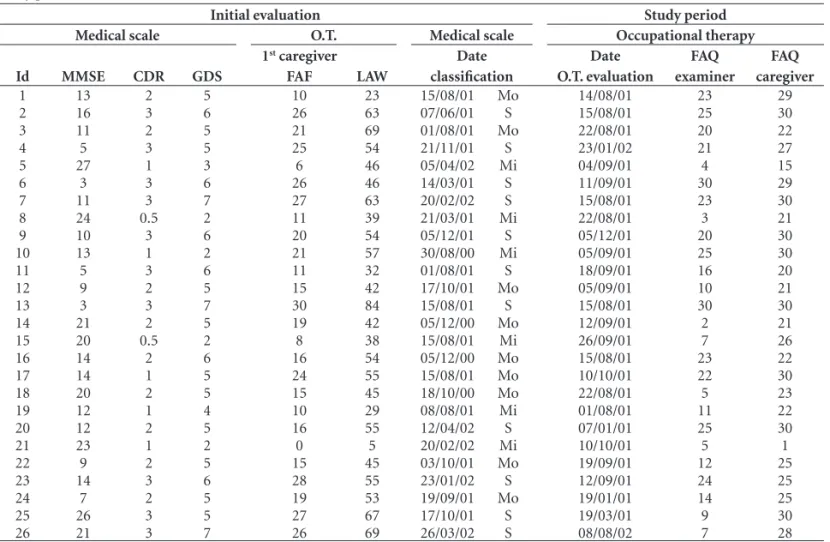
Cognition and functionality were assessed during the course of treatment. Table 3 presents the cognitive and functionality profi le during different stages, i.e., during treatment and the present investigation.
Agreement between caregiver’s Pfeffer and examiner’s Pfeffer was studied (Table 4).
Statistical analysis showed that out of ten items on the Pfeffer FAQ5 evaluated, the following seven showed weak
and non-signifi cant agreement: (1) handling money, (2) self-organization by making notes, (5) making coffee, (6) preparing food, (7) keeping up with community or neigh-borhood events, (9) reading the newspaper, and (10) taking a walk in the neighborhood without getting lost. Also, a weak and signifi cant agreement was observed for items (3), shopping, and (4), playing cards and dominoes. No agree-ment was observed for item (9), which tested the ability of the patient to remember engagements, family events and medications.
Table 2. Sociodemographic characteristics of the major *caregivers of patients.
Nº
Caregiver’s kinship
Caregiver’s age
Caregiver’s schooling (years)
Caregive R’S sex
Time AS caregiver (years)
Care time (hs/day)
1 Ex-Wife 55 11 F 7 12
2 Wife 67 2 F 7 12
3 Daughter 38 11 F 8 4
4 Daughter 55 8 F 6 4
5 Husband 75 15 M 9 12
6 Adopted daughter 48 8 F 8 12
7 Wife 46 4 F 9 12
8 Wife 72 4 F 7 12
9 Wife 43 4 F 14 12
10 Wife 52 1 F 3 12
11 Daughter 39 8 F 5 8
12 Husband 65 4 M 5 12
13 Wife 64 4 F 5 12
14 Wife 54 3 F 8 12
15 Wife 67 4 F 13 12
16 Nora 52 4 F 5 4
17 Wife 55 4 F 5 12
18 Daughter 55 17 F 6 4
19 Husband 64 4 M 5 4
20 Husband 89 1 M 4 12
21 Daughter 42 4 F 4 8
22 Son 43 3 M 5 4
23 Wife 74 4 F 4 12
24 Mother 75 1 F 4 8
25 Daughter-in-law 46 13 F 4 8
Table 3. Evaluation of cognition and functionality and dementia staging on fi rst visit, and results of the evaluations performed over the study period.
Initial evaluation Study period
Medical scale O.T. Medical scale Occupational therapy
Id MMSE CDR GDS
1st caregiver
FAF LAW
Date classifi cation
Date O.T. evaluation
FAQ examiner
FAQ caregiver
1 13 2 5 10 23 15/08/01 Mo 14/08/01 23 29 2 16 3 6 26 63 07/06/01 S 15/08/01 25 30 3 11 2 5 21 69 01/08/01 Mo 22/08/01 20 22 4 5 3 5 25 54 21/11/01 S 23/01/02 21 27 5 27 1 3 6 46 05/04/02 Mi 04/09/01 4 15 6 3 3 6 26 46 14/03/01 S 11/09/01 30 29 7 11 3 7 27 63 20/02/02 S 15/08/01 23 30 8 24 0.5 2 11 39 21/03/01 Mi 22/08/01 3 21 9 10 3 6 20 54 05/12/01 S 05/12/01 20 30 10 13 1 2 21 57 30/08/00 Mi 05/09/01 25 30 11 5 3 6 11 32 01/08/01 S 18/09/01 16 20 12 9 2 5 15 42 17/10/01 Mo 05/09/01 10 21 13 3 3 7 30 84 15/08/01 S 15/08/01 30 30 14 21 2 5 19 42 05/12/00 Mo 12/09/01 2 21 15 20 0.5 2 8 38 15/08/01 Mi 26/09/01 7 26 16 14 2 6 16 54 05/12/00 Mo 15/08/01 23 22 17 14 1 5 24 55 15/08/01 Mo 10/10/01 22 30 18 20 2 5 15 45 18/10/00 Mo 22/08/01 5 23 19 12 1 4 10 29 08/08/01 Mi 01/08/01 11 22 20 12 2 5 16 55 12/04/02 S 07/01/01 25 30 21 23 1 2 0 5 20/02/02 Mi 10/10/01 5 1 22 9 2 5 15 45 03/10/01 Mo 19/09/01 12 25 23 14 3 6 28 55 23/01/02 S 12/09/01 24 25 24 7 2 5 19 53 19/09/01 Mo 19/01/01 14 25 25 26 3 5 27 67 17/10/01 S 19/03/01 9 30 26 21 3 7 26 69 26/03/02 S 08/08/02 7 28
Id, number of identifi cation of the subjects in order studied; MMSE, Mini-Mental State Examination; CDR, Clinical Dementia Rating Scale; GDS, Global Deterioration Scale; FAQ, Pfeffer Functional Activities Questionnaire; LAW, Instrumental Activities of Daily Living - IADL by Lawton & Brody; Mo, moderate dementia; S, severe dementia; Mi, mild dementia; O.T., occupational therapy; FAQ examiner, Functional Activities Questionnaire applied to the patient which is judged and scored by the examiner; Caregiver FAF, Functional Activities Questionnaire applied to the caregiver.
Table 4. Agreement between caregiver information, and investigator observations on functional performance of the patient in the labora-tory of Instrumental Activities of Daily Life.
Questions
Caregiver X Patient Agreement Interpretation Weighted
K
SD
(Weighted K) P
Q1 – Able to fi ll out a check, pay bills and handle money. 0.17 0.09 0.35 Weak and nonsignifi cant agreement Q2 – Able to organize himself by making notes. 0.20 0.15 0.50 Weak and nonsignifi cant agreement Q3 – Able to buy clothes and food. 0.48 0.15 0.78 Weak to reasonable and signifi cant
agreement
Q4 – Able to play cards, checkers and dominoes. 0.51 0.15 0.81 Weak to reasonable and signifi cant agreement
Q5 – Able to make coffee and not to forget to turn off the stove. 0.34 0.15 0.64 Weak and nonsignifi cant agreement Q6 – Able to prepare food. 0.21 0.10 0.31 Weak and nonsignifi cant agreement Q7 – Able to keep up with community or neighborhood events. 0.24 0.11 0.35 Weak and nonsignifi cant agreement Q8 – Able to pay attention to and to understand a television or
ra-dio program and to read and understand a newspaper or magazine. 0.29 0.16 0.61 Weak and nonsignifi cant agreement Q9 – Able to remember engagements, family events and his/
her medications. –0.00 0.14 0.28 No agreement Q10 – Able to take a walk outside the neighborhood without
getting lost. 0.16 0.08 0.32 Weak and nonsignifi cant agreement
Table 5. Comparison between mean patient performance observed by the investigator and by the caregiver.
Questions Caregiver Patient P Interpretation
Mean SD Median Mean SD Median
Q1 – Able to fi ll out a check, pay bills and handle money.
2.73 0.83 3.00 1.73 1.31 2.00 0.002 Signifi cant Caregiver>Patient difference Q2 – Able to organize him/herself
by making notes.
2.69 0.84 3.00 1.96 1.04 2.00 0.006 Signifi cant Caregiver>Patient difference Q3 – Able to buy clothes and food. 2.62 0.80 3.00 2.08 0.93 2.00 0.002 Signifi cant
Caregiver>Patient difference Q4 – Able to play cards, checkers
and dominoes.
2.19 1.30 3.00 1.31 1.26 1.00 0.001 Signifi cant Caregiver>Patient difference Q5 – Able to make coffee and not to
forget to turn off the stove.
2.23 1.18 3.00 1.31 1.12 1.50 0.002 Signifi cant Caregiver>Patient difference Q6 – Able to prepare food. 2.54 0.76 3.00 1.23 1.14 1.00 <0.001 Signifi cant
Caregiver>Patient difference Q7 – Able to keep up with
community or neighborhood events.
2.62 0.90 3.00 1.58 1.14 2.00 0.001 Signifi cant Caregiver>Patient difference Q8 – Able to pay attention to and
to understand a television or radio program and to read and under-stand a newspaper or magazine.
2.04 1.34 3.00 1.62 1.10 2.00 0.16 No signifi cant Caregiver=Patient difference
Q9 – Able to remember engage-ments, family events and his/her medications.
2.54 0.90 3.00 1.85 1.05 2.00 0.02 Signifi cant Caregiver>Patient difference
Q10 – Able to take a walk outside the neighborhood without getting lost.
2.65 0.85 3.00 1.35 1.23 1.50 0.001 Signifi cant Caregiver>Patient difference Total 24.81 6.43 26.50 16.00 8.90 18.00 <0.001 Signifi cant
Caregiver>Patient difference
Further analysis was conducted in order to compare the mean performance of the patient observed by the exam-iner, to the information provided by the caregiver, using the non-parametric Wilcoxon test for paired data (Table 5)
All items of the questionnaire, except item 8 (Table 5), presented signifi cant differences between Pfeffer caregiver and Pfeffer examiner scores, where the caregiver tended to be more pessimistic when evaluating the patient, emphasizing the functional disability of the latter. In other words, from the viewpoint of the caregiver, the patient was more dependent.
Discussion
The study showed weak and non-signifi cant agreement for 7 items on the Pfeffer FAQ (1982) (1, 2, 5, 6, 7, 8 and 10), yet reasonable and signifi cant agreement in items 3 and 4, and disagreement in item 9, i.e., there was disagree-ment regarding most of the items in the questionnaire.
In later analyses comparing mean patient performance observed by the examiner to the information provided by the caregiver, signifi cant differences were observed in all
items except item 8. The responses of the caregivers re-vealed that they were more pessimistic and tended to evalu-ate the performance of the patient in a more negative man-ner. The caregiver, when evaluating the patient, stressed the patient’s functional disability.
Similar studies2-4 have also detected a difference
be-tween the information provided by the caregiver and that drawn from direct patient evaluation in daily life activities. The reasons for this difference may be due to the following: 1) not all, but most of the caregivers tend to “do for the patient” instead of “doing with the patient”, thus masking the parameters of the response; 2) The examiner involved in the direct evaluation of functional performance was a health professional more attuned to determining the po-tential/limitations of the patient.
However, the present results differ from those reported in other studies.2-4 American and European caregivers tend
The differences detected may possibly be related to fac-tors such as socioeconomic and cultural level which may strongly infl uence the assessment of the caregiver. Some studies have pointed out the compromise caused by de-mentia in the daily life of both patient and caregiver: the load and the stress due to direct patient care,2-4 as well as
intra-family confl icts, fi nancial diffi culties, loss of purchas-ing power after retirement along with increased expenses involved in patient care, and lack of a social and health support network. All of these factors may contribute to the impairment of the physical and mental health of the caregiver.10 However, this relationship warrants further
in-vestigation.
One study concluded that depression interferes with the evaluation of the caregiver while care load does not,2
whereas others have stated the opposite for caregiver de-pression and load respectively.4
Some important limitations of the present study should be emphasized: 1. In the present approach both caregiver and examiner (a health professional) answered the FAQ. We suggest that a third evaluator trained for direct patient observation during the performance of the tasks be in-cluded in future studies. 2. The time taken for application of the FAQ tasks was one hour on average, a length of time considered unviable in daily clinical practice. 3. We sug-gest the inclusion in future studies of an instrument for screening caregivers regarding depression, quality of life and load, so that the results may be compared with those of previous studies.2-4 4. The present study was conducted
on a specifi c group that frequents a behavioral neurology outpatient clinic, representing selected demand and thus prevents the generalization of the fi ndings to the general sphere of Brazilian caregivers of patients with dementia.
Despite its limitations, the present study highlights the need to set up a program of continued guidance with in-formation for the caregiver and relatives about dementia, as well as the need for future studies in order to better un-derstand the attitude of the caregiver toward dementia. We can conclude that the information provided by the caregiv-ers is unreliable in as far as the caregiver underestimates
functional capacity of the patient and considers the patient to be more dependent than they really are.
References
1. Brasil. Ministério da Saúde. Programas e Projetos: saúde do idoso. s.d. Disponível em http://www.saude.gov.br/program-as/idoso/proposta. Acesso em 29 mar 2001.
2. Arguelles S, Loewenstein DA, Eisdorfr C, Arguelles T. Care-giver’s judgments of the functional abilities of the Alzheimer’s disease patient: impact of caregivers’ depression and perceived burden. J. Geriatr Psychiatry Neurol 2001;14:91-98. 3. Loewenstein DA, BATES CB. The direct assessment of
func-tional status (DAFS). Manual for Administration and Scoring. Miami Beach, Florida: Neuropsychological Laboratories, The Wien Center for Alzheimer’s Disease and Memory Disorders, Mount Sinai Medical Center; 1992.
4. Zanetti O, Geroldi C, Frisoni GB, Bianchetti A, Trabuchi M. Contrasting results between caregiver’s report and direct as-sessment of activities of daily living in patients affected by mild and very mild dementia: the contribution of the caregiver’s personal characteristics. J Am Geriatr Soc 1999;47:196-202. 5. Pfeffer RI, Kurosaki TT, Harrah CH, Chance JM, Filos S.
Measurement of functional activities in older adults in the community. J. Gerontology, Orange 1982;37:323-329. 6. Herrera E Jr, Caramelli P, Silveira AS, Nitrini R.
Epidemio-logic survey of dementia in a community-dwelling Brazilian population. Alzheimer Dis Assoc Disord 2002;16:103-108. 7. Nitrini R, Caramelli P, Bottino CMC, Damasceno BP, Brucki
SD, Anghinah R. Diagnóstico de Doença de Alzheimer. Aval-iação Cognitiva. Recomendações do Departamento Científi co de Neurologia Cognitiva e do Envelhecimento da Academia Brasileira de Neurologia. Arq Neuropsiquiatr 2005;63:720-727. 8. Bustamante SE, Bottino CM, Lopes MA, et al. Combined
instruments on the evaluation of dementia in the elderly: preliminary results. Arq Neuropsiquiatr 2003;61:601-606. 9. Tabert MH, Albert SM, Borukhova-Milov L, et al. Functional
defi cits in patients with mild cognitive impairment – Predic-tion of AD. Neurology 2002;58;758-764.
QUESTIONÁRIO DE ATIVIDADES FUNCIONAIS
(1) Ele(a) é capaz de preencher cheques, pagar contas, manejar o próprio dinheiro?
0 = Normal (ou: Nunca o fez, mas poderia fazê-lo agora)
1 = Faz com difi culdade (ou: Nunca o fez e agora teria difi culdades) 2 = Necessita ajuda
3 = Não é capaz
(2) Ele(a) é capaz de organizar suas coisa, fazer anotações?
0 = Normal (ou: Nunca o fez, mas poderia fazê-lo agora)
1 = Faz com difi culdade (ou: Nunca o fez e agora teria difi culdades) 2 = Necessita ajuda
3 = Não é capaz
(3) Ele(a) é capaz de comprar roupas, comida, coisa para casa, sozinho?
0 = Normal (ou: Nunca o fez, mas poderia fazê-lo agora)
1 = Faz com difi culdade (ou: Nunca o fez e agora teria difi culdades) 2 = Necessita ajuda
3 = Não é capaz
(4) Ele(a) é capaz de jogar baralho, dama, dominó, etc?
0 = Normal (ou: Nunca o fez, mas poderia fazê-lo agora)
1 = Faz com difi culdade (ou: Nunca o fez e agora teria difi culdades) 2 = Necessita ajuda
3 = Não é capaz
(5) Ele(a) é capaz de esquentar água para um café sem se esquecer de apagar o fogo?
0 = Normal (ou: Nunca o fez, mas poderia fazê-lo agora)
1 = Faz com difi culdade (ou: Nunca o fez e agora teria difi culdades) 2 = Necessita ajuda
3 = Não é capaz
(6) Ele(a) é capaz de preparar uma comida?
0 = Normal (ou: Nunca o fez, mas poderia fazê-lo agora)
1 = Faz com difi culdade (ou: Nunca o fez e agora teria difi culdades) 2 = Necessita ajuda
3 = Não é capaz
(7) Ele(a) é capaz de manter-se em dia com os acontecimentos atuais da comunidade ou vizinhança?
0 = Normal (ou: Nunca o fez, mas poderia fazê-lo agora)
1 = Faz com difi culdade (ou: Nunca o fez e agora teria difi culdades) 2 = Necessita ajuda
3 = Não é capaz
(8) Ele(a) é capaz de prestar atenção e entender um programa de rádio ou televisão, um jornal ou uma revista?
0 = Normal (ou: Nunca o fez, mas poderia fazê-lo agora)
1 = Faz com difi culdade (ou: Nunca o fez e agora teria difi culdades) 2 = Necessita ajuda
3 = Não é capaz
(9) Ele(a) é capaz de lembrar-se de compromissos, acontecimentos familiares, seus medicamentos?
0 = Normal (ou: Nunca o fez, mas poderia fazê-lo agora)
1 = Faz com difi culdade (ou: Nunca o fez e agora teria difi culdades) 2 = Necessita ajuda
3 = Não é capaz
(10) Ele(a) é capaz de passear fora da vizinhança sem se perder?
0 = Normal (ou: Nunca o fez, mas poderia fazê-lo agora)
1 = Faz com difi culdade (ou: Nunca o fez e agora teria difi culdades) 2 = Necessita ajuda