The magnitude of intimate partner violence
in Brazil: portraits from 15 capital cities
and the Federal District
Magnitude da violência entre parceiros íntimos
no Brasil: retratos de 15 capitais e Distrito Federal
1 Instituto de Medicina Social, Universidade do Estado do Rio de Janeiro, Rio de Janeiro, Brasil. 2 Coordenação de Prevenção e Vigilância, Instituto Nacional de Câncer, Rio de Janeiro, Brasil. 3 Instituto de Nutrição, Universidade do Estado do Rio de Janeiro, Rio de Janeiro, Brasil. 4 Escola Nacional de Saúde Pública Sergio Arouca, Fundação Oswaldo Cruz, Rio de Janeiro, Brasil.
Correspondence M. E. Reichenheim Instituto de Medicina Social, Universidade do Estado do Rio de Janeiro. Rua São Francisco Xavier 524, 7oandar,
Rio de Janeiro, RJ 20559-900, Brasil. [email protected]
Michael Eduardo Reichenheim 1
Claudia Leite Moraes 1
André Szklo 2
Maria Helena Hasselmann 3
Edinilsa Ramos de Souza 4
José de Azevedo Lozana 2
Valeska Figueiredo 2
Abstract
This paper concerns the prevalence of intimate partner violence in 15 State capital cities and the Federal District of Brazil. A population-based multi-stage survey in 2002/2003 involved 6,760 15-69-year-old women (respondents). Using the Conflict Tactics Scales – Form R, the overall preva-lence of psychological aggression and “minor” and severe physical abuse within couples was 78.3%, 21.5%, and 12.9%, respectively. Preva-lence rates varied distinctively between cities. For instance, total physical abuse ranged from 13.2% to 34.8%. On the whole, prevalence was higher in the North and Northeast cities than in the Southeast, South, and Central West. Also, all types of intimate partner violence were more frequent in couples including women who were younger (< 25 years) and had less schooling (< 8 years). After stratifying by gender, although women tended to perpetrate at least one act of physical abuse more often, scores were consis-tently higher among male partners who were perpetrators. The results are compared to inter-national findings. Regional, demographic, and gender differentials are discussed in light of the growing role of the Brazilian health sector in re-lation to intimate partner violence.
Domestic Violence; Cross-sectional Studies; Preva-lence
Introduction
Intimate partner violence is now recognized as a major phenomenon worldwide and a serious public health problem 1. The world report on
violence and health by the World Health Orga-nization (WHO) reports lifetime prevalence of violence against women as high as 69% (Ni-caragua) or thresholds above 50% covering the 12 months prior to the surveys (West Bank and Gaza Strip) 1.
The wide range of negative consequences of violence for individual health has also played a relevant role in awareness-raising and incor-porating intimate partner violence into the public health agenda. Studies have highlighted that women subject to intimate violence are more prone to a wide range of problems. These include both physical problems, essentially re-lated to physical and sexual abuse, and inter-personal, familial, and social problems, result-ing principally from permanent stress, disap-pointment with the partner, and lack of hope in changing the situation of violence 2,3,4.
in the United States, where this trend was sharpest, it took 20 years for the aware-raising to lead to legislation and effective measures. Only in the early 1990s were comprehensive laws enforced and effective resources allocated to deal with gender violence 5.
The recognition of and the debate on inti-mate partner violence are somewhat more re-cent in Brazil. It was not until the early 1980s that the country joined the overall movement for gender equality and signed the Convention on the Elimination of All Forms of
Discrimina-tion against Women, passed three years
previ-ously by the United Nations General Assembly. The year 1985 witnessed the founding of the National Council for Women’s Rights and the first Women’s Defense Precinct (Delegacia de Defesa da Mulher – DDM) in the State of São Paulo. In 1986 the first Special Precinct for Women (Delegacia Especial de Atendimento à Mulher – DEAM) was implemented in the city of Rio de Janeiro.
These last 15 years have seen substantial progress in the political and social debate on issues related to violence in general and partic-ularly that against women. In 1988 the Brazil-ian government fully ratified the entire 1979 Convention, and in 1995 Brazil also signed the
Inter-American Convention on the Prevention, Punishment, and Eradication of Violence against
Women, a meeting that came to be known as
theConvention of Belém do Pará (http://64.
233.187.104/search?q=cache:q591IIuuuHcJ:w ww.saude.rj.gov.br/apav/convencao_belem.do c+convencao_belem.doc&hl=pt-BR, accessed on 29/Nov/2005). Since then, various important laws have been enacted (National Act 10.778. https://www.planalto.gov.br/ccivil_03/Leis/20 03/L10.778.htm, accessed on 02/Jun/2005; Lei
Federal n. 10.886. https://www.planalto.gov.br/
ccivil_03/_Ato2004-2006/2004/Lei/L10. 886.htm, accessed on 16/Jun/2005). More re-cently the Special Secretariat for Women’s Poli-cy was created. In itsNational Plan(https:// www.planalto.gov.br/ccivil_03/_Ato2004-2006/ 2005/Decreto/D5390.htm, accessed on 16/Jun/ 2005), the Secretariat clearly stated the impor-tance of curbing gender violence in order to achieve full citizens’ rights. Incorporation into the sphere of the Ministry of Health has also been recent, through the drafting of the Na-tional Policy for the Reduction of Morbidity and
Mortality from Accidents and Violence6and the
National Plan for the Prevention of Violence7.
In the midst of this political and legislative impetus, organized civil society has also fo-cused more closely on violence. The mass me-dia have focused increasingly on the issue, both
in news stories on specific cases and incorpo-rating the issue into more generic stories or dramatizations for television 8. Pressure by
pub-lic opinion, the national women’s movement, and awareness-raising of numerous profes-sionals, including those in the health field, have also led to major strides in the field of tar-geted interventions. Women’s shelters have been organized, and help groups for perpetra-tors have been set up in some States. Rich ex-periences have emerged with various actions in different health services, as well as evalua-tion and research groups increasingly backed by specific support for dealing with the issue.
Nevertheless, it is still surprising that in light of the growing concern over the problem of family violence, there are still few studies on its magnitude. And the research is even scarcer if one looks for studies focusing on intimate partner violence. The few existing studies tend to be based on clienteles limited to health ser-vices and public security 9,10,11,12,13,14,15or, al-though population-based, are limited to one or two cities or even just selected neighborhoods
1,16,17,18. Most are limited to physical or sexual abuse, leaving out psychological aggression, which is likewise harmful to the health of the parties involved as other forms of intimate vio-lence. Although they may contribute orienta-tion concerning the problem’s magnitude in Brazil, none of the studies thus far is compre-hensive or representative of a national profile. Another important aspect is that the prevailing focus is on intimate violence with the woman as victim and the male partner as perpetrator. According to the legislation cited above, the scientific literature has not focused on the con-flicts and possible aggressions emerging within the couple, i.e., in the relations between inti-mate partners themselves.
Aimed at filling these important gaps, the current study launches the dissemination of findings on intimate partner violence in the
Household Survey on Risk Behaviors and Re-ported Morbidity from Non-Communicable
Diseases(Inquérito Domiciliar sobre
Material and methods
Design, sampling procedure, and study population
The IDCRMRANT was a cross-sectional popu-lation-based study conducted in 2002/2003, with a target population consisting of individu-als 15 years or older residing in the Federal Dis-trict and 15 Brazilian State capitals: Manaus, Belém, Fortaleza, Natal, João Pessoa, Recife, Aracaju, Belo Horizonte, Vitória, Rio de Janeiro, São Paulo, Curitiba, Florianópolis, Porto Ale-gre, and Campo Grande. Although the choice of these cities was conditioned by logistic and operational factors, all the country’s regions are represented by at least two cities.
The sampling model was based on self-weighted clusters with two-stage selection 20.
The primary sampling units were census tracts and the secondary units were households. Cen-sus tract selection probability was proportion-al to the number of households existing at the time of the population census. Aimed at re-specting the self-weighting principle, the sec-ond stage sampling fraction was specified as a function of the ratio between the mean size and number of households per tract. From a target population of 24,426,350, a total of 26,003 indi-viduals were sampled, belonging to 11,204 oc-cupied households. Specifically, the study’s tar-get population concerns women from 15 to 69 years of age with some type of stable hetero-sexual relationship, including married women and those living with a partner at the time of the interview, as well as those with some inti-mate relationship lasting a month or more in the 12 previous months. With the sample, this figure is estimated to correspond to 70.5% of the women 15 to 69 years of age in the popula-tion. The number of women actually tapped in the analysis is shown city-by-city in the first table in the Resultssection. The overall mean percentage of missing data was 6.3%, varying from 3.8% in Fortaleza to 9.9% in Rio de Janeiro. Still, using as a premise the known proportion of stable relationships in women who were ac-tually interviewed, it is possible to project an overall 4.4% of missing data among the eligible women, with the extremes also belonging to the two cities cited above (2.8% to 6.9%, respec-tively).
Variables and measuring instruments
The multidimensional questionnaire created for the study was based on various known and commonly used measuring instruments,
cov-ering demographic and socioeconomic infor-mation; risk behaviors; referred morbidity; quality of life and functional status; access to exams; traffic accidents; and intimate partner violence.
Of central interest to the current article, the module covering intimate partner violence was based entirely on the Conflict Tactics Scales
(CTS) – Form R 21. This instrument was adapt-ed for use in Brazil, and the Portuguese version can be found in the attachment to Hasselmann & Reichenheim 22. The CTSproposes to mea-sure strategies by family members to resolve possible clashes and indirectly to capture situ-ations of conflict or violence. The instrument uses 18 items in the scoring process, compris-ing three scales 21. That of “reasoning” consists of using persuasion through moderate and sensible language (3 items); verbal aggression relates to the use of insults and threats with the intention of symbolically hurting and injuring the other party (6 items); and physical aggres-sion assesses the explicit use of physical force to resolve conflicts (9 items). The latter encom-passes two sub-scales, one on what are consid-ered “minor” events (3 items) and another that covers severe acts (6 items).
Each item refers to both members of the couple as perpetrators. In the current study, for operational purposes, the information on the respective intimate partner was obtained by proxy from the responding woman. It is worth pointing out that to focus primarily on inti-mate partner violence within the sphere of the couple tends to mitigate a possible informa-tion bias. This combinainforma-tion increases the prob-ability of a mutual canceling 22, since on the one hand there is a known propensity to over-estimate the violence perpetrated by the part-ner when measured by proxy, and on the other there is a tendency to underreport one’s own acts 21,23. In the current study, a “positive” event is defined as the report of at least one item in the respective scale. From the perspective of vio-lence concerning the couple, the positive event is characterized by at least one of the members reporting an item. Each scale’s score is formed by the sum of the respective items. The recall period recommended and actually used in the study covers the 12 months prior to the inter-view.
Data collection
were visited in 2002. Data were collected in Na-tal, Recife, Aracaju, Vitória, São Paulo, Floria-nópolis, and Campo Grande in 2003. To con-duct the interviews, preferably the head of household (whether male or female) was con-tacted and provided the information on the list of household members. All the eligible inter-viewees (15 years or older) were contacted sub-sequently to conduct the individual interviews, preferably in a reserved place. The module on intimate partner violence was applied specifi-cally to eligible women amidst other modules dealing exclusively with information on women’s matters, a strategy that allowed greater privacy. Avoiding the partner’s presence attempted to minimize the propensity to conceal or deny any violence the women had suffered, not only because of some instinct to protect the partner, but also for fear of subsequent retaliation lead-ing to escalated violence 24. It was also helpful that only previously trained female interview-ers were deployed to apply the modules specif-ically targeting women.
Anonymous and voluntary participation was ensured to the research subjects. Informed consent, signed by the interviewees themselves or by the parent or guardian (for individuals under 18 years), was required for participation. The study complied with the criteria set by the Brazilian National Council on Research Ethics (CONEP) 25.
Data entry, processing, and analysis
To facilitate verification of incoherencies and/or inconsistencies, the data were keyed in central-ly, in parallel with the data collection. The data entry application was developed by the IT Di-vision of the National Cancer Institute (INCA) using Delphi language and the Oracle database platform. Processing of variables and data analy-sis used Stata 9 (Stata Corporation, College Sta-tion, Estados Unidos). The analysis used the application’s SVY suite to deal adequately with the clustering sample structure and allow in-corporation of expansion fractions in the analy-ses 26,27.
Further details on the sampling procedures, data collection instruments, fieldwork and its quality control, and statistical basis for data analysis can be found in IDCRMRANT 19.
Results
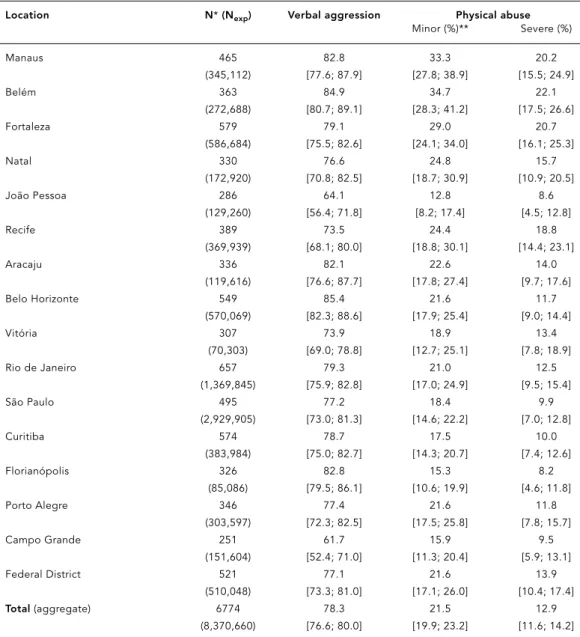
Table 1 shows the prevalence of verbal aggres-sion and the shades of physical abuse involv-ing couples in the 16 cities. In the aggregate,
slightly more than three-fourths of the women reported some psychological aggression be-tween the members of the couple during the 12 months prior to the interview. Still, this figure tended to vary by city, from 61.7% in Campo Grande to 85.6% in Belo Horizonte.
Prevalence of minor physical abuse varied from 12.8% in João Pessoa to 34.7% in Belém. Serious physical abuse was some 40% less, but with a distribution similar to that of minor abuse. Florianópolis (8.2%) and Belém (22.1%) were the two extremes. For the cities as a whole, the prevalence of minor and serious physical abuse was 21.5% and 12.9%, respectively.
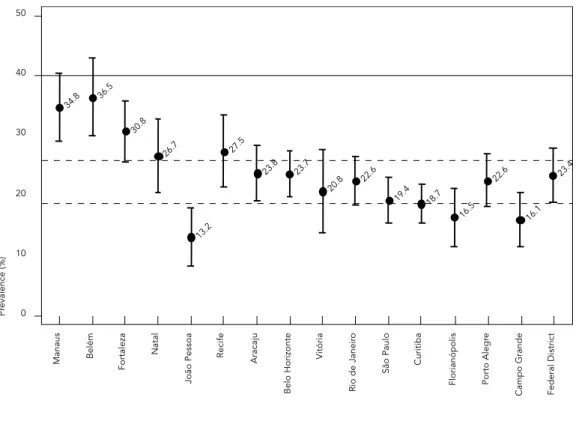
For a better perception of the phenome-non’s regional distribution, Figure 1 highlights the profile of total physical violence involving at least one member of couple for each of the cities. Notice the two dashed lines around the 20% and 25% prevalence cutoffs. Even consid-ering the confidence intervals (whiskers in Fig-ure 1), there is a perceptible gradient. Except for João Pessoa, it is possible to distinguish the North and Northeast as having higher preva-lence rates than the other regions and also to identify two other cities with levels clearly be-low the others (Campo Grande and Florianó-polis). All the State capitals in the Southeast have intermediate prevalence rates.
ob-servation is corroborated by a formal aggregate analysis (the set of 16 cities), which shows a clearly significant difference (p = 0.000) be-tween the prevalence of 28.2% (95%CI: 25.68; 31.0) in younger women and 21.2% (95%CI: 19.3; 23.1) in those over 25.
Table 2 also shows a comparison by school-ing of the woman (interviewee). Prevalence rates
for total physical violence in couples where the woman has an incomplete primary education are consistently higher than in the other group. With rare exceptions, the magnitudes reach thresholds that are consistent with the aggre-gate for the North and Northeast. Placed in perspective, the prevalence of intimate partner violence increases from 18.9% (95%CI: 17.3;
Table 1
Profile of intimate partner violence: verbal aggression (psychological) and minor and severe physical abuse in couples, in 15 State capitals and the Federal District, Brazil, 2002/2003.
Location N*(Nexp) Verbal aggression Physical abuse
Minor (%)** Severe (%)
Manaus 465 82.8 33.3 20.2
(345,112) [77.6; 87.9] [27.8; 38.9] [15.5; 24.9]
Belém 363 84.9 34.7 22.1
(272,688) [80.7; 89.1] [28.3; 41.2] [17.5; 26.6]
Fortaleza 579 79.1 29.0 20.7
(586,684) [75.5; 82.6] [24.1; 34.0] [16.1; 25.3]
Natal 330 76.6 24.8 15.7
(172,920) [70.8; 82.5] [18.7; 30.9] [10.9; 20.5]
João Pessoa 286 64.1 12.8 8.6
(129,260) [56.4; 71.8] [8.2; 17.4] [4.5; 12.8]
Recife 389 73.5 24.4 18.8
(369,939) [68.1; 80.0] [18.8; 30.1] [14.4; 23.1]
Aracaju 336 82.1 22.6 14.0
(119,616) [76.6; 87.7] [17.8; 27.4] [9.7; 17.6]
Belo Horizonte 549 85.4 21.6 11.7
(570,069) [82.3; 88.6] [17.9; 25.4] [9.0; 14.4]
Vitória 307 73.9 18.9 13.4
(70,303) [69.0; 78.8] [12.7; 25.1] [7.8; 18.9]
Rio de Janeiro 657 79.3 21.0 12.5
(1,369,845) [75.9; 82.8] [17.0; 24.9] [9.5; 15.4]
São Paulo 495 77.2 18.4 9.9
(2,929,905) [73.0; 81.3] [14.6; 22.2] [7.0; 12.8]
Curitiba 574 78.7 17.5 10.0
(383,984) [75.0; 82.7] [14.3; 20.7] [7.4; 12.6]
Florianópolis 326 82.8 15.3 8.2
(85,086) [79.5; 86.1] [10.6; 19.9] [4.6; 11.8]
Porto Alegre 346 77.4 21.6 11.8
(303,597) [72.3; 82.5] [17.5; 25.8] [7.8; 15.7]
Campo Grande 251 61.7 15.9 9.5
(151,604) [52.4; 71.0] [11.3; 20.4] [5.9; 13.1]
Federal District 521 77.1 21.6 13.9
(510,048) [73.3; 81.0] [17.1; 26.0] [10.4; 17.4]
Total(aggregate) 6774 78.3 21.5 12.9
(8,370,660) [76.6; 80.0] [19.9; 23.2] [11.6; 14.2]
* Values refer to women respondents 15 to 69 years of age with partners. Totals (by city and aggregate) actually used to calculate proportions varied slightly according to the amount of missing data for each variable, i.e., 1% for verbal aggression and 0.2% and 0.18% for the two forms of physical abuse, respectively. In parentheses is the female population from 15 to 69 years of age with partners (estimated after expansion, subtracting the equivalent fraction of missing data).
20.7) in couples where the woman has a com-plete primary education to 31% (95%CI: 28.0; 34.2) for those with less schooling. As in rela-tion to age, this difference is statistically signif-icant (p = 0.000).
Figure 2 shows the city-by-city profile of any physical abuse in the previous 12 months, fo-cusing now on the perpetrator. There is regular evidence that the woman tends to perpetrate at least one violent act more frequently than the respective male partner. In the 16 cities as a whole, the prevalence rates for total physical abuse by female and male perpetrators in the couple are 19.7% (95%CI: 18.2; 21.2) and 14.6% (95%CI: 13.3; 15.9), respectively. The contrast is similar when focusing on minor physical abuse, but is about one-half for serious physical abuse: 10.4% (95%CI: 9.3; 11.5) and 7.2% (95%CI: 6.3; 8.1). Discerning between the uni- and bi-direc-tional situations, although in half of the situa-tions the acts are reciprocal, there is also a pre-ponderance of women perpetrators when the (total) physical abuse is one-way. Expressed in numbers, the perpetration exclusively concerns women and men in 8.3% (95%CI: 7.4; 9.3) and
3.2% (95%CI: 2.6; 3.8) of the couples, respec-tively, and in 11.2% (95%CI: 10.1; 12.3) the abus-es are committed by both partners.
Although women commit physical abuse more frequently than their male partners, the picture changes when focusing (according to severity) on the mean number of acts perpe-trated among those who are actually perpetra-tors. As shown in Table 3, except for Vitória, the mean score of the acts always tends to be high-er in men when dealing with shigh-erious events. The overall mean for the 16 cities is 1.70 (95%CI: 1.63; 1.78) acts per woman, but increases to 2.31 (95%CI: 2.12; 2.50) per male perpetrator. A formal statistical analysis reinforces this con-trast. Regression of the physical abuse score by gender and city produces a p-value of 0.000 by gender in the case of serious physical abuse, but only 0.357 for minor physical abuse.
Discussion
Given the disparity between the methods used in nationwide surveys and the population types
Figure 1
Profile of all physical abuse (minor + severe) in couples in 15 State capitals and the Federal District, Brazil, 2002/2003.
34.8 36.5
30.8
26.7
13.2 27.5
23.8 23.7
20.8 22.6
19.4 18.7 16.5
22.6
16.1 23.4
0 10 20 30 40 50
Manaus Bel
é
m
Fortaleza
Natal
Jo
ã
o Pessoa
Recife Aracaju
Belo Horizonte
Vi
tó
ria
Rio de Janeir
o
S
ã
o Paulo Curitiba
Florian
ó
polis
Porto Alegr
e
Campo Grande Federal District
Pr
they encompass, any comparison of this study’s results with those of surveys conducted in oth-er countries should be done with caution. Even so, it is worthwhile to revisit the extensive liter-ature published by Heise et al. 28,29. Adding to two more recent references 30,31and focusing
primarily on the estimates from studies con-ducted in the last 15 years on the physical abuse occurring in the 12 months prior to the surveys, the prevalence rates for the 16 cities studied as a whole in the IDCRMRANT are at an intermediate level. On the one hand, the prevalence of total physical violence
perpetrat-ed by men against women (14.6%) is far higher than the mean of the estimates reported in North America (2%); moderately higher than those from Europe (8%) and Sub-Saharan Africa (9%); and, excluding the extremely high level of violence observed in Korea (38%), close to the levels found in Asia and Oceania (12%). On the other hand, in the aggregate, the Brazil-ian rate is well below the mean quoted for North Africa and the Middle East (33%). Less strikingly, the joint Brazilian rate is also lower than the Latin American average of 21%, al-though similar to the rates reported for Mexico
Table 2
Profile of intimate partner violence: prevalence (in %)* of total physical abuse (minor + severe) in the couple, stratified by woman’s age and schooling (primary), in 15 State capitals and the Federal District, Brazil, 2002/2003.
Location Age Basic schooling
< 25 years ≥25 years p-value Incomplete Complete p-value (≤7 years) (> 7 years)
Manaus 46.0 30.0 0.0006 39.7 31.2 0.0802
[39.3; 52.7] [23.1; 36.9] [30.9; 48.4] [24.9; 37.4]
Belém 39.5 35.0 0.3895 42.0 33.2 0.0963
[31.2; 47.8] [27.1; 42.9] [32.0; 52.0] [26.2; 40.1]
Fortaleza 36.0 28.8 0.0273 40.5 24.1 0.0000 [29.7; 42.2] [23.1; 34.5] [33.8; 47.2] [18.5; 29.6]
Natal 36.8 22.6 0.0119 28.1 26.6 0.7433
[26.1; 47.4] [15.8; 29.5] [19.6; 36.7] [19.3; 33.8]
João Pessoa 16.8 12.0 0.1919 18.9 8.7 0.0115 [9.1; 24.4] [6.7; 17.2] [11.4; 26.4] [3.3; 14.1]
Recife 32.4 25.7 0.1216 44.0 16.1 0.0000
[22.5; 42.3] [19.9; 31.5] [36.8; 51.3] [10.4; 21.8]
Aracaju 27.1 22.6 0.3619 32.4 18.0 0.0010
[17.5; 36.7] [19.9; 27.2] [24.7; 40.1] [13.7; 22.4]
Belo Horizonte 32.4 20.7 0.0024 33.3 18.4 0.0002 [25.1; 39.8] [16.6; 24.9] [26.1; 40.5] [14.3; 22.5]
Vitória 27.2 19.0 0.1401 41.8 13.9 0.0000
[16.4; 38.0] [11.8; 26.3] [31.1; 52.6] [8.8; 19.0]
Rio de Janeiro 25.5 21.7 0.2933 31.7 19.1 0.0004 [19.2; 31.8] [17.3; 26.2] [24.2; 39.2] [15.0; 23.2]
São Paulo 22.0 18.6 0.3785 27.0 15.6 0.0041 [15.1; 28.9] [14.3; 22.9] [19.6; 34.5] [11.7; 19.5]
Curitiba 26.9 16.2 0.0057 24.6 16.9 0.0572
[20.4; 33.3] [12.3; 20.2] [18.0; 31.2] [12.8; 21.0]
Florianópolis 23.6 14.4 0.0079 23.2 14.0 0.0724 [15.3; 31.8] [9.8; 19.0] [12.8; 33.6] [9.1; 18.9]
Porto Alegre 29.3 20.1 0.0346 31.2 19.8 0.0474 [22.5; 36.1] [14.8; 25.5] [20.2; 42.2] [15.3; 24.4]
Campo Grande 26.5 12.6 0.0038 19.2 13.2 0.2549 [17.0; 36.1] [7.8; 17.4] [10.1; 28.4] [7.9; 18.4]
Federal District 29.1 20.8 0.0063 24.7 23.2 0.7049 [24.4; 33.6] [15.4; 26.2] [17.3; 32.1] [18.3; 28.2]
(15%) and Uruguay (10%). An analogous com-parative profile applies to the 6.9% estimate found in IDCRMRANT with regard to serious physical violence perpetrated by men against women.
Focusing now on the perspective of the couple as a whole, one is impressed by the high frequency of intimate violence in the relation-ship. No less than three-fourths of the women reported at least one act of psychological ag-gression in the 12 months prior to the survey. Even more striking is that approximately one in five women reported an episode of physical force during the same period, with one in every seven couples involving severe acts, such as punching, beating, choking, or even brandish-ing or actually usbrandish-ing a knife or firearm.
It is also possible to recognize regional sub-tleties. Even though the demarcation of ranges proposed here is admittedly somewhat arbi-trary, it is possible to perceive (Figure 1) that as a whole the levels are intermediate in the South and Southeast, yet much higher in the North and Northeast. For example, in Manaus and
Belém (North), nearly one in four couples re-ported having experienced some act of physi-cal violence during the reference period, a sce-nario which (as discussed above) is more simi-lar to that of North Africa and the Middle East. At the other extreme, the comparatively low lev-els found in three cities (Florianópolis, Campo Grande, and João Pessoa) are surprising. The latter, capital of the Northeast State of Paraíba, is particularly noteworthy, since it is located in the region of the country with the highest rates, yet has the lowest prevalence of all 16 cities studied. The disparities identified in the profile above clearly require follow-up and more in-depth study. Several important facets from the ecological model emphasized in the WHO re-port merit further detail 1. At the individual
lev-el, it would be interesting to explore the previ-ous history of aggression in the families and the use of psychoactive substances like alcohol and illicit drugs. At the community level, it would be relevant to know the possible differ-ences in the contexts in which social relations take place, for example focusing on the
resi-Figure 2
Physical abuse (minor + severe) according to gender of perpetrator (female/male) in 15 State capitals and the Federal District, Brazil, 2002/2003.
0 10 20 30 40
Manaus Bel
é
m
Fortaleza
Natal
Jo
ã
o Pessoa
Recife Aracaju
Belo Horizonte
Vi
tó
ria
Rio de Janeir
o
S
ã
o Paulo Curitiba
Florian
ó
polis
Porto Alegr
e
Campo Grande Federal District
Pr
evalence (%)
32.2 32.1
25.8
21.3
11.2
23.2
20.0
21.6
16.3
18.7 17.0
15.0
14.0
18.6
14.6
20.3 22.2
25.8
21.9
17.4
9.5 18.9
16.8
13.3 13.7 13 .9
12.2 12 .7
11.0 11
.5 11.8 13.0
dential mobility patterns, the geographic ho-mogeneity or heterogeneity in the origins of community members, and rates of unemploy-ment and violence in the community. At the macro-structural level, factors promoting or inhibiting violence would be relevant, such as those linked to the cultural norms governing gender relations, as well as iniquities in welfare structures related to public policies in health, education, and work 1.
As for the frequencies of intimate partner violence in certain population subgroups, the findings are consistent with higher levels of
in-timate partner violence in low-income couples and those including younger women, a profile similar to that found in other studies 1,18,32,33. In the 16 cities as a whole, the prevalence rates reach 28.2% and 31% in these strata, magni-tudes that again are in keeping with the rates in North Africa and the Middle East. Even in the cities in the South, Southeast, and Central West of Brazil, the prevalence rates in these subgroups reach levels as high as in the more extreme regions as a whole.
Stratifying the data by gender can be evalu-ated jointly through Figure 2 and Table 3. The
Table 3
Mean score* for minor and severe physical abuse according to perpetrator in 15 State capitals and the Federal District, 2002/2003.
Location Minor physical abuse Severe physical abuse Male Female p-value Male Female p-value
Manaus 1.60 1.63 0.7215 1.97 1.85 0.5769
[1.43; 1.76] [1.50; 1.75] [1.57; 2.37] [1.59; 2.11]
Belém 1.59 1.67 0.4651 1.91 1.81 0.5949
[1.42; 1.76] [1.53; 1.81] [1.64; 2.17] [1.58; 2.05]
Fortaleza 1.79 1.66 0.1680 2.25 1.80 0.0274 [1.63; 1.95] [1.53; 1.79] [1.91; 2.59] [1.61; 1.98]
Natal 1.64 1.64 0.9945 2.40 1.54 0.0081
[1.41; 1.86] [1.45; 1.82] [1.82; 2.97] [1.25; 1.83]
João Pessoa 2.02 1.72 0.2224 2.31 1.86 0.3510 [1.73; 2.31] [1.46; 1.97] [1.66; 2.95] [1.41; 2.32]
Recife 1.75 2.00 0.0451 2.12 1.90 0.4090
[1.55; 1.95] [1.80; 2.19] [1.74; 2.51] [1.60; 2.20]
Aracaju 1.73 1.63 0.4071 2.22 1.71 0.1051
[1.55; 1.90] [1.41; 1.85] [1.76; 2.67] [1.37; 2.05]
Belo Horizonte 1.76 1.64 0.2168 2.35 1.63 0.0165 [1.61; 1.90] [1.51; 1.77] [1.83; 2.86] [1.40; 1.86]
Vitória 1.51 1.71 0.1322 1.50 1.61 0.7020
[1.30; 1.72] [1.55; 1.86] [1.09; 1.90] [1.30; 1.91]
Rio de Janeiro 1.70 1.73 0.7159 2.19 1.81 0.0907 [1.53; 1.86] [1.59; 1.87] [1.79; 2.58] [1.53; 2.09]
São Paulo 1.73 1.57 0.1793 2.71 1.51 0.0007 [1.53; 1.93] [1.43; 1.71] [2.15; 3.26] [1.23; 1.79]
Curitiba 1.61 1.68 0.6388 2.28 1.49 0.0134
[1.40; 1.82] [1.51; 1.84] [1.76; 2.79] [1.14; 1.83]
Florianópolis 1.51 1.47 0.8104 1.76 1.55 0.4641 [1.25; 1.77] [1.25; 1.70] [1.26; 2.26] [1.12; 1.97]
Porto Alegre 1.68 1.64 0.8125 1.90 1.68 0.5342 [1.42; 1.95] [1.43; 1.85] [1.26; 2.53] [1.27; 2.09]
Campo Grande 1.73 1.50 0.1521 2.07 1.54 0.2308 [1.44; 2.01] [1.28; 1.71] [1.28; 2.85] [1.13; 1.95]
Federal District 1.59 1.76 0.2169 2.14 1.76 0.1545 [1.40; 1.78] [1.58; 1.94] [1.67; 2.61] [1.52; 1.99]
two clearly show that, as a whole, more women commit at least one act of physical violence than their respective partners, but the male partners who are perpetrators consistently commit more such acts. Among the males who had perpetrated some serious act in the previ-ous 12 months, the mean number of acts was some one-third greater than for the respective women. This evidence is fully consistent with the literature using a similar approach. Various studies have shown women as more frequent perpetrators, while women are at a clear disad-vantage in situations in which they are the vic-tims 34,35,36. For example, a study in Brazil shows a threefold risk of a victimized woman suffer-ing blatantly harmful consequences, such as requiring emergency care for injuries inflicted by the male perpetrator 18.
The current finding that women perpetrate as many or more violent acts than their part-ners corroborates the impression of many re-searchers in the field, that population-based surveys are preferentially prone to capture moderate forms of violence, which are rather common in daily relations between members of the couple, where women participate active-ly in the processes, often reacting to constant subliminal psychological aggression by the male partner 37,38,39. Meanwhile, the evidence of more accumulated acts perpetrated by the male partner, in keeping with findings from other studies that the consequences are worse for women, appears to show that surveys are somehow capable of capturing a second pat-tern of intimate partner violence postulated by the experts. According to this second pattern, there is an escalation of violence characterized by multiple forms of threats and abuse by men against women, often culminating in heinous scenarios requiring immediate reporting and drastic legal action 39,40.
At any rate, one cannot hastily conclude that violence involving intimate partners is quantitatively and qualitatively symmetrical in relation to gender. Power structures and domi-nation must be contemplated and discussed, since the potential for hurting and severely in-juring the other is not reciprocal. The second point is that there are different scenarios for clashes. Some are alarming, calling the atten-tion of the media and the general public and having been traditionally portrayed as “spouse abuse” or “wife battering”. However, others are much subtler and can easily be fit into the “normalcy” of relational cohabitation. Although severely victimized women require uncondi-tional support and such cases demand firm and immediate action, measures should also
be contemplated in the sphere of daily routine procedures in the health sector, allowing to deal with the more common and less severe sit-uations, but which nevertheless are not harm-less in terms of proper functioning of families and the well-being of their members 3,41,42,43. The application of models to suspect and de-tect cases; enhancement of reporting systems; development and implementation of follow-up strategies at the local and regional levels; and the improvement and integration of referral networks are some examples of such actions.
A third aspect is that violence must be un-derstood as an interactive event between mem-bers of a group, often extending beyond the couple to other family members. Likewise, inti-mate partner violence should not be viewed as committed exclusive by men against women, but can occur inversely, principally with “every-day” acts. Beyond the macro-structural deter-minants and explanatory factors, which are certainly important in the genesis and perpet-uation of gender conflicts and violence, more attention should be focused on situational is-sues generating processes which (as discussed above) can be performed by both men and women. It is important to recognize the pat-terns by which conflictive relations usually evolve, with special emphasis on the “triggers” that tend to spark clashes. The search to under-stand this dynamic can aid health workers in the early identification and handling of these potentially conflictive relations, prioritizing a family approach as opposed to those based on-ly on exclusive care for the purported victim.
The current findings should be viewed in light of some methodological considerations. In addition to the issues already raised in the section on methods concerning potential prob-lems arising from measurement by proxy or due to the fact that interviews are held in the household, another methodological aspect meriting reflection is an inherent limitation of the measurement instrument itself. Even hav-ing received a positive recommendation for use in Brazil 22and having been chosen for the present survey for reasons of logistic and oper-ational efficiency, the CTS 21does not allow ex-plicitly informing on the context and conse-quences of the recorded events, nor does it ap-proach other important forms of intimate part-ner violence, such as coercion and sexual abuse. In this sense, future surveys might uti-lize other more complete instruments, such as
the Revised Conflict Tactics Scales44,45,46.
record-ing some injuries suffered by the victim and the resulting need for use of health services. Due to its greater complexity, it offers finer dis-tinction as to the grading of violence and a more enhanced debate as to the distinction be-tween severe forms and more “routine” or “everyday” forms.
As presented in the Introduction, the recog-nition that intimate partner violence is a prob-lem in Brazil has progressively motivated pro-posals for broad and multi-sector action. Fur-thermore, the health sector has been called up-on to coordinate and integrate such actiup-on. The high prevalence of different types of intimate partner violence in Brazil and their potentially serious repercussions further emphasize this point, effectively placing the problem at the core of major public health concerns in the country. Reinforcing the privileged position of
the current study as a watershed for future comparisons, we highlight the need to contin-uously search for new evidence with a view to-wards monitoring the magnitude of violence in general and specifically that involving intimate partners. This is an important component to sustain effective intervention measures, one of the pillars in the tripod that also includes on-going improvement of the pertinent legislation and a progressive enhancement of the integrat-ed networks for action by the legal and health sectors. As indicated by the WHO guidelines 1, now fully supported by the Brazilian Ministry of Health 11,47, it is necessary to prioritize and invest in the evaluation component, a central activity to maintain knowledge up-to-date in relation to a phenomenon which until recently remained concealed and which, as increasingly appears, is neither rare, trivial, or ephemeral.
Acknowledgments
The Household Survey on Risk Behaviors and Report-ed Morbidity from Non-Communicable Diseases (ID-CRMRANT) was financed by the Health Surveillance Secretariat (Secretaria de Vigilância em Saúde – SVS) of the Brazilian Ministry of Health, with counterpart funds from the National Cancer Institute (INCA). The Rio Grande do Norte, Santa Catarina, and Sergipe State Health Departments and the Curitiba Munici-pal Health Department financed the data collection in their respective capital cities. We wish to thank the Fogarty International Center of the National Insti-tutes of Health (USA) for supporting the research through grant no. R01-HL-73699. M. E. Reichenheim and E. R. Souza are supported by the Brazilian Na-tional Research Council (CNPq), grants PQ-300234/ 94-5 and PQ-304939/2003-0, respectively.
Contributors
M. E. Reichenheim participated in the data analysis and as lead author in the elaboration/preparation of the article. C. L. Moraes, M. H. Hasselmann, and E. R. Souza participated in the elaboration/preparation of the article as co-authors. A. Szklo participated in the data processing and analysis and in the elabora-tion/preparation of the article as co-author. J. A. Lozana participated in the consultancy for elabora-tion/preparation of the article’s methods section. V. Figueiredo participated as the general executive co-ordinator of the IDCRMRANT Project and in the elab-oration/preparation of the article as co-author. Resumo
Este artigo apresenta a prevalência de violência entre parceiros íntimos em 15 capitais brasileiras e no Dis-trito Federal. Um inquérito de base-populacional em múltiplos estágios foi realizado em 2002/2003, envol-vendo 6.760 mulheres (respondentes) de 15 a 69 anos. Usando o instrumento Conflict Tactics Scales – For-mulário R, a prevalência global de agressão psicológi-ca, abuso físico “menor” e grave no casal foi de 78,3%, 21,5% e 12,9%, respectivamente. Prevalências varia-ram distintamente entre as cidades, o abuso físico tal indo, por exemplo, de 13,2% a 34,8%. Como um to-do, as prevalências foram mais altas nas cidades do Norte/Nordeste do que nas do Sudeste/Sul/Centro-oeste. Também, todos os tipos de violência entre par-ceiros íntimos foram mais freqüentes entre casais for-mados por mulheres jovens (< 25 anos) e com menos escolaridade (< 8 anos). Desagregando por gênero, ain-da que mulheres tendessem a perpetrar pelo menos um item de abuso físico mais amiúde, os escores foram consistentemente mais altos entre parceiros positivos. Os resultados são comparados à literatura externa. Os diferenciais regionais, demográficos e de gênero são discutidos à luz da crescente responsabilidade do setor saúde em relação à violência entre parceiros íntimos.
References
1. Krug EG, Dahlberg LL, Mercy JA, Zwi AB, Lozano R. World report on violence and health. Geneva: World Health Organization; 2002.
2. Heise L, Ellsberg M, Gottmoeller M. A global overview of gender-based violence. Int J Gynaecol Obstet 2002; 78 Suppl 1:S5-14.
3. Campbell J. Health consequences of intimate partner violence. Lancet 2002; 359:1331-6. 4. Jasinski JL, Williams LM. Partner violence: a
com-prehensive review of 20 years of research. Lon-don: Sage Publications; 1998.
5. Gelles RJ. Intimate violence in families. London: Sage Publications; 1997.
6. Ministério da Saúde. Política nacional de redução da morbimortalidade por acidentes e violências. Brasília: Ministério da Saúde; 2001.
7. Ministério da Saúde. Plano nacional de preven-ção da violência. Brasília: Secretaria de Atenpreven-ção à Saúde, Ministério da Saúde; 2004.
8. Rodrigues A, Mousse S, Mendes T. Marcadas pelo medo. O Globo 2003, 29 jun; Jornal da Família, p. 5. 9. Soares LE, Soares BM, Carneiro LP. Violência con-tra a mulher: as DEAMs e os pactos domésticos. In: Soares LE, organizador. Violência e política no Rio de Janeiro. Rio de Janeiro: Instituto de Estu-dos da Religião/Relume-Dumará; 1996. p. 65-106. 10. Deslandes SF, Gomes R, Furtado MC, Silva P. Ca-racterização dos casos de violência doméstica contra a mulher atendidos em dois hospitais pú-blicos do Rio de Janeiro. Cad Saúde Pública 2000; 16:129-37.
11. Vargas JD. Familiares ou desconhecidos? A re-lação entre os protagonistas do estupro no fluxo do Sistema de Justiça Criminal. Rev Bras Ciênc Soc 1999; 14:63-82.
12. Schraiber LB, d’Oliveira AF. Violence against women and Brazilian health care policies: a pro-posal for integrated care in primary care services. Int J Gynaecol Obstet 2002; 78 Suppl 1:S21-5. 13. Moraes CL, Reichenheim ME. Domestic violence
during pregnancy in Rio de Janeiro, Brazil. Int J Gynaecol Obstet 2002; 79:269-77.
14. Menezes TC, Amorim MMR, Santos LC, Faúndes A. Violência física doméstica e gestação: resulta-dos de um inquérito no puerpério. Rev Bras Gi-necol Obstet 2003; 25:309-16.
15. Mendes CHF. Vozes do silêncio: estudo etnográfi-co sobre violência etnográfi-conjugal e fertilidade feminina [Tese de Doutorado]. Rio de Janeiro: Instituto Fer-nandes Figueira, Fundação Oswaldo Cruz; 2005. 16. Instituto Brasileiro de Geografia e Estatística.
Re-solução de conflitos domésticos e violência in-trafamiliar nos bairros da Tijuca e Maracanã. Rio de Janeiro: Instituto Brasileiro de Geografia e Es-tatística; 1999.
17. Soares BM, Gaspary MC, Ingelfritz I. Textos sele-cionados: violência intrafamiliar contra a mulher. Rio de Janeiro: Subsecretaria de Pesquisa e Ci-dadania, Secretaria de Estado de Segurança Pú-blica; 1999.
18. NOOS Instituto de Pesquisas Sistêmicas e Desen-volvimento de Redes Sociais. Publicações e ativi-dades. http://www.noos.org.br/atividade.html (accessed on 29/Nov/2005).
19. Coordenação de Prevenção e Vigilância, Instituto Nacional de Câncer. Inquérito domiciliar sobre comportamentos de risco e morbidade referida de agravos não transmissíveis. http://www.inca. gov.br/inquerito/ (accessed on 16/Jun/2005). 20. Kish L. Survey sampling. New Jersey: John Willey
& Sons; 1995.
21. Straus MA. Measuring intra-familiar conflict and violence: the conflict tactics (CT) scales. J Mar-riage Fam 1979; 41:75-88.
22. Hasselmann MH, Reichenheim ME. Adaptação transcultural da versão em português da Conflict Tactics Scales Form R(CTS-1), usada para aferir violência no casal: equivalências semântica e de mensuração. Cad Saúde Pública 2003; 19:1083-93. 23. Archer J. Assessment of the reliability of the con-flict tactics scales: a meta-analytic review. J Inter-pers Violence 1999; 14:1263-89.
24. Yllö K. Theories and methodology: investigating the problem of family violence. In: Barnett OW, Miller-Perrin CL, Perrin R, editors. Family vio-lence across the lifespan: an introduction. Lon-don: Sage Publications; 1997. p. 19-38.
25. Conselho Nacional de Ética na Pesquisa. Normas para pesquisas envolvendo seres humanos (Res. CNS 196/96 e outras). Brasília: Conselho Nacio-nal de Saúde, Ministério da Saúde; 2000. 26. Korn, EL, Graubard BI. Analysis of health surveys.
New York: John Wiley & Sons; 1999.
27. Stata Corporation. Survey data manual. Stata sta-tistical software: release 9. College Station: Stata Corporation; 2005.
28. Heise LL, Ellsberg M, Gottemoeller M. Ending vi-olence against women. Baltimore: Population In-formation Program, School of Public Health, Johns Hopkins University; 1999. (Population Re-ports, Series L, 11).
29. Heise L, Gracia-Moreno C. Violence by intimate partners. In: Krug EG, Dahlberg LL, Mercy JA, Zwi AB, Lozano R, editors. World report on violence and health. Geneva: World Health Organization; 2002. p. 87-121.
30. Jewkes R, Levin J, Penn-Kekana L. Risk factors for domestic violence: findings from a South African cross-sectional study. Soc Sci Med 2002; 55:1603-17. 31. Taft AJ, Watson LF, Lee C. Violence against young Australian women and association with repro-ductive events: a cross-sectional analysis of a na-tional population sample. Aust N Z J Public Health 2004; 28:324-9.
32. Harrykissoon SD, Rickert VI, Wiemann CM. Prevalence and patterns of intimate partner vio-lence among adolescent mothers during the postpartum period. Arch Pediatr Adolesc Med 2002; 156:325-30.
33. Rickert VI, Wiemann CM, Harrykissoon SD, Beren-son AB. The relationship among demographics, reproductive characteristics, and intimate partner violence. Am J Obstet Gynecol 2002; 187:1002-7. 34. Morse BJ. Beyond the Conflict Tactics Scale:
as-sessing gender differences in partner violence. Vi-olence Vic 1995; 10:251-72.
national survey of family and households. Gend Soc 1990; 4:56-67.
36. Straus MA, Gelles RJ. Physical violence in Ameri-can families: risk factors and adaptations to vio-lence in 8145 families. New Brunswick: Transac-tion Publisher; 1995.
37. Saunders DG. When battered women use vio-lence: husband-abuse or self-defense? Violence Vic 1986; 1:47-60.
38. Marshall LL. Effects of men’s subtle and overt psychological abuse on low-income women. Vio-lence Vict 1999; 14:69-88.
39. Johnson MP, Ferraro KJ. Research on domestic vi-olence in the 1990s: making distinctions. J Mar-riage Fam 2000; 62:948-63.
40. Kantor GK, Jasinski JL. Dynamics and risk factors in partner violence. In: Jasinski JL, Williams LM, editors. Partner violence: a comprehensive re-view of 20 years of research. Thousand Oaks: Sage Publications; 1998. p. 1-43.
41. Campbell J, Lewandowski LA. Mental and physi-cal health effects of intimate partner violence on woman and children. Psychiatr Clin North Am 1997; 20:353-74.
42. Emery RE, Laumann-Billings L. An overview of the nature, causes, and consequences of abusive family relationships: toward differentiating mal-treatment and violence. Am Psychol 1998; 53:121-35.
43. Reichenheim ME, Hasselmann MH, Moraes CL. Conseqüências da violência familiar na saúde da criança e do adolescente: contribuições para a elaboração de propostas de ação. Ciênc Saúde Coletiva 1999; 4:109-21.
44. Straus MA, Hamby SL, Boney-McCoy S, Sugarman DB. The revised Conflict Tactics Scales (CTS2): de-velopment and preliminary psychometric data. J Fam Issues 1996; 17:283-316.
45. Moraes CL, Hasselmann MH, Reichenheim ME. Adaptação transcultural para o português do ins-trumento “Revised Conflict Tactics Scales (CTS2)” utilizado para identificar a violência entre casais. Cad Saúde Pública 2002; 18:163-75.
46. Moraes CL, Reichenheim ME. Cross-cultural mea-surement equivalence of the Revised Conflict Tactics Scales (CTS2) Portuguese version used to identify violence within couples. Cad Saúde Pú-blica 2002; 18:783-96.
47. Ministério da Saúde. Direitos humanos e violên-cia intrafamiliar. Informações e orientações para agentes comunitários de saúde. Brasília: Minis-tério da Saúde; 2001.
Submitted on 01/Aug/2005