RESEARCH
Ivania Vera
I, Roselma Lucchese
I, Adélia Yaeko Kyosen Nakatani
I, Valeria Pagotto
I,
Selma Rodrigues Alves Montefusco
I, Geraldo Sadoyama
III Universidade Federal de Goiás, School of Nursing, Nursing Graduate Program. Goiânia-GO, Brazil.
II Universidade Federal de Goiás, School of Biology, Departament of Biological Sciences. Catalão-GO, Brazil.
Submitted: 04-11-2014 Approved: 30-11-2014
ABSTRACT
Objective: the aim of this study was to identify factors associated with family functionality of non-institutionalized long-lived subjects, who were residents in Goiânia (GO), Brazil. Method: this was a population-based epidemiological study with cross-sectional outline. Evaluation scales of the functional and cognitive capacities were used. Family dynamics was measured using the Adaptation, Partnership, Growth, Affection, and Resolve (APGAR) instrument by making home interviews with 131 long-lived individuals.
Results: there was prevalence of the female gender, average of age of 83.87 years old, widowhood condition, and residence in a big family, primary schooling, and self-perception of regular health. A great amount showed independence for self-care and partial dependence for daily life instrumental activities. Family functionality prevailed with score average of 9.06 points. Conclusion: in conclusion, family functionality in long-lived subjects is associated with self-perception of poor/bad health, osteoporosis, and fall. Results allowed characterizing long-lived subjects’ family functionality with the aim of valuing and prioritizing family as a caregiver.
Key words: Nursing; Aged, 80 Years or More; Family Relationships.
Family functionality in oldest old household
residents
INTRODUCTION
The worldwide phenomenon of aging reveals that oldest old, identified as people aged greater than or equal to 80 years old are advancing rapidly in numbers, especially in develop-ing countries(1). The 14 million oldest old identified in the 20th century will correspond to, in 2050, more than 400 million worldwide. The highest prevalence is related to gender, for each group of 100 oldest old women, there are 61 men of the same age group(1).
In Goiânia (GO), the oldest old have already reached 7.9% of the elderly population(2). The heterogeneity of the elderly population is directly influenced by the decline in mortality in advanced ages, gender, marital status, geographic region and people’s accessibility to social and economic conditions. The longevity of humanity should be seen as a triumph of develop-ment and one of the greatest achievedevelop-ments of humanity(3-4).
Endless opportunities about this triumph of development are related to the adoption of new policies, strategies and laws on the development due to the different characteristics, such as age, gender, ethnicity, education, income and health(1). Among the strategies, health promotion and healthy behav-iours at all ages are needed to reduce, prevent and delay the onset of chronic diseases, through less exposure to risk behav-iours throughout life(4).
The challenges are related to the recognition that the aging of populations is a worldwide reality, and therefore, transfor-mations are necessary in a society where these people are inserted, such as income guarantees, access to quality health-care services and environments that stimulate and facilitate the coexistence of people with functional disabilities, that is, their home(1), above all, meeting this stratum of the population is essential in relation to demographic conditions and health, functional capacity and Family Functionality (FF).
This silent evolution in intergenerational family demo-graphics has provided the conviviality of the elderly with a greater number of generations and a lesser amount of relatives by generation. Such conviviality is an opportunity for struc-tural transformations inside the family context, with contribu-tions and assignments linked to different actors.
The forms of family grouping have been modifying since 1960, being sculpted by social features (individualism and immediate consumption of material objects, among others), changing intra-family relations(5-6).
The investigation of family dynamics explores and visual-izes if there is harmony or disharmony in family relationships, from the perspective of the elderly in old age, in relation to care received from his/her family, as a stressor or protective factor(7). Subjective aspects, such as adaptation to the new alities facing stressful situations, or sharing decisions and re-sponsibilities in order to maintain its members protected and fed, supporting new ideas and directions, interacting emo-tionally in the family context and having shared time, can be evaluated before the family intervention.
A screening test is the Adaptation, Partnership, Growth, Affection and Resolve (APGAR) of family, through five ques-tions, the test analyses the following domains: adaptation,
partnership, growth, affection and resolve(7-8). High scores, re-sulting from the sum of the domains, reveal the family’s ability to adapt to new situations and manage conflicts, with a view to FF, while low scores indicate an environment with low capac-ity to adapt to the new situation, requiring early intervention(9). Thereby, in the context of health care of people with 80 years or more, the APGAR instrument can be a strong ally in family relations evaluation and detection of risk factors that deserve intervention. Given the above, the objective of this study was to identify the factors associated with FF of the non-institutionalized oldest old residents in Goiânia (GO), Brazil.
METHODS
Population-based epidemiological study with cross-sec-tional design through household interviews with elders, held in a Midwestern Brazilian capital, which had more than one million inhabitants. Of these, 7.9% were oldest old.
The study population consists of elderly living in urban ar-eas from probabilistic sample array, from the database of the Network for Health Surveillance of the Elderly (REVISI). The sample calculation considered the following parameters: ex-pected frequency of 30% for all the objectives of the research, a significance level of 5%, absolute precision of 5.0%, and design effect of 1.8. The representative sample was composed by 934 elderly.
The process of sampling was probabilistic by conglomer-ates, in multiple stages. In the first stage 56 census sectors were drafted, among 912 sectors of the urban municipality. For the second stage blocks, corners and domiciles to be vis-ited were also drafted.
The sample met the following eligibility criteria: (1) age of 80 years or more; (2) residence in the Goiania urban area; (3) resident of the visited domicile; and (4) have answered all five questions about Family APGAR. Elderly who were drafted but did not reside in the family home were excluded, in addition to the questionnaires answered by caregivers and/or family members, the total number of excluded individuals was 131.
After the pilot test, we began data collection by trained in-terviewers, in the period of December 2009 to April 2010. Authorization was requested of the elderly by means of con-sent form (CF) and, in a private space, the semi-structured questionnaire was applied, it contained socioeconomic and demographic features, information about the caregiver, health condition and self-perceived pain, falls, hospitalization in the past year and access to health services. The assessment of functional capacity was measured by scales of basic activities of daily living (BADL), Instrumental Activities of daily living (IADL) and cognitive assessment via the Mini Mental State Examination (MMSE). The family dynamics, from the perspec-tive of the elderly, was measured by Family APGAR index.
dependence and 27 refers to independence in the perfor-mance of these activities(11).
The MMSE was applied to verify the cognitive function, having been chosen to be used in populational studies in the various practical scenarios(12). As cut-off points, we used the years of education: 20 points for illiterate; 25 points to 1-4 years of study; 26 points for 5-8 years; 28 points to 9-11 years; and 29 points for more than 11 years. This test does not replace the neuropsychological assessment in subjects with low scores, requiring a verticalized investigation of functional loss(12-13).
In order to evaluate the family dynamics, we applied the APGAR Family(8). The acronym APGAR derives from words Adaptation, Partnership, Growth, Affection and Resolve. The five domains are assigned values of zero, 1 and 2 points. Zero for the option “hardly ever”, 1 for “some of the time” and 2 “almost always”. The total sum of the scores oscillates on a scale from zero to ten points, in which: from zero to 4, indi-cates severely dysfunctional family (SDF); from 5 to 6, moder-ately dysfunctional family (MDF); and from 7 to 10, Functional Family (FF)(8,13). In other words, the FF is expressed by ≥ 7 scores and Family Dysfunction (DF) by <7 points scores(8,13).
In this sense, the exposure variables were socioeconomic and demographic characteristics, self-reported health condi-tions, functional and cognitive capacity. The FF was the out-come variable.
Data were entered in the Excel software for Windows® 2003-2007 after double check. Data analysis was conducted by measures of absolute and relative frequency, mean and standard deviation in the IBM software Statistical Package for the Social Sciences (SPSS) for Windows® version 20.0. For univariate association analysis between the FF of oldest old and exposure variables, Chi-square or Fischer tests were used, with significance level of 5%. The measurement of effect used was the prevalence ratio (PR). Multiple logistic regression was
applied to identify the factors associated with the FF through the construction of the model with the predictor variables, which obtained p-value ≤ 0.20 in univariate analysis.
The variables entered into the multivariate analysis were scaled in two blocks, Block 1 socioeconomic demographic − (marital status, children, educational level, residents at house-hold and type of residence); and Block 2 – self-perceived health conditions (self-perception of health, falls and demand for health services).
The ethical care that conduct research involving humans have been secured, according to Resolution 196/96 of the Na-tional Health Council, and the research was approved by the Research Ethics Committee of Universidade Federal de Goiás (UFG) under the protocol 050/2009.
RESULTS
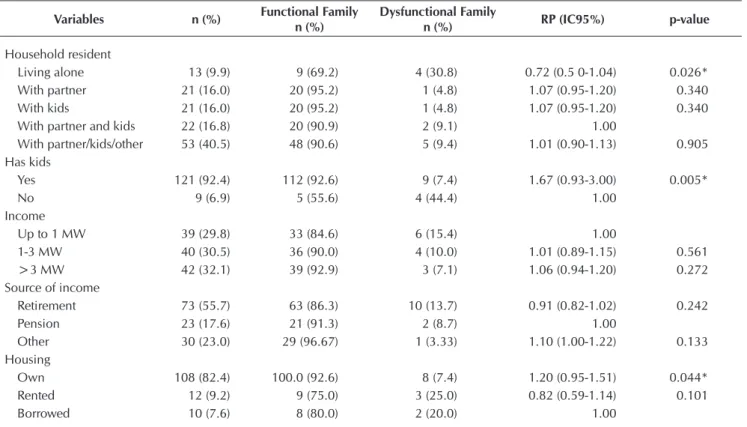
Among the 934 participants, 173 (18.5%) were oldest old. Of these, 131 (75.72%) responded the five questions of the Fam-ily APGAR. Table 1 shows demographic characterization and present an average age of 83.87 years, maximum of 94 years old (±3.389), prevalence of females (61.8%), widows (50.4%), with primary education (59.5%), living with a big family (40.5%), with children (92.4%), in their own home (82.4%) with income (96.2%) from retirement (55.7%) and by age (37.4%).
Among those interviewed, these are the items that prevailed: regular health self-perception (45.0%), complaint of pain (58.8%), hypertension (60.8%), visual impairment (90.8%), falls (41.2%) and seek for health service (70.2%) (Table 2).
Regarding functional capacity, more than half of the old-est old reported they needed assistance from someone for any activity (52.7%), however, a large part also revealed in-dependence for BADL (93.1%) and partial in-dependence IADL (81.7%). When assessing cognitive function, the mean MMSE score was 23.5 points (± 3.242). (Table 3).
Table 1 - Stratification of elderly according to socioeconomic and demographic conditions and factors associated with func-tional family residing in in the city of Goiânia (GO), 2010 (n=131)
Variables n (%) Functional Family n (%)
Dysfunctional Family
n (%) RP (IC95%) p-value
Gender
Male 50 (38.2) 45 (90.0) 5 (10.0) 1.00
Female 81 (61.8) 73 (90.1) 8 (9.9) 1.00 (0.89-1.12) 0.601 Marital status
Married 51 (38.9) 47 (92.2) 4 (7.8) 1.04 (0.93-1.16) 0.519 Single 8 (6.1) 4 (50.0) 4 (50.0) 0.54 (0.27-1.08) 0.003* Widow 66 (50.4) 63 (95.5) 3 (4.5) 1.13 (1.01-1.27) 0.061
Separated 5 (3.8) 3 (60.0) 2 (40.0) 1.00
Education
Illiterate 23 (17.6) 18 (78.3) 5 (21.7) 0.85 (0.68-1.06) 0.053 Literate 10 (7.6) 9 (90.0) 1 (10.0) 1.00 (0.81-1.24) 0.737 Primary school 78 (59.5) 75 (96.2) 3 (3.8) 1.19 (1.04-1.37) 0.004* Secondary school 15 (11.5) 11 (73.3) 4 (26.7) 0.80 (0.58-1.08) 0.049* Higher education 4 (3.1) 4 (100.0) 0 (0.0) 1.00
Variables n (%) Functional Family n (%)
Dysfunctional Family
n (%) RP (IC95%) p-value
Household resident
Living alone 13 (9.9) 9 (69.2) 4 (30.8) 0.72 (0.5 0-1.04) 0.026* With partner 21 (16.0) 20 (95.2) 1 (4.8) 1.07 (0.95-1.20) 0.340 With kids 21 (16.0) 20 (95.2) 1 (4.8) 1.07 (0.95-1.20) 0.340 With partner and kids 22 (16.8) 20 (90.9) 2 (9.1) 1.00
With partner/kids/other 53 (40.5) 48 (90.6) 5 (9.4) 1.01 (0.90-1.13) 0.905 Has kids
Yes 121 (92.4) 112 (92.6) 9 (7.4) 1.67 (0.93-3.00) 0.005*
No 9 (6.9) 5 (55.6) 4 (44.4) 1.00
Income
Up to 1 MW 39 (29.8) 33 (84.6) 6 (15.4) 1.00
1-3 MW 40 (30.5) 36 (90.0) 4 (10.0) 1.01 (0.89-1.15) 0.561 >3 MW 42 (32.1) 39 (92.9) 3 (7.1) 1.06 (0.94-1.20) 0.272 Source of income
Retirement 73 (55.7) 63 (86.3) 10 (13.7) 0.91 (0.82-1.02) 0.242
Pension 23 (17.6) 21 (91.3) 2 (8.7) 1.00
Other 30 (23.0) 29 (96.67) 1 (3.33) 1.10 (1.00-1.22) 0.133 Housing
Own 108 (82.4) 100.0 (92.6) 8 (7.4) 1.20 (0.95-1.51) 0.044* Rented 12 (9.2) 9 (75.0) 3 (25.0) 0.82 (0.59-1.14) 0.101
Borrowed 10 (7.6) 8 (80.0) 2 (20.0) 1.00
*p-value<0,05. PR: prevalence ratio; 95%CI: 95% confidence interval; MW: minimum wage1
To be continued Table 1 (cont.)
Table 2 - Family Functionality and self-perception of disease. hospitalization and oldest old falls in the city of Goiânia (GO). 2010 (n=131)
Variables n (%) Functional Family n (%)
Dysfunctional Family
n (%) RP (IC95%) p-value
Self-perception of health
Great/good 53 (40.4) 49 (92.45) 4 (7.55) 1.00
Regular 59 (45.0) 54 (91.5) 5 (8.5) 1.06 (0.94-1.20) 0.529 Poor/very poor 12 (9.2) 8 (66.7) 4 (33.3) 0.72 (0.48-1.09) 0.022* Pain
Yes 77 (58.8) 69 (89.6) 8 (10.4) 0.99 (0.88-1.11) 0.831
No 54 (41.2) 49 (90.7) 5 (9.3) 1.00
Self-reported disease Hypertension
Yes 79 (60.8) 69 (87.3) 10 (12.7) 0.93 (0.83-1.04) 0.220
No 50 (38.5) 47 (94.0) 3 (6.0) 1.00
Diabetes
Yes 20 (15.3) 17 (85.0) 3 (15.0) 0.93 (0.77-1.13) 0.315
No 111 (84.7) 101 (91.0) 10 (9.0) 1.00
COPD
Yes 19 (14.5) 18 (94.7) 1 (5.3) 1.06 (0.94-1.20) 0.405
No 112 (85.5) 100 (89.3) 12 (10.7) 1.00
Stroke
Yes 10 (7.6) 9 (90.0) 1 (10.0) 1.00 (0.81-1.24) 0.662
No 121 (92.4) 109 (90.1) 12 (9.9) 1.00
Musculoskeletal disease
Yes 29 (22.1) 26 (89.7) 3 (10.3) 1.00 (0.87-1.15) 0.602
No 99 (75.6) 89(89.9) 10 (10.1) 1.00
Table 2 (cont.)
Variables n (%) Functional Family n (%)
Dysfunctional Family
n (%) RP (IC95%) p-value
Osteoporosis
Yes 48 (36.6) 46 (95.8) 2 (4.2) 1.10 (1.00-1.22) 0.080
No 83 (63.4) 72 (86.7) 11 (13.3) 1.00
Cancer
Yes 9 (6.9) 9 (100.0) - 1.12 (1.05-1.19) 0.378
No 122 (93.1) 109 (89.3) 13 (10.7) 1.00
AMI
Yes 7 (5.3) 7 (100.0) - 1.12 (1.05-1.19) 0.469
No 123 (93.9) 110 (89.4) 13 (10.6) 1.00
Visual impairment
Yes 119 (90.8) 106 (89.1) 13 (10.9) 0.89 (0.84-0.95) 0.268
No 12 (9.2) 12 (10.2) - 1.00
Hearing impairment
Yes 62 (47.4) 57 (92.0) 5 (8.0) 1.04 (0.93-1.17) 0.482
No 68 (51.9) 60 (88.2) 8 (11.8) 1.00
Falls
Yes 54 (41.2) 52 (96.3) 2 (3.7) 1.13 (1.01-1.25) 0.085
No 76 (58.0) 65 (85.5) 11 (14.5) 1.00
Seeking health service
Yes 92 (70.2) 87 (94.6) 5 (5.4) 1.21 (1.01-1.44) 0.009*
No 37 (28.2) 29 (78.4) 8 (21.6) 1.00
Hospitalization in the last 12 months
Yes 34 (26.0) 32 (94.1) 2 (5.9) 1.07 (0.96-1.20) 0.255
No 91 (69.5) 80 (87.9) 11 (12.1) 1.00
*p-value <0.05. PR: prevalence ratio; 95%CI: 95% confidence interval; COPD: chronic obstructive pulmonary disease; AMI: acute myocardial infarction.
Table 3 - Family functionality according to the presence of caregiver, functional capacity and Mini Mental State Examination (MMSE) in the oldest old in the city of Goiânia (GO), 2010 (n=131)
Variables n (%) Functional Family n (%)
Dysfunctional Family
n (%) RP (IC95%) p-value
Needs help
Yes 69 (52.7) 62 (89.9) 7 (10.1) 1.00 (0.89-1.12) 0.814
No 61 (46.6) 55 (90.2) 6 (9.8) 1.00
Has someone to help
Yes 72 (55.0) 67 (93.1) 5 (6.9) 1.09 (0.96-1.24) 0.253
No 54 (41.2) 46 (85.2) 8 (14.8) 1.00
BADL
Totally independent 122 (93.1) 110 (90.2) 12 (9.8) 1.01 (0.80-1.29) 0.621 Partially dependent 8 (6.1) 8 (100.0) - 1.12 (1.05-1.19) 0.422
Totally dependent 1 (0.8) - 1 (100.0) 1.00
IADL
Totally independent 24 (18.3) 21 (87.5) 3 (12.5) 1.00
Partially dependent 107 (81.7) 97 (90.65) 10 (9.35) 1.04 (0.88-1.22) 0.438 Totally dependent
-Education
Illiterate 17 (16.8) 14 (82.4) 3 (17.6) 0.90 (0.71-1.13) 0.221 1-4 years 55 (54.5) 49 (89.1) 6 (10.9) 0.98 (0.86-1.11) 0.488 5-8 years 18 (17.8) 17 (94.4) 1 (5.6) 1.06 (0.93-1.21) 0.434
9-11 years 4 (4.0) 4 (100.0) - 1.00
>11 years 7 (6.9) 7 (100.0) - 1.12 (1.04-1.20) 0.470
66
Rev Bras Enferm. 2015 jan-fev;68(1):61-8.Family dynamics expressed by FF was estimated at 90.1% (n=118). DF was estimated at 9.9% (n=13), divided in 5.3% with MDF (n=7) and 4.6% (n = 6) with SDF. The average score was 9.06 points (± 2.067).
Regarding Family APGAR domains, the first domain, “I am satisfied, because I can count on my family in case I need help when there is a disturbance or preoccupation” referred to the ad-aptation component. In this matter, 5 (3.8%) oldest old reported never being satisfied with the family member about the care re-ceived, 12 (9.2%) responded sometimes and 114 (87.2%) were always pleased to able to rely on family for help when needed.
The second domain referred to the Partnership component, “I am satisfied with the way my family and I talk and share problem”. In this domain, 6 (4.6%) oldest old reported never being satisfied with the ability of the family to share decisions and responsibilities, 9 (6.9%) responded sometimes and 116 (88.5%) responded they were always satisfied with communi-cation between his/her family members, as well as protection and food intended for them. This was the domain with the highest percentage of acceptability of the oldest old.
The third area, “I am satisfied with the way my family accepts and supports my desires to begin or to search for new activities and to search for new paths and
di-rections”, referred to the Growth do-main. In this item, 6 (4.6%) oldest old reported never being satisfied with the way the family unit was man-aged, both in the structural and emo-tional areas, 16 (12.2%) responded sometimes and 109 (83.2 %) were always satisfied with the way which his/her family helped him/her.
The fourth domain, “I am satis-fied with the way my family dem-onstrates affection and reacts to my emotions, such as anger, regret or love” referred to the Affection do-main. In this item, 3 (2.3%) oldest old reported never being satisfied with the way the family unit was managed, both in the structural and emotional areas, 15 (11.5%) answered sometimes and 113 (86.3 %) were always satisfied with the care for the emotional interactions in the family context.
The fifth area, “I am satisfied with the way my family and I spend time together”, referred to the Re-solve domain in the family unit. In this latter domain, 5 (3.8%) oldest old reported never being satisfied with the response capacity of their family, 21 (16.0%) answered some-times and 105 (80.2%) were always satisfied with the time they shared.
In the univariate analysis, we
associated FF in the oldest old block 1: single (p=0.003), pri-mary school level (p=0.004), secondary school level (p = 0.004), lives alone (p=0.026), has children (p=0.005) in own house (p=0.044). We associated to Block 2: poor/very poor self-reported health (p=0.022) and seeking health services (p=0.009). After Poisson multivariate analysis remained asso-ciated FF to the exposure variables: poor/very poor health (PR: 1.33; 95% CI: 1.13-1.57), osteoporosis (PR: 1.11; 95% CI: 1,02-1,21) and falls (PR: 1.14; 95% CI: 1.06-1.23) (Table 4).
DISCUSSION
Most oldest old reported family dynamic with FF, demon-strating that the family was able to care for their elderly, as found in other studies(9,14-15).
Among the domains of Family APGAR, FF was estimated in the Partnership domain, followed by adaptation, indicating that there is a greater family care for the elderly in relation to sharing decisions, responsibilities, protection and affection facing family stress situations, regarding family balance. Re-garding time shared and problem solving, this domain was reported by the elderly as less attention by family members,
3,8%9,2% 4,6%6,9% 4,6% 2,3% 3,8%
12,2% 11,5% 16,0%
87,2% 88,5%
83,2% 86,3% 80,2%
0,0% 10,0% 20,0% 30,0% 40,0% 50,0% 60,0% 70,0% 80,0% 90,0% 100,0%
A P G A R
Never Sometimes Always
Legend
A:Adaptation
P:Partnership
G:Growth
A:Affection
R:Resolve Figure 1 - Family dynamics of the oldest old for the domains Adaptation, Partnership,
Growth, Affection and Resolve (APGAR) of Families in the city of Goiânia (GO), 2010 (n=131)
Tabelas 4 - Predictor variables that remained associated with the Family Functionality in the oldest old in the city of Goiânia (GO), 2010 (n=131)
Variables RP (IC95%)crude p-value* RP (IC95%)adjusted p-value*
Self-perceived health
Great/good 1.00
Regular 1.06 (0.94-1.20) 0.529 1.00
Poor/very poor 0.72 (0.48-1.09) 0.022* 1.33 (1.13-1.57) 0.000* Osteoporosis
Yes 1.10 (1.00-1.22) 0.080 1.11 (1.02-1.21) 0.014*
No 1.00 1.00
Falls
Yes 1.13 (1.01-1.25) 0.085 1.14 (1.06-1.23) 0.000*
No 1.00 1.00
On the other hand, this result suggests a vertical analysis of relationships and intergenerational living, as this greater con-tact with the elderly and greater family care demands can lead to DF by the impact of chronic diseases, in addition to trigger-ing conflicts and dissatisfaction on the part of the elderly, who can promote changes of intra-family roles and main caregiver selection(17). In this context, we highlight the ischemic heart disease, stroke (CVA), visual impairment and chronic obstruc-tive pulmonary diseases (COPD)(4).
Regarding self-reported health conditions, the elderly who reported worse health conditions showed a better family dy-namics. It is known that the family is decisive for a successful aging process and the elderly quality of life (QOL)(18-19). In this context of aging and self-reported health conditions, there is a higher consumption of health services to the elderly, which is related to the individual’s life path, resulting in lifestyle(4), showing that the association between health and behaviour throughout life influences the QOL of elderly and the FF(20).
In other words, aging and FF influence the QOL of people, that is, the higher the FF, the better QOL, and the older they get, the worse is their QOL(21). The role of intra-family support in the elderly QOL proved to be a motivation factor for QOL and better health(22). In this sense, the oldest old generation, because they are not homogeneous, requires vertically inte-grated policies to the real needs, considering gender, ethnic-ity, education, income and health(1).
No studies that associate FF by Family APGAR and osteo-porosis were found. However, the association between FF and osteoporosis may reflect family dynamics, as appropriate envi-ronments for physical activity, social support and infrastructure
contribute to a more active behaviour and therefore greater functional independence and improved QOL(23).
Regarding FF and the exposure variable falls, it is known that it can worsen the health status, on a downward spiral, result-ing in long-term care due to the increased possibility of depen-dence, loss of autonomy, confusion, immobilization, depression and death(4). These factors can influence the FF and changing family dynamics, due to increased demand for attention, the changing roles and new styles of family relationships(9).
CONCLUSION
After multivariate analysis, the Family Functionality, in the oldest old, remained associated with self-perceived poor/very poor health, osteoporosis and falls. These results fill a gap in the literature, since this ground breaking research in the Bra-zilian Midwest also allows better characterization of the oldest old on Family Functionality.
Given the demographic and epidemiological transition ex-perienced in contemporary times, the elaboration and the ap-plicability of existing public policies to the real needs of low income women are necessary. Therefore, the results contribute to clinical practices for better planning and family strengthening in home care with support and care of Nursing professionals engaged in primary care, that is, in home care, family should be prioritized as a caregiver and partner in the care of these people.
However, methodological limitations of this study should be considered, especially the cross-sectional design, which did not allow causal relationship inferences between Family Functionality and associated factors.
REFERENCES
1. United Nations Population Fund (UNFPA). Ageing in the Twenty-First Century. A Celebration and a Challenge [Internet]. UNFPA; 2012 [acesso em 29 de setembro de 2014]. Disponível em: http://unfpa.org/ageingreport/.
2. Instituto Brasileiro de Geografia e Estatística (IBGE). Popu-lação total - Goiás.Contagem da População 2010. Cen-sos, 2010. [Internet]. Brasília, DF: Ministério do Planeja-mento, Orçamento e Gestão (BR); 2011 [acesso em 29 de setembro de 2014]. Disponível em: http://www.ibge.gov. br/home/estatistica/populacao/censo2010/tabelas_pdf/to-tal_populacao_goias.pdf
3. Gomes MMF, Turra CM, Fígoli MGB, Duarte YAO, Le-brão ML. Associação entre mortalidade e estado ma-rital: uma análise para idosos residentes no Município de São Paulo, Brasil, Estudo SABE, 2000 e 2006. Cad Saúde Pública [Internet]. 2013 [acesso em 29 de setem-bro de 2014];29(3):566-78. Disponível em: http://www. scielosp.org/scielo.php?script=sci_arttext&pid=S0102--311X2013000700014&lng=en
4. World Health Organization (WHO). Good health adds life to years. Global brief for World Health Day 2012 [In-ternet]. WHO; 2012 [acesso em 29 de setembro de 2014]. Disponível em: http://www.who.int/ageing/publications/ upcoming_publications/en/index.html
5. Moragas RM. Gerontologia social. Envelhecimento de qualidade de vida. São Paulo: Paulínea; 2010.
6. Sayão R. Filhos... melhor não tê-los? In: Aquino JG, Sayão R, Rizzo S, Taille Y de L, editores. Família e educação: quatro olhares. Campinas (SP): Papirus; 2011. p. 17-48.
7. Duarte YAO. Família: rede de suporte ou fator estressor. A ótica de idosos e cuidadores familiares. [Tese]. São Paulo: Escola de Enfermagem da USP; 2001.
8. Smilkstein G. The family APGAR: a proposal for a fam-ily function test and its use by physicians. J Fam Practice. 1978;6(6):1231-9.
9. Gonçalves LHT, Costa MAM, Martins MM, Nassar SM, Zuni-no R. A dinâmica da família de idosos mais idosos Zuni-no contex-to do Porcontex-to, Portugal. Rev. Latino-Am Enfermagem [Internet]. 2011 [acesso em 29 de setembro de 2014];19(3):9 telas. Dis-ponível em: http://www.scielo.br/pdf/rlae/v19n3/pt_03.pdf
10. Katz S, Ford AB, Moskowitz RW, Jackson BA, Jaffe MW. Studies of illness in the aged: the index of ADL: a stan-dardized measure of biological and psychosocial func-tion. JAMA. 1963;185(12):914-9.
Gerontologist. 1969;9(3):179-86.
12. Brucki SMD, Nitrini R, Caramelli P, Bertolucci PHF, Oka-moto IH. Sugestões para o uso do mini-exame do estado mental no Brasil. Arq Neuropsiquiatr. 2003;61(3B):777-81.
13. Ministério da Saúde (BR). Secretaria de Atenção à Saúde. Departamento de Atenção Básica. Envelhecimento e saúde da pessoa idosa. Brasília, DF: Ministério da Saúde; 2007.
14. Santos AA, Pavarini SCI. Funcionalidade familiar de ido-sos com alterações cognitivas em diferentes contextos de vulnerabilidade social. Rev Eletr Enf [Internet]. 2011 [aces-so em 29 de setembro de 2014];13(2):361-7. Disponível em: http://www.fen.ufg.br/revista/v13/n2/v13n2a24.htm
15. Polaro SHI, Gonçalves LHT, Nassar SM, Lopes MMB, Ferreira VF, Monteiro HK. Dinâmica da família no con-texto dos cuidados a adultos na quarta idade.Rev Bras Enferm [Internet]. 2013 [acesso em 29 de setembro de 2014];66(2):228-33. Disponível em: http://www.scielo. br/pdf/reben/v66n2/12.pdf
16. Navarro R, Duarte YAO, Lebrão ML, Nunes DP. Envelhe-cimento e funcionalidade familiar: panorama do municí-pio de São Paulo/SP- Estudo SABE. Programa de Iniciação Científica-Universidade de São Paulo 2009-2010. São Paulo; USP: 2010.
17. Santos AL, Cecílio HPM, Teston EF, Marcon SS. Conhecen-do a funcionalidade familiar sob a ótica Conhecen-do Conhecen-doente crônico. Texto Contexto Enferm [Internet]. 2012 [acesso em 29 de setembro de 2014];21(4):879-86. Disponível em: http:// www.scielo.br/scielo.php?script=sci_arttext&pid=S0104--07072012000400019&lng=en
18. Gonçalves LH, Nassar SM, Daussy MFS, Santos SMA,
Alvarez AM. O convívio familiar do idoso na quarta idade e seu cuidador. Cienc Cuid Saude [Internet]. 2011[aces-so em 29 de setembro de 2014];10(4):746-54. Dispo-nível em: http://www.periodicos.uem.br/ojs/index.php/ CiencCuidSaude/article/view/18319
19. Paiva ATG, Bessa MEP, Moraes GLA, Silva MJ, Oliveira RDP, Soares AMG. Avaliação da funcionalidade de famí-lias com idosos. Cogitare Enferm [Internet]. 2011 [aces-so em 29 de setembro de 2014];16(1):22-8. Disponível em: http://ojs.c3sl.ufpr.br/ojs/index.php/cogitare/article/ viewFile/21107/13933
20. Lim AT, Manching I, Penserga EG. Correlation between Family APGAR scores and health-related quality of life of Filipino elderly patients with knee osteoarthritis. Int J Rheum Dis. 2012;15(4):407-13.
21. Andrade A, Martins R. Funcionalidade familiar e qualida-de qualida-de vida dos idosos. Millenium. [Internet]. 2011 [aces-so em 29 de setembro de 2014];40:185-99. Disponível em: http://www.ipv.pt/millenium/Millenium40/13.pdf
22. Marques EMBG, Sánchez CS, Vicário BP. El apoyo como factor promotor de la calidad de vida de la persona ma-yor. Pedagogía social. Revista interuniversitaria [Internet]. 2013 [acesso em 29 de setembro de 2014];23:253-71. Disponível em: http://www.upo.es/revistas/index.php/ pedagogia_social/article/view/683/647