The role of p16 as putative biomarker for cervical
neoplasia: A controversial issue?
Jessica E.S. GonçalvesI, Cecilia Vianna de AndradeII, Fabio B RussomanoII, Gerard J NuovoIII, Sergio M Amaro-FilhoIV,
Maria OO CarvalhoV, Alcina Frederica NicolV
DOI: 10.5935/MedicalExpress.2017.06.01
I Brazilian Institute of Medicine and Rehabilitation (IBMR) – RJ, Brazil.
II Instituto Nacional de Saúde da Mulher, da Criança e do Adolescente Fernandes Figueira, Fundação Oswaldo Cruz (IFF/Fiocruz), III State University Comprehensive Cancer Center, Columbus, OH, USA
IV Division of Genetic, National Institute of Cancer , Rio de Janeiro, Brazil
V Evandro Chagas National Institute of Infectious Diseases, and Laboratory of Interdisciplinary Medical Research (LIPMED) - IOC - Rio de Janeiro, Brazil
INTRODUCTION: Protein p16 has been extensively studied as a potential biomarker for precursor lesions to distinguish cervical Intraepithelial neoplasia (CIN) from their mimics. However, the use of p16 as prognostic biomarker for diagnosis of cervical cancer and precancer is controversial. This study focuses on the assessment of peer-reviewed scientiic data related to the use of p16 to predict disease severity and its controversies.
METHODS: We reviewed publications in MEDLINE/PubMed assessing the clinical, diagnostic and prognostic signiicance of p16 in CIN and cervical cancer; we included publications from 2009 to June 2017.
RESULTS: The use of p16 as a prognostic marker is still unreliable, although it could be a useful tool for diagnosis of Cervical Intraepithelial Neoplasia lesions with undetermined morphology. Moreover, p16 appears to be a speciic marker of high-risk oncogenic HPV infection.
CONCLUSION: This review shows the potential utility and drawbacks of p16 for clinical practice and the diagnosis of cervical cancer. Further studies are required to substantiate the role of p16 in conjunction with other more sensitive and speciic biomarkers for diagnosing CIN and predicting its progression.
KEYWORDS: p16 protein, HPV infection, cervical cancer, biomarker, cervical intraepithelial lesion.
Gonçalves JES, Andrade CV, Russomano FB, Nuovo GJ, Amaro-Filho SM, Carvalho MOO, Nicol AF. The role of p16 as putative biomarker for cervical neoplasia: A controversial issue? MedicalExpress (São Paulo, online). 2017 Dec;4(6):M170601
Received for Publication on September 26, 2017; First review on November 4, 2017; Accepted for publication on November 19, 2017; Online on December 5, 2016
E-mail: [email protected]
■
INTRODUCTIONCervical cancer is the second most frequent type of cancer in women in underdeveloped regions;1 in Brazil, it is the third most frequent cancer in the female population and a public health problem mostly affecting poor women without access to public health services.2 The recent introduction of prophylactic HPV vaccination has been successfully implemented in several countries worldwide, although HPV vaccines, like all other ones, may not protect all vaccinated individuals, a reason why regular cancer screening programs must be carried out.3
Copyright © 2016 MEDICALEXPRESS. This is an open access article distributed under the terms of the creative commons attribution
Pap smear tests are of limited value due to the
significant amount of false positive findings in current
screening programs and by the high inter-observer va-riability of smear interpretation. This makes a strong
case for the need of a more sensitive and specific test
for improving cervical cancer screening and accurately diagnosing precancerous lesions.4 The use of biomarkers may improve the positive predictive value of Pap smears. This contribution, in turn, may decrease the incidence of cervical cancer, resulting in more adequate treatment and a lower morbidity associated with unnecessary in-terventions.
cannot to differentiate between CIN 2 from CIN 3.15-17 These results suggest that monitoring women with CIN 2 diagnosis should be re-evaluated.
The strong association between the degree of dyspla-sia and p16 immunoreactivity in the CIN specimens could be explained by cervical malignant transformation associated with high-risk HPV infections due to high levels of the E7 viral oncogene.4,12 Cervical p16 staining with high-risk HPV types has been reported as strong, diffuse and located either in nuclei and/or cytoplasm compartments.18-20 Differently, in infections caused by low-risk HPV types, the p16 im-munostaining pattern displayed weak and focal staining, located in nuclei and cytoplasm of the intermediate and
superficial layers only.11
Amaro-Filho et al.9 observed p16 overexpression in invasive cervical cancer, with diffuse patterns and strong intensity, when compared to the control samples. Another study in CIN 1 showed that specimens with diffuse p16 immunostaining had higher chances of progression to CIN 2-3.11
It has not been well established whether non-dysplastic epithelial cells can express the p16 protein. In certain physiological conditions, such as tissues from older women, which show shortening of the telomeres, p16 expression may alter the cell cycle and induce apoptosis. In this case, a focal pattern with weak intensity has been observed. In fact, the diffuse (non-focal) staining pattern, as opposed to the overall signal intensity might be the more important variable in the interpretation of p16.19 Moreover, a p16 positive reading in normal tissues has been suggested to represent background from immunohistochemistry methodology, which could be resolved by improving the technique, such as using a different enzyme horseradish peroxidase.19 Additionally, in HIV-1 positive specimens there is a potential reason for caution when interpreting the immunohistochemical staining of p16 in cervical lesions.20
Razmpoosh et al. 21 conducted a study matching the immunohistochemical staining with DNA-HPV data by polymerase chain reaction, and found that p16 expres-sion with a diffuse staining pattern was associated with high-risk HPV. They suggested that cases with a p16/HPV ratio within the high-risk range should not be considered to have clinical value, because the mere presence of high risk HPV is a poor predictor of CIN 1. However, Mills et al.22 demonstrated that women with the diagnosis of CIN 1 with positive p16 that exhibited diffuse pattern had a higher risk of lesion progression after two years of diag-nosis of CIN 1.
It is important to emphasize that for specimens negative for HPV and also negative for p16 the diagnosis of high-grade intraepithelial lesions (HSIL) should be very cautiously dealt with, in order to avoid unnecessary excisional procedures.23
or hypermethylation;5,6 this is the a reason why The Lower Anogenital Squamous Terminology Standardization Project for HPV- associated Lesions (LAST Project) suggested p16 staining as a preferred biomarker for cervical lesions.7 HPV oncogenic types associated with high grade lesions are characterized by overexpression of p16, which can be detected by immunohistochemistry.8 p16 expression is associated with the grade of cellular alteration observed in the squamous epithelium.8 The positivity of p16 in cervical intraepithelial neoplasia (CIN 1), although less frequent, could potentially indicate a high risk of progression,7 leading to the unequivocal diagnosis of CIN, a sexually transmitted disease with strong emotional implications for women.
However, even today, the use of the p16 protein as a prognostic biomarker of cervical cancer remains contro-versial. The present study conducted a review to describe the use of p16 to predict disease severity and as a tool for
the definitive diagnosis of CIN.
■
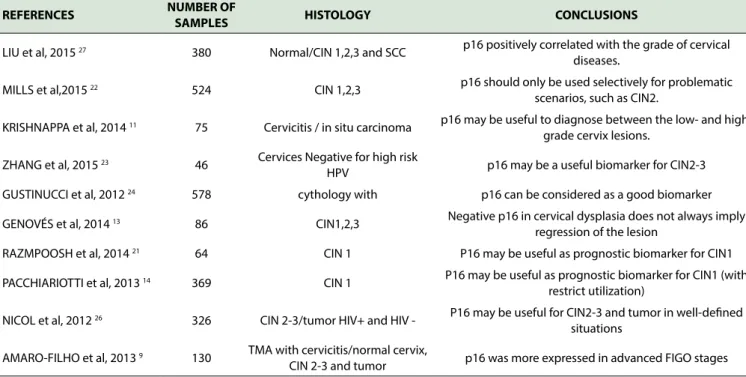
MATERIALS, METHODS AND RESULTSThis study is a review using the PubMed/Medline database, with following keywords: [p16 AND prognostic diagnostic] AND [CIN] AND [cervical cancer] AND [p16]. The studies selected include cervical cancer, human papillo-mavirus and cervical intraepithelial neoplasia, published from April 2009 to June 2017 and in English language.
After analyzing the recovered references, ten articles related to the use of p16 as a possible prognostic
bioma-rker were selected; five of them demonstrated a strong
correlation with p16 overexpression as an indicator of the neoplasia development of high-grade lesions in cervical
specimens with CIN 1 (low grade CIN). These findings are
depicted in Table 1 and discussed below.
■
DISCUSSIONSeveral studies have reported p16 overexpression in cervical cancer as well as in high grade cervical intraepithe-lial neoplasia (CIN2-3), 9-11 although the clinical importance of these findings remains controversial. A meta-analysis
showed that p16 overexpression in cervical cancer speci-mens appeared to increase overall or disease-free survival rates, indicating a more favorable prognosis.10 One report claimed that CIN 2 diagnosis could only be confirmed by
p16 utility in screening and in conjunction with other markers
The p16 protein can be used as an auxiliary com-plement for the screening of cases of low-grade squamous intraepithelial lesion (LSIL), atypical squamous cells of
undetermined significance (ASC-US) and with pap smear
negative results.23 Moreover, it has been strongly suggested that the p16 protein may be a useful tool to improve cytolo-gy and submit the colposcopy to a more detailed analysis.23 Also, p16 staining can assist in the interpretation of results of Pap Smears or of histology in cases of ambiguous results and/or divergence between observers.23 Although p16 has been shown to be a good indicator of undetermined cases, the use of this protein as a prognostic tool of lesion pro-gression is restricted, since it is not possible to evaluate the complete lesion of the cervix. There are no widely accepted criteria for an immuno-histochemical staining study that evaluates whether the p16 stain is positive or negative,
often causing the stain to be labelled as unspecific and the results to be classified as unreliable.14
Several studies have shown increased sensitivity and
specificity for cervical cancer screening using p16 staining in
conjunction with other biomarkers, such as p16/Ki-67 15,16,24-26 and Survivin, the inhibitor of apoptosis.27
Controversies
It is well known that cervical cancer is preceded by cervical intraepithelial neoplasia (CIN), and that high grade CINs show a greater potential of progressing to cervical cancer compared to low grade CINs. However, it is also recognized that the interpretation of cervical biopsies
is subjective and has a substantial degree of inter- and intra-observer variability. This can lead to both under- and over-reporting of clinically important cervical disease.12 Previous studies of p16 immunohistochemistry in CIN 1
have suggested the likely utility of p16 in stratification of
women at risk for subsequent CIN 2-3. But Ziemke et al17 have shown that those studies had limitations in statistical power, histologic diagnosis, and disease ascertainment. Moreover, it is still unclear whether p16 is suitable as a prognostic marker for low-grade lesions.17
Mills et al. 22 recommend that p16 should only be used selectively for problematic scenarios, such as CIN 2 because of its inherent lack of reproducibility, especially in cases in which CIN 1 and CIN 2 are benign mimics of CIN3. Tsoumpou et al.12 considered the reproducibility assays for p16 is still limited due to insufficient standardization
and interpretation of the different immunoreactive stain. Furthermore, there is a level of heterogeneity related to the expression of p16 according to the different CIN grades and cervical cancer. In fact, Nuovo19 recently raised the point that false positive results in diagnostic immunopathology can lead to unnecessary treatment, emphasizing that a false positive level of p16 can be related to variables such as incorrect pretreatment and too concentrated primary antibody as well as the choice of the polymer with the conjugated horseradish peroxidase. Additionally, Liu et al. 28 described that the accuracy of ambiguous p16 immunoreac-tive stain in predicting high risk HPV and HSIL outcome is
low, suggesting that specific guidelines for the ambiguous
cases should prevent diagnostic errors and help implement p16 IHC in general practice.28
Table 1- Main articles related to p16 expression
REFERENCES NUMBER OF
SAMPLES HISTOLOGY CONCLUSIONS
LIU et al, 2015 27 380 Normal/CIN 1,2,3 and SCC p16 positively correlated with the grade of cervical diseases.
MILLS et al,2015 22 524 CIN 1,2,3 p16 should only be used selectively for problematic scenarios, such as CIN2.
KRISHNAPPA et al, 2014 11 75 Cervicitis / in situ carcinoma p16 may be useful to diagnose between the low- and high-grade cervix lesions.
ZHANG et al, 2015 23 46 Cervices Negative for high risk
HPV p16 may be a useful biomarker for CIN2-3
GUSTINUCCI et al, 2012 24 578 cythology with p16 can be considered as a good biomarker
GENOVÉS et al, 2014 13 86 CIN1,2,3 Negative p16 in cervical dysplasia does not always imply regression of the lesion
RAZMPOOSH et al, 2014 21 64 CIN 1 P16 may be useful as prognostic biomarker for CIN1
PACCHIARIOTTI et al, 2013 14 369 CIN 1 P16 may be useful as prognostic biomarker for CIN1 (with restrict utilization)
NICOL et al, 2012 26 326 CIN 2-3/tumor HIV+ and HIV - P16 may be useful for CIN2-3 and tumor in well-deined situations
AMARO-FILHO et al, 2013 9 130 TMA with cervicitis/normal cervix,
■
CONCLUSIONSThe use of p16 as a biomarker could become an impor-tant tool for the diagnosis of cervical lesions with undetermi-ned morphologies. Despite the clear application of p16 in the
diagnostic definition of lesions with difficult morphological
interpretation, the use of p16 as a prognosis marker is still a
controversial issue and in countries such as the United States
it is not typically used as a stand-alone test, but rather in con-junction with other tests such as Ki67. We strongly suggest that further studies are needed to substantiate the role of p16 in conjunction with other markers in large prospective trials in order to design rational and potent clinical prognostic biomarkers for CIN and cervical cancer evaluation.
■
CONFLICT OF INTERESTThe authors declare no conflict of interest.
■
ACKNOWLEDGMENTSThe authors acknowledge LIPMED – IOC /Fiocruz and the Brazilian Institute of Medicine and Rehabilitation (IBMR) for the support of this study.
■
AUTHORS CONTRIBUTIONSJESG, AFN (literature review and writing of the ma-nuscript); CVA, GJN (revised and writing the mama-nuscript); MOC, SMAF, FBR (revised the manuscript); AFN (conceived
the review and revised the final version); GJN (edited the final version).
REVISÃO: O PAPEL DA PROTEINA p16 COMO MARCADOR PUTATIVO PARA NEOPLASIA CERVI-CAL: UM TEMA CONTROVERSO?
INTRODUÇÃO: A proteína p16 tem sido estudada
como um biomarcador potencialmente específico de lesões
cervicais precursoras e como uma forma de diferenciar
as lesões parecidas com Neoplasia intra-epitelial cervical
(NIC). Contudo existem várias controvérsias sobre a utili-zação de p16 como um biomarcador prognóstico e como uma ferramenta para o diagnóstico de câncer cervical e de
lesões pré-câncer. O objetivo deste estudo foi a revisão de dados científicos por pares de bases, relacionados com a
utilização da p16 e suas controvérsias.
MÉTODOS: O estudo foi projetado como uma
revi-são da literatura das publicações do Medline/PubMed que avaliam o significado clínico, diagnóstico ou prognóstico do p16 em lesões de NIC e no câncer cervical no período
de janeiro de 2009 a junho de 2017.
RESULTADOS: o uso do p16 como um marcador
prognóstico ainda não é confiável, apesar de que a p16 po
-deria ser uma ferramenta útil para o diagnóstico em lesões
de NIC com morfologia indeterminada. Além disso, a p16
parece ser um marcador específico de infecção por HPV de
alto risco oncogênico.
CONCLUSÃO: A presente revisão mostra a potencial
utilidade da proteína p16, bem como os inconvenientes para uso clínico-patológico e diagnóstico no câncer cervical. Contu-do são necessários mais estuContu-dos para fundamentar o papel da p16 em conjunto com os outros biomarcadores mais sensíveis
e específicos para diagnosticar NIC e prever a sua progressão. PALAVRAS CHAVES: proteína p16, HPV , câncer cervical, biomarcador, neoplasia intraepitelial cervical.
■
REFERENCES1. World Health Organization. Human papillomavirus (HPV). Geneva: WHO; 2010.
2. Instituto Nacional do Câncer. Retrieved from http://www2.inca.gov. br/wps/wcm/connect/tiposdecancer/site/home/colo_utero/hpv--cancer-perguntas-mais-frequentes.
3. Nicol AF, Andrade CV, Russomano FB, Rodrigues LL, Oliveira NS, Pro-vance DW Jr. HPV vaccines: a controversial issue? Braz J Med Biol Res. 2016;49(5):e5060. DOI:10.1590/1414-431X20155060
4. Brown CA, Bogers J, Sahebali S, Depuydet CE, De Prins F, Malinowski DP. Role of Protein Biomarkers in the Detection of High-Grade Disease in Cervical Cancer Screening Programs. J Oncol. 2012;2012:289315. DOI:10.1155/2012/289315.
5. Na K, Sung JY, Kim HS. Stromal p16 Overexpression in Adult Granu-losa Cell Tumors of the Ovary. Anticancer Res. 2017;37(5):2437-44. DOI:10.21873/anticanres.11583
6. Bonner JA, Mesia R, Giralt J, Psyrri A, Keilholz U, Rosenthal TI, et
al. p16, HPV, and Cetuximab: What Is the Evidence? Oncologist. 2017;22(7):811-22. DOI:10.1634/theoncologist.2016-0433 7. Darragh TM. The LAST Project and the diagnostic bottom line.
Cyto-pathology. 2015;26(6):343-5. DOI:10.1111/cyt.12299
8. Mahajan A. Practical issues in the application of p16 immunohis-tochemistry in diagnostic pathology. Hum Pathol. 2016;51:64-74. DOI:10.1016/j.humpath.2015.12.021
9. Amaro-Filho SM, Golub JE, Nuovo GJ, Cunha CB, Levi JE, Villa LL, et al. A comparative analysis of clinical and molecular factors with the stage of cervical cancer in a Brazilian cohort. PLoS One. 2013;8(3):e57810. DOI:10.1371/journal.pone.0057810
10. Lin J, Albers AE, Qin J, Kaufmann AM. Prognostic significance of ove -rexpressed p16INK4a in patients with cervical cancer: a meta-analysis. PLoS One. 2014; 4;9(9):e106384. DOI:10.1371/journal.pone.0106384 11. Krishnappa P, Mohamad IB, Lin YJ, Barua A. Expression of P16 in high- risk
human papillomavirus related lesions of the uterine cervix in a government hospital, Malaysia. Diagn Pathol. 2014;9:202. DOI:10.1186/s13000-014-0202-z 12. Tsoumpou I, Arbyn M, Kyrgiou M, Wentzensen N, Kaliopaulos G, Hirsch--Martin P, et al. p16INK4a immunostaining in cytological and histo-logical specimens from the uterine cervix: A systematic review and meta-analysis. Cancer Treat Rev. 2009;35(3):210-22. DOI:10.1016/j. ctrv.2008.10.005
13. Genovés J, Alameda F, Mancebo G, Solé JM, Bellozillo B, Lloveras B, et al. Human papillomavirus detection and p16INK4a expression in
cer-vical lesions: a comparative study. Hum Pathol. 2014;45(4):826-33. DOI:10.1016/j.humpath.2013.10.035
23. Zhang G, Yang B, Abdul-Karim, FW. p16 Immunohistochemistry is
Useful in Confirming High-grade Squamous Intraepithelial Lesions
(HSIL) in Women with Negative HPV Testing. Int J Gynecol Pathol. 2015;34(2):180-6. DOI:10.1097/PGP.0000000000000112
24. Gustinucci D, Passamonti B, Cesarini E, Butera D, Palmieri EA, Bulletti S, et al. Role of p16(INK4a) cytology testing as an adjunct to enhance the
diagnostic specificity and accuracy in human papillomavirus-positive
women within an organized cervical cancer screening program. Acta Cytol. 2012;56(5):506-14. DOI:10.1159/000338979
25. Ebisch RM, van der Horst J, Hermsen M, Rijstenberg LL, Vedder JE, Bulten J, et al. Evaluation of p16/Ki-67 dual-stained cytology as triage test for high-risk human papillomavirus-positive women. Mod Pathol. 2017;30(7):1021-31. DOI:10.1038/modpathol.2017.16
26. Leite PMO, Tafuri L, Costa MZO, Lima MIM, Simões RT. Evaluation
of the p16 and Ki-67 Biomarkers as Predictors of the Recurrence of Premalignant Cervical Cancer Lesions after LEEP Conization. Rev Bras Ginecol Obstet. 2017;39(6):288-93. DOI:10.1055/s-0037-1598643 27. Liu HQ, Wang YH, Wang LL, Hao M. P16INK4A and survivin:
Diagnos-tic and prognosDiagnos-tic markers in cervical intraepithelial neoplasia and cervical squamous cell carcinoma. Exp Mol Pathol. 2015;99(1):44-9. DOI:10.1016/j.yexmp.2015.04.004
28. Liu Y, Alqatari M, Sultan K, Ye F, Gao D, Sigel K, et al. Using P16 Immuno -histochemistry to Classify Morphologic Cervical Intraepithelial Neopla-sia 2: Correlation of Ambiguous Staining Patterns with HPV Subtypes and Clinical Outcome. Hum Pathol. 2017;66:144-51. DOI:10.1016/j. humpath.2017.06.014
15. Kanthiya K, Khunnarong J, Tangjitgamol S, Puripat N, Tanvanich S. Expression of the p16 and Ki67 in Cervical Squamous Intraepithelial Lesions and Cancer. Asian Pac J Cancer Prev. 2016;17(7):3201-6. 16. Schmidt D. Modern biomarkers for precancerous lesions of the
ute-rine cervix: Histological-cytological correlation and use. Pathologe. 2016;37(6):534-41. DOI:10.1007/s00292-016-0231-3
17. Ziemke P, Marquardt K, Griesser H. Predictive value of the combined p16 and Ki-67 immunocytochemistry in low-grade squamous intraepithe-lial lesions. Acta Cytol. 2014;58(5):489-94. DOI:10.1159/000367838 18. Gatta LB, Berenzi A, Balzarini P, Dessy E, Angiero F, Alessandri G, et
al. Diagnostic Implications of L1, p16, and Ki-67 Proteins and HPV DNA in Low-grade Cervical Intraepithelial Neoplasia. Int J Gynecol Pathol.2011;30(6):597-604. DOI: 10.1097/PGP.0b013e31821ac4fd 19. Nuovo G. False positive results In diagnostic immunohistochemistry
are related to horseradish peroxidase conjugates in commercially available assays. Ann Diagn Pathol. 2016;25:54-9. DOI:10.1016/j. anndiagpath.2016.09.010
20. Nicol AF, Golub JE, e-Silva JR, Cunha CB, Amaro-Filho SM, Oliveira NS, et al. An evaluation of p16 (INK4a) expression in cervical intraepithelial neoplasia specimens, including women with HIV-1. Mem Inst Oswaldo Cruz. 2012;107(5):571-7. DOI:10.1590/S0074-02762012000500001 21. Razmpoosh M, Sansregret A, Oligny LL, Patey N, Dormoy-Raclet V, Ducruet T, et al. Assessment of Correlation Between p16INK4a
Stai-ning, Specific Subtype of Human Papillomavirus, and Progression
of LSIL/CIN1 Lesions: First Comparative Study. Am J Clin Pathol. 2014;142(1):104-10. DOI:10.1309/AJCPBX74QXCPXIKK