© 2013 Sociedade Brasileira de Hemodinâmica e Cardiologia Intervencionista. Published by Elsevier Editora Ltda. All rights reserved.
Clinical Outcome after Percutaneous Coronary
Intervention in Patients with Prior Renal Transplantation
Fábio Trentin
1, Eduardo França Pessoa de Melo
2, Carlos Vinicius Abreu do Espírito Santo
3,
Flavio Jota de Paula
4, William Carlos Nahas
5, André Gasparin Spadaro
6, Jose Jayme de Lima
7,
Luiz Henrique Gowdak
8, Carlos Augusto Homem de Magalhães Campos
9, Pedro Alves Lemos Neto
10RESUMO
Evolução Clínica após Intervenção Coronária Percutânea em Indivíduos
com Transplante Renal Prévio
Introdução: A doença arterial coronária é uma das princi-paiscausas de óbito em pacientes com doença renal crônica. Alémdisso, em decorrência da elevada prevalência de fatores de risco para aterosclerose, muitos desses pacientes necessitam de intervenção coronária percutânea (ICP) mesmo após o trans-plante renal. O objetivo deste estudo é descrever a evolução tardia de pacientes transplantados renais submetidos à ICP com stent. Métodos: Foram incluídos pacientes transplantados renais, com idade > 18 anos, tratados com ICP. O seguimento foi realizado por análise de prontuários e contato telefônico. O desfecho do estudo foi a incidência de eventos cardíacos adversos maiores (ECAM) durante o seguimento. Resultados: Foram incluídos 29 pacientes. A média de idade foi de 54,8 ± 8 anos, sendo a maioria do sexo masculino (72,4%). A prevalênciade hipertensão arterial sistêmica foi de 89,7%, de dislipidemia de 69%; e de diabetes, de 51,7%. A maior parte apresentava doença multiarterial (biarterial, 44,8%; triarterial, 41,4%). A complexidade das lesões foi elevada, sendo 84,3% dos tipos B2 ou C e 27,5% com lesões em bifurcação. A taxa de sucesso do procedimento foi de 100%. Stents convencionais foram utilizados em 96,6% dos casos. O tempo de seguimento foi de 1.378 ± 977 dias. A mortalidade foi de 25,1%, a taxa
ABSTRACT
Background: Coronary artery disease is a major cause of death in patients with chronic kidney disease. Moreover, due to the high prevalence of risk factors for atherosclero-sis, many of these patients require percutaneous coronary intervention (PCI) even after renal transplantation. The aim of this study is to report the late follow-up of patients with renal transplantation treated with PCI and stenting. Methods:
Patients > 18 years of age, with prior kidney transplantation, and treated with PCI were included. Clinical follow-up was evaluated by medical record analysis and telephone contact. The study endpoint was the incidence of major adverse car-diac events (MACE) during follow-up. Results: Twenty-nine patients were included. Mean age was 54.8 ± 8 years and the majority male (72.4%). The prevalence of hypertension was 89.7%, dyslipidemia 69% and diabetes 51.7%. Most of them had multivessel disease (2-vessel: 44.8%; 3-vessel: 41.4%). Lesion complexity was high, being 84.3% type B2 or C lesions and 27.5% bifurcation lesions. Procedural suc-cess rate was 100%. Bare metal stents were used in 96.6% of cases. The follow-up time was 1,378 ± 977 days. The mortality rate was 25.1%, target vessel revascularization rate was 15.9% and none of the patients presented non-fatal infarction. The incidence of MACE during follow-up was 34.5%. Conclusions: Late follow-up after PCI in renal transplantation patients demonstrated a high probability of
Original Article
1 Resident physician at the Hemodynamics and Interventional Cardiology
Service of Instituto do Coração do Hospital das Clínicas da Faculdade de Medicina da Universidade de São Paulo. São Paulo, SP, Brazil.
2 Resident physician at the Hemodynamics and Interventional Cardiology
Service of Instituto do Coração do Hospital das Clínicas da Faculdade de Medicina da Universidade de São Paulo. São Paulo, SP, Brazil.
3 Resident physician at the Hemodynamics and Interventional Cardiology
Service of Instituto do Coração do Hospital das Clínicas da Faculdade de Medicina da Universidade de São Paulo. São Paulo, SP, Brazil.
4 Doctor. Physician at the Renal Transplantation Unit of Hospital das
Clínicas da Faculdade de Medicina da Universidade de São Paulo. São Paulo, SP, Brazil.
5 Titular professor of the Urology Subject - Renal Transplantation Service
of Hospital das Clínicas da Faculdade de Medicina da Universidade de São Paulo. São Paulo, SP, Brazil.
6 Interventionist cardiologist physician at the Hemodynamics and
Interventional Cardiology Service of Instituto do Coração do Hospital das Clínicas da Faculdade de Medicina da Universidade de São Paulo. São Paulo, SP, Brazil.
7 Full professor. Cardiologist physician at the Hypertension Unit of
Ins-tituto do Coração do Hospital das Clínicas da Faculdade de Medicina da Universidade de São Paulo. São Paulo, SP, Brazil.
8 Full professor. Cardiologist physician at the Clinical Unit of Chronic
Coronary Disease of Instituto do Coração do Hospital das Clínicas da Faculdade de Medicina da Universidade de São Paulo. São Paulo, SP, Brazil.
9 Interventionist cardiologist physician at the Hemodynamics and
In-terventional Cardiology Service of Coração do Hospital das Clínicas da Faculdade de Medicina da Universidade de São Paulo. São Paulo, SP, Brazil.
10 Full professor. Director of the Hemodynamics and Interventional Cardiology
Service of Instituto do Coração do Hospital das Clínicas da Faculdade de Medicina da Universidade de São Paulo. São Paulo, SP, Brazil.
Correspondence to: Pedro Alves Lemos Neto. Av. Dr. Enéas Carvalho de Aguiar, 44 – São Paulo, SP, Brazil – CEP 05403-000
E-mail: [email protected]
clinical events. However, the study population was a sample of high clinical and angiographic complexity.
DESCRIPTORS: Angioplasty. Stents. Coronary disease. Kidney transplantation.
service. The research was based on the analysis of the database, medical records review, and telephone contact.
Study population
Between March 2002 and June 2011, 36 patients with prior renal transplantation were treated with PCI at the Instituto do Coração do Hospital das Clínicas, School of Medicine, Universidade of São Paulo (Incor/ HCFMUSP, São Paulo, SP, Brazil). Seven patients were excluded, as they did not have any new consultations recorded in their medical charts and it was not possible to complete the follow-up by telephone. A total of 29 subjects comprised the inal population of the analysis.
Procedure
Unfractionated heparin at a dose from70 U/kg to 100 U/kg was previously administered in all the procedures, aimed at obtaining activated clotting time between 250-300 seconds; the patients were receiving dual antiplatelet therapy with acetylsalicylic acid 100 mg and clopidogrel 75 mg.
The choice of access route, techniques, and materi-als, as well as diagnostic and intervention methods was made at the surgeon’s discretion. All cases received at least one bare-metal stent (BMS) or drug-eluting stent (DES) with diameters varying between 2.5 mm and 4 mm. Angiographic success was considered with residual stenosis < 30% after PCI.
Data collection
Clinical and angiographic characteristics were ob-tained from the database of the Service of He modynamics and Interventional Cardiology of InCor/HCFMUSP. In-formation on the use of immunosuppressants was also assessed in each case.
The investigation of the events was performed using information obtained through medical record review and telephone contact. For cases in which the same event occurred more than once for the same patient, the re-peated event was disregarded in the temporal analysis.
The study outcome was the occurrence of major adverse cardiac events (MACE) during follow-up, deined
de revascularização do vaso-alvo foi de 15,9% e nenhum paciente apresentou infarto não fatal. A incidênciade ECAM durante a evolução foi de 34,5%. Conclusões: A evolução clínica tardia após ICP em pacientes transplantados renais demonstrou elevada probabilidade de eventos clínicos. No entanto, a população estudada foi uma amostra de altacom-plexidade clínica e angiográica.
DESCRITORES: Angioplastia. Stents. Doença das coronárias. Transplante de rim.
T
he increasing prevalence of chronic kidney dis-ease and consequent incrdis-eased demand for renal replacement therapy has induced increased rates of renal transplantation worldwide.1 Only in Brazil, in the irst half of 2012, 2,689 kidney transplantations were performed.2 In this context, there is an increased concern regarding this speciic part of the population, aiming to identify their clinical peculiarities and to understand the comorbidities that develop over time.3In recent years, chronic kidney disease has been conirmed as a condition very frequently associated with coronary artery disease, which is one of leading causes of death in patients who require substitutive therapy.4 In a recent study of patients who underwent renal transplantation, after a period of 2.9 years, 32.8% had altered non invasive tests for assessment of myocardial ischaemia and 14.5% had angiographically signiicant lesions in the coronary angiography.5
In this scenario, percutaneous coronary intervention (PCI) has been increasingly used in renal transplantation patients, especially because it is a less invasive procedure when compared with the surgical alternative, following its speciic indications. Moreover, in general, mortality between percutaneous and surgical revascularization alternatives is very similar in this population.6
Few studies have analyzed the long-term evolu-tion of patients with prior renal transplantaevolu-tion treated with PCI and stenting. Research on this subject is of considerable interest, since it not only allows for the evaluation of the inluence of classical risk factors for the development of coronary artery disease, but also for speculation on the impact of the characteristics of renal transplantation recipients, including the use of already tested immunosuppressive drugs to reduce intrastent restenosis.7-9
This study aimed to describe the late evolution in patients with a history of renal transplantation submit-ted to PCI with stenting.
METHODS
as death from any cause, acute myocardial infarction, and target vessel reintervention.
Statistical analysis
Analysis of the clinical and angiographic data was performed using the SPSS software (IBM Corp. – New York, United States). Continuous variables were described as mean and standard deviation, while categorical vari-ables were described as frequencies and percentages. The event rate was estimated by Kaplan-Meier method.
RESULTS
The mean age was 54.8 ± 8 years and most of the subjects were males (72.4%). The prevalence of hypertension was 89.7%; dyslipidemia, 69%; diabetes, 51.7%; and previous or current history of smoking, 48.3%. The clinical picture that motivated the PCI was, in most cases, acute coronary syndrome without ST-segment elevation, observed in 55.2% of cases, fol-lowed by acute coronary syndrome with ST-segment elevation in 27.6%. All others were diagnosed with stable angina (Table 1).
On average, patients had 6 ± 6 years since the transplantation. The prescription of immunosuppressants was available for 23 patients, and the drugs most often prescribed were mycophenolate (56.5%), prednisone (47.8%), and tacrolimus (39.1%) (Table 1).
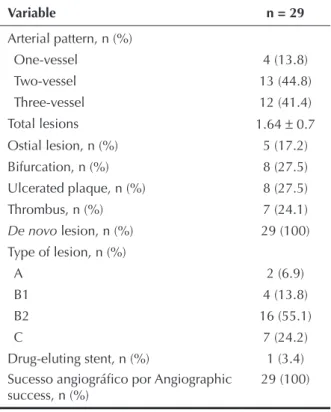
Most cases had a multivessel obstructive pattern (two-vessel, 44.8%; three-vessel, 41.4%). Lesion com-plexity was high; 79.3% were type B2 or C lesions, and 27.5% involved bifurcations lesions,24.1% lesions with thrombus, and 17.2% ostial lesions. De novo lesions were treated in all cases. BMS were used in 96.6%of the cases, and angiographic success was attained in 100% of cases (Table 2).
The meantime of follow-up after PCI was 1,378 ± 977 days. During this period, 34.5% of patients had at least one MACE. The incidence of adverse events occurred throughout the study period (Fig. 1). Mortality during follow-up was 25.1%. None of the patients had non-fatal acute myocardial infarction in the period, and 15.9% required target vessel reintervention.
DISCUSSION
According to previous studies, the incidence of coronary atherosclerosis substantially higher in renal transplantation patients than in the general popula-tion.10 Moreover, the risk for development of coronary artery disease is high, even before the progression to end-stage renal disease.11
This study evaluated the long-term evolution of patients treated with PCI and stenting in this speciic population of transplanted patients. The authors consider the research relevant, as it allows for a better evaluation
TABLE 1 Clinical characteristics
Variable n = 29
Age, years 54.8 ± 8
Male gender, n (%) 21 (72.4)
Diabetes 15 (51.7)
Systemic arterial hypertension, n (%) 26 (89.7)
Dyslipidaemia, n (%) 20 (69)
Smoking, n (%) 14 (48.3)
Family history of early coronary artery disease, n (%)
2 (6.9)
Previous stroke, n (%) 1 (3.4)
Peripheral vascular failure, n (%) 2 (6.9) Previous acute myocardial infarction, n (%) 3 (10.3) Previous percutaneous coronary
intervention, n (%)
3 (10.3)
Previous coronary artery bypass graft surgery, n (%)
4 (13.8)
Clinical picture, n (%)
Stable angina 5 (17.2)
Acute coronary syndrome without ST-segment elevation
16 (55.2)
Acute coronary syndrome with ST-segment elevation
8 (27.6)
Immunosuppressants n = 23
Tacrolimus 9 (39.1)
Cyclosporine 4 (17.4)
Mycophenolate 13 (56.5)
Sirolimus 1 (4.3)
Azathioprine 0
Prednisone 11 (47.8)
of the results of percutaneous treatment in patients with such particular characteristics, through the analysis of a signiicant sample of patients with these characteristics.
The occurrence of MACE in approximately one-third of patients over a period of more than three years indicates that, even with partial renal function or fully recovered, the sample relects a population at high risk for developing severe events.12
observed in the present study.13-15 This result may be associated with a potential beneit of the immunosup-pressive therapy, reafirming what has been suggested in previous studies7-9,16
During the follow-up period,in one-quarter of the patients, mortality from all causes was the major component of the high occurrence of MACE. This high
death rate is expected in this population group, since, in addition to the high underlying cardiovascular risk, the impaired immune capacity (caused by the chronic kidney disease itself and the use of immunosuppressants) is associated with a higher risk of developing severe comorbidities, such as infections and malignancies, which are potentially life-threatening.3,17
Study limitations
The study has some limitations, including the fact that it was retrospective, based on information obtained from a database and medical records, as well as telephone contact, which was not possible in all cases. There was, therefore, loss of a non-negligible portion of patients who could not be included the inal analysis. Moreover, the inclusion of patients who had their procedures performed at very different times, especially in an area of cardiology in which there are constant advances in the methods, materials, and medications, caused some individuals to receive slightly differentiated treatment.
CONCLUSIONS
In the present study, late clinical outcome after PCI in renal transplantation patients showed a high likelihood of clinical events. However, the population studied was a sample of high clinical and angiographic complexity. The rate of target vessel revascularization was reduced, but this inding needs to be better evalu-ated in studies with larger sample sizes.
CONFLICTS OF INTEREST
The authors declare no conlicts of interest.
REFERENCES
1. Sociedade Brasileira de Nefrologia. Censo de Diálise [Internet]. São Paulo; 2011 [citado 2013 mar. 28]. Disponível em: http:// www.sbn.org.br/pdf/censo_2011_publico.pdf
2. Brasil. Ministério da Saúde. Sistema Nacional de Transplantes [Internet]. Brasília; 2012 [citado 2013 mar. 28]. Disponível em: http://portalsaude.saude.gov.br/portalsaude/arquivos/pdf/2012/ Set/27/transplantes_270912_inal.pdf
3. Oliveira MIG, Santos AM, Salgado Filho N. Análise da so-brevida e fatores associados à mortalidade em receptores de transplante renal em Hospital Universitário no Maranhão. J Bras Nefrol. 2012;34(3):216-25.
4. Peres LAB, Biela R, Herrmann M, Matsuo T, Ann HK, Camargo MTA, et al. Estudo epidemiológico da doença renal crônica terminal no oeste do Paraná: uma experiência de 878 casos atendidos em 25 anos. J Bras Nefrol. 2010;32(1):51-6. 5. Kahn MR, Fallahi A, Kim MC, Esquitin R, Robbins MJ. Coronary
artery disease in a large renal transplant population: implica-tions for management. Am J Transplant. 2011;11(12):2665-74. 6. Herzog CA, Ma JZ, Collins AJ. Long-term outcome of renal
transplant recipients in the United States after coronary revas-cularization procedures. Circulation. 2004;109(23):2866-71. 7. Versaci F, Gaspardone A, Tomai F, Ribichini F, Russo P, Proietti I,
et al. Immunosuppressive Therapy for the Prevention of Re-stenosis After Coronary Artery Stent Implantation (IMPRESS Study). J Am Coll Cardiol. 2002;40(11):1935-42.
TABLE 2
Angiographic characteristics
Variable n = 29
Arterial pattern, n (%)
One-vessel 4 (13.8)
Two-vessel 13 (44.8)
Three-vessel 12 (41.4)
Total lesions 1.64 ± 0.7
Ostial lesion, n (%) 5 (17.2)
Bifurcation, n (%) 8 (27.5)
Ulcerated plaque, n (%) 8 (27.5)
Thrombus, n (%) 7 (24.1)
De novo lesion, n (%) 29 (100)
Type of lesion, n (%)
A 2 (6.9)
B1 4 (13.8)
B2 16 (55.1)
C 7 (24.2)
Drug-eluting stent, n (%) 1 (3.4)
Sucesso angiográico por Angiographic success, n (%)
29 (100)
Figure – Incidence of major adverse cardiac events (death, acute myo-cardial infarction or target vessel reintervention) during follow-up. MACE, major adverse cardiac events; ICP, percutaneous coronary intervention.
0
0 20 40 60
365 730 1,095 1,460
80 100
MA
CE cumulativ
e incidence (%)
8. Mota FM, Araújo J, Arruda JA, S Júnior HT, Pestana JOM, Sousa JMA, et al. Evolução clínica pós-stent coronariano em
pacientes submetidos a transplante de rim. Arq Bras Car-diol.2007;88(5):521-4.
9. Brito FS Jr, Rosa WC, Arruda JA, Tedesco H, Pestana JO, Lima VC. Eficacy and safety of oral sirolimus to inhibit in-stent intimal hyperplasia. Catheter Cardiovasc Interv. 2005;64(4):413-8. 10. Kasiske BL, Guijarro C, Massy ZA, Wiederkehr MR, Ma JZ.
Cardiovascular disease after renal transplantation. J Am Soc Nephrol. 1996;7(1):158-65.
11. Joki N, Hase H, Nakamura R, Yamaguchi T. Onset of coronary artery disease prior to initiation of hemodialysis in patients with end-stage renal disease. Nephrol Dial Trans-plant.1997;12(4):718-23.
12. Sarnak MJ, Levey AS, Schoolwerth AC, Coresh J, Culleton B, Hamm L, et al. Kidney disease as a risk factor for develop-ment of cardiovascular disease. Circulation. 2003;108(17): 2154-69.
13. Kastrati A, Schömig A, Elezi S, Schühlen H, Dirschinger J, Hadamitzky M, et al. Predictive factors of restenosis after coronary stent placement. J Am Coll Cardiol. 1997;30(6): 1428-36.
14. Mercado N, Boersma E, Wijns W, Gersh BJ, Morillo CA, de Valk V, et al. Clinical and quantitative coronary angiographic predictors of coronary restenosis: a comparative analysis from the balloon- to-stent era. J Am Coll Cardiol. 2001;38(3):645-52.
15. Mehran R, Dangas G, Abizaid AS, Mintz GS, Lansky AJ, Satler LF, et al. Angiographic patterns of in-stent restenosis classii-cation and impliclassii-cations for long-term outcome. Circulation. 1999;100(18):1872-8.
16. Arruda JA, Costa MA, Brito FS Jr, Tedesco H, Barbosa AH, Ribeiro EP, et al. Effect of systemic immunosuppression on coronary in-stent intimal hyperplasia in renal transplant pa-tients. Am J Cardiol. 2003;91(11):1363-5.