Vol. 10, No. 3, Sept/Dec., 2013 pp.541-560 ISSN online: 1807-1775
DOI: 10.4301/S1807-17752013000300005
_____________________________________________________________________________________ Manuscript first received/Recebido em 01/02/2013 Manuscript accepted/Aprovado em: 28/07/2013 Address for correspondence / Endereço para correspondência
Gilberto Perez, Mestre (2003) e Doutor (2007) em Administração pela Universidade de São Paulo. Na Universidade Presbiteriana Mackenzie atua como Coordenador e Pesquisador do Núcleo de Estudos em Estratégia e Inovação - NEPEI - Universidade Presbiteriana Mackenzie, Rua da Consolação, 930, São Paulo 01302907 - São Paulo, SP – Brasil E-mail: [email protected]
Isabel Ramos, Centre Algoritmi, University of Minho, Braga, Portugal, E-mail: [email protected]
Acknowledgements: This paper is funded by: “FEDER funds through the Operational Program for Competitiveness Factors, COMPETE and Portuguese Funds through FCT - Foundation for Science and Technology under the Project: FCOMP-01-0124-FEDER-022674 and MackPesquisa - Mackenzie Research Fund”.
UNDERSTANDING ORGANIZATIONAL MEMORY FROM THE
INTEGRATED MANAGEMENT SYSTEMS (ERP)
COMPREENDENDO A MEMÓRIA ORGANIZACIONAL A PARTIR DOS
SISTEMAS INTEGRADOS DE GESTÃO (ERP)
Gilberto Perez
Universidade Presbiteriana Mackenzie, São Paulo/SP, Brazil
Isabel Ramos
Centre Algoritmi, University of Minho, Braga, Portugal
__________________________________________________________________________
ABSTRACT
With this research, in the form of a theoretical essay addressing the theme of Organizational Memory and Integrated Management Systems (ERP), we tried to present some evidence of how this type of system can contribute to the consolidation of certain features of Organizational Memory. From a theoretical review of the concepts of Human Memory, extending to the Organizational Memory and Information Systems, with emphasis on Integrated Management Systems (ERP) we tried to draw a parallel between the functions and structures of Organizational Memory and features and characteristics of ERPs. The choice of the ERP system for this study was made due to the complexity and broad scope of this system. It was verified that the ERPs adequately support many functions of the Organizational Memory, highlighting the implementation of logical processes, practices and rules in business. It is hoped that the dialogue presented here can contribute to the advancement of the understanding of organizational memory, since the similarity of Human Memory is a fertile field and there is still much to be researched.
RESUMO
Com esta pesquisa, no formato de ensaio teórico abordou-se o tema da Memória Organizacional e os Sistemas Integrados de Gestão (ERP), buscando apresentar alguns indícios de como este tipo de sistema pode colaborar para a consolidação de algumas funcionalidades da Memória Organizacional. A partir de uma revisão teórica sobre os conceitos da Memória Humana, com extensão à Memória Organizacional e Sistemas de Informação, com ênfase nos Sistemas Integrados de Gestão (ERP), procurou-se estabelecer um paralelo entre as funcionalidades e estruturas da Memória Organizacional e as funcionalidades e características dos ERPs. A escolha do sistema ERP para este estudo deveu-se à complexidade e escopo abrangente deste sistema. Pôde-se constatar que os ERPs suportam de forma adequada algumas funções da Memória Organizacional, com destaque à implementação das lógicas, processos, práticas e regras vigentes de negócio. Espera-se que o diálogo aqui apresentado possa contribuir para o avanço do entendimento da Memória Organizacional, visto que à semelhança da Memória Humana, é um campo fértil e ainda existe muito a ser pesquisado.
Palavras-chave: Memória Humana, Memória Organizacional, Sistema de Informação,
ERP.
1. INTRODUCTION
To assess whether an organization can be understood as a system, to which the concepts of memory are likely to be applied, has become a challenge for researchers of organizational theories. Perhaps, this is considered a preposterous claim by scholars of the humanities. However, if the claims of the General Systems Theory (TGS) (Bertalanffy, 1975) are observed, an organization can be conceptualized as a system because it is based on open systems as they relate to the environment (various stakeholders); presents perspectives to organize itself as a whole and is able to implement a holistic view.
It is clear that the cybernetics has enabled the development of TGS, as well as the operationalization of ideas that converged at a theory of systems applied to management. To cybernetics is also associated the use of Systems and Information and Communication Technologies, widely used in the integration and exchange of information within the organization and with the environment. Likewise, studies in psychology, philosophy and sociology contributed substantially to the evolution of the concepts of memory and understanding of the complex mechanisms involved in its operation. Based on these approaches, the initial proposition proves to be quite promising and studies on Organizational Memory begin to appear, but there is much still ahead.
In its essence, the memory is related to one of the central concepts of the theory of information processing. In turn, the information is a valuable resource for organizations and sometimes, it generates competitive advantage. Organizational Memory is related to the accumulation of socially constructed solutions to the problems of the past and that are often found within organizations (Ackerman & Halverson, 2004).
In practice, the Organizational Memory influences in various ways individuals and areas that are part of it. This is the case of decisions made by managers, who rely on information and knowledge that the organization is able to store and recover in due course in information systems. The decisions influence the results of the organization and determine its future. Thus, organizational memory is somehow tied to the effectiveness and performance of organizations.
One can then infer that organizational memory is somehow related to the use of available systems, often very expensive, as is the case for Enterprise Resource Planning Systems (ERP), since this is a system widely used by organizations thanks to the range of functions it incorporates, its modularity and integration of data and information from various areas that make up the organization in a single database.
Since the Organizational Memory shows up as a fertile field of research while challenging, the purpose of this essay was to better understand its mechanisms of operation, associating them with the Information Systems (another fertile research field), in particularly with Enterprise Resource Planning Systems (ERP), given the complexity and scope of such systems, which has as one of its main purposes, the preservation of organizational memory.
Before the case presented, it was formulated the following research question:
How can Enterprise Resource Planning Systems (ERP) contribute to consolidate the Organizational Memory? Its overall objective was to determine how ERP systems can somehow assist in the consolidation of organizational memory.
2. METHODOLOGICAL CONSIDERATIONS ABOUT THE ESSAY
Although the established essayists position themselves on not having the need to adopt a methodology in the preparation of an essay, it was decided to maintain this section, which aims to present the reader with some concepts and the uniqueness of the theoretical essay, as well as to clarify the choice of this type of text. It was understood that the logic of argument of an essay should also be present in its structure.
Medeiros (2000: 112) refers that the essay "is a methodological display of performed issues and original conclusions that have been reached after careful examination of an issue." He emphasizes further that the test should take part problematically, anti-dogmatically, and that it should stand the critical spirit of the author, as well as originality.
Besides the theoretical study, another guiding aspect of this essay was its multidisciplinary approach, in this case, the Organizational Memory and Information Systems. Therefore, by not introducing the empiricism of traditional papers, it is hoped that the dialogue and reflections presented here can somehow entice the reader into a further reflection and, perhaps, to continue the discussion herein initiated.
3. THEORETICAL REFERENCIAL
This chapter presents an overview of the evolution of the concepts of Human Memory, extending the concepts of Organizational Memory and Information Systems, with emphasis on ERPs.
3.1 Evolution of the concepts Memory and Human Memory
The field of memory studies is multidisciplinary and combines intellectual currents of several areas, including (but not limited to) anthropology, education, literature, history, philosophy, psychology and sociology (Roediger & Wertsch, 2008). According to those authors, philosophers have written about memory problems since 2500 years ago and psychologists have studied empirically the questions related to memory for over 125 years.
The memory is an important and complex cognitive process, which can be defined as a process consisting of three mechanisms: storage, retention and access. While those mechanisms are considered sequential, they are, in fact, interdependent. That is, how the content has been stored can influence the retention, the access depends on which types of retention are activated, and so forth (Baddeley, 1999).
The memory can be natural or artificial. As Simon (1955) states, information can be stored in the natural memory or stored in an artificial memory in the form of documents, books, notes, decisions, knowledge, processes, etc. This type of memory assumes a representative role for organizations in the form of Information Systems. In organizations, the decision maker can use the natural memory whenever she/he runs into a problem already experienced. However, she/he can use the artificial memory to access files, databases, and records and other typo of information about how a past decision influenced the organization, so they are useful in solving new similar problems.
Over time, various models have been proposed to study human memory. It is a theme constantly revised in view of the findings in the areas of neuroscience, progressively more accessible due to the increasing sophistication of research methods in the area. A model commonly adopted, based on neuropsychological research, shows how memory can be divided into two basic types: declarative and non-declarative (Sternberg, 2008). Moreover, memory is defined in two ways: by retention time and by its contents (Davidoff, 2001; Gazzaniga, Ivry & Mangun, 2006).
information stored and how it is encoded and evoked. It relates to emotions, to learning mechanisms and suffers losses associated to the human development (Oliveira, 2007).
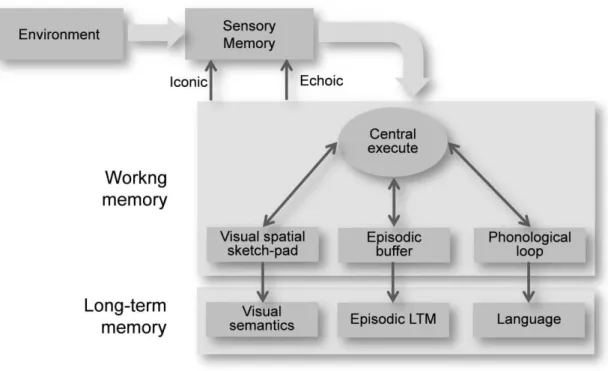
From what has been presented so far, to develop a unique model of human memory presents itself as a relatively difficult task. One justification for this is that the knowledge about human memory is evolving fast mainly by the contribution of Psychology and Neuroscience. However, a model (Figure 1) developed by Alan Baddeley - Professor of Psychology - is widely accepted by these two scientific communities.
Figure 1: Representation of Human Memory
Source: Adapted from Baddeley et al.(2009)
Observing the model in Figure 1 reveals that human memory consists of three other memory types, namely: 1) Sensory memory (very fast and retains the stimuli received) 2) Working Memory (stores information that will be the basis for reasoning and learning) 3) Long Term Memory (information to be used indefinitely). Together, these memories enable humans to adapt to their environment, to achieve the proposed goals, knowledge integration and patterns maintenance – a human ability that accelerates the interpretation of new events based on past experiences.
Recent studies in neuroscience indicate that human memory has some constructive features (Schacter & Addis, 2007). A practical example of this capability occurs when presenting to a group of people, for a certain period of time, a list of words related to a given context, eg: tired, bed, awake, sleep, dream, night, blanket, napping, sleep, snoring pillow, yawning, peace and sleepy.
also produce results with sufficient flexibility (Schacter & Addis, 2007). One clue comes from studies indicating that memory errors can present evidence of an adaptive functioning, rather than faulty processes.
3.1.1 Considerations about the study of Human Memory
According Dudai, Ill Roediger & Tulving (2007, p 1), "a new science around the memory is developing before our eyes." According to the authors, this science comes true resting on the shoulders of giants, such as: psychology, neurobiology and brain research, computer science and philosophy. Each of these disciplines contributes a distinct vocabulary of terms and acronyms, interconnected to some degree or form in generic features and conceptual frameworks. In the case of computer science the contributions include Neural Networks, Genetic Algorithms, Artificial Intelligence Systems and systems of Fuzzy Logic.
Since the studies of memory comprehend multiple disciplines, methods and used techniques, they can also be quite diverse. Those studies include basic research in the humanities, the careful examination of primary historical sources and documentary studies as well as case studies, interviews, questionnaires and eyewitness reports of the social sciences (Tulving, 2007). In psychology and neuroscience, real experiments are sometimes used (Cesar Perez, Vidal & Marin, 2010). It is expected that different types of inferences can be made from various applications of these techniques. One challenge we see for the future of memory studies as a discipline is to develop a set of strict and systematic methodologies that provide a wide range of possibilities for analysis (Roediger & Wertsch, 2008).
For scholars of the science of memory to be able to properly explore the topic and to benefit from this rich multidisciplinary methods and results, they should strive to understand the language and modus operandi of researchers from other disciplines and/or sub-disciplines (Dudai, Roediger ill & Tulving, 2007). For the authors, such an understanding is a sine qua to the success of this challenge that is to study memory. No doubt this is a great opportunity for students of computer science, given the development of cybernetics in recent decades.
Thus, systematize and improve the methodological foundations for studies in the field are prerequisites for progress on cumulative memory. Thus, both quantitative and qualitative methodological approaches rigorously developed by researchers in the humanities and social scientists, as applicable in other specific areas of study, will also be applicable to studies of human memory (Roediger & Wertsch, 2008).
A similar approach can be taken in relation to the theoretical and conceptual questions. The field of memory studies needs to develop theoretical perspectives unique to withstand the critical issues of the field (Roediger & Wertsch, 2008). Scholars interested in studies of memory and collective memory, often uncritically borrow terms of studies of human memory (Wertsch, 2002). According to the author, it is necessary to adopt well-defined criteria, because such approaches are often the best simplifications, the best and the worst caricatures.
theoretical approaches, such as those presented by neuroscience and computer science, which are the case of this theoretical essay.
3.2 The Organizational Memory, an Evolving Concept
Historically, the concepts of Organizational Memory (OM) followed the concepts related to human memory, which indicates that human memory has been used as a metaphor to refer to the organizational memory, even if implicitly. Given the difficulty presenting a model for human memory, it was expected that the same difficulty occurred in the representation of organizational memory, since, in theory, it should provide functions similar to human memory.
Researchers of organizational memory (Walsh & Ungson, 1991; Morgeson & Hofmann, 1999; Nevo et al., 2008 & Rowlinson et al., 2010) argue that organizations need to know what they already know, to use this knowledge in the present decisions and thus project the future. In addition, some authors argue that information about the past can be stored by organizations in multiple ways (Douglas, 1986; Kantrow, 1987).
When researchers of the organization science have adopted the term memory, they imported the same meanings associated to the concept of human memory and applied them to organizations. However, these meanings and implications should be explained so that it is possible to understand if in fact they apply to organizations. Thus, the "memory" remains one of the central concepts of the theory of information processing. However, the understanding of these concepts is still incipient, particularly in theories of organizations (Walsh & Ungson, 1991; Nevo et al., 2008).
The challenging issue is the implementation of the concepts of human memory for the study of organizational memory. This is why, although their basic structures are completely different, which are trying to see whether the same features occur in both. The use of metaphors allows the researcher to establish a bridge between two different concepts in nature, but similar in their functions.
Thus, its importance is closely linked to the development of systems capable of capturing what should be archived, to categorize stored knowledge representations, to establish mechanisms that facilitate the connection of these contents to human knowledge, favoring the creation of new knowledge, to facilitate the process of knowledge sharing and to allow for the recovery of knowledge representations for decision and human action support.
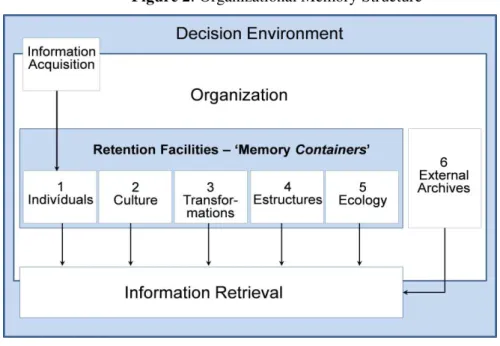
Figure 2: Organizational Memory Structure
Source: Adapted from Walsh & Ungson (1991)
The borders and the center of the organizational memory structure proposed by Walsh and Ungson (1991) represent:
Information Acquisition: actions that relate to information on decisions and solved problems, and constitute the basis of organizational memory over time (Walsh & Ungson, 1991).
Information Retention: The information and decisions can be stored in different locations, such as: individuals, adopted procedures, protocols, furniture arrangements, technological devices, etc. Pondy and Mitroff (1979) simplified the explanation and argued that the possibilities for storage of information are similar to "brains and paper".
Information Retrieval: in the day-to-day organizations, a lot of information used by individuals in their analyses are retrieved from organizational memory. Such retrieval can occur in a controlled manner, or automatically (Langer, 1983).
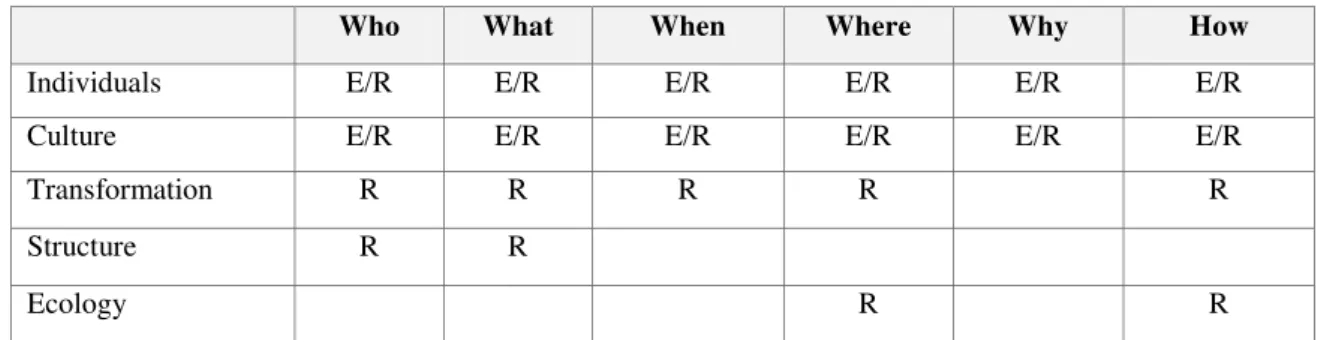
Table 1: Properties of Retained Information
Who What When Where Why How
Individuals E/R E/R E/R E/R E/R E/R
Culture E/R E/R E/R E/R E/R E/R
Transformation R R R R R
Structure R R
Ecology R R
Note: E = stimuli Decision / Information, R = Organizational Responses Source: Walsh and Ungson (1991)
Walsh and Ungson (1991: 61) define organizational memory as "the information stored by the history of an organization that can influence the present decisions of the organizations". However, because it was a seminal work, which is still regarded as a classic by the authors, who cited it over 300 articles, it is also natural that the model has been object of much criticism.
Zwass and Stein (1995) extend the concept of organizational memory by including the effectiveness element. The authors argue that organizational memory is the way in which the knowledge acquired in the past can influence the business activities of the present, thus resulting in a higher or lower level of organizational effectiveness.
Systems and information technologies are widely used tools by modern organizations for this purpose (Perez & Zwicker, 2010). For Stein and Zwass (1995), the basic organizational memory consists of cognitive elements (memory content); the authors define organizational memory as a process based on the acquisition, retention, maintenance and restoration, as shown in Figure 3.
Figure 3: Process of Organizational Memory
Source: Stein & Zwass (1995)
dynamic process that integrates reconstructions functions enabling the recall of past experiences.
Corbett (2000) argues for a dynamic view of the structure of organizational memory, which should take into account the social nature of this memory. For the author, rather than seeing the memory as knowledge stored in containers, organizational memory should be seen as a continuous process of construction and reconstruction by the interaction between humans and their organizational environment. Meanwhile, the definition given by Ackerman and Halverson (2004) indicates that organizational memory can be understood as the accumulation of socially constructed solutions to the problems of the past and that are frequently found by the organization.
A new approach to the organizational memory takes into account that it should not systematically present an organizational design geared only towards the needs of the moment, but it must consider the imaginative reconstruction of the past as an essential factor to plan for the future (Rowlinson et al. 2010).
Among other aspects, Nevo et al., (2008) argue that the model of Walsh & Ungson (1991) is adequate to support research efforts in the area of Information Systems and Technology. The basic assumption is that information technology can be used to create a uniform, complete, consistent, updated and integrated set of knowledge that can be made available to decision-making processes at all levels of the organization.
The processes of Organizational Memory involving the acquisition, preservation, search, maintenance and recovery are faster and more accurate when automated by Organizational Memory Information Systems (OMIS) (Nevo & Wand, 2005). Within organizations, these systems began with large databases of complex information, having evolved later to more distributed systems developed according to the principles of the Theory of Transactive Memory (Brandon & Holligshead, 2004: Lewis & Herndon, 2011). In this approach, information systems are tools to connect information repositories and to make them available for groups and individuals, as repositories of knowledge, enabling the interconnection of distributed repositories across the organization into an integrated memory.
The concepts coming from systems theory are corroborated by some researchers of organizational theories (Morgeson & Hofmann, 1999; Nevo et al., 2008), which add to the organizational memory concepts, features related to repositories of information, processes and decisions, which can be redeemed for problem solving and present situations. Other authors (Feldman & Feldman, 2006; Ramos & Carvalho, 2008; Rowlinson et al., 2010; Ramos, 2011; Ramos & Levine, 2012) added new facets and critical theories of organizations, introducing concepts that help the understanding of organizational memory, associating it with the reconstruction capability of organizations.
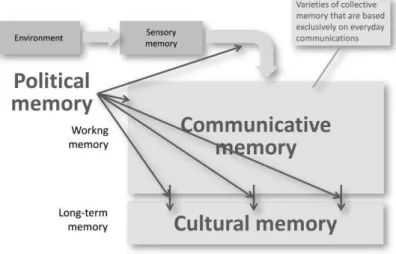
One possibility that presents itself for the representation of a model for organizational memory is to use the model of Baddeley et al. (2009). In line with the authors of these studies and researches on the cultural, communicative and political memories (Barnier, Sutton, 2008; Hirst, Manier, 2008), it is possible to propose a new model for representing organizational memory through the juxtaposition with the model of human memory. Ramos (2011) presents a model (Figure 4) in which the memories
mentioned above are presented as organizational concepts equivalent to the Baddley’s
Figure 4: Representative Model of Organizational Memory
Source: Ramos (2011), based on: (Assmann, 1995; Barnier et al., 2008; Hirst & Manier, 2008)
Each memory type shown in Figure 4 stores different types of knowledge (Hirst, Manier, 2008, Rowlinson et al. 2010). Thus, the sensory memory is a shorter memory for which an equivalent organizational term has not yet been found. This memory retains the impressions of the environment, the events occurred in the interaction with the environment of the organization, after the original stimuli ceased. The communicative memory is the one that results from the sharing of individual experiences, transforming them into organizational knowledge; cultural memory retains organizational knowledge for long periods of time, giving rise to a collective identity built on the experiences that are part of the history of the organizations.
As seen previously, the concepts of organizational memory have evolved fast. It is observed in Figure 5, from containers storing information to organizational memory, possessing complex processes, coming finally to the concepts of distributed and reconstructive capabilities of the organizational memory. As previously stated, despite this progress, much remains to be done in order to understand the mechanisms of organizational memory.
Information Systems are now key elements of organizational memory, in that they enhance the retention, sharing and application of representations of individual and collective knowledge. More specifically ERPs can be seen as tools to enhance organizational memory, facilitating and bringing new ways to implement the processes of capture, retention and application of organizational knowledge.
3.3 Information Systems
The decision maker can have access to information on all aspects and areas of your organization by using information systems, since systems are present in the day-to-day of managers and organizations (Perez & Zwicker, 2010).
Several different definitions of Information Systems (IS) can be identified in the literature. To Moraes (2007), SIs are computer applications with the main purpose of providing information to certain users at different levels of expertise, ranging from the operational level to the strategic level. According to Turban, Rainer and Potter (2007), an SI collects, processes, stores and disseminates information for a specific purpose and considers hardware, software, database, network, procedures and people as basic components of an IS.
To Laudon & Laudon (2011), the SI components are related to each other, working together to collect, process, provide information to the decision systems and / or processes, coordinating, controlling, analyzing and visualizing the internal processes of the organization. Moreover, the SI contains information about people, places and significant items for the organization or the environment that surrounds it, besides producing activities that organizations need to make decisions, control operations, analyze problems and create new products and services.
According to Laudon & Laudon (2011) and Turban, Leidner, McLean, & Wetherbe (2010), companies are investing in IS and IT to achieve six organizational goals: operational excellence; new products, services and business models; close relationship with customers and suppliers; improved decision making; competitive advantage; survival. SIs provide important tools to improve the efficiency of business operations and enabling them to achieve greater profitability (Laudon & Laudon, 2011).
For O'Brien & Marakas (2008), in conceptual terms, the SI in the real world can be classified in several different ways. Some types of the SI, for example, can be classified as either operations management systems or as management information systems (GIS). We can classify information systems in terms of the number of people in an organization who use them. Regarding the typology, Nickerson (2007) presents five types of information systems that are most commonly used:
Individual Information Systems: affect the way a single individual works;
Information Systems for Working Groups: affect groups of individuals working together and often make use of networked computers;
Inter-Organizational Information Systems: systems used by various organizations simultaneously. These systems operate on computers located in different organizations and are connected by inter-organizational networks;
Global Information Systems: systems that operate in organizations located in more than one country, which are connected by global networks of greater amplitude.
3.3.1 Decision Support Systems
Decision Support Systems (DSS) are SIs that provide interactive information to managers and business professionals during the decision-making process. These systems use analytical models, specialist database, opinion and perception of the decision maker and an interactive computer-based modeling (O'Brien & Marakas, 2008).
According to Gordon and Gordon (2006), the complete DSS consist of four major components: database, knowledge base, decision models and a user interface. Laudon & Laudon (2011) defend the idea that the DSSs help middle managers make non routine decisions, focusing on specific issues that change quickly and for which there is no default resolution procedure.
Second (Nickerson, 2007; O'Brien & Marakas, 2008; Laudon & Laudon, 2011), usually several types of information systems for use as decision support are found in organizations. Here are some examples:
Management Information Systems: supporting the decision makers providing varied information in the form of reports or responses to searches in the database. These systems help managers in decision making, providing information from a database, with little or no analysis;
Decision Support Systems: help managers in decision making, analyzing data from a database and providing test results to the manager;
Executive Support Systems: are designed to meet the specific information needs of strategy managers, and;
Expert Systems: unlike previous systems that only help managers in decision making by providing and analyzing information, an expert system provides specific answers to the decision maker.
3.3.2 Intelligent Systems
One category of information systems that is gaining more and more importance within organizations is intelligent systems able to mimic human capabilities of learning and knowledge assessment. The main techniques and methodologies for the development of these systems are: Knowledge Acquisition, Machine Learning, Neural Networks, Fuzzy Logic, Evolutionary computation, Agents and Multi-Agents and Data Mining (Rao, 2003). Such systems have become able to solve complex problems. Intelligent systems encompass Knowledge Based Systems (KBS) and Expert Systems (ES).
Knowledge-based systems are computer programs that use knowledge representations to solve problems. Thus, they are able to manipulate knowledge and information in an intelligent way and are designed for use in problems that require a considerable amount of human knowledge and expertise (Rao, 2003).
3.3.3. Enterprise Resource Planning Systems - ERP
Enterprise Resource Planning Systems or Enterprise Systems (ERP) are designed to integrate all functions of a company. O'Brien & Marakas (2008) define cross-functional ERP systems as guided by an integrated set of software modules that supports the basic internal processes of a company. As for Gordon and Gordon (2006), ERPs (Figure 6) integrate different activities within or outside the company, support multiple languages and currencies and help companies integrate their operations dispersed across various locations and business units.
Figure 6: Typical Representation of an ERP
ERPs are used to integrate business processes in the areas of manufacturing and production, finance and accounting, sales and marketing and human resources into a single software system (Laudon & Laudon, 2011); in this sense, they are packages of process applications supporting standardized business processes, providing business visibility though integrated and consolidated information in a database for different areas of an organization in real time (Decoster, 2008).
In addition to providing reliable information in real-time, the implementation of an ERP system can generate significant socio-cultural changes in organizations, one of the most relevant, the impact on power relations due to the possibilities of increased visibility and access to information by the users (Elmes, Strong & Volkoff, 2005).
According to Turban et al. (2010), the main objective of ERP is to integrate all departments and information flows in a company into a single computer system that meets all the needs of the company. Some key features of an ERP are: Modularity; Scope; Integration of the various areas of the company; Uniformity and Standardization of Information; Customization Capability; Incorporation of best practices; Quality of information; Functional openness; besides Guaranteed evolution of the solution.
Companies that have invested heavily (planning and funding) in the implementation of an Enterprise System as an ERP, more than trying to eliminate the dependency on legacy systems also seek to use it as a kind of backbone, connecting it with other emerging systems with emphasis on CRM (Customer Relationship Management), SCM (Supply Chain Management), Collaboration Systems and Business Intelligence.
4. RELATING ORGANIZATIONAL MEMORY AND ERP
On one hand, researchers of organizational memory often combine their research to theories of information processing (Walsh & Ungson, 1991; Morgeson & Hofmann, 1999; Ackerman & Halverson, 2004; Nevo et al., 2008; Rowlinson et al., 2010), on the other hand, some authors in the area of Information Systems and Technologies (Chou and Cheng, 2006; Kiu & Lee, 2009; O'Donovan et al., 2010) also concentrate efforts to assess the implications of information systems in the organizational memory, and vice versa.
Among the solutions provided by the systems and information technologies currently used by companies, the modern data warehouses provide similar functionality to the acquisition, retention (storage and retrieval), among which: the organization of data in accordance with the norms and standards of the company so that they can be used for the analysis of managers and decision making, a range of standardized query tools, analytical tools and facilities through reports and graphs; availability of data for access by any user in the organization, as needed (Laudon & Laudon, 2011).
Some applications of information systems and technologies currently available can be deployed in organizations, in order to provide solutions for the access to information, improve communication and action / interaction support that are related to processes characteristic of organizational memory (Fraidin, 2004; Vaast & Walsham, 2005). Some examples of these applications are given in Table 2, highlighting the ERP.
Perception Monitoring Memory Reaction Reason
CRM X X
ERP X X X
Colaborative
Systems
X
Datawarehouse X
E-Learning X X
Knowledge Systems
X X
Document Management
Systems X
Source: Adapted from Fraidin, 2004; Vaast & Walsham, 2005.
In addition to the applications listed in Table 2, the associations between ERPs and organizational memory extend to other aspects, since this type of system interconnects people and areas of the organization, which is directly related to the collective and dynamic memory (Rowlinson et al. 2010). With ERPs the logic, processes, practices and rules in business can also be implemented (Medeiros Jr., 2007), which follow in line with Corbett (2000), which added to the dimension of process to the organizational memory.
A single database ERP can be related to the external database model of Walsh and Ungson (1991) as it focuses the information throughout the organization. This
relationship can be defined as the support to the organizational memory’s ability to recover details of past decisions, which were acquired and stored on devices, repositories or containers, so that they can be applied to present and future decisions.
Another relevant approach with respect to ERP and organizational memory relates to the culture of a particular institution, which strengthens the relationships with all types of stakeholders, and reinforces forms of power. Thus, that user or group of users that makes the best use of the information, and performs their tasks more efficiently and effectively, also exercised power through decision making and access to better information, thereby increasing their visibility in the organization (Elmes, Strong & Volkoff, 2005).
As pointed out by O'Donovan et al. (2010), the implementation of complex systems such as ERPs involves the modification and adaptation of the organizational memory, particularly in the case of information and knowledge repositories, as well as the transformation of the relationships between individuals, groups and areas of the organization which now use the ERP, seeking to add value to the company, and especially for the customer.
Given its scope and complexity, there are many benefits that can be obtained from the use of an ERP. However, its implementation is still complicated and difficult, no matter the size or segment of the organization. The system meets the various internal functional areas and extends to the external agents such as customers, suppliers, government and strategic partners, each one with their peculiarities of organizational memory.
5. FINAL CONSIDERATIONS
It is clear that an integrated management system as the ERP is not the only type of system that can somehow be related to organizational memory, but it is certainly one of the systems that are best suited to the specificities of organizational memory, because of its complexity and breadth and also by the range of features that the system provides to users and groups that are part of an organization.
Another important aspect to consider is that system manufacturers will hardly develop and deliver to market a specific system for organizational memory, ie, an Organizational Memory Information System (OMIS), as described by Nevo & Wand (2005) since several features are already present in systems offered to the market, including ERP systems, widely used by organizations of various sizes and segments.
However, the dynamics inherent in the organizational memory are not always reflected in ERPs, due to a bad implementation, to failures in customization and even to its misuse. Such problems may involve difficulties in acquiring information, in information retrieval in the form of knowledge representations, in the storage of information in external files, in the settings made on the retrieved information and in the diverse needs in decision making.
Thus, at the end of this essay, it is proposed that other studies attempting to relate the ERP to new approaches to organizational memory, such as memory disorders that are similar to the human memory, also exhibits loss of information and knowledge, inappropriate use of information, rework, and consequently, resulting in wrong decisions and loss of organizational performance.
REFERENCES
Ackerman, M.S. & Halverson, C. (2004) Organizational Memory as Objects, Processes, and Trajectories: An Examination of Organizational Memory in Use. In: Computer
Supported Cooperative Work, v.13, n. 1, p. 155–189.
Anderson, M.H. & Sun, P.T.Y. (2010) What have scholars retrieved from Walsh and Ungson (1991)? A citation context study. In Management Learning 41(2) 131–145.
Baddeley, A.D. (1999) Memoria Humana: Teoría e Práctica. Madrid: McGrawhill.
Baddeley, A.D., M. Eysenck, & M.C. Anderson (2009). Memory. Hove: Psychology Press.
(HICSS-29). Maui, Hawaii, 3-6 January 1996: IEEE Computer Press, Los Alamitos, 156-167.
Bertalanffy, L.V. (1975) Teoria Geral dos Sistemas. Ed. Vozes.
Brandon, D. P. & A. B. Hollingshead (2004). Transactive memory systems in organizations: matching task, expertise and people. In: Organization Science, 15, 633-644.
Cesar, A.M.R.V.C., Perez, G., Vidal, P.G., Marin, R.S. (2010) Neuroaccounting contribution to understanding the decision making: an example from an innovative company. In: CONGRESSO ANPCONT, 4., 2010, Vitória (ES). Anais. Vitória: FUCAPE. 2010. CD-ROM.
Chou, T. & Cheng, S. (2006) Design and implementation of a semantic image classification and retrieval of organizational memory information systems using analytical hierarchy process. In: Omega, v. 34, n.1 p. 125–134.
Corbett, J. M. (2000). On being an elephant in the age of oblivion: Computer-based information systems and organizational memory. In: Information, Technology, and
People, 13, 282-297.
Davidoff, L.L. (2001) Introdução à Psicologia. São Paulo: Makron Books.
Decoster, S.R.A. (2008) Aspectos comportamentais no uso de sistemas ERP: um estudo em uma organização global, 146p. Dissertação (Mestrado em Administração de Empresas). Programa de Pós-Graduação em Administração, Universidade de São Paulo. São Paulo.
Douglas, M. (1986) How institutions think. Syracuse, NY: Syracuse University Press.
Dudai, Y., Roediger Ill, H.L. & Tulving, E. (2007) Memory Concepts. In Roediger III, H.L., Dudai, Y. & Fitzpatrick, S.M. (eds.) Science of Memory: Concepts, pp. 1–9.New York: Oxford University Press.
Elmes, M.B., Strong, D.M. & Volkoff, O. (2005). Panoptic empowerment and reflective conformity in enterprise systems-enabled organizations. In Information and Organization v. 15, n. 1, p. 1–37.
Feldman, Regina M; Feldman, Steven P. (2006) What Links the Chain: An Essay on Organizational Remembering as Practice. In:Organization, v.13, n. 6, p. 861-886.
FRAIDIN, S.N. (2004) When is one head better than two? Interdependent information in group decision making. In: Organizational Behavior and Human Decision Processes
93: 102-113.
Gazzaniga, M.S.; Ivry, R.B. & Mangun, G.R. (2006) Neurociência cognitiva – a
biologia da mente. Porto Alegre: Artmed.
Gordon, S.R. & Gordon, J.R. (2006) Sistemas de informação: uma abordagem gerencial.3. ed. Rio de Janeiro: LTC.
Kantrow, A.M. (1987) The constraints of corporate tradition. New York: Harper & Row.
Kiu, C. & Lee, C. (2009) Interoperating ontologies of organizational memory through hybrid unsupervised data mining. In: The journal of information and knowledge
management systems. v. 39, n. 4, p. 353-375.
Laudon, K. & Laudon, J. (2011) Sistemas de informação gerenciais. 9. ed. São Paulo: Pearson Prentice Hall.
Lewis, K. & B. Herndon (2011). Transactive memory system: current issues and new directions. In: 7th Organization Science Winter Conference (OSWC-XVII) on
Organizational Memory, Colorado, USA, February, 2011.
Medeiros Jr., A. (2007) Sistemas Integrados de Gestão:Proposta para um procedimento de decisão multicritérios para avaliação estratégica. São Paulo: Tese (Doutorado) - Escola Politécnica da Universidade de São Paulo. Departamento de Engenharia de Produção, 2007.
Medeiros, J.B. (2010) Redação científica: a prática de fichamentos, resumos, resenhas. 11ª ed. São Paulo: Atlas.
Meneghetti, F.K. (2011) O que é um ensaio-teórico? In:. Revista de Administração
Contemporânea. [online]. vol.15, n.2, p. 320-332.
Moraes, M.B.C. (2007) Sistema de informações contábeis: modelagem e aplicação de agentes inteligentes, 107p. Dissertação (Mestrado em Engenharia de Produção). Programa de Pós-Graduação em Engenharia de Produção, Escola de Engenharia, Universidade de São Paulo. São Carlos.
Morgeson, F.P. & Hofmann, D.A. (1999) The structure of collective constructs: Implications for multilevel research and theory development. In: Academy of
Management Review, v. 24, n. 2, p. 249-265.
Nevo, D., Furneaux, B, & Wand, Y. (2008) Towards an evaluation framework for knowledge management systems. In: Information Technology Management, v. 9, n. 1, p. 233-249.
Nevo, D. & Wand, Y. (2005) Organizational memory information systems: a transactive memory approach. In: Decision Support Systems, v. 39, n.3, p. 549–562.
Nickerson, R.C. (2007) Business and Information Systems. New Jersey USA: Prentice Hall.
O’Brien, J.A. & Marakas, G.M. (2008) Administração de sistemas de informação: uma introdução. 13. ed. São Paulo: McGraw-Hill.
O’Donovan, B., Seymour, L., Geldenhuys, J., Isaacs, I. & Kaulule, K. (2010) The
Influence of Organizational Memory Mismatches and Coping Strategies on ERP Outcomes. In: The Electronic Journal Information Systems Evaluation. v. 13, n. 2, p. 165–176.
Oliveira, A. (org.). (2007) Memória, cognição e comportamento. São Paulo: Casa do Psicólogo.
Perez, G. & Zwicker, R. (2010) Fatores determinantes da adoção de sistemas de informação na área de saúde: um estudo sobre o prontuário médico eletrônico. In: RAM:
Revista de Administração Mackenzie, v. 11, n. 1, p. 175-200.
Pondy, L. R. & Mitroff, I. I. (1979) Beyond open systems models of organizations. In B. M. Staw (Ed.), Research in organizational behavior, v. 1, p. 3-40.
Rezende, S.O. (2003) Sistemas Inteligentes – fundamentos e aplicações. São Paulo: Manole.
Ramos, I. (2011) Organizational memory: a neuroscience-based comprehensive model. In 7th Organization Science Winter Conference (OSWC-XVII) on Organizational
Memory, Sheraton Steamboat Hotel and Conference Center, Steamboat Springs, Colorado, USA, February 10-13,2011.
Roediger, H.L & Wertsch, J.V. (2008) Creating a new discipline of memory studies. In:
Memory Studies, v. 1, n. 1, p. 9-22.
Rowlinson, M.; Booth, C., Clark, P., Delahaye, A. & Procter. S. (2010) Social Remembering and Organizational Memory. In: Organization Studies,v. 31, n. 1, p. 69-87.
Schacter, D.L & D.R. Addis (2007) Constructive Memory: the ghosts of past and future,
Nature, 445, pp. 27.
Simon, A.A. (1955) A behavioral model of rational choice. The Quarterly Journal of
Economics, v. 69, n. 1, p 99-118.
Stein, E.W. & Zwass, V. (1995) Actualizing Organizational Memory with Information. In: Systems. Information Systems Research, v. 6, n. 2, p. 85–117.
Sternberg, R.J. (2008) Psicologia cognitiva. Porto Alegre: Artmed.
Van Stijn, E. & Wensley, A. (2001) Organizational Memory and the Completeness of Process Modeling in ERP Systems: Some Concerns, Methods and Directions for Future Research. In: Business Process Management Journal, 7, 3: pp181-194.
Tulving, E. (2007) Are There 256 Different Kinds of Memory? In J.S. Nairne (ed.) The
Foundations of Remembering: Essays in Honor of Henry L. Roediger, III, pp. 39–52. New York: Psychology Press.
Turban, E., Rainer Jr., R.K. & Potter, R.E. (2007) Introdução a sistemas de informação: uma abordagem gerencial. Rio de Janeiro: Campus.
Turban, E., Leidner, D.E., Mclean, E.R. & Wetherbe, J.C. (2010) Information
Technolgy for management – transforming organizations in the digital economy. New York: John Wiley & Sons.
Vaast, E. & Walsham, G. (2005) Representations and Actions: The Transformation of Work Practices with IT Use. In Information and Organization, v. 15, n. 1, p. 65-89.
Walsh, J.P. & P. Ungson (1991). Organizational memory. Academy of Management
Review, 16(1), pp. 57-90