ISSN online: 1807-1775
DOI: 10.4301/S1807-17752010000200005
_____________________________________________________________________________________
Recebido em/Manuscript first received: 06/10/2008 Aprovado em/Manuscript accepted: 30/11/2009 Endereço para correspondência/ Address for correspondence
Paulo Roberto Gião, doutorando Universidade de São Paulo, Rua Maria Cândida R. Peres, 32, São João da Boa Vista, SP Brasil, E-mail: [email protected]
Felipe Mendes Borini, Doutor em Administração pela FEA/USP; Escola Superior de Propaganda e Marketing, Rua Alvaro Alvim, 123, Vila Mariana, São Paulo, SP Brasil, E-mail: [email protected]
Moacir de Miranda Oliveira Júnior, Livre Docente, Doutor e Mestre em Administração pela FEA/Universidade de São Paulo, Universidade de São Paulo. Av. Prof. Luciano Gualberto, 908 Cidade Universitária 05508-010 - Sao Paulo, SP - Brasil Telefone: (11) 30915845 E-mail: [email protected]
ISSN online: 1807-1775
Publicado por/Published by: TECSI FEA USP – 2010
THE INFLUENCE OF TECHNOLOGY ON THE PERFORMANCE
OF BRAZILIAN CALL CENTERS
A INFLUÊNCIA DA TECNOLOGIA NO DESEMPENHO DOS CALL
CENTERS BRASILEIROS
Paulo Roberto Gião
Universidade de São Paulo, São Paulo, Brazil Felipe Mendes Borini
Escola Superior de Propaganda e Marketing, São Paulo, Brazil Moacir de Miranda Oliveira Júnior
Universidade de São Paulo, São Paulo, Brazil
___________________________________________________________________
ABSTRACT
Call centers (CCs) show an evolution over the course of time. There is an intensive use of technology in CCs, although not always a positive side. The article is based on a survey carried out among the 103 Brazilian companies that have come (falta algum complemento, não conseguimos entender a frase) and call center services and seeks to verify the contribution of technology in four distinct dimensions: cost reduction, customer relations, communication channels and monitoring of employees. The theoretical framework is eclectic based on strategic considerations, details of the technical areas of telecommunications and information technology, marketing. It focus particularly in the area of customer relations and especially of various national and international studies that have been developed regarding service and customer satisfaction. The results show that heavy use of technology does not mean a general improvement in performance in all dimensions assessed and some dimensions choices to be made over others.
RESUMO
Os call centers (CC) têm mostrado constante evolução com o decorrer do tempo. Existe um uso intensivo de tecnologia nos CCs. No entanto, nem sempre para um lado positivo. O artigo é baseado em um survey feito com 103 empresas brasileiras que possuem ou provêm serviços de
call center e procura verificar a contribuição da tecnologia sobre quatro distintas dimensões: redução de custos, relacionamento com clientes, canais de comunicação e monitoramento dos empregados. O referencial teórico utilizado é bastante eclético baseando-se em considerações estratégicas, informações das áreas técnicas de telecomunicações e tecnologia da informação, marketing em especial à área de relacionamento com clientes e, principalmente, de vários estudos nacionais e internacionais que vêm sendo desenvolvidos a respeito do atendimento e satisfação dos clientes. Os resultados mostram que o uso intenso de tecnologia não significa uma melhoria geral no desempenho de atendimento em todas as dimensões avaliadas e que escolhas precisam ser feitas por algumas dimensões em detrimento de outras.
Palavras-Chave: tecnologia, call center, telecomunicações; desempenho, estratégia organizacional.
1 INTRODUCTION
Technology has altered the world in the last decades. Advancements made in computers and in telecommunications allowed for an increased integration between countries throughout the world and also of organizations, not only in internal networks but also with their suppliers and clients. Internally, in the organizations, technology has penetrated all communications, processes, production, and finances; thus, it is possible to quickly access information from all corporate areas (Siqueira, 2000)
This is corroborated by Hitt et al. (2002), who show that technological change and the substantial speed in which it is occurring, causing a reduction in the life span of products and that the competitive advantage may also be quickly increased or missed.
Telecommunications have also benefited themselves with digitalization and have shortened distances between organizations, communities and people, and, most recently, with the Internet and its IP protocols have produced significant drops in costs and have integrated the world in a definitive way. In reality, it has been observed that it has been incorporating new forms of communication and also integrating into more complex systems (Oliveira, 2000; Holtgrewe, 2005).
Consequently, call centers (CC) have shown constant evolution as time has passed. As a result of this, there is an intensive use of IT and telecommunications at CCs, albeit not always on a positive side.
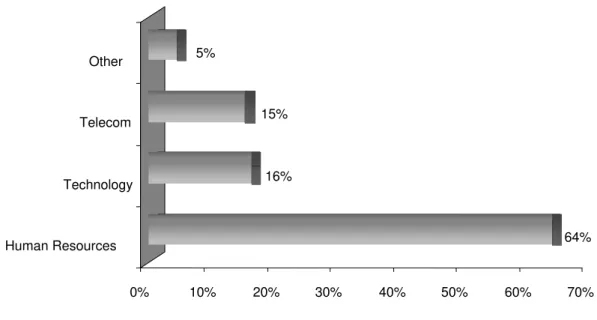
CCs present a simple structure, but that does not mean it is easily comprehended or operated. Simply put, it is basically composed of people and technologies that interconnect and that allow for access to consumers. Anton (2005), among other authors, shows that these two main components represent the main costs at a CC. Typical human resources expenses represent 64% and information technology (IT) and telecommunications represent the other 31% of the total of a call center organization (figure 1).
Figure 1- Typical costs of a call centre
Fonte: Anton, J. Best-in-Class Call Center Performance: Industry Benchmark
With such a cost make up, many companies attempt to increase the amount of technologies that represent fixed costs, reducing the quantity of attendants (variable cost). Nevertheless, if such a solution tends to improve the operational costs, perhaps the same cannot be said of the client satisfaction, which many times prefer human contact to interacting with equipment.
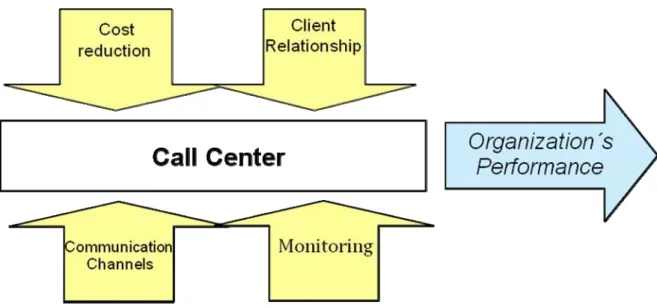
Considering this compromise between operational results and client satisfaction, this article analyses the different technological applications in areas / interfaces of a CC environment, which shall be denominated as dimensions as they apply to important macro areas of the administration. These dimensions are:
a) Cost Reduction: with the technological advancements observed in the evolution of CCs, some innovations have incorporated themselves and have direct implications in the costs of the organization. Among them are the automated call distribution (ACD), audio response unit (IVR) and voice over IP (VoIP);
b) Relationship with clients: the development of CRM tools allowed for complex studies and evaluations to better serve consumers and vying for client loyalty and the prospecting of new ones;
64% 16%
15% 5%
0% 10% 20% 30% 40% 50% 60% 70%
Recursos Humanos Tecnologia
Telecom Outros
Source: ANTON (2005) – Best - in - Class Call Center Performanc
64% 16%
15% 5%
0% 10% 20% 30% 40% 50% 60% 70%
Human Resources Technology
Telecom Other
c) Communication channels: the emergence of the Internet allowed for new ways of access by consumers which were incorporated into the traditional form of telephone access. Such examples are emails and chats; and
d) Monitoring of the work: naturally the workers performance is monitored in some way, explicitly or implicitly, in all professions. Meanwhile, at CCs, there is a series of parameters that monitor the attendants´ time spent on received calls, the recording of what they talk about with consumers, among others.
Figure 2 shows a current graphical representation of the technological dimensions at call centers
Figure 2 – Current technological dimensions at a call center
Source: the authors
Have these technologies really helped the financial performance of CCs in terms of reducing costs? Furthermore, have these technologies impacted performance with the client?
Most certainly, all consumers have their stories about their “pleasurable” interactions with CCs regarding the different types of contracted services or acquired products which required some kind of explanation. Not to mention the “opportune” calls from telemarketers who reach us in not so opportune moments. This caused some of the more advanced countries like the United States, to elaborate a law called the Telephone Consumer Protection Act, as of 1991. This Act demands that sellers keep a do not call list so that the consumers contacted do not receive any more calls from a company (FCC 2003). In parallel to this and worried about their operations and the destiny of their sector and their practices, the Brazilian companies from this sector got together and issued at the end of November 2005 the PROBARE, the Call Center/ Contact Center/ Help Desk / SAC / Telemarketing which would be a preclude in the same direction as the one occurred in the United States (ABF 2005).
and Company, shows that complaints by clients that were not satisfactorily handled present a repeat purchase index (of products and services) of approximately 54% and that of clients whose complaints were handled quickly present an intended repeat purchase index of around 82%.
Based on the framework of figure 2 and in unresolved queries as it relates to the organizational performance, this article contemplates the utilization of technologies in the CC sector. The central question is whether the utilization of technology has presented financial results for companies and client satisfaction.
1.2 The specific objectives of the article verify whether the impact on operational performance and on service performance of CCs in relation to the use of (1) digital technologies, (2) CRM technology, (3) technology via Internet and (4) monitoring technology of workers’ performance.
A survey held of 103 call centers in Brazil serves as a basis for a hypothetical test and a discussion of its results.
2 LITERATURE REVIEW
The bibliographic review is structured in three parts. First, the companies’ CCs are put into context. Following this, the use of technologies at CCs is tackled. This panorama allows for the elaboration of hypothesis that aims to verify the impact of technologies in the performance of CCs.
2.1 Call Centers
The formal legitimization of a Call Center (CC) did not exist until the 1980´s (Hawkins et. al., 2001). Nevertheless, consumers already had some form of communication with companies through a telephone or even through correspondence. In order to answer client inquiries, attendants had some access to information, normally in manual form, about their products or services and also about the clients, but in an incipient format. In the 1960´s and 1970´s, with the arrival of the computer, companies improved their ways of dealing with consumers, almost always through the telephone. According to Norman (2005), CCs originated in the United States at the beginning of the 1960´s, when car manufacturer Ford began researching for possible buyers for their cars, making 20 million calls to consumers.
interaction in which clients surf through predefined menus, normally through options via keypad, and no longer be forwarded to a set of attendants for further transfer(s).
It was the convergence between telecommunications and computing that made CCs more powerful and valuable (Strouse, 1999). The computer-telephone integration (CTI) allowed for other facilities to be associated with ACD like the geographical distribution of calls allowing for a closer consumer servicing, statistics on the length of calls, the rate of hung up calls to the CC, among others, allowed for a better evaluation of the dimension of the CC, and consequently, an improved quality of service to the consumer. Later, the interactive voice responder (IVR) was added, which allowed for audible messages to be passed on to users automatically, without the intervention of attendants.
In the latter part of the 1980´s and 1990´s, other technological facilities were added due to the evolution of technology and the integration of systems. The possibility of interaction with users by means of other sources, especially the Internet, created a convenience to users and a bigger complexity of IT systems that support CCs. Email, fax, voice-to-text converters and even the use of VoIP (voice over IP) demanded more intelligent terminals and better preparedness by operators (ABT, 2005).
In fact, Holtgrewe (2005) detected this in his company. Email and fax are used in 89% and 86% of CCs, respectively, representing the largest addition to telephone calls. Still from this research, 30% communicate via web, 16% use VoIP and voice recognition is the least used with 8%. Also Graelm (2004) says that companies have shown more preoccupation with using company sites to offer after sales support and obtain feedback from clients.
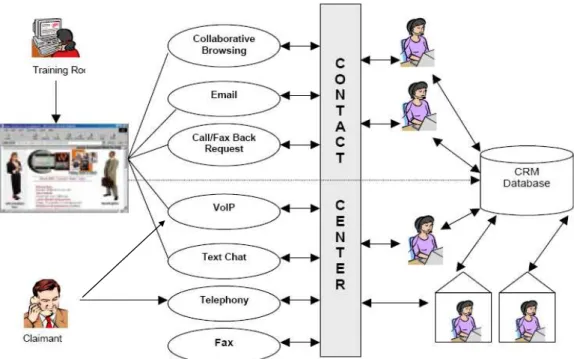
Figure 3 – Typical Architecture of a Contact Center integrated with a CRM
Fonte: Adaptado de HAWKINS, L.; MEIER, T.; NAINIS, S. JAMES, H.. The Source: Adapted from HAWKINS, L.; MEIER, T.; NAINIS, S. JAMES, H.. The Evolution of the Call Center to Customer Contact Center. Information Technology
Evolution of the Call Center to Customer Contact Center. Information Technology Support Center, White Paper, 2001.
several forms of access and also its integration with a CRM – customer relationship management. Figure 3 shows clients using several forms of access to solicit or to contract some type of service. Notice that this contact may be done by telephone, Internet, fax, email as well as via VoIP. When accessing an attendant, attendants have access to much information about the client by means of a data base in the CRM. Information about contracted services, bill payments, amounts of purchases, and previous interactions, among others, are displayed for the attendant, who may also offer other products, according to the profile in the CRM.
Thus, the advances in technology throughout the years have increased the use and the importance of CCs.
2.2 Technology
Inside corporations and in the business environment, technology has become increasingly more essential. Ackoff (1974) says that information is not only necessary to make a decision, but also to evaluate it after it has come into effect and implemented. This allows the administrator to determine if the decisions made previously should have been modified or if a corrective action should have been taken,
Porter (1989), in his strategic vision and worried about the competitive advantage of organizations, alerts:
The technological transformation is not in itself important, but it is impotant to affect the competitive advantage and the industrial structure. Not all technological transformation is strategically beneficial; it may even worsen the competitive position of a company and its attractiveness. High technology does not guarantee profitability. Technology, however, penetrates the network of values of a company and exceeds technologies directly associated with the product (Porter,1989, P.153).
It concludes that technology affects the competitive advantage if it has a significant role in determining the relative cost position or the difference it makes. Technology will affect this cost or this difference if it influences the vehicles of the costs or the vehicles of each individual activity of value (Porter, 1989).
Specifically in the universe of call centers, Mcphail (2002) says the call centers are typically locations of intense use of technology, highly monitored and highly interconnected (networked). Kefi and Kalika (2005) say that technology, beginning in the 1980s, started being considered strategic and an enabler in order to obtain competitive advantages.
Nevertheless, competitive advantage does not derive simply from financial results, but from the creation of value for all clients (Hitt et. al., 2002). Thus, it is important then, to verify the evolution of the use of technology in CCs and its financial impact, but also for their clients.
2.2.1 The Cost Reduction Dimension
The use of technological tools used in the management of calls associated with the interactive voice responders (IVR) as a first option to interact with users, certainly represent a reduction in costs for CCs. After the initial investment, the use of pre-recorded messages, and afterwards the supply of information through voice messages allow for a reduction in the number of employees to execute these repetitive tasks.
Through this, the management of calls associated with IVR allowed for a significant gain in CCs productivity, even if not too well accepted by consumers, according to research done by TNS InterScience and reported in the Folha de São Paulo (2006). Complaints related to the long duration of messages and excessive number of menu options, excessive time in transferring from the electronic to human replies, badly administered electronic service wait times and difficulty in contacting an attendant, obtained respectively 51%, 57% and 58%.
This data matches the data obtained by DTI (2004) on a survey done in the United Kingdom: 35% said to reduce the number of automated menus; 44% of consumers feel menus do not offer the correct options they desire; 50% of adults complain that the music played while holding irritate them, and; the majority of complaints by consumers, 60% of adults feel frustrated with the long wait on hold until they are attended by a person.
How far would a client go until they gave up on a company due to these factors? The analysis is not that simple and involves many other variables to which clients may be even more sensitive, such as the price, for example. An example of this can be found in the cellular phone services. All providers make use of these technological tools and in such case, there is no competitive differential among any of them for using fewer automated interactions, even if the providers are given equal consideration on equal terms.
Furthermore, the gains companies obtain in reducing the costs associated with larger numbers of employees will hardly sensitize the CCs since, according to FBR (2005), the cost of an answered call by an attendant is between 3.50 and 4.00 dollars while a call answered by an IVR system costs a mere 30 cents.
The other technological tool used has to do with VoIP and, in this case, it represents a savings of 80% for a company over the traditional voice channels and given the quality that is now obtained, it is hardly noticed by clients who do not know whether their calls are being routed through IP or not. The longer the distances involved, the bigger the cost reduction, so this tool has benefitted many call centers offshoring operations all around the world.
Hypothesis 1a: The more the use of digital technologies, the better the operational performance of CCs.
2.2.2 Client Relationship Dimension
Wright et al. (2000) maintain that it is never too much to emphasize the importance of service. In a recent survey, more than one third of people interviewed chose companies that charge high prices, but offer excellent service, instead of those who offer low prices but mediocre services. The same authors citing Dube et al. (1994) report that a personalized service is an important factor by which some companies offer a superior service. This personal attention involves emphasizing details, listening to clients concerns, answering technical questions and offer after sales services.
According to Heskett et al. (1994), for most services, the people are the deciding factor in determining quality. And again, the ways companies look for which are the most effective manners in providing incentive to people to offer high quality service vary immensely. One of the ways to provide the most effective service is to increase supervision. Another, on the other hand, advocates more expenditures with training, more exercises in perception and more independent decision making by front line employees.
Meanwhile, in the CCs sector, this is not what actually occurs. Data obtained seem to indicate that there is still a strong taylorism in the sector. The division of work, the little independence, the absence of the need for creativity, the relatively low wages, the specific training, the high turnover are all part of current call centers (Azevedo; Caldas, 2005)
As for CRM, it really is an important tool, if well used. Zenone (2001) warns that CRM is a strategy for relationships, not a technological tool! Each scenario (situation) requires a particular analysis so that procedures may be defined for this relationship. Again, citing the survey by DTI (2004), about how to improve CCs, 57% said to hire agents (attendants) who are more knowledgeable and that may be capable to deal with calls quicker. Therefore, it is not enough to have a CRM for post-processing and for the identification of groups of clients with a certain profile, but also for these agents to be used in real time, when the client is on the line with the attendant.
Thus, the use of CRM may increase operational costs (have a lower operational performance), but have a sustainable growth since it captures and treats the client better. Notwithstanding, given the focus of operations of most CCs being operational efficiency, investing in CRM would not be a factor in line with the strategical choice of this service.
Hypothesis 2a: The bigger the emphasis on CRM technology, the worse the operational performance of CCs
2.2.3 New Communication Channels Dimension
The Internet has revolutionized communication all around the world and it could not be any different in the communication between organizations and consumers. The possibility of interaction between users through other sources, especially the Internet, has created a convenience for users and a bigger complexity of IT systems that support CCs. Email, webmail, chat, voice-to-text converters demanded more intelligent terminals and more qualification of the operators. As a matter of fact, Holtgrewe (2005) detected this in his survey: email is used in 89% of CCs, representing the biggest usage to telephone calls.
These new communication channels favor not only a closer tie in client relationships but also aid in reducing costs. On the former, focusing more on the higher classes who have Internet access and who may by surfing on it, resolve a concern, solicit a second copy of a bill, among other things. On the latter, interaction via Internet is cheaper than any other interaction. A comparison is made by von Poser (2005) when he references that serving a consumer over the counter may cost R$12,00, via telephone R$6,00 and only R$1 over the Internet.
Therefore, it is natural that CCs have evolved, as they have, and allowed these new channels for consumers, as we have seen, perhaps vying for a reduction in costs as its biggest motivation.
Hypothesis 3a: The bigger the emphasis on the Internet and other media, the better the operational performance of CCs.
Hypothesis 3b: The bigger the emphasis on the Internet and other media, the better the service performance of CCs.
2.2.4 Work Monitoring Dimension
Technology as it operates almost as a central nervous system inside organizations becomes even more present at CCs. Aside from easing access to a variety of information, it has the power to increase its control over its employees, work pace and its quality of the work. Batt et.al. (2002) state that the use of electronic monitoring for the managing of performance is a common practice at call centers, and this has been shown to create dislikes and stress on employees. McPhail (2002) also reminds us that information systems have the capacity to measure worker´s performance through a collection of individualized statistics and that every single word spoken on the telephone may be recorded.
Azevedo and Caldas (2002) are very critical and say that call centers seem to be part of a “regression” in the organizational theory that preconceives innovation and technology, bigger worker participation in decision making and in the work process that it should make companies more organic and flexible, but that in reality, in spite of being structured on advanced IT and telecommunications systems, they continue to present more rigidity and standardization in work methods, standardized and repetitive work processes and are increasingly more supervised.
All this shows that technology has also provided for a bigger control over the attendants resulting in increased pressure to meet goals that it may also reflect in client relationship as reported in the Folha de São Paulo (2006) in which 58% show dissatisfaction with the human service.
Hypothesis 4a: The bigger the emphasis on the monitoring of worker performance, the better the operational performance of CCs, since the primary focus of CCs is the operational efficiency.
Hypothesis 4b: The bigger the emphasis on the monitoring of worker performance, the worse the service performance of CCs.
3 METHODOLOGY
The study that supports this article is part of a wordwide Project named The Global Call Center Industry Project (GCCIP), and its main objective is to map the call centre industry in 20 countries in all continents. Among the countries surveyed are the United States, United Kingdom, Germany, France, Australia, South Africa, India and Brazil.
It is a descriptive and quantitative study using questionnaires done via personal and via telephone interviews. The survey involves a large quantity of aspects related to call centers, from strategy and technology to the practices of human resources and the performance of all types of economic sectors such as telecommunications, financial services and retail.
The same basic questionnaire was applied to all countries, and adapted where possible, but without altering the general objectives of the project was applied to Brazil. Part of the data from this survey was structured here for the results of this article.
A members list of the main association of call centers of the country was obtained and refined, identifying only the organizations that were or operated CCs in their structures. A pretest was performed to test the actual questionnaire, the comprehension of the questions, and the willingness to respond to it. This pretest has shown to be quite useful, for one of the sections regarding the institutional context there was some reluctance on the part of respondents for it referred to pressures received or imposed by government, associations, unions, among others. By consensus then among the research members, such questions were removed.
The time span for the collection of the data was six months, between May and October 2005 and the survey was done through personal and telephone interviews. The occupation of respondents was also taken into consideration and the questionnaire was answered by at least a human resources manager when not by directors, CEOs or presidents, giving more credibility to the information provided.
3.1 Construction of Variables
The dependent variables dealt with operational performance and client service performance.
The first group of variables for the operational performance dealt with the growth in sales over the last two years and over the expected future growth of the call center in terms of hiring. The sales variables and the number of employees constitute important measures in the size of the company. Past sales show actual growth. However, future sales make it hard to predict future growth, for they are susceptible to many fluctuations. The plans for expansion of human assets are subject to fluctuations, but they reflect a more consistent planned measure of future investment, giving it a more precise indication of the industry´s perspective (HITT et.al., 2002).
The variables “increase in sales” and “increase in hiring” were of two choices, of either “yes” or “no”.
The dependent variables relating to service were four (see appendix). The first investigated client satisfaction; the second and third investigated the use of formal mechanisms which guaranteed a reply or feedback to the client and the use of a formal/standard system that identifies and resolves complaints. Finally, informal and more personal mechanisms were investigated to resolve problems or provide solutions to clients (Operators/attendants have a “blank check” to deal with complaints until they are resolved. All ordinal variables on a five point scale were transformed into a two choice variable to comply with the prerequisites of the logistic regression. According to other work done by GCCIP, the transformation of the variables occurred in the following manner: values equal to or above three versus values above three.
The independent variables investigated the use, or not of technologies like email, fax; various media (a mix of several related instruments); Voice recognition; CRM; VoIP; Internet interaction. It also asked about the percentage of the use of technologies VRU, IVR and call management at the company.
Finally, the percentage of activity by operators/attendants that were continuously monitored via technology, during the day, whether the information was used or not was also investigated.
3.2 Handling of Data
logistic regression is also less affected by the inequality variables and co-variables along the group (HAIR,et al, 2005).
The procedures chosen for the predictor variables were the forward stepwise, method, in which the variables are selected at each step, according to statistical scores, based on several criteria: a bigger reduction in the -2LL value, a bigger Wald coefficient, bigger conditional probability of maximum likelihood (HAIR,et al, 2005).
The R2 measurements from Cox and Snell and the R2 from Nagelkerke show the explanatory power of this model, the latter being even better, for Cox and Snell do not reach 1. Thus, the R2 presented in this article is the R2 from Nagelkerke (HAIR,et al, 2005).
4 RESULTS
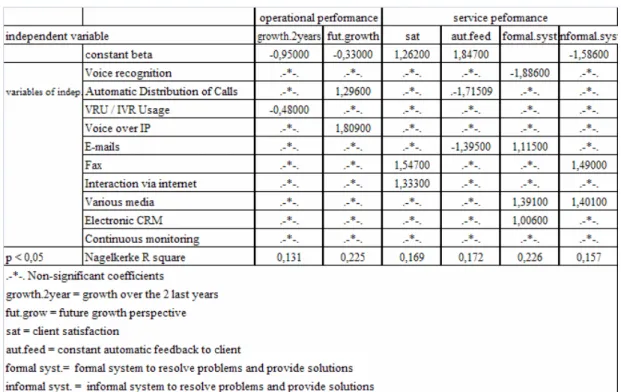
The results of the logistic regression are shown on table 1. Table 1: Regression Models
Source: the authors.
The H2a, H3a and H4a and H4b operational performance hypotheses were not significant to the point of being convincing vis-a-vis the sample used.
performance. This is because, when taken into account the last two years, the IVR and VRU technologies show a reversed relationship toward the operational performance. In spite of reduction in costs, the result seems to have weighed on consumers, to leave a company due to problems caused by technology. Thus H1a is contradictory, and does not allow for a conclusion.
On the other hand, when analyzing H1b we notice its confirmation. The results show that voice recognition and management of calls present an inverse relationship with better service, that is, the more the use of digital technologies, the worse the service performance of CCs
The electronic CRM is preferred as a formal relationship system, supporting H2b: the bigger the emphasis on CRM technology, the better the service performance of CCs
In the matter of performance in terms of client service it stands to confirm H3b for client satisfaction (fax and Internet). This confirms that the bigger the emphasis on Internet technology and other media, the better the service performance of CCs. This confirmation does not exist in the cases of constant feedback when email still presents resistance here in Brazil. This result differs from the result from Holtgrewe (2005), as the focus is for automatic feedback and not for any and all calls. When clients make a complaint they do not expect an automatic reply, but would like it if there were someone on the other side to really understand their problem.
5 DISCUSSION
Chart 1 shows a summary of the results and of the confirmed hypotheses. In general terms, the result shows that the more the use of digital technologies the more it harms service performance of CCs in Brazil. On the other hand, investments in CRM and in the means of communicating via the Internet and other media favor the company´s service performance. On the other hand, the results related to operational performance do not allow for further discussion due to the non-confirmation of the hypothesis.
Chart 1: Summary of Results
Therefore, as for the questions brought up in the introduction, the results of the present article allow for a more profound discussion only as it relates to the use of technology and its impact on the performance towards the client. It is evident from chart1 the influence of the use of digital technologies, CRM technology and Internet technology in the performance of client services of Brazilian CCs.
It cannot be said that the digital technologies have an impact on the operational performance; nevertheless, this strategy of cost reduction has a negative impact on the service performance. As such, although there is the distortion of costs in the human being and technology equation at CCs, the use of digital technologies does not seem to be the best way to reduce costs. This strategy would mean the deterioration of this relationship with the market.
On the other hand, in the pursuit of more client-oriented CCs and with more accepted and respected interfaces by the population, the results of the article show that investing in CRM and in communication channels seem to be the main way to reach this objective.
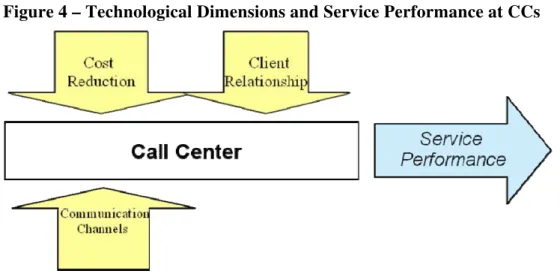
Going back to the figure presented at the beginning of the article which served as the framework for the elaboration of objectives and hypotheses, results show that the service performance at CCs is influenced only by the three dimensions presented in figure 4 and not by all four, as previously suggested. Nevertheless, as we can observe, the arrow showing the cost reduction dimension is pointed towards the opposite direction. This shows that in Brazil, the investment in these technologies is not adequate to the performance of service.
Figure 4 – Technological Dimensions and Service Performance at CCs
Source: the authors.
On this same token, that it is not technology that makes a difference in the evolution of Brazilian CCs, Azevedo and Caldas (2005) show that excessive investing in technology tends to turn CCs into mechanical organizations. In turn, investment in technology together with new forms of management helps to make for a more flexible organizational architecture directed at the interests of the market.
On the other hand, focusing on CRM technologies at Brazilian CCs confirms the study done by Minghelli (2002), which shows to be an important tool for the gathering of information and in the interaction with clients.
Finally, the use of the Internet and other media confirms the study done by Gião (2006) and Melo (2007), which shows how these tools may increase value for the clients and also in the strategies of Brazilian CCs, as opposed to the traditional vision of CCs, almost always seen as a non-strategic component.
6 LIMITATIONS
One of the important limitations of this article is the measurements of operational performance and of satisfaction. They are two choice or ordinal. Surveys done that directly involve revenues, the number of employees or the number of calls would be interesting in order to confirm or refute these results. Especially, these data would be important for the results relating to operational performance, which the results of this survey have shown to be non-conclusive.
REFERENCES
Ackoff, R. L. (1974). Planejamento Empresarial. Rio de Janeiro: Livros Técnicos e Científicos.
Anton, J. (2005). Best-in-Class Call Center Performance. USA: Industry Benchmark Report.
Araujo, M., Araujo, F., & Adissi, P. (2004). Modelo para segmentação da demanda de um Call Center em múltiplas prioridades: Estudo da implantação em um Call Center de Telecomunicações. Revista Produção OnLine, 4(3).
Azevedo, M., & Caldas, M. (2005). Estudo Empírico sobre o Impacto de Mudanças Tecnológicas sobre o Desenho do Trabalho em Call Centers. Revista de Administração Contemporânea, 9(3): 33-55.
Associação brasileira de telemarketing -ABT. (2005). BRASIL: pólo de qualidade em call center – Casos de excelência no relacionamento com o cliente. São Paulo: ABT. Batt, R., Doellgast, V., & Kwon, H. (2004). The U.S. Call Center Industry 2004: National Benchmark Report. The Global Call Center Industry Project. Cornell University.
Friedman Billings Ramsey (FBR). VOIP adoption starting to ramp in the Contact Center. Friedman, Billings, Ramsey & CO., Inc, USA, October, 2005
Federal communications comission-FCC. (2003). Unwanted Telephone Marketing Calls. USA.
FOLHA DE S. PAULO. Brasileiros reprovam call centers. Jornal Folha de São Paulo, Caderno B2, Dinheiro. 14 de maio de 2006.
Gião, P. R. (2006). Estratégia em Call Centers: Analisando o alinhamento com as práticas internas. Dissertação de Mestrado, Pontifícia Universidade Católica de São Paulo, São Paulo, Brasil.
Griffin, J. (1998). Como conquistar e manter o cliente fiel: transforme seus clientes em verdadeiros parceiros. São Paulo: Futura.
Hair, J. F., Anderson, R. E., Tatham, R. L., & Black, C. (2005). Análise multivariada de dados. Porto Alegre: Bookman.
Hawkins, L., Meier, T., Nainis, S., & James, H. (2001). The Evolution of the Call Center to Customer Contact Center. Information Technology Support Center, White Paper.
Heskett, J. L., Sasser, E. W., & Hart, C. W. L. (1994). Serviços Revolucionários: mudando as regras do jogo competitivo na prestação de serviços. São Paulo: Pioneira. Hitt, M. A., Ireland, R. D., & Hoskisson, R. E. (2002). Administração Estratégica. São Paulo: Pioneira Thomson Learning.
Holtgrewe, U. (2005). Call Centres in Germany – Preliminary Findings from the Global Call Centres Project. Report for the Russell Sage Foundation, Duisburg, Germany. Kefi, H., & Kalika, M. (2005). Survey of Strategic Aligment Impacts on Organizational Performance in International European Companies. Proceedings of the 38th Hawaii
International Conference on System Sciences, Volume 08, HICSS’05, IEEE Computer Society, Washington, DC, USA..
Melo, P. L. (2007). Estratégia e Práticas de Gestão em Call Centers Próprios e Terceirizados no Brasil. Dissertação de Mestrado, Pontifícia Universidade Católica de São Paulo, São Paulo, Brasil.
Minghelli. (2002). Call center: estudo de casos múltiplos em empresas de telefonia do estado do rio grande do sul. Monografia de Conclusão do Curso e Informática, Usinos, Rio Grande do Sul, Brasil.
Mcphail, B. (2002). What is ¨on the line¨ in call centres studies? A review of key issues in the academic literature. University of Toronto.
Norman, K. (2005). Call centre work - characteristics, physical, and psychosocial exposure, and health related outcomes. Doctoral Thesis, Linkoping University, Sweden. Oliveira, M. M. (2000). Telecomunicações no Brasil: um estudo sobre a dinâmica do setor industrial na década de mil novecentos e noventa. Dissertação de Mestrado, Pontifícia Universidade Católica de São Paulo, São Paulo, Brasil.
superior. Rio de Janeiro: Elsevier.
Siqueira, E. (2000). Brasil: 500 anos de Comunicação. A eterna busca da liberdade. São Paulo: Editorial.
Strouse, K. G. (1999). Marketing Telecommunications Services: New Approaches for a Changing Environment. United States: Artech House.
Von, P. D. (2005). Marketing de Relacionamento: Maior lucratividade para empresas vencedoras. Barueri: Manole Ltda.
Wright, P., Kroll, M. J., & Parnell, J. (2000). Administração Estratégica: conceitos. São Paulo: Atlas.
Zenone, L. (2001). Customer Relationship Management (CRM) Conceitos e Estratégias: Mudando a estratégia sem comprometer o negócio. São Paulo: Atlas.
Appendix I
Questionnaire – dependent variables transformed into two choices - Service Performance
Totally disagree
Totally agree Client satisfaction is high at the Call Centre of
your company 1 2 3 4 5
A formal/standard system identifies and resolves
complaints 1 2 3 4 5
There is a formal/standard system to deal with
complaints 1 2 3 4 5
Operators/attendants have a “blank check” to