850 Brazilian Journal of Physics, vol. 35, no. 3B, September, 2005
A Direct Measurement of the Neutron-Neutron Scattering Length
G. E. Mitchell1, W. I. Furman2, E. V. Lychagin2, A. Yu. Muzichka2, G. V. Nekhaev2, A. V. Strelkov2, E. I. Sharapov2, V. N. Shvetsov2, B. G. Levakov3, V. I. Litvin3, A. E. Lyzhin3, E. P. Magda3, B. E. Crawford4, S. L. Stephenson4, C. R. Howell5, and W Tornow5
1North Carolina State University, Raleigh NC,
USA 27695-8202 and Triangle Universities Nuclear Laboratory, Durham NC, USA 27708-0308
2Joint Institute for Nuclear Research, 141980 Dubna, Russia 3Russian Federal Nuclear Center
−All-Russian Research Institute of Technical Physics, P.O. Box 245, 456770 Snezhinsk, Russia
4Gettysburg College, Box 405, Gettysburg PA, USA 17325 5Duke University and Triangle Universities Nuclear Laboratory,
Durham NC, USA 27708-0308
Received on 3 November, 2004
A direct measurement ofnn-scattering by colliding free neutrons has never been performed. Indirect mea-surements continue to provide inconsistent results, leaving the issue of charge symmetry in the nuclear force unresolved. At present the Russian pulsed reactor YAGUAR is the best neutron source for such a measurement. A neutron moderator is installed in the central through channel and the scattered neutrons are detected at a dis-tance of 12 m from the reactor. An instantaneous value of 1.1×10¹⁸/cm2s was obtained for the thermal neutron flux density. The experiment will be performed by the DIANNA Collaboration as ISTC project No. 2286.
I. INTRODUCTION
Values for the neutron-neutron 1S0 scattering length ann appeared (by 1999) tohave converged to consistent num-bers: ann =−18.55±0.05(stat)±0.3 (syst) fm [1] from the 2H(π−,γn)n reaction, and a
nn =−18.7±0.3 (stat)± 0.6(syst)fm [2] from the2H(n,nn)preaction. Comparison with the well established value of the proton-proton scattering length app=−17.3±0.005(stat)±0.4(syst)fm indicates charge-symmetry breaking (CSB).
However, a recent investigation of the neutron-neutron and neutron-proton final-state interaction in then−dbreakup re-action revived this issue. Theann-value of−16.27±0.40 fm was obtained in Ref. [3] for the2H(n,np)nreaction, where the total uncertainty consists of about equal parts of statisti-cal and systematic errors. This latest result differs from that of Ref. [2] by almost 4σ, and renews the long-standing con-troversy regarding the conclusion on charge-symmetry brea-king. An appealing solution is a direct measurement of the nn-scattering length. Such a measurement has been never per-formed. Here we describe the directnn-scattering measure-ment which is under preparation at the unique aperiodic pul-sed reactor YAGUAR.
II. EXPERIMENTAL DESIGN
For thermal neutrons the zero effective-range approxima-tion works well. The effective thermal neutron cross secapproxima-tion
σmeasured with unpolarized neutrons is a statistical sum of the singletσsand tripletσtcross sections. Since the Pauli ex-clusion principle for identical particles forbids the interaction of two neutrons in the triplet state, the cross sectionσt is ex-pected to be zero, and the measured cross sectionσis equal to
πa2nn.
Proposals for a direct measurement of the nn-scattering length have a long history; detailed references are provided in Ref. [4]. None of these proposals has been implemented. Except for the proposed use of underground nuclear explosi-ons, most of the proposals are similar. The neutrons collide in a neutron interaction chamber, which we denote as thenn -cavity, and the scattered neutrons are detected externally. In such arrangements the “target” and the “beam” are neutrons produced by the same neutron source. Therefore, thenn scat-tering intensity is proportional to the square of the neutron flux density, while the background intensity depends linearly on the flux density.
The situation is most favorable at pulsed neutron sources, where the thermal neutron flux density can be very high. It appears that the pulsed aperiodic reactor YAGUAR [5] at Snezhinsk, Russia, best fulfills requirements for thenncross section measurement. Thisnnproject was initially proposed at the Dubna ISINN-VIII meeting [6]. The fast neutron pulse is of 0.68 ms (FWHM) duration. The 40-liter volume of the YAGUAR active core contains the water soluted salt UO2SO4. The solution contains 465 g per liter of uranium which is en-riched to 90%235U. The effective diameter of the cylindrical active core is 40 cm, with an effective inside diameter of 17 cm. The critical height is about 39 cm, depending on the posi-tion of the startup rods. The body of the reactor has a central channel of 15-cm diameter, which in the standard operating mode has startup rods that leave a cylindrical space of 12-cm diameter.
G. E. Mitchell et al. 851
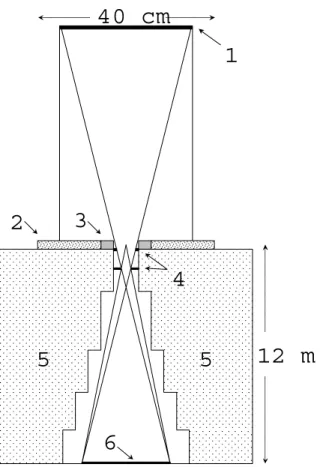
detector counting rate, and if the parameters of the neutron field are determined and the geometry is known, then the de-tector counts (integrated over the thermal neutron part of the TOF spectrum), measure thenn-scattering cross section. The proposed arrangement for thenn-scattering experiment at YA-GUAR is shown schematically in Fig. 1.
1
40 cm
12 m
2
4
5
6
3
5
FIG. 1: Experimental setup (not to scale): (1) neutron absorber, (2) cylindrical reactor active core, (3) polyethylene moderator, (4) colli-mators, (5) shielding, (6) neutron detector.
The active core 2 is placed on three supports at 2 m above the floor level. The neutron CH2moderator 3 is inserted inside the channel. An evacuated tube contains a collimation system 4, and the neutron detector 5 is placed at a flight path of about 12 m. The collimation system is designed to screen the source and to minimize background due to neutrons scattered from the walls. The3He absorber 1 reduces neutron scattering from the back wall.
III. NEUTRON FLUX
The reactor produces a hard neutron spectrum in the through-channel (average neutron energy 0.91 MeV) that is not suitable for the nn-experiment. We performed calcula-tions for various moderators in the YAGUAR geometry and also performed measurements with various moderators at the
reactor YAGUAR. The Monte Carlo modeling [7] was perfor-med using the code MCNP-4 [8].
Neutron activation studies were performed to measure the thermal neutron densities inside cylindrical converters inser-ted into the YAGUAR reactor channel. The polyethylene con-verters are hollow cylinders with different inner diameters. The activation detectors for the absolute flux measurements were gold and copper foils placed in the central plane. Details of the measurements are given in [4]. The relative distribution of the neutron flux along the axis of the through-channel was also obtained. These measurements, combined with known neutron activation cross sections, determined the fluency, de-fined as the number of neutrons per cm2per YAGUAR pulse. The measured neutron fluencies for the four polyethylene converters vary linearly with thickness. This dependence agrees very well with Monte Carlo simulations [7]. With the experimental results for the fluence and using the value
∆t=0.7 ms for the thermal neutron pulse, we conclude that the 3-cm thick cylindrical moderator provides, for the pulse power of 30 MJ, an instantaneous value of 1.1×10¹⁸/cm2s for the thermal neutron fluxΦcentral in the central region of the channel.
The moderated neutron flux spectrum is expected to be pre-dominantly Maxwellian and to have a 1/En epithermal tail with the value of n depending on the moderator thickness. The gold and copper activation data were analyzed to ob-tain experimental estimates of such parameters as the effective Maxwellian temperature, the relative size of the epithermal tail, and the slope parametern.
IV. SIMULATIONS A. Counting Rates
After nn-scattering in the evacuated moderator channel, some of the scattered neutrons will reach a detector placed at about 12 m from the channel central plane, and will be me-asured by the TOF method with an effective solid angleΩe f f. For ideal collimation, direct neutron paths from the modera-tor and the walls (besides the back wall of thenncavity) to the detector are excluded. Then the detector countsNnn per pulse (integrated over the thermal part of the TOF spectrum) are related to thenn-scattering cross sectionσnn, the average neutron flux densityΦav, the effective pulse duration∆t, the effectivenn-cavity volumeV, and the most probable velocity v0by
Nnn=2cav
Φ2 av vo
σnn∆t VΩe f f (counts/pulse), (1)
852 Brazilian Journal of Physics, vol. 35, no. 3B, September, 2005
a realistic value for the solid angle (Ωe f f ≃5×10⁻⁶), then from Eq. (1) we expectNnn≃180 nn-counts in the neutron detector per burst.
B. Backgrounds
Ideally with extensive shielding no slow or fast source neu-trons can reach the detector directly. However, in practice one can expect several background components.
The thermal neutron background component from the ther-mal and epitherther-mal neutrons multiply scattered on collimators will depend on the collimation system. Several collimator op-tions, as presented in [4] and in references therein, were consi-dered, and an estimate of this component was found to be less than 20% even for the simplest two-diaphragm collimation.
Fast neutrons that originate during the reactor pulse are also separated by the TOF measurement. The time interval alloca-ted for detecting thermal neutrons is about 5 ms and is delayed by≃2 ms relative to the maximum of the reactor pulse. At this time the subcritical reactor continues to emit fission neu-trons. The background issues that these neutrons create were addressed in Ref. [10].
The background calculations and preliminary measure-ments of the background are very promising. More extensive modeling and detailed measurements are planned. Direct ex-perimental separation of thenn-signal from the background is also possible, because thenn-scattering intensity is proportio-nal to the square of the neutron flux density, while the back-ground intensity depends linearly on the flux density.
C. Time-of-Flight Spectra
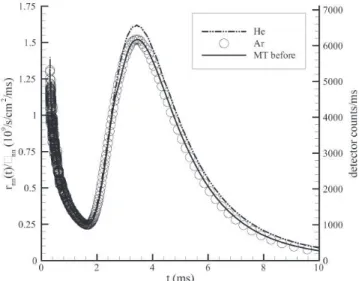
Thennscattering measurements at the pulsed reactor YA-GUAR will be performed by the TOF method. For a 12-m flight path and 2.5-cm thick cylindrical moderator the simu-lated ’incident’ TOF spectrum is represented in Fig. 2 by the full curve. Such a spectrum would be measured by the neu-tron detector if it were placed as shown in Fig. 1 and thenn cavity filled with a heavy gas such as argon, for which the transformation of the neutron spectrum after scattering can be neglected. The spectrum essentially consists of a Maxwellian part abovet=2 ms and a 1/t2epithermal part. For conveni-ence we refer to the distributions above and belowt⋆= 2 ms as the ’slow’ and ’fast’ components. This value oft⋆is expected to be a cut off value for the experimental TOF spectrum below which the background will increase sharply.
The size of a possible contribution to the thermal energy region from ’fast-slow’ and ’fast-fast’ collisions producing ’slow’ neutrons is addressed in Ref. [11]: the integral of the realistic scattered spectrum abovet⋆changes only slightly as compared to the pure Maxwellian case.
FIG. 2: The n-gas collision rate (rng(t) as a function of time of flight for n-He scattering (dash-dot) and n-Ar scattering (circle) compared with the initial flux scaled to the n-Ar spectrum (line). The right axis shows the estimated detector counts assuming a gas density of 0.2 Torr.
V. SUMMARY
An experiment to measure directly thennscattering length is at the late design stage. Measurements of the neutron flux and preliminary background measurements are consistent with simulations and indicate that the background contribu-tion is of order 20%. The final collimacontribu-tion arrangement will be installed shortly and initial measurements with the com-plete experimental system performed in 2005.
Acknowledgments
This work was supported in part by the International Sci-ence and Technology Center under project No. 2286, by the Russia Foundation for Basic Research Grant No. 01-02-17181, by the US DOE Office of High Energy and Nuclear Physics under grants 97-ER41042 and DE-FG02-97-ER41033, and by the US NSF through an International Research Fellow Award No. 0107263.
[1] C.R. Howellet al., Phys. Lett. B444, 252 (1998).
[2] D.E. Gonz´alez Trotteret al., Phys. Rev. Lett.83, 3788 (1999). [3] V. Huhn, L. W¨atzold, Ch. Weber, A. Siepe, W. von Witsch, H.
Witala, and W. Gl¨ockle, Phys. Rev. C63, 014003 (2001).
[4] W.I. Furman et al., J. Phys. G: Nucl. Part. Phys., 28, 2627 (2002).
G. E. Mitchell et al. 853
Meeting on Physics, Safety and Application of Pulsed Reac-tors: Washington, D.C. (American Nuclear Society, La Grange Park, 1994), p. 67.
[6] C.D. Bowman, B.G. Levakov, A.E. Lyzhin, E.V. Lychagin, E.P. Magda, A.Yu. Muzichka, A.V. Strelkov, E.I. Sharapov, and V.N. Shvetsov, in: ISINN-VIII, Report E3-2000-192 (Joint Institute for Nuclear Research, Dubna, 2000), p. 245.
[7] S.L. Stephensonet al., in: ISINN-X, Report E3-2003-10 (Joint Institute for Nuclear Research, Dubna, 2003), p. 427.
[8] J.F. Briesmeister (Ed.), “MCNPT M−A General Monte Carlo N-Particle Transport Code, Version 4c”, Report LA-13709-M
(Los Alamos National Laboratory, Los Alamos, 2000). [9] B.E. Crawfordet al., in: ISINN-X, Report E3-2003-10 (Joint
Institute for Nuclear Research, Dubna, 2003), p. 436.
[10] G.P. Gueorguiev, C.R. Howell, G.E. Mitchell, E.I. Sharapov, W. Tornow, in: Proceedings of the Sixth International Topical Meeting on Nuclear Applications of Accelerator Technology, AccApp’03 (American Nuclear Society, Inc., La Grange Park, 2004), p. 53.